




Abstract
The focus of the current research efforts on artificial intelligence (AI) literacy is mainly on learning about it. However, there is a need for the duality between learning about and with generative artificial intelligence (GenAI) to augment the learning experience in schools and corporate settings. The current study, therefore, aimed to propose a model of GenAI literacy for learning by adopting the grounded theory approach. The participants were professors from four countries and diverse relevant fields. The data were collected through semi-structured interviews and open-ended questions. The findings revealed readiness factors, core dimensions, and potential consequences of GenAI literacy. The proposed model also covers the potential challenges and negative impacts of GenAI. This study demonstrates that learning about GenAI serves as a basis for learning with GenAI, leading to potential consequences. The proposed model has the potential to serve as a guide for future research and practice on enhancing GenAI literacy for society.
Keywords
Introduction
Although artificial intelligence (AI) is not a novel technology, its use in learning environments has gained more popularity than ever, particularly with the common adoption of generative artificial intelligence (GenAI). This popularity means that the increasing use of GenAI tools in diverse learning environments, including school and corporate settings, will continue to increase. AI refers to a broad field encompassing machine learning, deep learning, data mining, or natural language processing. In other words, AI is an umbrella term referring to diverse methods and technologies (Zawacki-Richter et al., 2019). In the relevant current literature, particularly after the public release of ChatGPT 3.5 at the end of 2022, what is meant by AI is generally GenAI, given the common adoption and use of ChatGPT and other popular GenAI tools such as Claude, Gemini, or Grok. For this reason, the studies on these popular large language models are required to be referred to as GenAI or large language models for clarity. In the present study, GenAI was, therefore, used to describe a specific, but most popular type of AI technology. Recent studies confirmed the advantages of GenAI in education, such as improving problem-solving (Urban et al., 2024) and writing skills (Liu et al., 2024). More potential advantages were also documented, such as individualized and interactive learning experiences, intelligent tutoring, and language learning (Rawas, 2024). These potential advantages lead to increasing research attention and efforts on GenAI in learning environments.
The accelerating usage speed, together with the recently reported advantages, requires a dual approach to GenAI in learning environments: (a) learning about GenAI and (b) learning with GenAI. In terms of the former, the focus of the current research is on learning about GenAI or GenAI education (e.g., Kong et al., 2023; Ng et al., 2024) and acceptance of GenAI tools (Jo, 2024; Karaoglan Yilmaz et al., 2024; Strzelecki, 2024a; 2024b). As for the latter, learning with GenAI, these tools can be integrated into diverse learning environments, can be used with a wide variety of learning strategies, and can provide enhanced learning experiences (Kikalishvili, 2024) with the potential advantages they currently provide (Rawas, 2024). However, there is a fundamental need for theoretical and conceptual frameworks, in the role of guides for research and practice, to design and evaluate the integration of GenAI tools into learning environments. This integration requires learners and instructors, as the primary stakeholders, to have GenAI literacy. On the part of learners, they need to have competencies to effectively use GenAI in their learning experience. This suggests that they are required to have GenAI literacy with an emphasis on learning. Based on this notion, this study aims to propose a model of generative artificial intelligence literacy for learning (GenAI-LL) by adopting a grounded theory approach. More specifically, the core dimensions of GenAI-LL, its antecedents, potential consequences, and challenges were revealed together with their interactions.
Generative Artificial Intelligence and Learning
GenAI refers to language models trained with big data that generate text, audio, image, and video content through machine learning algorithms (Hsu & Ching, 2023; Mannuru et al., 2025). These tools can generate solutions and original outputs based on the pre-trained language models with big data (Huang et al., 2023; Mesko, 2023). In other words, GenAI tools provide the advantage of producing online content such as images, text, or audio based on the predictions through the used models and data (Corchado et al., 2023; Lodge et al., 2023). These capabilities provide novel affordances for learning in all fields of education, including face-to-face, open, distance, life-long, and informal learning environments.
GenAI has great potential and advantages for both learners and instructors as it provides them with personalized and collaborative learning experiences in addition to facilitating learning. The findings from the recent studies confirmed this potential. A study by Akkaya and Şengül (2023) showed that GenAI tools facilitate language learning by guiding the learning experience. Language learning can also be enhanced through GenAI-assisted language learning motivation (Demirci et al., 2025). Besides, learners have a chance to generate content and perform self-evaluation with GenAI tools (Akgün, 2023). Using these tools also improves learners’ engagement and supports individualized learning at their own pace (Totlis et al., 2023). These findings reveal that GenAI meets the expectations of augmenting learning opportunities and experience in face-to-face, open, distance, and blended learning environments. However, the degree to which learners benefit from these tools highly depends on their consumption and production competencies or GenAI literacy, as these competencies are required for understanding these tools and the content they produce, and for obtaining or producing targeted content.
Generative Artificial Intelligence Literacy in Education
Literacy is a generic term used to define the competencies required by all members of society to meet the needs of the age and includes consumption and production competencies. Digital literacies are required for a society to understand, use, evaluate, and produce content through relevant and current technological tools or concepts. This means that the definition, dimensions, and types of literacies vary depending on the era people live in. In this respect, GenAI literacy is essential for learners and instructors in the age of AI to effectively use these tools for learning.
Although there is no commonly adopted definition of AI literacy, it is defined as “the acquisition of learner competencies required in the AI era based on learning functional, social, and technical literacy” (Yi, 2021, p. 356). From another perspective, AI literacy is the essential competency for effective user–AI interaction and critical evaluation of AI (Long & Magerko, 2020). Specifically, learners are highly desired to understand GenAI tools’ ethical and safe use, to have a critical perspective on the content they generate, and to produce or get the content they need for problem-solving. For this aim, several studies specifically focused on learners’ acceptance and AI literacy.
With the popularity and recognition of the potential of GenAI tools in education, studies on how learners benefit from them have gained more attention. The focus of the existing studies is on learners’ acceptance and literacy regarding AI tools. In terms of the former, AI acceptance of university students was investigated through the lens of the Unified Theory of Acceptance and Use of Technology (UTAUT) model (Venkatesh et al., 2012): “performance expectancy,” “effort expectancy,” “social influence,” “facilitating conditions,” and “behavioral intention” (Karaoglan Yilmaz et al., 2024; Strzelecki, 2024a, 2024b). Karaoglan Yilmaz et al. (2024) developed and validated an acceptance scale for GenAI and explored the role of the UTAUT components on behavioral intention and use behavior. Strzelecki (2024a, 2024b) additionally included “hedonic motivation,” “habit,” and “personal innovativeness,” in addition to “price value” (Strzelecki, 2024a), to explain the behavioral intention and use behavior. Jo (2024) additionally revealed that individual impact and innovativeness are the drivers of GenAI adoption among higher education students. Demirci et al. (2025) also demonstrated that GenAI adoption is highly associated with learners’ motivation for GenAI-assisted language learning.
As for the latter, the current studies underlined the need for AI literacy for the effective integration of these novel technologies into learning environments. For this highlighted aim, they paid more attention to learning about AI or GenAI and adopted the theoretical background regarding learning about it. Laupichler et al. (2023) presented an item set for assessing non-experts’ AI literacy through a Delphi study with the participation of the subject field experts. Ng et al. (2024) further developed and validated a questionnaire for secondary school students’ AI literacy, covering the learning outcomes or competencies as a result of AI literacy education. As for higher education, Biagini et al. (2023) developed and validated an AI literacy questionnaire for assessing university students’ competencies about AI: “knowledge-related,” “operational,” “critical,” and “ethical” dimensions, which focus on learning about AI. Wang and Lu (2023) additionally focused on the development of pre-service teachers’ AI literacy and proposed a model of AI literacy for university students, covering both learning and teaching about AI.
Further studies on AI literacy aimed to reveal the antecedents of AI literacy, adopted as the competencies relevant to the general use of AI tools. In this regard, Celik (2023) explored that computational thinking and ICT-related factors (e.g., physical access, motivation, skills) predict university students’ AI literacy, encompassing “awareness,” “use,” “evaluation,” and “ethics.” In another study with secondary school students, Ng et al. (2024) demonstrated that an AI-driven intervention by using project-based learning improves learners’ motivation, AI literacy, and collaboration in AI education. Kong et al. (2023) also investigated the effect of an AI literacy program on university students’ AI competencies and revealed positive impacts.
The Need for the Duality of Learning About and With GenAI
The reviewed studies mainly concentrated on the acceptance of AI tools (Karaoglan Yilmaz et al., 2024; Strzelecki, 2024a, 2024b), and assessment (Biagini et al., 2023; Laupichler et al., 2023; Ng et al., 2024; Wang & Lu, 2023) and improvement (Celik, 2023; Kong et al., 2023; Ng et al., 2024; Wang & Lu, 2023) of AI literacy. The concept of AI literacy in these studies refers to learning about AI. GenAI also has a great revolutionary potential for enhancing learning outcomes through its integration into learning environments with diverse learning strategies (Kikalishvili, 2024). Despite this potential, the duality of learning about and with GenAI remains uncovered and lacks a framework for research in this regard. As the first step for this aim, a model of GenAI literacy for learning is essential for guiding future research and practices about how to benefit from GenAI in learning environments and, for sure, offers a future research agenda. Therefore, the current study is a first phase aimed at exploring and presenting a model of GenAI literacy for learning. More specifically, the model revealed and elaborated on the readiness factors, dimensions, and outputs of GenAI literacy with an emphasis on learning, in addition to the potential challenges and negative impacts of GenAI, which would challenge the learning experience with GenAI. The follow-up studies, as the next phases, were conducted and aimed to quantitatively confirm the proposed model in the present study by the researchers (Gümüş, 2025; Gümüş & Kara, 2025).
Method
Research Design
The grounded theory approach proposed by Glaser and Strauss (2017) was adopted based on the aim of the study. This approach is used to investigate largely unexplored phenomena or concepts in detail and to construct theoretical models from qualitative data (Corbin & Strauss, 2014). It was used in this study as a systematic qualitative research design to reveal an unexplored phenomenon (Creswell, 2012): GenAI literacy for learning. In this sense, the procedures proposed for the grounded theory approach by Corbin and Strauss (2014) and Creswell (2012) were used as methodological guides, and the trustworthiness of the findings was ensured through the guidelines proposed by Lincoln and Guba (1985).
Participants and Procedure
The purposeful sampling, together with the maximum variation sampling strategy, was used to identify the participants. Purposeful sampling is defined as a sampling strategy by which the researchers select participants based on the degree to which they inform the understanding of the phenomenon under investigation (Creswell, 2012). In this regard, the participants were 15 volunteer professors who are experienced in the research and practice of AI and have a doctoral degree in a relevant field. On the other hand, maximum variation was used to select various participants depending on their specific characteristics. To gain maximum variation in the responses, they were selected from diverse titles, research experiences, universities, countries, and scientific disciplines. The participants were identified through the search and review of the relevant research papers on the databases and were invited to participate in the study via e-mail.
The data were collected from the participants at their convenience and demands through either semi-structured interviews or written responses to the interview questions. Based on their demands, online (n = 9) and face-to-face (n = 2) semi-structured interviews were conducted, while other professors (n = 4) preferred to participate in the study with their written responses to the interview questions. The data collection and analyses were concurrently conducted and continued, characterized by Creswell (2012) as a data collection-analysis loop in a spiral manner, until accessing conceptual saturation, referring to gaining no new data for the development of the properties and dimensions of the emerged concepts and their relationships (Corbin & Strauss, 2014). The data collection procedure was completed in the fall semester of the 2023–2024 academic year.
The participant professors were from four countries (Türkiye, Australia, Germany, and China) and 13 universities. They have the titles of Assistant Professor, Associate Professor, and Full Professor, which were unintentionally equally distributed, with an age range of 28 to 55. The fields they gained doctoral degrees were Educational Technology (n = 7), Computer Engineering (n = 3), Educational Sciences (n = 2), Statistics (n = 1), Psychology (n = 1), and Distance Learning (n = 1). In conjunction with the employed sampling strategy, their research areas included various relevant issues to AI for learning, such as online learning, educational technology, machine learning, and AI applications. The informed consent forms were obtained from the participants, and they were kept anonymous through the pseudonyms assigned to each of them from P1 to P15.
Data Collection Instrument
The data were collected through semi-structured interviews with and written responses from the professors. The written responses were taken from the professors through an adapted version of the interview questions. The questions in the form were developed by the researchers based on the relevant literature on GenAI, digital literacy, instructional design, and learning sciences.
As for the development and implementation procedure for the instrument, the guidelines offered by Creswell (2012) were followed. The developed form was reviewed by two professors of educational technology and one experienced professor in qualitative research. The interview form was then revised based on their criticisms and recommendations. In addition, a pilot interview was conducted with one professor (P1), and the form was revised accordingly. The data from the pilot interview was also included in the analysis. Thus, based on the relevant literature and the feedback from the professors, the final form of the instruments covered the questions regarding the issues of production/consumption, knowledge/skills, three types of interaction for learning (learner-instructor, learner-learner, and learner-content), personalization of learning, higher-order thinking skills, and behavioral/cognitive/affective outcomes of GenAI. Example questions from the interview schedule were as follows: “What consumption/production skills are expected from learners to have literacy on generative artificial intelligence?” and “How can generative artificial intelligence tools contribute to the personalization of learning or meeting learners’ needs?”
The semi-structured interviews were conducted with 11 professors, with a mean duration of approximately 30 minutes. These interviews were recorded with the participants’ permission and transcribed into the text format. Together with the written responses from four professors, the collected qualitative data were analyzed concurrently with the data collection.
Data Analysis and Trustworthiness
The data analysis was conducted in three stages as recommended by Creswell (2012): (a) organization of the collected qualitative data, (b) reduction/abstraction of the data through constant comparative analysis (Glaser, 1965; Glaser & Strauss, 2017), and (c) presentation of the findings through a figure, tables, and in-depth depiction. In line with Creswell's (2012) explanation, these three stages were taken in multiple loops within a spiral, rather than in a linear manner, since the data collection and analysis steps were concurrently taken.
In the first stage, the data were collected in the form of voice records and written responses. The records were transcribed into written texts and included in the analysis with the written responses obtained from other professors. Each participant's responses were initially read several times, and memos were taken by the researchers at all stages. In the second stage, the data were analyzed and interpreted through constant comparative analysis (Glaser, 1965; Glaser & Strauss, 2017). The participant responses were repeatedly read and continuously coded and interpreted through open coding. At this coding phase, the properties and dimensions of the codes, such as needs analysis, autonomous learning, or critical thinking, were defined, depicted, and improved. Each code that emerged from a participant's responses was constantly compared with his/her other responses and the responses from other participants based on their properties and dimensions. Axial coding was also employed to relate and categorize the initial codes that emerged from the data under the higher-level groups based on their properties, dimensions, and contexts, which are labelled as core dimensions, readiness factors, potential consequences, and potential challenges and negative impacts. As the data analysis continued, the codes, their dimensions/properties, categories, and relationships were refined and improved based on the new data and the memos taken by the researchers. This procedure continued until the conceptual saturation (Corbin & Strauss, 2014). In the final stage, the findings were reported with in-depth descriptions of the codes and themes by reflecting multivocality in the participant responses.
The trustworthiness of the findings was ensured through the guidelines proposed by Lincoln and Guba (1985). First, the researchers’ prolonged engagement and experience in educational technology enabled them to create the best rapport between them and the participants and facilitated the co-construction of the meanings attributed to the emerged codes. The findings were secondly triangulated in terms of methods, data sources, and analysts. Methods triangulations were achieved by collecting the data through both interviews and written responses. The data sources were triangulated through the inclusion of participants from diverse backgrounds (e.g., educational technology, computer science, data science) and through the replication of data analysis at different time points.
The analysts were triangulated through the coding and interpretation by two different analysts and through the supervision of an external researcher. Analyst triangulation was further used for peer debriefing to avoid any potential bias and gain awareness about implicit assumptions regarding the central phenomenon under investigation, GenAI literacy for learning. For this aim, the data were independently coded and interpreted by two researchers and then negotiated three times during the analysis period. In the first and second negotiations, Cohen's Kappa and agreement percentages were computed. In the first negotiation after the analysis of the responses from the first participant, the Kappa coefficient was obtained as .76 with an agreement of 90%. In the second negotiation, after the analysis of the responses from the first five participants, the Kappa coefficient was obtained as .85 with an agreement of 92%. As these Kappa coefficients indicated a strong consistency between the coders (McHugh, 2012), any further negotiations were not considered necessary until the rest of the data analysis was independently completed. In the final negotiation after the analysis of the responses from all participants, a full consensus was achieved on the codes, categories, and their relationships.
In addition, member checking was conducted, and three of the participants, who provided the richest data, were asked to check the codes, their properties/dimensions, relationships, categories, and interpretations derived from their responses. The emerged codes and categories were then reported with the in-depth descriptions, including their context, properties, dimensions, and relationships. These depictions were supported with direct quotations from the participant responses. As another trustworthiness strategy, the data collection and analysis procedure and the findings were supervised and evaluated by an external researcher, an experienced professor in the field of educational technology. With the consideration of a further trustworthiness issue, the transparent explanation of the research design also enables the replication of the current study.
Findings
The Model of GenAI-LL
The model of GenAI-LL consists of four domains: (a) Core Dimensions, (b) Readiness factors, (c) Potential Consequences, and (d) Potential Challenges and Negative Impacts (see Figure 1). The core dimensions cover the learner competencies needed to characterize them as GenAI literate for learning and are delimited within the context of GenAI with a specific focus on learning. More specifically, this category presents the learner competencies required for them to effectively use GenAI for learning objectives. The second part covers the readiness factors needed by learners as an antecedent of GenAI competencies for learning. These factors are the base for the core dimensions of GenAI-LL and refer to the more comprehensive competencies far beyond the GenAI-assisted learning context. In other words, they are either the factors related to learning about GenAI or indirect factors regarding learning but are influential on GenAI-assisted learning. In the same vein as the readiness factors, the consequences refer to the wider and long-term potential influences resulting from learning experiences with GenAI tools.
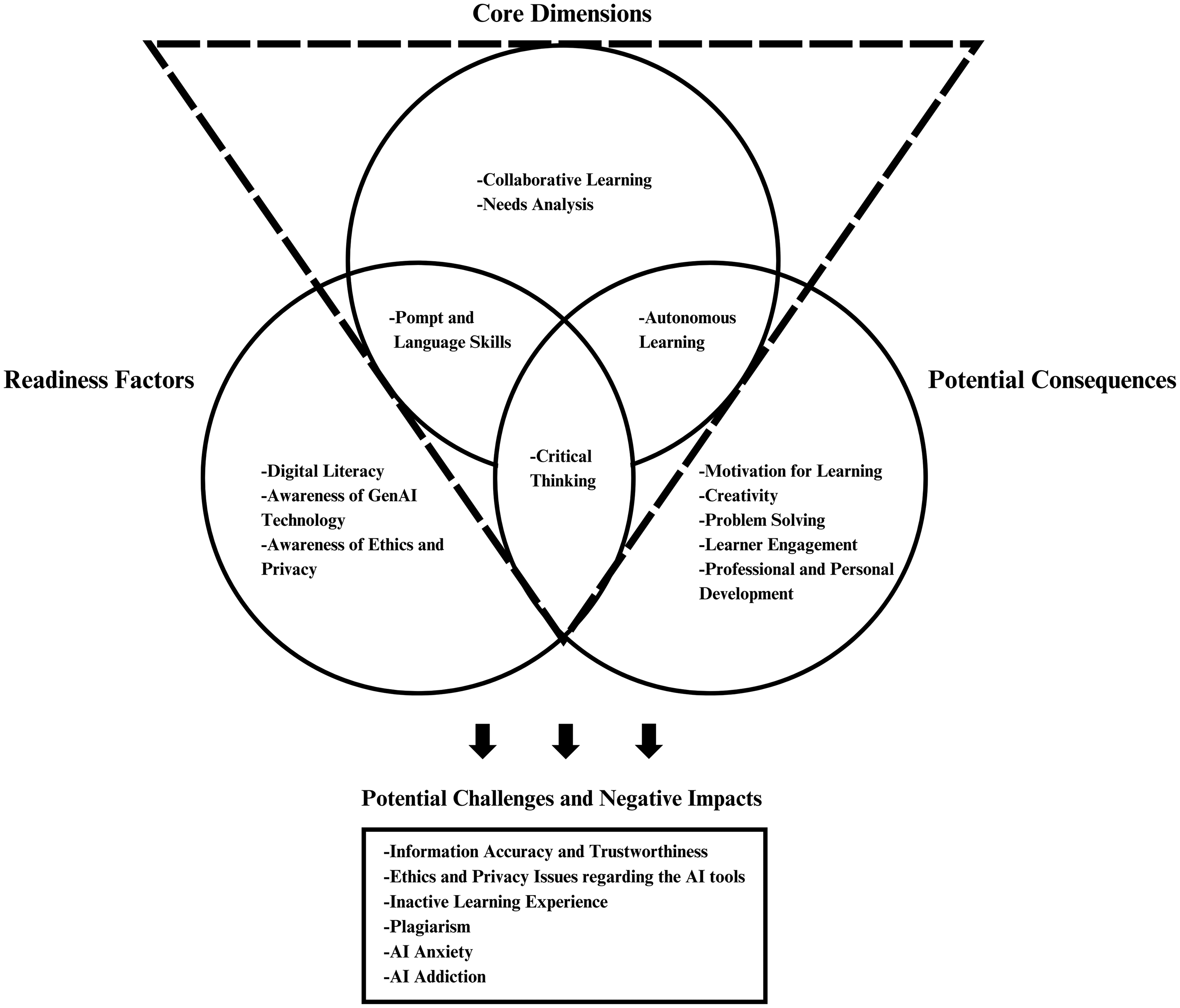
The model of GenAI-LL.
Some of the extracted concepts were demonstrated at the intersection of the readiness factors, core dimensions, and potential consequences, as shown in Figure 1. These concepts at the intersection areas were determined based on the properties of the concepts and categories from the participants’ perspectives. First, prompt/language skills and critical thinking were placed in the intersection of readiness factors and core dimensions since these concepts are not only the core competencies for learners to adequately benefit from GenAI tools for learning, but also the more comprehensive competencies essential for them as a base for GenAI-assisted learning. In other words, learners need to have an adequate level of language and critical thinking skills as the readiness factors to effectively use GenAI tools for learning purposes. Second, autonomous learning and critical thinking skills are placed in the intersection of the core dimensions and potential consequences since the use of GenAI tools for learning potentially improves their autonomous learning and critical thinking skills beyond GenAI-assisted learning environments from the standpoints of the participants. The domains, extracted competencies, and their relationships were further elaborated on in the next parts.
Core Dimensions of GenAI-LL
This part presents the core dimensions of GenAI-LL (see Table 1), defined as the learner competencies required for learning with GenAI tools, but not learning about them. The core dimensions are delimited within the context of GenAI-assisted learning. The extracted concepts from the data were “autonomous learning,” “prompt and language skills,” “critical thinking skills,” “needs analysis,” and “collaborative learning.” Of these concepts, the “prompt and language skills” concept was determined as both a readiness factor for and dimension of GenAI-LL, whereas “autonomous learning” was characterized as both a dimension and consequence of GenAI-LL. On the other hand, “critical thinking” emerged as a core concept in GenAI literacy and was identified in all categories: readiness, dimensions, and consequences.
Core Dimensions of GenAI-LL.
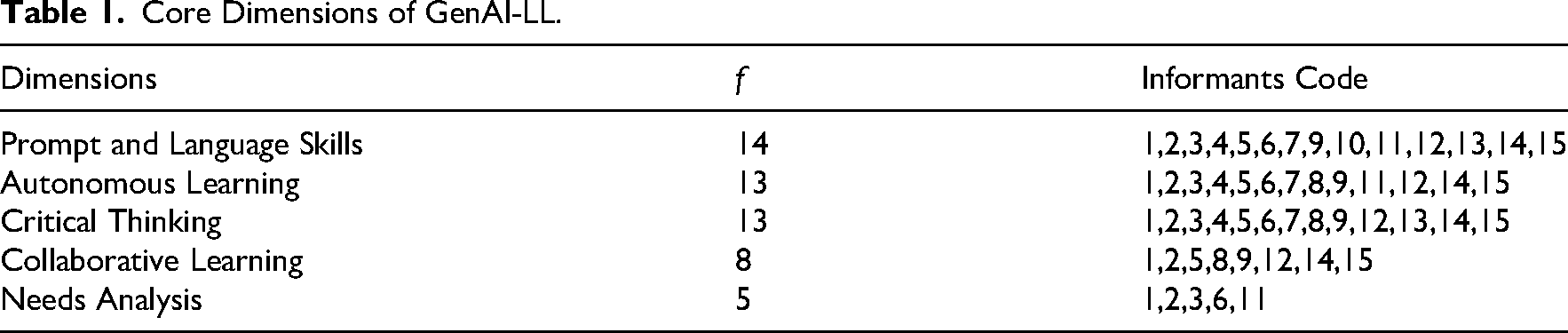
The first concept covers both prompt skills and language skills. These skills were coded as a single concept (f = 14) as they were highly interrelated. It refers to the construction of gradual dialogue with a GenAI tool through (a) the formulation of prompts to access relevant and correct responses, (b) the knowledge and skills regarding the language used (including grammar and writing skills), and (c) the use of the terms in the relevant study field. These are needed by learners to define and state their needs, problems to be solved, and the content they would like to access by correctly producing prompts with proper language skills. Therefore, this concept was also classified as a readiness factor for GenAI-LL, as it is a fundamental competency needed far beyond learning in the GenAI context. P9, for example, underlined the role of prompt and language skills as follows: “Students’ language skills play a crucial role in AI literacy as they need to be able to ask good questions and improve the conversations between generative AI and themselves.”
The second concept, autonomous learning, refers to the degree to which learners have the competence to take responsibility for their learning experience, including self-directed learning skills. Although it could also be categorized as a readiness factor, it was only included in the core dimensions and potential consequences since the readiness factors in this model were delimited with the ones either indirectly relevant to learning or learning about GenAI. Most of the participant professors underlined it as a significant dimension of GenAI-LL (f = 13). Autonomous learning encompasses learners’ competencies to access the needed synthetic content for learning, to meet their individual learning needs, to use relevant GenAI tools in the role of tutors/coaches, and to interact with the adaptive content generated by the relevant tools. GenAI is not only considered by the professors as a source of knowledge but also as an environment/scaffolding tool for knowledge construction. Thus, GenAI, underlined with its tutor/mentor role, offers continuously available opportunities to autonomously personalize their learning experience, knowledge/content construction, feedback they receive, self-evaluation, and consequently for learners to have improved metacognitive learning strategies. In addition to being a core dimension, some of the participants also believe that the use of GenAI tools for learning will potentially contribute to learners’ autonomous learning competencies by allowing them further exploration in specific areas and their relationships, enhancing motivation for learning, developing self-regulated learning skills, and providing further insight into their learning experience beyond the GenAI context. For this reason, it is also classified as a potential consequence. For example, P8 explained this concept as follows: “AI can be highly useful in encouraging learner autonomy, as it provides students with the opportunity to study by themselves and decide what knowledge they would like to learn more about. The feedback provided can also be useful in guiding the student throughout the learning journey.” “…Assuming that everything generated by artificial intelligence is correct might cause a vital fallacy. So it is very important for one, when in the role of consumer, to be still awake, to be still skeptical of the data obtained. I mean being skeptical, being critical, is of critical importance. Using artificial intelligence without this skill carries very serious risks.”
The last concept extracted from the professors’ responses is needs analysis (f = 5). Needs analysis refers to learners’ competencies required to identify, define, and understand their learning needs and goals, or analyze the problems to be solved through GenAI. In other words, learners are required to determine the phenomenon they need to learn or the problem they need to solve completely and correctly. In this sense, prompt and language skills also emerge as a factor highly interrelated with properly defining the needs and interacting with the GenAI tools. P1 explained this dimension and its relationship with prompt skills as follows: “Our demands, more precisely I mean identifying our needs. …I mean prompt skills are important, very important. But, what is behind prompts and their content?: Defining the needs. Defining the needs skill, this is very important as well.”
Readiness Factors for GenAI-LL
Readiness factors for GenAI-LL refer to the competencies indirectly relevant to learning either beyond the GenAI context or learning about GenAI. As explained above, prompt/language skills and critical thinking skills are classified as both readiness factors for and core dimensions of GenAI-LL since they are beyond the scope of GenAI-assisted learning. Besides them, the readiness factors cover digital literacy, awareness of GenAI technology, and awareness of ethics and privacy (Table 2).
Readiness Factors for GenAI-LL.

The first readiness factor is digital literacy (f = 15), for which a full consensus was observed in the professors’ responses. Digital literacy was defined as learners’ competencies of using current digital tools to both consume and produce content following their aims. These tools include computers, the internet, and any relevant new media, which are needed to use GenAI tools. According to the participant responses, GenAI literacy is fundamentally based on digital literacy, which covers three dimensions: (a) computer/internet literacy, (b) data literacy, and (c) information/media literacy. P1 explained digital literacy as a prerequisite of GenAI literacy as follows: “People are first required to have digital literacy before artificial intelligence literacy. …I mean having the competency of using the current technologies is a very important dimension. …Second, artificial intelligence has its own context. I mean artificial intelligence is a natural language processing model. So, it presents you with something by processing the data on the internet. Here information-seeking skills emerge. …Another issue is data literacy. I mean when we use artificial intelligence, it gives us something, attempts to give meaningful data for our needs. We need to interpret this. So, I can state data literacy as a sub-component of artificial intelligence literacy.” “How are these data processed, how are recommendations offered? I mean this flow should be basically known. Otherwise, literacy is perceived as a superficial concept. I mean as if s/he were literate if s/he uses ChatGPT… I mean it is required to understand the algorithms behind a tool, rather than using it [for AI literacy]. …If we know machine learning algorithms, how a system offers recommendations, we can then regulate the prompts.”
Potential Consequences of GenAI-LL
The potential consequences cover the learning outcomes of GenAI-LL (see Table 3). These outcomes refer to the potential consequences of the learning experience with GenAI. The participants pointed out autonomous learning and critical thinking as both the core dimensions and consequences of GenAI-LL, since the practice of these skills during the learning experience with GenAI also improves them in the long run. The other consequences were determined as motivation for learning, creativity, problem-solving, learner engagement, and professional/personal development.
Potential Consequences of GenAI-LL.
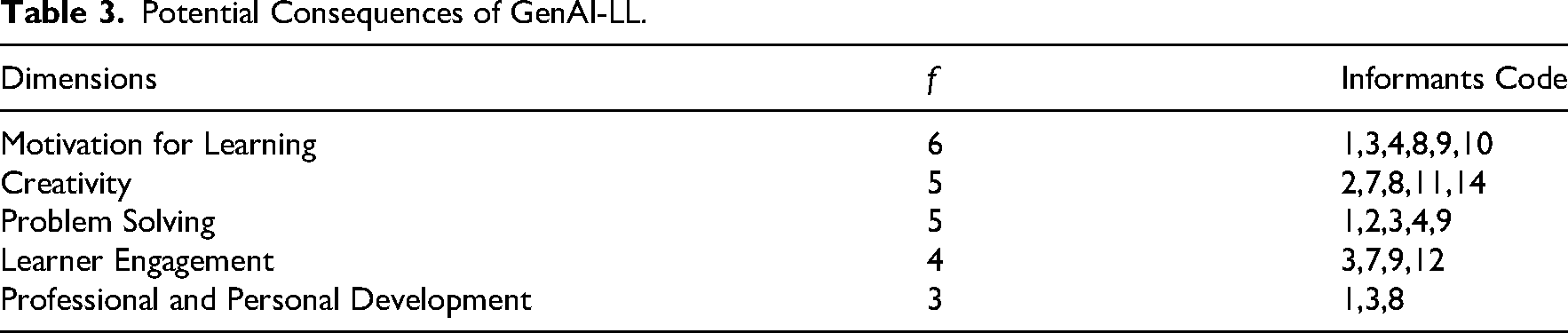
The first concept derived from the participant responses is motivation for learning (f = 6). The participants stated that the advantages of GenAI, such as providing synthesized and personalized content, have the potential to trigger their motivation for learning. What they mean by motivation is rather internal motivation for learning, as GenAI tools would present content in a more interesting and concrete/authentic manner. The participants also stated that learners’ opportunity to learn with interesting/attractive authentic content/cases, generating that content whenever they need to, and obtaining feedback about their performance will also improve their motivation for learning. For example, P3 explained this consequence of GenAI as follows: “I think artificial intelligence, its capability of concretization, personalization, appropriateness with a person's learning needs… And [GenAI] naturally will become triggering for internal motivation. I mean his/her motivation for content or course would gradually increase within a course equipped with the cases s/he will continuously face or relevant with him/her.” “Motivation issue, debatable… I mean it is reported in the studies that it increases. But, for motivation, providing sustainability is important. I mean it, of course, improves motivation at the beginning because there is someone [GenAI] caring for personally. But, after a while, it decreases in the graph. It is necessary to trigger this. I mean it is important to use interventions that will improve motivation in the process.”
As implied in the explanation of creativity, the professors also believe that GenAI has the potential to support problem-solving (f = 5). From the professors’ perspective, learners will have a chance to improve their problem-solving skills by using GenAI tools for the aims of concretization with authentic cases, accessing further details, and producing creative and novel solutions to problems. P9, contrary to P14 above, claims that GenAI will lead learners to be more active: “AI would lead learners to be more active in learning by encouraging self-directed learning, inquiry-based approaches, and problem-solving activities.”
As also implied in the elaboration of motivation for learning and problem-solving, the participants also think that GenAI will enhance learner engagement (f = 4) as they believe that GenAI tools have the potential to improve learner-content, learner-instructor, and learner-learner interaction. The interesting, authentic, and more relevant content to learners’ needs would contribute to their active participation and consequently improve their engagement. On the other hand, augmented learning experiences and quality feedback designed by instructors will enhance the dialogue between learners and instructors as P9 stated: “It [GenAI] enables engaging in interactive and adaptive learning experiences.”
The final potential consequence of GenAI-LL is learners’ professional and personal development (f = 3). As a result of the learning opportunities and advantages elaborated above, GenAI tools have the potential to contribute to higher education students and adult learners’ personal and professional knowledge and skills in both formal and informal ways. The participants believe that GenAI tools provide opportunities for improving their knowledge and skills in their subject areas, as well as exploring their interests and getting further knowledge and skills about them. P1, for example, explains this consequence as follows: “…Adult learners, higher education students… There are some professional and personal skills they need to develop. It [GenAI] can greatly contribute to these. For example, foreign language… …artificial intelligence tools can be used very effectively for especially writing.”
Potential Challenges and Negative Impacts of Using GenAI for Learning
The findings from the professors’ responses also revealed the potential challenges and negative impacts of GenAI (see Table 4). They include the potential challenges posed by the GenAI tools and learner behaviors, as well as the potential negative impacts on learners.
Potential Challenges and Negative Impacts of Using GenAI.
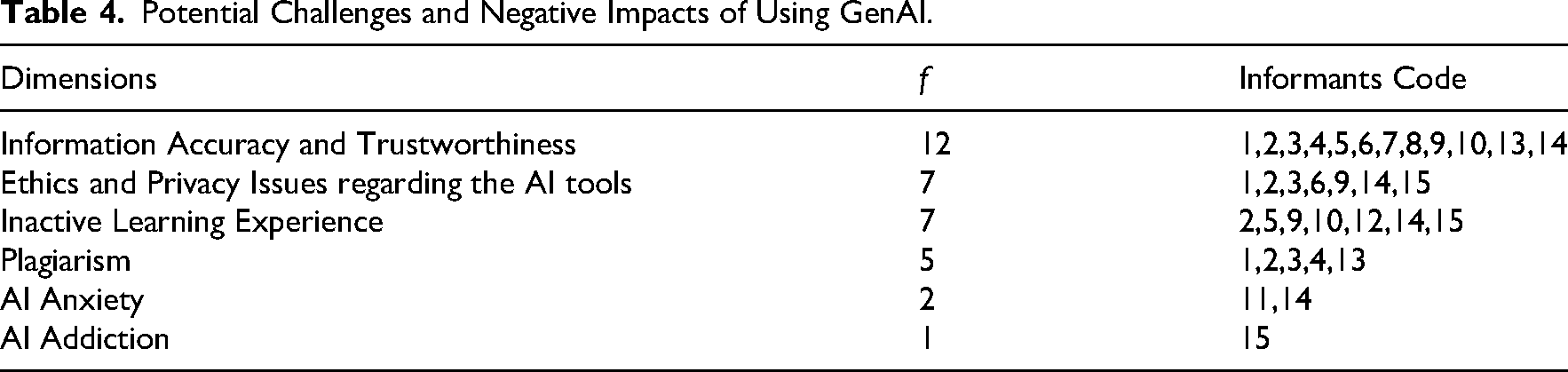
The most highlighted concern in the participant responses was the accuracy and trustworthiness of the content presented by the GenAI tools (f = 12). This is also consistent with the critical thinking concept underlined by the participants as a requisite of the readiness for and process of the learning experience. The professors emphasized that the possibility of generating misleading or incorrect information or content by the current GenAI tools is a fundamental challenge in using those tools for learning. For this reason, they underlined that it is essential to have instructor guidance/coaching and critical thinking skills. For instance, P8 explained his concern as follows: “Generative AIs may generate information or may present totally incorrect answers. So, AI literacy becomes quite important for supporting learners to evaluate the reliability of information.”
The second concern stated by the participants is ethics and privacy issues (f = 7). This negative aspect is about the AI tools’ ethics and privacy policy and practices, such as the use and misuse of learners’ data, including personal data, and manipulation through the subjective outputs. In this regard, one of the participants stressed the need for transparent and accountable AI systems. A professor (P15) explains his concerns as follows: “These [GenAI tools] are not totally objective, neutral technologies. It works through a model, a designed model and certain parameters, and it would be a great problem that learners continuously interacting with them can be unconsciously manipulated…”
Inactive learning experience (f = 7) is another challenge raised by the professors. From the professors’ standpoint, learners’ opportunities to easily and quickly access the desired content through the current GenAI tools may direct them to act in a passive role in the learning process. P5 states his concern regarding the negative affective and cognitive effects of GenAI tools on learners as follows: “Learners would be led to affective and cognitive dulling regarding learning processes with the comfort provided by this rapidly developing technology [GenAI].” Another potential negative impact of this comfort was also stated by P15 as AI addiction (f = 1). His concern is that the comfort of quick and easy access to the desired content might lead to addiction, which may emerge as deprivation in case of unavailability of these tools. He explained his concern as follows: “…Addiction, for instance, is an affective issue. It may cause feelings of deprivation, feeling of deficiency, or a learner continuously using generative artificial intelligence may lose his/her self-confidence when s/he cannot use it. This kind of problems is naturally possible.”
The final concern expressed by the professors is AI anxiety (f = 2), which stems from AI's uncertain potential and impacts on individuals and society. Besides, one of the professors stated that the uncertainty in the policies regarding the data collected from the users is another source of AI anxiety. A professor (P14) underlined this anxiety as follows: “All in all, we don’t know the boundaries of artificial intelligence. We all have anxiety as we don’t know. It's generating. What will it do? What will happen to us?”
Discussion
The current study revealed the core dimensions, readiness factors, and potential consequences of GenAI-LL as well as the potential challenges based on the grounded theory approach. The core dimensions of GenAI-LL refer to the learner competencies needed for learning and are delimited within the context of GenAI-assisted learning. The emerged codes regarding learning about GenAI or beyond the scope of GenAI were either categorized as readiness factors or potential consequences.
The core dimensions that emerged from the participants’ responses were “autonomous learning,” “Prompt and language skills,” “critical thinking skills,” “needs analysis,” and “collaborative learning.” The Prompt and language skills concept had emerged as both a core dimension and a readiness dimension, while autonomous learning was coded as both a core dimension and a potential consequence. Particularly, the critical thinking skills dimension was placed at the core of GenAI-LL as it was specifically underlined by the participants as a readiness dimension and a fundamental skill needed during learning. On the other hand, it was assumed that the use of GenAI for learning would potentially improve learners’ critical thinking skills.
The previously determined dimensions in the relevant literature can be broadly categorized as understanding the foundations of AI (Biagini et al., 2023; Ng et al., 2024), using AI technologies (Biagini et al., 2023; Celik, 2023; Kong et al., 2023; Ng et al., 2024), and ethics (Biagini et al., 2023; Celik, 2023; Kong et al., 2023; Ng et al., 2024). The findings regarding the core dimensions in this study have partial similarities and differences with the use of AI technologies in the prior studies. Autonomous learning, which emerged in this study, refers to learners’ competencies to take responsibility for their learning and covers metacognitive learning, consistently shown by Yi (2021) as the metacognitive competence dimension. Although it was possible to include needs analysis in autonomous learning since it also covers identifying, defining, and understanding learning needs and goals, it was distinguished, as it was specifically underlined by the participants as a distinct dimension. Critical thinking and collaboration were also underlined in previous studies. Long and Magerko (2020), consistent with the current study, proposed a literacy model for AI, including critical thinking skills and collaborative learning. Similarly, Ng et al. (2024) demonstrated collaborative learning as a dimension of GenAI literacy. As for critical thinking, Biagini et al. (2023) pointed out critical evaluation as a dimension of GenAI literacy. Compared with the existing models, prompt and language skills emerged as a separate dimension in this study. Although it was covered in the prior models as using or applying AI (Ng et al., 2024) or as an operational dimension (Biagini et al., 2023), it was distinguished in this study, as the focus is on GenAI, and generating through these technologies is highly dependent upon prompts and the language used. Despite the conceptual similarities, the reason behind the differences from the prior studies (Biagini et al., 2023; Celik, 2023; Karaoglan Yilmaz et al., 2024; Kong et al., 2023; Laupichler et al., 2023; Ng et al., 2024; Ng et al., 2024; Strzelecki, 2024a, 2024b; Wang & Lu, 2023) is twofold: this study (a) specifically focused on GenAI, rather than the umbrella term of AI and (b) covered solely the dimensions directly relevant to learning experience with GenAI.
The other dimensions determined by the relevant studies as understanding the foundations of AI (Biagini et al., 2023; Ng et al., 2024) and ethics (Biagini et al., 2023; Celik, 2023; Kong et al., 2023; Ng et al., 2024) were covered in the present study as the readiness factors since they are indirectly relevant with learning and beyond the scope of GenAI. Thus, the readiness factors are “digital literacy,” “awareness of GenAI technology,” and “awareness of ethics and privacy.” These determined dimensions are all relevant to AI education or learning about AI, and indirectly relevant to learning with AI. For this reason, since the focus of the literature on AI is mainly on learning about it, these dimensions are consistent with their findings. In the relevant literature, digital and data literacy (Long & Magerko, 2020; Miao & Shiohira, 2022; Olari et al., 2023; Stolpe & Hallström, 2024), awareness of AI ethics (Eguchi et al., 2021; Laupichler et al., 2023; Miao & Shiohira, 2022; Ng et al., 2021; Stolpe & Hallström, 2024), awareness of technical aspects and practices (Laupichler et al., 2023; Long & Magerko, 2020; Miao & Shiohira, 2022; Ng et al., 2021; Stolpe & Hallström, 2024) and critical thinking (Laupichler et al., 2023; Stolpe & Hallström, 2024) are already determined as the dimensions of AI literacy. However, the current study, as aforementioned, distinctively underlined the role of prompt and language skills as a readiness dimension.
The findings regarding the core dimensions and readiness factors provide an integrated framework by revealing the interplay between learning about and with AI from a dual perspective. The GenAI-LL model proposes that readiness factors, such as digital literacy and awareness of AI technology, are the antecedents of learning with GenAI, or the core dimensions, such as needs analysis and autonomous learning with GenAI. This means that learners need the competencies categorized in the core dimensions to have an augmented learning experience with GenAI tools, which is enhanced by the fundamental competencies gained by learning about AI in the readiness factors.
The proposed model thirdly revealed the potential consequences of GenAI-LL: “motivation for learning,” “creativity,” “problem-solving,” “learner engagement,” and “professional and personal development.” Besides, improved autonomous learning and critical thinking skills also emerged as potential consequences. These findings are in conjunction with the previous studies in terms of problem-solving (Du & Wang, 2023; Long & Magerko, 2020), creativity (Long & Magerko, 2020; Yetişensoy & Rapoport, 2023), and critical thinking (Biagini et al., 2023; Du & Wang, 2023; Yetişensoy & Rapoport, 2023). On the other hand, the potential consequences of motivation, engagement, professional/personal development, and autonomous learning were obtained as the distinctive findings of this study, focused specifically on learning experiences with GenAI.
The present study finally explored the challenges of using GenAI technology for learning and the potential negative influences of GenAI on learners: “information accuracy and trustworthiness,” “ethics and privacy issues regarding the AI tools,” “AI anxiety,” “inactive learning experience,” “plagiarism,” and “AI addiction.” These potential concerns such as trustworthiness (Su et al., 2023), ethics and privacy issues (Jo, 2024; Van Brummelen et al., 2021), AI anxiety (Wang & Wang, 2019), reducing cognitive capabilities, and AI addiction or dependence (Bai et al., 2023; Zhang et al., 2024) were also consistently reported in the prior studies. All these challenges require instructors’ interventions (Wang & Wang, 2019), cautious utilization (Bai et al., 2023), and the readiness factors determined in this study for the integration of GenAI into learning environments.
Conclusion
The current study proposed a model for using GenAI in learning environments, focusing specifically on the learning experience. The findings indicated the learner competencies and their relationships needed for an augmented learning experience through GenAI. Additionally, the potential consequences of this augmented learning experience with GenAI were also revealed. The main implication of this study, therefore, is that learners need improved competencies in “prompt and language,” “critical thinking,” “needs analysis,” “collaboration,” and “autonomous learning” skills to benefit from the current GenAI tools. However, particularly the findings on the readiness factors and the potential challenges still underline the importance of AI education or learning about AI. For this reason, the proposed model in this study underscores the need for the duality between learning about and with GenAI. Considering the readiness factors obtained, learning about GenAI serves as a base for learning with GenAI to lead to the potential consequences, and diminishes the potential challenges and negative impacts revealed in this study.
The potential consequences obtained in this study demonstrate the overwhelming advantages of integrating GenAI into learning environments. For this aim, the findings underscore the importance of learning about AI for learning with it and imply the need for AI education in the curricula at all educational levels to both augment learning experience with AI and mitigate the potential challenges and negative impacts during the integration of AI technologies into educational environments. The professional development of both teachers and school leaders is also essential in both aspects of learning about and with AI, as they are the primary stakeholders of education, together with learners.
Limitations and Recommendations
The findings of this study have limitations and recommendations for further research and practice. First, the present study is qualitative, and future studies are recommended to quantitatively confirm the proposed model and its generalizability. As the first phase for this recommendation, a valid and reliable instrument for measuring GenAI-LL was developed by the researchers (Gümüş & Kara, 2025) as a follow-up study for measuring learners’ GenAI-LL. Future studies can be further conducted to confirm the developed scale based on the GenAI-LL model proposed in the current study in other cultural contexts. Future studies may also quantitatively identify the proposed relationships among the readiness factors, core dimensions, consequences, and potential challenges and negative impacts, as partially done by the researchers in another follow-up study (Gümüş, 2025).
Besides, future experimental studies are highly recommended to empirically demonstrate the consequences of GenAI interventions by taking the readiness factors and core dimensions into account. As another recommendation, actions informed by the current research on GenAI should be taken to minimize the potential challenges and negative impacts for maximizing the potential of GenAI for learning. The current study was also delimited with the experienced professors in the research and practice of AI and learners’ literacy. Thus, future studies are required to revise the model with the perspectives of other stakeholders such as learners, teachers, and school leaders. Further studies are also recommended to reveal instructor and leader competencies regarding the integration of GenAI into learning environments. Finally, future studies may also revise the model by grounding it in the previously established theories to enhance its explanatory power.
Footnotes
Acknowledgments
This study is a part of the doctoral dissertation of the first author supervised by the second author and was submitted to Amasya University, Türkiye.
Data Availability
The data used in this study are not publicly available due to ethical restrictions.
Declaration of Conflicting Interests
The authors declared no potential conflicts of interest with respect to the research, authorship, and/or publication of this article.
Ethical Approval
This study was conducted with the ethical approval of the Social Sciences Ethics Committee at Amasya University (Approval/Reference No. E-30640013-108.01-214189). Informed consent was obtained from all participants prior to their involvement. Their confidentiality and anonymity were rigorously protected throughout the research process; all data were collected and analyzed anonymously, with no personally identifiable information retained. The study's purpose and procedures were fully explained to participants, and their right to withdraw at any time without penalty was emphasized.
Funding
The authors received no financial support for the research, authorship, and/or publication of this article.
Informed Consent
Informed consent form was obtained from each participant before the study.
