



Abstract
The proliferation of Artificial Intelligence (AI) across multiple sectors has ushered in significant transformations, especially within the realms of education and creative industries, provoking considerable discourse regarding its effects on employability. This study examines the mediating effect of self-creativity identity within the association between AI development and unemployment anxiety among Fine Arts students. Utilizing a sample of 589 Fine Arts undergraduates in China, this research analyzes how AI's advancing capability to replicate creative tasks shapes students’ perceptions of their future career security. Findings indicate that AI exerts a substantial impact on self-creativity identity, with students perceiving AI as a transformative factor in their creative self-concept. Nevertheless, a notable contradiction arises; while AI contributes to enhancing self-creativity identity, it simultaneously intensifies unemployment anxiety, particularly concerning the perceived vulnerability of roles traditionally safeguarded by human creativity. Mediation analysis conducted via the PROCESS macro verifies that self-creativity identity partially mediates the relationship between AI impact and unemployment anxiety. These findings highlight the importance of equipping educational institutions to address such anxiety by cultivating resilience, adaptive skills, and AI literacy. Such initiatives may empower Fine Arts students to adeptly navigate an evolving landscape increasingly shaped by AI, thereby promoting their employability and reducing anxiety surrounding future career prospects.
Keywords
Introduction
Artificial Intelligence (AI) has emerged as an indispensable force shaping human existence across all facets, including education, daily life, and professional environments. In education, AI technologies significantly enhance learning experiences by providing tools that support self-regulated learning and personalized instruction (Hutson et al., 2022; Jin et al., 2023). According to Jin et al. (2023), learners utilized AI applications to improve their outcomes, though some reported insufficient support for motivational regulation. Similarly, Wu and Yu (2023) found that while AI chatbots can enhance learning, they may also lead to frustration when used for practicing communication skills. In the workplace, AI contributes to increased productivity and efficiency, assisting in decision-making processes and risk prediction in occupational health and safety (Joskowicz & Slomovitz, 2024; Jetha et al., 2023). However, the integration of AI raises concerns regarding professional identity, as employees may perceive threats to their roles and self-perception (Mirbabaie et al., 2021). Furthermore, ethical considerations emerge with AI deployment, necessitating responsible practices to mitigate issues such as data privacy and algorithmic biases (Akbarighatar, 2024). Therefore, while AI holds the potential to significantly benefit society, it also presents complexities that require careful navigation to ensure its positive impact is fully realized.
Further, the escalating development of AI has significantly amplified debates regarding its disruptive influence on global employment, particularly within creative industries such as fine arts. Numerous empirical studies highlight the capacity of AI technologies to replicate human roles, exacerbating anxieties around large-scale unemployment. Moghayedi et al. (2024) report a marked decline in job security due to AI adoption, as evidenced by the −87.7% Relative Importance Index reflecting perceived instability. The transformative impact of AI on the economic landscape posits that AI's cognitive capabilities endanger roles previously safeguarded from automation. In the fine arts, Brewer et al. (2024) document growing concern over AI image generators, which are perceived to threaten the uniqueness of human creativity. For fine arts undergraduates, this technological advancement heightens the risk of employment displacement. Similarly, Ayanwale et al. (2024) examine how AI undermines established roles within education and artistic sectors, necessitating a strategic reevaluation of educational and occupational frameworks to protect human creativity. The collective findings of these scholars illustrate the extensive and complex consequences of AI's rise, prompting urgent calls for recalibrated policies that address the intersection of creativity and automation.
Thus, the advent of AI in the creative industries has generated substantial concern, particularly amongst Fine Arts undergraduates, who are increasingly apprehensive about their employability within the job market. With AI's capacity to autonomously produce artistic and design works, there has been a discernible shift in the perception of human creativity's value. AI-generated art challenges traditional concepts of originality, which, in turn, engenders uncertainty regarding the career prospects of Fine Arts graduates. Moreover, as noted by Lee (2022), the rapid integration of AI within the cultural sectors necessitates a reevaluation of the roles humans occupy within creative professions, thus heightening the anxiety of students who fear becoming redundant in a rapidly evolving technological landscape. In addition, Hughes et al. (2021) draw attention to the unease stemming from AI's capacity to redefine the creative skills required for success, further exacerbating concerns about the future relevance of human artists. This anxiety is intensified by the realization that AI's proficiency in automating routine creative tasks potentially undermines the necessity for human intervention, raising profound questions about the sustainability of artistic careers (Zhang et al., 2024). Consequently, it becomes imperative for academic institutions to confront these concerns by fostering the development of competencies that enable Fine Arts students to work synergistically with AI, rather than in opposition to it.
In today's AI-dominated job market, the development of self-creativity identity (SCI) among fine arts students emerges as an indispensable determinant of their employability. Such a creative identity not only facilitates personal expression but also cultivates critical problem-solving skills, essential for navigating the contemporary workplace (Lukaka, 2023; Frenette, 2017). Studies suggest that fine arts students possessing a mature self-creative identity are distinctly advantaged in adapting to the fluctuations brought about by AI, harnessing their creative capacities to remain innovative and relevant (Jin & Ye, 2022; Currant et al., 2024). The artistic endeavors in which these students partake significantly contribute to their psychological resilience, enabling them to confront both the emotional and professional uncertainties inherent in an AI-permeated economy (Jin & Ye, 2022; Currant et al., 2024). Flexibility, a trait central to creative identity, allows graduates to exhibit adaptability—a characteristic particularly esteemed in the current competitive job landscape (Lindemann et al., 2017). In addressing gender-related challenges, fostering creative self-efficacy (CSE) among female students equips them to assert their creative identities with greater assurance (Luo et al., 2023), thereby increasing their employability in an era of rapidly evolving AI technologies (Frenette, 2017; Luo et al., 2023). In this regard, the development of SCI acts as a crucial mediator between technological advancements in AI and shifting job market expectations.
This study endeavors to elucidate the complex interrelations between AI, SCI, and unemployment anxiety (UA) among Fine Arts students. The principal aims are fourfold: firstly, to examine the impact of AI on these students’ SCI; secondly, to investigate the influence of SCI on their UA; thirdly, to assess the direct effect of AI on their anxiety concerning future employment; and fourthly, to determine whether SCI mediates the relationship between AI and UA. As AI increasingly replicates tasks hitherto reliant on human ingenuity, Fine Arts students may perceive a diminution of their unique contributions, thereby experiencing heightened vulnerability and apprehension regarding employability. By exploring whether a strong SCI can alleviate the anxiety associated with AI's encroachment into creative domains, this research aspires to provide invaluable insights into adaptive strategies that these students might adopt to navigate an evolving landscape wherein AI occupies an increasingly prominent role.
Literature Review
Artificial Intelligence is exerting an increasingly profound influence on human creativity and self-perception, thereby significantly impacting SCI (Mikalef & Gupta, 2021). The incorporation of AI-generated content (AIGC), such as AI-created selfies and artistic works, is reshaping traditional conceptions of self-expression and authenticity (Zhou & Sterman, 2024; Zarzycki, 2023). Artificial Intelligence tools afford users the opportunity to explore and generate diverse identities and creative outputs unattainable through human effort alone, thus blurring the boundaries between the real and the virtual self (Ioannidou et al., 2024). This development presents both prospects and challenges: while AI has the potential to augment creative capabilities and democratize creative expression (Creely & Blannin, 2023; Watkins & Barak-Medina, 2023), it may also engender a dependency on technology, potentially undermining individuals’ self-efficacy and agency within the creative process (Karwowski, 2012; Magni et al., 2023). The dual impact of AI on SCI suggests a complex interplay between the enhancement and erosion of personal creativity. It is therefore imperative to comprehend how AI influences individuals’ perceptions of their own creativity and to address the ethical and psychological ramifications of this transformation (Rezwana & Maher, 2022; Rezwana & Maher, 2023). Accordingly, the following research hypothesis 1a is proposed: H1a: Artificial intelligence has a substantial impact on the identity of self-creativity
The concept of self-creativity holds substantial importance in determining the level of UA, particularly within the cohort of Fine Arts students whose career expectations are closely linked to their creative capabilities. A well-established sense of creative identity can serve as a mitigatory factor, reducing anxiety in relation to employment uncertainties. Encouraging creativity within educational systems significantly diminishes concerns about future job prospects, especially for individuals whose self-worth is intrinsically connected to their creative expression. These students frequently rely on their CSE—the confidence in their ability to produce original work—to navigate the complexities of the job market (Tierney & Farmer, 2011). Furthermore, resilience, cultivated through the creative process, is integral in managing the unpredictability of a competitive market. However, heightened levels of creativity anxiety, as Daker et al. (2020) have observed, can aggravate concerns about employability. Consequently, it is imperative that educational institutions address both creativity and anxiety. Based on this, the current research proposes hypothesis 1b as follows: (H1b) Self-creativity identity significantly affects unemployment anxiety of Fine Arts pupils
Artificial intelligence has become an influential factor exacerbating UA among students, particularly within Fine Arts disciplines. It is widely accepted that the swift progression of AI technologies has engendered apprehensions regarding job displacement and the potential redundancy of traditional artistic competencies (Frank et al., 2019; Maity, 2022). Fine Arts students frequently perceive AI as a menace to their prospective careers, harboring fears that their creative roles may be supplanted by AI-driven automation (Li & Zhang, 2022; Ermiş & Imamoğlu, 2019). Recent studies suggest that this anxiety is intensified by the inadequate preparation afforded by educational institutions concerning AI's impact on employment (Abdelwahab et al., 2022; Ulutaş & Saklan, 2022). Furthermore, global observations indicate that students’ perceptions of AI's influence on job opportunities are characterized by widespread concern over escalating unemployment due to AI advancements (Ruiz-Talavera et al., 2023). Moreover, the incorporation of AI into the arts has provoked disquiet about the diminishing value attributed to human creativity (Huang et al., 2021; Moybeka et al., 2023). Additionally, ethical considerations and inherent biases within AI systems contribute to students’ trepidations (Wang et al., 2023; Mehta et al., 2021). The psychological ramifications, including diminished self-esteem and heightened stress levels, are well-documented (Davras, 2020; Işcan, 2021). Accordingly, there exists an increasing imperative to address UA among Fine Arts students by integrating AI literacy and ethical deliberations into curricula (Sapci & Sapci, 2020; Sit et al., 2020). Consequently, the researcher hypothesizes (H1c) below: (H1c) Artificial intelligence significantly impacts unemployment anxiety of Fine Arts students
Self-creativity identity is posited to serve as an essential mediator within the domains of AI technology, education, and psychological well-being. Empirical investigations have indicated that SCI substantially influences mental health, particularly among individuals confronting stressors such as prospective unemployment resultant from AI advancements. Within educational contexts, a robust SCI cultivates motivation, engagement, and profound learning, thereby enabling students to acquire creative problem-solving competencies indispensable in an AI-dominated landscape (Tierney & Farmer, 2011). Moreover, participation in creative activities has been shown to enhance mental well-being and emotional regulation, which may mitigate UA. Furthermore, a strong SCI is correlated with elevated levels of well-being and diminished anxiety, as creative engagement augments personal satisfaction and mental health. Thus, SCI may mediate the relationship between AI and UA by fortifying self-esteem and adaptability. Accordingly, the study puts forward Hypothesis 2 (H2): (H2) The identity of self-creativity exerts a mediated effect in the relationship between AI and unemployment anxiety.
Drawing upon the preceding scholarly discourse and postulated theoretical propositions, Figure 1 delineates an integrative conceptual framework, rendered as a path-analytic model that explicates the hypothesized mediational relationships under investigation in this empirical study.
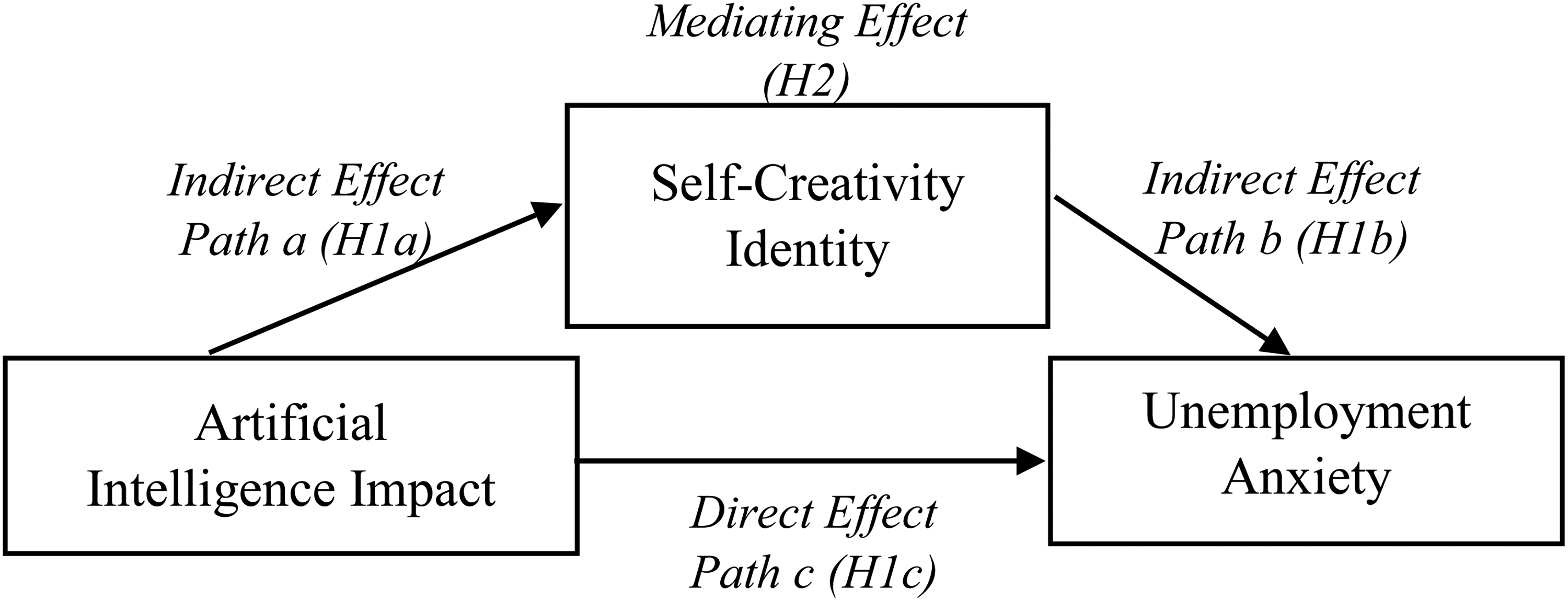
Path Diagram for Mediation Analysis Model of the Current Study.
Method
Research Design and Approach
This research employed a quantitative research design utilizing a cross-sectional survey methodology to examine the mediating role of SCI in the relationship between AI impact and UA among Fine Arts students. The study adopted a positivist paradigm, employing correlational and mediation analysis techniques to test the proposed theoretical model. The research was conducted through a structured online questionnaire administered via convenience sampling, representing a nonexperimental design appropriate for exploring psychological constructs and their interrelationships within the target population.
Demographic Characteristics of Participants
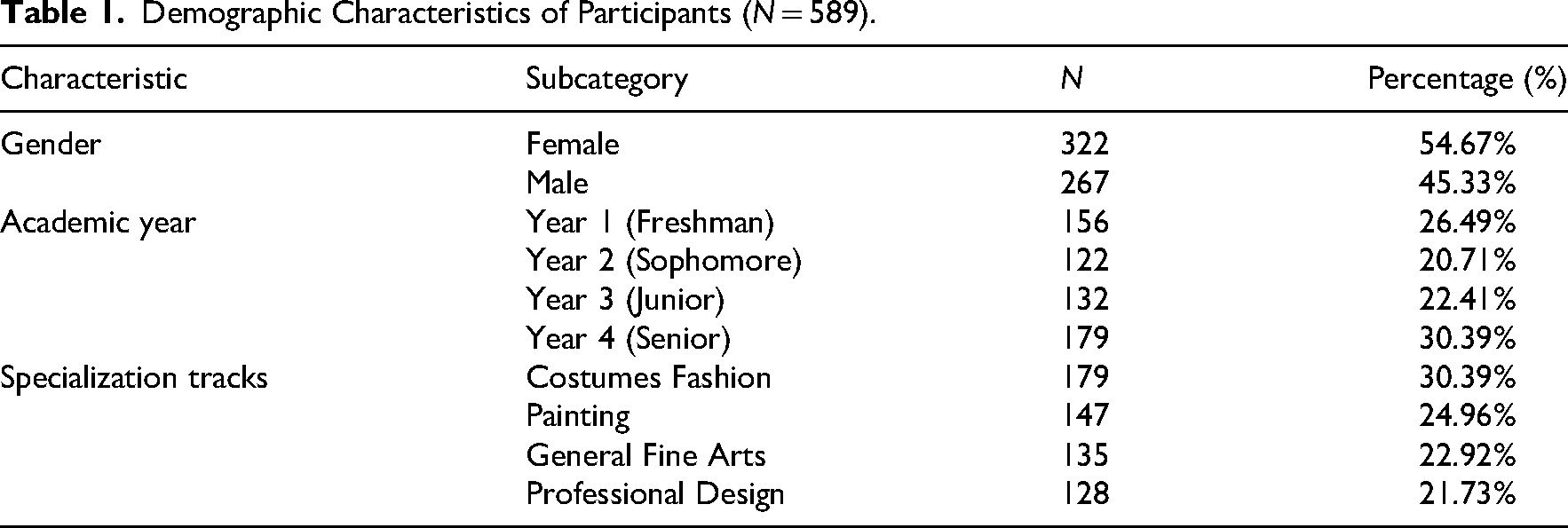
The study, as shown in Table 1, comprised 589 Chinese undergraduates (N = 589) from a private Fine Arts university in Guangzhou, China, ensuring uniform academic standing through the undergraduate enrolment criterion. Participants included 267 males (45.33%) and 322 females (54.67%), reflecting typical Fine Arts enrolment patterns, and spanned all academic years: 156 Year 1 (26.49%), 122 Year 2 (20.71%), 132 Year 3 (22.41%), and 179 Year 4 (30.39%). Specializations were 147 Painting (24.96%), 135 General Fine Arts (22.92%), 128 Professional Design (21.73%), and 179 Costume Fashion (30.39%), providing balanced representation across gender, year, and discipline for comprehensive analysis. Data collection occurred in July–August 2024 in Guangzhou—a technologically advanced creative hub—during a pivotal moment approximately at least 6 months after consumer-accessible generative AI tools (e.g., Kling AI, Tencent's Yuanbao, DeepSeek) achieved widespread recognition in China. This timing ensured sufficient participant exposure to AIGC technologies for informed perceptions of their impact on creative industries, while the demographic diversity facilitated nuanced analysis across Fine Arts subfields and educational trajectories.
Demographic Characteristics of Participants (N = 589).
As for the AI proficiency assessment, seen in Table 2, to address the temporal and regional variations in AI familiarity, participants were asked to self-assess their proficiency with AI and AIGC technologies on a 5-point Likert scale (1 = “Not familiar at all” to 5 = “Extremely familiar”). Descriptive analysis revealed that 23.6% (n = 139) reported low familiarity (scores 1–2), 41.8% (n = 246) indicated moderate familiarity (score 3), and 34.6% (n = 204) demonstrated high familiarity (scores 4–5). Analysis of variance indicated significant differences in AI familiarity across academic years (F(3,585) = 12.47, p < .001), with senior students (Year 4) exhibiting significantly higher familiarity (M = 3.42, SD = 1.18) compared to freshmen (Year 1) (M = 2.78, SD = 1.21), suggesting progressive exposure and engagement with AI technologies throughout their academic progression.
Artificial Intelligence Proficiency Assessment—Statistical Summary (N = 589).
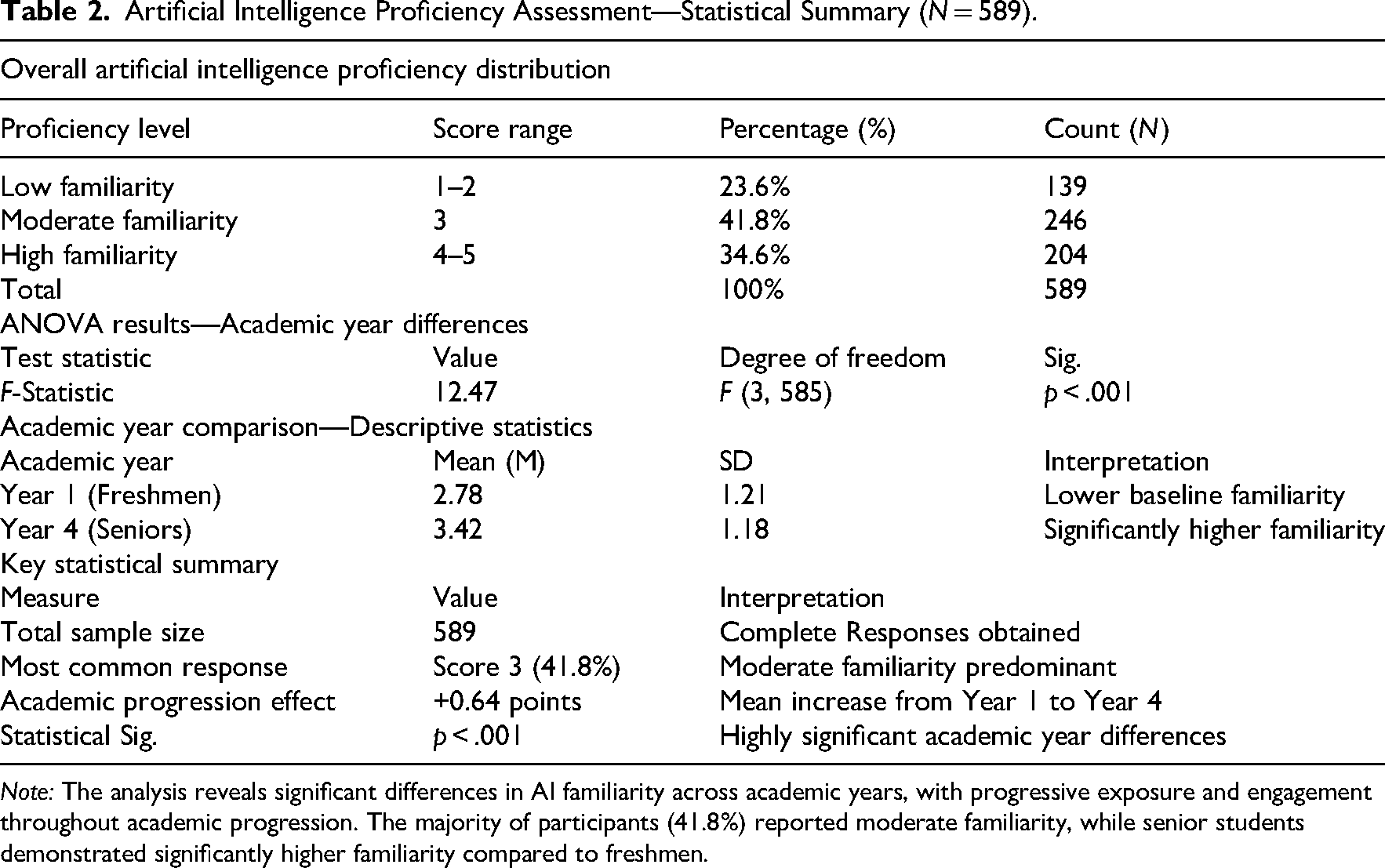
Note: The analysis reveals significant differences in AI familiarity across academic years, with progressive exposure and engagement throughout academic progression. The majority of participants (41.8%) reported moderate familiarity, while senior students demonstrated significantly higher familiarity compared to freshmen.
Research Measurement Tools
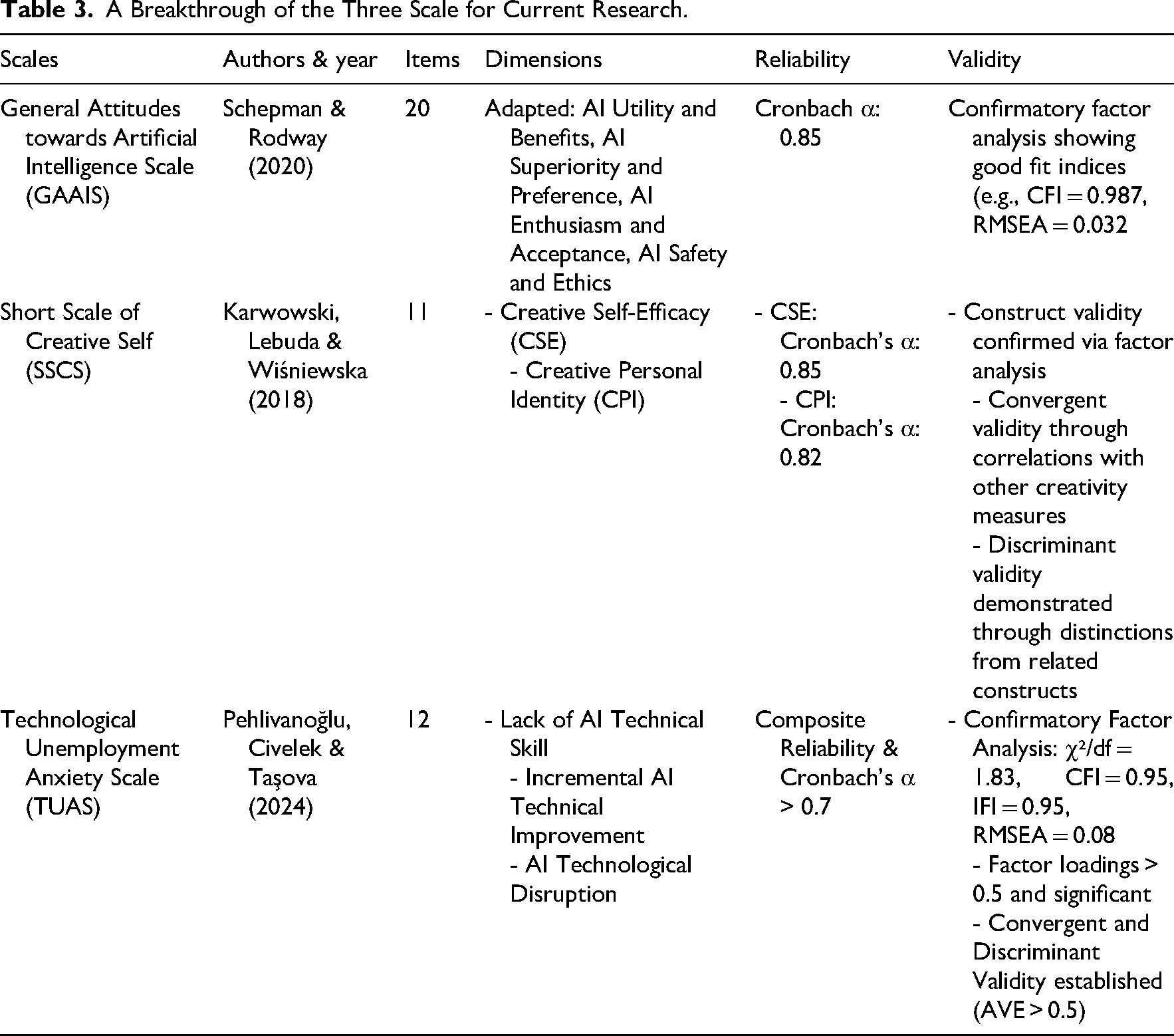
In the current investigation, three primary scales were adopted for data collection. Firstly, the General Attitudes towards Artificial Intelligence Scale (GAAIS), originally devised by Schepman and Rodway (2020), was utilized to assess participants’ attitudes towards AI. The initial GAAIS comprised 20 items partitioned into two dimensions: Positive GAAIS and Negative GAAIS. For the purposes of this study, the scale was adapted by rearticulating all negative items into positive formulations, thereby ensuring uniformity in scoring wherein higher scores denote more favorable attitudes towards AI. The modified GAAIS now consists of 20 items classified into four dimensions: AI Utility and Benefits, AI Superiority and Preference, AI Enthusiasm and Acceptance, and AI Safety and Ethics. This adaptation was undertaken to facilitate more efficient data management and processing. The reliability and validity of the adapted version GAAIS were substantiated through confirmatory factor analysis, which yielded satisfactory fit indices (e.g., CFI = 0.987, RMSEA = 0.032) and demonstrated high internal consistency with Cronbach's alpha values of 0.85.
On the other hand, the second measurement instrument employed in this study is the Short Scale of Creative Self (Karwowski et al., 2018). This 11-item scale is designed to assess individuals’ creative self-concept, encompassing two distinct dimensions: CSE and Creative Personal Identity (CPI). Responses are gauged using a 5-point Likert scale ranging from “Definitely not” to “Definitely yes.” The CSE dimension, which includes items such as “I trust my creative abilities,” has demonstrated commendable internal consistency, evidenced by a Cronbach's alpha of approximately 0.85. Similarly, the CPI dimension, featuring items like “Being a creative person is important to me,” exhibits reliable internal consistency with a Cronbach's alpha around 0.82. Validity analyses confirm the scale's construct validity through factor analysis, supporting its two-factor structure. Moreover, convergent and discriminant validity have been established via correlations with other creativity measures and appropriate distinctions from related constructs (Karwowski et al., 2018).
Furthermore, the third instrument employed is the Technological Unemployment Anxiety Scale (TUAS), as developed and adapted by Pehlivanoğlu, Civelek and Taşova (2024). Comprising 12 items, it is delineated into three dimensions: Lack of AI Technical Skill, Incremental AI Technical Improvement, and AI Technological Disruption. The TUAS measures the extent of anxiety that individuals harbor concerning potential unemployment precipitated by AI advancements in art-related vocations. The reliability and validity analyses yielded satisfactory outcomes; notably, the confirmatory factor analysis presented acceptable fit indices (χ²/df = 1.83, CFI = 0.95, IFI = 0.95, RMSEA = 0.08). All factor loadings surpassed 0.5 and were statistically significant, thus substantiating convergent validity. Furthermore, both composite reliability and Cronbach's alpha coefficients exceeded the conventional threshold of 0.7, thereby confirming the scale's reliability. Table 3, which follows, summarizes the breakthrough of the three scales.
A Breakthrough of the Three Scale for Current Research.
Data Collection and Analysis
Data collection occurred during July–August 2024 through a systematic process designed to ensure representativeness and response quality. The researcher meticulously integrated three validated scales into a singular electronic questionnaire, complete with detailed instructions for participants and additional demographic questions assessing AI familiarity and usage patterns. This instrument was designed to assess variables pivotal to exploring SCI as a mediator in the relationship between AI-induced UA and employability among undergraduates.
In August 2024, the online survey link was disseminated to students at the target national fine arts university in Guangzhou via a WeChat Group utilized for communication among fine arts undergraduates. WeChat Groups represent the primary communication platform for Chinese university students, ensuring maximum reach and accessibility. Over a two-week period, responses were systematically collected, culminating in 611 returned questionnaires. Following rigorous screening for invalid entries (incomplete responses, straight-lining, and attention check failures), 22 questionnaires were discarded, resulting in 589 valid responses and an impressive response rate of 96.4%.
The present study, in terms of analytical framework, employed a sophisticated analytical approach utilizing the PROCESS macro (Model 4) for mediation analysis in SPSSCrowson (2024). This methodological choice represents the gold standard for mediation analysis in contemporary behavioral research, offering superior robustness compared to traditional Baron and Kenny approaches. In the PROCESS dialogue box, AI-UA was designated as the independent variable (X), UA as the dependent variable (Y), and SCI as the mediator (M). Model 4 was selected to perform simple mediation analysis, with 5,000 bootstrap samples utilized to enhance the robustness of the estimates and provide bias-corrected confidence intervals. The bootstrap methodology addresses the non-normal distribution typically associated with indirect effects, thereby providing more accurate statistical inference.
Results
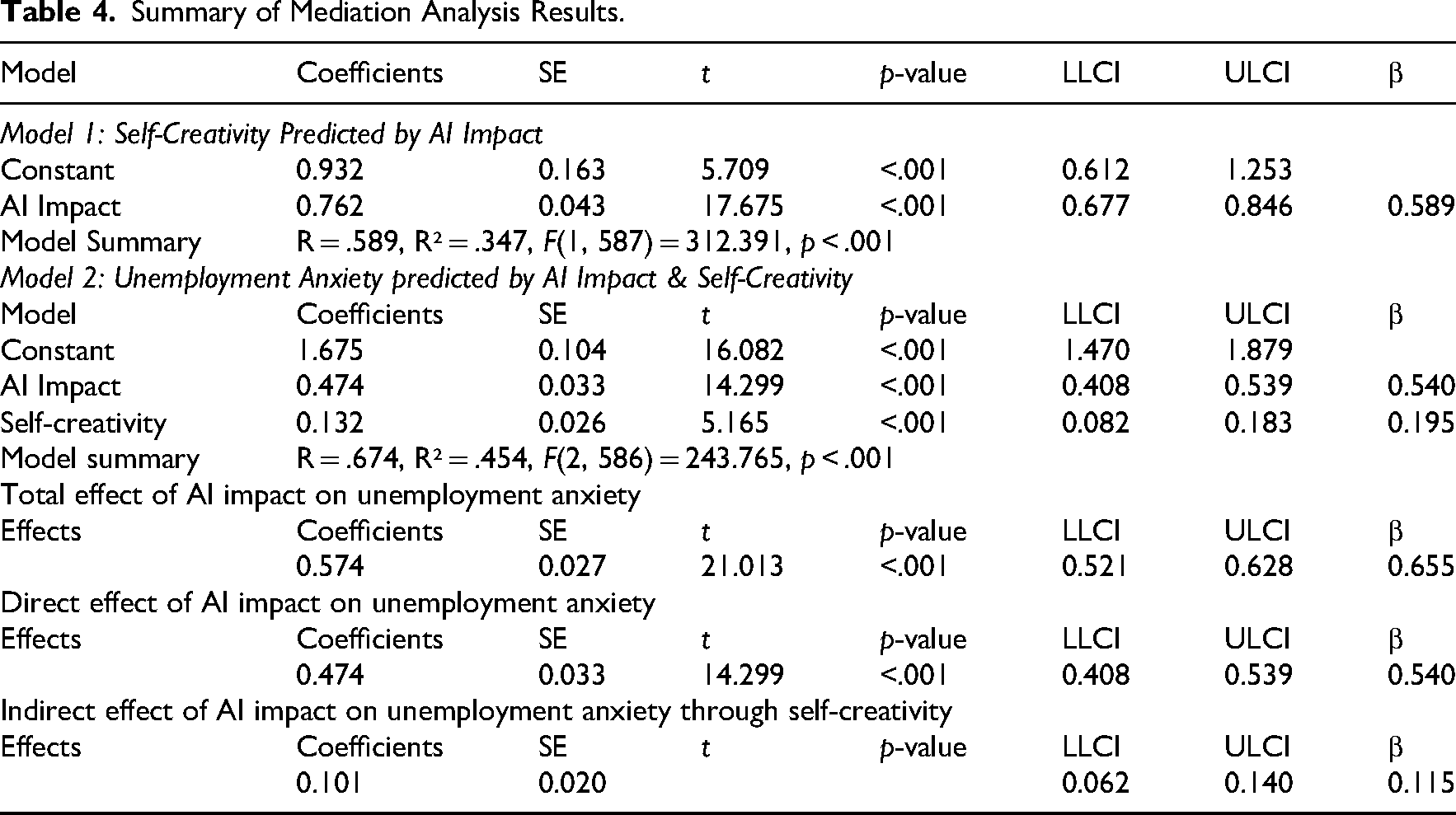
The study first examined the hypothesis that AI has a substantial impact on the identity of self-creativity among Fine Arts students (H1a). A simple linear regression analysis was conducted using the PROCESS macro in SPSS, where AI impact served as the independent variable (X) and self-creativity (SC) as the dependent variable (M). The results indicated a significant positive relationship between AI impact and SCI. The model summary revealed an R value of .589 and an R-squared of .347, suggesting that approximately 34.7% of the variance in SCI can be explained by AI impact (F(1, 587) = 312.391, p < .001). The regression coefficient for AI impact was significant (β = .762, SE = .043, t = 17.675, p < .001), with a 95% confidence interval ranging from .677 to .846. The standardized coefficient (β) was .589, indicating a moderate to strong effect size. These findings support H1a, demonstrating that AI impact significantly influences Fine Arts students’ SCI.
To test the hypothesis that SCI significantly affects UA among Fine Arts students (H1b), we performed a regression analysis with UA as the dependent variable and SCI as one of the independent variables, controlling for AI impact. The model was significant (R = .674, R-squared = .454, F(2, 586) = 243.765, p < .001), indicating that 45.4% of the variance in UA is explained by the predictors. The regression coefficient for self-creativity was significant (β = .132, SE = .026, t = 5.165, p < .001), with a 95% confidence interval from .082 to .183. The standardized coefficient (β) was .195, suggesting that higher levels of SCI are associated with higher UA. This supports H1b, confirming that SCI significantly affects UA in Fine Arts students.
Hypothesis H1c posited that AI significantly impacts UA among Fine Arts students. The regression analysis revealed a significant positive effect of AI impact on UA. In the total effect model where UA was regressed solely on AI impact (AI), the model was significant (R = .655, R-squared = .429, F(1, 587) = 441.540, p < .001). The regression coefficient for AI impact was significant (β = .574, SE = .027, t = 21.013, p < .001), with a 95% confidence interval between .521 and .628. The standardized coefficient (β) was .655, indicating a strong effect. This suggests that as the perceived impact of AI increases, UA among Fine Arts students also increases, thereby supporting H1c.
Lastly, the researcher investigated whether SCI mediates the relationship between AI impact and UA (H2). The current study assessed the indirect effect of AI impact on UA through SCI. The indirect effect was significant (Effect = .101, BootSE = .020, BootLLCI = .062, BootULCI = .140), and the confidence interval did not include zero, indicating a significant mediation effect. The direct effect of AI impact on UA remained significant (Effect = .474, SE = .033, t = 14.299, p < .001), although reduced from the total effect (Effect = .574). The standardized indirect effect was .115, with a 95% bootstrap confidence interval from .070 to .159. These results support H2, confirming that SCI partially mediates the relationship between AI impact and UA among Fine Arts students. Table 4 thoroughly summarizes the results of mediation analysis for the present study.
Summary of Mediation Analysis Results.
Conclusion and Discussion
Theoretical Implications and Empirical Contributions
The current study corroborates the hypotheses that AI exerts a significant influence on SCI and UA among Fine Arts students. In alignment with preceding research, our findings reveal a positive correlation between AI impact and SCI, accounting for approximately 34.7% of its variance (Hutson et al., 2022; Mirbabaie et al., 2021). This suggests that as AI technologies infiltrate creative industries, students perceive an enhancement in their creative self-concept, potentially due to AI's capacity to augment creative faculties (Creely & Blannin, 2023; Watkins & Barak-Medina, 2023). Nevertheless, the positive association between SCI and UA unveils a paradox; heightened SCI is associated with increased employability concerns (Daker et al., 2020; Susnea, 2017). This may stem from apprehensions that AI could render traditional artistic skills redundant, thereby intensifying anxieties regarding future employment prospects (Frank et al., 2019; Li & Zhang, 2022). The mediation analysis confirms that SCI partially mediates the relationship between AI impact and UA, thereby supporting Hypothesis 2. This finding is consistent with previous studies emphasizing the intricate interplay between AI, self-perception, and psychological well-being. The significant indirect effect indicates that the growing influence of AI not only directly heightens UA but also does so indirectly by enhancing SCI, which in turn amplifies anxiety levels.
Practical Implications and Strategic Recommendations
For Educational Institutions, the findings underscore the imperative for educational institutions to implement comprehensive strategies addressing the psychological ramifications of AI integration within creative domains (Ettman & Galea, 2023). Based on our empirical evidence, the researcher proposes the following strategic interventions:
AI Literacy Integration: Universities should systematically integrate AI literacy curricula that demystify AI technologies while emphasizing human–AI collaboration rather than competition (McGuire et al., 2024). This approach should include hands-on experience with generative AI tools, ethical AI usage training, and critical evaluation of AIGC (Owoseni et al., 2024). Psychological Resilience Programs: Institutions must establish dedicated counseling and support services addressing technology-induced anxiety. These programs should incorporate cognitive-behavioral interventions specifically designed to address UA while fostering adaptive coping mechanisms (Sharma, 2025; Moore et al., 2016). Creative Identity Development: Educational frameworks should explicitly focus on cultivating robust creative identities that emphasize uniquely human capabilities—emotional intelligence, cultural context understanding, and personal narrative construction—that remain beyond AI's current capabilities. Industry Partnership Programs: Universities should establish collaborative partnerships with creative industries to provide students with real-world exposure to AI–human collaborative workflows, thereby reducing uncertainty about future employment prospects.
For Fine Arts Students, Individual-level strategies should encompass:
Proactive AI Engagement: Students should actively engage with AI tools as creative collaborators rather than viewing them as threats, developing competency in human–AI cocreation workflows (Haase & Pokutta, 2024). Skill Diversification: Beyond traditional artistic skills, students should cultivate complementary competencies including AI prompt engineering, creative direction, and human-centered design thinking (Oppenlaender et al., 2024). Professional Identity Evolution: Students must reconceptualize their professional identity from “creators” to “creative directors” who orchestrate complex creative processes involving both human and AI (Oztas & Arda, 2025).
Limitations and Future Research Directions
Temporal and Geographic Constraints: This study was conducted within a specific temporal context (July–August 2024) and geographic location (Guangzhou, China), potentially limiting generalizability across different cultural contexts and technological adoption phases. Future research should examine cross-cultural variations in AI anxiety and employ longitudinal designs to track evolving perceptions as AI technologies mature.
Self-Report Methodology: The reliance on self-report measures may introduce response bias and social desirability effects. Future investigations should incorporate behavioral measures and objective assessments of creative output quality in human–AI collaborative contexts.
AI Proficiency Variations: While this study assessed AI familiarity, future research should develop more sophisticated measures of AI competency and examine how specific AI skills moderate the relationship between AI impact and employment anxiety.
Concluding Synthesis
In summation, this investigation illuminates the substantial impact of AI on Fine Arts students’ SCI and UA. The findings corroborate literature suggesting that AI both augments and challenges personal creativity and perceptions of employability (Mikalef & Gupta, 2021; Zhou & Sterman, 2024; Zarzycki, 2023). The positive correlation between AI impact and SCI indicates that AI tools are perceived as enhancing creative abilities (Ioannidou et al., 2024; Magni et al., 2023). However, the concomitant increase in UA necessitates critical examination of how AI influences students’ career outlooks (Ruiz-Talavera et al., 2023; Moybeka et al., 2023). The mediation effect discovered in this study provides crucial insights for educational policy and practice. Rather than viewing AI as an existential threat to creative education, institutions should embrace a paradigm of constructive adaptation, preparing students for a future characterized by human–AI collaboration rather than competition. This approach requires fundamental reconceptualization of creative education, emphasizing the development of uniquely human competencies while fostering technological fluency. Future research should investigate longitudinal trajectories of AI acceptance and anxiety, cross-cultural variations in AI adaptation, and the efficacy of specific interventions designed to enhance AI literacy while mitigating technology-induced anxiety. By addressing these challenges through evidence-based educational strategies, we can better equip the next generation of creative professionals for the evolving landscape of AI-augmented creative industries (Abdelwahab et al., 2022; Creely & Blannin, 2023).
Footnotes
Declaration of Conflicting Interests
The author declared no potential conflicts of interest with respect to the research, authorship, and/or publication of this article.
Ethical Considerations
This study was conducted in strict accordance with the ethical standards for research involving human participants and aligned with the principles of the Declaration of Helsinki. The research protocol, entitled *“I Am Creative, Therefore I Am Employable: Self-Creativity Identity as a Mediator of the AI-Unemployment Anxiety Link,”* authored by Li-Wei Wei (PhD), was reviewed and approved by the Human Research Ethics Committee of Dhurakij Pundit University (Research Project Number: DPUHREC008/67EX; Approval Number: COA001/68; Date of Approval: 1 August 2025). Prior to participation, all participants provided informed consent after being fully apprised of the study's purpose, procedures, potential risks and benefits, and their right to withdraw at any time without penalty. All ethical principles were upheld throughout the study, including the protection of participants' confidentiality, voluntary engagement, and secure handling of data in compliance with applicable institutional and legal guidelines.
Funding
The author received no financial support for the research, authorship, and/or publication of this article.
