




Abstract
Loneliness is widely reported among autistic adults and is associated with adverse mental health outcomes. However, loneliness in autism is often framed as a consequence of social isolation, reduced social motivation, or individual social difficulty. This article argues that these framings—while consistent with general loneliness models—overlook a central feature of autistic loneliness: it frequently occurs amid ongoing social participation. Drawing on belonging theory, neurodiversity scholarship, epistemic justice, minority stress, and broader loneliness frameworks, this conceptual analysis introduces the Presence Without Belonging (PWB) framework. PWB distinguishes social presence from belonging and identifies three conditions required for belonging: recognition (being understood and taken seriously as a social subject), access (participation without extraordinary communicative, sensory, or temporal effort), and sustainability (participation that can be maintained over time without disproportionate cumulative cost). When one or more conditions are absent, participation may persist without belonging, producing loneliness despite contact. By reframing loneliness as a relational and structural outcome rather than an individual deficit, this analysis provides a foundation for more precise measurement, more accurate clinical formulation, and more responsible approaches to inclusion.
Community Brief
Who is this brief for?
Autistic adults, families, practitioners, advocates, and community members.
What is this article about?
This article looks at why many autistic people feel lonely even when they are not socially isolated. Some autistic people are active at work, in school, in services, or in community settings, yet still experience loneliness. The article explores why social contact alone does not always lead to feeling connected.
How is this different from typical loneliness advice?
General approaches often focus on increasing social contact or changing thoughts about social situations. This article argues that for many autistic people, loneliness can persist even with contact if social spaces do not provide recognition, practical access, and sustainable participation.
Isn’t loneliness just about being alone?
Not always. Loneliness is about feeling disconnected, not just about how much time you spend with others. An autistic person can be surrounded by people and still feel lonely if their participation does not feel meaningful, safe, or sustainable.
What does the article mean by “belonging”?
Belonging means more than being included. It means feeling understood, accepted, and able to participate without constantly having to explain yourself, hide parts of who you are, or push past exhaustion just to keep up.
What conditions make belonging possible?
The article highlights three conditions:
Recognition: being understood and taken seriously as a social person, rather than being misread, dismissed, or spoken over. Access: being able to participate without overwhelming communication demands, sensory barriers, or time pressures. Sustainability: being able to stay engaged over time without burnout, constant masking, or repeated fights for support.
If even one of these is missing, social participation can continue, but it may feel draining or alienating rather than connecting.
Does this mean all autistic people are lonely?
No. Many autistic people enjoy spending time alone and do not experience loneliness. This article does not treat being alone as a problem. It focuses specifically on loneliness that happens despite social contact.
What is the main takeaway?
The article suggests that loneliness often reflects how social spaces are set up, not a failure on the part of autistic people. Shifting the focus away from telling autistic people to “be more social” and toward creating environments that are understandable, accessible, and sustainable may do more to reduce loneliness than increasing social exposure alone.
Keywords
Loneliness is widely reported among autistic adults and is associated with elevated anxiety and depression. 1 It has also been linked to reduced well-being and quality of life. Yet a persistent paradox runs through this literature: many autistic people who describe themselves as lonely are not necessarily socially isolated in a structural sense, highlighting a distinction between social presence and experienced connection. 2 They may be in classrooms, workplaces, families, clinics, and peer groups. 3 They may interact frequently with others, yet the loneliness remains. Qualitative accounts similarly describe a sense of being “with others but not truly connected,” even in socially populated environments. 4 This paradox points to a conceptual gap in how loneliness is currently understood. Existing models tend to focus on the absence or mismatch of social contact, 5 but struggle to explain situations in which interaction is present yet experienced as non-belonging. To address this gap, this article introduces the Presence Without Belonging (PWB) framework, which distinguishes social presence from the conditions required for belonging.
Loneliness in autism is often treated as a downstream consequence of limited social contact, social skills differences, or co-occurring mental health conditions. However, autistic loneliness often reflects PWB, a condition in which social participation occurs without recognition, access, or sustainability (Fig. 1A; see Fig. 1B, C for the general loop and the “what PWB adds” comparison). This article reframes loneliness in autism as a relational and structural phenomenon rather than an individual deficit.
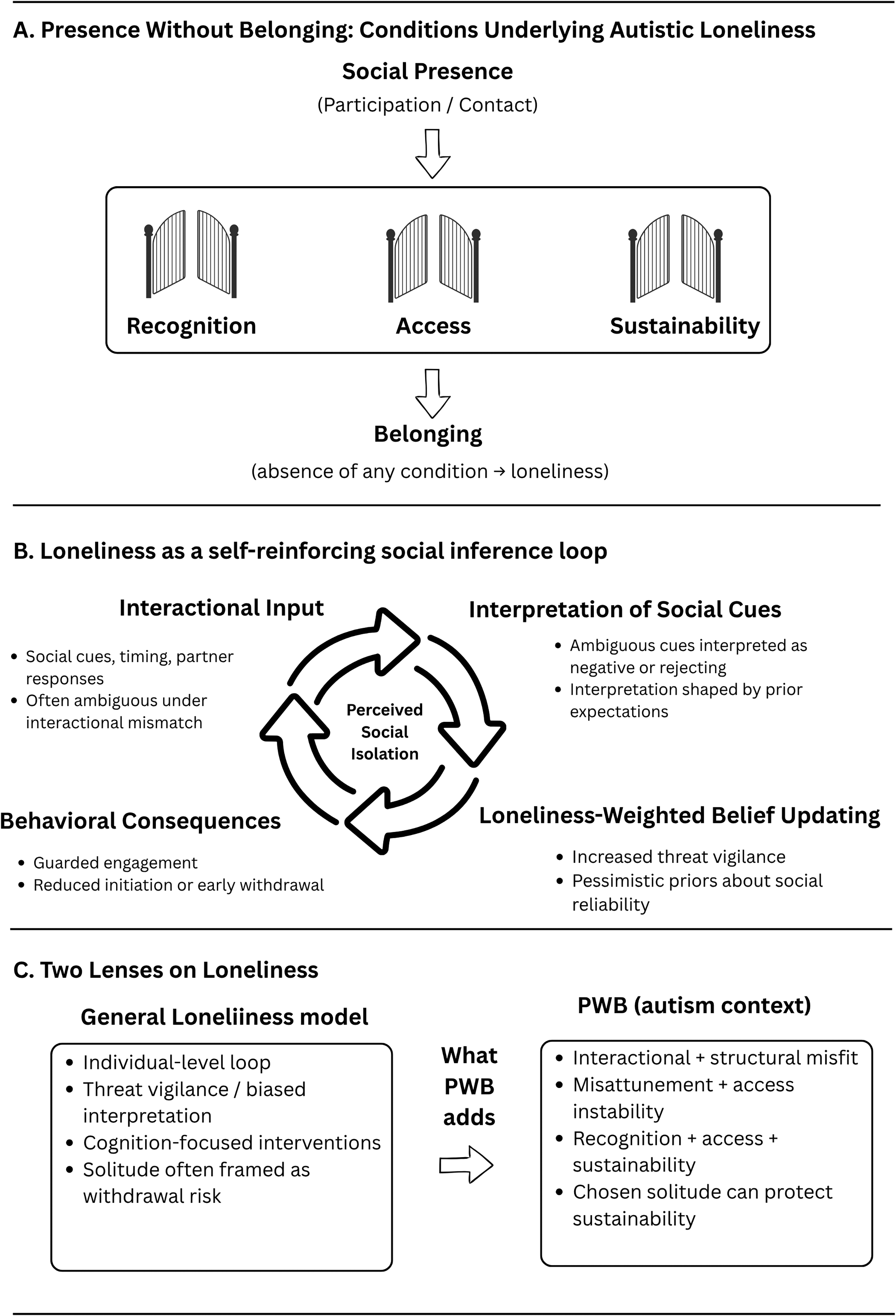
General loneliness maintenance and Presence Without Belonging (PWB) in autism.
Reviews have highlighted limitations in how loneliness is conceptualized and measured in autistic populations, including a relative lack of qualitative data and limited attention to broader dimensions of belonging. 1 These gaps leave unresolved why loneliness can persist even when social contact is present and social motivation is not absent. 6 While prior work has begun to examine environmental, sensory, and relational contributors to autistic loneliness,1,3,7 these accounts have not yet been integrated into a unified conceptual model of how loneliness persists in the presence of social contact.
This article advances a conceptual framework in which loneliness in autism arises when social presence is not accompanied by three conditions necessary for belonging: recognition, access, and sustainability. Recognition refers to being understood as a legitimate social subject rather than misread, dismissed, or infantilized.8,9 Access refers to whether interaction is communicatively, sensorily, and temporally possible without extraordinary effort. 10 Sustainability refers to whether participation can be maintained over time without disproportionate psychological or administrative burden.11,12 When these conditions are absent, social interaction may continue, but it becomes costly, fragile, or alienating. Loneliness, in this framing, is not the absence of others but the felt consequence of being unable to remain with others on terms that are livable. This analysis draws on belongingness theory, 13 neurodiversity scholarship, 14 the double empathy problem, 8 epistemic injustice, 9 and minority stress frameworks 15 to explain why loneliness persists under conditions of social participation. 1
Existing frameworks have identified important components of social experience, including the need to belong, 13 mutual understanding in interaction, 8 and the role of minority stress and structural barriers. 7 However, these accounts are often treated in parallel rather than as jointly necessary conditions for belonging. The PWB framework advances this literature by specifying that recognition, access, and sustainability are not independent contributors but interdependent conditions that must be simultaneously satisfied for belonging to occur. This shifts the focus from identifying individual correlates of loneliness to explaining how loneliness can persist even when some aspects of social participation appear intact.
The PWB framework provides a conceptual foundation for more precise measurement, more accurate clinical formulation, and more inclusive research design. In doing so, it reframes loneliness not as a personal failure to connect but as a predictable outcome of social and structural conditions that permit presence without ensuring belonging.
Conceptual Foundations
Understanding loneliness in autism requires conceptual clarity. Much of the confusion in the literature arises not from lack of data but from collapsing distinct phenomena under a single label. This section distinguishes loneliness from related constructs and situates it within relevant theory.
Loneliness, social isolation, exclusion, and belonging
Loneliness refers to distress arising from unmet connection needs and is distinct from objective social isolation and from chosen, restorative solitude.5,16,17 Belonging, by contrast, is a positive relational state—being received on one’s own terms rather than a proxy for contact or performance. 13 Table 1 summarizes these constructs, clarifying why social presence can coexist with loneliness in autism.
Constructs Often Conflated in Autistic Loneliness Research and How Presence Without Belonging Distinguishes Them
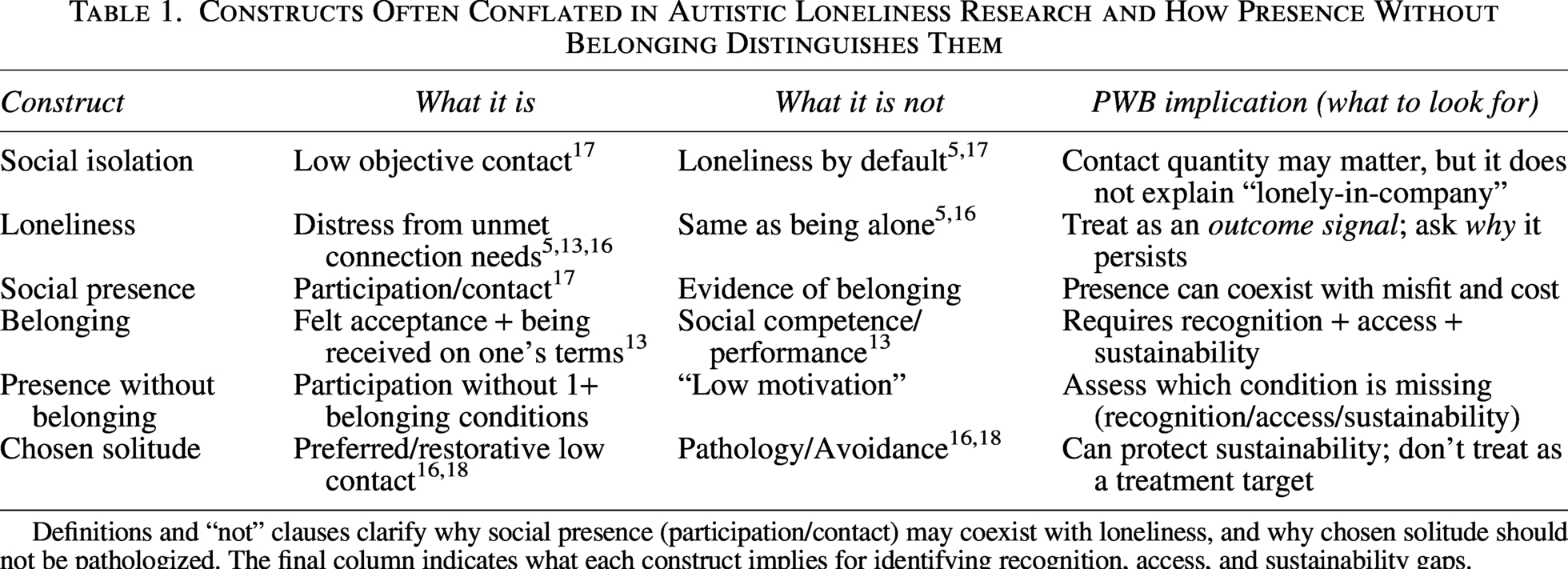
Definitions and “not” clauses clarify why social presence (participation/contact) may coexist with loneliness, and why chosen solitude should not be pathologized. The final column indicates what each construct implies for identifying recognition, access, and sustainability gaps.
Loneliness as a general psychological phenomenon: What existing frameworks explain
Loneliness research outside autism has established several principles relevant to understanding why loneliness can persist despite social contact. Cacioppo and colleagues’ evolutionary model characterizes loneliness as an adaptive signal that motivates social reconnection. 19 However, loneliness can become self-reinforcing: perceived social isolation heightens vigilance to social threat, biases interpretation of ambiguous cues, and promotes withdrawal or guarded engagement, reducing opportunities for positive social experiences.5,20 Over time, this stabilizes into loneliness cognition—patterns of hypervigilance and confirmation bias that make disconfirming social evidence difficult to integrate (Fig. 1B). 21
Importantly, increasing social contact alone does not reliably reduce loneliness. 22 Meta-analytic evidence shows that interventions targeting maladaptive social cognition are more effective than those focused on expanding opportunities, 22 suggesting that loneliness reflects qualitative features of social experience rather than the mere presence of others—given that interventions targeting social cognition outperform those focused on increasing contact. 22 The literature also distinguishes between emotional loneliness (absence of close attachments) from social loneliness (lack of broader social integration), which can occur independently. 18 Across both, relational quality—not quantity—is the stronger predictor of well-being. 13
While these frameworks provide essential scaffolding, they leave key gaps when applied to autism. They do not account for systematic communicative misattunement between autistic and non-autistic people that can generate persistent misunderstanding even when contact is frequent. 8 Nor do they address how sensory, communicative, and temporal access barriers shape whether participation is possible without extraordinary effort7,23 or the cumulative costs of sustained participation requiring constant self-monitoring or adaptation.7,11 The PWB framework builds on general loneliness science while extending it to capture these autism-specific dynamics (Fig. 1C).
Belonging as a fundamental need, not a personality preference
The belongingness hypothesis posits that humans have a fundamental need for meaningful interpersonal bonds, 13 independent of extraversion or social fluency. From this perspective, loneliness reflects unmet belonging needs rather than weak social motivation. Autistic people are often described as having reduced interest in social connection, yet this interpretation frequently conflates difficulty with normative social forms with lack of desire. Empirical work shows that autistic individuals seek connection and can experience rich engagement, particularly in contexts where interactional norms are shared or adapted. 24
More recent work—particularly within autism research—extends this account by conceptualizing belonging as relational and contextual: shaped not merely by social presence but by the extent to which individuals are understood, accepted, and able to participate without sustained effort to mask or adapt.3,7,8 From this perspective, belonging is not a function of proximity to others but of interactional fit and mutual understanding—contingent on the alignment between individual traits and environmental expectations rather than a universal outcome of social exposure. Persistent loneliness despite social contact therefore challenges accounts that attribute it to diminished motivation or preference for solitude, shifting attention toward the conditions under which participation becomes meaningful and sustaining.
Neurodiversity, misfit, and relational distress
Within a neurodiversity framework, disability-related distress emerges from misfit between individuals and environments rather than intrinsic impairment. 25 Loneliness can therefore be understood as a relational outcome of environments that privilege certain communication styles, sensory tolerances, and interactional tempos while marginalizing others. 25 This framing helps explain why loneliness persists in ostensibly inclusive settings, when inclusion is defined narrowly as access or nominal participation, deeper forms of misfit remain unaddressed. Autistics may be present in social environments that are not designed for their modes of engagement, leading to sustained strain rather than connection. Situating loneliness within this framework recasts it as a predictable outcome of relational misalignment rather than a deficit in social capacity. Related work on “ethical loneliness” in autism similarly shows how persistent misrecognition and environmental mismatch can produce disconnection despite social presence. 26
Double empathy and epistemic injustice
The double empathy problem describes the mutual difficulty autistic and non-autistic people may have in understanding one another’s experiences, intentions, and communicative cues, emphasizing reciprocity rather than unidirectional deficit. 8 Relatedly, work on epistemic injustice highlights how some individuals are systematically discredited as reliable knowers of their own experiences. 9 In autism, this can take the form of having one’s emotions misread, one’s reports discounted, or one’s communication treated as less authoritative. Research further shows that autistic communication is often rhetorically constrained, with legitimacy granted only when it conforms to neurotypical expectations.27,28
These processes matter for loneliness because recognition is not only about being seen but about being believed. When autistic people are repeatedly misinterpreted or required to translate their experiences into acceptable forms, social interaction may continue while relational trust erodes. Loneliness in this context reflects epistemic exclusion as much as social absence.
Minority stress and cumulative interactional burden
Minority stress theory describes how chronic exposure to stigma, prejudice, and social threat contributes to adverse mental health outcomes over time. 15 In autistic populations, this often operates through everyday interactions rather than overt discrimination, including demands for adaptation, concealment, and self-regulation.7,29 From this perspective, loneliness is not an isolated emotional state but a cumulative outcome of environments that require constant negotiation to remain intelligible and accepted.
Why Current Framings Fall Short
General loneliness frameworks provide useful grounding but offer incomplete explanations of autistic loneliness. Cacioppo and colleagues emphasize threat vigilance and confirmatory bias as maintaining mechanisms, 20 but do not address how these processes may arise from systematic interactional misattunement rather than individual social cognition alone. 8 Weiss’s 18 distinction between emotional and social loneliness similarly assumes that alleviating loneliness primarily involves changing behavior or increasing opportunities, without theorizing communicative or structural barriers that can make participation costly even when opportunities are present. 7 Meta-analytic evidence that cognitive interventions outperform contact-based approaches 22 reinforces that loneliness is not simply about absence but does not specify the relational conditions under which presence becomes meaningful. These models therefore require extension to account for the interactional and structural dynamics central to autistic loneliness.
These limitations become especially salient in autism. Despite growing literature, dominant explanatory frames struggle to account for why loneliness persists under conditions of social contact, inclusion, or apparent competence. The approaches below each capture part of the phenomenon while leaving core dynamics unaddressed.
Social skills and competence-based accounts
One influential approach treats loneliness as a consequence of social skills differences. While such models can explain some interactional challenges, they do not account for loneliness among autistic adults who are socially active, fluent in spoken language, or highly skilled at navigating normative expectations.3,11,30
Reduced social motivation accounts
Another common explanation attributes loneliness to diminished social motivation or a preference for solitude. This framing often conflates withdrawal with disinterest and treats reduced participation as evidence of limited desire for connection. However, qualitative and experimental findings show that autistic people value social connection and often report a strong desire for meaningful relationships, particularly in contexts where interactional norms are shared or flexible.6,29,30 These accounts also fail to distinguish between chosen solitude and enforced withdrawal.
Avoiding interaction after repeated experiences of misunderstanding, exhaustion, or dismissal is not equivalent to lacking interest in connection. Treating these outcomes as motivational deficits risks mischaracterizing adaptive self-protection as social disengagement.7,31
Co-occurrence-based explanations
Loneliness is frequently discussed as a correlate of anxiety, depression, or other mental health conditions. While these associations are robust, such explanations often operate circularly, treating loneliness as both cause and consequence without clarifying the conditions under which it emerges. 32 When distress is attributed solely to internal states, relational and structural contributors are rendered invisible.
Similar dynamics appear in public-facing discussions of autism and loneliness, including prior commentary and writing by the author, where distress is frequently met with reassurance or encouragement to cope rather than changes to the conditions producing loneliness.33,34 These narratives mirror academic tendencies to locate loneliness within individual emotional states, reinforcing the assumption that relief should come from internal adjustment rather than relational or structural change. 5
Camouflaging as a partial explanation
Research on camouflaging has documented the emotional and psychological costs of masking autistic traits in social contexts, including increased loneliness, anxiety, and exhaustion. 11 However, camouflaging alone does not explain why participation requires such effort in the first place. 7 Framing camouflaging as an individual strategy risks obscuring the norms that make masking necessary. 7 Without accounting for recognition and access, it can be misinterpreted as a personal coping style rather than a response to environments that reward conformity and penalize difference.
Methodological invisibility and whose loneliness counts
A further limitation concerns who is represented in loneliness research. Much of the literature focuses on adults with spoken communication who can complete standard self-report measures, excluding those who use AAC, require complex levels of support, or live in structured settings.35–37 For these individuals, “contact” may mean rotating staff and task-focused interaction rather than chosen, reciprocal connection.35,36 Loneliness may remain high even when they are rarely alone. 33 A public-health framing similarly distinguishes being surrounded by people from being known and connected. 38 PWB therefore treats the presence of staffing as social presence and asks whether recognition, access, and sustainability are met.
As a result, forms of loneliness tied to communication access, proxy decision making, and restricted autonomy remain under-theorized. 9 Methodological norms shape whose experiences are visible and whose are omitted. 37 When measurement privileges normative communication, loneliness is framed as a problem of social functioning rather than a signal of exclusionary design. 25
Toward a relational account
Existing framings locate loneliness primarily within individuals, whether as skill deficits, motivational differences, or co-occurring distress. What they lack is a relational account that explains how social environments can permit presence while withholding the conditions required for belonging. Cross-disciplinary neurodiversity-informed approaches emphasize cultural and interactional factors shaping autistic experience. 39 Applying this lens clarifies why increasing contact, skills, or reassurance often fails; without recognition, access, and sustainability, social participation may continue, but belonging does not follow. This gap motivates the conceptual framework introduced in the next section.
Presence Without Belonging: A Conceptual Framework
The central claim of this article is straightforward: loneliness in autism is often not a problem of absence but of conditions. Autistic individuals may be socially present—participating in classrooms, workplaces, services, and relationships—yet still experience persistent loneliness. What is missing is not contact, but the conditions that make participation livable. The PWB framework formalizes this distinction by separating social presence from belonging and proposing three interacting conditions: recognition, access, and sustainability. When one or more of these conditions are absent, participation may continue, but under strain that is experienced as loneliness. This reframing shifts the question from whether autistic people are socially engaged to the conditions under which that engagement occurs and whether it supports belonging.
Presence and belonging are not equivalent
Much of the loneliness literature treats social contact as a proxy for connection. 5 However, this assumption breaks down when contact is present, but connection is not. Belonging is not a function of proximity or frequency. It is a relational state in which a person can participate without needing to constantly monitor, adjust, or justify themselves—being received on one’s own terms rather than merely included.
For autistic individuals, this distinction becomes especially visible. Social environments often permit participation while maintaining narrow expectations about how interaction should occur. As a result, being present can require continuous adaptation—translating communication, suppressing differences, managing impressions, or anticipating misunderstanding.11,40 This is where the breakdown occurs. Presence achieved through such effort does not reliably produce belonging. In some cases, it undermines it. When remaining intelligible or acceptable requires ongoing adjustment, interaction becomes something to sustain rather than something that connects. The PWB framework begins from this point: social presence is necessary, but not sufficient.
Recognition: Being understood as a legitimate social subject
The first condition for belonging is recognition. Recognition refers to being understood as a meaningful and credible participant in social interaction—having one’s communication, affect, and intentions treated as coherent and valid. It is not reducible to inclusion, politeness, or even positive regard.
Failures of recognition are common in autistic experience. Communication may be misread, interpreted as inappropriate or absent, and intentions inferred through deficit-based assumptions. These patterns align with the double empathy problem, which highlights mutual breakdowns in understanding across neurotypes. 8 They also reflect deeper asymmetries in interpretive authority, often described in epistemic injustice. 9 When recognition is unreliable, interaction becomes unstable. A person can be present yet unsure whether they are being understood, believed, or taken seriously. Loneliness in this context is not the absence of others but the absence of being met as a legitimate participant.
Access: Participation without extraordinary effort
The second condition for belonging is access. Access refers to whether participation is possible without disproportionate effort, extending beyond physical accommodations to include pacing, sensory load, implicit norms, expectations about communication, and tolerance for difference.
For many autistic individuals, these demands create a constant background effort. Conversations may move too quickly, rely on unstated assumptions, or occur in sensorily overwhelming environments. Alternative communication methods may be available in principle but discouraged in practice, and accommodations may require repeated explanation or negotiation. 36
Importantly, lack of access does not eliminate participation. People still attend, respond, contribute, and comply—but often by compensating. Participation becomes adjusting rather than mutual engagement. This distinction is critical: accessible conditions enable engagement, whereas inaccessible conditions require endurance. When access is unstable or partial, interaction becomes effortful rather than connective, and loneliness emerges not from absence but from constrained participation.
Sustainability: The cost of staying engaged over time
The third condition for belonging is sustainability. Sustainability refers to whether social participation can be maintained over time without accumulating excessive cost. While access determines whether participation is possible in the moment, sustainability determines whether it is livable across time. Many forms of participation that appear successful in the short term are not sustainable. Autistic individuals frequently describe the cumulative burden of repairing misunderstandings, managing expectations, and navigating inconsistent support. 33
This burden is often asymmetric: responsibility for maintaining interaction falls on the autistic person, while the structure of the interaction remains unchanged. Participation is therefore possible, but only through sustained self-adjustment. When this cost exceeds manageable limits, participation becomes difficult to maintain. Often described as autistic burnout, this state reflects exhaustion and reduced functioning following prolonged strain. 31 Within the PWB framework, burnout is not a separate outcome but an indicator that participation has become unsustainable. Withdrawal, in this context, reflects the costs of conditions—not reduced motivation for connection.
Interaction of recognition, access, and sustainability
Recognition, access, and sustainability are analytically distinct but operate together. Failures of recognition increase the effort required to maintain access; inaccessible environments increase costs, undermining sustainability; and unsustainable participation reduces opportunities for recognition and reinforces withdrawal. These processes form a feedback system in which loneliness emerges from the interaction of conditions, rather than a single deficit. While individuals may experience different primary constraints, what unifies these experiences is their structure: social presence without the conditions required for belonging.
What the PWB framework explains
The framework explains why loneliness can persist despite frequent social contact, and why improving observable social performance does not reliably reduce loneliness. It also accounts for why autistic-majority or norm-flexible environments are often experienced as less lonely even with fewer interactions. 24 More broadly, it explains how withdrawal can coexist with a strong desire for connection, and why inclusion efforts can intensify loneliness under strain rather than absence. Crucially, the PWB framework shifts the level of explanation: loneliness is not located within the individual but arises from the structure of interaction.
Positioning relative to existing frameworks
The PWB framework builds on, but is distinct from, existing approaches. Traditional loneliness models conceptualize loneliness as a discrepancy between desired and actual social relationships, often in terms of quantity or perceived quality of interaction.5,16 While valuable, these models do not fully account for situations in which interaction is present but structurally misaligned.
The Double Empathy framework 8 provides a relational account of cross-neurotype misunderstanding. PWB extends this by specifying the conditions under which such breakdowns produce sustained loneliness—failures of recognition, barriers to access, and the cumulative participation costs. Belonging frameworks emphasize being valued within groups, 13 and emerging work in autism highlights shared understanding, norm flexibility, and environmental fit.8,41 However, these approaches treat belonging as an outcome of inclusion rather than a function of the conditions under which participation occurs. PWB shifts the focus to those conditions.
In this sense, PWB is not simply a model of loneliness but of how loneliness is produced under conditions of participation. It predicts that interventions focused solely on improving individual social performance will have limited effects unless recognition, access, and sustainability are addressed. This account aligns with broader psychological models emphasizing social context, including social safety theory 42 and interpersonal theories of belongingness and thwarted social connection.43–45 Qualitative accounts similarly show that barriers to connection arise from sensory environments, lack of shared understanding, and limited societal acceptance, even in the presence of contact. 46 PWB extends this literature by specifying when social presence becomes belonging rather than ongoing disconnection.
Implications for Measurement and Research Design
If loneliness in autism is understood primarily as an individual emotional state or proxy for social isolation, standard measurement approaches are largely sufficient. If, however, loneliness reflects the absence of recognition, access, and sustainability under conditions of social presence, then existing tools capture only part of the phenomenon. The PWB framework therefore has direct implications for how loneliness is operationalized, measured, and studied. 1
Limits of standard loneliness measures
Most loneliness research relies on global self-report scales (e.g., UCLA Loneliness Scale) that assess subjective distress but remain agnostic about why loneliness occurs.5,16,47 They do not distinguish between loneliness driven by isolation, loneliness driven by misrecognition, or unsustainable participation. As a result, individuals with markedly different social realities may receive similar scores—for example, someone living alone who desires connection and someone socially engaged but chronically misunderstood.1,17 Without additional measures, these experiences are analytically collapsed.
Emerging work has begun adapting these measures for autistic populations, underscoring the need for more context-sensitive assessment. 48 Contemporary mixed-methods evidence further shows that loneliness in autism is closely tied to sensory and environmental mismatch while distinguishing loneliness from social isolation and chosen (restorative) solitude. 49 Qualitative work similarly documents that loneliness often arises from structural barriers to connection, including sensory environments, lack of societal understanding, and limited opportunities for shared understanding. 46
These limitations constrain theoretical precision and downstream interpretation. The PWB framework does not argue against the use of loneliness scales but reframes them: scores should be interpreted as outcome signals that require contextual explanation.
Measuring recognition
Recognition—central to social experience—is measured directly in autism research. 50 Related constructs (e.g., perceived understanding, validation, interpersonal trust) offer partial analogues, but are not typically adapted for autistic populations or communication diversity. 37 From a PWB perspective, relevant domains include perceived credibility of communication, confidence in being accurately interpreted, and expectations of being taken seriously in interaction. These dimensions index whether engagement is experienced as reciprocal and valid, rather than corrective. Qualitative and mixed-methods work consistently identifies recognition failures as salient to autistic social distress, yet this dimension remains under-theorized and under-measured. 50 Incorporating recognition-focused items would allow researchers to distinguish loneliness associated with misrecognition from loneliness associated with the absence of contact.
Measuring access in social interaction
Access is often treated as a binary condition—either accommodations are present or not. 12 The PWB framework instead conceptualizes access as a gradient: interaction may be technically possible but practically costly. 7 Measurement should therefore assess not only whether participation is possible but whether it is experienced as accessible without constant self-adjustment.11,29 Relevant domains include communication pacing, sensory tolerability, predictability of norms, and the social cost of requesting accommodations. Disability research on environmental fit and participation restrictions offers useful models by asking not simply whether participation occurs but under what conditions and at what cost. 51 Applying this logic to social interaction makes visible forms of exclusion that occur within nominal inclusion.
Measuring sustainability and cumulative cost
Sustainability is the least captured dimension in current loneliness research.5,31 Most studies assess loneliness at a single time point, implicitly treating social participation as static. The PWB framework highlights cumulative burden and temporal dynamics. 31 Relevant constructs include masking frequency, recovery time after interaction, administrative burden with accessing supports, and anticipatory stress. While some of these domains are studied in adjacent literatures (e.g., camouflaging, burnout), they are rarely analyzed alongside loneliness.11,31 This distinction is critical: loneliness may increase even as contact increases when participation is not sustainable.
Inclusion, accessibility, and whose loneliness is studied
Measurement choices shape whose experiences are represented. 37 Autism loneliness disproportionately samples individuals able to complete standard self-report instruments under typical research conditions. Those who use AAC, require assistance to participate in research, or live in highly structured environments are frequently excluded.36,37 This exclusion has conceptual consequences. When samples privilege individuals with greater communication access, theories of loneliness are more likely to emphasize internal traits over structural barriers.25,52 Methodological norms can thus reinforce deficit-based interpretations by rendering exclusion invisible. 37
A PWB-informed approach requires attention to measurement accessibility, including multiple response formats, and treating alternative communication as legitimate data rather than noise. 35 Without these steps, the forms of loneliness most closely tied to access and sustainability will remain underrepresented.
Toward mechanism-sensitive, non-reductive measurement
Refining measurement is not about fragmenting loneliness into narrower constructs but situating it within a relational ecology.25,39 Recognition, access, and sustainability are not substitutes for loneliness measures; they are explanatory dimensions that clarify why loneliness arises and persists. Incorporating these dimensions enables movement beyond correlational description toward models that respect heterogeneity and context. This, in turn, supports more accurate interpretation of findings and avoids attributing loneliness to individual deficits when it reflects unmet conditions for belonging.25,52
Implications for Clinical Formulation
Clinical discussions of loneliness in autism often locate distress within the individual, framing it as withdrawal, reduced motivation, anxiety-driven avoidance, or relational difficulty. While such formulations may describe observable patterns, they do not explain why loneliness can persist despite ongoing social participation. The PWB framework offers an alternative lens: loneliness is not evidence of social failure but a meaningful signal of unmet relational conditions—specifically breakdowns in recognition, access, and sustainability.
Reframing loneliness as an interpretive signal
Within the PWB framework, loneliness is not treated as a symptom to be reduced in isolation but as information about the interaction between an individual and their social environment. High loneliness in the context of frequent social contact suggests that participation is occurring without recognition, access, or sustainability. From a formulation standpoint (see Box 1), this shifts the clinical question from “Why is this person lonely?” to “What conditions make social participation costly or unsafe for this person?” It challenges assumptions that loneliness necessarily reflects avoidance, lack of effort, or diminished desire for connection. An autistic person who attends work, school, or social activities may still experience profound loneliness if participation requires constant self-monitoring or compensation.
Implications for clinical goals and priorities
Formulating loneliness through the PWB framework alters the targets of intervention. Rather than prioritizing increased exposure or improved social performance, clinical work can focus on reducing interactional cost, increasing reliability of recognition, and stabilizing access. The framework also legitimizes solitude when it is chosen and restorative. Loneliness is not equivalent to being alone. Formulations that respect this distinction avoid pressuring individuals toward forms of social engagement that do not meet conditions for belonging.
Box 1. Clinical Formulation of Loneliness Beyond Social Exposure
Recognition-focused formulation asks whether an individual is consistently understood on their own terms. Clinically, this involves attending to patterns of misinterpretation, dismissal, or overcorrection across the person’s social history. Reports of being misunderstood, not taken seriously, or having one’s affect misread should be treated as clinically salient rather than peripheral.3,36 In practice, this means listening for moments when interaction feels invalidating or effortful despite apparent participation. Recognition failures often appear indirectly, through frustration, exhaustion, or reluctance to engage, and help distinguish loneliness driven by misattunement from loneliness driven by isolation.
Access-oriented formulation examines whether social interaction is practically navigable without extraordinary effort. This includes communication pacing, sensory demands, predictability of expectations, and consistency of accommodations. Access should be assessed as experienced rather than assumed. Clinically, this requires moving beyond accommodation checklists to understand how reliably supports are implemented and at what social cost. For example, a person may technically have access to alternative communication or sensory adjustments yet avoid using them due to stigma or repeated negotiation. In such cases, loneliness reflects fragile access rather than lack of opportunity.35–37,53
Sustainability-focused formulation considers whether social participation can be maintained over time without cumulative harm. This includes masking demands, recovery time, anticipatory stress, and emotional labor. Withdrawal is not immediately pathologized but examined as a possible response to prolonged, unsustainable engagement. When loneliness co-occurs with exhaustion or burnout, formulation should consider whether participation has exceeded sustainable limits. Efforts to increase engagement without addressing sustainability risk are intensifying distress rather than alleviating loneliness.11,29,31
Note: Use this as a formulation guide when loneliness persists despite contact; the target is not “more exposure,” but identifying which belonging condition is missing and where the cost is accumulating.
What the PWB framework cautions against
The framework highlights common clinical missteps, including interpreting loneliness as resistance to treatment, assuming reassurance alone is sufficient, or framing withdrawal as avoidance without examining interactional burden. Each of these risks reinforces the very conditions that sustain loneliness. By treating loneliness as a relational outcome rather than an individual deficit, the PWB framework supports formulations that are more accurate, less pathologizing, and better aligned with autistic lived experience.
Systems and Community Implications
Loneliness in autism is often framed as a personal or interpersonal problem, yet the PWB framework underscores the central role of systems and environments. Inclusion policies, service structures, and community norms shape whether recognition, access, and sustainability are possible in everyday life. When these conditions are absent, loneliness becomes a predictable outcome of institutional design rather than an individual shortcoming.7,15
Inclusion without belonging
Many institutions define inclusion in terms of access to space or opportunity. Autistic people may be admitted to classrooms, workplaces, clinics, or social programs, yet interactional norms remain unchanged. Participation is permitted, but only within narrow normative expectations of communication, pacing, and affect. 29 In such contexts, inclusion functions as presence without belonging. The burden of adaptation falls on the autistic person, while institutional norms are treated as neutral or inevitable.7,8 This dynamic often produces sustained engagement alongside persistent loneliness.
Institutions as loneliness amplifiers
Institutions often amplify loneliness through practices that appear neutral but have cumulative exclusionary effects.12,36 Rigid communication expectations, limited tolerance for alternative participation formats, and procedural barriers to accommodation do not require explicit exclusion to produce it. Health care and service systems are particularly salient. Autistic adults frequently report being spoken over, having their experiences reframed, or repeatedly justifying support needs.28,36 These interactions erode recognition and make engagement effortful. Loneliness in such contexts reflects not only social absence but also repeated relational invalidation.
Community norms and autistic-majority spaces
Community context shapes whether belonging is possible. Autistic-majority or autism-affirming spaces are often described as less lonely, despite fewer interactions—a pattern difficult to explain through contact-based models.1,13 Within the PWB framework, this reflects greater reliability on recognition, built-in access, and reduced demands to adapt. Connection is structured less by frequency of interaction and more by shared expectations and reduced need for self-correction. 52 These contexts illustrate that loneliness is not intrinsic to autism, but contingent on relational outcome.
Communication access as a community responsibility
Loneliness among autistic people who use AAC or alternative communication methods is often rendered invisible. Communication access is frequently treated as an individual accommodation rather than a shared responsibility. 36 When interaction is structured around speed, speech fluency, or implicit cues, those who communicate differently may be present but effectively excluded. 8 From a systems perspective, communication access is a prerequisite for belonging, not an optional support. Communities that normalize multiple communication modalities reduce interactional burden and expand the range of people who can participate meaningfully. Failure to do so reinforces loneliness within nominal inclusion.
Designing for sustainability, not endurance
Finally, systems often reward endurance rather than sustainability. Autistics may be praised for coping, masking, or “pushing through” challenging environments, while the costs of doing so are ignored. 34 Over time, this approach produces burnout, withdrawal, and deepened loneliness. Designing for sustainability requires shifting responsibility from individuals to environments. 31 This includes stabilizing accommodations, reducing administrative burden, and valuing forms of participation that do not require constant adaptation. When systems are designed to be livable rather than merely accessible, loneliness becomes less likely to persist.
Limitations and Boundaries
This article advances a conceptual framework rather than an empirical model, and its claims should be interpreted accordingly. The PWB framework is intended to clarify how loneliness in autism can arise under conditions of social presence, not to replace existing descriptive or correlational work. It does not provide prevalence estimates, test causal pathways, or specify intervention efficacy. The framework also does not assume that all autistic loneliness is uniform. Autism is heterogeneous, and experiences of recognition, access, and sustainability vary widely across individuals, contexts, cultures, and life stages. Some autistics experience little or no loneliness and may prefer limited social engagement. Solitude that is chosen and restorative should not be conflated with loneliness. 18 The framework is designed to distinguish these experiences, not collapse them. Cultural context represents an additional boundary. Norms around communication, interdependence, and belonging differ across societies and the conditions under which loneliness emerges. Much of the literature discussed here is drawn from Western contexts, and the framework therefore requires careful adaptation and validation in cross-cultural settings.
This analysis also brackets cognitive, perceptual, and neural mechanisms. While such processes may influence how loneliness is experienced or regulated, they are beyond the scope of this article. The focus on relational and structural conditions is deliberate: explanatory clarity at the interactional level is treated as a prerequisite for engaging lower-level mechanisms, not a substitute for them. Finally, the framework does not prescribe specific interventions or policies. Although it has clear implications for practice and systems design, translating these into concrete supports requires empirical testing, participatory input, and contextual tailoring. The absence of prescriptive guidance should therefore be understood as a boundary of scope rather than a limitation of relevance.
Conclusion
Loneliness in autism is widely documented, 1 yet it remains conceptually under-specified. Much of the literature treats loneliness as a function of social isolation, individual social difficulty, or co-occurring distress.1,2 This article has argued that a central feature of autistic loneliness is often missed: it can persist under conditions of ongoing social presence.3,32 The PWB framework names that gap. By distinguishing presence from belonging—and specifying recognition, access, and sustainability as necessary conditions—it reframes loneliness as a relational and structural outcome. Individuals can be included, engaged, and “present,” while the conditions that make participation livable are absent. From this perspective, the framework predicts that interventions targeting social skills alone will have limited effects on loneliness unless conditions of recognition, access, and sustainability are simultaneously addressed.
This reframing shifts what counts as explanation and what counts as progress. It helps explain why loneliness can persist in settings that appear inclusive, why increasing contact or emphasizing performance does not reliably resolve loneliness, and why withdrawal may reflect self-protection in response to unsustainable participation rather than reduced desire for connection.13,22,29,31 It also clarifies why autistic-majority or norm-flexible contexts can reduce loneliness even when networks are smaller: recognition is more reliable, access is built into interaction, and sustainability is protected.30,50
The implications are practical. Reducing loneliness requires moving from exposure-based models to condition-based models. For research, this means measuring the conditions that convert contact into belonging (recognition, access, sustainability), rather than relying solely on contact quantity or global loneliness scores. Sampling and methods should also be designed, so that AAC users and people with complex support needs are represented, rather than treated as measurement exceptions. For clinical practice, it shifts formulation away from “Why isn’t this person connecting?” and toward “Which belonging condition is missing here, and where is the cost accumulating?” (recognition, access, sustainability). For systems and services, it redefines inclusion as more than participation. Inclusion that depends on masking, sensory endurance, rapid normative communication, or repeated self-justification can intensify loneliness by increasing the cumulative cost of participation and undermining belonging conditions.11,29,31,36,53
PWB is a conceptual framework, not a finished mechanism model but it offers a usable target: design social environments where recognition is dependable, access is routine, and participation is sustainable. When those conditions are present, loneliness is not an inevitable feature of autism; it is a context-sensitive outcome that can be changed.
Positionality Statement
The author is an autistic + attention-deficit/hyperactivity disorder researcher whose work spans neuroscience, psychology, disability studies, and autism advocacy. This perspective informed the conceptual framing of loneliness as a relational and structural phenomenon rather than an individual deficit. To mitigate the limitations of any single perspective, this analysis draws on interdisciplinary scholarship and centers autistic first-person accounts alongside empirical research.
Footnotes
Author Disclosure Statement
No competing financial interests exist.
Funding Information
No funding was received for this article.