



Abstract
Stochastic long-term mine planning has evolved to account for different sources of uncertainty. Typically, the uncertainty and local variability of boundaries in geological domains have been overlooked by experts through their deterministic interpretation of available data. Categorical attributes are used to model geological domains, and their stochastic simulation accounts for the mentioned issues. The ability of two-points simulation methods to reproduce complex patterns or the requirement of a training image in multiple-points simulation methods has limited their implementation in mining environments. The high-order simulation of categorical attributes presents a mathematically consistent framework that overcomes these limitations by using high-order spatial statistics from sample data. The case study at a gold mining complex shows two stochastic mine plans based on two sets of geological realisations: geological domains in the first set are modelled using conventional wireframes, while, in the second, they are simulated through the high-order method. The resulting mine plans are substantially different; while both plans present a similar quantity of metal recovered and lifespan, risk profiles are up to 40% wider, and the expected NPV is 20% higher for the case of simulated geological domains, given the decrease of waste handling costs and the corresponding reduction in environmental footprint.
Keywords
Introduction
A mining complex or mineral value chain is an engineering system that manages the extraction, handling and processing of valuable materials from the ground to their final destinations, such as storing facilities, clients and spot markets. This system can consist of several mines, stockpiles, waste dumps, processing facilities, tailings dams and transportation mechanisms (Goodfellow and Dimitrakopoulos, 2017; Hoerger et al., 1999a, 1999b; Montiel and Dimitrakopoulos, 2015; Pimentel et al., 2010; Whittle, 2007, 2018). Conventional approaches to mining complexes (Barbaro and Ramani, 1986; Hoerger et al., 1999a, 1999b; Whittle, 2007, 2014, 2018; Zuckerberg et al., 2007) attempt to deterministically optimise siloed components of a mining complex.
In recent years, several methodologies have emerged to address the challenge of strategic open-pit mine production scheduling under geological uncertainty. A two-stage stochastic integer programming (SIP) formulation was developed (Dimitrakopoulos and Ramazan, 2008; Ramazan and Dimitrakopoulos, 2007, 2013), which maximises expected NPV while minimising the risk of not meeting production targets in terms of ore tonnes, grades and blending requirements. Boland et al. (2008) introduced a multistage stochastic programming approach that emphasised the evolving nature of open-pit mine operations, such that decisions made later depend on observations of the material mined in earlier periods by assuming that grades of the mined materials are known at the beginning of each period. Mai et al. (2019) proposed a SIP method that required the aggregation of blocks, which misrepresents the selectivity of materials to mine. While SIP formulations can obtain higher values than traditional deterministic formulations by quantifying and managing the risk of not meeting production targets, they are designed for a single pit. Thus, they cannot capitalise on the synergies of the simultaneous optimisation of a mining complex.
Unlike conventional approaches, the simultaneous stochastic optimisation (SSO) of a mining complex manages the supply and demand uncertainties related to geological attributes and commodity prices, respectively. SSO capitalises on the synergies of the different parts of the mineral value chain by optimising the strategic decisions simultaneously and in a single mathematical formulation. As a result, the expected net present value (NPV) is increased by up to 30%, as compared with the performance of a solution generated through standard practices (Del Castillo and Dimitrakopoulos, 2019; Dimitrakopoulos and Lamghari, 2022; Farmer and Dimitrakopoulos, 2018; Goodfellow and Dimitrakopoulos, 2016, 2017; Levinson and Dimitrakopoulos, 2020; Montiel and Dimitrakopoulos, 2013, 2015, 2017, 2018; Montiel et al., 2016). These decisions are taken under different sources of uncertainty and correspond to extraction sequences, destination policies and downstream decisions. The holistic approach of SSO unveils hidden value and reaches a higher NPV (Birge and Louveaux, 2011; Dimitrakopoulos, 2011; Dimitrakopoulos and Lamghari, 2022; Dimitrakopoulos and Ramazan, 2008) than siloed and deterministic optimisations of the mineral value chain components, while honouring technical constraints. SSO also allows for the management of the technical risk of not meeting production targets by penalising deviations from goals in the objective function.
Geological uncertainty of categorical and continuous attributes, such as geological units and element grades in mineral deposits, has been long identified as significant cause of risk of not meeting technical and financial outcomes (Dimitrakopoulos et al., 2002; Dowd, 1994, 1997; Jewbali et al., 2018; Ravenscroft, 1992; Vallée, 2000). These problems are due to ignoring geological uncertainty, misrepresentation of wireframed volumes and local variability of geological attributes. Conventional geological models, based on estimation methods, are known to cause such issues (Journel and Alabert, 1989), while stochastic geological modelling represents uncertainty and reproduces local variability found in drill-hole data. Geological uncertainty is incorporated into the simultaneous stochastic optimisation framework as a set of different equally probable orebody models with their respective categorical or continuous attributes simulated.
For categorical attributes, conventional geological modelling is understood as the subjective task of constructing wireframed volumes and boundaries for each geological unit, which is a deterministic representation of categorical attributes based on interpretations over sparse measurements. Conventional geological modelling can be divided into implicit and explicit structural modelling (Irakarama et al., 2020). In implicit structural modelling, the object being modelled is obtained by extracting a hypersurface along an iso-value of an interpolated function (Newman and Yi, 2006). In explicit structural modelling, geological boundaries are defined by a two-dimensional planar graph embedded in a three-dimensional space (Caumon et al., 2009). The conventional modelling of a geological domain's volumes and boundaries through wireframes is still one of the most widely used methods in the industry, and dependent on the expertise of the modeller.
The stochastic geological modelling of boundaries started with two-point simulation methods, such as sequential indicator simulation (Journel, 1983; Journel and Alabert, 1989) and PluriGaussian (Armstrong et al., 2011; Matheron et al., 1987). These methods cannot reproduce complex patterns or require Gaussian assumptions. Multiple-point statistics (MPS) methods (Guardiano and Srivastava, 1993; Mariethoz et al., 2010; Remy et al., 2009; Strebelle, 2002; Zhang et al., 2006) require a training image, which may limit their implementation in mining environments. Alternatively, high-order simulation methods present a mathematically consistent framework that overcomes the mentioned limitations by using high-order spatial statistics from sample data and the optional use of a training image (Dimitrakopoulos et al., 2010; Minniakhmetov and Dimitrakopoulos, 2022; Mustapha and Dimitrakopoulos, 2011). A high-order simulation method yields equally probable realisations of geological domains in real-life-sized mineral deposits.
For continuous attributes, such as element grades, a widely used method corresponds to the sequential Gaussian simulation (SGS) (Goovaerts, 1997; Journel, 1994; Remy et al., 2009). A significant improvement in the performance of SGS was provided by the direct block simulation (DBSIM) method (Boucher and Dimitrakopoulos, 2009). The DBSIM approach is faster than SGS, reduces the storage requirement considerably, and does not require re-blocking, which enables the simulation of real-life large deposits.
The goal of this manuscript is to show the effects of the high-order simulation of geological domains through the SSO framework. This is done by creating two sets of geological simulations; the first set considers only partial geological uncertainty given by the simulation of gold grades within geological domains obtained through conventional wireframing; the second set considers full geological uncertainty by simulating geological domains and gold grades within them. Then, the two sets are used as inputs to obtain two SSO mine plans respectively, as shown in Figure 1. It must be stressed that the only difference between both workflows are the boundaries of the geological domains, which, in case of Figure 1 (centre column), are obtained by conventional wireframes, while, in Figure 1 (right column), they are simulated through a high-order simulation method. Optimisation parameters are kept the same for both mine plans. The SSO outputs correspond to a single extraction sequence for each mine, destination policies, along with production and financial forecasts.
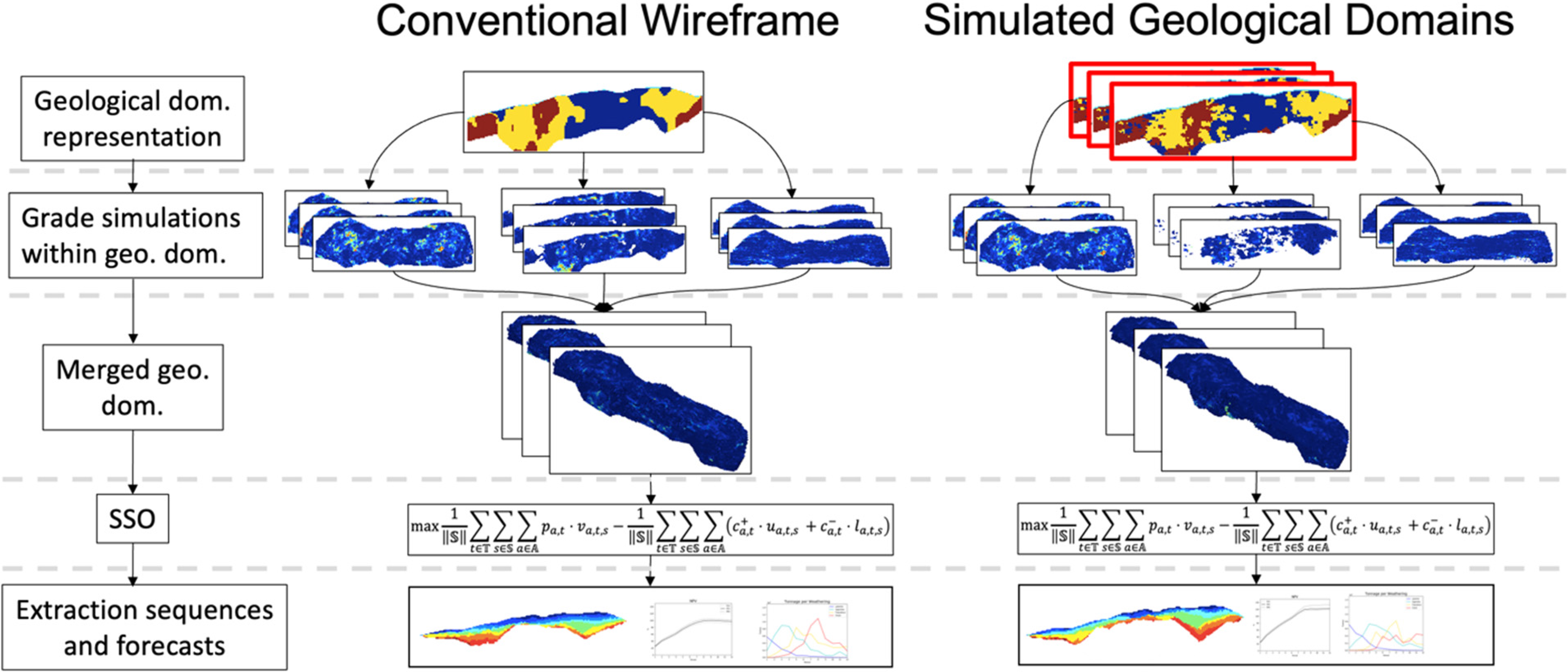
Workflows to compare the effects of high-order simulated geological domains. They start with the (a) representation of geological domains, respectively, (b) grades simulations, (c) merged geological domains into full orebody models, (d) SSO and (e) mine plans represented by extraction sequences and forecasts.
The following sections correspond to an overview of the categorical, continuous simulation methods, along with SSO. Next, the method's application to the Saramacca gold mine is described, and conclusions follow.
Methods
This section describes methods used to show the effects of the high-order simulation of geological domains in the stochastic LOM optimisation of mining complexes.
High-order simulation of geological domains
The high-order categorical simulation method used (Minniakhmetov and Dimitrakopoulos, 2022) did not require a training image. The main steps of the method are outlined as follows:
Having conditioning dataset, grid, and neighbourhood parameters:
Define random path visiting all the unsampled nodes from the grid. For each node Find the closest data samples For all Calculate conditional distribution from joint distribution Draw a random value Add Repeat steps (a) to (e) for all the points in the path defined in step 1.
In summary, the method calculates conditional probability distribution functions from the joint distribution given by high-order spatial indicator moments.


DBSIM of grades
The DBSIM method of continuous attributes is detailed in Boucher and Dimitrakopoulos (2009), and can be considered as an extension of the generalised SGS method (GSGS) (Dimitrakopoulos and Luo, 2004). DBSIM overcomes the memory requirements and improves computational performance by considering block-support values as conditioning data, rather than only point-support values.
The main characteristic of the method is the inclusion of conditioning data from different support scales. Having conditioning dataset, discretisation and neighbourhood parameters, the main steps of the method are summarised as:
Perform normal-score transformation of conditioning data from data-scale to normal-score. Define random path visiting each of the N blocks to be simulated. For each block,
Generate simulated values of the internal nodes by considering conditioning normal-score data of both point and block supports, similar to LU simulation. Average the simulated internal node to get a simulated block support in normal-score value. Back-transform the internal normal-score values to get point support values in data-scale. Average these to get a simulated block support value in data scale. Discard values of internal nodes and add the simulated block value in normal score to the conditioning data set; keep the block value in data scale as the result. Repeat steps in (3), up until all the block N are simulated, for each of the realisation required.
Simultaneous stochastic optimisation of mining complexes
The simultaneous stochastic optimisation of mining complexes framework was presented and further described in Goodfellow and Dimitrakopoulos (2016, 2017). The framework models the mining complex as a network where material mass flows from sources to destinations, changing its value based on optimised decisions on when and where to send it. SSO maximises expected value while managing the risk of not meeting production targets and capacity constraints, such as mining, hauling, processing and stockpiling. Being based on the value of products rather than the economic value of blocks, allows the simultaneous incorporation of non-linear relations such as blending and recoveries. The outputs of SSO correspond to a feasible and optimised production schedule, along with technical and financial forecasts.
The mining complex
There are three types of decision variables: extraction sequence, destination policy and processing stream. A binary decision variable
Revenues and expenditures are incurred throughout the mining complex, which are modelled as hereditary attributes and are directly incorporated into the objective function by calculating a discounted value
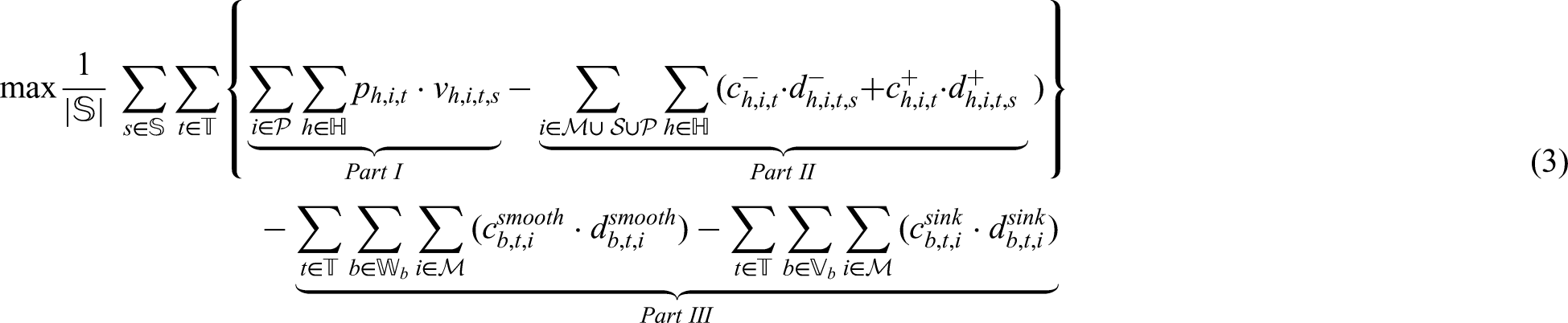
The mining, hauling, stockpiling and processing capacity constraints are managed to satisfy the operational capabilities of the mine by calculating the deviations



Producing a schedule for mining is difficult in a complex mining environment because of the numerous factors that need to be optimised at the same time. Most commercial optimisation tools simplify the issue by using a single estimated model, but this overlooks the unpredictability of orebody models. The probabilistic approaches used in this study make the optimisation more challenging, necessitating the use of a heuristic method to find solutions. Goodfellow and Dimitrakopoulos (2016, 2017), Lamghari et al. (2014) and Lamghari and Dimitrakopoulos (2020) explain various heuristic techniques. In this work, a combination of multi-neighbourhood simulated annealing with adaptive neighbourhood search is used (Goodfellow and Dimitrakopoulos, 2016, 2017). The method employed necessitates an initial viable solution, which is derived using a greedy algorithm designed to optimise the objective function while adhering to slope constraints. This preliminary solution undergoes various perturbations to yield an alternative solution. If this new outcome is superior, the related decision variables are incorporated. Conversely, if the solution does not improve, it may still be considered, but with a progressively diminishing likelihood.
Application: Case study at the Saramacca gold deposit
The Saramacca gold deposit is located approximately 25 km southwest of the Rosebel Gold Mine milling facility and was owned by IAMGOLD Corp. at the time of the study. This facility is located approximately 80 km south of the city of Paramaribo, capital of Suriname.
Stochastic simulation of the Saramacca gold deposit
The wireframe representation of lithologies (geological domains) of the Saramacca gold deposit is shown in Figure 2. The lithologies simulated correspond to the following three domains: fault zone, pillow basalt and rest. Laterite was considered as a thin (<10 m) sedimentary top layer, not simulated. Drillholes with pyroclastic information were not considered. The Fault Zone corresponds to a vertical zone which is associated with rich gold mineralisation, as shown in Figure 4(b). The rest zone corresponds to a barren lithology that encompasses Massive Basalt and Amygdular Basalt, both combined given their similar properties and considered to limit the SW extent of the gold-rich fault zone (Payeur et al., 2018).
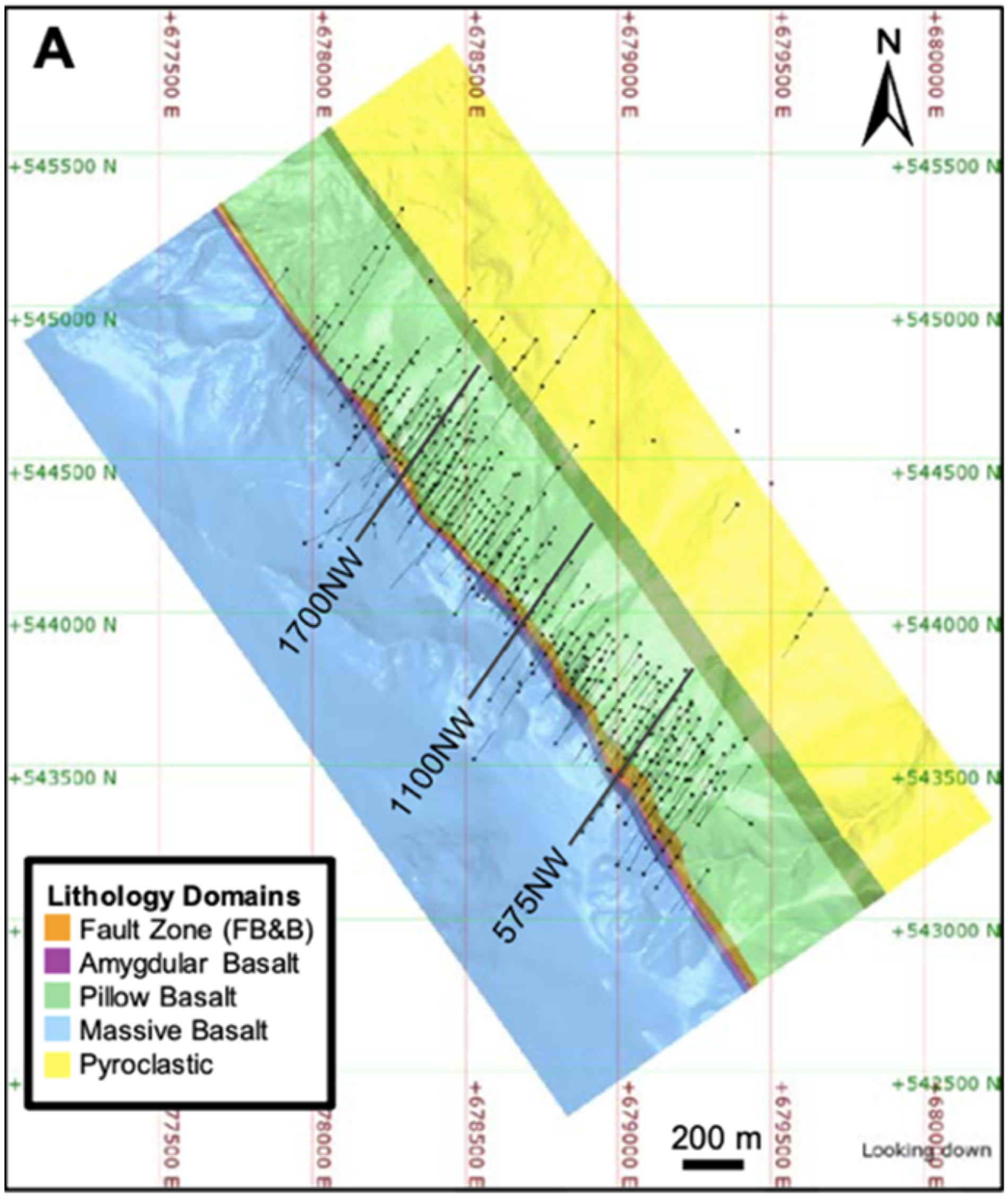
Plan view of Saramacca Gold deposit lithologies (Payeur et al., 2018).
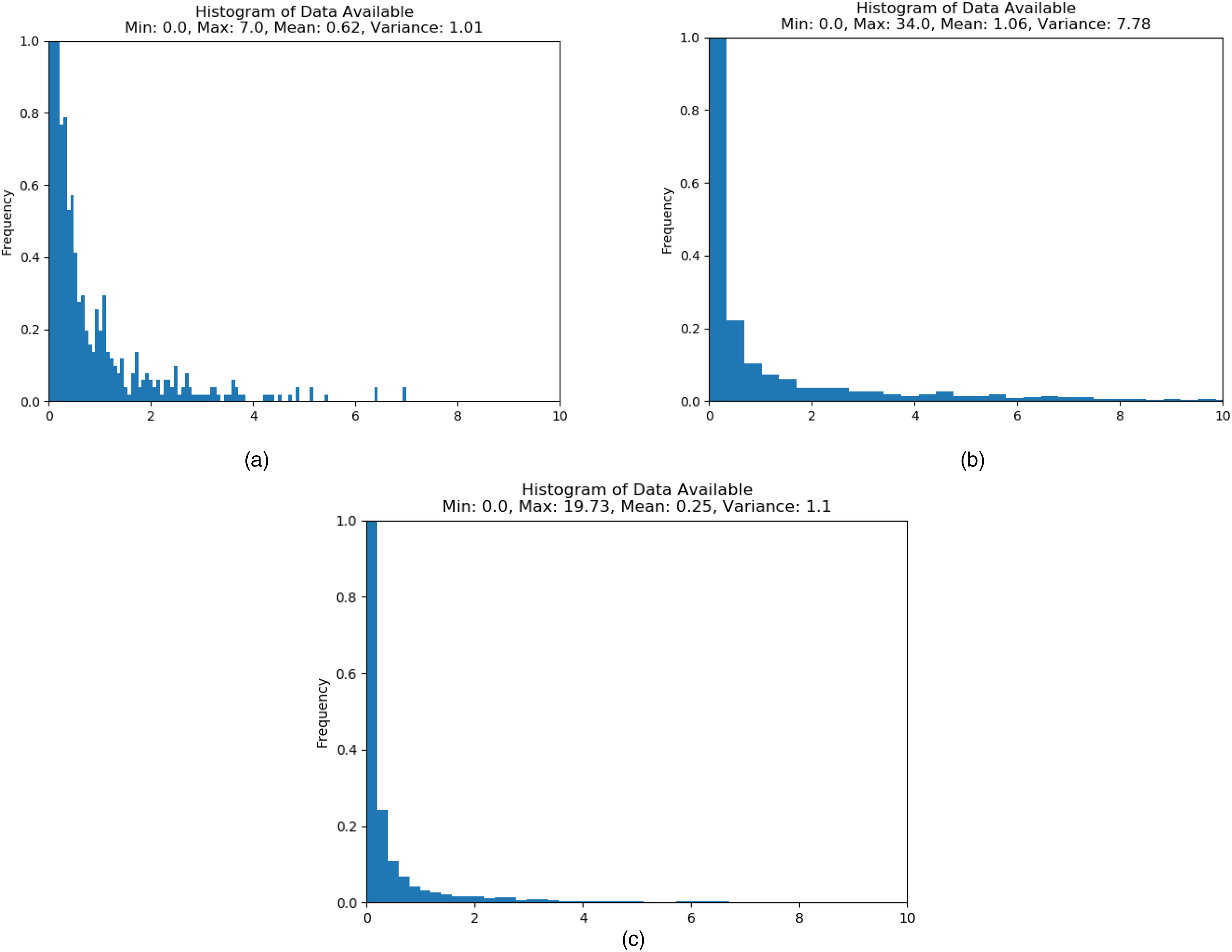
Histograms for mineralised lithologies (a) laterite, (b) fault and (c) pillow basalt.
Available data includes 473 exploration drillholes spaced about 50–60 m and composited in 5 m heights. North in Figure 3(a) is rotated 55 deg. counterclockwise with respect to north in Figure 2. Sampled dimensions in volume in Figure 3 are about 2 × 1 × 0.5 km in east-west, north-south, and up-down directions, respectively.
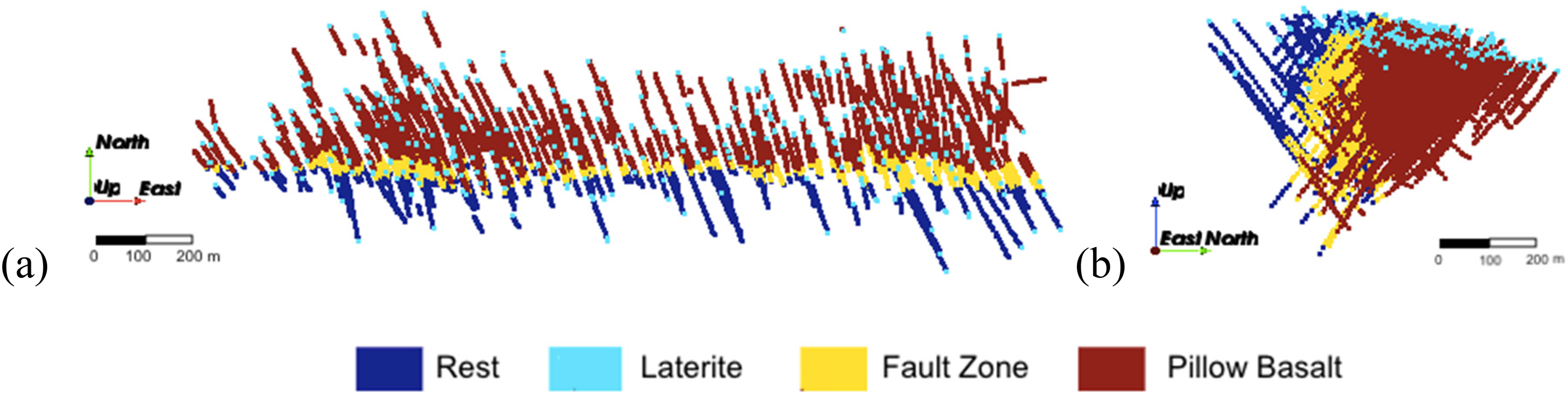
Top (a) and lateral (b) views of exploration drillholes. Light blue, yellow and red corresponds to Laterite, Fault and Pillow Basalt respectively. Dark blue corresponds to other lithologies combined of no interest named rest. Fault zone, pillow basalt and rest were simulated while laterite was considered deterministic.
Gold grade histograms based on drillhole data for the three mineralised domains simulated are found in Figure 4.
The mineral deposit is also modelled through different deterministic weathered types of materials shown in Figure 5. The weathered rock types are not simulated, and they were used as provided (Payeur et al., 2018), as they are related to different geotechnical and metallurgical parameters, along with drilling, blasting and processing costs. Deeper in the mineral deposit, the rock is more competent and less weathered for which costs and slope angles increase while recovery decreases (Payeur et al., 2018). The rock types are typically sorted along the vertical direction, starting at the top with the most weathered (less competent) thin layer of laterite and saprolite, to the less weathered (more competent) thick layers of transition and fresh rock.
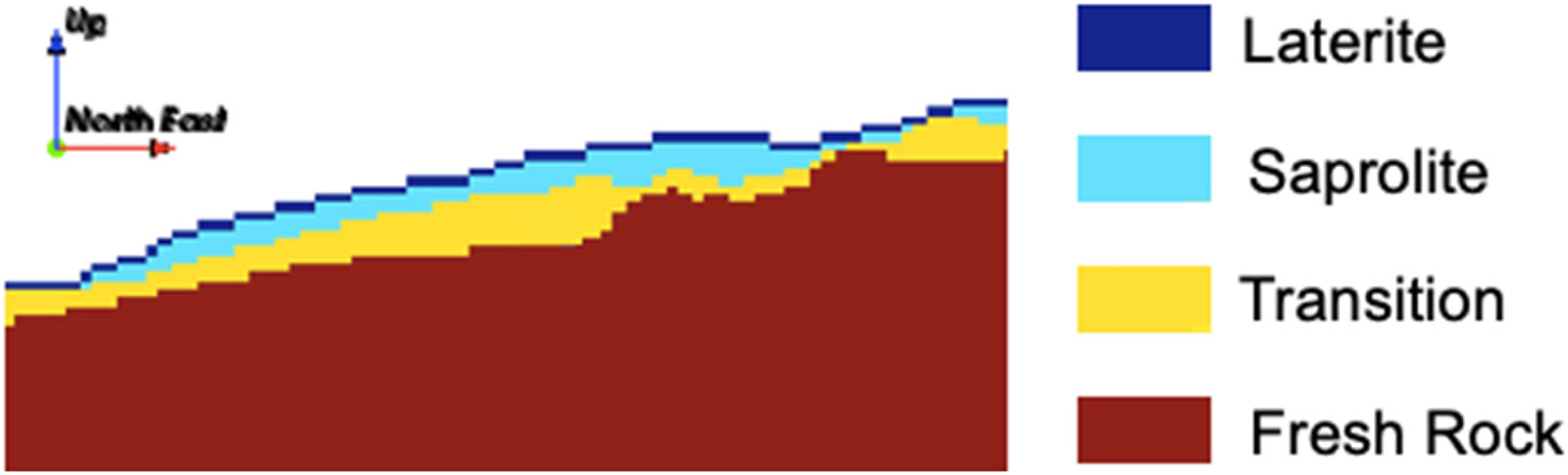
Vertical section of deterministic weathering profiles (not simulated).
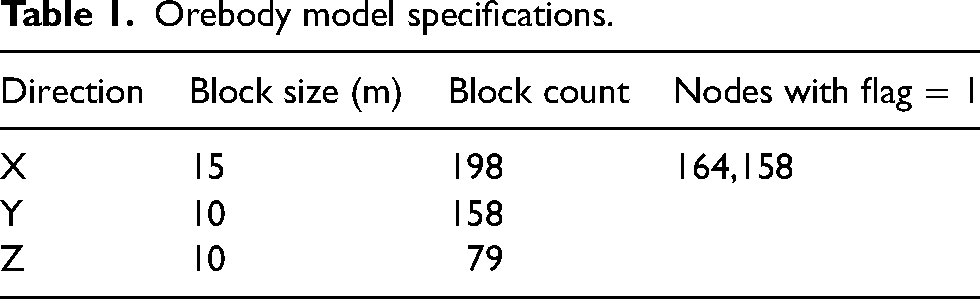
Orebody model specifications are found in Table 1. To account for the topography and mineralised volume, an arbitrary and deterministic flag was defined as 1 to each of the nodes to be assigned with a geological domain value (active for computation) and −999 for the rest (non-active for computation). The set of flagged nodes is named mask, and sections of it are shown in Figure 6. Positive flagged nodes outline the mineralisation and determine the domain where the categorical simulations of the geological domain will be generated. The use of a mask allows the simulation to be constrained by the topography and reduces the computational time as not all the nodes in a parallelepiped are needed to be computed (Mariethoz and Caers, 2015).
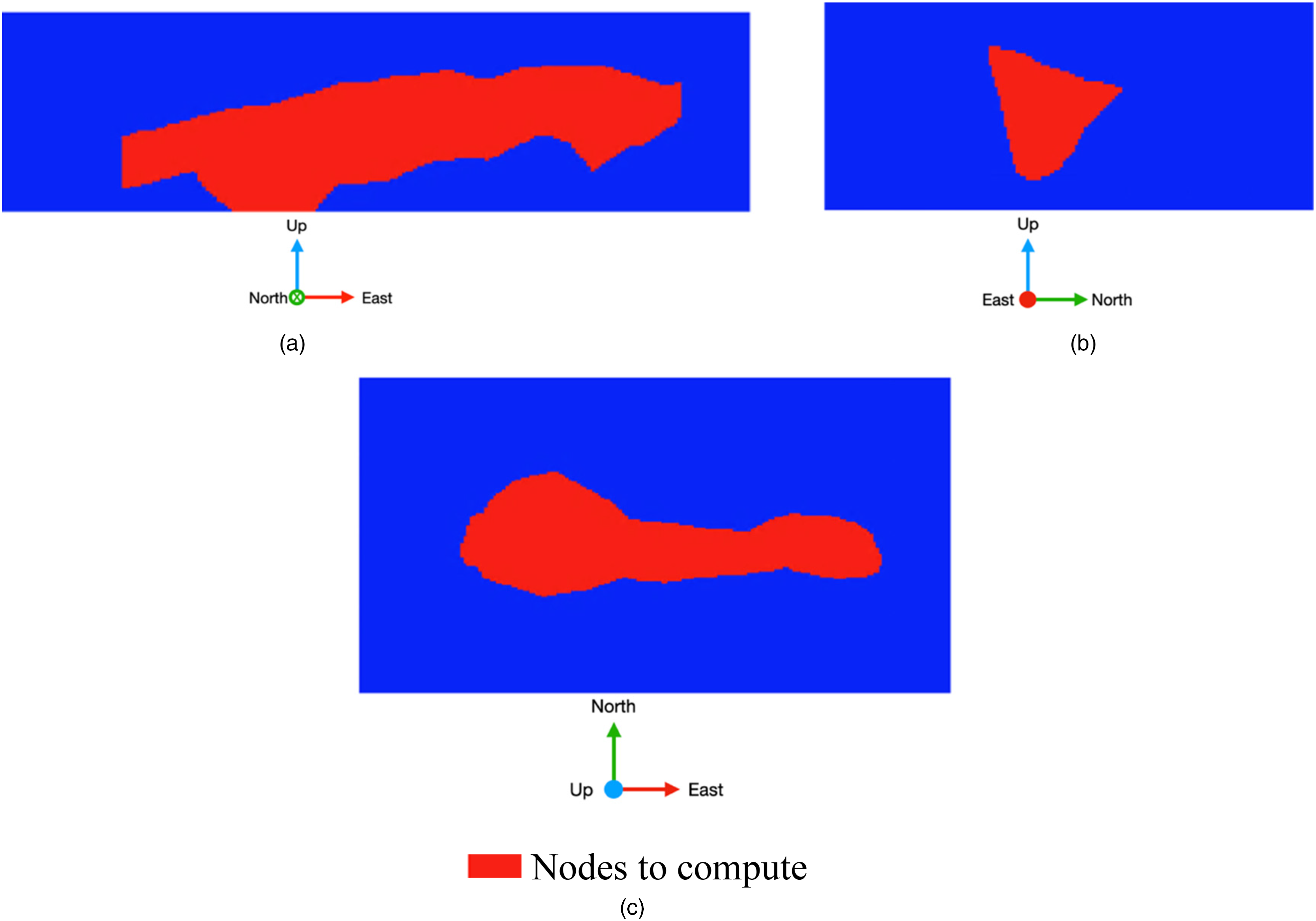
Sections of computational mask. Vertical (a), (b) and horizontal (c). Red and blue indicate nodes to compute and not compute, respectively.
Orebody model specifications.
Two sections of the given wireframes and two sections for each of the two categorical simulations of the geological domains (lithologies) are shown in Figure 7. Fifteen realisations were used, because it has been documented that 10–15 simulations are sufficient to generate stable results in long-term mine planning and production scheduling (Albor and Dimitrakopoulos, 2009; Montiel and Dimitrakopoulos, 2017). Given wireframes present smoother boundaries between the geological domains than realisations, that rather show high variability in these boundaries while maintaining consistency with data in the location of the domains. This local variability is a consequence of the uncertainty inherent in the sparse data sampled.
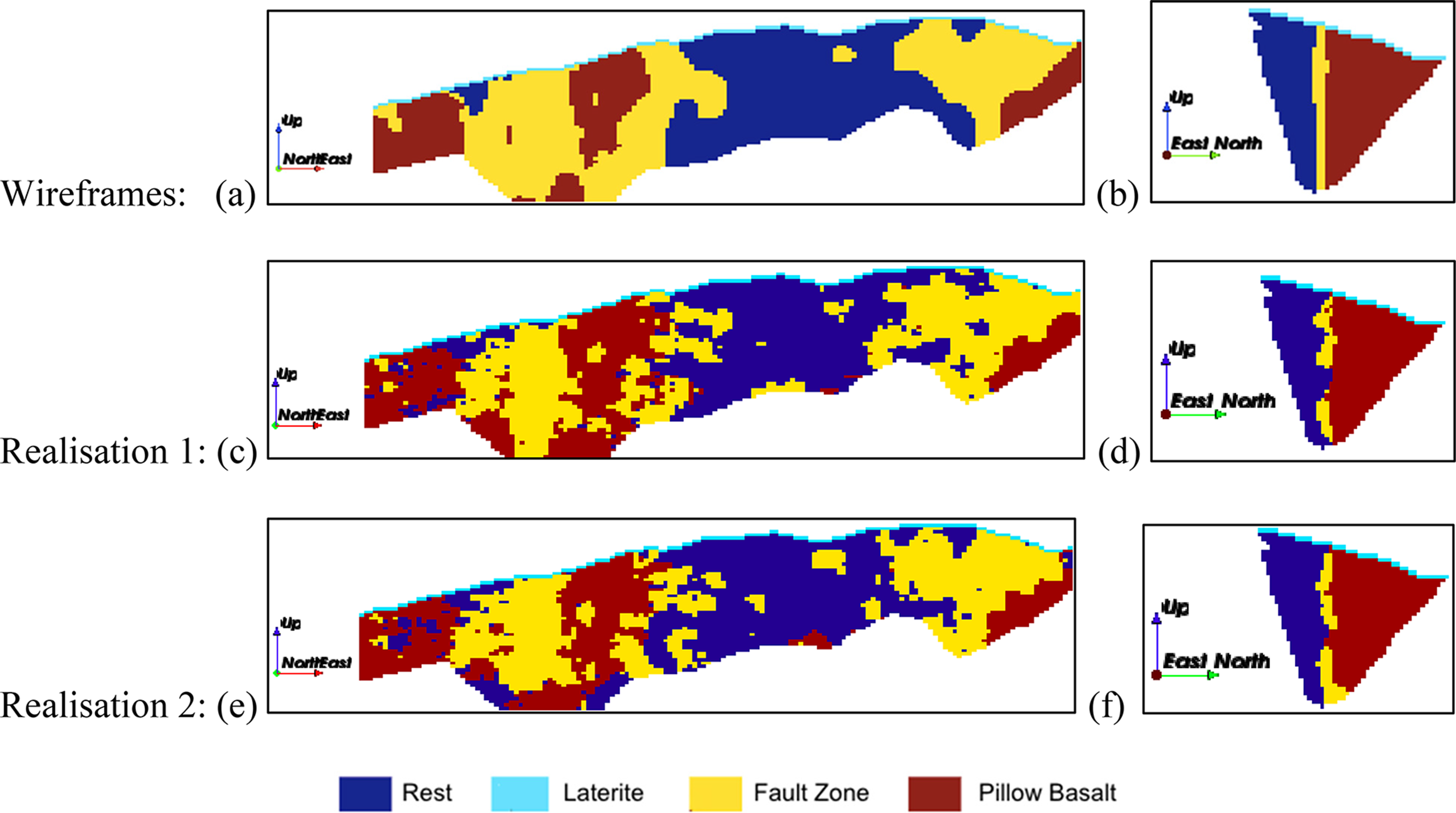
Vertical sections of geological units by given wireframes (a), (b); and two randomly selected realisations of simulated geological units (c)–(f).
The local variability of boundaries is more evident in the realisations than in the given wireframes, as shown in Figure 7(a) and (b). For the fault zone, in particular, which is the geological domain related with the highest grades, the more variable representation of boundaries in the realisations could render a different extraction sequence rather than using the single continuous and smoothed interpretation given by the wireframes.
The statistics considered for validation correspond to their respective orders. The first-order statistic corresponds to the probability of a single block to belong into a certain geological unit (one-point statistic), that is, the proportions of each geological unit in the domain of computation. Second-order corresponds to the traditional indicator variogram along certain directions, which is related to the joint probability of two points along one dimension to have the same values. Third and higher orders are given by the joint probability of corresponding points to belong to certain geological units. Joint probabilities are given by high-order spatial indicator moments. In this case, validation is shown up until the fourth order. For the following comparison of statistics, it must be noted that, rather than an exact collation, validation is done by considering the reproduction of main patterns.
As seen in Figure 8 and in Table 2, declustered proportions of each geological unit for the wireframed and realisation sets are similar; it is expected that the results are driven by the spatial distribution of these geological units rather than by their proportions. The biggest proportion corresponds to Pillow Basalt followed by rest, fault and laterite.
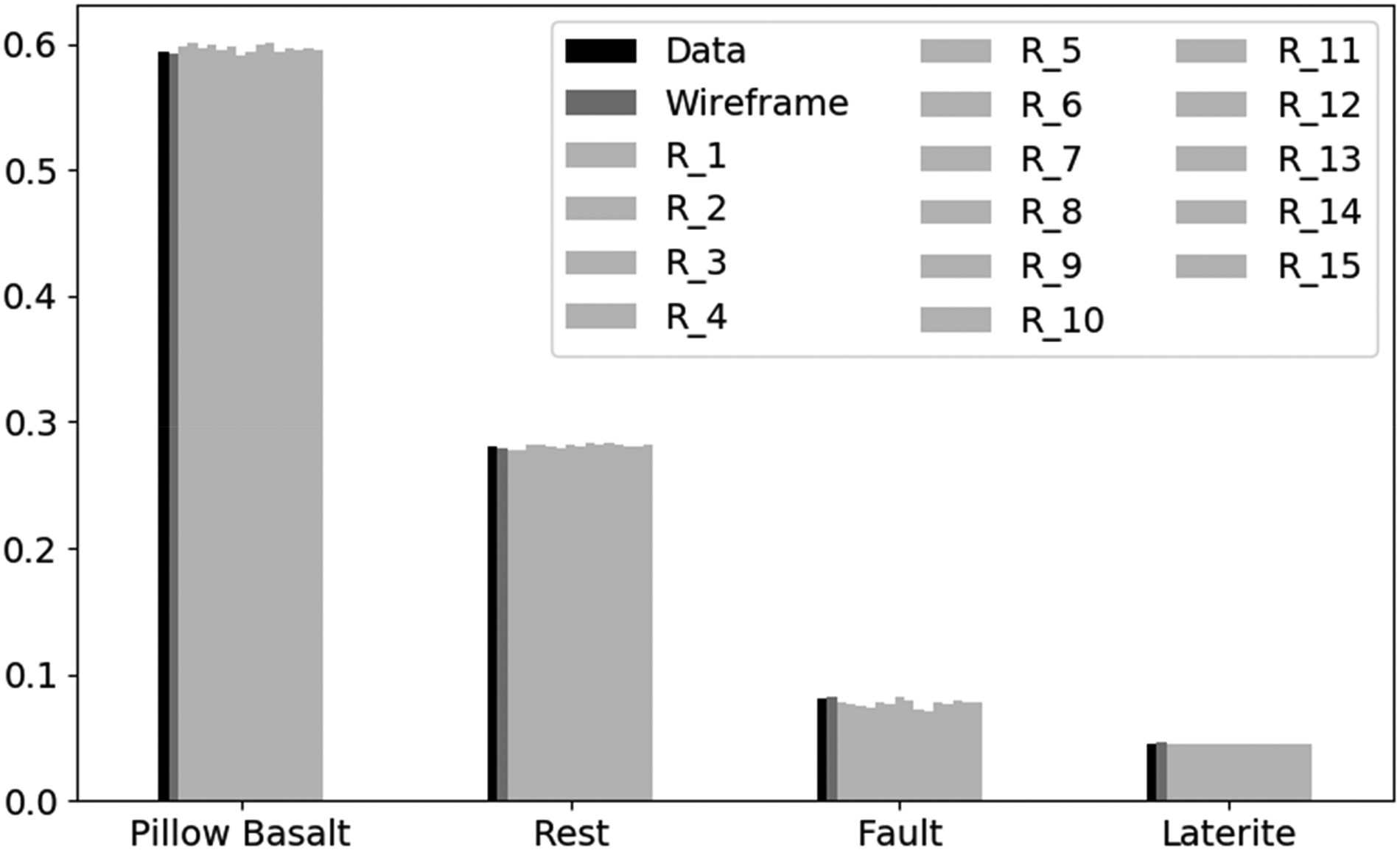
Proportions of lithologies given wireframed and simulated geological units.
Proportions of lithologies.

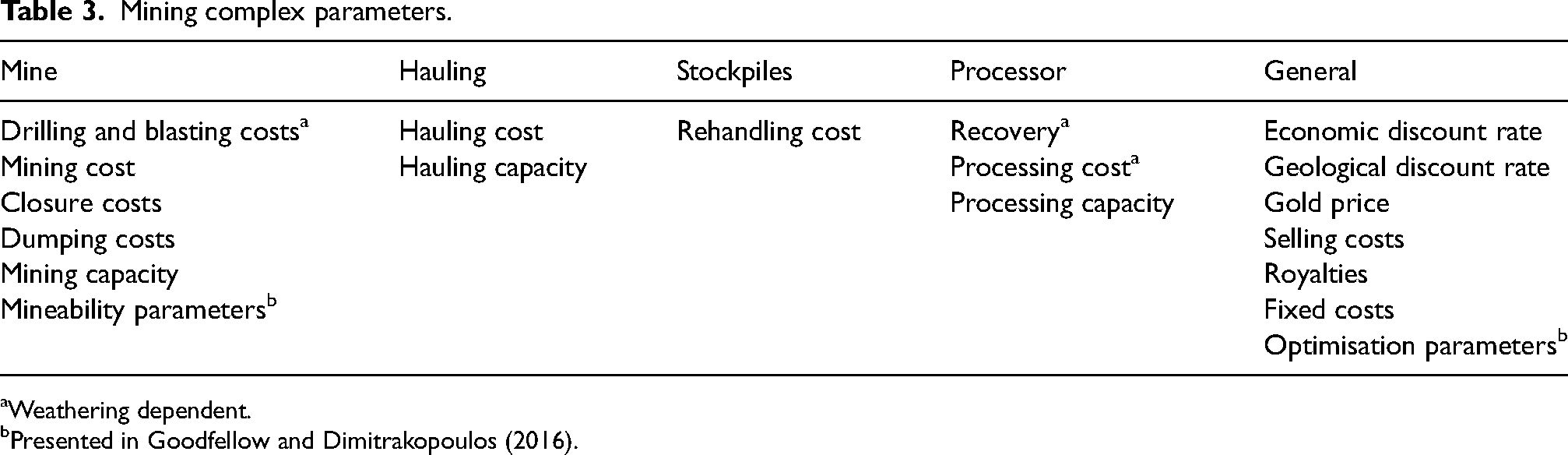
Mining complex parameters.
aWeathering dependent.
bPresented in Goodfellow and Dimitrakopoulos (2016).
Indicator variograms are calculated and shown in Figures 9–12, for each mineralised geological unit along the different directions, for the data, and the realisations. More detail on wireframed information can be found in the corresponding NI 43-101 report (Payeur et al., 2018). In general, data variability is reproduced. Laterite presents less variability than fault and basalt geological units for the lags shown. High reproduction of variability of basalt is attributed to the fact that it is the geological unit with the highest quantity of samples.
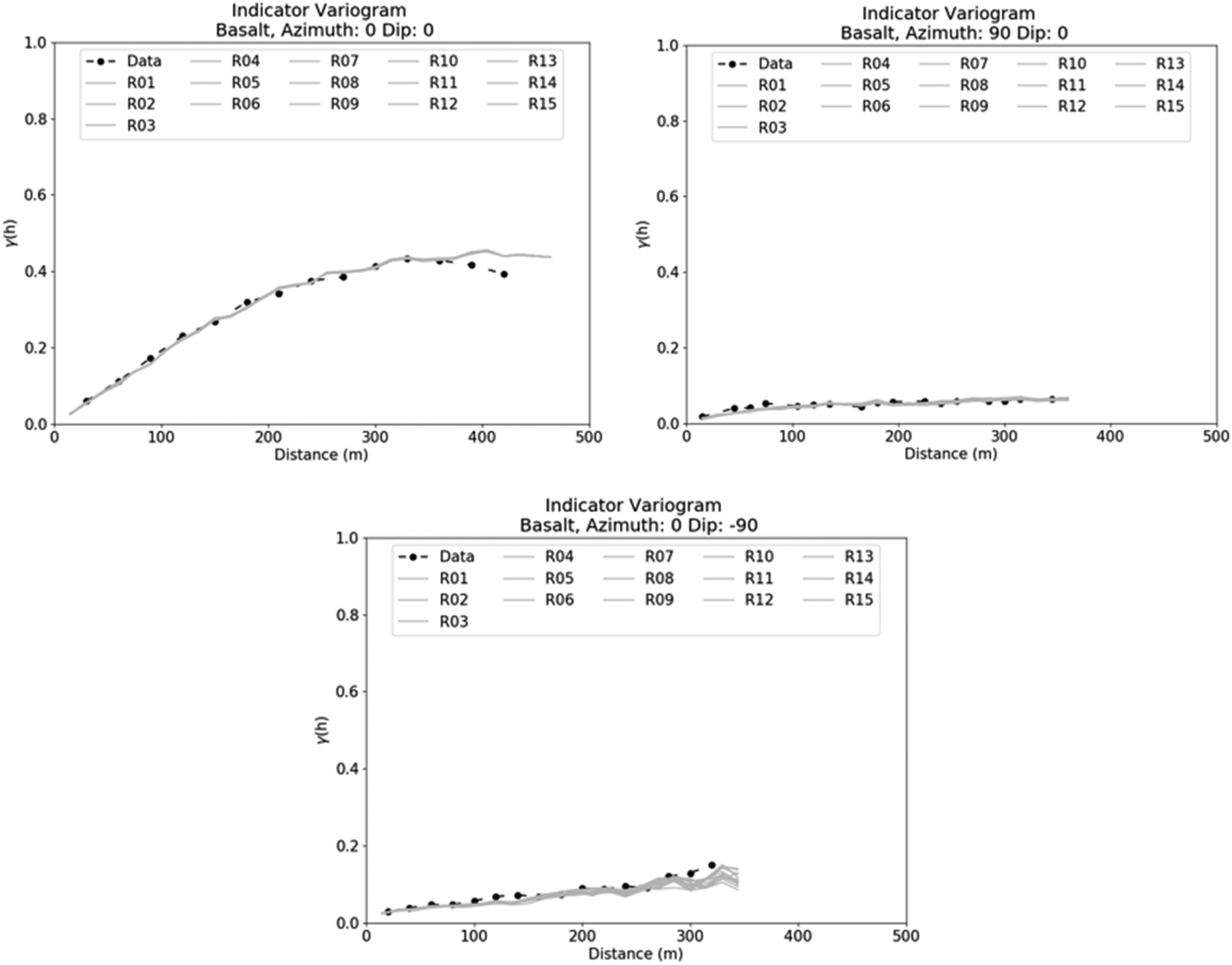
Indicator variograms of pillow basalt for different directions.
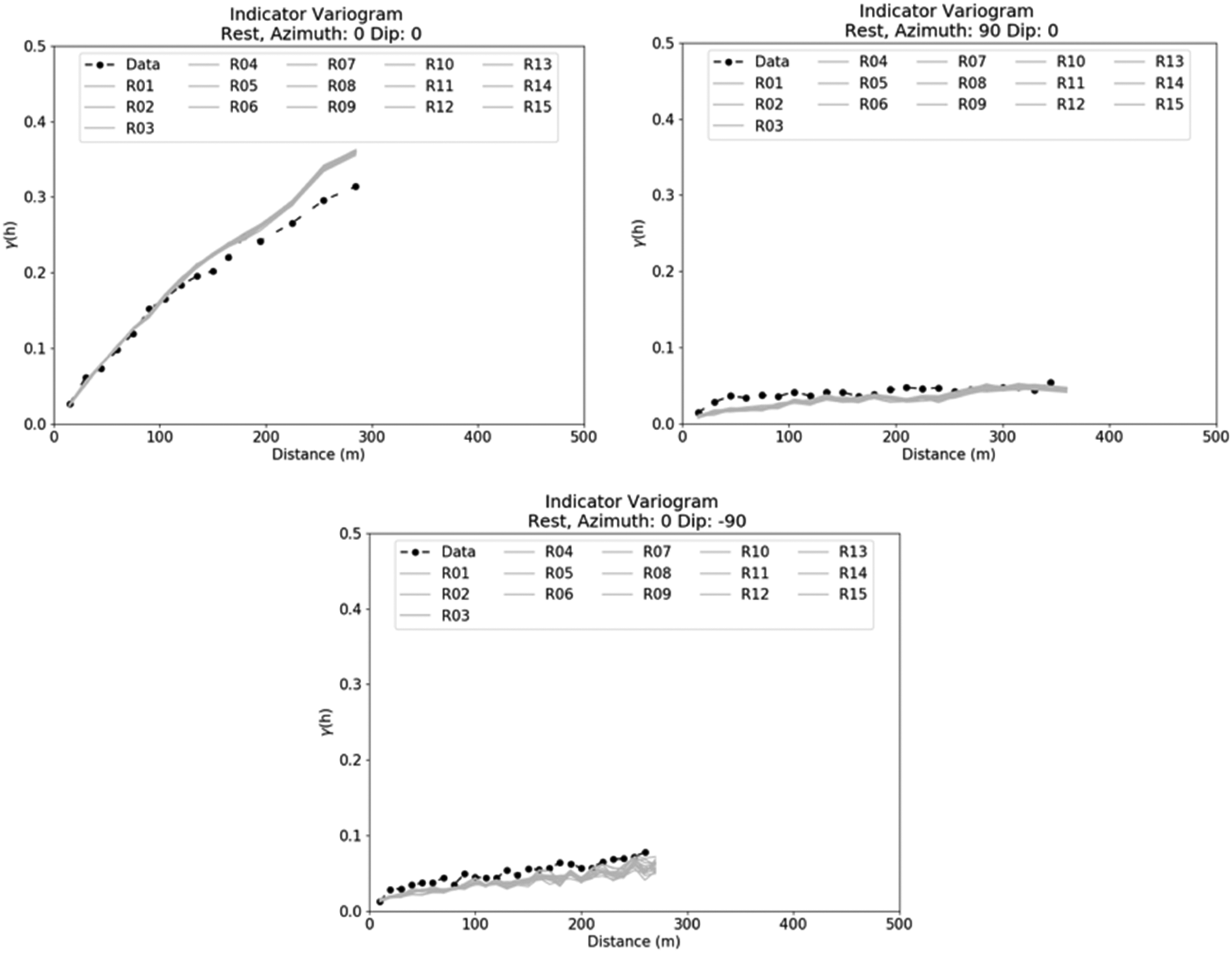
Indicator variograms of rest for different directions.
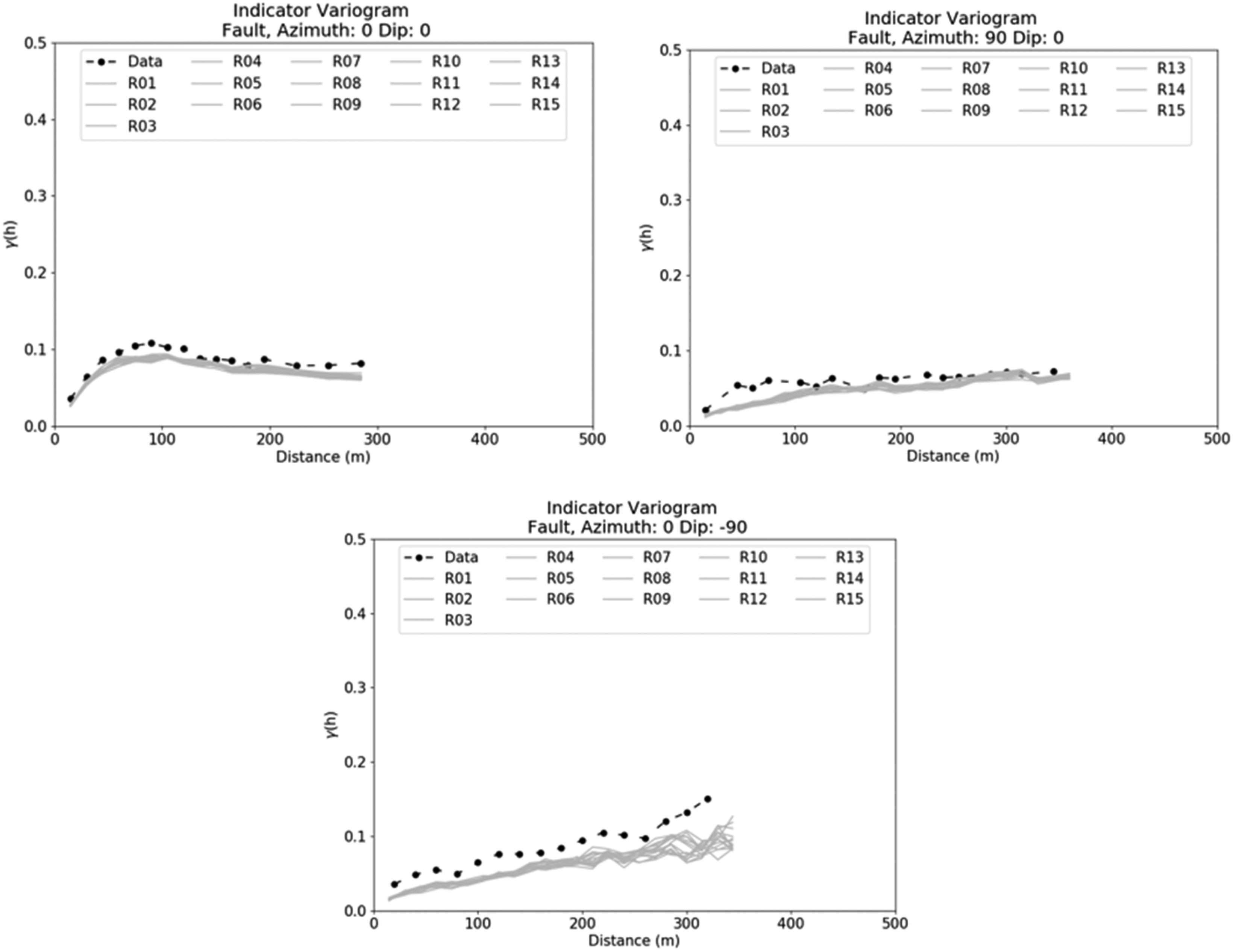
Indicator variograms of fault for different directions.
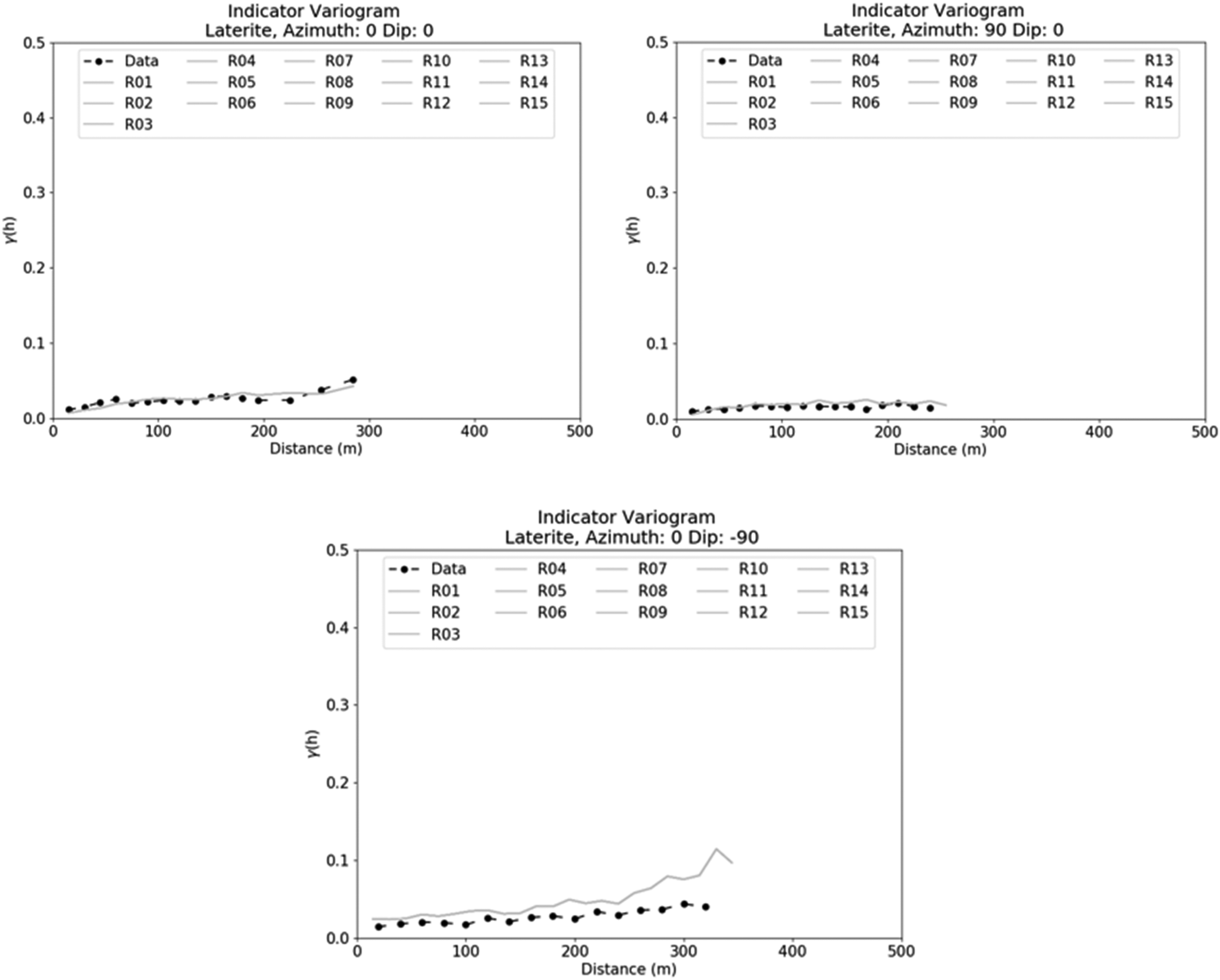
Indicator variograms of laterite for different directions.
The validation of higher-order statistics is done through the reproduction of the joint-probability distributions of having certain categories at respective positions, in an orthogonal template, represented by high-order spatial indicator moments maps. The codification of {Rest:0; Laterite:1; Fault:2; Basalt:3} is used for the indexation of
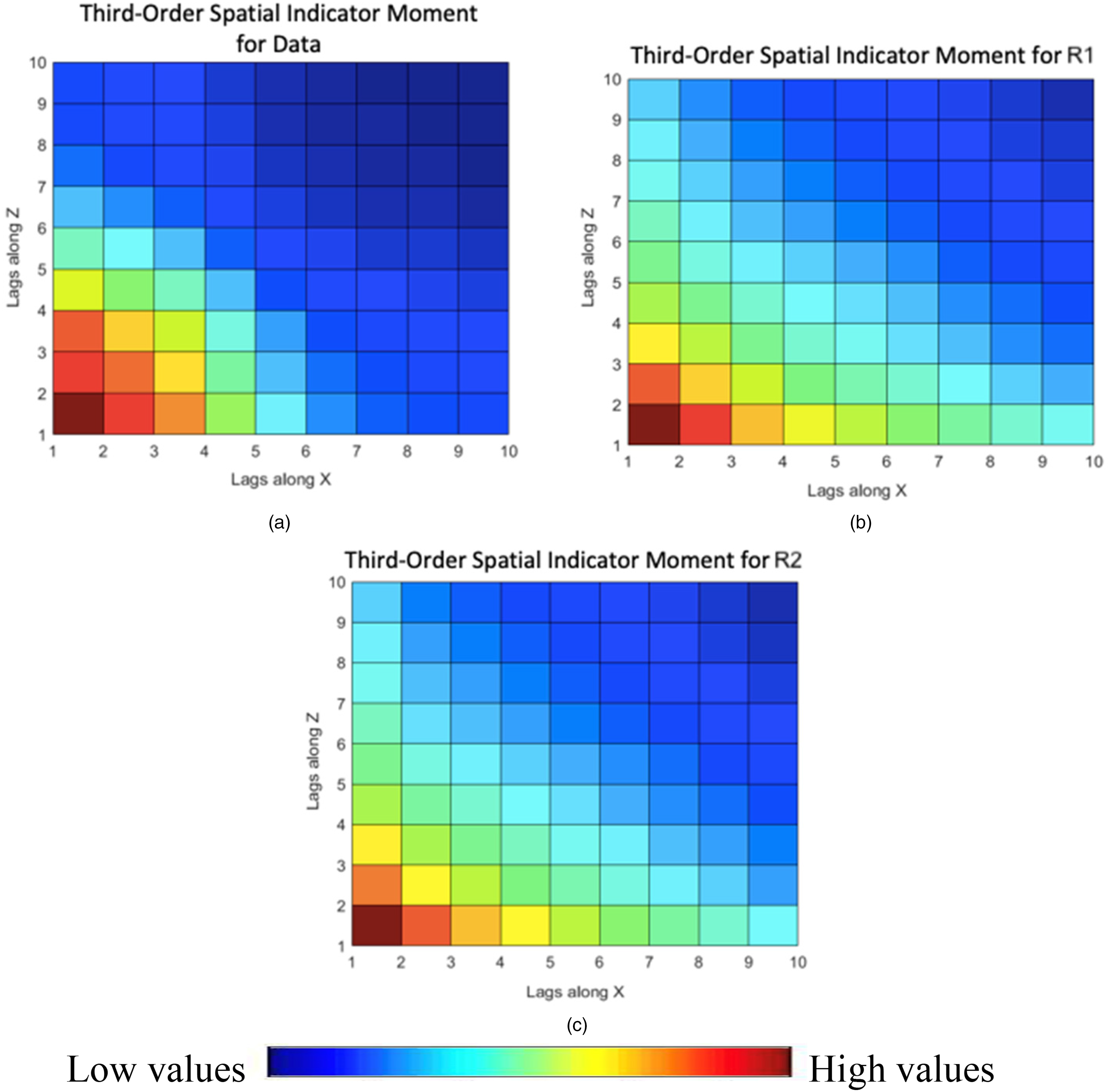
Third-order spatial indicator moment maps
Finally, Figure 14 shows the fourth-order spatial indicator moments where the centre and horizontal values in X and Y directions correspond to fault zone, while the last vertical Z correspond to basalt, noted
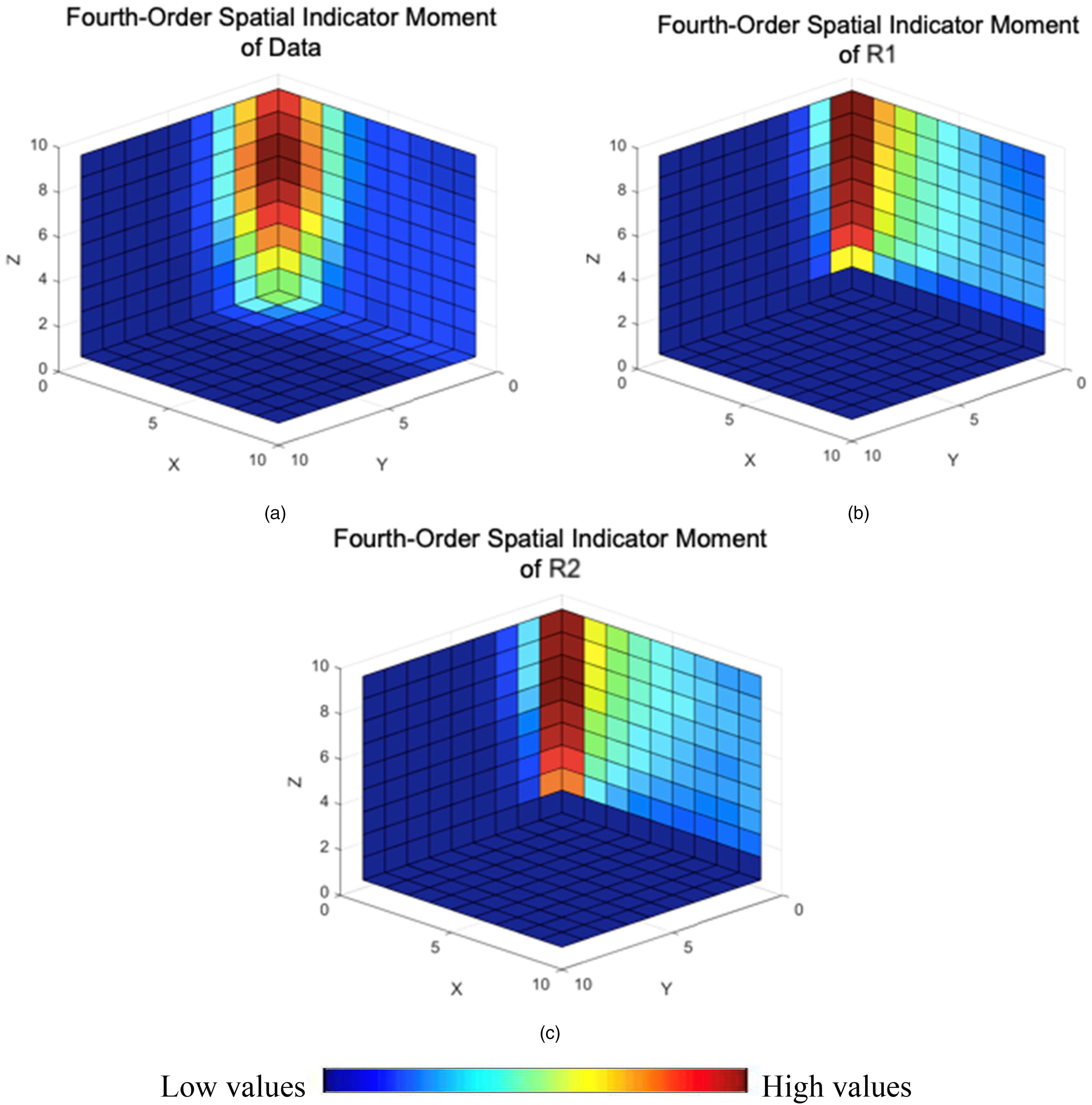
Fourth-order spatial indicator moment for fault zone in vertical, strike and perpendicular to strike directions noted
The simulation and validation of gold grades are performed for each mineralised geological domain by using the DBSIM method. Two sets of geological scenarios are defined. The first set considered the simulation of grades inside wireframed geological domains shown in Figure 7(a) and (b). The second set considered the full geological uncertainty given by the simulated geological domains and gold grades within them.
The data available for each mineralised geological domain corresponds to the capped exploration drillholes from 2018, composited in 5 m (Payeur et al., 2018). It is noted that the richest mineralised zone corresponds to the fault zone, which is also characterised with the highest gold grade variance. The laterite domain follows with lower average grades; however, as seen in Figure 7, it only represents a thin top layer of no more than 10 m of depth (Payeur et al., 2018). Finally, the pillow basalt domain presents the lowest average gold grade, but corresponds to the lithology with the most data records and relatively low variance.
Gold grade realisations for both sets, wireframed and simulated geological domains, are shown in Figure 15. The main difference between gold grade realisations within wireframed and simulated geological domains is the domain's spatial variability. This is particularly seen in fault zone, Figure 15(c) and (d), where the simulated domain in Figure 15(d) presents higher local variability than the wireframed domain in Figure 15(c). The clustered representation shown in Figure 7(d) and (f) allows high grades to be connected within clusters, rather than the thin vertical continuous domain shown in Figure 7(b).
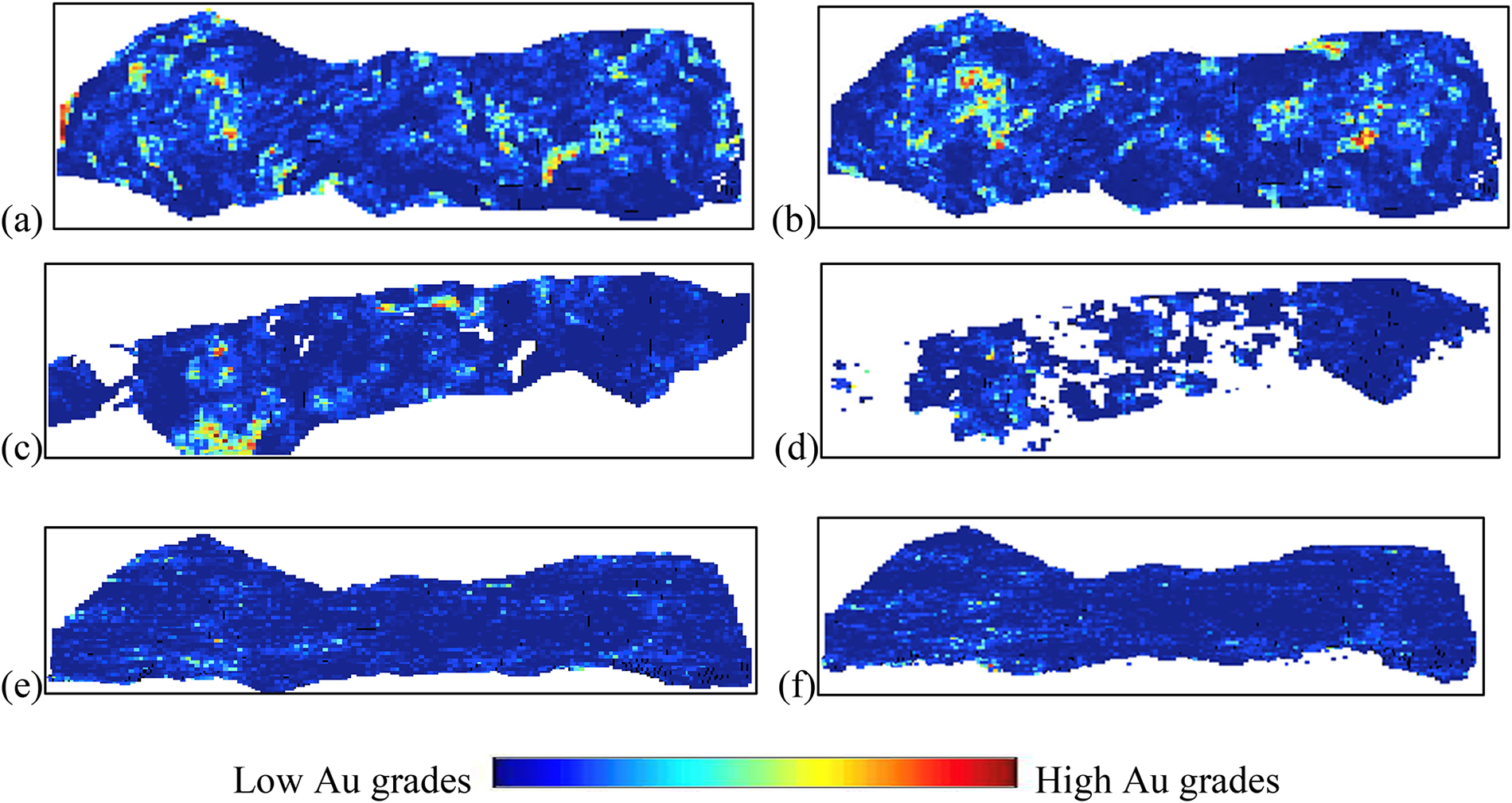
Top view of grade realisations within laterite within wireframed and simulated geological domains (a) and (b). Vertical view of grade realisations within fault zone within wireframed and simulated geological domains (c) and (d). Top view of grade realisations within basalt within wireframed and simulated geological domains (e) and (f).
E-types in Figure 16(a) highlight one artefact of using a deterministic representation of geological units, as a high-grade zone is drastically discontinued by a barren domain, while simulated domains in Figure 16(b) consider the possible mineralisation in that area. This will later translate into different extraction sequences, where the schedule based on the wireframed domains considers more waste to handle than the one based on simulated domains, thus increasing the costs and reducing the profit at the related financial forecasts.
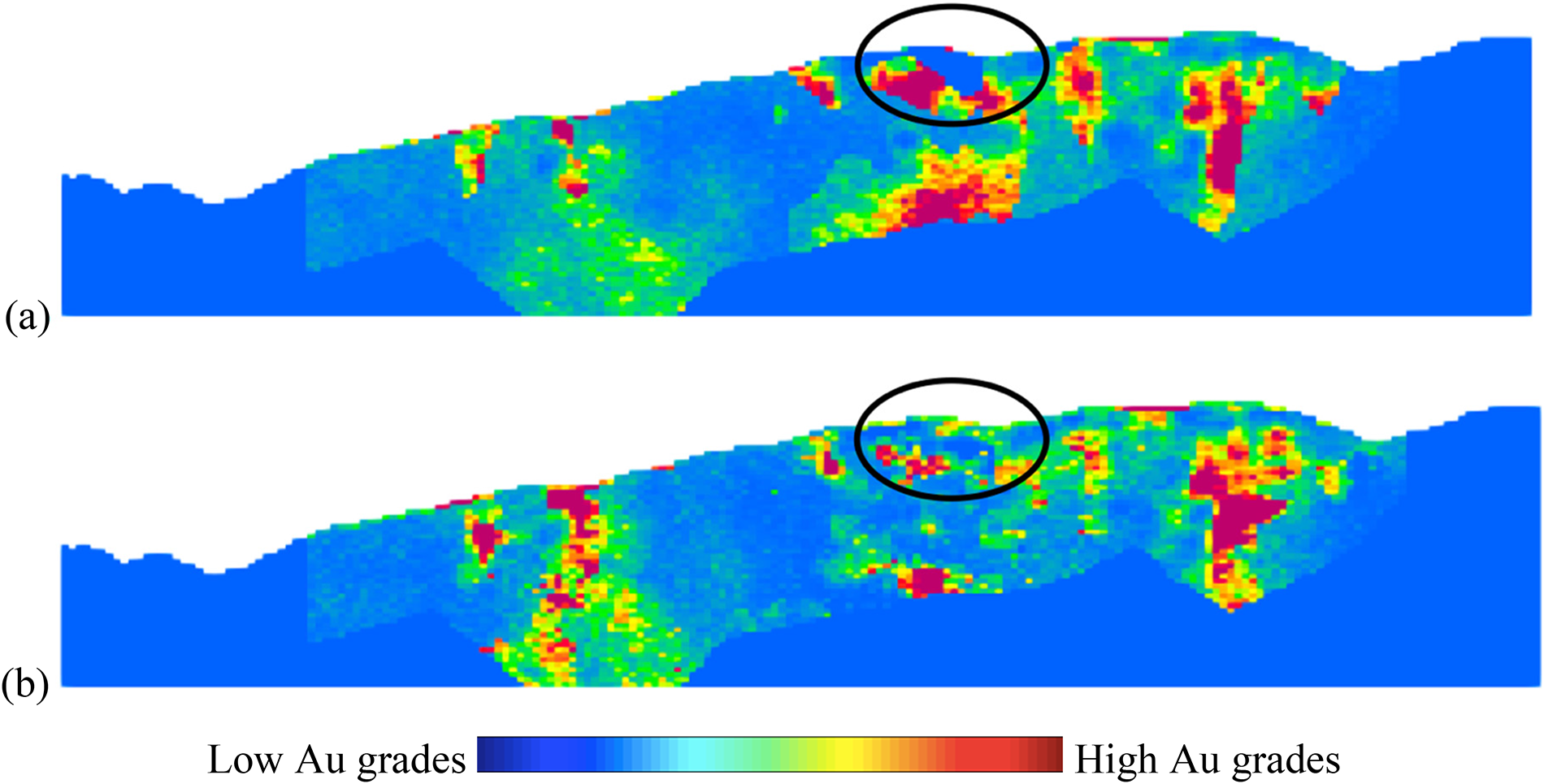
Vertical sections of e-types for (a) wireframed and (b) simulated geological domains. Black oval highlight differences.
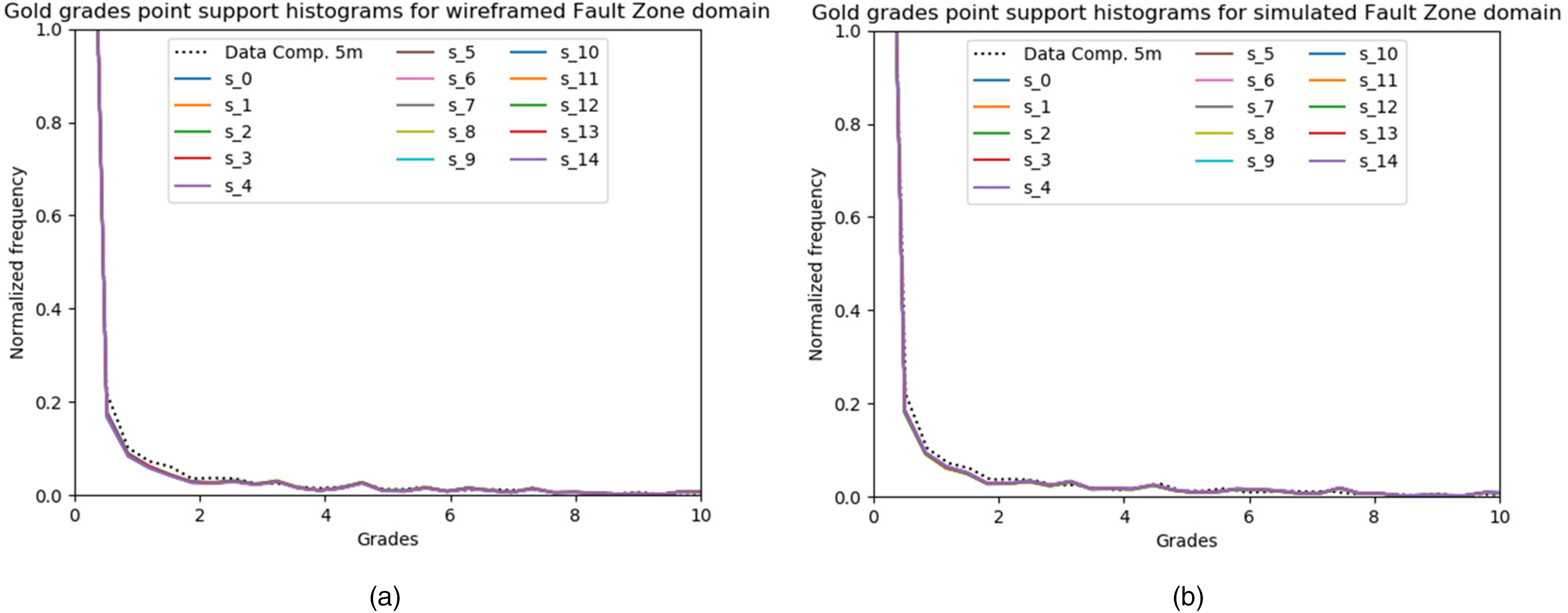
Histograms of gold grades within fault zone for (a) wireframed, and (b) simulated geological domains.
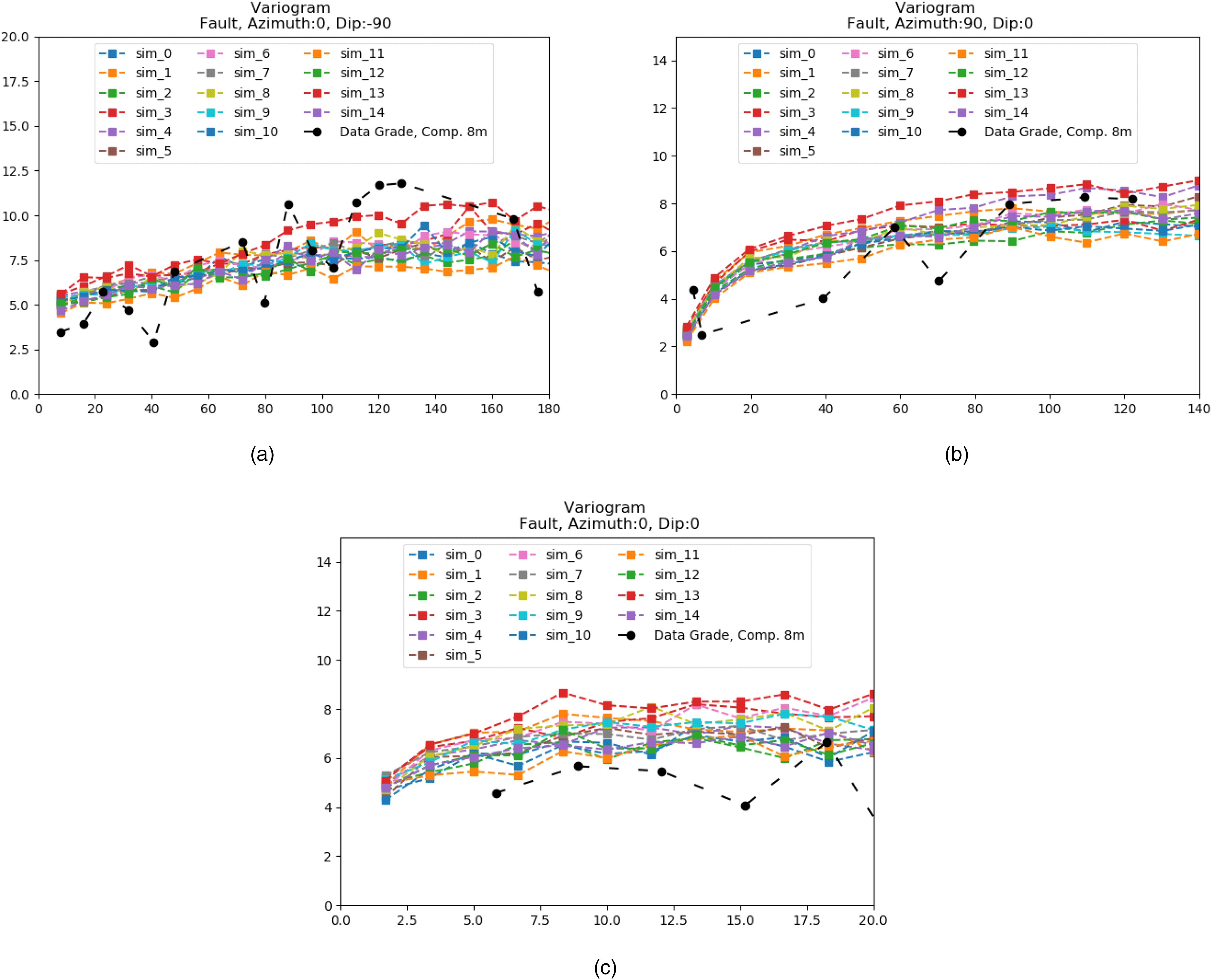
Variograms for gold grades in fault zone for simulated geological domains.
Validation of grade simulations is done by comparing first- and second-order statistics (histogram and variograms) of sample data and realisations in Figures 17 and 18, respectively, for simulated geological domains.
Simultaneous stochastic optimisation of the mining complex
The simultaneous stochastic optimisation framework is applied to the gold mining complex schematised in Figure 19. This study aims to explore how simulated lithologies of a gold deposit impact the strategic mine plan. The complex includes one open pit mine, an adjacent waste dump, and two stockpiles situated close to a processing mill. The two stockpiles are designated for soft and hard rocks; with the soft stockpile containing laterite and saprolite, while the hard stockpile holds transition and fresh rock types.
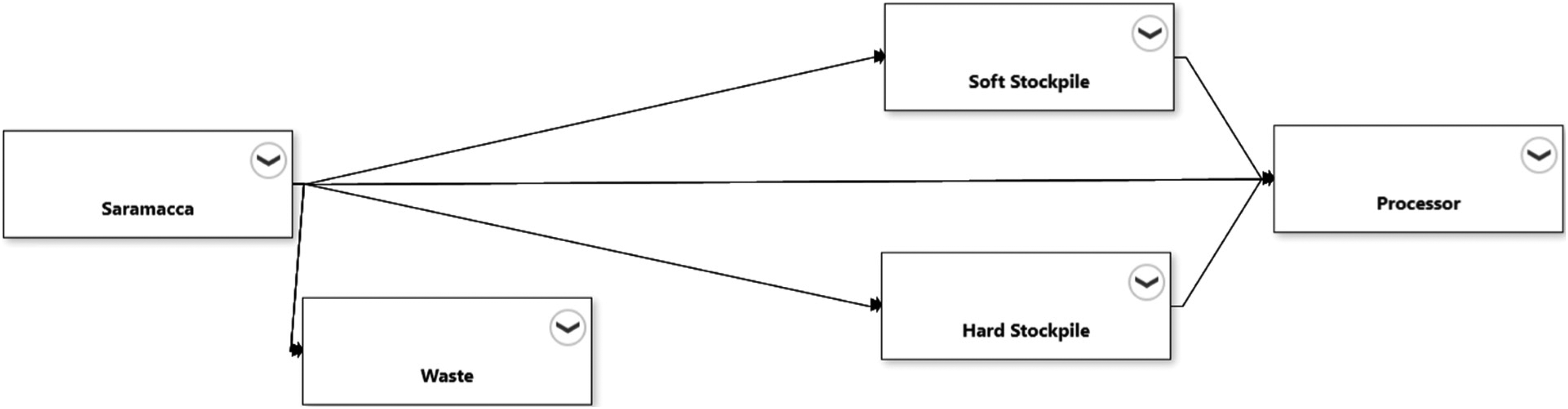
Mining complex modelled.
All extracted material that is not economically profitable to process is sent to the nearby waste dump. This destination policy is simultaneously optimised and does not require the input of pre-defined cut-off grades; rather, it comes out as an output of the optimisation process. Profitable material is hauled to stockpiles and a processor, constrained by the capacity of the truck fleet. Material is reclaimed from the stockpiles with generic equipment for which no capacity constraint is considered.
A summary of parameters considered in the optimisation is shown in Table 3.
Long-term production mine schedules for both sets, wireframed and simulated geological domains, are shown in Figure 20(a) and (b), respectively. As highlighted in Figure 20, extraction sequences are different for the two sets of simulations. These differences are attributed to the different spatial distributions of geological domains given by wireframes and simulated geological domains. As extraction sequences are different, ultimate-pit limits are also different. It must be noted that mineability constraints and parameters are the same for both optimisations, for which they have no influence in different extraction sequences. Economic and production forecast for schedules based on both sets, wireframed and simulated geological domains, are shown in Figures 21–27.
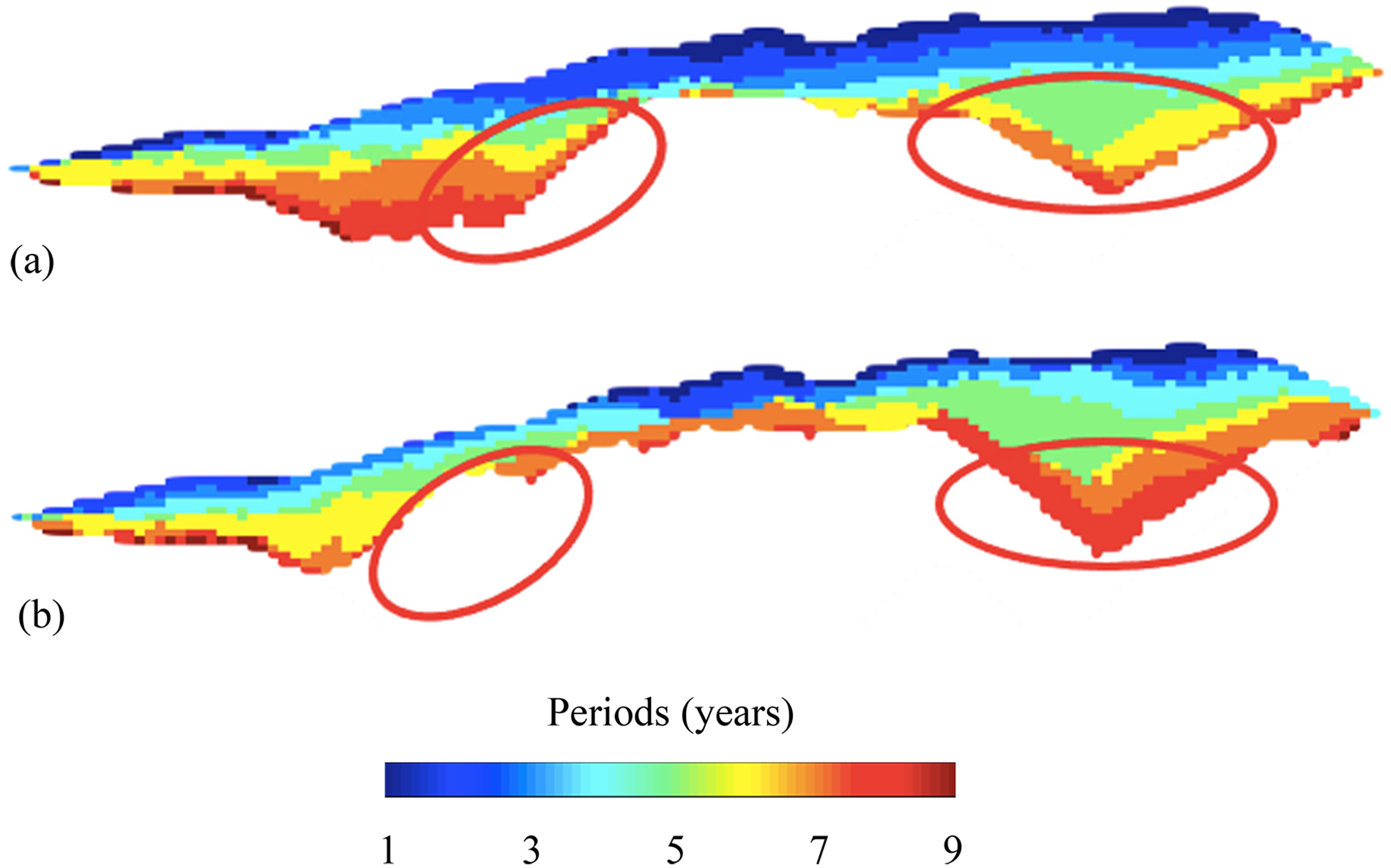
Vertical sections of extraction sequences for (a) wireframed and (b) simulated geological domains. Red ovals highlight differences.
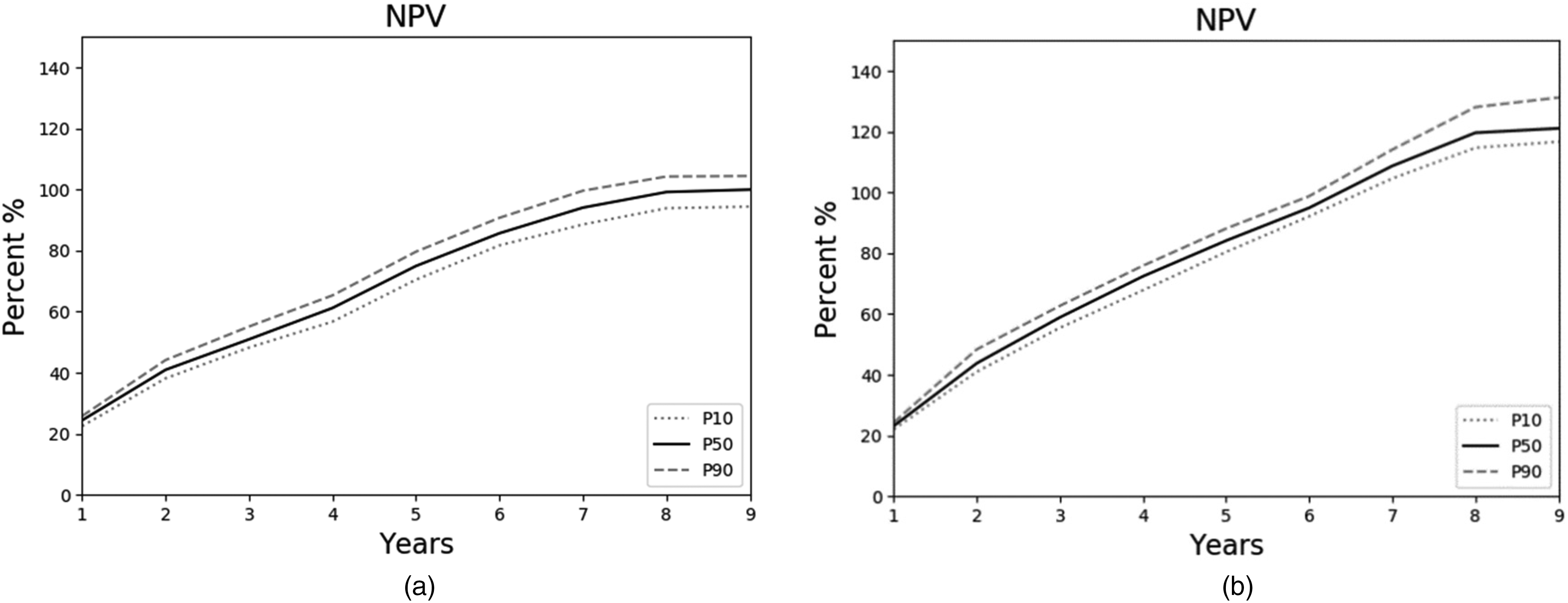
Scaled net present value (NPV) forecasts from schedules obtained from (a) wireframed and (b) simulated geological domains. Values scaled using year nine in (a).
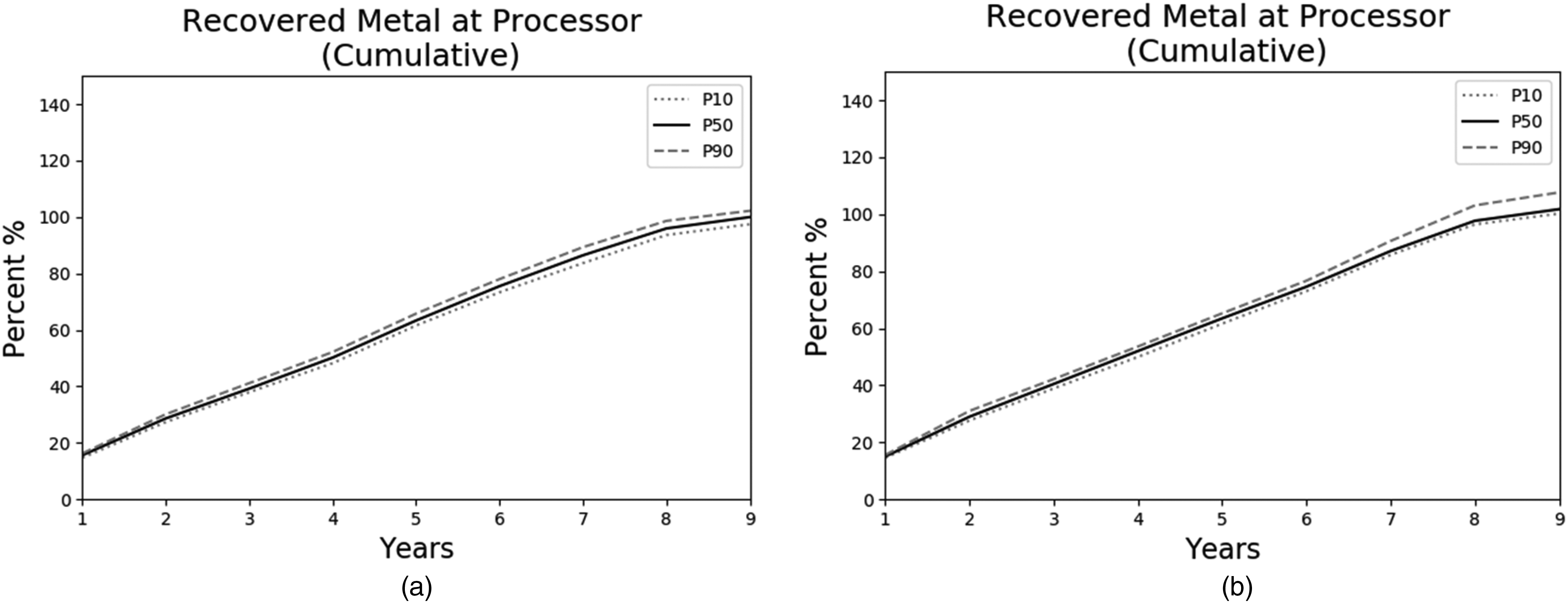
Scaled recovered metal forecasts from schedules obtained from (a) wireframed and (b) simulated geological domains. Values scaled using year nine in (a).
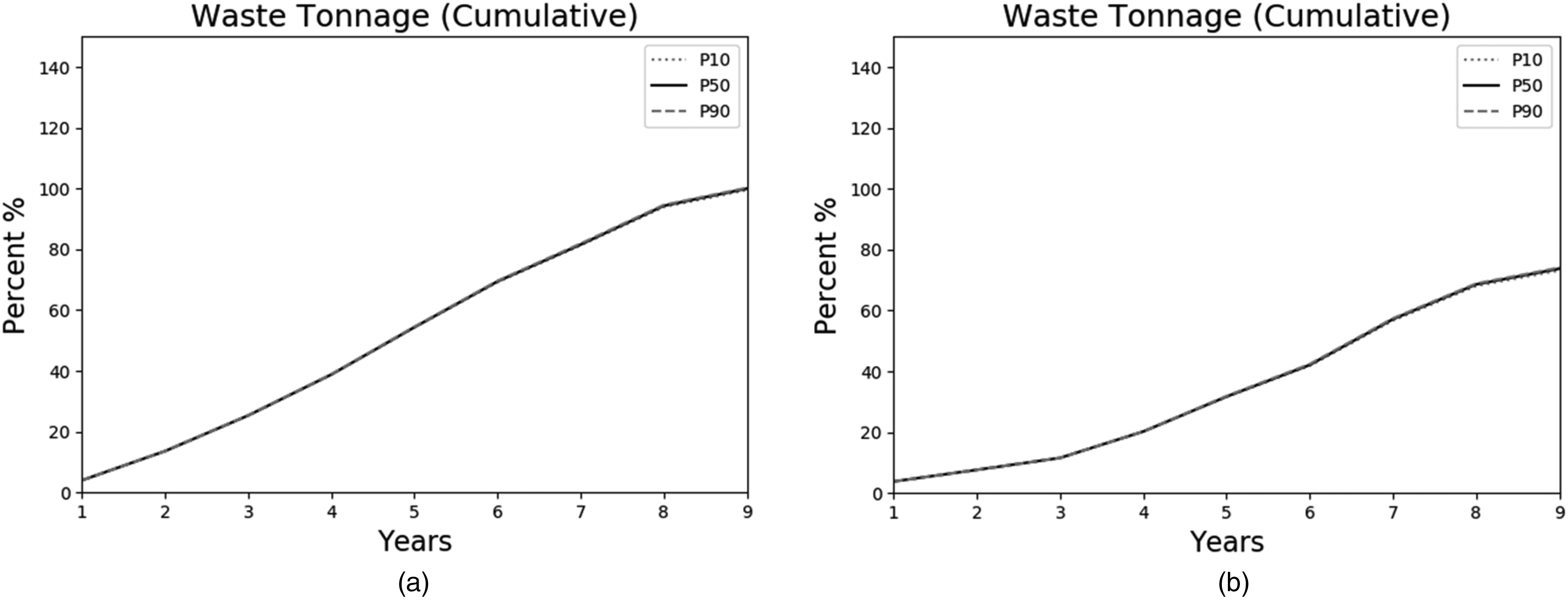
Scaled cumulative waste tonnage forecasts from schedules obtained from (a) wireframed and (b) simulated geological domains.
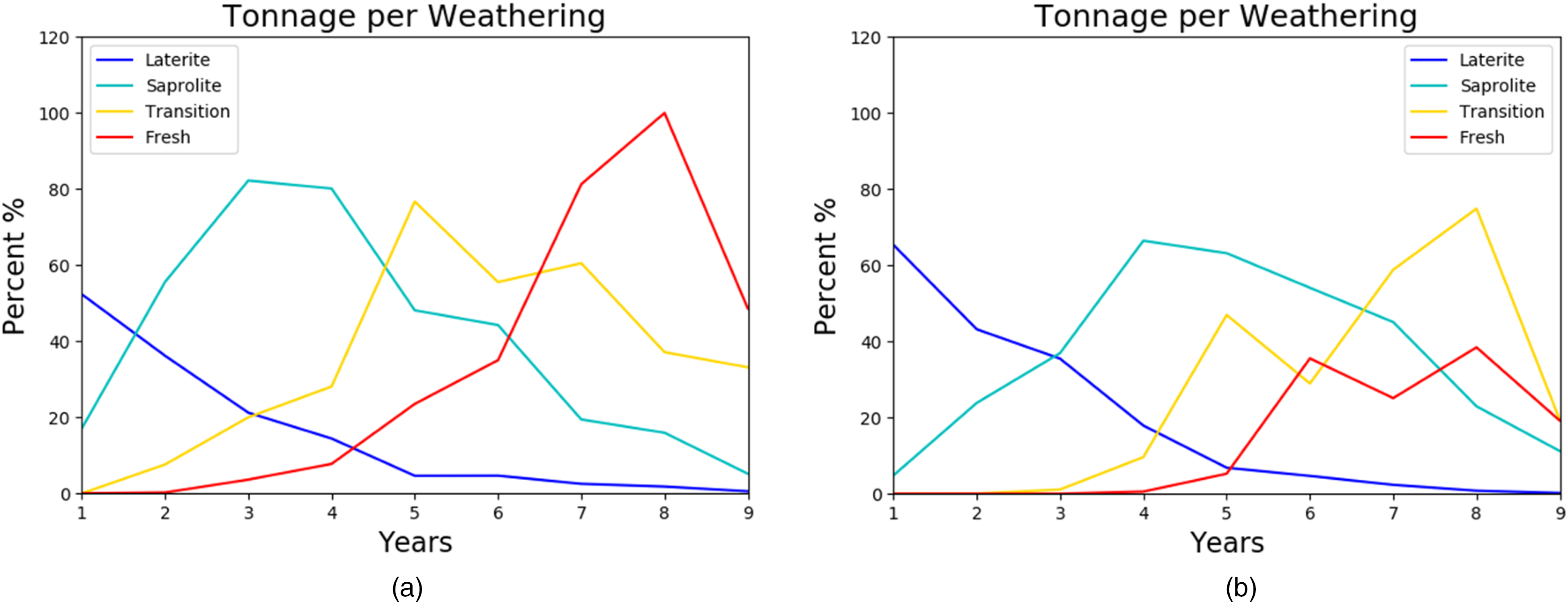
Scaled tonnage per weathering type from schedules obtained from (a) wireframed and (b) simulated geological domains.
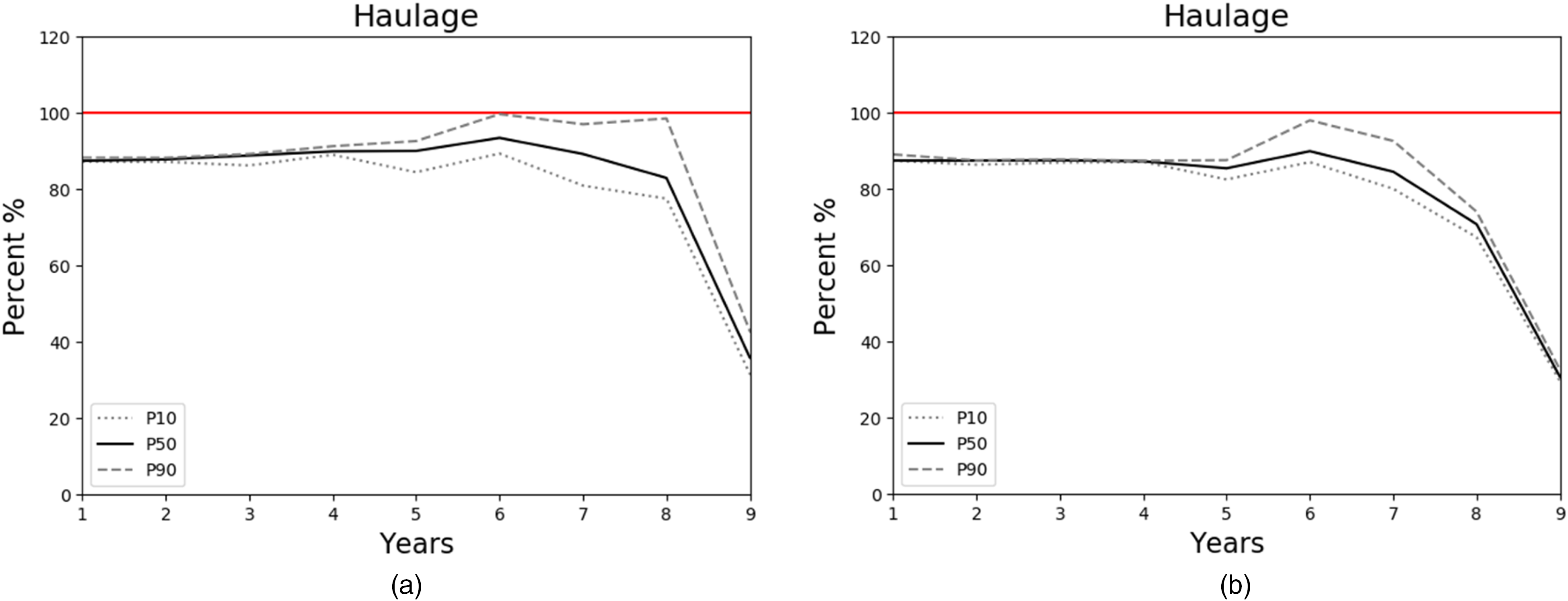
Scaled haulaged tonnes forecasts from schedules obtained from (a) wireframed and (b) simulated geological domains. Red lines indicate capacity constraint.
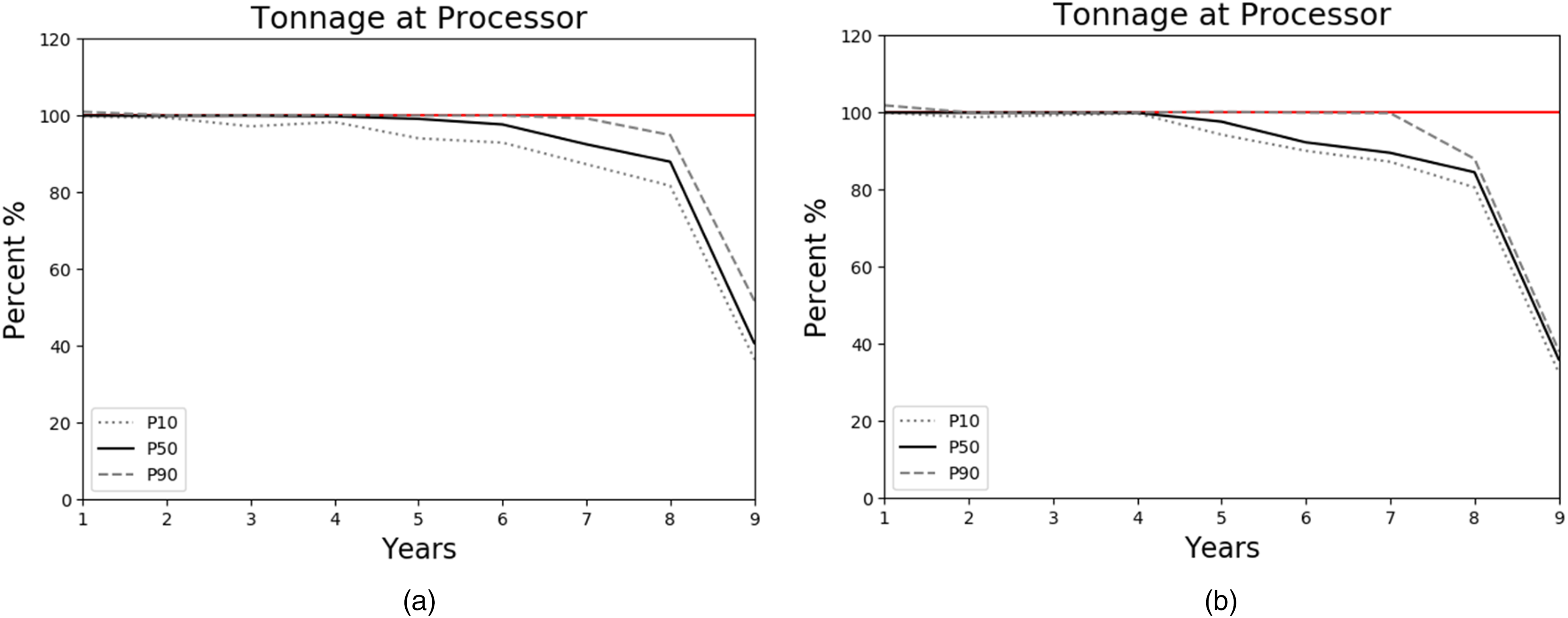
Scaled tonnes forecasts at processor from schedules obtained from (a) wireframed and (b) simulated geological domains. Red lines indicate capacity constraint.
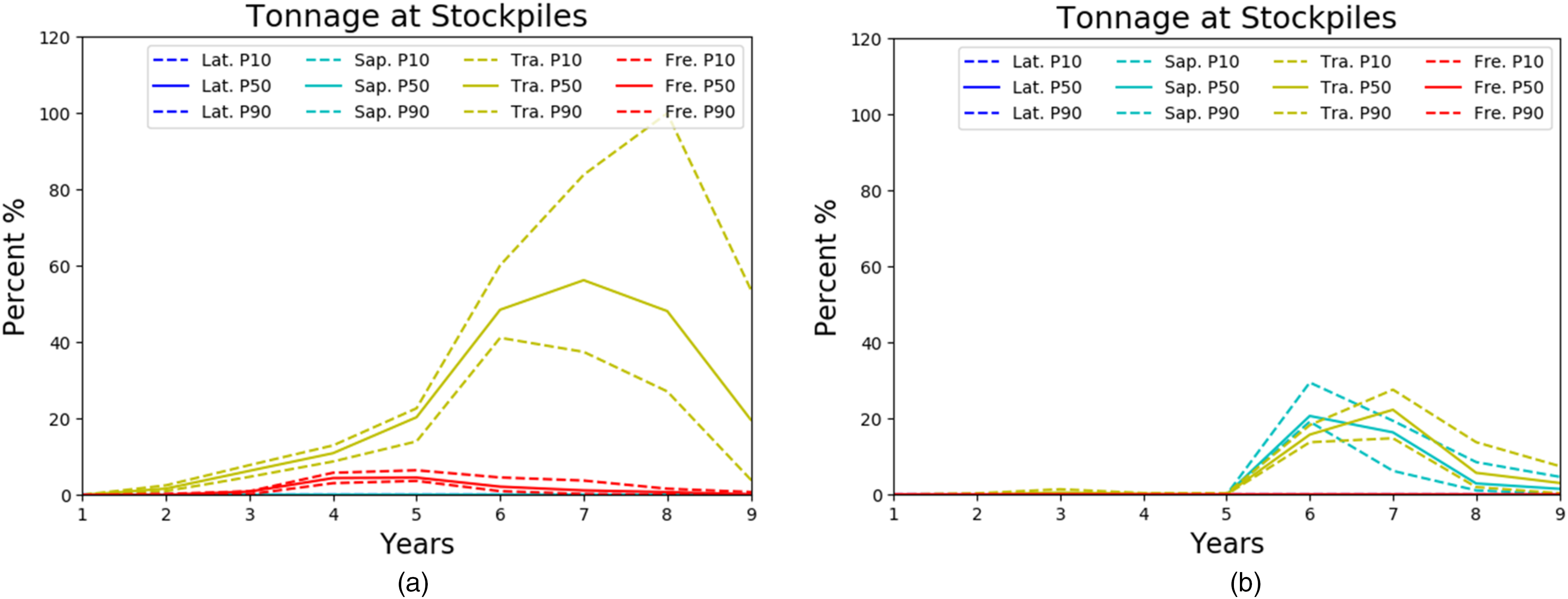
Scaled tonnes forecasts at stockpiles from schedules obtained from (a) wireframed and (b) simulated geological domains.
The forecasts for net present value (NPV) shown in Figure 21 present two noticeable differences. First, the widening of the risk profiles in Figure 21(b) for the schedule obtained based on simulated geological domains set. This widening corresponds to a 40% increase for year 9 (period of maximum NPV and mining stops), with respect to the NPV expected based on the wireframes. This result is expected, given that the additional source of geological uncertainty is accounted for, and it translates into more financial uncertainty with respect to the single wireframe-based schedule.
The second difference corresponds to a higher NPV reached by the schedule based on simulated geological domains. In this case, the increase corresponds to 20% with respect to the schedule based on wireframed domains. This effect is attributed to the ability of the optimisation process to capitalise over a representation of geological uncertainty and variability given by a set of realisations of geological domains and related boundaries, where simulated scenarios of geological domains replace the common single smooth wireframe representation of lithologies. To understand better this increase in value, more production forecasts are shown in Figures 22–27.
For the metal recovered at the processor shown in Figure 22, the two schedules present similar metal production at the mill. The only noticeable difference is, again, the widening in the risk profiles for the schedule based on simulated geological domains. As there are no major differences in cumulative metal production for the LOM, this is not the major cause for the difference in NPV noted between schedules. The difference is found in the waste tonnage handled by each schedule, shown in Figure 23. The schedule based on wireframed geological domains handles 25% more waste than the one based on simulated geological domains for the LOM. This difference is again attributed to the different spatial distributions of ore given by the simulation of lithologies, and to the simultaneous optimisation of cut-off grades given by the optimisation framework.
Another source for the difference in the expected NPV is attributed to the quantity of material types mined and the associated cost. Drilling and blasting costs for Fresh rock is five times higher than those for Laterite. As shown in Figure 24, the quantity extracted of Fresh in the schedule based on wireframed geological domains is higher than simulated ones, rendering a higher cost and respective reduction in NPV. The higher removal of Fresh rock also indicates that the schedule based on wireframed geological domains extracts more material at deeper levels, which can also be seen in Figure 20.
Regarding capacity constraints, Figures 25 and 26 show that both haulage and processing capacities are honoured. These figures also show the effect of the geological risk discounting, which allows for the management of risk by deferring it to later periods. This risk management is noticed by wider risk profiles in years 6, 7 and 8 than in the first four. The difference between the quantities shown in hauled and processed material is given by the material stockpiled, shown in Figure 27. Stockpiled material is also different for each schedule. The schedule based on wireframed geological domains stockpiles more quantity and more expensive material than the schedule based on simulated geological domains, helping to explain the difference in NPV forecasts.
Conclusions
The effects of the simulation of geological domains through the simultaneous stochastic optimisation of a gold mining complex were assessed and discussed. The optimisation method managed the geological uncertainty by maximising the NPV and minimising the risk of not meeting production targets and constraints, while capitalising in the synergies of the mine complex, for two sets of simulations: the first one based on a single wireframe, while the second based on simulations of geological domains.
The second set used 15 categorical scenarios of geological domains which were obtained through the high-order simulation method (HOSIM), without the use of a training image (TI). First- and second-order statistics of the fifteen realisations were validated by comparing them with corresponding data statistics. Similar validation was done for third- and fourth-order. The reproduction of statistics’ main patterns resulted as expected, given that HOSIM is a data-driven simulation method, rather than other TI-driven methods.
Validation of statistics (histograms and variograms) was also done for the simulation of gold grades within each mineralised geological domain. Grade simulations were obtained for wireframed and simulated geological domains.
The two sets of simulations were used as inputs to the simultaneous stochastic optimisation framework to obtain two schedules, respectively. The results observed by comparing both stochastic mine plans were: (a) different extraction sequences with consequently different ultimate pit limits, (b) 20% increase in expected NPV and 40% widening increase in the risk profiles when using the fully simulated geological set, (c) no major changes in metal recovered and (d) less handling of waste, with respective less cost, for the fully simulated geological set. These results stress the importance of accounting uncertainty and variability of geological domains in obtaining optimised mine plans.
The practical implications of these results start with the difference of extraction sequence and ultimate-pit limits, which are highly related to different mine designs and civil constructions such as ramps and the waste dump layouts. For the technical and financial forecasts, the widening of risk profiles is considered as a positive aspect because it implies a better accounting of geological uncertainty than only grade's uncertainty. The increase in 20% of expected NPV is considerable as for a gold project of this magnitude this percentage translates in the order of hundreds of millions of USD. Noticeable, this change in expected value does not come from more metal recovered, but for less waste handled, which also translates into volume reductions for the waste dump design and reduced environmental footprint.
For future work, for geological modelling, grades could also be simulated by HOSIM, as this method is known to represent better spatial connectivity of high grades. For mine-planning, multiple mineral deposits of the gold mining complex could be considered to fully capture the synergies of the mining complex, rendering an even higher economical value for the mining company. Considerations of gold price uncertainty could also be provided as it has increased substantially in the last years.
This manuscript has been derived from the work presented in Morales (2021).
Footnotes
Acknowledgments
Special thanks to Raphael Dutaut, Nathaniel Chouinard and Stephen Eddy from IAMGOLD for data and insights provided.
Data Availability Statement
The data is not publicly available due to confidentiality agreements.
Declaration of Conflicting Interests
The authors declared no potential conflicts of interest with respect to the research, authorship, and/or publication of this article.
Funding
The authors disclosed receipt of the following financial support for the research, authorship, and/or publication of this article: This research was supported by the National Science and Engineering Research Council of Canada (NSERC) CRD Grant CRDPJ 500414-16, NSERC Discovery Grant 239019 and the COSMO mining industry consortium (AngloGold Ashanti, Anglo American, BHP, De Beers, IAMGOLD, Kinross, Newmont Mining and Vale).