




Abstract
The purpose of this study was to examine the risk of victimization among missing persons and the ways in which gender and age shape this relationship. From a sample of 1,847 missing persons reports, multiple logistic regression was used to estimate victimization risk when missing, disaggregated by gender and age group and including vulnerability factors (i.e., the reasons for victimization risk). Results reveal that female missing persons compared to males and children/youths compared to adults had significantly increased odds of victimization risk. Vulnerability factors statistically significantly associated with victimization risk for females compared to males and children/youths compared to adults included transientness, victimization experiences (e.g., domestic violence, human trafficking), going repeatedly missing and mental health concerns. The findings suggest that victimization risk for missing persons varies along gender and age lines. This study contributes to the literature addressing the paucity of studies that apply exposure and opportunity theories to understand victimization risk when missing split by demographic characteristics. Thus, its novelty lies in advancing the victimology literature to the study of missing persons, and in discovering nuances in the relationship between victimization risk and going missing.
Introduction
Since their introduction in the 1970s, routine activity theory and lifestyle- exposure theory have had considerable influence on the study of victimization due to a primary premise of these related approaches: Victimization risk varies across demographic groups because people in these populations engage in different activities and make different life choices. 1 , 2 , 3 As a result, over the last several decades, it has been well-documented that gender and age (among other demographics) are correlated with the risk, rates, types and outcomes of victimization across various related issues, including female versus male gang member victimization risk, hot spots of youth crime and the gender gap in intimate partner homicide.1, 4 , 5 , 6 , 7 For instance, the latter has uncovered that men, compared to women, are more likely to experience violence by a non-intimate partner, and women are at greater risk than men of being violently victimized by an intimate partner.5, 8 , 9 , 10 However, one issue largely unexplored in this literature is missing persons.
A small but notable proportion of people experience harm, vulnerability and victimization related to going missing. 11 , 12 While most missing persons are located alive and unharmed and/or return within 24 to 48 hours, there is a percentage that does not and instead come to experience assault, exploitation, self-harm, suicide and even death when missing.11, 13 , 14 , 15 It is these extreme and exceptional cases—those that are murdered while missing and cases connected to crime and violence—that have emerged as the focus in much of the public and scholarly discussions on missing persons. 16 , 17 , 18 , 19 , 20 Research on such has uncovered that certain groups are significantly more likely to experience harm, vulnerability and victimization when missing than others, such as women and girls, children/youths, older adults, racialized persons and the 2SLGBTQ+ community.12, 21 , 22 Missing persons are, thus, relevant to the study of victimization, but, despite these ties, little scholarly attention in the field has been paid to this phenomenon.
Given the findings in existing scholarship between gender, age and victimization risk, and the emerging discourse in missing persons’ literature about the same, this study seeks to explore such linkages. Specifically, victimization risk among missing persons and how gender and age group impact this relationship are examined. This focus is imperative because different demographic groups seem to have varying levels of vulnerability when missing, but which experience greater victimization risk? This study seeks to advance the conversation on how ‘going missing’ may not be an evenly risky occurrence for all persons. Disaggregating findings can contribute to a more nuanced understanding of victimization risk and victimization patterns among missing persons. Further, by expanding the current knowledge on victimization risk among missing persons, more visibility can be given to missing persons in victimological research—a phenomenon generally omitted from such literature.
Literature Review
Victimization Risk
The literature highlights several trends with respect to the factors impacting an individual’s victimization risk. Lauritsen and Rezey point towards some critical sociodemographic correlates of victimization, including age, sex, race and ethnicity, and marital status. 7 For most forms of violence, younger people, men, racial and ethnic minorities, and those who are not in marital relationships are at a higher risk of victimization than their counterparts.1,7 Gender-based and sexual violence is an exception to this trend, as women face a greater risk of experiencing sexual assault and intimate partner violence. 7 Combined with gradual declines in the types of violence that primarily affect men (such as aggravated and simple assault) over the last few decades, sex/gender 23 has become a less consistent correlate of victimization in comparison to more stable factors such as race and ethnicity, marital status and age.7, 24 Most recent data suggest no statistically significant differences in the rate of violent victimization reported by men and women in the United States, 25 while Canadian data highlight a victimization rate for women that is nearly double that of men. 26 This reversal of the trend in the Canadian context is attributable primarily to the sexual assault rate reported by women being more than five times that reported by men. 26 Fundamentally, while the gender gap in rates of victimization may be narrowing between men and women, 5 sex/gender remains an important correlate of victimization when disaggregated by type of offence.
The role of age in understanding victimization has remained remarkably persistent since the earliest studies of victimization surveys, published around five decades ago. Hindelang et al. find that personal victimization rates peak among young people aged 16 to 19 (114 incidents per 1,000 people), with steady decreases in each subsequent age category. 1 The volume of crime has declined since the 1970s, but similar patterns of victimization by age are reflected in current data. For instance, Canada’s 2019 General Social Survey on Victimization finds the highest rate of violent victimization among those aged 15 to 19 (200 incidents per 1,000). 26 Similarly, data from the most recent National Crime Victimization Survey in the United States shows the highest violent victimization rates among those aged 18 to 24 (29.6 incidents per 1,000). 25 Both reports find the lowest rates of violent victimization in the oldest age categories, with violent victimization declining significantly around the age of 35.25,26 The salience of both age and sex/gender in understanding victimization patterns is reflected in the extensive bodies of literature that focus more narrowly on age-specific forms of crime (i.e., bullying, cyberbullying), highly gendered forms of crime (i.e., sexual assault, intimate partner violence), and areas where age and sex/gender intersect (i.e., sexual violence on college campuses, human trafficking). 27 , 28 , 29 , 30 , 31 , 32 Therefore, the qualitative differences in the types of victimization experienced by men and women and across age categories, and thus the risk of victimization experienced by each group is well-documented in the existing scholarship.
Missing Persons and Victimization Risk
While robust research highlights the impact, age and gender have on victimization rates and the types of victimization individuals can experience, little is known about both among missing persons. When explored, victimization is often considered in the discussion on the risk of harm and vulnerability, and harm experiences when missing, with such terms being used throughout studies seemingly interchangeably to understand people’s risk and experiences while missing.12,20 Given their overlap in the literature, findings on the risk of victimization, harm and vulnerability will be reviewed herein.
A prominent portion of the missing person’s literature focuses on how going missing can increase one’s vulnerability to harm. It has been consistently documented that the risk of harm (e.g., assault, violence, homicide) when missing is low across missing persons’ incidents. Vo, in a study of the risk of harm to missing or absent people, found that ‘around 99% of individuals did not suffer any crime harm whilst missing’. 33 Huey and Ferguson similarly report that going missing is a ‘mundane’ experience for a significant majority of missing people, with most returning of their own volition and/or being located alive. 34 That said, there is an inequality in the spread of harm, with particular groups experiencing harm when missing more than others. 11 Explicitly, Phoenix and Francis write that ‘though most missing persons are located quickly and safely, a small but important proportion suffers serious and fatal outcomes’. 35 Doyle and Barnes, for example, explore the risk of serious harm when missing, finding that juveniles, adults and women who go missing are more likely to experience harm during these incidents. 11 Phoenix and Francis also discovered that age and sex were significantly associated with the risk of harm while missing, with females and adults being more likely to be high risk compared to males and children. 12 The finding that age and sex/gender affect the risk of harm while missing is a trend across the scholarship.13,20, 36 , 37
There is also diversity in the types of harm, and victimization missing persons are at risk of, especially when considering the individual’s age, sex/gender and the circumstances surrounding the incident. 11 A survey of missing adults conducted by Hunter et al. discovered that ‘nearly 60% disclosed experiencing some other form of harm, including being threatened, sexually assaulted or experiencing physical violence while away’ and that ‘1 in 3 disclosing that they had experienced an unwelcome sexual approach or were assaulted sexually while missing, and nearly 1 in 4 experiencing physical violence or force’. 38 A dominant area of concern relates to the risk of serious harm to oneself when missing, given the enduring relationship between mental health issues, suicidal ideation and going missing.13, 39 One study reports that the strongest association between harm for under-18-year-olds and going missing is suicidal threats or ideation. 11 That said, Biehal et al. report that a small number of missing persons’ cases result in suicide but emphasize that the presence of mental health issues has the potential to increase the vulnerability of the missing person to harm and victimization. 13 The latter is true across demographic groups.12, 40
Children/youths tend to make up the majority of missing persons’ cases and are also known for being significantly likely to go missing more than once.20,37 Given that this group is likely to go missing more and do so repeatedly, this elevates their risk of harm and victimization compared to adults, and as Phoenix and Francis discuss, 12 going missing more than once may indicate the child/youth is experiencing exploitation and/or abuse. Research indicates this group is at elevated risk of victimization because of children/youths engagement in ‘survival crimes’ when missing due to the need to meet their basic needs, grooming, vulnerability and thrill-seeking.13,14 Missing children/youths have also been found to be at significant risk for sexual and criminal exploitation due to their known age-related vulnerability.12, 41 , 42 Indeed, in the United Kingdom, 2019 data revealed that abuse or exploitation was one of the top five reasons for children/youths going missing. 43 Stevenson and Thomas also documented that nearly 70 per cent of missing youths experience victimization, including family violence and sexual exploitation. 42 These findings on victimization in the study compounded for female missing youths who went repeatedly missing (i.e., missing more than once). 42 Hutchings et al. similarly documented that children who went repeatedly missing and were in a ‘high risk’ group were more likely to be victims of sexual exploitation and have experienced abuse and/or neglect in their lives. 44
Another area of the literature with information on victimization pertains to studies, which focus on missing persons in a criminal context, specifically homicide. According to the Association of Chief Police Officers, there is only a small number of persons reported missing because they have been victims of crime (e.g., murder, trafficking). 45 Nevertheless, research demonstrates that demographic characteristics are relevant to an individual’s risk of death and links to crime when missing. A study comparing missing persons’ demographic factors in non-criminal and criminal contexts identified that missing females, those 18 to 25 years old, and those last seen at a public location were more likely to be associated with a criminal situation. 46 Additionally, Newiss sought to understand missing persons who have been victims of homicide and uncovered that, for both youths and adults, females (68 per cent) were comparatively at the highest risk of being homicide victims than males (32 per cent) when reported missing. 47 This study further noted that most homicide victims related to going missing are 18 years old and above (67 per cent), but that gender played a more significant role for 14- to 18-year-olds as females in this group were 14 times more likely than males to be the victim of homicide when missing. 47 In fact, in Canada, a commission of inquiry was established and completed in 2012 by the Honourable Wally T. Oppal because of the enduring relationship between violence against women and missing persons and the crisis of missing and murdered women. 17 Together, gender and age seem to be important factors for understanding homicide risk among missing persons.
An emerging area of the literature concentrates on the lifestyle-related factors associated with missing persons who become victims, including experiencing homelessness, transientness, sex trade work, social exclusion, and substance use and abuse.16,18, 48 The impact of these lifestyle-related factors on victimization risk is also linked to demographic characteristics, such as more women occupying roles in the sex trade industry and, thus, tautologically, more being at risk of victimization when missing. 20 Some works have discovered that the rates of murder victims who were first reported missing are higher for people who are a part of the 2SLGBTQ+ community and are racialized.22, 49 For instance, Bragagnolo, in discussing the victims of the serial murderer Bruce McArthur from Toronto, Ontario, Canada, explained that McArthur’s victims were targeted because they frequented Toronto’s Gay Village. 50 This research explains that most of McArthur’s victims were queer men of colour, highlighting the unmistakable risk of victimization to persons in these communities. 50 There has also been consistent documentation of Indigenous peoples, specifically women and girls, being over-represented as victims of crime when missing.17,19,49 In fact, this trend of Indigenous women and girls going missing and being subsequently murdered is so critical that the National Inquiry into Missing and Murdered Indigenous Women and Girls (MMIWG) in Canada termed this phenomenon an ‘epidemic’. 51
Altogether, there is documentation of increased risk of harm, vulnerability and victimization among missing persons, a relationship impacted by the demographics of the missing individual (age, sex/gender, sexuality, race/ethnicity) and the case circumstances and lifestyle-related factors (e.g., last seen in a public location, involvement in sex trade work).
Theoretical Framework: Routine Activity/ Lifestyle Theory
The causes and risk factors involved in victimization have been discussed through many theoretical lenses. One category of theories that has been discussed more often during the last few decades is exposure and opportunity theories. Particularly, scholars have highlighted the significant influence routine activity theory, and lifestyle-exposure theory has on explaining the various risk factors that increase the likelihood of victimization. 52 , 53 , 54 , 55 It is essential to highlight that exposure and opportunity theories, like many other theories that discuss victims’ characteristics and behaviour as factors influencing the likelihood of victimization, have been criticized as contributing to victim-blaming ideologies. 56 Thus, while these theories emphasize that social structure is the source of these vulnerabilities, it is essential to reiterate that routine activity theory and lifestyle-exposure theory are used in this study, but victims do not bear responsibility for what they experience.
Routine activity theory is an opportunity model of crime that emphasizes the factors necessary for predatory offences to occur. 2 In order for crime to take place, Cohen and Felson argue that three key elements must converge in time and space: (a) a motivated offender, (b) a suitable target and (c) the absence of capable guardianship. 2 Thus, in addition to highlighting the motivated offender, the characteristics of the victims and the environment and context victims exist within are essential aspects of understanding victimization risks. This theory captures information about victims’ lifestyles, circumstances and proximity to sources of protection or guardianship that affect their risk of experiencing victimization. Routine activity theory has previously been used to explore risks and experiences of various types of victimizations while also discussing aspects of age and gender. 57 , 58 For example, Mustaine and Tewksbury explored women’s experiences as victims of stalking, 59 and Marcum et al. explored adolescents’ experiences with online victimization 60 ; both studies highlighted the importance of routine activity theory for understanding the risk of victimization, which has been echoed by many other scholars thereafter.56, 61 , 62 , 63 , 64
In addition to routine activity theory, another that explores victimization risks in relation to the habits, behaviour and choices of victims is lifestyle-exposure theory. 1 Lifestyle-exposure theory (also known as lifestyle theory) highlights that the risk of victimization is linked to the lifestyle and choices of the individual. The premises underlining this theory are that there are certain times and places that individuals have a higher exposure to being victimized, and there are certain individuals that have a higher risk of perpetrating crime. Hence, depending on a potential victim’s exposure and association with certain places, times and individuals, the likelihood of victimization increases. These arguments are fairly similar to the ideas presented by routine activity theory by Cohen and Felson 2 ; however, lifestyle-exposure theory also emphasizes the idea that an individual’s lifestyle can increase the frequency of exposure and association to high-risk spaces, times and individuals. Several studies have found support for the impact lifestyle, and choices have on one’s victimization risk,54,55 There is value in considering lifestyle-exposure theory in addition to routine activity theory for exploring victimization risks.
When looking at routine activity theory, its three elements—(a) a motivated offender, (b) a suitable target and (c) the absence of capable guardianship—appear relevant to missing persons’ incidents. People when missing can be in a vulnerable position for many reasons. The nature of going missing can involve separation from social networks and loved ones (i.e., friends and family), and someone generally has to recognize an individual’s absence to report them as missing.13, 65 , 66 This disconnection from and absence of contact with family, friends or other associations creates a lack of a support system and capable guardianship.
Going missing has also been tied to physical, mental and emotional distress,13,21, 67 , 68 which can lead to exposure or association with high-risk individuals, times and spaces that increase one’s risk of victimization. For example, Huey and Ferguson found that adults reported missing experienced significant life stressors, stressful situations and proximate stressors that triggered their missing episode, including family/spousal disputes, work stress, health issues such as cancer and awaiting surgery, financial strains, mental health crises and significant caregiving responsibilities. 34 This study wrote that the maladaptive behaviours used to cope with stress placed them in vulnerable positions—one behaviour of which was the activity of going missing, with others including gambling and drug/alcohol use to ‘blow off steam’. 34 Thus, missing persons can become suitable targets because they may be in emotional, psychological or physiological distress, which make them more vulnerable to victimization and also to individuals who prey on them.
Lastly, research documents that lifestyle-related factors regarding people who go missing also have the potential to increase vulnerability and the likelihood of being victimized, such as sex trade work, experiencing homelessness and transientness, and human trafficking.12,42,71 For these reasons, arguments are made for applying exposure and opportunity theories to better understand the potential for risk when missing,20,48 yet such appeals largely remain unaddressed. To remedy this knowledge gap, this paper contributes the theoretical application of exposure and opportunity theories to the phenomenon of going missing. Since this is an exploratory study, routine activity theory and lifestyle-exposure theory are utilized herein to contextualize the empirical findings on the relationship between gender, age and victimization risk among missing persons. 69
Current Study
This study serves as an introductory empirical investigation into how some demographic groups compare with respect to victimization risk when missing. Specifically, it seeks to answer the question, ‘How are gender and age associated with victimization risk when missing?’ There are marked reasons to consider this matter significant. As noted, the broader body of literature features well-established trends in the demographic and lifestyle differences regarding the risk of victimization. In the field of missing persons, similar patterns are emerging, with some scholars noting that the risk of harm when missing is gendered and age-related.11,42, 70 , 71 Moreover, such research indicates a variety of adverse outcomes related to victimization and missing persons, such as self-harm and death, especially for particular groups.42,44,49 However, this topic is an underdeveloped area in the literature.
This study, thus, seeks to provide basal insights on the connection between victimization risk and missing persons by disaggregating the findings according to different demographic groups and applying routine activity/lifestyle theory. As mentioned, routine activity theory emphasizes the concept of a suitable target. In the case of missing persons, vulnerable individuals may be more likely targets when missing. It is in this study that we seek to explore potentially vulnerable groups of missing persons and the vulnerability factors that influence their risk for victimization. Concerning lifestyle-exposure theory, the analyses also include various factors that contribute to one’s victimization risk when missing.
Materials and Methods
Data Source
Data were drawn from a cross-section of police service call files (regarded as Computer-Aided Dispatch or CAD data) from one Canadian municipal police service. 72 These data were stored and managed per the standards instituted by the Canadian Tri-Council Agencies and [redacted for peer review] research ethics board, from which approval was received to carry out this research. CAD data contain particulars on each police report, such as dispatcher’s comments, type of report (both initially assigned by the call taker and final type determined after police investigation), event synopsis and detailed information, final Uniform Crime Report categorization, times and locations, and other additional information acquired by police following response (e.g., risk assessment, priority level, time cleared). These data also include ‘flags’ for victimization risk. For context, upon the officer receiving the report and collecting information on the case via investigation efforts, this police service ‘flags’ files to bring attention to the person’s vulnerability factors and potential linkages to victimization for when the officer tasked to the file completes a risk assessment form. Risk assessment forms generate a level of risk associated with the missing person case (e.g., high risk, medium risk, low risk), and this level, then, steers the police response (e.g., the number of resources assigned to the case and the urgency of a response). Therefore, this dataset is employed as it contains a ‘flag’ for victimization risk.
A crime analyst at the police agency anonymized and extracted all files from over 2019 and generated Excel spreadsheets documenting these occurrences separated by crime-related cases (e.g., break and enter, assault) and social-related cases (e.g., check well-being, trouble with persons). This initial dataset consisted of 42,996 files (12,910 crime-related records and 30,086 social-related) over this one year. Crime- and social-related files were eliminated if they did not pertain to a missing person occurrence. At this stage, the dataset contained 1,920 missing person files. Following this, a further 73 cases with missing values regarding the included demographic factors and qualitative information were removed through list-wise deletion. This occurred to ensure the included files had relevant information for the analyses. The final sample, therefore, comprises 1,847 missing person files.
Measures
Victimization risk: Victimization risk is represented with a dichotomous variable indicating whether the missing persons files had a flag for victimization risk (0 = no victimization risk flag; 1 = victimization risk flag). Example comments within the files with victimization risk flags include ‘vic. [victimization] risk – flagged – known involvement in human trafficking’, and ‘flagged for risk – suicidal ideation, concerns over wellbeing’. In terms of conceptualization, victimization risk in this study is probabilistic, related to the specifics of the case that were flagged as impacting the individuals’ level of vulnerability to victimization or becoming a victim during a missing occurrence. Victimization risk, therefore, represents the chances of victimization occurring. If victimization risk was not mentioned in the files, this means that there were no marked concerns over the risk of victimization for that particular person based on the information gathered by the call taker and following police risk assessment and investigation, and victimization risk was generally not a determinant for police response. This is, thus, not exploring the actuality of victimization when missing or victimization outcomes—in other words, if an incident of victimization occurred or victimization rates. Instead, as mentioned, it examines the potential for victimization when missing. This approach aligns with routine activity and lifestyle-exposure theory.1,56
Demographics: Demographic predictors used in the models include dummy indicators for age group and gender. 73 Note that race/ethnicity data could not be included in the analyses due to 1,414 or 76.6 per cent of the files containing missing values regarding this variable. An absence of information on race/ethnicity is a known limitation of police data more generally, and missing persons’ records more specifically.19,49, 74 , 75 That said, it is recognized that victimization risk when missing may be affected by race/ethnicity, such as the epidemic of Indigenous women and girls going missing and subsequently murdered. 19 Excluding this demographic variable from the study was, thus, not researcher-imposed but driven by data limitations. Gender is coded as classified in the police files: Male and female. Age group is the variable utilized as a person’s exact age is not mentioned in these data, but instead, each individual is recorded as either an adult (aged 22 and above) or child/youth (aged 21 and under). 76 The age groupings, therefore, had to be coded as categorized. To provide an overview of these characteristics: Most of the full sample consists of children/youths (n = 1,176, 63.7 per cent) and females (n = 1,012, 54.8 per cent) compared to adults (n = 671, 36.3 per cent) and males (n = 835, 45.2 per cent). Mainly, the final dataset consists of a greater number of female children/youths (n = 620) and female missing adults (n = 392) compared to male children/youths (n = 556) and male adults (n = 279).
Vulnerability factors: The vulnerability factors cited in the missing persons’ records are the reasons for victimization risk being flagged. These variables are the following truncated categories: Substance use, transientness, sex work, victimization experiences, mental health issues, other health concerns, repeat/chronic and crime-related activities. Substance use comprised any mention of drug and/or alcohol use, addiction, alcoholism and substance use disorder within the files concerning victimization risk. Transientness pertains to victimization risk being cited in relation to the missing individual experiencing homelessness, ‘couch surfing’, living at a homeless shelter or mission centre, temporarily housed at another person’s place, experiencing insecure housing, and living at a hotel/motel/hostel without a home address or, despite having a home address, not living there. Sex work was coded for when files recorded involvement in sex work or the sex trade, prostitution, ‘street work/worker’, and ‘hooking’/‘hooker’ linked to victimization risk. To note, sex work connections for children/youths where sexual exploitation was noted and human trafficking were not included in this category but instead were captured under victimization experiences. Victimization experiences in connection with victimization risk include experiences of assault and battery (e.g., sexual, physical), abuse (e.g., domestic, parental), stalking (criminal harassment), theft, kidnapping, and, as mentioned, exploitation and human trafficking. Mental health issues capture a range of mental health-related concerns that were linked to victimization risk: Depression, bipolar, mania, suicidality, anxiety disorder, post-traumatic stress disorder and schizophrenia. Other health concerns consist of victimization risk concerns related to intellectual, physical and cognitive concerns and disabilities, including autism, brain injury, Alzheimer’s and dementia. Repeat/chronic cases are those in which the individual has gone missing multiple times. Lastly, crime-related activities pertain to experiences with crime related to the missing occurrence in connection with victimization risk, encompassing kidnapping, assault, abuse, drug-related offences, robbery, breaking and entering, and homicide. Dichotomous variables were created for each vulnerability factor to represent its identification in the file in connection with victimization risk, where 0 = not identified and 1 = identified.
Analytic Strategy
Data were manually coded within Excel to generate the variables included in the analyses. This was performed by manually reading all the data columns of each case, relying on the ‘flags’ and qualitative information (free text, synopsis, dispatcher comments and officer insights following response) for any victimization risk, and the reasons (i.e., demographic and vulnerability factors) attributed for victimization risk being flagged within the records. Each flag and identification was coded as per the variables identified above. Then, all variables were cross-tabulated to capture the frequency. Next, because the models predict a dichotomous dependent variable, multiple logistic regression was used to estimate victimization risk disaggregated by the demographic indicators. That is, since the outcome variable is dichotomous, using linear probability models violates standard OLS assumptions.
Below, two types of models are analysed: First, a model estimating victimization risk for gender and age group, respectively, with no other variables added (models 1 and 2), and the second introduces the vulnerability factors attributed to victimization risk being flagged (models 3 and 4). The purposes of this are in the first model design (models 1 and 2) to estimate baseline victimization risk for gender and age group (i.e., how these alone affect victimization risk), and then to analyse how each demographic group’s predicted victimization risk is further affected by vulnerability factors.
Results
Prevalence of Victimization Risk and Vulnerability Factors
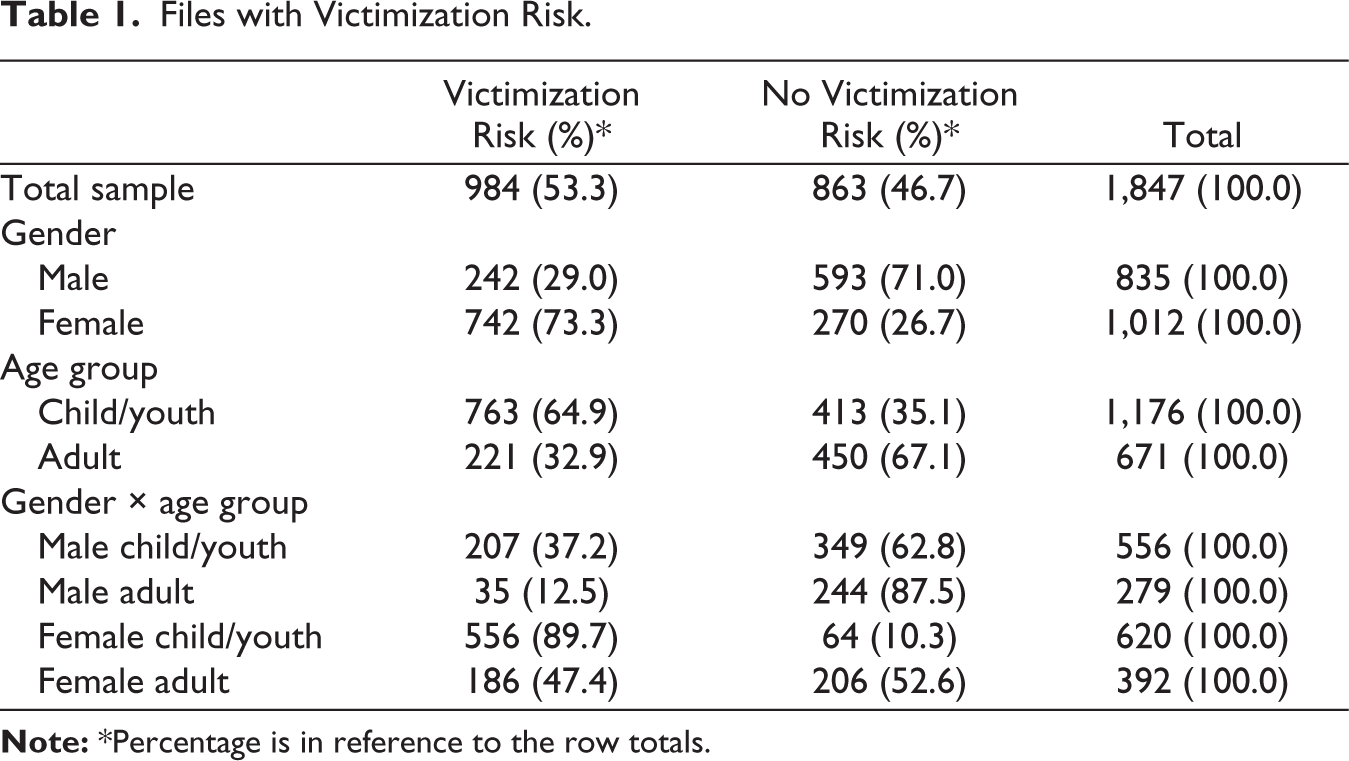
This section offers a descriptive overview of the included variables. Across the total sample, the data reveal that victimization risk is not rare among missing persons: Victimization risk is present in a total of 53.3 per cent (984 out of 1,847) of missing persons’ files, with 46.7 per cent (863 out of 1,847) not being flagged. Victimization risk is, thus, present in roughly half of the sample, albeit slightly more than no victimization risk. For gender, victimization risk is present in 29.0 per cent (242 out of 835) of male missing persons’ files, compared to 73.3 per cent (742 out of 1,012) of female missing persons’ files. For the age group, victimization risk is present in 64.9 per cent (763 out of 1,176) of missing child/youth cases compared to 32.9 per cent (221 out of 671) of missing adult cases (see Table 1). When considering both gender and age group, in order of most to least, victimization risk is present in 89.7 per cent (556 out of 620) of missing female child/youth files, followed by 47.4 per cent (186 out of 392) of missing female adult files, 37.2 per cent (207 out of 556) of missing male child/youth files, and, lastly, 12.5 per cent (35 out of 279) of missing male adult files. Put together, in the sample, female children/youths emerged as the most at risk of victimization when missing, and missing male adults the least.
Files with Victimization Risk.
Next, Table 2 displays the frequency of the vulnerability factors across the full sample and split by gender and age group. Overall, going repeatedly missing (repeat/chronic) was most identified for victimization risk (619 times) across all files, followed by, in order, transientness (549 times), mental health (506 times), substance use (435 times), other health concerns (411 times), victimization experiences (301 times), sex work (171 times) and, least of all, crime-related activities (81 times). This means that few files concern crime-related victimization risk, and most are at risk due to lifestyle-related factors (i.e., going missing repeatedly, transientness). In relation to gender, prominently, mental health issues, going missing multiple times (repeat/chronic) and transientness are most identified in connection with victimization risk for male missing persons. Examining female missing persons, going repeatedly missing (repeat/chronic), transientness and other health concerns were most identified for victimization risk. Turning to age group, missing child/youth cases vulnerability factors for victimization risk involve going repeatedly missing (repeat/chronic), mental health issues and transientness; whereas the vulnerability factors least identified for victimization risk for missing children/youths emerged as crime-related activities and sex work. Regarding missing adults, the vulnerability factors most identified for victimization risk were transientness, other health concerns and substance use, with the least being crime-related activities and sex work.
Ranked Number of Identifications for Each Vulnerability Factor Linked to Victimization Risk, Split by Gender and Age Group.
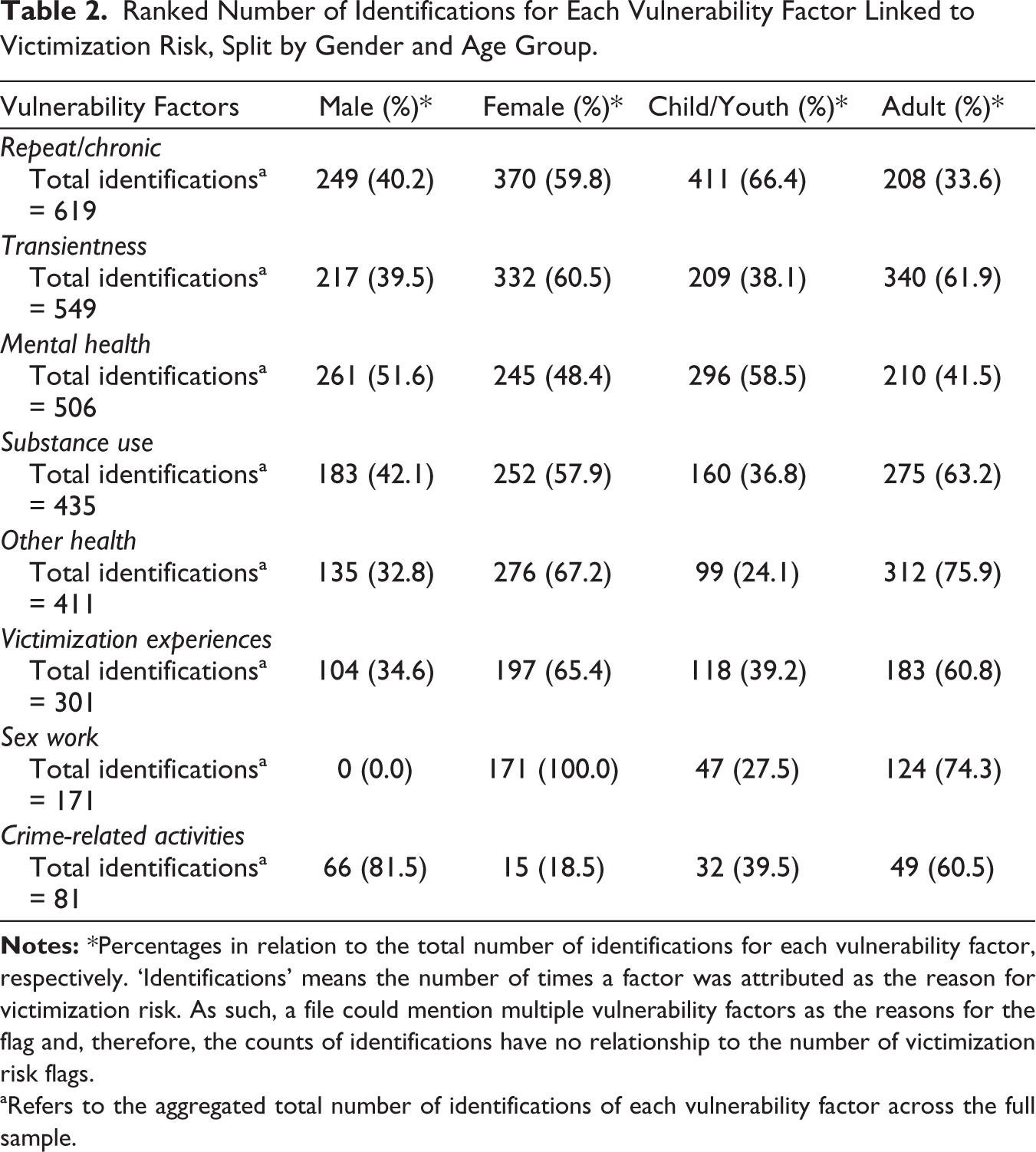
ªRefers to the aggregated total number of identifications of each vulnerability factor across the full sample.
However, there are descriptive gender and age differences with respect to the vulnerability factors, outside of what emerged as most and least prominent. To first consider gender: Victimization risk related to crime-related activities is concentrated among male missing persons’ file, whereas sex work is distinctly linked to the risk of victimization for female missing persons in the sample. Specifically, 81.5 per cent of all victimization risk flags for crime-related activities involved male missing persons compared to 18.5 per cent for females. For age, victimization risk related to going missing repeatedly is more for child/youth missing persons compared to adults, whereas other health concerns and sex work seem to be greatly relevant to adult missing persons’ risk of victimization. Amongst the victimization risk flags for going repeatedly missing, 66.4 per cent involved children/youths; for other health concerns, 75.9 per cent involved adults; and for sex work, 74.3 per cent involved adults. That said, the finding of victimization risk related to sex work for adults is likely a function of children/youths’ engagement in sex work being more so captured under ‘victimization experiences’ (i.e., sexual exploitation).
Statistical Analysis
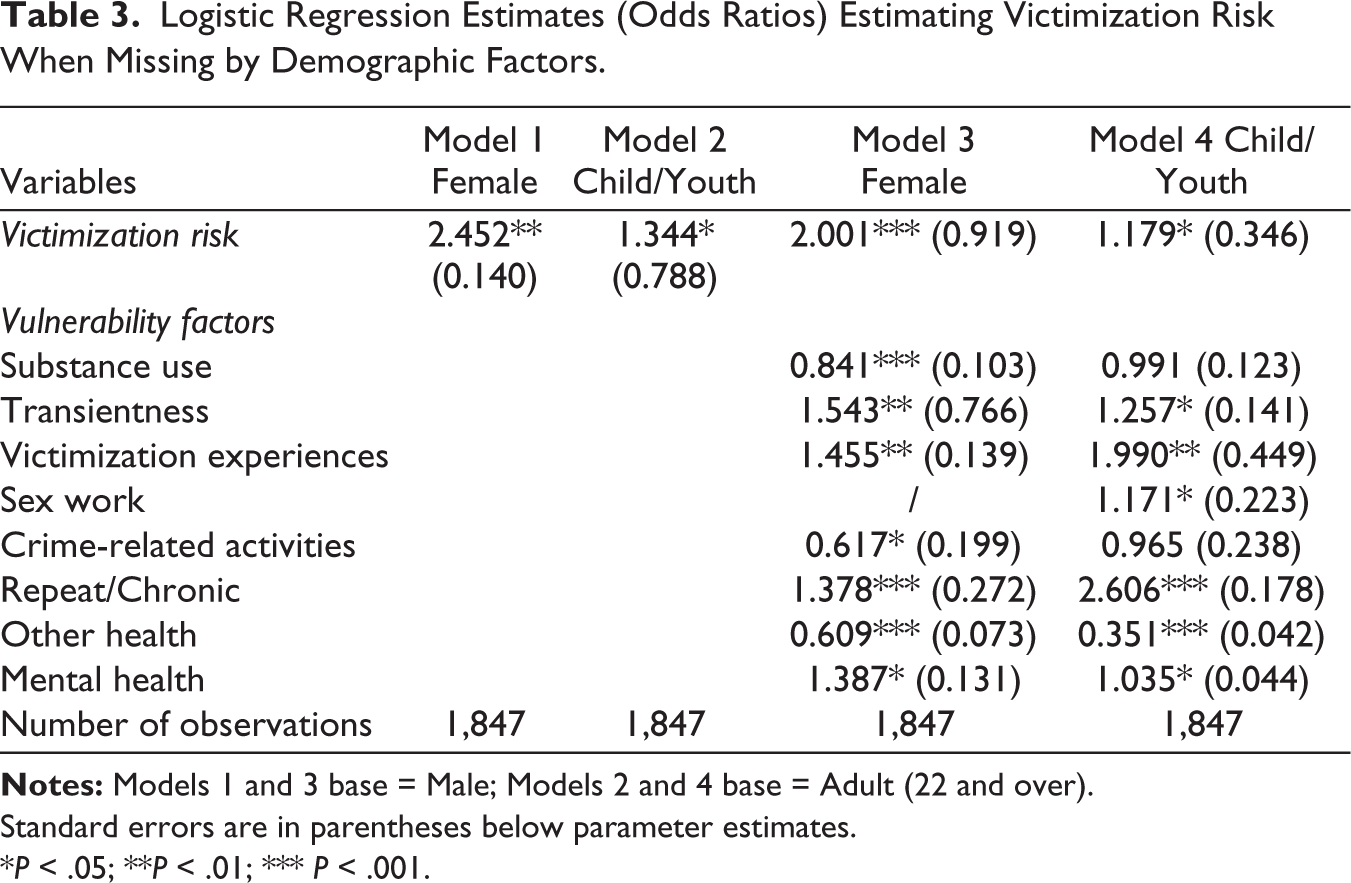
Table 3 displays the logistic regression models estimating victimization risk when missing. Recall that model 1 includes only gender and model 2 only age group to offer baseline estimates for victimization risk when missing without the vulnerability factors added. In models 3 and 4, the vulnerability predictor variables are introduced and disaggregated by demographic characteristics. Note that due to an absence of variation among the variable of sex work (i.e., all mentions of this factor involve female missing person files), this was excluded from analysis in model 3.
Starting with model 1, findings reveal that cases of female missing individuals are significantly more likely to be associated with victimization risk when missing compared to males. Specifically, females are 2.452 times or 145.2 per cent more likely to be at risk for victimization when missing than males. In reference to model 2, there was also a significant association between age group and victimization risk, with children/youths being 1.344 times or 34.4 per cent more likely to be at risk for victimization when missing compared to adults. Ultimately, at this stage, the odds of victimization risk when missing according to the baseline models appear to be higher for females and children/youths.
Logistic Regression Estimates (Odds Ratios) Estimating Victimization Risk When Missing by Demographic Factors.
Standard errors are in parentheses below parameter estimates.
*P < .05; **P < .01; *** P < .001.
For model 3, victimization risk still emerged as highly statistically significant for female missing persons. However, after introducing the vulnerability factors, the effect size reduced from models 1 to 3, revealing that cases involving females are 2.001 times or 100.1 per cent more likely to be at risk of victimization when missing compared to males. The mitigation of the increased odds of victimization risk from models 1 to 3 signifies that the relationship between victimization risk for this group appears partially explainable by certain vulnerability predictors. To expand upon this, females’ increased odds of victimization risk when missing is related to the following vulnerability factors: Repeat/chronic (1.378 times or 37.8 per cent more likely), mental health-related issues (1.387 times or 38.7 per cent more likely), victimization experiences (1.455 times or 45.5 per cent more likely) and transientness (1.543 times or 54.3 per cent more likely) compared to males. Notably, female missing persons’ odds of victimization risk is statistically significantly less concerning substance use (0.841 times or 15.9 per cent less likely), other health concerns (0.609 times or 39.1 per cent less likely) and crime-related activities (0.617 times or 38.3 per cent less likely) in comparison with males.
For model 4, similar to gender, age group alone did not emerge as predictive of victimization risk when missing; instead, this relationship is also affected by vulnerability factors. Ultimately, comparing both models 1–3 and models 2–4 reveals that vulnerability factors are notable considerations for the risk of victimization when missing. Nevertheless, the findings indicate that the younger the individual is, the greater the relationship to victimization risk when missing, and it is statistically significant. Mental health issues (1.035 times or 3.5 per cent more likely), sex work (1.171 times or 17.1 per cent more likely), transientness (1.257 times or 25.7 per cent more likely), victimization experiences (1.990 times or 99.0 per cent more likely) and going repeatedly missing (2.606 times or 160.6 per cent more likely) are all found to increase the odds of victimization risk for missing children/youths compared to adults. In contrast, other health concerns are significantly less likely (0.351 times or 64.9 per cent) to be associated with missing children/youths’ victimization risk. Substance use and crime-related activities did not emerge as statistically significant for missing children/youths’ victimization risk. Lastly, and altogether, the data in Table 3 show that both females and children/youths are statistically significantly more likely to be at risk of victimization when missing due to transientness, victimization experiences, going repeatedly missing and mental health concerns.
Discussion
The purpose of this study was to examine the risk of victimization among missing persons and explore how this relationship is impacted by gender and age group. Among a sample of police missing persons’ files, the analyses addressed the question of ‘How are gender and age associated with victimization risk when missing?’ To address this question, multiple logistic regression was employed, and separate models were provided for females compared to males and children/youths compared to adults. In general, the results are informative and highlight the importance of demographic-specific victimization risk analyses. These findings add to the literature by addressing the paucity of studies examining victimization risk when missing. The following further explains and contextualizes the key findings.
The results reveal that going missing can notably influence an individual’s risk of victimization, as slightly over 50 per cent of missing persons files are at risk in this sample. That said, there is a roughly even split in files with victimization risk, highlighting that around half of missing persons’ cases may involve concerns about the potential for vulnerability, exploitation, harm or criminal connections and around half may not. However, this finding is not identical across groups of missing persons—victimization risk when missing varies along gender and age lines in the findings. First, the prevalence of victimization risk was higher among missing females compared with males and missing children/youths compared with adults. Second, females and children/youths who go missing were significantly more likely than males and adults to be at risk of victimization. Third, factors associated with victimization risk differed for females compared to males and children/youths compared to adults. Females were primarily at risk of victimization because of involvement in sex work, experiencing transientness and going missing more than once, whereas males were mostly at risk because of crime-related activities and mental health concerns in this sample. Also, transientness, victimization experiences, going repeatedly missing and mental health concerns increased the odds of victimization risk when missing for females compared to males, but substance use, crime-related activities and other health concerns decreased the odds of victimization risk for this group. On the other hand, children/youths emerged as mostly at risk of victimization because of going missing multiple times and mental health concerns, whereas, for adults, risk relates to other health concerns (e.g., Alzheimer’s/dementia), involvement in sex work, using substances, experiencing transientness and victimization experiences. Relatedly, transientness, victimization experiences, sex work, going repeatedly missing and mental health concerns increased the odds of victimization risk when missing for children/youths compared to adults. These results are not to be construed to mean people cause their victimization but that certain identity and lifestyle factors are correlated with vulnerabilities that influence victimization risk when missing.
These findings speak to the core of routine activity and lifestyle-exposure theory, which contend that variation in victimization risk results from the different daily activities and life circumstances across demographic groups.1,2 But, interestingly, factors associated with victimization risk were generally alike for missing females and missing children/youths: Going missing multiple times, experiencing transientness, experiences with victimization (e.g., physical assault, sexual exploitation), involvement in sex work and mental health issues. These parallels suggest, it is possible that elevated victimization risk when missing is related to the same or similar factors across the demographic groups most at risk. Additional research considering the relationship between demographic characteristics and victimization risk is needed to make such a conclusion, but this pattern is noteworthy nonetheless as it has also been reported in the scholarship that addresses the risk of harm when missing.11,21,38 On another note, there is evidence in the literature that these variables may overlap, intersect and interact in ways that may affect this relationship. For example, Kiepal et al. document that people belonging to two or more disadvantaged groups (e.g., Indigenous, female and homeless) are at significantly higher risk when missing. 21 Hence, future research should also extend what was done here to examine how different demographic groups and vulnerability factors may mediate or moderate the relationship between going missing and victimization, how these variables may be related (e.g., imbricate) in meaningful ways, and the potential for other variables that may affect the relationship. Regarding the latter, for instance, some scholarship discusses that race/ethnicity affects victimization risk, experiences and rates related to going missing. In Canada, there are increased rates of Indigenous women and girls going missing and subsequently being murdered compared to other populations. 19
The data also showed that both demographic characteristics and vulnerability factors influence victimization risk when missing. Gender and age group alone seemed to elevate a missing individual’s risk of victimization, but there were considerations beyond identity markers, such as lifestyle-related factors, that affected this association. This emphasizes the diversity of factors at play when considering victimization risk among missing persons, and the importance of additional research that undertakes a lifestyle-exposure theory approach to offer more insights into this relationship. Going missing repeatedly seemed to be a particularly relevant factor influencing victimization risk when missing. The exposure and opportunity theories employed would suggest that going missing multiple times heightens someone’s risk of victimization as each disappearance brings about the potential for repeated exposure to various dangers, such as exploitation, violence or criminal activities. Transientness and mental health issues were also notable in this sample. In unhoused or marginally housed populations, victimization risk has similarly been reported as high in the scholarship; ergo, this finding is consistent with the broader victimization literature, which concludes that having stable housing may be a vital factor for attenuating victimization risk and ergo, safe housing should be of focus for social services for reducing victimization among persons experiencing homelessness. 77 , 78 , 79 As for mental health concerns, studies show that individuals with mental health issues are at an increased risk of victimization due to behavioural and clinical factors (e.g., maladaptive coping, medication non-compliance, poor social functioning). 80 , 81 , 82 Specific to missing persons, research indicates that mental health concerns increase the risk of harm to oneself when missing, along with elevated vulnerability due to the connection between mental health issues and drug and alcohol use, exploitation, impaired decision-making, public and police stigma and misunderstanding, limited social and communication abilities and erratic behaviours.40, 83 , 84
The factors identified in this study for elevating and contributing to a missing persons victimization risk present opportunities for opening discussions on potential solutions and/or prevention strategies, given their consistency with conclusions in the existing literature. For example, addressing mental health-related victimization risk among missing persons could involve the police (who bear the primary responsibility for responding to missing persons reports) collaborating with mental health professionals and engaging their support in missing persons’ cases with such linkages, participating in mental health and trauma-informed training (e.g., de-escalation techniques, understanding of mental health and vulnerability), and bridging connections to community mental health resources for missing persons who become located and/or return with mental health issues. The latter also has the potential to address underlying issues contributing to repeated disappearances for persons with mental health concerns, thereby also lessening the number of repeat/chronic cases through, for example, therapy, counselling and support groups to help the individual cope with and manage such challenges versus using disappearing as a maladaptive coping strategy. 34 That said, given the introductory nature of this study, we are hesitant to provide recommendations for solutions beyond these possibilities, so stress the need for further research undertaking victimological theories.
This study has several limitations that should be discussed. First, police reports are not immune from inaccuracy and incompleteness issues, and data quality issues can hinder the conclusions offered and the reliability of the findings. Some files had missing values, which resulted in removing these cases from being included in the analyses through list-wise deletion. This was necessary for stable and reliable analyses but could impact the results, even though a small sample was excluded. Second, other potentially critical demographic variables could not be included. For example, race/ethnicity data had too many missing values. This limitation was unavoidable given the use of police data, as there has been, historically, a lack of consistent or standard recording of such details by the police across many incident types, including missing persons.19,74,75, 85 , 86 This is meaningful in light of the potential connection between race/ethnicity and victimization experiences when missing.
Third, these data represent only a cross section of missing persons’ files from one police service, meaning the findings are specific to the sample, cannot test for mediation, 3 are likely not generalizable, and cannot offer conclusions regarding causality in any meaningful way. Because cross-sectional analyses were undertaken, there also could be a ‘time-window effect’ at play for the number of cases with victimization risk, 87 meaning that the counts may be representative of the one-year inclusion period and may change if additional data were included. While this must be acknowledged, the findings are in line with much of the literature on the risk of harm, vulnerability and victimization among missing persons, indicating that the results are not likely due to chance alone. These data limitations point to the need for further research that includes more years of missing persons’ reports, other data sources (e.g., more police services) and/or other variables (e.g., race/ethnicity) if possible. Finally, the analyses focused solely on victimization risk rather than victimization outcomes to identify vulnerable missing persons and understand how gender and age group affect the relationship explored in this study. This means that the findings can only speak on the potential for victimization and not whether victimization occurred or the types of victimization experienced by missing persons. These present two future research areas (victimization rates and types) that would be worth exploring to advance understanding of victimization when missing.
Regardless of the limitations above, this study attempted to address a research gap with respect to victimization risk when missing for particular demographic groups. The need to extract insights for use as a foundational launching point for further inquiry was notable and, as such, undertaken in this research. In conclusion, the findings emphasize that sources of victimization risk can vary depending upon each case, along with the demographic characteristics of the missing individual. These analyses, therefore, reveal support for gender- and age-specific models of victimization risk for missing persons. Continuing and extending disaggregation efforts in subsequent investigations seeking to understand this relationship would be fruitful. This study contributes to the missing persons’ literature in addressing the paucity of research on victimization risk that considers findings along age and gender lines.
Footnotes
Declaration of Conflicting Interests
The authors declared no potential conflicts of interest with respect to the research, authorship and/or publication of this article.
Funding
The authors received no financial support for the research, authorship and/or publication of this article.