




Abstract
This study aims to examine the sexual victimization process of individuals with disabilities using the interactional victimology theoretical framework. Specifically, we compare the victimological indicators of four different situations: victims were not disabled, victims were physically disabled, victims were psychologically disabled, and finally, victims were both physically and psychologically disabled. The sample used in this study consists of 1,077 cases of extrafamilial sexual assaults involving adult victims in France. Bivariate and multivariate analyses are performed to examine the differences between cases where victims were not disabled (n = 500), victims were physically disabled (n = 243), victims were psychologically disabled (n = 276), and victims were both physically and psychologically disabled (n = 58). Findings show that disability is a factor increasing the severity of sexual violence and that the type of disability affects the parameters of the victimization process. Moreover, results show that sexual victimization of persons with disabilities is more likely due to their vulnerability than to their exposure to risks. Both theoretical and practical implications related to the vulnerability concept are discussed.
Keywords
Introduction
The issue of sexual victimization of people with disabilities offers an interesting paradox for victimology. On the one hand, interactional victimology theories agree that individuals who are most exposed are most at risk of being victimized (Burgess, 2019). On the other hand, studies mention that people with disabilities, who may not have a particularly risky lifestyle, have a high likelihood of being victimized (Beadle-Brown et al., 2010; Hughes et al., 2012; Jones et al., 2012; Lin et al., 2009; Mitra et al., 2011). Since the middle of the 20th century, researchers have developed empirical knowledge making the victim at the forefront of the criminal act (Miethe, 1985). Several theories organized in a paradigm known as interactional victimology were interested in understanding why victimization occurred and not just why certain individuals were likely to commit crimes (Burgess, 2019). This paradigm shift in the way crime was analyzed has been groundbreaking in that it allowed crime to be viewed as a set of interactions between two or more individuals in a specific spatiotemporal environment (Burgess, 2019; Wortley and Mazerolle, 2008). These theories, among which the lifestyle and routine activities theories (Cohen and Felson, 1979; Hindelang et al., 1978) are the most well-known, were focused on understanding why certain individuals were more at risk than others of being victimized. This paradigm identified that individuals who were more exposed to risky situations (i.e. being in the presence of potential offenders) were those who were more likely to be victimized. However, it was also found that some people whose lifestyles did not present a risk exposure were still at a particularly high risk of being victimized. Studies on the sexual victimization of people with disabilities have mainly focused on two areas of analysis. First, they have identified that disability strongly increases the risk of sexual victimization (Beadle-Brown et al., 2010; Hughes et al., 2012; Jones et al., 2012; Lin et al., 2009; Mitra et al., 2011). Second, they have established that types of disability need to be distinguished because they have a different impact on the risk of victimization (Hughes et al., 2012; Jones et al., 2012; Mailhot Amborski et al., 2022; Mueller-Johnson et al., 2014; Turner et al., 2011). Although these results are fundamental to a deeper understanding of the phenomenon, they have rarely been undertaken with a victimological theoretical framework. Such an approach allows for the structuring of information relating to victims and the victimization process to develop a coherent body of knowledge to further the understanding of the victimization of persons with disabilities.
Similar to the work focusing on the sexual victimization of other types of persons who are considered particularly vulnerable (e.g. elderly people, see Beauregard and Chopin, 2021, for an exhaustive review), we believe that it is important to better understand the victimization phenomenon of people whose lifestyle does not present a specific risk exposure. Such an approach can provide a better understanding of this phenomenon, expand traditional theoretical frameworks, and propose more appropriate prevention measures. According to the studies that show the significance of victim gender in the application of lifestyle and routine activities theories (Jensen and Brownfield, 1986; Mustaine, 1997; Popp and Peguero, 2011), we decided to focus our study on female victims. The aim of this study is therefore to propose an analysis of sexual victimization of women with disabilities using an interactional victimology theoretical framework. Specifically, we compare the victimological indicators of four different situations: victims who were not disabled, victims who were physically disabled, victims who were psychologically disabled, and finally, victims who were both physically and psychologically disabled.
Lifestyle and routine activities theories as a victimization framework
Interpersonal victimization has been explained by various theories. Among the most commonly accepted are lifestyle and routine activities theories. These theories, which founded the interactional victimology and environmental criminology paradigms (Bones, 2013; Burgess, 2019; Miethe et al., 1987; Wortley and Mazerolle, 2008), suggest that victims’ lifestyles and routine activities interact with those of motivated offenders in common environments, resulting in the commission of crimes. These theories are primarily macro-analytical in nature and were initially used to understand why some individuals were more likely to be victimized than others and why certain temporal periods showed an increase in victimization rates (Wortley and Mazerolle, 2008). The shift from macro-victimology (i.e. analyzing victimization as a global phenomenon) to micro-victimology (i.e. analyzing specific types of victimization) has led to a shift in the interpretation of these theories (Chopin and Beauregard, 2021; Fattah, 2019). As mentioned by Bones (2013), macro-analysis focusing only on the overall likelihood of being victimized fails to consider that certain groups of individuals with specific vulnerabilities (e.g. disabilities, drug users, etc.) are disproportionately at more risk of suffering a specific type of victimization (e.g. sexual victimization) than others. It is therefore important to apply theoretical models at a micro-analytical level to provide an in-depth understanding of the victimization process.
The lifestyle theory assumes that individual characteristics may impact risk exposure because they place individuals in potentially vulnerable situations (e.g. alcohol/drug use), increase their exposure to potential offenders (e.g. active social life, criminal activities), or expose them to a lack of protection from other people (e.g. loner lifestyle) (Finkelhor and Asdigian, 1996; Hindelang et al., 1978). The routine activities theory (Cohen and Felson, 1979) suggests that victimization occurs when a motivated offender encounters an attractive target (i.e. victim) in the absence of a capable guardian (i.e. in a vulnerable situation). These three elements converge in space and time during common everyday activities (Cohen and Felson, 1979; Felson and Cohen, 1980). These theories have often been criticized by radical movements for blaming victims for their own victimization (Miethe, 1985). Such criticism is, however, the result of a misunderstanding and distorted interpretation of these theories. These unjustified criticisms have led to the distancing of victimology from the empirical study of victimization and victims, creating instead an activist movement where any scientific considerations have been absent (Chopin and Beauregard, 2022; Fattah, 2000, 2019; Miethe, 1985);. In reality, the above-mentioned theories do not imply that victims are the cause of their victimization, but that certain factors are perceived as vulnerabilities by offenders who exploit them to successfully commit their crimes.
This paradigm has recently been tested in the victimization context of particularly vulnerable adult victims. For instance, it has been tested and found to be relevant in explaining the victimization of illicit drug users (see Caravaca-Sánchez et al., 2021; Koo et al., 2008) and elderly people (e.g. Beauregard and Chopin, 2021; Chopin and Beauregard, 2020, 2021). All of this research balanced the concepts of risk exposure, on the one hand, and vulnerability on the other, which seemed to interact and explain a large part of the victimization process. The victimization of people with physical or psychological disabilities is fully in line with particularly vulnerable adult victims. Finkelhor and Asdigian (1996) were the first to formalize that the different forms of disabilities represented a vulnerability factor congruent with interactional theories. According to several studies, disabilities are perceived by motivated offenders as being associated with a more limited level of physical and/or psychological resistance (Chopin and Beauregard, 2022; Grattet and Jenness, 2012; Perreault, 2009; Petersilia, 2000). It is important to note that several empirical studies have demonstrated the importance of victim gender when using this theoretical framework to analyze victimization. For the same type of victimization, lifestyle and routine activity indicators do not interact in the same way if the victims are male or female (Jensen and Brownfield, 1986; Mustaine, 1997; Popp and Peguero, 2011).
The sexual victimization of persons with disabilities
Studies examining the sexual victimization of people with disabilities have shown that differences exist depending on the type of disability. While several studies on the topic considered people with disabilities as a homogeneous group of victims (Mitra et al., 2011; Reinke, 2005), it is now well documented that victimization characteristics vary depending on the type of vulnerability. Specifically, it has been reported that the victimization of people with physical disabilities should be considered distinct from the victimization of those with psychological disabilities (Hughes et al., 2012; Jones et al., 2012; Mailhot Amborski et al., 2022; Mueller-Johnson et al., 2014; Turner et al., 2011).
It is noteworthy that victimization of people with psychological disabilities (also labeled as intellectual disability, internalized disorders, and chronic mental conditions) has been much more studied than victimization of people with physical disabilities (McEachern, 2012; Mailhot Amborski et al., 2022). Previous studies showed that victims with psychological disabilities had an increased risk of being sexually assaulted when compared with people without any disabilities (Beadle-Brown et al., 2010; Lin et al., 2009; Mitra et al., 2011). It is important to consider that reporting rates to the police appear to be particularly low when considering the victimization characteristics of people with such vulnerabilities, (Petersilia, 2000), leading to a potentially false picture of the phenomenon. In that regard, studies have shown that victims with psychological disabilities were mainly women (Cambridge et al., 2011; Codina and Pereda, 2021; Fisher et al., 2016; Nixon et al., 2017; Vara et al., 2021), who were more likely to experience intrusive sexual acts (Vara et al., 2021). The analysis of the relationship between the victim and the offender indicated that most of the time it was someone known to the victim, either a relative or a caregiver (Beadle-Brown et al., 2010; Cambridge et al., 2011; Fisher et al., 2016; Vara et al., 2021). These victims were also at a greater risk of having multiple mental health disorders and being declared legally incapable (Codina and Pereda, 2021).
Like people with psychological disorders, those with physical disabilities were more likely to be sexually assaulted (see the meta-analyses by Hughes et al., 2012; Jones et al., 2012; Mailhot Amborski et al., 2022). While several studies focused on analyzing the risk of sexual victimization of people with physical disabilities, it is interesting to observe that empirical knowledge based on a micro-analytical approach is lacking. Bones (2013) used a sample of 3,346 individuals from the National Longitudinal Study of Adolescent Health who were aged 25–34 years at the time of the survey. Results from this study were innovative as they were the first to provide a multilevel analysis of the victimization process involving individuals with physical disabilities. Specifically, they examined associated factors and found that disabled, female, white victims who received public assistance were more likely to suffer sexual victimization (Bones, 2013). These victims were also more likely to be isolated, to experience emotional and physical abuse, to use substances, and to be involved in violent crimes (Bones, 2013). Similar results were found in the study of Mueller-Johnson et al. (2014) which focused on child victims. This study was based on data from a self-reported victimization survey including 6,749 students recruited throughout Switzerland. The results of the multivariate analyses showed that a range of risk factors was associated with sexual victimization of young people with disabilities. Mueller-Johnson et al. (2014) identified that children with physical disabilities were more likely to experience contact sexual victimization, live in a single-parent family, have fewer friends, and be involved in violent crimes. They were also more likely to experience harsh parenting and to be victims of child neglect (Mueller-Johnson et al., 2014). This review of the existing literature may, at first glance, give the impression that victimology focuses strongly on the role of disability in victimization. It is important to acknowledge that this is an able-bodied perspective that might seem to do a disservice to people with disabilities who may feel stigmatized. We believe, however, that just as there was a misinterpretation about victim precipitation, it is important to consider victimology as interactional. The study of vulnerabilities such as disability is not about focusing on how certain characteristics of victims are responsible for their victimization, but rather about understanding how they are perceived by potential offenders to better protect individuals and more effectively prevent the occurrence of aggression.
Aim of study
The literature review has provided an overview of studies focusing on the sexual victimization of persons with disabilities. All of these studies have contributed to a better understanding of this phenomenon, but remain deficient in several aspects. First, existing studies have focused mainly on determining whether disabilities were particular risk factors in their sexual victimization. Although this is a fundamental aspect, there is a lack of knowledge on the factors associated with the victimization process of persons with disabilities. Second, a significant number of these studies examined the victimization of children with disabilities, neglecting the victimization of adults. Finally, to our knowledge, no study used a theoretical victimological approach to frame the examination of such a phenomenon. Consequently, the purpose of this study is to empirically examine the victimization process of individuals with disabilities using an appropriate theoretical perspective. Framed by interactional victimology theories, the purpose of this study is, more specifically, to compare the victimization characteristics of people who were (1) not disabled, (2) who were physically disabled, (3) who were psychologically disabled, or (4) who were both physically and psychologically disabled at the time of victimization. The results from the previous studies allowed us to formulate three exploratory research hypotheses framing the analysis of the phenomenon:
H1. The type of disability affects the characteristics of the victimization.
H2. Persons with disabilities experience more severe victimization than other groups.
H3. Victimization of individuals with disabilities is associated with vulnerability rather than traditionally conceptualized risk exposure factors.
Methodology
Sample
The sample used in this study consisted of 577 cases of extrafamilial sexual assaults (i.e. offenders and victims are acquaintance or strangers) involving a victim with physical and/or psychological disabilities that occurred in France between 2000 and 2018. Information was taken from a large national database including information on offender, victim, and victimization characteristics. The data were collected and compiled by a limited number of crime analysts who have been trained specifically for this purpose and who were experts in extrafamilial sexual victimization. In each case, the information came from investigative reports, offenders’ interview reports, medical/autopsy reports provided by pathologists, psychological reports provided by a team of forensic psychologists, and crime scene forensic reports. As it is the case with most official databases used for operational purposes, information related to the coding process was not available as no inter-rater reliability measurements were performed. Although it is still possible to have missing values when the information is not always known, this was not the case with the variables examined in this study. Whenever discrepancies were noted between the descriptions of the events by the offenders and the victims, the version of the latter was retained, in line with factual evidence in the cases.
To be consistent with previous findings, we followed two methodological decisions to select cases included in the sample. First, we decided to exclude all cases involving child victims. Several studies have highlighted differences in the victimization process of children and adults (Bard et al., 1987; Beauregard et al., 2012; Hayman et al., 1968; Paquette and Chopin, 2022; Spohn, 1995). There is no consistent method to operationalize what constitutes child and adult victims. Consequently, we decided to follow the guidelines provided by previous studies and therefore the current sample excluded all cases involving victims under 16 years of age (Chopin and Caneppele, 2019; Leclerc et al., 2009, 2010). Second, considering that several studies focusing on the application of the interactional victimology theoretical framework and on the sexual abuse of victims with disabilities found gender differences in the victimization process (Codina and Pereda, 2021; Mitra et al., 2011; Mustaine, 1997), we decided to only include cases involving female victims. Finally, to compare victimization characteristics associated with cases involving victims with disabilities and/or internalized disorders with those involving victims with no disabilities, we conducted a random selection of 500 cases (500/5,754) involving adult (i.e. 16 and older) female victims with no disabilities that occurred in France between 2000 and 2018.
Measures
Dependent variable
The dependent variable used in this study is a categorical variable referring to the victim disability type at the time of the assault: 1 = the victim did not have a disability (n = 500); 2 = the victim had a physical disability (i.e. any physical health problem affecting daily activities; n = 243); 3 = the victim had psychological disabilities (i.e. any psychological problems affecting daily activities; e.g. psychological disorders, general learning disability, dementia, neurodegenerative disorders; developmental disabilities; n = 276), and; 4 = the victim had both physical disabilities and psychological disabilities (n = 58).
Independent variables
A total of 27 variables have been used to examine the victimization characteristics. These variables are divided into four distinct blocks assessing environmental exposure, individual vulnerabilities, routine activities exposure, and victimization characteristics.
Environmental exposure
Environmental criminology in general and more specifically routine activities theory, suggests that the environment plays an important role in the victimization process (Wortley and Mazerolle, 2008). The spatiotemporal configuration of a situation leads to a more or less important risk exposure and vulnerability. To test this aspect, we used the following dichotomous variables (0 = Absence, 1 = Presence): (1) victimization occurred at a deserted location (i.e. nobody can see and/or interrupt the crime), (2) victimization occurred at a living place (i.e. referring to a residence or common parts of a residence), (3) victimization occurred at a business location (e.g. victim’s and/or offender’s place of work), (4) victimization occurred on transport mode (e.g. victim’s vehicle, taxi, school bus, city bus, subway), (5) victimization occurred at an entertainment location (e.g. school, library, hospital, public washroom, theater, religious facility, public swimming pool), (6) victimization occurred in a public area (e.g. university, school, hospital, sports facilities, train station), (7) victimization occurred at an outdoor location (i.e. residence front/back yard, play space, green space, jogging/bike path, public park, wooded area, alley), (8) victimization occurred during the evening/at night (i.e. 6 pm–6 am), (9) victimization occurred during the weekend (i.e. Friday night until Sunday at midnight).
Individual vulnerabilities
Lifestyle and routine activities theories assume that certain victim characteristics increase their risk of being victimized because they are perceived as vulnerable by offenders who exploit them to successfully commit their crimes (Cohen and Felson, 1979; Hindelang et al., 1978). To test this assumption, we used the following variables (mostly dichotomous; – 0 = Absence, 1 = Presence ) : (10) the victim was single, (11) the victim was living alone, (12) victim age (x̄ = 35.74; SD = 19.51; range 16–99 1 ), (13) the victim was intoxicated with alcohol (i.e. identification of alcohol consumption was made on the basis of victims’ and offenders’ testimony as well as coroner toxicology analysis), (14) the victim was intoxicated with drugs (i.e. identification of drug consumption was made on the basis of victims’ and offenders’ testimony as well as coroner toxicology analysis), (15) the victim had an active social life (i.e. participates in social situations and attends events where other people, including acquaintances and strangers, gather), (16) the victim presented a loner lifestyle (i.e. victims have a lifestyle with few social interactions and try to avoid contact with others).
Routine activities exposure
Routine activities theory suggests that victimization occurs when a motivated offender encounters an attractive target during daily activities (Cohen and Felson, 1979; Felson, 2008). To better understand the victimization context of persons with disabilities, we used the following dichotomous variables (0 = Absence, 1 = Presence) to describe the victim’s routine activities at the time of the offense: (17) the victim was involved in domestic activities (e.g. watching TV, cleaning home, cooking, etc.), (18) the victim was sleeping, (19) the victim was traveling from one point to another, (20) the victim was partying, (21) the victim was working.
Victimization characteristics
Finally, we included several dichotomous (0 = Absence, 1 = Presence) variables to describe the characteristics and context of the victimization: (22) victim and offender did not know each other (i.e. implies that victims have never seen or talked to the offender before the assault), (23) the victim was approached with a con strategy (e.g. befriended the victim, posed as an authority figure, offered assistance, etc.), (24) the victim sustained intrusive sexual penetration (i.e. vaginal and/or anal penetration), (25) the victim was beaten, (26) the victim was injured (i.e. physical injuries caused by non-sexual violence during the assault— e.g. the victim was hit, thrown to the ground), (27) the victim was killed (i.e. the victimization led to the victim’s death).
Analytical strategy
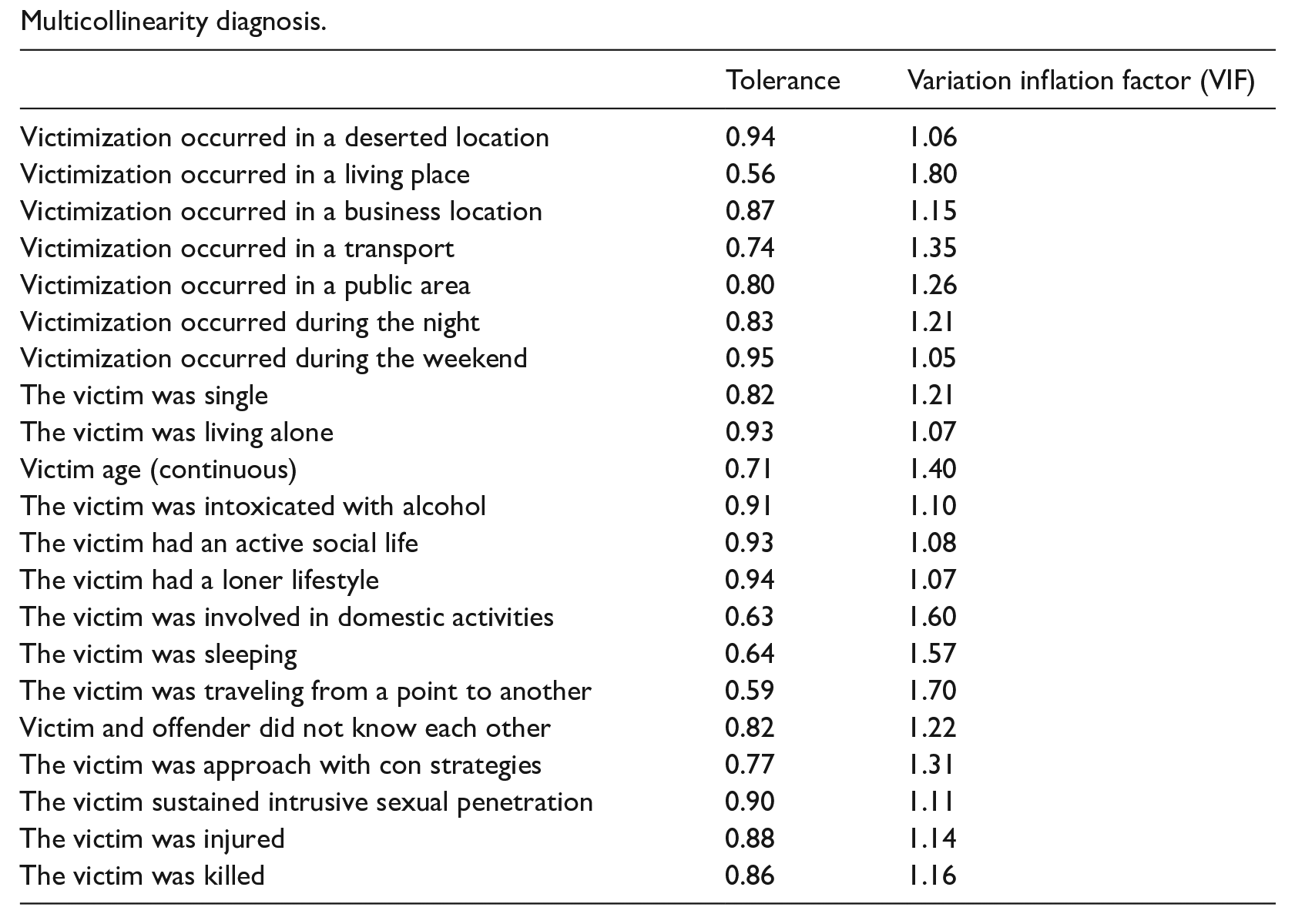
To better understand the victimization process of people with disabilities and to identify its specificities, we followed a two-step process. The first analytical step of this study was to determine at the bivariate level (i.e. Chi-square analysis, Kruskal–Wallis test 2 ) the differences between the four groups (i.e. the victim did not have a disability, the victim had a physical disability, the victim had psychological disabilities, the victim had both physical disabilities and psychological disabilities) in relationship to all the independent variables used to characterize the victimization process. The second analytical step was to identify the differences between the four groups at the multivariate level using multinomial logistic regression. Multivariate analysis allows the identification of the most important factors that characterize the differences between the four groups. All explanatory variables that were significant at the bivariate level (p ⩽ 0.05) were included in the multinomial regression analysis. The test for multicollinearity was conducted for the variables included in the multivariate analyses, and results showed that the variance inflation factor (VIF) statistic did not exceed the 1.80 thresholds and the tolerance was above 0.56 (see Appendix 1).
Results
Table 1 presents the bivariate analyses. The analyses indicated that, compared to all other groups, victims with physical disabilities were more often assaulted in a living place (3, N = 1,077, χ2 = 18.96, p < 0.001, ϕ = 0.13), while they were less often victimized on transport (3, N = 1,077, χ2 = 7.96, p = 0.047, ϕ = 0.09) or at an outdoor location (3, N = 1,077, χ2 = 11.17, p = 0.011, ϕ = 0.10). Victims with both physical and psychological disabilities were more likely than victims of other groups to be assaulted at business locations (3, N = 1,077, χ2 = 9.93, p = 0.019, ϕ = 0.10). Victims without any disabilities were more often assaulted during the night (3, N = 1,077, χ2 = 42.88, p < 0.001, ϕ = 0.20) than victims of other groups, while victims with psychological disabilities were less likely to be assaulted during the night (3, N = 1,077, χ2 = 9.13, p = 0.028, ϕ = 0.09). As to the individual vulnerabilities, victims with psychological disabilities were more often single (3, N = 1,077, χ2 = 29.69, p < 0.001, ϕ = 0.17) than victims with psychological disabilities and victims without any disabilities. Victims without any disabilities were more often living alone (3, N = 1,077, χ2 = 13.90, p = 0.003, ϕ = 0.11) and younger (H (3) = 108.89, p < 0.001, ω2 = 0.12) at the time of the offense than victims of other groups. Findings also showed that victims with physical disabilities were more often intoxicated with alcohol in comparison to those with psychological disabilities (3, N = 1,077, χ2 = 9.67, p = 0.022, ϕ = 0.10). Finally, victims without any disabilities had more often an active social life (3, N = 1,077, χ2 = 50.04, p < 0.001, ϕ = 0.22) and were less likely to have a loner lifestyle (3, N = 1,077, χ2 = 28.64, p < 0.001, ϕ = 0.16) than victims of other groups. As for the routine activities at the time of the offense, victims without any disabilities were less likely to be involved in domestic activities (3, N = 1,077, χ2 = 25.55, p < 0.001, ϕ = 0.15) or to be sleeping (3, N = 1,077, χ2 = 19.77, p < 0.001, ϕ = 0.14) than victims of other groups. To the contrary, victims without any disabilities as well as victims with psychological disabilities were more often traveling from a point to another (3, N = 1,077, χ2 = 33.71, p < 0.001, ϕ = 0.18) compared to victims of other groups. Regarding victimization characteristics, findings showed that victims without any disabilities were more likely than all other groups not to know their offenders (3, N = 1,077, χ2 = 62.21, p < 0.001, ϕ = 0.24), while they were less likely to have been approached with a con strategy (3, N = 1,077, χ2 = 90.81, p < 0.001, ϕ = 0.29) and to have sustained sexual penetration (3, N = 1,077, χ 2 = 55.00, p < 0.001, ϕ = 0.23) than victims of other groups. Finally, victims without any disabilities and victims with physical disabilities were more likely to be injured (3, N = 1,077, χ2 = 14.30, p = 0.003, ϕ = 0.12) than victims of other groups.
Bivariate analysis (N = 1,077).
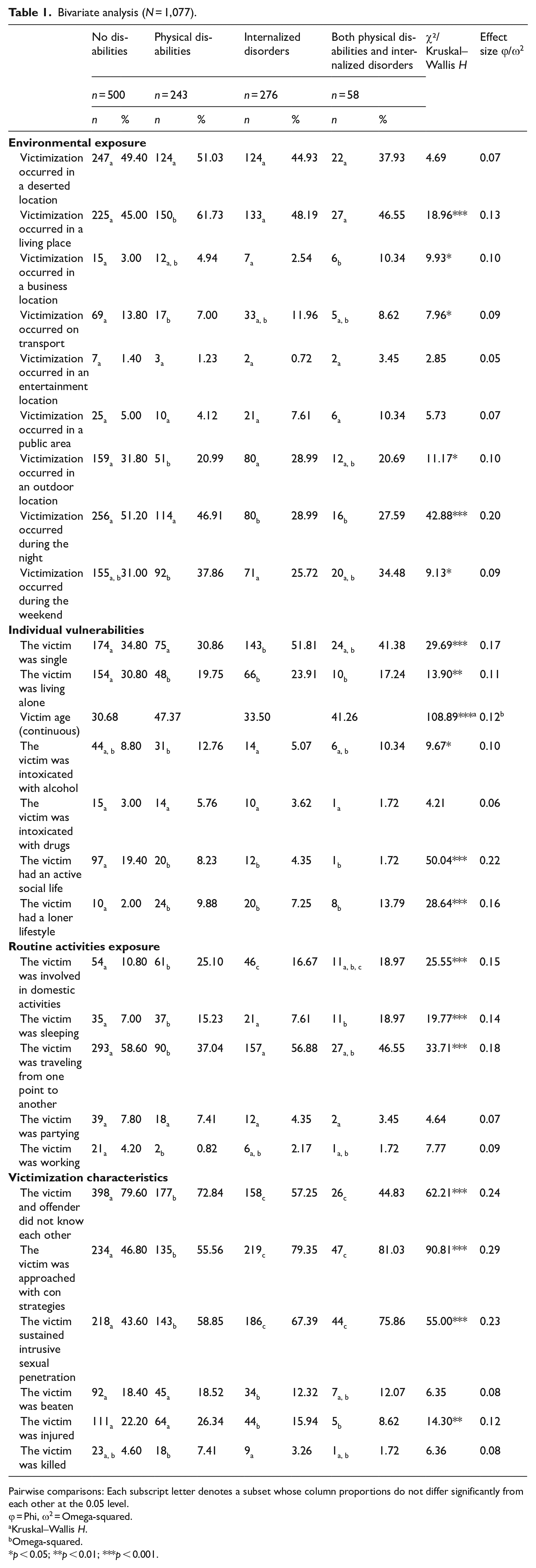
Pairwise comparisons: Each subscript letter denotes a subset whose column proportions do not differ significantly from each other at the 0.05 level.
ϕ = Phi, ω2 = Omega-squared.
Kruskal–Wallis H.
Omega-squared.
p < 0.05; **p < 0.01; ***p < 0.001.
Table 2 describes the findings of the multinomial logistic regression. The goodness of fit indices of the regression model suggested a good explanatory capacity of the studied phenomenon with a Nagelkerke R2 of 0.40. Three models were conducted. Model 1 compared the reference category (i.e. cases where the victim did not have any disabilities) with the category including cases where the victim had physical disabilities. In cases where victims had physical disabilities, victims were more likely to be older (β = 0.04, odds ratio (OR) = 1.04, p < 0.001) and to have adopted a loner lifestyle (β = 1.27, OR = 3.56, p = 0.003) than victims without any disabilities. Moreover, victims with physical disabilities were more likely to be approached with a con strategy (β = 0.56, OR = 1.75, p = 0.005) and to have sustained intrusive sexual penetration (β = 0.43, OR = 1.54, p = 0.019) than victims without any disabilities. On the contrary, victims with physical disabilities were less likely to present an active social life (β = −0.63, OR = 0.53, p = 0.023) than victims without any disabilities.
Multinomial regression with victims without disabilities as reference category (N = 1,077).
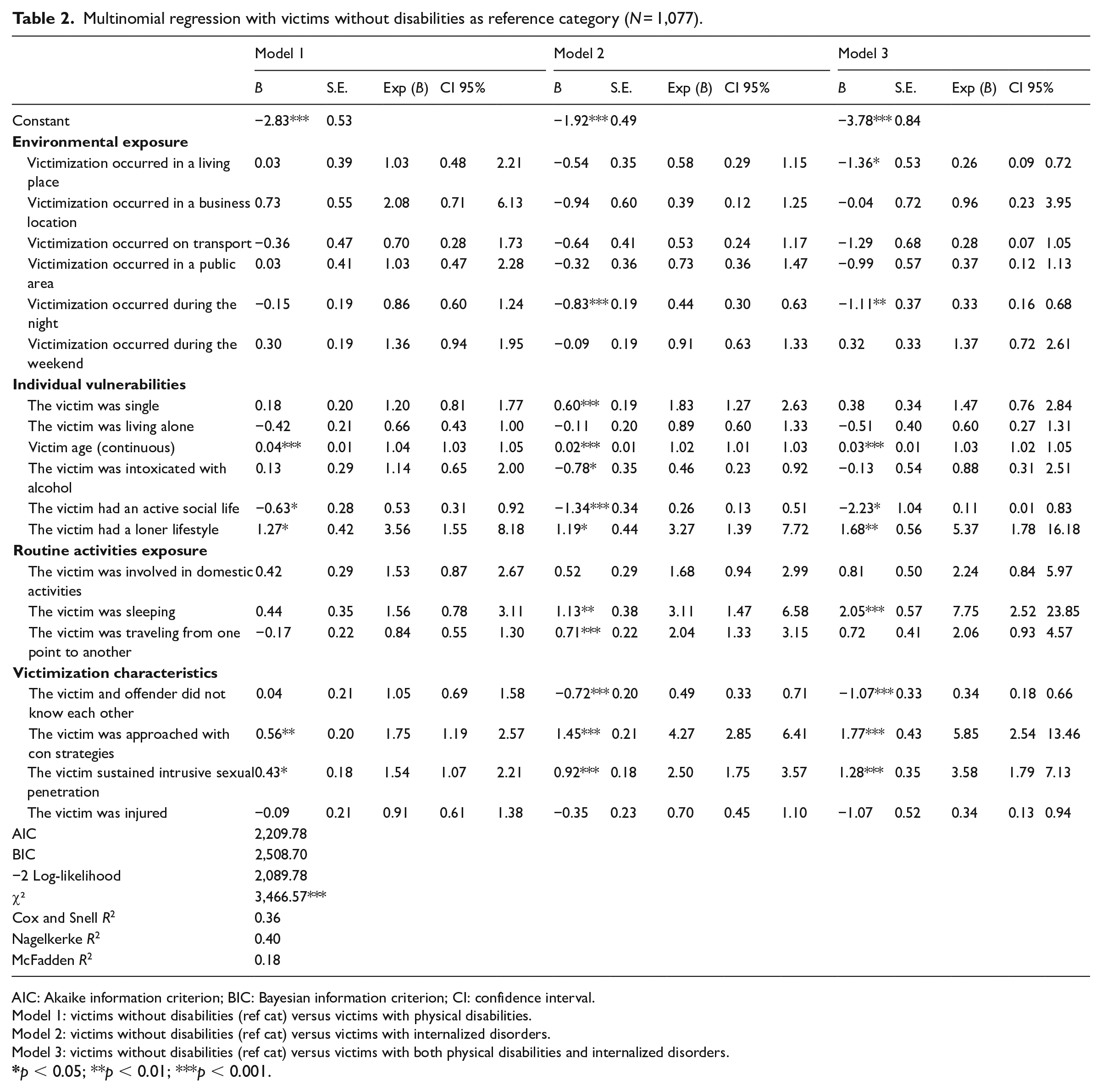
AIC: Akaike information criterion; BIC: Bayesian information criterion; CI: confidence interval.
Model 1: victims without disabilities (ref cat) versus victims with physical disabilities.
Model 2: victims without disabilities (ref cat) versus victims with internalized disorders.
Model 3: victims without disabilities (ref cat) versus victims with both physical disabilities and internalized disorders.
p < 0.05; **p < 0.01; ***p < 0.001.
Model 2 compared the reference category (i.e. cases where the victim did not have any disabilities) with the category including cases where victims had psychological disabilities. Victims with psychological disabilities were more likely to be single (β = 0.60, OR = 1.83, p = 0.001), older (β = 0.02, OR = 1.02, p = 0.001), and to present a loner lifestyle (β = 1.19, OR = 3.27, p = 0.007) than victims without any disabilities. In addition, these victims were more likely to be victimized while they were sleeping (β = 1.13, OR = 3.11, p = 0.003) or traveling from one point to another (β = 0.71, OR = 2.04, p = 0.001) than victims without any disabilities. As to the characteristics of victimization they sustained, victims with psychological disabilities were more likely to be approached using deception (β = 1.45, OR = 4.27, p < 0.001) and to have sustained sexual penetration (β = 0.92, OR = 2.50, p < 0.001) than victims without any disabilities. Finally, victims with psychological disabilities were less likely to be intoxicated with alcohol (β = −0.78, OR = 0.46, p = 0.027), to present an active social life (β = −1.34, OR = 0.26, p < 0.001), and to be victimized by someone they did not know (β = −0.72, OR = 0.49, p = 0.023) than victims without any disabilities.
Model 3 compared the reference category (i.e. cases where the victim did not have any disabilities) with the category including cases where victims had both physical and psychological disabilities. Victims who had both physical and psychological disabilities were more likely to be older (β = 0.03, OR = 1.03, p < 0.001), to present a loner lifestyle (β = 1.68, OR = 5.37, p = 0.003), and to be victimized while they were sleeping (β = 2.05, OR = 7.75, p < 0.001) than victims without any disabilities. Moreover, these victims were more likely to be approached with a con strategy (β = 1.77, OR = 5.85, p < 0.001) and to sustain sexual penetration (β = 1.28, OR = 3.58, p < 0.001) than victims without any disabilities. Conversely, victims who had both physical and psychological disabilities were less likely to be assaulted in a living place (β = −1.36, OR = 0.26, p = 0.010), during the night (β = −1.11, OR = 0.33, p = 0.003), to present an active social life (β = −2.23, OR = 0.11, p = 0.032), to be assaulted by an individual they knew (β = −1.07, OR = 0.34, p = 0.001), and to be injured (β = −1.07, OR = 0.34, p = 0.038) than victims without any disabilities.
Discussion
This study investigates the sexual victimization of adult women with disabilities. The analysis is framed within an interactional theoretical perspective to provide an in-depth analysis of the victimization process. Using a large sample of sexual offending cases, we compared four different disabilities situations: the victim does not present a disability, the victim presents a physical disability, the victim presents a psychological disability, and the victim presents both physical and psychological disabilities. The use of both bivariate and multivariate analyses allowed us to better understand the influence that different types of disabilities can have on the victimization process. This is not to say that the presence of a disability is in any way responsible for the victimization of an individual, but rather to understand the role that it may have played in the perpetrator’s perception of the victim’s vulnerability. Three hypotheses were put forth: (1) the type of disability affects the victimization characteristics, (2) people with disabilities experience more severe victimization, and (3) victimization of people with disabilities is rather a function of vulnerability than of traditionally conceptualized risk exposure factors. The results of the analyses allow us to verify these three hypotheses.
Different disabilities, different victimization processes
The first hypothesis suggests that different types of disabilities create specific victimization contexts. The results support this hypothesis and are in line with previous studies (Hughes et al., 2012; Jones et al., 2012; Mailhot Amborski et al., 2022; Mueller-Johnson et al., 2014; Turner et al., 2011). First, as a general trend, findings show that the characteristics of cases involving the victimization of a person with both physical and psychological disabilities are much more similar to those involving victims with psychological disabilities. This result may suggest that when a victim combines both types of disability, it is the psychological disability that conditions more strongly the victimization process. Such result may be explained by the fact that these two types of victims are more likely to be assaulted by individuals they knew (Beadle-Brown et al., 2010; Cambridge et al., 2011; Fisher et al., 2016; Vara et al., 2021) than victims without any disabilities. The victim-offender relationship is known to be an important factor in conditioning the crime-commission process (Bownes et al., 1991; Koss et al., 1988). Second, we observe that victims with psychological disabilities are assaulted in different environments than those victims with physical disabilities or those without disabilities. These results suggest that people with psychological disabilities present different routine activities (e.g. psychological care, institutional care) than people without disabilities, which does not appear to be the case for people with physical disabilities. Such observation could be related to the degree of dependence that the disability creates, and we hypothesize that people with physical disabilities have more autonomous routines than victims with psychological disabilities.
Less resistance, more serious sexual violence?
The second hypothesis suggests that the victimization of people with disabilities is more severe than that of people without disabilities. To test this hypothesis, several indicators are used to examine the level of violence at the time of contact between the perpetrator and the victim: the degree of physical violence during the crime, the presence of sexual penetration, and the death of the victim. Our results indicate that only the presence of sexual penetration is significantly more likely to occur for people with disabilities, which is in line with observations from previous studies (Vara et al., 2021). Interestingly, victims with disabilities are also less likely to be approached with violent and coercive methods, but they are more likely to be approached with deceptive strategies. Yet, they suffer severe sexual victimization but without the use of physical violence. These results can be related to studies showing a link between the degree of victim resistance and the severity of sexual victimization (Ullman, 2007; Ullman and Knight, 1992). As noted for victimization involving elderly people (Beauregard and Chopin, 2021; Chopin and Beauregard, 2020), the presence of such victimization may be due to the increased difficulty of victims with disabilities to offer resistance that would discourage motivated perpetrators from carrying on their acts and committing the assault (Chopin and Beauregard, 2022; Grattet and Jenness, 2012; Perreault, 2009; Petersilia, 2000). Several studies indeed found that when the offender is known by the victim, and uses deception to approach their targets, the victims are less likely to resist and more likely to experience severe sexual victimization (Atkeson et al., 1989; Balemba and Beauregard, 2019; Burnett et al., 1985; Chopin and Beauregard, 2022; Koss et al., 1988; Ullman and Siegel, 1993).
Static vs dynamic vulnerabilities: a key factor to explain victimization
Our third hypothesis is that sexual victimization of persons with disabilities is more likely to be due to their vulnerability than to their exposure to traditionally conceptualized risks. The study results tend to support this hypothesis. We observe a clear trend suggesting that two aspects of the lifestyle theory (Hindelang et al., 1978) play a key role: the age of the victims at the time of the assault and their risk exposure. Study results indicate that, regardless of the type of disability, victims with disabilities are systematically older at the time of their victimization than victims with no disabilities. Results also show that victims with disabilities are less likely to have an active social life and more likely to have a loner lifestyle, suggesting a limitation in the risk of being confronted with potential offenders. Although these two factors may appear to be concomitant, the analyses show that there is no multicollinearity, suggesting that in a significant number of cases, one can occur without the other. These results raise the question of the role of traditionally conceptualized risk exposure and vulnerability in explaining sexual victimization. In the situation of victims without disabilities, the results follow the seminal application of lifestyle and routine activity theories: those who are most exposed to potential perpetrators (i.e. active social life) are more likely to be victimized. In the other situation, however, people with disabilities do not expose themselves to motivated offenders but are nonetheless victimized. These results are in line with previous studies highlighting that victim vulnerability is an important concept to explain the victimization process (Conte et al., 1989; Elliott et al., 1995). Moreover, they suggest that under certain circumstances, the concept of vulnerability becomes particularly central to explain victimization. This concept, which seems simple and general at first glance, is multifaceted and complex (Green, 2007; Walklate, 2011). At a macro level, vulnerability can be seen as a homogeneous set of factors that increase the probability of victimization. However, research on the victimization of vulnerable people suggests that patterns of aggression differ according to the type of vulnerability and that the relationship with the concept of risk exposure is affected. In a similar fashion to risk factors observed for offenders, we believe that the concept of vulnerability could be divided into two subcategories: static and dynamic vulnerability factors. Static vulnerability could be defined as the set of indicators leading individuals to persistent weakness. In contrast, dynamic vulnerability could be defined as the set of indicators associated with temporary weakness. Disability, which has been identified as a major sexual victimization factor (Beadle-Brown et al., 2010; Hughes et al., 2012; Jones et al., 2012; Lin et al., 2009; Mailhot Amborski et al., 2022; Mitra et al., 2011) can be seen as a static vulnerability indicator. We hypothesize that in the victimization context of people with disabilities, persistent and static vulnerability (i.e. disability) is the trigger for victimization leading to a situation that is conducive to the absence of guardians (e.g. social isolation). In such a context, chance or premeditated encounters with motivated offenders inexorably leads to an increased likelihood of victimization. Conversely, in the victimization context of nondisabled people, the presence of dynamic vulnerability reinforces the risk of victimization, which is mainly conditioned by exposure to risk.
Conclusion
This study aimed to analyze the sexual victimization of adult women with disabilities through the lens of victimological theories. Through the exploration of three hypotheses, our results show that disability is a factor that creates the conditions necessary for motivated offenders to engage in the crime process. Our results also show that the type of disability affects the parameters of the victimization process as it both impacts the lifestyle and routine activities of the individuals. Finally, the study results also highlight that people with disabilities are more likely to experience severe sexual victimization, which could be explained by the fact that they are often found in a context and conditions that limit their ability to resist.
The results of this study allow for discussion of both theoretical and practical implications. Victimological theories provide an appropriate framework for explaining the sexual victimization of people with disabilities. Such theories allow us to introduce the concepts of static and dynamic vulnerability, referring to a notion of persistence of an individual’s weaknesses. The combination of these concepts with the one of risk exposure could be an important key to understanding the victimization of vulnerable people. Specifically, it allows us to consider the prominence of disability as a static vulnerability factor in victimization. In contrast to people without disabilities—for whom it is the risk exposure that leads to dynamic vulnerability—people with disabilities are mainly affected by this static vulnerability, being at the source of the risk exposure situation. In other words, individuals with static vulnerabilities are known to have a lifestyle that exposes them less to potential perpetrators. However, the vulnerabilities that characterize them substitute for the absence of exposure to create a risky situation. Such an interpretation should allow us to rethink the practice of situational prevention, which should no longer focus only on individuals who present exposure to risk but also on those whose characteristics are likely to put them at risk.
Although interesting and innovative, this study presents several methodological limitations. The first is the nature of the data used. Official data are known to have validity issues as they represent only a part of the studied phenomenon since they include only cases that were reported to the authorities (Aebi, 2006). Previous studies indicate that the sexual victimization of persons with disabilities is underreported (Petersilia, 2000). Our results thus represent victimization situations reported to the police and we cannot exclude that unreported cases may show different patterns. Second, we have seen how the type of disability may affect the victimization process. While we tried to consider three distinct types of disability, it is clear that the use of subcategories or more defined ones (e.g. distinguishing types of psychological disability) would have provided a much more refined understanding.
Further research should investigate the use of a victimological theoretical framework to better understand the victimization process of people with disabilities. First, it seems important to continue the exploration of the relationships between vulnerability and risk exposure. Second, it seems appropriate to make a more precise distinction between the different situations of disability, particularly with regard to psychological disabilities. Finally, it would be useful to investigate the influence that characteristics of individuals who commit aggression have on people with disabilities to better identify their motivations to act.
Footnotes
Appendix 1
Multicollinearity diagnosis.
| Tolerance | Variation inflation factor (VIF) | |
|---|---|---|
| Victimization occurred in a deserted location | 0.94 | 1.06 |
| Victimization occurred in a living place | 0.56 | 1.80 |
| Victimization occurred in a business location | 0.87 | 1.15 |
| Victimization occurred in a transport | 0.74 | 1.35 |
| Victimization occurred in a public area | 0.80 | 1.26 |
| Victimization occurred during the night | 0.83 | 1.21 |
| Victimization occurred during the weekend | 0.95 | 1.05 |
| The victim was single | 0.82 | 1.21 |
| The victim was living alone | 0.93 | 1.07 |
| Victim age (continuous) | 0.71 | 1.40 |
| The victim was intoxicated with alcohol | 0.91 | 1.10 |
| The victim had an active social life | 0.93 | 1.08 |
| The victim had a loner lifestyle | 0.94 | 1.07 |
| The victim was involved in domestic activities | 0.63 | 1.60 |
| The victim was sleeping | 0.64 | 1.57 |
| The victim was traveling from a point to another | 0.59 | 1.70 |
| Victim and offender did not know each other | 0.82 | 1.22 |
| The victim was approach with con strategies | 0.77 | 1.31 |
| The victim sustained intrusive sexual penetration | 0.90 | 1.11 |
| The victim was injured | 0.88 | 1.14 |
| The victim was killed | 0.86 | 1.16 |
Acknowledgements
The authors would like to acknowledge the Police Chief of the French Central Office for the Repression of Violence against Persons (Office Central de Répression des Violences aux Personnes) and the Central Director of the French Judicial Police (Direction Centrale de la Police Judiciaire).
