



Abstract
A systematic and continuous performance assessment method alongwith timely and constructive feedback on employee contribution is crucial to human resources functions, driving organizational growth and development. An effective performance management system significantly enhances clarity on goal setting and accountability, leading to improved individual and team performance - which is crucial for a company like Softech which was evolving out of its ‘startup’ days. It helps align employee contributions with the organizational goals. Clear articulation of key performance indicators (KPIs) and key result areas (KRAs) plays a vital role in managing talents. This case study examines the HR challenges faced by Softech Semiconductor, a leading technology service provider with eight branches in India, and plans for global expansion. Despite its success in the semiconductor space in India, Softech struggles with talent management, retention, and reliance on conventional HR processes. To overcome these challenges, Mr Vikas Patil, a visionary leader and the founder of Softech, in association with his HR team and external organizational development experts, implemented a new talent strategy, focusing on introducing KRAs to enhance clarity, accountability, and alignment with the company’s vision and mission. The case study highlights the challenges, interventions, and outcomes, offering valuable insights for HR leaders looking to modernize talent management in technology-driven industries. The case captures the growth challenges related to people management and leadership styles when a startup firm scales up and strives to transform into an established organization.
Keywords
Introduction
It was a long day at the office for Vikas Patil, founder and CEO of Softech Semiconductors, and his HR team. It was late in the evening and Vikas was in the board room with his HR Head, Murugesh Hiremath, and Assistant Manager–HR, Sudha Joshi. They were going through the feedback given by their employees on the recently introduced key result area (KRA) system by senior consultant Dr Anil Rao. Mr Murugesh and his junior Sudha were working on the employee-perception survey report to gauge the employees’ opinions about KRA and performance metrics which were introduced at Softech. The KRA system was incorporated by Mr Vikas and the team to bring objectivity to the performance assessment of employees and to link performance with compensation in rational ways. Further, they added that KRA-based assessments would create a more performance-driven culture that is aligned with the company’s strategic objectives, foster employee development and facilitate fair and transparent assessments. However, the integration of KRA’s marked a major cultural shift within the workplace where the employees were not prepared for it. The unawareness of employees with KRA concepts bred apprehensions, importantly about the potential impact of performance appraisal connected to compensation. This scepticism became conspicuously visible in the post-implementation satisfaction survey, which resonated with numerous concerns about the KRA system. The prevailing sentiment highlighted employees’ unease, questioning whether this approach would genuinely lead to performance improvements directly linked to their compensation.
Softech was the dream entrepreneurial venture of Vikas which is now in the growth phase—an evolving company, still in early stages of organizational life stage. This growth phase was posing new organizational and leadership challenges for Vikas. Vikas and the team were caught in a whirlwind of concern, facing unprecedented HR-related issues. The deluge of criticisms from Softech’s employees had grown louder, echoing through every available channel—be it social media, department meetings or suggestion boxes. The resounding feedback pointed to fundamental flaws in the company’s HR practices: The compensation system was deemed archaic, failing to honour and incentivize employee performance adequately. Moreover, it lacked mechanisms to identify and nurture standout talents.
As the company was evolving out of its ‘startup’ days and systems were expected to meet the demands of a growing organization, the entrepreneurial and person-centric approach of the founder was facing challenges and criticisms on many occasions. Vikas braced himself to tackle these multifaceted challenges; he recognized the need for a new breed of leadership. It was not just about rectifying HR practices; it was about sculpting a culture that valued its workforce, acknowledged their contributions and propelled star performers forward. This was not merely a test; it was an opportunity to redefine Softech’s identity and reinforce its commitment to its employees, demanding innovation, empathy and resilience in leadership like never before. These thoughts made Vikas restless and prevented him from having open discussions with his teammates.
Journey of Softech Semiconductors
Softech Semiconductor was an advanced technology services provider offering comprehensive solutions from concept to prototype in the semiconductor space. It was fast emerging as a leading analogue and mixed-signal semiconductor design service provider in the country. It offered an integrated portfolio of services to clients in key domains including digital design, analogue design, high-speed physical interface IP, embedded memory compiler and EDA modelling. Softech was now the preferred semiconductor design service partner for several leading companies of the country in the fields of automotive, consumer electronics, industrial IoT and medical electronics space. It focused on a niche area of analogue and mixed-signal IC design, which accounted for more than 80% of its revenue.
Vikas provided effective leadership based on his industry experience of over 10 years (prior to his entrepreneurial journey) across varied functions like operations management, customer relations, marketing, programming, chip design and product development teams. Vikas had significant experience in mixed-signal and analogue product design and System-on-chip development, including firmware development. Prior to Softech Semiconductor, Vikas Patil served as Program Manager at Qualcomm (an American multinational corporation), San Diego, California, USA, from 1995 to 2005 and as project engineer and team lead for Wipro, Bengaluru from 1991–1995. He got inclined towards starting up on his own during his US stint. Vikas had a B. Tech. and MS degrees from BITS Pilani, Rajasthan. After establishing himself at Qualcomm, he decided to return to his roots to provide new avenues of growth to the local youth and prevent brain drain. With that vision, he founded Hubli-based Softech Semiconductors in 2005.
Many questioned Vikas’s decision of starting a new venture in a Tier II city like Hubli (which happened to be his hometown). People were sceptical whether Vikas would be able to achieve his dream of inclusive growth by attracting talent from interior areas and small towns. Despite having the odds stacked against him, Vikas achieved ‘the impossible dream’. He soon proved the sceptics wrong and his company started growing leaps and bounds. The company had grown over the last 15 years from six employees to nearly two hundred by 2020. It had eight branches across the country and was contemplating expansion across the national boundaries. Vikas proclaimed, ‘My major intent is to engage youngsters from all sections of society and enable inclusive growth. Softech Semiconductors is a small step towards that’. The entrepreneurial journey of Vikas had quite a remarkable beginning, but the organizational challenges slowly started to surface, which would test his people management and leadership skills.
Problems in the HR System before the Introduction of KRA
Softech’s talent pool consisted mostly of young employees, the majority being in the age group of 25–35 years, which reflected the management’s philosophy, especially Vikas’ vision to provide an opportunity to young people and enable them to rise in the world of technology.
Softech’s HR team included the HR head, assistant manager, HR executive and an administrative officer (admin officer). The regular operational aspects were managed by the HR executive under the supervision of the assistant manager, who finalized the salary and employee benefits, medical insurance, welfare schemes and other employee-related issues. The admin officer’s role was to oversee leaves, maintenance, canteens, travel and statutory compliances. The assistant manager also took care of the employees’ performance appraisal system which was quite traditional since the inception of Softech. The HR executive took care of recruitment and selection of candidates. The line managers took inputs from the HR executive while deciding the compensation and salary structure of recruits.
Softech’s earlier HR approach focused primarily on administrative functions, lacking a robust developmental aspect for employees. Performance evaluation was haphazard, with vaguely defined goals and insufficient differentiation between star performers and others. Talent management strategies were rudimentary, relying heavily on subjective judgements rather than systematic identification and development. Training efforts were sporadic, favouring junior employees, leading to skill stagnation among senior staff. Surprisingly, given the company’s tech orientation, HR practices lacked technological integration, missing out on advancements like AI, HR analytics and IoT. The lack of policy-driven systems resulted in emotion-based decisions, mismanagement issues and inconsistencies in resource allocation, documentation and accountability.
Recent Incidents: Trigger Points for Change
During an industrial summit, organized by the Karnataka Chamber of Commerce, Hubli, a few executives from the product design team were representing Softech. During one of the high-tea meetings of the summit, a discussion on career growth and performance-based compensation sparked up. Representatives from another software company in the region, CHL Private Limited, happily shared their recent compensation revamp and how the surplus money helped them with investments in real estate, children’s education and self-development courses. It gave food for thought to the representatives from Softech as to why, despite their best efforts in their job roles (also being in similar work profiles as their friends), their salaries still lagged behind the industry standards substantially. They also realized that the employee-welfare initiatives provided at Softech, when compared to competing firms of the region, were far below the expected levels. They were struggling to save money for their family concerns, children’s education and their professional growth. It started to dawn on them that the rewards were not in line with the efforts put in by them. Feelings of dissatisfaction cropped up in their minds. The very next day, they met in the cafeteria and explored the avenues for expressing their grievances. One of the seniors from the team suggested taking up the issue with the HR department first. Following the discussion, they immediately teamed up and sent a strongly worded e-mail to the HR team of Softech.
Another recent development at Softech, which proved to be a major pain point for Vikas Patil, was the resignation of some of their key employees who went on to launch their startup. A group of star employees from the R&D team (who were former ex-teammates at a previous organization too) had recently launched their venture. All of them had around five to eight years of experience in the industry. These were the first people to identify the dissatisfaction among Softech employees about compensation, fast growth and employee-welfare schemes. After quitting, they started a new company on the same model as Softech, but with one key change: They offered a far better compensation structure based on objective assessment through the KRA approach. They also started poaching juniors from Softech and other similar companies in the region, inciting them with a better package.
To add to the woes of the HR team and management, some employees started using social media platforms to vent their anger over the grudges and grievances against the company and its leadership which deeply hurt Vikas and the senior management team.
Leader’s Response
Vikas Patil had always hired and encouraged talent which seemed to be the best fit for the culture of the organization. As in the case of most entrepreneur ventures in their initial stages, these choices were purely based on his judgement and discretion. The recruits had the challenge of meeting his high standards, high expectations, obsession with quality, unique working style which was total devotion to work, his vision and his preferences. It often took time to understand and appreciate the vision and values at the core of his heart. Many found it difficult initially to adjust to the highly unpredictable, enigmatic and volatile personality traits of Vikas. A majority of the decisions taken by Vikas were quite spontaneous and often driven by emotions. One of the few things that made him go soft (even compromise) on his quality standards was his consideration for friends and relatives and his desire to contribute to society in whatever way he could. He used to hire employees based on references and those who needed a job. Many times, he had to face the flak from other employees for his unpredictable preferences. He used to give a chance to people who belonged to the deprived sections of society and had the potential and willingness to work hard. In many cases, these recruitments resulted in the selection of the wrong people. It happened that in some cases the attitude, willingness and motivation were visible but basic aptitude and skillsets were missing. In a few cases, it was the other way around. Years of mentoring and training efforts could not undo the wrong decisions of hiring.
Vikas’ personality-driven approach often raised grievances among employees and some started believing that even their good work might not be recognized or rewarded unless the top leaders noticed it. This was creating dissatisfaction at workplace. The discretionary approach to annual merit incentives was another cause for grievance. Personnel and administration-related policies like loans, benefits, facilities and welfare schemes were not clearly defined and there was an apparent lack of transparency, clarity and communication (despite the good intentions with which Vikas had established the firm). Due to the competitive environment, job poaching and job-hopping problems were becoming more frequent. He was often recommended by friends and well-wishers to set up a system of talent management and keep his emotions aside while making crucial decisions. One such decision that Vikas took was to hire Sudha, a young and promising HR executive with around three years of MNC work experience, with an MBA in management from a leading B-school. The recent negative incidents were serious and concerning to Vikas as well as to the HR team. Vikas was now feeling convinced that it was the right time to fix the internal processes, the first being the HR system and especially the compensation part of it.
Vikas, though emotional at heart, also believed in the philosophy that anything that had to be managed well must be measured well too and the same applied to managing employee performances also. After detailed deliberations with the senior management team, advisers and friends, Vikas invited Dr Anil Rao, a senior organizational development (OD) consultant and compensation expert with more than 30 years of consulting experience. Dr Anil had an excellent reputation in industry circles and in most of the assignments he handled, his interventions yielded very positive results. Vikas’ friends had also used his services and had a favourable opinion about Dr Rao and his work. The major purpose of consulting Dr Rao was to revamp Softech’s appraisal system and make it firmly based on the KRA approach. Dr Rao preferred a thorough systematic OD approach: contract with the client, proper diagnosis of the problem, data collection through surveys, providing intermittent inputs to the leadership, designing appropriate interventions, implementation of an action plan and then systematic follow-up. He developed a plan based on the above approach and started working towards conducting employee surveys, focused-group discussions and some surveys of best industry practices to begin with.
Senior HR manager Murugesh was sent to attend a management development programme on KRAs and compensation management at a premier B-school. Sudha, the junior HR manager who was already in an MNC with the KRA system, was closely involved in working on the introduction of the same at Softech. The whole process of the KRA system introduction was carried out by the HR department under the guidance of Dr Rao. This led to the beginning of establishing the KRA system and performance-based compensation structure at Softech.
Talent Strategy Reframed
Dr Anil Rao was convinced that the HR system needed a complete rehaul and there was a need to develop a structured performance management system. He was crystal clear in his thoughts that the discretionary approach to annual merit incentives should be done away with and the emotion-based decision-making should give way to an objective, standardized system-driven approach. Policies needed to be reframed to institutionalize the system-driven approach replacing the ad hoc and subjective practices. Dr Rao started with the following areas of improvement:
Introduction of the KRA System
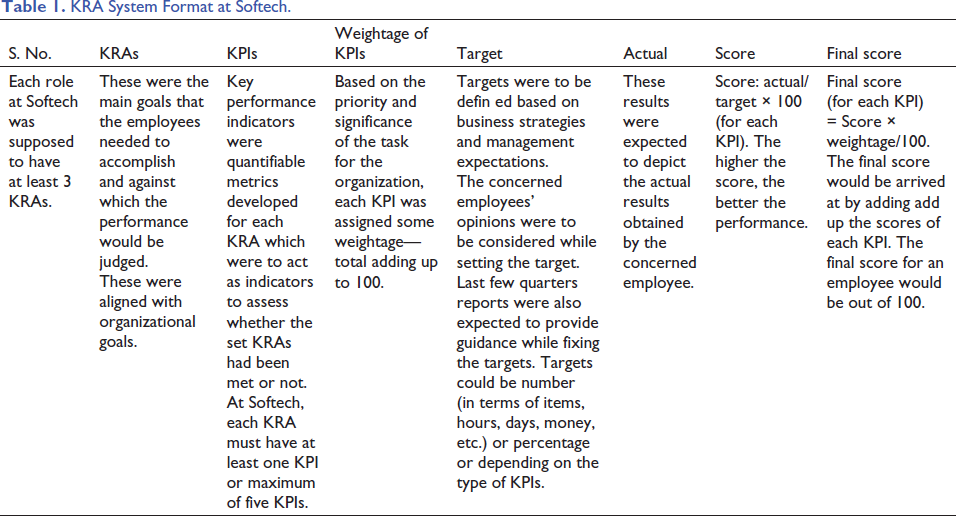
Organizational goals and departmental goals had to be clearly linked with the KRAs of individuals. Department goals, deliverables, KRAs, key expectations and targets needed to be fixed. KRAs had to be clearly defined for each job. The attainment of KRAs would be the defining factor for deciding employee ratings. The KRA format is given in Table 1.
KRA System Format at Softech.
A performance ratings system was to be implemented and salaries needed to have both fixed and variable components. He proposed that the performance-linked reward system would be introduced, and at least 10% of CTC should be linked to performance as variable pay, and for executive levels and C-suite leaders, it was proposed to be in the range of 10%–30%.
As per the recommendations, a new system of rating scales was to be introduced to clearly link the reward system with performance. Ratings were on a five-point scale with one depicting the lowest and five denoting the highest performance. The scale recommended looked like this:
Poor performance – No incentive Below expectation – 40% incentive Average performance – 60% incentive Good performance – 80% incentive Vital contributor – 100% incentive
There was a provision the identification of high-potential employees from the last two categories, which was to be done in congruence with potential assessment.
This system was implemented in a phased manner over the next one and a half years in three phases of six months each.
Job valuation and job tenure have a direct bearing on salaries. The parameters for deciding the job valuation (which in turn would affect the compensation structure of a job) were as follows: education, job proficiency, scope of the job, roles and responsibilities, impact of job, degree of problem-solving, decision-making, task complexity and business impact.
These parameters and the logic behind salary determination and salary differentiation had to be communicated clearly to employees. The significance of various jobs had to be identified during job valuation. The linkage of rewards with the significance of job, experience and tenure of employees and most importantly the performance of the employee was clearly established.
Streamlining of HR Roles
A suggestion was made to create new roles of talent acquisition (TA) executive and compensation–benefit (Comp-Ben) manager. The TA executive was supposed to exclusively look after the recruitment and selection process by keeping track of the latest industry trends while sourcing talent. The Comp-Ben manager was expected to decide the salary fixation and other compensation benefits including performance incentives and bonus. He/she was also expected to undertake surveys to understand the industry trends while fixing salaries.
Introduction of KRA-Based Appraisal at Softech
HR was given the responsibility to initiate the process of setting KRAs for each employee at the beginning of the year. Supervisors were responsible for discussing the KRAs with employees to help them finalize their SMART KRAs with mutual agreement (MBO approach). The employee was supposed to write an action plan for each KRA for the specific period for each quarter and get it approved by their supervisor. Then, the HOD would authorize all the KRAs. After the approval, all the KRAs were compiled and put in a performance matrix sheet to be available to all for reference and tracking. Supervisors kept employees informed about the process and progress and ensured their full involvement at all stages. Employees continued to perform the tasks assigned and also work towards each KRA. Supervisors monitored the employees’ performances and employees were expected to keep the progress updated. Employees were given a chance for self-evaluation, before the supervisor reviewed their performance mid-year. The performance review was always done by the immediate supervisor manager, with approval from the head of the department and keeping the HR in the loop.
The review of employees was done in two stages: a mid-year review and an end-year review. Through the mid-year review, gaps were analysed and feedback was provided to employees based on their status on each KRA. Employees, based on the mid-year feedback given, continued with their respective assigned KRAs. In the year-end review, employees were rated based on their performance for a complete year. Based on the annual assessment, the following decisions depended; increments, performance bonuses, promotions, training needs, internal transfers, counselling and so on. Some of the employees were assigned different KRAs every year, which helped them develop new skills as required by their job profiles. This helped in continuous skill development. Management believed that such a system would help them in getting their employees trained with different work roles and hence would enhance their capabilities and also help them in career advancements.
Promotion decisions were now based on performance and were linked with their KRA achievements consistently, their skill upliftment and their eagerness to take on greater responsibilities. Promotions were based on objective and rational criteria of performance, efficiency, quality of work and experience.
After the introduction of the KRA system at Softech, a survey was conducted to check the effectiveness of the system. Sudha and her team, under the supervision of Mr Murugesh and Dr Rao, were assigned the task of conducting the survey and preparing the report. The report had clear signs of improvements, though certain grey areas persisted.
Employees’ Reaction to the KRA System
The findings of the employee satisfaction survey conducted by Dr Rao and the HR team had mixed responses. The majority of employees at Softech were convinced that well-defined KRAs would eventually increase the performance management in the organization. Both management and employees believed that, in general, individual KRAs were aligned with organizational goals and reward systems. The targets set for employees were mostly realistic, achievable and measurable which helped to identify the strengths and weaknesses and consequently led to improvements in overall employee skill-set and productivity. Most employees felt that the new PMS was well defined at Softech, which allowed them to set and achieve meaningful goals by allowing them to perform better and aspire for career growth.
Marked improvement was seen in the communication between management and employees, this resulted in transparency and most of the employees had better awareness about the new PMS process. KRAs were communicated at the beginning of the appraisal, and most of the employees accepted that they got to know about their assigned responsibilities at the start of the year through their supervisors. As per the survey, KRA introduction had led to reduced instances of role overlaps and role conflicts among employees.
Employees also seemed to be satisfied with the fact that the management kept employees posted about the process and that their involvement was considered to be valuable. The new system now had two review phases for employees, mid-year and yearly reviews, which was a pragmatic step towards continuous assessment systems and led to better tracking of performance. The new review system was seen as more systematic, standardized and consistent, with the potential for constructively analysing employees’ weaknesses and helping them overcome through corrective actions.
Despite the efforts of Vikas, Dr Rao and the HR team, there were still many grievances which employees expressed in the survey conducted. Many of the employees found difficulties in attaining KRAs in the given time frame with their normal workload. They expressed their inability to do justice to all of their KRAs or not being able to concentrate on all the KRAs equally because of workload. Depending on the defined KRAs’ importance and weightage, the time frame to complete the same had to be finalized in discussion with employees because ultimately the responsibility to complete and meet deadlines to meet KRAs lay with employees. Weightages given to each KRA and time frame given to complete them were found to be satisfactory but some employees had grievances in this regard. Employees even expressed their apprehensions regarding the subjectivity creeping in when decisions about increments, bonuses, promotions and so on were taken. Few employees had complained that though training needs were identified in the new system and even training was being prescribed by supervisors, these did not materialize in reality in the absence of a strategy for training and development. Senior employees were more vocal in complaining about inadequate provisions for their skill enhancements and promotional avenues.
The majority of employees felt free to express their disagreement (could be manager review ratings, etc.) to their appraiser regarding appraisal decisions. However, some hesitated to express their disagreements with their supervisors. Also, it was clear from the survey that the new recruits needed a clear idea of the PMS process during their initial training period, rather than waiting until their performance evaluation process began. There had to be a clear policy regarding the first performance appraisal for new recruits.
Some employees pointed out the lack of effective onboarding and initial socialization and the lack of clarity regarding job descriptions. The orientation programme did not clarify the organization’s vision, its relation with KRAs and the company’s expectations from employees. Also, there were complaints regarding the lack of proper training for clarity regarding KRAs. The management also had difficulty in identifying and writing the KRAs.
Employees were still confused with the points system and were not sure whether it would work or not. Those who took time to complete their routine work were not able to complete and achieve their KRAs. There were still some concerns among employees regarding the choice of high-potential employees. Though the provision of identifying and fast-tracking them was evident, concerns existed regarding the fairness in the selection of these high-potential employees. There were suggestions to establish a separate performance counselling cell with well-qualified and trained counsellors for conducting performance counselling. There were still concerns about how to reduce the career plateauing of senior employees and how to engage these employees meaningfully so as to reduce monotony and boredom.
Vikas had his own reservations as he felt constrained in the new system when it came to his individual command over affairs (which he was used to since the startup days of Softech), his entrepreneurial approach and his sole discretion in certain people-related decisions. He had apprehensions of losing free rein in selecting and promoting the talent of his choice (underprivileged and deprived sections of the society) which was one of his underlying principles for starting Softech.
Finally, employees expressed satisfaction that the management was serious about their compensation status and had involved a consultant to improve the system. They wanted the process to reach its justifiable destination. They also welcomed the feedback survey process, the first of its kind, hoping that it would be a permanent practice in the future. The hopes and satisfaction of employees were evident and comforting for the management, even though the new system brought in a new set of challenges too. How would the entrepreneur in Vikas reconcile between the managerial and leadership expectations from him as Softech enters into the growth phase of its organizational journey?
Footnotes
Declaration of Conflicting Interests
The authors declared no potential conflicts of interest with respect to the research, authorship and/or publication of this article.
Funding
The authors received no financial support for the research, authorship and/or publication of this article.
