



Abstract
Nykaa (FSN E-Commerce Ventures) distributed 2,373,563,075 bonus equity units of ₹ 1 on 12 November 2022. With Nykaa’s 5:1 bonus issue, questions have been raised about alleged weak governance practises at the firm that went public in November 2021. The timing of this bonus issue created concerns about the company’s motives and suggested to the market that it was attempting to manipulate the stock price and prevent a potential sell-off as the market grew more wary of the business models of new-age companies. The case study queries whether the controversial bonus issue of Nykaa represented a failure in corporate governance.
Introduction
On 12 November 2022, Nykaa (FSN E-Commerce Ventures) distributed 2,373,563,075 bonus equity units of INR 1. Concerns over alleged weak governance practices at the company that went public in November 2021 have been raised with Nykaa’s 5:1 bonus issue. The timing of this bonus issue raised questions about the company’s intentions, sending a signal in the market that it was trying to manipulate the stock price and arrest a possible sell-off with the market becoming more cautious about new-age companies’ business models. Nykaa’s chief financial officer, Arvind Agarwal, resigned after the company issued a controversial bonus.
Does the bonus issue by Nykaa raise the concerns regarding corporate governance lapse?
Nykaa’s Origin
Falguni Nayar was born in Mumbai, Maharashtra, on 19 February 1963. Her father was a successful businessman who had a little bearings company. She obtained a Bachelor of Commerce degree from Sydenham College of Commerce and Economics after completing her education. She afterwards enrolled in the Ahmedabad campus of the Indian Institute of Management. Nayar spent 20 years in Kotak Mahindra Group before to founding Naykaa in 2012 (Abhinandhinee, 2023). For over 4 years, she served as the managing director of Kotak Investment Banking. She started Nykaa at the age of 49 at her father’s workplace.
Nayar started Nykaa with just three employees and minimal background in technology, manufacturing, or the retail industry. When the company was first established in 2012, it had only received roughly 60 orders. Nykaa then launched its first physical presence in New Delhi shortly after. In 20 Indian cities, it already has over 68 offline outlets. In-house cosmetics by Nykaa were released in 2015, while bath and body care products were added in 2016. The brand became well-known on a worldwide scale because to the company’s girl-next-door marketing campaigns that were launched on social media platforms like Youtube and Instagram, as well as highly publicized relationships with supermodel Gigi Hadid and Indian actress Katrina Kaif. In 2018, Nykaa launched new verticles called the Nykaa Fashion (a curated marketplace for fashion and lifestyle products) and Nykaa Man (platform exclusively dedicated to Men’s grooming). In 2019, the company launched ‘Masaba by Nykaa’ in collaboration with Masaba Gupta. In addition to the collaboration, Nykaa the clothing brand ‘20 Dresses’.
Nykaa’s Business Model
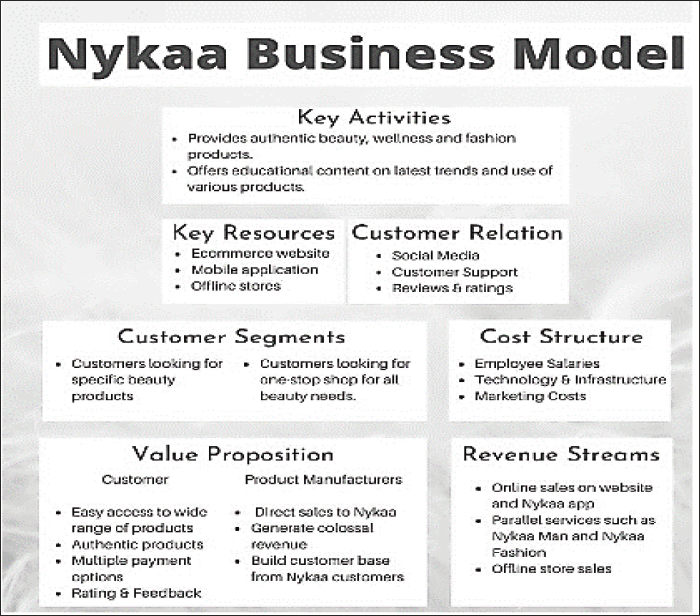
Nykaa operates under an inventory-based business model, where all things are kept in one location and orders are processed in accordance with the stock level. With this inventory-based business strategy, Nykaa purchases goods from retailers and producers. Such products are kept in Nykaa’s warehouses in Mumbai, Bangalore, and New Delhi, among other cities. These goods are also available for purchase at Nykaa’s website or through its offline retail outlets (see Figure 1), Nykaa Kiosks, Nykaa Luxe, and NykaaOn Trend.

Nykaa’s business model is centred on a diverse consumer base, which can be summarized as:
Customers looking for a particular brand or category of beauty products. Customers seeking an online marketplace that can meet all of their beauty product requirements.
Specific categories of Nykaa customers can be explained as Active Product Seekers (Customers between the ages of 19 and 25 who require beauty product advice), Busy Schedule Shoppers (Working customers between the ages of 27 and 45 who know what products they require and have a busy schedule that leaves them with little time to shop), Beauty Conscious (Customers between the ages of 25 and 45 who are concerned with their appearance and style and spend time researching the latest beauty trends and brands) and Brand Seekers (Customers who have been exposed to international brands and are more brand specific).
Nykaa’s revenue model includes multiple revenue streams (see Figure 2). It includes product sales (Nykaa makes money from the sale of both its own line of goods and those of partner businesses), banner advertisement (banner advertisements for partner brands are how Nykaa makes money on its app, website, and stores), commissions (in the financial year 2019, Nykaa recorded commission income of INR 8.8 crore), parallel services.
Nykaa uses a digital marketing technique to operate in the digital environment. Nykaa has embraced world-class digital marketing methods to reach all consumers in every internet-connected group, including women and girls, students, and young professionals. Nykaa uses below mentioned different digital marketing strategies: Content Marketing: As part of its content strategy, Nykaa has assembled a team of young professionals and creatives, and by doing this, Nykaa is able to draw customers by producing cutting-edge material that appeals to the audience’s sensibilities. Additionally, the company’s innovative content draws buyers to its items. Nykaa wants to draw in audiences from a variety of demographics by creating fashionable content for many platforms, including blogs, websites, video content (such as tutorials), and web articles. YouTube-based Marketing: Nykaa uses videos to engage their audience with a dedicated YouTube channel called ‘Nykaa TV’. Customers may watch the greatest and most recent video instructions on this channel for using beauty and wellness products, and it also informs them of the most recent trends in society. Customers and users may select the proper items and learn how to use them properly by watching a series of ‘how-to’ films. Platform Marketing: In order to reach a wider audience, Nykaa advertises their brand on mobile applications and websites. Brand placement is given a lot of attention on the Nykaa website across all platforms. This demonstrates that the company’s target audience has access to regularly updated and new material. Nykaa employs blogs, targeted adverts, and guidelines to boost online sales. SEO (Search Engine Optimization): Nykaa is utilizing SEO services to enhance organic research and boost the presence of its brand. The business has optimized its content with prospective keywords by utilizing the best SEO services, maintaining it high in search results. Influencer Marketing: As part of its efforts to raise awareness for the release of its upcoming items, Nykaa has also utilized influencer marketing methods. Working with influencers allowed Nykaa to quickly reach millions of followers, thus enhancing their media value. Jahnvi Kapoor, an actress from Bollywood, has also been announced by Nykaa as its brand ambassador.
The Initial Public Offering
The initial public offering (IPO) date was set on 28 October 2021 to 10 November 2021 while the listing date was on 1 November 2021. The company used the book building method for the allotment of shares and the price band was determined between INR 1,085 and INR 1,125 per share.
The company had the following objectives for the issue:
Investment of INR 420 million to finance the opening of new retail locations at FSN Brands and/or Nykaa Fashion, two of its subsidiaries; INR 420 million for the company’s capital outlay and investment in a few of its subsidiaries, including Nykaa E-Retail, Nykaa Fashion, and FSN Brands, to pay for the construction of new warehouses; INR 1,560 million for the prepayment or redemption of outstanding borrowings taken out by the business and Nykaa E-Retail, one of its subsidiaries; Expenditure of INR 2,340 million to acquire and retain customers by enhancing the visibility and awareness of the brands; and General corporate purposes.
IPO Valuation, Brokerages Opinion and the Final subscription
Financial performance of the Nykaa had been strong with revenue CAGR of 48.2% over Financial Year 2019–2021. Operating margins of the company have also seen a marked improvement from 1.85% in Financial Year 2019 to 6.61% in Financial Year 2021. Given the strong financial performance and the improving operating margin, the IPO was valued at 21.8X EV/Sales on Financial Year 2021 financials (refer to Table 1).
Peer Comparisons with Listed Digital Platforms.
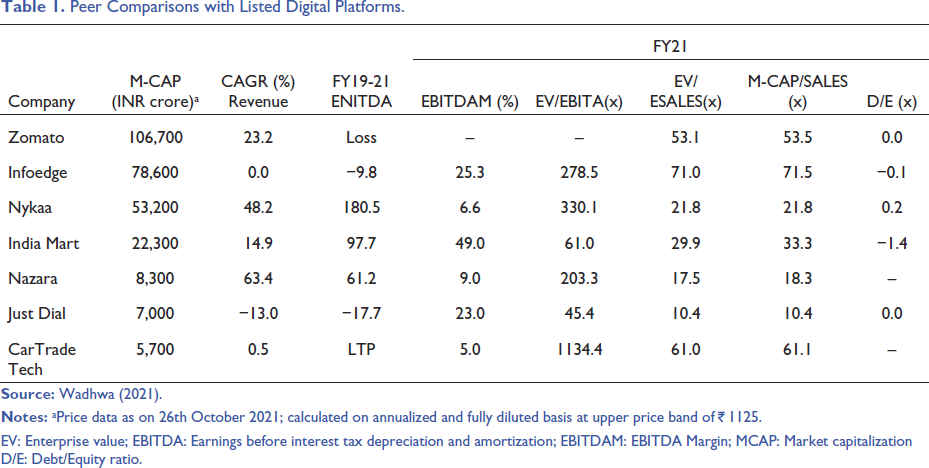
EV: Enterprise value; EBITDA: Earnings before interest tax depreciation and amortization; EBITDAM: EBITDA Margin; MCAP: Market capitalization D/E: Debt/Equity ratio.
Motilal Oswal Securities, a brokerage firm, was of the opinion that Nykaa is a profitable tech platform and advised investors of high-risk appetite to subscribe to the IPO. On the other hand, Anand Rathi, a brokerage firm, questioned the high valuation of the IPO. BP Wealth advised the investors to subscribe the IPO as Nykaa had the highest average order value and huge growth capabilities.
The issue was subscribed 81.78 times. Retail individual investors subscribed 12.24 times, non-institutional investors 112.02 times, and qualified institutional buyers 91.18 times in the category specified for them (Livemint, 2021).
The Controversial Bonus Issue
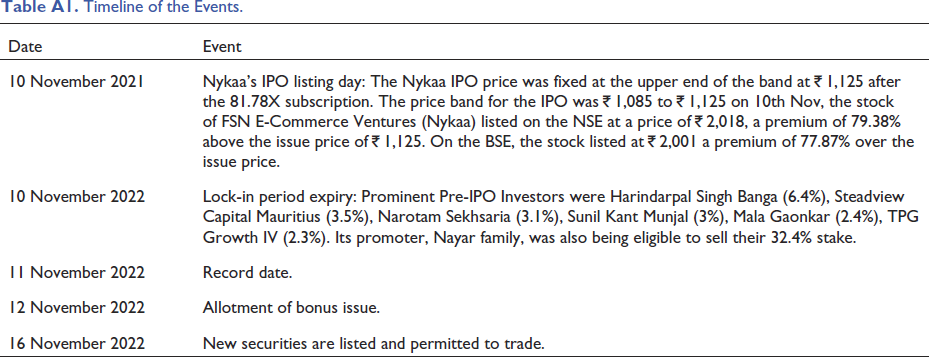
The lock-in period for pre-IPO investors in Nykaa was scheduled to end on 10 November 2022 (Table A1), however, Nykaa announced a 5:1 bonus share issue immediately before the stock’s much-anticipated sell-off (Springwala, 2022). Over 310 million shares, or more than two thirds, of FSN E-Commerce Ventures were held by pre-IPO investors. Following the company’s stock market listing, the lock-in period prevents initial investors, promoters, or even employees from selling or liquidating their shares for a predetermined amount of time. The bonus issue led to investors owning only 1/6th of the shares on the day lock-in expired while it has significantly changed the tax incidence for early-stage investors.
The implications of Nykaa’s controversial bonus issue and its CFO Arvind Agarwal’s sudden departure as a result of the action were discussed by Shriram Subramanian, the founder and MD of corporate governance advisory firm InGovern. He added that the bonus issue was a stupid decision in the first place and that it appears the CFO was used as the scapegoat. He also emphasised how important it is for modern businesses to practice proper corporate governance.
The bonus issue announced by Nykaa, according to Rajarao, founder and CEO of Fraudopedia, is suspicious in terms of timing and intention. He claimed that as there has been no substantial improvement in business since the IPO, the offer of bonus shares appeared to have been made to prevent the share price from plummeting.
‘Clearly, Nykaa fails the smell test’, Shyam Sekhar, founder of iThought, which runs portfolio management and investment advisory services, said in a tweet. ‘When a company with founders from the investment banking industry does this, it is like a 9/11 fire alarm for corporate governance in India. Clearly, the independent directors have failed in their duty. Shareholders are victims’. According to moneycontrol.com, Nykaa’s decision to issue bonus shares to shareholders hit the retail investors with an additional tax burden when they sold their holdings. They used the following example to explain: Suppose the investor bought one share of Nykaa during the IPO at INR 1,125. The investor received 5 additional shares as bonus, the cost of acquisition of which was zero for tax purposes. If he sold all six shares on 14 November for INR 210 each, the investor would now register a loss of INR 915 on the share he purchased at the IPO, which is classified as a long-term capital loss. For the five bonus shares, the investor’s overall gain—which would be regarded as short-term capital gains—would be INR 1,050 (INR 210 X 5). According to Indian income tax law, long-term capital losses cannot be used to set-off short-term capital gains (STCG).
Due to this, the investor would have to pay an STCG tax of INR 157.50, or 15%, on the actual profit that was made. As a result, there would be a net short-term profit of INR 892.50. You would have sold a single share on 14 November, assuming there was no bonus issue. Shares would have cost INR 1,260. (Bonus not taken into account). You would have made a profit of INR 135 (INR 1,260–INR 1,125). As the share cost INR 1260 to purchase, its selling price is INR 1,125, which equals INR 135; 10% of INR 135 equals INR 13.5. Hence, 157−13.5 = INR 144.
Appendix A
The chronology from IPO listing to bonus issue allotment is presented below:
Timeline of the Events.
Footnotes
Declaration of Conflicting Interests
The author declared no potential conflicts of interest with respect to the research, authorship and/or publication of this article.
Funding
The author received no financial support for the research, authorship and/or publication of this article.
