



Abstract
The aim was to evaluate whether headache experts rarely, if ever, investigate spontaneous or provoked migraine/headache attacks. All the 494 Original Articles in five volumes of Cephalalgia (from 2014 to 2018) were screened and classified as dealing with spontaneous or provoked migraine/headache attacks, or other aspects of migraine/headache. Only 4.9% (24/494) of papers reported on studies of spontaneous and provoked migraine/headache attacks. Investigations of the pathophysiology of spontaneous or provoked migraine/headache attacks in humans could result in the development of better drugs for migraine, and to the identifications of biomarkers for use in personalized medicine.
Introduction
Ideally, the mechanisms of migraine and other episodic headaches should be investigated during actual attacks; but it is the impression that most scientific headache experts rarely, if ever, investigate spontaneous or provoked migraine/headache attacks. This bibliographic mini-review of original papers published in Cephalalgia in the last 5 years was performed in order to document this problem.
Methods
All the 494 original reports, published under the heading Original Articles, in the five volumes of Cephalalgia (from 2014 to 2018) were screened twice by reading the abstracts, and if necessary, the whole paper. The original reports were classified according to whether they dealt with (1) spontaneous acute migraine/headache attacks, (2) provoked acute migraine/headache attacks, and (3) reports on other aspects of migraine/headache. For each report in (1) and (2), the number of patients or volunteers were noted.
Results
As shown in Table 1, only 12/494 (2.4%) of papers reported on investigations of spontaneous and only 12/494 (2.4%) on provoked migraine/headache attacks. In total, 24/494 (4.9%) of papers reported on either spontaneous or provoked migraine/headache attacks. The median number of patients investigated in studies on spontaneous migraine/headache attacks was 25 (range, 10–96) and the median number of patients investigated in studies on spontaneous migraine/headache attacks was 30 (range, 6–163).
Number of original reports in Cephalalgia from 2014 to 2018 on spontaneous acute headaches attacks, provoked experimental headache attacks, and papers on other subjects.a
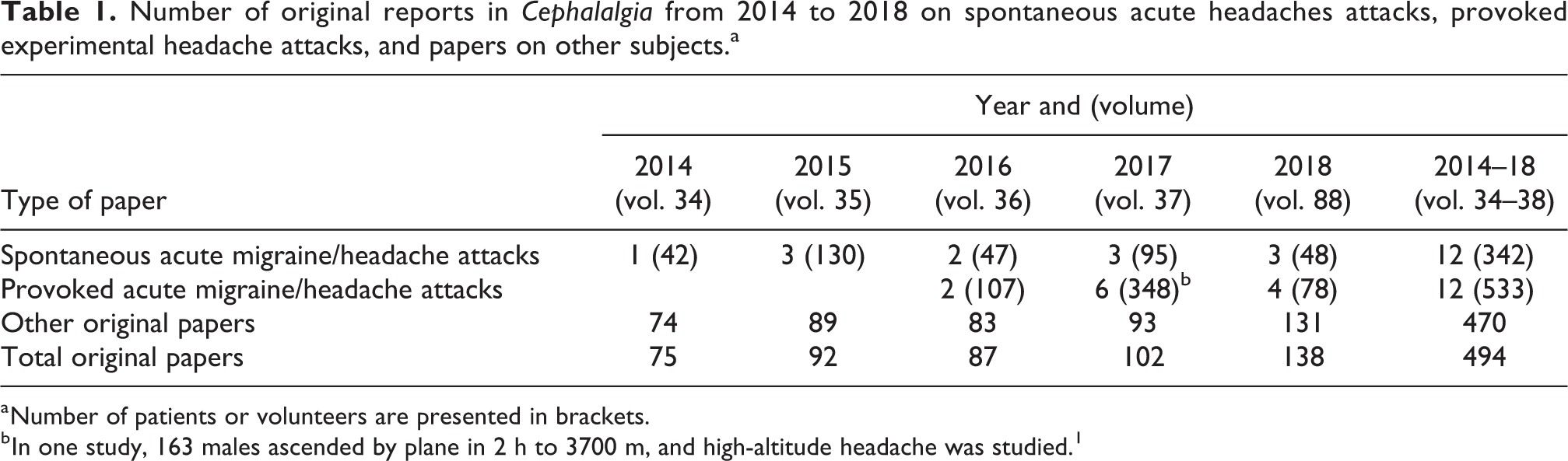
a Number of patients or volunteers are presented in brackets.
b In one study, 163 males ascended by plane in 2 h to 3700 m, and high-altitude headache was studied. 1
Discussion
This mini-review of original papers published in Cephalalgia in the 5 years from 2014 to 2018 strongly indicates that investigations of patients during spontaneous or provoked migraine/headache attacks are relatively rarely performed. The low percentage of original papers dealing with these spontaneous or provoked migraine/headache attacks was also found in two spot tests of reports published recently in Journal of Headache and Pain (JHP). Among the top cited 21 reports in 2016–2017 in JHP, only 1 reported on spontaneous headache, 2 and among 81 reports published under the heading Research Article in 2018 in JHP, 1 dealt with spontaneous 3 and 4 dealt with provoked migraine/headache attacks.
If the pathophysiology of migraine and other headaches are to be fully elucidated, there is an urgent need for investigations during actual migraine/headache attacks, being it spontaneous or provoked attacks. Relevant imaging and functional methods have been developed and can be used in our patients.
What is needed is that headache centers prioritize the investigations of spontaneous or provoked migraine/headache attack. 4 Investigations of pathophysiology of migraine will probably result in the development of better acute and prophylactic treatment of migraine, and, in addition, to the identifications of biomarkers for use in personalized drug treatment. It is my personal experience that patients are willing to present themselves for investigations with established migraine/headache attacks, and they also volunteer for provocation studies, in both cases conditional on an effective treatment, for example, subcutaneous sumatriptan, being available.
Clinical implications
Actual spontaneous or provoked migraine attacks should be investigated. This is relatively rarely done: only 5% of original papers in Cephalalgia concerns human attacks.
Footnotes
Declaration of conflicting interests
The author(s) declared no potential conflicts of interest with respect to the research, authorship, and/or publication of this article.
Funding
The author(s) received no financial support for the research, authorship, and/or publication of this article.