



Abstract
Big-team science collaborations have been heralded as a solution to oversampling in a limited number of high-income countries. Despite early successes, there is insufficient involvement from the global community and unclear benefits to globalized science. The expansion of research from sites in North America and Europe to parts of the world where most people live can create the appearance of progress based on geographical diversity while neglecting the perspectives, problems, and knowledge specific to those populations. Here, we describe participatory open-research practices that bring global perspectives to open science. Participatory practices involve revising and transparently communicating worldviews, valuing humility over control, prioritizing team facilitation over management, and listening to versus instructing collaborators. We detail these concepts and their utility and provide recommendations for conducting robust, open, and culturally embedded research that will help realize the potential value of big-team science.
Big-team open science, in which researchers from many institutions and often different parts of the world collaborate (Coles et al., 2022), represents an important step in testing behavioral phenomena with global samples (Ghai et al., 2024; Henrich et al., 2010; Wuchty et al., 2007); yet they largely generalize Western-centric theories and methods. “Big-team science” refers to coordinated collaborations that engage a large number of researchers distributed across institutions, countries, and cultures to achieve goals that exceed what small-team approaches can deliver (Baumgartner et al., 2023; Coles et al., 2023). In practice, big-team projects, which are larger in scope and complexity, are led from the top down, with the typically well-resourced Western labs designing the study and global collaborators translating materials and collecting data. 1 Left unexamined, this default approach runs a real risk of missing the perspectives, problems, and knowledge specific to those populations (Schimmelpfennig et al., 2024).
Although large-scale open-science and team-science efforts promise broader inclusion, representation remains heavily skewed toward high-income regions, and conventional evaluative metrics (e.g., citations, journal impact) systematically disadvantage researchers in less resourced contexts, undermining claims of universal openness (Pourret et al., 2022). Simply scaling collaboration or sharing data does not automatically yield equity: Without active governance of inclusion, big-team open science risks reaffirming existing hierarchies rather than transforming them. In practice, this imbalance often becomes visible not at the level of stated values but in mundane decisions about timelines, authorship order, and which analytic concerns are treated as negotiable versus fixed.
In this article, we describe why and how big-team science can better realize its goals of bringing greater diversity of perspectives to science (Baumgartner et al., 2023) by pivoting away from top-down management in favor of participatory open-research practices, collaborative decision-making informed and even made by synthesizing the voices on the research team. The knowledge obtained from these large-scale collaborations represents a material improvement from a more siloed business-as-usual single-lab approach that relies on dominant perspectives and homogeneous samples. Although a core strength of big-team science lies in its ability to collectively pool resources, funds, and researcher time to together advance psychology, the scale of such projects also puts it at risk for making errors at a larger scale. For example, top-down decisions can result in measurement invariance across samples, leading to lab comparisons that are spurious and nonreplicable (Dong & Dumas, 2020).
Big-team projects are typically led by well-resourced labs, and the research agenda consequently builds on and is thereby liable to focus on a relatively narrow set of worldviews and theoretical assumptions. Left unexamined, this default approach for large-scale global collaborations runs a real risk of using limited research resources in projects that have a global scope in terms of the geographic distribution of sites for data collection but that miss the perspectives, problems, and knowledge specific to those populations.
A growing body of scholarship makes clear that the global landscape of big-team science remains uneven, with persistent structural barriers limiting participation and leadership from researchers in low- and middle-income countries. Recent analyses emphasize that inclusion must extend beyond diversifying samples to transforming how collaborations are built and governed through resourcing partners worldwide and bridging Majority- and Minority-World research communities (Chuan-Peng et al., 2025; Jeftić et al., 2024). We lay out benefits and challenges of this approach and concrete ways to make big-team open science more participatory. Importantly, this is not an all-or-nothing approach; to the extent researchers can incorporate any participatory open-research practices, they promote more inclusive and ethically grounded big-team science.
Beyond Top-Down Big-Team Science: Collaborations Built on Humility and Listening Practices
At present, big-team behavioral science largely relies on a positivist approach that involves working with a priori concepts and models through rational analysis. The positivist, “etic” (Harris, 2001) approach underlines rigorous testing of effects through confirmatory tests essential for direct replication attempts. It is assumed that this approach offers more control, rigor, and structure (Feleppa, 1986). Indeed, big-team science is often motivated by the structural asymmetries in the field’s incentive system, which favor research narratives valuing full methodological control and prediction (Nosek et al., 2012; Smaldino & McElreath, 2016). As a result, big-team science often begins with the goal of confirmatory testing, although many of its useful outputs are exploratory as side effects of the intensive research efforts and resources required to produce it (Forscher et al., 2023).
In contrast, constructivist approaches hold that knowledge is constrained by the subjective interpretation, culture, and experiences of the knowledge-seeker, and “emic” data approaches that suspend cross-cultural assumptions can hold unique benefits (Amineh & Asl, 2015; Cutler, 2019; Denicolo et al., 2016; Finlay, 2002). Constructive regression earlier into the theory-building journey ultimately yields research processes and findings that better reflect the range of human experiences.
Although bottom-up designs and emic data approaches produce contextually sensitive insights and help capture cultural nuances, they present significant challenges for cross-cultural research, particularly in terms of generalizability (Newson et al., 2021). These methods prioritize locally derived knowledge and values, which can limit the ability to compare findings across diverse settings or draw broader conclusions. One way to address this tension is to adopt a hybrid approach that combines emic and etic perspectives, leveraging the strengths of both. For instance, research teams can use emic methods to develop culturally tailored frameworks and measures while also embedding core etic constructs that facilitate cross-cultural comparisons (Newson et al., 2021). This hybrid model ensures that the richness of local context is preserved without sacrificing the ability to identify broader patterns or universals. Importantly, hybrid approaches do not eliminate these tensions; rather, they make them explicit and therefore discussable.
The view stems from growing evidence underscoring that global inclusion in big-team and open-science initiatives cannot be achieved without a fundamental shift in how psychological science conceptualizes generalizability. For example, Adetula et al. (2022) argued that psychology must generalize from, not merely to, African contexts, noting that African scholars, methods, and research priorities remain structurally marginalized in mainstream collaborative science. Their analysis highlights how overreliance on Western theoretical frameworks, limited infrastructural support for African research institutions, and persistent authorship inequities reproduce well-documented hierarchies even in projects that explicitly embrace openness and scale. Incorporating these insights clarifies that expanding participation is not solely a matter of diversifying samples but also of reshaping governance, leadership, and epistemic norms so that researchers across the Global South influence research questions, methodological choices, and interpretations from the outset.
Given convincing evidence the field might be plagued by measurement and generalizability challenges (Flake & Fried, 2020; Lilienfeld & Strother, 2020), it is more likely than not that there is pressing need to adapt, qualify, or in some cases, completely rethink the suitability of theories and measures developed and tested on American university students for investigating global and universal human phenomena. To achieve this, researchers have argued for participatory research to improve big-team and open science, highlighting the need for participation and epistemic equity as core to collaboration for improving accessibility and relevance of open research across diverse contexts (Coles et al., 2023; Vaughn & Jacquez, 2020). For example, Gourdon-Kanhukamwe et al. (2023) argued that participatory methods in the neurodiversity-research domain enable contributors from underrepresented groups to influence design, interpretation, and dissemination, offering an instructive model for large-scale projects, and Hobson et al. (2023) suggested that open and participatory-design practices in autism research make transparent whose knowledge shapes the inquiry.
We see participatory shifts as starting from values and ending in behavior with timelines across two potential pathways (Fig. 1). On the left in Figure 1 is the customary research approach; on the right is a proposed alternative pathway toward which researchers can shift. We recognize that these recommendations are challenging in practice and not always feasible. However, we believe in the added value to behavioral science when researchers can incorporate them—at least some of the time—into developing research programs. To do so, open-science researchers working in teams should consider three shifts in the metaprocesses that drive their collaborations: a shift (a) from control to humility, (b) from leadership to facilitation, and (c) from telling to listening.

Two pathways from values to behavior in the research-collaboration process.
Shift 1: value-system shifts from control to humility
Moving to meaningful inclusion in big-team science means taking a step back to openly consider broad perspectives when planning research. We draw on insights from such fields as anthropology and sociology, recognizing that worldviews of researchers are driven by phenomenological understanding (Denicolo et al., 2016; Feleppa, 1986; Gallagher & Zahavi, 2020; Harris, 2001; Mostowlansky & Rota, 2020), to recommend humility in conceptualizations and methodologies to inform big-team behavioral science moving forward. At present, open-science practices are largely predicated on the values of having accurate a priori prediction and careful control, both of which drive a value toward transparency (Open Science Collaboration, 2015). Those values assume that researchers have suitable a priori knowledge, that is, a theory and history of observations and psychological principles and processes to be tested.
Researchers have so far called for humility about the specific methodological and analytic decisions of traditional research approaches (Martin et al., 2019). Participatory open-research practices call for an expansion of this stance and a shift away from valuing a confident empirical position and control over the research process. Valuing humility in this case means understanding and practicing research in ways that consider and explicitly communicate own worldview limitations, other worldview representation, and group decision-making approaches. It is worthwhile to ongoingly consider how gaps in one’s knowledge arise because they fall outside of the theories and perspectives that anchor one’s worldviews or because they represent other worldviews than one’s own. This includes acknowledging and owning limitations for the broader validity of the research findings across perspectives. Doing so goes hand in hand with a culture of openness in which one can accept biases in worldview, accept disagreements in diverse teams, and empower team members to address limitations in a constructive way.
Shift 2: transitioning from leadership to facilitation
Guided by the principle of humility, researchers can occupy the role of research “facilitator,” providing structure, space, and motivation for researchers to share their ideas in open dialogue. Borrowing from research on school educators, facilitators have been differentiated from two other teaching roles, that is, designers and subject-matter experts, in that their predominant role is to be present and available and share expertise to support the educational journey (Martin et al., 2019).
The participatory-research approach reflects the willingness of principal investigators (PIs) to coordinate rather than determine all aspects of research activities. For example, rather than conducting work by providing top-down instructions, the facilitator can guide the research questions to be asked, convey research findings back into mainstream research outlets, and ensure the research is conducted carefully and through open-science principles. Facilitators could see their role as eliciting active participation from collaborators, including participation that challenges the status quo, repositions aspects of the work, and informs key aspects of research design.
It is, however, important to distinguish participatory facilitation from fully flat organizational structures, the latter of which can create ambiguity and slow progress and at times, halt large projects altogether. Experiences from recent big-team initiatives demonstrate that facilitation is most effective when paired with clearly articulated governance structures, transparent decision rules, and unambiguous role assignments rather than an absence of hierarchy. In this view, facilitators provide coherence and procedural clarity, coordinate contributions, and surface disagreements early, and PIs or steering groups retain the authority to make timely decisions when consensus cannot be reached.
Participatory approaches do not therefore preclude leadership; instead, they work best when embedded within well-defined structures that specify how decisions are made, how responsibilities are delegated, and how contributors can meaningfully shape project directions without producing inertia. This more pragmatic framing reflects the realities of large collaborations, in which many researchers volunteer their time with limited institutional rewards, and underscores that inclusive practice depends on combining participatory ideals with robust organizational scaffolding.
Importantly, a single-PI team may not always be appropriate. Some researchers in low- and middle-income countries are already active contributors to big-team science and themselves could take on direct leadership roles or may be “liminal scientists,” researchers with experience in both Majority- and Minority-World contexts, who can help build bridges across research cultures, institutional constraints, and collaborative norms (Jeftić et al., 2024).
In addition, leadership and decision-making can also be shared, rotated, or held by representative bodies (including low- and middle-income countries and liminal scientists) rather than defaulting to PIs as the final arbiters. Projects could embed shared authority in their formal governance—for example, through mandated colead roles, rotating or representative leadership bodies, and decision-making rules that give low- and middle-income countries and liminal scientists real agenda-setting and oversight power. Broadening participation can therefore involve, alongside creating space for involvement, a redistribution of leadership and influence across global research communities.
Shift 3: behavioral shifts from telling to listening
With a value shift toward humility and a mindset shift to the role of the PI as facilitator, conducting culturally embedded collaborative research will ultimately necessitate a shift from telling to listening. Attentive and receptive listening to collaborators’ unique perspectives through workshops and meetings structured to elicit open dialogue can ultimately lead to wider and richer models of human experience and behavior. Researchers have argued that listening (to participants) must be at the heart of effective qualitative research (Lavee & Itzchakov, 2023). High-quality listening builds relationships (Bavelas, 2022; Huang, 2020), increases listeners’ learning (Hargie, 2022), creates an open environment for effective knowledge exchange (Gordon, 2011), and ultimately supports the cocreation of new knowledge (Mercieca & Mercieca, 2013) and higher performance (Bergeron & Laroche, 2009).
Listening involves more than just paying attention. Rather, researchers must be willing to suspend their own judgments and change their own ideas and approaches in the research process. Listening also helps to balance the distribution of power in which the primary investigator’s facilitation power is enhanced at the same time as the collaborator’s influence (Hurwitz & Kluger, 2017). In the context of research collaborations, when PIs listen openly to collaborators’ ideas and approaches, they can build knowledge that informs all steps of the research life cycle: from conceptual development or model building to stronger operationalization of constructs and to developing better methodologies and a more nuanced understanding of research findings.
The Life Cycle of Participatory Research
Step 0: building diverse teams from the outset
To address what we call “Step 0,” building a genuinely diverse team cannot be left to open calls and goodwill alone; it requires deliberate structures for outreach, resourcing, and power-sharing. Empirical and conceptual work on cross-cultural research shows that researchers in low- and middle-income countries are routinely bypassed, undercredited, and structurally constrained by precarious contracts, heavy teaching loads, and limited infrastructure such that “being reached” is not the same as being able to participate equitably (Bou Zeineddine et al., 2022; Broesch et al., 2020; Urassa et al., 2021). In practice, this means that researcher recruitment must include codeveloping project aims with regional hubs rather than simply advertising through informational commons; budgeting specifically for release time, connectivity, translation, and local coordination; and offering multiple levels of engagement (e.g., local lead, site PI, consultant) that recognize diverse constraints and expertise. Guidance from decolonial and community-centered approaches further underscores that equitable recruitment is inseparable from capacity building and shared leadership, not just from geographical spread of sites (Broesch et al., 2020; Decolonial Psychology Editorial Collective, 2021; Montiel & Uyheng, 2022).
Big-team initiatives such as Many Labs Africa illustrate one concrete model: They began with a smaller, co-led preparatory cohort in which African collaborators and partners jointly developed training activities, codesigned protocols, and collectively identified feasibility barriers before scaling up (Adetula, 2022; Adetula et al., 2022). Drawing on these lessons, we recommend that big-team projects treat Step 0 as a distinct, funded phase in which teams work with low- and middle-income-country-led networks to identify who is structurally missing, invite and support new collaborators, and conegotiate decision-making and authorship arrangements up front so that later participatory practices rest on a more representative and sustainable foundation (Baumgartner et al., 2023).
Step 1: participatory conceptual model building
From the model-building stage on, one can shift from telling researchers and participants what they might expect from Western models of psychology to listening to both collaborators and participants intentionally in a way that elicits their thoughts about how phenomena under study could translate to local experiences. Qualitative research is well suited to building conceptual insights that guide future quantitative research, and its tools can be used creatively to synthesize not just diverse participants’ implicit conceptual models but also models put forth by multiple collaborators on a project, which themselves can be thematically analyzed (Braun & Clarke, 2012). As an example, consider the following qualitative approach taken in a study that examined the role of mental-health stigma in social and mental-health outcomes (Prizeman et al., 2024). Instead of determining the nature of a presumed causal model a priori, researchers asked participants to build their own causal models and then thematically analyzed those drawings (Fig. 2). Likewise, when collaborating with researchers worldwide, collaborators could describe their conceptual models or propose their own conceptual models, which can then be thematically analyzed across labs for new conceptual approaches that represent the views of collaborators. In all, conceptual model building can be something other than a top-down exercise in applying theory to empirical tests; it can begin with diverse perspectives offered by participants (a common use) or alternatively, collaborators for a broader perspective that drives informed research programs.

Summary of conceptual model drawings drawn by participants who received the constructs but not the relationships between them. From Prizeman et al. (2023).
Step 2: cocreating conceptual and operational definitions to drive research
The way researchers conceptualize psychological models informs and is informed by working definitions of specific constructs being tested. At present, PIs often make executive decisions about what construct definitions should entail, which, of course, subjects them to culture bias. Outside of team efforts, researchers have turned to qualitative research to examine and redefine psychological constructs already used in the field. For example, researchers have asked the lay public to define mindfulness (Haddock et al., 2022) or benchmark body mass index in relation to ideal body weight (Crawford & Campbell, 1999) rather than using top-down measures for measuring the construct with predefined items that prematurely constrain its definition. Such explorations have often resulted in more sensitive or otherwise broadened definitions to guide further scientific discourse (Weinstein, Hansen, & Nguyen, 2023). Refined construct definitions are better embedded in history, traditions, and culture (Hughner & Kleine, 2004). As has been done with participants, this too can be done with collaborators. A participatory open-science approach would ask collaborators to describe and define the constructs under study. Synthesis of responses or a thematic analysis of them would highlight agreements and disagreements across labs and cultures. In all, such explorations inform stronger conceptual definitions that reflect the diverse perspectives of the behavioral sciences.
Step 3: participatory study design and measurement decisions
Experimental design often offers an opportunity to stay consistent with best practices already established in one’s field, keeping in mind the feasibility of those designs for the labs involved in the project. Decisions for the research to involve survey, experimental, or another method or to be qualitative, quantitative, or mixed can be determined at the start of the project in line with the approaches suitable to answering the specific research questions under study and following best practices in cross-cultural research (Brislin, 1980; Matsumoto, 2001). Keeping in mind the values of participatory open science, teams could instead collaboratively select study design to optimize sensitivity to cultural variations. For example, experimental stimuli—whether delivered in written, visual, or another form—may present content, writing, and images that reflect the leading lab’s culture and thus might benefit from cocreation with each lab contributing to or even selecting their own version of the experimental stimulus.
In addition, participatory approaches can benefit item selection in scales being used. Typically, researchers use scales and scale items based on those options that have been widely used or well validated. However, many scale items reflect North American cultural views. For example, consider the item “My partner would go to bat for me,” a reference to baseball, embedded in a psychological-safety scale (Tynan, 2005). The need for greater sensitivity to cultural idioms and experimental and item variations has already been recognized in the field of cross-cultural psychometric measurements (Yasir, 2016) and extends to fields such as marketing (Leach & Liu, 1998) and emotions (Leff, 1977), among others. Ultimately, this approach will shift away from control of the methods themselves to control in determining the research process that leads to those decisions, including deciding a priori boundary conditions for methodological proposals made by collaborators (e.g., when research methods are too burdensome for the group), inclusion criteria for materials selected (e.g., so that scale modifications do not fundamentally change the meaning of a scale in a way that undermines the research), and how data about the group’s perspectives are synthesized and used to inform final methods. For a summary of these options, see Table 1.
Five Opportunities to Apply Participatory Open-Science Practices

Outputs That Convey the Participatory Mindset and Approach
We propose a series of practical recommendations that support a participatory mindset and approach. Dissemination strategies should prioritize open, wide accessibility and inclusivity. Sharing findings through workshops, policy briefs, or other nonacademic formats ensures that the knowledge generated benefits not only the academic community but also the participants and communities involved. By embedding reflexivity, collaboration, and iterative feedback into their workflows, researchers can operationalize epistemic humility in ways that enhance the rigor, inclusivity, and contextual relevance of their work.
Representing perspectives in preregistrations and articles
The shifts from control to humility, leadership to facilitation, and telling to listening inform how researchers preregister their research, communicating limitations and ambiguities transparently over communicating expectations with perfect confidence (Dienlin et al., 2021) and sharing a priori which research steps they will take and how research decisions are to be made. Researchers have already called for preregistrations that communicate uncertainty, shifting the way one thinks about open science as perfectly controlled to open science that is fully informative and reflects the open minds of its researchers (Hardwicke & Wagenmakers, 2023; Leonelli, 2023). When researchers disagree, PIs can decide and then explicitly describe how and which top-down decisions are made and the process of negotiation and decision-making. Amendments and supplemental materials can document agreements and disagreements that were negotiated and resolved by the lead team. Rationales and counterarguments could be clearly documented and considered alongside a decision log, with a clear process toward final decision-making established. Preregistrations and post hoc documentations that state both what is known and what is unknown and disagreements in the decision-making process can inform readers’ understanding of how the research process unfolded while supporting necessary flexibility in future research decisions that allows for open and collaborative decisions made along the way. Preregistration can enrich transparency, but it presupposes familiarity and infrastructure. Equitable capacity building, such as multilingual training materials, is necessary to prevent new divides as international collaborators take PI roles or select to undertake separate preregistration processes, and the global community must recognize that they take an immense amount of time to prepare (Chuan-Peng et al., 2025).
Taking the idea of humility from preregistration to research articles, existing calls for such shifts in research articles suggest focusing less on research that looks “polished” and more on research that is “well calibrated”: that interprets results with humility and caution and reflects the real uncertainty in the research process (Hoekstra & Vazire, 2021). Scholars have proposed solutions to this issue by adding “Constraints on Generalizability” statements (Simons et al., 2017), but more transparency in discussion sections and owning limitations are practices that remain to be widely adopted (Clarke et al., 2024). When considering the value of participatory open-science research, editors and peer reviewers can urge stricter standards for reporting decision-making processes throughout the research process and cultural embeddedness as a strength or limitation of the research conducted. Here, we suggest taking this approach fully and willingly to acknowledge a research project in which little is decided a priori but concrete and specific plans are made for how decisions are to be made and what constraints are set on the decision-making process. To further improve the publication process, it is ultimately also important to increase diversity in the editorial and review procedures and the research process, providing a broader set of perspectives than currently offered by a body of editors largely from higher-income countries (Liu et al., 2023).
Acknowledging and reporting global researcher perspectives
The shift in preregistrations can include discussions of worldview currently missing from what is described at the outset of conducting research. Rigorous controlled studies therefore at least partly reflect the cultural and historical biases and present-day pressures of the researchers leading big-team efforts; ensuing research can be influenced in insidious ways. For example, PIs are motivated to produce journal publications that will be positively evaluated by colleagues who are familiar with culturally dominant concepts and have culturally driven expectations (Berry, 2013). We illustrate this with an example not from psychology but from biology, when the against-all-odds publication in a 1977 issue of Science showed that gay seagulls were found living off Santa Barbara Island, California. This one study, challenging the current worldview, opened the door to new investigations and publications, catapulting science from virtually no such peer-published evidence of queer animal existence to remarkably widespread evidence that had, in turn, an impact on U.S. policy and medical practices in relation to the LGBTQ+ community (Alaimo, 2010). In psychology, like in biology, both the PIs and the intellectual systems and frameworks in which they operate color the research itself. They bring specific phenomenological perspectives that shape the research agenda.
Open-science researchers who reflect on worldviews can transparently communicate them in preregistrations and articles, providing readers with a clear context and understanding of how research conclusions have been derived and interpreted. To date, although these assumptions form the basis of empirical argument for a priori expectations (Weinstein, Hill, & Law, 2023), they are rarely explicitly discussed in public registrations or articles that set expectations for or interpret the findings of quantitative psychological research. Rarely do researchers make statements about worldviews and how those worldviews might affect questions asked. In contrast, qualitative researchers see such reflections as normative and even expected (Christians, 2008), with the understanding that worldview biases inevitably drive research questions and that the research itself cannot be understood as separate from the worldview of researchers (Yin, 2015).
Researchers can be transparent about worldviews by exercising reflexivity in their approach, documenting and discussing their own, collaborator, and even participant worldviews and how those influence and shape the research process, outcomes, and interpretations (Gough, 2017). For example, “worldview maps” and positionality statements can efficiently describe background characteristics of researchers that might have influenced their own worldview in the project. These include descriptions of researchers’ background (e.g., ethnicity, gender, and personal experiences) and the impact on worldviews in relation to the data collected (Jacobson & Mustafa, 2019). They may, for example, take into account dimensions along the wheel of privilege (D. Hartmann et al., 2025), a tool mapping structural advantages in a global academia cluster around characteristics such as institutional prestige, geographic location, funding access, language fluency, and career stage.
Across hundreds of coauthors, such statements become unwieldy, but they can be thematically analyzed for big-picture conclusions or takeaways about the composition of the research team (e.g., Many Labs Listen, 2024). Participants can be asked to report their backgrounds with the same social-identity maps, allowing researchers to triangulate worldviews represented across (a) researchers’ backgrounds, (b) participants’ backgrounds, and (c) backgrounds reflective of the general population (e.g., using publicly sourced data, https://data.worldbank.org/ or https://ourworldindata.org, or other sensitive sources). Positionality statements can be more than a tick-box exercise. By presenting and synthesizing positionality statements, researchers help individuals outside the research team to better understand the different lenses through which the data were analyzed.
To use them to benefit the research process, we recommend several concrete steps. First, research teams can adopt standardized templates for positionality statements, focusing on aspects that directly influence research design and interpretation, such as theoretical influences and cultural perspectives. These statements can be thematically analyzed to identify shared biases or gaps in perspective across the team, fostering reflexivity and collaborative problem-solving. Second, researchers can engage in structured workshops in which positionality statements are discussed openly, allowing team members to identify how their worldviews shape research decisions. Finally, positionality analysis could inform decisions throughout the research process, such as hypothesis generation, data processing and interpretation, and dissemination strategies.
The Merits of Starting Slow Before Building Speed
Shifts to participatory open-science methods necessitate a slowing down before researchers once again speed up to conduct the fast research with which the field is now accustomed. “Fast” research in the context of big-team studies frequently takes the forms of (a) replicating or extending a Western phenomenon in a global context; (b) translating measures, stimuli, and protocols into different languages (often without considering measurement invariance); (c) collecting data online; and (d) prioritizing confirmatory framing over a descriptive approach focused on exploration.
Big-team science has produced models generalized globally across diverse range of countries (Ruggeri et al., 2022). However, how big-team research moves from “a universal psychology of numerous individuals to a localized psychology of collectives” remains an open question (Montiel & Uyheng, 2022). Indeed, these projects inadvertently miss important ethical, methodological, and sampling considerations and rarely account for a culturally informed design (Ghai et al., 2024). One model of slow research is provided by the Many Labs Africa project (Adetula et al. 2022; Many Labs Africa, n.d.), designed to replicate the African-discovered claims across 46 research sites. The project employs intensive training to ensure African researchers are at the heart of this inquiry. By incorporating a participatory approach and an epistemologically diverse perspective on replication studies (Haddock et al., 2022), this big-team-science study ensures the research remains culturally grounded and robust before evaluating replication.
Contributing to researchers and communities internationally
Participatory open-science methods emphasize reciprocal benefits such that communities gain tangible value from their involvement. This might involve sharing findings in accessible formats, supporting capacity-building initiatives, or fostering long-term collaborations. Such practices build trust, reduce the risks of extractive dynamics, and create a foundation for sustainable, equitable partnerships that enhance both the validity and ethical accountability of research. By engaging local collaborators, stakeholders, or community representatives during the conceptualization phase, researchers can ensure that their projects address locally relevant issues and respect cultural nuances. For instance, convening community advisory boards to review and refine research questions can help prevent ethnocentric assumptions and foster trust. In addition, preliminary findings can be shared with local collaborators or community stakeholders in workshops, allowing for their critique and contextualization. This iterative process ensures that interpretations remain grounded in lived realities and culturally specific knowledge.
Recent years have seen the emergence of several grassroots efforts that work to increase the global reach and inclusivity of big-team and open-science practices. These initiatives illustrate that meaningful change is already underway and that researchers across diverse regions are actively reshaping collaborative norms from the ground up. For example, the Open Science Community Serbia, Advancing Big-Team Reproducible Science Through Increased Representation, a consortium led by researchers from Bosnia-Herzegovina, Brazil, India, and Mexico, and the Brazilian Reproducibility Network are nationally or cross-nationally organized networks that support researchers in adopting open and transparent research methods. These examples highlight that improvements in global representation do not depend solely on top-down policy changes but can stem from grassroots networks (Chuan-Peng et al., 2025).
Scaling up slowly
To incorporate participatory open-science methods into the research process, research teams may begin with a small handful of research teams before scaling up with a more informed perspective. In this case, initial collaborative decisions can be made by a “small team,” understanding that participatory work from a handful of labs across the world will yield broader information than a top-down approach from one dominant lab. When scaling up with more labs around the world, each new lab can be invited to challenge or affirm the initial decisions and approaches in line with their own cultural understanding. This step will facilitate the consideration of ethical nuances across different countries and democracies that go beyond mere ensuring of data privacy (Montiel & Uyheng, 2022). Consider a similar approach to that taken by qualitative researchers learning from their participants for guiding research conducted globally: Initial collaborations form the basis of initial conclusions, but the model is open to revision until saturation is reached and no new knowledge is gained. In this case, large-scale studies are then warranted, based on a better-informed foundation. Having built such a foundation, researchers returning to big and fast research are testing ideas more likely to apply to the cultures they study.
Challenges and Considerations of Participatory Open-Research Practices
Although we have laid out a case for participatory open-research practices, there are notable challenges to implanting them in big-team-science projects (for a summary, see Fig. 3).
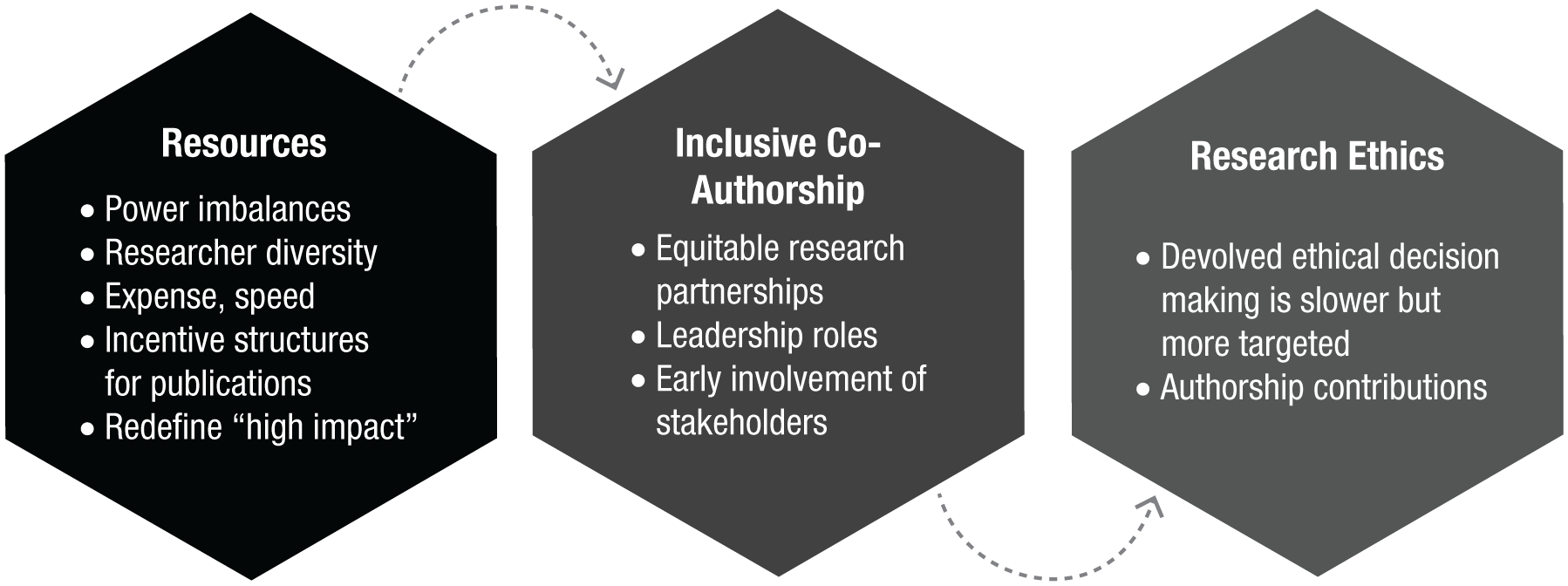
Challenges of participatory open-science research.
Resources
Power imbalances in global research are both geopolitical and deeply intersectional. Researchers from culturally diverse contexts, particularly women and marginalized racial or ethnic groups, often face compounded barriers in accessing funding, leadership, and recognition. This intersectional devaluation is reinforced by the coloniality of funding streams, which favor PIs from well-resourced regions, systematically excluding less resourced voices (Bou Zeineddine et al., 2022; Decolonial Psychology Editorial Collective, 2021). Beyond technical support, inclusive research requires epistemic pluralism. Feminist open-science practices (H. Hartmann et al., 2025) and community-developed resources, such as the Advancing Big-Team Reproducible Science Through Increased Representation organization (ABRIR: https://abrirpsy.org/), demonstrate alternative frameworks for equitable knowledge exchange.
In contrast to top-down research, going slow is expensive and hard to do. Adopting a slow-research mindset requires careful theorizing and sampling across and within different cultures. This involves trade-offs in gathering underrepresented samples (e.g., resources, time) and a thoughtful understanding of the cultural diversity of each country. Furthermore, the slower timelines of planning (e.g., seeking ethical approvals) and conducting studies (e.g., field experiments) that prioritize emic approaches may make for slower and fewer publications and inadvertently disincentivize researchers. To tackle this hurdle, the field needs a cultural and systemic change in the incentive structure of research publications and to redefine what high-impact research truly means. Although a normative change may be hard to achieve, slower team-science projects will incrementally build momentum toward valuing culturally valid and impactful research that is not purely extractive.
Inclusive coauthorship
One persistent challenge in any big-team-science project remains equitable coauthorship practices (Coles et al., 2023). This is especially important when doing cross-cultural collaborations because projects typically remain funded by high-income countries (Schroeder, 2023). It is therefore critical when conducting cross-cultural research to build equitable research partnerships that meaningfully include local researchers throughout the research process (Urassa et al., 2021). Requiring local researchers to contribute funding to be a coauthor overlooks the funding and incentive models for researchers based in low- and middle-income countries (Broesch et al., 2020). Slow team science helps directly avoid top-down research by including local partners meaningfully in research collaborations from the inception stages (e.g., in grant writing) to ensuring true inclusion (e.g., leadership positions in big-team-science projects).
Recent work has outlined clear steps for improving authorship equity in large-scale collaborations (Jeftić et al., 2024). Jeftić et al. (2024) recommended redistributing authorship roles toward greater leadership from these scholars, including ensuring that individuals with experience across Majority- and Minority-World contexts hold positions that can bridge research cultures and anticipate inequities. Their work further emphasized that authorship criteria should be sensitive to local expertise, recognizing contributions such as cultural adaptation, community coordination, and contextual knowledge as core intellectual inputs rather than peripheral labor. Like Chuan-Peng et al. (2025), Jeftić et al. highlighted the need for transparent authorship plans, negotiated and documented early in the project, and governance structures that prevent decision-making and data control from being concentrated in high-income-country leadership.
Research ethics
Cross-cultural research can come with complex ethical challenges. This slower big-team-science approach with culturally embedded researchers coconstructing the research seeks to alleviate some of these concerns. First, researchers can ensure that ethical guidelines are not just from one university or an institutional board but also that local ethical guidelines in the countries they intend to do research are followed (Ravinetto et al., 2011). Second, the inclusion of local researchers embedded in communities who are familiar with the settings can ensure that there is true value for the research populations studied. In addition, local researchers have a better cultural context for navigating issues around informed consent, such as protecting against possible coercion (especially in low-income countries, where many do not have access to necessities, such as safe drinking water; World Health Organization, 2019) and respecting cultural norms (e.g., involving family in informed consent; Akhter-Khan et al., 2024). Third, ethical consideration should extend beyond protocols to include a critical assessment of potentially unintended and negative consequences of a study/intervention. For instance, an intervention aimed to reduce political polarization or intimate-partner violence can backfire or lead to an increased risk in different cultural and sociopolitical populations (Cullen et al., 2025). In addition to ethical issues in working with human subjects, big-team science can come with ethical challenges around authorship contributions.
The approach for which we are advocating aims to address the power differential that can happen in big-team cross-cultural research by encouraging a shared power model rich in big-team listening and learning. Researchers must weigh up these risks in collaboration with local researchers and ultimately ensure they play a decisive role in determining whether the study is ethically appropriate. In line with this, recent work has emphasized a community-centered approach in which the local needs are considered, there is meaningful involvement from community members, and research outputs are shared with participants and community stakeholders (Broesch et al., 2020).
Closing
Participatory big-team science represents a shift from an individual sport in which PIs drive the research agenda in full to a team sport (Coles et al., 2022) facilitated by PIs who give space for global collaborators to voice their perspectives. Given the realities of power asymmetries in big teams and projects being supported by high-resource institutions, researchers will need to rethink how to structure the future of team science in sustainable and equitable ways, including fair and equitable authorship practices. Participatory open research is a useful lever for researchers who intend to do innovative research that is culturally informed, rigorous, and practically relevant for communities. Researchers pursuing these avenues can access resources such as the open science in the developing world compendium (Chuan-Peng et al., 2025), which provides practical guidelines to support researchers working in low- and middle-income countries and outlines the infrastructural, ethical, and collaborative conditions important for equitable participation in global science. This will be especially critical with the success and proliferation of big-team science with researchers opening calls to collaborate, more funding being awarded to big-team studies, and more infrastructure being pooled to make such studies more representative. Such efforts call for shifts in values, mindsets, and behaviors of leading teams. They also require lead teams to embrace humility, give up control, and listen carefully to underrepresented collaborators to enable fully participatory activities.
Doing so across all steps of the research process can feel intimidating and unachievable. It also has practical challenges, including coordinating meetings across researchers living in different time zones, language barriers, and eliciting genuine feedback from the less heard members of research teams. We argue that benefits operate on a dose-response principle: Even one step—whether it be conceptual model development, construct definitions, or measurement or decisions—can improve the breadth and cultural relevance of the research being conducted in a research program that could be taken through an etic (top-down, lead-team driven) or emic (bottom-up, culturally embedded) approach. Like most else in psychology, the choice is not black or white. Rather, principles can be adapted to suit the needs of the research, the feasibility of the work and collaboration, and of course, the interests of collaborators. Any movement in this direction helps to build a stronger foundation for conducting future psychological research through an approach that leverages the expertise of diverse and global researchers promoting a more inclusive, rigorous, and transparent research.
Footnotes
Transparency
Action Editor: David A. Sbarra
Editor: David A. Sbarra
Author Contributions
