



Abstract
Fixed-effects modeling is a powerful tool for estimating within-clusters associations in cross-sectional data and within-participants associations in longitudinal data. Although commonly used by other social scientists, this tool remains largely unknown to psychologists. To address this issue, we offer a pedagogical primer tailored for this audience, complete with R, Stata, and SPSS scripts. This primer is organized into three parts. In Part 1, we show how fixed-effects modeling applies to clustered cross-sectional data. We introduce the concepts of “cluster dummies” and “demeaning” and provide scripts to estimate the within-schools association between sports and depression in a fictional data set. In Part 2, we show how fixed-effects modeling applies to longitudinal data and provide scripts to estimate the within-participants association between sports and depression over time in a fictional four-wave data set. In this part, we cover three additional topics. First, we explain how to calculate effect sizes and offer simulation-based sample-size guidelines to detect within-participants effects of plausible magnitude with sufficient power. Second, we show how to test two possible interactions: between a time-invariant and a time-varying predictor and between two time-varying predictors. Third, we introduce three relevant extensions: first-difference modeling (estimating changes from one wave to the next), time-distributed fixed-effects modeling (estimating changes before, during, and after an individual event), and within-between multilevel modeling (estimating both within- and between-participants associations). In Part 3, we discuss two limitations of fixed-effects modeling: time-varying confounders and reverse causation. We conclude with reflections on causality in nonexperimental data.
Keywords
Fixed-effects modeling is a simple yet powerful tool for analyzing (a) clustered cross-sectional data, such as students nested in schools, employees nested in firms, or residents nested in countries, and (b) longitudinal data, in which repeated observations can be leveraged to strengthen causal inference (Allison, 2009; Brüderl & Ludwig, 2015; Wooldridge, 2010). Although widely used in economics, sociology, political science, and medicine, fixed-effects modeling has yet to gain broad acceptance in psychology (Bauer & Sterba, 2011; McNeish et al., 2017; Petersen, 2008). One reason may be the siloed structure of the social sciences, which limits the diffusion of methodological advances across disciplines. In this primer, we aim to break down that silo, providing a clear, nontechnical introduction to fixed-effects modeling. It is organized into three parts.
In Part 1, we introduce fixed-effects modeling for clustered cross-sectional data using a synthetic data set in which students (participants) are nested in schools (clusters) and we provide R, Stata, and SPSS scripts. Psychologists often analyze such data with multilevel models, yet fixed-effects models are more practical when the goal is to estimate differences between individuals who belong to the same cluster rather than differences between clusters (for contrasts between these two approaches and clarification that the term “fixed effects” has a different meaning in multilevel modeling, see Table 1). For example, researchers can use fixed-effects modeling to compare individuals within the same country (Araki, 2023), employees within the same firm (Balzano et al., 2025), or students within the same school (Fang et al., 2022). By focusing on within-clusters variation, this approach effectively controls for all between-clusters differences (e.g., national historical heritage, organizational culture, school resources), thereby avoiding misleading comparisons across clusters (McNeish & Kelley, 2019).
Comparison of Multilevel Models and Fixed-Effects Models
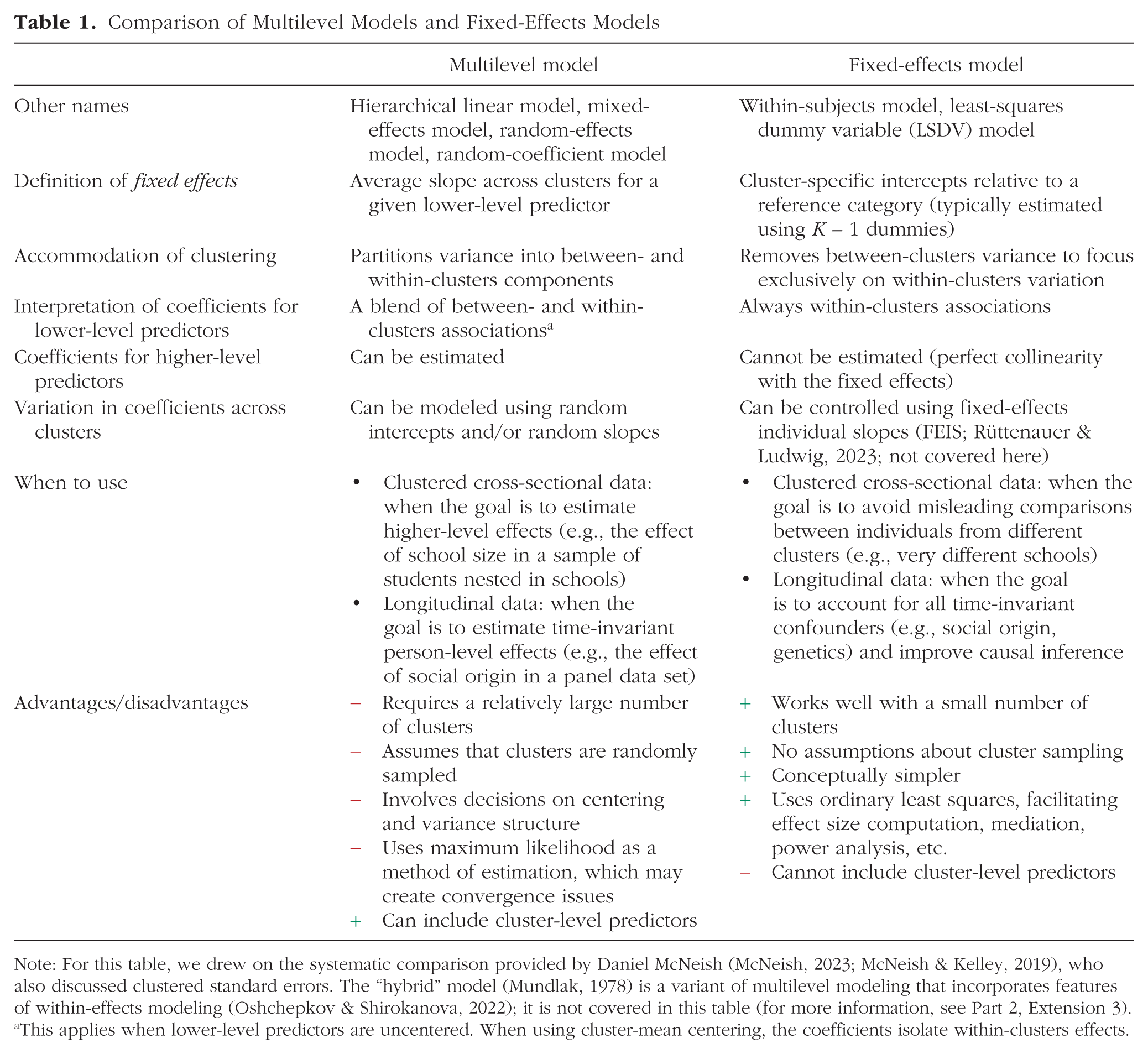

Note: For this table, we drew on the systematic comparison provided by Daniel McNeish (McNeish, 2023; McNeish & Kelley, 2019), who also discussed clustered standard errors. The “hybrid” model (Mundlak, 1978) is a variant of multilevel modeling that incorporates features of within-effects modeling (Oshchepkov & Shirokanova, 2022); it is not covered in this table (for more information, see Part 2, Extension 3).
This applies when lower-level predictors are uncentered. When using cluster-mean centering, the coefficients isolate within-clusters effects.
In Part 2, we expand on the concepts introduced in Part 1 to show how fixed-effects (panel) modeling applies to longitudinal analysis using a synthetic data set in which students are followed for 4 weeks and, again, we provide R, Stata, and SPSS scripts. The growing availability of large-scale panel surveys has become a valuable resource for psychologists because these data sets allow researchers to track individuals over time and study changes in psychological outcomes (Lillard, 2024). Major panel data sets—such as the German Socio-Economic Panel, the Swiss Household Panel, the U.S. Panel Study of Income Dynamics, and the Korean Labor and Income Panel Study—offer repeated measures relevant to psychology, including family dynamics, personality, and mental health (for a more exhaustive list of data sets, see Table A1 in the Appendix). Psychologists can use fixed-effects panel modeling (and its extensions) to examine associations among these measures while focusing only on within-persons change, thereby eliminating all participant confounders that do not vary over time (e.g., genetic dispositions, family social class, ethnicity) and offering a stronger basis for causal inference (e.g., Seifert et al., 2024).
In Part 3, we discuss the strengths and limitations of fixed-effects panel modeling and offer reflections on causality. Although other fields have long engaged with the challenge of drawing causal inferences from longitudinal data, psychological research has been more hesitant to address causality outside of experimental designs (Grosz et al., 2020). Fixed-effects models help approach causality by isolating within-persons change over time and removing all time-invariant confounders. However, time-varying confounding and reverse causation remain key threats to causal inference. We propose viewing causality not as a binary judgment but as a continuum of plausibility: Fixed-effects panel modeling leverages within-persons variation in longitudinal data and raises the plausibility of causal inference beyond that of cross-sectional analyses even if these models cannot establish causality with certainty.
Part 1: Fixed-Effects Modeling Applied to Clustered Cross-Sectional Data
In this section, we show how fixed-effects modeling can be used to estimate within-clusters associations in cross-sectional data. Imagine you have collected a sample of N = 200 students across K = 4 schools (your four clusters). Students reported the number of hours they spent on sports activities in the previous week (your predictor). Then, they completed a depression screening tool and received a depression score ranging from 0 to 5 (your outcome). Your hypothesis is the following: “The more students do sports, the less depressed they are.” 1
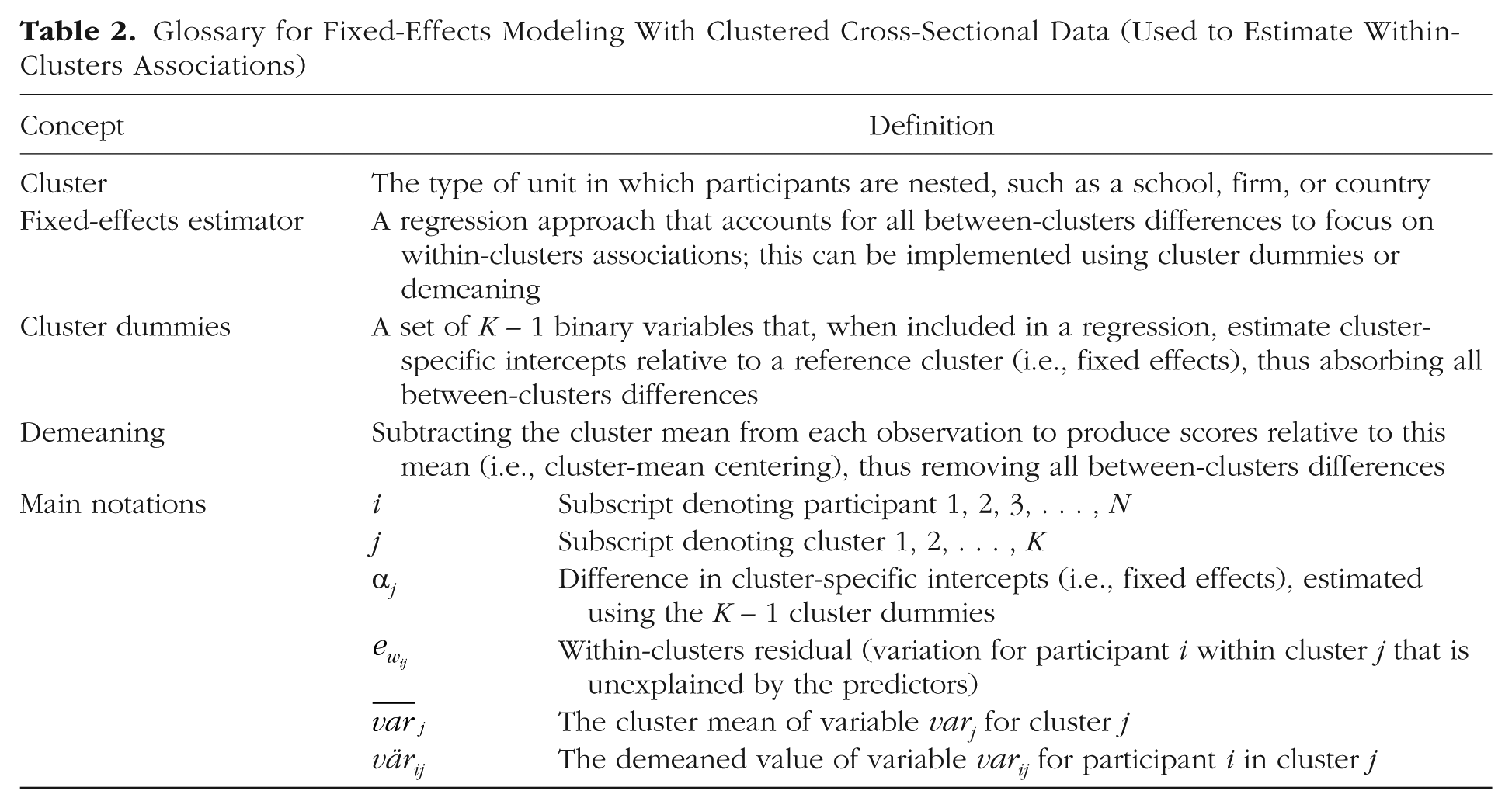
Here, we go through four modeling strategies to pedagogically explain how fixed-effects modeling works and how it can be used to estimate the within-schools association between sports and depression: (a) a standard regression, (b) a regression with cluster dummies, (c) a regression with demeaned variables, and (d) a fixed-effects regression with R, Stata, and SPSS. The synthetic clustered data set and the Quarto (R), Stata, and SPSS scripts to run the analyses are available at https://osf.io/fvck7/. We encourage you to work with these resources while reading this section. Table 2 is a glossary of concepts and notation used throughout this section, and Box 1, at the conclusion of the section, provides a concise summary.
Glossary for Fixed-Effects Modeling With Clustered Cross-Sectional Data (Used to Estimate Within-Clusters Associations)
Box 1 . Summary of Part 1
• Fixed-effects modeling is a simple and effective approach to account for data clustering in cross-sectional data and to isolate within-clusters associations between variables.
• Fixed-effects modeling can be implemented by including the cluster identifier as a categorical predictor (Model 2), which fully removes between-clusters variation.
• Fixed-effects modeling can also be implemented by demeaning the focal predictor and outcome (Model 3), although degrees of freedom must be corrected for mean estimation.
• Fixed-effects modeling can be implemented using R (plm()), Stata (xtreg, fe), and SPSS (UNIANOVA), respectively (Model 4); full commands are provided in the text.
Model 1: standard regression
First, you run this standard regression model:

where i = 1, 2, . . . , 200 participants; j = 1, 2, 3, 4 schools; B0 is the intercept (the predicted depression score for respondents who did not do sports in the prior week); and eij is the residual.
Note that in Equation 1 and the following regression equations, the residuals are assumed to satisfy the basic regression assumptions: normally distributed, eij ∼ N(0, σ2); homoscedastic, Var(eij | sportij) = σ2; and independent (for a discussion of when clustering needs to be taken into account, see the section on “Design Effect” in Sommet & Morselli, 2021).
As shown in Table 3, your estimate of interest is B1 = −0.01, SE = 0.07, p = .913. You may believe it accurately captures the association between doing sports and depression. However, this estimate is biased for two reasons. First, using a standard regression with a clustered data set violates the independence assumption, which requires that residuals associated with different participants be independent of one another (Snijders & Bosker, 2012). In your case, this assumption does not hold because data from students from the same school are likely more similar than data from students from different schools.
Parameters From the Four Modeling Strategies Presented in Part 1

Note: Results shown are from the standard regression, regression with cluster dummies, regression with demeaned variables, and fixed-effects regression run using your preferred software. The latter three models yield the pooled within-clusters association between the predictor and outcome, as described by the text in bold.
This model is biased because it violates the independence assumption and fails to isolate within-clusters associations.
This model is unbiased and is a fixed-effects model.
This model isolates within-clusters associations, but the standard errors are biased because it ignores the degrees of freedom used to estimate cluster means. The bias is minimal here because our example uses K = 4 schools for easier graphical display, but it would grow with K = 10, 20, or more schools.
This model is unbiased and can be replicated using the R, Stata, and SPSS commands described in the text.
This estimate is generally neither interpreted nor reported in fixed-effects-regression results.
Second, using a standard regression with a clustered data set fails to isolate the within-clusters associations because estimates reflect differences not only among participants in the same clusters but also across different clusters (Enders & Tofighi, 2007). In your case, treating students from different schools as interchangeable units can lead to misleading comparisons. Does it really make sense to estimate the association between sports participation and depression by comparing students in less affluent versus more affluent schools, rural versus urban schools, or regular schools versus schools with elite sports programs? A more defensible strategy is to compare each student with peers from the same school, thereby isolating the within-schools association.
There are various tools for addressing the violation of the independence assumption (e.g., clustered standard errors; Cameron & Miller, 2015) and isolating within-clusters associations (e.g., cluster-mean centering in multilevel modeling; Bell et al., 2018). However, fixed-effects modeling arguably stands out as the simplest solution for modeling within-clusters associations.
Model 2: regression with cluster dummies
Second, you run the same regression as in Equation 1 but add school dummies:

where i = 1, 2, . . . , 200 participants; j = 1, 2, 3, 4 schools; and
In this model, you essentially treat school identifiers as a categorical variable. You include K – 1 = 3 dummy-coded variables in Equation 2, with School S1 serving as the arbitrary reference category. This means that (a) α0 represents the mean depression score in School S1 when sporti1 = 0 (the intercept in School S1), (b) α1 contrasts this score with the intercept in School S2, (c) α2 contrasts it with the intercept in School S3, and (d) α3 contrasts it with the intercept in School S4. 2 This approach is referred to as the “least-squares dummy variable” (LSDV) model (Brüderl & Ludwig, 2015) and can be written more simply as follows:

In the context of fixed-effects modeling, the intercept α0 and the K – 1 cluster-dummy coefficients (α1 to αK–1) are collectively referred to as “fixed effects” and denoted by αj . Fixed effects are generally not interpreted, although researchers may inspect them to examine cluster-specific patterns in the outcome (e.g., which school has the highest intercept or to create the regression line for a particular school). In practice, the primary function of the fixed effects is to account for all unobserved differences between clusters. Simply put, by using school dummies, your model becomes fully saturated at the cluster level, leaving no between-schools differences to be explained. Thus, if you were to add a school-related variable as an additional predictor (e.g., school size, school resources), its effect could not be estimated because all between-schools variation is already accounted for. This addresses the violation of the independence assumption (McNeish & Kelley, 2019). 3
As shown in Table 3, your estimate of interest is now B1 = −0.26, SE = 0.03, p < .001. In this model, B1 is uncontaminated by between-clusters differences because these are accounted for by the inclusion of cluster dummies. Therefore, B1 is interpreted as the pooled within-schools association between doing sports and depression. To be clear, students are compared only with their schoolmates (e.g., students from School S1 are compared only with their peers in School S1), meaning that B1 reflects the within-schools association based on comparisons made within each school and aggregated across schools. Following the same principle, the error term is now denoted
Model 3: regression with demeaned variables
Third, you run the same regression as in Equation 1 but first subtract the mean of each school from each individual observation:

where the diacritical lines (the bars) denote the school-specific mean (four possible values).
By subtracting the relevant cluster mean from each individual observation, you generate values that are relative to that cluster mean. For instance, (a) a negative score on the demeaned depression variable indicates that the student is less depressed than the student’s schoolmates (e.g., −2 means the student is 2 points less depressed than the school average), (b) a null score indicates that the student is as depressed as the student’s schoolmates (i.e., 0 means the student matches the school average), and (c) a positive score indicates that the student is more depressed than the student’s schoolmates (e.g., +2 means the student is 2 points more depressed than the school average). This procedure is known as “demeaning” (Wooldridge, 2010) and is similar to cluster-mean centering in multilevel modeling (Bell et al., 2018; Enders & Tofighi, 2007; Hamaker & Muthén, 2020). The equation can be written more simply as follows:

where the diacritical marks (the dots) indicate that the variable has been demeaned.
As illustrated by Figure 1, after demeaning your predictor and outcome, each school ends up with an average sport time and depression score of zero. In Figure 1 (left), the uncentered variables suggest that School S1 has higher averages in both sport time and depression (perhaps this is an elite sports school where students feel intense pressure), whereas School S4 has a higher average for sport time and a lower average for depression (perhaps this is a private school with more resources). As also shown in Figure 1 (middle, right), demeaning aligns the averages for both predictor and outcome across schools, thereby removing all between-schools differences.

Graphical representation of the demeaning procedure. Shown are school-specific regression lines with (left) uncentered variables, (middle) demeaned outcome, and (right) demeaned outcome and predictor (as in fixed-effects modeling). School S1 (red filled circles) may be a competitive athletic school where students are under performance pressure, resulting in high levels of sports activity but also a high risk of depression, whereas School S4 (green triangles) may be a private school with greater resources to offer sports activities and a student body from wealthier families, resulting in high levels of sports activity and a low risk of depression. (Left) The black dashed line represents the standard regression line ignoring school clustering, B1 = −0.01, SE = 0.07, p = .913 (Model 1). (Right) The black dashed line represents the fixed-effects regression line, B1 = −0.26, SE = 0.03, p < .001 (Models 2 and 4).
As shown in Table 3, your estimate of interest is B1 = −0.26, SE = 0.02, p < .001. The coefficient estimate is identical to that of the regression using cluster dummies. The reason is that it is also uncontaminated by between-clusters differences because these have been eliminated through demeaning. The coefficient estimate is again interpreted as the pooled within-schools association between doing sports and depression. Note that the model no longer requires an intercept because it is effectively zero, and that
However, the standard error—and by extension, the inferential test, confidence interval, and p value—differ from that in the regression using cluster dummies. The reason is that demeaning was performed manually, without accounting for the degrees of freedom consumed by the estimation of cluster means (Judge et al., 1991). Consequently, the standard error is slightly underestimated, although the bias is minor because we have only K = 4 clusters (i.e., only K – 1 = 3 df are unaccounted for). The discrepancy will become larger as K increases, which can lead to erroneous conclusions (e.g., if the 200 students had been drawn from 50 schools). This issue will be resolved by your statistical software.
Model 4: fixed-effects regression using R, Stata, and SPSS
Finally, you run a fixed-effects regression using your favorite software: R summary(plm(depression ~ sport, data = df_clustered, index = "school_id", model = "within")) Stata xtreg depression sport, fe i(school_id) SPSS UNIANOVA depression BY school_id WITH sport /INTERCEPT=EXCLUDE /PRINT PARAMETER.
where depression is the outcome, sport the predictor, and school_id the school identifier. R users should install the package plm (Croissant & Millo, 2008). Stata users should note that xtreg, fe reports an intercept, which is not directly estimated but represents the average of the fixed effects (i.e., the mean school-specific intercept).
Technically, both plm() with model = “within” in R and xtreg, fe in Stata use demeaning while appropriately accounting for the degrees of freedom consumed by the estimation of cluster means, yielding the same residual degrees of freedom as the regression with cluster dummies (SPSS does not have a built-in command for fixed-effects modeling, and we run a regression with cluster dummies). Regardless, you can describe your model using either Equation 2′ (using cluster-dummy notation) or Equation 3′ (using demeaning notation).
As shown in Table 3, your estimate of interest is B1 = −0.26, SE = 0.03, p < .001. This finding supports your hypothesis: Students in a given school who reported 1 additional hour of sports activity relative to their schoolmates scored, on average, a quarter of a point lower on the depression-screening tool. Note that built-in fixed-effects routines in R or Stata return the same focal coefficient estimates and standard errors as a regression with cluster dummies because both approaches are fixed-effects models that focus exclusively on within-clusters variation. Either approach can be used for estimation, although the output from the regression with school dummies may be tedious to read when there are many clusters because it displays the K – 1 fixed effects.
Comparing fixed-effects and multilevel modeling for clustered cross-sectional data
Fixed-effects modeling is an elegant and practical approach for estimating the pooled within-clusters association between two variables in clustered cross-sectional data. Although psychologists often default to multilevel modeling for such analyses, fixed-effects modeling offers several advantages (see Table 1). For instance, fixed-effects modeling performs relatively well with a small number of clusters (even with K = 4, as in our example; Maas & Hox, 2005; McNeish & Stapleton, 2016) and does not require clusters to be sampled from a representative population of clusters (Bryan & Jenkins, 2015). 4 Note, however, that regardless of modeling strategy, a small or nonrepresentative set of clusters limits the generalizability of the findings (Firebaugh, 2018). Moreover, although multilevel modeling relies on complex maximum-likelihood optimization methods, fixed-effects modeling uses ordinary least squares, which is more efficient, does not create convergence problems, and makes it simpler to calculate residual-based effect sizes (Olejnik & Algina, 2003) or conduct 1-1-1 mediation analysis (Hayes, 2013). 5 Despite these advantages, fixed-effects modeling has an important drawback: By focusing exclusively on within-clusters variation, it cannot estimate the main effects of cluster-level predictors. Multilevel modeling therefore remains necessary when the research question concerns between-clusters differences.
Beyond the choice of model, concluding that doing sports leads to reduced depression based on your data would be misguided. Psychologists often overlook a fundamental assumption in regression: exogeneity (Gardiner et al., 2009). This assumption requires that regressors be uncorrelated with the residual, which is a sophisticated way of saying that your focal predictor must be a true independent variable, unaffected by between-participants confounders (for a discussion, see Maxwell et al., 2017, p. 62). Although your fixed-effects model removes all between-schools sources of noise, it does not address more critical threats to causal inference, such as time-invariant person-level confounders (Pearl, 2009). Addressing such concerns requires longitudinal analysis.
Part 2: Fixed-Effects Modeling Applied to Longitudinal Data
In this section, we show how fixed-effects modeling can be used to estimate within-participants associations in longitudinal data. Imagine you have followed N = 800 undergraduates over the course of T = 4 weeks (yielding a total of 800 × 4 = 3,200 within-participants observations). Each week, students recorded the number of hours they spent on sports activities (your predictor, with four data points per participant) and completed the same depression-screening tool used in the cross-sectional study (your outcome, with four data points per participant). Your hypothesis is the same as before: “The more students do sports, the less depressed they are.”
Part 2 builds on the concepts presented in Part 1 (fixed-effects estimator, cluster dummies, demeaning) to focus on the most critical application of fixed-effects modeling: longitudinal data. Here, we begin by showing how the classical two-way fixed-effects panel model can be used to estimate the within-participants association between sports and depression over time. Next, we show how to estimate two types of interaction that involve different combinations of time-invariant and time-varying predictors. Finally, we introduce three extensions: (a) first-difference modeling, (b) time-distributed fixed-effects modeling, and (c) within-between multilevel modeling. The synthetic longitudinal data set and the Quarto (R), Stata, and SPSS scripts to run the analyses are available at https://osf.io/7mz2q/. We encourage you to work with these resources while reading this section. Table 4 provides a glossary of the jargon and notation used in this section.
Glossary for Fixed-Effects Panel Modeling With Longitudinal Data (Used to Estimate Within-Persons Associations)

Fixed-effects panel regression
If you analyzed the relationship between sports and depression using a standard regression model, time-invariant individual differences—such as temperament, athletic predisposition, or chronic health conditions—could bias the estimates. For instance, students with greater baseline stamina may be both more likely to engage in sports and less likely to feel depressed even if sports itself has no causal effect on depression. The model would then mistakenly attribute these stable, unmeasured differences to the effect of sports.
Fixed-effects modeling applied to longitudinal data addresses this issue by removing all time-invariant between-persons differences from the estimation. The principles are similar to those described in Part 1 with one key difference: The clusters are now the participants themselves rather than higher-level units, such as schools (Allison, 2009; Brüderl & Ludwig, 2015; Wooldridge, 2010). In this context, the model is called a “fixed-effects panel model” and can again be conceptualized in two ways.
Regression with participant dummies
A fixed-effects panel model can be conceptualized as a regression that includes participant identifiers as a categorical variable (akin to Model 2 in Part 1). In practice, this entails incorporating N – 1 dummy variables (whose coefficients are referred to as “fixed effects”) so that all time-invariant differences are absorbed and no stable between-participants variation is left to be explained. The model therefore focuses exclusively on within-participants change.
Regression with demeaned variables
A fixed-effects panel model can also be conceptualized as a regression that uses demeaned outcomes and predictor(s) (akin to Model 3 in Part 1). In practice, this entails subtracting the participant-specific mean from each observation (also known as “person-mean centering”). After this transformation, a positive value on sports, for example, marks a moment when the student is more active than usual, whereas a negative value on depression marks a moment when the student feels less depressed than usual. As before, any association between two variables now reflects within-participants change.
Both models are fixed-effects panel models and will produce identical slope estimates, although in the demeaned specification, the degrees of freedom must be adjusted to account for the estimation of participant means (Judge et al., 1991). Before explaining how to run this model, we consider two precautions.
Precaution 1: using panel-adjusted standard errors
Scholars have pointed out that fixed-effects panel modeling does not automatically address the problem of nonindependent residuals in longitudinal data (Arellano, 1987; McNeish & Kelley, 2019). Consequently, many researchers have advocated for the use of panel-adjusted standard errors (Angrist & Pischke, 2009; Brüderl & Ludwig, 2015; MacKinnon et al., 2023), which accommodate arbitrary heteroskedasticity (unequal residual variances) and serial correlation (dependence of residuals over time) within participants (MacKinnon et al., 2023). In the remainder of this primer, we systematically incorporate panel-adjusted standard errors in our R, Stata, and SPSS commands (Cameron & Miller, 2015).
Note that default CR1-type panel-adjusted standard errors can be biased in samples smaller than N ≈ 50 participants (Kézdi, 2004), and other cluster-robust variance estimators (e.g., CR2) have been proposed (Pustejovsky & Tipton, 2018). Alternatively, analysts can use feasible generalized least squares (FGLS), an estimation method that directly models the assumed serial correlation in the residuals rather than merely correcting the standard errors (Bai et al., 2021). Although potentially more efficient, FGLS requires correctly specifying the error covariance structure and is not supported in all statistical software. 6 Even more complex approaches, such as alternative variance formulas and bootstrap procedures, have also been proposed (Abadie et al., 2023).
Precaution 2: taking time into account
Another important consideration when analyzing longitudinal data is the inclusion of time in the model. There are two main strategies here. First, time can be treated as a continuous covariate. This approach, often referred to as “detrending the time-varying outcome,” conceptualizes time as a linear confounder (Wang & Maxwell, 2015). It enables analysts to partial out the variance attributable to the passage of time (Hoffman & Stawski, 2009; for a more in-depth discussion, see Falkenström et al., 2023). Second, time can be treated as a categorical covariate. This approach, known as “two-way fixed-effects panel modeling,” incorporates both participant fixed effects (e.g., using participant dummies) and time fixed effects (e.g., using time dummies; Wooldridge, 2021). It enables analysts to isolate the estimates of interest net of period effects (Kropko & Kubinec, 2020). Technically, in such a model, observations are treated as cross-classified by participants and periods. Although two-way fixed-effects panel modeling has been criticized for creating interpretational complexities (Hill et al., 2020; Imai & Kim, 2021), it is a common strategy to account for time, and we use it throughout the remainder of this primer.
Implementing a two-way fixed-effects panel model in R, Stata, and SPSS
In the conceptualization of fixed-effects modeling using participant dummies to focus on within-persons variation, the two-way fixed-effects panel modeling equation is as follows:

where i = 1, 2, . . . , 800 participants; t = 1, 2, 3, 4 waves; α
i
are participant fixed effects (estimated using the N – 1 dummies);
In the conceptualization of fixed-effects modeling using demeaning to focus on within-persons variation, the two-way fixed-effects panel modeling equation is as follows:

where the diacritical marks (the dots) indicate that the variable has been demeaned (with standard errors adjusted for the degrees of freedom used to estimate participant means).
Equations 4 and 5 are equivalent. Below are the relevant commands in your preferred software with panel-adjusted standard errors: plm(depression ~ sport, data = df_longitudinal, index = c("part_id", "wave"), model = "within", effect = "twoways") %>% coeftest(., vcovHC(., type = "HC1", cluster = "group")) Stata xtreg depression sport i.wave, fe i(part_id) vce(cluster part_id) SPSS UNIANOVA depression BY part_id wave WITH sport /INTERCEPT=EXCLUDE /PRINT PARAMETER /ROBUST=HC1 /DESIGN=part_id wave sport.
where depression is the outcome, sport is the predictor, part_id is the participant identifier, and wave is the time identifier. R users should install lmtest (Hothorn et al., 2015). The SPSS command addresses only heteroskedasticity. A CR1-based version is included in the script on the OSF but runs slowly as N increases.
Running either of these commands, you will find that your estimate of interest is B1 = −0.31, SE = 0.02, p < .001. Figure 2 provides a graphical representation of this finding, showing the individual associations between the demeaned variables for the first eight participants for illustrative purposes. This finding supports your hypothesis: For each additional hour of sports activity per week, the depression score of a given participant decreases by a third of a point. Note that this estimate is free from what economists and sociologists have referred to as “time-constant individual heterogeneity” (Brüderl & Ludwig, 2015, p. 328). The fixed-effects estimator accounts for all observed and unobserved participant characteristics that do not vary over time, thereby removing any potential time-invariant confounders (i.e., variables assumed to be stable over time and to influence both the predictor and outcome variables; see Murayama & Gfrörer, 2024).

Within-participants association in a fixed-effects panel model. Shown are the pooled associations between sports and depression (solid line) with the 95% confidence interval (shaded area) and individual associations for the first eight participants (dashed lines).
Calculation of effect sizes and simulation-based statistical power
As mentioned previously, effect sizes in fixed-effects modeling can be calculated in the same way as in standard linear regression. For example, the partial eta square, which quantifies the proportion of within-individuals variance explained by a dichotomous or continuous predictor, can be calculated using the following formula (Cohen, 1965):

where dfresidual represents the degrees of freedom for the residuals, calculated as the number of observations minus the number of estimated fixed effects and the number of predictors.
What constitutes a “typical” effect size in psychology? Gignac and Szodorai (2016) collected 708 meta-analytic correlations from psychological studies using cross-sectional designs and found that the 25th, 50th, and 75th percentiles of the distribution for between-participants effect sizes were η p 2 ≈ .01 (smaller estimate), η p 2 ≈ .04 (median estimate), and η p 2 ≈ .08 (larger estimate), respectively. 7 However, these benchmarks refer to between-persons effects and therefore do not automatically generalize to within-persons effects. Between-persons differences can span nearly the full response scale (e.g., 1–7 on a Likert item), whereas within-persons fluctuations are typically narrower (e.g., ±1 around the person mean), meaning that within-persons effect sizes may often be smaller (Hoffman & Stawski, 2009). To date, no systematic investigation has mapped the distribution of within-persons effect sizes from fixed-effects panel models to empirically assess this expectation (for research focused on cross-lagged panel models [CLPMs], see Orth et al., 2024). Nonetheless, illustrative findings suggest that such within-persons effects may often fall in the lower quartile of Gignac and Szodorai’s distribution, such as the within-persons associations between social media use and distraction (Siebers et al., 2022), loneliness and life satisfaction (Mader & Franzen, 2025), or financial scarcity and depression (Sommet & Spini, 2022).
Accordingly, we ran simulations to determine the sample size required to detect a within-persons association of η p 2 ≈ .01 with 80% power and α = .05. We simulated 2,000 data sets for each of 50 sample sizes in three-, four-, and five-wave designs and identified the sample size at which 80% of the data sets produced a significant within-persons estimate in a one-way fixed-effects panel model. The simulations yielded three key findings: (a) N = 381 participants are required to detect a within-participants effect of η p 2 ≈ .01 in a three-wave panel data set, (b) N = 259 are required in a four-wave panel data set, and (c) N = 192 are required in a five-wave panel data set (for the power curve and further details, see Fig. 3). These figures should be viewed as illustrative rather than prescriptive. The simulations assumed ideal conditions: balanced data with complete cases (i.e., no attrition and no item nonresponse), homogeneous within-persons slopes, and variation in the focal variables for all participants (for details, see the Limitations section). Moreover, expected effect sizes vary by subdiscipline, population, measurement, and other study characteristics (Schäfer & Schwarz, 2019). For instance, η p 2 ≈ .01 is plausible in long-term longitudinal survey data (e.g., a yearly panel study), but the same estimates may not apply to repeated-measures experiments, which tend to show stronger effects (Flora, 2020; Onwuegbuzie & Levin, 2003; Sommet et al., 2023).

Power curves for detecting a within-persons association of η
p
2 ∼ .01 using fixed-effects panel modeling with T = 3, 4, and 5 waves. These power curves were derived from simulations in which
Interaction effects in fixed-effects panel regression
Fixed-effects panel modeling allows analysts to test two types of second-order interactions: (a) the interaction between a time-invariant predictor and a time-varying predictor and (b) the interaction between two time-varying predictors.
Type 1: interaction between a time-invariant predictor and a time-varying predictor
Fixed-effects panel modeling cannot be used to estimate the statistical effects of a time-invariant predictor because the participant fixed effects leave no time-invariant differences between participants to be explained (Hsiao, 2022). However, it can be used to estimate whether the within-participants effect of a time-varying variable depends on a time-invariant participant characteristic (Allison, 2009). In multilevel modeling, this would be referred to as “cross-level interactions” (Aguinis & Gottfredson, 2010). For example, here is how to test whether the association between sports and depression over time varies between men (coded −0.5) and women (coded +0.5) 8 :

Running the OSF-uploaded script for Equation 7, we find that the interaction term is B2 = −0.01, SE = 0.05, p = .907. This indicates that the pooled within-participants association between sports and depression over time does not significantly differ between men and women. Equation 7 does not include the main effect of sex because—as with any time-invariant predictor—it cannot be estimated.
Type 2: interaction between two time-varying predictors
Fixed-effects panel modeling can also be used to estimate whether the within-participants effect of a time-varying variable varies as a function of another time-varying variable (Schunck, 2013). However, if you test such interactions using participant dummies or the demeaned product term of the nondemeaned variables (as your software typically does), the estimation will be contaminated by between-participants differences (Giesselmann & Schmidt-Catran, 2022). To mitigate this bias, one should use “double demeaning”: One should demean the product term of the already demeaned predictors to ensure accurate estimation of the pooled within-participants interaction term (Balli & Sørensen, 2013). For example, you can test whether the association between sports and depression over time varies as a function of sleep quality during the week of data collection:

where the diacritical marks denote demeaned variables and the stacked diacritical marks denote double demeaning with
Running the OSF-uploaded script for this equation, we find that the interaction term is B3 = −0.07, SE = 0.02, p < .001. This indicates that the pooled within-participants association between sports and depression over time differs according to sleep quality. Decomposing this interaction reveals that the association is weaker in weeks when the participant has poorer than usual sleep, B–1SD = −0.07, SE = 0.03, p = .047, and stronger when the participant has better than usual sleep, B+1SD = −0. 23, SE = 0.03, p < .001. Note that the recommendation to use double demeaning is based on recent work (Giesselmann & Schmidt-Catran, 2022), and the methodological consensus on this issue may continue to evolve.
Three extensions of fixed-effects panel modeling
Below, we briefly introduce three extensions of fixed-effects panel modeling: (a) first-difference modeling, (b) time-distributed fixed-effects modeling, and (c) within-between multilevel modeling.
Extension 1: first-difference modeling
Whereas fixed-effects panel models estimate the long-term association between two variables across waves, first-difference models capture the short-term association between changes in a predictor and changes in an outcome from one wave to the next (Allison, 2009). When only T = 2 waves of data are available, a fixed-effects model is equivalent to a first-difference model (Schmidheiny, 2023; for an article on longitudinal analyses with two waves of data, see Johnson, 2005). Here is the equation:

where i = 1, 2, . . . , 800 participants; t = 2, 3, 4 waves; Δ denotes the difference between the variable score at time t and t – 1; and
Running the OSF-uploaded script, we find that the focal estimate is B1 = −0.31, SE = 0.03, p < .001. 9 As illustrated by Figure 4 (left), this indicates that for each additional hour of sports activity in a given week compared with the previous week, the depression score of a given participant decreases by 0.31 points. Note that fixed effects (for participants and time) do not appear in Equation 9 because they cancel each other when the first differences are taken (Schmidheiny & Siegloch, 2023). Moreover, data from the first wave cannot be used because the initial value of the predictor or outcome is unknown (i.e., t = 2, 3, 4).

Associations of interest in (left) first-difference modeling, (middle) time-distributed fixed-effects modeling, and (right) within-between multilevel modeling. The figure shows (left) the associations between sports and depression from one wave to the next; (middle) the changes in depression scores before, during, and after beginning sports; and (right) the within-participants and between-participants associations between sports and depression (the 95% confidence intervals are indicated by the shaded areas or error bars).
Extension 2: time-distributed fixed-effects modeling
Whereas fixed-effects panel models estimate the gradual statistical effect of a continuous predictor, time-distributed fixed-effects models track changes in the outcome for each wave preceding or following a particular event (Ludwig & Brüderl, 2021). This approach—also known as “dummy impact functions”—is particularly popular for modeling anticipation effects (changes occurring before the event) and scarring effects (changes persisting after the event) in relation to events such as job loss, divorce, or the birth of a child (Clark et al., 2008). Technically, the predictor is replaced by a series of binary indicators, each representing a specific time point relative to the event (e.g., “2 weeks before,” “week of,” “1 week after”), allowing the model to freely estimate changes in the outcome at each time point (i.e., without imposing a linear form). In our example, we focus on the participants who started doing sports during the study, and we create binary indicators for the weeks before, during, and after they began:

where i = 1, 2, . . . , 175 participants; t = 1, 2, 3, 4 waves;
Running the OSF-uploaded script, we find that B1 and B2 are null and that B3 through B5 are significantly negative. As illustrated by Figure 4 (middle), this indicates that a participant who starts doing sports during a given week experiences an immediate reduction in depression scores, which persists for at least 2 weeks. This analysis is confined to the subset of participants who started sports within the 4-week window of the study (i.e., n = 175 out of 800). Generally speaking, this analysis may exclude additional data points because some participants may experience multiple spells of activity (e.g., resuming sports after a break), and analysts often focus only on the initial spell.
Extension 3: within-between multilevel modeling
Whereas fixed-effects panel models focus solely on within-participants associations, within-between multilevel models are one of several hybrid approaches that simultaneously estimate within- and between-participants associations (e.g., Hamaker & Muthén, 2020; Kreft et al., 1995; Mundlak, 1978). These models are labeled “hybrid” because they combine features of both fixed-effects and multilevel models: As fixed-effects models, they use demeaning to capture relationships involving time-varying predictors; as multilevel models, they use a random intercept while modeling relationships involving time-invariant predictors (Brüderl & Ludwig, 2015). Specifically, the within-between multilevel model incorporates two distinct versions of the focal predictor: (a) the demeaned predictor (i.e., person-mean centered), which estimates the within-participants association, and (b) the person-specific predictor mean (i.e., a single value per participant), which estimates the between-participants association. Here is the equation:

where the diacritical marks denote the demeaned predictor, the diacritical line denotes the person-specific mean, B00 is the fixed intercept (mean outcome across participants), u0i is the random intercept (between-participants residual), and
Running the OSF-uploaded script, we find that Bwithin = −0.31, SE = 0.02, p < .001 and Bbetween = −0.04, SE = 0.01, p < .001. As illustrated by Figure 4 (right), this indicates that (a) for each additional hour of sports per week, a given participant’s depression score decreases by 0.31 points, whereas (b) for each additional average weekly hour of sport, participants’ depression scores are 0.04 points lower compared with other participants. Note that Bwithin and its standard error match B1 and SE1 from the fixed-effects panel regression model (Equations 4 and 5). Because both estimates capture the within-participants association, they are expected to be identical, although minor decimal variations might occur because multilevel modeling uses maximum-likelihood estimation rather than ordinary least squares.
If you are interested in estimating both within- and between-participants associations for your focal variable(s), a within-between multilevel model is preferable to a fixed-effects panel model. However, if your interest lies solely in within-persons associations, each approach has its strengths and limitations. On the one hand, within-between multilevel models are highly flexible but rest on the distributional assumptions of multilevel modeling and require preliminary transformations to correctly separate within- and between-persons associations (Curran & Bauer, 2011). On the other hand, fixed-effects models are less versatile but involve minimal assumptions and yield coefficients that are directly interpretable as within-persons associations; they also rely on simple closed-form estimation procedures that are not subject to convergence issues and support direct extensions of standard regression techniques (Angrist & Pischke, 2009).
Limitations of fixed-effects modeling
Fixed-effects modeling is a straightforward and effective method for examining within-participants associations in longitudinal data while controlling for time-invariant confounders, thereby strengthening causal inference. Nevertheless, it has important limitations.
First, fixed-effects models assume slope homogeneity: All units are expected to share the same slope for any time-varying predictor (Hashem Pesaran & Yamagata, 2008). In the example above, our fixed-effects panel model estimates a separate intercept for each participant but constrains all individual sport-depression slopes to be parallel. When the assumption of slope homogeneity is violated, such a one-size-fits-all slope risks misattributing effects (Ludwig & Brüderl, 2018). Several diagnostics can be used to evaluate this assumption (e.g., Hausman-like tests), and the fixed-effects-individual-slopes (FEIS) approach can relax it by interacting the time-varying predictor with participant dummies, thereby giving individuals their own slope (Rüttenauer & Ludwig, 2023). Although FEIS reduces heterogeneity bias, it typically requires a very large sample size (Morgan & Winship, 2014).
Second, fixed-effects panel models often rely on an effective sample size that is smaller than the total sample size (Beck & Katz, 2001). Because these models focus on within-persons variation, participants who show no change over time do not contribute to slope estimation. In our example, only the subset of participants who move from active to inactive (or vice versa) and from depressed to not depressed (or vice versa) inform the results. Consequently, the analysis draws on fewer informative cases than the raw sample count suggests, reducing statistical power. It is therefore advisable to report the proportion of participants who exhibit within-persons variability, clarifying how many are involved in the analysis (Hill et al., 2020).
Finally, the two most important limitations affecting causal inference—time-varying confounders and reverse causation—are discussed in the next section.
Box 2 . Summary of Part 2
• Fixed-effects panel modeling accounts for all time-invariant between-participants differences in longitudinal data and isolates within-participants associations between variables.
• It is advisable to estimate panel-adjusted standard errors to comprehensively address the problem of nonindependence of residuals.
• Time can be taken into account using either detrending (treating time as a continuous covariate) or two-way fixed-effects modeling (treating time as a categorical covariate).
• Fixed-effects panel modeling can test Time-Invariant Variable × Time-Varying Variable interactions (Type 1); in this case, the main effect of the time-invariant predictor is not estimated.
• Fixed-effects panel modeling can also test Time-Varying Variable × Time-Varying Variable interactions (Type 2); in this case, double demeaning is recommended.
• First-difference modeling (Extension 1) estimates the within-participants association between two variables from one wave to the next.
• Time-distributed fixed-effects modeling (Extension 2) estimates within-participants changes in the outcome for each wave preceding or following an event.
• Within-between multilevel modeling (Extension 3) estimates both within-participants associations and between-participants differences.
Part 3: Fixed-Effects Panel Modeling and Causality
Causality with nonexperimental data is a key topic of discussion in other social sciences (e.g., Arkhangelsky & Imbens, 2024; Gebel, 2023; Grätz, 2022) but remains somewhat taboo in psychological science (Grosz et al., 2020). Fixed-effects panel modeling is often regarded as the “gold standard” for leveraging the structure of longitudinal data (Bliese et al., 2020; Osgood, 2010; Schurer & Yong, 2012) and inferring causality from within-participants effects (Halaby, 2004; for relevant research from psychologists, see Bailey et al., 2024; Quintana, 2021; Rohrer & Murayama, 2023). Thus, we believe that fixed-effects panel modeling deserves a place in psychologists’ analytical toolbox, whether for analyzing panel data (as in our example), repeated-trial experiments, or daily diary studies (i.e., using experience-sampling methods; Hektner et al., 2007). However, it is important to be aware of two key limitations of fixed-effects panel modeling for causal inference (Bell & Jones, 2015; Collischon & Eberl, 2020; Hill et al., 2020).
Limitation 1: time-varying confounders
Although fixed-effects panel models effectively eliminate all potential time-invariant between-participants confounders, they remain vulnerable to time-varying within-participants confounders (Treiman, 2014). In our example, participants who experience temporary health issues, such as a cold, indigestion, or allergies, may spend less time engaging in sports and feel sadder because of physical limitations. Thus, the association between sports and depression may be partially or even fully explained by changes in health. Of course, one could add health and other relevant variables as time-varying covariates, but it will always be possible to imagine yet another unmeasured (or even unmeasurable) time-varying variable that could act as a confounder (for relevant research, see Cinelli et al., 2024). In other words, adding controls offers a limited solution to the problem that the focal predictor is not exogenous by design (as in an experiment), leaving residual doubt about whether its effect is truly causal. That said, one should keep in mind that cross-sectional analyses are sensitive to both time-invariant and time-varying confounders, meaning that fixed-effects modeling resolves what is arguably the bigger half of the problem (Collischon & Eberl, 2020).
Limitation 2: reverse causation
Fixed-effects panel models are vulnerable to reverse causation (Vaisey & Miles, 2014). In our example, participants whose depression scores increase over the course of the study might lose motivation and reduce their sports participation. Thus, depression may lower sports participation rather than the reverse. Analysts often address this concern by fitting CLPMs. In their traditional form, CLPMs use a structural-equation-model framework to simultaneously estimate (a) directional paths (doing sports at time t → being depressed at t + 1), (b) reciprocal paths (being depressed at time t → doing sports at t + 1), and (c) autoregressive paths (doing sports at time t → doing sports at t + 1; being depressed at time t → being depressed at t + 1; for foundational work, see O. D. Duncan, 1969; Finkel, 1995; Heise, 1970). However, traditional CLPMs are known to be biased because they fail to properly distinguish within-persons dynamics from between-persons trait-like differences (Hamaker et al., 2015).
To address this limitation, several refined CLPMs that require at least three waves of data have been developed, including the random-intercept CLPM (RI-CLPM), the stable trait, autoregressive trait and state (STARTS) model, and dynamic panel models (Leszczensky & Wolbring, 2022; Murayama & Gfrörer, 2024; Orth et al., 2021; Usami et al., 2019). Despite these refinements, the debate continues. Lucas (2023) demonstrated that although advanced CLPMs clearly outperform traditional CLPMs, the RI-CLPM can still yield biased estimates under realistic conditions, and the STARTS model is often associated with estimation problems. Hamaker (2023) also offered a nuanced discussion on these issues, emphasizing that advanced CLPMs demand careful attention to study design (e.g., time span and measurement spacing), patterns in empirical data (e.g., lag structure and measurement error), and the nature of the research question (associative vs. causal). One should keep in mind that cross-sectional analyses are also vulnerable to reverse causation; ultimately, fixed-effects panel modeling does not resolve this issue, and CLPMs are not always a panacea.
Causality as a continuum of plausibility
In epidemiology, experimental work is rarely possible, and scholars often conceptualize causality in probabilistic rather than deterministic terms (Parascandola, 2011). Likewise, in psychology, experiments are not always possible (Diener et al., 2022), and psychologists could benefit from viewing causality in observational studies as a continuum of plausibility rather than as a simple binary. For example, in longitudinal studies using self-reported variables, a standard regression—which uses both between- and within-participants variance—would fall at the lower end of such a continuum because it is vulnerable to the influence of unobserved differences between participants. Fixed-effects panel regression—which uses only within-participants variance—would rank higher, although not at the top of the continuum, because it remains vulnerable to time-varying confounders and reverse causation. Triangulating longitudinal evidence using additional tools can push the analysis further toward the upper end of the continuum (Bailey et al., 2024). These tools might include those covered in this primer (e.g., first-difference modeling and advanced CLPMs) and others (e.g., matching procedures and growth-curve modeling; T. E. Duncan & Duncan, 2009; Thoemmes & Kim, 2011).
An analytical tool’s position on this continuum is not absolute: It depends notably on whether assumptions about the causal process are properly identified and addressed (Rohrer, 2024) and whether the tool suits the research context (Rohrer & Murayama, 2023). For instance, an “out-of-the-box” advanced CLPM applied to data with unequally spaced time intervals (Mulder & Hamaker, 2021) may yield more biased estimates than a well-specified fixed-effects panel model that adequately controls for time-varying confounders (Hill et al., 2020). Ultimately, causal inference in observational research hinges more on study design than on the analytical tool itself, and only a longitudinal analysis leveraging exogenous shocks can approach the uppermost end of the continuum (Grosz et al., 2024). In our example, tracking depression scores of high school students before and after an educational reform that doubled physical-education hours would considerably enhance causal plausibility.
Conclusion
In this primer, we aimed to provide a clear, hands-on introduction to fixed-effects and fixed-effects panel modeling along with their extensions and limitations. In Part 1, we illustrated how fixed-effects models estimate within-clusters associations using clustered cross-sectional data. In Part 2, we illustrated how fixed-effects panel modeling estimates within-participants associations over time with longitudinal data. We also introduced three extensions to help researchers better capture temporal dynamics: (a) first-difference regression (modeling change between consecutive waves), (b) time-distributed fixed-effects modeling (capturing changes in anticipation of or in response to an event), and (c) within-between multilevel modeling (disentangling within-persons associations from between-persons associations). In Part 3, we acknowledged that although fixed-effects models remain vulnerable to time-varying confounders and reverse causation, they eliminate bias from time-invariant unobserved heterogeneity and offer a valuable tool for studying within-persons change. Thus, we believe they should be part of every psychologist’s methodological toolbox for leveraging the causal potential embedded in longitudinal data.
Footnotes
Appendix
Overview of 12 Major Longitudinal Panel Data Sets for Psychological Research

| Data set | Country | Years | N |
|---|---|---|---|
| BHPS: British Household Panel Survey | Understanding Society (from 2009) https://www.understandingsociety.ac.uk |
United Kingdom | 1991–present | ≈40,000 participants |
| CFPS: China Family Panel Studies https://www.isss.pku.edu.cn/cfps/en/ |
China | 2010–present | ≈16,000 households |
| EU-SILC: European Union Statistics on Income and Living Conditions https://ec.europa.eu/eurostat/web/microdata/european-union-statistics-on-income-and-living-conditions |
European Union | 2003–present | ≈130,000 households |
| SOEP: German Socio-Economic Panel https://www.diw.de/en/soep |
Germany | 1984–present | ≈30,000 participants |
| HILDA: Household, Income and Labour Dynamics in Australia https://melbourneinstitute.unimelb.edu.au/hilda |
Australia | 2001–present | ≈17,000 participants |
| JHPS/KHPS: Japan Household Panel Survey https://www.pdrc.keio.ac.jp/en/paneldata/datasets/jhpskhps/ |
Japan | 2004–present | ≈4,000 participants |
| KLIPS: Korean Labor and Income Panel Study https://www.kli.re.kr/kli_eng |
South Korea | 1998–present | ≈13,000 participants |
| LASI: Longitudinal Ageing Study in India https://www.iipsindia.ac.in/lasi |
India | 2017–present | ≈73,000 participants |
| PSID: Panel Study of Income Dynamics https://psidonline.isr.umich.edu |
United States | 1968–present | ≈18,000 participants |
| RLMS: Russia Longitudinal Monitoring Survey https://www.hse.ru/en/rlms |
Russia | 1994–present | ≈10,000 participants |
| SLID: Survey of Labour and Income Dynamics https://www150.statcan.gc.ca/n1/en/catalogue/75F0011X |
Canada | 1993–2011 | ≈30,000 participants |
| SHP: Swiss Household Panel https://forscenter.ch/projects/swiss-household-panel/ |
Switzerland | 1999–present | ≈12,000 participants |
Note: This table presents 12 major panel data sets that psychologists use to examine psychological change within individuals over time. The selected data sets include core resources from the Cross-National Equivalent File (Lillard, 2024), complemented by key longitudinal surveys from the European Union (EU-SILC), China (CFPS), and India (LASI) for broader geographic coverage. Researchers interested in additional sources may also consult the Comparative Panel File (Turek et al., 2021), the psychological stimulus sets and data sets (Brick et al., 2020), or the American Psychological Association’s links to data sets and repositories (American Psychological Association, 2023).
Acknowledgements
Before submission, we uploaded a preprint of the article to OSF: https://osf.io/preprints/psyarxiv/etn9d. The synthetic data set, Quarto (R), Stata, and SPSS scripts used in this primer, and scripts to simulate the data, create all figures, and run the power analysis are available on OSF:  .
.
Transparency
Action Editor: David A. Sbarra
Editor: David A. Sbarra
Author Contributions