



Abstract
Over the past decade, the open-science movement has transformed the research landscape, although its impact has largely been confined to developed countries. Recently, researchers from developing countries have called for a redesign of open science to better align with their unique contexts. However, raising awareness alone is insufficient—practical actions are required to drive meaningful and inclusive change. In this work, we analyze the opportunities offered by the open-science movement and explore the macro- and micro-level barriers researchers in developing countries face when engaging with these practices. Drawing on these insights and aiming to inspire researchers in developing regions or other resource-constrained contexts to embrace open-science practices, we offer a four-level guide for gradual engagement: (a) foundation, using open resources to build a solid foundation for rigorous research; (b) growth, adopting low-cost, easily implementable practices; (c) community, contributing to open-science communities through actionable steps; and (d) leadership, taking on leadership roles or forming local communities to foster cultural change. We further discuss potential pitfalls of the current open-science practices and call for readaptation of these practices in developing countries’ settings. We conclude by outlining concrete recommendations for future action.
“Open science,” also known as “open scholarship,” is an umbrella term that encompasses the principle that scientific knowledge should be openly accessible, transparent, rigorous, reproducible, replicable, cumulative, and inclusive 1 in all appropriate contexts (Parsons et al., 2022). The open-science movement in psychological science started after the “replicability crisis” (i.e., failures to replicate seminal findings; Doyen et al., 2012; Open Science Collaboration, 2015) and high-profile cases of fraud (e.g., the Stapel scandal; Callaway, 2011). Efforts to regain trust—termed the “credibility revolution”—have driven the adoption of new practices to enhance the credibility of psychological research (Korbmacher et al., 2023; Nosek et al., 2022; Vazire, 2018). This movement advocates for transparent, credible, reproducible, and accessible science.
As a result of this movement, mainstream research culture is changing. The English-speaking community has witnessed an increasing number of manifestos, recommendations, best-practice guidelines, journal policies, networks, and tutorials for adopting open-science practices (Munafò et al., 2017; Nosek et al., 2022). For example, many journals, societies, and funding agencies now advocate open data, open materials, open code, free and open-source software (FOSS), open-access articles, open peer review, and open educational resources (for glossary and abbreviations, see Table 1). In some developed countries, scientists and other interested parties (e.g., funding agencies) actively reshape policies and incentive systems to support open science (e.g., new funding unit for metascience in the UK; see Singh Chawla, 2024).
Terms Used in the Current Article

Term not included in or deviating from the current open-scholarship glossary compiled by FORRT (FORRT, 2025b).
Frequently used abbreviation in this article.
Although open-science practices are not uniformly adopted in developed countries (e.g., Hughes-Noehrer et al., 2024; Paret et al., 2022; Toribio-Flórez et al., 2021), most of these practices have been driven by researchers from these countries. Few best-practice guidelines or consensus-based recommendations incorporate perspectives from developing countries. 2 For the psychological-science communities in many developing countries, open science is still a new and emergent concept, and the number of grassroots networks dedicated to promoting open science in developing countries remains limited (Jin et al., 2023; Skubera et al., 2024). On the journal level, editors and editorial-board members are predominantly from developed countries (Dada et al., 2022; Lin & Li, 2023; F. Liu et al., 2023; Rawat et al., 2023; Roberts et al., 2020); consequently, their perspectives and values dominate international journals, and works from developing countries are subject to misunderstanding and may be deemed irrelevant to editors/audiences in developed countries (Naidu et al., 2024). The scarcity of voices from developing countries not only contradicts the core values of the open-science movement—diversity, equity, inclusivity, accessibility, and social justice—but also risks widening the research gap between developing and developed countries (Ledgerwood et al., 2024; Puthillam et al., 2024).
Recently, researchers from developing countries have begun to make their voices heard more widely. Many are calling for a redesign of open science to better suit their unique needs (Onie, 2020), supporting grassroots local open-science networks (Jeftic et al., 2024; Jin et al., 2023; Xu et al., 2024), including researchers with experience in the developing world in open-science projects (Jeftic et al., 2024), and emphasizing the heterogeneity within developing countries (Ghai, 2021; Ghai et al., 2024, 2025). However, highlighting these issues alone is insufficient—concrete actions are necessary to drive real change.
In this article, we aim to provide a practical guide for researchers in developing countries on adopting, promoting, and improving open-science practices. Our primary target readers are researchers in developing countries, especially early career researchers, but our guide is also applicable to individuals currently working in resource-limited settings or who are still unfamiliar with open-science practices. To achieve this goal, the leading author (H. Chuan-Peng) first drafted an outline of the article and called for contributors on Twitter, Linkedin, and the Slack channel of the Framework for Open and Reproducible Research Training (FORRT) in 2022. Respondents, 44 researchers in total, who had firsthand experience in developing countries were included, representing 20 developing countries/regions. Then, contributors selected a topic or topics they were most familiar with and shared their experience, and each topic had a designated lead. After that, contributors discussed all the topics and reorganized the article, moving details to supplementary materials (osf.io/gu7v4). Although some of the authors are currently working in developed countries, all authors contributed to this article based on their experience studying or working in developing countries with an aim to foster the open science in developing countries. We collected successful initiatives led by researchers from developing countries, showcasing these efforts to overcome barriers and promote open science (e.g., Chinese Open Science Network [COSN]; Jin et al., 2023; Xu et al., 2024). Sharing these success stories can provide valuable guidance and inspiration to other researchers in similar contexts.
This article is structured to provide a comprehensive guide for researchers in developing countries to adopt and promote open-science practices. 3 Our collective experiences have been organized into four levels: foundation (using open resources for essential research needs), growth (adopting open-science practices to enhance research quality), community (engaging and contributing to the broader scientific community), and leadership (leading and advocating for open-science initiatives). We begin the article by exploring the opportunities offered by open science and barriers to its implementation and promotion in developing countries. We then delve into personal and collective strategies for engaging with open science and share actionable insights and practical experiences. To illustrate these efforts, we highlight three successful open-science communities in boxes, providing a comprehensive overview of their impact. Finally, we offer a cautious yet hopeful outlook on the evolution of open science in developing countries, emphasizing potential pitfalls that must be navigated carefully. Our goal is to demonstrate that researchers in developing countries can adopt and promote open-science practices despite significant challenges. We urge the international community to foster inclusivity and provide robust support, thereby unlocking the full potential of open science worldwide.
Opportunities and Barriers to Open Science
The open-science movement offers promise for researchers in developing countries, including access to free resources, collaboration opportunities, and global visibility. However, many researchers in these regions remain unaware of how to use these open resources because of a multitude of barriers. When researchers in developing countries attempt to engage with open science, they face challenges stemming from social, economic, and cultural factors. Crucially, these barriers should be viewed through the lens of intersectionality—a framework that highlights how overlapping disadvantages create unique and cumulative challenges (Cole, 2009; Elsherif et al., 2023; Ledgerwood et al., 2022). In this section, we summarize opportunities and barriers, providing a reality check before we present our practical guide for adopting open-science practices.
Opportunities
The open-science movement brings significant opportunities to researchers in developing countries by providing free access to a wealth of research-related resources. Platforms such as Open Science Framework (OSF; osf.io), GitHub (github.com), and Zenodo (zenodo.org) and domain-specific repositories, such as PsyArXiv (psyarxiv.com), bioRxiv (www.biorxiv.org), and OpenNeuro (openneuro.org), offer open-access literature, data, software, and educational materials, breaking down barriers imposed by paywalls. These resources significantly enhance the learning, teaching, and research capabilities of researchers in developing countries, especially when language barriers are addressed. Open-access articles, preprints, and postprints now constitute a substantial portion of scientific literature (UNESCO, 2023), and initiatives such as the FORRT 4 democratize open-science education and metascience (Azevedo et al., 2019, 2022). Free and open-source software, such as R, JASP, and Jamovi, further reduce costs and provide opportunities for researchers to engage in global developer communities.
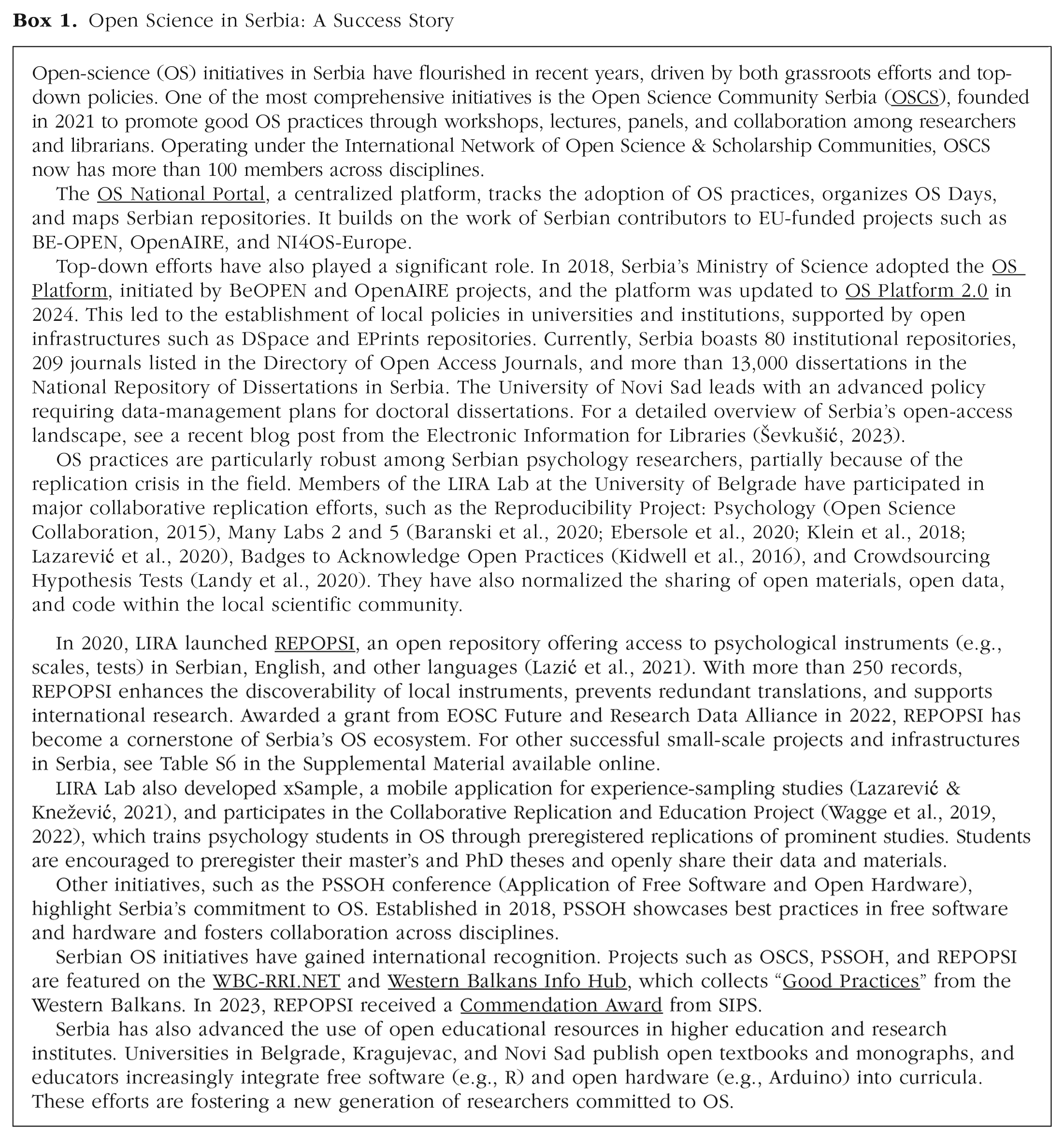
Open science further fosters collaboration on an unprecedented scale. Initiatives such as the big-team science paradigm bring together researchers from diverse disciplines, cultures, and continents to tackle shared research questions (e.g., Forscher et al., 2023). This mode allows researchers in developing countries to contribute to global projects through data collection, translations, and analysis, expanding their roles in international collaborations. Many researchers in developing countries have also launched initiatives, such as the Open Science Community Serbia (see Box 1), the Brazilian Reproducibility Network (see Box 2), and Advancing Big-Team Reproducible Science Through Increased Representation (see Box 3), that emphasize collaboration, education, and training in non-English-speaking developing countries/regions. Organizations such as the Society for the Improvement of Psychological Science (SIPS; SIPS, 2025) and FORRT (e.g., FORRT, 2025d) promote inclusivity through inclusion, diversity, equity, and access committees, whereas other initiatives, such as Peer Community In (https://peercommunityin.org/), PREReview (https://prereview.org/), and Reviewer Zero (https://www.reviewerzero.net/), aim to establish equitable peer-review systems (Atherton et al., 2024).
Open Science in Serbia: A Success Story
Brazilian Reproducibility Network

Advancing Big-Team Reproducible Science Through Increased Representation (ABRIR)

The open-science movement has also led to the emergence of new research topics, which are increasingly recognized as vital components of scientific inquiry. Examples include studies on the impact of gender (e.g., Hartmann et al., 2023), race (e.g., Ricard et al., 2023), geographical location (e.g., Thériault & Forscher, 2024), neurodiversity (e.g., Zaneva et al., 2024), and the intersectionality of these factors (e.g., Ledgerwood et al., 2022) in scientific-research methodologies. 5 These topics highlight the role of open science in promoting diverse perspectives and inclusivity within the global research landscape.
Under the influence of the UNESCO Recommendations on Open Science and policies in Europe (European Commission, 2024; UNESCO, 2023), open science is driving policy shifts in both international organizations and developing countries (see Table S1 in the Supplemental Material available online). These policies are fostering the adoption of open-science practices and the development of new infrastructures, promising greater inclusivity, accessibility, and diversity in research. With continued momentum, open science empowers researchers in developing countries with the tools, knowledge, and opportunities to actively shape the global scientific community.
Barriers
Researchers in developing countries have to navigate a complex web of barriers compounded by intersectionality (Cole, 2009; Ledgerwood et al., 2022). Economic, societal, cultural, institutional, and geographical disadvantages interact and amplify the obstacles to engaging in open science. For example, limited funding and unstable infrastructure are exacerbated for scholars in remote regions, who are further marginalized by restricted access to global networks. Likewise, language barriers intersect with cultural biases in the scientific community, which is dominated by Western culture (vs. non-Western; for country classification based on values, see Awad et al., 2018), sidelining researchers from non-Western culture and their contributions (e.g., Lin & Li, 2023). These compounded challenges demand recognition of the significant efforts researchers in developing countries must undertake to participate in open science.
To better understand these challenges, we categorize barriers into macro levels or micro levels. Macro-level barriers affect science in general (i.e., “barriers to science”), whereas micro-level barriers directly hinder engagement in open-science practices (i.e., “barriers to open science”); see Figure 1. 6 These categories are interrelated because macro-level barriers often shape and intensify micro-level obstacles, and some micro-level obstacles may also reinforce macro-level barriers.

A schematic representation of the nested and interconnected structure of barriers for engaging in open science in developing countries. The top layer describes the three aspects of engaging in open science: accessibility to open resources, accessible resources to be able to contribute to open science, and opportunities to exercise leadership and to be a leader. The middle layer includes micro-level barriers that directly and specifically slow down engagement in open science. The bottom layer includes macro-level barriers that constrain science in general. The dashed line means the indirect constraints, and the solid line means direct constraints; different colors are used for the lines to enhance visibility.
Macro-level barriers include insufficient economic investment, poor infrastructure, language barriers, geographical isolation, and societal and cultural factors. The scarcity of essential resources—such as stable electricity, reliable Internet, and financial support—remains a significant challenge in developing countries (Straub, 2008). Language is another critical barrier because most open-science resources are in English, creating obstacles for researchers who are not proficient in the language (Amano et al., 2023). Cultural influences, including metric-based research-evaluation systems and intellectual-property laws, further complicate engagement with open science (Nuechterlein et al., 2023; Shi & Rao, 2010). These structural barriers often intersect, and researchers in developing or geographically isolated regions experience compounded disadvantages that limit their participation in global scientific networks.
Micro-level barriers directly affect researchers’ ability to access resources, contribute to open science, or take on leadership roles. These include limited institutional support, poor working conditions, time constraints, inadequate training (especially statistical trainings), and lack of incentives, visibility, and sustainability. For example, time constraints—stemming from longer working hours and additional administrative responsibilities (e.g., Lee et al., 2016)—limit the extra efforts to engage with open-science practices, such as organizing data or contributing to collaborative projects. Inadequate training further restricts participation and hampers the development of local open-science communities.
These barriers often intersect and reinforce one another. A lack of incentives and visibility discourages researchers from contributing to open science, weakening the development of local communities, which, in turn, perpetuates limited participation. Gender, race, and disability add additional layers of complexity because these dimensions further influence how barriers are experienced. Compounding these widely discussed barriers is the scarcity of empirical data on the extent to which they hinder engagement in open science (Ch’ng et al., 2024). Addressing these gaps is critical for creating targeted strategies to reduce barriers and enhance participation from researchers in developing countries.
Policy recommendations: beyond grassroots initiatives
To move from localized grassroots efforts to systemic change, policy interventions must be reimagined to incorporate the unique social, economic, and cultural contexts of developing countries. Policy frameworks must move beyond rhetorical commitments to inclusivity and actively dismantle barriers that hinder meaningful participation from researchers in developing countries (European Commission, 2024; UNESCO, 2023). In addition, institutional and national policies should not merely adopt open-science paradigms from developed countries; they must also be tailored to address local resource constraints, infrastructural challenges, and diverse sociocultural factors (Jeftic et al., 2024). Although global organizations, such as UNESCO and the European Commission, emphasize open science, accounting for regional inequities in research funding, infrastructure, and academic incentives has been lacking (Corral-Frias et al., 2023). Without explicit commitments to addressing the structural disadvantages that researchers from developing countries face, open science risks becoming yet another framework that benefits the already privileged (see Korbmacher et al., 2023). This involves establishing dedicated funding streams and policy frameworks that support sustainable open-science infrastructures, incentivize context-sensitive research practices, provide institutional incentives (e.g., integrating open-science engagement into promotion criteria), actively integrate local knowledge systems, and redistribute global research resources to counteract epistemic asymmetries. Governments, funding agencies, and policy frameworks—in both developed and developing countries—must (a) require international research collaborations to involve local scholars in leadership roles rather than as passive data collectors, fostering equitable partnerships, and (b) prioritize the creation of regulatory environments that empower local research communities, ensuring that open science becomes a tool for both academic excellence and societal transformation.
Practical Guides for Implementing Open Science
Although open science spans all scientific disciplines, in this guide, we focus on practices most relevant to psychological-science research, particularly in developing countries. Rather than organizing by general topics or countries, we structured the guide around the path from individual actions to efforts that are more community-oriented (see Fig. 2). Usually, one could begin with affordable individual practices to build a solid foundation for transparent and rigorous research. Then, one could engage with open-science communities and facilitate its adoption in developing countries or even assume leadership roles and initiate local communities. As we describe below, each type of open-science practice itself is a spectrum, ranging from accessible actions to more resource-intensive ones. Note that one does not have to wait to engage with the community or initiate a community only after becoming an expert in open-science practices. Instead, adopting open-science practices that suit one’s personality, resources, and settings is the best approach. Early career researchers can start initiatives and learn along the way (e.g., Jin et al., 2023).

Practical guide for engaging in and contributing to open science as researchers from developing countries. Researchers start with using open resources and building a solid foundation, gradually grow and adopt recommended practices according to their own pace and context, contribute to the community in various ways, and finally, become leaders in the open-science movement.

The hidden costs of “best open-science practices” for researchers in developing countries. FORRT = the Framework for Open and Reproducible Research Training; COSN = the Chinese Open Science Network; APC = article-processing cost; OA = open access.
Level 1: foundation—using open resources for essential research needs
The global “publish-or-perish” culture in academia (Barrett, 2019; van Dalen & Henkens, 2012) requires consistent publication in academic journals to sustain an academic career, especially for researchers in developing countries (Lim et al., 2025). Researchers in developing countries often face significant resource constraints, such as limited funding for journal subscriptions, purchasing equipment, or data collection. These constraints exacerbate the challenge when researchers aim to publish in top-tier journals, which enforce high standards for data quantity and quality (Thériault & Forscher, 2024; for global disparities in journal representation, see Thériault & Forscher, n.d.). As the open-science movement makes more resources publicly available, researchers in developing countries are offered opportunities to enhance research quality and productivity at reduced costs. In many cases, using open resources adds benefits without increasing workload.
Leveraging openly accessible scholarly articles is an essential strategy for conducting literature reviews, especially for researchers in developing countries, who often face barriers accessing articles behind paywalls (Boudry et al., 2019; Himmelstein et al., 2018). Fortunately, the availability of open-access (OA) articles has grown through various means, including shadow libraries and dedicated websites (Bodó et al., 2020; Bohannon, 2016), and about 42% of all indexed scholarly articles from 2012 to 2021 are now openly available (UNESCO, 2023). In addition, preprints and self-archiving have become widely accepted among researchers and journals, making a substantial number of articles accessible on preprint/postprint platforms, such as arXiv, PsyArXiv bioRxiv, and SSRN. OA platforms for scholarly articles or preprints in languages other than English are also well established and continue to grow (e.g., Moutinho, 2024; for OA repositories in developing countries, see Supplementary S1.1 in the Supplemental Material). Beyond OA articles, there are other ways to access scholarly articles without paying, for example, contacting the corresponding authors for the full text. For more tips on accessing articles without incurring unfair fees, see Lazić (2021).
Using open data, code, and digitized materials can significantly enhance research efficiency and reduce costs. 7 Over the past decade, supported by open-science platforms and updated publishing guidelines such as the Transparency and Openness Promotion Guidelines (Kianersi et al., 2023; Nosek et al., 2015), the availability of such resources has grown substantially (Nosek et al., 2022). Platforms such as OSF (osf.io), Zenodo (zenodo.org), Figshare (figshare.com), and OpenNeuro (openneuro.org) now host vast collections of data, code, and materials. In addition, large-scale data sets funded by governments, such as large social surveys (e.g., the Chinese Family Panel Study, Xie & Hu, 2014; National Health Survey in Brazil, Szwarcwald et al., 2014) and brain-imaging data sets (e.g., the Human Connectome Project, Barch et al., 2013; the Chinese Human Connectome Project, Ge et al., 2023; for an overview, see Horien et al., 2021; Laird, 2021; Lu et al., 2024), are now available. Likewise, other data sets for social science are readily accessible (e.g., data generated from big-team science; for a compilation, see W. Liu et al., 2024). Repositories such as GitHub and OSF also provide extensive code and materials that can be reused for learning or teaching new methods and preparing original research. Researchers in developing countries in particular can leverage these resources to reduce costs and improve efficiency. For instance, open neuroimaging data sets have saved an estimated $893 million to $1.7 billion in acquisition costs (Milham et al., 2018). Small data sets are also valuable: Duan et al. (2024), for example, combined open data sets in English, French, and Japanese with new data collected in China to assess cross-language invariance of the Free Will and Determinism Scale, significantly reducing expenses. For additional tips for navigating open data and resources, see Supplementary S1.2 in the Supplemental Material.
Adopting free and open-source software and open-science hardware can significantly lower research costs, often reducing expenses by 90% to 99% compared with traditional scientific instruments (Pearce, 2017). Free and open-source software are widely used in psychological research, including (a) software with graphical user interfaces (GUIs), such as Jamovi and JASP for data analysis and OpenSeSame (Mathôt et al., 2012; Mathôt & March, 2022) for presenting stimuli and collecting data, and image-processing software, such as the GNU Image Manipulation Program (an alternative to Adobe Photoshop) and Inkscape (an alternative to Adobe Illustrator) for stimuli preparation; (b) general programming languages, such as R (R Core Team, 2024), Python (Van Rossum & Drake, 2011), Julia (julialang.org), Octave (alternative for Matlab), and jsPsych and PsychoPy specifically for data collection; and (c) integrated development environments, such as RStudio and Visual Studio Code. Likewise, open-science hardware is increasingly available for psychological-research applications (for definitions, see Table 1). For example, OpenBCI boards, which are based on Arduino (www.arduino.cc/), can be used to measure electrophysiological signals, such as electroencephalography signals, for experiments and beyond (www.opensourceimaging.org/project/openbci/). Another important resource is open computational power, which is necessary for complex calculations. For example, Brainlife.io created a decentralized platform for computing in neuroimaging data analyses (Hayashi et al., 2024). For a list of FOSS, hardware, and computational-power resources, see Supplementary S1.3 in the Supplemental Material.
Open educational resources play a crucial role in helping researchers navigate the rapidly evolving methods in psychological science (Epskamp, 2019; Pownall et al., 2023, 2024). Because many of the recommended methods and practices in the open-science movement go beyond the standard curriculum of undergraduate and graduate courses, these freely accessible materials fill an important gap (for an overview, see FORRT’s educational nexus, https://forrt.org/nexus). These online resources, covering a wide range of topics, allow for learning, teaching, mentoring, and engaging in open science and metascientific research. Although a significant portion addresses research methods, such as linear mixed-effects models (Brown, 2021), there are also materials on registered reports (RRs; e.g., Kirtley et al., 2021), data management (e.g., Kovacs et al., 2021), structuring articles (e.g., Mensh & Kording, 2017), using artificial-intelligence tools (e.g., Lin, 2024), and other aspects of research (e.g., Hartmann et al., 2025). If researchers overcome the English-language barrier, these resources allow them to learn new methods (especially statistics) and adopt new practices at minimal cost. For a comprehensive list of open learning materials, see Supplementary S1.4 in the Supplemental Material.
Level 2: growth—implementing open-science practices for better research
As researchers engage with open resources, they naturally develop a deeper understanding of open-science practices and their benefits, such as enhanced scientific rigor, increased citations and media visibility, expanded collaboration opportunities, and improved job prospects (see McKiernan et al., 2016, Fig. 2). This growing awareness increases the likelihood of adopting open-science practices. However, these practices must be adapted to address the unique challenges faced by researchers in developing countries (Onie, 2020). Note that all these practices should be viewed as a spectrum rather than binary, ranging from simple, low-cost actions to more complex, resource-intensive ones. For instance, a simple, low-cost action to make one’s article OA is posting it on a preprint platform; a more resource-intensive one would be publishing one’s article in an OA journal with high costs (see the last paragraph in this section). We recommend adopting open-science practices at one’s own pace and tailoring them to one’s specific context. Below, we offer specific tips aligned with the key steps of the ideal hypothetico-deductive model of the scientific method (Munafò et al., 2017).
Learn, practice, and implement preregistration and RRs. As key practices of open science in psychology, preregistration and RRs offer significant benefits but are often misunderstood (Chambers & Tzavella, 2022) and challenging to implement (Allen & Mehler, 2019; Kathawalla et al., 2021). For researchers in developing countries, the first step is to address these misunderstandings by learning about preregistration and RRs and introducing them in local languages through articles, blogs (e.g., Zhao et al., 2024 in Chinese; Smederevac et al., 2020 in Serbian), or collaborative learning activities, such as journal clubs (e.g., ReproducibiliTEA or the OpenMinds by COSN). Preregistration can then be practiced with straightforward studies, such as a direct replication. Using templates (https://osf.io/zab38/wiki/home/) or referring to published RRs is helpful as well. The PCI-RR platform, for example, hosts numerous Stage 1 RRs accepted in principle (https://rr.peercommunityin.org/). Another practical approach is registering an analysis of existing data or participating in big-team science projects that often employ RRs. With deeper understanding and initial experience, researchers can progress to implementing self-preregistration or RRs for new, more ambitious studies. For additional tips on preregistering direct replications, see Supplementary S2.0 and S2.1 in the Supplemental Material.
Collect data from a representative sample of the targeted population. Currently, most psychological studies rely on convenience sampling, typically recruiting participants from nearby areas or via the internet (e.g., Ghai et al., 2024). Engaging hard-to-reach populations poses a spectrum of challenges beyond logistical hurdles, including barriers related to geographical remoteness, socioeconomic status, culture, language, and literacy. These challenges are faced by researchers in both developed and developing countries (e.g., Akhter-Khan et al., 2024; Emery et al., 2023). To effectively engage hard-to-reach populations, researchers must identify potential barriers and plan their studies carefully. This includes adapting and diversifying response methods, designing ethically sound approaches, fostering respectful communication, and building trust by acknowledging participants’ environmental, cultural, and personal contexts. Successful strategies require careful attention and tailored solutions (for examples, see Supplementary S2.2 in the Supplemental Material). Researchers in developing countries hold a unique advantage in this area because their deeper understanding of local contexts enables them to develop culturally sensitive and effective approaches to engage diverse populations. These advantages should be shared: By collecting data from hard-to-reach populations or establishing equitable, collaborative partnerships between developing and developed countries, the scientific community as a whole will benefit from the diversity of samples.
Manage data, code, digitized materials, and the computational environment with care. Good data management not only reduces errors in research (Kovacs et al., 2021) but also improves reproducibility and efficiency. At the project level, systematically organize folders using templates, such as the TIER protocol (www.projecttier.org/tier-protocol/protocol-4-0/), and include README files whenever possible. At the data level, use a codebook or manual to describe variables (e.g., Arslan, 2019; Buchanan et al., 2021; Hu et al., 2019) or adopt standardized formats, such as Brain Imaging Data Structure for brain-imaging data (Poldrack et al., 2024). For data analysis, document all scripts, computational environments, and software versions. When using GUI-based software (e.g., JASP, Jamovi), report the version used. For script-based tools, such as R or Python, list packages or modules and their versions and the operating system used for analysis. Tools such as Docker images or custom R packages are highly recommended for full reproducibility (Moreau et al., 2023; Wiebels & Moreau, 2021). To further enhance reproducibility, integrate data analysis and manuscript preparation into a single workflow using tools such as papaja (Aust & Barth, 2023). Similar to other open-science practices, we recommend focusing on gradual progress and future research projects when managing one’s data, code, materials, and environment rather than aiming for immediate perfection (for additional recommendations, see Supplementary S2.3 in the Supplemental Material).
Make scholarly articles accessible to all to expand readership and increase the impact of research. Publishing in an OA model is a key strategy for achieving this goal. OA comes in various models—diamond, green only, golden, hybrid, and bronze—depending on the journal’s policies, hosting publisher, and repository (UNESCO, 2023). For researchers with limited funding, diamond OA (no fees of publishing or accessing content) and green OA (publishing in a traditional journal and sharing the article on open repositories, such as PsyArXiv or Zenodo) are particularly viable options. Some journals also waive or discount the article-processing charge (APC) for researchers with financial challenges, although some journals have limits for how many times someone can apply for these waivers. For example, Collabra: Psychology has an easy process applying for up to two waivers per corresponding author a year. In addition, the Directory of Open Access Journals provides a list of APC-free journals (www.doaj.org); the open policy finder (openpolicyfinder.jisc.ac.uk) can help authors and institutions search, understand, and comply with OA policies from a wide range of publishers. For platforms of preprints, see Supplementary S1.1 in the Supplemental Material.
Level 3: community—contributing to a better community
Adopting open-science practices naturally enhances one’s understanding of the movement and highlights the critical role of grassroots communities (Skubera et al., 2024). Although contributing to these communities may initially seem daunting, there are various accessible ways to get involved. These include conducting metaresearch, assessing the reproducibility and generalizability of published research, contributing to FOSS projects, developing small-scale infrastructure, and participating in local open-science initiatives. Again, viewing these contributions as a spectrum, we recommend starting with simple and low-cost actions to build confidence and gradually increase engagement.
Assess the reproducibility of quantitative or qualitative studies. Reproducibility can be evaluated at multiple levels, from computational or analytical reproducibility to replicability (Goodman et al., 2016; Nichols et al., 2017; Nosek & Errington, 2020). “Computational reproducibility” refers to the ability to duplicate the results of a prior study using the same materials/data as were used by the original investigator; “replicability” refers to the ability of a researcher to duplicate the results of a prior study if the same procedures are followed but new data are collected (Goodman et al., 2016). Even with limited resources, researchers in developing countries can assess reproducibility within their fields. A cost-effective approach is to reproduce data analyses and verify results (i.e., computational or analytical reproducibility), which is critical given the low computational-reproducibility rate in this area (e.g., Crüwell et al., 2023; Hardwicke et al., 2021). Note that although identifying errors in published results is increasingly recognized and rewarded (e.g., error.reviews), one should exercise this practice with extreme respect, care, and caution. This is because it might be harmful or even detrimental to the careers of the error detectors, especially when the original authors hold significant influence, or to the original authors, particularly when they are early career researchers (e.g., Gross, 2016; Oransky & Marcus, 2017). For researchers capable of collecting data, conducting direct-replication studies or joining a crowd-sourced replication project (e.g., projects from Psychological Science Accelerator) offers additional value. These studies allow researchers to learn open-science practices, assess the generalizability of findings in their contexts, and contribute unique data sets. The open materials, scripts, and data generated through such replication efforts can also serve as valuable resources for other researchers in similar settings (e.g., Oshiro et al., 2024). Similar to the reproducibility of quantitative studies, qualitative research’s reproducibility can also be studied and improved (cf. Aguinis & Solarino, 2019; Makel et al., 2022). For tips on conducting direct replications, see Supplementary S2.1 in the Supplemental Material.
Conduct metaresearch to assess the rigor of published studies and beyond. Metaresearch, also known as “metascience” or “the science of science,” examines research practices to identify and address issues in the research process, promoting robust scientific norms (Ioannidis, 2018; Peterson & Panofsky, 2023). Its scope spans methods, reporting, reproducibility, evaluation, incentives, and public engagement (cf. Ioannidis, 2018). High-quality metaresearch can serve one key purpose: improving the norm of the scientific standards. It also helps researchers develop critical-evaluation skills, deepen their understanding of research practices, and design more rigorous studies (Fabiano et al., 2024). For researchers in developing countries, metaresearch offers additional benefits: It enables the assessment of local research practices and findings (e.g., Y. Liu et al., 2021) and provides unique perspectives from developing countries that may bring changes in the field (e.g., Z. Chen et al., 2023). To maximize its benefits, metaresearch projects should align with available expertise and follow best practices, such as preregistration and sharing data and code (Moreau & Gamble, 2022). For further guidance for conducting metaresearch in developing countries, see Supplementary S3.0 in the Supplemental Material.
Engage in the development of free and open-source software. Free and open-source software has added immense value to the global research community, and contributing to its development is more accessible than it may seem. Contributions span a wide spectrum, from simple tasks to more complex projects requiring expertise. One of the easiest ways to contribute is by improving documentation. For example, the NeuroKit development team explicitly invites contributors to enhance its documentation (https://github.com/neuropsychology/NeuroKit; Makowski et al., 2021). More advanced contributions include adding new functions or features to existing software, such as improving reproducibility through containerization techniques (see Table 1; Moreau et al., 2023; Wiebels & Moreau, 2021). An example is dockerHDDM (Pan et al., 2025), which streamlined installation and added features to the original HDDM Python module for Bayesian hierarchical-drift-diffusion models (Wiecki et al., 2013). The next level of contribution involves developing new packages (or modules). For example, researchers from developing countries now account for 17% of contributors in the Comprehensive R Archive Network community, having developed 3,073 R packages (15% of all packages) by 2024. Alternatively, researchers can develop standalone software, mobile apps, or ShinyApps based on R. A notable example is xSample, an open-source experience-sampling app for Android and iOS that Lazarević and Knežević (2021) developed using free programming languages, such as Java (Oracle Co., Austin, Texas, USA) and Swift (Apple Inc., Cupertino, California, USA). It enables researchers to conduct experience-sampling surveys and collect data without requiring extensive programming skills (see Box 1). Another example is the FORRT Academic Wheel of Privilege (also known as “AWoP”), which is designed to support equity-based authorship decisions in team scholarship (available at https://forrt.shinyapps.io/awop/). For similar examples from developing countries, see Lin et al. (2022, 2023). In short, contributing to FOSS development is a feasible and impactful way for researchers in developing countries to engage with both local and global communities. For additional tips, see Supplementary S3.1 in the Supplemental Material.
Create small-scale open-science infrastructures. Open-science infrastructures are essential for supporting open science, encompassing both physical resources, such as laboratory equipment, and digital tools, such as OA repositories (UNESCO, 2021). Although general infrastructures, such as OSF, Figshare, and GitHub, are widely available, specialized research needs in developing countries often remain unmet. One example is the need for local data-collection platforms. In developed countries, platforms such as MTurk, Prolific, and Gorilla are widely used, but they face constraints in some developing countries, such as Brazil and China. Building a local data-collection platform can be challenging because of high costs associated with hardware (e.g., high-performance servers), software (e.g., scalable systems for large user bases), personnel (e.g., programmers and customer-support teams), and ongoing updates for data security and quality control. In addition, such public research platforms are expected to be nonprofit, which increases the challenges of securing funds. To address these challenges, Chinese researchers developed the NaoDao platform (www.naodao.com). Inspired by platforms such as MTurk and Prolific, NaoDao provides a user-friendly tool for psychological research while integrating features that promote open science, such as data and code sharing through OSF or GitHub. Since its launch, NaoDao has supported more than 8,000 researchers and facilitated the sharing of more than 250 open-data and -code sets (G. Chen et al., 2023). Similar initiatives, such as REPOPSI in Serbia, demonstrate how small-scale infrastructures can meet local research needs while advancing open science (see Box 1).
Engage in grassroots open-science communities—whether as a volunteer, event organizer, or attendee. Open-science communities rely on diverse roles, such as publicizing events on social media, maintaining websites, and organizing activities. All such tasks are essential for building and maintaining vibrant local networks. For example, volunteers were instrumental in the growth of the COSN. Early career researchers initially supported the network by editing blog posts to boost visibility, and later, a volunteer team standardized workflows, improving efficiency for future members (see Xu et al., 2024). National reproducibility networks and open-science communities have also been formed mostly on a grassroots basis around the world, spanning regions such as Latin America, Africa, and the Middle East (www.ukrn.org/global-networks; Box 2; Box S1 in the Supplemental Material). SIPS holds virtual conferences every year, which are free to attendees who live or work in developing countries. Likewise, Serbia’s REPOPSI project began as an unfunded initiative, relying on volunteer efforts for documenting and depositing instruments. Activities such as social media outreach and conference presentations eventually helped the project secure funding (see Box 1; https://osf.io/5zb8p/wiki/home/; Lazić, 2025). We encourage researchers, especially early career researchers, to engage in these grassroots initiatives. Such involvement not only supports the open-science movement but also offers opportunities for deeper engagement and future leadership roles.
Level 4: leadership—leading the open-science movement
Leading the open-science movement offers researchers in developing countries a chance to reshape research culture from the inside out. Although more demanding in terms of time, resources, and institutional navigation, such leadership can have transformative and lasting impact (Nosek et al., 2022). Several strategies can lead to leadership roles. One approach is joining the leadership of established open-science organizations or networks. Alternatively, researchers can initiate grassroots networks to address the needs of specific populations not yet supported by existing efforts. Mid-career and senior researchers can also drive change through top-down initiatives, such as integrating open-science principles into education, training, hiring, or grant evaluations (for a reference, see FORRT, 2025d; FORRT’s aim is to align social justice and representation with open scholarship, rigor, and reproducible research). Leadership can take many forms, and starting with feasible, incremental actions can make the process more manageable.
Join the leadership of existing open-science networks or organizations. Grassroots networks promoting open science have grown rapidly in recent years and often seek leaders to organize events, provide training, and manage initiatives. For early career researchers, regularly attending events and contributing time can naturally progress to leadership opportunities within these networks. For example, SIPS and FORRT offer leadership opportunities through their efforts in integrating (early career) scholars—especially from developing countries—into their executive committees and working groups. Likewise, the Organization for Human Brain Mapping Open Science Special Interest Group actively recruits volunteers and committee members annually (e.g., for 2025, see The OHBM Open Science Special Interest Group, n.d.). Researchers from developing countries are encouraged to volunteer for these committees and pursue leadership roles. Many grassroots networks welcome early career researchers, providing opportunities to support open science while gaining leadership experience. For a list of networks supporting researchers from developing countries, see Table S10 in the Supplemental Material; for tips on exercising leadership in these organizations, see Supplementary S4.0 in the Supplemental Material.
Start a local grassroots initiative if no active open-science communities or international networks are available. In many developing countries, such networks are still lacking, yet they are crucial for overcoming the delivery bottleneck in bringing open science to the intended communities. Although resources such as previous articles (e.g., Jin et al., 2023; Kent et al., 2022; Xu et al., 2024) and the International Open Science Community’s (2021) starter kit offer helpful tips, a practical guide tailored to developing countries has been missing. To address this, we provide a comprehensive guide with 10 actionable steps for initiating a grassroots network based on our own experience (Table 2; for details, see Supplementary S4.1 in the Supplemental Material). Two critical considerations when initiating a local initiative are the following: Are the events aligned with the principles of open science, and are the events valuable to the attendees? These guiding questions help ensure that the network promotes open science, remaining relevant and engaging for its members.
Ten Simple Steps for Starting a Local Open-Science Community

Foster the change of policies and shift the culture. Mid-career and senior researchers in developing countries, often in decision-making or policy-setting roles, have a unique opportunity to integrate open-science practices into policies and influence research culture (cf. Kowalczyk et al., 2022). Their efforts can extend to teaching, supervision, peer review, grant review, journal editing, hiring, and institutional policies, depending on the local context and dynamics. By incorporating open science in these areas, middle-career and senior researchers in developing countries can drive significant changes. First, embedding open science in education fosters a culture of openness among the next generation of researchers. For example, Pownall et al. (2023) found that integrating open and reproducible practices into higher education enhances student engagement, scientific literacy, and positive attitudes toward open science. Supervisors can reinforce these principles by training graduate students and postdocs in practices such as contributorship (Holcombe, 2019) and encouraging publications in RRs or diamond/green OA journals with transparent peer review (Ross-Hellauer, 2017). Second, advocating for open science in peer review, journal editing, and grant evaluations can drive cultural change (Morey et al., 2016). Senior researchers can push for journal-policy reforms (e.g., Hardwicke & Vazire, 2024) and show public support for grassroots initiatives by attending or speaking at their events, thus inspiring early career researchers and supporting local open-science communities. Third, incorporating open-science principles into hiring policies and evaluation criteria can further embed these practices within institutions (Kowalczyk et al., 2022). In addition, creating funding opportunities for open-science initiatives and revising incentive structures can ensure the sustainability of local efforts (Louderback et al., 2021; Smaldino et al., 2019).
Cautions and Next Steps
In the previous sections, we discussed the barriers and opportunities in the open-science movement and provided practical guidance for implementing open science at both personal and community levels. The guides available in the Supplemental Material offer detailed instructions tailored to diverse research contexts, particularly for early career researchers starting their open-science journey. Before concluding, we highlight important caveats to help researchers navigate potential pitfalls and propose concrete actions for the next steps.
Cautions
Current open-science standards and practices may not always suit the local contexts in developing countries because they are largely shaped by researchers from developed countries (Adetula et al., 2022; Onie, 2020). Imposing these practices without considering local circumstances could negatively affect the careers of researchers in developing countries (Ghai et al., 2025). Because the challenges of implementing open science in developing countries can vary and not all of them have been fully explored, our suggestions here provide a nonexhaustive list of potential pitfalls to consider.
The first pitfall is the hidden costs associated with implementing open-science practices, such as time, labor, and financial investment (Ghai et al., 2025). As previously mentioned, open-science practices exist along a spectrum, and blindly pursuing what is considered “best practice” can be resource-intensive, even for researchers in developed countries (Hostler, 2023). For example, adopting RRs may significantly extend the timeline of a project because full analysis pipelines, piloting, manuscript preparation, and peer review must occur before data collection (Allen & Mehler, 2019; Spitzer & Mueller, 2023). This extended process could be detrimental for graduate students with limited time to complete their degrees, potentially delaying their graduation or career progress. Another example is sample-size justification: Although sample sizes can be justified using various methods (e.g., sequential analyses), in some cases, planning sample size based on traditional power analysis may require large sample sizes, which takes more time and can drain the funding of researchers. However, a more balanced approach, such as using Bayes’s factor experimental designs or equivalence tests (Lakens, 2022), is often overlooked. Moreover, preparing data, materials, and scripts for sharing often requires “extra” time, and insufficient time has been reported as one of the common barriers for data sharing (Borgman & Bourne, 2022; Houtkoop et al., 2018; Tenopir et al., 2011). A more practical approach is to start implementing these principles in future studies. In addition, we note that journal policies on open-science practices are inconsistent, which means that researchers’ efforts to conduct rigorous open science may not receive the recognition they deserve. Finally, open-science practices recommended in previous sections often require work that is not (yet) paid or credited, although it is valuable to the scientific community. For researchers, especially early career ones, aligning these activities with one’s career-development goals is important. In short, we recommend researchers carefully evaluate their available resources and adopt practices that align with their capacity and career goals while enhancing research openness and quality.
The increased collaborative opportunities brought by the open-science movement also present potential pitfalls because of unequal collaborative relationships (Rakotonarivo & Andriamihaja, 2023). Several issues can arise. First, researchers from developed countries often dominate decision-making regarding the research questions and study design, leaving the local data-collection team with minimal input (Adetula et al., 2022; Forscher et al., 2023; Minasny & Fiantis, 2018). As a result, the measurement instruments may be poorly suited to the local context, requiring substantial effort to reinterpret findings (Yang et al., 2023). Second, researchers in developing countries typically have limited resources for data collection (see Kijilian et al., 2022, Section 1.2). Collaborative projects can divert these scarce resources away from local research priorities. Without adequate financial compensation, such collaborations can further strain already limited resources. Third, data ownership and ethical practices in international collaborations are often ambiguous. The CARE Principles (collective benefit, authority to control, responsibility, and ethics; Carroll et al., 2020; see Table 1), which emphasize ethical and equitable data use, is underused in psychology. Local teams frequently lose control of the data they collect because the data are often managed by the leadership of big-team science projects. In extreme cases, exploitative practices, such as “helicopter research” or “ethical dumping,” occur, in which researchers from developed countries exploit weaker ethical and regulatory frameworks in developing countries (Adame, 2021; Haelewaters et al., 2021). Even in more inclusive big-team science projects, researchers from developing countries are often relegated to data-collection and logistical roles and have less chance to engage in the idea-generation or study-design phases or being the first authors (Buchanan & Lewis, 2023; Forscher et al., 2023).
Another significant issue is the duplication and sustainability of small open-science initiatives. Limited visibility increases the risk of reinventing the wheel because researchers in different regions may independently create similar initiatives. For example, small-scale infrastructures developed by one laboratory may go unnoticed by others, even within the same university, resulting in redundant efforts and inefficient use of resources. Sustainability presents an even greater challenge. Many initiatives struggle to secure funding for long-term growth because open science is often undervalued in developing regions compared with developed countries. This not only jeopardizes existing projects but also discourages the development of new ones. To mitigate these challenges, we encourage researchers from developing countries to proactively connect, increase the visibility of their projects, and collaborate to build more impactful and sustainable initiatives.
Next steps
The open-science movement has transformed psychological science in developed countries, but it is still lagging in developing countries. Researchers in these regions can learn from both the successes and shortcomings of the movement to adapt open-science practices to their local contexts. In this article, we aim to provide actionable guidance for driving this change. The past decade of the open-science movement has shown that even small individual actions can make a difference (e.g., the Psychological Science Accelerator was started from a post on social media by Christopher Chartier, and FORRT arose from an unconference at SIPS; see also Azevedo et al., 2019; Korbmacher et al., 2023). By engaging in open science, researchers contribute to and become the change they want to see.
For individual researchers, a good starting point is to leverage open resources to conduct research more efficiently and at lower costs while adopting practices that enhance rigor and transparency. Researchers can also enrich open resources, participate in local and global communities, and lead efforts to implement changes tailored to their contexts. Collectively, these actions will help foster a cultural shift toward open science.
For grassroots-network leaders, building connections is essential for sustainability. The first step is creating a comprehensive directory of existing grassroots networks in developing countries and establishing mechanisms for collaboration, such as a shared GitHub repository. It is critical to identify common research priorities (e.g., surveying the public; Cologna et al., 2025) and barriers (e.g., surveying researchers; Iyer et al., 2022) and codevelop feasible solutions. In addition, connecting with other interested parties—government agencies, publishers, librarians, and software developers—can amplify efforts and drive systemic change. Together, researchers and networks can create a more inclusive and sustainable open-science movement, ensuring its benefits extend to all corners of the scientific community.
Supplemental Material
sj-docx-1-amp-10.1177_25152459251357565 – Supplemental material for Open Science in the Developing World: A Collection of Practical Guides for Researchers in Developing Countries
Supplemental material, sj-docx-1-amp-10.1177_25152459251357565 for Open Science in the Developing World: A Collection of Practical Guides for Researchers in Developing Countries by Hu Chuan-Peng, Zhiqi Xu, Aleksandra Lazić, Piyali Bhattacharya, Leonardo Seda, Samiul Hossain, Alma Jeftić, Asil Ali Özdoğru, Olavo B. Amaral, Nadica Miljković, Zlatomira G. Ilchovska, Ljiljana B. Lazarevic, Han Wu Shuang Bao, Nikita Ghodke, David Moreau, Mahmoud Elsherif, Chinchu C., Sakshi Ghai, Clarissa F. D. Carneiro, Danka Purić, Yin Wang, Mirela Zaneva, Felipe Vilanova, Iris Žeželj, Obrad Vučkovac, Saida Heshmati, Pooja Kulkarni, Nadia Saraí Corral-Frías, Juan Diego García-Castro, Shubham Pandey, Jamal Amani Rad, Thipparapu Rajesh, Bita Vahdani, Saad Almajed, Amna Ben Amara, Leher Singh, Ali H. Al-Hoorie, Marcelo Camargo Batistuzzo, Daniel Fatori, Frankie T. K. Fong, Zahra Khorami, Joseph Almazan, Biljana Gjoneska, Meng Liu and Flavio Azevedo in Advances in Methods and Practices in Psychological Science
Footnotes
Acknowledgements
We thank Christopher Graham, Crystal Steltenpohl, and reviewers for their valuable comments and suggestions to the earlier version of this work. We also thank the following early career researchers for their suggestions on the readability of this work: Yi-Ling Zhang, Jiawei Zhao, and Ziyang Zhao.
Transparency
Action Editor: David A. Sbarra
Editor: David A. Sbarra
Author Contributions
H. Chuan-Peng and Z. Xu share first authorship.
ORCID iDs

Notes
References
Supplementary Material
Please find the following supplemental material available below.
For Open Access articles published under a Creative Commons License, all supplemental material carries the same license as the article it is associated with.
For non-Open Access articles published, all supplemental material carries a non-exclusive license, and permission requests for re-use of supplemental material or any part of supplemental material shall be sent directly to the copyright owner as specified in the copyright notice associated with the article.
