



Abstract
Open Science is becoming a mainstream scientific ideology in psychology and related fields. However, researchers, especially early-career researchers (ECRs) in developing countries, are facing significant hurdles in engaging in Open Science and moving it forward. In China, various societal and cultural factors discourage ECRs from participating in Open Science, such as the lack of dedicated communication channels and the norm of modesty. To make the voice of Open Science heard by Chinese-speaking ECRs and scholars at large, the Chinese Open Science Network (COSN) was initiated in 2016. With its core values being grassroots-oriented, diversity, and inclusivity, COSN has grown from a small Open Science interest group to a recognized network both in the Chinese-speaking research community and the international Open Science community. So far, COSN has organized three in-person workshops, 12 tutorials, 48 talks, and 55 journal club sessions and translated 15 Open Science-related articles and blogs from English to Chinese. Currently, the main social media account of COSN (i.e., the WeChat Official Account) has more than 23,000 subscribers, and more than 1,000 researchers/students actively participate in the discussions on Open Science. In this article, we share our experience in building such a network to encourage ECRs in developing countries to start their own Open Science initiatives and engage in the global Open Science movement. We foresee great collaborative efforts of COSN together with all other local and international networks to further accelerate the Open Science movement.
愿中国青年都摆脱冷气,只是向上走,. . . 能做事的做事,能发声的发声。有一分热,发一分光,——鲁迅《热风·随感录四十一》 [I] wish the Chinese youth could get rid of that indifference and keep moving forward, . . . do what you can do and voice what you can voice. Glow when you have the energy.
Open Science is an “umbrella term reflecting the idea that scientific knowledge of all kinds, where appropriate, should be openly accessible, transparent, rigorous, reproducible, replicable, accumulative, and inclusive, all which are considered fundamental features of the scientific endeavor” (Parsons et al., 2022). The Open Science movement is a collective endeavor that aims to make science more open, transparent, and rigorous. It involves not only researchers and research institutions but also stakeholders from relevant sectors, including academic societies, journals and publishers, private and public funders, domestic regulators, and international organizations (e.g., United Nations Educational, Scientific, and Cultural Organization [UNESCO]).
WEIRD (Western, Educated, Industrialized, Rich, and Democratic) Open Science
The Open Science movement has gained momentum in the last 2 decades. In reaction to the reproducibility problem in many fields, researchers started to call for more transparent research practices, such as openly sharing data, codes, and materials. As data-sharing consortiums grow, their spirit of openness ignited a series of Open Science movements (“Data Sharing and the Future of Science,” 2018; Gewin, 2016; Milham et al., 2018; Milham & Klein, 2019). Since then, a variety of Open Science practices have emerged, such as big-team science (Bethlehem et al., 2022; Coles et al., 2022), Peer Community In (see peercommunityin.org), registered reports (Chambers & Tzavella, 2022), postpublication reviews (Hunter, 2012), and executable articles (Tsang & Maciocci, 2020). Although these endeavors are driving Open Science to become mainstream, the Open Science movement is largely confined to academia in developed countries (Fig. 1). As a result, we face a WEIRD (Western, educated, industrialized, rich, and democratic) problem (Henrich et al., 2010) in scientific reform. This problem challenges some of the core values of Open Science: inclusiveness, diversity, and equity (Ross-Hellauer, 2022; Syed & Kathawalla, 2021). Only until recently has there been slightly increasing participation from developing countries to catch up with the Open Science advances in developed countries.

Global engagement in the Open Science movement (China is highlighted with yellow boundaries). (a) Tree maps of country/region distributions for ambassadors of the Center for Open Science and for members of the Society for the Improvement of Psychological Science (SIPS). The size of a square represents the number of members from one specific country or region. Green squares represent developed countries, and pink squares represent developing countries. (b) Tree maps of country distributions for Reproducibility Networks, ReproducibiliTea, and Open Science Grassroots Networks. The size of a square represents the number of networks originating from one specific country or region. Blue squares represent developed countries, orange squares represent developing countries, and white squares represent unidentifiable countries of origin (see https://github.com/OpenSci-CN/COSN_Manuscript for the source data).
Challenges to Developing Countries
Promoting Open Science is challenging in both developed and developing countries. For instance, the scientific stakeholders (e.g., journals, funding agencies), academic incentive, and education systems do not specifically require or incentivize Open Science practice at this moment, possibly because of a lack of comprehensive knowledge about Open Science or disagreement about the necessity of such policies. It is only within the last decade that funding agencies in developed countries have begun to increase support for Open Science-oriented projects, such as developing open-source software, constructing neuroinformatic databases, building platforms, conducting secondary analyses (see Gau et al., 2021; Halchenko et al., 2021; Pedregosa et al., 2011), and requiring resource-sharing plans in grant applications (e.g., NIH Brain Initiative, n.d.).
By contrast, researchers in developing countries face greater obstacles than those in developed countries when engaging in open science. First, in many developing countries, most researchers cannot secure sufficient funds to conduct original and discovery-oriented research (e.g., Okafor et al., 2022), not to mention, for example, obtaining additional funding to promote Open Science or to develop the necessary infrastructures and tools. Second, there is a lack of institutional policies and legal frameworks for promoting Open Science (Mwangi et al., 2021; Okafor et al., 2022). Consequently, few resources are invested in Open Science, and such a situation probably will not change in the near future. Third, a substantial portion of researchers in developing countries lack awareness of Open Science and have limited access to related education or training resources (Gownaris et al., 2022; Okafor et al., 2022; Rabelo et al., 2020; Steltenpohl et al., 2021; Z. Zhang et al., 2014). In other words, the community is small, and peer support is scarce. Fourth, in general, the research culture in developing countries emphasizes more on metric-based scientific productivity (e.g., impact factors, H-index, and the number of citations; see Nicholas et al., 2020; Nobes & Harris, 2019; Quan et al., 2017) and intellectual property (Mwangi et al., 2021) compared with developed countries. Under such circumstances, researchers may fear that they end up publishing fewer articles because of “wasting” time on Open Science or being “scooped.” This fear will discourage researchers from practicing Open Science. Finally, researchers from developing countries face general and country- or region-level inequalities: Despite being part of the global research community, they have fewer opportunities or support, are cited less (Gomez et al., 2022), are underrepresented in research leadership (Lin & Li, 2022), and are often driven to study those topics trendy in developed countries to publish their research in prestigious journals. Moreover, in developing countries where English is not an official or widely used language, researchers have difficulty in following the latest Open Science developments, which are predominantly disseminated in English.
In addition to these common challenges, each developing country may face issues with unique cultural and societal underpinnings (e.g., Heng et al., 2020). This heterogeneity should not be overlooked (Ghai, 2021). For example, in China, the traditional culture stresses social harmony, modesty, and conformity. These values do not encourage people to challenge existing norms (which is also reflected in the infrequent public engagement of East Asian Americans in the United States; see Lu et al., 2020). Therefore, researchers with a Chinese cultural background can feel ambivalent about reforming the dominant scientific practices. Moreover, the hierarchical structure in academia further discourages early-career researchers (ECRs) from initiating or promoting changes. Their voices were largely disregarded and can sometimes be suppressed by their communities. Second, cross-disciplinary communication is scarce in the Chinese-speaking research community. Many researchers in North America and Europe regularly engage in cross-disciplinary and cross-sectorial discourses on social media platforms (e.g., Twitter) and in online social events (e.g., Meet the Editors). In contrast, there are few such discussions on the Chinese Internet. This slows down the dissemination of advances on Open Science. Moreover, because of the lack of top-down coordination, training (see Geng et al., 2022), and properly structured incentives, researchers in China rarely communicate or collaborate with other academic professionals, including librarians, funders, and publishers. For example, pushing forward open access—an important aspect of Open Science—is typically regarded as a job of librarians, and most researchers do not engage in the discussion of open-access and open-publication models. Consequently, although there are exciting new initiatives such as Science Data Bank (www.scidb.cn) and ChinaXiv (www.chinaxiv.org), they remain largely unknown to many researchers. Thus, systematic changes are slow.
Chinese Open Science Network
Recognizing the importance of Open Science and to address the challenges above, the Chinese Open Science Network (COSN) emerged as a grassroots network in 2016 to promote Open Science in Chinese-speaking research communities and facilitate communication between the Chinese-speaking community and the international Open Science community.
Spreading the word to cultivate interest
COSN is young (Fig. 2b). Motivated to “voice what we can voice” and raise the awareness of Open Science among Chinese-speaking researchers, early members of COSN published a Chinese journal article that first introduced the “replication crisis” in psychology to the Chinese community (Hu et al., 2016). In the same year, COSN held its first workshop on reproducibility and Open Science in Xi’an, China, as a preconference workshop for the annual meeting of the Chinese Psychological Society. With the attendance of more than 100 enthusiastic ECRs, this workshop was one of the most popular preconference workshops. The article and the workshop brought the replication crisis to many Chinese ECRs’ attention. At the dawn of the Open Science movement, the replication crisis led to an emphasis on publicly sharing data and study materials (OECD, 2007). However, Open Science is more than that. As more findings failed to replicate, people started to demand more transparency of the full research cycle. To better accommodate the need of Chinese-speaking researchers, particularly ECRs, for information about Open Science, COSN started a WeChat Official Account and has been leveraging the vast user base of WeChat to efficiently spread Open Science principles and practices (see Box 1).

The organizational structure and milestones of Chinese Open Science Network (COSN). (a) The Communication and Events Committee organizes Open 4+ events, and the Logistics and Media Committee coordinates social media contents and online resources. (b) The milestones of COSN and some related important events (e.g., Baker, 2015; Callaway, 2011).
Box 1.
WeChat and an Example of Our Posts
WeChat (Table 1) is the most popular instant messaging application in China. It has two features that Chinese Open Science Network (COSN) took advantage of to build an online community: WeChat Groups and WeChat Official Accounts. A WeChat Group, similar to a discussion group in WhatsApp, allows up to 500 users to have real-time discussions. A WeChat Official Account is like a blog. The administrator of an Account can edit and publish multimedia posts that are pushed to its subscribers (who are WeChat users) in no time. Subsequently, subscribers can share these posts either to their Moments (a list of posts that are by default visible to all their WeChat friends) or directly to individual WeChat users. Because WeChat has an enormous user base in China, popular posts from WeChat Official Accounts spread extremely quickly.
Up until present, COSN has created five WeChat Groups for discussing Open Science–related topics, and one of them is dedicated to topics related to the Psychological Science Accelerator (Moshontz et al., 2018). In addition, COSN manages a WeChat Official Account (ID: OpenScience) that we use to announce Open 4+ events, publish translated articles and blog posts, and recruit volunteers. The COSN WeChat Official Account was honored as one of the “Top 100 Academic WeChat Account” in 2021 by Huanqiu Kexue (环球科学, “Global Science”), the publisher of the Chinese version of Scientific American, for its active contributions to the Chinese-speaking research community.
A typical announcement of our online events (e.g., OpenTalks, see below) contains the title of the event, speaker’s information, online meeting tool (usually Zoom), and time. The exact time is usually displayed in at least three time zones (see the figure below).
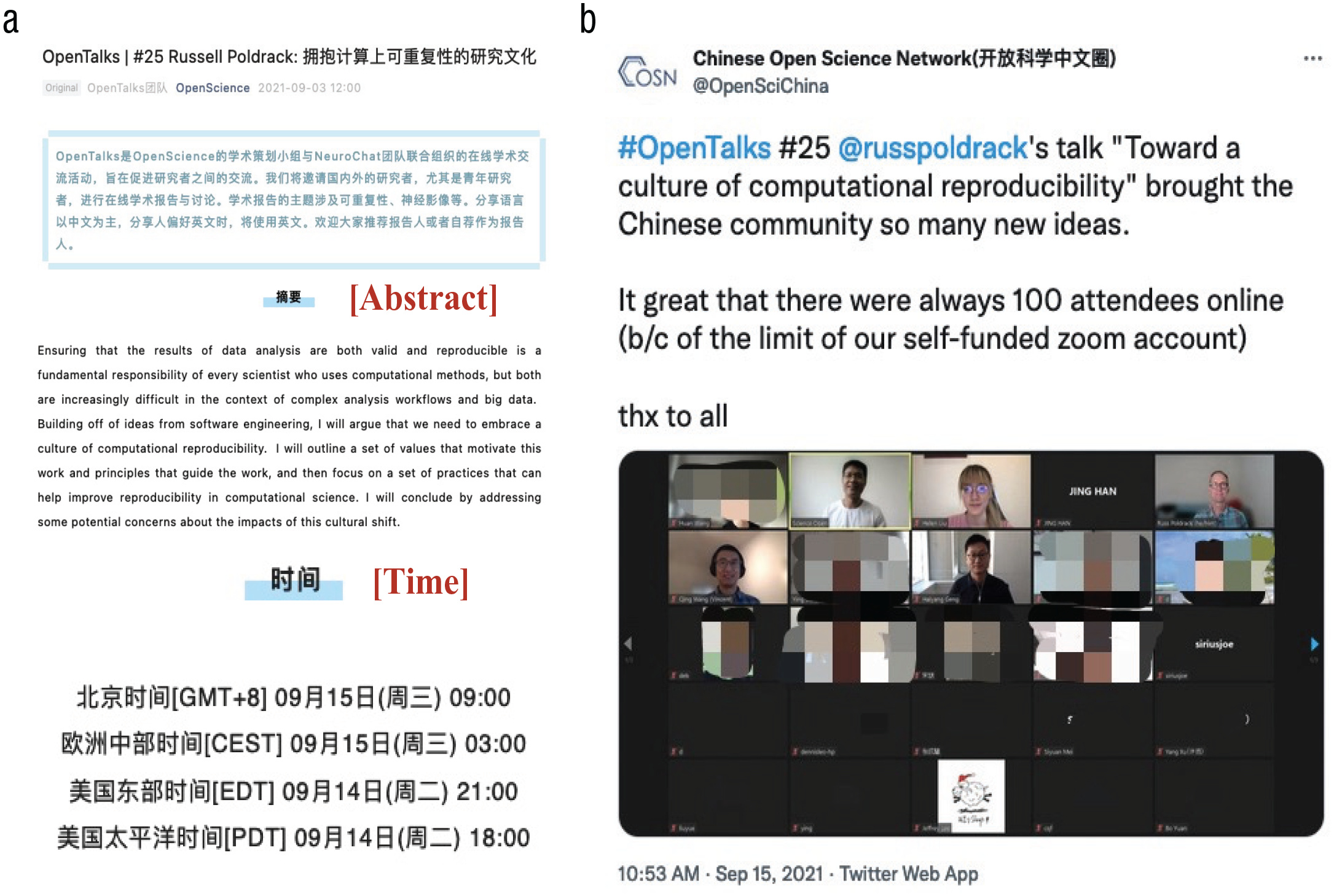
(a) A screenshot of our announcement for OpenTalk #25, which included both Chinese and English information and time in four time zones (see https://mp.weixin.qq.com/s/aqe7flO9L-NjSnDcIUMliQ). (b) The posttalk promotion of OpenTalks #25 on our twitter account (see https://twitter.com/OpenSciChina/status/1437972806520741889). Permission has been granted for unmasked faces.
As more ECRs joined the COSN community, two more in-person workshops were organized in 2017 and 2019, again as preconference workshops for the annual meetings of the Chinese Psychological Society. Moreover, as the need for communicating about the advances on Open Science increased, more regular online activities emerged within the newly formed community. For example, COSN started an online journal club (see OpenMinds below) in 2019 that is similar to ReproducibiTea (Orben, 2019) but uses researchers’ native language. In 2020, the COVID-19 pandemic rendered in-person workshops temporarily unfeasible, and COSN started to organize more events online. These online events attracted Chinese-speaking ECRs all over the world, and thus, COSN started to grow rapidly.
Promoting diversity and inclusivity through grassroots initiatives
During its development, COSN gradually identified its core values, which, in turn, accelerated the promotion of Open Science. COSN embraces three core values: grassroots-oriented, diversity, and inclusivity. The main goals of COSN include helping ECRs to engage in Open Science, promoting communication and education of Open Science principles and practices within the Chinese-speaking community, bridging the gap between Chinese- and non-Chinese-speaking scientific communities, and, ultimately, contributing to the Open Science movement.
Compared with other Open Science communities, COSN is unique in its strong emphasis on grass roots. Here, “grass roots” refers to people without sufficient support, opportunities, or resources to undertake formal research training, and they typically include undergraduate students, graduate students, and ECRs (Restivo, 2005). By focusing on grass roots, COSN hopes to plant seeds of Open Science and achieve community-wide awareness of Open Science practices in a bottom-up manner. To this end, COSN offers free and systematic study materials that are commonly available only in English for anyone who is interested in methods that follow the principles of findability, accessibility, interoperability, and reusability (Wilkinson et al., 2016). COSN’s Steering Committee (see below) consists of ECRs who frequently practice Open Science in their own research and are aware of the challenges that their Chinese-speaking colleagues may face. Thus, they can organize events that are most helpful for researchers at similar career stages to engage in Open Science.
COSN embraces diversity by proactively involving different Chinese-speaking groups regardless of their nationalities, countries of residence, career stages, disciplines, and sociodemographic backgrounds. The COVID-19 pandemic forced COSN to shift all its events online. Although we appreciate the benefits and advantages of in-person interactions, embracing this shift allowed us to further boost the diversity of our community because it has never been easier to engage with scholars, Chinese-speaking or not, around the globe. To ensure that we reach an audience as diverse as possible, we do the following: First, we announce our online events on multiple social media platforms in Chinese and English and make efforts to schedule events at times that suit people across different time zones (see Box 1). Second, we welcome—or even intentionally involve—both ECRs and senior researchers from different academic backgrounds, ethnicities, and countries and regions. We commonly locate a speaker by actively reaching out to researchers who have recently published inspiring or meaningful work or by inviting nominations from our community members (we also welcome self-nominations). As a result, ECRs have been well represented in our events, giving 36 out of the 48 COSN talks until October 2022. Third, although most of our audiences are from psychology and/or cognitive neuroscience, we try our best to reach out to researchers from different disciplines. For example, we have invited team members of ChinaXiv and the Science Data Bank to talk about preprints and online data archiving as well as the relevant situations in China. Fourth, COSN is supported by a group of Open Science enthusiasts who volunteer to do the backstage work for our events and activities and organize our open and free materials (for more information, see Table 1). We are proud and honored to work with a growing number of undergraduates and ECRs from various psychological subfields and at different academic career stages, who are diligent, passionate, and inspiring. Finally, members of COSN also acknowledge the importance of diversity of samples for both Chinese and international psychological studies and started to investigate this issue in depth (Ge et al., 2023; Liu et al., 2021; Yue et al., 2021; Zuo & Dong, 2021).
Platforms Used by Chinese Open Science Network to Promote Open Science

The fast growth of the COSN community reflects an ever-increasing awareness of Open Science. Nonetheless, championing Open Science as the only correct way of doing science may also breed prejudices against, for instance, researchers who do not now identify with or practice Open Science. Therefore, COSN actively incorporates the value of inclusivity across its platforms and in its events. That is, COSN stands with humility and equity and against prejudice and biases regardless of whether they are about identity or academic work. In addition, we recognize that Open Science practices form a spectrum (e.g., Jwa & Poldrack, 2022), and people do not engage in Open Science in an all-or-none fashion. We also recognize that the members of our community conduct research in many different ways, which may be constrained by their resources and may not be deemed “ideal” by the latest Open Science standards (which are often not consensual). Our goal is to disseminate information and ideas about Open Science and encourage people to adopt Open Science wherever they see fit. Following the Chinese old saying “be strict with yourself and be lenient with others,” COSN encourages all members to apply more rigorous standards to their own research (i.e., “be strict with yourself”) and, at the same time, respect others’ work and be tolerant of different perspectives (i.e., “be lenient with others”). If more researchers are willing to take a small step to share their data, COSN will be one step closer toward our goal of accelerating Open Science in Chinese-speaking communities.
Building organizational structure
To better practice our values and fulfill our goals, COSN developed a flat organizational structure and established the following three core committees: the Steering Committee, the Communication and Events Committee, and the Logistic and Media Committee (Fig. 2a). The Steering Committee provides overall strategic and scientific guidance for COSN. It organizes monthly meetings to coordinate with the other two committees. The Communication and Events Committee is responsible for planning Open Science events and activities, such as inviting and communicating with guest speakers for COSN’s main Open Science event series, Open 4+ (detailed below). The Logistics and Media Committee serves as a support team for COSN’s online platforms (Table 1), such as its WeChat Official Account, official website, Open Science Framework page, and GitHub repository. The Logistics and Media Committee also supports COSN’s events by publishing and maintaining the contents (e.g., blog posts, translated articles, event announcements, and recordings) across social media and video-streaming platforms. These platforms (Table 1) are critical for COSN to connect researchers interested in Open Science, share materials and resources about Open Science, and more importantly, organize and publicize events related to Open Science.
Establishing clear objectives
COSN gradually established clear objectives during its development: community building, education and training, and bridging the Chinese-speaking community with the international community. These objectives are achieved with OpenTransfer, OpenMinds, OpenTalks, OpenTutorials, and OpenPlus, collectively called “Open 4+ events” (Table 2). OpenTransfer and OpenMinds started as early as in 2017 and 2019 (Fig. 2b). Since the outbreak of the COVID-19 pandemic in 2020, COSN has started the other online event series, including OpenTalks, OpenTutorials, and OpenPlus (Figs. 2b and 3).
Open 4+ Events and Their Main Functions


Number of reads of WeChat posts and articles for Open 4+ events. Different Open Science events are represented with different colors and marker shapes (see legend). The size of scatter markers shows the number of reads for a specific event. Each line shows the cumulative reads distribution for a specific type of Open Science event. Please note that the event “WE LOST” has been merged into OpenMinds. The y-axis is in log scale. The title of the most read posts for each type of Open Science event is shown in the annotations.
OpenTransfer translates research resources, particularly those related to Open Science, from English to Chinese to make them more accessible to Chinese-speaking researchers. These translated resources are popular with our audience because of their practicality. As said, most Open Science materials are written in English, and a language barrier hinders the spread of Open Science knowledge within the Chinese-speaking community. Through translating those valuable resources, COSN makes them more widely read and more accessible to those who are less literate in English but enthusiastic about Open Science. So far, COSN has translated 15 resources, including books, journal articles, and blogs, covering various topics, such as practical applications of statistics and open experimental materials (e.g., face and voice databases). The two most popular OpenTransfer posts introduced an open database of face stimulus and tool (13,519 reads; translated from two sources: http://www.epaclab.com/face-stimuli and https://rystoli.github.io/FSTC.html) and translated a journal article titled “Ten Common Statistical Mistakes to Watch Out for When Writing or Reviewing a Manuscript” (10,261 reads; Makin & Orban de Xivry, 2019). OpenTransfer has gradually established a mature workflow: selecting high-quality resources, communicating with the authors, recruiting translators and proofreaders from COSN community members and subscribers, translating and proofreading, and, finally, publishing the resources on COSN’s WeChat Official Account.
OpenMinds is an online journal club dedicated to Open Science-related topics. So far, it has featured discussions of the replication crisis (Open Science Collaboration, 2015), “measurement crisis” (Flake & Fried, 2020), and “theory crisis” (Eronen & Bringmann, 2021) in psychology. It aims to nurture regular group discussions on Open Science among Chinese-speaking ECRs. As the title, OpenMinds, suggests, in this event series, we advocate for open-minded criticisms of current practices in psychological research and strive to broaden the horizon of everyone involved. The alpha version of OpenMinds started in 2019 with the title WE LOST, which stands for WEekly Learning Open Science Team. The organizers titled the journal club with this rather pessimistic acronym because they felt lost in their direction in psychological science in view of those many “crises.” Later, COSN changed the title to OpenMinds to demonstrate a more positive spirit. OpenMinds 1.0 in 2020 covered the replication crisis, questionable measurement and statistical practices, and the theory crisis. Then, in late 2021, OpenMinds 2.0 continued the discussion on the theory crisis. By May 2022, the journal club had discussed a collection of important articles, including Meehl’s (1978) seminal work about significance tests and a series of work emphasizing formalizing theory in psychology (Eronen & Bringmann, 2021; Proulx & Morey, 2021). Open Science is ever evolving, and meta scientific research on the impact of Open Science practices has blossomed in recent years. OpenMinds will continue incorporating these new advances into our discussions.
OpenTalks is a regular online talk series with two specific aims. One is to introduce the latest developments in Open Science, and the other is to make scientific talks more accessible. We invite both Chinese and international speakers to talk about advances in Open Science and connect Chinese-speaking Open Science enthusiasts with researchers who speak other languages. COSN values the perspectives of ECRs; thus, we encourage young scholars to request talks that would interest them or deliver talks themselves to showcase their skills and passion. COSN strives to make the talks as accessible as possible; for example, no registration is required so that they serve our audience with diverse backgrounds and different levels of experience.
OpenTutorials provides short, hands-on tutorials on methods in psychology and neuroscience for attendees, and it was initiated with the intention to equip researchers with practical skills and tips for conducting open and reproducible research to counter the reproducibility crisis (Bhagwat et al., 2021; Botvinik-Nezer et al., 2020; Ioannidis, 2005; Zuo et al., 2019). So far, COSN has organized 12 OpenTutorials that covered preregistration, meta-analysis, Bayes’s factor, version control, docker, and toolboxes such as Nilearn, among others. The most popular ones are about Bayes’s factor and fMRIPrep. In addition, COSN supports hackathons (Gau et al., 2021) in China. For example, it helped with the 1st Computational Psychiatry Hack organized by Chinese Computational Psychiatry Network 1 (Geng et al., 2022; see also L. Zhang, 2022) and the 1st COSN Summer Hackathon, which focused on power analysis.
In addition to the four regular Open Science event series, COSN organizes a relatively more spontaneous and festively featured series called OpenPlus. This series covers broader topics related to academia and research life and is organized in more flexible formats, for example, as a panel discussion. OpenPlus is usually held around major holidays as a gala for COSN. For example, for the last OpenPlus, titled 2021 Merry Industry, COSN invited both industry leaders and researchers in psychology, biomedical engineering, and neuroscience for a roundtable discussion on the transition from academia to industry and vice versa. The main purpose of this event was to broaden the view of COSN and provide genuinely useful information for our audience, for example, a communication channel between academia and industry. With this event, COSN hoped to promote collaborations between the academic research community and industry and further spread the idea of Open Science to the Chinese industry. Beyond communicating with industry peers, COSN will organize more OpenPlus events with more flexible forms of communication in the future to meet the emerging needs of a Chinese Open Science community.
Six Simple Tips
Through developing COSN, we have gained experience that might be useful for colleagues in developing countries or regions who intend to initialize their own local Open Science networks (Table 3). Scholars now actively share their tips and suggestions for advancing Open Science (Elsherif et al., 2022; Kent et al., 2022; Onie, 2020; Puthillam et al., 2022; Savage et al., 2021; Steltenpohl et al., 2021). Most of them, however, focused on top-down policy changes or how individuals can start to adopt Open Science practices; few were about building local Open Science communities, particularly in developing countries. The experience of COSN as a grassroots network highlights the importance of adapting to the local cultural and societal reality and using approaches and methods that are feasible and affordable.
Tips for Building Local Open Science Networks

Be bold and optimistic
Take the initiative to proactively promote Open Science in your local community. We believe that researchers who intend to establish their own Open Science networks believe faithfully in Open Science’s promising future. This belief is not an illusion because Open Science is increasingly recognized by not only the scientific communities but also the societies, including international organizations (e.g., UNESCO) and government bodies. Although many senior researchers may not publicly support Open Science (for what senior researchers can do, see Kowalczyk et al., 2022), they may do it in a more private or subtle way, such as by providing positive review comments for research that practices Open Science. So, do take the leap!
Be connected
Find like-minded people both inside and outside of your local community. As challenging as it might be, social media makes it possible. In the early days of COSN, we connected Chinese-speaking colleagues who are interested in reproducibility and Open Science through including them together in a WeChat Group (see Box 1). Even in such loosely organized communities, many colleagues, especially ECRs, either expressed their support for the Open Science movement or made contributions to the best of their capacity, such as by translating part of an article, typesetting posts, or leading a journal-club session. In fact, merely reading and sharing the posts or attending the online events shows the support from the local community. At the same time, staying connected with the international community will not only help you keep abreast with the trends and advances in Open Science and obtain collaboration opportunities, but it will also aid you in receiving support from international colleagues. For example, being an ambassador of the Center for Open Science (three of the steering members are indeed current ambassadors, L. Zhang, Y. Chen, and H. Chuan-Peng) provides a sense of identification and makes it easier to seek help from the Center. You may also join the inclusiveness and diversity committees of other academic organizations, such as the Organization for Human Brain Mapping Special Interest Groups and the Society for the Improvement of Psychological Science.
Be practical
Stress concrete benefits of Open Science, especially for individual researchers. Open Science, with its great emphasis on research transparency and rigor, is often depicted as beneficial for science but not necessarily so for scientists or the community themselves. This depiction oversimplifies the picture. Engaging in Open Science practices can benefit individual researchers, especially ECRs (Allen & Mehler, 2019), in addition to the academic community as a whole. For example, sharing data brings more opportunities for learning and collaboration. Researchers themselves also enjoy citation advantage and increased attention in the field by embracing Open Science practices such as open data, preprints, and registered reports (Colavizza et al., 2020; Ellis, 2022; Fu & Hughey, 2019; Hummer et al., 2017; Hunt, 2019). For the larger communities or societies, Open Science means that more materials, data, and other information are available online, giving rise to more efficient and affordable research. For instance, researchers can test many interesting ideas with open data instead of collecting data on their own, which saves them time and money (Milham et al., 2018), even lives (Besançon et al., 2021). These positive aspects should be emphasized when promoting Open Science. You may also start by introducing content that has immediate benefits to researchers. Our experience is that practical skills, such as statistical applications or toolbox, are especially popular. This can be exemplified by our most popular articles: one about the open materials that can be used in lab studies and the other one about the common statistical mistakes.
Be visible
Make sure that adopting Open Science practices (Poldrack, 2019) or building local communities contributes to your career development. A community can sustain itself better by creating additional tangible benefits for its members. However, because Open Science is still not universally valued, people who participate in it can sometimes find themselves in a social dilemma. Whereas organizing events, teaching, and advising others on Open Science-related topics are important for the scientific community, individual careers could be jeopardized by such efforts that are often not recognized or insufficiently appreciated. Thus, we advise people who engage in Open Science to explore ways for their career to profit from their engagement. For instance, when possible, one can write and publish journal articles related to Open Science, methods, and reproducibility because these are concrete outputs that help build up a curriculum vitae (CV). This can be done in various ways. For example, H. Chuan-Peng, one founding member of COSN, has engaged in many collaborations during training phases and benefited from these collaborations with both coauthored articles and first-author articles (e.g., Hu et al., 2019). In addition, by writing articles in Chinese or coauthoring Chinese articles, the steering committee members (H. Chuan-Peng, L. Zhang) gained a good reputation within the Chinese community, especially among ECRs. These records on a CV will help the members to survive and land safely in academia. The more people supporting Open Science stay in academia, the faster and the broader changes would take place.
Be affordable
Do what you can afford to do. In the early days of COSN, because of our limited capacity, we mainly focused on disseminating information about new policies, methods, and changes of standards that we retrieved from the international Open Science community. This effort was affordable for us in the sense that it did not burden us much beyond our daily research and teaching obligations. In this spirit, we always try to make sure that contributions to COSN are affordable and minimally obligatory for our members. Instead of doing all things by ourselves, we crowdsource tasks to interested volunteers. For example, in preparing articles for our OpenTransfer series, we ask contributors to engage only in the part that they are mostly interested in and nothing beyond. Meanwhile, we constantly strive to streamline our workflow to facilitate such crowdsourcing of tasks. Through making contributions to COSN flexible, affordable, and mostly driven by passion rather than by obligation, we make COSN a self-sustaining community that does not depend on the efforts of only a few.
Be local
Tailor your activities to best accommodate local cultural and social norms. We must admit that the local cultural norms might vary from that of the English community. For example, COSN has been relying on the Internet for building a community. However, because the Chinese academia often stigmatize Internet influencers as frivolous, we tried to avoid presenting ourselves as an influencer and limit our discussions to only research-related topics to make ourselves more acceptable by the academic community. In addition, because the local culture values harmony and modesty, we strive to avoid labeling and judging one another: We celebrate when people support and practice Open Science but do not call out names if they do otherwise. Open Science is not equal to good science, and a lack of diverse voices in a scientific reform (e.g., “Bropenscience”; Parsons et al., 2022) could backfire. We fully understand that researchers face their own unique difficulties and pressures, and we encourage everyone to do what they can. In this way, COSN can build a local Open Science network.
Conclusion
In the past decade, the Open Science movement has gained momentum and gradually changed the landscape of psychological science and many other fields (Nosek et al., 2022). Relevant ideas and practices have spread both within and outside of the English-speaking communities. Chinese ECRs are trying their best to make the voice of Open Science heard by the Chinese-speaking research community. Their efforts led to the COSN, which started as a small interest group, has survived a relatively challenging environment, and is now joining the force of the global Open Science movement. More Chinese ECRs are now joining the COSN or other Open Science networks. By sharing our experiences and tips, we intend to not only present another story in promoting Open Science but also to help and encourage researchers who are interested in starting their own Open Science initiatives or engaging in Open Science practices. As Open Science spreads to more countries, it is now a good time to initiate and nurture local Open Science communities. This is also true for COSN (for the future of COSN, see Box 2). However, grassroots networks are not enough; the flourishing of Open Science needs more concrete actions from all stakeholders (for actions needed from COSN’s perspective, see Box 2). Together, we move forward to a community with open, diverse, inclusive, and transparent practices as the norm instead of an exception.
Box 2.
Prime Time for Open Science and Chinese Open Science Network
New opportunities:
Better policies from international organizations (e.g., UNESCO Open Science Recommendations) and governments call for integrating bottom-up efforts with top-down efforts.
New infrastructures from other sectors call for cross-sectorial collaboration. For example, new preprint platform ChinaXiv and open-data platform Science Data Bank call for collaboration between librarians, infrastructure providers, and researchers.
New journal policies (e.g., mandating data sharing, publicizing peer reviews) and government policies (e.g., Article 95 of the Law of the People’s Republic of China on Science and Technology Progress) create a stronger need for Open Science training for researchers.
COSN perspectives:
Continually support the Chinese-speaking research communities to embrace Open Science and make contributions to the international communities.
Establish a better organizational structure to survive and sustain (e.g., establish election systems for our committees, draft by-laws of committees).
Continue and improve Open 4+ events.
Archive and organize the materials we accumulated. These efforts will result in courses, books, or databases about Open Science.
Support regional-wise grassroots networks within China and, if possible, outside China.
Collaborate with and contribute to international organizations. As more early-career researchers (ECRs) gain knowledge about Open Science in Chinese Open Science Network (COSN), they can contribute to not only COSN but also international communities such as the Psychological Science Accelerator or the Society for the Improvement of Psychological Science.
Reach out for cross-sectoral collaborations and apply for financial support.
Call for actions:
Concrete incentive policies need to be established in support of Open Science practices (e.g., financial support and recognition in funding opportunities, faculty assessment, postdoc and student scholarships).
Enhance cross-sectional coordination that connect all stakeholders (e.g., funding agencies, universities, publishers, infrastructure providers) to promote Open Science efforts (e.g., host open-access articles and reduce its cost).
Promoting equality and diversity in global open science by providing more opportunities for researchers from developing countries in leadership, staffing, and practice and bringing diverse voices into international events, global platforms, and relevant policy discussions.
Researchers from developing countries and underrepresented groups themselves need to be more active in broader dissemination and engagement.
Pass on the spirit of Open Science to ECRs and students by providing supports and encouraging open science practice in academia.
Footnotes
Transparency
Action Editor: David A. Sbarra
Editor: David A. Sbarra
Author Contribution(s)
H. Jin, Q. Wang, Y.-F. Yang, H. Zhang, M. Gao, and S. Jin contributed equally to the current article.
