




Abstract
The resources needed to conduct psychological research (i.e., time, access to participants, equipment, expertise, etc.) are sometimes distributed inefficiently: Resources going unused at one lab may be needed to complete projects at another lab. This inefficient distribution of resources can be an impediment to scientific progress and to individuals’ careers. StudySwap (https://osf.io/view/StudySwap) is an online platform where researchers can post brief de-scriptions of research resources that are available for use (haves) or that they need and another researcher may have (needs). This Tutorial provides instructions for posting haves and needs on StudySwap, responding to the posts of other researchers, and creating exchange agreements that define expectations of all collaborative parties prior to data collection or other resource exchanges. Ultimately, we hope that StudySwap can be used to increase the efficiency with which psychology’s collective research resources are being used.
Collectively, psychological scientists have access to a vast amount of resources (e.g., time, participants, expertise). When used efficiently, these resources have the potential to provide enormous gains in knowledge, shape public policy, and improve human lives. However, despite these potential contributions, these resources may not be used as efficiently as possible. In this Tutorial, we introduce a new tool aimed at increasing the efficiency with which psychological scientists use their collective resources: StudySwap.
StudySwap is intended to support crowdsourced research (McCarthy & Chartier, 2017). Broadly, crowdsourcing research involves coordinating and sharing resources to conduct research that would be difficult to complete individually. StudySwap is an online platform where researchers can find collaborators by posting descriptions of resources that are available for use (haves), posting descriptions of resources that they need and another researcher may have (needs), or coordinating collaborative research projects across several research teams. The ultimate goal of a crowdsourcing approach is that fewer research resources go unused and more researchers have access to the resources they need to complete their research (e.g., Schmalz, 2016).
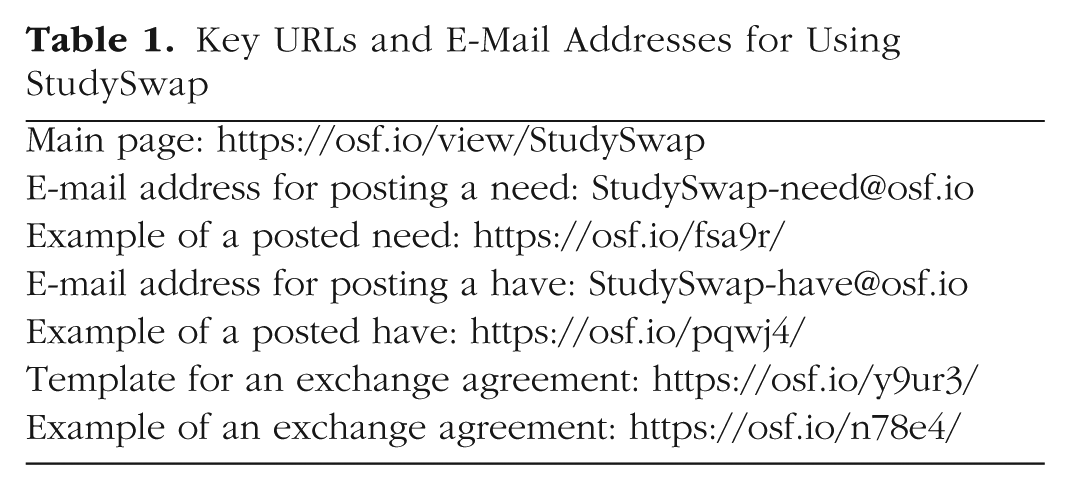
StudySwap is currently housed on the Open Science Framework (OSF), an online platform where researchers can document and archive their research workflow and share materials and data with one another. Thus, StudySwap integrates well with other tools that are commonly used by psychological researchers. For quick reference, Table 1 contains key URLs and e-mail addresses for using StudySwap.
Key URLs and E-Mail Addresses for Using StudySwap
Example Uses of StudySwap
Finding an independent lab to conduct a replication attempt prior to publication
The independent replicability of psychological research is critical for a cumulative psychological science (Open Science Collaboration, 2015). However, Nosek, Spies, and Motyl (2012) argued that practices that would improve the replicability of psychological research are sometimes at odds with the current incentive structure for professional success (Kunda, 1990). Confidence in a published scientific finding is increased if the finding can be demonstrated independently by other researchers (e.g., Lebel, McCarthy, Earp, Elson, & Vanpaemel, 2018). However, a potential barrier to independent, prepublication replication attempts is that many researchers have a difficult time finding other labs to conduct such attempts. StudySwap can be used to find an independent research team to conduct a replication attempt of a not-yet-published study (see Schweinsberg et al., 2016, for an excellent example of prepublication independent replication). This replication attempt can provide information about how much confidence should be placed in the replicability of the effect, can provide information about lab-to-lab variability of the effect, and can help researchers ensure that their study methods are described in sufficient detail to be reproduced in independent labs.
Researchers can post their needed independent, prepublication replication attempt as a need on StudySwap in hopes of finding a collaborator. They can post a have if they have the capacity to collect data for an independent replication of another researcher’s study. This latter option could be especially attractive to researchers mentoring students who want to get exposure to and experience in the research process and are also looking for a study that is “ready to go” (i.e., the hypotheses are created, the stimuli are collected, the methods are set, etc.).
Increasing the efficiency of in-lab sessions
Many psychology studies are brief and can be completed in a matter of a few minutes. However, most credit-based participant-pool systems assign credit in 15-, 20-, or even 30-min increments regardless of how long the actual studies take. Further, some participant pools have more individuals than are needed for local studies. Many participants, in effect, receive credit for time during which they do not provide data. Collectively, this results in a substantial loss of time and potential data that could be put to use by scientists who need access to participants.
One straightforward solution to address this inefficiency is to combine the data collection for two or more studies into one procedure. Combining procedures can be especially efficient if they have overlapping features (e.g., common demographic questions or a common individual difference measure). Many additional brief studies could fit comfortably within the study sessions that other researchers are already using. Researchers can post a have to StudySwap if time with their participants is available. Of course, judgment and discretion are needed to ensure that studies included within the same session are compatible with one another (e.g., researchers need to be mindful about possible participant fatigue and carryover effects from one study to the other).
Increasing the size of a participant pool
Researchers at institutions with a small participant pool are limited in the number of participants who can complete each of their studies in a given semester. Understandably, calls for increased sample sizes in psychological science have been met with concerns that researchers at such institutions may be disproportionately affected. By collaborating across institutions, researchers can achieve increased sample sizes without delaying their study timelines unduly. For example, imagine a research team that can run only 80 participants for a specific study in a given semester. If they have a target N of 160, they would spend a full academic year collecting data. Alternatively, they could post a need on StudySwap to find another researcher who is willing to collect data from an additional 80 participants for them during the current semester. Researchers who are willing to collect data for someone else can post a have. Also, researchers who have a small participant pool can use StudySwap to find other researchers who are in a similar situation and would like to directly exchange data so that both parties achieve their desired sample size in a single semester. This feature of StudySwap provides one mechanism by which researchers can meet increasing sample-size expectations without substantially slowing down their research process.
Sharing access to hard-to-recruit populations
Participants from populations other than those that are well represented in traditional participant pools (e.g., members of underrepresented minorities, infants, children, or people with a psychiatric diagnosis that has a low base rate in the population) can be challenging to recruit in numbers large enough to study properly. Researchers can post a have on StudySwap if they will recruit a sample from a hard-to-reach population and have the capacity to include data collection for another researcher who is interested in that same population, or researchers can post a need if they seek a collaborator with access to such a population.
Initiating a consortium project
Some research projects require the coordination of a moderate to large number of laboratories to adequately address the research question. In these cases, StudySwap can be used to advertise a consortium project and initiate collaboration across multiple laboratories. Several ongoing projects have recruited collaborators by posting on StudySwap a need calling for additional labs to join in data-collection efforts. Examples include Many Labs 5 (https://osf.io/beptk/) and the Pipeline Project 2 (https://osf.io/mqkpf/). These posts have been quite successful because the projects were already fully prepared and ready for a community of researchers that is quite interested in joining consortia and collaborating on a large scale.
Posting a Have
Researchers should post a have if they are willing to collaborate with other researchers in need of a particular resource. In most cases, this will likely result in shared authorship of the resulting research project, which incentivizes the posting of haves. Exchange agreements, discussed later in this article, are a way of explicitly documenting decisions on issues such as authorship prior to data collection.
Posting by e-mail
The quickest and easiest way to post a have is to e-mail some basic information and attachments to
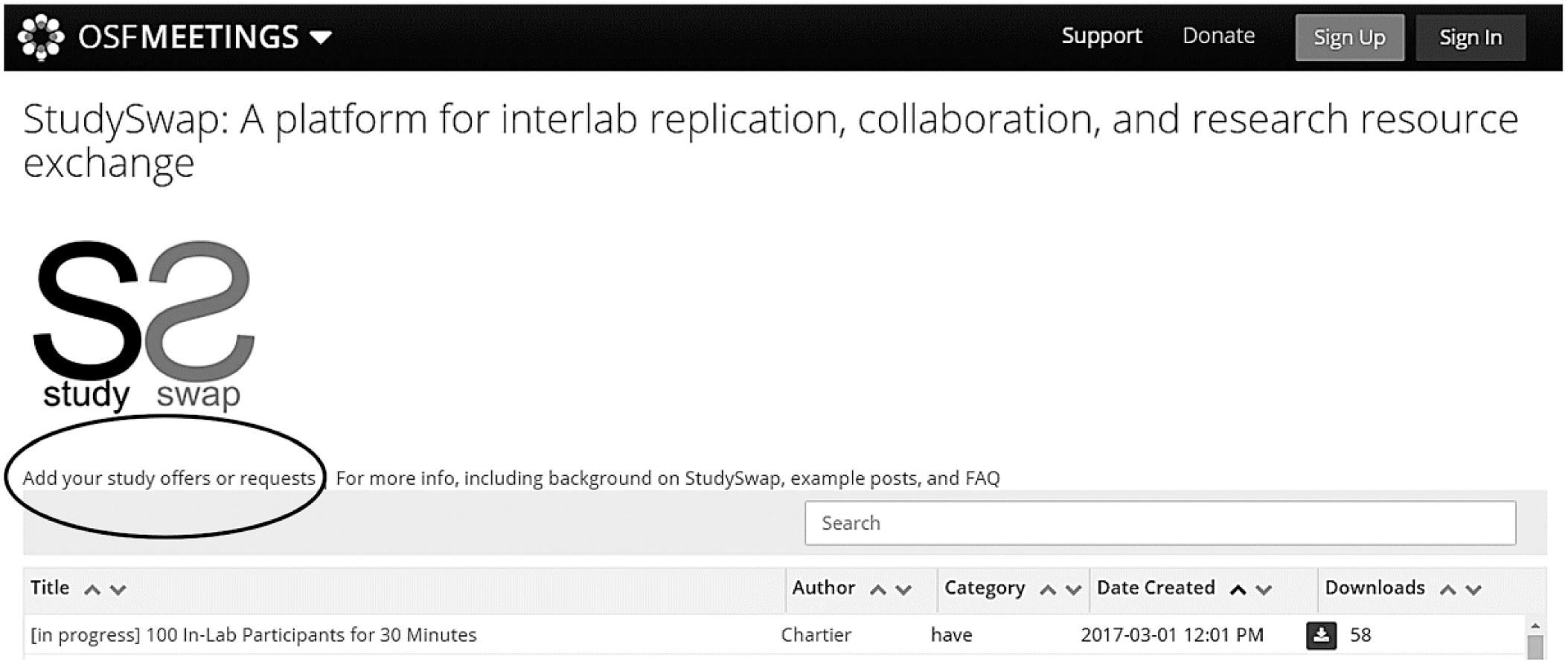
Accessing instructions for posting on StudySwap via e-mail. This screenshot of the main StudySwap page shows the “Add your study offers or requests” link (circled). Clicking on this link expands the page to reveal the instructions.
Your e-mail will automatically generate an OSF project page and a post on StudySwap. It should be structured in the following manner:
Once you send the e-mail, StudySwap will send you an automated message with a link to an OSF project and the permanent identifier that people can use to cite your work. You can then log in and make changes, such as uploading additional files, to your project at that URL. If you send the e-mail from an e-mail address associated with an OSF account, the project page will be added to your dashboard at OSF. If you do not have an OSF account, one will be created automatically for the e-mail address you used, and a link to set your password will be e-mailed to you. Researchers who are new to the OSF and would like guidance on setting up an account and getting started with OSF services can access an excellent set of tutorial videos from OSF’s training site (https://cos.io/our-services/training-services/cos-training-tutorials/).
Posting by tagging an existing OSF project page
Alternatively, you can post a have on StudySwap by first populating an OSF project page with the necessary information (title, wiki description, and all necessary documents) and then adding the tags “studyswap” and “have” to the project (see Fig. 2). Similarly, if you ever wish to remove your post from StudySwap, you can simply remove these tags. The project page will remain unchanged, but it will no longer appear on StudySwap. This is also the removal process for posts generated via e-mail. An example project page for a have can be seen at https://osf.io/pqwj4/.
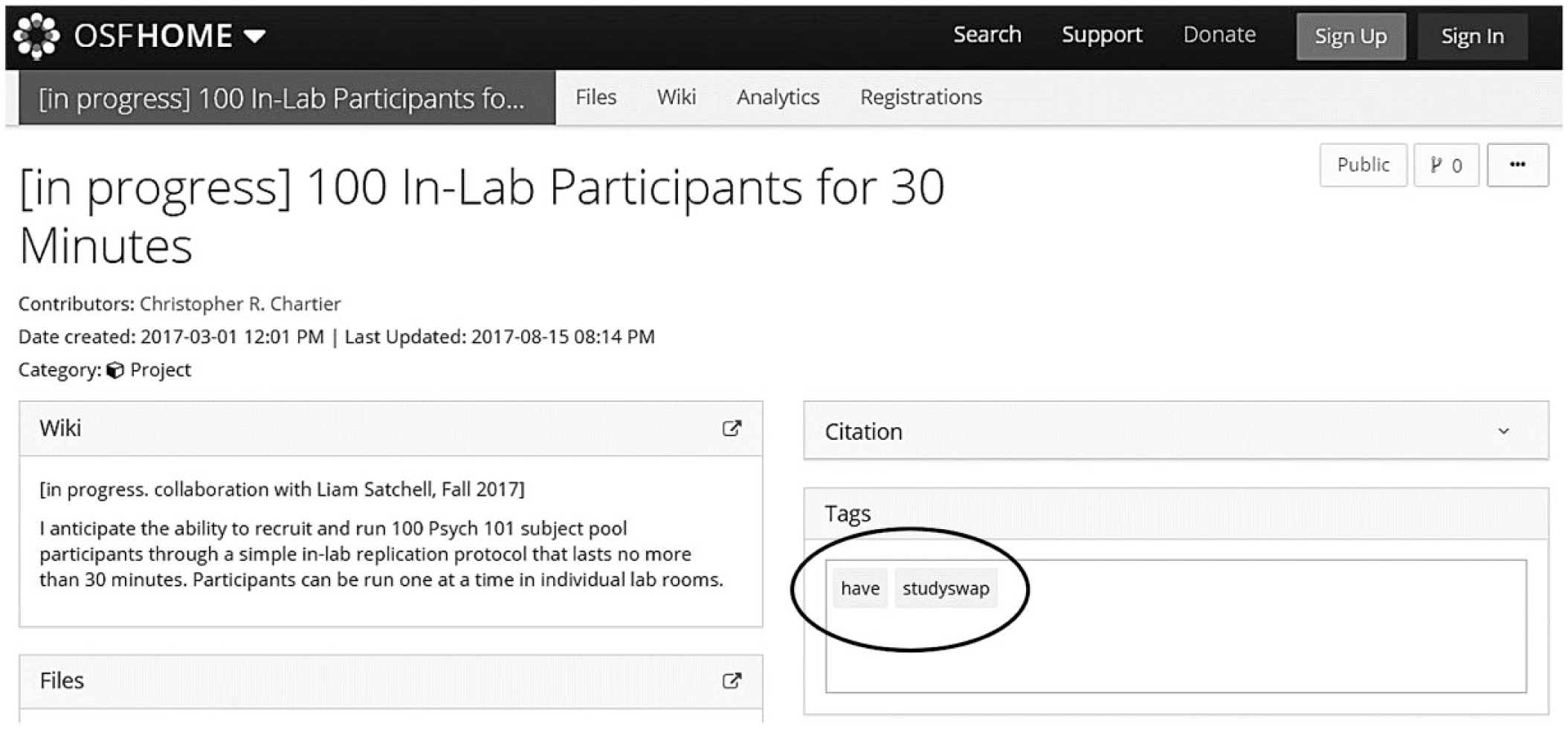
Screenshot of an Open Science Framework project page for a have posted on StudySwap. The author posted this have by adding the tags “have” and “studyswap” (circled) to the project page.
Posting a Need
Needs can be posted almost exactly as haves are posted. To post a need via e-mail, follow the instructions for a have post but send the e-mail to
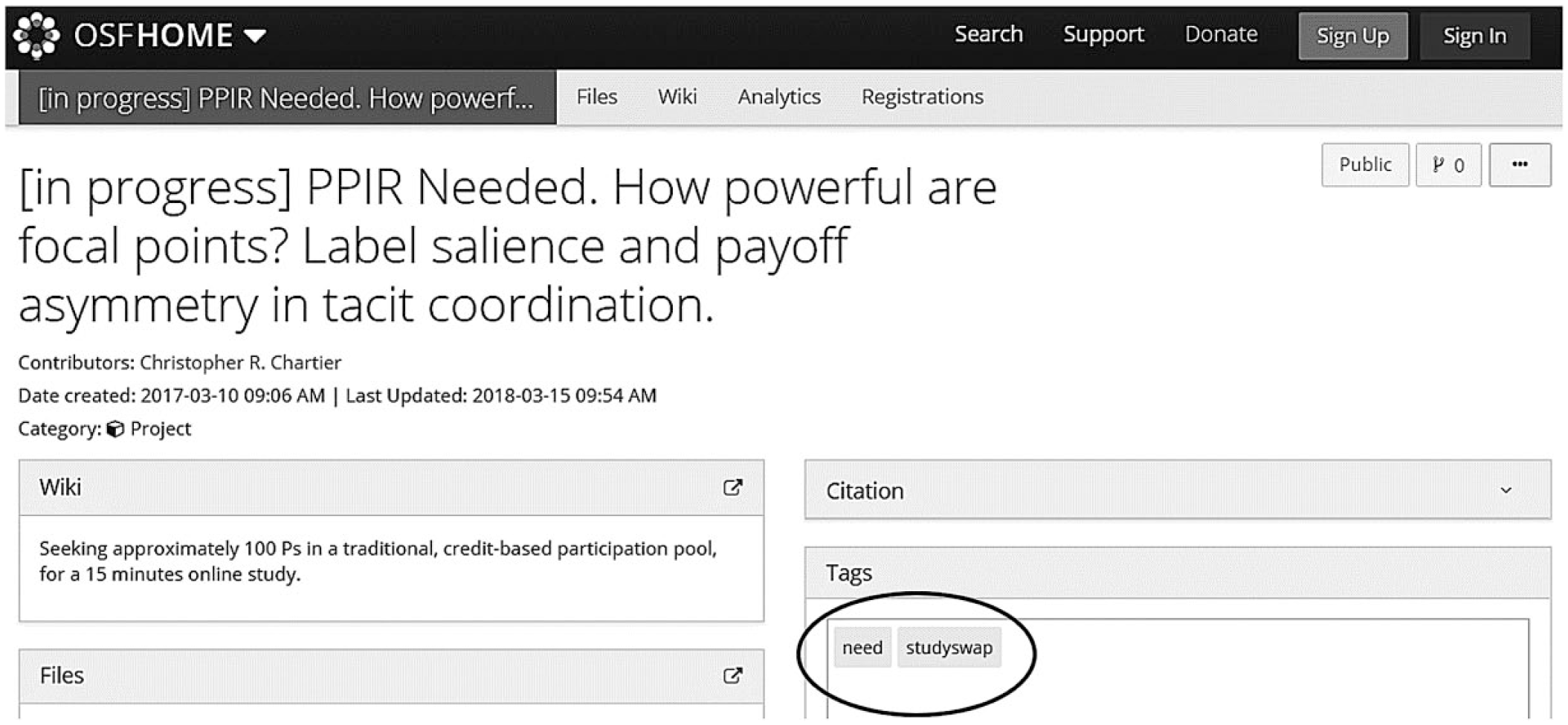
Screenshot of an Open Science Framework project page for a need posted on StudySwap. The author posted this need by adding the tags “need” and “studyswap” (circled) to the project page. PPIR = prepublication independent replication; P = participant.
Responding to a Post
The current StudySwap interface does not have a search function, but posts can be sorted by five characteristics: the title of the post, the posting author, whether the post is a have or a need, the date of the post, and the number of downloads (see Fig. 4). After reviewing the OSF project page and attached documents for a StudySwap post, e-mail the posting author if you are interested in collaborating. The collaboration can then proceed as any other collaboration would.
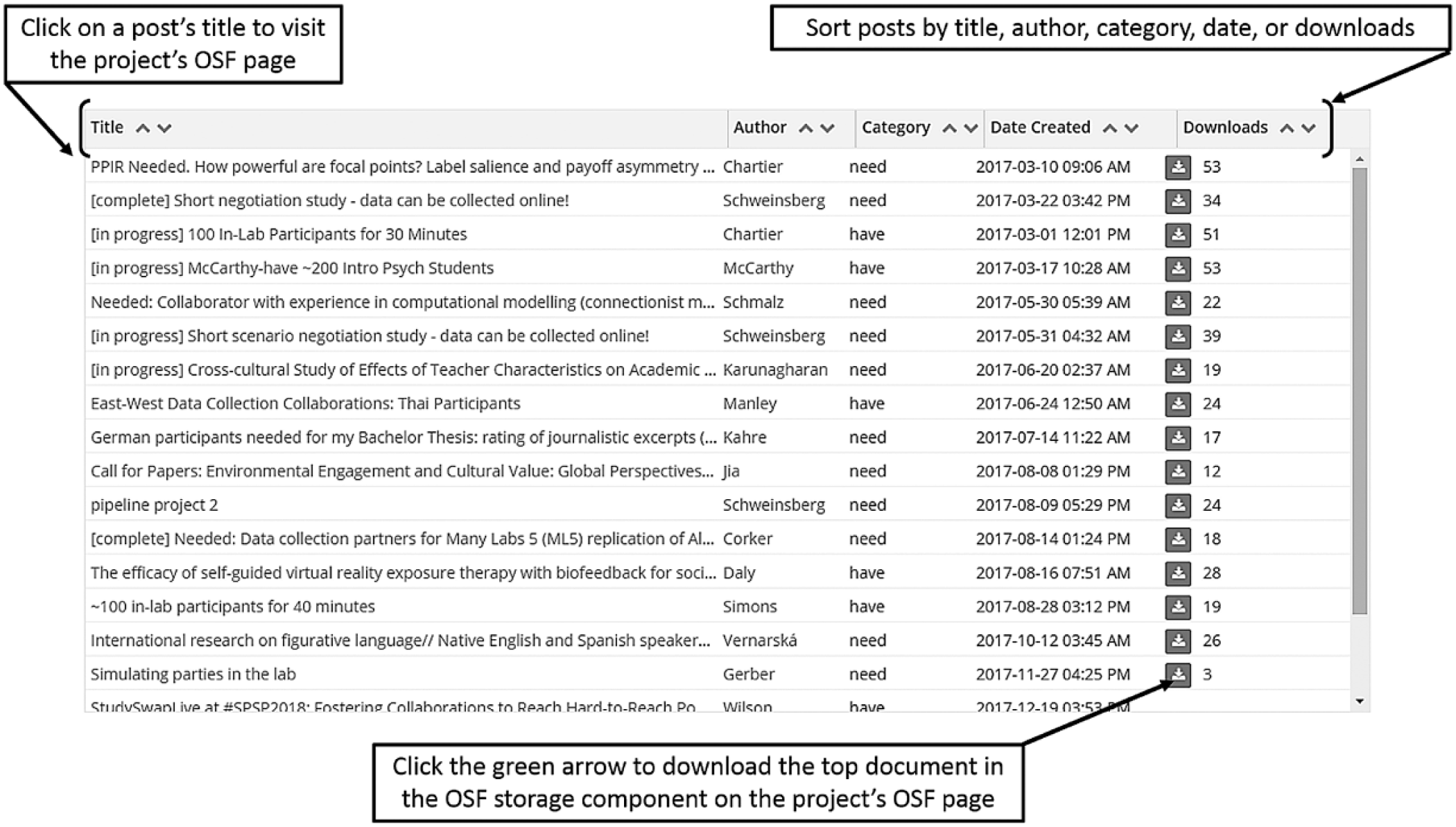
Screenshot showing a list of projects posted on StudySwap. Posts can be sorted by multiple criteria, and researchers can click on a title or download button to view a project page or an attached document, respectively. OSF = Open Science Framework.
Exchange Agreements
When entering into a collaborative project with other researchers, it is wise to document expectations early in the process. At a minimum, we suggest an e-mail trail that clearly documents things such as what will be done, when it will be done, and how authorship will be determined if a project results. However, we strongly recommend use of a signed exchange agreement that can be made publicly available at some point during the project’s life cycle. Much as study preregistrations document researchers’ hypotheses, sampling goals, planned analyses, and so forth at an early stage in the research process, exchange agreements document and make clear and transparent all expectations of collaborating parties in a collaborative project. These agreements can help avoid misunderstandings between collaborators and reduce the likelihood of later conflicts or disagreements during the collaboration. We suggest that these agreements include information on research practices such as preregistration, sharing materials, and posting data to public repositories. A template exchange agreement can be found at https://osf.io/y9ur3/, and an example of a completed exchange agreement can be seen at https://osf.io/n78e4/. Each participating lab should manage logistics with its own institutional review board, as indicated in the exchange agreement; ethics approval documents (e.g., documentation of approval for human-participants research) should be obtained and made accessible prior to data collection.
Help Us Make StudySwap an Active Community
StudySwap will become more effective with increasing awareness and traffic. True success will require a critical mass of researchers making new posts on the platform, reviewing current posts, responding to posts, and initiating multisite collaborations. We hope you will find it a useful tool for initiating and joining collaborations in psychological science.
Footnotes
Action Editor
Alexa Tullett served as action editor for this article.
Author Contributions
All three authors contributed to conceptualizing, drafting, reviewing, and editing the manuscript and approved the final submitted version of the manuscript.
Declaration of Conflicting Interests
The author(s) declared that there were no conflicts of interest with respect to the authorship or the publication of this article.
