



Abstract
Background:
Vaccines against COVID-19 are critical for preventing and managing COVID-19 because immunization is one of the most active and cost-effective health strategies for infectious disease prevention. Knowing the community’s willingness and factors affecting COVID-19 vaccine acceptance will support the design of effective promotion strategies. Therefore, this study was aimed at assessing COVID-19 vaccine acceptance and its determinants among the Ambo Town community.
Method:
A community-based, cross-sectional study was conducted using structured questionnaires from 1 to 28 February 2022. Four kebeles were selected randomly, and the systematic random sampling procedure was used to select the households. SPSS-25 software was used for data analysis. Ethical approval was received from the Institutional Review Committee of the College of Medicine and Health Sciences of Ambo University, and data were kept confidential.
Result:
Of the 391 participants, 385 (98.5%) of the respondents were not vaccinated for COVID-19, and around 126 (32.2%) of the respondents said that they would receive the vaccine if the government provided it. The multivariate logistic regression analysis revealed that males were 1.8 times more likely to accept the COVID-19 vaccine (adjusted odds ratio (AOR) = 1.8, 95% CI: 1.074–3.156) as compared to females. The acceptance of the COVID-19 vaccine was lower by 60% in those who tested for COVID-19 as compared to those who were not tested (AOR = 0.4, 95% CI: 0.27–0.69). Moreover, the participants who had chronic diseases were two times more likely to accept the vaccine. Acceptance of the vaccine was reduced by half among those who believed that there was a scarcity of data on its safety (AOR = 0.5, 95% CI: 0.26–0.80).
Conclusion:
The prevalence of COVID-19 vaccination acceptance was low. To enhance the acceptance of the COVID-19 vaccine, the government and different stakeholders should strengthen public education using mass media about the advantages of getting the COVID-19 vaccination.
Background
COVID-19 has had a significant health, economic, and social impact, prompting pharmaceutical companies to develop vaccines as soon as possible. 1 Vaccines against COVID-19 are critical for preventing and managing COVID-19 because immunization is one of the most active and cost-effective health strategies for infectious disease prevention. 2 The vaccines were formulated in the shortest time in vaccine history, due to important determinations in vaccine research, development, and manufacturing. 3 COVAX is a component of access to the COVID-19 Tools Accelerator, which the World Health Organization and cooperator launched in 2020 with the goal of ending the acute phase of the COVID-19 pandemic. 4 Although much significant progress has been made, there are still fundamental obstacles in the way of a possible COVID-19 vaccine, one of which is public acceptance. 5 Vaccine acceptance reflects the general public’s understanding of risk, vaccine attitudes, and demand, which are significant for vaccinations to achieve high vaccination coverage rates, especially for newly emerging infectious diseases. 6
The COVID-19 vaccine acceptance rates vary in different parts of the world. The countries with the highest COVID-19 vaccine acceptance rates were Ecuador, Malaysia, Indonesia, and China, which ranged from 97% to 91.3%. On the other hand, the lowest COVID-19 vaccine acceptance was recorded in Kuwait and Jordan. 7 Moreover, the COVID-19 vaccine acceptance rate was also low, at 48.93%. 8 The systematic study and meta-analysis of the study conducted in Ethiopia showed that the vaccine acceptance rate in Ethiopia was 51.64%. 9
Ethiopian authorities choose to employ the AstraZeneca COVID-19 vaccination through the COVAX facility. On 7 March 2021, Ethiopia received 2.184 million doses of COVID-19 vaccinations. 10 The Ethiopian Federal Ministry of Health formally launched the COVID-19 vaccine on 13 March 2021, at a high-level public event held at the Eka Kotebe COVID-19 hospital, where many health workers were vaccinated to kick off the vaccination campaign.10,11
COVID-19 vaccination could be affected by issues such as mass production, global distribution, and cost. 12 Moreover, there are some ambiguities concerning some aspects of the COVID-19 vaccine, such as uncertainty about long-term safety and the need for regular preparation amid evidence of SARS-CoV-2 evolution and the occurrence of genetic variants. 13
Many people remain skeptical about vaccine safety and efficacy, including the strength of the COVID-19 defense, because many cases of reinfection have been documented. 14 However, the studies revealed minor side effects and good effectiveness. The study conducted in Saudi Arabia on the safety of the AstraZeneca COVID-19 vaccine revealed that muscle aches, fever, and headache were the most frequently reported side effects. 15 The study conducted in Italy on the effectiveness of BNT162b2 mRNA COVID-19 vaccine showed that the vaccine effectiveness was 97.7% after 34 days of first-dose vaccination. 16
The other issues with COVID-19 vaccination are vaccine hesitancy and resistance. 17 According to various reports on vaccines,17–19 the hesitation may be due to religious values, personal beliefs, and safety issues based on general misconceptions, such as the connection between vaccines and autism, comorbidity, and other disorders. 20 Understanding the community’s readiness to receive the COVID-19 vaccine and identifying the factors affecting their vaccine acceptance will contribute to the development and implementation of efficient COVID-19 vaccination promotion strategies. 21 Therefore, this study was aimed at assessing COVID-19 vaccine acceptance and its determinants among the Ambo Town community.
Methods
Study area and period
The study was conducted in Ambo Town, Oromia Regional State. Ambo Town is located 114 km to the west of the capital city of Ethiopia, Addis Ababa, with an estimated population of 94,153, including 47,048 men and 47,095 women. The town of Ambo has one referral teaching hospital running under Ambo University, one general hospital, and two health centers. The study was carried out from 1 to 28 February 2022.
Study design
A community-based, cross-sectional study was conducted among the communities of Ambo Town.
Study populations
All of the Ambo Town communities with the age of 18 and above years.
Inclusion and Exclusion criteria
Inclusion criteria
All adults over the age of 18 who were willing to give oral consent were included.
Exclusion criteria
Severely ill people and mentally ill people who could not undergo an interview were excluded.
Sample size determination
The sample size was determined by using single population proportion formula and taking the p-value from the previously reported study conducted in Ethiopia which is 54.5%. 22 D-marginal error taken to be 5% and with 10% nonresponse rate, the final sample size is calculated to be 419.
Sampling procedure/technique
Four kebeles were randomly selected by lottery from a total of six kebeles in Ambo Town. A systematic random sampling procedure was used to select the households from the four kebeles that were chosen. The estimated households of the four selected kebeles (Hora Ayetu, Yai Gada, Torban Kutaye, and Kisose Ido Liban) were 17,452. 23 The first household was selected using a simple random sampling technique, and then, others were selected at regular intervals until the required sample size was reached. If there was more than one individual who fulfilled the inclusion criteria, one respondent was selected with a simple random sampling technique.
Data collection instrument
A structured questionnaire was developed from different related works of literature.11,22,24–26 The questionnaire consists of sociodemographic factors, participants’ health status and previous vaccine experience, experience with COVID-19, attitudes of the community toward the COVID-19 vaccine, and reasons for not receiving the COVID-19 vaccine.
Study variables
Dependent variable
The dependent variable in this study was the intention to accept the COVID-19 vaccine.
Independent variable
Sociodemographic factors such as age, gender, religion, educational status, marital status other factors like participant’s health status and previous vaccine experience, experience with COVID-19, attitudes of the community for COVID-19 vaccine, and reasons for not receiving the COVID-19 vaccine were included.
Data quality control
The questionnaire was adopted from different published papers and then reviewed by experts and pretested. The final corrected questionnaire was utilized for data collection after back-and-forth translation by a fluent speaker of both English and Afan Oromo languages. Data were checked daily by the principal investigator for the accuracy, consistency, and completeness of the questionnaires. Before analyzing the data, the data were entered and cleaned.
Data analysis
SPSS Windows version 25 was used for data analysis. The relationship between independent and dependent variables was investigated using bivariant logistic regression analysis. To control for possible confounding, all variables in the bivariate logistic regression model with a p-value < 0.25 were added to the multivariate logistic regression model, and variables in the multiple logistic regression model with a p-value ⩽ 0.05 were considered statistically significant.
Operational definitions
Great trust: the participant’s belief that the COVID-19 vaccine would prevent them from getting COVID-19.
Little trust: Those participants who believe that the vaccine would not fully prevent them from getting COVID-19.
Vaccine Contraindication: In this document, the vaccine contraindication was defined as the participants who had developed severe reactions to any previous vaccination and reported that they could not take the COVID-19 vaccination due to the fear of previous reaction.
Results
In this study, 391 individuals from four kebeles in Ambo Town were involved, with a 93% response rate. Out of the total respondents, 278 (71.1%) were male. The majority of respondents, 221 (56.5%), were >30 years old. The majority of the study participants 273 (69.8%) had a college or university education, while five people (1.3%) were illiterate. Two hundred twenty-nine (58.6%) of the respondents were married. The majority, 133 (34%), were government employees followed by businessmen/women, 105 (26.9%). Almost all of the respondents (99%) were living in urban (Table 1).
Sociodemographic factor of participants in Ambo Town community Ethiopia 2022 (N = 391).

Participant’s health status
Seventy-two (18.4%) of the study participants had a chronic disease, while 181 (46.3%) had previous vaccine experience (Table 2).
Participant health status in Ambo Town community, Ethiopia 2022 (N = 391).

Participant experience with COVID-19 in Ambo Town community
In the study area, 174 (44.5%) people were tested for COVID-19 and approximately 131 (33.5%) reported having close relatives or friends infected with COVID-19 (Table 3).
Participant experience with COVID-19 in Ambo town community, Ethiopia 2022 (N = 391).

Attitudes of the community for COVID-19 vaccine in Ambo Town
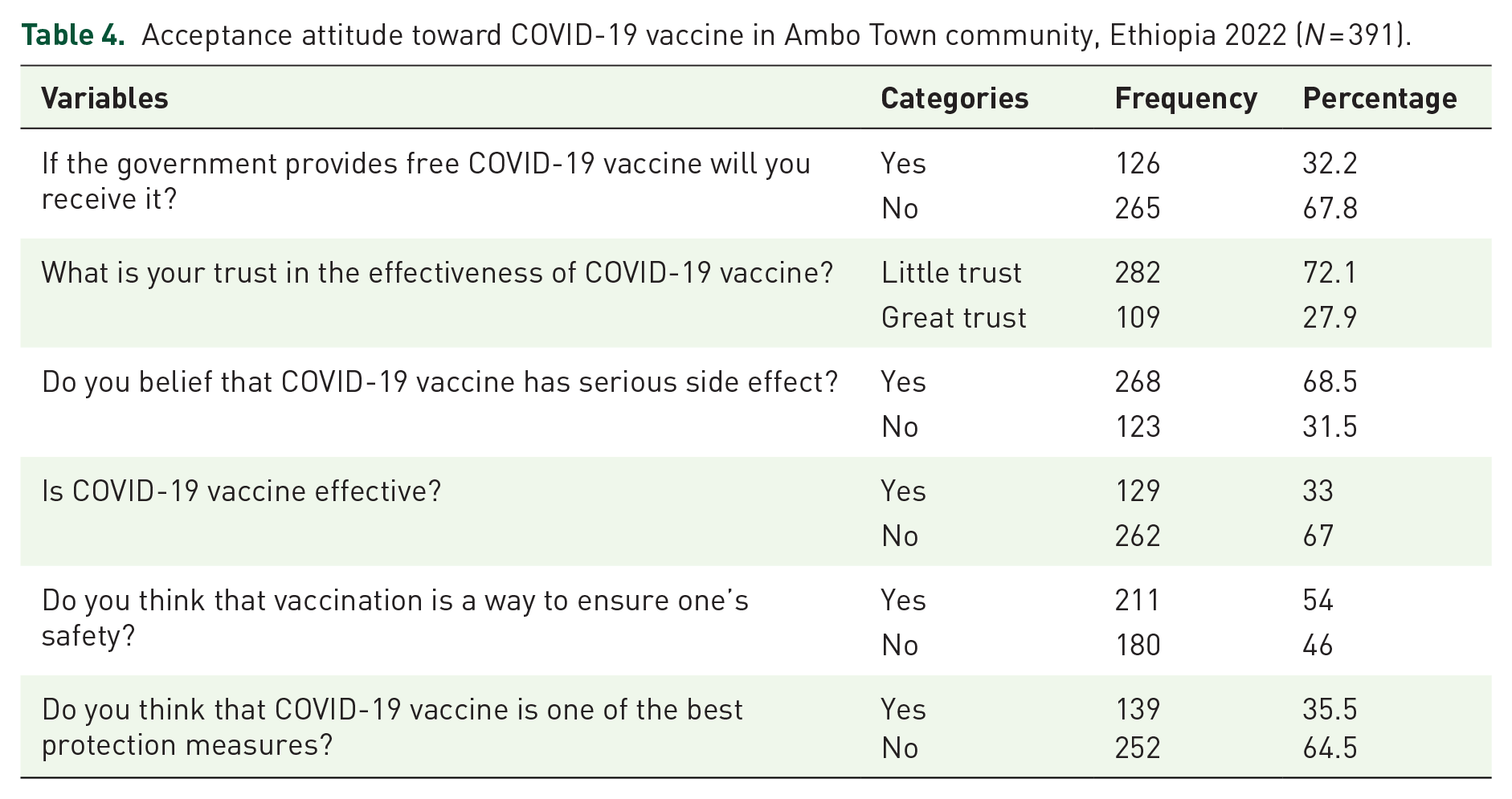
One-third, 126 (32.2%), of the respondents said that they would receive the vaccine if the government provide it. The majority of the 282 respondents (72.1%) had little trust in the COVID-19 vaccine’s effectiveness. Concerning side effects, 268 (68.5%) of respondents believed that the COVID-19 vaccine had serious side effects. More than half 252 (64.5%) of the respondents said the COVID-19 vaccine is not the best protection measure (Table 4).
Acceptance attitude toward COVID-19 vaccine in Ambo Town community, Ethiopia 2022 (N = 391).
Reason for not receiving of COVID-19 vaccine
In the present study, 385 (98.5%) of the respondents were not vaccinated for COVID-19. The majority of respondents (277, or 70.8%) refused to accept the vaccine, by the participants who were concerned that it would be ineffective. Other forms of protection were preferred by more than half of the 251 (64.2%) respondents. More than half (55.8%) of the participants (55.8%) refused to take the vaccine due to fear of an adverse COVID-19 vaccine effect (Table 5).
Reason of nonacceptance of COVID-19 vaccine in Ambo Town community, Ethiopia 2022 (N = 391).

Factor associated with COVID-19 vaccine acceptance
The variables included in multivariate logistic regression were sociodemographic characteristics, having tested for COVID-19, having a chronic disease, the severity of COVID-19, having a close friend or relative infected with COVID-19, having vaccine experience before, having experienced serious side effects from a vaccine, believing that vaccination is the best protection method, having adequate data on safety, having a fear of side effects, having a concern of being ineffective, having a vaccine cause COVID-like symptoms, age, sex, having tested for COVID-19, the severity of COVID-19, vaccine experience before, inadequate data about the safety of the vaccine, a concern about the vaccine being ineffective, and preferring other ways of protection.
The multivariate logistic regression result revealed that males were 1.7 times more likely to accept the COVID-19 vaccine (adjusted odds ratio (AOR) = 1.7, 95% CI: 1.074–3.156) as compared to females. The acceptance of the COVID-19 vaccine was lower by 60% in those who tested for COVID-19 as compared to those who were not tested (AOR = 0.4, 95% CI: 0.27–0.69). Vaccine acceptance was 64% lower among participants who believed COVID-19 was severe (AOR = 0.36, 95% CI: 0.22–0.60). Furthermore, vaccine acceptance was reduced by 50% among those who believed there was a scarcity of data on the vaccine’s safety (AOR = 0.5, 95% CI: 0.28–0.74; Table 6).
Multivariate analysis of factor associated with COVID-19 vaccine acceptance in Ambo Town, 2022 (N = 391).

COR = crude odds ratio, AOR = Adjusted odds ratio.
Significant association at p-value < 0.05.
Discussion
Effective vaccination against COVID-19 offers the most promise for bringing the pandemic to an end. The first vaccination campaign was started on 13 December 2020, in the United Kingdom. 27 On 13 March 2021, the COVID-19 vaccine was introduced for the first time in Ethiopia at the Eka Kotobe COVID-19 hospital. It was started by a frontline health worker and a letter after addressing a highly vulnerable community member; the vaccine has been made free for all community members in the country since August 2021.10,28 The current study, conducted from 1 to 28 February, after access to the vaccine was made open to the entire community except children, aimed to assess vaccine acceptability and related factors in the community.
The current study revealed that 385 (98.5%) of the respondents were not vaccinated for COVID-19. The results differed from a study of health professionals in Ethiopia, where 62.1% were vaccinated. 29 This difference might be due to the priority given by the government during the pandemic period. The majority (70.8%) of the respondents refused to receive the vaccine due to their concern that it was ineffective. The study conducted in Gondar also revealed that there was a concern about the effectiveness of the COVID-19 vaccine. 30
Acceptance of the COVID-19 vaccine is influenced by trust in its safety and efficacy. 31 In the present study, the majority of 282 (72.1%) of the respondents had little trust in the COVID-19 vaccine’s effectiveness, and the majority of the respondents also feared the side effects of the vaccine. The study conducted elsewhere revealed concerns about vaccine effectiveness or short- or long-term side effects. 32 People will be vaccinated when vaccine efficacy and duration of protection are improved. 33 The study conducted in Ghana also revealed that 65.5% of the respondents had concerns about the safety of the COVID-19 vaccine. 34
Other reasons for not taking the vaccine were unreliability due to the short time for the development of the vaccine and a belief in the community that the vaccine itself causes COVID-19 infection. The study conducted in the United States showed there was a concern about the safety of the vaccine due to the fact that the development had been rushed and responded to as there were not enough studies and at least it takes 2–3 years, but for this vaccine it only took months. 35 According to the other study, there have been various fake news claims spread through social media claiming that vaccines cause miscarriage and infertility. Others claimed that the vaccine could transmit a coronavirus, which was also reported in the current study. 36
In the study area, about one-third (32.2%) of the respondents said that they would receive the vaccine if the government provided it. The intention to accept the vaccine was lower than in the study conducted in Sodo Town. 22 The other study conducted in Ethiopia through an e-survey showed that 31.4% of the respondents were willing to accept the COVID-19 vaccine, which was in line with the current study.11,37
However, only 1.5% of the study participants were vaccinated. Another study in Gonder Zone, North West Ethiopia, found that 18.7% of the population was vaccinated, which is higher than the current study. 24 The other systematic review, which was conducted in Ethiopia, found that the pooled COVID-19 vaccine acceptance rate was 51.64%, which is higher than the current study. 9
The present study revealed the association of vaccine acceptance with sex, having tested for COVID-19, having a chronic disease, the severity of COVID-19, and inadequate data about safety. Males were found to be 1.8 times more likely to accept the COVID-19 vaccine as compared to females. Previous studies have also shown that females were more reluctant to take the vaccine.38–42 Moreover, those who believed that there were inadequate data about the safety of the vaccine were one of the main predictors of vaccine hesitance.17,43 The study conducted in the United Arab Emirates revealed that those who expressed concern about the inadequacy of safety data were less likely to take the vaccine. 25 Additionally, the study conducted in the United Kingdom also showed a lack of visible safety and efficacy data, which was the reason for vaccine hesitance. 44
Moreover, the respondents who said COVID-19 is severe were less likely to accept the vaccine as compared to those who said it is not severe. However, the study conducted in Kuwait revealed that the participants who anticipated that their COVID-19 symptoms would be mild were less likely to accept them than those who anticipated that their symptoms would be severe. 42 This may be due to the fear of getting COVID-19 from the vaccine, as few of the participants responded. On the other hand, those who had a chronic disease were more likely to accept the vaccine as compared to those who did not have a chronic disease. The study conducted in Egypt also showed those who had a chronic disease were more likely to accept the COVID-19 vaccine since they were concerned about the coronavirus infection. 45 In developed countries like Italy, guidelines have been developed. The guideline recommends vaccination of all patients with chronic diseases against the influenza virus because they are at high risk of influenza complications or death. 46 For people with chronic medical conditions, COVID-19 vaccines reduce the risk of further deterioration and death. 47
Different interventions have been tried to improve the COVID-19 vaccination. Some of them are public education, communications, and community engagement. Training health professionals, and participating community members like elders and religious leaders to teach other community members about vaccinations, had a great impact in addressing vaccine hesitance. 48 The misinformation that has been disseminated in the community through different social media should also be controlled by the government.48,49
The limitation of this study was that it was cross-sectional in nature, making it difficult to draw long-term conclusions.
Conclusion
The findings of this study revealed that the acceptance of a COVID-19 vaccine was low. Acceptance of the COVID-19 vaccine was significantly affected by age, sex, being tested for COVID-19, having a chronic disease, the severity of COVID-19, and believing that there is inadequate data on the safety of the vaccine. The government and other relevant authorities should carefully consider all of the factors influencing COVID-19 vaccine acceptance rates across the country and devise measures to make the public aware of vaccine hesitancy’s potential benefits and risks.
