



Abstract
Entrepreneurship residence halls/dorms have been appearing on more and more campuses, especially in the United States and Canada. However, there is a very thin knowledge base on which to construct and design these expensive campus facilities/programs. Sometimes called “dormcubators,” these facilities/programs are linked to both the university business incubation (UBI) and living-learning communities (LLC) movements. As a result, the design and delivery of these hybrid spaces/programs can be oriented toward achieving economic (i.e., starting companies), social (i.e., building communities), and/or educational (i.e., entrepreneurial learning) outcomes. Prior research on other kinds of post-secondary LLCs suggests that the intended outcomes are also likely accompanied by unintended negative consequences for students and faculty. To understand how various dorm-preneurship program designs have worked in practice, this paper applies an ‘educational design ethnography’ approach to four different residential entrepreneurship programs at the University of Waterloo, Canada. The key finding is that problems arise when dorm-preneurship programs lack any link to educational/curricular outcomes and focus only on economic objectives or social ones. Four design principles are developed to guide research and development of similar programs in other contexts.
Keywords
Introduction
New physical spaces for entrepreneurship are proliferating across college and university campuses. But Pittaway (2021) and colleagues (Pittaway et al., 2020) have flagged a serious concern: the near complete lack of research around the efficacy of these spaces/programs. Pittaway et al. (2020) echo Lange’s (2016) assessment that the construction of all these entrepreneurship and innovation spaces constitutes a “campus arms race” across the United States. In her New York Times feature, Lange (2016) notes that there is real pressure for universities to construct these spaces, even if “proof” of their efficacy “may be many years out, and difficult to quantify” (Lange, 2016, p. 15). Indeed, in their preliminary review of 57 such spaces, Pittaway et al. (2020) concluded that “universities seem to be copying each other when designing spaces” (p. 929). Then, in later work, Pittaway (2021) found that “motivations, stakeholder focus, and performance measures for the construction of such spaces were often unclear” (p. 57). Indeed, there appears to be a bandwagon effect in the construction of entrepreneurial spaces. It could be an extension of the rapidly expanding but somewhat vacuous “entrepreneurship industry” (Hunt & Kiefer, 2017). And so, we should ask whether these spaces are performing effective entrepreneurship education and development or merely offering conspicuous consumption of entrepreneurial identity (Hartmann et al., 2019).
Entrepreneurship residence halls are promising new campus spaces/programs because they aim to integrate curricular and extracurricular entrepreneurship education (EE) (Pittaway, 2021; Pittaway et al., 2020). Sometimes called “dormcubators” (Bechtel, nd; Sá & Kretz, 2015), entrepreneurship-focused residence buildings and programs can be linked to the university business incubation (UBI) and/or living-learning community (LLC) movements (Sá & Kretz, 2015). Of course, university business incubators (UBIs) constitute a major area of on-going study in the entrepreneurship and innovation literatures (see Hausberg & Korreck, 2020; Mian et al., 2016; Nicholls-Nixon & Valliere, 2020). But there has been little discussion in the field of entrepreneurship education on LLCs—sometimes also called living-learning programs (LLPs). These are “programs in which undergraduate students live together in a discrete portion of a residence hall (or entire hall) and participate in academic and/or extra-curricular programming designed especially for them” (Inkelas et al., 2007, p. I.2). Since the 1970s, LLCs have been embraced as a “high impact learning practice” in the United States (Brower & Inkelas, 2010; Kuh et al., 2010) because they can bridge students’ curricular and extracurricular experiences (Schroeder & Mable, 1994; Shapiro & Levine, 1999). But in contrast to the prescribed “best practices” (Brower & Inkelas, 2010; Inkelas et al., 2018; Wagner, 2019), many LLCs focus only on thematic social/extra-curricular experiences and neglect curricular outcomes (Browne & Minnick, 2005; Smith, 2015). This disconnection from curricular learning might seem like a good idea to those who have argued that extra-curricular EE is more effective than curricular EE (Lucas et al., 2006; Ribeiro et al., 2022). But despite their many potential benefits (Brower & Inkelas, 2010; Pascarella, Bohr, et al., 1994), we know that the extra-curricular social environments created within LLCs can also have unintended negative consequences for student behavior and curricular learning (Jacobs, 2008; Jaffee, 2007; Jaffee et al., 2008; Smith, 2015). These “pedagogical shortcomings” are understudied (Smith, 2015, p. 3). And, as we will see, very few studies of LLCs include entrepreneurship-focused cases.
Nonetheless, dormcubators are appearing on more and more campuses. In their book, The Entrepreneurship Movement and the University, Sá and Kretz (2015) explain that the University of Maryland introduced the first entrepreneurship-themed LLC in 2000. Seven years later, entrepreneurship had still not registered as a common theme in LLC/LLP programs across the USA (Inkelas et al., 2007). Sá and Kretz estimated that “about a dozen” universities and colleges across Canada and the USA had entrepreneurship dorms by 2015 (Sá & Kretz, 2015, p. 89). More recently, Pittaway (2021) has characterized entrepreneurial dorms as an accelerating trend. With his colleagues, he argued that entrepreneurship dorms “are integrative and seek to bring together all aspects of the innovation process” (Pittaway et al., 2020, p. 928). This is why these programs sit at the apex of the Pittaway et al. (2020) hierarchy of university spaces for entrepreneurship.
But at the same time, Pittaway and his colleagues have raised concern over the near complete lack of research on entrepreneurship spaces generally, let alone on entrepreneurship residences. Dormcubators have been discussed briefly in the context of broader trends in EE (i.e., Pittaway, 2021; Pittaway et al., 2020; Sá & Kretz, 2015). There are also some published descriptions of single programs at single institutions (e.g., Artz, 2016; Fine, 2016; Green, 2010). The most rigorous examination is embedded in a recent study on the speculative entrepreneurial identities that students are taught to perform while pitching (Chen & Goldstein, 2022). In that study, Chen and Goldstein (2022) conducted some of their interviews and observations at a newly established entrepreneurship residence and found something akin to Hartmann et al.’s (2019) “untrepreneurial economy” [sic]. In other words, this space was home to great deal of entrepreneurial identity work but relatively little entrepreneurial action. Overall, this is a thin and troubling knowledge base on which to construct and design expensive campus facilities/programs.
In this paper, we carefully (re)consider the proliferation of dorm-preneurship spaces and programs. We begin by reviewing what is already known about different approaches to LLCs, UBIs, and EE. We then discuss the few entrepreneurship residences that are already described in scholarly publications and develop a framework for understanding the economic, social, and/or educational orientations that might be taken by different residential entrepreneurship programs. To understand the challenges and effects of these different orientations, we present an ethnographic field study of four residential entrepreneurship programs within one institutional context. Our team travelled nearly 2000 km to immerse ourselves in residential campus life at Canada’s most famously entrepreneurial university—the University of Waterloo (Bramwell et al., 2008; Bramwell & Wolfe, 2008; Ornston, 2021; Spigel, 2017; Spigel & Vinodrai, 2020). Combining interview and observational data with news clippings and archival data from the web, this paper explores the evolution of Waterloo’s four differently designed dorm-preneurship spaces/programs: VeloCity Residence, GreenHouse Social Impact Incubator, Waterloo Entrepreneurial Residence Connection, and the PeaceTech LLC. Our aim was to understand the design of these four programs within the changing context of this one institution. Our analysis focuses on how these programs grappled with competing economic, social, and educational orientations. Three of these residence programs are now defunct. However, their stories illustrate issues that can arise in dorm-preneurship programs that lack an explicit educational orientation or connection.
As we will see, dorm-preneurship programs exist at a juncture point in discussions about curricular versus extracurricular entrepreneurial learning (e.g., Preedy & Jones, 2015; Rae et al., 2012). Some programs bridge coursework with extracurricular experiences, while others focus only on building peer communities and/or incubating ventures. Based on the LLC and incubation literatures, we show how these different orientations can manifest in dramatically different outcomes. Then, through an educational design research lens, we develop four design principles that can guide the go-forward development and research around dorm-preneurship programs. We conclude with some discussion on our three contributions: a contribution to knowledge about this unique form of entrepreneurship education, a methodological contribution that expands the repertoire for entrepreneurship education research, and a contribution to the practical design of extra/curricular entrepreneurship programs.
Literature Review
Living-Learning Programs
LLCs are a common feature of colleges and universities across the USA and nearly all the research on LLCs is situated in that national context. Caviglia-Harris (2022) estimates that, by 2018, over 84% of US colleges and universities were operating some type of LLC. The majority of these are either “freshman experience initiatives” or “themed cohorts” (Smith, 2015, p. 1). Freshman experience initiatives (sometimes called first year living communities, FLCs) are programs that help residential first-year students successfully transition into post-secondary education. LLCs are also sometimes organized around upper-year (sophomore, junior, senior) or honors cohorts (Brower & Inkelas, 2010). Meanwhile, themed LLCs organize students into cohorts based on shared personal interests (e.g., health and wellness, creative arts), common affiliations/ambitions (e.g., reserve officer training, civic and social leadership), programs of study/discipline (e.g., business), or other convening characteristics (e.g., foreign language halls) (see Brower & Inkelas, 2010; Inkelas et al., 2007). Despite the many ways students might be organized into LLCs, all these programs are supposedly designed around the “integration of students’ living and academic environments” (Shapiro & Levine, 1999).
Schroeder and Mable laid out the case for LLCs in their 1994 edited collection, Realizing the Educational Potential of Residence Halls. They explained how many post-secondary institutions in the US were first established as “colonial colleges” that echoed the models of Oxford and Cambridge (Schroeder & Mable, 1994, p. 6). But unlike those British institutions, faculty at US colleges “were saddled with the total responsibility of supervising their young charges and enforcing all disciplinary regulations” (Schroeder & Mable, 1994, p. 6). This “spawned the early vestiges of in loco parentis, a student-institutional relationship predicated on paternalistic control of students through rigid enforcement of numerous rules and regulations” (Schroeder & Mable, 1994, p. 6). It meant that “faculty were directly involved in all aspects of students’ lives, utilizing paternalistic control to foster students’ character development” (Schroeder & Mable, 1994, p. 6). While critical of this older student-institutional relationship, Schroeder and Mable (1994) argued that faculty and students had drifted too far apart by the 1990s. In response to widespread calls for higher education reform, they said, …residence halls, as the places where students spend most of their out-of-class time, should contribute to improving undergraduate education. Indeed, they should be structured in such a fashion as to provide integration between the instructional environment and various out-of-class experiences of students (Schroeder & Mable, 1994, p. 4).
This was not about a return to paternalistic control. Rather, Schroeder and Mable (1994) provided the argument for a proliferation of LLCs: “residence halls must become purposeful and intentional educational environments” (p. 17). Inspiration was drawn from famous practices, particularly the experimental liberal arts college established by Alexander Meiklejohn within the University of Wisconsin in the late 1920s. Programs like this “took hold” during the rapid expansion of US higher education in the 1950s–1960s (Brower & Inkelas, 2010, p. 36). But they did not ‘take off’ until a set of conferences in the early 2000s caused LLCs to “gain popularity” (Caviglia-Harris, 2022, p. 174).
During a flurry of research in the 1990s, the benefits of LLCs were understood to arise from connections among students and faculty. Pascarella, Terenzini, et al. (1994) argued that “LLCs exert most of their influence on student personal and intellectual development indirectly…mediated by the peer and faculty interactions they foster” (p. 34). They explained that “students in LLCs have significantly more informal interaction with faculty and perceive a significantly stronger intellectual dimension to their living environment than do students in conventional residence halls” (Pascarella, Terenzini, et al., 1994, p. 32). As a result, LLC participants are “more likely to persist…and to graduate…than their counterparts in conventional college residences” (Pascarella, Terenzini, et al., 1994, pp. 32–33). Further studies, using a variety of research designs, have supported this positive relationship between LLC participation and student retention/persistence and performance/success (Caviglia-Harris, 2022; Inkelas et al., 2007; Pike, 1999; Purdie & Rosser, 2011; Stassen, 2003; Wawrzynski & Jessup-Anger, 2010). This research has shifted the discussion from underlying principles toward desired outcomes.
But not all residential experiences have positive outcomes. For an extreme counterexample, we can look to “Greek” fraternity and sorority life. In a prominent study, De Donato and Thomas (2017) found that “Greek” living arrangements “are a significant distraction from coursework especially in spring semesters when new members are recruited and educated” (De Donato & Thomas, 2017, p. 50). Unfortunately, it has been somewhat taboo to consider whether LLCs might have similar negative consequences. Critical investigations have been “notably absent from the literature” (Smith, 2015, p. 3). The most prominent critical perspectives have come from Jaffee (2007) and Smith (2015).
Jaffee first laid out his position in a commentary for The Chronicle of Higher Education (2004), and then developed a theoretical framework in the journal College Teaching (2007). Focusing on first-year living communities (FLCs), he argued that “the literature on first-year experience has largely ignored the unique social-psychological dynamics of the FLCs that can produce problems and unintended outcomes” (Jaffee, 2007, p. 66). Jaffee (2007) says that these “include unruly student behavior, student resistance to learning, and student-faculty conflict” (p. 66). Notably, he tells us that “faculty who teach in FLCs frequently report a greater adversarial ‘us-versus-them’ student orientation” (Jaffee, 2007, p. 68). Turning to social-psychological theory, Jaffee explains how LLCs can produce these unintended negative outcomes. His approach explains that any “homophilous concentration of post-adolescent students” not only produces a peer learning community, but also increases behaviors expected in that peer group: “identity seeking, the struggle for autonomy, the need for acceptance, the formation of cliques and subcultures, a preoccupation with social affairs rather than learning, and disruptive and rebellious forms of behavior” (Jaffee, 2007, p. 67). He also notes the threat of groupthink in such tightly-bonded peer groups: “one would expect opinions and sentiments to be influenced more by the peer cohort than the faculty or the larger academic ethos” (Jaffee, 2007, p. 67). Jaffee’s point, however, is not that FLCs/LLCs are inherently problematic. Rather, his argument is that the outcomes are “contingent” on the social conditions in each learning community. His work argues that blind faith in the “theoretical intention” of LLCs should be replaced by more reflection on each “practical consequence” arising from such programs (Jaffee, 2007, p. 70).
Jaffee later worked with some colleagues and empirically confirmed the combination of positive and negative consequences in FLCs (Jaffee et al., 2008). But the most comprehensive investigation to-date was completed by Smith (2015). Smith completed an in-depth comparative study of two LLCs for his doctoral thesis. He found several negative outcomes that “occurred as a direct result of intended program outcomes such as heightened social integration and engagement” (Smith, 2015, p. 163). In other words, the positive intended outcomes of the programs triggered follow-on negative outcomes. At both of his case sites, Smith observed three categories of unintended negative consequence. First, he noted problematic social stratification and “social class conflict” (Smith, 2015, p. 165) between faculty, staff, and a student social hierarchy. Second, he noted insularity where students were “identifying strongly with their LLCs, but in so doing they sequestered themselves from other aspects of the institution” (Smith, 2015, p. 165). And third, Smith noted increased incidences of risky behavior, particularly peer pressured abuse of controlled and illegal substances. His study links these negative consequences to both the breakdown of stakeholder relations (e.g., between student affairs and academic partners) and an absence of programming for positive development of the peer community. But Smith also argues that the problems he observed cannot be reduced to errors in implementation. He asserts that, regardless of execution, social-psychological theory points to a troubling reality for LLCs: “the mixture of a post-adolescent student population coupled with LLCs’ unique social conditions may create a toxic, dysfunctional environment that ultimately undermines the intent of learning community programming” (Smith, 2015, p. 193). Based on his findings, Smith argues that those involved in organizing LLCs must come to understand the full range of LLC outcomes.
Before Smith (2015) and Jaffee (2004, 2007; Jaffee et al., 2008), sociological theory was applied thinly to LLCs. For example, Pascarella, Terenzini, et al. (1994) only speculated about the potential negative effects of LLCs. They suggested that grouping students into homogenous residence halls may increase and over accentuate the groups’ traits/interests and undermine students’ experiences of diversity in college. And, thinking specifically about honors LLCs, they worried that “when high-ability students are assigned to live together, this special assignment procedure helps gifted students achieve academically but deprives students living in conventional residence halls of exposure to these students as role models” (Pascarella, Terenzini, et al., 1994, p. 41). This concern, and others raised here, can be extended to entrepreneurial LLCs.
It is also concerning that the LLC literature provides limited rigor toward program design decisions. There is little research carefully comparing different LLC designs (Wagner, 2019). Indeed, Inkelas et al. (2008) argued that LLCs differ thematically more than operationally. Even those studies that compare different approaches suffer from a problem of self-selection bias (Caviglia-Harris, 2022; Pascarella, Terenzini, et al., 1994). LLCs are known to attract and/or select different kinds of students than other residences, and yet this is seldom considered in claims about the outcomes of LLCs (Pascarella, Terenzini, et al., 1994). Since it is not desirable or practical to engage in a random assignment experiment for an LLC, Caviglia-Harris (2022) attempted to mathematically correct for the self-selection bias. She found that students in the LLCs she studied were “between 6% and 13% less likely to drop out in a given semester” than students who were not in an LLC (Caviglia-Harris, 2022, p. 15). This still tells us little about how different LLC approaches produce different positive and negative outcomes. And as we will see, there is a similar problem in the incubation/acceleration literature.
Incubation/Acceleration Programs
Many readers of this journal will already be familiar with the broad contours of the UBI literature. Comprehensive reviews have been published elsewhere (see Hackett & Dilts, 2004; Hausberg & Korreck, 2020; Mian et al., 2016). For the purposes of this paper, it is helpful to notice parallels with the LLC literature.
First, we need to acknowledge that the labels “incubator” and “accelerator” conceal as much heterogeneity as the label “living learning community.” In their systematic literature review, Hausberg and Korreck (2020) explain, “a result of the evolution of the incubator industry, the forking of development paths, and experimentation with new incubator models, is that no universal definition has crystalized and that both practitioners and scholars often use similar concepts synonymously” (p. 152). They found no fewer than 17 different definitions of incubator/incubation. Based on this review, they conclude that any overarching or unifying definition needs to be broad enough to allow for a diversity of incubator models and incubating organizations. For them, the common defining activity is that all incubators “support the foundation and/or growth of new businesses” (Hausberg & Korreck, 2020, p. 163). Here they seem to neglect the studies they reviewed that recognize incubation of cooperative, social, and nonprofit ventures (e.g., Aernoudt, 2004; Etzkowitz, 2002). But regardless of any thematic objective or orientation, Hausberg and Korreck (2020) note that incubators are all designed to provide some combination of “tangible (e.g., shared space, shared equipment, and administrative services) and intangible (e.g., knowledge, network access) resources” over certain time periods and based on different funding arrangements (p. 163).
The specifics are even more difficult to nail down when it comes to accelerators. Walker et al. (2020) argued for an open, pluralistic definition of business acceleration since the phenomenon is still new and dynamically changing. They found that most existing scholarly definitions emphasize a limited duration, cohort-based, educational program that includes mentorship/coaching and a concluding event of some kind (Walker et al., 2020, p. 9). This approaches the formal definition proposed by Hochberg (2016). However, Walker et al. (2020) note a wide range of program elements are connected with the concept of acceleration but not found in any one definition. Overall, their work tells us that “rather than developing and promoting consensus on a single definition of the accelerator, the quality and comprehensiveness of theorizing might be better facilitated by encouraging researchers to approach the accelerator from multiple conceptual perspectives” (Walker et al., 2020, p. 22). Indeed, this would provide greater rigor for program design.
Nicholls-Nixon and Valliere (2020) point out that the literature on UBIs also fails to recognize the heterogeneity of program designs. Indeed, Nicholls-Nixon et al. (2021) have shown that the design of a single UBI can change considerably—over its “lifecycle” of conception, professionalization, and growth—and in response to a changing environment. Meanwhile, Bruneel et al. (2012) have argued that the norms around incubator services have changed considerably across three generations of incubation programming, with decreasing emphasis on physical space and increasing emphasis on professional services and then network access. However powerful the normative pressures might be, Nicholls-Nixon and Valliere (2020) assert the uniqueness of each UBI. They push us toward the possibilities for tailoring UBI programs to specific stakeholder contexts.
Unfortunately, as with LLCs, the evidence around incubation and acceleration programs is plagued by problems of self-selection bias (Brown & Mawson, 2016; Schwartz, 2013). Also, like the LLC literature, “much of the incubation literature is fragmented and anecdotal with a focus on success stories and outcomes” (Mian et al., 2016). But unlike the LLC literature, the potential negative impacts of incubators are accepted and well established. Brown and Mawson (2016) provide an extensive discussion of the unintended negative consequences that arise from incubation, acceleration, and similar programming. They say, “rather than enhancing firm performance these policy frameworks may actually stifle the kinds of dynamic and externally oriented capabilities firms need to prosper” (Brown & Mawson, 2016, p. 830). It has been argued that efforts to support and accelerate high-growth firms “might shift behaviour in unhelpful ways” (Nightingale & Coad, 2013, p. 134)—ways that impede entrepreneurial learning (Brown & Mawson, 2016). Indeed, the emerging consensus is that after controlling for selection biases, incubators have at best a negligible (e.g., Barbero et al., 2012; Colombo & Delmastro, 2002; Lukeš et al., 2019; Peña, 2004) or at worst a negative effect (e.g., Amezcua, 2010; Brown & Mawson, 2016; Brown et al., 2017; Lukeš et al., 2019; Schwartz, 2013) on the long-term performance of their incubated firms. Some studies have suggested that university-based incubators might provide more positive benefits than other types of incubators, thanks to the connectivity and legitimacy they offer (Amezcua, 2010; Barbero et al., 2012; Lasrado et al., 2016). Unfortunately, these studies assume that UBIs are homogenous. And so, the literature only really tells us that the impact of incubation programs is contingent on the design of their support services and the environments in which they operate (Lasrado et al., 2016). Aside from urging extreme caution, these studies do not provide design principles that are adaptable to different environments.
Residential Entrepreneurship Programs
Dorm-preneurship programs should be approached from the intersection of the LLC and UBI literatures. Just as those two literatures suggest we should proceed cautiously, Pittaway et al. (2020) have encouraged a more evidence-based approach to the design of campus entrepreneurship spaces. They say, “research on entrepreneurship spaces is scarce and provides little guidance to practitioners” (Pittaway et al., 2020, p. 912). Nonetheless, they do not hesitate to promote entrepreneurial dorms as the highest order form of campus entrepreneurial space. Writing about entrepreneurial dorms, they say, “their prime objective is not to foster innovation but instead to ensure those students interested in entrepreneurial endeavours, regardless of their discipline, have a unique place to meet and interact. Such spaces are integrative and seek to bring together all aspects of the innovation process” (Pittaway et al., 2020, p. 928). We share their interest in these spaces above other campus entrepreneurship spaces and extra-curricular programs. But we are not convinced that all dorm-preneurship spaces are integrative, cross disciplinary, or seek to facilitate a comprehensive innovation process. In this paper, we work to understand these spaces with a view to their heterogeneity and their potential for both positive and negative consequences.
The heterogeneity of these programs is confirmed by several descriptive cases that have been published. Pittaway et al. (2020) point to two specific examples: “Lassonde Studios” at the University of Utah and the “First Year Innovation Centre” at Babson College. These are briefly described in a separate chapter by Pittaway (2021). Sá and Kretz (2015) briefly mention examples in the USA at the University of Illinois Urbana-Champaign (also see Bechtel, nd) and the University of Florida; and Canadian examples at Wilfred Laurier University, Ryerson University (now called Toronto Metropolitan University), and the University of Waterloo. An example from Pace University is mentioned very briefly in a book on LLCs (Inkelas et al., 2018). There are also published self-report studies of entrepreneurship residences at Baylor University (Artz, 2016) and the University of Maryland (Green, 2010). Unfortunately, the limited and descriptive presentation of these various cases makes it difficult to draw any useful comparisons. Most of the examples appear connected to broader LLC programs on their campuses (e.g., Baylor, Florida, Illinois, Pace, Toronto Metropolitan, Wilfred Laurier). Some of these examples are at small institutions (e.g., Babson) and others are large entrepreneurial communities on large university campuses. For example, Lassonde Studios, the entrepreneurial LLC at the University of Utah, is home to an incredible 400 students (Pittaway, 2021). While some of the published examples are open to all disciplines (e.g., Baylor), others are linked to enrollment in particular academic programs. For example, Babson College’s residential Leonard A. Schlesinger First-Year Innovation Centre is “linked to the first year program ‘Foundations of Management and Entrepreneurship’” (Pittaway, 2021, p. 53). The University of Maryland entrepreneurship residence goes further, “with students enrolling in one course per semester for each of their four semesters in the program” (Green, 2010, p. 54). All told, these published examples hint at the variety of approaches to dorm-preneurship in practice. They do not, however, speak to the variety of positive and negative outcomes anticipated by the LLC and UBI literatures.
For an example of the potential dark sides of entrepreneurial co-living, we need to look at published examples from outside university housing. A former resident of the “Negev” hackerhouse in San Francisco told Reuters that it was “basically an extension of college. We sort of live in a frat house” (Lurie & Fares, 2017). Another former Negev resident, wrote about the “lore” versus the reality of living in the house (Frawley, 2017). To illustrate the lore, he named various entrepreneurs affiliated with the house and also explained how a three year old $85,000 vanity cheque from a Salesforce Hackathon “still sat above the cabinets and was tactfully used to impress potential new tenants” (Frawley, 2017). Conversely, to illustrate the reality, he described a poorly maintained, cockroach infested facility. At one point there were not enough mattresses for all the residents. On the social side, Frawley explained that, “sometimes we sported a heavy party culture, but what defined the Negev during my stay was hustle” (Frawley, 2017). He described the cultural tone of the house as “personal sacrifice in the name of entrepreneurship and community” (Frawley, 2017).
Orientations for Dorm-preneurship Programs
The literature might not be able to provide a template for dorm-preneurship programs, but it does give us heuristics for understanding the variety of possible designs and outcomes. These usefully align to the three types of objectives identified in the EE literature. Maritz and Brown (2013) define these goal orientations as pedagogical, social, and economic. They say, “pedagogical goals help potential entrepreneurs learn about entrepreneurship, while social goals can include developing the entrepreneurial culture of a region…[and]…economic goals include the creation of new ventures and jobs” (Maritz & Brown, 2013, p. 239). These three sets are not mutually exclusive, and the LLC and UBI literatures each suggest different tensions and trade-offs.
The LLCs literature emphasizes potential tensions between pedagogical (or educational/academic) objectives and social ones. Many LLC scholars are concerned about programs that slot students into buildings and then neglect or feign academic integration (Browne & Minnick, 2005; Jaffee, 2007; Mendelson, 2006; Smith, 2015). In their work, Browne and Minnick (2005) “lambasted learning community organizers for curricular negligence” (Smith, 2015, p. 4). Conversely, Caviglia-Harris (2022) argued that the primary goal of any LLC is “to create a supportive student community” (p. 2). But as we have already seen, too much social emphasis is what concerned Jaffee (2007). His work explained why any LLC is likely to become “more of a social than learning community as a result of the peer cohort dynamics” (Jaffee, 2007, p. 69). The social objectives are accompanied by unintended negative consequences (Jaffee, 2004, 2007; Jaffee et al., 2008; Smith, 2015).
Meanwhile, Nicholls-Nixon and Valliere (2020) have distinguished between “educational” and “commercial” narratives for UBIs. These narratives speak to different stakeholders and are founded in different institutional logics; they are “polar archetypes” (Nicholls-Nixon & Valliere, 2020, p. 6). On the one hand, “the commercial narrative is concerned primarily with short-term financial and market-based performance metrics (at the venture and incubator levels), while the educational narrative has a longer time orientation and is more concerned with individual learning and outcomes (which could include failure)” (Nicholls-Nixon & Valliere, 2020, p. 6). As we have already seen, the evidence does not support this commercial narrative—it suggests a negligible or negative long-term commercial impact on incubated firms. Further to this, Nicholls-Nixon and Valliere (2020) argue that the commercial narrative is “a narrow view of university entrepreneurship” (p. 2). It may be that the addition of an educational institutional logic is part of why some studies show positive effects from university-based incubators (e.g., Amezcua, 2010; Barbero et al., 2012; Lasrado et al., 2016).
In conclusion, we have arrived at three orientations that might help us understand differences in dorm-preneurship. Some might be inclined to plot these as three-dimensional axes and create an eight-part typology. However, as we will in the cases below, these educational, economic, and social orientations are neither mutually exclusive nor fully compatible. We have a good sense, from the literature, that some of these orientations might be problematic. But how is this all reconciled in practice?
Method
Context
The University of Waterloo is Canada’s most famously entrepreneurial university and is therefore a frequently studied site of entrepreneurial practice, policy, and pedagogy (e.g., Bathelt & Spigel, 2011; Bramwell et al., 2008; Bramwell & Wolfe, 2008; MacNeil et al., 2021, 2023; Ornston, 2021; Sá & Kretz, 2015; Spigel, 2015, 2017). It is a post-war university—founded in 1957 and located just west of Toronto in Waterloo, Ontario. The Regional Municipality of Waterloo is an amalgamated three-city urban area covering nearly 1400 square kilometers and nearly 600,000 residents. Approximately 42,000 students study on the University of Waterloo’s 445 hectare (1100 acre) campus. The University is composed of six faculties (arts, applied health sciences, engineering, environment, math, and science) and four affiliated/federated denominational institutions (Conrad Grebel University College, Renison University College, St. Jerome’s University, and United College). The four denominational institutions are residential colleges that house, feed, and offer courses/programs to several hundred students. They are located across a very small creek from the university’s main academic buildings. Meanwhile, the main institution operates several thousand residence rooms across traditional dormitory buildings and newer apartment and townhouse style graduate student housing.
Like nearly all Canadian universities, Waterloo is publicly funded and operates under a bicameral governance structure (separating fiduciary from academic governance). But unlike most Canadian universities, Waterloo does not have a centralized faculty of business. Its Faculty of Engineering does have a subsidiary unit called the “Conrad School of Business and Entrepreneurship.” However, all the other five faculties and many of the affiliated colleges also have faculty or departmental units that offer courses and/or degrees in business, entrepreneurship, and innovation. This means that any Waterloo student can declare an entrepreneurship minor. And there is considerable interest in entrepreneurship. During our fieldwork, we heard that “just shy of 60% of the incoming class [∼8000 students] identified entrepreneurship as one of the two reasons they chose Waterloo” [the other being cooperative education] (Staff Interviewee). The University’s entrepreneurial reputation has often been credited to the strength of its engineering, math, and computer science programs; its massive cooperative education program (which is mandatory in engineering); and its policy of faculty owned intellectual property (Bramwell & Wolfe, 2008). Further to this, the university is often considered the key driver of the Waterloo region’s status as a global technology hub (Bramwell & Wolfe, 2008; Sá & Kretz, 2015). Although, there are also major cultural and labor market factors at play (Bathelt & Spigel, 2011; Ornston, 2021; Spigel, 2017; Spigel & Bathelt, 2019; Spigel & Vinodrai, 2020). For more detailed reviews of the university’s entrepreneurial history, see Bramwell and Wolfe (2008) or Sá and Kretz (2015). Here, our focus will be on the history of various entrepreneurship residence programs at this university.
Educational Design Ethnography
Our research team travelled to Waterloo in November 2018 and conducted a week-long ethnographic field study. We rented short-term stay residence rooms at United College, ate great food at the St. Jerome’s cafeteria, attended a variety of public entrepreneurship events (two workshops, a film screening, and a founder talk) and generally immersed ourselves in campus life.
The first author holds a chair in entrepreneurship at our home institution, which is a small liberal education university near Canada’s Atlantic coast. Our trip was facilitated by his former Masters supervisor, Dr. Paul Parker, who at the time was Associate Dean in the Faculty of Environment and has since retired as a Professor Emeritus. The other authors all participated in the study as paid undergraduate research assistants. They were each studying in different academic programs (entrepreneurship, community development, and politics) and two of the three had worked as dormitory residence assistants at our own university. A fourth student, an entrepreneurship major, joined us in the field work but left the research team thereafter to focus on his startup.
While visiting campus, we were granted access to the many entrepreneurship facilities, events, and programs across the university. The first author interviewed faculty and staff peers (sometimes with another member of the team) while the students interviewed fellow students (sometimes in pairs). Together, we were given guided tours and engaged in participant observation at key facilities. All 14 interviews and five guided tours used a ‘grand tour’ format that began with slight variations on the question, “what can you tell us about student entrepreneurship in this place?” Interviews and tours were audio recorded and later transcribed by the team. We also conducted a pop-up engagement that involved a series of very short, anonymous interviews as students passed through an entrepreneurship space (with key words/concepts captured on sticky notes). We sat for extended periods of time in various public entrepreneurship spaces, drawing the layout of each space and recording our observations on a semi-structured heat map worksheet. The team then met each night to debrief that day’s field work. Those evening meetings addressed some fieldwork logistics, but they were primarily used as an “interpretive zone” (Gerstl-Pepin & Gunzenhauser, 2002). In other words, our daily debriefings were a time and place for each individual or pair of team members to report back on their fieldwork and for the entire team to collaboratively and reflexively make sense of what we were hearing and seeing. We recorded and transcribed these collaborative team interpretation sessions—later revisiting those discussions as ‘data’ for further interpretation. For 2 years before, and for 5 years after the trip, the lead author also supplemented the field data using online sources. Our broad objective was to understand the experiences of student entrepreneurs at this university, but our specific interest was in its unique assortment of entrepreneurial residence programs. This ethnographic approach gave us a thick, rich understanding of these programs and their context.
We approached all this ethnographic data from an “educational design research” perspective (van den Akker et al., 2006). Educational design researchers bring a variety of methods to the twinned tasks of understanding and improving educational practices (van den Akker et al., 2006; McKenney & Reeves, 2018). Much of the educational design research that has been published is grounded in a positivist ‘design science’ epistemology. In other words, much of it has a latent motivation to validate educational interventions. However, this validation is pursued differently than in a randomized experiment or comparative case study. Methods like those use deductive reasoning and are driven by principles of generalizability, reproducibility of methods, attempts at researcher objectivity, and falsifiability of claims. By contrast, educational design research involves abductive reasoning, iterative interventions, messy and situated contexts, and researcher reflexivity. Advocates of this approach argue that “by carefully studying progressive approximations of ideal interventions in their target settings, researchers and practitioners construct increasingly workable and effective interventions, with improved articulation of principles that underpin their impact” (van den Akker et al., 2006, p. 4). Notice here that educational design research can be conducted by scholars who are practicing educational design, scholars who are studying other peoples’ educational design practices, and scholars who are simultaneously studying and practicing educational design. Many educational design researchers study their own design processes and artifacts. Another possibility—the one we use in this paper—is to approach a set of changing educational programs from an ethnographic perspective.
To be clear, this means that we were not involved in designing the dorm-preneurship programs we studied. Rather, our approach was to examine these programs as “instantiations” of design knowledge (Gregor & Hevner, 2013, p. A3). This means that we were working to unpack the “implicit and explicit design decisions” (Nieveen et al., 2006, p. 153) captured in the on-going design and delivery of these programs. The programs were fuzzy artifacts that each represented a different “learning theory” (Kelly, 2006, p. 107)—and we were able to think about how different learning theories succeeded, failed, and changed through each program’s story. We were able to see how ideas about LLCs and UBIs (i.e., two pre-existing archetypes) were exapted into the design of these dorm-preneurship programs. We were also able to see how ideas about dorm-preneurship changed over time in this context.
However, we are not trying to perform a “God trick” here (see Haraway, 1988). We are not claiming that our understanding of these programs is universally true or better than other understandings. Elsewhere we have argued that there are multiple different ways to understand the student entrepreneurship experience at Waterloo (MacNeil et al., 2021). Our understanding of these programs is undoubtably different from the many ways people involved in the programs have understood them. Our positioning as ethnographic outsiders simply means that we were not wedded to any one of the program designs. If we had been directly involved in designing one of these programs, we would have been working to improve on that design. We would have been working to revise one learning theory through design research. Instead, we have positioned ourselves to compare these four different design approaches. We arrived at these programs with a healthy preunderstanding of the campus and a cautious skepticism toward entrepreneurial LLCs. The first author not only studied and lived in residence at Waterloo but also attempted to pilot a small LLC on our campus. Problematic student behavior undermined the project quickly. Within the first 30 days, he developed a personal appreciation for Jaffee’s (2007) critique of LLCs. Nonetheless, he came to appreciate why large universities might use LLCs to approximate the natural learning communities that can be found at small liberal education universities like ours. What was still not clear when we arrived at Waterloo was how different approaches to dorm-preneurship were conceived, organized, and experienced by faculty, staff, and students.
In the empirical discussion that follows, we present ethnographic vignettes on each of the four dorm-preneurship programs we encountered: Velocity Residence (now closed), the Waterloo Entrepreneurial Residence Connection (now a non-residential program), GreenHouse (now a non-residential program), and the PeaceTech Living Learning Community (a new addition to the PeaceTech Incubator at Conrad Grebel University College). Ethnographic narratives can be written in many ways, all of which represent the authors’ understanding “in self-consciously selected words” (Van Maanen, 1988, p. 4). Notice that the acts of writing and reading ethnography are also acts of interpretation. We have written the vignettes that follow as “tales from the field” (Van Maanen, 1988) in a relatively normal, post-positivist ethnographic style.
After presenting the four individual program stories, we provide an analysis of the set. In that cross-program discussion we unpack the different learning trajectories that these programs followed and develop “design principles.” On the surface, these principles look much like the theoretical propositions that are inductively derived from other types of qualitative and ethnographic research. However, the outcome of educational design research is not to establish “recipes for success” (Nieveen et al., 2006, p. 153) that can be uniformly applied to other contexts (as with research that aims for generalizability). Design principles are intended as “heuristic guidelines to help others select and apply the most appropriate knowledge for a specific design task in another setting” (Nieveen et al., 2006, p. 153). They can be judged by their transferable use-value, and so they are a pragmatist variation on Lincoln and Guba’s (1985) notion that good qualitative research establishes theoretical transferability. Here, good design principles arise from abductive inquiry into existing theoretical assertions (such as those in our literature review) and into a particular design context (such as the University of Waterloo) (Nieveen et al., 2006). As Kelly argues, “a simple or single codification of criteria for judging the quality of design research studies or proposals is not plausible or even desirable” (Kelly, 2006, p. 108). While our approach emphasizes ethnographic understanding, other approaches emphasize action and intervention (McKenney & Reeves, 2018). One version of educational design research is not better than the others, but simply yields different outcomes. After we have demonstrated the utility of our approach, we will conclude with some discussion of methodological contributions to entrepreneurship studies.
Residential Entrepreneurship Programs at University of Waterloo
Velocity Residence
For ten years, the University of Waterloo branded and operated its 70-room Minota Hagey Residence as an entrepreneurship community called “Velocity.” An archived news story on the university website explains the origins of the idea. It was 2006, and the soon-to-be Associate Provost for Students, Bud Walker, tasked Sean Van Koughnett with “a study to look into what the university should be doing to support students in an evolving computing environment” (University of Waterloo, 2017). At the same time, the housing department began exploring opportunities for themed LLCs. Van Koughnett proposed putting “a bunch of great startup minds together in one dorm” (University of Waterloo, 2017). After extensive renovations, “VeloCity” (with a capital “C” at first) opened in September 2008 as “one of Canada’s first student business incubators” (Sá & Kretz, 2015, p. 110). 1
In addition to its 70 single rooms, the Velocity residence had “a conference room, a wireless drone lab sponsored by Rogers Communications, and a large collaboration space where students work on their digital media ideas” (Sá & Kretz, 2015, pp. 110–111). At a certain point, 3D printers were added to the amenities and students also became eligible for micro-funding to support the development of their ventures. Beneath these amenities, the focus was said to be community building. This space was about co-living and co-working: …the programming of the Velocity Residence would evolve to offer workshops and bi-weekly dinners with local startup founders, but the concept of working together on projects throughout the term has always been at its core. As Sean [Van Koughnett] notes, “If you look at the history of innovation, it’s people working together, sharing ideas, learning together, identifying problems. Coming up with ideas is a very social act, and there’s no more socially intense environment than a residence. (University of Waterloo, 2018)
And by all reports, Velocity was socially intense. First, students needed to pass a competitive application process. First year students could not apply. Once accepted, new residents would go through an orientation week “bootcamp” (University of Waterloo, 2017). Later in the semester, there were weekly group dinners, training sessions, and guest speakers. When our team visited Velocity, one interviewee explained the programming this way: So, the one day they coached us on pitching. Another dinner they did marketing. And so, we just gather and eat and ask questions […] So they encourage you to go to the programming. There’s a little graduation at the end, they’ll do a little “here’s your sweater.” That’s an incentive to get people to go to the events, and they do good! Students do go. I think a lot of the programming is to help brainstorm, ideate and help bring them into the idea (Student).
Notice that Velocity did not include faculty and did not have any linked courses. During more than one interview, we were told about a former manager of the program who was widely thought to have encouraged students to drop out of their academic studies and focus on their ventures. We also felt the animosity toward faculty and academic coursework at a public Velocity event outside the residence: “it felt a lot like ‘your faculty wasn’t giving you what you needed, you can get what you need from Velocity’” (Student Researcher). Here, the assumption was clearly that students need extra-curricular programming with an “economic” not “educational” orientation. We heard Velocity’s success described by multiple interviewees using two key stories of economic success (although there were many): Pebble (smart watches) and Kik (instant messaging).
We quickly saw that this economic orientation was overriding Velocity’s original community building objectives. We had arrived on campus to study the Velocity Residence at exactly the time it was being quietly closed. We were unable to find any official announcement of the closure. But it came up in several interviews. Most notably, when we toured the residence, we had the following discussion in the main collaboration room: Tour Guide: So, this is kind of the main space. As you can see it used to say Velocity right here, so it looked really cool. I was really sad when they took it down. Student Author: So, when did all this start to get taken down? Guide: Literally a week ago, it was a little sad to be honest, I mourned it a little bit. […] So basically the reason…it’s not because they’re not excited about Velocity. There has been major international investment into the city and the region, so they’re seeing less and less students want to live in this particular building because now they can afford to live in these nice new condos, so they were investing a ton of money in the 70 students within this building and missing out on supporting a bunch of other students. So really next semester Velocity programming will support all the residents, not just limited to this building. Faculty Author: So, all of the money was concentrated on this building and now it’s an attempt to kind of decentralize that support? Guide: Not necessarily just the building but the students. It was mostly like the programming, so like brainstorming workshops, problem identification, pitch workshops, founders’ dinners. So, we had access to that and no one else. Now they’re expanding that reach.
You see, while Velocity began as a residence, it had expanded into a much larger formal incubation program (University of Waterloo, 2015, 2018). Most of its activities had already moved off-campus and across the city to Velocity Garage. We toured the Garage incubator and several of the small Velocity facilities on campus, including the new coaching/event space “Velocity Start” and wet lab, “Velocity Science.” Across various interviews and tours, we consistently heard that the on-campus Velocity programming was being reorganized as a staged pipeline to feed the Garage with high quality startups. We heard that a key strategy in expanding the “funnel” of student entrepreneurs was for the Velocity organization to close its flagship residence and expand programming to all residences on campus (by essentially acquiring the Waterloo Entrepreneurial Residence Connection). This signaled a clear shift in Velocity’s primary institutional logic: from the “community” that was envisioned as Velocity Residence to the “commercial” pipeline that has become the Velocity incubator.
Waterloo Entrepreneurial Residence Connection
When our team visited Waterloo in 2018, the Waterloo Entrepreneurial Residence Connection had been running for four years across all university residences (except Velocity and the affiliated colleges). At the time of our visit, it was managed by the housing department and fell under the LLC program umbrella. But it did not quite fit. One university employee explained, Staff: WERC has been running for about 4 years, but this is the third year it has fallen in the living learning portfolio. It used to be under the director’s office and came under the living and learning portfolio. Faculty Author: Was it not thought of as a living and learning community at first? Staff: Yeah, and I still don’t think we term it a living learning community because we’re not clustering students who like entrepreneurship together. So, we haven’t found a good name. The idea of WERC was for it to be more of a virtual community and the EiRs [entrepreneurs-in-residence] are there to connect with students, reach out and come to events and run events. So, we’re not placing students who are interested in entrepreneurship in residence. So that’s why it differentiates it from what we call our LLCs. Our communities are more academic based and so we place students who are in accounting and finance, which is one of the big communities here, we kind of group them near each other.
Another staff person described WERC as the only program under Waterloo’s LLC umbrella, “…that isn’t program or faculty based. It is for any student regardless of faculty or program and it also, um, isn’t a collection of students living in an area on campus, which is different from the rest of the programs that we have on campus.” She told us that it has its own set of measurable outcomes, distinct from the way other LLCs emphasize “student success through the academic lens.” She went on to explain that WERC is also different, in that no one identifies as part of the WERC program as they come in their first year. They don’t click anything on their residence application, as most LLCs would have you do to opt-in to the community. Instead, the entrepreneurs-in-residence, the EiRs, start from day one to try and engage with every student in residence on the topic of entrepreneurship (Staff).
This engagement involves some planned events. For example, during our visit an EiR offered a workshop about selling on Etsy. The word “entrepreneur” was downplayed on the posters. We were told, “it helps us reach students that probably wouldn’t come to a session that’s labelled ‘are you are entrepreneur?’” We also heard that staff hoped the Etsy workshop might attract more women. This was explained as an important challenge for WERC: …we have three female EiRs and one male EiR and they disproportionately have men reaching out to them to connect, which isn’t a problem, but each one of them has said like, I’d love to see more females in residence, like, reaching out and wanting to talk about entrepreneurship and like, I felt very empowered with creating a definition of entrepreneurship and I’d like to explain that to other women. Um, it isn’t a foundation of the program at all. You wouldn’t find that on a website or anything like that. But I think it’s something that we’ve noticed: that most of the interactions that the EiRs are having are with males (Staff).
And most of those interactions were one-to-one coaching support. We were told that the EiR from the engineering faculty was especially inundated with requests for peer support at the beginning of the semester: He gets a lot of questions, a lot of general random, one-on-ones, resumes, wanna work for a startup, all sorts of questions at the beginning of the year. And that teeters off, I’d say after September. And then it becomes similar interactions for all of the EiRs after the engineers, one: probably get their questions answered, and two: become more busy with school and less busy with the idea that they had before. Though, the other EiRs, they would say now that they probably each interact with three to five students, like, constantly throughout the year that have like solid business ideas or would like to create a product or working on a prototype or sometimes already have all of that created and are just students who I would say are very good at using all of the resources offered to them. And Waterloo makes very clear that we have lots of those for the students (Staff).
So, one of the key activities for the EiRs was to help students navigate campus resources. For this, and their coaching work, they received four days of training.
Since the EiRs were serving primarily first-year students, not all campus resources were relevant. But the WERC program still aspired to “giving them a little taste of all of the ecosystem partners on campus” (Staff) so that the students could get started in their entrepreneurial journeys. Staff told us that these ecosystem partners played a role in WERC that was parallel to the role of faculty in the university’s other LLCs. (Note, however, that Waterloo does employ several entrepreneurship faculty who could have been involved). Annual plans for other LLCs are run past faculty, but plans for WERC were being run past ecosystem partners instead. Or rather, starting at the time of our visit, semester plans were being developed in consultation with one ecosystem partner: Velocity.
We heard some trepidation about WERC being subsumed under the Velocity banner. After our visit, in the fall of 2019, Velocity began funding, training, and managing WERC alongside residence life. One employee suggested that this might change the way WERC interacted with other ecosystem partners, given the tensions between the Velocity organization and the other entrepreneurship units on campus. A student entrepreneur-in-residence told us that, “we’re not like the face of Velocity. We sort of want the students…(pause)…we give them the opportunity to introduce them to these kinds of resources and it’s up for them to figure out which one they would like to pursue.” However, we know that WERC was soon rebranded as “Concept by Velocity” and later disconnected from residence life. Velocity replaced WERC with a team of student “campus ambassadors” with a mandate that is not targeted at students in residence. A similar shift appears to have happened more recently at GreenHouse.
GreenHouse
GreenHouse was a residential social impact incubator at United College. United was established as St. Paul’s United College in 1962 by the United Church of Canada. It is one of the four affiliated colleges at Waterloo that were sponsored by different Christian churches. United offers university-wide courses in international development, Indigenous studies (including Indigenous entrepreneurship), human rights, religious studies, and Canadian studies (United College, 2023). St. Paul’s became independent of the church in 2005 and was renamed United College in 2022. It has nonetheless maintained a mission grounded in values of “social responsibility, social justice and good citizenship” (United College, 2023).
When we visited campus, the college was hosting three living learning communities in addition to GreenHouse: the Environment LLC (for students in Faculty of Environment), the Women in Engineering LLC, and La Bastille (a French language floor). The Waterloo Indigenous Students Residence was later added (United College, 2023). The formal LLCs were for first year students while GreenHouse was only for upper year students. At the time of our visit, the GreenHouse students were living in single rooms grouped together on two floors of a 1-year-old building. They had a shared kitchenette near their rooms and shared workspace on the main floor. In the years prior, participating students had lived in spare rooms at the St. Paul’s Graduate Apartments and worked in a spare boardroom elsewhere at the college. We were told that it took time to develop the program, which at first was “like selling air” (Staff). GreenHouse was developed under the leadership of Waterloo environmental studies alumnus and successful social entrepreneur, Tania Del Matto.
When we visited campus, 11 students were living in the GreenHouse residence spaces. As part of the program design, many former residents were also still actively involved in the programming. It was explained to us this way: They must live here for at least 4 months, for one term. Because it is crucially important that they gain that sense of community, that they really get the value out of the peer multidisciplinary environment. Then, in some cases, you know, they may choose to continue to stay and to live here. It is more expensive to live here versus off-campus. That’s a challenge we continually face. Some students will say, ‘you know what, I’m going to move on, but I still want to continue to engage.’ So, we let them continue to engage …because now they have got a sense of connection with us and have a clear idea of what sort of supports they need as well (Staff).
We heard that GreenHouse was firm on the requirement to live in residence for at least one semester. But it had been challenging to say ‘no’ to some passionate and motivated students who were not interested in the residential component. We asked a staff member to confirm that this requirement is “for the community building?” and they replied, It’s for the community piece, yeah exactly. And it also helps them with, especially when they’re in the early throes of figuring out what they’re wanting to do. With the support, students might not know what they want to do and miss out on gaining focus right? And I think that a lot of that comes with not only participating in the program but engaging with peers and have them help as well. It’s a fully immersive environment that all of a sudden ‘clicks’ for you one day, which might not happen if you come to a class every Tuesday. It’s a full on immersive, the stars the align throughout that immersion.
This immersion included two linked courses, but course enrollment was not mandatory. In fact, we heard that the courses were an afterthought. A few years into the program, staff noticed that the students were spending large quantities of time on their ventures, and this was putting strain on their coursework. The courses were introduced to “buy back time” and provide some structured accountability for some of the students—to let them earn course credit for the work they were doing anyway in GreenHouse. We heard that these courses were being taught by staff, not faculty. And one student helped us see that the coursework blurred into their overall GreenHouse experience: As a regular GreenHouse student, you’re only really expected to attend the weekly socials which are two hours long, and that’s when you, kind of, you do your level up presentation where you’re like, ‘this is all the work I’ve done’ and then they’re like, ‘awesome, you’ve done all the work that’s required to get out of this level.’ Which is kind of just like a way to see you’re actually making progress instead of just being like, ‘I’m just doing things and I don’t know what’s happening.’ So the levels give you goals to work towards and help you propel forward. So, the socials are where you do your level up presentations if you’re ready to level up. Otherwise, they run like workshops on something like that. And then the classes give you more of the business background of running a venture. So, we talk about, like, value proposition. We talk about, like, what makes a good pitch. We talk about how to, ohh canvas, what is the canvas? […debate ensues about which canvas…] but also there’s the empathy map, that’s the other big one we talk about. So, like, that’s where you learn, more of the business aspects of it. They do talk about that too, in the socials, for those that don’t go to the classes. But that’s, like, very high level, and in the classes they go more in depth. For me, I can’t remember what I learned when because the classes were introduced after my first term in GreenHouse and I didn’t take any of them but I would sit in them. So, which one was taught when, I don’t actually know (Student).
Given comments like this, it was clear that GreenHouse students were not required to follow a pre-determined linear path (as in typical incubation programs). The students were working on a variety of problems and projects that required different approaches and pacing. To cope with this, the program’s shared workspace contained a status board with student names and photos positioned across six ‘levels’ of progress. A student explained the chart to us: …pretty much everyone here was in level one at the start of September. […] So, you would have to complete these tasks and then do a presentation on your work on these tasks and then everyone kind of votes, but everyone kind of says ‘yes.’ We vote that ‘yes you have defined your problem,’ ‘yes you validated your problem.’ […] From there you do gap assessment, validating your solution, elevator pitch value proposition. So you do two of those, and then you do two of the ones that you haven’t done to get to level three. And then you go to level four and only one of us is there. […] During my time here I have only ever seen people get to level four and then typically afterwards you kind of you’re either done school—you usually leave the program at that point. But how we measure success is up to students—you measure your own success in that sense (Student).
When we left campus, GreenHouse was engaging in a process to articulate its theory of change. But that theory seemed clear to us: a residential peer community with professional coaching will incubate student impact ventures. We heard about success through the stories of ventures like Demine Robotics, Marlena’s Books, a student mental health toolkit, and zero-waste birthday parties.
Educational objectives were embedded within this design, but we did not hear any discussion of academic outcomes. We heard that “we have faculty that we engage with, that are definitely in the space, on campus, in courses, and what not. We lean on them, connect on them. Often times, we share similar students too” (Staff). But Greenhouse was clearly positioned outside that academic space. Indeed, we were told that the immersive GreenHouse program was different than entrepreneurship coursework because it was hands on: “we’ll have students who have come to do GreenHouse and maybe they have taken a few entrepreneurship courses or taking a minor […] they come to us and say ‘okay,’ I mean the reason they come to us is the hands on ‘let’s do it, let’s get it off the paper, let’s get it out there in action’” (Staff). And so, the program was loosely linked to academics, but did not have academic objectives.
There were two major motivating forces behind the establishment of GreenHouse and neither was academic. For one, St. Paul’s was looking to re-engage upper year students in its residences. At the same time, the college was noticing that many of its students were hesitant to engage in campus-wide extra-curricular entrepreneurship programs. A staff member at the college told us, There were a couple of challenges they were looking to solve. One was they were seeing a lot of traction with the Velocity program and, seeing the students who lived at St Paul’s, they weren’t engaging in it. Many students that live here at St. Paul’s are taking programs like environment and business, international development, social based focused programs. And they were noticing they weren’t really drawn to that program. They thought: ‘okay might there be a sort of different breed of students, who are very much problem solving, entrepreneurial mindset, wanting to make change happen, but they’re not connecting with the traditional entrepreneurship program. So might we start something here?’ So that was one of the opportunities that they saw. The dual opportunity was, through the university they have something called the first-year guarantee. So, St. Paul’s is part of that UW agreement, saying ‘okay we need to offer X number of our rooms to first years and guarantee that.’ But what it does to our community is…[pause]…first years are great, but it also limits how many upper years we can engage with right? So, students that want to continue to engage with us and have that sense of place. And so, by creating a program like GreenHouse they could kind of say ‘okay, we are actually going to set aside X amount of rooms for this upper year program and start to breathe new life into the community.’ (Staff)
That staff member and several other interviewees told us about the living conditions for students off-campus throughout the city. We heard especially about how the dominance of the university’s cooperative education program creates a 4-month revolving door of students moving to and from Waterloo. It is difficult for students to find housing, build community, and buy food (portions of the city are “food deserts”). We heard about student suicide. We heard that many Waterloo students “don’t really have an anchor or a sense of place when they come back [from coop]. Because now I’m over here living out of this, you know 4-bedroom unit and then, like, next term I have to get an apartment in Toronto, and that kind of thing” (Interviewee).
In contrast, one student told us: “…people love the community aspect of GreenHouse. Living here and being surrounded by people who are working on the same thing as you.” And a staff person explained how “…they are such unique passionate and inspiring students too, that them coming together is so natural. I think, like, yes, I have my hand in it, but I think a lot of it is them too. They naturally want to be together. That’s a cool thing about living in this residence, you get to live with people who are so like-minded and passionate about their goals too.” We heard that, GreenHouse students on the weekend they do get out, and do other things, but a lot of it are on their venture. So [they] do entrepreneurship society, and travel to conferences, to bring skills back to clubs. Or the climate change student society, so maybe they’re blocking guest speakers for screenings. Yeah, it’s different in the sense that a lot of their passion outside of school has to do with their ventures (Staff).
In our debriefing that night, we noted the contrast between what these respondents were telling us and the partying/drinking culture in our own university residences.
Then, two years after our visit, COVID19 hit. The University of Waterloo suspended classes on March 13, 2020, closed its residences on March 20, and switched all courses to online delivery for much of the remainder of that year (Hamdullahpur, 2020; University of Waterloo, 2020). GreenHouse had planned to celebrate its 20th student cohort on March 30 (GreenHouse, 2020b). On the GreenHouse Instagram account, Director Tania Del Matto announced that the celebration would become a virtual event (GreenHouse, 2020c). Public health restrictions were needed to contain the virus throughout parts of 2020 and 2021. That period was filled with social media posts inviting students to participate in virtual socials, with titles like “COMMUNITY IS NOT CANCELLED” (GreenHouse, 2020b). There was also a flurry of social promotion around the GreenHouse social venture courses (GreenHouse, 2020a). But over this time, the GreenHouse program was redesigned. A new “Social Innovators in Training” program replaced the “Innovators in Residence” program by the end of 2020 (St Paul’s University College, 2022). The GreenHouse incubation and education activities became open to all graduate and undergraduate students at Waterloo, but also became separate from the United College residence experience.
PeaceTech LLC
Adjacent to United College and its GreenHouse is Conrad Gebel University College and its Kindred Credit Union Centre for Peace Advancement. Conrad Grebel is another of the affiliated colleges at Waterloo; it was founded in 1961 by leaders of the Mennonite Church (Steiner, 2003). Today, the college maintains a mission grounded in Mennonite values of community and peace (Conrad Grebel University College, 2023; Steiner, 2003). Grebel offers university-wide courses in music, peace and conflict studies, history, Mennonite Studies, religious studies, and sociology (Conrad Grebel University College, 2023). Grebel also operates as an open residential community with 142 beds. Within this residence there are three LLCs: music, peace and conflict studies, and PeaceTech (which was launching during our visit to campus). Note that no more than half of the residents at Grebel have ever been Mennonite (Steiner, 2003). One of our interviewees estimated that about half are first year students and half are from upper years. This is because the college did not sign-on to Waterloo’s first-year guarantee program: it was felt that a predominantly first year student body might undermine the sense of community. One interviewee told us, “They really value having upper years and first years come together. Community is a big tagline you’ll hear if you spend any time in Grebel.”
But we did not need to spend any time at Grebel to experience this sense of community first-hand. When three of us went to tour the facility, we got lost finding the entrance. A random student stopped and asked to help. He took us in the back way, saying ‘hello’ to everyone we encountered as he led us to the Centre for Peace Advancement. This was starkly different from our tour of a much larger university residence, which felt like a dungeon and was described as looking “like a prison” by our student tour guide. Clearly, Grebel was building a student sense of community in a way that the main campus residences were not.
Conrad Grebel appears to have been working, since its early days, to integrate its faculty and staff into this student residential community. In his brief history of Conrad Grebel, Sam Steiner (2003) explains that the college’s first president ended his term with some commentary on “academic-residential program tensions.” The President, J. Winfield Fretz, said “the residential students’ strong sense of cohesion did not include Grebel faculty and staff. He suggested three reasons for this: the lack of recurring interaction between faculty and students in learning/teaching situations; the lack of control over scheduling of activities because of the affiliation with the university; and the ‘fluidity’ in the student population, particularly because of the popular co-op program at the university” (Steiner, 2003). Many years later, we encountered a college that was still very intentional about building relationships among faculty, staff, and students. We heard that the PeaceTech LLC was conceived as one way to engage the student community with faculty, staff, and the various partner organizations at the Centre for Peace Advancement.
Our tour of the Centre for Peace Advancement included a stop in its art gallery, coffee space, core collaborators co-working space, and Epp Peace Incubator. The core collaborators are established organizations with long-term tenancy at Grebel, such as Ploughshares—a Canadian NGO focused on nuclear/space disarmament that was founded at Grebel in the 1970s. That NGO had eventually been “crowded out” of the college buildings but was invited back in after a “transformative” gift from the Kindred Credit Union created the Peace Centre. Meanwhile, at the Centre’s Epp Peace Incubator, we saw office spaces for earlier stage organizations, like the alumni business Demine Robotics. But we also heard this is not a traditional incubator. We were told that the first week they opened, a leader in the Waterloo ecosystem remarked, “I don’t know what the hell you think this is, but it isn’t an incubator” (Staff). And although they then spent a year studying incubation models, none quite fit: …we’re trying to design a program informed by, you know, what other people were doing, but also, there aren’t peace incubators. Like, there aren’t. There isn’t like a mold or a model and so some of it was also designed like, some of it would work for the people who we’re working with at the moment. And at that early stage, and recognizing that right from the beginning, it was people at different stages and with very different peace education focus. Some were building tech. You know, it was broad, and it was pretty clear early on we weren’t going to be able to come up with a clearly delineated one size fits all approach. (Staff)
Another staff member explained, We don’t have a kind of set programme the way some incubators do, like some have these kinds of hard milestones, like by this date, your income has to be here, and by this date, you have to have x,y,z, and we don’t operate like that. It’s more individual and personalized and acknowledging that social impact doesn’t necessarily have the same targets that just looking at your bottom line would. (Staff)
This flexible incubation includes a co-working space, a micro-grant program, a mentorship circle, weekly coffee sessions, and group meals once a semester. Success looks different under this community-focused approach to incubation. Reflecting on this, a staff person told us, I think it gets back to the ‘thinking and working politically’ lens. I mean, we’re very much focused on that systemic impact, and so we define a successful venture as someone who came in here with a social enterprise who decided to fold it because she was able to facilitate a network building process that embedded her innovation in the larger food system in Waterloo region. So that’s, for us that’s a successful outcome. And Demine Robotics is trying to build a company that has reasonable business prospects and their ability to hopefully have a dramatic impact on the rate at which landmines are being removed in a variety of contexts. But you know, already through their intervention, they’ve almost singlehandedly—I would argue—raised the profile of landmine clearance for its, at a policy level, with the Government of Canada. And so last year Government of Canada doubled funding for clearance efforts after decades of decline. So, I would say they moved the needle, and that was, you know, even if their business were to crash and burn now, it’s been a, from our perspective, we can point to a significant impact. […] you know the real impact stories I don’t think we can do a proper job of until years in retrospect. (Staff)
Clearly, the Centre for Peace Advancement has foregrounded community values, drawn from Mennonite traditions, and applied these to its activities in peace education and peace incubation. We did not see or hear the short-termism that undermines many incubation programs.
Under the leadership of the Centre’s Director, Dr. Paul Heidebrecht, Grebel’s emphasis on peace, community, and incubation, naturally led to the establishment of a PeaceTech LLC. We had not heard about Waterloo’s newest LLC before arriving on campus, but the posters were everywhere (especially in the engineering buildings). Our tour guide at Grebel explained, …PeaceTech is new for us this year and we’re really excited about it. Something you might not know about Paul [Heidebrecht] is that he’s an engineer by trade. So, his undergrad was in engineering and then he went to study theology and Christian ethics and different things. So, he teaches a peace and engineering class every fall, and gets a whole host of people: engineers, folks who are studying peace and conflict studies, other people who are just interested in the intersection of the two. And we’ve been starting to notice there’s a lot of intersections of technology and peace in this space. So again, Demine Robotics, there’s a few different folks in our incubator who are doing kind of tech-based ventures. Project Ploughshare’s, their work on nuclear powers and space security, that’s also very techy. […] So we kind of coined this term, ‘PeaceTech’—so looking at the way technology is used for the betterment of all humanity. […] And we’re clear that, you know, you don’t have to be an engineer, you don’t have to be in computer science—if you use a cellphone, you use tech. If you care about feeling safe, you’re interested in peace. And if you’re interested in how those come together, this is a community for you. So, we’re launching that next year (Staff).
And so, the PeaceTech LLC arose from a combination of Grebel’s peace incubation program, its intentional community building, and its contributions to peace education at Waterloo. Later, we heard how the leadership at Conrad Grebel was hoping that this new LLC might also contribute to the student entrepreneurship experience at Waterloo. We heard that, …one of the challenges in the social—I would say more broadly the entrepreneurship space—at Waterloo, or anywhere, is […] the people who do really well tend to be strong interdisciplinary teams. And the challenge is how do you cultivate those interdisciplinary teams when everything is so structured and regimented within faculties and programs. And you can meet an engineering student here and, you know, take 95% of your classes with the same cohort of, you know, people in that particular department. Yeah, so how do you cultivate strong interdisciplinary teams? And we’ve realized, like, the residence programme at Grebel is actually this amazing Petri dish of teambuilding […] the PeaceTech living and learning community is one way to be a little more focused around coalescing teams to be thinking about technology, to be thinking critically about technology. We want it to be a space where you can reflect critically on you know, ‘hey what’s going wrong here?’, ‘what are the gaps or the problems?’—that sort of a technological mindset. (Staff)
We were told that the dream was to expand Waterloo’s emphasis on technology entrepreneurship in ways that make entrepreneurial action about more than just technology. It was also hoped that it might increase interest in Grebel’s Bachelor of Arts in Peace and Conflict Studies. Since we left campus, Grebel has successfully operated the PeaceTech LLC for 4 years, only pausing for COVID19 shutdowns.
Educational Design Analysis
These four program stories show the different ways dorm-preneurship has unfolded at the University of Waterloo. Approaching them through a design research lens, we will now briefly consider how the intended and unintended outcomes of LLCs and UBIs have been manifested, and what this suggests by way of go-forward design principles. Here, we are addressing the call from Nicholls-Nixon and Valliere (2020) for research that captures “the evolution of UBIs over time,” “the forces that may cause UBIs to change,” and “the implication of these changes for the positioning of the UBI along the continuum between commercial and educational narratives.” (p. 9). We are also addressing the call from Pascarella, Terenzini, et al. (1994) for LLC research to deploy “qualitative and naturalistic methodologies” rather than “quantitative, positivistic approaches” (p. 43). And, as urged by Maritz and Brown (2013), we are considering these EE programs in context (i.e., place and time). In this analysis, we first consider how these programs were being designed for different (and changing) desired outcomes. Then, we consider how they were being designed in response to unintended negative consequences.
Designing for Different Outcomes
Summary of “Initial” and “Latest” Dorm-Preneurship Program Designs at the University of Waterloo.
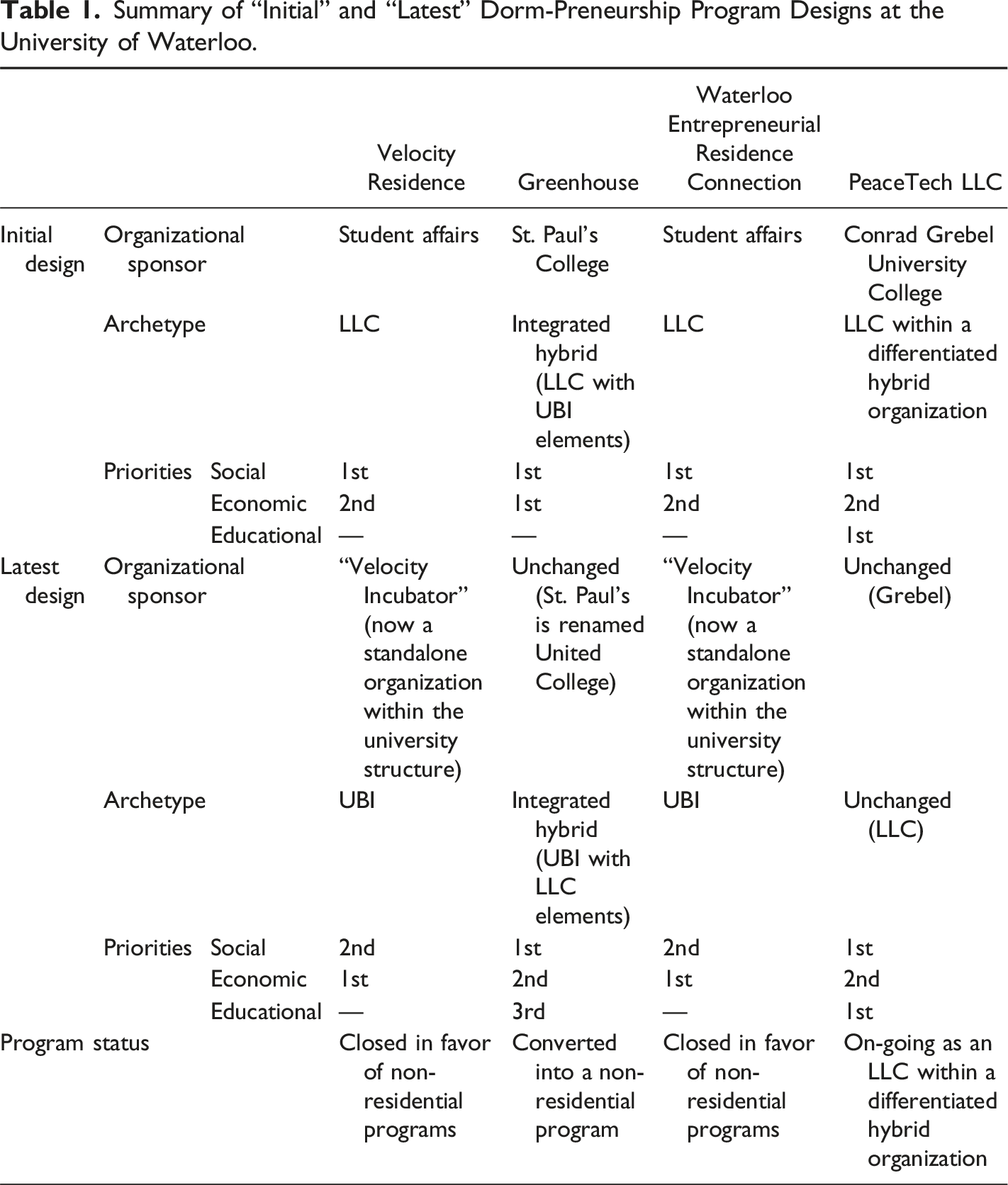
We saw Velocity Residence and GreenHouse both begin with the learning theory that residential communities—i.e., social interventions—will produce innovative/entrepreneurial outcomes. Velocity, and then WERC, both show us how dorm-preneurship programs that were initiated under this logic inside the field of student affairs might then drift toward archetypes from the field of business incubation and acceleration. Afterall, the Velocity organization went on to become the most famous Canadian UBI. In that UBI world, the most useful EE program designs are ones that instantiate and advance the biggest commercial outcomes—even when the scholarly literature shows this logic might be empty or counterproductive.
At GreenHouse and Grebel, we did not see dorm-preneurship giving way to a commercial incubation archetype. At GreenHouse, social and economic objectives were always recursive: community building led to social innovations/ventures—and those contributed to positive changes in a broader community. It seems that COVID19 undermined the residential aspect of the GreenHouse design. But GreenHouse also seems to have used this shock to build a more open community of social innovators. This is no longer dorm-preneurship, but social and economic objectives are both still central to this extra-curricular program. Meanwhile, Grebel’s Centre for Peace Advancement added an innovation LLC atop its existing social, educational, and commercial initiatives. These two organizations may have had an advantage in working through the conflicts of different institutional logics because their work was grounded in social entrepreneurship, where hybridization is a fundamental practice (e.g., Battilana et al., 2015).
It is hard not to notice that the only surviving entrepreneurial LLC at Waterloo arose from the success of an educational/academic initiative: the peace and engineering course taught by the Peace Centre’s Director. The other three cases were all initially designed as types of thematic LLCs—the learning was assumed to be extra-curricular. Even when GreenHouse added its courses, these were tertiary to building student community and supporting students as entrepreneurial change-makers. In this way, GreenHouse was successfully operating a kind of “integrated hybrid” (Ebrahim et al., 2014) where three potentially competing logics were addressed in one program. Meanwhile, the Centre for Peace Advancement at Grebel was being designed as a “differentiated hybrid” (Ebrahim et al., 2014). This means that commercial, educational, and social logics were being addressed within separate initiatives under the same organizational umbrella: the Peace Incubator, PeaceTech course, and PeaceTech LLC (not to mention its other related activities). Whether other programs follow the Greenhouse or PeaceTech approach, the tension among these different orientations must be addressed. Therefore, universities with dorm-preneurship programs would be well-advised to explicitly address the tensions in educational, social, and economic learning theories through either an integrated or differentiated approach (Design Principle 1).
Furthermore, those involved in (re)designing dorm-preneurship programs would be well advised to not ignore educational outcomes in favor of social ones. Notice that all the cases at Waterloo involved entrepreneurial learning. However, that learning was mostly separate from the university’s extensive and decentralized entrepreneurship curriculum. The LLC literature tells us that both student affairs and academic stakeholders must be at the table. Smith (2015) found that the negative unintended consequences of LLCs were exacerbated when these stakeholder relations broke down. Thinking back to Waterloo, we can see how this might happen when students are told by university staff that extra-curricular learning is better than curricular learning. This would advance the divisive faculty-student strife identified by Jaffee (2004, 2007) as a negative consequence of LLCs. It might even lead to faculty-staff strife across the curricular/extra-curricular dimensions. Meanwhile, the incubation literature tells us that an educational/university orientation is needed to address the negligible and possibly negative impacts of purely commercial incubation. Here too, an educational orientation brings value. And so, our analysis suggests that dorm-preneurship programs are likely more effective if they are not outside the curriculum (i.e., strictly extracurricular). Moving forward, dorm-preneurship program designs are best framed as ‘co-curricular’ rather than ‘extra-curricular’ (Design Principle 2).
Designing for Unintended Consequences
Unfortunately, Jaffee’s (2007) analysis suggests that all LLC designs will be subject to negative unintended consequences. These cohorts of like-minded peers will form strong social bonds and this will have both positive and negative implications. One answer is for universities to not engage in dorm-preneurship programming. This makes sense if we return to the corollary between honors LLCs and entrepreneurship LLCs. Remember that honors LLCs have been criticized for removing the influence of ‘the best’ students from the general student body. Some entrepreneurship LLCs might have a similarly negative effect: reducing the daily social interaction between the general student body and their most entrepreneurial peer role models. And, as was noted in the Velocity case, entrepreneurial LLC programs might lavish too much of the campus entrepreneurial resources on a small group of students. This concern was expressed to us in a more general way that might apply to all extracurricular entrepreneurship programs: …at the end of the day, most of these programs are enrichment activities, right? They’re again, enabling stars to do even more as opposed to being accessible to people who might actually have some really dramatic growth and learning opportunities but are struggling academically and the idea of participating in some cocurricular pitch competition is insane, because yeah they’re working a job, and they’re just struggling to get by in their classes, and so it’s, yeah, I think there are, there’s room for improvement. (Staff)
We agree that the design of these programs can unintentionally exclude and negatively effect non-participating students. Moving forward, those (re)designing dorm-preneurship and other extra-curricular EE programs should consider the possible negative consequences on students who are not their intended targets (Design Principle 3).
This brings us to what the four programs at Waterloo tell us about managing the unintended consequences for participating dorm-preneurs. We certainly did not hear about the problematic social behaviors and substance abuse cited in the LLC literature. (Although those arose in the short-lived pilot on our campus—and they cannot be described in detail for ethical reasons). Not hearing about these problems may have been a function of the institutional context at Waterloo. One staff person explained that, Well, our students are the hard-working students. Sure, they drink. But UW is known to be the school of the geeks, they barrel down, workhard, don’t really party. Whereas down the street at Laurier they’re more of like the partiers. (Staff)
At Waterloo, staff were more concerned about designing for student mental health. Not only did we hear that LLCs might address a sense of isolation for Waterloo students, but we also heard that both WERC and GreenHouse staff were being trained in mental health first aid. One student staff person told us, I would say that’s pretty important for the role because it’s a different set of stresses [these] students have because they’re typically trying to balance a full course load on top of starting their own venture. And it is a lot of work and a lot of energy and in that sense, you do need that mental health help, but it’s different than the first year where they’re transitioning into university for the first time and they’re like ‘oh my god what’s happening?’
We also had a student interviewee explain the personal pressures of dorm-preneurship this way: There is a bit of the tension between my GreenHouse community and my external friend group. And I do know people keep up with their friend groups still. But I do remember one student who was like, ‘this is like, this is tough,’ because that student was also going through a breakup in their relationship, and it was like, ‘I feel like my friends are making decisions and they’re hanging out with me, but they’re slowly leaving me out of the group because I’m not as available as I normally am because I’m working on my venture and I’m taking meetings with people and I have less available time.’ And the student was like, ‘I feel like they’re making long term decisions based off of, like, my short-term greenhouse experience.’ (Student)
But another student staff person suggested to us that one of the reasons she might have been hired to work on one of these programs was for her ability to address this challenge: …students also have to pass classes, but your venture is really cool. It’s hard to prioritize that. But I think that’s why I am here, not trying to ‘blow up my tires’ but I think I am kind of the person who can say ‘yes, work on your venture’ or also say ‘don’t forget about school’ or ‘go have fun.’ (Student Staff)
And so, while we did not hear about negative unintended consequences of dorm-preneurship at Waterloo, we did hear about faculty and staff working to intentionally design certain dorm-preneurship programs to address such consequences. Therefore, moving forward, we would argue that dorm-preneurship programs should be designed with intentionality toward the negative unintended consequences (Design Principle 4). As at Waterloo, this might be best addressed through the careful recruitment, selection, and training of program staff.
Conclusion
Dormpreneneurship programs have become an increasingly popular approach to extra-curricular entrepreneurship education. On the surface, they seem to be the highest order of campus entrepreneurial programming (Pittaway, 2021; Pittaway et al., 2020). And we certainly heard that these programs were effective in supporting Waterloo’s entrepreneurial identity: …the fact that there is someone living in residence that can talk to you about any of your questions about entrepreneurship really does help feed that certain buzz around that and helps with the recruitment of students to campus, … which is big for the University of Waterloo with the competitive housing market. We’re trying to continually show what we do that off campus housing doesn’t. And offering entrepreneurs in residence is definitely one of those things (Staff).
However, beneath the surface we can see that dorm-preneurship is not automatically the most “integrative” approach to campus entrepreneurship (Pittaway et al., 2020, p. 926). Indeed, just like other LLCs and UBIs, dormcubators take a variety of forms and yield a variety of positive and negative outcomes. Rather than blindly jumping on the dorm-preneurship bandwagon, we have argued that universities should design programs like these from an understanding of existing theory and practice. Our contributions here are twofold.
First, we are making a methodological contribution to the literature on entrepreneurship education. Our educational design ethnography approach allowed us to examine the explicit and implicit design theories found in four different variations on dorm-preneurship at this one university. If we had engaged in an autoethnography of our own design practice at our own institution, we would have been constrained by our own design theories. By ethnographically examining a set of four other program designs, we were in a better position to understand how different program designs have unfolded. This does not mean that our own ideas about dorm-preneurship were absent. Because we entered this context as self-conscious outsiders, we were well positioned to identify design principles that could have transferability beyond the University of Waterloo. This educational design ethnography approach is one of many possibilities for fusing ethnography and design research in entrepreneurship education. Like Kirsch (2022), we are excited about the methodological possibilities for ethnography and design; the many “hybrid alternatives that combine the value of deep or thick ethnographic knowledge with the novel and valuable opportunities offered by design research” (p. 5). We have contributed by demonstrating one such methodological possibility in entrepreneurship education research.
Second, we are making an entwined contribution to theory-and-practice through our four design principles. As noted in our discussion on method, good design principles should be abductively derived from rich understandings of both pre-existing scholarly knowledge and contextually situated design experiences. Good design principles should therefore also contribute back to both theory and practice. Our four principles can be treated like theoretical propositions by future researchers who are studying LLCs. But they can also be transferred directly into practice by those scholars and professionals working on similar extra-curricular entrepreneurship programs. Our principles suggest that dorm-preneurship programs will be better if they explicitly address conflicting design/learning theories, consider negative consequences for their intended and unintended student participants, and take a co-curricular rather than extra-curricular orientation. This last point is likely the most crucial. Without the anchor of an educational orientation, dorm-preneurship programs are likely to drift into either generic incubation programs or university-sponsored hackerhouses. The incubation and LLC literatures both tell us that these archetypes are to be avoided. If there is potential in the dorm-preneurship movement, we are convinced that it must be co-curricular. Here, we are agreeing with a Waterloo staffer we interviewed, who said, I would just say the pace and the rate of learning that I’ve observed in co-curricular activities, again some of it might be the nature of the students actively participating, but even there, like that is so much greater than what happens in a traditional classroom context, that just feels like it’s crazy for us not to figure out how to bottle that, and make more of that happen (Staff).
And we agree with another employee, who suggested that we might not always get EE programming right the first time, but we must keep iterating. She said, …when you make pancakes, the first pancake is always sort of like nasty, ugly, or it sticks to the pan, or it just didn’t turn out the way you wanted it to. But then you start making more pancakes and they start to form, and it becomes more uniform.
Laughing, we told her that we had burned our first ‘dorm-preneurship pancake.’ Now we know that our campus might just need to make a waffle.
Footnotes
Author’s Note
This research was funded by a Harrison McCain Emerging Scholars Award and by the Rath Professorship in Entrepreneurship, both at Acadia University. An earlier version of this work was presented at the 2021 Canadian Council for Small Business and Entrepreneurship virtual conference. Sam Sproule inspired us to pursue this research through her honors thesis. Thank you to Bailey Darling for his work as a research assistant on this project. Thank you to Dr. Paul Parker and the many research participants who welcomed us to the University of Waterloo campus and to Ross Munro of Dana Hospitality who arranged our wonderful meals. We have no conflicts of interest to disclose.
Declaration of Conflicting Interests
The author(s) declared no potential conflicts of interest with respect to the research, authorship, and/or publication of this article.
Ethical considerations
This study was reviewed and approved by the Research Ethics Board at Acadia University (REB #18-62) on November 6, 2018. The study was also reviewed and approved by the Office of Research Ethics at the University ofWaterloo (ORE #40322) on November 7, 2018. Site access was granted in writing by senior organizational representatives.
Informed consent
Individual respondents gave written consent before starting interviews, tours, and focus groups.
Funding
The author(s) disclosed receipt of the following financial support for the research, authorship, and/or publication of this article: This work was supported by the Harrison McCain Emerging Scholars Award and by the Rath Professorship in Entrepreneurship, both at Acadia University.
