




Abstract
This account of practice details an ongoing approach to entrepreneurship education currently being implemented at a large urban university in Toronto, Canada. The Music Den is an entrepreneurship incubator focusing on the music industry that collaborates with start-up businesses, music projects, industry, local communities and postsecondary students. The incubator deploys a pedagogical model that promotes self-direction and mentorship by way of adaptable curricular programming. The program design utilizes social constructivist principles to deliver a novel entrepreneurship education curriculum.
Start-up incubators and accelerators have proliferated on campuses globally, creating zones for entrepreneurship education. This paper describes the application of social constructivist principles to entrepreneurship education in one such start-up incubator. The Music Den is a university-supported music industry incubator that nurtures projects and nascent businesses while engaging its members through a pedagogical model that promotes self-direction and collaboration by way of adaptable curricular programming. Music Den programming is designed to create a confluence of self-directed study with targeted workshops and focused mentorship.
Based at Ryerson University in Toronto, Canada, the Music Den brings together undergraduate and graduate students, faculty, industry professionals, government and other stakeholders to create music businesses, services and initiatives. The goal is to develop innovative companies, creative professionals and an entrepreneurial community of learners. Students and non-students alike in the program aspire to work in the music industry, and through the Music Den they are able to develop entrepreneurial skills and work on projects directly within the music community by connecting to businesses, events and projects. The researchers have served as faculty and staff in the Music Den since its launch in 2016. This account of practice details the Music Den’s approach to entrepreneurship education and its impact on stakeholders in the university, the community and the Canadian music industry.
Literature review (pedagogical frameworks)
Entrepreneurship education
Throughout the last few decades, entrepreneurship education has become increasingly popular. There is vigorous debate over the definition of this relatively young field. Several scholars identify key gaps in research that offer potential to both define and understand the impact of entrepreneurship education. Programs have been categorized as being either; “for,” “about,” or “through” and/or “in” entrepreneurship. “For” entrepreneurship programs strive to prepare students as entrepreneurs and businesspeople. “About” programs help students develop a general understanding of entrepreneurial practice. “Through” or “in” programs provide an educational setting in which students learn through entrepreneurial practice (Mwasalwiba, 2010; Warhuus et al., 2018).
Higgins et al. (2013) view entrepreneurship education from a social constructivist perspective, which recognizes the importance of interdisciplinary knowledge and skill exchange as a framework for entrepreneurial learning. This provides a theoretical understanding of how students learn by interacting with others in their environment, and transfer knowledge through contexts. With this perspective, entrepreneurship education moves beyond in-classroom business education to become a process for growth and mindset development occurring outside the classroom through experiential learning. Morris (2019) echoes these sentiments, identifying the development of an entrepreneurial mindset and competencies—opportunity alertness, learning from failure, adaptation and more—as the most important area of entrepreneurship education.
Sörensson and Bogren (2020) studies the impact of people, place and process in entrepreneurial learning, and writes that the most effective programs are based in a different location than the traditional classroom. The location influences the brand of the program, and Sörensson advocates that students should be able to engage with, and critique, the community. This is similar to the approach of Higgins et al. (2013), who write that entrepreneurial education should reflect the daily variety of struggles and experiences that entrepreneurs face in their careers.
Nabi et al. (2017) performed an extensive literature review and identified key gaps in entrepreneurship education research. One key gap identified was a lack of pedagogical design frameworks, and a need for more research on connections between pedagogy and learning outcomes. These researchers also cite a dearth of studies with empirical designs that can be reproduced and validated.
Mwasalwiba (2010) calls for a more thorough understanding of the objectives of entrepreneurship education, and the impact on learners, educational institutions, community and other stakeholders. The majority of students who participate in entrepreneurship education pursue careers in the workplace and not as company founders. Given this situation, Mwasalwiba concludes that there has been too much effort directed toward creating start-ups and not enough aimed at understanding the personal student growth, pedagogical frameworks and institutional environments of entrepreneurship education.
Social constructivism
A seminal researcher and theorist of social constructivism, Brown (1994) views learners as active participants, creators and conductors on their own ongoing journey; not simply as passive recipients of knowledge patiently waiting for teachers to transmit authoritative information. This view mirrors the journey of many entrepreneurs through the processes of ideation, development, problem solving and growth.
Higgins et al. (2013) expand this view of social constructivism in the context of entrepreneurship education, suggesting that an entrepreneur’s reality is socially constructed through varied social interactions and behavior. This perspective views learning as a social activity and encourages entrepreneurs to identify narratives of how they build knowledge through interactions with others. The self is acknowledged in this knowledge creation process and illustrates how learning as a process of practice influences choices made by the entrepreneur. The Music Den’s curriculum and programming are designed to actively work with participants and offer social opportunities for learning, growth and discovery in a variety of curricular and pedagogical contexts (Nathan and Sawyer, 2014).
Aspiring entrepreneurs arrive at the Music Den with unique ideas, identities and a diversity of educational and cultural backgrounds. In the social constructivist context, these learners are encouraged to utilize their own understandings and develop new perceptions, ideas and skills that build on past experiences, unique contexts and opportunities for collaboration. A progenitor of this perspective, Vygotsky (1978), commonly considered the founder of social constructivism, characterizes “voluntary activity” as the primary distinguishing feature separating humanity from other animal species. He also saw learning as a “dialectical process” defined by irregularity and transformation within the interconnected nature of individuals and society. This is analogous to the nature of entrepreneurial growth and the necessity of working within local and global communities and ecosystems. An inherently collaborative and relational perspective, as Palincsar (1998) explains, social constructivism focuses “on the interdependence of social and individual processes in the co-construction of knowledge” (p. 345).
Vygotsky’s theory, the Zone of Proximal Development (ZPD), is the spectrum between learners’ present developmental level and their potential for growth when guided by adults or more advanced peers. When applied to the design of curricula for entrepreneurship education, where learners interact with peers, teachers, educational artifacts and tools, this approach can engage processes of learning for each student, regardless of current development or varied experience. Through individual inquiry and group collaboration, the ZPD perspective fosters learning for students of all levels, whose mental processes are developing and “are just beginning to mature” (p. 85). Vygotsky defines “higher psychological function” as the combination of “signs and tools” in learners’ psychological activity and physiological behavior. ZPD involves the variables of signs and tools regardless of manifestation as thought, language, symbol or technology. Recognition of the complex and dynamic relationships between learners, signs and tools is an epistemological foundation of ZPD.
Brown and colleagues (1993) theorize that learning environments designed with a ZPD framework can accommodate students’ distributed expertise. Students guide their learning in concert with peers, teachers and powerful technologies, including books, videos and computers. Technology continues to add new elements that need to be thoughtfully incorporated into classrooms and other community-oriented learning contexts.
Vygotsky argues that traditional educational perspectives institutionally assess student skills on a retrospective basis, grading current level of development and simply evaluating a standardized proficiency level. ZPD focuses on prospective development, interpersonally assessing the potential for growth. Learning outcomes include student self-assessment, retrospectively and prospectively, to identify strengths, weaknesses and strategies for development, and problem solving.
The Music Den: Overview
The Music Den is a business incubator focused on developing music technology projects and start-up companies. It supports early-stage companies and projects (for profit and not-for-profit) through education, mentorship, resources and a learning community that brings together educators, students, industry and government. The Music Den is part of Ryerson’s “Zone Learning” initiative, a model designed to “prepare students for the 21st century workplace by providing opportunities for them to work on real projects, causes, companies or startups” (Ryerson Zone Learning, 2020). The Music Den is housed in the Faculty of Communication and Design (FCAD), which includes degree programs in media production, journalism, interior design, fashion, theater and, relevant to the Music Den, a new Bachelor of Fine Arts in Professional Music (set to launch in 2021). Students in this faculty are both creative and business-oriented, and many strive to work as managers, executives or technical personnel in the creative industries.
For students and entrepreneurs, there are various ways to get involved in the Music Den. Entrepreneurs with their own start-up company or project can become members of the program. Through the program, they are offered mentorship, community and a range of resources including co-working and meeting spaces, studios and equipment, workshops, conferences and networking and showcase opportunities. Based on their needs, entrepreneurs generally take part in the Music Den program for anywhere from 4 months to a year.
Students who do not have their own start-up or project but are interested in developing knowledge and skills for the music industry can work as part of the Music Den in a variety of volunteer, internship and paid roles. Students are frequently matched to work with member companies based on their skills and interests. These roles usually start as volunteer or intern positions, as students often have to complete internship requirements to earn their degree. Over time, as the start-ups grow, these students can transition into paid roles. Beyond the member start-ups, the Music Den also connects students to internship and work opportunities with its steering committee members, who often look to Ryerson first when hiring students or new graduates (see Figure 1).
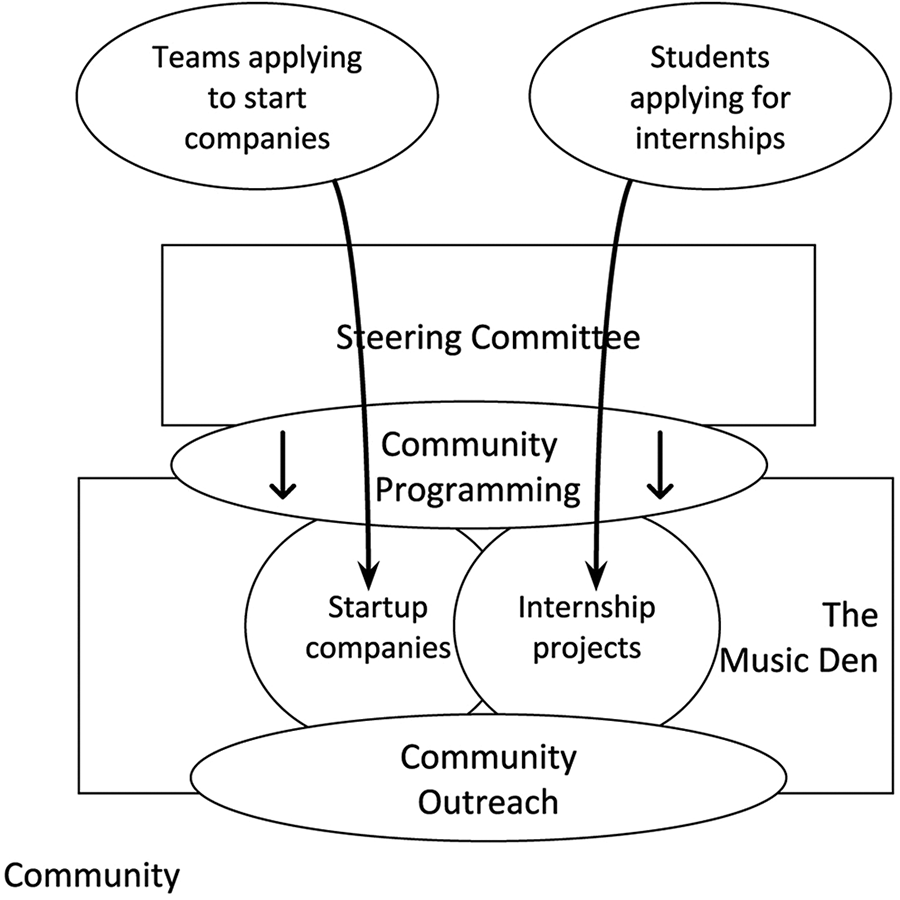
Music Den process diagram.
The Music Den integrates directly with the university curriculum, particularly in FCAD, working with faculty and classes to deliver experiential music business assignments and projects that give students an introduction to the industry and opportunities available through the Music Den. Students who want to further engage with the Music Den can work with entrepreneurs, start their own project and attend extra-curricular programming.
Staff and faculty work with participants to define what success means to them. Metrics of success may be selling a company or building a sustainable business, being hired as an employee or volunteer, or developing a portfolio or resume. In 2018, a digital artist development start-up company entered the Music Den with the goal of selling its software to a record label. The company’s founders leveraged the Music Den network to build relationships with key industry contacts and worked with Music Den mentors to make their product more appealing to their desired customers. After 6 months, the company was acquired by a major record label. By giving everyone a chance to reach their own level of success, the Music Den strives to develop a community that promotes self-direction, engagement, risk taking and reflection. Through the Music Den, a fourth-year media student developed a digital magazine focused on Canadian music, which she then used in her portfolio to help secure a job with a prominent music video production company.
Demand for music business education has been strong from these students. In an October 2018 electronic survey, 64% of students in Ryerson’s current media, production and performance programs indicated that they were “interested” or “very interested” in a career in the music industry. Potential careers cited in the survey included the business of music (artist management, marketing, legal and business affairs), music recording and sound production, and/or live music event production (Ryerson University Faculty of Communication and Design, 2019).
Similarly, there is high demand for skilled graduates in Canada’s music industry, much of which is centered in Toronto. In 2016, the city’s municipal government committed to a comprehensive “Music City” strategy to support the growth of music performance, business and education. The Music Den was launched as part of this initiative, developed in partnership with the City of Toronto’s Music Sector Development Office, as well as many of the largest music and media companies in Canada (including major record labels, live event companies, performing rights organizations, telecommunications companies, and technology companies). Music Den staff report to a steering committee composed of representatives from these organizations, as well Ryerson faculty and leadership.
The Music Den reflects Barth’s (1990) vision of education, who saw school as a community of learners, a community where everyone is engaged in the processes of teaching and learning. The Music Den is a community with several types of members learning and working together. It is a holistic approach to education and work.
Self-direction
The Music Den encourages the self-direction of its students, staff, faculty and industry partners and mentors. This type of experiential entrepreneurship education builds on students’ own interests and passions. This can create a high level of interest and a feeling of relevance, as students pursue their own life goals and entrepreneurial ambitions. Music Den participants are encouraged to identify their individual ZPD and work in conjunction with instructors and mentors toward their potential for growth.
Music Den staff and instructors act as mentors, guides and supporters, working to provide rich curricular and pedagogical scaffolding for students to learn, grow and reach their fullest potential. Music Den staff and mentors act as reflective practitioners, actively improving their practice, bringing their experiences into the classroom and reflecting on them to enrich students’ lives. Educators must simultaneously understand musical history and context and be up to date with the business’s current trends and technologies. Higgins et al. (2013) promote a social constructivist approach which emphasizes “inter-subjective exchange as a means of developing entrepreneurial learning” (p. 136). This pedagogical approach shifts the focus from traditional lecture-based entrepreneurial learning toward more experiential models.
The Music Den offers a communal list of educational resources: including books, magazines, journals, videos, podcasts and events. The use of these resources is not required; however, staff are deliberate in crafting their messaging of how these resources have helped past members—be it a foundational text on music technology, a podcast discussing lessons for young entrepreneurs, or an event opportunity to grow the member’s network.
Throughout the program, there is time built in for members to engage with these educational resources as they see fit. These individual moments are for reading, listening, studying and thinking, and can be rare in society today, especially in an industry like music creation, which promotes constant communication, collaboration and connection.
A technology Music Den member company, which created a guitar-effects amplifier and portable speaker, charted a self-directed path moving through the processes of prototyping, fundraising, manufacturing and selling the product. The company developed its technical and hardware-manufacturing skills in a self-directed way while leveraging the Music Den mentor network to develop brand footprint and grow awareness of the product in the music industry. During its time in the Music Den, the start-up raised over $800,000 in funding, and won several start-up pitching competitions. Today, the product is available in the marketplace.
Varied programming
With the emphasis on self-direction, there is minimal mandatory programming in the Music Den. Instead, programming is adapted to individual students and teachers, as well as more broadly to schools, industry and the community. With over two dozen mentors who have varied sets of knowledge, skills and experience in the industry, the Music Den is designed to respond and adapt to the needs of students and to provide a variety of resources, guiding them toward domain expertise. This approach allows students to work on projects and problems relevant to their interests and aspirations.
The Music Den offers variety in programming, both in-house and in collaboration with the other incubators at Ryerson University. Through Ryerson’s Zone Learning system, students can access a range of programming on general business topics, including business operations, finance, marketing, leadership and others. Within the Music Den, they access a host of music industry-specific programming depending on their interests and skill levels—this programming includes group workshops, one-on-one coaching, technical seminars, and more. Smith and Wilhelm (2002) write that options and choices regarding curricular content are important for student development. Participants bring their own conceptions, understandings and curiosities about music and the business that surrounds it, and this variety of programming helps them connect learning to their careers and lives, while simultaneously building their understanding of the music industry and their capacities to work in it.
The Music Den offers a number of opportunities for participants to engage with the industry, test their ideas and develop relationships and partnerships beneficial to their careers. These include social meet-ups and networking events, showcases hosted on campu, and opportunities to attend music and technology conferences around the world. This blend of in-class study and experiential learning helps encourage problem solving in different contexts, from tinkering with a technological concept to learning how to pitch ideas and build relationships.
A Music Den member group with an urban collective organization utilized Ryerson Zone Learning’s system of programming to learn and develop a sustainable non-profit model for delivering music production and design education to high school students. The group also received one-on-one coaching from a Music Den advisor and lawyer experienced in the non-profit sector. Through its time in the Music Den, the collective delivered programs in several schools across Toronto and built its own studio and workspace for evening and weekend sessions.
Mentorship
In the entrepreneurial realm, mentorship is one of the key forms of knowledge transfer and individual growth (Nabi et al., 2019). These mentors can take the form of many different stakeholders—from faculty to industry professionals and other students or entrepreneurs. The variety of potential mentors opens up opportunities that may have previously been unknown or unidentified by members and allows them to see several different models of entrepreneurial success.
Barth (1990) states that school is a context that encourages lifelong growth, not just for students but for teachers and staff as well. The Music Den has developed a circular mentorship model through which members can learn from each other—whether they are first-year undergraduates or 20-year industry veterans.
When new members enter the Music Den they are paired with a mentor. This person acts as their primary contact and guide throughout their time in the program. A member’s interests and skills are matched with a mentor’s expertise, experience and goals for being involved in the program. Throughout the program, these pairs are encouraged to develop autonomous relationships, which often range from bi-weekly phone calls to in-person meetings or social outings. Members and mentors who grow close will often continue working together beyond the end of the program, and many mentors have hired their mentees to work with their companies.
From the member’s perspective, an industry mentor offers a first-hand view into the business. The mentor often has decades of experience and can help guide the student through their learning and career. For the mentor, these relationships offer connections to ambitious and passionate young people who are eager to learn. Mentors often use the Music Den as a recruitment tool and a place to learn about and work with new music technologies. These connections, easily facilitated in this formal educational context, can be difficult to develop as an individual entrepreneur.
Music Den mentorships often evolve into long-term working relationships. In 2016, the incubator admitted a company that was building a youth-focused music streaming service which prompted users to engage with artists and advertisers through games on the platform. Though the start-up failed to gain traction, the CEO had built a strong relationship with his Music Den mentor, who in turn hired the former founder to lead innovation at a national music rights organization.
Collaboration
Collaboration is a 21st century skill and vital for the success of any entrepreneur (Ontario Ministry of Education, 2016). While the need for these 21st century skills is widely recognized, the impediment of outmoded pedagogical practices remains the challenge for innovators to overcome. And because collaboration takes many different forms, from the classroom to the workplace, a cohesive set of principles in the application of collaborative practice is elusive.
Peterson (1992) observes that many school activities involve groups connecting and relating to each other in a space about the size of a living room. This form of collaboration is a central feature of entrepreneurship education—exposure to a variety of new people, groups and viewpoints. Collaboration shifts the student–teacher relationship. In today’s digital age, in which each student has almost instant access to vast amounts of information via laptops and smartphones, the idea of the teacher as an all-knowing expert is diminishing. Ball (2000) states that the teacher must understand an argument, why it is made, and the counterarguments that can be made against it. Educators must not only understand content and context but must use these tools to connect to students and help them learn. This means representing ideas in multiple ways, connecting content and context effectively, and thinking about subjects in ways other than one’s personal experiences.
Music Den participants are encouraged to collaborate through monthly all-member meetings in which companies openly discuss their challenges, projects and ideas. These sessions often spark new collaborative projects. For example, in 2018 two Music Den participants found that they had similar target audiences, leading them to partner to create an event series through which potential customers would learn about and engage with both participants’ products. The companies reached an audience of hundreds and signed up dozens of paid clients while also using the event to capture promotional content, develop their email marketing lists and earn media coverage.
Reflection and conclusion
The Music Den is an example of entrepreneurship education engaging with a social constructivist pedagogy. Various stakeholders, including students, entrepreneurs and musicians, come together to broaden their understanding of, and situate themselves in, the music business and thereby expose themselves to the commercial, social and technological systems that undergird the industry. Participants set individual learning goals and timelines and work toward them alongside Music Den staff and mentors. They are encouraged to reflect on the reasons for their outcomes, be they successes or failures, and to plan for the future. The leaders of the Music Den, being ideological social constructivists, recognize the existence of a fund of knowledge that each member possesses and therefore provide an environment for each individual to access, then build upon, this knowledge fund through mentorship, reciprocal teaching by peers, community events and exposure to real-life activities. Social constructivism, then, offers a theoretical framework and a body of literature that inform the design of entrepreneurship education generally, and the Music Den curriculum specifically. This approach can sometimes lead to inconsistent outcomes at the participant level, which in itself is a necessary outcome in an entrepreneurial environment where failure is constantly absorbed, leading to new insights and approaches Such situations affect not only the group experiencing a setback but all other groups, which benefit vicariously by the trials and errors of others.
Darling-Hammond et al. (2005) writes that educators should understand the social context of their institutions and consider educational goals and purposes from a social perspective—both of the local community and broader society. The pedagogical theories used in the Music Den incorporate multiple stakeholders—including the school, students and industry. These theories and techniques could be implemented independently or as a whole in other entrepreneurship classrooms and educational settings. The Music Den offers an approach to experiential entrepreneurship education that combines the classroom, the workplace and the community, with the outcome being the development of innovative companies, creative professionals and an entrepreneurial community of learners. This style of program offers opportunities for students to build entrepreneurial skills, gain experience in the music business and work on projects directly in the industry.
Footnotes
Declaration of conflicting interests
The author(s) declared no potential conflicts of interest with respect to the research, authorship, and/or publication of this article.
Funding
The author(s) received no financial support for the research, authorship, and/or publication of this article.
