



Abstract
Extracurricular activities are increasingly being recognized for developing practical skills among entrepreneurial learners and connecting entrepreneurship curricula with real life. They offer socially situated learning experiences that can be cognitively stimulating and elicit reflective practices. However, the theoretical and pedagogical underpinnings of extracurricular activities in entrepreneurship are still in early stages, with their contribution towards entrepreneurship education requiring more empirical support. Moreover, current entrepreneurship pedagogies lack a much-needed integration of ecosystem actors’ inputs, who posses specific expertise with regards to extracurricular entrepreneurial activities. To address these issues, this study gathered the views of entrepreneurship mentors, consultants, and investors on the extracurricular activities that can be deployed to improve the skills of entrepreneurial learners, through conducting 22 in-depth interviews with experts from 13 countries across the world. We analyzed the results through a hybrid, inductive and deductive, approach. The experts recommended 34 extracurricular activities, that were discursively mapped against relevant learning theories: cognitive, experiential, social, situated, and existential. The study adds to the limited theoretical discussion on the origins of extracurricular activities and paves the way for theoretical evaluations in entrepreneurship education. It can aid educators in effectively integrating extracurricular activities in their curricula to better develop students’ entrepreneurial competences.
Keywords
Introduction
Entrepreneurship scholars and educators have researched and experimented with a plethora of approaches to teach entrepreneurship, to try to fathom what works, for which groups of students and why. Indeed, any approach, method or pedagogy used to prepare an audience of learners with the essential knowledge and skills to pursue an entrepreneurial career, could be labelled as “entrepreneurship education” (EE), according to Fayolle et al. (2006).
This study investigates one of the EE approaches that have not received rightful scholarly investigation, namely extracurricular activities (ECAs). It aims at analyzing the views of entrepreneurship ecosystem experts on the types of ECAs that can be used in EE, the benefits they bring towards students’ skills development, and discusses them against relevant learning theories, aiming at developing a typology of ECAs for EE.
ECAs have been receiving increasing interest in recent years (Beaumont et al., 2022; Gedye & Beaumont, 2018; Preedy & Jones, 2015). As their name imply, they do not form part of regular curricula and are considered complementary to classroom-based teaching. They contribute, however, to the learning experience of a specific course or program (Lilischkis et al., 2015; Vanevenhoven & Drago, 2015). They are led by students and driven by their interests, hence ECAs embody a heutagogical approach to learning (Hase & Kenyon, 2000, 2007). Through nurturing independent behaviors and actions, they can be deemed essential to developing entrepreneurial careers (Bacigalupo et al., 2016; Neck & Corbett, 2018). In contrast to traditional methods such as lectures and classroom-based instruction, which were shown to have little effect on developing practical competences (Hytti, 2018; Neck & Greene, 2011), ECAs are argued to incite entrepreneurial skills. They promote entrepreneurial intentions (Fayolle et al., 2006; Linan, 2008); expand social and professional networks (Preedy et al., 2020); enhance ECs (Padilla-Angulo, 2019), and enrich students learning experiences (Jones et al., 2015; Pittaway et al., 2015; Preedy et al., 2020). This is pertained to ECAs developing students’ skills through professional experiences, social activities, sports, and cultural events (Milner et al., 2016; Preedy & Jones, 2015). They, hence, firmly build on the premise of entrepreneurial learning as a socially situated phenomena that is better explained and enacted through a series of experiences and networks of interactions within enabling contexts (El-Awad et al., 2017; Howorth et al., 2012; Neck & Corbett, 2018; Pittaway & Cope, 2007; Pittaways et al., 2015; Rae, 2007; Toutain et al., 2017).
Despite their promising added value, there are several missing elements in our understanding of ECAs in EE. Firstly, we need further empirical insights on their possible utilization (Higgins et al., 2013; Pittaway et al., 2015; Preedy et al., 2020). Moreover, extant literature lacks enough theorizing of their nature, with scarce connections to learning theories (Arranz et al., 2017; Beaumont et al., 2022; Preedy et al., 2020; Preedy & Jones, 2015). It appears that most available studies apply an aggregate experiential logic to ECAs without much attention to other conjectures (Jones et al., 2015; Morris et al., 2017; Preedy et al., 2020; Shirokova et al., 2017), except for a few instances (e.g., Pittaway et al., 2011, 2015; Pocek et al., 2021; Politis et al., 2019). In addition, existing ECAs studies tend to solely focus on higher education institutions (HEI) perceptions (Lilschkis et al., 2015; Rae et al., 2012; Vanevenhoven & Drago, 2015) and classroom-based activities (Milner et al., 2016). However, EE processes usually involve several elements inside and outside HEIs (Brush, 2014), with the realization of EE benefits contingent on their effective collaboration (Isenberg, 2010; Kuratko, 2005; Lilischkis et al., 2015), and the successful inclusion of ecosystem actors (Bischoff et al., 2018; Galvao et al., 2020; Jones & Matlay, 2011; Wraae & Thomsen, 2019). Still, there is a dearth of studies incorporating ecosystem experts’ views in the EE process (Bischoff et al., 2018; Landstrom & Benner, 2010; Matlay, 2009), despite their specific expertise in ECAs and experiential activities (Ahmad et al., 2020; Gibb & Hannon, 2006; Wilson et al., 2009).
This study expounds on the types and benefits of ECAs for EE as recommended by entrepreneurship ecosystem experts. It discusses them against relevant learning theories, namely: experiential, social, situated, existential and cognitive, aiming at developing a typology of ECAs. It follows a qualitative approach though analyzing in-depth interviews conducted with 22 experts from different geographies, who have profound experiences in mentoring, consulting, and investing in startups (Amaral & Magalhaes, 2002; Bischoff et al., 2018), and identified 34 different ECAs accordingly.
The study enriches the scant literature on the nature, types, and potential value of ECAs (Arranz et al., 2017; Preedy et al., 2020). The proposed typology can provide a point of departure for the alignment of learning theories and different ECAs, and can spur theoretical discussions with regards to EE pedagogies and their evaluations. In addition, it adds cogency to the limited research at the nexus of EE and entrepreneurship stakeholders; extending its boundaries beyond HEIs walls (Bischoff et al., 2018; Lilischkis et al., 2015). It also highlights opportunities for educators to incorporate ECAs in EE, complementing classroom-based curricula. The paper is structured as follows. In the next section, we discuss the relevant literature and theoretical concepts related to EE and learning theories, and ECAs. We then explain our methodology, including sampling, research approach, and data collection and analysis. Following from that, we present our findings and discuss them against extant literature. We conclude the paper by highlighting its main contributions to theory and practice, its limitations, and propose future research avenues.
Literature Review
Entrepreneurship Education and Learning Theories
Entrepreneurship education programs and research have expanded in recent years and extended to include activities occurring in the wider ecosystem (Jones et al., 2017; Kuratko & Morris, 2018; Wenninger, 2019), such as ECAs. EE aims at developing the knowledge, skills, and behaviors of entrepreneurial learners (Fayolle et al., 2006; QAA, 2018), to support them along a variety of career choices, without being confined to the narrow venture creation path (Fayolle & Gailly, 2008).
With the rapid growth in EE, the pedagogical approaches have branched and diversified as well. One common approach organizes them into teaching about, for, or through entrepreneurship, along an incremental practical spectrum. Another approach classifies the methods used in EE largely into traditional (lecture-based) or experiential (activity-based) (Decker-Lange et al., 2021; Fayolle, 2018; Hagg & Kurczewska, 2021; Lackeus, 2015). EE, herein as a reflection of entrepreneurial realities, is a dynamic and multimodal field with a plethora of learning concepts that can help define its methods and activities (Fayolle, 2018; Gibb, 2002; Kuratko & Morris, 2018; Neck & Corbett, 2018). We hereby elaborate on some of those learning theories and concepts that are more relevant to ECAs.
Heutagogy
Heutagogy emphasizes human agency in the learning process, as the person embarks independently on an intellectual journey of discovery and experience (Hase & Kenyon, 2000, 2007, 2013; Jones et al., 2019). Thus, it aligns with student-centered approaches to education (ibid), which ECAs embody (Preedy et al., 2020), which instill a learning for self and for life mindset among entrepreneurship learners (QAA, 2018). According to Blaschke and Hase (2014); Gerstein (2014); and Hase and Kenyon (2013), heutagogical approaches have essential principles, which we argue that ECAs exemplify. These are: (1) learners are directly involved in planning and assessing their learning, and they are independent from the educator and the university, (2) educators have a rather supportive than controlling role, and (3) learning is non-linear, flexible, and focuses on practical applications of theory. Thus, the heutagogical orientation of ECAs suits the very core nature of EE, as a dynamic and experientially learnt discipline (Jones et al., 2015; Neck & Corbett, 2018).
Experiential Learning
Experiential learning (Kolb, 1984) has become one of the main pursued approaches to EE in recent years (Jones, 2019; Neck & Corbett, 2018). It provides a platform that facilitates the development of practical entrepreneurial skills (Cope, 2011; Neck & Greene, 2011; van Gelderen et al., 2021), which traditional methods like lectures and readings fail to support (Higgins et al., 2013; Kuratko & Morris, 2018; Tunstall & Neergaard, 2022). The student goes through cycles of learning experiences from which he extracts and internalizes new knowledge and skills and reflects on those episodes (Corbett, 2005; Robinson et al., 2016), to update his cognitive and affective readiness (Cope, 2005; Politis, 2005; Politis et al., 2019).
ECAs are commended for their contribution to develop learners’ competences through real-life experimentation and can thus be posited as emblematic of experiential approaches (Pittaway et al., 2011, 2015; Preedy et al., 2020; Preedy & Jones, 2015; Rae et al., 2012). They allow learners to project learnt theories onto engaging activities and reflect on their experiences (Gerstein, 2014; Hagg & Kurczewska, 2021), which is difficult to achieve in curricular methods (Blenker et al., 2012; Gibb, 1993; Nabi et al., 2017). However, there has been limited attention in literature to investigate ECAs-derived learning experiences.
Social and Situated Learning
Social models of learning are derived from two streams of logic induction. One is Bandura’s (1977) original postulation that learning happens through imitation of behaviors that lead to positive consequences (Bandura, 1977). In this regard, it resembles elements of vicarious learning (Robinson et al., 2016), that is, vicarious observation and reinforcement (Bandura & Walters, 1963), as in learning from role models. Wenger (1990, 1998) argued that another dimension of social learning occurs when subjects acquire knowledge and skills and recognize opportunities through transacting with their surroundings (Rae, 2007), following a community of inquiry (COI) model (Garisson et al., 1999). It encompasses four elements: identity development, learning by doing, reflecting on experiences, and community involvement (Lave & Wenger, 1991).
Learning truly happens among and through elements that exist within the context of the learner (Lave & Wenger, 1991), and is thus “situated” (Lave & Wenger, 1991, p. 35). Similarly, entrepreneurs learn through daily situations (Cope, 2003; Cope & Watts, 2000; Rae & Carswell, 2000), which are defined by their context (El-Awad et al., 2017; Pittaway & Cope, 2007). Hence, the direct environment forms an integral part of the learning process (Lans et al., 2008). Situated learning takes place in communities of practice (COP), among groups of people engaged in similar activities and aspirations (Lave & Wenger, 1991; Wenger, 2011). Learning in COP embodies a scaffolding or apprenticeship approach, as the novice gradually accumulates expertise through observing and interacting with more competent members and undertaking situated activities (Cope, 2005; Pittaway et al., 2023; Rae, 2002).
The social and situated learning conceptions posit that knowledge and skills flow through a myriad of situated social interactions (Wenger, 1990), rather than being imparted and transmitted in cognitive and behavioral approaches (Gherardi et al., 1998). They thus emphasize the role of context and networks as sources and facilitators for developing learner’s competences (Hanks, 1991). ECAs develop students’ skills through environmentally defined professional experiences and social activities (Milner et al., 2016; Preedy & Jones, 2015), They, hence, firmly build on the premise of entrepreneurial learning as a socially situated phenomena i.e. better explained and enacted through a series of experiences and networks of interactions within enabling contexts.
Existential Learning
In existential approaches, learners question and reflect upon the abstract reasons for their existence and engagement in various experiences (e.g., what and why?) (Marton, 1981). Existential learning is symbiotic to the reflective practices in experiential activities and extends to incorporate reflecting on oneself in action, in relation to others, and on existential matters. Consequently, learning becomes more meaningful and suitable (Mezirow, 2003) to influence a change in the learner’s identity, values, and orientation (Frick, 1987). Moreover, existential learning transcends knowledge and skills gains to effectively impact learners’ mental models, beliefs, and future choices (DeFillipi, 2001; Mathias et al., 2015; Mezirow, 2003). ECAs allow students to reflect on those multiple dimensions, and thus develop their knowledge base and adapt their skills and mindsets to entrepreneurial realities (Duval-Couetil et al., 2016; Pittaway et al., 2011).
Cognitive Learning
Cognitivism views learners as vessels to be filled with knowledge that is readily available (Fox, 1997; Freire, 2018), with learning occurring through the transmission from the source (educator) to the recipient (student), in a mechanistic approach. This model is still observed in some educational settings (Hagg & Gabrielsson, 2020; Robinson et al., 2016) that employ mass education techniques, such as lecture theaters and MOOCs, with the student assuming a rather passive role in the learning process. Cognitivism reflects a learning about entrepreneurship model which supplies learners with abstract concepts, theories, and information about the entrepreneurial process (Hagg & Kurczewska, 2021; Robinson et al., 2016). Hence, it is still regarded essential to the learning process (Bennett, 2006; Fiet, 2001; Gibb, 1993; Hytti & O’Gorman, 2004).
In summation, the richness and variety of ECAs allow for the exhibition of multiple learning concepts and modes through their enaction, as they are inclusive of an expanding array of activities (Arranz et al., 2017; Preedy et al., 2020; Preedy & Jones, 2015).
Extracurricular Activities (ECAs)
After briefly discussing common approaches to entrepreneurship education in literature, the relevant learning theories, and concepts, and hypothesizing their relationship with ECAs, in this part we elucidate on the current understanding of ECAs in literature.
Background
ECAs as activating pedagogies are receiving a growing interest from educators (Neck & Corbett, 2018; Preedy & Jones, 2017), as they support self-driven and experimental learning behaviors among students (Blaschke, 2012; Hase & Kenyon, 2000). Extracurricular activities, as their name suggest, are mostly initiated by the students, separately from the prescribed curricula (Souitaris et al., 2007). Still, their core purpose is to contribute to a course or a study program learning objectives (Milner et al., 2016; Preedy et al., 2020; Preedy & Jones, 2015, 2017). They can include cultural, employability, or socially oriented activities and tend to develop students’ practical entrepreneurial skills through active experiences (Milner et al., 2016; Pittaway et al., 2011, 2015; Rae et al., 2012).
Contribution to EE
ECAs foment students’ intentions, knowledge, and skills, and equip them with practice-based entrepreneurial competences (ECs) such as communication skills, leadership, teamwork, dealing with uncertainty, and perseverance (Arranz et al., 2017; Pittaway et al., 2015; Pocek et al., 2021; Politis et al., 2019; Preedy et al., 2020). They hence complement classroom-based EE (Lilischkis et al., 2015; Vanevenhoven & Drago, 2015). Moreover, Milner et al. (2016) argue that ECAs could help integrate remote learners with their educational institution, breaking the isolation and neglect spiral. Preedy et al. (2020) consonantly argue for a broader view of ECAs contributions as supportive instruments for personal development, employability, social and community engagement. Thus, echoing the wider definition of EE as an entrepreneurial learning endeavor (Fayolle et al., 2006).
Types of ECA for EE
ECAs feature a broad range of initiatives that occur either within the university or outside of it (Preedy et al., 2020; Souitaris et al., 2007). Arranz et al. (2017) attempted to classify ECAs in EE based on their role into cognitive-emotional (orientation); informative–formative (knowledge and competences); and instrumental support (resources). Although, they did not affix any ECA to those categories.
Additionally, several scholars developed elaborate lists of ECAs, such as startup projects, conferences and seminars, local workspaces and facilities, business simulations and company visits (Arranz et al., 2017). For example, Preedy and Jones (2015) and Preedy et al. (2020) identified several ECAs upon surveying and interviewing entrepreneurship education and support staff in UK universities. These include hackathons, seminars, mentoring sessions, guest speakers, student groups, grants, incubators, startup competitions, working spaces, and entrepreneurs in residence. Rae et al. (2012), reporting on an Institute of Small Business and Entrepreneurship (ISBE) led survey across UK universities, marked several ECAs including mentoring, awareness campaigns, support programs, legal and technical advice, funding matchmaking, and startup events. Pittaway et al. (2011; 2015) while investigating student-led entrepreneurship clubs and societies, cited entrepreneurship games, study exchange activities, mentoring, clubs and societies, workshops, business idea competitions, and incubators and pre-incubators. Moreover, Decker-Lange et al. (2021) in their world café study, discussed with participants several possible ECAs. The panels suggested advisory services such as coaching and startup clinics, competitions, networking events, exhibitions, and hackathons.
In conclusion, despite the evident scholarly efforts, research investigating ECAs in EE is still in its infancy (Preedy et al., 2020; Preedy & Jones, 2015). There are only a few attempts to categorize them (e.g., Arranz et al., 2017), while most studies either explored ECAs as part of a wider approach to renovate EE (e.g., Arranz et al., 2017; Decker-Lange et al., 2021; Higgins et al., 2013; Pittaway & Cope, 2007; Rae et al., 2012), or focused on specific types of ECAs such as student groups (Pittaway et al., 2011, 2015; Preedy & Jones, 2015, 2017), entrepreneurship centers and consulting (Zahra et al., 2011), or venture creation programs (VCPs) (Lackeus & Williams Middleton, 2015; Pocek et al., 2021; Politis et al., 2019). Moreover, the discussions in literature on the theoretical underpinnings of ECAs are limited, and mostly apply an aggregate experiential logic without much attention to other learning conjectures such as social and situated perspectives (Preedy et al., 2020). In addition, studies on ECAs are focused on university-based inputs, with limited attention to ecosystem actors’ views (Lilschkis et al., 2015; Rae et al., 2012; Vanevenhoven & Drago, 2015).
Methodology
Approach
This study investigates what ECAs can be leveraged to improve students and nascent entrepreneurs’ competence. It followed a qualitative approach by conducting in-depth semi-structured interviews, online with 22 entrepreneurship experts (Creswell, 2013). The decision to rely on ecosystem experts’ views is attributable to their specific expertise in ECAs and experiential activities for entrepreneurship (Ahmad et al., 2020; Gibb & Hannon, 2006; Wilson et al., 2009). The interviews were planned as lengthy dialogues to allow participants to reflect on their experiences with entrepreneurs and elaborate on their feedback regarding suitable ECAs, thus improving the quality of the narrative data collected (Sykes, 1990).
Sample
In selecting our sample, we relied on three groups among the external EE stakeholder’s categories developed by Bischoff et al. (2018): financial institutions (FI), support service providers (SSP), and incubators and accelerators (IA). We borrow the definition of an entrepreneurship expert from the Global Entrepreneurship Monitor as individuals who have direct involvement in the provision and evaluation of main components of entrepreneurial support mechanisms (GEM, 2023). The members of those groups are considered experts as they are closely supporting startups through mentoring, consulting, and funding on regular basis, through organizations outside HEIs (Amaral & Magalhaes, 2002; Bischoff et al., 2018).
Experts’ Countries and Roles.
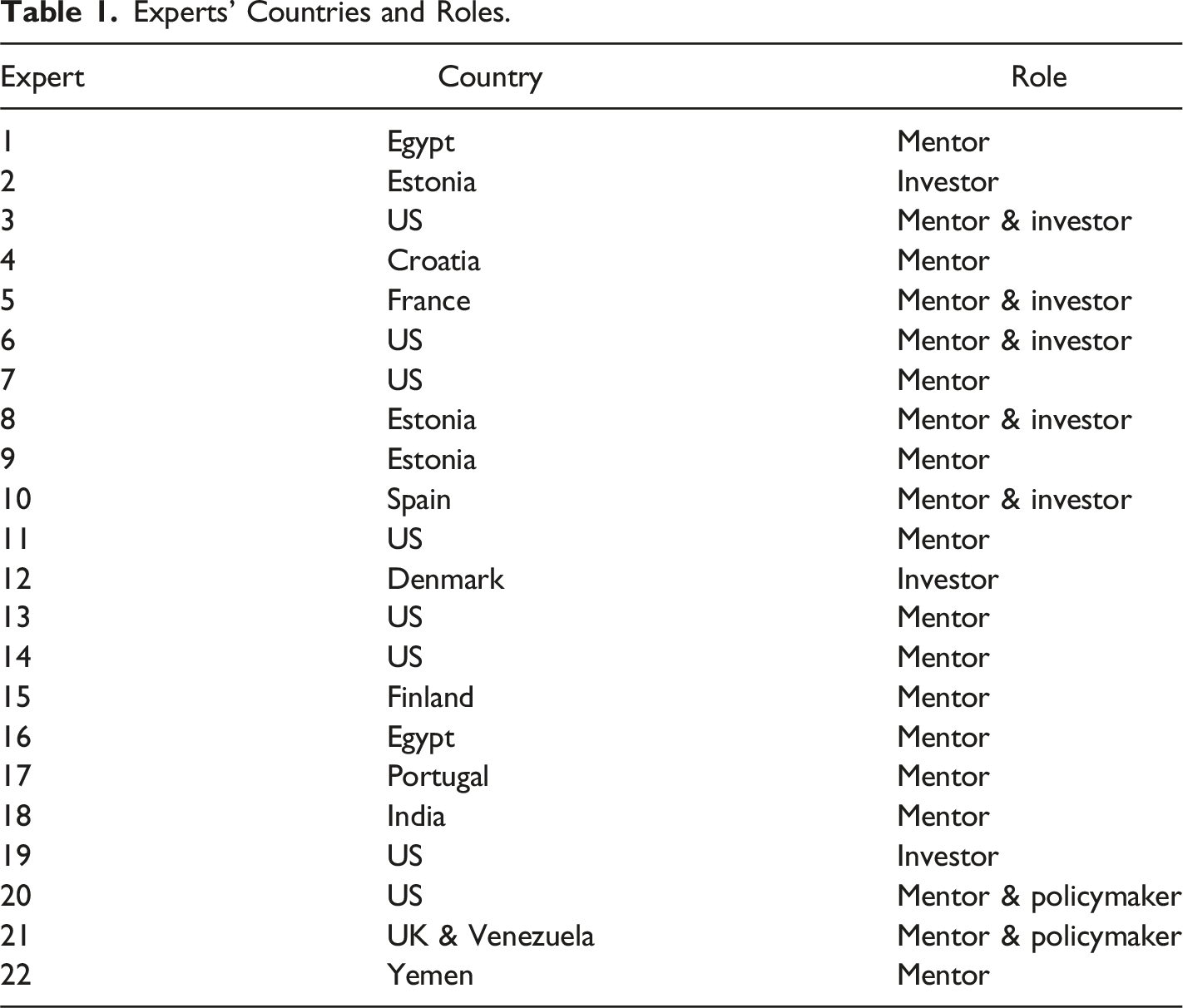
Initially, a list of experts based on author’s networks in the field was prepared (n = 87). Then, eligible experts based on the selection criteria were shortlisted and contacted (n = 36), with an additional eight recommendations received, bringing the total number of eligible experts contacted to (44). However, only half of the contacted experts responded positively to the interview request (n = 22).
Process
In the beginning, four interviews were conducted with different experts to test the question format and extract some good practices. The question settled upon after the initial phase was: “What ECAs can be used to improve entrepreneurial competences among nascent entrepreneurs/ entrepreneurial students?”
Interviews were held based on experts’ availability. Each interview lasted between 40 min and 2.5 h, as some experts went through specific personal and program experiences to provide context to their answers. We used online conferencing platforms: Microsoft Teams and Zoom, to conduct the interviews as most participants are in a country different from that of the interviewer. This also allowed us to record the interviews, after getting experts consent, and review them as many times as needed during the data analysis process.
Data Analysis
The data collection and analysis were conducted as an iterative process using manual coding. We applied a hybrid approach to thematic analysis through integrating the codes driven from interview data with those deduced from learning theories (Creswell, 2013; Fereday & Muir-Cochrane, 2006; Woiceshyn & Daellenbach, 2018). We first started with open coding, to identify codes. This was followed axial coding to build relationships between codes, as in individual ECAs and their benefits (Strauss & Corbin, 1998), as reported by the experts. We used an excel sheet, with a research assistant analyzing the data separately from the author. The identified ECAs (n = 34) and their benefits were reviewed and discussed several times throughout the analysis process between the author and the research assistant to enhance our understanding, refine the codes, and reach a consensus (Ritchie & Spencer, 2002).
The codes were then grouped into themes (Strauss & Corbin, 1998) derived from relevant learning theories. This approach provided us with theoretical guidance that can ensure the viability of our analysis and hence, the soundness of our proposed arguments (Robinson et al., 2016; Yin, 2015). The theming of ECAs by learning theories is demonstrated in Figure 1. In the following sections, the findings are discussed against relevant literature and theoretical concepts. A typology of extracurricular activities based on learning theories.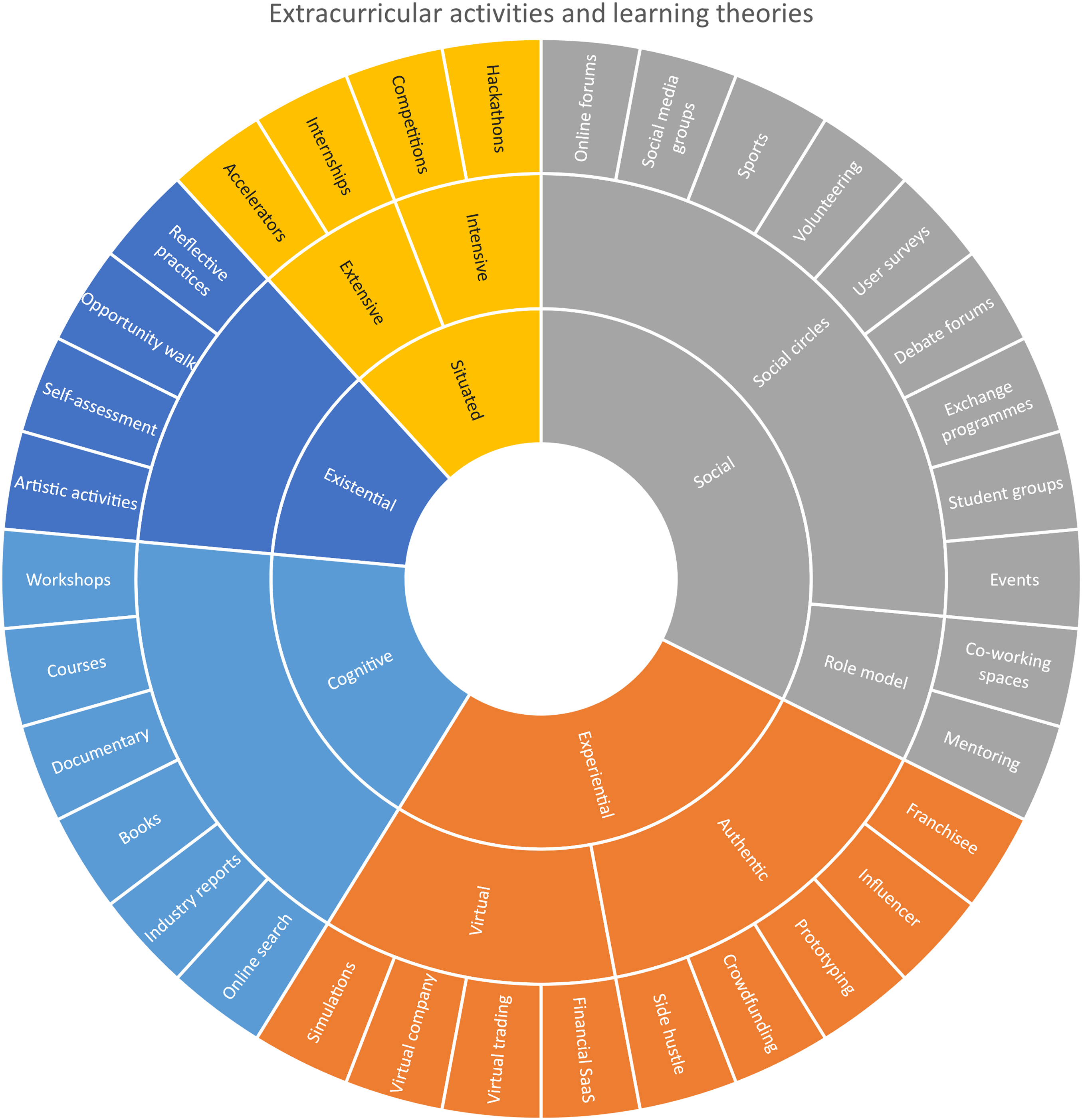
Analysis of the Findings
Through the interviews, experts identified and suggested a total of 34 different ECAs to improve entrepreneurial skills and competences of students. The ECAs were thematically grouped based on the nature of the activity, the intended purposes of engaging in it, and its context (Horsfall et al., 2001; Leininger, 1994) (see Figure 1). The themes were both inductively and deductively derived (Fereday & Muir-Cochrane, 2006; Woiceshyn & Daellenbach, 2018) to reflect pertinent learning theories and concepts in EE literature (Pocek et al., 2021; Politis et al., 2019; Robinson et al., 2016), and the codes driven from interview data. The experts’ views on ECAs in the following analysis were elaborated upon and enriched with direct quotes to establish adequate rigor (Rice & Ezzy, 1999), and supported by extant literature to improve its validity.
Cognitive ECAs
Students engage in cognitive ECAs to primarily acquire knowledge related to the entrepreneurial process (Arranz et al., 2017; Mitchell et al., 2000, 2002). Cognitive approaches are useful to educate masses of students about entrepreneurship in a rather standardised form (Bennett, 2006; Fiet, 2001; Hytti & O’Gorman, 2004), which is essentially what experts recommended them for. ECAs of cognitive nature suggested by experts include workshops, courses, documentaries, books, industry reports and online search.
Workshops and courses that focus on financial knowledge, were regarded as “important means to supply students with needed financial mastery.” They can improve students’ confidence and self-efficacy, and could be pursued through their own universities, another education provider, government agencies, investment providers or online via MOOCs. Moreover, workshops focused on developing communication, presentation, and public speaking skills were deemed advantageous in improving students’ ability to connect with existing and future team members. Watching documentaries, reading reports, books, and articles narrating startup stories, searching and following their news online was also recommended as a starting point to develop creativity, and identify and assess entrepreneurial opportunities by “learning from anecdotes.”
Experiential ECAs
ECAs of experiential nature exposes students to situations that are difficult to reproduce in classrooms (Preedy et al., 2020; Tunstall & Neergaard, 2022). They hence contribute substantially to the learning process and outcomes (Cope & Watts, 2000; Rae & Carswell, 2000). Experiential ECAs recommended by the experts were grouped into either virtual or authentic.
Virtual Experiential ECAs
Simulations expose students to business situations that mirror real life scenarios (Neck & Greene, 2011). In the experts’ views, these can include business simulations and games, virtual stock trading, virtual companies, and accounting/financial SaaS (free/basic tier). Essentially, gamified environments can help with “practicing doing financial forecasts and crunching the numbers for any idea they got.” They allow students to practice the different aspects of running a business including planning, marketing, supply chain management, taxation, investment, and payrolls (Kriz & Auchter, 2016; Newbery et al., 2016). Additionally, students tend to learn how to deal with uncertainty and risk, preparing them for the dynamic startup world.
Simulations are exemplars of experiential learning, where projected selves of participants (avatars) learn by doing in the virtual world (Dawley & Dede, 2014), test their plans and reflect on their decisions and experiences (Hew & Cheung, 2010). They emphasize learning by experiencing rather than consumption where the learner assumes a leadership position and learns from his decisions (De Freitas et al., 2010).
Authentic Experiential ECAs
Setting up a “side hustle” alongside regular education enhances students’ entrepreneurial knowledge and skills and builds their understanding and efficacy for managing a business (Neck & Greene, 2011). Several experts advised students “not wait until everything becomes perfect” and suggested several measures including starting an entrepreneurial project, launching a crowdfunding campaign, developing, and testing a prototype, becoming a social media influencer, or franchising an established business. Students can thus “live the different experiences a real entrepreneur encounters” such as opportunity recognition, team building, strategy, marketing, finance, and legal functions (Busenitz et al., 2003). For example, working as a social media influencer “teaches them everything as they manage their accounts from A to Z, more or less like a business.” Becoming a reseller or franchisee draws parallels with entrepreneurial venturing, as students will take responsibility for managing a project independently (Combs et al., 2011; Ketchen et al., 2011).
Moreover, building and testing a prototype, pushes students beyond their comfort zones. They develop an initiative taking spirit and learn to evaluate the feasibility of their ideas. As one expert said: “students should go out and try to sell a version of their products to people and gather feedback.” Similarly, launching crowdfunding campaigns allows them to practice establishing and marketing projects, as a risk-free opportunity to learn (Hui et al., 2014; Muller et al., 2013), and receive real-market evaluation of their innovative venture ideas (Chemla & Tinn, 2020).
Social ECAs
Social learning emphasizes the role of networks and relationships as indispensable assets for entrepreneurial learning and growth, through providing collaborative learning environments (Clark et al., 2008; Pittaway et al., 2011). Learning from role models for example, plays a role in the formative development of entrepreneurs (Fellnhofer, 2017), while participating in network-based activities, enhances the development of entrepreneurial skills through social interactions (Pittaway et al., 2015).
Several ECAs recommended by the interviewees build on the social learning principles. These are based on either interaction with role models, such as mentoring (guidance) and advice from experts in co-working spaces or through social circles such as student clubs and associations, customer discovery groups, exchange programmes, and events.
Role Models
Mentors possess greater level of entrepreneurial knowledge and expertise that they share with learners upon request (Robinson et al., 2016). They hence advance their ECs and self-efficacy (Fellnhofer, 2017).
Mentorship was the ECA recommended the most by experts, as having positive correlation with entrepreneurial progress (Kuratko et al., 2021; Morris et al., 2015). They perceive it as “invaluable” and “provides most competences and support an entrepreneur need” (Cope & Watts, 2000). Mentors are particularly valuable for advising on the formation and working of entrepreneurial teams and can help draft shareholder agreements and vesting schedules. They can “use their networks to connect cofounders with complimentary skills” and “advise and guide cofounders on how to work effectively together.” Moreover, mentors with industry experience and connections, facilitate access to specific resources and knowledge (Rigg & O’Dwyer, 2012). Similarly, young entrepreneurs can resort to co-working spaces as social support places (Spinuzzi, 2012; Winkler et al., 2018), to seek advice from experts and find team members as they are typically “charged with industry professionals, freelancers, and entrepreneurs.” It is worth noting, however, that the benefit of mentoring depends largely on the founder’s coachability (Kuratko et al., 2021).
Social Circles
Entrepreneurs rely on their social capital in acquiring knowledge and resources relevant to their projects (Holland & Andre, 1987; Rigg & O’Dwyer, 2012), while the social networks available to students through universities have always been a fundamental part of their learning (Buckley & Lee, 2021). Experts recommended several social activities that entrepreneurial students can participate in. These are events, student clubs, associations and debate forums, exchange programmes, volunteering and community work, social media and online forums, and sports teams.
They suggest that going to events and “speaking with people there” can help students find team members with complementary skills and advisors within their niche. They mentioned several types of events such as universities open days, startup events, meetups, industry conferences, and exhibitions. However, experts emphasized that students should “do their homework first” by researching the audience and practicing dialogues, thus improving their self-awareness and efficacy (Pittaway et al., 2011, 2015). Additionally, they emphasized the role of participating in group projects with defined goals through student clubs, associations, and debate forums. These socially oriented ECAs can help them improve their self-esteem, communication, and teamworking skills as they practice presenting themselves and working in dynamic groups. They will also practice persuading and influencing, learn from others’ experiences, and the networks they build will prove invaluable in accessing future resources (Buckley & Lee, 2021; Pittaway et al., 2011).
Several experts highlighted the importance of university exchange programmes in improving students’ cultural awareness and developing a global entrepreneurial mindset (Felicio et al., 2015), allowing them to work among diverse groups, and complementing their entrepreneurial curricula (Altbach & Knight, 2007; Minola et al., 2016). Most experts agreed that students should survey and interview their intended customers to identify their real needs and develop relevant solutions (Eisenmann, 2021), as “building products should be based on solving customers/real world problems.” It is inevitable that they will get negative comments, but this will make them more resilient and perseverant as they will “understand the realities of doing business.”
Volunteering and community work were another ECA suggested to develop students’ ECs (Clarke & Underwood, 2011). In the experts’ opinion, students get to interact with members of their communities and expand their social circles. They also develop some understanding of planning and implementing projects through transacting with their teams (Liszt-Rohlf et al., 2021). Moreover, playing sports was recommended to help improve the resilience and perseverance of entrepreneurial students (Marnoto & Carvalho, 2016), as “they know that today’s effort will pay you back in the future.”
In addition, experts advised students to share their ideas on relevant social media groups and online forums, as these are regarded communities of inquiries (COI) (Garisson et al., 1999), that facilitate knowledge sharing, collaborative idea development, and recruitment of potential team members with similar passion and complementary skills (Dron & Anderson, 2014; Ellison, et al., 2007; Garrison & Arbaugh, 2007).
Situated ECAs
Situated learning occurs when entrepreneurs get involved in COP, acquiring specific expertise and resources as they interact and learn from more experienced members, within a contextually defined environment (Cope, 2005; Rae, 2002). We classify situated ECAs recommended by the experts into two subcategories on a temporal scale. Intensive, and these are of a short duration, include hackathons, bootcamps and competitions, while more extensive ones include accelerators, incubators, and internships. Students’ involvement in these ECAs is a valid demonstration of situated entrepreneurial learning as they match startup environments (Gibb, 2002; Pocek et al., 2021).
Intensive Situated ECAs
Hackathons, bootcamps and competitions are intensive forms of situated learning, that have been receiving growing attention in policy and practice (Stolz & Sternberg, 2022; Syzmanska et al., 2020). They typically last a few days only. However, experts argue that they exhibit rich exchanges of knowledge and experiences among participating entrepreneurial actors (Passaro et al., 2017; Russell et al., 2008).
They “usually involve developing a business & financial model for their innovation,” an expert mentioned. Hence, students get to learn essential research, planning, and marketing skills (Schwartz et al., 2013; Tunstall & Neergaard, 2022). They were also regarded as “excellent opportunities to get used to preparing slides and pitching your idea,” improving students’ communication and presentation skills (Stolz & Sternberg, 2022). Students learn how to work together effectively under time constraints, distributing tasks and assuming leadership roles (Lans et al., 2021). They often “bump into others who share a similar enthusiasm,” leading to constructive dialogues. Students tend to develop better self-awareness and efficacy as they witness significant improvements in their planning, communication, and teamworking skills within a few days (Syzmanska et al., 2020). In addition, experts argue that competitions and hackathons act as “creativity beds” through developing problem solving and critical thinking skills, especially when they address specific challenges.
Extensive Situated ECAs
Accelerators and incubators can be viewed as an extended form of hackathons and bootcamps that spread over a few weeks or months. Nascent entrepreneurs get embedded within an entrepreneurial community of practice (Cope, 2005; Rae, 2002) and interact with like-minded people in socially situated learning environment (Kubberod & Pettersen, 2017; Lave & Wenger, 1991). Experts argue that students learn from their peers as well as the mentors and experts that deliver the different workshops and activities (Cope, 2005; Politis et al., 2019; Preedy & Jones, 2015). Here in, they improve their communication, presentation, teamworking, planning and management skills (Politis et al., 2019; Spigel, 2017; Williams Middleton et al., 2020). Moreover, they improve the motivation and perseverance of nascent entrepreneurs as they must “abide by certain milestones and deliverables.”
The potential for transforming ideas into viable businesses is influenced by the industry experience an entrepreneur possesses (Minniti & Bygrave, 2001; Reuber & Fischer, 1999). Hence, interning in an established business or a startup was one of the commonly suggested ECAs by experts to gain experience in a situated environment (Gault et al., 2010; Walmsley et al., 2006). Internships are regarded a form of apprenticeship; a coveted working experience for students (Simons et al., 2012). They provide guided learning experiences and equip entrepreneurial students with a variety of professional skills (Andriany et al., 2022; Ismail, 2018; Lantu et al., 2022). However, to avoid the “secretary” or “office boy” types of internships, experts recommended certain precautions. Internships must have clearly defined roles from the beginning and it is better if students work directly with decision-making executives or startup founders. Also, students “have to write a reflective report about their experience afterwards and what they learnt,” which follows the experiential learning premise.
Existential ECAs
Existential learners develop a deeper understanding of their identities, capabilities, and purposes, while revisiting and updating their convictions and values (DeFillipi, 2001; Marton, 1981). These are precursors to effective entrepreneurial learning and action (Bird, 1992; Cope, 2003; Neck et al., 2014). Learning activities of existential nature, however, are difficult to incorporate in curricular EE due to time and space constraints (Neck & Greene, 2011). Thus, it was recommended by experts to practice several ECAs that promote existential thinking and learning, outside classroom environments. These include reflective practices, opportunity walk, self-assessment tests, and participating in artistic activities.
Several experts recommended reflection to improve students’ understanding of themselves, their capabilities, and limitations (Brockbank & McGill, 2007). This was suggested whenever they conclude an activity or a task, to extract lessons from the experience they went through and improve their knowledge and skills (Neck & Corbett, 2018). Experts also argue that students should contemplate on the artefacts and events in their close environments through opportunity walks (Neck et al., 2014; Neck & Greene, 2011), that is, “try to observe simple problems at your household or neighborhood.” This will train them on identifying the root causes of problems and opportunities to design creative solutions, which are essential entrepreneurial capabilities. Experts also recommend self-assessment tests such as personality and ECs, to improve students’ self-awareness. This is especially relevant given the elusive nature of what makes an entrepreneur (Caird, 1993).
Participating in art activities, such as acting and theatre classes, were one of the few ECAs that experts recommended to improve students’ creative abilities that traditional EE pedagogies fail to address (Neck & Greene, 2011). Students “create character profiles and expand their horizons of real-life scenarios.” They go through the fictional scenarios in an experiential cycle of observing, practicing, reflecting, and learning (Heikkinen, 2002; Passila et al., 2012), which improves their self-awareness and efficacy.
In summation, the elaboration on the 34 ECAs that the experts recommended provide needed empirical insights on the benefits of ECAs towards developing entrepreneurial capabilities. Several learning theories and concepts were deduced and accordingly, the ECAs were organized against them through corroboration with extant literature. The preceding analysis of the interviews and dialogical exchanges with literature, thus provides a fecund ground for discussions on the theoretical alignments and benefits of ECAs within an EE context.
Discussion
ECAs have been receiving a growing interest from entrepreneurship educators (Neck & Corbett, 2018; Preedy & Jones, 2017), as they tend to improve the practical skills through active experiences (Milner et al., 2016; Pittaway et al., 2011, 2015; Rae et al., 2012). They promote independent knowledge and skills pursuit and development among entrepreneurial learners through embedding them in engaging and flexible socially situated experiences. ECAs thus play a complementary role to EE courses (Lilischkis et al., 2015; Vanevenhoven & Drago, 2015). This heutagogical orientation of ECAs is valuable in preparing students for the dynamic and experiential nature of entrepreneurship (Jones et al., 2015; Neck & Corbett, 2018). While consequently, ECAs are often explained through an experiential learning lens (Padilla-Angulo, 2019; Preedy et al., 2020), this study expanded the discussion on the theoretical interconnectedness of ECAs to additional conceptions, including social, situated, cognitive, and existential learning.
Throughout the analysis in the preceding section, it became more evident that entrepreneurship and entrepreneurial learning are essentially socially situated phenomena, that are predominantly experiential in nature (Politis et al., 2019; Rae, 2007; Robinson et al., 2016). ECAs can provide enhanced opportunities for ‘learning by doing.’ Thus, updating the entrepreneur’s knowledge, skills, and mindset through new experiences (Duval-Couetil et al., 2016; Pittaway et al., 2011). ECAs are also inclusive of the social and situated aspects through knowledge and skills sharing among networks of participants that are influenced and shaped by the context of their occurrence (Cope, 2005; Howorth et al., 2012; Lave & Wenger, 1991; Pittaways et al., 2015), which provide supportive environment for learning from and through others.
Moreover, the learning outcomes of these activities are augmented by existential reflective practices (DeFillipi, 2001; Gerstein, 2014). Existential ECAs hence exhibit a transformative role that transcends ECs development to upgrade learners’ identities, beliefs, and values (Frick, 1987; Mezirow, 2003). However, a transmissive approach of knowledge was still recommended by the experts, in line with extant literature (e.g., Hytti & O’Gorman, 2004), especially with regards to equipping students with basic financial and entrepreneurial knowledge through courses and workshops.
The conjoint nature of learning theories was exhibited across the recommended ECAs, when compared with literature. The dominance of one of them over others is thus situational and relies on the intended learning outcomes and the micro activities the learner participates in within in a specific ECA. For example, mentoring, a predominantly social learning phenomena where knowledge is shared between the mentor and the mentee, can also be framed as a situated learning mode when the entrepreneur steps into a mentoring network (Rigg & O’Dwyer, 2012) or mentorship is provided as part of an accelerator (Kuratko et al., 2021). Student clubs can also be seen as an experiential learning environment when learning occurs chiefly by working on projects (Clark et al., 2008). Also, traditional classes and workshops that are positioned as cognitive means for instilling theoretical knowledge among entrepreneurial learners (Arranz et al., 2017; Mitchell et al., 2000, 2002), can exhibit social learning experiences when they focus on developing communication and public speaking skills through practical exercises.
Research Contribution
The paper contributes to literature mainly through providing a basic understanding of the theoretical underpinnings of different ECAs for EE, as one of the few papers that focuses on this as its primary contribution (see also Pittaway et al., 2011; Poceck et al., 2021; Politis et al., 2019). By discussing and establishing relationships with different learning concepts, it demonstrates the versatility and richness of entrepreneurial learning approaches, more specifically ECAs, and provides much-needed rigor to the discussion on the theoretical origins of ECAs (Arranz et al., 2017; Preedy et al., 2020; Preedy & Jones, 2015). It also adds additional support to the broader EE pedagogies theoretical conceptualizations, when drawing parallels with this study, as called for by several scholars (Fayolle, 2018; Fayolle et al., 2016; Neck & Corbett, 2018). It can thus aid educators and researchers in understanding what could work and why (Robinson et al., 2016).
By providing an elaborate list of ECAs and outlining the value each can bring to ECs development (Morris et al., 2013), it enriches the growing stream of research on practice-based EE and its value in engaging students and equipping them with entrepreneurial skills (Galvao et al., 2018; Williams Middleton et al., 2019; Yi & Duval-Couetil, 2021). The study also opens the door for theory-based evaluations (Birckmayer & Weiss, 2000) to study the effectiveness of EE approaches and programs, by comparing the expected patterns of learning deduced from theories, against the nature and outcomes of the different ECAs. Theory-based approaches could prove beneficial in assessing the outcomes of an elusive and multidisciplinary educational field, such as entrepreneurship (Duval-Couetil, 2013; Pittaway & Edwards, 2012; Smith, 2015), and provide an alternative route to the prevailing economic (Nabi et al., 2017) and competency based (Morris et al., 2013) evaluations.
In addition, by relying on entrepreneurship ecosystem experts’ views, it supports their incorporation in the EE process as an important step to improving its outcomes (Isenberg, 2010; Kuratko, 2005; Lilischkis et al., 2015). This is especially relevant as existing ECAs studies, as to the wider EE literature, tend to focus on HEIs actors’ views (Bischoff et al., 2018; Rae et al., 2012; Lilschkis et al., 2015).
Practical Contribution
By leveraging the findings of this study and given the complementary nature of ECAs to curricular EE (Lilischkis et al., 2015; Vanevenhoven & Drago, 2015), educators can signpost their students to participate in different activities based on their competence profile to improve their attainment of ECs. This can further promote a student-centered approach to learning (Hase & Kenyon, 2000; Jones et al., 2019), which enhances entrepreneurial students’ engagement and drive better outcomes (Robinson et al., 2016).
For example, students with limited financial literacy, can benefit from blending cognitive (workshops and course) and experiential (simulations and games) approaches that were recommended by the ecosystem experts, to improve their financial knowledge and practical skills. Moreover, to those students having communication problems and/or lower self-confidence, several ECAs such as mentoring and participating in events and student groups, which are predominantly social in nature, can prove remedial. To cover for the experience gap among students, experts recommended activities such as interning, entrepreneurial projects, and community work. Moreover, to resolve the problem of idea-driven entrepreneurship, experts suggest that students engage in customer discovery, reflective practices, discuss ideas openly with others and online, and prototype their solutions to better identify real societal needs and build meaningful solutions.
Limitations and Future Research
The study relied on the entrepreneurship ecosystem experts’ views. While we critique previous literature for focusing solely on HEIs perspectives (Lilschkis et al., 2015; Rae et al., 2012; Vanevenhoven & Drago, 2015), a similar sampling limitation is true for this study. This can be avoided in future research by adopting a multidisciplinary sample featuring entrepreneurship educators and researchers together with ecosystem experts as in the world café study of Decker-Lange et al. (2021). It would be interesting to compare the views of the different groups as well, with regards to their recommended pedagogical approaches (ECAs). Moreover, the experts included in the study, although representing broad geographical backgrounds and diverse entrepreneurial expertise, were based on three groups among Bischoff et al. (2018) mapping of EE ecosystem. Future studies might want to expand its selection to include members of other groups.
The study is one of a few attempts to profile ECAs based on a learning conceptualization. We hence join several scholars’ calls for more discursive research of the theoretical backgrounds of ECAs (Arranz et al., 2017; Preedy et al., 2020) and EE methods in general (Fayolle et al., 2016; Neck & Corbett, 2018). Moreover, as the discussion of the theoretical grounds of ECAs in this study is based on our interpretation of extant literature, which might involve potential subjective bias (Horsfall et al., 2001; Leininger, 1994), we recommend that researchers adopt a more grounded approach in follow-up studies, to garner the perspectives of a broad base of experienced scholars. This can be achieved through applying a Delphi method, e.g., which was used effectively in studies of comparable purposes (e.g., Neck & Corbett, 2018; van Gelderen et al., 2021).
Conclusion
The paper discusses and proposes a typology of ECAs for entrepreneurship education, building on relevant learning theories and concepts, and comments on their benefits towards the development of entrepreneurial competences, based on interviews conducted with entrepreneurship ecosystem experts. It can help improve our understanding of the nature and value of these activities and provide rigor to the discussion on the theoretical origins of ECAs and similarly, the broader entrepreneurship pedagogies. The findings of this study can also help entrepreneurship educators, inside and outside HEI, better incorporate ECAs in their pedagogies and recommend them to their students.
Footnotes
Declaration of Conflicting Interests
The author(s) declared no potential conflicts of interest with respect to the research, authorship, and/or publication of this article.
Funding
The author(s) received no financial support for the research, authorship, and/or publication of this article.
