




Abstract
This article contributes to extending the current conceptualisation of entrepreneurial learning by challenging the assumption that entrepreneurial learning is solely embodied in the entrepreneur. Entrepreneurial learning is an emergent trend that involves a developmental approach to learning in acting on opportunities and experiences. We apply a social practice theory to entrepreneurial learning to advance understanding of the value of entrepreneurial thinking towards informal, experiential and aspirational learning. We position entrepreneurial learning within the social learning and social practice literature in the (1) alternative formats to formal learning, and (2) implications of entrepreneurial learning, as a social practice, for management learning and entrepreneurship education research. Based on a qualitative empirical analysis of a co-created entrepreneurial learning programme for ‘Stimulating Entrepreneurial Thinking in Scientists’, this study shows that entrepreneurial thinking can be expanded beyond the entrepreneur, and developed by others such as science, technology, engineering and mathematics scientists. With the drive for individuals to become entrepreneurial in their everyday practices, our study contributes towards extending the conceptualisation of entrepreneurial learning through insights from social practice theory. In addition, by understanding the value of entrepreneurial thinking, particularly via non-formal and informal approaches to learning, our research expands underexposed issues of entrepreneurial learning across diverse audiences, contexts and disciplines.
Keywords
Introduction
Science, technology, engineering and mathematics (STEM) scientists are rewarded for their ability to make specific contributions to academic disciplines, and this requires analytical thinking and looking for incremental progress, known as scientific learning (Besley and Nisbet, 2013; Jonsen et al., 2012; Rosendahl et al., 2015). The practice of learning to stimulate scientists’ ability to think entrepreneurially is known as entrepreneurial learning (EL) (Donnellon et al., 2014; Garbuio et al., 2018; Pittaway and Cope, 2007; Rae, 2005). While scientific learning requires precision, causality and specificity, EL is seen as the polar opposite, as it aims to expand opportunities, co-create experiences and generate new solutions from developing scenarios.
EL should be of paramount importance to STEM scientists because they can benefit from understanding business-led narratives, market behaviour and commercialisation of their innovations. One critical problem STEM scientists encounter is limited EL, as the relevant skills and competencies are usually missing, thereby hindering the application and commercialisation of their eco-innovations (Bosman and Fernhaber, 2018; Haynie et al., 2010). This problem persists for two reasons: first, the notion that EL is located only in the realm of the entrepreneur (Haynie et al., 2010; Rae, 2005; Williams Middleton et al., 2020) leads to STEM scientists’ detachment from business-led endeavours and their disconnections from emergent entrepreneurial trends in science and innovation. Second, entrepreneurial thinking has not been taught in most formal education establishments, where STEM scientists graduated (Williams Middleton et al., 2020), and less so in a non-Western educational system in West Africa, such as Ghana and Nigeria (Darley and Luethge, 2019), thereby perpetuating the cyclical nature of the problem.
There is furthermore a lack of accessibility to EL for STEM scientists since less consideration has been given to the way that learning occurs in individuals’ behaviours (Williams Middleton et al., 2014) and to developing ecosystems that encourage entrepreneurial thinking in individuals through situated learning practices (Bosman and Fernhaber, 2018; Gherardi, 2009). In addition, current literature highlights scant understanding of how, and why, scientists can embed entrepreneurial thinking in their everyday practices, in different disciplines, contexts, curriculum and geographies (Spanellis et al., 2021).
While existing research recognises the vital role of social interaction in making sense of EL (Brown and Duguid, 2002; Butcher, 2018; Howorth et al., 2012), we are not aware of any empirical and qualitative investigation on EL for scientific stakeholder audiences within an African research setting. Thus, this article advances understanding of the value of EL by challenging the current assumption that EL is solely embodied in the entrepreneur. In doing so, we draw on a social practice (SP) theoretical lens to deal with our research question, ‘how can social practice theory (SPT) advance understanding of EL?’ In following this line of enquiry, we explore how and why do STEM scientists embed EL in their work practices?
We particularly focus on how and why STEM scientists learn to stimulate EL, within a situated context of an industrial research institute in Ghana. STEM scientists from Ghana and Nigeria engaged in the co-creation of the EL programme ‘Stimulating Entrepreneurial Thinking in Scientists’ (SETS), shared their learning during the programme and experienced practices of ‘training the trainers’ within their organisations. Qualitative data analysis looked at non-formal and informal formats of learning, social interactions, relationships and the effects of the situated context in delivering EL. Our findings illustrate that STEM scientists can develop entrepreneurial thinking through an informal and experiential learning approach such as the model of EL co-created through the SETS programme. This realisation enables the socio-relational dimension of EL to emerge in scientists’ accounts and expands personal and professional aspirations, while not removing their unique ongoing scientific contributions. The findings also reveal that the non-formal nature of the SETS programme enables scientists to think about new possibilities that arose from working in a diverse and multidisciplinary cohort with other scientists, and show the added value and knowledge that came from such endeavours. The findings contribute to the conceptualisation of EL and identify the value of entrepreneurial thinking in STEM disciplines and how participation in SPs supports EL. Therefore, this study contributes to an advancement in management learning and entrepreneurship education (EE) by extending the current critical thinking on EL.
Why Entrepreneurial Learning?
EL is increasingly recognised as a critical element of the entrepreneurial process, and since the late 1990s it has become a key topic in the literature on entrepreneurial processes and practices of management learning (Rae and Wang, 2015). Defined as ‘learning to recognise and act on opportunities, through initiating, organising and managing ventures in social and behavioural ways’ (Rae, 2005: 40), EL is known to have the potential to change behaviours. Thus, to understand why individuals need and want to learn entrepreneurial skills (Haynie et al., 2010; Pittaway and Cope, 2007; Williams Middleton and Donnellon, 2014), it is fundamental to consider both motivations and EL approaches, as well as the situated context and the individuals’ background. Within EL approaches, we consider the cognitive approach that introduces the idea of knowledge structure; in other words, mental constructs that we use to accomplish personal efficacy in certain situations. These cognitive processes are related to how knowledge is received, used and processed, which make them highly relevant to entrepreneurial behaviour (Adomako et al., 2016; Garbuio et al., 2018). While the theory of social cognition is increasingly useful to help establish the phenomena associated with entrepreneurship behaviour, in general, and with EL, in particular, two limitations have been highlighted: first, the lack of explanatory features external to the entrepreneur such as context, time and materiality; and second, the restricted focus on studying the cognitive abilities of business-led individuals only, underestimating other kinds of entrepreneurs (Adomako et al., 2016; Garbuio et al., 2018; Rae et al., 2009). These limitations are problematic because more recent debates around the wider role of EE have highlighted a growing need to deliver EL beyond the domain of entrepreneurship (Bissola et al., 2017; González-López et al., 2019). This need has been empirically investigated, particularly across formal learning contexts, such as universities (Williams Middleton et al., 2019), in non-formal settings, like tech-led innovative industries (Pattinson et al., 2016), in schools following the global agenda for sustainable development (DeGhetto et al., 2016) and, more importantly for our study, in terms of natural science-related audiences (Bosman and Fernhaber, 2018).
Recent trends around EL emphasise the need for individuals to become entrepreneurial in their everyday practices, which is even more critical if they have organisational management responsibilities. However, there are issues around whether we can understand why individuals from a non-entrepreneurial audience need to acquire entrepreneurial competencies (Bosman and Fernhaber, 2018). Therefore, to develop a socio-relational understanding of the reasons behind the practice of EL, we situate EL within broader debates on the relationship between SP and situated learning. In conceiving entrepreneurial thinking and the respective learning as a socially situated everyday practice (Bissola et al., 2017; Howorth et al., 2012; Pattinson et al., 2016; Pittaway and Cope, 2007; Simpson et al., 2018), we position our study around the literature that addresses EL as a transformational trajectory, situated within a certain non-formal community or network, with the purpose of changing the way an individual’s entrepreneurial story gets told.
According to community of practice scholars (Handley et al., 2007; Lave and Wenger, 1991; Wenger, 1998), learning can be understood as the development of identities and practices through input in communities, networks or spaces across communities (Swan et al., 2002). Therefore, a situated learning approach can provide the background for social and transformational change that some STEM scientists associate with their trajectories (Bosman and Fernhaber, 2018). In an era of widening participation, we should endeavour to understand the overall environment and surroundings where EL can operate, not only to respond to Bosman and Fernhaber’s (2018) call to cultivate entrepreneurial mind-sets in the natural science disciplines, but also to contribute to reducing the imbalance in the Westernised approach to research on EE and management learning. With regard to the former, very little empirical work has been conducted on the value of EL for non-entrepreneurial audiences, across different contexts, geographical locations, and using alternative methods of learning and practices.
An attempt to fill this gap in the literature has been a recent focus on non-formal and informal formats of EL that offer the possibility of incentivising individuals to learn through the socialisation gained during university, or in the workplace, which often spans beyond those times (Williams Middleton et al., 2020). A recent study by Williams Middleton et al. (2020) sheds light on the importance of socialisation in the university setting, which enables relationships to be placed at the centre of the learning experience. The focus of this study is on social interactions in everyday learning routines. Williams Middleton et al.’s (2020) work, however, would benefit from an overarching perspective of how such socialisation requirements might apply in other geographical and contextual settings, which leads us to the second problematised gap.
Considering the imbalance in Western approaches to EL research, some scholars have sought to understand the overall landscape of practice from the audience to the space, including culture, context, social background and organisational settings (Bissola et al., 2017; Chalmers and Shaw, 2017; González-López et al., 2019; Pyrko et al., 2019). Darley and Luethge (2016, 2019) eloquently explain why we must reverse the imbalance. One recommendation from their most recent study states that ‘quality should be grounded in the socioeconomic and cultural background of the African context without a bias toward defining quality in Western standards’ (Darley and Luethge, 2019: 106). In addition, by applying Western standards to African societies, important management and business-related issues go unaddressed, particularly in a situated environment where EL is needed. Indeed, as collaborative relationships are formed organically, additional balanced relationships can also be created by individuals in their local contexts or communities to expand into their organisations. Pyrko et al. (2019), for example, offer a detailed description of how communities of practice and stakeholders relate within a larger context of practice, rather than relying on their limited knowledge. This viewpoint supports our argument that EL can be sustained when different disciplines and communities are exposed to experimentation.
Why is entrepreneurial learning in West Africa important?
The African Union recognises the relevance of EE to programmes as having the potential to empower individuals to take and own their decisions, by suggesting that the incorporation of vocational and technical training into universal education systems should include EE (DeGhetto et al., 2016). However, this suggestion has several challenges. For Mbeteh and Pellegrini (2018), stimulating entrepreneurial mind-sets in Sub-Saharan Africa is too theoretical. This challenge is lecturer-related, as most lecturers lack entrepreneurial experiences and business background; therefore, individuals focus on theory in detriment of practice (Echeonwu and Amaewhule, 2020).
While research on the importance of EE thrives, the literature on the challenges encountered, in efficiently developing such education, is scant in Africa. Hence, calls for a practice-based approach to EE have been made since it is about individuals’ experiences, the application of knowledge and their creative ideas (Mbeteh and Pellegrini, 2018). In addition, Hunter and Lean (2018) point out that education and learning institutions like universities, high schools and other training schools do not work closely with businesses, industries and communities. Hunter and Lean (2018) also shed light on the lack of, and need for, adequate learning facilities and materials – a critical challenge present in the African continent (Echeonwu and Amaewhule, 2020). When looking at the current situation on the implementation of EE in West Africa, Echeonwu and Amaewhule (2020) affirm that most African universities, particularly in Nigeria, are overpopulated with insufficient learning facilities and relevant human resources. Besides, the usage of local and innovative learning practices is lacking in most educational institutions in Africa, which are essential in the job-seeking market and in the growth aspirations of individuals (Hunter and Lean, 2018). In addition, some original features from the situated place can be used to foster EL – for example, the opportunity to spread the African local languages widely, as a unique selling point to differentiate communities and networks; however, this feature has rarely been used in the EL situated context, possibly due to an unconscious pressure by Western-led standards that tend to recognise the official language only (Darley and Luethge, 2019).
Due to the low income of most African countries and the fear of failing, individuals with entrepreneurial skills feel reluctant to undertake EL trajectories. Often, African individuals think that gaining employment is the best way to earn income and a good standard of living, which affects their process of thinking entrepreneurially. It may also damage the perception of EL as an inclusive tool that can widen participation and broaden the scope of transformational action towards societal development. In their study of EL in Kenya and Tanzania, Hunter and Lean (2018) call for alternative educational approaches to develop an entrepreneurial way of thinking, appropriate to the socio-economic context. Thus, while we can understand that stimulating EL in West Africa has specific challenges, this depiction alone does not give insight into what needs to change and how EL operates in a non-formal, situated learning environment. To do this, we can examine how EL, as a SP, evolves.
What is missing?
A Social Practice of Entrepreneurial Learning
Social theory dates back to the late 1960s and early 1970s, and has since evolved through the seminal work of critical scholars who have emphasised various dimensions, such as understanding social reality, its associations, agency and discourse (Foucault, 1972; Garfinkel, 1984; Habermas and Burger, 2008). Others have observed and examined individuals’ attitudes in perceiving the world (Giddens, 1979; Reckwitz, 2002; Schatzki et al., 2001; Shove et al., 2012). Investigations have used a SP theoretical lens in areas of work, organisation and technology (Pred, 1981, 2007; Shove et al., 2007, 2009), societal change, consumption (Shove, 2003; Shove et al., 2012) and climate innovation (Shove, 2014). Since its beginnings, social theory has been anchored on the idea that understanding the social requires an examination of the practices one encounters. Thus, a SPT places the unit of analysis in the ‘practices’ (Reckwitz, 2002). As an illustration, Reckwitz (2002) explains that ‘a certain nexus or interconnection of these actions, behaviours and routines – practices – affects the way social activity is undertaken in a specific place and time’ (p. 258).
Among the multitude of existing perspectives on practice theory, we draw on the SP strand advocated by Schatzki (1996, 2001), Reckwitz (2002) and Nicolini (2013). By using this approach, we are able to examine the layers and details of the practice under investigation, in our case, EL. For Schatzki (1996), ‘practice is the temporary unfolding and spatially dispersed sets (or nexuses) of doings and sayings’ (p. 96). This definition suggests that some actions perpetuate and continually extend practices temporally and that practices inevitably entail anomalies and complexities that may well jeopardise routine and regularity.
Nicolini et al. (2012) affirm that practices are carried out by humans, even if within a constellation of objects, and in so doing, they constitute fundamental and ‘meaningful blocks’ (p. 164). As an illustration, the practice of EL includes many different tasks, so that activities can be mobilised within those, such as engaging with participants while preparing the content and material for training sessions. EL includes many other practices, such as thinking, delivering, training, organising and creating, and these can sometimes overlap. In addition, these practices may not always have the same coordination across the organisation, setting or situated context. Collaboration in EL practice can face ‘simultaneous reconfiguration of multiple boundaries’ (Mørk et al., 2012: 264).
Therefore, to understand EL’s value, it is essential to disentangle its practices ‘element by element’ (Shove et al., 2012). The constitutive element of meaning relates to mental activities, emotions, aspirations and motivational knowledge depicted at every moment (Reckwitz, 2002; Shove, 2014; Shove et al., 2012, 2015). Competence is associated with notions of expertise, background knowledge, understanding, skills and techniques – with an emphasis on the ability to participate in multifaceted network of relationships (Gherardi, 2009; Gherardi et al., 2018). Materials are a constitutive part of the social and cultural environment in which an entrepreneurial mind-set operates, including a diversity of resources and artefacts (Nicolini et al., 2012).
To understand how STEM scientists’ learn entrepreneurial competencies, the above elements of meaning, competence and material operate within and across boundaries that are challenged in many occasions over time. This challenge can be illustrated through notions from the boundary brokering and spanning literatures. The latter describes individuals within a system that adopts the role of linking the scientists’ networks with external sources of information (Levina and Vaast, 2005). Boundary spanning applies to individuals linking practices from diverse arenas to each other (Mørk et al., 2012), and also between organisations with different sizes and resources. Key assumptions from these literatures suggest that paying extra attention to key tasks and roles are critical, particularly when challenges may affect the configuration of boundaries. Power relationships appear to be present across particular boundaries in the environment where STEM scientists operate (Contu, 2014). The concept of boundary organising implies navigation across the, not so well-defined, boundary between entrepreneurial and non-entrepreneurial practices. Mutual adaptation, negotiation and multiple reconfigurations of practice over time are some of the benefits of the concept of boundary organising (Mørk et al., 2012).
Situated Entrepreneurial Learning
Descriptive accounts of alternative approaches to formal learning, as a mechanism to unlock the full potential of individuals, remain unclear regarding the implementation of EL, particularly in scientists working across STEM disciplinary fields (Bosman and Fernhaber, 2018; Butcher, 2018; Haynie et al., 2010; Pittaway and Cope, 2007). Learning to think entrepreneurially can be understood as a SP that combines other approaches – non-formal and informal – as an alternative to the mainstream formal approach to learning. By formal learning, we mean an intentional form of learning, often assessed by a prescribed pedagogy and contained in a certain space or place (Amin and Roberts, 2008).
For example, individuals who have succeeded through formal learning will have received a respective certification indicating their qualifications, usually in the form of a degree. Likewise, non-formal learning is also an intentional and a structured approach, but often does not lead to a certification, and is not taught by an academic institution (Tuschling and Engemann, 2006). An example could be a training event or a thematic workshop, where there is to an extent some structure. Informal learning often results from a routinised daily practice without structure or intention (Rogoff et al., 2016). In this form, learning can occur everywhere throughout the day and is not prescribed nor assessed; thus, it does not lead to a certification. However, in their important examination of the above approaches to learning, Williams Middleton et al. (2020) show that the three approaches – formal, non-formal and informal – remain fundamental for entrepreneurial mind-set development. Our argument is, however, that Williams Middleton et al.’s (2020) proposed that a blended approach to EL neglects to consider the multi-layered society with minority ethnic groups of learners 1 : they may benefit from an informal approach to EL rather than a blended one. Moreover, there is a growing body of literature recognising that the delivery of EL mainly in a formal setting (Bissola et al., 2017; Simpson et al., 2018) brings incongruence to the contemporary view of EL, defined as socialised and experiential learning (Chalmers and Shaw, 2017; Currie et al., 2016; Scott et al., 2016). It is possible that this incongruence arises from EL being seen as primarily concerned with content knowledge (Fox, 2009; Pittaway and Cope, 2007), perceived performance (Clarke, 2011) and resilience (González-López et al., 2019).
In the context of EE, Handley et al. (2007) suggest that learning and knowing are integral processes to everyday practice, thus encompassing the aspects of practice and action. These aspects are strongly interconnected, so that situated learning (SL) challenges previous cognitive approaches, where one learns a static object of knowledge and disregards the influence of the social, relational and contextual surroundings in the learning experience. Learning is a cognitive and social activity that tends to occur in, within and for a community of practice (Gherardi et al., 1998). We take as a starting point the SL conceptual framework, as it was originally devised, as a ‘cognitive and a social activity’ (Gherardi et al., 1998: 273).
In reviewing the literature, we have drawn on notions beyond SL to suggest ways of how scientists may socially experience the practice of EL and to discuss how a SP lens can advance understanding of EL in West Africa. While the relationship between situated informal learning and societal transformation is of paramount importance (Fox, 2009), we know little about that relationship in West Africa. Drawing on social learning, we have acknowledged a practice view of EL (Nicolini, 2013; Reckwitz, 2002). As a result of these combined perspectives, the ‘boundaries’ of the academic setting are slowly removed and replaced with experiences, meanings and connections. Thus, we propose that EL holds the potential to create everyday routines that challenge mainstream pedagogies and learning approaches. In conceptualising EL from a SP perspective (Nicolini, 2013), we discussed three elements, constituents of practice, that enabled a stronger generative EL trajectory to evolve across different situated contexts (Butcher, 2018). In analysing the empirical findings of our study, we illustrate how the elements of meaning, competence and material interweave. We explain the empirical setting of this study in the next section.
Research design
Research context
Our study is about a West African context in STEM communities from Ghana and Nigeria, where entrepreneurial thinking was needed and co-created. The first trial of the ‘Stimulating Entrepreneurial Thinking in Scientists’ (SETS) programme was developed in June 2016 in response to a UK Natural Environment Research Council development and training programme and ‘added value activities in innovation’ call. This resulted in the delivery of the UK pilot of the SETS programme in a university, in the United Kingdom, in 2016. The success of the UK SETS programme indicated that it could be delivered in different contexts and as such formed the basis of the future SETS programmes delivered in some of the UK partner universities, in Ghana and Nigeria.
In 2017, a large scale proposal was submitted by Lancaster University to the Research Councils UK, through a specific fund: Global Challenges Research Fund (GCRF), with the main goal of promoting high-standard interdisciplinary research to addressing the main challenges in the Global South (RECIRCULATE: Driving Eco-Innovation in Africa: Capacity Building for a Safe Circular Water Economy, 2017). ‘RECIRCULATE’ is a £7 million international programme that aims to develop strong and equitable inter-organisational collaborations between the United Kingdom and African communities, and includes four interlinked environmental science work packages, as well as a crosscutting entrepreneurship and innovation work package.
In this context, the need for entrepreneurial thinking was originally prompted by one of the partners’ institutions in Ghana, the Council for Scientific and Industrial Research (CSIR), as they were required by their government to start generating revenue from their scientific knowledge to become more sustainable. Council for Scientific and Industrial Research (CSIR, 1958) is the foremost national science and technology institution that is mandated to carry out scientific and technological research for national development. The demand for implementing EL was made to Lancaster University by two directors within the CSIR network. As a result, the SETS programme was co-created in close collaboration with these partners and constituted a non-formal learning environment. The SETS training programme took place at the Food Research Institute (FRI), in Accra, Ghana (henceforth referred to as ‘Ghana SETS’), whose participants came from outside Accra and some from Nigeria – thus, the initial reference to West Africa as the situated context. Participants were scientists, mainly across STEM disciplines, but not exclusively, as the CSIR invited some practitioners, industry affiliates and community users to attend the SETS training. Henceforth, and to ease understanding, the participants in the Ghana SETS programme are referred to as ‘STEM scientists’. To ensure anonymity we used pseudonyms, when required.
The initial SETS programme was adapted to respond to the needs of the CSIR in relation to stimulating entrepreneurial thinking in their staff members. For this programme, the idea was to implement a phased programme, comprising three ‘training the trainers’ type sessions: two residentials and one virtual session. Table 1 shows the respondents and relevant features of the SETS programme.
Respondents in the SETS programme.
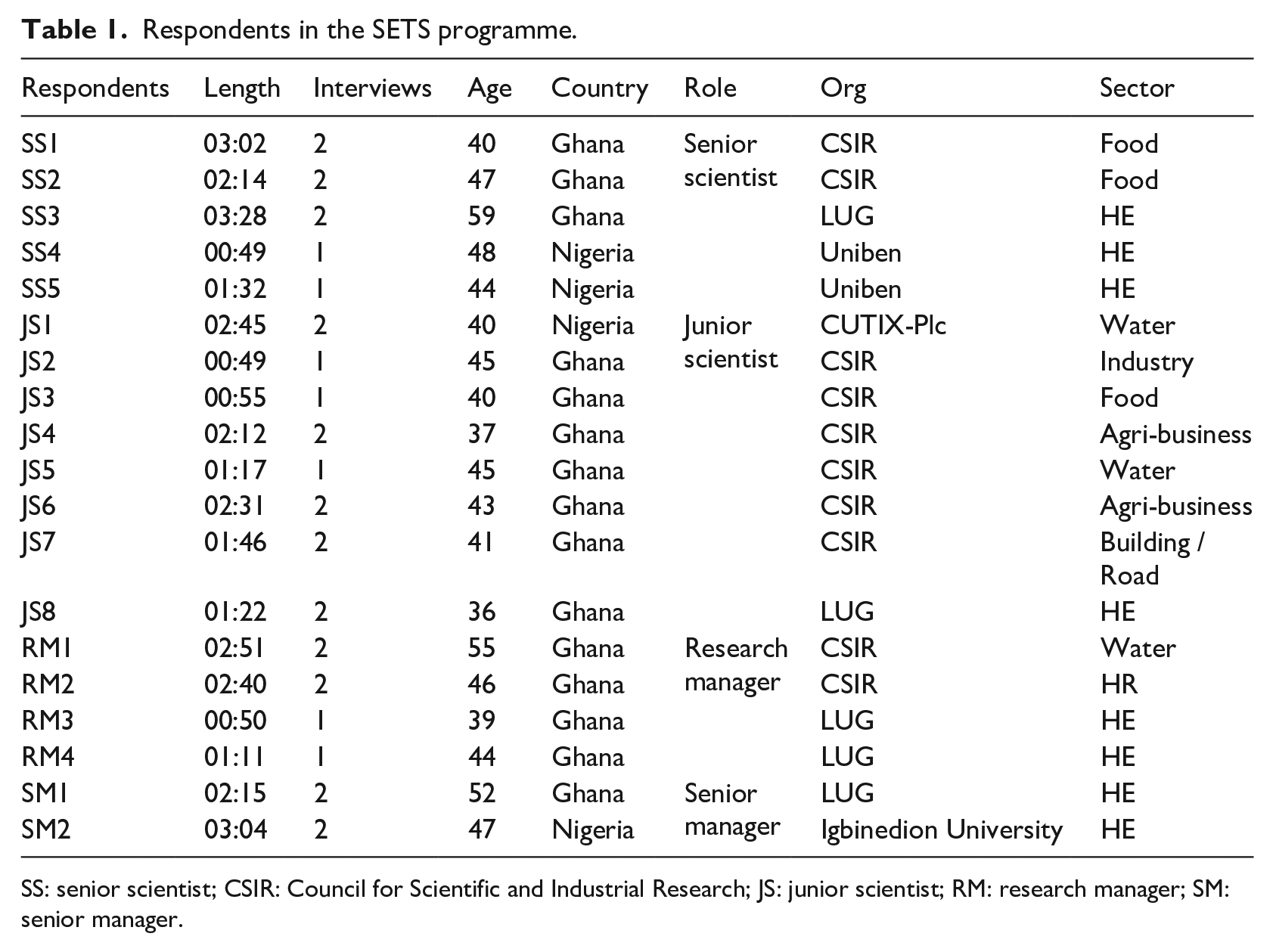
SS: senior scientist; CSIR: Council for Scientific and Industrial Research; JS: junior scientist; RM: research manager; SM: senior manager.
Research methodology
This qualitative study combined participant observation with interviews, using a conversational approach to data collection (Creswell, 2007; Silverman, 2011). Throughout the research, we remained a collaborative team by staying attuned to the application of practice theory, as well as data collection and interpretation to understand the value of the current conceptualisation of EL. In addition, we sought to account for our assumptions about formal EL, by examining how, and to what extent, natural scientists value alternative formats of experiential and aspirational learning. Although many studies on EL have used a qualitative research design, the literature on SP reminds us of the importance of interpreting different situated contexts (Shove et al., 2012). Hence, our study adopted an interpretive, inductive approach (Huberman and Miles, 2000), specifically chosen to allow us to generate an in-depth understanding of the practice of EL in scientists. Our intention was purposefully aimed at investigating the practice of scientists, in the way we could explore learning among individuals from various managerial roles within their organisations (Creswell, 2007).
Learning within the SETS programme was aligned with an active construction of knowledge by each scientist and individual (Handley et al., 2007). It was a socially situated mode of learning. In addition, we aimed to generate knowledge about this programme’s learning trajectory and how it evolves over time by investigating the extent to which this learning experience enabled a sense of participation, identity and practice of EL. For example, what forms of participation within the methodology of the SETS programme enabled individuals to develop their entrepreneurial competencies?
Data collection
To obtain the sample for this study, we visited three of the 12 CSIR affiliate institutions: FRI, Industrial Research Institute (IRR) and Water Research Institute (WRI), following three key criteria for selecting the most appropriate institute to take part in our study (the institute had to have research-led evidence; the managing director or board was available and willing to give their time and their employees’ to the research progress; and participants and/or the manager had to articulate their rationale on the critical role EL could play in the STEM scientists’ personal development and growth). In responding to this sampling criterion, FRI was of particular interest for the practice of EL. The institute had since its origins led a consistent approach to research and innovation, not only in the production of research outputs but also in innovating their equipment to increase the quality and reach of their work for societal impact. The leader was proactive and perceived as an exemplar role model among their peers and across other institutes. This leader had also shown interest, availability and commitment to embark in a thorough research process and to participate on an EL journey. As a result, we purposefully decided to work closely with them (Huberman and Miles, 2000; Patton, 2002). FRI’s participants were therefore chosen for what they brought to developing theoretical insights on situated EL.
For our starting point, we used observation because this offered rich data on interactions, which might enable or hinder individual learning. Our study followed the SETS programme held in Ghana, between February and September 2019, from its co-design stage for over three participant observation sessions with 40 attendees, totalling 42 hours approximately. Field note entries were captured on a researcher’s log during the sessions, and other relevant information were noted during discussions, events and meetings.
To capture a robust account of participants’ experiences, we observed what participants – the STEM scientists – did in the sessions (Silverman, 2011). These observations were followed up with interviews designed to explore ‘what they think they did’ during those sessions. By exploring ‘what they said they did’, we were able to depict relevant accounts, reflections and contradictions in relation to the willingness of individuals to stimulate their mind-set through a combination of different learning experiences. We also invited participants to keep journals in which they reflected on the learning journey they engaged in. These reflective journals were explored for details relating to the analytical themes. From here, we were able to generate new insights about the learning journey as the interpretative process evolved. A co-author also validated the themes we were identifying by returning to our respondents and sharing our initial thoughts with them. We used this to support triangulation and verify that the patterns we saw in the data reflected the actual situation. The different sources that we used provided a good picture of what was going on and also provided methodological plurality, supporting the triangulation process (Silverman, 2011).
In addition, we conducted 31 semi-structured interviews with 19 respondents. We had more than 1 interview with some participants for clarification purposes. We took a conversational approach to interviewing (Creswell, 2007), which allowed individuals to share part of their personal and professional journeys and the triggers to initiating entrepreneurial journeys within their institutions. These individuals not only responded to our interview questions but were also highly participative throughout the data collection period. For instance, they were keen to ‘train other trainers’ and shared a willingness to replicate the model of the SETS programme in their own organisations. The lead researcher collected data over the following three phases, as illustrated in Figure 1.
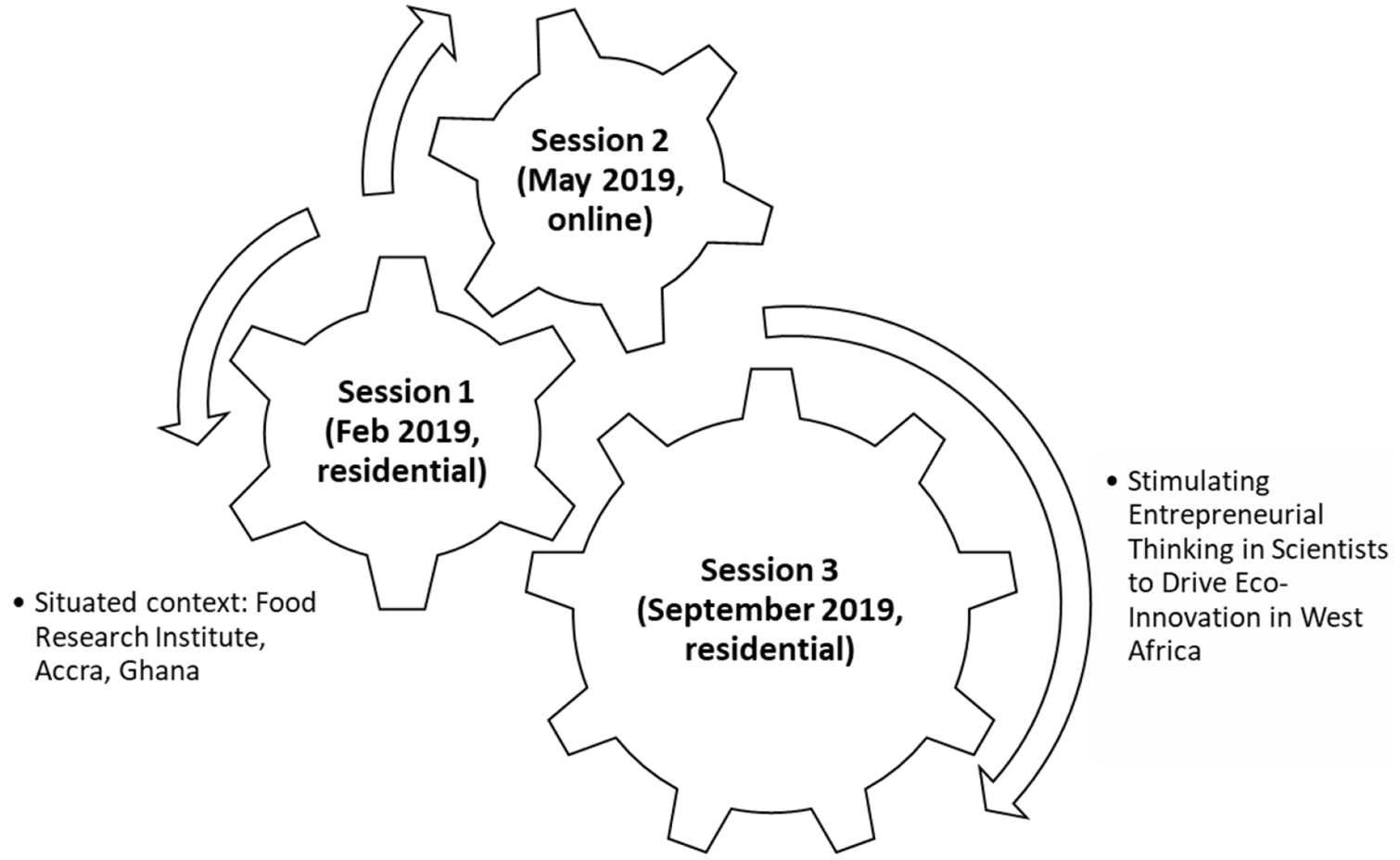
Research timeline – SETS programme in Ghana.
Data analysis
Data were analysed in stages using an inductive approach and we started by searching across all data for identifying themes, associations or/and interesting connections on the practice of EL. Second, the first author organised the descriptive data using an open coding approach to identify segments of text that could describe EL and its practice, to assign descriptive codes. In this phase, data were shared with the second author to discuss, revise and assign meaning to the descriptive codes, so that an identified segment became a category, and subsequently a theme. For example, there was a code that we described as ‘change is needed’ but as the analysis progressed it became clearer that by reflecting, from a SP lens, on why change was needed, participants had embarked on a journey of unexpected learning. Thus, the previous code evolved to an analytical category we termed ‘unexpected learning’. This phase was particularly relevant as the second author contacted respondents for data validation (Patton, 2002) and the first author made an initial attempt at drafting preliminary findings (Huberman and Miles, 2000). The third stage combined the categories that previously emerged: an emotional dimension of learning, unexpected learning, socio-relational collaboration and carrying EL practice beyond the entrepreneur. These categories helped to understand and explain the process and practice of EL operating in a situated context in West Africa.
Again, the support of the other authors was critical to ensure reliability of the analysis, as we collectively built on the refinement of analytical codes to find overlap, association, similarities or contrasts. For example, the codes ‘emotional dimension of learning’ and ‘socio-relational collaboration’ at various points overlapped where data assigned had a similar meaning. In this situation, we had another round of analysis from an interpretive perspective. Using this iterative element of a grounded approach has become accepted in other studies around EL and entrepreneurial networks (Anderson and Jack, 2002; Jack et al., 2010).
Field notes, interviews, observations and raw data were pulled together. They were then reduced to our core interests and sorted into descriptive categories which described, in the respondent’s terms, the observed reality (Jack et al., 2010). This happened through a process of searching for emerging patterns and commonalities in the data which showed how the learning journey played out for our respondents (Huberman and Miles, 2000). These patterns also fitted well with our research question. These descriptive categories were then brought together as analytical categories to offer themes which explained what was going on. Explanatory concepts identified in the data and also present in the literature were: learning through reflexive practice, learning together through collaboration and how learning takes place. This iterative process entailed looking at the ideas emerging from the data against the literature (Silverman, 2011). This constant comparative approach offered a way to review data with emerging categories and concepts (Anderson and Jack, 2002; Huberman and Miles, 2000) and to move from descriptive to analytical categories (Table 2).
Moving from descriptive to analytical categories.
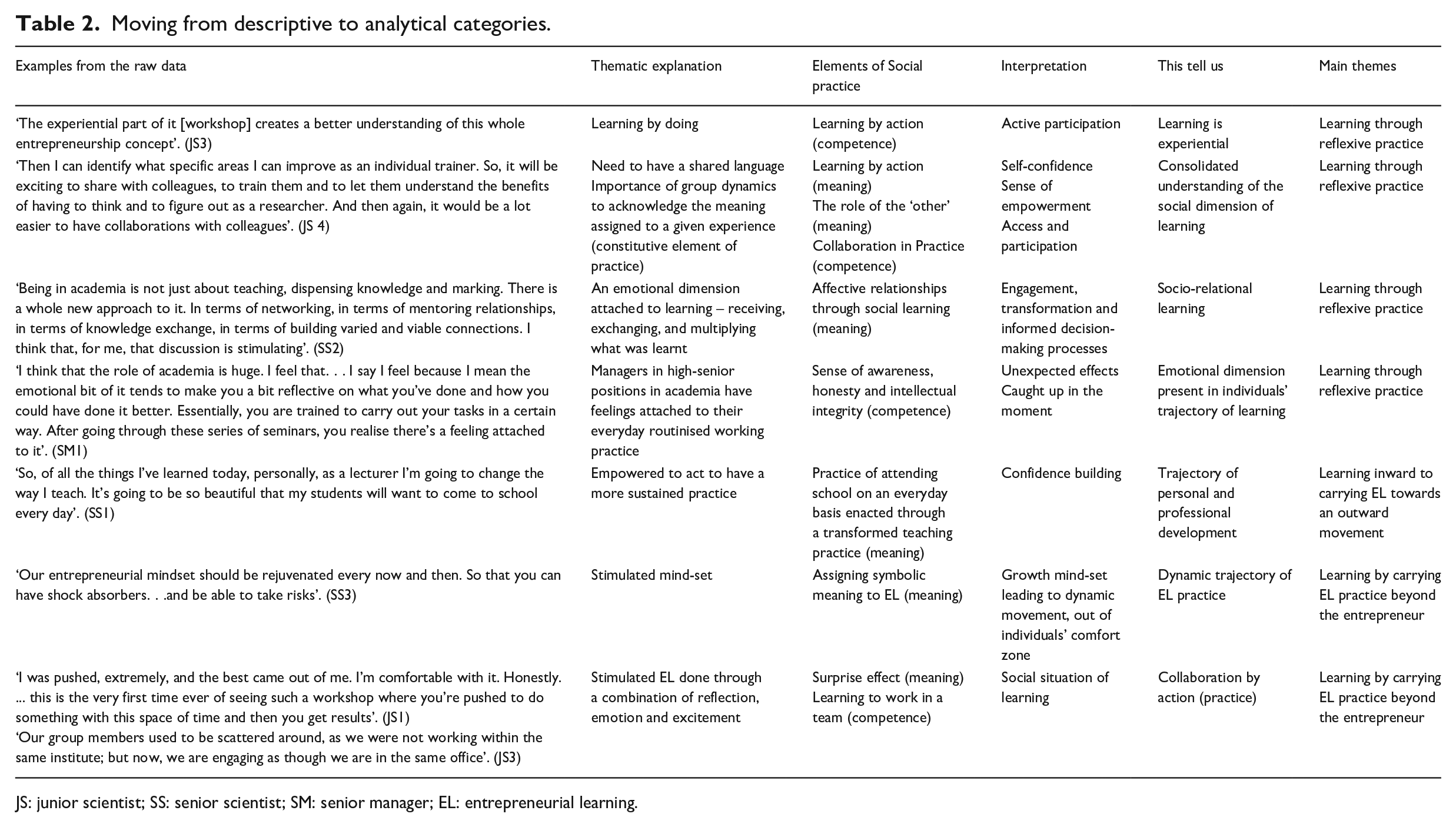
JS: junior scientist; SS: senior scientist; SM: senior manager; EL: entrepreneurial learning.
Entrepreneurial learning from a social practice perspective
The fact that we did not impose any expected outputs generated a stronger involvement and embedding by participants; the SP lenses allowed us to observe this. The findings show that participants took ownership of the SETS programme and explored their own environment by learning through reflexive practice, learning together and learning by carrying EL practice beyond the entrepreneurial persona.
Learning through reflexive practice
In this section, we present the key themes that were drawn from the analysis of the trainer-trainee relationship in the SETS programme, EL practice and its learning environment. These themes are not meant to reflect the full complexity of the relationships; instead, they are used to illuminate the empirical contributions of this programme to EL, proposed in the next section.
Unsurprisingly, the learning identified from each participant’s story is an example of how the participants in the SETS programme, namely, natural scientists showed their willingness to ‘change their story’. Words from SS4 echoed other scientists’ views by illuminating their frustration regarding the lack of access and the freedom to be innovative in their professional development area.
I think that, in terms of networking, mentoring relationships, knowledge exchange, and building varied and viable connections . . . for me, that discussion is stimulating and is very much needed here. In Ghana, these discussions are not accessible for all scientists. (SS4)
Our data emphasised, below, the need to widen the interactions between the natural scientists with other stakeholders.
I think it’s [interactions]a two-way affair. The senior managers will have to take part and then other groups will also have to take part. The biggest challenge for me was putting everybody together. (SS5)
Talking about non-linear learning journeys, SS5 noted that these movements often entail an implicit emotional dimension of learning, and went on to affirm that scientists can enact connections when they reflect and, intentionally decide, to express their voice.
I think that this whole learning journey has actually brought me into a state of introspection, if that’s the right word. A very quiet internal dialogue, you know. . . This dialogue allowed me to train other scientists, in my institute, and even to talk with directors, and deputy directors. (SS5)
Hence, as the extracts above show, when exposed to a non-formal environment, scientists reconnected more within themselves, and then feel empowered to reconnect with others – therefore, their story can be changed. This more intimate and relational environment influenced the way they accessed, and participated in the SETS training.
Reflexivity, as an engaged reflective practice, emerged as a key theme, validated during informal conversations with scientists. Interestingly, it is also important to understand what triggered reflection in becoming a practice, that participants not only accepted but actively used, particularly during the residential sessions, to tap into their unknown territory to rewrite their stories (Gherardi et al., 2018). In reflecting on their learning journey JS1 shared that, I must tell you that I felt so tired after the sessions. But I must also tell you that I have enjoyed the process because we must learn new things. Yes, I learned new things and I embrace it. I like it. I was supposed to bring out my best. I was pushed, extremely, and the best came out of me. And I tell you, I’m comfortable with it. (JS1)
JS1 was not only stimulated to think entrepreneurially but to reflect on the learning practice over time. This insight shows that their learning comes to the surface through reflection and emotion; however, there is a fine balance to be achieved in incorporating reflection in the practice of EL, as a vital component of the SETS programme. Most scientists referred to reflection as a developmental practice that involved them as change agents, their experiences, challenges and peers in a joint trajectory, which connects practice with agency. Hence, this multi-layered linkage of relationships emerged from our analysis as instrumental reflection. Our data show that through reflection we can understand more deeply how scientists learn when practising EL. In this sense, reflection becomes an instrument to analyse the trajectory of EL and, to an extent, it is valued by scientists in their everyday practices. Furthermore, it was visible that participants were eager to learn through interaction and experimentation. As some of the research managers (RM) said: The training was an eye-opener to me as the facilitators sparked off my entrepreneurial mindset (RM2); I brought out those effects that make our product unique, embellished that uniqueness and came up with a new look. (RM3)
Learning together
At the initial session of the SETS programme, we observed an increased awareness of the need for collaboration, as shown in this extract from the field notes.
It is curious to note that the rationale of collaborative work seems very new here [host organisation], as observed in the group dynamics this morning. The puzzling aspect is that, socially speaking, communities in West Africa are known as ‘easy-going’ and extrovert in social gatherings, cultural festivities, parties, weddings and funerals. However, in professional spheres it was observed, and then confirmed in my interviews, that individuals shy away and resist to share information and resources with colleagues. (Fieldnote day 2, Feb 2019)
Although we observed this issue during the SETS programme, there was also evidence of a vivid and supportive environment, where the sense of togetherness was visible. We observed scientists slowing down, observing, listening and noticing others in the group – who perhaps could be a colleague working next door or even a former colleague in an affiliate organisation in another region. This notion of slowing down, finding out something new and being exposed to the unknown was reported as shaping the way participants behaved, I think that the new trend is to understand the mentoring relationships and networking in Ghana. From experience, I feel that it’s so frigid and unidimensional. There is no flow of life in that relationship. I feel that, sometimes, it’s just a power position… This SETS programme, it’s an opportunity to unlearn, relearn and assimilate all that is useful. (JS6)
Yet, in further discussions, it was highlighted that the ontological nature of working and learning in a West African situated context is very hierarchical (Hunter and Lean, 2018), with few opportunities to meet informally or socially, but holding on tight to ‘power positions’, as JS6 revealed.
Equally relevant, in our empirical material, is the emphasis on unexpected learning, as some junior scientists (JS) shared the sense of getting more learning than expected, particularly concerning the nature of interactions and that this learning enables them to replicate the training delivered in the SETS programme within their institutions. This finding illustrates how scientists become agents of change or, ‘organisational members as storywriters’ (Gherardi et al., 2018). Through a practice of reflexivity, they ‘unlearn and relearn’ so that EL practice may evolve. These learning opportunities happened in a professional environment that is contained (space), structured (time) and shared (socio-relational). We observed our scientists participating in the group dynamics and noted the importance of those informal encounters to reproduce and sustain their (social) practice of EL, I feel like the training really enlightened us on making lemonade out of the lemons we have had so far. Because, you know, many scientists think about entrepreneurship, or feel like it’s a no-go area. They look at the lemons and this training helped us, kind of, make lemonade out of it. So, I am feeling, you know, liberated and adventurous about going into entrepreneurship. And more importantly, you know, hopefully facilitating this training in the future. (JS1)
There was the expectation that formal learning is expected in a formal and non-formal educational setting, where learning objectives and outcomes are explicit; however, as JS1 explains below, our data suggest that an unexpected dimension of learning was present through the replication of the SETS programme to other audiences, contexts and organisations: I think the most important thing about my learning is being able to step it down. You know, being able to replicate it and teach others what you have learned. (JS1)
A key thread was revealed in relation to their willingness and commitment to replicating the SETS programme, as SS2 illustrated: The training imposes confidence in myself in terms of developing modules, pitching, and taking an active role in panel discussions. I am really keen to try it out in my institution. (SS2)
Our data show diverse participatory encounters through which individuals replicated the SETS programme in Ghana and Nigeria over two workshops. These EL trajectories were followed up by the second author (Table 3).
Replications of the SETS training.
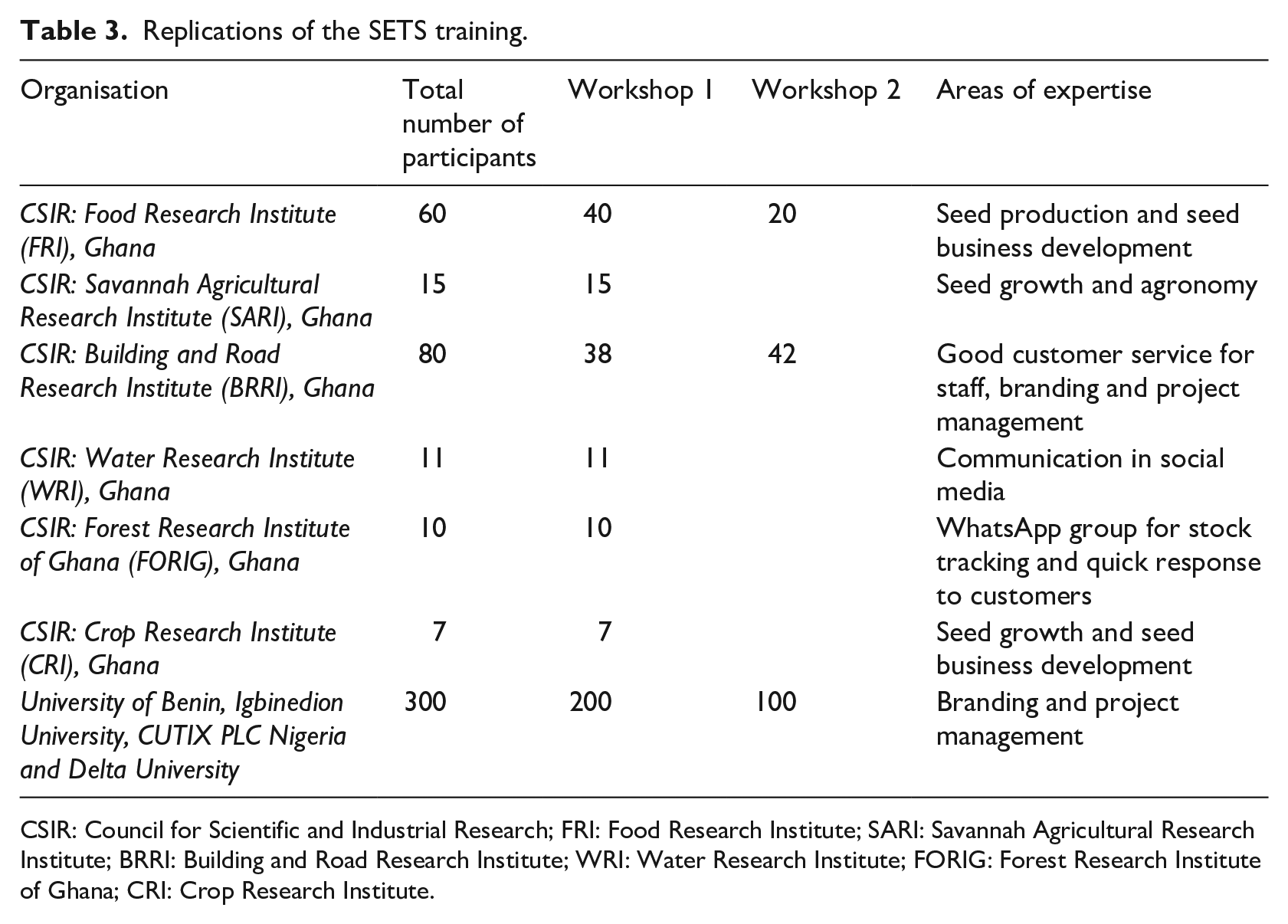
CSIR: Council for Scientific and Industrial Research; FRI: Food Research Institute; SARI: Savannah Agricultural Research Institute; BRRI: Building and Road Research Institute; WRI: Water Research Institute; FORIG: Forest Research Institute of Ghana; CRI: Crop Research Institute.
In addition, this analysis revealed that EL can influence the everyday practices of scientists, particularly in leveraging their scientist persona. The participation and commitment to replicate the SETS programme was described by a senior manager (SM) as an ‘outward movement’ (SM1), in which the socio-relational and emotional dimensions of informal learning played a central role.
Learning by carrying EL practice beyond the entrepreneur
During the final session of the SETS programme in Ghana, we observed peer group engagement on diverse occasions. For instance, JS2 noted that the programme allowed them to have more appreciation for the work conducted by their colleagues in the everyday routine. Similarly, Shove et al. (2012) illustrate that the awareness of a routinised practice is critical to ensure that it is sustained and carried forward over time. Thus, by the end of the training, not only did JS2 showed more appreciation for his colleagues (which improved relationships within their working environment) but also, they were able to promote their research, researchers and the organisation.
In their accounts of the SETS programme in Ghana, one practitioner commented that it enabled their confidence to act and influence others to think more entrepreneurially. The meaning assigned to the programme was depicted through individuals’ aspirations. In a similar vein, one senior scientist (SS) indicated: ‘So, of all the things I’ve learned today [. . .] I’m going to change the way I teach. It’s going to be so beautiful that my students will want to come to school every day’ (SS1).
During our in-depth interviews, some participants stated the benefits gained from the programme, possibly because all the groups have had their preliminary engagements with their institutions, and some had undertaken activities with their target audiences. According to another SS, the mid-term engagement was a wakeup call since it made them organise meetings to efficiently plan the presentations for the online engagement in the SETS programme. Participants also reported that the online engagement made them feel as if they belong to a network, that of the RECIRCULATE family. This ability to have access to, participate in, and gain new skills about entrepreneurship beyond the individual’s physical location reveals their sense of belonging to a wider network, including researchers, opportunity business models, prototypes, conferences and team meetings. The intersection of these individuals, artefacts and events was visible when triangulating data from our field notes with informal conversations held with key participants such as JS3: Our group members used to be scattered around, as we were not working within the same institute; but now, we are engaging as though we are in the same office. (JS3)
The socio-relational and friendly environment observed during the SETS programme provided the collaborative platform for the scientists’ practice of EL. They were invited to take active part in the everyday social exchanges of EL by reflecting on their routines, rather than on those of their organisations (Shove et al., 2015). For instance, SS4 illustrated how EL practice and collaboration were formed: ‘[The] SETS programme made us showcase the knowledge we have and share that with others’.
It was apparent that once the training was being delivered, the host organisation’s SM carried forward the practice of EL, irrespective of their situated context. This intentional act of participating, sharing with, enabling and leading others in their everyday role is termed ‘carriers of practice’ (Shove et al., 2012). Thus, the importance of understanding that SM and scientists can co-construct a network of EL by enacting their agency or, by endorsing the SP of EL, carrying it beyond their networks, is shown below.
This has been a learning experience for us. As academics we learned that we can design non-formal programmes which connect to people who have had formal education and enable them to begin to take ownership of their informal learning. So, there is an empowerment going on here, that is not all about the educator, but about the relationship between the educator and the participant and how the latter become self-educated, by taking ownership of their informal learning. (JS8)
Besides, not all scientists prioritise analytical thinking and precision; some were keen to expand opportunities and to develop challenge-led solutions, for example, ‘there has been a lot of co-learning, bringing in a very different way of thinking. I can actually see myself doing this as a scientist . . . using all those skills that I would never have found in a book’ (JS7). Our data support the recognition of the socio-relational learning of the SETS programme, as a critical opportunity, where scientists are the human agents bringing EL practice towards an enactment zone, for example, ‘the opportunities are available. Enormous opportunities are available. This workshop is one. Essentially, we have started to deconstruct a very traditional mind-set about entrepreneurship, EL, and education’ (SS4).
The key finding of this study concerns the dimension of the individuals’ experiential learning in a setting that features the relationships among participants, which tends to be disregarded by EL scholars. Instead of a group of scientists articulating their goals and commitments, the group was diverse, affective, intense, empathic and, at times, driven by some emotional dispositions. It is in this ‘crazy quilt’ of constructs that EL takes place, corroborating Lave and Wenger’s (1991) construct that learning is situated. Knowing, combined with learning, occurs in the routinised everyday practice. This insight from our research expands the understanding of the value of EL by reminding us that education is about relationships.
The STEM scientists were able to articulate that the relationships they developed in their informal learning environment were equally important as, or even more important than, the ones they developed in the formal and non-formal learning settings. Taken together, these results suggest an association between entrepreneurial and social learning, which is of particular importance in the context of management learning and EE across African developing countries.
Discussion
The first and primary contribution of our study is the extension of the conceptualisation of EL by bringing a practice-theory perspective to generate a new insight. In addition to assisting us in making sense of EL through SP theory, this insight stimulates individuals’ mind-set to go beyond the expected entrepreneurial identity. Through our SP lens, we argue that EL is viewed as a multilevel practice, applicable to situated learning, inclusive approaches and cultural fields. This contribution is extremely relevant to the field of management learning and EE, as it shows that EL enables aspirational opportunities to flourish in situated settings beyond management and business schools.
While EL initiatives in Europe have been studied (Bosman and Fernhaber, 2018; Williams Middleton et al., 2020), its effects are yet to be fully understood in West Africa. Empirically, our study illustrates how EL practice is enacted in a STEM situated context, and how scientists learn by carrying EL practice beyond the entrepreneur – that is, it is the persona of the scientist who learns, and not only the entrepreneur per se. This contribution lays the groundwork for expanding the current critical thinking on EL, because it shows that delivering entrepreneurial competence, as non-formal and informal learning, expands knowledge beyond the expected EL learning outcomes. This trajectory of EL delivery surfaced as an unusual behaviour across the participants’ organisations in Ghana and Nigeria, which was a surprising finding – however, it was critical to allow scientists to fully engage, participate and carry the practice of EL across other disciplines and non-academic audiences. A possible explanation for this might be the realisation that to understand the value of EL, one can move beyond entrepreneurship. This aspect helps to enhance and develop further interdisciplinary collaboration, which brings other peers along, resulting in an added insight to EE and management learning research.
The capacity, and willingness, of the participants to join a wider network have strongly emerged from the findings, as a re-conceptualisation of EL. This finding assists us in better understanding the intersection of scientists, artefacts and events, in an informal, socialised practice of EL. This insight is consistent with Nicolini et al.’s (2012) notion of ‘meaningful blocks’ (p. 164), and sheds light on the formation of a SP.
Our analysis shows how ‘togetherness’, and ‘learning together’ generated unexpected learning, reconfigured in two stages for the enactment of EL: first, an introspection where scientists reflect back on their journeys through an inward process of transformative social learning. Second, scientists identify an active movement outwards, realising their need and disposition to ‘change their story’. The insights gained from this study reveal that STEM scientists, in sharing and reconfiguring their everyday EL, assign meaning to that practice and how it changes over time.
The current study advances entrepreneurship theory by re-conceptualising EL as a competence that goes beyond the realm of the entrepreneur, being available to a wider audience of stakeholders. This interpretation draws on the constitutive elements of SP, of which competence is one (Shove et al., 2012). In addition, our work adds to the increasing body of research indicating that former experiences tend to be critical in balancing power relations and opportunities for participation, as most JS reported, as well as being central for what might happen next in their trajectories of life. The STEM scientists accept and carry different practices at different times.
Subsequently, the delineation of a practice, ‘where it is reproduced, how consistently and for how long’ (Shove et al., 2012: 63) – depends on the role, participation, and empowerment of the STEM scientists, as impactful carriers of EL practice.
The second contribution of our study advances understanding of the context formation in an EL setting. While other EL contexts have been examined (Butcher, 2018; Williams Middleton et al., 2020), the value of enacting and delivering EL across non-entrepreneurial audiences is not fully understood (Bosman and Fernhaber, 2018). Our findings indicate that the context-neutral feature of the SETS programme reinforces the notion that SP is about the way actors socialise their learning, and how they fully or peripherally participate in the contemporary world. Hence, our study makes the context formation highly relevant, particularly in the underdeveloped domain of EL research, practice and policy in West Africa (Beane, 2019).
The situated research context of the SETS programme displayed a strong socio-relational aspect and this ‘knowing in action’ influenced participants to share their journeys with others, to ‘know them in practice’ (Nicolini, 2013). Furthermore, it was the enactment of EL practice that drew the network of the SETS programme together, contextualising the social element in which that practice was sustained and reproduced over time in a given landscape of practice (Brown and Duguid, 2002; Spanellis et al., 2021).
Our findings suggest that the experiences of scientists are at the centre of the co-design, delivery and replication of the SETS programme. Hence, our study offers theoretical and empirical insights into how and why STEM scientists assign meaning to stimulating entrepreneurial mind-set and to embedding this practice in the everyday routine of their organisations. This interpretation draws on another element of SP theory, that of meaning, so that individuals who ‘carry certain routinised ways of understanding, knowing-how and desiring, as well as many different practices, need to be coordinated with one another’ (Reckwitz, 2002: 250).
Our study indicates that in taking active part in the everyday social exchanges of the SETS programme, scientists reflect on their routines, rather than on those of their organisations (Shove et al., 2015). This perception, while preliminary, has important implications for developing the application of SP theory, particularly regarding the element of ‘material’. By being invited to co-create a collaborative platform for their practice of EL, scientists were exposed to new configurations between language, technology, informal conversations, digital outlets and a variety of artefacts – in Shove et al.’s (2015) terms – to the formation of EL as SP.
This study has practical implications for management learning and EE. We understand EL as a SP in the ‘unexpected’ dialogic mode of learning, a form of movement beyond the boundaries of the aforementioned forms of learning. In such practice, the exploration of boundaries is the first move, and it encourages managers and senior leaders to engage in socio-relational conversations with others in various disciplines. In particular, our research indicates that meaning, competence and material are present in the SP of EL, and may be applicable in other contexts such as management and business schools in West Africa. It can therefore be assumed that the managerial implications of the SETS programme’s approach are multiple, and lead to the notion that SP theory increases our understanding of EL. Overall, this work contributes to existing knowledge of management learning and EE, suggesting that business school staff, and other stakeholders should be alerted to the opportunity of learning from socio-relational approaches, in addition to more formalised education structures.
Conclusion
This study draws attention to a combination of formal, non-formal and informal learning, illustrated through the methodology of the SETS programme, which empowered participants to act and develop a shared language and cultural symbolic meaning. Our analysis illustrates ways in which EL represents a step forward in scientists’ innovative solutions to tackling global challenges in West Africa. This study strengthens the notion that a multi-disciplinary approach to science plays a critical role in tackling global challenges in West Africa. According to this paradigm, a view of social learning enables STEM scientists to ‘get out’ and move across and beyond their silos into the space of ‘social’ EL. Our research shows that further studies on EL programmes or similar initiatives in other contexts are needed, as well as further investigations on the extent to which SP theory is applicable.
We highlighted the social nature of practice theory as observed in the empirical setting. There is an opportunity for further research on the dynamic nature of SP, especially concerning the constitutive elements of SP – meaning, competence and material (Shove et al., 2012). A natural progression of this work is to explore whether these elements have a dynamic nature, and can be sustained over time, particularly in the post-development stage of EL (such as advancements towards a SETS online programme). This is important because, although we have been able to generate an understanding of EL in West Africa, further studies are required on strategies to sustain the effects of EL in the mind-sets of scientists.
Since this study was built on a rigorous qualitative research approach within the Ghanaian context, the setting where the SETS programme was observed, it was not possible to extend the contributions of this study beyond that context. However, it is expected that other scholars may apply quantitative large-scale surveys to explore scientists’ trajectories of learning in acquiring entrepreneurial competencies. Continued efforts are needed to make EL more accessible to STEM scientists across various settings and regions. Our learning approach to the SETS programme can be used to advance pedagogies in management learning and EE.
Footnotes
Acknowledgements
The authors are grateful to all the individuals who participated in this study, providing insights into their learning.
Funding
The author(s) disclosed receipt of the following financial support for the research, authorship and/or publication of this article: This research was supported by the UK Research & Innovation through Global Challenge Research Fund grant: GCRF RECIRCULATE: Driving eco-innovation in Africa: Capacity-building for a safe circular water economy, Grant Ref.: ES/P010857/1.
