




Abstract
This study applies an action research to investigate the possibility of unsettling management education and the entrepreneurial self from neoliberal logic. The reflection takes as its case an action research diploma seminar in a Polish management school based on collaboration among students, employers from public and nongovernmental sectors, and academic teachers in the preparation of master’s theses. The main goal of this article is to illustrate the struggles involved in resisting neoliberal demands, including the ethical reorientation of the entrepreneurial self, in the management classroom. We conclude with a discussion of the emancipatory value of our project and its limitations.
The goal of becoming independently responsible for the creation of a successful future, understood in economic terms (employability, profit maximization), has become a naturalized imperative in contemporary management education (Berglund & Verduijn, 2018b). This goal stems from the neoliberal assumption of autonomous and economically rational individuals ready to constantly reinforce their competitive entrepreneurial competencies to perform instrumental actions (Bragg, 2007). What emerges is a neoliberal form of the entrepreneurial self (Scharff, 2016) that must capitalize on learning to become an employable, creative problem-solver who is productive for society rather than responsible for others (Dahlstedt & Fejes, 2019).
This study attempts to join the debate surrounding the negative outcomes of neoliberal rationality in the business schools and to respond to the growing demands for the reinvention of management education (Steyaert et al., 2016). It focuses on action research (AR) as a process of reorienting students’ and teachers’ thinking and actions to nurture more meaningful and ethically aware entrepreneurial selves. To illustrate our reflection, we use the example of a 2-year AR master’s thesis seminar at a Polish management school.
To better understand the process of unrooting management education and the entrepreneurial self from neoliberal demands, this article poses the following research question: What are the challenges of unrooting management education and the entrepreneurial self from neoliberal demands through a diploma seminar based on AR?
This article is structured as follows. We first provide an overview of neoliberal changes in contemporary business schools, focusing on the entrepreneurial self as a main subject of those changes. We then describe our approach to AR, as based on two supplementary traditions: pragmatic and critical. Next, we present and analyze a case study involving unrooting management education from neoliberal demands derived from our seminars, in addition to presenting supervisors’ reflections about the difficulties we and the students experienced when reshaping entrepreneurial selves in the management classroom. Finally, we present our conclusions and the implications with respect to redirecting management education.
Neoliberal Education and the Entrepreneurial Self
Neoliberal Education
Business schools and their approaches to management education have been held partly culpable for the corporate ethical failures of recent decades and for many of the economic and organizational challenges facing contemporary society (Parker, 2018). Management education has also been implicated in these failures, in the corporate collapses of the early 2000s, the financial crisis in 2008, the ongoing tax scandals, the lack of business response to climate change, and in the emergence of the global sustainability crises (Locke & Spender, 2011). Particular ideological perspectives, such as neoliberalism, have influenced curricula content and pedagogical practice and very often resulted in a lack of awareness and accountability for the role of management education in preparing responsible and caring leaders (Gabriel, 2015).
Neoliberalism is a rationality that allows uncontrolled market mechanisms to determine people’s fate (Crouch, 2011; Young, 2003). It is a “form of reason that configures all aspects of existence in economic terms” (Brown, 2015, p. 17), in which all values are subordinate to the project of monetary growth. As Carl Rhodes (2017) observes, in the neoliberal way of thinking, “all individuals and institutions are conceived of as market actors whose objectives are to maximize their capital value, and whose values rest on enterprise and investment” (p. 25). In other words, neoliberalism is a termite-like normative order of reasoning that configures public goods in economic terms and human beings as profit-oriented actors (Brown, 2015).
In recent decades, neoliberal rationality has challenged universities to transform themselves into market-oriented institutions (Ergöl &Coşar, 2017; Slaughter & Rhoades, 2000; Wright & Shore, 2018) and has reduced the university’s potential for the democratization of society for the benefit of the market and excellence games (Butler & Spoelstra, 2012; Kostera, 2019; Münch, 2013). The performance-based model of managerial universities negatively affects management education: Business schools are forced to become profitable cash cows (Parker, 2018), and academics are forced to seek performance excellence in university ranking games at the expense of teaching (Izak et al., 2017; Kallio & Kallio, 2014).
Affected by this instrumental order, business schools have become market-driven organizations in which students are redefined as customers (human capital) whose choices are best met through practices of buying and selling (Fleming, 2019; Khurana, 2007). Consequently, management schools’ curricula are dominated by anodyne models and textbooks containing tick-box exhortations (how to do it) without recourse to critical thinking (Huzzard et al., 2017). Moreover, course evaluations are very often based on marketing tools that offer a positive assessment of what is seen as popular rather than what is seen as pedagogically effective (Alvesson, 2013). Management education has become a project to self-invest in ways that enhance competitive positioning and attract investors rather than an arena in which to learn civic attitudes based on critical thinking and responsibility for others (Ericson, 2018).
Entrepreneurial Self
Because of neoliberal pressure, business school teachers very often reduce curricula to such issues as “how to make a business,” “how to better train people in business making,” or “how to become an entrepreneur” without leaving room to teach the ethical dimensions of entrepreneurship, such as responsibility for others or solidarity in collective actions (Hjorth & Johannisson, 2007; Kuratko, 2005; Rahm, 2019). In other words, there is a tendency to link entrepreneurship exclusively to instrumental competencies, such as employability or effective moneymaking (Berglund, 2013; Simons & Masschelein, 2008), and to define entrepreneurship narrowly as the emergence of new economic activities (Davidsson, 2015; Jones & Spicer, 2009).
At the expense of developing critical thinking and ethical sensitivity as the key skills for entrepreneurial activities (Costa & Saraiva, 2012; Peters, 2001), management students primarily learn how to implement taken-for-granted models to make themselves or organizations more profitable (Blenker et al., 2006). This, in turn, generates a false conviction that the knowledge that counts is the knowledge that can be measured in terms of market success or failure (Verduijn et al., 2014). Being socialized to aggressive competitiveness and self-interest, students are expected to constantly improve, change, and adapt to a society capable only of producing winners and losers (Berglund & Verduijn, 2018a). Teachers, in turn, are expected to help students achieve those instrumental goals (Ball, 2003).
In this competitive orientation to teaching immersed in the neoliberal culture of perfectionism (Curran & Hill, 2019), learning moral vulnerability and responsibility is extremely limited and is pushed into the background (Ball & Olmedo, 2013; Berglund et al., 2017). Consequently, as some researchers have observed, a neoliberal form of the entrepreneurial self emerges and is strengthened by educational processes (Berglund & Verduijn, 2018b; Essers et al., 2017); this self can be described as “a life form constituted by the autonomous, self-regulating, responsible and economically rational individual” (Berglund & Verduijn, 2018a, p. 10; see Foucault, 2007). The neoliberal mode of self is based on the unrealistic assumption that everyone can turn their life around and is fully responsible for their own destiny and success. This, as Dahlstedt and Fejes (2019) observe, provides a challenge for democracy, as citizenship defined as concern with the public good is being replaced by citizenship reduced to homo economicus (see Fleming, 2017).
Neoliberalism in Polish Management Education
The problem of the neoliberalization of management education seems to be particularly acute in Poland, where the process of managerializing universities has been rapid and more widely supported than in other Western European countries (Dakowska, 2015; Ostrowicka et al., 2020; Wagner, 2011; Zawadzki, 2017). Since 2015, the new government has increased efforts to reform the higher education system and has strengthened a neoliberal vision aligned with the characteristics of the entrepreneurial university: a strong authority core, a culture of entrepreneurship, funds differentiation, and new university functions (Jessop, 2017). The academic ethos has been transformed into corporate value, which becomes institutional capital and is used for competition and income generation (Ostrowicka & Stankiewicz, 2019).
A consequence of the neoliberal turn in Polish higher education is the narrowing of education to prepare students for the labor market (Ostrowicka & Stankiewicz, 2019; Sułkowski & Zawadzki, 2016). According to the new Higher Education Act in Poland (pompously termed the “Constitution for Science”; Ustawa, 2018), education should be defined as a commodity and an economic investment in individuals, not a common good forming future citizens. The discourse of neoliberal logic prevails in Polish management schools, forcing academics and policy makers to design curricula in an instrumental manner. What is worse, because the mainstream discipline of management in Poland is based primarily on a provincial in scope, neoclassical economic orientation—at the expense of more global critical and humanistic perspectives (Banaszak, 2019; Kostera, 2016)—the implementation of neoliberal solutions has found fertile ground here.
To resist neoliberal rationality, we decided to use AR in our management classrooms. In the next part, we explain our approach to AR and describe our project.
Action Research
AR is a methodological approach that allows researchers to combine thoughts and actions with theory and practice through cooperation with organizational members and students by supporting the development of individuals and organizations (Coghlan, 2019). Following the popular definitions in the literature (Coghlan & Brydon-Miller, 2014; Greenwood & Levin, 1998; Johansson & Lindhult, 2008), there are two main traditions of AR: a pragmatic one, based on Kurt Lewin’s approach and related to a managerial perspective concerned with solving organizational problems, and a critical one (participatory AR or critical participatory AR), based on Paolo Freire’s approach and focusing on the emancipation of marginalized and oppressed groups as a way of changing organizations and societies. In the next section, we summarize the differences between these traditions (see Table 1) to better clarify our approach to AR.
Comparison Between a Pragmatic and a Critical Orientation to Action Research.
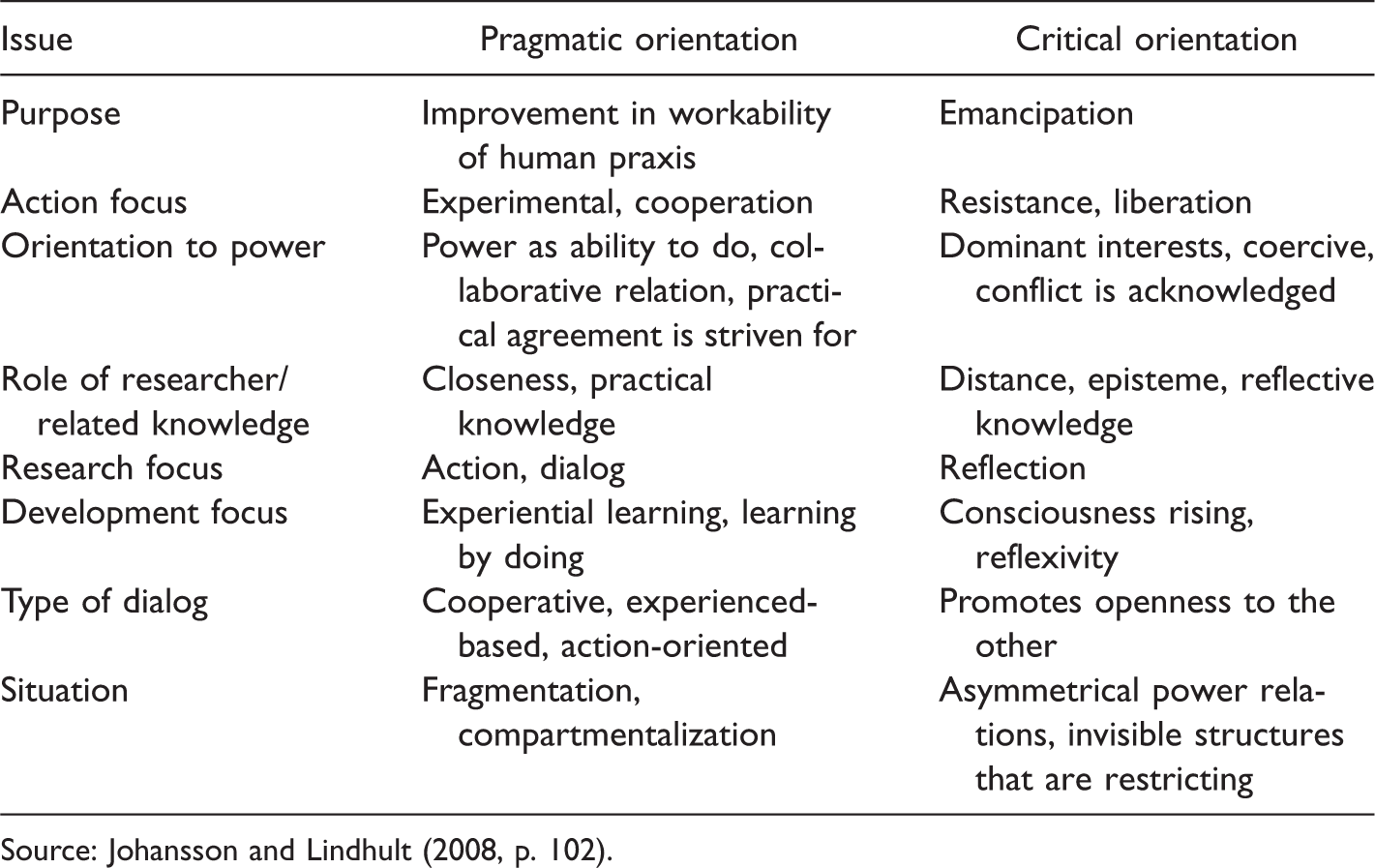
Source: Johansson and Lindhult (2008, p. 102).
Pragmatic Approach to AR
The pragmatic approach to AR stems from the assumption that knowledge can be acquired primarily through cycles of action and evaluation (McNiff et al., 2001). This approach, rooted in Kurt Lewin’s (1951) ideas, is based on a spiral cycle comprising action planning, implementation, observation of results, and reflection aimed at improving organizations. The aim of pragmatic AR is to solve organizational problems, which requires researchers to possess practical skills and the ability to adapt to specific conditions (Dickens & Watkins, 1999).
The effect of AR conducted in organizations should be to produce a change in culture (e.g., in values, mentality, or norms) or structure (e.g., structures or work methods). AR allows actors to create new knowledge through the process of organizational problem-solving (Coghlan, 2019), and power is seen in this orientation as a force enabling democratic dialog and cooperation as a prerequisite for consensus. In contrast to the standard process of academic research, AR enables researchers to redefine the research problem if it does not fit the practical problem observed in the organization (Peters & Robinson, 1984).
Pragmatic AR is mainly intended to serve practitioners outside the academy: In this sense, research is to be useful for representatives of external organizations who can request such research and implement recommendations to solve organizational problems (Coghlan, 2003). The people involved in the research process have the opportunity to participate in the change process by sharing their knowledge, for example, at so-called dialogic conferences.
A Critical Approach to AR
At the core of the critical approach to AR inspired by Paolo Freire’s (2018) philosophy is a critical approach to social reality based on dialog and a rejection of social hierarchy (Levin & Greenwood, 2018). Using this approach, researchers problematize the natural, cultural, and historical reality in which they are immersed (Kemmis, 2008). Problematizing here means the antithesis of the managerial disposition of “problem-solving,” as evident in more pragmatic approaches to AR. In the latter, experts analyze organizational problems, devise the means to resolve difficulties in the most efficient way, and then dictate a strategy or policy. Such instrumental problem-solving, as advocates of participatory AR claim, distorts the totality of human experience by reducing it to a means to fulfill organizational goals (Johansson & Lindhult, 2008).
Organizational change, under a critical approach to AR, should be done in a bottom-up manner detached from the top-down imposition of ready solutions. A critical researcher enables—by virtue of democratic dialog and by not imposing his critical vision—others engaged in research to engage in self-reflection, which can then be turned into a transformative activity (McTaggart, 1991). Top-down decision making is treated here as oppressive because it disregards the voice and needs of those employees who disagree. Because the goal is the participatory development of knowledge through mutual learning, patterns of change cannot be imposed on individuals. In this orientation, power is perceived as entangled in the interests of privileged groups, whereas conflict is a natural element that can check those interests and relieve people from oppression (Johansson & Lindhult, 2008).
To reach emancipatory goals, problem-solving should be treated not as the goal (the pragmatic approach to AR) but as a method for unlearning taken-for-granted ideas (Berglund & Wigren-Kristoferson, 2012). Problematization can generate critical consciousness and empower people to take specific actions (Goulet, 2005).
Combining the Practical and Critical Orientations: Our Approach to AR
In our approach to AR, we sought to combine the pragmatic and critical orientations to avoid the disadvantages of both traditions. On one hand, we perceive a pragmatic orientation as creating too much dependency on the managerial power of organizations. A critical orientation, on the other hand, does not always offer the possibility of implementing changes in an organization, as it very often stops at the level where one is struggling with an unwillingness to be emancipated (Johansson & Lindhult, 2008). Rather, we agree with Berglund and Verduijn (2018a) that emancipation from neoliberal rationality in the classroom should not simultaneously discourage students from taking responsibility for specific actions. Thus, we sought to create a learning environment that was deliberative and focused on critical reflection, giving students the possibility of emancipation; however, our intention was to offer them practical tools related to analyzing and understanding organizational problems.
We believed that the AR approach would allow us to create an emancipatory space that would redirect students’ entrepreneurial selves. In this space, they could understand complex organizational problems with the support of caring supervisors and in so doing dislodge themselves this from the neoliberal agenda. We invited students to develop entrepreneurship skills based on both emancipation and the development of practical reasoning (Gayá & Brydon-Miller, 2017; Kemmis, 2008; Winkler et al., 2018). We wanted to determine how that form of collective self-reflection, a self-reflective inquiry undertaken by participants (our students and us) in social situations, would allow us to improve the moral rationality and justice of our own practices and how it would improve our understanding of these practices and of the situations in which they are carried out.
We wished to avoid assuming the roles of external authorities and exclusive purveyors of knowledge who try to convince students of the real value of knowledge and who erroneously believe only in the value of instrumental, egoistic careers. Both students and teachers, from our perspective, should be committed to changing the organizational reality through collaborative and critical learning (Berglund & Verduijn, 2018b). Such an education—participatory and democratic—could potentially enhance our own and our students’ civic attitudes based on solidarity with and responsibility for others (Levin & Greenwood, 2018).
The AR Project and the Master’s Thesis Seminar
AR in a Master’s Thesis Seminar
A master’s thesis seminar at a Polish university is a specific form of academic activity combining education and research and emerges from the idea of the university’s self-regeneration through its constitutive “master–student” relationship (Sajdak, 2013). This is an educational activity during which the learner (student) should have lively, direct contact with her master (tutor).
Writing a thesis is necessary for students to complete their studies in Poland, but recently, it has started to be treated as a “necessary evil” by students and teachers alike. As supervisors, we noticed that students very often lack a passion for knowledge, treating a master’s degree only as a necessary step in their careers. Students expect to be guided by supervisors in the writing process (from topic formulation through language editing to checking the quality of the final version)—and supervisors very often are ready to reproduce those paternalistic relationships.
The works we receive (as supervisors and reviewers of master theses) are also very often detached from philosophical reflection on organizational problems, fragmentary and lacking deep consideration of the social complexity of the management world. There are many reasons for this, but it appears that the teachers—including the authors of this article—very often fail to provide conditions that afford students the opportunity to be more involved in the writing process, motivated to intellectually collaborate with supervisors, and ready to deepen their understanding of organizational phenomena. To remedy this situation, we decided to apply the AR approach in our diploma seminars.
Our idea was to combine academic education with practical experience that would not restrict education—as expected by the neoliberal logic and its advocates—to developing corporate and vocational skills but instead focus on building a deeper understanding of the human aspects of nonacademic organizations. The AR approach does not offer students ready-made solutions previously tested in practice in organizations but, on the contrary, allows them to understand the complexity and ambiguity of organizational problems and the advantages of collaboration based on solidarity when seeking solutions (Reason & Bradbury-Huang, 2013). This requires open critical thinking and taking responsibility for others in the context of social action.
Organization of AR Seminars
We introduced AR in master’s thesis seminars in two separate institutes at the Faculty of Management and Social Communication, Jagiellonian University, in Kraków: the Institute of Public Affairs and the Institute of Culture. Students participating in the project were involved in various study programs in the field of management education: management, culture and media management, and social policy.
In our model, the main theme of a master’s thesis was always selected by the student in consultation with the organization through dialog with its employees and the academic supervisor. The work was devoted mainly to understanding social problems identified in the examined organizations. We also expected from the students that they would formulate recommendations for solving the problems. Problems included strengthening the motivation of volunteers in a nongovernmental organization, implementing employability procedures in a third-sector organization for adults with Down syndrome, developing ethical guidelines for crisis management in a culture management institution, shaping health attitudes in a secondary school, and advancing rules of behavior for concert audiences in a cultural institution (further analyzed in the illustration of the case study later). The role of the academic supervisor was to provide support through critical analysis of and feedback on the applied research methods, including their methodological rigor.
The supervisor did not enter the organization studied. Similarly, the insider from the organization did not participate in the master’s diploma seminars. The student was the link: She or he was familiar with both the organization and the insider and with the supervisor and the seminar (Figure 1). She or he had “two tutors” in two different contexts. Moreover, it was also important for her or him to share experiences with colleagues in the seminar group who were conducting similar projects in other organizations.
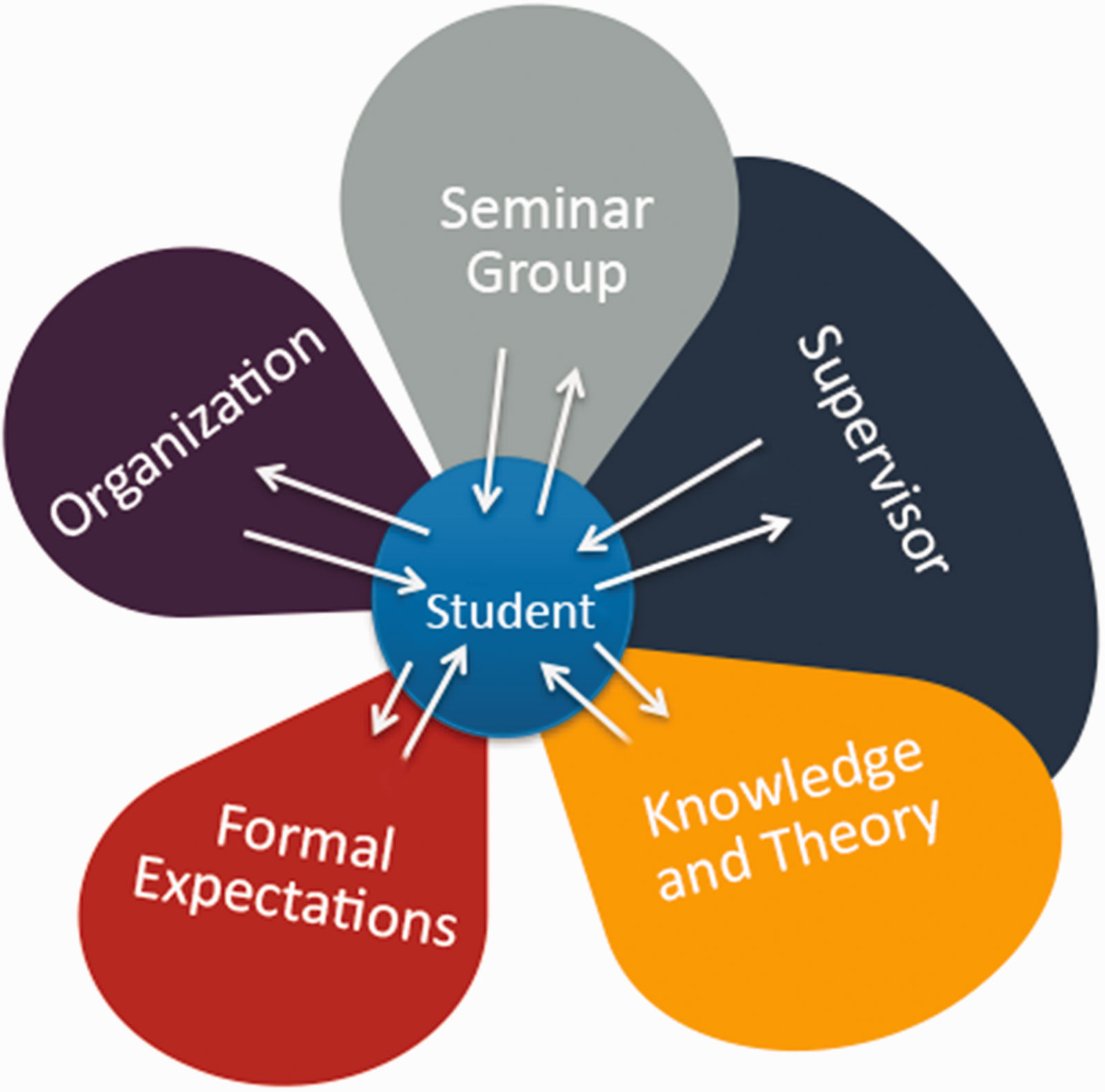
Student in the AR Supervision Process.
We succeeded in securing financial support for the implementation of AR in our master’s thesis seminars from the EU cofunded program POWER. Applying for external funding was necessary because our project needed additional financial support in addition to faculty resources. We used the funding to organize seven daylong workshops for students and employers, to make two study visits to Irish and British universities, where we learned about their best practices for AR thesis supervision, and to pay the faculty for additional tutoring hours for master’s students. We also bought several dozen books on AR; we placed these in the faculty library, where there were no books about AR that students could use.
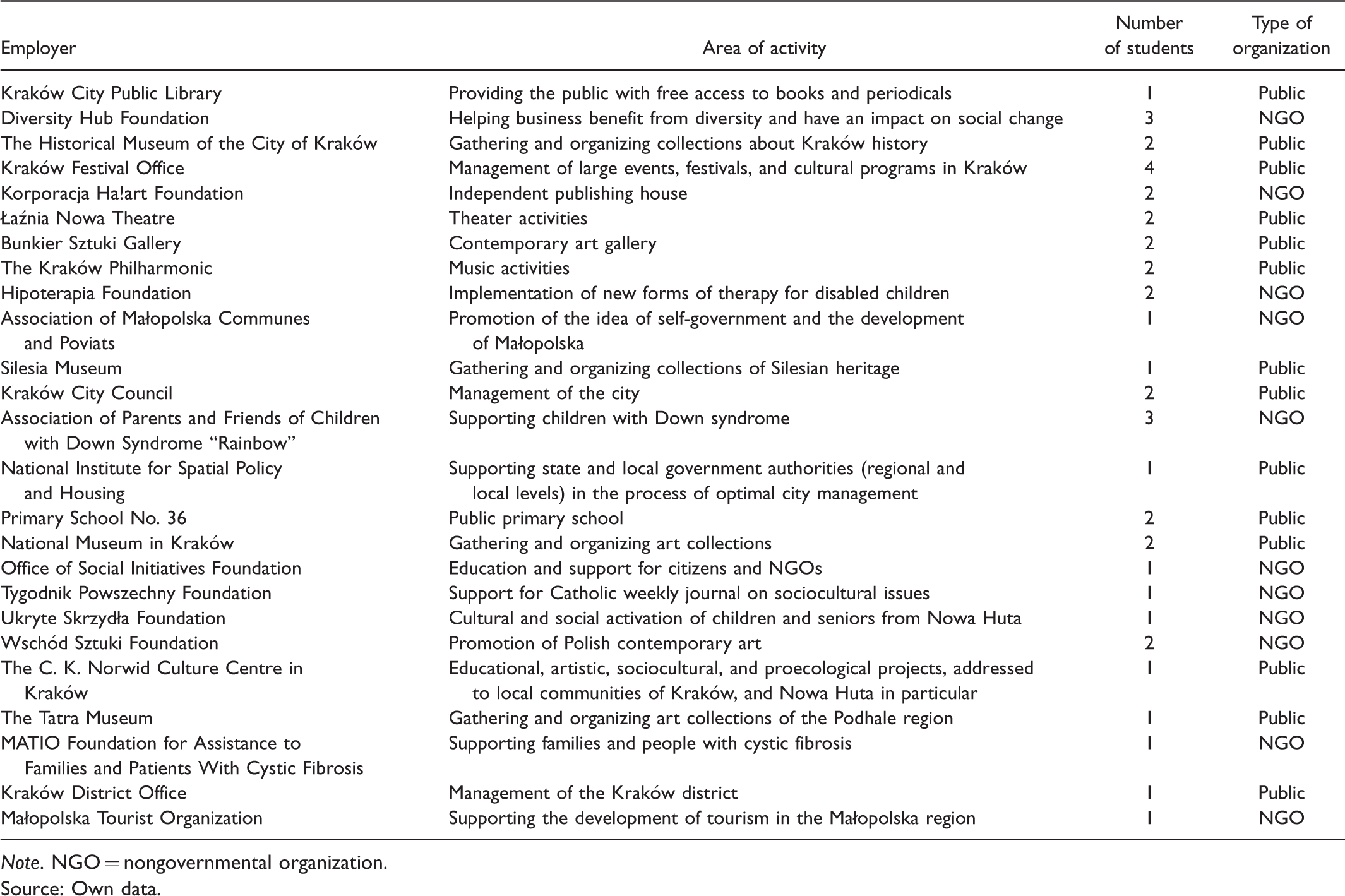
In September 2017, we began the project, which aimed to change the way our students prepare their master’s theses and to introduce AR master’s thesis seminars into our curriculum. More than 40 students and 25 employers were involved. We conducted the project with a group of 11 academics and 2 administrative staff members. The employers represented two sectors: public and nongovernmental. Their areas of activity were highly diverse (see Table 2). The choice of employers with different specializations was intentional: It allowed our students to gain experience and become involved in activities in multiple areas.
Organizations Involved in the Action Research Project and Their Areas of Activity.
Note. NGO = nongovernmental organization.
Source: Own data.
Table 2 presents the variety of partners that we recruited and the number of students who conducted AR at each organization. Until October 2019 (the end point of the project), the project saw the successful defense of 35 master’s theses. 1
Unrooting Management Education From Neoliberal Demands: A Case of Caring Supervision
To illustrate the research problem—unrooting management education and entrepreneurial self from neoliberal demands through AR—we describe a case of cooperation between a student and a supervisor during one of our seminars. We chose the case method because we are in the initial phase of exploring and understanding retrospectively what truly happened in our project. The narrative nature of the empirical illustration can help us trace the process that took place during the master’s seminar. The research material gathered to prepare the case description comprises one of the supervisor’s personal notes (researcher’s diary) and printed email conversations from members of a group of supervisors involved in the project.
The following story illustrates a relatively successful case of abandoning the usual neoliberal education framework in favor of an emancipatory framework in which the patronizing relations between student and teacher are redefined. This framework gave the student the opportunity to redirect the entrepreneurial self from a neoliberal orientation to an ethical orientation connected with taking moral responsibility for the human side of organizing. The example illustrates a very successful “result” of our project: students’ emancipation through the use of AR. Our project, which involved 43 student participants, offered several similar successful examples. However, we also experienced many failures: Eight students did not complete their research projects, while others did so in a less reflective, more superficial way. In the next part of the text, we discuss the reasons for these failures.
Case: Caring Supervision Through AR

Case: own source
Redirection of the Entrepreneurial Self
As this case study shows, the supervisor tried to steer the teaching and learning processes in such a way as to give the student a space to independently explore the ethical dimension of organizational problems. It was the student who assumed responsibility for her own learning process through research and an independent discovery of the world of organizations, along with an understanding of context. The student discovered that neoliberalism gives birth to changes in social behavior—primarily, the objectification of culture in a neoliberal society for market consumption. Culture, for a new middle class and its offspring, very often becomes only a means to reach the next level on the social ladder. In addition, by understanding the broader context of contemporary cultural institutions, the student stopped focusing solely on the economic aspect of the operation of cultural institutions.
This process is an example of emancipatory action in which the student had the opportunity to become responsible for her own discoveries, with help from her supervisor as a critical and caring friend. Caring supervision creating emancipatory space for both student and teacher is an example of escape from the neoliberal orientation of the entrepreneurial self in the management classroom, as it strengthens mutual responsibility, solidarity, and collaboration and dislodges the educational relationship from hierarchical demands.
As this example shows, the student independently discovered the organization’s dysfunctions and began to understand them. The teacher, through her attitude and in building a partnership with a young researcher based on constant conversation and the free exchange of ideas, was therefore able to build a space to counteract neoliberal education and logic. Usually, when lecturers seek to educate students about the many disadvantages of neoliberalism, they are unconvincing due to the general acceptance of this phenomenon. However, when students recognize for themselves the neoliberal dysfunctions and pathologies they examine, their critical understanding of the threats involved becomes more real. Through AR, especially the cycles of dialog with organizational representatives and the university supervisor, this mechanism of self-reflection was activated in the case study. Through her research and self-reflection, the student became critically aware of the system. Therefore, AR helped her understand the social context of neoliberalism.
By independently choosing her subject of inquiry, the student was deeply involved in the research process. The supervisor, without imposing research problems, empowered the student as a researcher; thus, the student felt more involved. At first, however, the student’s goal was to achieve another diploma easily and quickly. In the course of her research and independent work and by confronting the organization, the student began to show a deep commitment to critically understanding the practical problem and to carrying out research.
In the case of this student, the decision to undertake further study and engage in an AR project, thus combining university education with practical activity, was motivated by economic logic. Her goal was to raise her attractiveness in the labor market (she was pursuing two other MA degrees and had unsatisfactory, temporary employment). She chose an organization that, in her eyes, possessed employable values. Her attitude changed, however, when she realized that neoliberal ideology not only forces cultural organizations to undertake activities motivated by economic rationality but also changes social attitudes—replacing sensitivity and passion for art with elitism. The supervisor did not direct the student’s thought process in any way: It was the result of her observation, research, and reading. She ended by formulating her own critical reflection on the effects of neoliberal ideology on cultural organizations.
In the process described in the case study, the turning point was the student’s conversation with the cashier working in the researched organization. It was she who made the student aware that the organization comprises people and represented more than just financial or even artistic results. Indeed, the student felt her first contact with the organization had been internally extremely conflicted—an undermining of her image of the temple of art, with which she strongly identified. This illustrates how AR helps one understand latent knowledge, the hidden, human, and moral aspects of the life, and functioning of an organization that are not very visible in the neoliberal reasoning of many business education programs focused mainly on adapting to taken-for-granted economic goals.
The emancipatory character of the change that occurred in the student is illustrated by her engagement and commitment. The student, on her own initiative, did not stop at designing a solution to the observed problem. She decided to implement the recommended change together with employees from the organization and prepared a competition for children and school classes. At some point, the student fully took the initiative. Driven by her passion and mission to support the organization, she went beyond a patronizing relationship with her supervisor.
Struggles and Limitations: Supervisors’ Reflections
From the beginning of our project, we sought to escape the neoliberal demands on management education based on market fundamentalism as the taken-for-granted imperative of learning/teaching processes (Alvesson, 2013). Instead, we sought to implement collective responsibility, solidarity, and critical reflection. We created a program that would support the transformation of the actors involved into critical and caring thinkers and that might also provide an opportunity for students to critically reflect on organizational problems. We also assumed that during the AR cycle, students would meet new people in organizations and build deeper relationships beyond task-related relationships and would develop a readiness to constantly evaluate various viewpoints and beliefs with the aim of reaching a consensus. In practice, however, our ideal pragmatic-critical approach to AR was challenged by the “neoliberal thermite” (Brown, 2015) tunneling our reasoning and that of the students.
We carried out our project on the very bumpy road toward critical consciousness in neoliberal management education. At the end of the day, we very often reproduced feudal structures powered by neoliberal mechanisms (Holligan, 2011), such as hierarchical and patronizing relations with the students that discouraged them from engaging in critical discussions in the classroom and taking responsibility for building collaborative relationships with others. These patronizing relationships were also reproduced in the organizations, where students very often waited for guidance from organizational mentors; the latter, however, often treated students not as partners in dialog but as pupils who must be guided and taught what to do.
It was indeed a major challenge for us as supervisors to maintain an appropriate level of student motivation and involvement in the research and self-reflection process and to avoid overprotection. While conducting the supervision process, we observed some students taking the initiative and responsibility for their own decisions through collaborative dialog with supervisors and organizational representatives. Those students delved deeper into the examined reality with great commitment: It was clear they were experiencing a research adventure and had visibly matured over the course of the seminar. Others quickly became discouraged when they saw that, in practice, there are no simple, unambiguous problems or solutions and that involvement in this project would not give them a quick opportunity to become more successful on the job market. They then tried to shift the entire responsibility for their actions onto their supervisors and waited for guidance. Others, however, remained passive and did nothing to proceed with the project: They preferred to focus on economically profitable self-realization, directing their actions into more employability-related strategies (e.g., avoiding learning activities to save time in the process of getting a university diploma).
Because of the students’ passivity and our own struggles with overprotection, we found it difficult to establish a dialog in the seminar classroom. Although dialog should lead to liberation (Freire, 2005), very often an inherited custom of monolog prevailed. We recognize now that students might have felt powerless, as they probably perceived problematic situations as the consequences of their personal failures (Ball, 2015). As some researchers have observed, a side effect of neoliberal changes is the politicization of students’ and academics’ identities via the reinforcement of their conformist attitudes (Knights & Clarke, 2014; Rhodes, 2017). Consequently, as was visible in our project, opportunism, authoritarian dependency, and a lack of autonomy emerge. One of the main consequences of the neoliberal pressure to be successful, creative, and responsible for one’s success is a feeling of helplessness and shame (Curran & Hill, 2019); this in turn pushes one to adopt a follower role, which acts as a tension-reducing mechanism (Fleming, 2005).
It is worth emphasizing that the complexity of the entire endeavor made student work difficult. Students struggled with multiple tasks: understanding the AR philosophy, finding a place in the host organization, establishing relations with their mentors in the organization, engaging in dialog with master’s thesis supervisors, and—of course—following AR steps to the end point: writing the dissertation. Students had to manage multiple relationships, navigate the organizations in which they were placed, negotiate with people in the organization and with their supervisors, learn new philosophical perspectives and research skills, read and discuss new ideas, and survive the rigid structure of the research process. Most important, students had to define a useful and important organizational problem and make recommendations that would be acceptable to organization members. All this happened while students were also expected to be involved in authentic, democratic, critical dialog and to take responsibility for their increasing empowerment. They had to follow all project regulations while also becoming more emancipated.
Admittedly, we, as academics, were also haunted by the ghosts of academic neoliberalism (Roy, 2014) in at least one way: We spent too much time on research excellence or on the bureaucratic rules we had to follow when realizing the project. We fell into the trap of projectification (Fowler et al., 2015), focusing too much on the instrumental results of our project by, for example, helping students finish their master’s theses on time or wondering about the number of students who should receive diplomas according to project regulations. Sometimes we did indeed treat students like stones in the patronizing and neoliberal curling process (Alvesson, 2013), being more interested in a student’s completion of a master’s thesis than in his or her learning.
Conclusions
One of the main ethical tasks of our project was to unroot management education from neoliberal demands and to deconstruct the neoliberal form of the entrepreneurial self in the university classroom. We tried to reorient students’ educational goals so that they enjoyed opportunities to learn for the sake of learning, in which knowledge and creativity become the main sources of curiosity and passion, without strong expectations of employability. We also put a great deal of effort into giving our students the opportunity to experience firsthand the reality of organizational processes and problems.
We used the AR framework in the master thesis seminars not only to give students the opportunity to work on organizational problems in public and nongovernmental organizations (pragmatic approach to AR) but also to emancipate them from neoliberal and patronizing relationships in the classroom (critical approach to AR). We tried to facilitate an emancipatory space of teaching and learning—with deliberation and cooperation among teachers, students, and employers—in which career-oriented goals were not the prevailing outcomes. We sought to implement cooperation, collegiality, and solidarity as ways to create a space for the emergence of a critical citizenship capable of improving the human aspects of organizational practice. We very often, however, failed to accomplish our emancipatory mission, reproducing neoliberalism and patronizing relationships in the classroom. One of the lessons we learned was that as a tension-management device, paternalism might give teachers a chance to care for the students—but under the pressure of neoliberal rationality in the classroom, paternalistic relationships become means to fulfill the instrumental goals of education, eroding learning processes.
Nonetheless, we believe that we should not perceive the difficulty we experienced in our project only as evidence of failure: It was also a struggle based on hope. As Paulo Freire (1996) postulates in his philosophy (Darder, 2017), education is the practice of liberty, but hope of liberation does not mean liberation already. It is necessary to fight for it, within historically favorable conditions. If they do not exist, we must hopefully labor to create them. Liberation is possibility, not fate nor destiny nor burden. (p. 44)
We hope that our project will create a space for discussion about the negative outcomes of neoliberalism and will promote social responsibility, solidarity, and critical thinking as the main outputs of management education. We agree with Richard Tunstall’s (2018) suggestion that the cornerstone of defending the university from neoliberal weaknesses is its deconstruction and reconstruction. This may become possible if we provide students with a space for critical resistance to neoliberalism, albeit with an affirmative attitude toward finding new, more collegial and democratic modes of engagement in organizational practice (Lindbergh & Schwartz, 2018; Wettermark et al., 2018).
In our attempt to resist neoliberalism, we follow Martin Parker’s (2018) call to transform business schools into schools of organizing, where different alternatives of being entrepreneurial might be practiced, instead of reproducing the dominant model. For example, we agree with Achtenhagen and Johannisson (2018) that a practice approach that contains cognitive, social, and emotional activity might be a very good way to craft alternative entrepreneurial selves better grounded in ethical vulnerability. Interventionist, art-based pedagogy, as Resch et al. (2018) explain, creates space for this type of ethical crafting of the self. Awakening to and undertaking a “childlike transformation” (see Hjorth, 2011) to break with dominant norms and values and becoming aware of (“conscientization,” to use a Freiran term, Freire, 2018) the moral dimensions of organizing and the dignity of other people are necessary conditions for forming more ethically oriented citizens. Playing music, dancing, and performing theater in the management classroom seem to be very effective “tools” to achieve this goal (Johnsen et al., 2018; Steyaert et al., 2016).
Unfortunately, the continued neoliberalization of higher education creates a danger that students and teachers will be converted into spectators, manipulated by the myth of homo economicus (Fleming, 2017; Giroux, 2014) and reproducing feudalistic academic cultures (Holligan, 2011; Zawadzki, 2017). However, even if it is impossible to fully avoid neoliberal ideology (Ball & Olmedo, 2013), humanists have a duty to constantly resist it. The neoliberal myth of excellence and economic success is turning increasing numbers of people into frightened groups unable to build democratic relationships and lacking the critical and loving ties that help transform them into caring leaders of other people in organizations (Gabriel, 2015). By resisting neoliberal ideology in universities, AR is one approach that promises emancipatory transformation.
Footnotes
Declaration of Conflicting Interests
The author(s) declared no potential conflicts of interest with respect to the research, authorship, and/or publication of this article.
Funding
The author(s) disclosed receipt of the following financial support for the research, authorship, and/or publication of this article: The publication prepared as a result of the project “Research for practice. Using implementation-oriented master's theses based on action research for the development of organisations”. Project no. WND-POWR.04.01.00-00-IH02/16 was financed under the European Social Fund, programme POWER.
