




Abstract
The projectified self is suggested in this article as a way to advance emancipatory project studies toward improved understandings of how individuals in contemporary neoliberal societies are urged to become self-controlling, self-improving, self-commercializing, life-compartmentalizing, and deadline driven. We propose (1) a developed theoretical foundation for studies of the projectified self, based on recent writings on enterprising selves, and (2) the notion of prosumption as a concept for how the worthiness of this projectified self is constructed in a simultaneous process of project-based production and consumption. This is discussed in relation to the on-going studies of social media entrepreneurs.
Keywords
Introduction
In this article, we develop the concept of the projectified self (originally coined by Kalff, 2017) as a way to study and analyze how individuals in contemporary neoliberal societies are attracted to and urged to identify with the culture of projectification and the consequences thereof. We suggest that such a conceptualization may advance emancipatory project studies (Geraldi & Söderlund, 2018) to help better understand how life is projectified and how emancipation is conditioned. The projectified self is an expression of the cultural values inherent in the projectified neoliberal society, in which individuals’ worth is dependent upon their ability to produce and consume themselves and others as self-controlling, self-improving, self-commercializing, life-compartmentalizing, and deadline-driven human beings. Our work is based on recent writings on selves in neoliberal societies vividly discussed in sociology (Bröckling, 2005; Rose, 1996), organization studies (Gay et al., 1996), and in critical entrepreneurship studies (Dey, 2014). From these writings, we suggest that emancipatory studies of projectification may move beyond its interest in how individuals work by projects, and focus on how and why and with what consequences individuals identify with the cultural notion of projects and how they make themselves and others a project.
For individuals in neoliberal society, projects have come to be an unquestioned vehicle to organizing reality, a rational scheme of life, and a particular way of forming a relation to the self and others (Cicmil et al., 2016; Jensen et al., 2016). Current critical theorizing in project studies on conditions for individuals has indeed acknowledged projects as an aspect of identity work (cf. Hodgson, 2005; Kalff, 2017). At the same time, however, these analyses often tend to relate these conditions mainly to project-based work and project management as a general discursive formation (cf. Cicmil et al., 2016; Lindgren, Packendorff et al., 2014) rather than to the underlying political/cultural values in contemporary societies. In parallel, sociological analysts of contemporary neoliberal societies have for long claimed that its citizens are increasingly becoming part of an enterprise culture in which notions of employability, flexibility, project orientation, and individual responsibility are central to the ways in which we gain and prove our personal worth (Chiapello & Fairclough, 2002; Keat, 1991; Kelly, 2013). Contemporary culture is one that urges us to assume new identities, such as an entrepreneurial employee, manager, entrepreneur, parent, or retiree (Whiting & Pritchard, 2018). These authors discuss individuals’ identification with such conditions in terms of enterprising selves (Rose, 1999), here a concept that we will build on and extend in order to advance the research agenda in emancipatory project studies.
Drawing on the literatures on enterprise cultures, we posit that societal projectification does not only urge individuals to embrace project-based ways of working, but also puts them in a situation where they are increasingly compelled to run their lives as a project and view themselves and others as a project. Through societal projectification humans are invited and urged to work on themselves to become projectified selves—to be in a constant state of improvement, achievement, and beautification (Bröckling, 2016). We therefore view the projectified self as a continuation of the enterprising self; a more refined subjectivity perpetuated through prosumption; in other words, the on-going production of a public self that simultaneously proves its worth and is consumed by others (Ritzer & Jurgenson, 2010; Charitsis, 2016). The one who can lead and manage his or her life as a well-functioning and attractive project can also become worthy and highly valued in a society driven by and through projects. While this can be seen as an emancipated life in its own right, it is at the same time only made possible through succumbing to the notion of active, responsible, self-improving, independent men and women as the ideal citizens in contemporary neoliberal society.
To better understand how the projectified self can be analytically useful, in this article we provide examples of personae who have proven worthy and highly valued in these respects—social media entrepreneurs, whose business activities are based on their constant and transparent sharing of their personal lives on the internet. Their subjectivities as presented online evolve through a life consisting of various projects and through identification with project-like conditions (Kalff, 2017; Wood et al., 2019). Not only are their lives organized as a series of projects, they also become who they are as projects; their personal worth in neoliberal society is defined through their ability to produce themselves as projects and to be consumed as projects.
In line with the overall theme of the special issue, this article is organized as a conceptual discussion and exploration in order to identify future research agendas in project studies. We start by locating the projectified self in previous sociological literatures on societal development and change that have emphasized the notion of projects as a human condition (Jensen et al., 2016) in contemporary neoliberal society. We draw not only on the well-known conceptualization of the project-oriented cité suggested by Boltanski and Chiapello (2005) but also, as mentioned above, in the critical sociological literatures on historical developments of neoliberal society and enterprise culture (Bröckling, 2016; Kalff, 2017; Rose, 1996). We point out that these latter literatures assist us in better understanding the historical/cultural milieu of projectification (the enterprise culture), and urge us to remember that projectified selves gain worth from organizing themselves as enterprises (prosumption). We then illustrate and exemplify how the notion of the projectified self can be subject to empirical inquiry through an on-going study of social media profiles, and conclude by identifying theoretical strands for further exploration in emancipatory project studies.
Locating the Projectified Self in a Neoliberal Projectified Society
Our suggestion to study the projectified self as a subject position in neoliberal society by which individuals are invited and urged to improve themselves, is based in discussions on societal change and transformation that have been going on in management studies and sociology for almost 30 years. It is a discussion that has evolved around how cultural, technological, and economic developments in society will result in new ways of organizing political governance, business management, and also our personal lives—often resulting in new conceptualizations such as the network society (Castells, 2000), the post-industrial society (Touraine, 1971), or the neoliberal society (Dardot & Laval, 2014). These discussions have recently also appeared within project studies, as scholars have turned increased attention to the macro-context of projectification and its impact on economies, industry sectors, and organizations (Geraldi & Söderlund, 2018; Lundin et al., 2015).
An emergent stream of literatures both inside and outside the realms of project studies has focused on how societal projectification may impact conditions for the individual. In their well-recognized discussion on the historical development of cultural and political modes of understanding and justifying reality, Boltanski and Chiapello (2005) claim that a new justificatory regime is emerging in contemporary society—the project-oriented cité. In comparison with the six historical cités—which were based on, for example, religious beliefs, bourgeois civil society values, industrial logics, or market mechanisms—the project-oriented justificatory regime puts primacy on activity, project initiation, and social networks as basic tenets of societal activity.
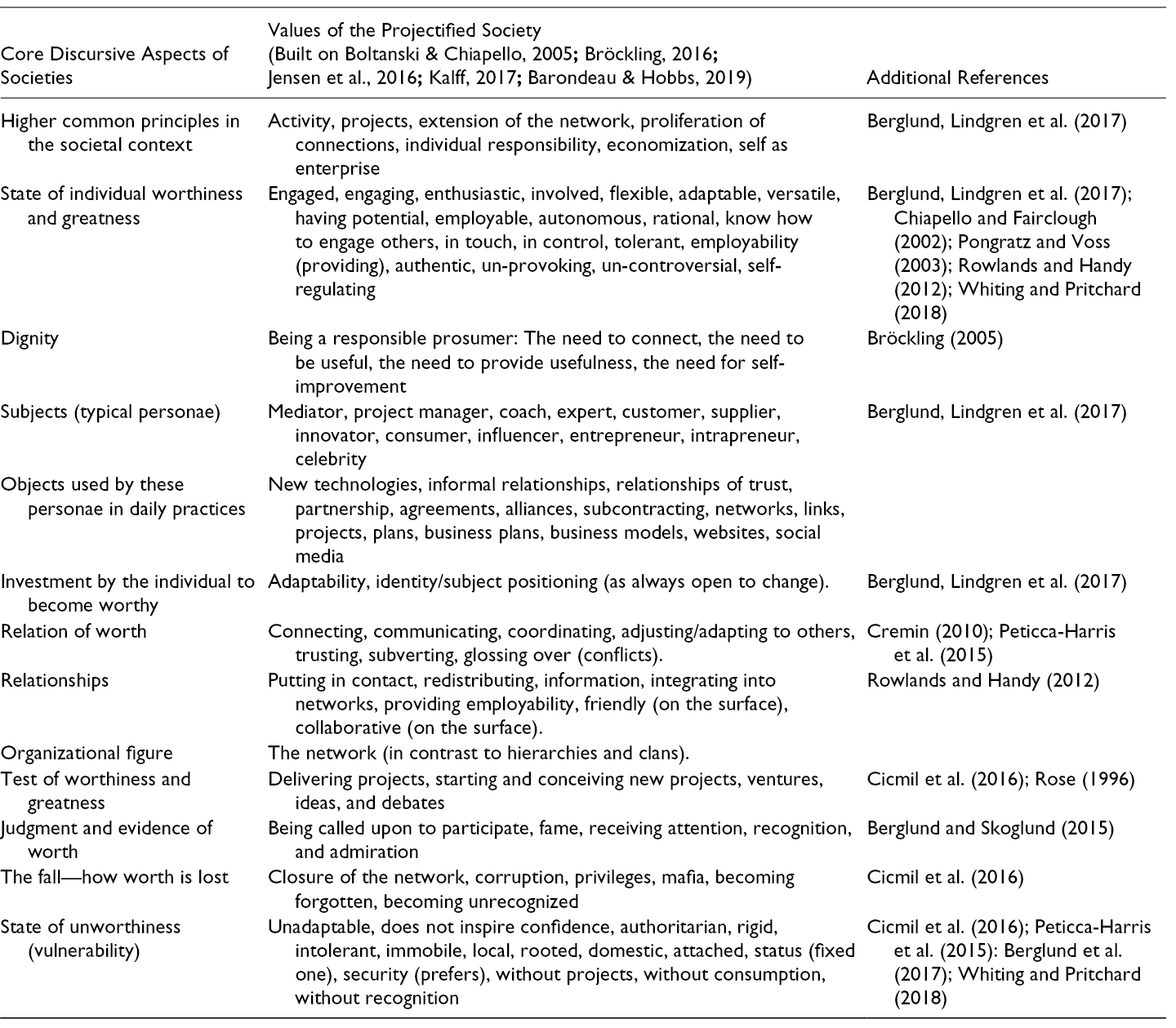
Central to Boltanski and Chiapello’s (2005) notion of cités is that they imply different ontologies’ worth, in other words, what it entails to be and become a person who strongly embodies and adheres to taken-for-granted values in society. The successful and worthy citizen of the project-oriented cité is thus described as an adaptive, flexible, and connective team player, able to generate enthusiasm and handle multiple cultural traditions, always prioritizing availability, employability and new projects over social stability and lifelong plans (cf. also Chiapello & Fairclough, 2002). Based on this reasoning, scholars have highlighted the risks and vulnerabilities associated with, for example, individual responsibilization in project-based work (Cicmil et al., 2016; Packendorff & Lindgren, 2014); the importance of networking and crafting one’s own life and career (Jensen et al., 2016); the importance of projects as instances of governmentality (Bröckling, 2016; Kalff, 2017; Müller et al., 2014); and the emphasis on collaboration and collaborative techniques in work life (Barondeau & Hobbs, 2019). The tenets of the projectified society identified in these literatures are summarized in Table 1.
Summary of the Core Tenets of Individual Worth in Neoliberal Projectified Society (Developed From Barondeau & Hobbs, 2019)
Projectified Selves and the Pursuit of Worth
Given the above characterization of the basic values and norms of the projectified society, we now turn to the question of how individuals position themselves within these values and norms and how they lead their lives and strive to preserve and increase their worth. In order to take such a discussion further, we thus need a theoretical perspective that does not only identify the emergence and main tenets of the neoliberal projectified society, but also strives to conceptualize how individuals construct themselves and their lives as projects. According to critical sociologist, Bröckling (2016), such a conceptualization can be found in the literatures on enterprising and entrepreneurial selves.
The literatures on enterprising and entrepreneurial selves (here we use the terms interchangeably) emerged in the early 1990s in the wake of Thatcherist reforms in the United Kingdom (cf. Keat, 1991), and were influenced by Michel Foucault’s writings on how power, subjectivity, and modes of governing have changed over the course of history (e.g., Lemke, 2001). Accordingly, this self took shape from the Enlightenment ideal of the Man of Reason to today’s Homo Economicus. Through the evolvement of modernity this self has taken different shapes and been molded into today’s entrepreneurial self: the entrepreneur of the self who no longer asks how he or she can benefit from society but who is spurred to take responsibility by asking what he or she can do for society. In a neoliberal society, the roles and responsibilities of the citizen have thus changed from claiming entitlement to particular rights guaranteed by the state to actively and entrepreneurially participating in solving problems themselves (Berglund & Skoglund, 2015). This implies giving one’s life “a specific entrepreneurial form” (Lemke, 2001, p. 202) through customizing one’s self into an active, responsible, and creative actor in the market economy (Grey, 1994).
Consequently, the notion of the entrepreneurial self is no longer connected only to the traditional entrepreneur who starts a new company or a new project but also to the very embarking on life as an entrepreneurial project (Kelly, 2013; Rose, 1996). In that sense, the entrepreneurial self has come to form a background against which we attach worth to human beings in contemporary society (Cremin, 2010; Gay et al., 1996; Fournier, 1998). This involves a kind of productive power that does not demand us to do something, but rather that can be described as enticing, friendly, and productive as it works through us (Bröckling, 2016). Earlier studies of such subjectification show how individuals in neoliberal society strive for improvement, freedom, and developing their potential (cf. Costea et al., 2012), while concealing their insecurity and vulnerability (Scharff, 2016).
To summarize the argument thus far, the projectified self builds on the enterprising/entrepreneurial self and comes as part and parcel with the idea of a society where personal worthiness rests upon our subjectification as autonomous, self-regulating, enterprising, and rational (Barry et al., 1996; Cremin, 2010). This self fits well into the enterprise culture since it adapts to change and aligns itself with prevailing market conditions (Grey, 1994; Harvey, 2000; Kelly, 2013). What is celebrated is a self-controlling, self-commercializing, self-rationalizing (Pongratz & Voss, 2003), affective, caring, ethical (Vrasti, 2012), self-driven, and self-organized human being who runs his or her life as a project (Bröckling, 2016; Kalff, 2017; Rose, 1996).
Studying Prosuming Projectified Selves
The consequences of the developments presented earlier had already been discussed by Rose (1996), who expounded on how “contemporary individuals are incited to live as if making a project of themselves: they are to work on their emotional worlds, their domestic and conjugal arrangements, their relations with employment and their techniques of sexual pleasure, to develop a ‘style’ of living that will maximize the worth of their existence themselves.” (p. 157) The sequencing of work thus demands maximum flexibility of the projectified self who has not only to span between an intense mode of self-organizing to high degrees of cooperation (Barondeau & Hobbs, 2019), but also to manage different projects and their potential overlapping, clashes, and opportunities for coordination (Bröckling, 2016; Jensen et al., 2016). There is a constant need for the projectified self to negotiate his or her project plans as if he or she is an enterprise. A parable can be made with the self as the parent company, where the project becomes the subsidiaries. Similarly, to the descriptions of the entrepreneurial self, the projectified self becomes both its own boss and subordinate, and its own supplier and customer:
“…by applying the principle of intrapreneurship to himself and splitting himself up accordingly: as, “customer of himself”, he is his own king, a being with needs that are to be recognized and satisfied by the “supplier of himself”. If the latter ignores the demands of his internal business partner, this partner will chasten him with lethargy, exhaustion or other forms of energy deprivation. If the exchange works well, however, both profit from it.” (Bröckling, 2005, p. 13)
This involves not only accomplishing specific tasks through projects and being on the alert for new potentially interesting and valuable projects that can be integrated into the project portfolio—it also requires an intricate negotiation with self’s demands as customer/producer. To gain worth, success, and admiration in such a life, one must display optimism and action orientation and identify oneself with the successful and admired in society rather than with the socioeconomic context in which one is currently situated (Gill, 2014). Again, this points to the centrality of prosumption; in other words, that the projectified self must at one and the same time put an attractive mix of characteristics on display and make sure these are recognized and appreciated by others.
Prosumption has traditionally been used as a descriptive concept, sometimes with normative appeals, to describe how new markets can be enacted in more inclusive ways through participatory web cultures (Beer & Burrows, 2010) where consumers can craft products for their own use (Campbell, 2005). However, prosumption has also been discussed in critical consumption studies, as an aspect of the governing of producers/consumers and a signifier of marketing becoming biopolitical (Skålén et al., 2008; Zwick & Bradshaw, 2016). These literatures point out how capitalism is taking on new forms as prosumption intensifies by becoming more and more entangled in all facets of life. With this comes the need to ask new questions. Ritzer and Jurgenson (2010), therefore, stress the need to understand how prosumption makes capitalism take on a different guise. In their view, this is implicated with “a trend toward unpaid rather than paid labor and toward offering products at no cost, and the system is marked by a new abundance where scarcity once predominated” (Ibid., p. 14).
Projectified Social Media Profiles: Glimpses From an on-Going Study
In this section, we will provide an example of the type of empirical landscape in which the projectified self can be studied. Given the on-going status, this is neither an exhaustive nor a final portrayal of the study. Nevertheless, we use it to conceptualize the projectified self’s relation to prosumption and worth. To study some of the above outlined consequences of the projectified self, we have turned to social media entrepreneurs as sources of examples of how projects become integrated with identity within the enterprise culture.
Social media offers spaces for networking by facilitating digital sharing and exchange (Kaplan & Haenlein, 2010), which have opened up marketplaces for entrepreneurs (Turan & Kara, 2018), and where the traditional boundaries between participating in a friendly dialogue and being targeted as a consumer have become highly blurred. These days, the notion of social media covers everything, including blog posts, podcasts; posts on major platforms, such as Instagram or Twitter; and offers a new terrain for a new breed of influencers to capitalize on a wide range of topics, including fashion, culture, technology, family, gender equality, career, self-improvement, and so forth. Thus, through social media a new arena for persuasion has emerged (Lanham, 2010), involving a new rhetoric (Ge & Gretzel, 2018), increased possibilities for everyone to become an opinion leader and participate in the personalization of politics (Bennett, 2012), and much more heterogenous and dynamic conditions for organizational reputation building (Etter et al., 2019). Some recent examples of these are beauty/fashion influencers, such as Huda Kattan and Chiara Ferragni; self-improvement and fitness advocates, such as Michelle Lewin, Lilly Singh, and Amanda Cerny; and creative humorists, such as Zach King and Andrew Bachelor—all of whom have tens of millions of followers worldwide. In addition, social media is also utilized for political activism (e.g., Tarana Burke’s #metoo movement, actress Emma Watson’s #heforshe campaign, or the anti-racist #blacklivesmatter movement) as well as for propelling the existing fame and fortunes of celebrities, famous entrepreneurs, and powerful politicians, including Kim Kardashian, Richard Branson, and Donald Trump.
In this terrain entrepreneurs have acted upon this new economy and built up multifaceted businesses around their personae—centering on a constant sharing of their personal lives combined with positioning themselves as socialites and experts on matters such as fashion, interior decorating, media trends, travel, and entrepreneurship. Clearly they are not the ones most at peril in the projectified society, but they are at the same time forerunners and inspirators for a young generation in search of values to project one’s ambitions onto. The example of social media entrepreneurs makes up an extreme case (Flyvbjerg, 2006) that facilitates the study of how the projectified self is advanced in contemporary enterprise culture.
For the purpose of this article, we have selected three cases (see Table 2) from one of the many recurring ranking lists in the social media sector in Sweden. These cases are part of a wider ongoing study, carried out by a research team that has been following social media entrepreneurs in various media outlets since 2017. The material consists of a collection of blog posts, transcriptions from podcasts, other (social) media clips that portray the entrepreneurs followed, along with the involved researchers’ observational notes conducted over time. The analytical process involves both individual reflections; jotting down analytical points; and collective analytical work, where the analytical points and relevant empirical material have been juxtaposed by putting the cases next to each other, making it possible to see one case through the characteristics of the others and vice versa (Marcus & Fischer, 1986; Sørensen, 2014). This has facilitated the process of conceptualization and discerning the need for applying new theoretical concepts built on prosumption and worth. In the process of defamiliarization, the concepts of responsibilization and neoliberal understandings of gender structures appeared to be important for the study of the projectified society—implying future development possibilities related to literatures on, for example, responsibility and postfeminism in organizations.
Selected Social Media Cases: Main Characteristics
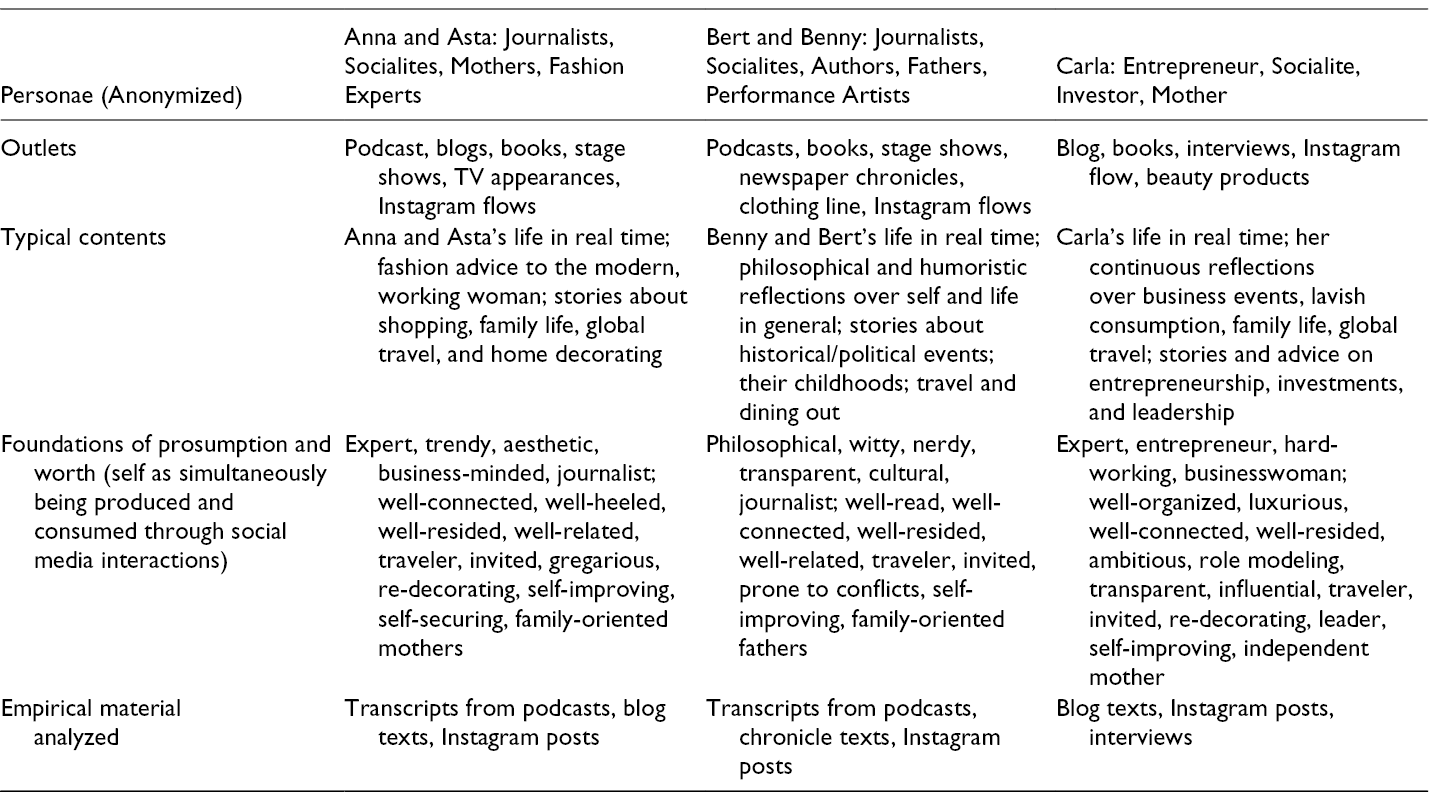
The base of these media entrepreneurs’ operations is typically a blog site and/or a weekly podcast, expanded by all sorts of other activities (e.g., Instagram flows, book publishing, television shows, stage performances, beauty products, clothing lines, and magazines). Blogs and podcasts at this level (i.e., six-digit number of individual listeners, which is at the same level as the leading daily newspapers in Sweden) are highly profitable operations; the cost of production and broadcast is very low, and the revenues from advertising and sponsor partners may sometimes exceed US$1 million per year. The different technologies allow for frequent updating, because their podcasts are published on a weekly basis, whereas posts on blogs and Instagram are made several times per day. In all of the three cases studied, incomes are obviously reinvested into extravagant lifestyles from which the entrepreneurs can draw additional material for future blog posts and podcasts. The world constructed in these three cases is a fragmented and eventful world to embrace, a world consisting of opportunities, creative collaborators, and an incessant flow of new projects and activities.
Social Media Entrepreneurs—Prosumption and Worth
What unites the social media entrepreneurs we have studied is that they all convey an optimistic project orientation in life. These entrepeneurs promote enhancement of self-confidence and well-being through the consumption of fashion, accessories, travel, exclusive food, spa treatments, or socializing with famous friends, However, their consumption of something also involves a marketing—or production—of the self, continuously making it more attractive, interesting, luxurious, and thus worthier. Carla’s blog post illustrates how consumption and production become intricately woven together:
Something that always makes me happy is when women choose to start their own businesses. To hear about their big ambitions and offer support along the road. Today I had lunch with [Rose] and [Richard] in their house. Rose has started her own lingerie brand called [Rosy Pants]! They remind me a bit about Hanky Panky but the quality is much better and they cost less. I have changed all my underwear to [Rosy Pants] now. I am so thrilled! Fantastic fit, and feels incredibly luxurious. I also love the idea with a complimentary bag for the pants. When I am travelling, I have always used a dust bag for shoes for my underwear but now I have this one. Wonderful colors, too. Keep up the good work, [Rose]! I really hope you are discovered by the whole world now!
[Carla, blog post]
Carla endorses “Rose,” a new producer of a lingerie brand, which simultaneously makes it possible for Carla to produce herself as both more luxurious and practical (there is a complimentary bag for the pants). In this post, Carla achieves several different purposes. She presents herself as a consumer of the new brand: “I have changed all my underwear to [Rosy Pants] now!” The post is written to entice her readers to follow her example and also buy Rose’s product. However, Carla not only recommends Rose, she also lets her become a role model of the desired entrepreneurial orientation to life—it makes her so happy when women start businesses. Rose, Carla, and the followers of the blog are at the same time positioned both as consumers and producers—as projectified selves who continuously need to improve their worth through prosumption. This projectified self needs to juggle not only the project of work or of life, but also to manage herself as a project that needs to be simultaneously produced and consumed. To remain attractive to the social media market, the projectified self needs to fashion herself with new accessories that distinguish her uniqueness, but this uniqueness is also produced for others to consume. Therefore, the projectified self constantly needs to be on the move, since the business model requires an incessant working on the self as unique and authentic.
To sustain life, the projectified self needs to recruit his or her followers to live life in a more projectified and prosumptive way. Blog posts from Carla, along with other female social media entrepreneurs, often revolve around fashion, lifestyle, careers, and entrepreneurship, which are mixed into postfeminist tropes found to have a tremendous impact on younger generations as coveted inspiration and disguised coaching (e.g., Duffy & Hund, 2015). The female entrepreneur who starts up and manages her own company is entwined with the assertive entrepreneurial woman who dares to express her femininity and can do attitude (Gill, 2007; Lewis et al., 2017). Carla presents herself as a symbol of equality, the emancipated woman, and a role model to follow. Carla, along with Asta and Anna, indeed recognize societal problems as gender inequality, but it is a fight to be won through successful competition in the marketplace by including and coaching more women with feminist aspirations (Berglund, Ahl et al., 2018). Successful competition requires the projectified self to keep up to date, looking for new products, network with new entrepreneurs but, paradoxically, also to remain within the boundaries of a de-politicized can do gendered subject who promotes equality without focusing on current social structures.
For the projectified self, there is no market out there to be conquered. Rather, the market is anywhere, everywhere, and entangled with the mundane. In dialogues, Anna and Asta discuss entrepreneurship as a way of successfully linking together work and family life; making the right, rational choices irrespective of what others may think; and becoming liberated from everyday life through consumption. In the following extract, “the most gorgeous desk ever” spurs them to consider the start-ups of new projects:
Anna: I just love that today we are recording this podcast sitting by a fantastic piece of furniture!
Asta: Yes, by the most gorgeous desk ever! [a designer item from the 1950s recently purchased by Anna]
[Anna tells a story about how she was interviewed by another famous influencer and discussed the unimportance of if furniture is classified as antique or vintage.]
Anna: But the point is that it’s an old but renovated desk with provenance…
Asta: …and then I start to think about who has used this desk before. I think it was a real power woman—such as you Anna!
Anna: Yeah, maybe! Cool!
Asta: I want to think like that anyway. Now I also want a desk. This might be the start of me working from home. I am really bad at that. You know, when I came in here and saw the desk, I said to myself: This. Is. The. Start. Of. My. New. Book!!!
Anna: Wow, you thought like that??? I’m so inspired hearing that!
[Anna and Asta, podcast]
In this dialogue, a desk is no longer a desk, but becomes a symbol of a power woman. Anna appears as a greater and improved self after this acquisition, and Asta is spurred to buy a similar desk herself to get inspiration to start up the project of writing a new book. This example illustrates how the projectified self—in the case of Asta—submits to a negotiation with her internal team members—or the CEOs of her internal subsidiaries (Bröckling, 2005)—admitting her productivity problem while also suggesting a solution. This very negotiation, we posit, is implicated in the intensification of prosumption, where the projectified self constantly needs to think both as a producer and consumer. Buying a desk can result in the production of a book, which, in turn, can lead to a greater self and new avenues for prosumption. The book project can be combined with subsequent projects, such as book releases, invitations to television shows, meet-and-greet events with followers, meetings with new entrepreneurs, and thus new prosumptive opportunities. And, so, the wheel is spinning: prosumption propels the projectified self to advance and involve both centrifugal and centripetal powers. On the one hand, it facilitates the projectified self to create markers that distinguish the self from others, making the self a unique product to be consumed in the social media market. On the other hand, it also involves others following suit—the projectified self not only sells him or herself, but also a (partly) accessible way of living. To stay ahead, however, these social media entrepreneurs need to be constantly on the go and be prepared to add themselves to new prosumptive opportunities.
Not surprisingly, social media entrepreneurs display a high degree of awareness that someone is always reading and listening and that their online persona/brand is not entirely controlled by themselves but also by the communities they address (cf. Paschen et al., 2017). They engage in constant dialogue with their followers; they come up with new activities, ideas, and provocations to keep the dialogue going. Most of their professional and private lives are on display, and we are also subjected to their inner thoughts and emotional reactions to things that happen in relation to their spouses and children—sometimes provoking harsh online reactions that in turn generate new material. This closeness, which is being built up as their personae are being consumed by their followers, is of course also employed in every podcast to convey recommendations to the very same followers regarding consumption opportunities elsewhere. None of them hesitates to label themselves professionally in a multitude of ways depending on the situation: they talk about themselves as bloggers, fashion experts, stylists, entrepreneurs, entertainers, journalists, and influencers and describe a hectic social life they share with other such professionals. Being occasionally overworked is a signifier of passion for entrepreneurship, almost an aesthetic statement in performing the presumptive made-up’ed, made-over’ed life of the projectified self:
You, who followed my recent Instastory (soon a quarter of a million followers there, yippee!), saw that my yesterday became quite long. When we landed in Madrid at 8:30 p.m. my luggage was lost so I went directly to meet my wonderful friend [Andrew], founder of [global cellphone accessory company] at the restaurant. He happened to be in the same town; he has 200 travel days per year so we try to meet occasionally. I haven’t seen him since I was in Cannes. I am so grateful to be able to spin ideas together with someone who is a step ahead of me.
By 1:00 a.m., the airport called and had found my luggage. I could have picked it up in the morning when taking my next flight to Milan, but I felt like having my things close, so I took a taxi out there and fetched my bags. Slept like a log back in my room by 2:30 a.m. I love this hotel but I did not get to see much of it, not even the breakfast. The taxi arrived at 7:30 a.m. this morning to take me back to the airport, so I just slept as long as possible. I had planned to go to the fitness center in the morning, but I took the liberty of sleeping those extra 30 minutes instead.
[Carla, blog post]
Carla presents herself as the super-effective individual, the one who stretches herself to the limits, but who has acquired the skills of combining the effective ethos of the projectified self with the pleasures this life also brings. A dinner with a friend is not only a moment of relaxation and pleasure, but also an opportunity to spin new ideas. Practices of prosumption are always present, and veil the paradox of the super stressful yet enjoyable life of the projectified self. Problems are tackled with a positive can do attitude; people in their vast networks are described as sometimes marvelous, lovable, generous individuals who inspire them, and sometimes as exciting villains.
If entrepreneurialism has become a signifier of the postfeminist female subject—active, self-made, self-improved, rising through shattered glass ceilings by means of attention to details, explicit business models, and collective girl power—then masculine entrepreneurship is disguised behind nerdiness, self-introspection, emotional outburst, attention to ideas, low-intense conflict, and being seemingly unaware of economic realities. This is reflected in the following dialogue from Bert and Benny’s podcast:
Benny: Before my flu, I had incredible news. Our live podcast was sold out in [three main Swedish cities]. What brutes would we be if we could not add some additional dates?
Bert: We have new dates. We’re putting our feet down. Check our homepage for tickets! You know what? There are two sorts of nerds here in the world: the good and the evil. The good ones are those who don’t care about how the world perceives them.
Benny: Ha-ha-ha!!! But we need to return to the issue of my flu. You know, it was like the heart of darkness. My organs, my body, all feelings not necessary for survival, everything shut down. Except for my anger: Who did this to me? Who infected me?
Bert: You know who it was? You know, I got it too.
Benny: This flu was life changing! I will not live in Sweden next winter because of this. I’m sorry that you got that evil from me. But we’re gonna hunt that guy down now, the one responsible.
[They make calls to several famous male friends and accuse them of infecting Benny with the flu at a high-end restaurant in central Stockholm. In the end, they conclude that a TV host [Patric] is the villain, but he does not answer their call].
Benny: The only thing you can think of when you are ill is “Who did this to me?” [Patric] cares about everything and he started it all! How many work hours and suffering has he caused Swedish work life? We’re talking about thousands of people!
[Benny and Bert, podcast]
In contrast to the hectic life of Carla or the self-critical exposures of Anna and Asta, who seek ways to improve their lives toward perfection, Benny and Bert seem almost devoid of ambition and stress—except for occasional outbursts of hypochondria or childhood anxieties. Postfeminist tropes and hopes are found in this male context, where the two men go back and forth between taking the soft man position—treating women as equals and supporting empowerment of their female partners—and reinforcing patriarchal and aggressive masculinity by not shying away from making accusations, bursting out, and simultaneously claiming a victimized position (cf. Rumens, 2017).
The notion of worth in terms of social status, mobility, and entrepreneurialism is always present in our cases. All of the social media entrepreneurs studied exhibit quite lavish spending habits: it is obvious that they reside in exclusive neighborhoods, have access to multiple homes, travel to exclusive vacation spots, buy expensive things, and so on and so forth. They rarely miss an opportunity to tell their followers about the famous people they are friends with and at what high-end venues they congregate. All of them, except for Carla, come from well-known families and depict themselves as yet another gifted generation rather than as ascending from nothing. There is an awareness of structural societal problems in all cases, but the solution is to take initiatives, launch new projects, and inspire others to do the same. The necessary attitude to life is to choose to remain positive and adaptive. Being critical is being negative, un-entrepreneurial, unattractive, unsellable, and a nobody. The follower, who nurtures a relation with his or her social media personae, can develop a relation with this life in proximity to oneself, lived out by consuming the attitudes and identity markers offered.
Conclusion
In this article we set out to develop the concept of the projectified self as a way toward future emancipatory project studies on how and why individuals in contemporary neoliberal societies identify with the ethos of projectification and the consequences thereof in their professional and private lives. The literatures on projectification go into some depth on the discursive resources individuals draw upon in pursuing project-based work (cf. Cicmil et al., 2016; Packendorff & Lindgren, 2014). However, there remains potential in exploring how power structures in society underpin the emergence of projectified selves (Kalff, 2017)—in other words, the construction of self and life in general as a project to achieve development and (re)affirmation of personal worth.
Through the conceptualization of the projectified self offered in this text and the empirically based example of social media entrepreneurs, we want to highlight possible new avenues for emancipatory project studies—both in terms of inquiring into traditional empirical settings in project research with new questions and studying new empirical settings (e.g., the social media entrepreneurs described earlier). Examples of possible empirical settings to study are entrepreneurs in general, the inhabitants of the gig economy, professionals in project-based industries, academics, public servants, new kinds of entrepreneurs aimed at social and environmental change, and other individuals who try to propel their careers through social media presence. The concept of the projectified self enables us not only to analyze how their identities are simultaneously produced, consumed, and also how their subject positions as emancipated human beings are constrained within an enterprise culture. The one not constantly involved in production and consumption of self and the one not constantly striving to become increasingly visible, available, relevant, and admired is without worth. Needless to say, the possibilities to gain and the risks to become bereft of such worth differ among individuals depending on other identity bases.
When pointing at possible new theoretical engagements available to project scholars when employing the notion of projectified selves, we thus suggest the study of markers used to further the projectified self, for example, gender, class, ethnicity, and political orientations. Linking these to the theoretical discussions on enterprising selves and enterprise culture, we suggest they can be employed to analyze how the projectified self thrives in neoliberal society and theorize how it morphs to accommodate specific circumstances in different contexts. Without any ambition to be all encompassing, we have summarized three interrelated theoretical avenues, described as follows.
The first avenue relates to the consequences of project-based fragmentation of careers and lives—to what extent is the projectified self a fragmented self, and what does that mean for long-term achievements and well-being? As noted by Lindgren and Wåhlin (2001), some individuals tend to construct fragmented identities over time, compartmentalizing their selves and moving between identities depending on the situation. This is something that can be expected in a projectified setting with its various and varying demands from different markets and the need for the projectified self to stay relevant and worthy (Chiapello & Fairclough, 2002). Our perspective emphasizes the complexities and nuances of fragmentation—projectified selves are always conditioned to split themselves up in time and space in order to be prosumed in new contexts and situations while also preserving some sort of coherent narrative of self. Moreover, it should also be of interest to revisit the notions of greatness and worthiness in Boltanski and Chiapello’s (2005) work: What does it mean to be great or small in projectified milieus? What possibilities and problems are in store for those aspiring to achieve, prosper, and gain social status; in other words, never really attaining the phantasmic worth they so desperately seek? (cf. Jones & Spicer, 2005) What happens when projectified selves do not trust traditional notions of career, advancement, or downfall in organizations to offer the security, confidence, and predictability they once did?
The second avenue is the far-reaching responsibilization of individuals (Berglund, Lindgren et al., 2017) in neoliberal society in relation to the responsibilization going on in project-based settings (Hodgson, 2005; Kalff, 2017). Here, it is of interest to ask how such responsibilization is articulated, internalized, negotiated, and what the consequences are for the sense of individual risk and vulnerability (Cicmil et al., 2016). Projectified selves are both moral and moralizing selves, explicitly and/or implicitly producing ideologies and values, yet also subject to expectations to live according to these ideologies and values in order to gain and preserve personal worth.
Third, the projectified self is a highly gendered subject position (Berglund, Lindgren et al., 2017; Bröckling, 2005), implying that it is of interest to inquire about which femininities and masculinities are produced and reproduced in the process of prosumption in pursuit of worth. This particular kind of doing gender has been investigated in the feminist literature under the label of postfeminism. As noted by Ringrose (2007, p. 484), “…the postfeminist woman represents ‘neoliberal dreams of winning and “just doing it” against the odds’”. She is a “‘can do,’ ‘have it all’ poster child for ‘free market feminism’ (McRobbie, 2004), celebrated as one who rises above her station in life to become not only a more productive and fulfilled worker, but also a better self” (Sullivan & Delaney, 2017, p. 839). A postfeminist perspective on projectified selves thus allows us to analyze how emancipation in an enterprise culture is still gendered, in other words, that women have a much more conditioned space of action than men; that personal improvement thus may require not only action orientation and fearless entrepreneurialism but also adherence to feminine issues and explicit restraint and remorse. Future studies of how we can escape this postfeminist dilemma could be done by tracing practices on how we can be part of emancipatory action and changes in social structures.
Footnotes
Acknowledgments
We are indebted to the session participants at the 10th Biennial International Interdisciplinary Conference on Gender, Work and Organization, Maquarie University, Sydney, Australia, 2018, and the 9th Making Projects Critical (MPC) Workshop, Mälardalen University, Västerås, Sweden, 2019, for their insightful comments on earlier versions of this article. We also would like to thank the special issue editors and the anonymous reviewers for their most constructive and helpful comments in revising this article for publication.
Authors’ note
Karin Berglund is also affiliated with Nord University, Bodö, Norway.
Declaration of Conflicting Interests
The author(s) declared no potential conflicts of interest with respect to the research, authorship, and/or publication of this article.
Funding
The author(s) received no financial support for the research, authorship, and/or publication of this article.
Author Biographies