




Abstract
In Aotearoa New Zealand's capital city of Te Whanganui a Tara Wellington, the endemic kākā parrot has become a poster child for urban conservation success. Big, loud, and sociable, their return to the city after 70 years of absence has transformed the urban area for good. But while their charismatic screeching presence has made kākā a Wellington icon for many, their practice of stripping bark and killing city trees has led to rumbling tensions and questions about who truly belongs in the city. This article investigates multispecies relations in urban areas, in particular how cities are continuously remade through relations and meaning-filled collaborations with more-than-human beings. Through a focus on the dynamic relations between kākā, humans, and trees in Wellington city during a period of significant change following the release of captive-bred kākā, we reveal the productive role that more-than-human beings have in co-producing meaning and materiality in the city. Drawing Karen Barad's agential realism into productive conversation with Catherine Hill's reconceptualization of human-wildlife conflict, we propose that the rumblings of kākā-human tension was not a singular event that has since been managed by human institutions but a productive force which was vital to the emergence of new urban multispecies relations; relations which have unsettled established histories, amplified conservation discourses, and brought new urban worlds and identities into being. Ultimately we suggest that reframing human-wildlife conflict as neither a management failure, nor as evidence of ‘misbehaviour’ by a particular group, but as an intense period of relational meaning making between species, could provide both analytical insight and guidance for navigating shared spaces.
Keywords
Introduction
Once considered a “biodiversity basket case” (Ward, 2021), Aotearoa New Zealand's capital city of Te Whanganui a Tara Wellington is now touted as “one of the only cities in the world where the diversity of native birds is increasing” (Shanahan, 2018: 1). Over the past 200 years, the land area has been subjected to processes of colonisation which have had profound impacts on the environment. Concerted efforts in the last two decades to restore some native biodiversity have been surprisingly successful. One result is that the city's bustling urban area is now home to some of Aotearoa's most critically endangered bird species: kererū, kākā, tūī, pīwakawaka, korimako, kārearea, kākāriki and tīeke. Despite struggling nationwide with habitat pressures and predation from introduced mammals, these endemic birds are now thriving alongside the 440,000 or so human inhabitants of Wellington.
Amongst these avian residents, the charismatic kākā parrot is becoming an increasingly prominent actor in this new urban multispecies assemblage. Big, boisterous and highly social, with a shrieking call and playful demeanour, they have won the hearts of many human residents, injecting themselves into public discourse and taking the role of poster child for the city's conservation achievements. Yet despite their current popularity, kākā (re)introduction into the city has not been without trouble. Equipped with sharp beaks and a taste for sap, their practice of ringbarking city trees is proving deadly for a number of tree species. This taste for trees has also been accompanied by related beaky escapades such as nibbling at wooden decks, taking fruit from trees and in some cases stripping lead flashing from roofs. But despite initial rumblings of anti-kākā sentiment among some human residents, especially tree lovers, the anticipated push back against kākā has never really come to a head. Indeed, contrary to common sense understandings of human-wildlife conflict, kākā have risen in popularity even as their deadly impact on beloved city trees becomes more noticeable.
With the kākā as our guides, this article explores multispecies relationships in urban areas. Through a focus on kākā, human and tree relationships, we show that by shifting from an anthropocentric to a relational lens of analysis we can reveal the productive role that more-than-human (MTH) beings have in co-producing meaning and materiality in the city. We argue that the rumblings of kākā-human conflict was not a singular event that has since been managed by human institutions, but a productive force which was vital to the emergence of new urban multispecies relations; relations which have unsettled established histories, amplified conservation discourses, and brought new urban worlds and identities into being. Amidst powerful national myths of the worth of native vs exotic species, these kākā-human-tree relations and their material-discursive practices (Barad, 2007) have complicated and diffracted (Geerts and Tuin, 2016) what it means to belong. In a city marked by settler colonial histories and presents, this article brings the kākā into frame as significant actors in unsettling established colonial multispecies partnerships, posing (sometimes uncomfortable) questions about which histories can be celebrated in the city's town belt.
To make this argument we bring Catherine Hill's (2021) work on multispecies conflict into productive conversation with Karan Barad's agential realism (2007) in the context of urban conservation initiatives. This article therefore connects debates in human-wildlife conflict literature on the risks and benefits of sharing space with wild animals (Schroer, 2021) to relational MTH theory which challenges anthropocentric notions of agency (Lorimer, 2015; van Dooren et al., 2016). In doing so it contributes to growing discussion in MTH geographies which aim to expand our notions of, and account for, MTH agency in conservation spaces (Ampumuza and Driessen, 2021; Boonman-Berson et al., 2016; Edelblutte et al., 2023; Toncheva and Fletcher, 2022). The urban focus of our study also brings it into contact with work which explores the ways in which MTH life is always constructive of the urban, rather than simply transgressive presences (Barua, 2023; Hinchliffe and Whatmore, 2006; van Dooren and Rose, 2012). By bringing these literatures into conversation with each other, we offer new ways of thinking through how contemporary conservation practices are reshaping urban spaces.
In what follows we first set out our conceptual landscape, outlining the approach to MTH agencies used in this analysis. We then outline our methods before situating ourselves with the Wellington kākā, tracing and ultimately untangling the current understanding of conflict in order to follow the discursive-material practices at work. Finally, we reflect on the implications of this relational analysis for the understanding of new notions of identity and history at a highly visible and important site for multispecies relations and identity making in Wellington: the Botanic Gardens.
Thinking with more-than-human agencies
Posthuman theory has argued for expansive explorations of who shapes the world. This large body of thought takes seriously the role and agencies of nonhumans, engaging with onto-epistemological tools and theory to think beyond humans as the centre of the world. While contested and spanning many disciplines, posthumanism can be roughly summed up as thought which troubles the notion of ontologically fixed categories prevalent in post-enlightenment Western thought. Posthumanism emphasises the complex, entangled and multiple nature of the world (Grusin, 2015; Wolfe, 2010). This thinking originates with and continues to be developed by Indigenous philosophers, communities and scholars. These scholars and communities have long looked beyond anthropocentrism and critiqued the separation of nature and culture and other hierarchies that characterise Western thought (TallBear, 2011; Todd, 2016; Watts, 2013; Winter, 2022). Celermajer et al. (2020) write that the array of Indigenous philosophies that could be described as ‘posthumanist’ view “the world, both human and non-human, as animated, agential, knowing, feeling, and relational” (pg.7). For example, in Aotearoa, the Māori philosophical concept of whakapapa conveys the ontological understanding that all beings are an essential, agential and active part of a complex web of multispecies kinship relations which relies on and is upheld by obligations of reciprocal care (Watene, 2016).
Posthumanism in Western academic traditions has often been presented as new; a tendency which is critiqued as perpetuating colonialisms (Sundberg, 2014; Todd, 2016) and maintaining hierarchy over indigenous ways of thinking (Watts, 2013). We are three white researchers largely trained in Western, Eurocentric academic traditions. 1 We follow calls to challenge the persistence of colonialisms in posthuman literature (Todd, 2016) by seeking to engage with these perspectives not as novel theoretical interventions, but as part of longer conversations with complex genealogies that extend beyond and before Western academic traditions. By engaging with a posthuman lens, we seek not only to move away from human exceptionalism, but also to open spaces for recognising diverse ways of knowing and being in the world: both human and non-human (Bawaka Country et al., 2013). Given our positionalities, training and relationships, we remain mindful of the limits of our insights.
Posthumanism's contestation of dualisms (such as nature/culture, mind/body, subject/object) has involved the re-integration of the realms of the ‘social’ and the ‘natural’ (Latour, 2005). Donna Haraway (2003) has pointed out that dividing the world up into discrete spheres of ‘natural’, ‘cultural’, ‘social’ and ‘economic’ realms is a “misplaced concreteness” (pg.6) in a world that is always being made. This resistance to the separation of the ‘social’ or ‘cultural’ human sphere of influence from the static ‘natural’ realm of nonhumans has also involved opening up our modes of analysis to appreciate the MTH influences within the social, cultural, economic and political. As exemplified by the declaration that “we have never been human” (Haraway, 2008: 3), thinkers in this area argue that taken for granted categories such as ‘human’ are in fact ontologically fluid and that such categories, rather than being a means of separation, have always been the result of collaboration and coevolution with MTH entities (Grusin, 2015). Such work challenges the Western tradition of anthropocentrism and draws attention to the deep multispecies entanglements which co-construct worlds (Singh, 2022). In doing so it offers a transformed approach to the humanities and social sciences, arguing that “the question of political or social change becomes a question of changing our relations not only to other humans but to nonhumans as well” (Grusin, 2015: 18).
Key to a MTH explanation of political and social change are conceptualisations of agency. Agency, the capacity to act or make transformative change, has long been considered a distinctly human quality by the Western canon. Latour (2010) argued that by confining nonhumans to the realm of ‘nature’, a category synonymous with static, biologically determined, scientifically discoverable truth, dualistic Western thought can explain away nonhuman impacts on human lives by treating their actions as innate, evolutionary predetermined behaviours generic to their species. Deconstructing such mechanistic depictions of nonhumans and recognising the agencies of “beings, things, and objects previously ignored as active agents” (Dowling et al., 2017: 824) has been an essential part of confronting human exceptionalism in MTH scholarship (Haraway, 2008). Yet noticing, and indeed studying, nonhuman agency presents a profound challenge to Western assumptions about what it means to be agentic; particularly notions of intentionality, individuality and free will.
In conversation with posthumanism's relational ontologies, Karen Barad's agential realism (2007), often classified as part of feminist new materialisms, offers a useful philosophical approach to account for nonhuman agency. Through a focus on the vitality of matter and the material world Barad's agential realism stresses the relationality of agency, arguing that it is not something held or possessed by an individual but, rather, embodied and enacted in relation to others. Agency is an achievement gained temporarily through interaction with an assemblage of other agents: that there can be no agency that is not shared with others. Such thinking shifts the study of agency from a focus on individual actors to the relationships between entities.
By recognising that agency is not solely a human attribute but emerges relationally through the entangled intra-actions of humans and nonhumans, agential realism invites us to critically interrogate the apparatuses, both material and discursive, that shape the ways urban spaces are configured to enact or produce certain hierarchies and narratives of belonging. Crucially, for Barad (2007: 3) “matter and meaning are not separate elements”, thus bringing together the previously disparate tools of social constructionism (notably discourse analysis) and a materially inclusive onto-epistemology. Using the notion of intra-action to describe the constant and productive entanglement of matter and meaning, agential realism challenges the separation between discourse and materiality. Here discursive practices are always material and vice versa, something which further emphasises the inseparability of entities from their relations to others: “relata do not pre-exist relations” (Barad, 2007: 140). This is an approach that not only displaces the notion of causality but also dissolves the subject/object divide. From this positioning then, humans do not act upon nonhumans/matter, rather humans and nonhumans are both actors in a world that is continuously brought into being through their agentic relations. It is in these relations that discourse and materiality (including the material-discursive bodies of the actors themselves) are produced.
Not only does this approach challenge the often-implicit hierarchies that position humans as dominant actors while relegating nonhuman beings to the status of passive objects or resources, it also compels us to consider our ethical and political responsibilities in co-constituting urban ecologies; in which we are always in consequential relationship with our multispecies neighbours (Tsing, 2012; van Dooren et al., 2016). Exploring the continuous work of world making is particularly useful in urban spaces; spaces that while often articulated as places outside of ‘nature’ are always “inescapably multispecies affairs”mpa#rdquo; (van Dooren and Rose, 2012: 16). Thinking in terms of the multispecies city or ‘living city’ acknowledges that MTHs “don't just exist in cities, precariously clinging to the towers and edifices of modernity, but shape and are shaped by their urban relations” (Hinchliffe and Whatmore, 2006: 127). Furthermore, making visible the “messy business of living together”mpa#rdquo; (Hinchliffe and Whatmore, 2006: 134) means confronting and grappling with the ethical questions at play between beings. Extending our analysis to explore and understand our interspecies dependencies and conflicts gives us the flexibility to begin to negotiate what it might mean to really share a space (Lorimer, 2015; van Dooren and Rose, 2012). In the city of Wellington, questions of how and who to share space with are playing out in the sphere of urban conservation, bringing to the fore crucial political and ethical questions of how beings live together.
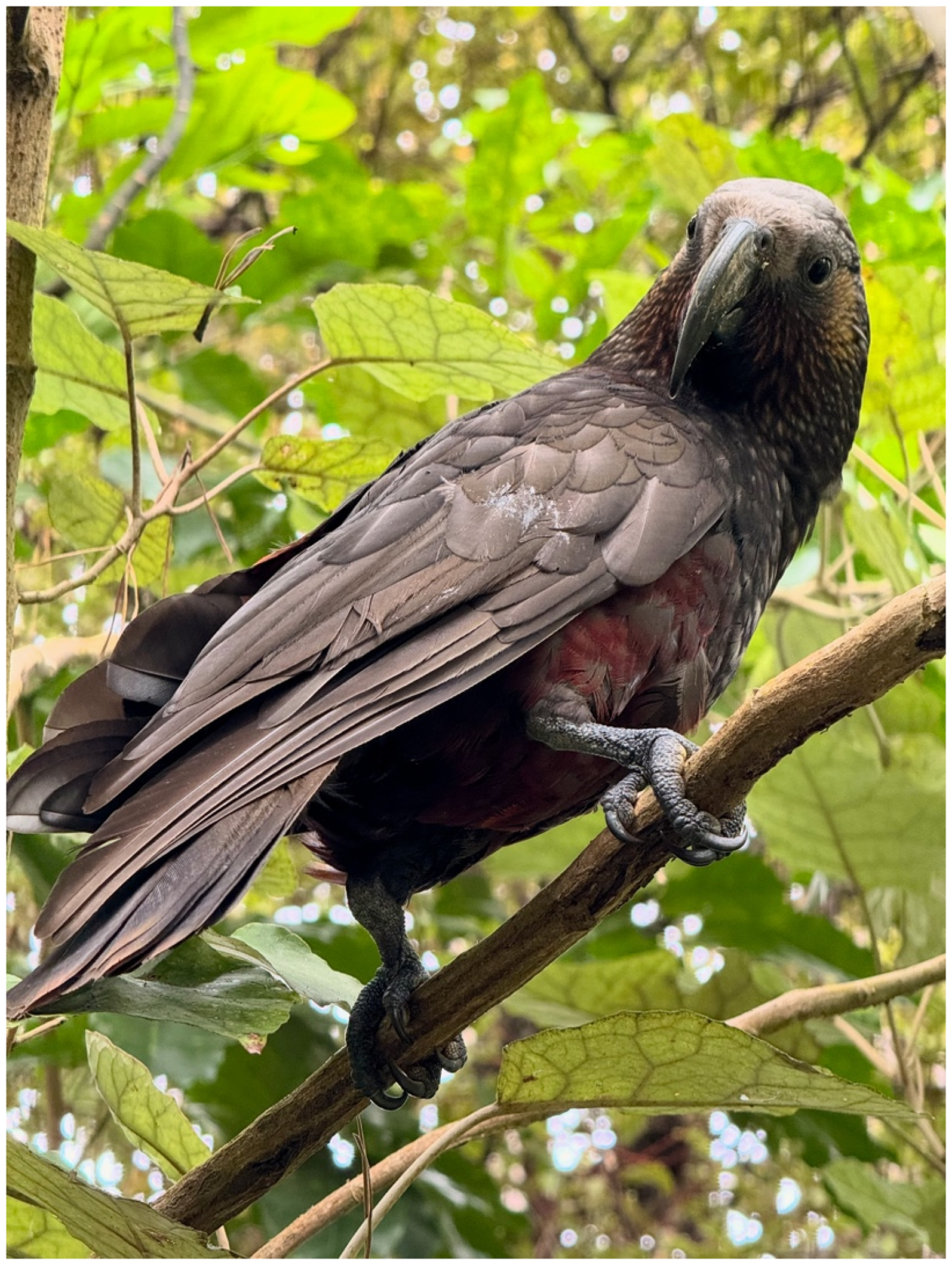
Kākā looking down from a branch. Photo: Author's own.
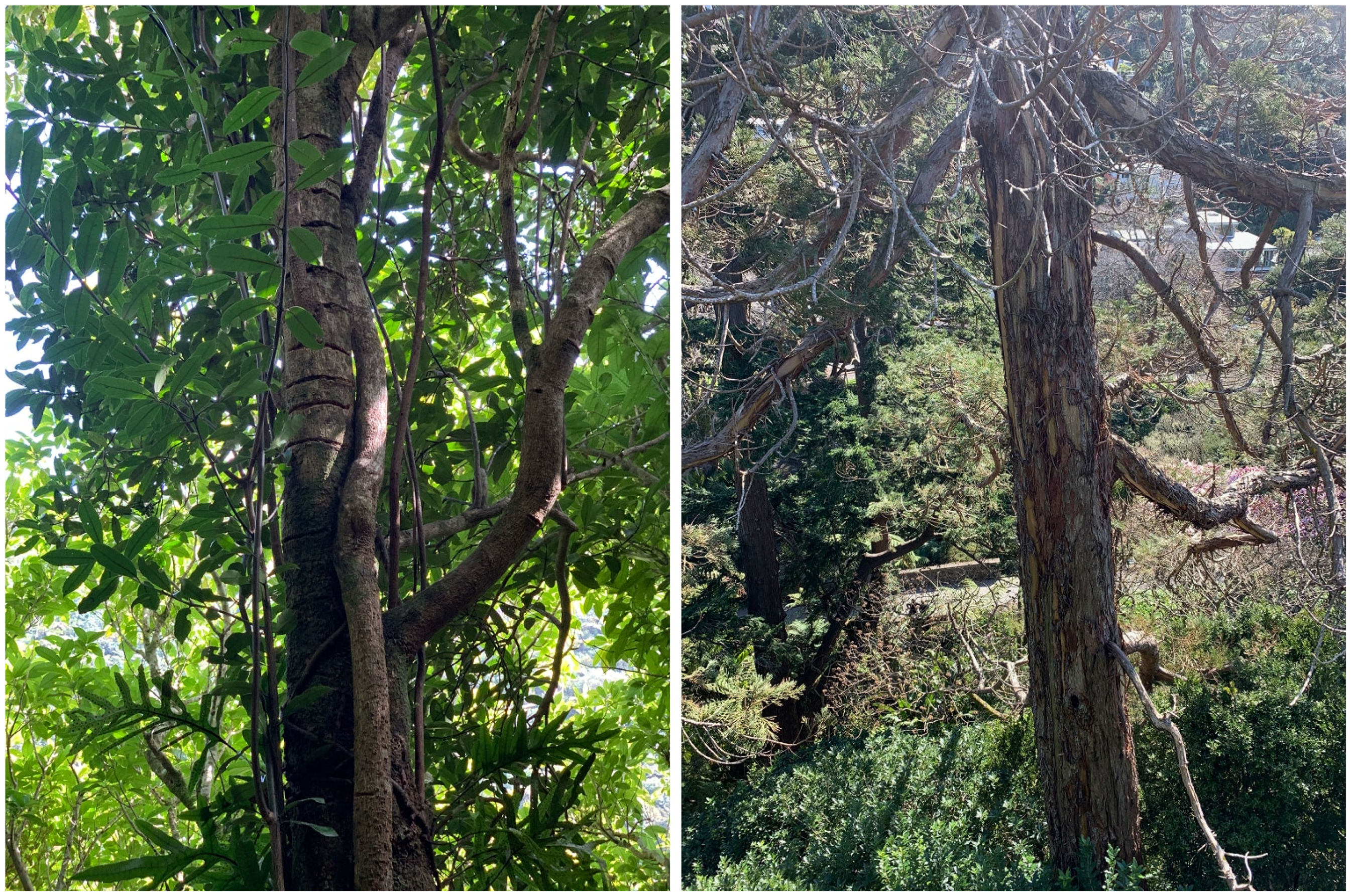
Types of kākā induced tree damage. Left: Beak gouges on tree in Brooklyn. Right: Dying redwood with areas of ripped and shredded bark, at Botanic Gardens. Photos: Author's own.
Methods
To explore kākā-human relationship in Wellington city the lead author carried out a multispecies ethnography (Boonman-Berson and van Bommel, 2023; Chao, 2020; Kirksey and Helmreich, 2010). This entailed a mix of methods which can be roughly aligned with the labels of semi-structured interviews, participant observation and direct observation (Hodgetts and Lorimer, 2015). This data was collected as part of the lead author's masters research (Breed, 2024) between June and September 2023, which was granted human ethics approval by our institution.
Interviewees were seventeen people who live, work or have had significant experiences with the Wellington kākā and were identified and recruited through existing relationships, and then a process of snowballing (Braun and Clarke, 2013). Two participants were mana whenua rangers, environmental workers who belong to the Māori iwi (tribes) with accountability and authority to the land in Wellington city. The other participants were Pākehā/New Zealand European. This range of interviewees does not capture the rich cultures and ontologies that make up Aotearoa New Zealand and should not be taken as a comprehensive account of kākā-human lifeworld's. Instead what we have done is bring together a select range of evolving human-kākā relationships and put them into conversation with literatures in MTH and human-wildlife conflict. Throughout the article we’ve drawn on research that points to this ontological pluralism, and crucially the primacy of Te Ao Māori, the Māori world (Roberts et al., 1995). Māori never ceded sovereignty, and have and continue to engage in active resistance to colonialism.
Who are the Wellington kākā?
Usually heard before they are seen, the Wellington kākā are classified as North Island kākā, a large parrot endemic to Aotearoa. They stand between 30–50 cm tall and appear mostly olive brown, with a deep crimson belly and undertail and shockingly red-orange underwing. They have a set of strong, scaly feet used for climbing, hanging playfully from branches and delicately holding food to nibble on. As omnivores, their vicious-looking curved beaks are an important tool for removing tree bark to access sap and insects. Though their loud ‘skraak’ is their most recognisable call, they communicate using a wide variety of whistles and songs, many of which are now recognised as regional flock-specific dialects (Horik et al., 2007; Powlesland et al., 2009). Kākā are also highly social creatures, regularly seen in groups known as hoons (Figure 1).
Birds that would now be recognised as North Island kākā have a long history in the region. Fossil evidence from as far back as 400,000 years ago shows the presence of kākā ancestors in the land known as Te Upoko-o-te-Ika-a Māui (the head of Māui's fish), later named Te Whanganui-a-Tara (the great harbour of Tara), now officially Wellington Harbour (Wellington City Council, 2023a). Documentary evidence from mana whenua, (Indigenous people of, and with authority in, the land), latterly Taranaki Whānui who migrated to the area in the 1820s (Skelton and Taranaki Whanui, 2022), offers glimpses into the lives of these flocks and their relationships with humans during this period. Notably their role as an important game-bird, the spiritual and symbolic significance of their red feathers which are in turn treasured as materials for kahu kura (kākā feather cloaks), and their group dynamics which are highly regarded for their loyalty and also individuals’ capacity for chiefly leadership (Riley, 2001). The material connection between these kākā and the Wellington region was profoundly disrupted by British colonisation which began in the mid-nineteenth century. Processes of ecological imperialism including deforestation, hunting and the introduction of novel nonhuman species decimated local bird populations and rendered kākā functionally extinct in the Wellington region by the early twentieth century.
The emergence of modern day urban kākā is the direct result of collaboration between captive-reared kākā, and local eco-sanctuary and conservation organisation: Zealandia Te Māra a Tāne (alongside conversations and collaboration with local iwi). Opened in 2000, over the last 25 years this world-first mammal proof sanctuary, nestled between two central suburbs, has flooded the capital with a now thriving population of native birds. After almost 70 years of absence in the Wellington region, Zealandia released six captive bred kākā into their centrally located sanctuary in 2002 (Belcher, 2004), followed by a further eight over the years to 2007. This small group grew to an established population of more than 750 in 2016 (Zealandia, 2023) many of whom have now spilled over Zealandia's fence line into Wellington city and beyond. 2
Wellington's multispecies transformation has been enthusiastically received by most of the city's human residents. The city's thriving bird numbers are a regular good news headline in local (Mackay, 2023), national (Ballance, 2018) and even international news (Stutchbury and Bullock, 2022), and the spread of popular species like kākā further out into the regions surrounding Wellington is excitedly reported by locals (Boyack, 2023). A significant number of the city's human residents show their active support for the birds by volunteering their time with the city's many local conservation or predator free groups (Wellington City Council, 2023b). Meanwhile Zealandia, once a much-contested local investment (Burges, 2011) has become a national icon and important tourist destination as well as a leading ecosanctuary (Wellington City Council, 2023c).
The kākā holds particular appeal as a charismatic, loud and characterful bird. They have been informally adopted as an ambassador for Zealandia and are regularly depicted in city wall murals, library cards, local art and general iconography which celebrates the arrival of the avian residents. Indeed, the story of conservation success seems to have become central to a whole new Wellington identity: as eco-city (Lonely Planet, 2022), a “poster-city” for conservation (Corlett, 2022), and an “ecological triumph” (Marris, 2018).
However, the kākā-human relationship in Wellington since reintroduction hasn’t been straightforward. Kākā are highly adaptable foragers. Known as seasonal specialists, they eat a broad range of seeds, fruit, nectar, honeydew and insects (Moorhouse, 2013). They also have an unusual talent for sap feeding. Using their razor-sharp beaks, they can slice bark from tree branches and trunks, either whittling precise rings around the whole limb or excitedly ripping away great strips to get at the sugary sap underneath. Unfortunately, for a significant number of trees, this repeated beaky onslaught can be deadly. There is no definitive understanding of the mechanism, but the arborists and gardeners interviewed for this research thought that repeated ring barking made trees vulnerable to insects and disease as well as depleting their energy resources. Years of having to re-seal their bark ultimately leads to death from sheer fatigue. As participant Greg pointed out, “It's death by a thousand cuts”- a thousand kākā inflicted cuts (Figure 2).
The deadly relationship between city trees and the Wellington kākā was totally unexpected. Kākā were known to be occasional sap eaters, but until their release into Wellington very little was known about the exact nature of their sap foraging behaviour (Charles and Linklater, 2013). Now the traces of kākā are carved into trees in every corner of the city, from the bustling central strip of Courtney Place to the expanse of trees across the spines of the hills that surround Wellington. Of particular concern to city management and local news outlets, has been the impact on the city's Botanic Gardens. Sitting pride of place in Wellington's green belt, kākā impact on trees at the Gardens has been nothing short of cataclysmic. Barry at the Gardens explained: It's almost crisis management now about what trees have to come out next….this giant sequoia [nonnative] out here, which is over 100 years old, they've killed it, which is a real shame because it's a heritage tree, it's part of the original tree fabric of the garden. In terms of the lifespan of sequoia, it's still a seedling, even though it's 30 metres high. The biggest trees in the world are sequoias. So it's really, really, really disappointing to see that. And they really are attacking all those northern hemisphere conifers, particularly the ones with the soft barks, the Leyland cypresses and the cedars. All those sorts of things are getting attacked. The deciduous trees are also getting attacked.
Relations with pine trees in Aotearoa are actively entangled in a complex web of histories and associations. They first arrived with colonial settlers in the 1850s and quickly became key partners in establishing economic success on land newly ‘acquired’ (variously confiscated or stolen) from Māori peoples (Barbour et al., 2023). Conifers such as the Pinus radiata D.Don continue to be important participants in commercial forestry and as a shelter plant for farmers (Berg, 2008). In Wellington, northern hemisphere conifer planting started in earnest in the town belt in 1880s and it is this framework of trees that still shapes much of the plant assemblage and landscape arrangement in Wellington today (WellingtonCity Council, 2015). The Botanic Gardens was given the role of trialling oversees trees, plants and even some animals to see which would be suitable for growing in Aotearoa (Hemi, 2015). The gardens protect and celebrate their collection of pine trees (known as the heritage pines), often as an ally in and symbol of broader colonial success. It is this tree collection with its close links to the colonial founders of Wellington that is now suffering significant kākā induced loss. Indeed, there is some consensus, at least at the City Council and the Botanic Gardens, that certain tree populations will soon no longer be able to withstand the kākā population and alternative, more kākā resilient, species will need to replace damaged trees.
The political implications of the association between pine trees and humans are complex and often surprisingly emotive for New Zealanders. For example, the felling of mature pine trees on the 14 tūpuna maunga (ancestral mountains) administered by the Tūpuna Maunga Authority in Tāmaki Makaurau Auckland, has been highly contentious. Attempts to remove mature pine trees and replace them with native plants have been met with fierce push back from some (mostly Pākehā/New Zealanders of European heritage) residents (1News, 2023). However, Barbour et al. (2023) note that human-pine entanglements in Aotearoa defy simple, binary narratives and associations; such as the claim that pines are a straightforward partner in colonisation. They show that while pines have a long and painful association with colonisation, some Māori have also developed close associations with the trees through owning and managing forestry plantations and also because of their associations with the landscape and whakapapa ties to Tāne Mahuta, god of the forest. ‘Wilding’ pines, pines which spread beyond their intended plantation sites, similarly challenge binary categorisations. They are much maligned by (often Pākehā) conservation groups as a problem for biodiversity and as troubling the native first agenda (National Wilding Conifer Control Programme, 2023). Pines are thus involved in co-producing multiple and diverse cultural discourses throughout Aotearoa; relations that are never neutral but always complex. Indeed, such complexity indicates the relevance and importance of introduced pine's own agencies and their capacities to forge a variety of relations with different actors in the lands they now occupy (Carvalho et al., 2020; Chao, 2022; Kimmerer, 2013). Kākā entrance into these relations at the Wellington gardens has further complicated and reinvigorated questions about how human residents relate to these trees.
Untangling conflict
As kākā travelled beyond the Zealandia fence line in the years after their release, people started noticing not just bark stripped off their trees but also chunks gnawed out of wooden deck railings, lead flashing stripped from house roofs, and fruit or nuts taken from food trees. Jessica, part of Zealandia's conservation team, remembers the flood of complaints: “It felt like every second phone call was a complaint about kākā.” Rhiannon recalls a similar pattern of grievance at the Council: My first work with the kākā was following them starting to leave the fence, and it's been a bit of an interesting journey with a kākā because most of my first things were actually around people complaining about them. Lots and lots of complaints over the years, and it still happens, people still complain… there was a lot of kickback in the early years of kākā with people saying that they’d been introduced rather than reintroduced. So people saying “well actually you”, – being council, Zealandia, the whole thing – “you introduced these birds now you’ve got to help me fix this or deal with this because, you know, damage to fruit trees, damage to roofs, damage to property”… some people were basically saying these are a pest, that was quite common terminology in those early years because they were impacting people in a way that they hadn’t had to deal with before.
In approaching the thorny issue of human-wildlife conflict, conservation practice and thought has traditionally framed ‘conflict’, in which wildlife presence and/or actions negatively impact human interests, as the undesirable opposite of peaceful cohabitation (Frank, 2016; Nyhus, 2016). Such approaches tend to centre human agency (Edelblutte et al., 2023; Schroer, 2021) putting the emphasis on reducing or resolving negative interactions between humans and nonhumans in order to create better relations. Indeed, conservation can often approach nonhumans as rigid, homogenous, mechanistic bodies that can be predicted and thus carefully controlled by humans (Ampumuza and Driessen, 2021; Edelblutte et al., 2023; Haraway, 2008) despite much evidence to the contrary. From this standpoint humans, particularly human organisations, take on the role of ‘managing’ or containing nonhuman behaviours, often by altering human behaviour or putting in place wildlife management strategies to physically prevent nonhumans from enacting ‘negative’ behaviours.
From such a standpoint the resolution of the conflict between kākā and Wellington humans might be attributed to good management by the local conservation institutions. Wellington City Council certainly took seriously the question of how to help residents embrace the kākā. Campaigns to dissuade people from feeding the kākā were a key part of this strategy. The hope being that fewer feeding encounters meant fewer birds amassing around people's houses and tucking into garden trees. A concerted effort was also made to “weave a more positive story” into conversations with consistent complainers. Rhiannon recalls: We’d say: well actually kākā used to be here, we're the reason why they're not, they haven't been introduced, we have just enabled them to come back again and this is something that we now have to live with. Here are some things that you can do around, you know, don't feed them yourself, discourage your neighbours from feeding them. There was definitely an element of, you're just going to have to learn to put up with it…this is the new reality. It was a little bit of them [complainers] just giving up, you know? Become more normalised and accepted. People have stopped caring about their impact on the trees quite so much.
The anthropocentric lens traditionally utilised in human-wildlife conflict management is increasingly being challenged and exposed as insufficient. Political ecology and broader MTH geographies have pointed to the importance of MTH dimensions to the relationships and makes important strides in recognising nonhuman agency (de Silva and Srinivasan, 2019; Dempsey, 2010; Komi and Nygren, 2023; Lorimer, 2015; Sundberg, 2011) and ways to coexist together (Edelblutte et al., 2024). Recent thinking in the field of human-wildlife coexistence provides fruitful ground for deepening this analysis by troubling the very notion of conflict as something which straightforwardly opposes or stands in the way of peaceful ‘coexistence’mpa#rsquo; (König et al., 2020; Pooley et al., 2021). This thinking argues that dualistic models of conflict vs coexistence (Thinley et al., 2022), and to some extent the anthropocentric lens it relies upon (Schroer, 2021), are unable to reflect the complexity of multispecies relations (Pooley, 2021). Within this body of thought, Catherine Hill (2021) has argued that conflict between species is neither a dichotomy (conflict or coexistence) nor a spectrum (conflict at one end, coexistence at another). Rather, for Hill, what we term conflict is not something to be managed through better recognition of nonhuman agency but is itself is an integral part of multispecies living: an important “indicator of, and force for, change, [which] thereby facilitates long term co-occupancy” (pg. 3). Hill's work offers a drastic reorientation of conflict. Rather than something that must be resolved,Hill reconceptualises conflict itself as an integral part of multispecies living and an essential productive force in multispecies world-making.
Framing conflict not as a problematic state to be reconciled but as an integral part of multispecies relationships allows us to not only take seriously the nonhuman agencies at play in the city, but unsettle the common and often dominant conservation paradigms that seek to eliminate tension from human-wildlife relations. Furthermore, it forces us to consider that ‘living well’ with MTH beings, particularly in urban settings, is never a static state to be achieved, but a relationship whose meanings and material impacts are always necessarily a collaboration between species (Hinchliffe and Whatmore, 2006; van Dooren and Rose, 2012).
Kākā agency: making meaning with native vs exotic hierarchies
Taking kākā seriously as agents in Wellington is in some ways not a great stretch. They are highly charismatic birds who engage fairly easily with people, and exhibit behaviour that humans often recognise as characterful. In their relationships with the city's trees, they have also displayed a level of stubbornness and resistance to human control which has left many tree lovers feeling powerless. Rhiannon explained that when the scale of kākā impact on the city's trees became apparent there was a rush to find some sort of tool that would control it: We did a whole lot of investigations, working with the university at the time, around applications that you can put on trees and stuff to try and deter the kākā, but nothing was successful. We have tried distraction…We tried food trays, we tried reflecting things and moving things but they're smart birds and they work it out. They work it out in a flash. There was some talk of a preventive spray going into it, because for rabbits you can get a preventive spray that goes into a tree because they don't like the taste of it. But imagine trying to treat 1400 or 1500 trees. It's just not a goer. We tried air horns. First time with an air horn it was so loud I had to wear earmuffs and the bird took off. Second time, it just looked at me and was like, “what are you doing?” They’re such intelligent birds… it didn’t work again.
The kākā are actors within many discourses in Wellington, but one that has emerged as particularly central to their identity is that of ‘nativeness’. The classification of plants and animals as either native or non-native (exotic) is a staple of conservation in Aotearoa, regularly mobilised to signal certain species as ‘out-of-place’ as opposed to those which truly belong in the country (Dominy, 2002). While not unique to Aotearoa, this dichotomy has become a central tenet of a distinctive national discourse, sometimes referred to as eco-nationalism (Ginn, 2008). Efforts to label and subsequently demonise problematic exotic species such as the Australian bush-tailed possum have been found to be steeped in notions of patriotism and nationalism, for example (Potts, 2009). Nativeness remains a key criterion of recent policies such as Predator Free 2050, which make it clear that conservation protection is contingent on non-human nativeness (New Zealand Government, 2020). Kākā identities are deeply entangled in this native vs exotic discourse. They are a prized endemic native species who are legally protected by conservation law (New Zealand Legislation, 2022) and are the intended beneficiary of multiple conservation efforts around the country, most of which focus on the eradication of exotic predator species. Indeed, their release into the Zealandia ecosanctuary in Wellington was primarily due to their credentials as a rare native species.
The Wellington kākā relationship with this conservation narrative goes beyond their classification as a native species, however. While kākā ring-bark many species of tree, they seem to have a particular taste for those classified as nonnative. This preference is especially noticeable when combined with the observation that nonnatives seem to be less resilient to kākā attentions: they die while natives seem to be able to heal.
3
This apparent preference for damaging exotic city trees has been noted and almost embraced by the local conservation efforts. Greg explained that the kākā penchant for exotic trees significantly mitigated the degree to which their actions were considered problematic by the local and national authorities: I remember the very first time I had a meeting with the City Council, Zealandia, regional council, DOC [Department of Conservation], whole bunch of us in a room. And I said, “You know I’ve got concerns about what kākā [are] doing to the trees” and I explained the ring barking etc. There was like absolute horror. But then as soon as they realised that 95% of the damage, I'm guessing 95…about that, was to exotic trees, they didn't give a rat's arse. Because they're being pro-native.
While it might seem unsurprising that conservation professionals prioritise native species over exotic trees, what is notable is how this shift in values has extended far beyond those who are professionally or ideologically invested in kākā conservation. Residents who have experienced direct impacts to valued garden trees have also adopted the idea that kākā have a greater right to belong than their ‘exotic’ plants. Indeed, this discourse of the supremacy of native belonging was repeatedly reproduced by interview participants, despite many having positive relationships with the tress that they were rendering killable. Wellington residents Claire, Scott, Carol, Shaun and Fiona all had startlingly similar stories about trees around their houses that had died as a result of kākā sap feeding. They all expressed regret and a fondness for the trees “even though it's, you know, non-native” (Carol) but ultimately “the birds were here first before the introduced tree” (Fiona).
As we noted above, this broad shift in values cannot be straightforwardly explained by conservation education or Council management strategies. Following Hill's reconceptualization of human-wildlife conflict, looking to the productive tensions of living with kākā can help reveal how such significant changes in urban values and belonging have emerged. By examining how kākā's material practices entangle with discourses of native and exotic species, we can begin to trace how these apparent conflicts have generated new understandings of what it means to belong in Wellington's urban spaces.
Reframing kākā relations through material-discursive practices
Brewing tensions between kākā, humans and trees in Wellington through the 2010s acted as productive forces in reshaping and transforming urban relationships. These tensions manifested through material-discursive practices: people had to repair roofs, mourn treasured fruit trees, and deal with the dangers of weak and dying giant conifers, processes which simultaneously challenged and unsettled their understandings of urban belonging. Through Barad's lens of intra-action, we can see how these encounters didn't just revitalise pre-existing entities and discourses, but in active relation with these ideas, kākā practices reconstituted what it meant to be human, kākā, and tree in Wellington. This generative process is most obvious in the renegotiation of categorisations of non-human belonging, a concept which in Aotearoa is most often articulated as nativeness.
In an immanent world which is always becoming, human residents’ relations with city trees became entangled in meaning making with the kākā. Tree displays of damage and failing health drew people into kākā worlds. The paying of attention to and desire to interpret kākā-tree relations created new ways of knowing, being and relating. Here, the kākā refusal to cooperate with human attempts at control (their persistence at eating prized trees), doesn’t represent a failure of coexistence, as was noted at the time by commentators like Linklater (2018). Instead these tensions drove the evolution of new relationships. This wasn't simply a case of humans managing conflict away, but of conflict itself generating new relationships and new possibilities for multispecies living.
For instance, by being drawn into relations of noticing and observing the kākā, humans in Wellington created a new “way of being in the world” (Despret and Meuret, 2016: 31); one where what was important was not just that kākā killed trees but that only certain trees seemed to die after an encounter with kākā. Despret and Meuret (2016) noted a similar process of learning or ‘metamorphosis’ in their work with shepherds; through interacting with and noticing each other, sheep and shepherds together learned a new way of being, something that, once done, cannot be undone. In Wellington, this understanding transformed what was initially seen as destructive behaviour into something that actively revitalised and produced the already powerful native/exotic hierarchy, bringing it into frame and relevance in relations where previously it wasn’t being practiced.
The productive power of this tension is clear in the way in which it has reshaped urban belonging in the city. Now rather than threatening kākā place in the city, the scale of their impact on exotic trees has become an important part of their identity, one which actively reproduces their status as ‘native’ and ‘belonging’, while also unsettling and dramatically reimagining tree categorisation and their identities of belonging in Wellington. Although people are still often a bit miffed that their trees are being killed, rather than attributing it to kākā ‘destructiveness’ or even ‘pestiness’, it can be rationalised as an inevitable example of the native/exotic hierarchy: one species simply belongs here more than another. Here the very tensions that might traditionally be classed as problematic have become the means by which new urban identities have emerged.
Suddenly the kākā can be celebrated as an urban conservation success story: a species which has at last ‘returned’ to Wellington and can thrive among fellow native creatures. According to this worlding, yes, they have some undesirable impacts on trees derived from outside of Aotearoa but ultimately these trees are ‘out of place’. Rather than threatening the perceived right of kākā to be here, the scale of their impact serves to continually reproduce their status as belonging. Indeed, the more people are drawn into engaging with kākā-tree relations the more their status is perpetuated: kākā are native, that tree is not.
Weaving new stories at the botanic gardens
As a now-celebrated, firmly ‘belonging’ species, the kākā, with their surging presence and their continually evolving relations with other city residents, are playing a significant role in shaping broader notions of identity and history in the city. Specifically, intra-actions with the kākā and their relationships with both the city's trees and human residents are unsettling traditional discourses and multispecies partnerships at Wellington's Botanic Gardens.
Franklin Ginn (2008) has noted that New Zealand's Botanic Gardens are particularly important sites of nonhuman participation in (and subversion of) settler colonial discourses and national identity. His exploration of Christchurch's Botanic Gardens in the nineteenth century revealed them to be key sites in the multispecies extension of colonial space where the actions of non-humans shaped the foundation of the nationalist project. In the Wellington Gardens, various nonhumans are similarly involved in the co-production and subversion of colonial narratives. Here, the deadly impact of kākā on a treasured collection of northern hemisphere conifers, planted by the early colonial settlers, is contributing to a broader dialogue re-evaluating which histories to celebrate in the Gardens. Rhiannon explained that: [The kākā have] shifted planning strategies in the Gardens, so we are now moving away from the heritage pines. So, the pines in the Sir James Hector Pinetum… they've got a story, they've got a heritage, they're important in their own right, but the kākā were just nobbling all of them. So it was a case of actually maybe we just move away from that particular story and we start telling some different stories. In terms of what we're doing around celebrating te ao Māori and that whole part of things and not just celebrating our colonial heritage. [Some people argue that the trees kākā are killing are] part of the heritage of the country, part of the heritage of the city and the cultural heritage of the country, and the economic heritage. And this is a terrible loss. And I think from that point of view there is some validity in that. This is still a young country in terms of colonisation. We still don't know what the life of these trees is. We know that the pines there are mature to over-mature, but we don't know how long they're going to live. Because they're still part of that first generation. There's still a lot of unknowns, which for some trees we are just not going to know. That iwi were here before Europeans were. And that it was their place, it was their ahikā, their fires were burning here. So they lived here, they foraged here, they buried their dead here, or they had their dead on the platforms, all those things. They were well and truly imbued in their culture in here, and their dependence on the place. And the kākā was part of that dependence. They used the feathers, they still do use the feathers. If we get a dead one here, it goes back to the iwi and they use the feathers, which is a really cool cycle. The kākā actually came earlier. The name change happened later… it sort of landed on us actually… and when it sort of came through, there was some angst. I thought, “God, bloody hell we can't call it that.” But it just happened. The Friends [volunteers who support the Gardens] were pretty indignant about it, because there was one or two of them on the Friends Committee who just absolutely hated the kākā because of the damage they were doing to the trees. Yeah, I think it felt like a bit of a slap in the face to them really, but yeah, we just talked through it and embraced it. It is what it is. I think the general… the general feeling wasn't particularly one of pleasure, by even people high up, because… the trees are important. We’re getting a lot of tree damage. It's costing us to manage it. We're losing awesome trees and that's going to impact everything.
Conclusion
Tracing the making and re-making of kākā-human-tree relations in Wellington following the release of a generation of captive-bred kākā offers several theoretical and practical contributions to understanding urban multispecies encounters. Bringing Hill's (2021) reconceptualization of conflict into conversation with Barad's agential realism (2007) offers a novel theoretical path for understanding kākā-human relations in Wellington, as well as urban multispecies relations more broadly. While agential realism provides the philosophical framework to explore how the world is being made—how kākā and humans emerge through their intra-actions and how material-discursive practices produce urban realities—Hill's intervention regarding the nature of conflict adds crucial political and practical dimensions. By thinking through conflict not as a problematic state to be resolved, but as integral to multispecies living, we not only take seriously the nonhuman agencies at play in the city but unsettle common conservation paradigms that seek to eliminate tension from human-wildlife relations.
Through this theoretical lens, we suggest that the tensions surrounding kākā practices of sap feeding were not simply moments of conflict to be overcome but productive forces generating new ways of making meaning in the city and challenging notions of who and what belongs in it. These encounters reveal how our cities and urban identities are always multispecies achievements (Hinchliffe and Whatmore, 2006; van Dooren and Rose, 2012) and remind us that even the most human-seeming spaces and discourses are always playing out in collaboration with MTH beings. As such we suggest, in line with other relational thinkers, that being open to and aware of the ways in which we might navigate our relations with MTHs with whom we share space is not just ecologically important but also socially and politically wise (Liboiron, 2021; Sundberg, 2011; Winter, 2022).
Building from this understanding, we suggest that deeper consideration of the productive nature of tensions, often classified as ‘human-wildlife conflict’, provide analytical insight into periods of intense exploration and meaning-making between species. Rather than viewing conflict as an indication of failure or as evidence of ‘misbehaviour’ by certain groups, such instances can instead represent vital moments of relationship building between species communities. In these encounters, all parties are not only learning what it means to share space but are being actively transformed in the process. In practice, this reframing of conflict, not as failure but as a productive renegotiation of relationships, may help those involved to navigate such instances with greater openness and sense of mutual wellbeing.
While acknowledging these productive aspects of conflict, it is also important to address the political implications of the kākā-entangled reinvigoration of nativeness discourse in Wellington. Although kākā have contributed to much-needed conversations about Wellington's colonial heritage in city gardens (in conjunction with broader decolonial movements), strengthening binary categorisations of native versus non-native creates concerning consequences for those caught in simplistic hierarchies of belonging. As Head and Muir (2004) have noted, the ‘nativeness/alienness axis’ drastically oversimplifies the complex and contingent nature of human interactions with other species, perpetuating notions of human exceptionalism and settler colonial ideas of space and time (Head, 2012).
Indeed, our exploration of kākā role within the production of this discourse in itself highlights the limits of dualistic thinking, particularly the imaginary of dividing humans from the rest of nature. Such reductive binaries have tangible consequences for both our understanding of the world and the many beings whose lives depend on narratives of belonging (Head, 2022; Kim, 2015; Lawton, 2019). Thinking beyond such dualisms allows us to delve into the ways that our societies and cities, which are always more-than-human, are built beyond the realms of human intentionality (Barua, 2023).
Consequently, expanding beyond anthropocentric analysis reveals how collaborations, tensions, and meaning-making with MTH communities are not isolated incidents but ongoing processes that must be continually and skilfully navigated by all parties involved. Centring awareness of MTH participation in these material-discursive urban practices opens alternative pathways for navigating the complex terrain of urban coexistence. Rather than approaching wildlife management through frameworks of ‘control’ or ‘management,’ which rely on flawed notions of human power and exceptionalism, we believe embracing more open relations of politeness (van Dooren, 2016), mutual learning, and willingness to engage in the creative arts of living together offer greater possibilities for multispecies flourishing.
Ultimately the story of the Wellington kākā is much more than a tale of urban conservation. It reveals one strand of a lively MTH city that is continually remade by all of its inhabitants; and where the work of one bold, hungry community of parrots can transform our shared urban futures.
Highlights
Kākā parrots were translocated to Wellington city after being regionally extinct for 70-years. They have become urban icons despite initial tensions caused by their tendency to damage city trees.
This work brings human-wildlife conflict theory into conversation with relational thought, specifically Karen Barad's agential realism. This offers a novel pathway for analysing multispecies urban relations.
We argue that the kākā-human tension was not a singular event that has since been managed by human institutions but a productive force which was vital to the emergence of new urban multispecies relations.
Through a focus on the dynamic relations between kākā, humans, and trees in Wellington we reveal the productive role that more-than-human beings have in co-producing meaning and materiality.
Footnotes
Acknowledgments
We are very grateful to the Zealandia team for their help and support in getting this project off the ground: thank you for introducing us to the ways and places of Zealandia kākā. To all our research participants, thank you for sharing your expertise and insights, your generosity made this research come to life. We also thank the three anonymous reviewers of this article for their generous and constructive feedback.
Author contributions
Cathy Breed: Lead author, research conducted as part of Cathy's master's thesis project
Brendon Blue: Project supervisor, editor
Amanda Thomas: Project supervisor, editor
Consent to participate
All participants provided written informed consent prior to participating in interviews.
Consent for publication
All participants provided written informed consent, prior to participating in interviews, for the interview data to be used in relevant publications.
Ethical considerations
This study was approved by the Te Herenga Waka—Victoria University of Wellington Human Ethics Committee [application ID 0000030974] on the on May 29th, 2023.
Funding
The author(s) disclosed receipt of the following financial support for the research, authorship, and/or publication of this article: The work of the lead author (Cathy Breed) was supported by funding from the William Georgetti Postgraduate Scholarship (supported and run by Universities New Zealand).
