



Abstract
Recent efforts within geography to deconstruct anthropocentric readings of the urban and explore the city as ‘multispecies’ or ‘more-than-human’ face substantial methodological challenges. This paper contributes an empirical case study of human-coyote urban cohabitations in the Greater Toronto Area, Canada, using a ‘hybrid’ methodological approach to individual animal geographies. It builds on dialogues surrounding animals’ geographies that centre individual animal lifeworlds and experiences, exploring coyotes as subjects and actors who participate in the co-creation of shared urban worlds. A methodological approach based on collaboration and storying recounts the tales of two coyotes – Urban10 and Blondie – and their kin whose stories are gleaned by weaving together diverse social and ecological research tools, including: participant observation with Coyote Watch Canada, document review, semi-structured interviews, GPS collar data, field investigations, ethological observations, and trail cameras. The discussion details implications in terms of cynanthropy – ‘becoming-canid’ as methodology, delving into coyote lifeworlds using hybrid tools – as well as synanthropy – coyote synurbization and more-than-human urban belongings. Dwelling with Urban10 and Blondie in cynanthropic exploration makes visible opportunities for multispecies researchers to generate knowledge collaboratively with other-than-humans. Findings surrounding synanthropy highlight the practices involved in adapting to and participating, ecologically and socially, in life in the multispecies city. Overall, this paper advances efforts aimed at developing innovative and experimental hybrid methodologies for animal geographies, and theoretical discussions around re-storying the more-than-human city towards livable multispecies futures.
Keywords
Introduction
In our rapidly urbanizing world animals are increasingly sharing space with us in cities. Within these ‘recombinant’ urban ecologies, novel niches, species assemblages, and challenges for cohabitation are constantly being negotiated (Barker, 2000; Barua and Sinha, 2019; Hinchliffe and Whatmore, 2006). As Narayanan (2017: 488) notes, too often cities represent “battlespaces of violence” for nonhuman inhabitants, and taking seriously more-than-human spatial claims and multispecies justice requires that we deconstruct assumptions that cities are inherently human spaces, restorying cities towards livable multispecies futures.
Traditional dialogues around managing urban natures remain resolutely anthropocentric, encountering nonhumans as inert matter – as bodies that become impacted by human decision-making practices, but are rarely seen to actively participate in shared understandings, practices, or cultures (Gibbs, 2020; Metzger, 2016; Steele et al., 2019). To combat this anthropocentrism, efforts within animal geographies and broader fields of animal and multispecies studies endeavour to engage animals 1 as actors within ecological, socio-spatial, and politico-ethical realms. Nonhuman actors and agencies are acknowledged as shaping experiences of place, shared understandings, political discourses, and material practices. Explorations allow us to see, for example, how companion dogs’ agencies impact urban planning decisions and socio-spatial outcomes in the United States (Urbanik and Morgan, 2013); how chickens in Botswana shape how the city looks, functions, and is experienced (Hovorka, 2008); and how possums in Australia shape urban residents’ perceptions of home (Power, 2009).
As noted by Lloro and Hunold (2020: 190), “[h]ow wild animals become encoded into the urban fabric is not well understood and is undoubtedly shaped by the animals themselves”. This paper contributes to such understandings by exploring coyotes (Canis latrans) as actors who participate in the co-creation of shared urban worlds. It builds on approaches to animals’ geographies (Hodgetts and Lorimer, 2015) that centre animals’ lifeworlds and experiences of place through novel hybrid methodologies. It aims to advance dialogues in individual animal geographies, engaging meaningfully with nonhuman difference (Bear, 2011). It does so by recounting the stories of two individuals, Urban10 and Blondie, as a means of disaggregating ‘the animal’ or ‘the coyote’ as Figures who so often remain backgrounded, stereotyped, or homogenized within both popular discourse and social research (Philo and Wilbert, 2000; Rutherford, 2018).
Specifically, this paper mobilizes empirical case studies of human-coyote cohabitations in the Greater Toronto Area (GTA), 2 Canada, through stories grounded in the dual frameworks of synanthropy, and cynanthropy. Synanthropy is an ecological term used to describe species who thrive in proximity to humans (Francis and Chadwick, 2012; Luniak, 2004). Crows, gulls, rats, racoons, and countless other wildlife have become synanthropic, taking advantage of the opportunities afforded around human settlements. Coyotes are one of the most recent, conspicuous, and unsettling North American synanthropes, disrupting expectations around urban cohabitations (Gehrt et al., 2011; Rutherford, 2018). Whether due to increasing numbers, or increased visibility – either physically or discursively – the contested definition of this animal and its place within the urban environment is a source of ongoing tension. Eastern coyotes in urban areas are viewed variously as dangerous predators, invasive hybrid ‘coywolves’, or valued wildlife who provide essential ecosystem services. Competing definitions result in conflicting management priorities: lethal removal, translocation, or more humane efforts to coexist. As Blue and Alexander (2015: 153) note, “[t]he first response to coyote conflicts tends to involve removal of the animal by trapping, poisoning, or extermination”. However, lethal measures often prove contentious, and some urban residents advocate on behalf of their coyote neighbours. Coyotes are a fascinating ‘companion species’ – in the sense delineated by Haraway (2008) and taken up by Lorimer (2010b), Tsing (2012), and others – with long shared histories with humans and ever-evolving relations with us within novel Anthropocene environments. Indeed, Rutherford (2018) terms them the ‘Anthropocene's animal’, ‘feral cotravelers’: adaptable, indeterminate, provocative. Theoretically, this paper contributes a situated and nuanced understanding of coyote synurbization and its implications for re-thinking the city as a co-constructed more-than-human world.
Cynanthropy is a psychiatric and anthropological term for becoming-canid: for those humans who think they are dogs, or who can shape-shift into them. This paper can also be thought of as a story of becoming-canid as methodology, taking inspiration from Deleuze and Guattari’s (1987) writings on ‘becoming-animal’, which involves a deterritorialization of the human, the subject, or any self-contained stable identity, with an aim “to achieve a form of ‘molecular proximity’ with the chosen organism” (Lorimer, 2008, 384). It is concerned with ‘learning to be affected’ (Latour, 2004; Lorimer, 2008) through intimate encounters with nonhuman Others, and the practices of imaginative dwelling required to allow animals to “speak for themselves” (Bear et al., 2017: 225) within multispecies research. Thus, this paper reflects on the opportunities and challenges involved in mobilizing hybrid approaches to animals’ geographies based on a methodology grounded in collaboration and storying.
This paper begins by detailing the emergence of individual approaches to animals’ geographies and the need for hybrid methodologies before relaying the stories of Urban10 and Blondie. The divergent data collection tools employed in each case illustrate diverse opportunities for collaboratively storying more-than-human lives and experiences through individual animal geographies. The discussion reflects on the methodological significance of these case studies in terms of cynanthropy – imaginatively dwelling in ‘coyote world’ – and the theoretical insights into synanthropy – coyotes’ becoming cohabitants of a shared urban world.
Hybrid methods for individual animal geographies
The ‘animal’, ‘more-than-human’, ‘materialist’, and ‘multispecies’ turns in the social sciences and humanities over the past several decades have led to a diversity of approaches aimed at complexifying, deconstructing, and recoding previously-anthropocentric understandings of space, sociality, and culture. Despite exciting empirical and theoretical advancements, there has been “a tendency to consider what other species mean to humans rather than considering or seeking to understand how humans and animals co-constitute the world” (Hamilton and Taylor, 2017: 2). In response to this, within the field of geography animal geographers have increasingly turned their attention to the ‘beastly places’ forged by animals, “reflective of their own ‘beastly’ ways, ends, doings, joys and sufferings” (Philo and Wilbert, 2000, 14). In foregrounding the agencies, subjectivities, and lived experiences of animals, the importance of, and opportunities offered through, individual animal geographies have become central. Bear (2011: 303) first advanced individual animal geographies in his exploration of the octopus Angelica in a UK aquarium, concluding that “[e]ngaging the individual is, then, part of a wider ethical and political project to move animals from the shadows”. Rather than focusing on the scale of species or other collectivities, or on animals as abstracted Figures, animals are engaged as “embodied individuals living their lives entangled with humans and their own wider environment” (Taylor, 2012: 40).
A key challenge to advancing individual animal geographies is methodological, and “developing methodologies that allow animal geographers to move closer to the animals themselves as individual, subjective beings remains a vital trajectory for the subdiscipline” (Hovorka, 2020: 130). A range of approaches have been advanced to promote “hybrid concepts and practice” (Hovorka, 2018: 459) for centring animals’ geographies (Hodgetts and Lorimer, 2015) using innovative and transdisciplinary tools. These approaches have typically followed two trajectories. The first is the extension of social research methods to consider other-than-human lives, experiences, and practices. Most notably, multispecies ethnography engages ethnographic tools of participant observation and immersion into more-than-human relations and cultures. Such interventions have varied widely in terms of the species and relation under investigation, from an ‘ethnoherpetology’ of human-Nile crocodile relations in Africa (Pooley, 2016) to a ‘sensuous and spatial’ multispecies ethnography of urban bees (Ellis, 2021). Ethnographic research with animal participants presents both opportunities and challenges. These include the ethical tensions and ambiguities involved in witnessing and participating in complex and contested animal practices (Collard, 2015; Gillespie, 2016), and the transformative possibilities of an ‘intimate’ (Gillespie, 2017) or ‘politicized’ approach to observing or interacting with animal participants that is “gentler, more caring, and ethically attuned” (Gillespie, 2019: 17).
The second approach is the creative mobilization of natural science research tools. This has included the use of tracking technologies to map the ecological, social, and political dynamics of animal movements (Evans and Adams, 2018), animal welfare assessments to characterize individual animals’ physical and emotional states (Geiger and Hovorka, 2015), and ethological approaches to understanding animal behaviours, communication, and cultures (Barua and Sinha, 2019; Lorimer, 2010a). The challenge in enrolling bio-, eco-, or ethological tools lies in crafting a qualitative approach to data collection and analysis which avoids the objectification of animals, remaining attentive to their experiences, emotions, and individuality.
This research sought to bring together these two approaches in a ‘hybrid’ methodology – following Whatmore (2002) and Hovorka (2018) – dialoguing mixed social and ecological research tools in a way that is politicized, intimate, qualitative, and, ultimately, focused on the individual. It aimed to ecologize the ethnographic, and explore ecological data through a qualitative social science lens. The resultant case studies detail the lives of two coyotes, advancing collaboration and storying as two useful orientations to individual animal geographies. First, and similar to the endeavours of other multispecies researcher, such as Baynes-Rock’s (2015) work with hyenas in Ethiopia, I sought to encounter coyotes as key informants or collaborators, rather than objects or subjects of research (Van Patter et al., forthcoming). This requires acknowledging animals as “agents and active participants in socioecological and knowledge production realms” (Hovorka, 2018: 459), who become enrolled in the research process as active participants (e.g. Bastian et al., 2016; Locke, 2017). To do so I mobilized an etho-geographical approach (Barua and Sinha, 2019) to foreground my coyote collaborators’ sensory experiences, embodied practices, communication, and knowledges.
Second, I approached my data collection and presentation through the lens of storying. Conceptually, this involves acknowledging that animals dwell in ‘storied places’, with place and subjectivity emerging relationally in the narratives performed between bodies and lively terrains (van Dooren and Rose, 2012). Methodologically, storying involves tracking animals using disparate tools and evidence, becoming attuned to the ways in which more-than-human traces can be read as articulations which teach about often unnoticed ecologies and lifeworlds (Hinchliffe et al., 2005). As praxis, such an approach foregrounds the ethical imperative to restory animals as unique thinking, feeling beings, and to interrogate the spatial politics through which belonging and coexistence are negotiated (Barua, 2016). Overall, mobilizing hybrid methodologies to story-with animals offers a promising “opening into a mode of encounter” (van Dooren and Rose, 2016: 83) useful to individual animal geographies.
Collaboration and storying both also emphasize my active role in knowledge production. I understand knowledge creation as a form of world-building, an endeavor stemming as much from my embodied experiences of following canid tracks through the snowy landscape as from raw locational data. The narratives contained herein aim towards a degree of polyvocality – to ‘articulate with’ rather than merely ‘speaking for’ coyotes (Haraway, 1992). This account remains inevitably one-sided, but I have endeavoured to provide a rich sense of Urban10 and Blondie by pairing textual and visual data in the form of maps, images, and excerpts directly from my field notes.
Tools differed for each case, but included: participant observation with Coyote Watch Canada (CWC), document review, semi-structured interviews, GPS collar data, field investigations, ethological observations, and trail cameras. Specific methods for each case are relayed in greater detail in the subsequent sections. Ethics approval for this research was granted by the Queen's General Research Ethics Board and the University Animal Care Committee. Overall, I advance that hybrid methodological experimentations and innovations are necessary for advancing individual animals’ geographies and restorying the more-than-human city.
Case study 1: Urban10
Methods
Urban10's story became central to this research after obtaining GPS collar datasets from the Ontario Ministry of Natural Resources and Forestry (OMNRF) for 11 urban coyotes released following rehabilitation at Toronto Wildlife Centre (TWC). She was selected as a focal individual since CWC and other key informants had been aware of her the previous year, and thus I had the opportunity to pair anecdotal evidence with spatial data to weave her story.
Assembled data fell into three broad categories: spatial, anecdotal, and ecological. Her spatial dataset comprised 1196 locations recorded over 228 days between January and August 2018. This was complimented by anecdotal data, including: document review of community coyote sighting reports from a local news media outlet reported within her range; semi-structured key informant interviews with members of the local government and organizations who had knowledge of her family; and semi-structured participant interviews with individuals residing in the area. Additionally, I collected ecological data through fieldwork within the urban forest central to her range: tracking to delineate mobility patterns, visually analyzing scat to glean insights into diet, and mounting six trail cameras from March to August 2019, with 212 unique coyote capture events.
Data analysis involved triangulating disparate sources to weave a narrative of the life of Urban10 and her kin. I explored spatial data using ArcGIS 10 (ESRI, 2011), visualizing her movements during temporal windows of interest identified through interviews and sighting reports. Field notes and interview transcripts were qualitatively coded in NVivo 12 (QSR International Pty Ltd, 2020). Camera trap data were logged, noting species, date, and time of capture, and analyzed for trends using Microsoft Excel. Overall analysis was an iterative process, where explorations of spatial data gave rise to questions that I then posed to key informants and the field, and vice versa.
Story
Urban10's family have been living around the same urban forest in the GTA for close to a decade, according to neighbourhood residents. A primary concern surrounding coyotes in the area is mange, with residents noting: “It's their fur, they’re skinny, you can see their wounds” (P010), and that they were “just basically skeletons walking around” (P012). Sarcoptic mange (Sarcoptes scabiei) is a contagious skin infection spread by mites. It was employed in the early 1900s in the United States and Canada as a biological weapon in the war against predators, with coyotes and wolves intentionally infected to spread the disease to their families (Knowles, 1909; Niedringhaus et al., 2019). Mange causes hair loss, skin lesions, and can be fatal due to starvation and compromised immunity.
Urban10 was caught by a team from the Humane Society in late October 2018 and was in care at TWC for 80 days (see Figure 1). Along with treatment for mange, she underwent eye surgery to remedy a split eyelid and ingrown eyelashes that had caused painful ulcerations and could have compromised her ability to hunt. In mid-January she was collared and released back into the city. OMNRF regulations stipulate that no animal may be translocated more than 1 km. TWC staff try to be as strategic as possible while adhering to these regulations, locating a habitat patch with optimal resources and minimal threats like busy roads or densely populated areas. This requires that one ‘think like a coyote’, looking for corridors and barriers, endeavouring to discern what a particular individual might know about the landscape, and releasing them somewhere with connectivity to familiar and safe navigation routes (S. Castillo and A. Wight, personal communication, February 28, 2019).
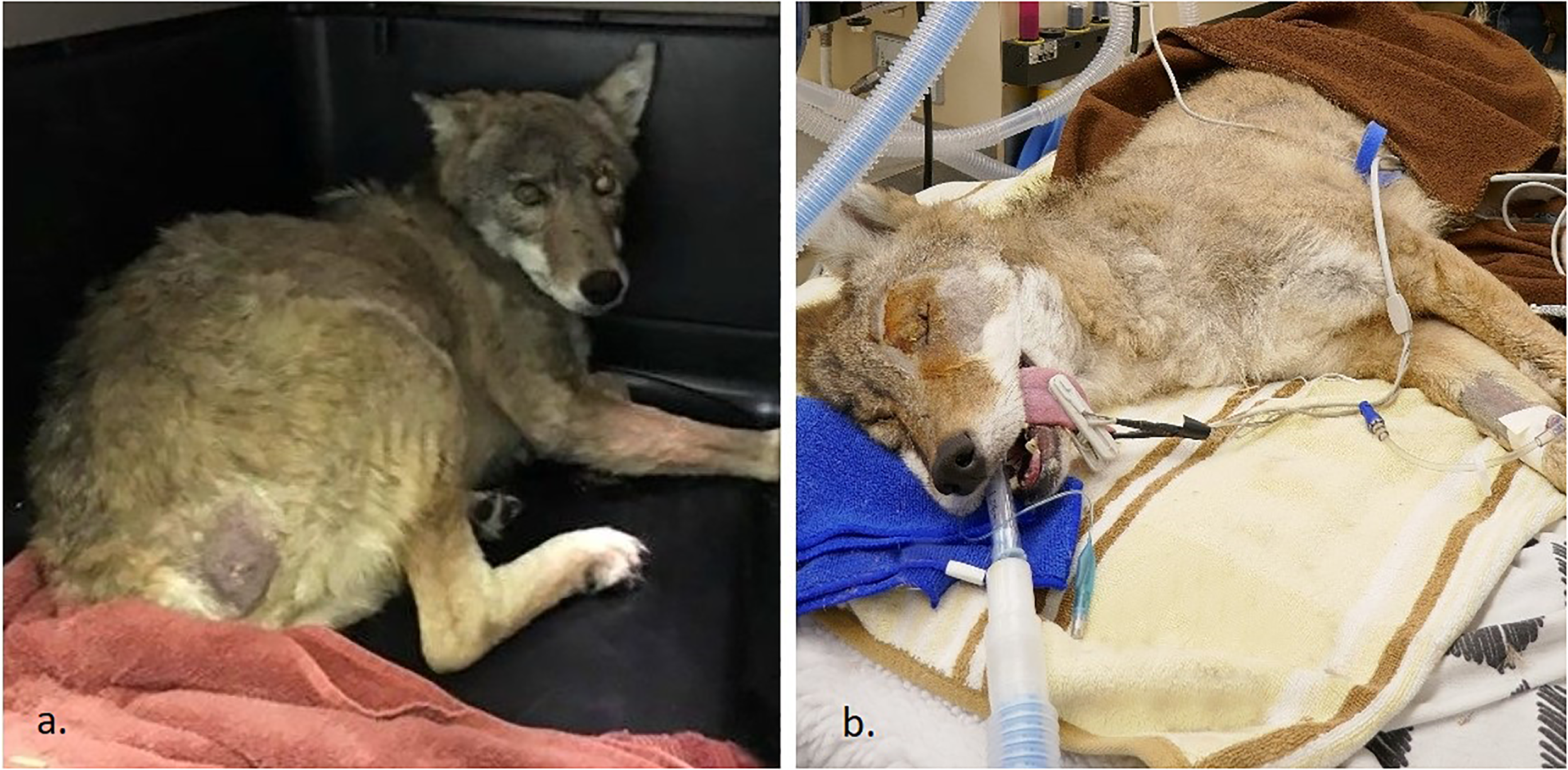
Urban10: a. at time of capture (photograph screen capture from TWC video: https://www.youtube.com/watch?v=4kwsRE5PEYo&feature=youtu.be); b. post mange treatment undergoing eye surgery (photo courtesy of TWC).
Post-release, Urban10 spent the first afternoon and evening resting before beginning to travel northwest. Over the next three days she journeyed more than 50 kilometres. This is likely a significant underestimate due to the artificiality of simply connecting 3-h interval point data linearly. Her path took her out of the city into the surrounding farmlands, where she travelled southwest parallel to the urban perimeter. Sometime after 6am on the second day, she reversed her trajectory and charted her way back east then north, circling around and ending up only five kilometres from her release site, within her original home range prior to capture three months earlier (see Figure 2).
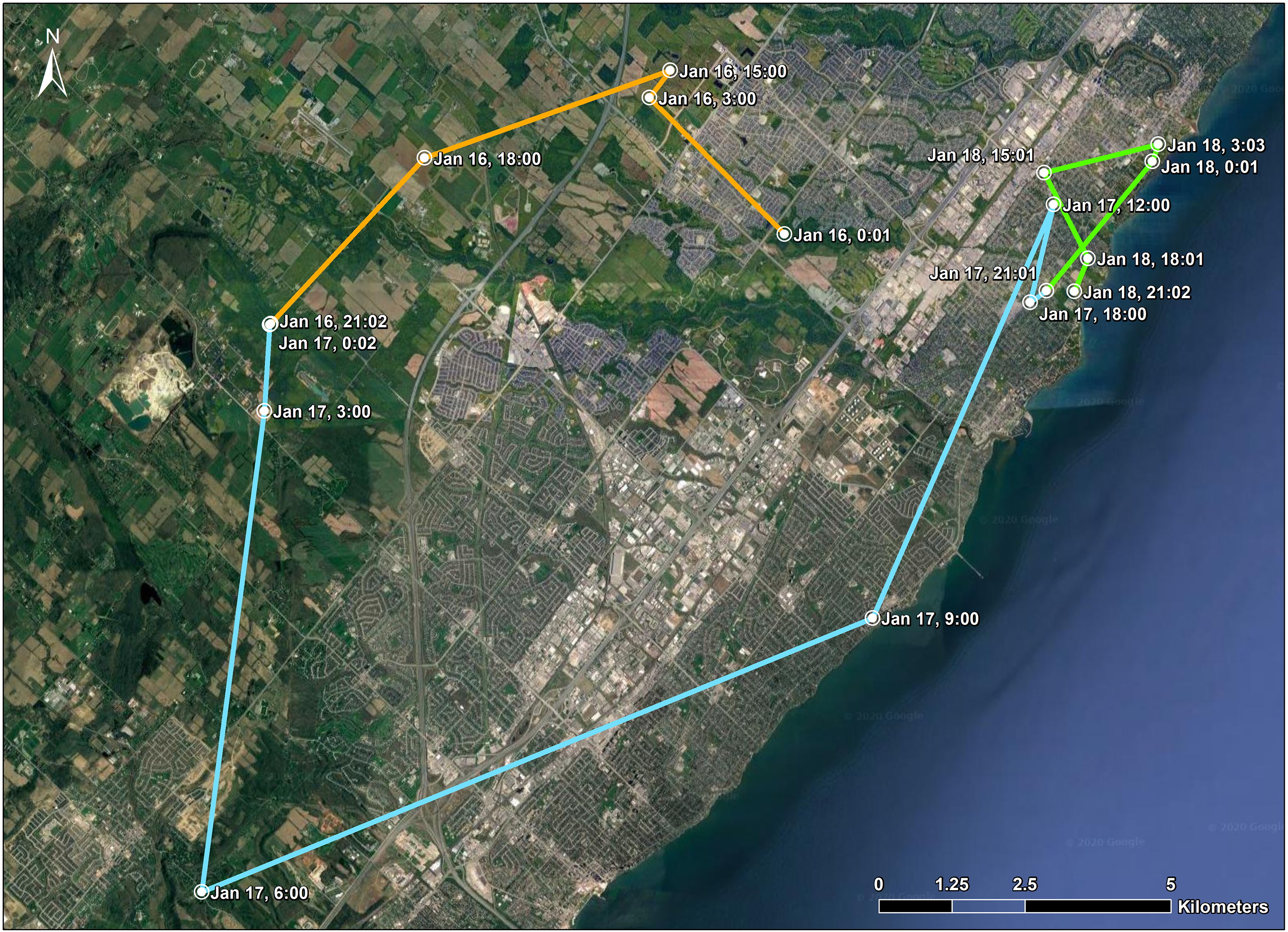
Urban10's movements over the three days following post-rehabilitation release; her first day's journey is represented in orange, her second in blue, and her third in green.
Her final destination was a residential area between an industrial strip and the lakeshore. Houses encircle several small parks, an urban forest, and ravine – recreational spaces frequently used by humans and domestic dogs. Reports from that winter describe Urban10 as ‘lovely’, ‘healthy’, and ‘healthy-sized’, frequently placing her with another individual who is described as ‘sickly’, ‘mangy’, ‘thin’, and ‘lacking fur’. Residents recount stories of the two of them walking or running down streets, lounging under park slides, sleeping, howling, hunting, scavenging on garbage day, and being scared away by dogs. Since coyotes generally partner for life, it seems likely that this second individual was her mate prior to rehabilitation.
That spring they had a litter of five pups. Coyotes practice biparental care, with both parents foraging and returning food to the den (Schell et al., 2018). The map in Figure 3 illustrates the classic star-shaped pattern of foraging and provisioning pups. During this period, there were some concerns reported by residents, which frequently centred on fear for pets and children. Individuals note changes in daily routines and patterns of mobilities, as dog walks are skipped or rerouted along paths that are perceived as safer. Around the end of June, a crisis erupted, as reports came in that pups had been found under a resident's back deck. We can only speculate as to what caused her to move her family from its previous location, which had successfully managed to avoid notice in the preceding months. Perhaps humans, or more likely dogs, located her den, and the stress of this encounter precipitated the move. In the following weeks she searched for a safe place, moving her pups repeatedly, each time leading to concerns about this wild family, which was perceived either as a risk, or as at risk by neighbouring humans. OMNRF biologists began recording her location every 90 min to better assess her whereabouts and the potential need for a response. By mid-July reports from concerned residents ceased, likely as pups became more mobile and were able to venture to less conspicuous rendezvous sites. No reports during this time or subsequently mention her partner, and his fate remains a mystery. Her movements tell a story of searching for a safe refuge amidst a landscape of fear (Laundré et al., 2010). Although this may paint the city as inhospitable, the reality of coyotes’ success in urban environments (Gehrt et al., 2011) suggests that perhaps the threats of cars and domestic dogs are easier to predict and respond to than the guns, poison, and traps that await in the surrounding rural areas.
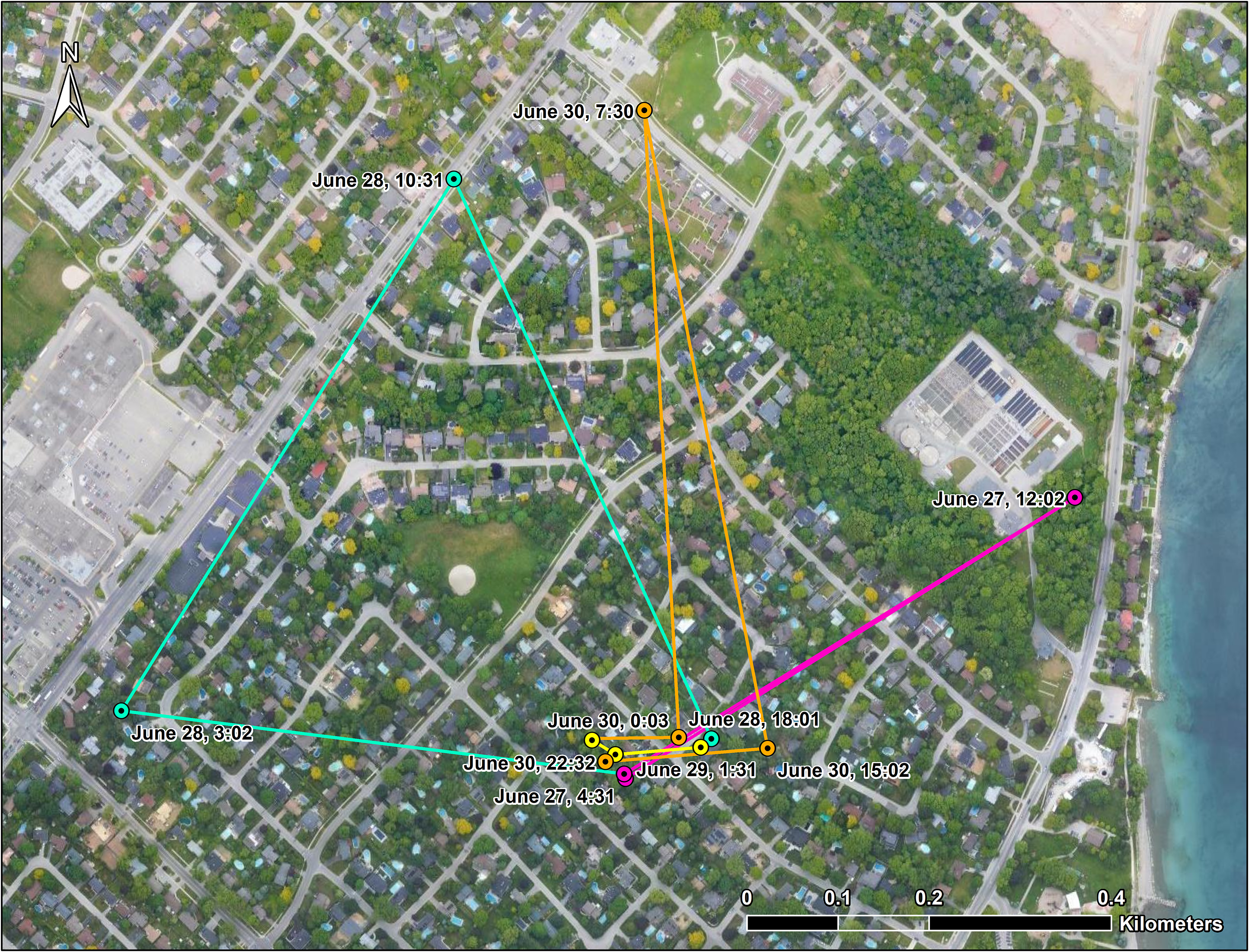
The star-shaped pattern of foraging and return to feed pups; between June 27–30, 2018.
Urban10's collar auto-released on August 31st, and, for a time, we lose sight of her. Her movements provide insights into the encounters and possibilities that wild canids living in a city can experience. Her home range covered approximately 8 km2, 3 with much of her time spent around a single urban forest and ravine. These spaces provide ample food resources, including rodents, rabbits, and the fruits of apple and pear trees that line the streets. There is also evidence of anthropogenic provisioning, from bird seed observed in scats, to tales from residents of turkey and vegetable offerings left in the park after Thanksgiving.
Two months after I mounted trail cameras, Urban10 appeared for the first time (that could be confirmed with certainty), visibly pregnant (see Figure 4). This confirmation that she was alive and well, still dwelling in the same forest and expecting another litter of pups any day, was a magical presence after months of following her tracks, in space, through a six-month temporal disjuncture. She became real to the research in a way that had not been possible through tracking data alone.
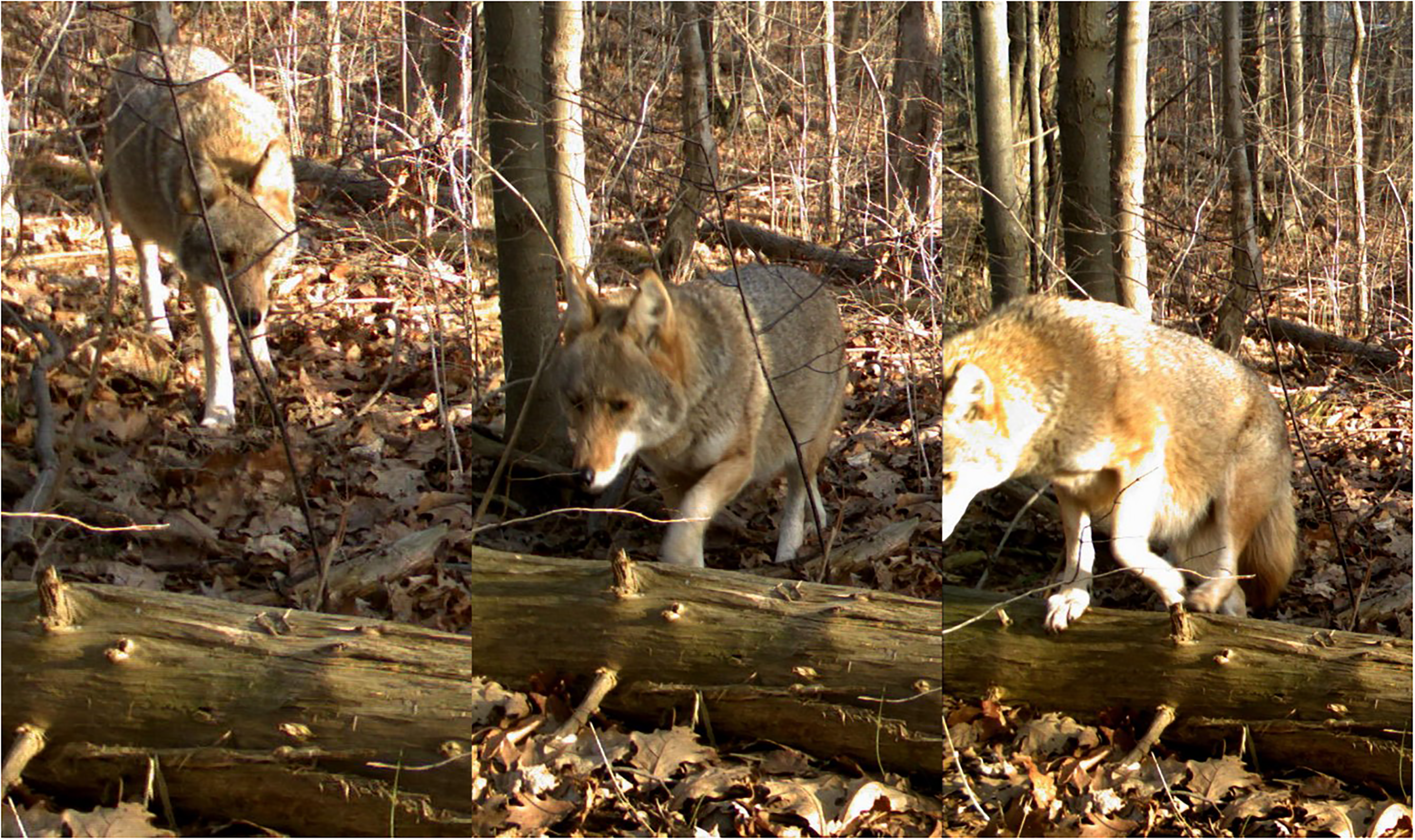
A pregnant Urban10 captured on trail cameras in the urban forest on March 27, 2019; identification is based on facial markings, and distinctive scar on her left ear.
I did encounter other of Urban10's kin on my frequent visits to their forest, which I always experienced with a mixture of excitement, gratitude, and ambivalence: I heard a noise and looked up, and there was a coyote walking towards me from within the thick dense brush area … she probably walked up to about three car lengths from me behind that brush, and she obviously didn't see me … I really didn't want to startle her, so as soon as I saw that she was walking towards me, I moved and made a noise just to alert her to my presence … when she heard me move, she looked at me, her head was lowered below shoulder height and sort of sticking out forward, and she focused on me, and then immediately, she didn't run, but she turned around and went back the direction she had come as soon as she knew I was there. I think she's still back there, just a ways off and I can't see her, because I heard some noise after. (Fieldnotes, April 10, 2019)
I saw a flicker of movement through the trees. A flash of beige … I had never seen her in this area before … I wondered if maybe, rather than me (unbeknownst) following her to this patch, if she had in fact been the one following me, perhaps curious, checking out what I was doing, or ensuring that I was leaving the den area – the ‘stalking’ behaviour that is so often (mis)reported. A queer feeling came over me, that for the first time I really felt, in my body, like this whole forest was her space. It was her home, and she moved through it according to her routines, needs, and whims. It was right that she should be concerned about what I was up to in her forest … She fit here, and her shadowing me, or us shadowing each other, regardless of the degree of intentionality, felt like a new kind of encounter. (Fieldnotes, May 27, 2019)
As for Urban10, I could say that since we never came face to face, my feelings over the knowledge of her existence were not reciprocated – she did not know me. But this fails to account for the different ways of knowing across species, wherein my tracks, trails, and scents perhaps revealed a great deal about me to her during my frequent visits, and it is possible that at any of those times, she could have been tracking me just as closely without my knowledge.
Case study 2: Blondie
Methods
The story of Blondie is based on a closer ethnographic encounter: 80 h of participant observation with CWC over a month working to promote coexistence, which included personal experience of aversive conditioning. 4 Participant observation involved noting humans’ and coyotes’ material-discursive practices: where they go, what they do, with whom and how they interact, and what is being articulated – in a broad sense. It was grounded in background knowledge of coyote behaviour, aimed in particular at an “ethology concerned with non-human learning, knowledges and cultures” (Barua and Sinha, 2019: 1166). Collected data included 66,000 words of fieldnotes, 1074 photographs, and 38 videos. A qualitative narrative analysis of textual data was undertaken using NVivo 12 (QSR International Pty Ltd, 2020), and photographs and videos were examined alongside written notes to generate insights into human and coyote behaviours, experiences, and interactions. While unpacking human discourses and practices was generally straightforward and grounded in well-established qualitative social research techniques, often more creativity was required to interpret what my coyote collaborators were ‘saying’ – though not always. At times, I felt very confident in my understandings of what Blondie was communicating and why, whereas certain behaviours I witnessed of human residents, I was unable to fathom.
Story
In early June 2019 CWC received reports that a coyote family had moved their pups to a culvert under a road in an affluent suburban neighbourhood. We learned that altercations with domestic dogs had occurred, and many residents were a combination of concerned, confused, and angry. Field investigation revealed a nearby park and ravine with possible den sites, and recently-commenced construction on a new housing development. We surmised that the family may have been denning in the park and were disrupted by the construction. We then learned that they had moved the pups several days ago to underneath a cement front porch – where the property owner was tolerant to their presence – but other residents had harassed the family with sticks and dogs to displace them. The culvert was a second move necessitated by impending danger. We do not know if there may have at one point been more than two pups, given that litter sizes are typically larger. 5 Residents informed us that at least one dog had been bitten while they were denning under the porch. As a result of the construction, plastic fencing had been placed along the length of the boulevard adjacent to the sidewalk approximately five metres from the opening under the porch. Thus, if anyone had been walking with a dog on the sidewalk while a parent was present, the coyote would have felt cornered and unable to escape this canine incursion so close to the denning pups.
I, along with members of CWC's Canid Response Team, the City, and local Humane Society staff, spent the next three weeks working to mitigate conflict and ensure community safety – for this coyote family, humans, and domestic dogs. In our first days it became apparent that the largest concern was the father's – who came to be known as Blondie due to his colouration (see Figure 5) – defensive behaviours towards domestic dogs in the area surrounding the den. When a dog approached, he would crouch down, tail tucked and hackles up, and charge the dog. If the dog moved away, he would shadow until they were a block away from the den. Most residents, unaware of the coyote's need to protect his nearby pups, interpreted this as an aggressive attack on them, and him as a threat to their safety. The presence of nearby elementary and high schools, and a school bus stop across the street from the den, exacerbated these fears. However, observations made evident that he was relaxed and unconcerned with human pedestrian and cyclist traffic on the street and sidewalk. Our approach to promoting coexistence became two pronged: attempt to educate both residents and Blondie to reshape behaviours and interactions. Our aim was to cultivate patience and tolerance for the several weeks needed until the pups were mobile. Signage was implemented, the bus stop was temporarily relocated, and residents with dogs were asked to walk them elsewhere temporarily and be respectful of the space around the den.
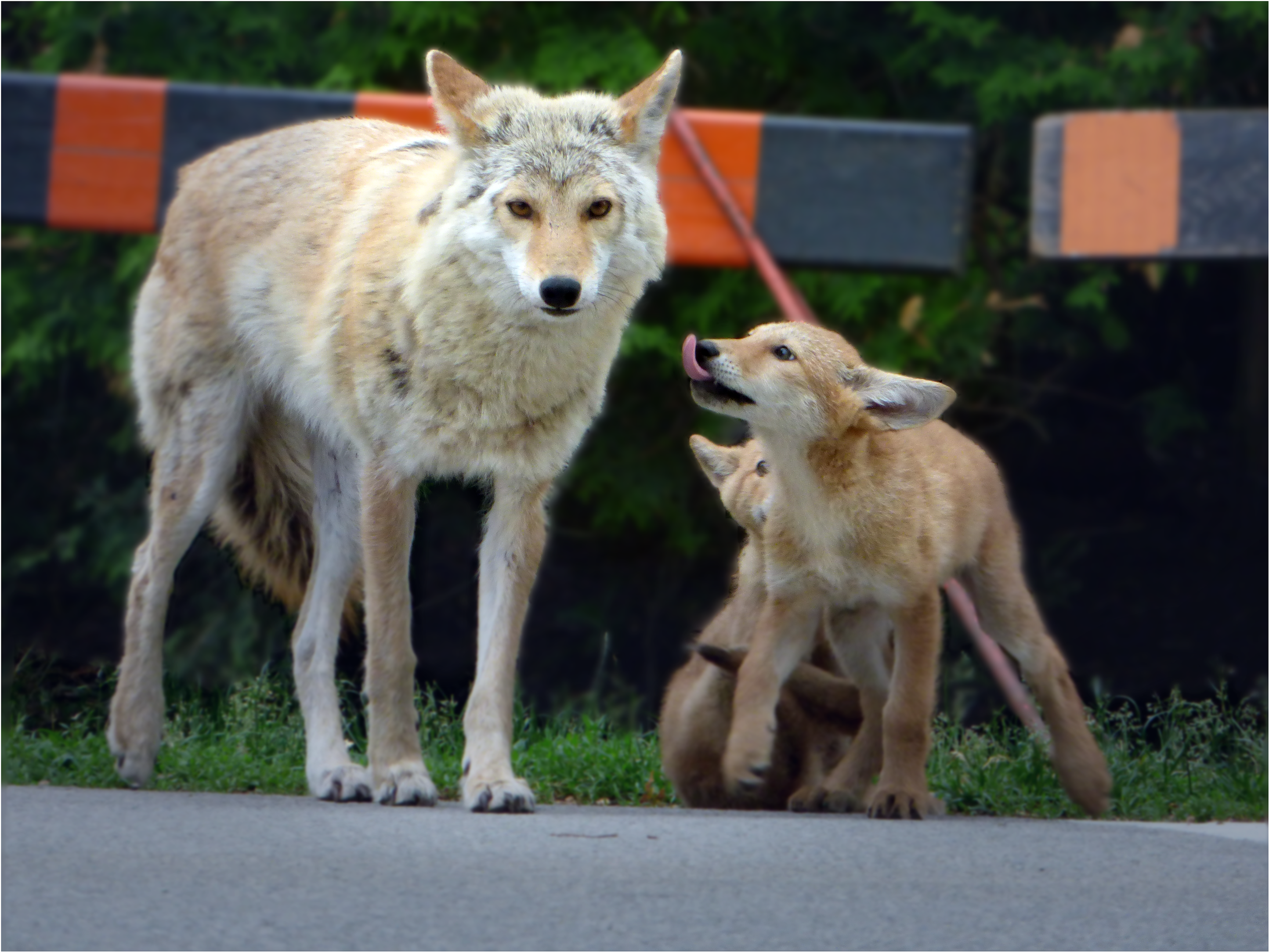
Blondie and his two pups; June 15, 2019.
Coyote education involved applying aversion conditioning to reshape two of Blondie's behaviours. The first was his habit of lying immediately next to the sidewalk across the road from the den, and the second, his defensive approaching of domestic dogs. By ‘thinking like a coyote’, we surmised that his preferred daytime resting location presented an ideal vantage point for his primary parenting need: to protect the den. The culvert was located under a T-intersection, and by lying at the ‘top’ of the T, he could monitor activity down all three avenues leading to the den. As there was only a sidewalk on this one side of the street, pedestrian traffic passed within a few feet of his resting place. Pedestrians largely passed by without noticing him, or saw him and crossed the grassy boulevard to walk on the street. Some saw him and passed by within a few feet, unconcerned. Blondie, for the most part, remained tucked under the spreading branches of a spruce tree, assuming he had not been seen. When a resident obviously saw and made eye contact with him, he would swiftly get up and move several metres away until they had passed by, at which point he would return to his vigil, or depart the area for a time. In over 80-h of close observation, 6 we never witnessed him approaching a human who was not accompanied by a domestic dog. Thus, although we were not concerned about him posing a threat to pedestrians, we still felt it was best to discourage him from occupying this space to maintain healthy boundaries with residents navigating the sidewalk.
Our practice became to displace him from this spot by sitting there ourselves, trying to recode this area as ‘our’ territory rather than his. When we found him lying there, we would use the ‘bag method’ – walking towards him while loudly snapping a garbage bag filled with air – to get him to move away, and would sit in the grass ourselves (see Figure 6): I went and sat back in my new spot. Around 10–15 min later a couple crossed [the road] and stopped a few metres from me, saying “do you know there's a coyote behind you?” I say “oh good he's getting brave enough to sneak around me to the den”, and explain what I’m doing here and why. We chat for a minute, and they tell me they’ve seen these guys around for years … While we’re talking dad walks cautiously across onto [the neighbour's] lawn, crosses [the road], then goes over behind the trees. The man asks me “you were crouched here with the coyote right behind you and you really weren't worried?” “No, he's terrified of me” I replied. The man seems surprised, in a thoughtful way. The couple walks on. The pups come out and play and dad curls up on the lawn. I’m surprised again about him getting them out to play and relaxing while I’m right across from them. Clearly he doesn't want to interact with me, but he doesn't see me at all as a threat to his family. (Fieldnotes, June 11, 2019)
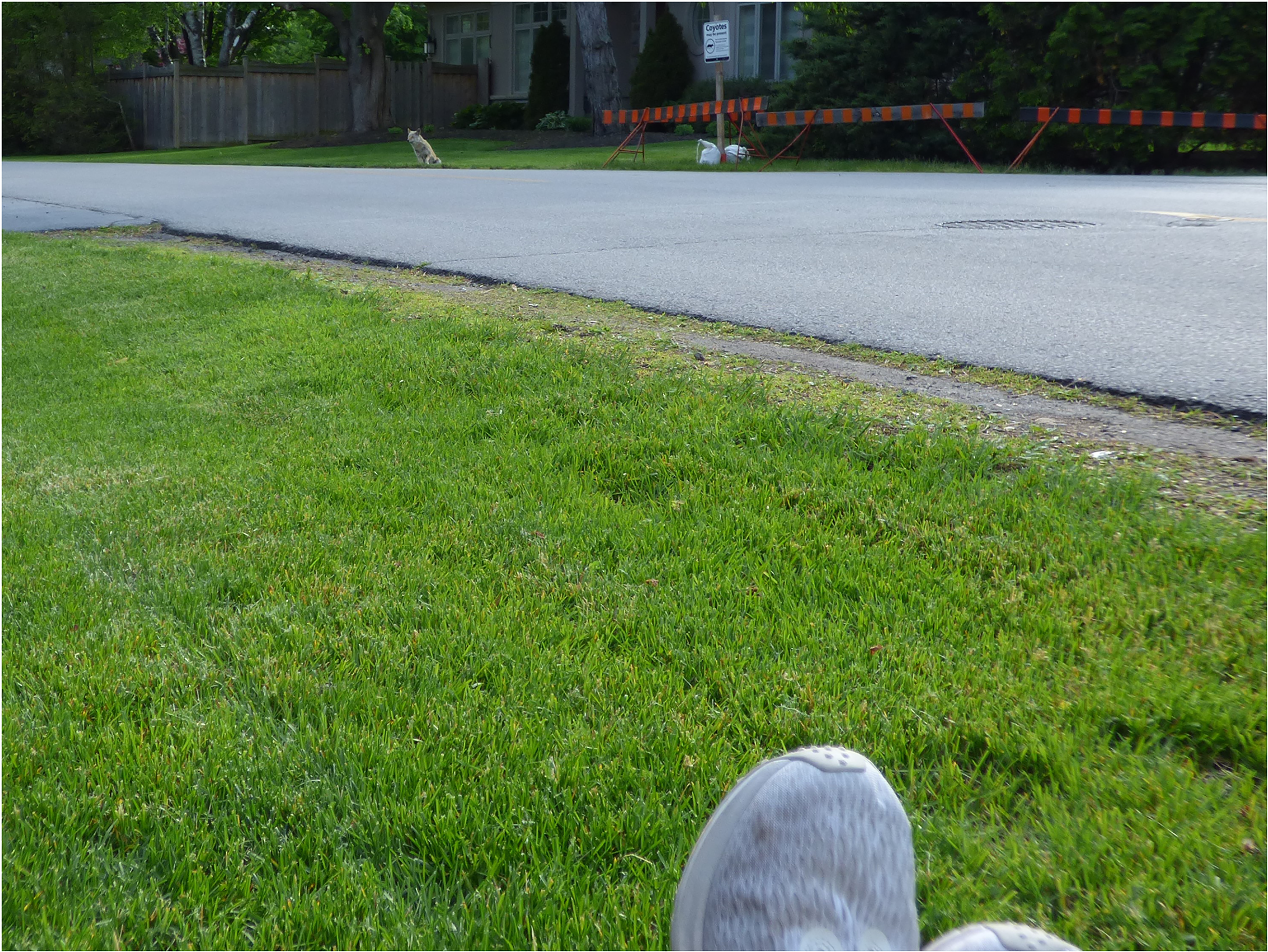
Blondie across the road by the den after I had ‘taken over’ his spot by the sidewalk; June 11, 2019.
We also intervened in his defensive approaching of dogs, placing ourselves in between and snapping a garbage bag to prevent him from following as residents moved their dogs away from the area: The collie was jumping at the end of the leash and barking, clearly very much wanting to be coming over this way, but they brought him away and turned down the next street. And this whole time again the coyote was watching me, looking at the collie, looking at me, and I was standing on the sidewalk firmly. I had my one hand out in a stop gesture … whether the hand signal was anything significant to the coyote, or whether it just helped my whole body convey the message I was trying to convey to him most effectively, I’m not sure … But there was a real attitude in the posture of his body of apprehension, or uncertainty, or indecision … but I don't know whether it was entirely about whether or not to go after this collie, or whether those attitudes were about me and what I was doing and my intention there … But then he sort of half sat, and I relaxed my body, and turned away from him, and then he laid down, and I backed away. (Fieldnotes, June 6, 2019)
Over the course of three weeks, we witnessed drastic change in the overall atmosphere of the neighbourhood. Upon arrival there was a palpable tension as we heard from vocal and frustrated residents who wanted the family gone. Residents discussed feeling like ‘prisoners’ in their own neighbourhood, afraid to leave the house with their dogs, and insistent that the coyotes needed to be relocated. Rarely did we hear that they should be killed, most often residents wanted the family to continue living, just somewhere else. We patiently explained that relocation was both unfeasible and ineffective. Trapping or tranquilization are difficult and dangerous, translocated animals are rarely successful, and if the ecological niche remains viable, other families will simply move in to make use of available habitat and resources. Translocation is simply not an effective nor humane wildlife management tool (Craven et al., 1998; Massei et al., 2010). Residents had to come to terms with the reality that this was the family's habitat, their home: the only option was coexistence.
With time and education, the overall more-than-human ‘atmosphere’ (Lorimer et al., 2019) of the neighbourhood began shifting from one of tension and fear, to mutual tolerance. As the days went by, we began increasingly to hear from residents who were very concerned about the welfare of the family, liked having them in the neighbourhood, and were willing to take action to ensure that they went unharmed. Our task quickly became, rather than calming incensed individuals who wanted them gone, keeping away the constant stream of people who wanted to approach the family to observe and take photographs. The majority of residents were willing to temporarily alter their dog walking routes, and became less concerned about the coyotes as a threat to children as more time passed without incident.
In terms of Blondie and his family, I also observed a dramatic change over the weeks. When we arrived they had been twice traumatized, struggling to find safety. Five days later I noted that: my gut assessment is that he seems less desperate today than on Monday. On Monday it seemed like he had a [frantic] need to ward off dogs. He was triggered immediately. Now he seems calmer, and like it's a more calculated assessment of whether or not the situation (a passing dog) requires intervention. He is more settled in his decision not to move when he sees me, and relaxes more quickly once the dog has moved a ways off. (Fieldnotes, June 8, 2019)
Over the weeks I watched closely as he met up with his mate and went hunting, returned to regurgitate food for the pups, curled up into a ball and took naps, called his pups up out of the culvert and bathed them (see Figure 7), carefully watched over them while they played and chased one another through the grass, and generally went about daily tasks of protecting, provisioning, and teaching his young. Even while we worked to aversively condition him, he still had a great deal of tolerance and trust towards his human neighbours, including us. I noted on several occasions my surprise that he did not generally perceive humans as a threat to his pups, as long as they did not approach: Amazing, dad is resting with his head down while I am closer than him to his playing pups. (Fieldnotes, June 11, 2019)
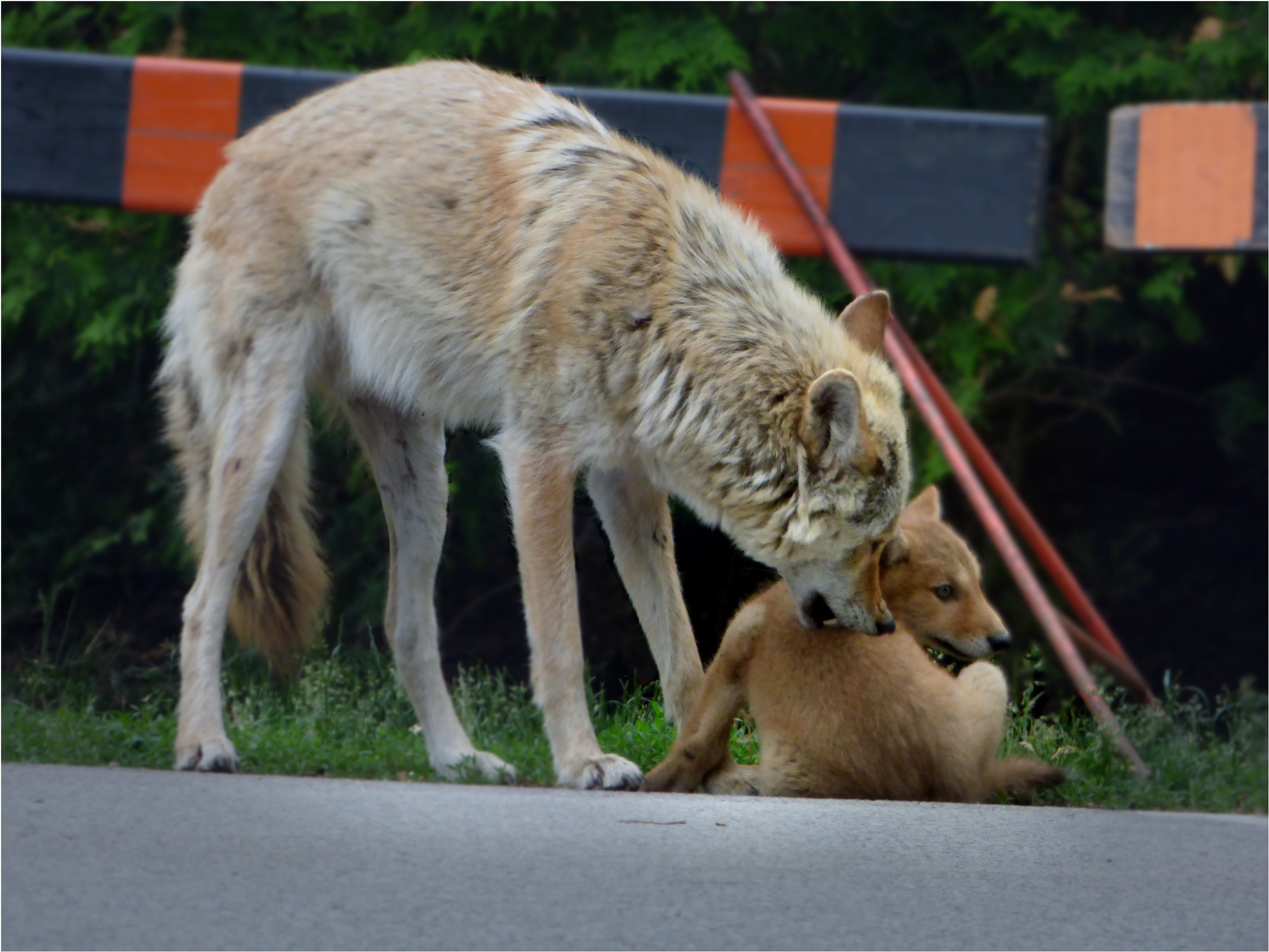
Blondie grooming one of his pups; June 15, 2019.
Despite this tolerance, he did communicate warnings, or what I interpreted as displeasure, at our interference, especially when the pups were out. On one occasion I prevented him from pursuing two large poodles accompanying a pair of joggers, standing between him and them: I said ‘stay!’ and then he barked, he gave a little ‘woof!’, deep in his throat … the people were running further and further away, and I said ‘it's okay, it's okay’, and then once they had gotten a little ways off, he seemed to relax a little bit. (Fieldnotes, June 8, 2019)
Along with learning to communicate with him to mitigate potential conflicts in the neighbourhood, we also learned from him, observing idiosyncrasies in his behaviours that alluded to his unique experiences and knowledge of survival in the city. For example, on several occasions I observed him chasing vehicles passing by the den: A car drove slowly by and he chased after it. Why? Because the pups were out? But they stayed out for around 10 min wrestling and he didn't chase after any of the other (∼6) cars that drove by before the pups went away (Fieldnotes, June 3, 2019)
We were puzzled by this behaviour, and his interpretation of vehicles as threats that needed to be chased away from the den. But as we found, his assessment of risk was based on firsthand experience: I just saw someone try to hit the coyote with their car. He was standing on the road, and the car came up behind me, speeding up when they saw him. He dashed down [the road] and the person swerved abruptly, speeding after him and turning into the left lane. The coyote got onto the grass and the car turned around and drove off. (Fieldnotes, June 3, 2019)
Witnessing this gave meaning to his actions, but we were still puzzled about his pursuit of certain vehicles and not others: he chased one car that turned the corner but he didn't chase the second car that did (Fieldnotes, June 8, 2019)
We further learned from the local Humane Society that there had been reports of a limping coyote in this neighbourhood several months ago. They surmised that Blondie or his mate were likely struck by a vehicle and injured, though apparently had healed well since. Given Blondie's defensive actions towards certain vehicles, it is likely that his experiences of violence and injury informed his assessment of vehicles-as-risk on an individual basis.
A final puzzling observation surrounded his decision whether to pursue, and the intensity with which he would pursue, various dogs who approached the den. On one occasion I observed an older couple with a golden retriever walk down the street across from the den, ready to intervene if needed: When they passed dad looked back and forth between the dog and myself. He didn't seem too driven to pursue the dog. I wonder why he is so driven to pursue some dogs but not others. This dog did have a very placid attitude, totally oblivious or unconcerned with the coyote. I wonder if he's particularly targeting dogs he has had encounters with in the past (like the small grey shih tzu I saw him pursue the 1st day), and very energetic/young dogs, like that akita and the collie who both jumped at the ends of their leash and barked. (Fieldnotes, June 8, 2019)
Some dogs passing by the den he seemed to nearly ignore, while others he would immediately approach to scare off, and shadow the length of a block to ensure they were departing the vicinity. What we might take as relevant factors in assessing risks to his pups, such as the dog's size, did not appear to correlate to the intensity of his reaction – as demonstrated by a very active defensive display against a small shih tzu, and apparent disregard of a retriever. Thus we hypothesized that previous experience with a dog (e.g. the Shih Tzu lived several houses down and this was not their first interaction, perhaps previously this dog had approached the den too closely or energetically), or perception of the dog's attitude or energy (placid versus straining to approach and barking) were more relevant to his decision-making and response.
Over the course of three weeks of close observation, I watched as the two pups grew and became more confident and adventurous, eventually witnessing their departure from the den on June 21st. During the final days they followed Blondie further from the culvert, crossing the street, venturing onto neighbouring lawns, but ultimately getting spooked and running back to the safety of the den. On this final evening, I observed as Blondie and his partner encouraged them to follow, trotting several metres down the street, turning around and waiting for them to catch up. Just like that, they made it down the block, around the corner, and off into the evening (see Figure 8). There has been no escalation of coyote concerns in the neighbourhood since the family's departure from this den site.
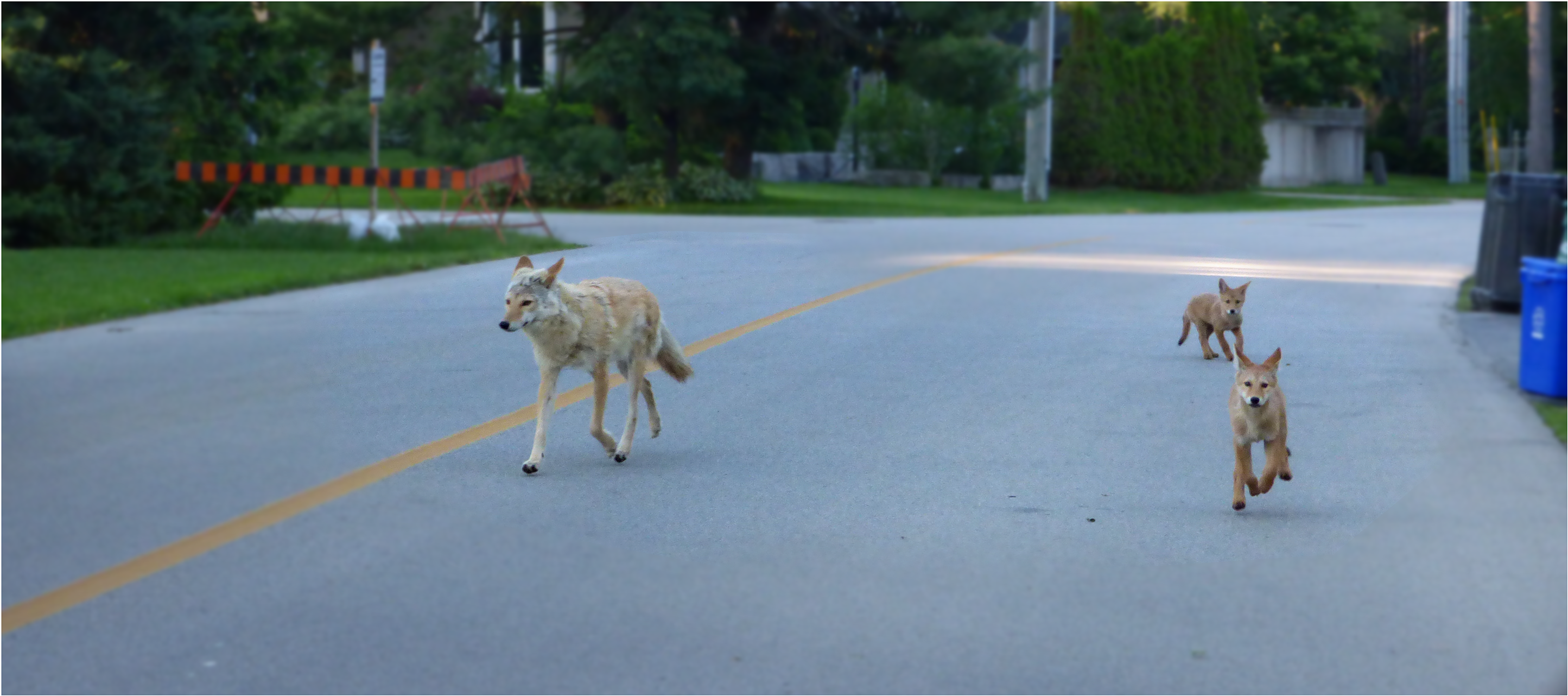
Blondie and his pups departing the den for the last time; June 21, 2019.
Discussion
What do these narratives of Urban10 and Blondie, unique stories gathered through disparate methods, tell us about living with urban animals and restorying the city through individual animal geographies? There are implications for our theoretical understandings of synanthropy – of coyote synurbization and more-than-human urban belonging – as well as for cynanthropy – delving into canid lifeworlds and piecing together individual animals’ geographies using hybrid tools. Each of these are briefly reflected upon below.
Synanthropy
The stories of both Urban10 and Blondie help us to see the city as an always more-than-human achievement. They make visible the reality that “urban landscapes jointly inhabited by coyotes and humans … are formed, materially and discursively, through interspecies encounters (Hunold and Lloro, 2019: 6, italics in original). Though Urban10 may not represent an average coyote, her story makes visible the moments of dramatic restructuring through which the animal-as-subject becomes reconfigured, in terms of their subjective experiences, and their construction by and relations with human neighbours. In Urban10's case, these moments include her capture and rehabilitation, collaring and release, and eventual disruption and relocation of her pups. Remapping the city as more-than-human requires perceptual experiments in thinking about how other beings sense, and make sense of, the city. The hybrid methodologies mobilized in this case study permit an experimental delineation of meaningful spaces for Urban10, presented in Figure 9, which translates her locational data into places of safety, resource, or danger. This is an imaginative exercise, but also potentially a political counter-cartography (Counter Cartographies Collective et al., 2012; Peluso, 1995). Amin and Thrift (2017: 4) write that “the city produces a sense of direction … the city literally directs its inhabitants’ lives, allowing them access to, and egress from, some spaces, while simultaneously banning them from others”. Considering the spaces Urban10 accessed and avoided calls into question not only how urban spaces are experienced, but the politics and ethics of inclusions and exclusions. As Shingne (2020: 9) notes, a more-than-human right to the city includes not only using city spaces as allocated by those in power, but “occupying and engaging those spaces and resources that will allow one to thrive”, whether or not this aligns with dominant (human) visions of how city spaces should be inhabited and by whom.
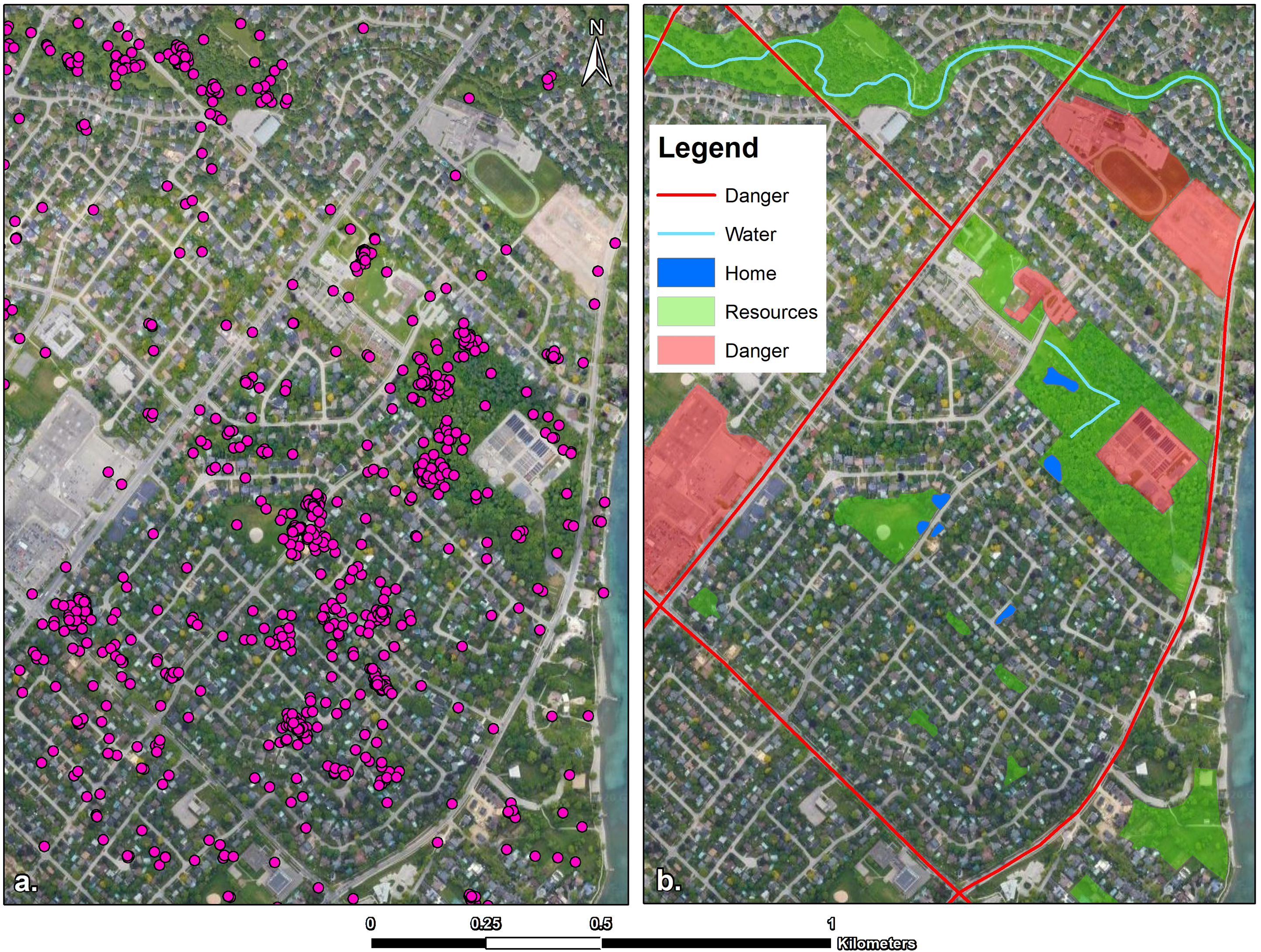
Urban10's aggregated locational data (a) used to create a speculative mapping of her dwelt spatial experiences, including resources, sites of danger, and key safe places of home (b).
In Blondie's case, there are insights into how environments, behaviours, and assumptions all factor into the creation of a ‘problem’ animal. The built environment was a key factor in creating conflict scenarios: first in terms of the construction and disruptive displacement from the family's original den; and second in terms of the fencing which channelled (unknowing) humans and domestic dogs into proximate contact with a protective parent with no means of escape. Interventions involving the physical and digital environment attempted to mitigate some sources of conflict. Barricades and signage around the den were erected to keep people from approaching. At one point the road was virtually closed, such that mapping software would redirect vehicular traffic to alternate routes in hopes that this would stem the constant flow of vehicles who, incidentally or intentionally, stopped by the den to catch glimpses or photographs of the family. Responses to ‘conflicts’ with urban coyotes vary widely, determined by each local government. In this case partnerships between the City and CWC enabled the responses required to promote coexistence: reshaping both humans’ and coyotes’ understandings and behaviours. Not all coyote families are afforded the resources required to promote patience and tolerance in their human neighbours.
Blondie's story also challenges a common assumption in wildlife management literature and practices: that a ‘habituated’, or ‘problem’ animal is a fixed state requiring, most often, lethal removal (e.g. Baker and Timm, 2017). This has been contested elsewhere, for instance in Bogan’s (2012: 104) study of urban coyotes, which reported that “conflict interactions may result from short-lived, situation-specific events in which an animal quickly reverts back to an avoidance state”. Ultimately, in attributing fixed characteristics to individual animals, we neglect the fluidity of coproduced more-than-human social and spatial interactions. In this case, neighbourhood residents were incensed about Blondie's defensive behaviour towards dogs, but had harassed the family using dogs, forcing them to relocate their pups. Some residents refused to temporarily keep dogs away from the new den site. These factors shaped Blondie's behaviour, teaching him that dogs were a threat that required vigilance, whereas patience and respecting the family's space might have created a very different culture of coyote-dog-human interactions in the neighbourhood. In constructing the coyote as a threat, residents undertook practices which influenced his behaviours, ultimately reinforcing their assumptions about who or what he was.
Assumptions about urban spaces also shape human-wildlife conflict, outcomes, and opportunities for coexistence. Many individuals understand the inherent risks of taking one's companion animals into ‘wildlife areas’, especially off-leash. Should your dog be in an altercation with an animal like a coyote while roaming freely in a ravine, trail system, or other space perceived as ‘nature’, most people would feel responsible for not having implemented best practices for companion animal supervision within these spaces. However, when a dog is nipped while on a sidewalk in one's own neighbourhood, or in a backyard that is insufficiently fenced, there is a perception that this is an act of transgression – that the coyote has crossed a line and become a problem. Hunold and Lloro (2019: 13) report similar findings: “many participants view natural areas (woods and meadows for wildlife) and residential areas (yards for people and pets) as distinct and separate, materially and symbolically, with the imagined boundaries between the two landscapes being crossed by coyotes”. Yet if we revise our thinking to see the city in its entirety as nature – as wildlife habitat, or human-animal ‘borderland’ (Gullo et al., 1998) – it reshapes perceptions of these interactions and human responsibilities, rather than the oversimplistic and culturally-contextual process of constructing ‘problem animals’ (Jerolmack, 2008; Taylor and Pacini-Ketchabaw, 2017). In this case, it challenges us to consider how we can keep our companion animals safe, while acknowledging places like sidewalks and recreational spaces as legitimate coyote territories and locales where interactions are possible. There are moments when these ways of understanding the city become restructured through animal encounters, such as when I realized I was being shadowed, and “really felt, in my body, like this whole forest was her space”. Thus coyotes, themselves, come to restory the city for others.
Cynanthropy
The two case studies detailed herein mobilized disparate hybrid methods to piece together narratives about individual coyote's lives and experiences. They had the common aim of restorying the city through the point of view of a wild animal, a liminal inhabitant frequently encountered as out of place in the urban environment. In both cases, methods were drawn together in an effort to ‘think like a coyote’, to capture fleeting glimpses of an urban ‘coyote-world’. In the case of Urban10, the lack of firsthand observations and reliance on ecological data such as trail camera records and GPS collar locations from the preceding year was a limitation. As noted by my collaborator Lesley Sampson of CWC (personal communication, March 10, 2019), spatial data provides only a “shadow environment”, requiring augmentation through on-the-ground, immersive methods which reveal richer contextual insights. Field investigations, tracking, and the occasional encounter with her kin helped me to better envision and get a feel for her environment, and anecdotal data from interviews and sighting reports further augmented details of her story. This pairing of techniques was necessary to construct her story, but still did not permit the same type of knowing as the close ethnographic encounters with Blondie. I knew of Urban10, but I did not know her, not in the personal, reciprocal register in which I came to know Blondie.
Urban10's story also highlights the active role of technologies of surveillance in making certain subjects visible and thereby governable (Adams, 2019; Blue, 2016). The collar made her identifiable to her human neighbours and the City. It made the Ministry responsible for her behaviours and any perceived conflicts. And finally, it has made her story visible to ‘science’, to this research, permitting this window into another manner of inhabiting the city. As Adams (2020: 18) writes, tracking technologies give animals “a digital presence, a second life lived through the continuous unspooling of location data … This digital life is thin, a trace in space and time”. Urban10's second life was initially aimed at creating knowledge for science, then at monitoring potential conflict scenarios – to assess the degree to which she might represent a ‘problem animal’ in need of removal – and now to remap the city from a less anthropocentric standpoint, highlighting the potentials of animal surveillance to serve the interests of both care and control (Blue, 2016).
In the case of Blondie, closer ethnographic and ethological observations allowed me to understand him firsthand in a more intimate manner. I came to know him as a devoted parent – with a careful and often joyful mien in his interactions with his pups – and a discerning urbanite – able to proficiently assess risks, respond to challenges, and keep himself and his family safe within a complicated landscape of multispecies threats and opportunities. In terms of cynanthropy – of becoming-coyote – my experience in ‘participant observation’ with Blondie in particular changed my orientation to the world in a way that is relevant to, and exceeds, my role as a researcher. My understanding of conflict, coexistence, and priorities for reshaping relationships with urban wildlife are a direct result of our interactions and mutual becomings. I don't believe there is any straightforward way to invoke or prescribe what it means to ‘become-animal’ as a multispecies researcher. But it requires being open to the possibility that separations between researcher and nonhuman subject/participant/collaborator may break down in surprising ways, transforming each body and creating understandings that are not easy to articulate as research methodologies. This discussion is nascent and speculative, but one I feel would be fruitful to pursue in greater depth in future more-than-human research engagements.
In participating in a more active manner than anticipated – interacting with Blondie and mitigating potential conflicts with domestic dogs – I was filled with ambivalence and uncertainty about my dual role as researcher-practitioner. This resonates with Collard’s (2015) concerns with the primacy of observational methods in animal geographies: what does this mean for animals who would be better served by remaining unencounterable? Even when research is guided by best intentions, a key challenge is “the deep uncertainties we often face in navigating the complex and emotional terrain of multispecies fieldwork that requires us to make care-full, yet spontaneous, decisions that, however big or small, touch the lives of our more-than-human interlocutors” (Turnbull and Van Patter, forthcoming). These fraught ethical dilemmas involved in not only observing, but shaping the unfolding events in this neighbourhood, are discussed in greater detail elsewhere (Turnbull and Van Patter, forthcoming). Ultimately, “We need to hold ourselves accountable to the disruptions and burdens caused by our research, even if we feel the outcomes we are striving to cultivate for a well-balanced constellation of beneficiaries are worth the risks” (Turnbull and Van Patter, forthcoming). Despite these challenges, in the context of this research the methodology deployed provided a unique opportunity to encounter Blondie as a collaborator in the research: a co-producer of shared knowledges. It pushed me to take seriously his actions as teachings or evidence, as an integral part of a story of his knowledge and experiences. Learning not simply about, but from him provided insights into the multispecies histories of the space, including his previous interactions with vehicles, dogs, and humans.
Overall, investigating, experiencing, and relaying these two individual animal geographies foregrounds the necessity of experimental and integrative hybrid methodologies. It makes clear that storying more-than-human worlds requires an assemblage (McLeod, 2014) or bricolage (Kincheloe, 2005) approach oriented towards “engaging with animal worlds in more embodied, interactive and exploratory ways opens new avenues for developing richer accounts of animal lifeworlds” (Hodgetts and Lorimer, 2015: 289). Practically, promising avenues include collaboration with animal researchers or practitioners, as has been previously noted (Hodgetts and Lorimer, 2015; Hovorka, 2018), as the stories contained herein would not have been visible without the OMNRF and CWC Canid Response Team. Ethological methods grounded in understandings of animal behaviours are an important starting point, but it is crucial to remain open to more experimental ethnographic and interpretive approaches, where the focus is the “social dynamics at play in intersubjective contexts of co-presence, co-observation and co-constitution” (Lestel et al., 2014: 130). Combining such approaches with ethnographic and other social research tools affords a mode of multispecies storying that is open-ended and transdisciplinary, generative and generous, passionate and polyvocal (Tsing, 2011; van Dooren and Rose, 2016).
Conclusion
This paper contributes to efforts in developing individual animals’ geographies by relaying the findings of two tales of urban coyotes. Bringing these disparate case studies together has both theoretical and methodological significance. Methodologically, there is pressing need to continue developing practices for animals’ geographies, extending dialogues concerning specific tools, challenges, and opportunities. Dwelling with Urban10 and Blondie in cynanthropic exploration allows for experimentations in ‘becoming-coyote’, in seeing the city and learning to intra-act within an urban world that is as much coyote as human. Collaboration and storying offer a path towards crafting a careful and responsible “way of doing knowledge” which is centred on “finding ways to re-affect an objectified world” (Puig de la Bellacasa, 2017: 64). Engaging with the behaviours, decisions, and interactions of animals as articulations which shed light on situated knowledges and diverse narratives of being is necessary in developing meaningful approaches to individual animals’ geographies. There is great scope for animal geographers to continue extending such experimental and hybrid methodologies.
These methodological contributions intersect with theoretical questions concerning how storying-with Blondie and Urban10 might provide insights into synanthropy and the practices involved in adapting to and participating, ecologically and socially, in life in the multispecies city. The narratives contained herein story individual nonhuman animals as social and political beings, and individual coyotes as adaptive, diverse, perceptive, communicative, and often misunderstood urban cohabitants. The cases of these two coyotes illustrate that problem animals are not simply socially constructed, they are created through practices based too often on human assumptions, and not sufficiently grounded in acknowledgements of animals’ unique circumstances, needs, and experiences. Attending to this individuality is part of a broader political agenda of restorying the more-than-human city to “redefine urban human and nonhuman Others as fellow residents, no longer as ‘invaders,’ ‘pests,’” (Shingne, 2020: 12). As Duhn (2017: 54) notes, “[m]aking our multispecies natures visible in unexpected ways is a powerful gesture. It invites engagement”. Hopefully future efforts in storying individual animal geographies will similarly invite and deepen engagements with the more-than-human city.
Highlights
Understandings of the urban remain anthropocentric, and we need new ways of approaching the more-than-human city
Individual animal geographies grounded in collaboration can help us to restory the more-than-human city towards livable multispecies futures
This requires ‘hybrid’ research methodologies which combine social and ecological tools
Nonhuman animals are subjects and actors who participate in the co-creation of shared urban worlds
Individual coyotes are adaptive, diverse, perceptive, communicative, and often misunderstood urban cohabitants
Footnotes
Acknowledgements
I am grateful to Alice Hovorka and Lesley Sampson for their valuable comments on an earlier draft of this paper. Thanks also to my research collaborators at Coyote Watch Canada, and to Brent Patterson of the Ontario Ministry of Natural Resources and Forestry for GPS collar data and trail cameras. Thanks to the Toronto Wildlife Centre for information on Urban10 and permission for photo use. Sebastian Bevelander and Nick Edmunds assisted in the preparation of Figures.
Declaration of conflicting interests
The author(s) declared no potential conflicts of interest with respect to the research, authorship, and/or publication of this article.
Funding
The author(s) disclosed receipt of the following financial support for the research, authorship, and/or publication of this article: This work was supported by the Social Sciences and Humanities Research Council of Canada (grant number 767-2016-0090).