




Abstract
Shifts toward more relational understandings of human-shark encounters among ocean users (e.g., swimmers and surfers) have been emerging in Australia. Alongside community debates about shark nets, culls, whale migration, over-fishing and the growing numbers of ocean users in attacks and encounters, many ocean-users have articulated more nuanced understandings of sharks, which challenge the biased representations of shark behaviours represented in various media and policy realms. Drawing on ethnographic research that includes fieldwork, interviews and social media analysis, in this discussion, I explore the effects of drone footage of human-shark encounters on social media on how ocean users, like swimmers and surfers, think about their relationships to sharks. Following ecofeminists like Val Plumwood (e.g., 2012) and Deborah Bird-Rose (e.g., 2015), I am interested in the ethical effects and affects of how these alternative representations of human-shark encounters is ‘resituating’ people in how they think about themselves as part of both multispecies and technologized ocean ecologies. In this way, drone footage that is shared on social media is part of a ‘digital Anthropocene’ that is changing understandings of human–environment relations and how we live together and is changing how people observe, access and relate to wild animals. Providing a non-human view from above, drone footage and social media are ever more deeply entangled in how we related to the living world in these human-induced times of climate change, environmental degradation, biodiversity loss, mineral extraction, and energy transition. Most significantly, they might support new forms of human (swimmer and surfer) relations with sharks that disrupt dominant ‘shark as predator’ representations and challenge the need for human-centric and ecologically destructive shark bite mitigation interventions and policies.
Introduction: I surf, therefore I encounter sharks
Everyday along Australian coastlines, people swim and surf in ocean waters. Being immersed in ecologies put us directly into relation with the critters who dwell there meaning rising ocean use for recreational sport has meant an increase in the encounters between people and marine life (Gibbs, 2021; Olive, 2025). One of the most high-profile of these possible human-animal encounters, is with sharks. While injuries and deaths by shark bite or attack are statistically unlikely, they do occur. The Australian Shark Incident Database (ASID) provides comprehensive records of fatal and non-fatal shark bites that have occurred in Australia, with the first fatality recorded in coastal waters “near Sydney” in 1791. ASID records include the activity the person was involved in at the time of their attack, including surfing/boarding, swimming, diving, snorkelling, spearfishing, boating, and fishing. According to the ASID, in the five years between January 2020 and March 2025, sixteen (16) people in died in Australia as a result of “unprovoked” shark bites and attacks, one (1) died from a “provoked” bite or attack, with 89 others surviving their encounters either injured or uninjured (TCSA, n.d.). The seventeen fatalities occurred when people were surfing (10), swimming (4), snorkelling (2) and diving (1), with the sharks identified as “white shark” (Carcharodon carcharias) (12), “whalers” (Carcharhinus spp.) (2), “bull sharks” (Carcharhinus leucas) (2), and an unknown species (1).
As a significant public policy response, shark net and drum line programs have been installed by Australian State Governments as shark bite mitigation measures at popular beaches in Sydney since 1937, and Cairns and the Gold Coast since 1962 (Roff et al., 2018). The use of nets and drum lines is ongoing at many east coast Australian beaches (see for example, https://www.sharksmart.nsw.gov.au/current-program), but there is scepticism about the correlation of human safety with the use of open water nets. In examining historical data from Queensland Fisheries, Roff et al. (2018) found that “the extent to which targeting shark populations reduces interactions with humans in coastal ecosystems is contentious” (2). This echoed a New South Wales Department of Primary Industries report which showed that of the 38 shark bite incidents recorded in NSW from 1937–2008, 24 of them (63%) took place at netted beaches (via Pepin-Neff, 2011).
Beside questions about their effectiveness for the safety of people, shark nets have severe outcomes for marine animals, with many non-target species of shark killed by becoming entangled or hooked, along with rays, dolphins, turtles, whales, and birds (Gibbs et al., 2020; Gibbs & Warren, 2014; 2015; see also https://www.sharksmart.nsw.gov.au/shark-nets/north-coast-net-trial). In April 2024, the Humane Society International (HSI) Australia released the ‘catch’ data, obtained under a Freedom of Information process, for NSW's Shark Meshing Program from 1 September 2023 until 11 April 2024 that showed NSW shark nets caught 208 non-target wildlife, with 134 of those animals found dead (HSI, 2024). 1 According the HSI's analysis, 93% of marine animals caught in NSW shark nets during the 2023–2024 season were non-target species such as whales, turtles, dolphins, rays and smaller or non-aggressive sharks, including critically endangered grey nurse sharks (Carcharias taurus) (5), and endangered loggerhead (4) and leatherback (1) turtles.
As the ASID statistics suggest, fears amongst swimmers and surfers are understandable – the idea of being attacked and consumed by another animal is genuinely horrifying and is also, for ocean users, a real possibility (Farr & de Lourdes Melo Zurita, 2025). In addition, and given the popularity of beach and ocean leisure in Australia, each shark bite incident becomes a focus for news and surf media reporting and ocean users such as swimmers and surfers feel much more at risk of dying from or being injured by a shark bite than the general Australian population. As the established work on sharks in media and film has shown, human-shark relationships have been articulated through visual and language codes that anthropomorphise shark behaviours as akin to those of human serial killers and murders, which ‘may influence public policy toward shark conservation issues and ocean environments’ (Hopkins, 2023: 886; see also Neff, 2015; Sabatier & Huveneers, 2018). As geographer, Leah Gibbs (2021) writes, ‘Such intense focus on the “imminent threat” of the shark limits the need to look further for possible sources of conflict and pathways for negotiating co-existence’ (659).
However, public attitudes are shifting. Public protests against the various shark meshing programs – in real life and online – have slowly gained visibility, while recent media reporting on the HSI report noting that the ‘bycatch toll sparks renewed call for permanent halt to meshing program’ (Proust, Simkin and Levi, 2024, www). In recent years, alongside ongoing community debates about the roles of shark nets, culls, whale migration, over-fishing and the growing numbers of ocean users in attacks and encounters, Leah Gibbs (2021) has shown that many ‘Ocean-users hold nuanced understandings of sharks, their behaviour and their agency’ (661; see also Gibbs & Warren, 2014). Such nuance challenges the ‘partial – both incomplete and biased – form of shark [behaviour] represented in media and policy realms’ (Gibbs, 2021: 661), whereby ‘Human-shark relations are frequently represented in their most dramatic terms’ (648). Like the ocean-users in Gibbs’ projects, developing greater knowledge about the animals we might encounter, and the risks we are taking when we paddle out into ocean ecologies should be a part of ocean recreation practices (Schnierer, 2021).
Echoing Gibbs, in my ethnographic research I have noticed shifts in people's understandings of our vulnerability in oceans across everyday, recreational surfing and ocean swimming communities (e.g., Olive, 2023, 2025). People who use oceans regularly, ‘come to know that shark behaviour is diverse, determined by species, season, location, time of day, and the character, rhythms and moods of individual animals’ (Gibbs, 2021: 655). Along with experiences, my fieldwork and interviews have also emphasised the continued importance of media imagery and representations in how we come to think about sharks. In this case, drone footage on social media.
As the established work on sharks in media and film has shown, human-shark relationships have been articulated through visual and language codes that anthropomorphise shark behaviours as akin to those of human serial killers and murders (Neff, 2015). Neff argues that such footage influences perceptions of politicians and the public and ‘can be used as a narrative that defines the debate and allocates blame’ (2015: 117) for human death by shark bites on ineffective coastal management policy. As geographer, Leah Gibbs (2021) writes, ‘Such intense focus on the “imminent threat” of the shark limits the need to look further for possible sources of conflict and pathways for negotiating co-existence’ (659). In this discussion, I explore the effects of drone footage of human-shark encounters on social media in challenging dominant representations of sharks as predators of humans and impacting how ocean users, like swimmers and surfers, think about their relationships to sharks.
A growing number of social media accounts have offered new perspectives on human-shark encounters, which are unnoticed by ocean users when they are immersed. These images and videos offer records of moments when people and sharks come into proximity while the people are swimming or surfing in the ocean. While there are many species of shark that swimmers and surfers encounter in the ocean, these videos focus on large sharks including white sharks, tiger sharks, bull sharks, and grey nurse sharks, some of which are the main species that cause serious or fatal injuries to people. Following ecofeminists like Val Plumwood (e.g., 2012) and Deborah Bird-Rose (e.g., 2015), I am interested in the relational ethics of how drone footage is ‘resituating’ people in how they think about themselves as part of ocean ecologies. My argument builds on growing work on the role of digital technologies in shaping how ‘people view and relate to wild animals’ (von Essen, Turnbull, Searle, Jørgensen, Hofmeester & van der Wal, 2023: 680, see also Mclean, 2020) and the ‘affective environmental relations that emerge via digital mediation’ (681). Focusing on drone footage and social media adds interactive, shareable and interconnected dimensions to early scholarship on the role of digital technologies in monitoring “wild” animal behaviours, as well as their encounters with humans (Benson, 2010; Lorimer, 2010).
Most significantly, I am interested in how drone footage of human-shark encounters on social media is evidencing how commonly people are already swimming with sharks without incident. The emphasis on human-shark encounters is different from forms of digital wildlife recordings by the public that von Essen et al. (2023) argue act as ‘online simulacra, images that have lost their contact with reality and have become their own order of (hyper)-reality, which changes expectation for encountering the animal’ (692). Instead, the drone recordings I am focused on are always of “wild” human-shark encounters and are thus grounded in encounter (Lorimer, 2010). It is in this way that this footage might support forms of human (swimmer and surfer) relations with sharks that disrupt dominant ‘shark as predator’ representations and challenge the need for human-centric and ecologically harmful shark bite mitigation interventions and policies.
Resituating people as part of ecologies
Narratives of the “imminent threats” of nature are clear in the case of human-shark relationships (Gibbs, 2021, 659). While fear of being bitten by a shark is likely universal, the current framing of sharks in places including Australia, the USA, and Reunion Island as a threat to human leisure practices (Hammerton & Ford, 2018) reflects ocean relationships based in European ideological traditions of human ‘mastery of nature’ (Plumwood, 1993, see also Lobo et al., 2023). Many cultures integrate sharks – and other predators – into their relationships to oceans (e.g., Márquez et al., 2022; Tsuji, 2022). This includes in the Torres Strait where there are deep ancestral and cultural connections between Indigenous people and sharks (Gerhardt, 2018). And yet, in these cultures, there is no sense of people having a “right” to feel safe in the ocean at the expense of marine animals (Hammerton & Ford, 2018). Instead, their understandings are cultural, relational and interconnected, and potentially based in affective atmospheres of empathy, trust and respect, as well as fear and greed (Lobo, Alam & Bandyopadhyay, 2023).
In this case, the understandings developed by ocean users represent how encounters help ‘resituate’ people in ocean ecologies and challenge the assumption of human rights of the rights of “nature”, or that human lives and ways of living are separate from “nature” (Olive, 2023). For those of us used to seeing humans as the planet's dominant species, feeling our relationality and vulnerability to animals, waves, weather, pollution, environmental disturbance, and climate change as we are immersed in ocean waters can be confronting and can ‘disrupt this deep historical dualism by resituating humans in ecological terms at the same time as it resituates non-humans in ethical and cultural terms’ (Rose, 2015: 3). As Deborah Bird Rose (2015) elaborates,
To resituate the human in ecological terms is to overcome the idea that humans are outside of nature … The second task—to resituate the non-human in ethical terms—overcomes the idea that the non-human world is devoid of meaning, values, and ethics (3).
As well as emerging from European philosophical traditions 2 , this relational, ecofeminist approach is also strongly influenced by Australian Aboriginal and Torres Strait Islander people's worldviews, which always understand people to be in relation with the animals, plants, landscape, minerals, histories, ancestors, spirits, emotions, and lore that make up Country (Kwaymullina, 2018; Lobo et al., 2023; see also Ingersoll, 2016). In ecofeminist and feminist posthumanist scholarship, relational ecological conceptions also include technologies, economies, and possible futures (Haraway, 2016; Braidotti & Bignall, 2018).
The relational conception of human-shark relationships influencing this discussion brings together people, animals, politics, policy, drones, scholarly literature, and social media, to think about how people are learning about and resituating themselves in relation to sharks, in a way that highlights how swimmers and surfers are already part of the oceans we are learning about. In this way, representations of how ocean users are always part of the ecologies we swim and surf in challenge how ‘the most common representation of human-wildlife interaction – in this case “shark attack” – has become so powerful as to marginalise or erase other relations and effects’ (Gibbs, 2021: 655). Such challenges may result in better outcomes for sharks and other marine life. That is, bringing people, knowledges and policy into better relations with coastal and ocean ecologies. My research about ocean sports and multispecies ecologies has found that drone footage of human-shark encounters shared on social media offer alternative representations of encounters between sharks and people, in which ocean users are resituated as part of ocean ecologies (Figure 1).
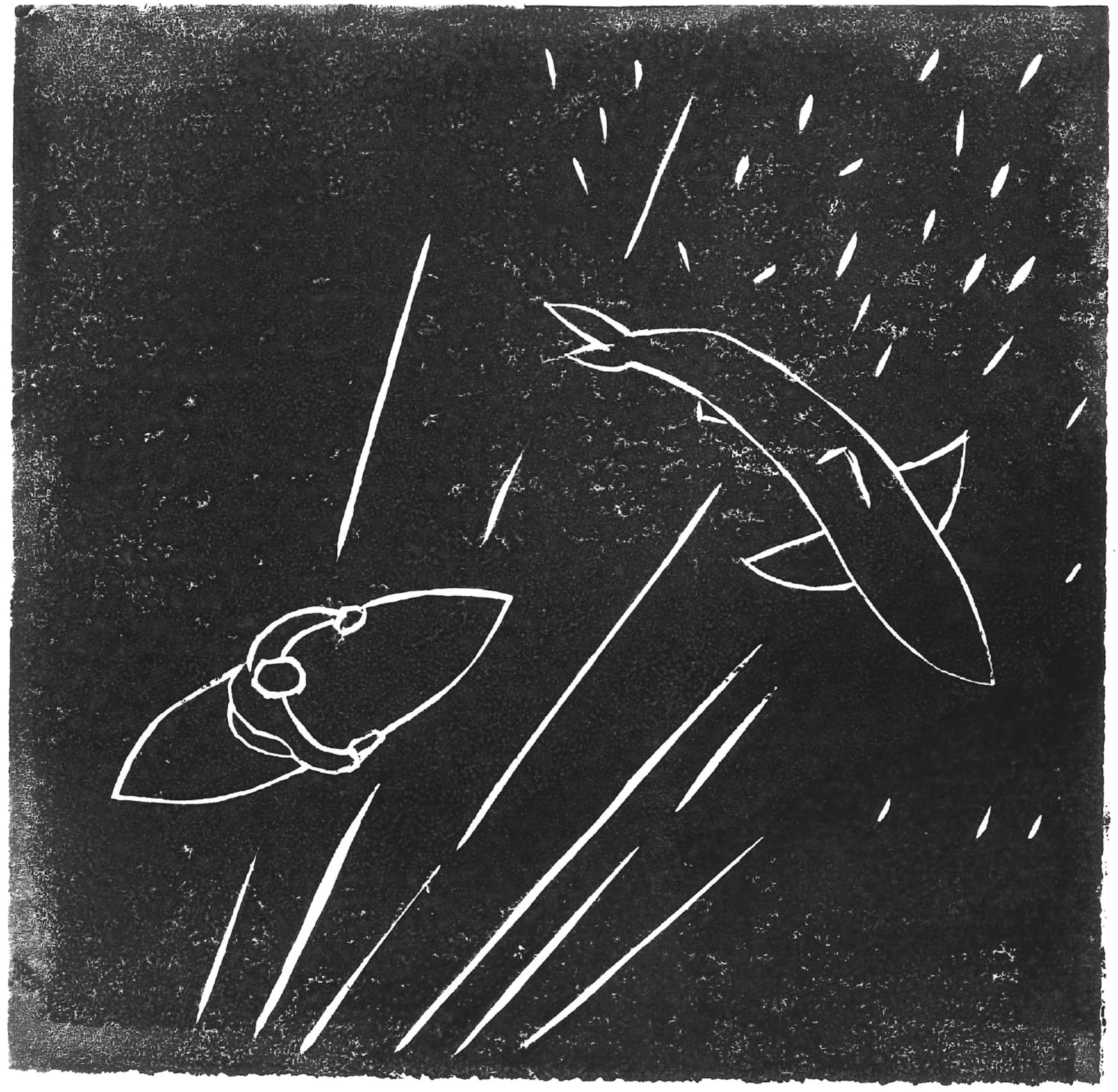
Lino print by Rebecca Olive. A representation of drone footage of a human-shark encounter post on Instagram. This print is based on a photo by @scott-_fairchild, Instagram 27 January 2023, https://www.instagram.com/p/Cn5EBY0Oxkp/?igsh=b2dkd2R0cDNjZXJ6.
Method
The data in this discussion is drawn from a larger project about the role of sports and physical activities in how people learn about, build relationships to, and care for coastal and ocean ecologies (2019-present). The project uses ethnographic methods of participatory fieldwork, in-depth interviews, and social media analyses. This creates “multiple validities” (Saukko, 2003) in terms of the various contexts of the issue, the media and cultural discourses that shape understandings and everyday experiences of recreational sport, physical activity, health, and leisure in coastal and ocean ecologies. Project sites include multiple locations in Australia across urban, regional and rural areas in New South Wales (NSW), Queensland, Victoria, Tasmania, and Western Australia, and has focused on ocean swimming and surfing activities. Data collection started in May 2020 and as a result of pandemic border closures and lockdowns, I spent multiple months at some locations (Byron Bay, NSW), made multiple trips to other locations (e.g., Bondi in NSW), and had only a few days at others (e.g., Bicheno, Tasmania and Freemantle, Western Australia).
Participating in activities with existing ocean-user groups allowed me to experience encounters and emotions we were discussing in interviews (Butler-Eldridge, 2024). All activity groups were competent and confident everyday recreational participants in the ocean and in their activity, but the groups were not competitive (although some individuals were) or elite. In the case of surfing, I had existing access to communities through ongoing projects. With ocean swimming I focused on groups who swim between one and seven times per week, and who generally swim distances of 1.2–1.6 kilometres.
Along with the many in-water, and post-swim or surf conversations I participated in during fieldwork with individuals and groups, I conducted sixteen (16) in-depth, recorded interviews with participants from each site and from broader media contexts. Voice-recorded interviews were 45–90 min and covered a range of topics related to how participation in recreational ocean swimming and surfing shaped their understandings of, relationships to, and practices of care for multispecies ocean ecologies. I formally recorded interviews with nine (9) men and seven (7) women, with ages ranging from 28 to 75 years old. Participants’ main ocean use activity included eight (8) surfers and eight (8) ocean swimmers. Although some of them lived across contexts, four (4) had their main ocean use site in an urban context – Sydney (3) and Freemantle (1) – and twelve (12) were from regional or rural coastlines across New South Wales, Victoria, and Tasmania. All had varying skill levels from competitive to recreational, although all were confident and competent ocean users, each with many years of ocean experience. Interviews were conducted in a place of the participant's choosing. This included at the beach, in homes, and at cafes.
In addition to fieldwork and interviews at the beach, I followed and observed multiple social media accounts, including those that post drone footage of human-marine fauna encounters, such as sharks, whales, and seals. I extended my ethnographic research to social media as an extension of ocean swimming and surfing cultures. These media reveal insights into how people represent their understandings and experiences of coasts and oceans, and how these contribute to broader cultural narratives, vernaculars, and knowledges (Pink et al., 2015). Surfers’ and swimmers’ use of social media on mobile phones is an example of how ‘As mundane tools that are an integral part of our lives, they provide intimate, expressive, creative and practical ways to research on the move in and through place’ (Hjorth and Goggin, 2024, 1–2). For these reasons, I approach social media using similar participant-observer fieldwork methods that I use while in the field (see Olive, 2015). My aim is to recognise that while offering a mediated version of experiences and relationships, social media are part of, not separate from, surfing and swimming cultures in the water and on the beach. In this project, social media data collection and analysis was managed from a research account on Instagram, @moving_oceans. I established my Instagram account as a point of public contact for the research project in a media platform significant to many swimmers and surfers. I followed relevant users, liked and commented on posts, and used direct messaging as an initial point of contact with possible participants (see Olive and Jennings, In Press). Having a participatory Instagram presence allowed me to follow relevant social media accounts in a way that was always linked to details of my research project.
My use of social media was shaped by the accounts I initially followed, which included a mix of international ocean conservation organisations and influencers, ocean swimming groups, ocean-related media, and individual surfers and ocean swimmers, some of whom I knew offline. As I would in the field, I engaged with how these accounts were being used to tell stories and share information. Over time, I started following accounts in the same way we snowball sample research participants – I found accounts through the accounts I already followed. Also, platform algorithms responded to my online activity (e.g., accounts followed, topics searched, posts viewed, interactions, etc) by suggesting increasing numbers of posts of drone footage of human-animal encounters in the ocean. Aware of the ephemeral nature of social media content, and of the right for users to delete content (see franzke et al., 2020), I used the in-app bookmarking function to collect and store relevant posts for analysis. This meant deleted posts would be removed from my records.
Social media posts discussed in this article are from accounts that collect and share drone footage of human-shark encounters and/or re-post drone footage taken by others, and which are set to ‘public’. While drone footage was also re-posted from a range of accounts by everyday users, key accounts that regularly film and share human-shark encounter footage include Australian-based accounts @dronesharkapp (212 K followers), @scott_fairchild (76.2k followers), @wanderlust_flyer (17.1 K followers), @bondiripper (10.k followers), as well as USA-based account @themalibuartist (188k followers). 3 The accounts include footage from both the east and west coasts of Australia, in particular, around Sydney and Perth.
Drones and social media
Before I present the data, understanding the qualities and capacities of drones and social media is essential for understanding their potential for offering new ways of understanding sharks. So far as coasts and oceans are concerned, drones are relatively small, lightweight, remote-controlled, airborne devices that allow people to film from the sky creating a “god's eye view” of an area, that is otherwise only accessible to animals (or people) in flight (Fish & Richardson, 2022; Jackman & Brickell, 2022). As filming devices, drones are relatively affordable, relatively easy to operate, and require relatively limited mobility – you can film over large areas while standing safely onshore in one place. Drones are less intrusive and noisy than other image gathering methods (e.g., filming from boats or helicopters) and so can be operated to follow animals (or people) in a way that has less impact on their movements (Joyce et al., 2018). For these reasons, drones have offered important new forms of access and data collection for coastal, marine and ocean science research (Fish, 2022), including for shark science (Butcher et al., 2021). For example, drones are being used for observing shark behaviours and movements (Colefax et al., 2019; Tucker et al., 2021), and in an attempt to avoid shark culls or other injury causing interventions, drones are also being used in place of much higher cost – in terms of funding, fuel, personnel, etc – helicopter programs as surveillance tools and warning systems in shark bite mitigation programs (Gorkin et al., 2020; Li, Huang and Savkin, 2020, see also, https://australianuavs.com.au/). In all cases, marine science researchers highlight both the accessible and less-invasive impacts of drone research to the animals involved, and the import insights that drone footage and sample collecting have added to our knowledge about sharks.
As well as creating knowledge, drones can enhance human relationships to marine life. Drawing on drone-based marine science methods that collect behavioural footage and biological samples of seals and whales, Adam Fish (2022) writes that ‘drone oceanography could positively affect the existence of ocean life through the development of public-facing conservation media’ (863) and that the forms of ocean representation and knowledge drone footage enables have the capacity to ‘inspire political conservation … and should result in more profound responsibilities to care for marine species’ (864). Fish argues that drones facilitate forms of ‘intimate, interspecies sensing, conveying people and marine animals into closer proximity’ (2022: 865). This is true for the drone operators and filmers, but my fieldwork, interviews and social media analyses data suggest that it is true for viewers and ocean users too.
Important in facilitating successful public access to drone footage are social media. Social media are online self-publishing platforms that are accessible from mobile phones. Social media offer similar forms of technological accessibility for users in that they are relatively cheap and easy to navigate, allow sharing of content and commenting on posts, and are available to view on the smart phones that are so popular among Australians (Bucher & Helmond, 2018; Carlson & Frazer, 2021). Posting and sharing footage on social media (including YouTube, Instagram and Facebook) allows filmers – scientists and amateur drone operators – to share their multispecies ocean encounters with a broad public. There are many platforms, but this discussion focuses on Instagram, because this media is culturally popular among ocean swimmers and surfers. Instagram emphasises video and image posts on user accounts, which followers can view, share with other users, and comment on. Even marine predator scientists have been viewing amateur drone footage posted to Instagram to gain insights into shark behaviours in relation to the relationship between whale migrations and human-shark interactions (Pirotta et al. 2022). Social media have also been used in sharing other forms of land-based wildlife tracking and conservation, shaping possibilities for “knowing the wild” (Benson 2010). Examples of this include apps such as Shark Smart. When a tagged shark swims within 500 metres of a buoy, the app notifies users (Fish, 2024).
Before moving on to a discussion of the potential benefits of drone footage, there are significant limitations and tensions to note. While I am arguing that drone footage can help disrupt human-centred values in how we understand our relationships to sharks and other marine species, I am not suggesting that drones are an unproblematic good when it comes to learning about, experiencing and interacting with coasts, oceans, and marine life (Fish & Richardson, 2022). As Fish and Richardson remind us, ‘the drone is more than a camera on high’ (2022: 3). Instead, drones are 'intimately related to the militarized history of the aerial view’ and are ripe with contradictions in that they ‘can give as well as take life, empower as well as oppress, and open up new potentials for justice as well as enclose and control’ (4). These contradictions are strongly at play in the use of drones for animal, erosion and human surveillance along coasts and oceans.
The operation of drones by filmers, such as those producing the coastal and marine footage used in this analysis, is contributing to the ‘dronification’ of public spaces (Richardson, 2018: 91) and to the normalisation of ‘everyday droning’ in our lives (Jackman and Brickell, 2022: 157). This is a particularly important point to emphasize in a discussion such as this one, in which the effects of the operation of drones as un-regulated objects of surveillance – which are intrusive, gendered (usually operated by men), and lack consent from the people and animals they film – can disappear into a celebration of their everyday utility (Fish, 2024; Jackman and Brickell, 2022). In the use of drones for marine science, ‘conservation drones violate human privacy, safety, mental health, data security and understanding of conservation’ (Fish and Richardson, 2022: 7; see also Sandbrook, 2015). These violations are clear in how people in the videos discussed in this article do not seem to have been asked for their permission to be filmed and have their image shared online to hundreds of thousands of account followers, and are not seemingly alerted to their proximity to a large shark as the encounter is recorded by an unseen drone operator standing on a shore. Amateur filmers can also ‘unwittingly collect data that is deployed in the pursuit of top-down control over wildlife’ (von Essen et al., 2023: 683).
It is beyond the scope of this discussion to draw out the complexities of the mobilisation of drones as techno-innovations for people and animals, but it is imperative to at least acknowledge that the presence of drones imbues public beaches, coasts and oceans with layers of surveillance, militarisation, extraction, and commodification. Their mobilisation as tools of serious and amateur science and leisure means that these tensions are further obfuscated by the positioning of drones for “non-violent” and “less-invasive” marine science and safety tools, including the popularity of human-shark encounter footage on social media (Gorkin, Adams, Berryman et al., 2020). These are serious issues that deserve attention by coastal and marine researchers, planners, managers, and policy makers. Of course, multiple things can be true at the same time and in the case, drone footage of human-shark encounters is creating benefits in ocean users’ understandings of sharks and human-shark relationships.
Analysis: A change of perspective on human-shark encounters
Together, the participatory and ethnographic methods I used, in the field and online, provided rich empirical information for understanding how drone footage posted to social media is shaping ocean users understandings of everyday human-shark encounters. Fieldnotes are woven through the analysis of the social media posts and interviews, but in the discussion below, I have separated the analysis of the social media posts and captions from the interview quotes about participants’ perceptions and experiences of the drone footage on their relationships to their ocean use. This highlights different aspects of how we are resituated in ecological relationships by this footage. The social media content is useful in highlighting how people represent experiences, and the interviews illustrate the effects of these knowledges on how ocean-users make sense of their multispecies ocean encounters.
Representations of sharks through drone footage on social media
In my analysis of social media posts, I have followed the established news media and film analyses that found coding of sharks as predators through imagery, language, and music to focus on how account holders and drone filmers’ represented sharks and human-shark encounters in their footage, narrations and captions. I am not examining audience comments below these posts, although an analysis of these would offer even deeper insight into commenter perspectives on sharks. Instead, I have focused on the posts – the images and videos shot from drones – as well as the narrations and captions added during filming or while editing and posting on social media. The most significant observation is that drone footage of human-shark encounters that I viewed on Instagram codes human-shark encounters very differently from news media and film. This is the case both in the visual representations and the language used to narrate or caption the imagery.
Imagery: Context and point of view of human-shark encounters
A key relational difference in the drone footage and images compared to news media is the shift in the audience point of view (POV), which is from above rather than below. This angle allows for a larger contextual field of vision of interactions between people and sharks, and often includes other animals, as well as well as water, rocks, waves, boats, surfboards, buildings, and the shoreline. Regular viewers can become familiar with the rocks, cliffs, seaweed beds, water and wave directions, and animals at the beaches where different drone operators most often film and can place the sharks and their interactions with people in a geography, environment, and ecology. Rather than presenting them as an out-of-place predator, this normalises sharks as a regular presence in coastal waters used everyday for swimming and surfing. It also provides information about where and when human-shark encounters can happen, including challenging the idea that encounters are most common at dawn or dusk. For example, many videos show encounters in shallow water in which people are standing, and in bright sunlight rather than soft dawn or dusk light.
In addition to the geographical and environmental location of encounters, the drone POV allows for additional information about human-shark encounters beyond the moment of close proximity. For example, drone footage offers a different version of how sharks approach people. Rather than approaching from the front or from underneath of swimmers or surfers, the sharks often approach people from behind, towards their feet, meaning many of the swimmers and surfers do not notice sharks at all, even when they are only metres apart. In other footage, sharks move slowly under the feet of swimmers and surfers who are in deeper water. In the cases when people do notice them and react with obvious shock, the sharks tend to swim away quickly.
In longer videos, viewers are able to consider the speed of the approach of the shark, the distance between the shark and the person, the total length of the encounter, and what might cause the shark to swim away. Of course, videos may be sped up or slowed down in editing, but such information is not usually shared in the post. None of the videos of human-shark encounters reflected forms of predatory, targeted hunting by the sharks. Instead, encounters appear incidental to shark movements. Sharks tend to move slowly and with apparent caution, keeping their distance from people and swimming quickly away from them after briefly approaching or inspecting them or when people notice them. While some people notice sharks and react with visible fear, other times they react with calm curiosity. They adjust their body so they can see the shark, sometimes swimming towards it, in which case the shark usually swims away.
Language: Representing sharks in captions and narration
Language used in the captions under posts and voice-over narrations of videos was very different from that found dominating media reporting. There was no use of terms such as “attack”, “monster”, “killer”, or “jaws” which previous research found to be common in headlines (Le Busque and Litchfield, 2022; Muter et al., 2013). Instead, language in both the captions and the narrations tended to be excited, affectionate or neutral in tone, rather than sounding frightened or unsure about what might happen. This is perhaps a result of the familiarity the filmers have with non-injurious human-shark encounters and with the physical distance they personally have from the encounter they are narrating. It is easy to feel excited and affectionate from the safety of the shore.
One Sydney-based filmer, @dronesharkapp, adopts a non-panicked tone in his narrations, which includes playful elements. For example, he gives animals human (mostly masculine coded) names, such as Norman the grey nurse shark, Sammy the seal, Wally the wobbegong, and Raylene the stingray. Even though some animals will be migratory or passing through, these names evoke a sense of the animal as a regular presence at the location and emphasises them as a resident of the waters. It positions them as a local. This tactic anthropomorphises the animals as effectively as language like “serial killer”, but it does so to a different relational end; these animals are neighbours we share our community with rather than simply predators to be feared (see also Lobo et al., 2023). In contrast, except for one ocean swimmer who does occasional social media post collaborations with a filmer (they link his drone footage with her underwater camera footage of the same in-water encounters), the people in the videos remain nameless and thus coded as visitors to the ocean ecology.
This observation about the narration of local animals and unaware swimmers and surfers seems at first to contradict my argument that drone footage of human-shark encounters is helping ocean users ‘resituate’ themselves in ecologies. However, the footage and ocean users’ responses to the footage, have two resituating effects: the footage highlights that sharks have complex lives and behaviours to which people are incidental rather than central; and it reminds people that they are part of multispecies ecologies when they are in the water. You cannot know who or what you will encounter when you swim or surf and you cannot be sure you will notice even when it happens.
In their real-time narrations, one filmer often laughs at and teases ocean swimmers who they describe as not having noticed animals close to them. However, whether or not the people in the videos are unaware of their encounters or have simply not visibly reacted to their presence, is not clear. From my fieldwork and interviews with swimmers and surfers in some of these locations, people are as likely to be aware of and unbothered by an animal's presence as they are to be aware and frightened (see also Olive, 2025). The assumptions of the filmer perhaps reflect established assumptions about people's fears of sharks, rather than ecological understandings that swimmers and surfers take with them into the water (Gibbs, 2021; Olive, 2023).
The effects of drone footage on ocean users: Interviews
While the analysis of social media posts and content yielded insights related to representations of human-shark encounters, interviews revealed how ocean users are making sense of drones in how we learn about sharks and human-shark encounters. While my fieldwork in the water and online made me aware of these social media accounts, it was interview participants who highlighted the effects of the drone footage on swimmers’ and surfers’ thinking about human-shark relationships, rather than me planning it as a pre-decided topic for discussion.
The interviews highlighted the impacts of drone footage on ocean users’ understandings of the possibilities of what human-shark encounters look like and what their outcomes can be.
Interviews: Greater awareness of the presence of sharks
During interviews, participants explained how drone footage evidenced something they already knew in theory; that they are swimming with sharks. Many of the incidents and examples that Bondi-based interviewees referenced related to one popular, Sydney-based account, @dronesharkapp.
Swimmer 1 (urban, Bondi, woman, 40s): Well, there's plenty of drone footage (…) interesting ones I find are you see a surfer swimming across one end of a bait ball and there's a shark at the other end. That's like what happened to us. You wouldn't know they're there because you can't tell when you're in the water. (…) But if you're up top looking down, you can see that.
—–
RO: … the Drone Guy footage, do any people talk about that? Swimmer 2 (urban, Bondi, man, 30s): I think it's that realisation about [sharks have] always been there. Yeah, there's, like, ‘Oh, my God’, and then the next conversation, it generally follows that that they've always been there. It's not like they weren't there and now they are.
Interviews: Multispecies shark encounters
As is common in the videos, and as all the swimmers explained, a key time for encounters with animals in the ocean is when they are swimming in the middle of “fish balls”, which is a general term for a very large school of fish. These huge, ceaselessly moving assemblages are easy to spot from the shore or the surface by the birds diving from the air into the water to feed on them. But of course, there are often other animals feeding on the fish too: dolphins, seals, and sharks.
Swimmer 3 (urban, Bondi, man, 70s): (…) if you look at the drone shark [footage] they've taken videos here where there's been bait balls which one of them, I think there were four sharks, kind of munching away a bait ball. So, you know, I reckon I've probably swam with sharks and had no idea. (…) Because they're here. They're here [eating].
—–
Swimmer 2 (urban, Bondi, man, 30s): … we have those moments where someone gets caught on footage by a drone with like a pod of whales, and everyone is just like, wow (…) And then it's like that encouragement to, okay, if I want to experience that, then I've got to go out more and be more involved.
Interviews: Drones, sharks and safety
Using drones to collect footage of ocean animals is not only for entertainment. Drone use is being advocated as a “non-violent” form of shark bite mitigation (e.g., Fish, 2024; Gorkin et al., 2020; Li, Huang and Savkin, 2020). Flying drones as above-water surveillance of sharks at busy beaches is being increasingly adopted by surf clubs in summer months. RO: Helicopters go over in the summer now [to spot for sharks]. I don't know if they do that here? Swimmer 3 (urban, Bondi, man, 70s): Yeah they do…and drones.
Using drones for surveillance can allow operators to alert people to the presence of a shark. For ocean users in a regional area of north-east New South Wales, where there have been a number of surfer deaths by shark bite and attack, drones represent a safety measure more than a learning device. Surfers were ambivalent about these programs. RO: What are your thoughts on [drone programs for safety]? Surfer 1 (regional, northern NSW, man, 60s): Not much. I mean, they are handy obviously, but when you’re around river mouths and that, you can’t see nothing anyway. RO: (…) would it make you feel safer if there was one hovering over on the… Surfer 1 (regional, northern NSW, man, 60s): Yeah. One of me mates was walking out of the water and the drone's hovering over his head and the blades are like this [laughs] and he's looking around going, I can’t see. He's looking and he said this bloody shark was about six foot away from him. —- Surfer 2 (regional, northern NSW, man, 70s): Well, people in the flags [patrolled swimming zone] have drones that fly around out of the top of them, and they are looked after. Surfing people down the beach, not so much.
The comments of the surfers here reflect a key limitation of drone filming and surveillance in relation to oceans in that visibility is only possible in certain conditions. As Colefax et al. (2019) found, there have to be clear weather conditions (i.e., no rain and low wind velocity), high levels of water clarity, low wave incidence, and the sunlight must not reflect off the water surface meaning it is only effective at certain times of day, depending on the location. These comments also reflect the low levels of confidence in the use of drones for shark bite mitigation among some groups of surfers (Stokes et al., 2020).
The ethics of filming human-shark encounters
Those last interview comments highlight issues of ethics related to everyday droning and surveillance. While the use of drones as a shark bite mitigation program has clear goals and processes in terms of alerting people to the presence of sharks (e.g., sirens and loud speakers), the responsibilities of amateur drone-operators are much less clear. The filmers cannot know that no harm will come to the person whose shark encounter they are filming, so how do they make sense of their bird eye view of what lies beneath ocean users and the proximity of sharks to people at the time? What are their responsibilities to the people that they are filming without permission?
I have not been able to interview any of the drone operators for this research to ask about their practices and ethics. However, one operator, @wanderlust_flyer, wrote about this issue in a caption on one post from 2 January 2023.
4
The post is a video of a near shore encounter between a woman and a large tiger shark on the west coast of Australia, in the north of Perth. Despite the clear water, the woman does not see the shark that is so close to her although she does turn to look up at the drone as it buzzes above her. When she turns, the shark also turns and slowly swims away in the other direction. The video is confronting and although we know that there will be no attack – the video is posted online after all – it is unnerving watching the large shark's interest in someone so close to shore. The video is also highly viewed. With over 3.5 million plays just on that post (it could be reposted elsewhere), it is not surprising that it had accrued 1890 viewer comments as of March 2024 (the comment count is no longer a public number). As well as including information about the location, the image caption appears to have been edited over time in response to viewer comments to include qualifying description of the shark's behaviour: !! AS SOON as I realized people were still in the water after spotting the tiger shark, I immediately called through to the Surf Life Savers to inform them as well as sprinting down the beach from where I was filming (800 metres away) to get everyone out of the water. As a drone photographer we do everything that we can if we spot a shark at the beach to ensure everyone's safety.
Clearly there is a perception that drone operators have responsibilities to the people they are filming, including a sense of responsibility among the drone operators themselves. An example of this came up in interviews in Sydney, where one swimmer suggested that the common nature of the presence of sharks was initially a surprise to one drone operator.
Swimmer 2 (urban, Bondi, man, 30s): (…) when [the drone shark guy] first turned up (…) he was like this pest, because he'd be calling the lifeguards, being like, “there's a shark, there's a shark!” They're like, “what”, and he's like “close the beach!” So they were closing the beach, like three days a week, shark alarms are going off, because this guy is seeing all these sharks. And then they're like, “You know what, mate? These sharks have been there forever. Like, unless it's a great white and you're 100% sure, let us know.”
Because the footage is on social media, I assume there will be no attack as such videos would have no place on highly corporatized social media platforms. Still, the drone operators cannot know the outcome of the encounters at the time they are filming them.
While they do not constitute the kinds of direct human-shark encounters that are the focus of this discussion, some accounts also share footage of animals, including sharks, seals and dolphins, that have been filmed when the animals are trapped by drum lines or nets installed as parts of State Government beach netting programs (Roff et al., 2018). This includes the @dronesharkapp account, as well as footage shared on anti-shark net activist accounts (e.g., @envoyfoundation, @hollyrichmond_). On @dronesharkapp, the filmer narrates these situations with emotion. He sometimes speculating that the animal caught is one of the “local” animals, using his human name for the animal (e.g., ‘Oh no, is that Sammy the seal? Sammy, mate. No!”) to communicate a sense of familiarity, care and affection for a critter they regularly interact with through the drone. These videos evoke a sense of the violence of an animal being caught on a piece of infrastructure aimed at human safety (Gibbs and Warren, 2015; Hammerton and Ford, 2018). In this way, they represent what von Essen et al. (2023) identify as a ‘positive reading’ of the potential of digital Anthropocene relationality ‘that emphasises the digitization of human–environment relations and changing power relations’ (Mclean, 2020, 160) by becoming ‘a basis for more informed practices of care’ (von Essen et al., 2023, 692). On the Gold Coast in Queensland, footage of entrapped and distressed animals including sharks, whales, dolphins, and rays, as well as footage of sharks being killed or euthanised (Bolton, 2024), is more difficult for drone operators to capture. This is in part because of the proximity of the beaches to the local airport and thus restrictions on the flying of drones in that area (see CASA, nd; City of Gold Coast, nd; Dronemade, 2019).
There remain essential questions about the impacts of drones on everyday militarisation and surveillance of beaches and on the wellbeing of animals (Fish, 2024; von Essen et al., 2023). However, drones are playing an increasing role in the everyday ocean knowledges and experiences of coastal and ocean users. This is in part through the use of drones for marine science and beach safety, but drones also offer accessible, intimate, previously inaccessible video perspectives on our everyday encounters and offer alternatives to the ‘intense focus on the “imminent threat”’ (Gibbs, 2021: 659) that sharks have long been understood to pose to surfers and swimmers. The effect of these changes is possibly reflected in the NSW State Government's decision to end the 2024/2025 Shark Meshing Season one month earlier than usual at fifty-one beaches between Newcastle and Wollongong (https://www.sharksmart.nsw.gov.au/shark-nets). The ‘NSW Shark Smart’ program's promotion of this decision on Instagram emphasized, While the nets might be coming out on 31 March, we will still have the 305 SMART drumlines in place every day from Tweed to Bega (weather permitting), our 37 tagged shark listening stations, and up to 50 SLS NSW drones during the school holidays.
5
With this approach, they are navigating both care for ocean animals, with public interest in ocean user safety. Drones are a growing part of this digitized approach to care for people and animals (Fish, 2024; Gorkin III, Adams & Berryman, 2020). However, it is essential that we stay attentive to the human-centric politics of gender, surveillance, privacy, and consent that shape human-shark-drone-ocean-sky relations.
Conclusion
As I make these arguments, I do not wish to minimise how the risk of shark bites and attacks is very real for ocean users. Nor do I wish to suggest that a fear of shark bites and attacks is irrational, especially for regular ocean users like surfers and swimmers. Although unlikely, sharks do bite, attack, injure, and kill swimmers, surfers and other ocean users, and fear of such an encounter is something I feel myself. As well as physical effects, shark bites and attacks result in ongoing trauma for individuals and for coastal communities, some of which are collectively recovering from multiple incidents of serious injuries and deaths (Carrol, 2024; Farr and de Lourdes Melo Zurita, 2025). I also recognise that none of the posts I examined in this analysis included imagery of a human-shark encounter that ended in injury for the person involved. Other than one recent clip of a tiger shark biting the head of a diver in Mauritius, which appeared multiple times in my feed in November 2024 (the diver was not seriously injured and the shark quickly swam away), the only “attacks” shown were sharks biting or ramming recreational fishing boats, or sharks thrashing to escape from men who intentionally jumped onto them from a boat. While my account curation shapes what I see, it is also a function of the social media platforms – footage of such fatalities or serious injuries would not be allowed (Instagram, 2018). Other algorithms or other platforms might lead me to such content, but in this study it is only ocean users’ proximity to sharks in the water that I have seen represented, rather than the bites or attacks more often discussed in news media.
Ocean knowledges developed through interactions between drone footage, social media, conversations, and experiences are about more than water, climates, people, and marine science, but are politicised, diverse, experiential, technological, embodied, activated, and relational (McLean, 2020; von Essen et al., 2023). As Farr and de Lourdes Melo Zurita (2025: 1) remind us, ‘An ocean is made up of infinite bodies’. The swimmers and surfers in this project shared varying perspectives on the relations between these bodies, but in all cases they accepted that the risk of shark encounters, bites and attacks are a risk of paddling out into the ocean. These attitudes reflect Gibbs’ finding of ocean-users’ more ‘nuanced understandings of sharks, their behaviour and their agency’ (661). Through their filming practices, drones and drone operators are entangled in intimate being-with relations between people, animals, places, technologies, politics, and possibilities that have the capacity to ‘inspire political conservation … and should result in more profound responsibilities to care for marine species’ (Fish, 2022: 864). By capturing and sharing footage that facilitates new kinds of ocean knowledges and literacies, filmers are resituating swimmers and surfers as part of oceans ecologies, and reminding viewers that animals have lives entirely separate from how we think about them in relation to human safety.
Highlights
Technologies such as drones and social media are changing how we understand human relationships to wildlife.
Footage of everyday human-shark interactions of swimmers and surfers are contributing to more nuanced knowledges of shark behaviours.
While digital technologies can have unintended harms on wildlife, they can also contribute to positive change for animals.
Footnotes
Declaration of conflicting interests
The author(s) declared no potential conflicts of interest with respect to the research, authorship, and/or publication of this article.
Funding
The author(s) disclosed receipt of the following financial support for the research, authorship, and/or publication of this article: This research was funded by the Australian Research Council (DE190101178).
Australian Research Council, (grant number DE190101178).
Ethics
The methods used in this project have ethics approval from The University of Queensland and RMIT University. Fieldwork was conducted in various locations and always after first contacting a member of the group for permission to join. I discussed my project with all new people I encountered in the field and gave them the research project website address so they could find out more and contact me, or my intuitions for further information. All interviews were carried out with informed consent, including consent to publish. All participant information has been de-identified to ensure anonymity.
