




Abstract
We live in an increasingly drone-saturated world. In this article, we bring drone scholarship and feminist geopolitics into dialogue to interrogate the drone-home. We re-orient military- and state-led accounts, foregrounding the growing range of non-state actors enacting and subject to the drone as it is increasingly employed in the Global North. In so doing, we develop the concept of ‘everyday droning’ as the honing and homing of military technology and drone capitalism. Examining militarization and enclosure at the scale of everyday home life, we urge future geographical work to engage with everyday droning being actively seeded in the domestic here-and-now.
I Introduction
In January 2020, a technology journalist described watching a live demonstration of Sunflower Lab’s ‘Home Awareness System’, a form of home security comprising an autonomous drone, activity sensors and a charging station (Sunflower Labs, n.d.). The journalist stood at a stall at CES 2020, an annual US-based technology event positioned as ‘the most influential in the world’ (CES, n.d.), where technology media and enthusiasts alike capture glimpses of technology innovations, prototypes and potential futures. Over recent years, unmanned aerial vehicles, or drones as they are colloquially known, have occupied greater prominence in these so-called hallowed halls. One of the numerous drone products on display was Sunflower Lab’s system that distinguished itself as the ‘first fully autonomous residential drone’ (Sunflower Labs, n.d.). Working with ‘always-on activity sensors’ disguised as ‘attractive garden lights’, the drone can be rapidly deployed to aerially view ‘unusual activity’ above and around your home’s perimeters (ibid). Watching a live-streamed demonstration at a nearby Airbnb property, the journalist described viewing live drone ‘inspections’ and ‘heat maps of detected movement’ (Summers, 2020: n.p.). These invocations draw attention to both the drone as a technology ‘making life easier while expanding the global economy’ (Parks and Kaplan, 2017: 2) and to the ‘dronification’ of the site and scale of the home (Richardson, 2018: 91). The drone patrols as techno-security-agent in and above domestic perimeters, rendering visible perceived transgressions while cohabiting and dwelling therein.
In this article, we explore a growing trend in the Global North to both make domestic and domesticate the drone, arguing that it augurs the need to bring drone scholarship and feminist geopolitics (of home) into new dialogue. At this intellectual juncture, we articulate the concept of ‘everyday droning’, one seeking to re-orient military and state-led accounts of the drone through its foregrounding of a growing range of non-state actors multiply mobilising, experiencing, and subject to the drone. While it is now repeatedly asserted that we live in a ‘drone age’ or ‘zeitgeist’ (Coley and Lockwood, 2015; Rothstein, 2015), drone literature continues to be predominated by the drone as military surveillance and strike tool in formal warfare. Here, geographers have made important contributions to understanding the drone’s emergence, employment, and its implications as a ‘contemporary icon’ of airpower (Akhter, 2017; Gregory, 2011a, 2014; Hall Kindervater, 2016, 2017; Shaw, 2016, 2017; Shaw and Akhter, 2012; Wall, 2013: 33; Williams, 2011). In revealing the spatial dimensions of drone warfare, they have interrogated the drone’s role in the War On Terror’s ‘forever’ and ‘everywhere war’ (Gregory, 2011b: 238). As Gregory (2011b: 239) explains, such a conceptualisation comprises several ‘geo-graphs’, including both the shifting of battlefields into ‘multidimensional battlespaces’, and the emergence of war as a ‘pervasive matrix within which social life is constituted’. As researchers have more widely shown, home plays a key role here – as a site of both refuge, aerial strikes and fear (Forensic Architecture, 2014; International Human Rights and Conflict Resolution Clinic at Stanford and Global Justice Clinic at NYU, 2012). Further, in probing these ‘geo-graphs’, the drone is approached in three, rather than two-dimensional terms, with analyses attentive to the ways in which warfare and security ‘go up and down’ and are experienced within ‘volumetric space’ (Billé, 2019; Elden, 2013: 49).
It is in this vein that drone scholars have engaged the concept of enclosure to interrogate the ‘imprisoning of life inside nonhuman apparatuses’ and spatial volumes (Shaw 2016: 47; Shaw, 2017a). Tracing successive ‘apparatuses’ of enclosure, Shaw (2016: 7) asserts that the drone age sees enclosure becoming ‘more atmospheric, more machinic and more militarized’. While pertinently demonstrating the diffusion of warfare ‘everywhere’, scholars keenly observe that it is simultaneously located ‘somewhere’ (Gregory, 2014: 15), with battlefields contracting to the scale of the ‘target’ body (Shaw, 2016: 113). In this article, we hone in on the ‘somewhere’ of the ‘domestic’ in the Global North to trace a feminist geopolitics of the drone-home that builds from, yet also exceeds, this well-established field of study. The article that follows engages drone geographies and feminist geopolitics (of home) in conversation to further this task. Here, we find resonances in the drone’s shared ‘promises of liberation from the burdens of human existence – from war to work’, and potential to further interrogate its ‘complex imbrications with’ – and at the scale of – the body (Richardson, 2018: 79). After all, feminist geopolitics is centrally concerned with rescaling accounts of the geopolitical to attend to the diverse actors, embodied experiences and everyday contexts composing and comprising geopolitical worlds.
The article is organised in the proceeding way. In the second section, we situate our discussion of everyday droning within the analytic space of feminist geopolitics, while highlighting points of intersection and opportunity with drone scholarship. In the third and fourth sections, we explore drone-home militarism, building upon entrenched accounts of the military drone’s targeting of the home through an exploration of the militarisation of the metropole home via commercial and consumer drone technology increasingly equipping and intervening in these spaces. Inciting the growing popularity of commercial drone-home-security, we identify a mobilisation of militarized drone logics at the scale of the home, one necessitating critical reflection on the diverse and differentiated impacts of such devices on those below them. By focusing on citizens living with drones in and over domestic territories in the Global North, we identify a need for drone scholarship to recognise a wider range of under-accounted-for drone harms – those spanning harassment to the infliction of physical injury. In the fifth section, we turn to drone-home enclosures, and through the lens of social reproduction, we show how both remain under-examined facets of drone capitalism. As Richardson (2018: 79 and 80) astutely observes, ‘drone capital is increasingly entangled in daily life, impinging upon bodies’, with convenience afforded at the ‘price of surveillance’ (see also Grewal, 2017). In recognition that drone enclosure both ‘operates by’ and constitutes a ‘territorializing’ of ‘new social, spatial’ ‘corporeal and technical’ relations (Crampton, 2016; Richardson, 2018: 79; Shaw, 2017a), we show how the home is increasingly in the sights and sites of capitalism. We interrogate profit-driven enclosure through languages of care, critically engaging the drone’s sanitization as a displacement of household labour and devaluation of social reproduction.
In recognition of the growing diversity of platforms comprising drone ‘ecosystems’ (Jackman, 2019), our article contributes to critical efforts to understand the more-than-military drone and its everyday droning of home life. The sections on militarisation and enclosure hook into, and further catalyse, intensifying interest in the drone’s ‘twin imperative to secure and profit’ (Shaw, 2017a: 884) in this expanded geography of drone life. Collectively, therefore, the article forges fresh dialogue between drone geographies and feminist geopolitics (of home) to show how the drone-home reveals, and will likely compound, the uneven distribution of protection and emancipation, harm and precarity, in the drone age. Our article contributes to both multiscalar readings of the drone attentive to bodies and homes, and the extension of vocabularies of militarisation and enclosure to the realm of the everyday, offering intervention in a context of emergent techno-innovation. Just as drones are poised to enter, permeate and envelop the homes in the Global North, so too are feminist scholars well equipped to act, ‘grounding’ research to ‘subvert’ ‘geopolitical narratives’, driven by a desire to ‘make things better’ (Hyndman, 2004: 309). As such, we take a deliberately anticipatory orientation towards the drone-home, developing a discussion of everyday droning to provoke questions around multiply inhabited homes, embodied experience, uneven social relations, and their implications in both scholarly and lived terms.
II Feminist Geopolitics: Conceptualising ‘Everyday Droning’
Over the past two decades, feminist geopolitics has re-focussed and diversified the actors, scales and contexts at the centre of geopolitical accounts. In offering a ‘new reading’ of and ‘redefining what counts as’ geopolitics (Massaro and Williams, 2013: 567; Naylor, 2017: 27), feminist geopolitics forged a ‘distinct analytical, epistemological and methodological approach’ attentive to more diverse acts, spaces and scales of geopolitical power, agency and experience (Hyndman, 2019: 8). In this section, we contextualise the article’s discussion of everyday droning, situating it in relation to feminist geopolitics in three main ways.
A first key concern of feminist geopolitics is diversifying the actors foregrounded in accounts of the geopolitical. Scholars have identified a state-centric focus, arguing for a ‘decentering of the nation-state’ (Massaro and Williams, 2013: 567), driven by a desire to ‘destabilize dominant and disembodied geopolitical discourse’ through a diversifying of the ‘subjects of geopolitics’ (Hyndman, 2007: 36). Advocating analysis at the ‘finest’ geopolitical scale of the body (Hyndman, 2019: 4), feminist geopolitics has questioned over-reliance upon ‘the texts of political elites’, embracing instead ‘testimony of lived’ experience (Sharp, 2020: 2). It thus examines ‘power as it unfolds’, which is corporeally encountered, expressed and circulated to ‘constitute and reinforce socially produced and embodied differences (e.g. gender, race, class sexuality)’ (Massaro and Williams, 2013: 567).
Drone scholarship has, in discussion of its actors, tended to pivot around military drone operators in state-led operations (Allinson, 2015; Asaro, 2013; Gregory, 2011a; Shaw, 2016; Williams, 2011), while recognising the blurring of ‘military and civilian, battleground and homefront’ as mobilised in policing via the drone (Kaplan and Miller, 2019: 419; Wall, 2013, 2016). Scholars have used Haraway’s ‘god-trick’, describing the ‘illusion of being able to see everywhere from a disembodied position of ‘nowhere’' (Gregory, 2011a; Wilcox, 2017: 13; see also Parks, 2016). In seeking to ‘destabilize’ this ‘god’s eye view’ (Naylor, 2017: 27) through an engagement with feminist geopolitics, Williams (2011: 381) draws upon ‘firsthand accounts’ to explore how drone operators embody and ‘experience combat’ (see also Clark, 2018; Manjikian, 2014; Parks and Kaplan, 2017; Wilcox, 2017). In further critiquing the geopolitical ‘tradition of adopting a downward looking view-from-above’, Williams (2013: 225) calls for an ‘active re-orientation to encompass discourses and practices of looking up’. While scholarship drawing upon first-hand interviews with those living below military drones in Afghanistan contends that ‘drone surveillance constitutes a form of psychological colonization’, so too is attention drawn to ‘resiliency and indigenous coping strategies’ (Edney-Browne, 2019: 1341). In thinking anew with the ‘complex ways in which civilian life is lived with, through and against the drone’, Bradley and Cerella (2019: n.p.) turn to the more-than-military drone as it increasingly punctuates everyday skies and lives in the Global North (Choi-Fitzpatrick, 2019; Garrett and Anderson, 2018; Jablonowski, 2015; Kaplan, 2020). Spotlighting the now infamous drone incursions at London’s Gatwick airport in December 2018, Bradley and Cerella (2019: n.p.) describe ‘the emergence of a new species of non-state drone actor’, namely the citizen flyer. While not to eschew the civilian citizenry under military drones, nor the non-state organisations protesting their targeting (#NotABugSplat, n.d.; Parks and Kaplan, 2017), this case and the scholars’ accompanying call for a ‘political geography of our domestic dronescape’ (Bradley and Cerella, 2019: n.p.) invite an engagement centred less on state-focused drone deployments at/of the ‘homefront’, and more on accounting for diverse civilian encounters with drones. In what follows, we thus focus on alternative and under-accounted for drone mobilisations through engaging diverse non-state actors who are (speculatively) designing, commercially marketing and/or living with drones-at-home in the Global North. Here, we recognise that the age of readily accessible consumer drones ushers in a range of under-accounted everyday droning practices and harms (Jackman, 2019), those which both raise questions of privilege (Jackman and Jablonowski, 2021) and are variously gendered (Thomasen, 2018) and racialised (Allinson, 2015). In the telling of further and ‘contradictory drone stories’ (Jablonowski, 2015: 13), we thus turn to feminist geopolitics to interrogate the home’s vertical airspace and its horizontal axis. It remains important that such a move learns from research on the circulation of violent and racialised military and police drone power, which while being ostensibly state-led forms of ‘droning’ of course impact upon and harm non-state citizenry.
A second core aspect of feminist geopolitics is its bringing to the fore of a range of ‘supposedly non-political spaces, processes’ and experiences that variously compose and comprise the geopolitical (Sharp, 2020: 2). In undertaking this re-focusing, feminist geopolitics shifts analysis of the ‘global’ and ‘grand’ to the ‘everyday’ (Hyndman, 2007: 37) to expose the artificiality of divisions between the ‘private’ home and ‘public’ arena of geopolitics (Blunt and Dowling, 2006; Brickell, 2012a; Carter and Woodyer, 2020). In this pursuit, the home is positioned as a foundational loci of geopolitical power and process (Brickell 2020; Williams and Massaro, 2013). While recognising the value of ‘grounding’ the geopolitical in the domestic everyday, feminist geopolitics is distinct in its fervent commitment to tracing and conceptualisating the imbrication of multiple sites and scales of power, including entanglements between the ‘mundane’, nation and national, and the international (Dowler and Sharp, 2001: 171; Pain, 2015; Sharp, 2020).
Drone scholars have reflected too on the boundaries between military and more-than-military drones, revealing shared lineages and logics (Sandvik and Lohne, 2014). In discussions on drone policing and the wider commercialisation of airspace, researchers have identified a ‘blurring’ between military and civilian drones, those which cannot be differentiated given that ‘the development and logic of each inform the other’ (Agostinho et al., 2020; Crampton, 2016; Garrett and Fish, 2016; Jensen, 2016; Kaplan and Miller, 2019: 419; Richardson, 2018; Richardson, 2020; Shaw, 2017a; Wall, 2013, 2016). Here, a feminist geopolitics of the drone-home brings to bear the importance of everyday droning, namely the honing and homing of military technology and drone capitalism.
Third, while feminist geopolitics has long-examined ‘relations that operate through and upon bodies’ and the experiences and agencies of ‘particular corporealities’ (Dixon and Marston, 2011: 445), so too has it responded to geography’s wider disciplinary ‘non-human’ and ‘more-than-human’ turn, presenting, for example, a ‘feminist materialism’ (Hyndman, 2019: 9). Scholars have asserted that in approaching the ‘micropolitical’, corporeality and embodiment are not the ‘be all and end all’ (Dixon, 2014: 147; Dixon, 2015). Rather, what emerges is an opportunity to pursue a ‘reconfigured’ feminist geopolitics attentive to the diverse ‘“matter” of the geopolitical’ and the ‘materialities of everyday life’ (Dixon and Marston, 2011: 445 and 446). Thinking with Dixon’s thesis, Sharp (2020: 5) asserts that feminist geopolitics can recognise ‘embeddedness within networks of other agents’ without ‘losing a sense of the body as a locus for social justice’. This nods to wider disciplinary currents’ interrogation of the non-human’s ‘constitution and exercise of state power’ (Meehan et al., 2013: 1). As such, feminist scholars have explored both human and non-human actors’ ‘negotiation and transformation’ of the geopolitical worlds ‘they animate and inhabit’ (Dixon and Marston, 2011: 445; Jackman et al., 2020; Sundberg, 2008). By engaging feminist geopolitics’ concerns around intimacy, precarity and vulnerability, as well as the role of humans and non-humans alike in constructing home and processes of dwelling, a feminist geopolitics of home explores the drone’s role in reshaping domestic spatiality, cohabitation and intimate relations.
III State-Led Home-Drone Militarism
Following the events of 11 September 2001, drones emerged and cemented as central tools in the waging of the US-led ‘War on Terror’. The drone’s meteoric rise as a tool of warfare and subject of academic scrutiny was accompanied by growing interest and concern around the decision-making processes and practices underpinning its strikes (Weber, 2016). This has included examinations of the ‘disputed method’ the US adopts for ‘counting civilian casualties’, one which sees ‘military-aged males killed by drone strikes designated as militants’ unless or until there is ‘intelligence posthumously proving them innocent’ (The New York Times, 2012: n.p.; Wilcox, 2015: 129). As such, scholars have raised critical questions around both the definition and distinction between civilians and combatants under the drone (Allinson, 2015; Cupples and Glynn, 2020; Gregory, 2017) and their designation as a precarious and ‘targeted class’ (Akhter, 2017; Holmqvist, 2013; Parks, 2016: 230). Highlighting the drone’s capacity to surveil for lengthy periods and wait for the ‘most opportune moment’ to strike (Gregory, 2017: 212), scholars have focused attention to the striking of ‘homes, vehicles, and public spaces’ (Wilcox, 2015: 129) through particular strike practices, such as the ‘knock-on-roof’. Writing of Israeli drone strikes in Gaza, Forensic Architecture (2014: n.p.) describes small ‘non-lethal missiles’ fired at the home to ‘warn’ residents that ‘a larger aerial bombardment is imminent’. This warning to evacuate acts to simultaneously ‘legitimise the bombing of residential neighbourhoods while shifting the responsibility for civilian deaths onto civilians’ (Forensic Architecture, 2014: n.p.) and to enact ‘different than to political rationalities’ in the ‘management and justification of drone violence’ (Joronen, 2016: 340). Although drone strikes can, of course, be emplaced within wider practices and histories of the ‘air target’, the drone’s ‘apparent precision’ marks a notable ‘narrowing of the target’s resolution’ combined with a ‘technological shortening of distances and relationships’ and the ‘blurring of autonomy over these decisions’ (Adey et al., 2011: 174, 175, 178; Gregory, 2011a). Here, in the targeting of lifeworlds and homes, such practices demonstrate sharply the techno-lethality and geopolitics of droning at the scale of the everyday.
Such everyday impacts impress the ‘unbearably human’ (Shaw and Akhter, 2012: 1505) and ‘under-accounted for harms’ of the military drone. Here, both scholarship and popular culture alike have foregrounded the experiences of (US) drone pilots and the ‘dissociative relation between the battlefield and home that they must negotiate’ (Asaro, 2013; Bentley, 2018; Chandler, 2016: 13; Gregory, 2011a). Accounts describe experiences of anxiety and insomnia, post-traumatic stress disorder and the emergence of (gendered) violence in the operator’s home (life) (Asaro, 2013; Edney-Browne, 2017; Hijazi et al., 2019). In ‘re-orientating’ (Williams, 2013) analysis of military drone violence, research has also explored the drone’s impact on the lives below it, identifying the further fracturing and blurring of both psyche and home (Alkarama, 2015). The drone’s presence, one likened by civilians to ‘a mosquito – even when you don’t see them, you can hear them’ (in Schuppli, 2014: 383), infects intimate home life with anxiety. In-depth interviews in Pakistan reveal that citizen fears surround both the targeting of people in everyday life and at home, and a swathe of financial concerns following the loss of breadwinners and home (International Human Rights and Conflict Resolution Clinic at Stanford and Global Justice Clinic at NYU, 2012: vii, 75, 77). For those living under the drone, avoiding its gaze ‘out of worry’ can mean eschewing community events and family gatherings given the drone’s targeting of ‘more-than-normal numbers of people’ (Edney-Browne, 2019: 1349; Gregory, 2017). Just as drones re-spatialise warfare (Gregory, 2011a, 2014), they too re-spatialise the everyday inside, as well as outside, of formal warfare. Drones are thus part of the ‘insidious militarisation of everyday life’ (Graham, 2011: xiv; Parks, 2016; Richardson, 2020). As Kaplan et al. (2020: n.p.) argue, if ‘the military and its official wars are worthy of study and analysis in circumscribed fields, the nuances of everyday militarism bring considerations of state violence, territorial occupations, and power inequities into any field of study’. Everyday droning is integral to the horizon-widening that Kaplan et al. call for. A feminist geopolitics of the drone-home challenges binaries between public/private, war/peace and global/intimate, enabling a dissolving of distinctions between ‘masculinised’ military space and ‘feminised’ spaces of home (Christian et al, 2016).
As a result, in the rest of this section, we turn our attention to the more-than-military drone as it is mobilised in and around the home, poised as it is to saturate airspace and afford diverse service provision in the Global North. We approach the drone as a platform raising timely questions around new, and as yet under-documented forms of drone-enabled harm and violence. As critical scholars of home have long asserted, the home is co-constituted through vectors of care, warmth and comfort, as well as violence, alienation and harm (Blunt and Dowling, 2006; Brickell, 2012b). A feminist geopolitics of the drone-home thus pursues a sited examination of both the ‘security’ and ‘protection’ the drone purportedly offers some, and its potentially uneven impacts upon ‘others’. It recognises that the impact of the ‘security state’ is not only evident in ‘political and spatial restrictions on public space’ and ‘militarized national borders’, but rather also in the ‘increasing penetration of the domestic and private realm of the home’ (Low, 2017: 365).
To evidence this everyday militarisation, we can first make recourse to the growing deployment of drones by government, local councils, and police outside of formal realms of war and conflict. In the United Kingdom, for example, drones have recently been mobilised in conducting remote aerial surveillance on homeless populations (Glaser, 2020), and identifying illegal rental beds in sheds (Norwood, 2019). Each speaks to the drone’s surveillant stranglehold over vulnerable bodies in its midst. In the latter case, thermal sensor-equipped drones are employed to track the heat emissions of bodies occupying rental beds in garages and outbuildings, an act echoing and importing the sensor-laden military drone’s ‘hunt for heat’ and resultant transformation of the bodies in its crosshairs into ‘indistinct human morphologies’ (Parks, 2014: 2518, 2519). In media discourse, local councils (such as Oxford City Council) are framed as taking definitive action against the criminal exploitation of vulnerable people by profiteering landlords (Norwood, 2019). Digging deeper, the scheme’s funding was provided by the UK government’s Controlling Migration Fund, launched in November 2016 to help local authorities mitigate the impacts of recent migration on communities in their area. Here, dealing with ‘rogue landlords’ in order to protect vulnerable migrants, co-exists with the goal of ‘reducing the impact of illegal migration, often in partnership with Immigration Enforcement’ (Ministry of Housing, Communities and Local Government, 2017). The ‘concern’ for migrant welfare is thus enmeshed within a militarised web of immigration enforcement enabled by the drone. The identification of ‘beds in sheds’ via the surveillant drone does not deal with the structural violences leading precarious migrants to need to live in cold and damp informal housing. Compromised labour market positions and uncertain socio-legal statuses are part of the ‘hyper-precarity’ ‘emerging from the ongoing interplay of neoliberal labour markets and highly restrictive immigration regimes’ (Lewis et al., 2015: 582). The drone as ‘solution’ is rather ‘an outcome of the failure to address migration challenges with other means, being used as a technical panacea for the consequences of failed policies and politics to manage and secure the periphery’ (Csernatoni, 2018: 176). It is a diversionary technology, which turns attention away from structural inequalities and their generative conditions, and through their punitive enforcement capabilities, entrenches what Lombard (2019: 574) identifies as ‘racial stereotypes and anti-immigration rhetoric’ in responses to shed housing.
Techno-policing is a form of everyday droning that is becoming ever-more normalised in the Global North. The drone acts to super-charge ‘domopolitics’, namely the aspiration to ‘govern the state as a home’ (Darling, 2011: 263). ‘Domopolitics’ presents homeland as a protected cocoon of community and citizenship set against a dangerous outside of illegals who breach it (Walters, 2004). Echoing realist-inspired traditional geopolitics, this ideal of governmentality constructs the international realm as distinct from the domestic, one in which sovereign power within and by the nation-state is absolute. The drone polices any such breaches. Following this political logic, drones have been mobilised in the policing of the COVID-19 virus in similar ways (Chen et al., 2020), narrated and managed in several quarters as a ‘foreign’ disease from ‘outside’ (Cole and Dodds, 2020). The bordering of the virus is circumscribed through the drone to distribute automated messages to ‘stay home’ and obey COVID19 restrictions (Duncan, 2020). In their governance of the intimate and border transgressions, these recent examples highlight the diffusion of droning into everyday life.
IV Non-State Home-Drone Militarism
Thinking with such pernicious examples of everyday militarism accentuates a need to open up, and in turn flesh out, a feminist geopolitics of the drone-home. While thus far we have explored state-led practices of everyday droning, in this section, we turn to non-state actors. We re-approach the drone in both its commercial iterations as home security and household assistant and as it is disruptively or subversively mobilized by citizen flyers. We interrogate the positioning of the drone as a device seeking to compose the ideal home by policing it, while highlighting a range of as yet under-accounted-for harms that are likely to arise as the drone enters intimate dwelling spaces.
To advance a feminist geopolitics of the drone-home, it is necessary to respond to the call made in the geographies of home literature for criticality around the ‘idealised’ home and the tendency to focus upon experiences of protection at the expense of those of tension and conflict (Brickell, 2012b). Drone scholarship also raises similar questions of drone protection for whom (Shaw, 2016a; Wall, 2013, 2016)? While drone scholars are increasingly attentive to non-state-deployed drones (Choi-Fitzpatrick, 2019; Crampton, 2016; Fish et al., 2018; Jackman, 2019; Kaplan, 2020; Schnepf 2019), including what Parks (2016: 227) describes as the drone’s ‘softer, neoliberal side’, there nonetheless remains a paucity of work attentive to the scale of the home, and its intersections with narratives and experiences of protection. Here, we can return to the article’s opening vignette. As described, Sunflower Lab’s ‘Home Awareness System’ is a drone-enabled autonomous home security system. As shown in Figure 1, the drone patrols the perimeters of its user’s home to ‘learn your property’s routines’ and ‘alert you to unusual behaviour’ (Sunflower Labs, 2020: n.p.).
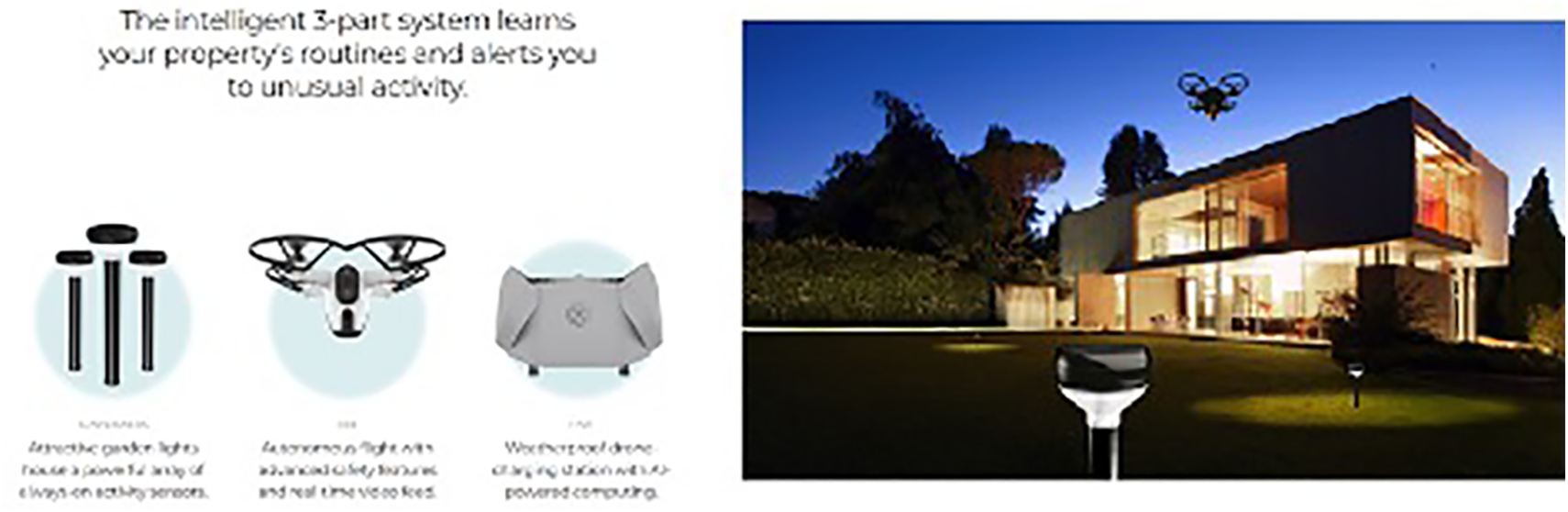
‘Home awareness system’ (Source: Sunflower Labs, 2020, n.p.).
In evoking the language of ‘alert’ and visual display of the drone as ‘real-time’ patrol object (Figures 1 and 2), Sunflower Labs mobilise long-standing military drone discourse around aerial protection and the drone as ‘hunter-protector’. Writing of ‘cynegetic war’, Chamayou (2011: 4) describes the military drone as marking a shift from warfare as ‘duel’ involving ‘a reciprocal relation of exposure to death’ to ‘hunt’ – where ‘the master’ instead ‘barely ever confronts his prey directly’. While conducted in the name of ‘protecting the nation’, drone warfare assures the ‘hunter’ ‘maximum protection’, preserving their life through ‘the mediation of hunting auxiliaries’ – drones (ibid). This doctrine of ‘militarized manhunting’ is thus underpinned by a ‘rationality of safety’ that seeks to pre-emptively ‘protect society from danger’ (Chamayou, 2011: 4). Drone scholarship recognises that this rationale increasingly extends beyond the battlefield, with militarised drone logics mobilised within ‘the homeland’. Yet, attention still clings to the growing deployment of drones as ‘technologies of state surveillance and policing’ (Davies, 2019; Shaw, 2016a; Wall and Monahan, 2011: 243). Sunflower Lab’s brandishing of their drone with the popular military and policing adage of an ‘eye in the sky’ (figure 2) evidences the need for further attention to the growing presence of the drone in the home. This example is of course one facet of a wider phenomenon, with domestic(ated) drones increasingly anticipated and imagined across diverse forms of popular culture, media, and commercial artefacts (Basotia, 2020; Graae, 2020; Jackman and Jablonowski, 2021). Following Van Veeren’s (2013: n.p.) encouragement for attention to the multiple imaginaries of the military drone and ‘the ways in which issues and their subjects are imagined’, our intervention seeks to further emergent analyses of the plural ‘terrains’ in and through which more-than-military drones are ‘imagined, legally constituted and deployed’ (Jumbert and Sandvik, 2017: 2).
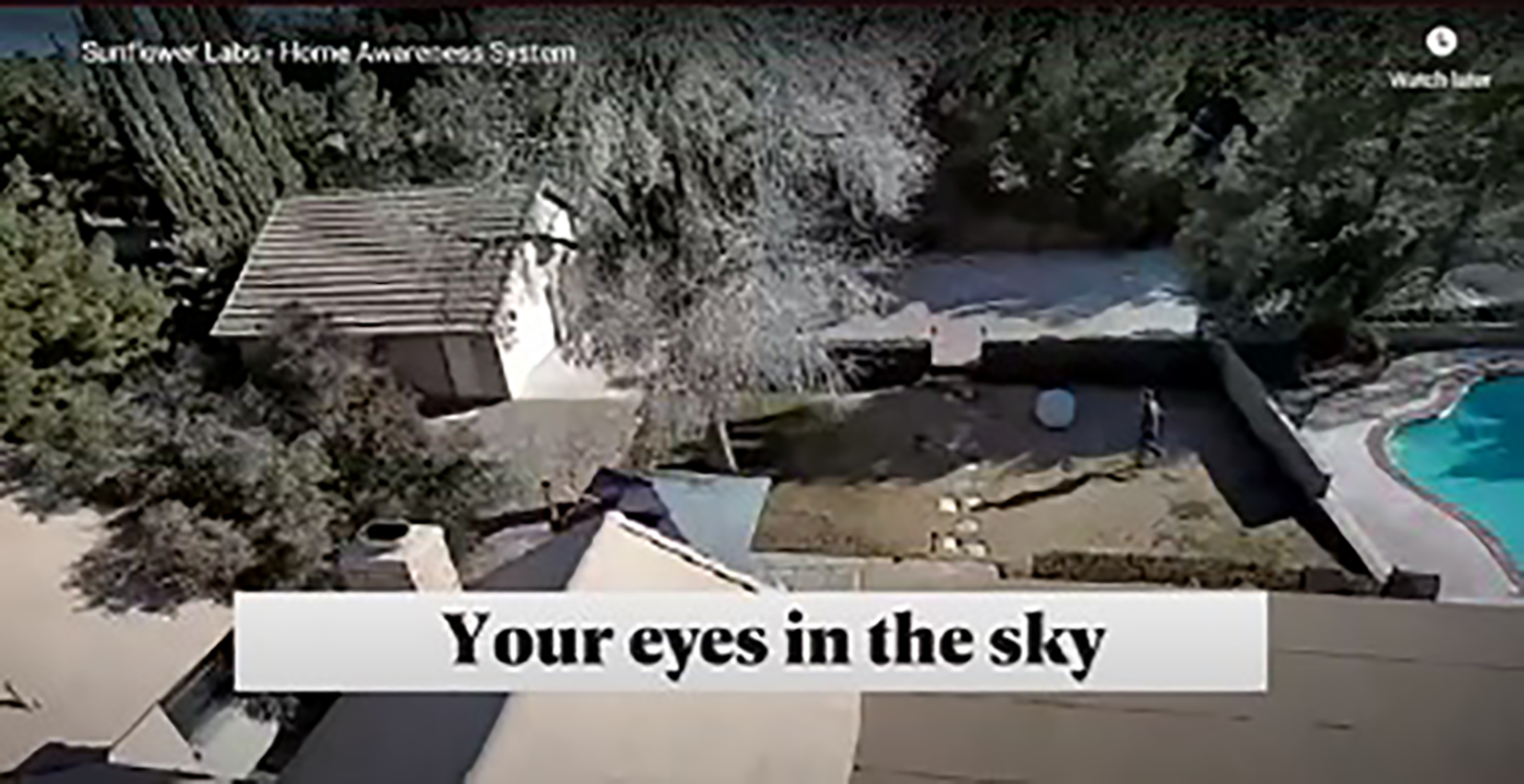
‘Home awareness system’ (Source: Sunflower Labs, 2020, n.p.).
It is in discussions of (potential) police drone futures that we see the seeds of feminist concerns around intimacy and embodiment. Scholars describe the ‘materialization of more intimate forms of aerial policing’ (Shaw, 2016a: 25) and ‘affective trepidation’ experienced by populations under its gaze (Wall, 2013: 49). Sunflower Lab’s drone system, and those like it, urge researchers to pay greater to the ‘intimate terrains’ within which these commercial systems operate, and the ‘entanglement’ of the geopolitical in such emergent intimacies (Barabantseva et al., 2019: 3). Given that the drone industry is a multibillion dollar one acting to ‘re-enchant the atmosphere’ (Shaw, 2017a: 894) while privatising airspace (Garrett and Fish, 2016), scholars are increasingly attending to the drone’s creation of ‘new forms of subjectivity and governance’ (Crampton, 2016: 137 & 138). Recognising the mobile, ‘sporadic and punctual’ drone’s complication of existing forms and regimes of ‘systematic’ surveillance (Klauser and Pedrozo, 2015: 287; see also Richardson, 2020a), Richardson (2018: 81) rescales such analysis to offer a particularly helpful reflection on the drone’s ‘relationship to flows of capital’ through the tripartite lenses of ‘security, finance and the home’. He explains how the drone creates ‘affective atmospheres of domestic spaces’ by opening the bodies therein to ‘datafied abstraction’ (p.93). Here, an everyday droning of the home entails the ‘collection, collating and mapping’ of ‘activities and desires’, mobilised as service (p.91). As such, ‘drone capitalism’, Richardson (2018: 93) asserts, ‘complicates the body’ – widening it’s ‘intimate atmospheres from the personal to the technological’.
In the Sunflower drone, we see this imperative securitised. In applying a feminist geopolitical lens attentive to ‘processes of securitisation and their uneven effects’, we are prompted to reflect upon both practices and differing ‘lived experiences’ of such techno-security (Williams and Massaro, 2013: 752). For example, as West et al. (2019: 6 & 3) articulate in interrogation of artificial intelligence as ‘systems of discrimination’, there remain serious concerns regarding image recognition software-led determinations of behaviour and ‘criminality’. There are, they continue, a ‘steady stream of examples’ highlighting the ‘miscategorization of black faces’, acting to amplify ‘existing structures of inequality in society’ (West al, 2019: 6). Following scholars inviting greater attention to the ‘imbrications of racial capitalism and drone technologies’ (Schnepf, 2019: 749), we must ask, how then is ‘unusual behaviour’ determined by the Sunflower drone, and what kinds of power relationships might be enacted in an uneven targeting and subjugation of individuals below this drone service? It is pertinent to reflect upon who is ‘consuming’ verticalised and militarised ‘protective’ drone services, and who is consumed and subsumed by them. Although designed to offer mobile policing of the perimeters of home, what does the drone’s wide-angle gaze mean for adjacent properties and those inhabiting them? This remains an ongoing concern within a context of ambiguity around the ‘ownership’ of the sky and rights of navigation and visibility (Shaw, 2017a). Moreover, Figures 1 and 2 present idealized homes – large, detached, with land and swimming pools – thus recognising both the luxurious home as a ‘status symbol’ for its wealthy owner to protect, and the capital required to do so. In re-approaching the commercial home security drone through a feminist analytic attentive to difference, we thus clearly see that what may be presented as ‘security’ for one can mark insecurity for another.
In continuing to develop our conceptualisation of everyday droning in the remainder of this section, we shift focus to an alternative series of actors emerging at the nexus of the drone-home. While recognising the importance of interrogating drone capitalism as ‘practices of value production via the autonomous sensor’ (Richardson, 2018: 80), we argue that there remain alternative practices of drone consumption by non-state actors such as citizens, those rendering visible a range of experiences of everyday droning. Commercially-available consumer drones are increasingly mobilised to both disrupt airspace and activities below and inflict emotional and physical harm through diverse forms of weaponization (Bradley and Cerella, 2019; Davies, 2019; Jackman, 2019). The drone, we contend, furthers the ambiguity of home as a site of protection versus harm, thus compelling greater focus on neglected drone harms.
On this front, Thomasen’s (2018) privacy-focused reflection on gendered experiences of the drone provides a valuable foothold. As Thomasen (2018: 1) highlights, while media reportage is increasingly ‘splashed’ with stories of ‘drones spying on sunbathing or naked women and girls, drones being used to stalk women through public spaces, and drones delivering abortion pills to women who might otherwise lack access’, the gendered dimensions of everyday life with drones has yet to be ‘the subject of significant academic analysis’. Here, we can look to scholars who argue that any analysis of the drone requires an attentiveness to its violent trajectories (Feigenbaum, 2015) and an in-depth reflection of the bio- and necro-political dimensions of drone technology through geographies ‘closest in’. To this end, Brickell and Cuomo (2020: 301) argue that there has been a domestication of military technologies leading to the phenomenon of ‘drone peeping toms’; a threat under-explored in academic work. The authors cite the US government report, the Integration of Drones Into Domestic Airspace: Selected Legal Issues (Dolan and Thompson, 2013), which identifies drone stocking as a growing threat to women given the drone’s ready availability to private citizens. In September 2020, in Pennsylvania, USA, a man was sentenced to 5 years in prison for unlawfully possessing firearms and explosives, and using an unregistered drone to drop explosive devices on the home of his ex-girlfriend (Department for Justice, 2020). In the weaponised consumer drone, an alternative form of ‘armed drone’ is enacted and performed. When paired with the drone’s growing accessibility, such events point to the wider potentials for drone-enabled harms. These span both the drone’s ability to be outfitted with cameras, the affording of higher-end consumer drones with ‘intelligent’ flight modes including ‘follow’ and ‘track’ modes, and the ability of drones to carry increasingly diverse payloads (Jackman, 2019). Drones have been outfitted with explosive materials and weapons, as well as adapted to carry harmful materials more broadly – from tasers to chemical matter (ibid). In bringing with them a novel set of risks and challenges which need to be confronted, drones necessitate further reflection on both the emotional and physical harms they may engender, and the ways in which such everyday drone harms may disproportionally impact particular individuals and groups.
In furthering this agenda, scholars must consider how seemingly ‘surgical’ methods of drone warfare might be both replicated to target civilians, and mobilised by civilians in the targeting of others. In the case of domestic violence, however, reducing discussions to the realm of everyday militarism is an overly reductive move (Pain, 2015). Rather, domestic violence and international warfare can be considered entangled entities, part of a ‘single complex’ of violence given their ‘common gendered, psychological and emotion-laden foundations of power’ (ibid: 64). Thus, in moving forward with an expanded recognition of more diverse forms of drone consumption – and the harms to which they are bound, we note the pressing need to complement emergent media reportage with further academic work attentive to the multiplicity of actors, embodied experiences and agencies at play. Withstanding the onus of media reportage on individual cases, the research could more systematically reflect upon what we identify as a wider emergent phenomenon of everyday droning and its unevenly distributed effects.
V Drone-Home Enclosures
In this penultimate section of the article, we turn to the drone’s capitalist enclosure of the home. In recognition of the drone’s growing presence in everyday skies, scholars have increasingly engaged the concept of enclosure as a framework through which to interrogate the ‘privatisation and securing of common spaces’ and the ‘enfolding of bodies’ into ‘increasingly atmospheric spatialities’ (Crampton, 2016; Garrett and Anderson, 2018; Garrett and Fish, 2016; Richardson, 2018: 81; Shaw, 2017a: 883). We expand existing analysis to the scale of the home, while foregrounding social reproduction; the gendered biological, material, and care-based work required to reproduce households day-to-day, that is primarily undertaken by women (Bakker, 2007).
Here, we can think with Richardson’s (2018: 86) pertinent reflection on drone enclosure as datafication, that is, the drone’s ‘accumulation of data’ about your household and routines which is at once ‘quantified’, ‘has value to other actors’ such as insurers and marketers, and ‘entails labour’. In extending discussions around drone labour and its ‘techno-affectivities’ (Richardson, 2018: 91), a feminist geopolitics of everyday droning is attentive to both embodiment and thinking through difference. After all, traditionally, it has been mainly women managing ‘to reproduce that vital force indoors, preserving a realm of domestic production, cooperative arrangements, care and affect away from markets’ (Sevilla-Buitrago, 2015: 1012 and 1013). The home and social reproduction are however now more than ever a ‘new niche for accumulation, triggering a further erosion of the domestic commons’ (ibid). In outsourcing social reproduction and enclosing the home for profit, the drone undermines the commons in its ‘commitment to life beyond marketisation, privatisation and commercialisation’ (Jeffrey et al., 2012: 1249).
In this guise, Huws (2019: 122) positions housework ‘at the epicentre of capitalism’ and argues that ‘the labour of social reproduction, which underpins it, also represents a future for expansion’. The drone stands poised as a technology of expansionism to do just this. Alongside the drone ‘existing, taking to the skies everyday’, it is also increasingly speculated (Jackman and Jablonowski, 2021; Rothstein, 2015). For example, reports issued by commercial outfits paint a picture of (future) ‘life more automated’ to describe and illustrate the prospect of ‘multidrone households’, those populated by affordable (micro-)drones tasked with a growing range of household assistance and aid (Comparethemarket.com, 2020: n.p.).
In this speculation of the future drone-home, living with drones is ‘sold’ as the means to achieving ‘sparkling homes’: UV light drones could be programmed to sterilise surfaces, meaning that kitchen and bathroom surfaces would automatically be cleaned overnight, ready for the next day’s use, while heavily used objects around the house…would no longer become sources of bacteria, likely resulting in healthier inhabitants. Dusting could become obsolete as insect-sized drones are programmed to fly around, constantly picking up lint and dust from the air, before it has a chance to collect on surfaces (Comparethemarket.com, 2020: n.p.).
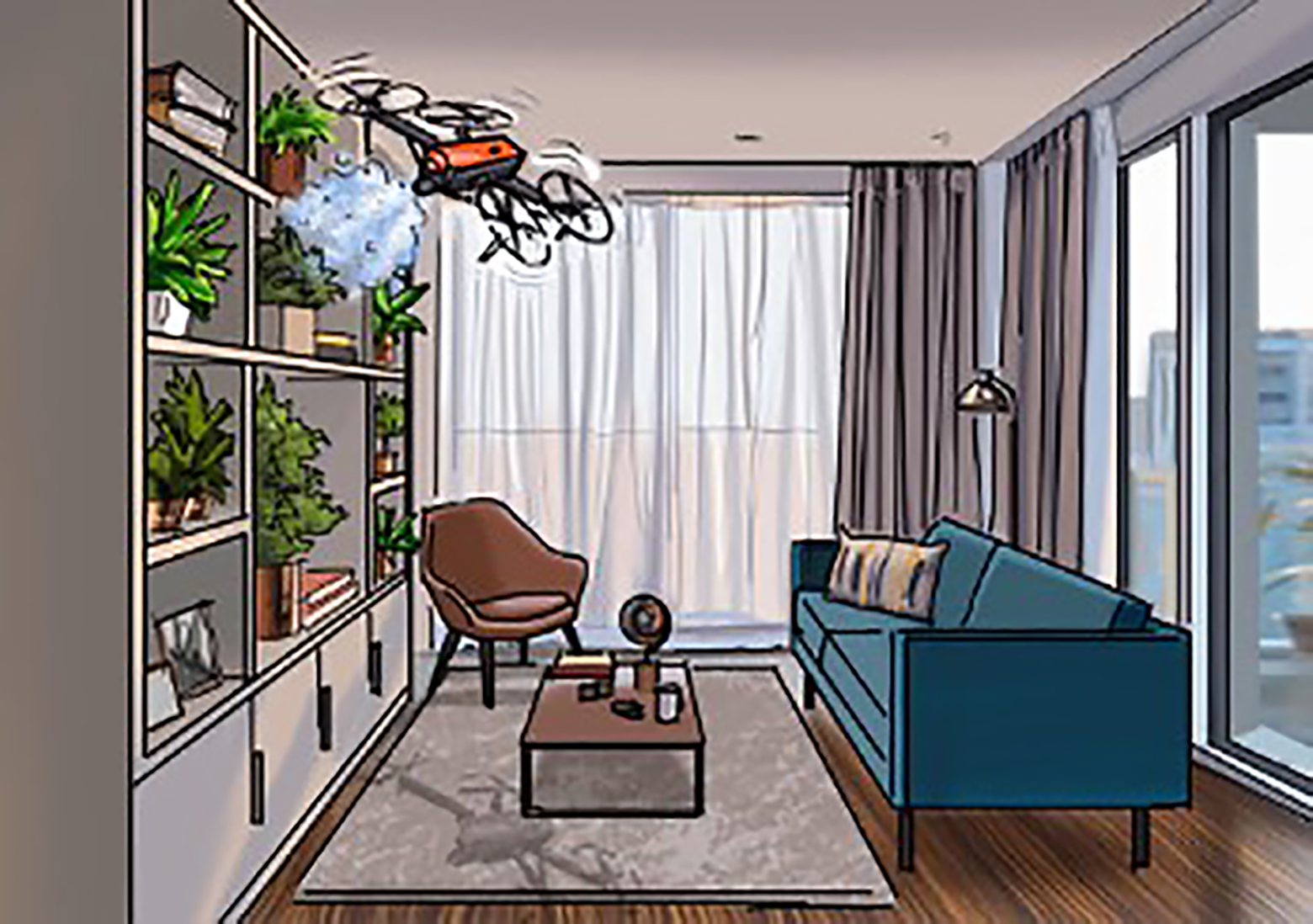
Get Living, a UK build to rent operator, envisages tech we will have in our homes by 2040, including plant-watering drones (Source: Get Living, 2020).
In such speculative renderings, convenience, efficiency and cleanliness are attributed to the drone. In contrast to, and mitigation of, human failings of inattention, the drone is positioned to perform the care work needed to sustain plant life; its shadow ever-present on the rug of a pristine high-rise apartment (Figure 3). In the kitchen meanwhile, robot dogs hang out with anthropomorphised drones-with-arms ensuring that the shine and sleekness of the cabinetry and surfaces remain untarnished by bodily occupation (Comparethemarket, 2020). Each home is vacated of human life, kept in the stasis of order and spotless decorum. In these homes of the future, the ‘fleshy, messy, and indeterminate stuff of everyday life’ (Katz, 2001: 711) that is constitutive of social reproduction is banished. The drone is unburdened with other engagements, directed only to anticipate and perform its scripted tasks – both in service of, and seeking to replace, social reproduction.
The drone-home thereby de-emphasises the human dimensions of social reproductive work. Home and social reproduction are ‘droned’; everyday life becomes the domain, subject, and practice of the drone. The prospect is raised of the capitalist management of everyday life being furthered, consumer-subjects being transfixed by technological allure, and the commodification of domestic life cemented. Enclosure’s logic is a spatial one, sustaining itself by ‘subsuming non-capitalist social spaces under the value practices of capital’ while articulating interventions into the ‘spheres of production, social reproduction and social ordering’ as a ‘strategic domination of space’ (Sevilla-Buitrago, 2015: 3). The drone is increasingly part of this strategy, a strategy of everyday droning. It is a domination the home no longer escapes. The home and social reproduction are deployed as fresh territory in the Global North for the drone market to enclose; ‘the fabric of our life becomes labour within the domain of drone capitalism’ (Richardson, 2018: 88).
On this, feminist Marxist thought has long revealed how ‘the economic impulse of capitalist production’ comes to condition ‘the so-called noneconomic’ (McNally, 2017: 75). Geographical writing on enclosure further speaks to spatial enclosure through neoliberal strategy which seeks to hold grip on new spaces of extraction (Chatterton and Pusey, 2020; Jeffrey et al., 2012; Vasudevan et al., 2008). The drone becomes a productive technological ally in this regime, to the extent that a new frontier for ‘dronified forms of enclosure’ (Shaw, 2017: 884) takes hold of the domestic sphere. Further, the drone-home demonstrates that enclosure is at once spatial and temporal. Everyday droning of the home devalues time to care, and by extension, the time-spaces of social reproduction. The message is de facto that time and energy are more beneficially spent ‘elsewhere’ on productive labour tasks rather than strengthening relational bonds through social reproductive work. Enclosure, therefore, can be viewed as foreclosing sociality as ‘ultimately common’ (Vasudevan et al., 2008: 1644 emphasis in original). The ‘abjection’ of care as a necessary condition of capitalism (Kristeva, 1982; Muller, 2019) is therefore captured by the drone, sold on the premise that it will unburden unnecessary caring responsibilities and tasks from home dwellers.
Further, the drone-home sells a vision of solving constraints, it manufactures need for profit and then requires consumer-subjects to work harder to afford it. On this, ‘it is not technology per se that degrades us, but the use capital makes of it’ (Cox and Federici, 1975: 13) to extract surplus profit from social reproduction. In Marxism, ‘necessary labor time is that portion of the workday in which the worker makes value equivalent to what is needed for her own reproduction’, whereas ‘surplus labor time is the remainder of the workday, where she makes additional value for capital’ (McNally, 2017: 71). The drone cross-cuts these distinctions: it not only releases the worker from a greater portion of ‘necessary labor’ to enable more time for ‘surplus labour’ but also it commands social reproduction to produce surplus value. Driven by a mantra of ‘never would the capitalist class have allowed so much domestic work to survive if it had not seen the possibility to exploit it’ (Federici, 2017: 31), the drone is thus enrolled in social reproductive work central to both the production of ‘labour-power’ and processes of capital accumulation (see Dalla Costa, 1975; James, 1975).
In its entrenching of domestic practices into capitalist flows, we can thus situate the drone-home within both desires for domestic efficiency and frictionless existence enabled by expanded circuits of (over)consumption, and a broader financialisation of everyday life (García-Lamarca and Kaika, 2016; Hillig, 2019; Lazarus, 2017; Martin, 2002; Pellandini-Simányi, 2021) forged through technical systems. Here, it is helpful to consider the drone’s claims to augment and improve household lives within the wider context of the ‘smart home’ trend. As Goulden (2019: 2) makes clear of Amazon and Google’s domestic devices, where ‘the state has only carefully tread, the tech giants of Silicon Valley are rushing in’, seeking to both ‘capture, and remake, domestic life’. This is why a feminist geopolitics attentive to political and geoeconomic practices operating at scales other than the nation-state matter. As Goulden (2019: 2) continues, the smart home enables the ‘establishment of new monopolistic platforms – market places in which domestic life is integrated with global capital’. Critical geographies of home are well versed in ungrounding home’s conception as independent private autonomous enclaves free from outside interference. The dronified smart home not only exposes this truism further but also solidifies the direction of home life in the future as ‘more fully a part of the exploitative social factory, rather than transforming the political, economic, social, gender, racial, and affective relations of the factory in its various guises’ (Schiller and McMahon, 2019: 175). In this context, it is welcomed that geographers are increasingly reflecting upon the ‘technicity’ of ‘domestic objects’ (Dodge and Kitchin, 2009) and the ‘ambivalent effects of digital technologies on care’ (Del Casino, 2016; Schwiter and Steiner, 2020: 1).
Further attention is needed, likewise, to the drone’s rupturing of ‘dichotomous’ separations between the human and technological in the care work of social reproduction (Schwiter and Steiner, 2020: 1), and the ‘crude discipline’ and ‘seductive’ (Sevilla-Buitrago, 2015: 1013) emancipations tied non-human care-work. Feminist work (the majority on the 20th century) has long unravelled the commonly-held view of labour-saving technologies as ‘freeing’ women from domestic work, for other non-housework tasks, including leisure and paid work (Bose at al., 1984; Cox and Federici, 1975). Sugg-Ryan’s (2018) work on the interwar period in Britain focuses on the rise of the modern professional housewife whose efficiency is maximised through new domestic practices and technologies. Yet, despite ‘labour-saving’ promises, the ‘commercial-culture of homemaking’ arising from the mid-1930s in fact remained one of ‘considerable drudgery’ accompanied by ‘anxieties about gender and class roles’ (Sugg-Ryan, 2018: 133; see also Cox, 2013). Although the push for efficiency has never gone away, the digital turn of the 2000s further propelled and accelerated it. Wireless and voice-activated household appliances continue to be marketed as simplifying domestic labour via the remote activation of tasks. Through this Internet of Things, households are tied ever more closely into ‘global markets via the commodities their members covet, consume and discard’ (Huws, 2019: 122). As before, this is gendered. It not only ‘creates kinds of capitalist production labour but also new kinds of consumption work’ (Huws, 2019: 122, emphasis in original). As Richardson (2018) aptly notes, as well as the drone’s ‘work’ itself, both maintenance work to sustain it, and responses to its failure should also not be forgotten. The smart home more widely, he writes, remains ‘prone to disruption, or problems of translation’ (ibid: 93). It thus remains important to reflect on the range of labours performed, and moments of ‘ceased functioning’ to interrogate and ‘problematize the flows and circulations’ normalized in it (Graham, 2010: 3). The enclosure of social reproduction through everyday droning is therefore not to be taken lightly in geographical work but positioned centrally in critical scholarship on what it means to undertake life’s work in the drone age.
VI Conclusions
In this article, we have diversified accounts of the drone through a feminist geopolitical analytic. Bringing into productive dialogue drone geographies and feminist geopolitics (of home), we have introduced and expanded on the notion of everyday droning, one affording greater attention to the growing range of non-state actors that multiply mobilize, practice, experience and become subject to drones while recognising the agencies of the drone itself in everyday contexts. The journey we have taken does not eschew the military lineages within which drones are located, but rather fostered investigations of the geopolitical insides, but also outsides, of formal war. Following the assertion that ‘in the militarization of everyday life’ both military and consumer devices remain ‘entangled’ (Grewal, 2017: 343), in their interrogation through the everyday and home, in this article, we raise several implications for drone geographies and related scholarship.
First, in re-scaling our analysis to domestic dwellings in the Global North increasingly enclosed by consumer and citizen drones, we have both engaged and complicated entrenched divisions between ‘there’ and ‘here’, warfare and ‘homefront’, instead of teasing out alternative ‘homes’ in ‘homeland’. Rendered visible are a range of military drone logics working, practiced and experienced at the scale of home, those also entwined with increasingly pervasive drone capitalism (Richardson, 2018). In this vein, our investigation expands existing debates around the discourses and vocabularies of the drone. We find commonality across both the military and more-than-military drone-home through the shared mobilisation of the ‘surgical’ and ‘sanitized’ as a case for legitimation. In each instance, the drone is fetishized, boasting efficiency and rationality, while abstracted and treated as an ‘autonomous agent’ from the ‘military apparatus behind it’ (Shaw and Akhter, 2012: 1501). This is significant, as Krasmann (2017: 26) argues, because while media reportage commonly distinguishes between ‘weaponized drones in the fight against terrorism and more praiseworthy’ good drones, there remains a need to engage critically with their blurring, and the effects of the drone’s legitimacy-making more widely.
Second, in diversifying the vocabularies of the drone, we have contributed to growing work attending to the embodied experience of drone flying. Here, accounts remain predominantly researcher first-person (Fish et al., 2017; Jablonowski, 2020; Munck Petersen, 2020), and while they skilfully place the body at the heart of their analysis, less attention is played to the wider power politics of the uneven distribution and effects of such aerial-techno-possibilities. A feminist geopolitical response to ongoing calls for a ‘specifically domestic drone theory’ (Bradley and Cerella 2019, n.p.) thus offers a grounded approach foregrounding gendered, racialised, classed, and sexualised everyday experiences.
Third, our interrogation of the drone-home has implications for critical geographies of home. Its scholars have long attended to the home’s ‘co-manifestation at a range of spatial scales’ from the ‘micro to the homeland’ (Brickell, 2012a: 575). Yet, drawing inspiration from scholars cognisant that ‘our primarily two-dimensional conceptualisation of cities and spaces needs revision’ (Jackman and Squire, 2021; Jensen, 2020: 417), this article asks questions of the vertical and volumetric dimensions of the home, and their commodification and capture via the drone. In attending to the geographical volumes of home, it is possible to crack open the aerial and atmospheric in new ways. The vertical life of the home and its inhabitants is an area for further research, as is its militarisation and enclosure through more-than-human affairs. While recognising that for all this ‘visible technology’, the drone-home remains something as yet ‘not quite arrived: clumsy and incomplete’ (Richardson, 2018: 93), we can draw inspiration from other now-normalised home robotics. For example, iRobot’s ‘Roomba’ robotic home vacuum can be scheduled to function in our absence ‘without human oversight’, representing the granting of domestic object’s with ‘capacities that extend their technicity and enable them to do additional work in the world’ (Dodge and Kitchin, 2009: 1352). Such technologies raise questions of both their cohabitation and ‘making and remaking of the conditions and relations of everyday life’ (Del Casino et al., 2020: 606). In further interrogating the drone-home, it is crucial to employ a feminist lens attentive to both the ‘burdens of nurturing and caring’ most commonly ‘placed on the shoulders of women’ (McDowell, 2004: 136) and to difference as it unfolds, marking uneven affordances and harms in its advent.
In this article, we have sought to enliven, substantiate and site the drone-home. The drone is a technology with various ‘making and world changing powers’ (Jablonowski, 2015: 2), this digitality ‘(re)producing power and sociospatial inequalities’ (Elwood and Leszcyzynski, 2018: 680). In recognition that ‘life is changing’ in the drone age (Parks and Kaplan, 2017: 19), it remains crucial that future geographical work engages with, and develops further, the concept of everyday droning as an anticipatory horizon of militarisation and enclosure being actively seeded in the domestic dwelling here-and-now.
Footnotes
Declaration of conflicting interests
The author(s) declared no potential conflicts of interest with respect to the research, authorship, and/or publication of this article.
Funding
The author(s) received no financial support for the research, authorship, and/or publication of this article.
