




Abstract
In this article, we draw on the case of experimental drone uses in African health care systems in order to explore how diverse actors use digital innovation to stimulate critical changes in infrastructural provision and the ways in which the global role of places such as Silicon Valley, Rwanda, and Ghana, as well as their connections, are configured in such processes. Developing the idea of ‘infrastructure-as-service’ as a concept, we suggest that data extractivism and fantasies of infrastructural leapfrogging are major forces behind emergent fields of infrastructural experimentation. Revisiting dominant theories of infrastructure, the article scrutinizes the promises of digital infrastructures and sheds light on the specific ways in which regions in the Global South participate in, and offer indispensable services for infrastructural changes.
Introduction
In 2016, the Silicon Valley-based tech company Zipline signed a deal with the Rwandan government for the delivery of logistical services in order to support the provision of health care in remote, infrastructurally disconnected areas of the country. Promoted as the world’s first ‘fully automated instant delivery system’, these services differ from conventional logistics offerings in that they are based on unmanned aerial vehicles, popularly known as drones, whose operation depends on complex software and digital computing. Initially, Zipline’s drone services consisted of blood deliveries for medical emergencies to hospitals outside the capital city of Kigali. However, as the company expanded its operations to other countries such as Ghana, their services developed into a full-fledged infrastructural package, including the establishment of regional distribution centers from which medical supplies of all sorts could be delivered via drone. Robotics-based infrastructural innovations such as drones often come with lofty – yet to date unfulfiled – promises, embodied, for instance, in Zipline’s boldly formulated mission to ‘put every human on the planet within a 15–30-min delivery of any essential medical product’. 1 In a similar vein, after signing an agreement with Zipline in early 2021 for the delivery of coronavirus disease 2019 (COVID-19) vaccines, the government of the northern Nigerian state of Kaduna stated that drones ‘will revolutionize access and availability of critical and lifesaving medicines for millions of people’. 2
This raises an intriguing set of questions: Why did Zipline choose to focus on health as a use case for the development of drones? Why did African countries become the frontrunners in the application of this digital innovation? And how does the rise of digital and robotics-based technology challenge conventional anthropological understandings of the social life of infrastructure?
In this article, we draw on the case of experimental drone uses in African health care systems in order to explore how diverse actors use digital innovation to stimulate critical changes in infrastructural provision and the ways in which the global role of places such as Silicon Valley, Rwanda, and Ghana, as well as their connections, are configured in such processes. We begin with an empirical puzzle: Even before the beginning of the digital age, technological inventions were concentrated in Silicon Valley and its supreme ecosystem of innovation. Yet while major digital inventions have been developed, programmed, and built in California as a high-tech context to be used by customers in other high-tech contexts, Zipline’s drones learned to fly in African skies. Why was this so, and what do we learn from these global entanglements about how Africa is connected to the digital revolution? And how does Africa serve the development of new digital infrastructures?
Seeking to answer these questions, our article is essentially a story of how a transatlantic cast of human actors and non-human entities has been bundled together in order to produce new ways to realize one of the world’s most pressing contemporary concerns: securing health care by bringing medicine to people. The cast includes Zipline’s data engineers, venture capitalists, and the US Federal Aviation Authority (FAA) on the American side; governments, fulfilment managers, pharmacists, health care workers and ‘lives to be saved’ on the African side; but also non-humans, such as rugged landscapes, bad weather, data, and, of course, drones. Drawing attention to the divergent interests and sometimes contradictory motivations of these actors, we show how postcolonial legacies of poor infrastructures, underfunded health systems, empty skies, and reliable telecommunication systems become the real-world testing ground for digital infrastructures.
In early 2016, Keller Rinaudo, CEO of Zipline, explained why they decided to start their services on the African continent:
3
A lot of commercial [drone] operators in the US are waiting to get permission from the FAA [Federal Aviation Authority]. But the FAA is saying ‘we want more data’. But no one is actually flying. So, I actually think that […] one of the best ways that we can work together with the FAA to help this technology take off in the US is by operating in a country where we can basically serve a very clear need and get tens of thousands of hours of safe flight data.
4
Two discrete storylines are woven together in this statement: one that centers on the humanitarian concern to serve ‘clear needs’ by saving African lives, and another one that revolves around the need for data. This statement serves as our point of departure, pinpointing as it does two needs that have helped to entangle Silicon Valley with remote areas of Africa. However, while the CEO anticipates a world in which the production of flight data and the saving of lives smoothly interact in mutually beneficial ways, we suggest that such infrastructural transregional alignments configure health care on the ground in ways that are hidden from official scripts.
What we will call infrastructure-as-a-service involves a number of disconnecting practices, on which this new airspace logistic relies. These disconnections may actually thwart the promise to improve and democratize access to lifesaving medicines in rural Africa. What we subsequently call ‘Africa-as-a-service’ indicates that the encounter between African countries and Silicon Valley is simultaneously an expression of these disconnections as well as an attempt to invisibilize them.
We begin by situating our account in contemporary research on infrastructures. In doing so, we seek to unravel both the continuities and disruptions that characterize the place of digital infrastructures in existing infrastructural landscapes. The main part of the article explores Zipline’s fate in African skies and on African soil in order to shed light on the specific ways in which regions in the Global South participate in, and offer indispensable services for, infrastructural innovation. 5
Drones as infrastructures
The increasing use of Unmanned Aerial Vehicles (UAVs) in civil airspaces has generated some interest in the wider field of social science research (Lockhart et al., 2021; Wang et al., 2021). In the anthology ‘The Good Drone’ many contributions discuss a number of use cases that focus on the surveillance capacity of drones (e.g. ranging from border control to agriculture and species conservation) (Sandvik and Jumbert, 2018). Other chapters have critically engaged with not only the (potential) impact cargo drones will have on specific sectors of society (Adu-Gyamfi et al., 2021; Eichleay et al., 2019) but also how drones are shaped by humanitarian settings (Sandvik et al., 2014; Sandvik et al., 2017) or biomedical use cases (Peckham and Sinha, 2019).
Our article focuses on this context of humanitarianism, where we have seen a proliferation of this controversial technology on the continent. In her work on ‘African drone stories’, Sandvik (2015: 75) suggested that one main reason for this has been African governments’ (relative) inability to resist the rescue and/or investment efforts of outsiders’. In addition, Wang (2020, 2021) discusses experiences of experimental testing of medical drones for Malawi’s ‘humanitarian drone corridor’ and suggests the need for an ethically informed policy frame that helps guide sustainable introduction of innovative (unproven) technology in low-resource contexts. While largely following these argumentations, in our article we situate debates around technical innovations, digitization, data and improved health within the field of infrastructure studies.
In an influential contribution, Larkin (2013: 328) usefully describes infrastructures as the ‘built networks that facilitate the flow of goods, people and ideas and that allow for their exchange over space’, and as the physical form that shapes ‘the nature of a network, the speed and direction of its movements, its temporalities and its vulnerability to breakdown’. Based on these ideas and on Star’s earlier suggestion to view infrastructures as a ‘system of substrates’ (Star, 1999: 380) which carries much of the visible world, most social science research has been concerned with water supply (Björkman, 2015), electricity grids (Schwenkel, 2015), waste disposal (Fredericks, 2018) and transport systems (Harvey and Knox, 2015), focussing on the political rationalities underlying them, the visions in the name of which they have been justified, and the intricate ways in which they are used to serve their purpose.
Recently, scholars have begun to explore the ways in which the use of digital technologies affect infrastructural provision, highlighting, for instance, the integration of sensors and real-time data analytics into existing material forms such as motorways and ticketing service (Douglas-Jones et al., 2021; Knox, 2021). Digital infrastructure is not only taken to mean the digitization of classical infrastructures but also the cables, wires and other material elements that enable digital technologies. Much recent neo-liberal economic restructuring has depended on, and has been enabled by, digital innovations for which the emergence of new forms of finance and the rise of platform economies provide major evidence (Kenney and Zysman, 2016; Plantin et al., 2018). In fact, drone systems differ from classical infrastructures in that while serving a classical purpose – transport and logistics – they have (mostly) emerged out of Silicon Valley’s tech industries and depend on much more variegated types of data. Therefore, we suggest that drone projects offer valuable insights into the ways that infrastructural formations enmesh digital and material technologies, a nexus that despite its growing real-world implications has not received enough scholarly attention particularly for constellations in the Global South. At the same time, several lines of research in studies on infrastructure are highly useful for understanding drones.
First, infrastructures are an indispensable part of the imaginaries of modernity, of its presumed movement toward material improvement and development. ‘Instigating waves of societal progress’ (Edwards, 2003: 42), they have animated popular fantasies of upliftment and fueled governmental desires to steer emancipatory or economic transformations. Infrastructures are thus marked by particular historicities and temporalities – real and imagined – and are always linked to promises about a particular kind of future which they help realize and to which Larkin (2013: 332) refers as infrastructure’s ‘poetics’. On the one hand, today’s drones signal a particular promise that links up with how running water, electricity, and railways became synonymous with civilization in an earlier historical period. As we will show, it is the idea of catapulting African countries into the digital age and turning them into sites of digital innovation that has inspired African leaders to embrace drone infrastructures. On the other hand, infrastructures-as-a-service enacted by drone logistics also promise to overcome the shortfalls of earlier infrastructural dreams, of bad roads and non-functioning cooling equipment.
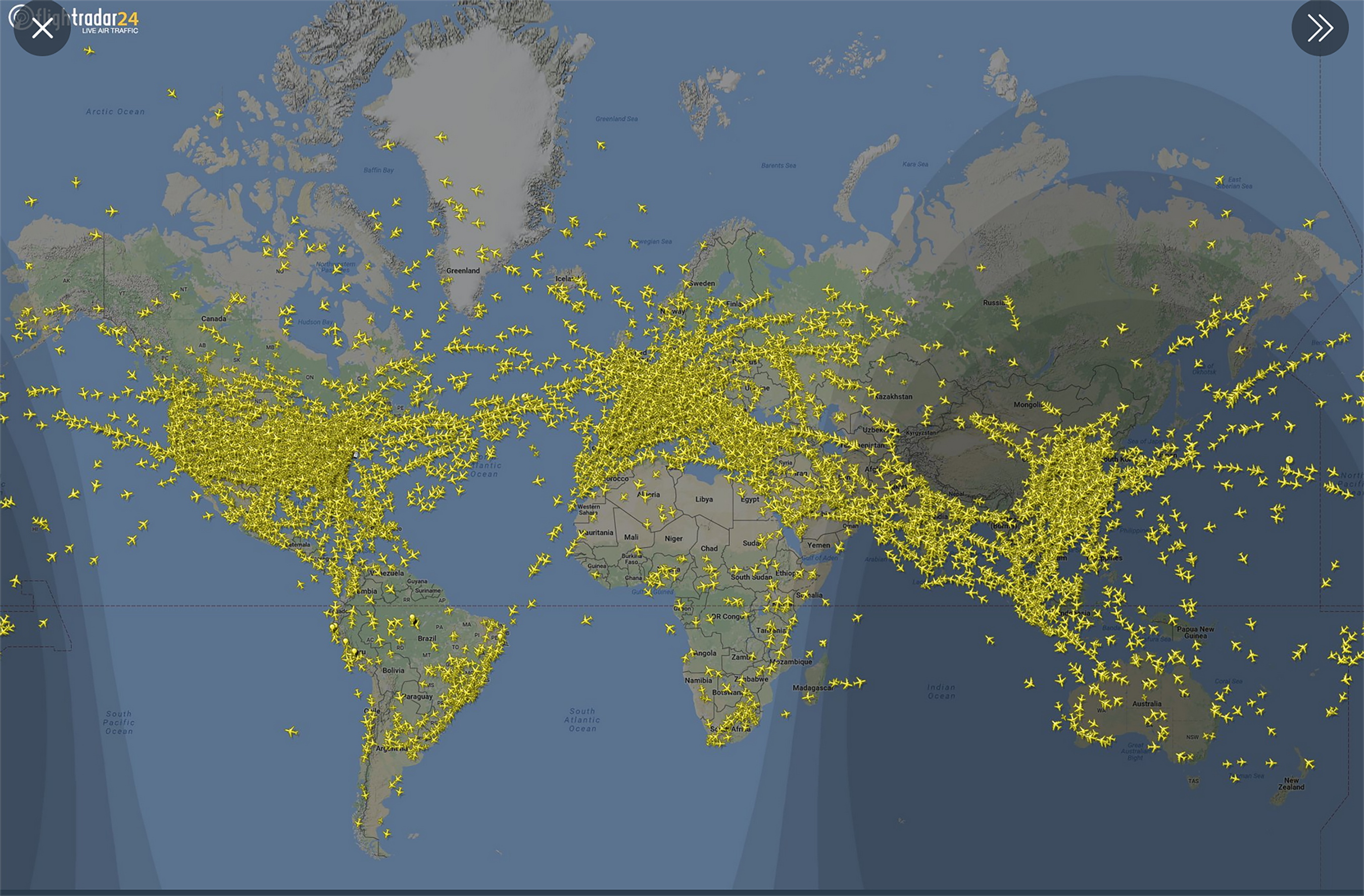
The screenshot was taken from “ight radar (www.”ightradar.live) and shows a real-time distribution of the global air traf!c. In comparison with the dense Asian, European, and American airspace the image shows a largely empty sky over the African continent.
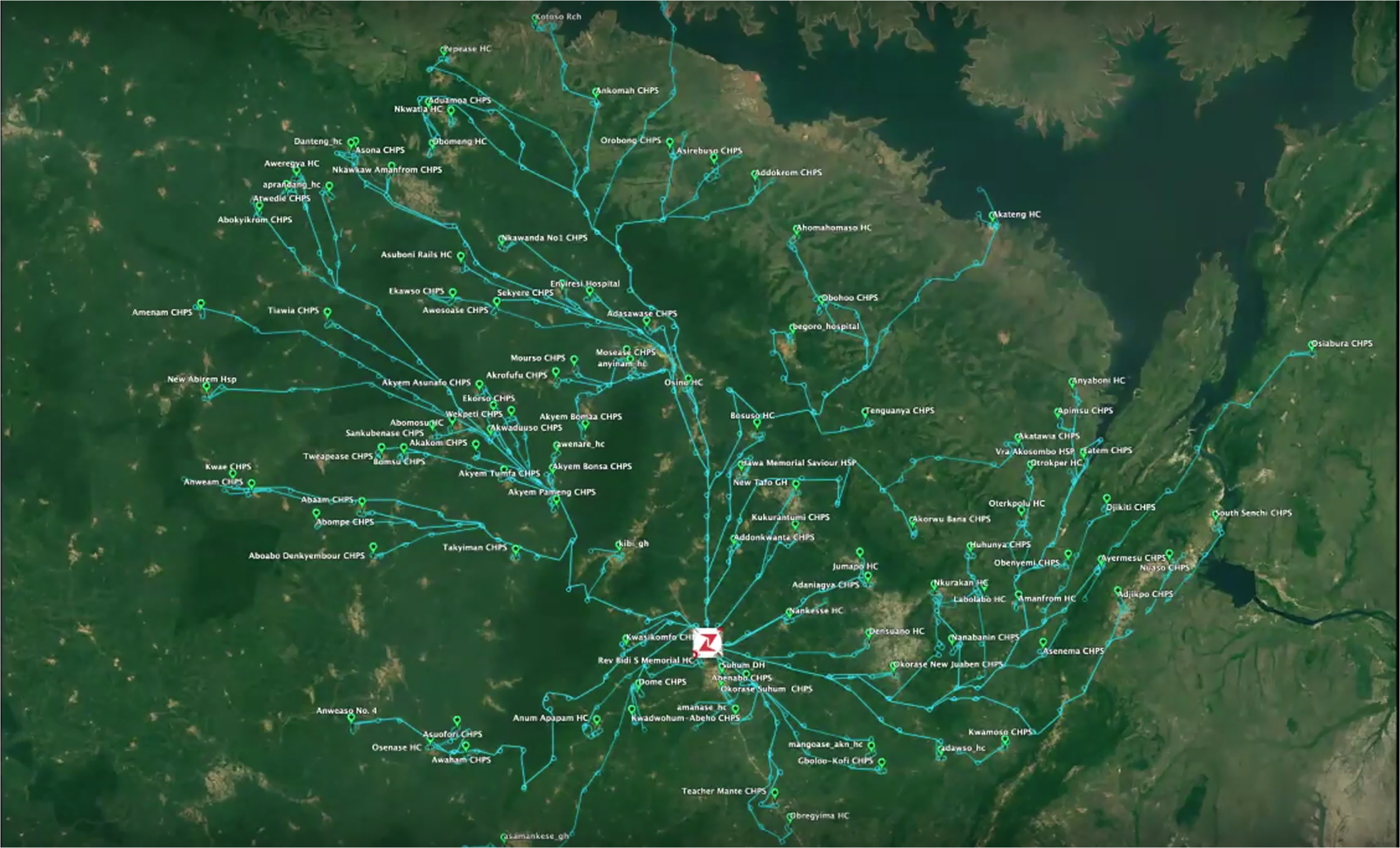
Flight ‘transit plan’ for one of Zipline distribution centers in Ghana (Z) (Source: https://www.youtube.com/watch?v=xB29HG5JNlE, accessed 23 March 2021).
Second, such configurations also remind us, as Harvey and Knox (2015) show in their ethnographic study on large-scale road engineering in Peru, how infrastructures are usually associated with processes of nation-building and state formation. This is because by providing access to valued goods, infrastructures literally connect people to the state, turn them into citizens, and create an imagined community of equals. However, as we will show, the constellation of infrastructures-as-a-service transforms both the role of the state as well as notions of citizenship compared to other forms of infrastructural provision. Questions of ownership and accountability as well as modes of engagement of users are reconfigured through novel entwinement of digital and material technologies. Making visible these newly assigned roles and responsibilities, our approach is in line with social science scholarship that conceptualizes the interplay between the digital and the material infrastructures and its political effects (Knox, 2021; Pink et al., 2020; Vonderau, 2019). Researching new intertwinements between the digital and the material infrastructures will also highlight the underlying mobilization and orchestration of human actors that make vehicles fly and eventually allow Zipline to claim to operate the world’s first ‘fully autonomous’ drone network.
Over the past decade, the most significant developments in infrastructure innovation have hinged upon cloud computing and software-sharing and have set in motion the concept of infrastructure-as-a-service. In the corporate world ‘as-a-service’ refers to new digital connections in a business-to-business manner that promise to save labour, time, and costs. Not having to build digital and material infrastructure is considered a major advantage and liberation from uncertain investments as services are not owned but rented. Applying the concept to examples of infrastructural provision in the field of Global Health and development cooperation, we hope to add to the existing body of literature that conceptualizes digital infrastructures. The restructuring of medical supply chains in African countries as infrastructure-as-a-service helps us to critically discuss how the newly achieved connections rely on and enact a number of disconnections that threaten to further destabilize already fragmented health systems. Other studies have also drawn attention to the interplay between the connecting and disconnecting qualities of technologies and infrastructures in Global Health and post-disaster contexts (Dilger and Mattes, 2018; Sheller, 2021). Our article suggests that adopting this perspective to the study of drones and airspace logistics will produce valuable insights into the social live of digital/material infrastructure provision in African contexts.
Third, while in the digital economy the term infrastructure-as-a-service refers to corporate solutions based on Google Cloud or Amazon Web Service, these developments have more generally shifted attention to the role of data as new central resources. Whereas water, electricity and ground-based transport infrastructures are arguably all premised on the material transformation of natural environments, digital infrastructures pivot on ‘datafication’ and ‘data extractivism’ (Morozov and Bria, 2018); in other words, on the ways in which nature and human activities become data to be extracted, coded, and turned into a resource (Gago and Mezzadra, 2017; Mezzadra and Neilson, 2017). As Couldry and Mejias (2019: 337) suggest the social and economic relationships datafication establishes should be construed as ‘data colonialism’, ‘which combines the predatory extractive practices of historical colonialism with the abstract quantification methods of computing’. Below we will show how Zipline’s extraction of data from African societies and natural spaces is an integral part of drone development. If infrastructures are ‘critical locations through which […] accumulation and dispossession […] are formed, reformed and performed’ (Appel et al., 2018: 3), it is important to ask how such processes unfold through digital infrastructure such as drones. It is also because of the significance of data that there are striking overlaps between the notion of ‘infrastructure-as-as-service’ and platform capitalism, the digital economy and platform society more generally (van Dijck et al., 2018).
Fourth, terms such as ‘data extractivism’ warrant comparisons of drone infrastructures and the unlikely connections between Silicon Valley and Africa which they have produced with earlier techno-scientific projects in which Western colonizing states were engaged in infrastructural development in Africa. Chiefly, while often justified as bringing civilization and progress, such projects were geared toward extracting raw materials and generating revenues, leading to highly uneven forms of infrastructural integration and provision (Apter, 2002; van Laak, 2004). In their postcolonial iteration, such projects became central components of the ‘development’ agenda that sought to modernize African states, emancipate their citizens, improve standards of living for local populations, and integrate them as producers and consumers into global markets (Monson, 2009). This raises questions as to how these partly contradictory ambitions, oscillating as they do between common goods and private interests, play out in emerging technological fields in which data are the major revenue to be yielded.
Finally, we are inspired by the observation, made in numerous ethnographic studies (e.g. Anand, 2011), that new infrastructures are often grafted onto existing technologies and materialities. In this sense, infrastructures are always premised on some idea of the ‘public good’. As Anand (2015) eloquently suggests: Infrastructures accrete. They gather and crumble incrementally and slowly, over time, through labor that is at once ideological and material […] They are innovated, installed, and brought into being on top of already existing infrastructures that both constrain and enable their form.
Part of this ‘enabling’, we suggest, is that in their ability to enlist public support (and to inspire the fantasies of private investors), infrastructural innovations depend, in significant ways, on narratives of the breakdown or malfunctioning of these existing infrastructures. How, then, are drone technologies inserted into existing infrastructural landscapes? As we will argue, it is not only the (image of) bad roads, but also the widespread and reliable availability of internet connections that have helped Zipline’s drones to fly. In the subsequent analysis, we follow the development of drone infrastructures from Silicon Valley to regional distribution centers in Ghana and Rwanda, and from there through African skies and the way they are transformed into geodata and weather data, all the way to the local health centers which they serve.
Infrastructures made in Silicon Valley
Zipline was officially founded as a startup company in late 2013 but was initially born out of another startup called Romotive, which developed a toy-like smartphone robot. Headed by three Ivy League graduates specialized in biotech engineering, robotics, and business development, Zipline operates a development, research, and testing site on a large cattle ranch at Half Moon Bay (California), a small town on the Pacific coast. During their first 3 years, before signing the deal with the Rwandan government, the company did their prototype testing rather secretly and without much noise. 6 During that time, the founders applied for various patents securing corporate legal rights on the different inventions they made while learning to fly (Chambers et al., 2016). They also pushed for a knowledge exchange with US military drone operators, an exchange that eventually resulted in a collaboration that was largely kept out of the media. 7
Significantly, as drone logistics are based on programming and digital data handling to a much greater degree than classical infrastructures, core principles of the internet such as networking and connectivity have also inspired the way Zipline imagines infrastructural access to medical products. Reflecting on the mission of his company, Rinaudo once suggested that ‘technology has gotten us to a point where we can deliver products, especially medical products as quickly and efficiently as the Internet delivers information’. 8 The way he projected features and practices from the digital world onto the material world of logistics clearly points to the company’s intellectual and commercial origins in Silicon Valley (Daub, 2020).
Between 2015 and 2020, the company collected approximately $225 million (US) over three funding rounds. In 2019, Zipline was valued at over one billion dollars, turning it into a so-called ‘unicorn’ startup and placing the company at the epicenter of digital technological innovation, venture capital, and futuristic ideologies. Importantly, though, the company’s funding is adapted to its context of operation; venture capital investment supports scaling up the company’s team and technology in the US, government and business customers pay for the use of Zipline’s instant delivery service, and key philanthropic partners like Global Alliance for Vaccines and Immunization or the Bill & Melinda Gates Foundation help to support the establishment of distribution centers in low-income and middle-income markets.
Zipline’s strongest competitors in the US are currently Google and Amazon, both digital giants that run their own drone programmes and were also granted experimental waivers by the FAA in 2019. 9 For Zipline, this competition has been a double-edged sword. On the one hand, Amazon’s and Google’s investment in drone logistics has helped to generate massive global attention for drones, emphasized their economic potential, and created markets for them. On the other hand, it has subjected all companies in the field to significant pressure, pushing them into use case niches and inducing them to expand aggressively in order to secure market shares before one of the giants can begin to operate. Through this process, Zipline has successively transformed into a big tech company with currently approximately 500 employees.
This orientation toward the principles of monopolistic internet giants is illustrated in the way Zipline offers a ‘full package service’ to its customers, such as the government of Ghana: It provides its own distribution centers, its own inventory system and, of course, its homegrown avionics software. The company positions itself as a logistical intermediary and inserts its service between national medical supply chain management and local health facilities dispersed across the Ghanaian and Rwandan national territories. They operate their services from distribution centers, from which they supply several hundred health centers and hospitals with blood, vaccines, and other medical products on a 24/7 basis. At the distribution centers, professional positions range from medium-skilled inventory and fulfilment managers (who are often trained pharmacists), flight operators, and flight controllers to the low-skilled labourers required for the assembly of Zipline’s cardboard boxes and batteries. Once orders have been received via text message, core tasks for launching a vehicle involve pulling items from racks, putting them into the preassembled boxes, placing boxes on the planes, programming the mission with an old iPhone via a bar code onto the plane, setting the plane on the launching catapult, and pushing two buttons. In addition, flight operators are responsible for maintenance of the vehicles and for changing spare parts. Most tasks at the distribution center are highly repetitive and standardized, comparable to the work in Amazon’s distribution centers. But this also reflects a general tendency within Silicon Valley startup rhetoric to overstate the size and scope of one’s impact. When Zipline talks of Africa, it currently refers to Rwanda and Ghana; when the company presents its service as ‘operational at national scale’, it refers to two distribution centers in Rwanda and four in Ghana; when it states that ‘people’s lives depend on their services’, it usually refers to the one-tenth of their daily deliveries that respond to medical emergency situations. 10
Thriving on Silicon Valley’s fascination with autonomous driving, Zipline too describes its drones as autonomous. In reality, once the respective health facility’s target coordinates have been programmed onto the drone, a catapult system propels it into the air and it flies along a predetermined route. Upon arrival at its destination, it drops the cargo in low-flying mode. The cargo then glides to the ground on a parachute, where health personnel collect and administer it. Without touching the ground, the drone returns to the distribution center using the same route. When approaching the distribution center, the plane communicates automatically with the recovery system. Through algorithmic programming, the drone is recovered from the air by a wire that catches onto a tiny hook on the plane’s tail. Throughout the entire flight, flight controllers watch a visualization of the drone on an iPad screen. If everything goes according to plan, they do not have to do anything. If something unexpected happens, chief technical officer Keenan Wyrobek described the protocol as follows: And obviously designing this from the ground up is key to the operators of a system like this, and then couple that with how we basically fly this fleet of planes in a similarly robust, fault-tolerant way where literally that [flight] controller […] could call somebody in California – and this has happened a couple of times since October [2016] – and someone in California can literally pop up the screen in the same way and fly that fleet of planes basically with no sort of technical hurdle. We designed this into the very core of the avionics, the electronics, and the software that flies the plane.
11
This explanation also indicates who is in control of the planes. Because flight controllers and engineers in California engage remotely with the vehicles, the drone infrastructures are essentially managed from afar. From a local point of view, they also become a fully black-boxed technology, one which effectively disables appropriation by users. Importantly, the question of who is in control is linked to the ways knowledge is produced and managed in networked societies. Local experts and controllers are excluded from the innovation process chiefly because Zipline’s entire research and development is centralized in its San Francisco headquarters. While this type of remote control seems to be a security issue it also significantly touches on issues of the sovereignty of the involved states. Zipline’s desire to control knowledge and data largely turns its African counterparts into menial labourers, not unlike workers in the gig economy.
In spite of this, several African political leaders have become highly interested in drone technologies, especially – but not only – those, such as Rwandan head of state Paul Kagame, who see themselves as vanguards of technology-driven state-building. Thus, in 2016 Kagame stated: This use of unmanned commercial drones to transport essential medical products is a milestone for Rwanda in many respects. Rwandans have learned to embrace innovation […] This attitude has enabled us to overcome great odds in the last twenty-two years, and makes us optimistic about how much more we can achieve […] ‘Good enough’ is no longer enough. We need to aim for the best
12
Kagame’s words clearly remind us, as Appel et al. (2018: 19) suggest, how ‘infrastructures signal the desires, hopes, and aspirations of a society, or of its leaders’. Significantly, the fascination and engagement in the drone field echo recent tendencies to address infrastructural deficiencies not by investing in existing supply systems (e.g. around water, electricity, and transport) but by circumventing or ‘leapfrogging’ these by pushing innovations such as solar panels, mobile money, point-of-care diagnostic tests, or drones. In a recent article, Kristin Sandvik critically analysed how drone proponents try to adopt the concept of leapfrogging and apply it to the relation between roads and drones on African grounds. 13 While this tendency is indeed evident in grey media and drone start-ups’ statements during their pilot phases and mainly serve to attract attention, such seemingly bold claims have been toned down with the maturing of the field. At least Zipline increasingly refrains from making too many comparisons between roads and drones given that all of their distribution centers still – and always will – massively depend on roads.
Often, in the wake of the neo-liberalization of Africa, citizens’ right to infrastructural provision has been reframed as a customer service to be paid for (von Schnitzler, 2016). But, as we argue, neo-liberalization has also turned states into customers who purchase (or ‘rent’) services from private companies. The way drone infrastructures are managed gesture toward a particular form of infrastructural nation-building, one in which states do not buy and own any material part of the infrastructure but rather contract companies who offer services. Elaborating on the notion of ‘infrastructure-as-a-service’, Dr Anthony Nsiah-Asare, Director General of Ghana Health Services, emphasized the following in an interview: Ghana Government is not buying drones. As of now in the technological world nobody buys technology. You use the service of the technology […] so, what we are doing is a ‘performance-driven strategic service agreement’; it is not a procurement or agreement of buying drones. We bear no risk for the installation, the operation is not to our cost, a contract is purely a service contract. This is not a lease agreement. We are neither buying or leasing the equipment; this is a service agreement. Essentially it is akin to a transportation service. It’s like a taxi that’s taking you from point A to point B – we’re not buying the infrastructure.
14
For Ghanaian and other African political elites, not only the ‘point B’ to which drone infrastructures are supposed to take them is improved access to medicine and health care for national populations, but also the realm of global state-of-the-art digital technologies. Claiming stewardship of technological progress has long been a central domain through which African rulers have sought to amalgamize political support, a process that is now entwined with the building and contracting of ‘infrastructures-as-a-service’. As also highlighted by Lockhart et al. (2021: 858, 861), drone operations have been framed as a strategic field for certain branches of the state, especially those whose political interests are closely aligned with the implementation of large-scale digitization projects.
At the same time, Ghanaian officials have been eager to dispel criticisms of the costs. Costs incurred through the establishment of distribution centers are borne by international donors such as (e.g. the Vaccine Alliance Gavi and Bill & Melinda Gates Foundation (BMGF)), but also of private corporations such as Pfizer or UPS, leaving the Ghanaian state with only the cost of the flights. Yet, as the following quote from Ghana Vice President Dr Mahamudu Bavumia suggests, there are efforts to shift even these costs to other shoulders: The cost of this lifesaving technology is not borne directly by Government. The Ministry of Health has engaged the services of a fundraising company to raise funds for the payment of this service. I am informed so far that some organizations have donated money to the ministry for payment of the services and others have made pledges as part of their corporate social responsibility strategies, in particular Ghana National Petroleum Company and Ghana Gas.
15
This ability to sidestep most of the costs for drone infrastructures lends state narratives on ‘infrastructure-as-a-service’ further plausibility and demonstrates the extent to which infrastructural provision in the digital age has become subject to, and dependant on, multiple forms of (often unstable and volatile) private engagement.
Why health and emergencies?
At the first glance, employing drones for speedy interventions in medical emergency situations appears to be an excellent way to make use of this new technology. Gaining time during medical emergencies indeed offers clear benefits for saving the lives of patients. However, as the pressures of identifying profitable market niches stemming from fierce competition demonstrate, the branding of Zipline UAVs as ‘medical drones’ is highly contingent. In this section, we will situate the company’s focus on health and medical emergencies within a broader context of increasing proliferation of and competition for drones for civil use. The upshot is that, as a field of intervention, health is construed as a common denominator that is expected to align moral agendas (saving lives), market imperatives (i.e. becoming profitable), and safety concerns.
Against their negative use as a weapon in asymmetrical warfare, drones are increasingly being turned into ‘dual-use technologies’ for both civic and military aims. As part of its (re-)branding efforts, the drone industry has stepped up its attempts over the past 10 years to turn military drones into ‘good drones’ (Sandvik and Jumbert, 2018) that serve moral purposes such as humanitarian relief and disaster management. Zipline’s (and other companies’) focus on health, diagnosis, or medical emergencies is part and parcel of this endeavour to change public perceptions of this war technology. Zipline’s CEO put the issue as follows: ‘Drones obviously have a bad rep[putation] because the people that have primarily been using drones are militaries, and they have been used as weapons. But of course, any technology is just a platform, and it can be used for a wide range of use cases.’
While being aware of the military role of drones, Zipline’s CEO was also eager to relativize military uses by equating technology with platforms, pinpointing the contingencies involved in defining acceptable use cases of certain technologies. However, looming large behind the defining of credible use cases is the mounting competition for market share. Companies are required to find niches to distinguish themselves from competitors and attract venture capital. Spelling out Zipline’s unique selling point, CEO Rinaudo argued on a number of occasions that with ‘every flight saving a human life, [it] certainly helps when you talk to the regulators’. While lacking evidence, this statement suggests that it actually matters to regulators whether a drone carries a pizza or human blood. The fact that drone projects for Google and Amazon focus primarily on ordinary consumer products raises doubts in this regard.
During public presentations, Zipline representatives often describe themselves as the only drone logistics company in the world to operate at a ‘national scale’, referring to the coverage area of Zipline’s distribution centers. This raises questions as to how the distribution centers are integrated into existing national medical supply chain management. While Zipline limited its initial service offering in Rwanda to blood, in Ghana it added a variety of medical products to its portfolio, ranging from different types of vaccines (e.g. measles, rabies) to other essential medicines like paracetamol, oral rehydration therapy, and anti-malarial drugs. In both countries, Zipline's distribution centers therefore rely on a frequent (re-)supply from national medical stores and blood banks. System integration requires that the Ministries of Health and the authorities in charge of supply chain management adapt their delivery patterns in order to accommodate Zipline’s demand. While it should be the other way around, the integration of Zipline’s service carries the risk to exacerbate the fragmentation of national health care sectors that have been observed since the onset of large HIV and AIDS programmes.
In Ghana, this mode of integration has been criticized for two interrelated reasons. First, it has been highlighted that as per its contract, the Ministry of Health (MoH) grants Zipline access to all ‘relevant data owned or controlled by MoH regarding public health supply of the Medical Products list […]’(MoH, 2019: 17). Second, the stocking pattern of Zipline’s distribution centers ‘must be based on how clinics in the “coverage area” are consuming supplies. In fact, that is why Zipline has unloaded that entire forecasting burden onto the government.’ 16 This implies that if one of Zipline’s distribution centers is running out of stock of a needed product, the company can pass on responsibility to the national forecasting system. Serving a clear need like emergency deliveries of blood by air and on demand requires not only the provision of existing data, but also the production of new data. Serving hospitals through their four distribution centers in Ghana, Zipline has started to generate and collect a significant amount of specific data on demand and use of essential products. Zipline’s head of Global Health has therefore admitted that they are currently ‘learning all kinds of interesting things about real demand and data’. 17
While the flow and creation of new data is likely to yield political implications in the future, the stocking of medical products in Zipline’s distribution centers instead of remote health facilities has severe consequences. Chiefly, this stocking leads to new regional concentrations of infrastructural capacities and the depletion of resources in towns and villages outside the distribution centers. Since its early operational phase in Rwanda, Zipline has repeatedly emphasized that its system has facilitated cutting back on waste of medical products, claiming that it has reduced Rwanda’s blood waste rate from 7% to almost 0%. Storing blood and other essential medicines in Zipline’s distribution centers, so the argument goes, has made physical distribution and storage in health facilities redundant. According to Zipline’s chief technical officer, this form of recentralizing the national medical supply has the advantage of there being ‘no need to maintain thousands of refrigerators’. Instead of considering the risks involved in the anticipated technological and infrastructural downscaling of remote clinics, Zipline’s Global Health head actually extolled this disconnect between urban centers and rural regions as advantageous: ‘We do guarantee the cold chain down to the last mile, which frees up a lot of these last mile health facilities from having to have cold chain storage on site’. 18
However, while most of the supplies currently delivered by Zipline are paralleled through ground-based supply via cars and motorbikes, further reliance on drone delivery will likely entail the rolling back of decentralized supply and storage of products. Zipline celebrates this major change in a national health system’s distributive logic as an advantageous liberation, not only from seasonal flooding of bad roads, but also from the maintenance of cold chains in remote areas. In fact, it is chiefly the image of bad roads and fragile cold chains in remote areas, as well as the promise of ‘leapfrogging’ them, that turns the downscaling of existing local infrastructures and drones’ disconnection from them into liberation. Much Science & Technology Studies scholarship and studies of infrastructures have argued that ‘artifacts have politics’ (Winner, 1980). We suggest that the politics involved in framing infrastructure-as-a-service as liberation exacerbates existing disconnections between urban areas and remote regions. In fact, instead of connecting remote regions, such a politics frames and, to some extent, produces remoteness as a quality of imagined peripheries to imagined centers, by pronouncing the infrastructural dependance of the former on the latter.
Ecologies of safety data
We have noted above that Zipline’s operations in the field of health and emergency rely on and further its control of certain health-related data sets regarding supply and demand. However, the company’s core interest lies in collecting flight data. The CEO outlined these implicit priorities with the following words: Obviously, one of the reasons that we’ve been very careful in recording our safety record in Rwanda is that we’re going to need that safety record to convince the FAA to move a little bit more quickly and not allow the U.S. to fall behind in this kind of technology more than we need to.
19
Echoing the self-driving car industry in the United States, Zipline constantly announces the number of miles that its autonomous delivery service has flown. But using airspace (as opposed to ground-based, terrestrial infrastructures like roads and cars) relies on strategic framings of these two spatial forms. From the beginning, Zipline has highlighted the infrastructural challenges that African states grapple with, particularly in the transportation sector. Ryan Oksenhorn, head of software at Zipline, explained the situation as follows: ‘Countries like Rwanda face many challenges in terms of how you move things around in the country. We are able to fly over all of these troubles, fly through the rain storms and deliver to places that are entirely cut off from any national scale infrastructure’. 20 In this section, we interrogate these claims by pointing to some of the technical hurdles and complexities that Zipline’s proposed ‘leapfrogging’ faces. In particular, we highlight conceptions of differing airspaces, the availability and use of weather data, and the role of markets.
Zipline’s mission to ‘put every human on the planet within a 15–30-min delivery of any essential medical product’ 21 is mirrored in its incessant emphasis on how their service has already become an integral and indispensable part of national health and emergency networks: ‘So, Zipline’s new product is the fastest delivery drone in the world, and we have built that in direct response to customer need because when people rely on us and with the lives of their families … speed is everything when there is a medical emergency’. 22 On other occasions, Zipline has stressed the high number of customers, suggesting they are already operating a direct-to-consumer service. 23 Our central point is that Zipline’s technical requirements (data) and its moral mission (serving clear needs) are in fact closely intertwined.
For Zipline, responding to emergency orders is chiefly a technical exigency that legitimizes flying in all sorts of weather conditions. Asked during a CNBC interview, ‘What happens when it is windy?’ CEO Rinaudo responded: ‘I mean, interestingly, it is not enough for us to say we can save a patient’s life. When the weather is bad, we have to be able to operate all the time, so we fly in crazy storms day-in, day-out, rain, wind, everything.’
24
To put the issue differently: taking higher risks of, for example, crashing vehicles due to unexpected heavy and uncontrollable wind gusts or accidentally hurting somebody on the ground appears more difficult to justify if the delivery is destined for a normal medical procedure with no immediate threat of loss of life. Engineers responsible for the modelling of flight behaviour have emphasized on several occasions that they were caught by surprise by the extreme weather conditions they encountered in East and West Africa, which are very different from the Bay Area climate. Thus, they said: So, the first thing we can talk about what’s hard here is we don’t get to pick when we fly. I don’t get to pick when somebody needs blood in an emergency so if it’s a thunderstorm that’s fine, we’re launching. So, the environment gets to be really, really nasty with the stuff we have to put up with.
The bottom line of the engineers’ explanations is that Zipline is able to collect data on flight behaviour in extreme weather conditions. However, they would neither be able nor allowed to fly under such conditions in real-time and real-world circumstances in the US. Thus, the company deliberately takes higher risks in Africa, even though the official service agreement between Zipline and Ghana’s MoH actually permits Zipline to refrain from flying if monsoon-level rains and strong winds create unfavourable conditions. 25 Arguably, in choosing to fly under such conditions, Zipline puts the lives of people underneath their flight paths at higher risk in order to save another person’s life elsewhere. 26
Stereotypical images of poor people without access to health services due to bad roads and unreliable transportation infrastructures serve as the context that justifies risk-taking. Significantly, such risk-taking also creates valuable flight data, a resource in the name of which African skies and the grounds below them are turned into Silicon Valley’s distant laboratories. The idea of Africa as a provider of data is thus reminiscent of how through scientific practice in the age of imperialism, African colonies were understood as ‘living laboratories’ (Tilley, 2011) and became ‘a vast experimental terrain where all kinds of unproven technologies could be tested’ (Rottenburg, 2009: 434). On the one hand, the framing of African states as agile and young risk-takers – against Western governments as slow and risk-averse – powerfully resonates with Silicon Valley ideologies and requirements of moving fast and taking high risks. On the other hand, Africa’s colonial past together with its experimental histories serve as a justification of risk-taking as presumably African governments and populations have less to lose and have historically grown accustomed to risk.
Taming terrestrial geographies
Having learned about the connection between emergency situations and extreme weather conditions and the role this relationship plays for the collection of flight data, we now turn to two other challenges for Zipline – and other drone companies – for using airspace in a reliable fashion. Zipline’s operation in African airspace stems from the continent’s position in the world of global connectivity. Figure 1 shows a (pre-COVID-19-pandemic) real-time snapshot of global air traffic. Compared to the rest of the world, especially Western Europe and the US, the sky over Africa appears largely empty, indicating the continent’s comparatively low rate of intraconnectivity and interconnectivity and the small role airspace plays for the transportation sector. For Zipline, African skies are ideal real-world testing sites, as the risk of collision with manned aircrafts is comparatively low. Although air traffic is sparse, regulations in Ghana and Rwanda prohibit Zipline from using airspace above a fixed height. Figure 2 shows Zipline’s ‘transit plan’, indicating all predetermined routes their vehicles take. Obviously, drones do not take the shortest way (following a straight line) but rather take zigzag routes. This is largely the result of another technological factor, namely the decision not to use cameras and visualizations for orientation but instead flying ‘blind’. On the one hand, waiving the use of cameras has likely helped to cut short discussions with governmental bodies and affected communities over privacy and other issues incited by the use of bird’s-eye view technology. On the other hand, not using visualization tools requires manual mapping, building flight plans, and preparing emergency landing spots (dots on the route that have no name). Zipline’s geographic information systems team travels physically along every flight path to check for potential elevations and obstacles. Its chief technical officer, Keenan Wryobek, has explained some of the complexities that the team faces in planning flights: We do a drone survey, so we use quadcopters […] to build a 3D map model that we carefully double- and triple-check, and we manually make this plan to not hit obstacles in the ground area. These are things like tall trees, cell towers – that’s the big things that we look out for, as well as terrain – make sure we have that training. […] Our customers are not rich and, well, they are quite poor, and we have to be very cost-sensitive.
27
In this costly and time-consuming effort, Zipline’s engineers must pay attention to the particularities on the ground, which prevent vehicles from flying in a straight line. In order to better cope with these specific challenges, Zipline has undertaken a commercial agreement with Intermap Technologies, a company that focuses on geospatial data solutions for the aviation industry, governments, and the military. Intermap delivers on-demand, near real-time geospatial data 28 , adding another important element to the extraction and resourcification of digital data in the field of health logistics.
Importantly, operating flights in comparatively empty African skies does not necessarily prepare Zipline to operate safely in the United States. Joseph Marshall, Zipline’s head of flight operations in North Carolina, summarized a much more realistic scenario in the Global North, for which African skies do not provide lessons, in this way: ‘The absolute most challenging part to airspace integration thus far has been how to deal with uncooperative aircrafts or aircrafts that aren’t broadcasting their position’. 29 While it remains unclear how such problems of airspace coordination will be dealt with in the United States, Africa offers empty skies, providing the ideal testing (air-)space for a company seeking to learn to fly its autonomous vehicles.
Another challenge emerges from the fact that Zipline’s drones are required to fly at lower altitudes in order to keep the risk of collision as minimal as possible. However, being limited to particular altitudes (90–110 m) also means that drones have to circumvent large elevations. If drones were to fly in higher mountainous altitudes, they would be exposed to yet another set of challenges such as harsh winds, rainstorms, and other unpredictable weather conditions. Extreme head winds can place a significant strain on the drone’s battery, requiring it to return without having made the delivery. Wind gusts may also cause a sudden updraft or downdraft, causing the vehicle to lose control, tip over, and potentially crash. In aviation, one way of coping with weather issues is to use weather forecasting data, which are often broadcasted by the weather sensors of planes themselves. Due to the low airport density, however, such data are largely lacking, causing Zipline to fly in ‘multiple types of weather overseas – windstorms, rain’. 30
As a matter of fact, Zipline operates above African grounds – and beyond the visual line of sight – in the dark. The unevenness of these experimental geographies becomes salient when compared to how Zipline operates in the US, with its sophisticated weather forecasting system. Here, Zipline has suggested, ‘we are very conservative. If we see an exceedance somewhere, we don’t fly most of the time’. 31
How do we interpret these starkly contrasting norms of operation, with the company allowing flights under extreme weather conditions in Africa but not taking any such risk in the US? On the one hand, these practices certainly point to how different airspaces around the world really are. This likely calls into question the idea that flight data collected in African airspace can actually be accepted as proof of operational safety in US airspaces. On the other hand, Zipline’s working in extreme weather conditions clearly resonates with notions of Africa as a laboratory (Tilley, 2011). While the company’s openness to risk-taking on African grounds is largely justified by its focus on emergencies, there are serious doubts as to whether regulators in the United States would accept such risks, even if Zipline adopted this emergency narrative. In fact, until 2021 there has been no evidence that Zipline’s operations in African health care sectors have produced the kind of competitive advantage that the company imagined.
That said, we argue that the different regulatory contexts play an important role in the configuration of the drone landscape with emergency health and the motivations of Zipline and other social interests backing the company. At the same time, we highlight that these differences are primarily related to the differences in air traffic density and the resulting willingness of African governments and regulatory authorities to create corridors for drones. In their article on drones and airspace regulations in Rwanda and Tanzania, Lockhart et al. (2021: 861) argued that governments in both countries maintained and extended tight control, refuting the myth of African airspaces as experimental testbeds for foreign drone companies. While our data suggest that the governments of Ghana and Rwanda appear as no less risk-averse than others, it is actually Zipline that, in discourses on its operations, continuously foregrounded risk-taking as an important element.
As we have seen, drone technologies are grafted onto existing infrastructures in complex ways: They rely on functioning electricity, telecommunications, and internet services that connect new distribution centers and remote clinics; they fly through skies that low air traffic density leaves comparatively empty (as visualized in Figure 2) and require the transformation of nature into data (see also Harvey and Knox, 2015); and they are also built upon narratives and imageries of bad roads and fragile health infrastructures in African villages, framed as ‘remote’ and ‘disconnected’. There are thus not only material conditions but also multiple levels of discursive representations of the African countries and the entire continent which facilitate the insertion of drones into existing infrastructural landscapes.
‘Push a button, get what you need’: Health as frontend
The increasing dependance of remote health facilities on Zipline’s centralized storage is just one instance of the company’s overall tendency to disconnect its services and logistics from local capacities. This tendency is in line with a specific framing of end-users, which in the language of software engineers is called the frontend of a service. The following quote from the CEO reveals how strongly Zipline’s notion of its end-users resonates with Silicon Valley’s technological utopias: ‘Although we are taking advantage of a lot of technology on the backend to make that experience possible, the experience for the user, the doctor or the nurse, is really, really simple: Push a button, get what you need’.
Projecting an idealized user experience of an Amazon order in well-connected American settings onto rural African health logistics is construed as a massive advantage. However, if pushing a button is all that is required for engaging Zipline’s services, this also means that there is no need to rely on local expertise and know-how. Significantly, the strong disconnect between infrastructure and end-user engagement is, first and foremost, an effect of the specific technology, namely fixed-wing drones. Systems that use quadcopters and tilt-rotators, by contrast, can hover, take off, and land in rural sites, and both allow and require basic knowledge and training in how to receive or send items. Depending on the context and the actual use case, systems that are open to end-user engagement have the clear advantage of making use of flying back and forth between destinations. Zipline, by contrast, replicates the old logistical problem that vehicles return home empty. The central point is that disengaging end-users from interaction with the technology spares the company the costs of training and reliance on non-experts to keep their operations running.
While Zipline emphasizes the positive aspects of these changes, empirical observations show that securing medical emergency supply is rarely as simple as pushing buttons. Certain complexities trouble the supposed simplicity of Zipline’s recentralized logistics with its core promise of instant delivery. ‘Pushing a button’ involves writing a text or WhatsApp message or making a phone call to place the order at the distribution center. There might be back-and-forth communication and the need to clarify between the Zipline pharmacist and the ordering nurse or doctor, and there is a mixture of additional social, technical, and infrastructural requirements on which Zipline’s system still relies. Sending WhatsApp messages requires the availability of prepaid data or credit on a (smart-)phone, which cannot be taken for granted, as many locals are regularly out of credit or data. Similarly, there is the need to have a constantly charged mobile phone, which in rural regions (with the patchy availability of reliable electricity) might become a problem. From an infrastructural perspective, ‘pushing a button’ also relies on the constant availability of network connections, which is not always the case in rural settings. Another issue concerns the need to synchronize the arrival of the delivery with the timing of the emergency itself, or with tasks arising after the message had been sent.
Crucially, even Zipline’s central argument – the time saved – only holds true if certain circumstances are kept out of the discussion. Decentralized blood storage in the hospitals Zipline serves has the potential to actually accelerate the availability and applicability of blood. Fetching a pint of blood that is stored in-house takes no more than 5–15 min – half or less of Zipline’s average delivery time of 30 min. In addition, Zipline’s depiction of blood storage ignores the role of a local practice called replacement donation. In many rural regions, hospitals stock small quantities of blood. When demand rises, they use the stored blood, but in turn will approach caring relatives of their patients and ask for donations to replace the used blood (Bates and Hassall, 2010). While this system is imperfect, the World Health Organization (WHO) estimates that 50% of blood donations (mostly in developing countries) come from on-site replacement donors (WHO). 32 If we take the reach and amount of national blood banks into account and consider the role of local replacement donations, the need that Zipline serves appears in a different light.
Attention to such local health practices not only relativizes the advantages of drones but also uncovers how disconnections are compounded on this operational level: Apart from disengaging end-users, Zipline’s services undermine the decentralization policies in health care, which many African countries have implemented. Instead, the company’s services require a heavy centralization not only with regard to knowledge production but also to medical resource supply. Relying on a system that caters for only one direction due to its fixed-wing approach, the usefulness of this infrastructure is limited in disconnected regions.
Conclusions: Africa-as-a-service
Our article has been an attempt to reveal the implicit and less visible aspects of infrastructural innovation in the digital age, as a result of which infrastructural provision is framed as a service. Chiefly, we suggest Rwanda and Ghana serve Zipline at least as much as the company serves the two countries. Capturing this aspect in the notion of ‘Africa-as-a-service’, we argue that drone infrastructures point toward the role of Africa in the world and the frictions, paradoxes, and new experimental entanglements that are linked to it. By way of conclusion, we highlight the central lessons in this regard.
First, James Ferguson (2006: 5) famously suggested that we should understand ‘“Africa” as a category through which a “world” is structured – a category that (like all categories) is historically and socially constructed (indeed, in some sense arbitrary), but also a category that is “real”, that is imposed with force, that has a mandatory quality; a category within which, and according to which, people must live’. With the notion of ‘Africa-as-a-Service’, we point to the mobilization of resources, narratives, and images of Africa that are both constructed and real but never tied to one particular place only. This observation also resonates with other contemporary reflections on the historical entanglements of drones on the African continent (Adu-Gymafi et al., 2021). Sandvik, for instance, has called attention to the links between colonial uses of airpower and how they play into current innovations within African airspaces through the use of drones. 33
‘Africa-as-a-service’ points to how Africa figures in new techno-scientific formations that have emerged and thrive under labels such as infrastructure-as-a-service. Actively promoted by African leaders, digital innovations have quickly turned into a top priority of national development agendas and are now treated as a panacea for Africa’s most urgent problems. At the same time, such innovations engender changes in the relationship between states and infrastructures, imposing shifts in ownership to access that are fundamentally driven by the dynamics of ‘data colonialism’ (Couldry and Mejias, 2019). We have shown how African actors as well as the continent’s geography produce data regarding flight safety, weather, health logistics, and more, without which infrastructural innovations could not advance. What Achilles Mbembé called a ‘geographical accident’ (Mbembé, 2002: 632) is an ‘Africa’ that is decomposed and recombined in modular ways, serving to convince or please investors as well as regulatory bodies.
Second, African actors and states also provide infrastructural services that are necessary for developing drone infrastructures, turning the continent into an attractive location for product development. Zipline’s public presentations inevitably hinge upon images of bad roads, seasonal flooding, and poor health care in order to pitch airspace logistics as superior to ground-based transport. However, this image invisibilizes the existence and importance of well-functioning information and communications technology networks and other assets. The case of Zipline shows how this infrastructural unevenness and the resulting frictions are rendered productive in digital economies and platform capitalism. It is also this unevenness that has contributed to configuring connections between Ghana, Rwanda, and Silicon Valley in a seemingly unlikely transregional techno-scientific assemblage.
Finally, we suggest that the way that drone infrastructures in Africa are managed demonstrates that the interaction between digital and material aspects of such novel infrastructures hinge also on their disconnecting qualities. While many effects might only happen in the future and with increasing reliance on Zipline’s service, we have highlighted several important disconnections: drones disconnect African professionals from processes of knowledge production, innovation and related intellectual property; they produce remote areas disconnected from cooling infrastructures; and they disconnect local populations from medical expertise. We have suggested the term infrastructure-as-a-service because of its conceptual capacity to highlight the logics of connecting and disconnecting practices that are required for the successful implementation of digital/material infrastructures. Studies such as ours are imperative in order to decipher the socio-technical impact of these hybrid infrastructures on the biopolitics of health and medicine in the Global South. Despite its promise and hopes to actually connect people and regions to medical services and products, we argue that Zipline’s drones potentially disconnect regions, instead of decreasing health inequities, in the long run. Engaging with Silicon Valley ideologies and interventions runs the risk of focussing only on the short-term effects and losing sight of long-term impact whose costs will almost certainly be higher than the gains of ‘simply’ renting infrastructural services.
Footnotes
Declaration of conflicting interests
The authors declared no potential conflicts of interest with respect to the research, authorship, and/or publication of this article.
Funding
The authors received financial support for the research from the German research foundation (DFG).