




Abstract
In the context of current debates on care in animal geographies, this article examines care practices for Egyptian geese in the German city of Frankfurt am Main, drawing on empirical research. Since urban policies, legislation, discourses and related affects frame Egyptian geese as invasive, polluting and health-threatening, I conceptualise the geese as abject urban animals. Their constitution as abject depends essentially on the fact that they inhabit urban spaces, but politics consider the city to be the wrong place for them. Therefore, Egyptian geese are excluded from the city, both imaginatively and spatially. However, affective and embodied entanglements form between the geese and some people, leading them to care for the animals. Through the practices of feeding, aiding injuries and political advocacy, the carers work for the inclusion of the animals as significant co-inhabitants of the city. This article aims to explore the complex tensions between the exclusion of Egyptian geese in urban politics and the attempts made by individuals to include them in the city through their care practices. This proves especially advantageous for research on care as specific links between affective and political dimensions of care become apparent.
Keywords
Introduction
The presence of wild animals in urban environments draws attention to the fact that cities are not solely human habitats. This is particularly evident in the case of animals that humans perceive as a nuisance, a problem or a danger. The overlapping living spaces of these animals and human city dwellers often lead to conflicts of public interest (see Jerolmack, 2008; Rose, 2011). The Egyptian goose (Alopochen aegyptiaca) in the German city of Frankfurt am Main is a case in point. The native habitat of the bird is in sub-Saharan Africa. From the 17th century onwards, humans imported Egyptian geese from Africa to Europe to keep them as ornamental birds, because at that time, they were still valued for their decorative appearance. However, some Egyptian geese escaped from captivity and wild populations established themselves in several European countries (Gyimesi and Lensink, 2012: 128–129; Huysentruyt et al., 2020: 206–208). They became unruly by appropriating habitats in cities where, according to the logic of urban planning, they should not be. In Frankfurt, the population of Egyptian geese developed in the 1990s (Rösler and Stiefel, 2018: 4). In recent years, the growing population has led to ongoing debates in the media and in urban politics about how to deal with the Egyptian geese. Media discourse frames the Egyptian goose as being alien and invasive, and in connection with the excrement, they leave on green spaces as disgusting and health-threatening (Kornherr and Pütz, 2022). In the context of these debates, the city's administration implemented a ‘goose management’ (Rösler and Stiefel, 2018) in order to limit the population of geese and direct them to areas where they do not disturb humans.
Building on the notion of abjection (Kristeva, 1982), I conceptualise Egyptian geese in Frankfurt as abject urban animals. Abject animals ‘rarely become subject to positive valuations or human sympathy’ (Fleischmann and Everts, 2024: 1). According to Kristeva (1982), the abject appears as the foreign, disgusting and repulsive Other of the self and of the ordered society. It is confined to an ‘outside’ and seems threatening when it crosses the boundary between outside and inside. Thus, abject urban animals are spatially and imaginatively located outside of human urban society and are constituted as being a danger based on their intrusion into the city (see also Rutherford, 2018: 214–215).
In Frankfurt, urban policies and political discourses frame the Egyptian geese as a problem, attempting to marginalise and exclude them from the urban landscape. Parallel to this exclusion, some people make an effort to include the geese in the city as subjects worthy of living there. Despite, and partly because of, the restrictive measures against the Egyptian geese, these people campaign for the animals; they look after their physical well-being and politically advocate for the preservation of their habitat in the city. Thus, I consider these practices as ‘care’. According to a much-cited definition by Fisher and Tronto (1990: 40), care is a ‘species activity that includes everything that we do to maintain, continue, and repair our ‘world’ so that we can live in it as well as possible. That world includes our bodies, our selves, and our environment, all of which we seek to interweave in a complex, life-sustaining web’. Although perspectives on care long had an anthropocentric focus, more recent conceptual approaches increasingly consider care in a more-than-human fashion (Puig de la Bellacasa, 2017: 1–2; Steele et al., 2019: 412). This entails that agency is not only attributed to humans but that the connections between humans and more-than-human entities take on a fundamental meaning (Puig de la Bellacasa, 2017: 2). To capture this, the notion of ‘caring with’ fits well. It highlights that care does not move unidirectionally from the care giver to the care receiver but that both constitute the care relationship reciprocally (Power, 2019: 764; with reference to Tronto, 2013). Caring is therefore not only a matter of providing help but also a process of mutual becoming. In this regard, it is crucial to acknowledge that the Egyptian geese also constitute the networks of care in which they are embedded, and to consider them as actors with agency.
In this article, I conceive care as being a more-than-human practice aimed at including the Egyptian geese in the city. My research focuses on the micro-social embodied interactions between humans and geese. I understand these interactions as being embedded in the larger public circumstances described above in which a political exclusion of the Egyptian geese takes place. As Srinivasan (2019a: para. 2) describes, when engaging with care for animals, questions arise about the connection between the individual and the collective, and ‘between the socio-political context and embodied, everyday encounters, i.e., between structure and agency’. Following on from this, the central issue of this article is how care practices for the Egyptian geese are defined by the tension between exclusion at the level of urban society and the individual efforts for inclusion. In order to address this query, we must ask to what extent does the constitution of the Egyptian goose as an abject animal matter in care practices and, furthermore, how do the embodied interactions between humans and animals create political impact? The article thus analyses the interrelationship between the affective and political dimensions of care. Related to the issue of caring for abject urban animals is the challenge of how humans and these animals can coexist in urban environments (see Brighenti and Pavoni, 2021; Clement and Bunce, 2023; Smith and McManus, 2024; Wilson, 2022). The demand of animal geographies to integrate animals and their needs further into urban policy and planning (Houston et al., 2018; Wolch, 2002) becomes complicated when it involves abject animals. This raises the question of how caring can show ways of sharing the city with abject urban animals, that is, not excluding them, but instead emphasising the entanglement of different species in the city.
In the next chapter, I outline the processes that constitute the Egyptian geese as abject urban animals and how this relates to their exclusion from the city. Drawing on the research already available on care in the field of animal geographies, I then delineate caring as a practice of inclusion. After describing my methods of narrative interviews conducted as multispecies go-alongs and ethnographic observations, in the empirical part of the paper, I analyse three different care practices that emerged as particularly relevant: feeding, aiding injuries and political advocacy. In conclusion, I discuss what can be learned from the case study of the Egyptian geese in Frankfurt about the role of care for coexistence in the multispecies city.
Egyptian geese in Frankfurt framed as abject urban animals
There is an increasing research interest in animals that humans often perceive as disliked, disturbing and problematic. Authors frame these animals as trash animals (Nagy and Johnson II, 2013), monsters (Davies, 2003; Dixon and Ruddick, 2011; Ginn, 2014; Shaw et al., 2013), awkward creatures (Ginn et al., 2014; Lorimer, 2014) or unloved others (Rose and Van Dooren, 2011). Likewise, referring to Kristeva’s (1982) concept of the abject, I conceptualise these animals as abject animals (see also Creed and Hoorn, 2016; Rutherford, 2018: 215). The abject is ‘what disturbs identity, system, order. What does not respect borders, positions, rules’ (Kristeva, 1982: 4). Kristeva describes the abject as something that brings danger to internalised orders. In maintaining those orders that are essential to the constitution of the self and the society, humans define the abject as the ‘Other’ and constantly strive to distinguish themselves from it. According to Kristeva, the abject is located on the outside. Abject animals are thus perceived as the ‘Other’ of human society and, consequently, are spatially excluded.
With a focus on their habitat in the city of Frankfurt, I specifically conceptualise the Egyptian geese as abject urban animals. Their constitution as abject depends essentially on the fact that they inhabit the city, but legislation, public policies, discourses and related affects frame them as if they do not belong there. The Egyptian goose appears as the outside of urban society, transgressing boundaries that are fundamental to the order of the anthropocentric city, which renders the animal disruptive and even dangerous (Kornherr and Pütz, 2022).
Initially, the constitution of the geese as outside of the city refers to their classification as wild animals. Conventional thinking tends to divide the city from nature, and human urbanites from wild animals (Franklin, 2017). As Buller (2014b: 235) notes, the city is ‘above all an act of placing, a spatial ordering and selecting where ‘civilization’ seeks both to remove ‘nature’ from itself and itself from ‘nature’’. The perception of the Egyptian goose as an animal that comes from the outside is reinforced by the fact that in 2017, the European Commission (2017: 37–39) placed the Egyptian goose on the list of invasive alien species. The main reason for this legal classification was that Egyptian geese might harm the native European ecosystem and displace other waterfowl. Based on this classification and linked to their origins in sub-Saharan Africa, the discourse characterises them as ‘alien, invasive, and aggressive’ (Kornherr and Pütz, 2022: 4). Furthermore, the media reinterpret the ecological invasiveness of the geese in the sense that they are carrying out an invasion on urban spaces designated for human use (Kornherr and Pütz, 2022: 4). Thus, from the perspective of urban planning, a European city is the wrong place for the Egyptian geese. Following Philo and Wilbert (2000), the Egyptian geese transgress their ‘animal spaces’, the spaces in which they are imaginatively and spatially located by humans (nature in Africa), and instead create their own ‘beastly places’ by living in Frankfurt. As Clancy (2023) notes on Canada geese, people may view geese as a nuisance when the birds appropriate urban areas as their ‘beastly places’ as they are perceived not to belong there. Moran (2015: 646; with reference to Buller, 2014a [2013]: 311) draws a connection between abject animals and ‘‘improper’ or ‘out-of-place’ animals whose presence causes conflict with human users’. Conflicts can arise because people perceive the ‘right place’ for abject animals to be outside their own spatial sphere. In encounters between humans and abject animals, the own and the unfamiliar, the inside and the outside confront each other. When abject animals leave the outside into which they are placed, they challenge the ‘‘inside/outside’ dichotomy we wish to maintain with the abjected other’ (Seegert, 2014: 7).
Crucial for constituting Egyptian geese as abject urban animals is also the excrement they leave on the city's green spaces and water bodies. In connection with the excrement, the discourse constitutes the Egyptian goose as ‘disgusting, polluting, and health-threatening’ (Kornherr and Pütz, 2022: 5). As with other animals such as rats in Zurich (Imhof, 2023) or flying foxes in urban areas in Australia (Smith and McManus, 2024), people associate animal faeces with a potential health risk. Kristeva (1982: 71) emphasises the abject character of faeces: ‘Excrement and its equivalents (decay, infection, disease, corpse, etc.) stand for the danger to identity that comes from without: the ego threatened by the non-ego, society threatened by its outside, life by death’.
Similar narratives and associated emotions repeatedly produce animals as a problem and often justify actions against their spatial appropriation. Public discourses form, for example, narratives of pigeons as disease carriers (Jerolmack, 2008), carp in Australia as ‘noxious, feral, and invasive’ (Atchison, 2019: 739) or coywolves as invasive and impure (Rutherford, 2018). Discursive formations of abject animals rely on negative emotions, such as fear or hatred, and naturalise these. At the same time, discursive othering can reinforce the subjective aversion towards abject animals. This may result in violence against unwanted animals or even their killing (Connors and Short Gianotti, 2023; Rose, 2011).
However, abject animals can be seen as actors with agency, as they possess the potential to challenge the established categorisations and orderings that define their representation (Fleischmann, 2023: 1; Fleischmann and Everts, 2024: 2). Atchison (2019: 744) uses the example of carp in Australia to describe how such animals are constituted as abject but ‘engender particular kinds of affection and contribute to the production of alternative counter narratives about their lives and value. The point here is not simply that carp have agency, but that carp have considerable agency in their specific affective capacity to form and also dissolve their ontological status’. Thus, the imaginary and spatial exclusion of abject animals can be challenged via the affects that they induce in humans. This becomes particularly clear in affective care relationships.
Caring for abject animals as an affective and political practice
Tronto (1993: 108) describes that ‘care is perhaps best thought of as a practice’. This does not mean that caring should merely be reduced to activities but, rather, that these practices combine ‘thought and action’ (Tronto, 1993: 108). Care, as a practice, is inextricably linked to affectivity and political demands. Puig de la Bellacasa (2011: 90) describes care from a feminist perspective as ‘an affective state, a material vital doing, and an ethico-political obligation’. Therefore, it is important to take into account both affective and political dimensions of care and their interconnectedness.
Encounters in the context of care represent a particularly relevant mode of human–animal interaction (Schuurman, 2021: 549). In the discipline of animal geographies, an increasing number of publications on care have appeared in recent years, focusing, for example, on caring in nature conservation, food production or in the laboratory (for an overview, see Gibbs, 2021: 374–376). Researchers in the field of animal geographies theoretically focus on how care is a more-than-human process that needs to be thought of beyond simplistic dichotomies (Donald, 2019; Doubleday, 2017). Central to this research is to attribute relational agency to animals in care contexts. Human notions of how caring is properly carried out significantly shape care relationships between humans and animals, but therein lies the potential for animals to exert agency. Care relationships and the spaces in which caring takes place are, thus, always co-produced by humans, animals and other more-than-human elements (MacKay, 2023; Schuurman, 2021; Taylor and Carter, 2020). With a decidedly critical view, authors examine that care is an ambivalent practice as it is always entangled in uneven power relations (Benson et al., 2017: 7). Caring for animals is entwined with anthropocentric structures and hierarchical inequalities between humans and animals. Therefore, it is not a process that necessarily affects all participants positively as it can also involve violence or killing (Baker, 2024; Holmberg, 2022; Roe and Greenhough, 2023).
There already exists research on how people care for abject animals despite the discursive othering and subjective aversion to them. Caring takes place, for instance, with worms in composting (Abrahamsson and Bertoni, 2014), insects in food production (Bear, 2021), geckos in a conservation initiative (Krieg, 2020) or bats that choose people's homes as their habitat (Caiza-Villegas et al., 2024). In these contexts, people try to support animals that are typically regarded as alien, disgusting or unwanted in the particular circumstances in which they live.
Caring also takes place for abject animals in the city. It becomes clear that it is precisely the exclusion of animals in urban politics and planning that leads people to engage in caring practices aimed at including the animals. Schilthuizen (2018) and Van Dooren (2016) describe how public authorities have taken measures to get rid of the non-native Indian house crows, including killing the birds. This had the unintended consequence of people trying to protect the birds and campaigning for them politically. Similarly, in a case where the Singaporean government problematises street cats and wants to reduce their numbers, residents campaign for the animals to remain in their local environment by allowing them to live in people's homes or by feeding them on the street. The care relationships between cats and carers are political, as the care practices challenge the state and its policies. Here, the political relevance of embodied care practices in the more-than-human city becomes apparent (Davis, 2016 [2011]; Franklin, 2017; with reference to Davis, 2016 [2011]).
These examples describe how animals affect the people who care for them. Positive emotions can condition an attunement to animals that makes them seem less othered. This points to the significant role of affective involvement and embodied communication in care encounters. Embodied experiences are a worthwhile focus for research that deals with political aspects of human–environment relations in cities (Gandy, 2022: 28). In embodied communication, people and animals are affected by, and respond to, something or someone else (Gugutzer, 2020: 187–189). Overarching influencing factors, such as norms and discourses, that impact embodied communication are co-communicated by the actors (Pütz, 2024: 12). Consequently, embodied care encounters can be considered political because they are shaped by the circumstances in which they occur. Embodied care practices with abject animals thus provide access to understanding the concrete connections between affective and political dimensions of care. They are characterised by tensions between discourses, legal or normative guidelines that aim to exclude the animals, and personal convictions and desires to support them in their lives in the city.
Methods
In my research on Egyptian geese in Frankfurt, I used different methods to gain empirical access to the field. I conducted 14 interviews with people who are politically, professionally or privately involved with Egyptian geese in Frankfurt. For this article, particularly relevant are the interviews with people who have been interested in and cared for Egyptian geese for a longer period. They are aware of how the urban policies affect the Egyptian geese and could get to know the animals over time, both as a species and as individuals. In the narrative interviews, I asked the interviewees with a narrative prompt to tell their personal stories with the Egyptian geese. Follow-up questions were based on the stories described (see Fischer-Rosenthal and Rosenthal, 1997). Where possible, the interviews were conducted as go-alongs in accordance with Kusenbach (2003) approach so that the interviews and participant observations could take place simultaneously. The interviewees had the opportunity to actively shape the go-along interviews (see also Caiza-Villegas et al., 2024: 916), as they were able to determine our destinations and activities. Furthermore, in order to highlight the influence of more-than-human entities on knowledge production (see Hinchliffe et al., 2005: 653), I speak here of multispecies go-alongs. Even if research with animals has a problem of representation in principle, since animals cannot be interviewed (Pütz, 2021: 587), their agency in the research process should still be acknowledged. With Colombino and Bruckner (2023: 13), the question at the centre is: ‘how do we know with animals?’ [emphasis in original]. Multispecies go-alongs provide access to this ‘knowing-with’, firstly because the interviewees have become acquainted with the Egyptian geese over a longer period and have shared common experiences with them. Their statements thus represent ‘narratives created with animals’ [emphasis in original] (Jones, 2023: 79). Secondly, during the multispecies go-alongs, I had the opportunity to observe embodied communication between humans and Egyptian geese directly as I accompanied the interviewed carers while they visited the geese to check their health or to feed them. These observations during the interviews could be included in the analysis in the form of protocols.
In addition, I conducted 27 separate ethnographic observations in the habitats of the Egyptian geese. The purpose of this was to acquire a deeper understanding of the interactions between humans and Egyptian geese through embodied experiences. It was therefore less about the objective observation of care practices from an external perspective and more about gaining knowledge through my own participation. In doing so, I tried to become ‘open to the agency of more-than-human actors in the field’ (Bell et al., 2018: 142). By referring to recent publications on autoethnographic methods in human–animal studies, I focused my observations on my own impressions and feelings in relation to the animals (see Gillespie, 2022; Holmberg, 2019). Fox et al. (2023) emphasise how a focus on affective involvement in ethnographic research offers the potential to gain a profound understanding of embodied communication between humans and animals. In attuning to the animal lifeworld, it is possible to get a sense of what is meaningful to an animal and to include this in the analysis.
In methods such as multispecies go-alongs and (auto)ethnographic observations with animals, an anthropomorphic interpretation of the animal's perspective is unavoidable. Nevertheless, instead of criticising anthropomorphism, in general, as being unscientific, it can also be seen as having potential for a better understanding of the animal lifeworld through a focus on similarities between humans and animals. These similarities do not refer to human language but to affective, embodied experiences (Jones, 2023: 74; Jones and Taylor, 2023: 44). In the sense of a ‘responsible anthropomorphism’ (Jaicks-Ollenburger, 2023: 114), however, it is crucial that researchers do not equate humans and animals unreflectively but are attentive to the differences and power inequalities.
Caring practices with Egyptian geese
Affective and political dimensions closely interrelate in care practices with Egyptian geese in Frankfurt. Three practices demonstrate this particularly clearly, revealing the tensions between the exclusion of abject animals from urban society and the efforts of carers to promote inclusion: feeding, aiding injuries and political advocacy.
Feeding in the tension between restrictions and embodied relatedness
Feeding is a common practice that people undertake to get in contact with wild birds and to come close to them in encounters (Bell, 2021: 929; Jones, 2018). In the case of the Egyptian geese in Frankfurt, however, feeding is subject to restrictions. An influential urban policy that affects feeding is the wildlife feeding ban that applies to the city's green spaces (Grünanlagensatzung der Stadt Frankfurt am Main § 3, Abs. 4, Nr. 4). This policy is based on the assumption that feeding animals contributes to disorder in the city. The disorder manifests itself in the form of dirt and disease as the outcomes of feeding. According to the municipality, animals would produce faeces through feeding and, thus, pollute water and green spaces. An additional problem is that rats are attracted to the feeding areas (Grünflächenamt der Stadt Frankfurt am Main, 2018). In cities, rats are considered to be a dangerous and disease-carrying pest (Beumer, 2014) – and represent another example of abject urban animals (Imhof, 2023). Jerolmack (2008: 86) describes the links drawn between feeding pigeons, attracting rats, defaecation and potential health hazards posed by the animals in urban planning logic. Feeding of ‘problem animals’ such as pigeons is subsequently criminalised (Jerolmack, 2008: 72). The narrative of interviewee Beth
1
illustrates how the feeding ban and the accompanying criminalisation both restrict care practices. Beth fed a male Egyptian goose in a park for a long period of time to support him when he had an injured leg: And then I visited him. Daily, for months. I somehow rearranged my life in such a way, or planned it in such a way, that I was allowed to go and feed him every day at special times when I had the feeling that it was more relaxed or it suited quite good. Knowing fully well that I'm doing something forbidden, so the signs in the park can't be overlooked. And yes, I wanted to avoid comments from passers-by. […] And there I was very conflicted. But it was more important for me to help this animal.
The feeding ban is visible in the form of signs in the park that make it clear to her and other park visitors that she is doing something illegal by feeding the goose. However, the ban does not stop her from feeding the Egyptian goose although she adapts her individual practice to this restrictive rule. She only feeds the Egyptian goose when her actions go unnoticed by other park users; here, the social control of the park visitors reinforces the legal requirement. 2
In addition, it is important to note that a widespread norm states that wild animals should not be fed. This norm not only guides the actions of park visitors but also those of Beth herself: ‘And otherwise I am generally of the opinion that humans should not, or was of the opinion that humans should not, feed wild animals and intervene in this system’. Thus, the wildness of the animals also plays a role in the feeding situation. Kirksey et al. (2018: 607–608) also describe how feeders are aware that feeding wild birds is not considered the norm for appropriate behaviour in the city. Feeders are concerned that the animals may lose their wildness and independence, and that incorrect feeding may harm the birds’ health. In the case of feeding wild animals, the question of the extent to which ‘nature’ is influenced also arises (Doubleday, 2017). Between the desire to preserve nature and the wildness of the animals and the need to support the animals with food, negotiation processes take place in the embodied experience of the feeders in a form of ‘embodied boundary work’ (Pütz and Schlottmann, 2020: 101).
Wildlife feeding is particularly problematised when it occurs in the city. As Buller (2014b: 234–235) describes, nature, and therefore wild animals, is not something that people locate in the well-ordered city. In urban planning logic, feeding wild animals is not an ethically correct form of caring but presents a problem because it symbolises a border transgression between city and nature, and between humans and wild animals. The Egyptian goose is already seen as an outsider due to its categorisation as a wild animal and its placement in nature. In this context, feeding Egyptian geese is an abject practice. It contributes to the production of animal faeces and pollution, and it supports the presence of an outsider in the city.
Not only the animals are considered abject but social exclusion also takes place for the people feeding them. This is mentioned by a person, whom I met by chance at a multispecies go-along when she was feeding the geese: I've been insulted here so much that last year I suspended a year. […] Or whenever you come here and it's really cold and you feed or something and then people shout: Don't feed! Don't feed them! But the animals were so terribly hungry and could hardly move and then lay down and ate out of my hand because they couldn't really move anymore.
Discursive othering of abject urban animals in media discourse and the aversion expressed therein affects not only the animals but also the people who feed them (see Jerolmack, 2008: 80). Feeders can also be affected by violence in concrete actions, for example, when they are attacked while feeding disliked animals (Johnston, 2024: 940). It becomes evident that more-than-human caring not only has positive effects but that the connections between humans and animals, in accordance with ‘less-than-human geographies’ (Philo, 2017), can also harm and restrict caring capacities. Nevertheless, the interviewed persons continue to feed the Egyptian geese. In their experience of the feeding encounters, personal convictions guide their actions rather than the restrictive laws and norms. Their feeding practices are driven by the desire to support the animals in difficult situations and to provide them with food when they are injured or hungry. This is based on a general belief that it is important to help animals, and is also precipitated by an individual orientation towards the animals. Needs that the carers ascribe to the care receivers are, thus, fundamental to their actions (see Tronto, 1993: 105).
As a starting point for the emergence of these individual convictions that lead to feeding, I see affective involvement. Affective involvement always refers to another entity with which living beings are connected in embodied communication (Gugutzer, 2020: 187–189). In the embodied contact, individual meanings of feeding are formed, as Beth describes: But then he always preferred to eat out of my hand. […] I was very touched. So how does such a beak feel and how wonderful are these sounds when the hard grains are so-. […] That sounds incredibly beautiful. And I also felt it as a cuddle.
The mutual touching of humans and animals (Steele et al., 2019: 412) and the sounds that the Egyptian goose makes while feeding – a kind of ‘sonic charisma’ (Bell, 2021: 925) – create positive emotions and an embodied proximity. This points to the significant role of affective involvement in human–animal entanglements. In an ethnographic observation in which I feed an Egyptian goose out of my hand (Figure 1), the feeding encounter reveals agency: When she touches me with her beak for the first time, I am startled, but quickly realise that she is not pinching or biting me, but that she is carefully exerting pressure on my hand with her beak just enough to get a good grip on the food. The beak feels hard and unfamiliar, more like an object than another living being. Nevertheless, I am no longer afraid of her. I am more relaxed now and happy to be able to be so close to her.
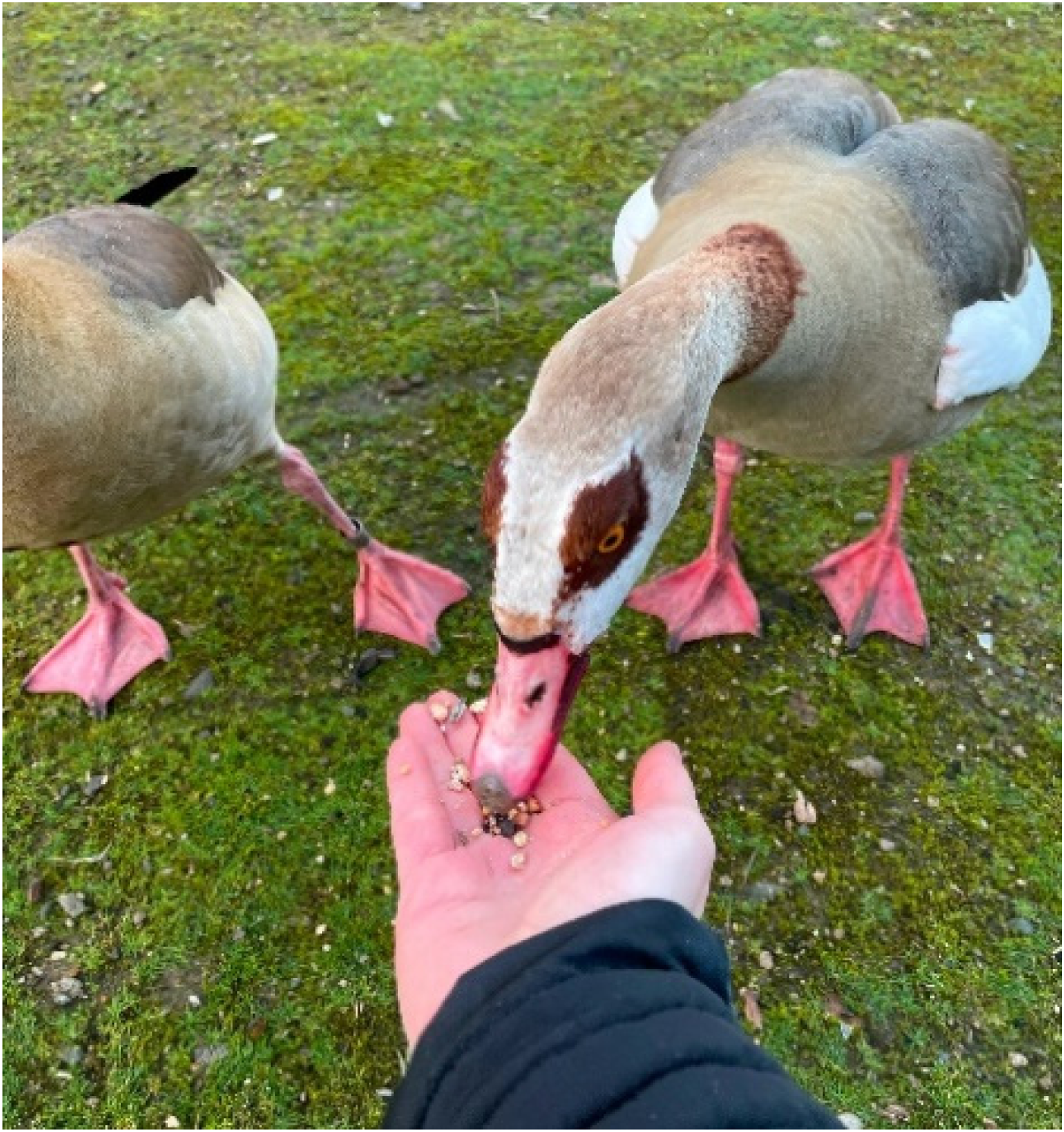
Feeding encounter with an Egyptian goose (photo by Elisa Kornherr).
In the practice of feeding, a knowing-with (Haraway, 2018: 103) is possible that adds new aspects to the discursive image of the Egyptian goose. Although feeding represents a crossing of boundaries between the self and the other, which is shown in the fact that I feel the otherness of the goose in the contact between beak and hand, this does not have a negative effect on me but triggers a kind of excited joy. In this process, I can comprehend through my affective involvement, how for the carers, the positively experienced aspects of these encounters can be more decisive than the construction of the geese as abject animals. Feeding is thereby a form of communication ‘that is not inflected in words, sentences and grammar, but in the utterance of practices’ (Abrahamsson and Bertoni, 2014: 134).
In feeding, the Egyptian geese initially provoke affective involvement as individuals involved in micro-social interactions. However, a positive image of the geese can subsequently develop among the feeders, even at the species level, as Beth illustrates: ‘I find Egyptian geese incredibly communicative and I really like that, I really appreciate that about them’. Thus, feeding encounters have the potential that the Egyptian geese do not gain meaning as abject animals but as valued co-inhabitants of the city.
Aiding injuries and connections to violence
In the context of unequal power relations between humans and animals, care and violence are reciprocally connected (Benson et al., 2017: 7; Holmberg, 2022: 2). It is crucial to consider the particular vulnerabilities of each species, as these can vary significantly (Narayanan, 2018: 20–21). In caring for the Egyptian geese, violence relates to their status as abject urban animals and their political exclusion from the city. This becomes apparent at three points in the care practice of aiding injuries.
Firstly, it shows that conditions of violence are the cause of care in the first place. As Anastasia describes, it was an encounter with several injured Egyptian geese that prompted her to care for them: So in 2015, October, I was jogging here and suddenly I stopped and saw all these injured Egyptian geese. […] They have hanging wings, which were broken by bicycle or by kick, just by cruelty to animals. […] And then several animals were injured here in a strange way. […] So I thought: What do I do now? Look at the animals, control them through feeding or just make something out of it really.
Here, caring is a reaction to violence against the Egyptian geese. Tronto (1993: 105–109; with reference to Fisher and Tronto, 1990: 40–45) categorises caring in an idealised form into four phases: caring about, taking care of, care-giving and care-receiving. In the above example, the phases of ‘caring about’ and ‘taking care of’ take place. ‘Caring about’ first means recognising that there is a need in a situation that requires care (Tronto, 1993: 106). The injuries sustained by the Egyptian geese profoundly affect Anastasia. As a result, she interrupts her daily practice of jogging and decides that she want to respond to the condition of the geese. This is followed by ‘taking care of’, which means taking responsibility and determining how to address the needs that require care (Tronto, 1993: 106). She decides to visit the animals regularly and check on their state of health.
As she and other carers describe, they experience situations where the actions of people injure the geese (Figure 2), for example, when they let their dogs loose on the animals. When asked why the geese are injured, one interviewee answers: That is often intentional here. They laugh when they do it. With a leash [a man] also goes straight at the geese here, although he has a lot of space. So, do I have to provoke that? Then he laughs at that: we have enough Egyptian geese after all.
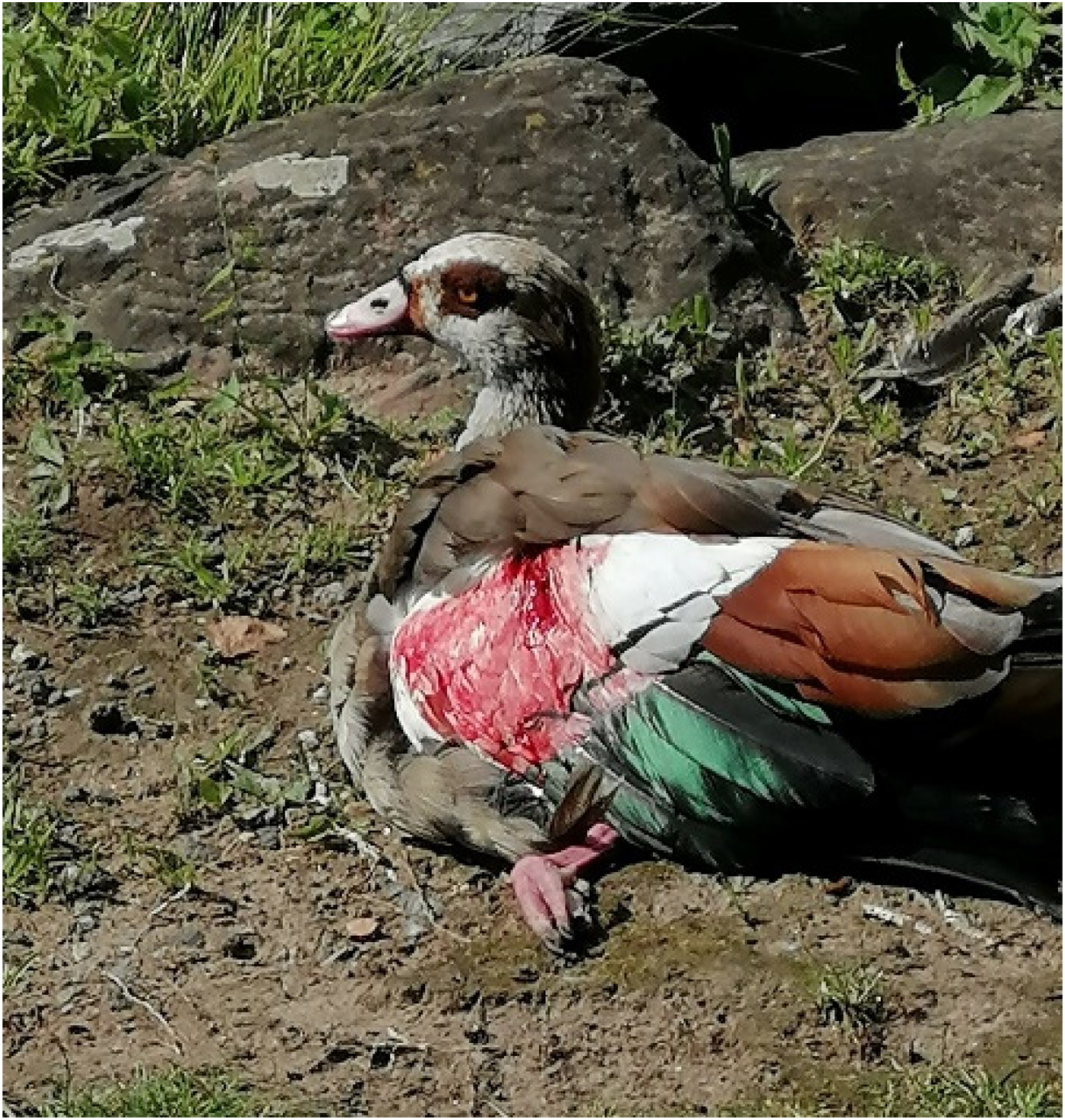
An injured Egyptian goose with a bleeding wing that Anastasia took care of (photo by Anastasia).
The dog owner's statement reflects that injuring or killing a goose is justifiable due to the large number of Egyptian geese. From the perspective of the carers, one reason for the geese's injuries is that the geese are ‘hated’ by many people in the city as a ‘result of such news reporting’ (interview Rachel). In a ‘smear campaign against these geese’ (interview Kim), narratives are spread such as ‘the Egyptian goose is aggressive, eats bread and kills ducks. It's always the same’ (interview Anastasia). The discursive constitution as abject corresponds to a subjective antipathy towards the animals and may even encourage violent actions against the geese. This reveals a species-specific vulnerability due to the origin of the animals (see Narayanan, 2018).
Thus, violence not only includes physical violence but also relates to discourse formations that have a restrictive effect on caring practices. This restrictive effect is also evident in an EU law. Egyptian geese are considered an invasive alien species under EU regulation (European Commission, 2017) and, thus, they are not allowed to be ‘released into the environment’ (European Parliament and Council of the European Union, 2014: 44). For the carers, this means that they are not allowed to release the Egyptian geese back into their habitats after they have given them medical care at home or at a veterinary practice.
Little intrinsic value is ascribed to Egyptian geese in their constitution as abject animals. Such animals are devalued at the moral level and are, subsequently, more easily categorised as violable or killable than animals with a higher moral status (Crowley et al., 2018; Sutton and Taylor, 2019: 379; Taylor and Signal, 2009: 134). The carers are aware of this and want to help them for this very reason. In this respect, the status of the Egyptian geese as abject animals and the violent conditions that accompany this are reasons to help the geese and to work for their inclusion in the city.
The second point that illustrates the link between violence and care is that caring for abject urban animals can be seen as a practice that has the potential to counteract violent conditions through the bonding element of embodied communication. Some carers form their personal truth that guide their actions, such as Anastasia: ‘They decided: the geese are invasive, catch them but don't let them out. It's all illegal, yes, so actually you can let them out because they are normal geese’. She denies the importance of the EU law, while attributing more importance to her own experience based on direct contact with the Egyptian geese. According to this, the Egyptian goose is not invasive and alien but a ‘normal goose’.
Characteristics that designate geese as abject in the public debate take on new meanings in caring for them. In connection with faeces as a typical abject matter according to Kristeva (1982: 71), the discourse describes them as disgusting and health-threatening (Kornherr and Pütz, 2022: 5). An observation during a multispecies go-along, where I accompany Anastasia in the caring for two geese she is looking after in a veterinary practice, shows a care-specific meaning of faeces: Anastasia opens the boxes where the geese are, changes the underlays and checks their faeces in the process. […] She asks the gander: Did you eat well, sweetie? Looking at the dirty underlay she pulls out of his box, she says: Ah, dirty is always good.
The faeces are not seen as a symbol of disease, but as an indicator of the functioning food intake and metabolism of the goose. It does not seem disgusting or unhygienic to Anastasia in direct contact but as a chance to check the health of the goose.
In the formation of individual, positive meanings of the geese, it is important to focus on embodied connections between humans and animals. When people get to know the Egyptian geese in the care relationships, two further phases of caring according to Tronto (1993: 107–108), are connected: ‘care-giving’ (practically addressing the identified problem) and ‘care-receiving’ (the reaction of the care receiver): So it's not only catching and controlling, but also looking after the animals is very important. You also see the behaviour and character of the animals. […] Or this look, as if they were laughing. Then there are sad eyes, there are tired eyes and there are ‘I'm so exhausted’ eyes. I have also cared for many animals. You begin to see the differences.
Caring means being curious and learning something about the caregivers, the care receivers and the circumstances in which care takes place (Van Dooren, 2014: 292–293; with reference to Haraway, 2008 and Puig de la Bellacasa, 2012). In the above example, eye contact is crucial for getting to know each other. In the gaze, partners are mutually related through embodied communication (Gugutzer, 2020: 191). Responsible caring involves carers becoming attuned to the specific needs of the animals (Roe and Greenhough, 2023: 56). With ongoing care relationships and repeated encounters, the people who care for them are ‘learning to be affected’ (Latour, 2004: 206). This means being affected by the other, their needs, sensitivities and the differences that exist to the self (Latour, 2004). A quote from Anastasia illustrates this embodied compassion when the geese are injured and suffering: ‘Then you have to feel their suffering. Not pity and not that sympathy, it's suffering. You feel their pain. […] Only when I feel the pain like that, then I know I can now start and help them’.
With reference to Despret (2013: 51), the concept of embodied empathy can be cited here ‘which describes feeling/seeing/thinking bodies that undo and redo each other, reciprocally though not symmetrically, as partial perspectives that attune themselves to each other’. Here, Despret (2013) is referring to researchers who are interacting with animals in their fieldwork. However, this concept can also provide an explanation beyond academic researchers for the practice of people who care for the geese, who also use embodied communication as a mode of knowledge generation. Building on affective attunement in encounters with the counterpart (Despret, 2004: 125), ‘caring with’ can be quoted as a complementary phase of caring, foregrounding the relationality between care giver and care receiver (Power, 2019: 764; with reference to Tronto, 2013).
As a third point in the context of violence and caring for abject urban animals, it should be emphasised that caring itself can often be violent as embodied attunement does not always succeed. For example, Egyptian geese may resist the caring efforts of the helpers or refuse to be captured. As Anastasia describes, the behaviour of the Egyptian geese is not necessarily the primary reference point for their actions. Instead, humans implement their own ideas of necessary caring: ‘In the beginning he was also rowdy, but we had to leave him in a narrow box at first’ and ‘then sometimes you have to get them out with force. There were many cases there, too’. Rachel also provides an example: We had a goose that was hit by a beer bottle and her backbone was paralysed, of course there was nothing we could do. But you simply have to alleviate the suffering and in that case you have to euthanise her.
Caring is intertwined with harm (Parreñas, 2018) and can, therefore, include the killing of animals (Palmer et al., 2023: 1528–1531). The above quote shows that Rachel decides what is the right caring for the Egyptian goose. It is also within human decision making to see death as the best option for caring and to kill the goose. Caring as a counter-project to violent exclusion is, thus, not an innocent practice despite good intentions. Power structures and inequalities are always present.
Advocacy as embodied politics of care
Caring can be the foundation for socio-political change. An essential contribution of care in this context is to bring politically excluded actors into focus (Tronto, 1993: 175). The carers of the Egyptian geese in Frankfurt are working for the inclusion of the geese by challenging the construction of the animal as abject and its subsequent exclusion from the city. In line with a political animal geography (Hobson, 2007; Srinivasan, 2016), I argue for understanding care for the Egyptian geese as an implicitly political practice in which both people and Egyptian geese are political subjects in relational care networks. I ascribe political agency to the Egyptian geese because they ‘exercise influence on the terms and conditions of interaction, which challenges the limits of existing liberal democratic models of politics’ (Meijer, 2013: 28).
The agency of the geese is evident in the way the carers’ affective involvement in relation to the animals provokes political engagement. Affective involvement can trigger the desire not only to feed the Egyptian geese and treat their injuries but also to stand up for them politically. I argue that this political engagement has its origins in individual encounters and can develop into a commitment to the collective of Egyptian geese in the city.
In order to understand this process, the focus is first on micro-social encounters. Although encounters with abject animals often elicits negative emotions in humans (Moran, 2015: 646–647), contact with the Egyptian geese in care relationships can evoke positive feelings. Rachel tells about the interaction with a male Egyptian goose that she had known for some time and whose swollen leg she had treated: He recognised us from afar, flew to us and then greeted us. As a gesture of thanks, you could say. If you want to interpret it in human terms. He spread his wings and bowed to us. That was quite astonishing. […] The animals then win your heart. Yes, it is-, it is communication, one would almost say, between animal and human.
For the carers, caring does not only mean investing time and energy to improve the situation of the animals in the city. In their view, they get something back from the animals, such as the animal's gratitude in the above narrative by Rachel. The value of these encounters resides in mutual affecting; ‘Encounter value thus means being affected by, and deriving value from, an encounter’ (Pütz, 2021: 595). It is therefore crucial to understand caring as a more-than-human practice in which humans and Egyptian geese mutually influence each other.
Based on micro-social interactions with the animals, carers form convictions that require intervening in larger political structures. Their credo is that the Egyptian geese are precious co-inhabitants of the city. Rachel describes the development of this rationale, from emotional involvement with individual animals to advocacy for the Egyptian geese as a neglected group in the city, as follows: At first it was pure observation. The pleasure of the animals, this amazement that you can observe all these families. […] And in 2013, 2014, […] there was a hunting season for them and that's when I started my work. Because in the meantime I felt that they were so valuable and such an enrichment that I thought I had to somehow stand up for them and get involved and take a stand.
Thus, the personal connection to the animals leads to political engagement (see also Kirksey et al., 2018: 606) and, thereby, an alliance is formed between humans and animals in caring (Krieg, 2020: 182).
The carers professionalise their caring efforts and try to influence the overall situation of the Egyptian geese. Anastasia expresses this by founding a ‘lobby for Egyptian geese’ in the city. According to her, this lobby is helping to overcome the negative public image of the Egyptian goose: ‘because slowly people are starting to believe that it's not all true’. Part of the work of the carers is to inform the public about the positive characteristics of the Egyptian geese by distributing flyers and making statements on their own websites, for example, that they are ‘intelligent, lovable creatures with a complex social behaviour’ (brochure ‘Colourful waterfowl – Things to know about Egyptian geese’, March 2019). They also share information about their care work on social media channels. Social media and other forms of public relations can be powerful components of care networks (Nelson, 2017). The aim of the campaign to raise awareness about the Egyptian goose is to influence the debate in media and politics. Thereby, the carers counteract the constitution of the Egyptian goose as an abject animal. They are also committed to this through their everyday actions. To dispel the image of the dirty and disgusting goose, the carers regularly clean a staircase on the riverbank where the geese often spend time. According to Kim, this helped to improve the image of the Egyptian goose: ‘And then the situation eased a bit, because then at least the stairs were clean and somehow people didn’t perceive the animals as such a nuisance anymore’.
Besides public relations, a crucial action of the carers is to found associations to represent their interests. This enables them to network better for the help of the animals and to support each other (see also Johnston, 2024: 941). As associations comprise several people and have a defined organisational structure, they are more significant political actors in urban politics than an individual can be, as Rachel describes: In this function I was also invited to certain political events. […] That really opened the door, because you don't go there as some private person, but as an official representative of a group or contact person for certain geese.
The carers see themselves as representatives of the geese's interests in the city. Developing relationships with unwanted animals and caring with them can lead to an understanding of their needs and thus to a more-than-human knowledge of the city (McKiernan and Instone, 2016: 490). As spokespersons for the geese, the carers are trying to prevent the displacement of the animals to marginal locations within the city, as is intended by the municipal goose management. Instead, they want the beastly places that the geese themselves have chosen as their habitat to be designed according to the animal's needs. As Anastasia reports, she spoke to the city administration to persuade them to find a solution for the remodelling of the aforementioned stairs that would allow the animals to remain there during the renovation. In this case, a compromise was found, which indicates that the carer's advocacy is increasing the understanding of political decision-makers that the geese are a part of the city.
However, the political exclusion of the Egyptian goose is not limited to the scale of the city, but also extends to the EU. The carers view the listing of the Egyptian goose as an invasive alien species under EU regulation to be a major problem for their constitution as an outsider. Therefore, the carers try to take action against it: So they are widespread, […] it has never been proven that they cause any harm. It was all just allegations, unsubstantiated allegations. And so the legislation is, if a species is no longer eradicable, then it has to be taken off the list. That is now our starting point to tackle this with legal help.
The carers question the legitimacy of the legal basis and set their own rationale against it (see also Connors and Short Gianotti, 2023: 2131–2133). Affective relatedness with animals is rationalised in the struggle against their classification as invasive, based on the awareness that fact-based argumentation can be more effective in transforming broader structures (see also Crowley et al., 2019).
Conclusion
The constitution of the Egyptian geese in Frankfurt as abject urban animals initially complicates the cohabitation of humans and the animals in the city. A focus on care can help to understand the complexities of living together and to provide clues as to what a coexistence between humans and abject urban animals might look like. When looking at the care practices of feeding, aiding injuries and political advocacy for the Egyptian geese, it becomes apparent how the tensions between exclusion from urban society and the carers’ individual efforts for inclusion manifest themselves concretely.
In urban politics and planning, there are restrictive programmes for caring. Some relate specifically to Frankfurt, such as the wildlife feeding ban for urban green spaces or the Frankfurt-specific discourse that renders Egyptian geese abject. Some are also linked to higher levels, such as the listing as an invasive alien species under EU regulation, or the norm that localises wild animals outside the city. These contribute to the constitution of the Egyptian goose as an abject urban animal, leading to the imaginary and spatial exclusion of the geese from the city. The carers’ negotiations with these exclusionary factors influence the micro-social care encounters. For instance, they are cautious when feeding the geese so as not to attract attention. They experience that their conjunction with the geese can lead to them being subjected to insults and social exclusion. However, it is not these restrictive factors that influence care practices the most, but rather the embodied connection with the animals.
The efforts towards inclusion arise from affective involvement in embodied communication between humans and animals, for example through glances or touch. In mutual affecting during care encounters, new meanings of the animals can emerge beyond the constitution as abject. This shows that caring can change the individuals involved through embodied relating (Puig de la Bellacasa, 2011: 98). The carers change in such a way that the vulnerabilities of the geese become accessible to them. Often marginalised in urban politics, the animals are particularly vulnerable to violence caused by anthropocentric structures. To paraphrase Philo and Wilbert (2000): Politics, planning and norms do not produce Frankfurt as the right ‘animal space’ for the geese. However, the Egyptian geese have already appropriated Frankfurt as a ‘beastly place’. In the entanglement between geese and carers, the people recognise how this contrast shapes the living conditions of the Egyptian geese. Thus, the animals themselves play a decisive role in this knowing- and caring-with. A multispecies perspective on caring-with points out that the Egyptian geese ‘co-constitute the performance of care’ (Power, 2019: 767).
Individual human–animal relationships can lead to a desire to work for inclusive conditions for the whole species in the city. Inclusion takes place through individual assistance, but at a higher level, it also involves trying to convince urban society that the Egyptian geese should be allowed to live there. For the people involved, the city appears as a shared habitat in which the Egyptian geese are precious co-inhabitants. In this respect, through caring interactions, the Egyptian geese are changing the way at least some people look at Frankfurt. Caring with abject animals in the city shows that animals like Egyptian geese are co-constitutive actors in urban spaces (see also Barua and Sinha, 2019; Clement and Bunce, 2023).
The case study serves to highlight the interconnections between the political and affective dimensions of care, as caring for abject urban animals gains political impact by connecting people and animals through affect. The findings help to reflect on what care can do for the inclusion of animals in the city. Even if the exclusion of Egyptian geese as abject animals undoubtedly persists, urban politics is enriched by the fact that people bring in a perspective characterised by a positive connection with the animals. Steele et al. (2019) regard multispecies care as an approach to creating urban politics that is more-than-human. Ethical practices here include not only humans but also other living beings. Especially in the case of animals that are considered problematic, positive care relationships cannot be the only practice that determines coexistence. It is also important to recognise that there may be disturbance or conflict caused by the animals (Srinivasan, 2019b: 387–388). This entails not only discerning the human needs within the city but also accepting the ways of life and vulnerabilities of other species, even if they initially seem to be disruptive (Van Dooren, 2016: 202–207; Wilson, 2022: 1148). In this way, caring for unloved beings can represent an opportunity for a more liveable more-than-human future (Doiron, 2023) and contribute to recognising cities as multispecies places.
Highlights
The article analyses the conflictual care practices for Egyptian geese in the German city of Frankfurt am Main, which I conceptualise as abject urban animals.
The exclusion of Egyptian geese, both imaginatively and spatially, from the city leads the carers to stand up for the animals and attempt to include them.
The care practices of feeding, aiding injuries and political advocacy reveal a close interconnection between affective and political dimensions of care.
Although restrictive factors limit the care practices, the carers continue to help the geese, motivated by their embodied connection with the animals.
The embodied connections form the basis of the carers’ political commitment to the geese.
Footnotes
Acknowledgements
I would like to thank the editor and three anonymous reviewers for providing highly valuable feedback on an earlier version of this manuscript.
Funding
The author disclosed receipt of the following financial support for the research, authorship, and/or publication of this article: This work was supported by the Deutsche Forschungsgemeinschaft (DFG, German Research Foundation) [512513565].
