




Abstract
In this article, I draw on a case study of interviews with Ontario grass-fed beef farmers about cow welfare and theorize these using the analytics of animal geographies and biopolitics. I engage with the former's work on animal agency and subjectivity, and the latter's focus on animal commodification, showing how welfare practices impact cows’ subjectivities, agencies, bodies, and interrelations. I make clear that cows exercise agency in their relationships with farmers, despite and in response to the different forms of governance that shape cows’ welfare and relationships with farmers. Analyzing welfare practices as different forms of biopower, I show how cows’ liveliness impacts their commodity value and describe the contexts in which farmers build emotional and disciplinary connections to cows. Central to my argument is that cows’ subjective and agentic features complement and complicate their commodification. Fusing animal geographies and biopolitics, I extend my analysis of cow welfare into a discussion of the emotional, economic, and ethically complex relationships between farmers and cows. Lastly, I contribute to emerging debates in literature on the complexities of caring and killing in human-animal relations through my analyses of welfare as an avenue for exploring the function of care, commodification, and killing in farmer-cow relations. Attending to these complexities, I argue, disrupts fixed logic about the ethics of animal production, while prompting us to rethink the way we relate with animals we call food.
Introduction
The World Organization for Animal Health defines animal welfare as “the physical and mental state of an animal in relation to the condition in which it lives and dies,” as well as “a complex and multi-faceted subject with scientific, ethical, economic, cultural, social, religious and political dimensions” (2021: para. 1). Animal agriculture is one industry in which animal welfare is critical while rightfully contested. For example, some scholars argue that claims about farm animal welfare mask the industry's violence toward animals (Gillespie, 2011; Sankoff, 2019; Shukin, 2009; Stanescu, 2014), describing how animal welfare can be less about animals’ wellbeing and more about finding new ways to commodify animals. Welfare's multidimensionality and ability to offer a glimpse into animals’ everyday lives, however, make it worthy of investigation, and the violence that agricultural animals often endure makes an analysis of their welfare timely and necessary. Grass-fed beef farming offers a noteworthy context for exploring animal welfare because grass-fed beef cows are pasture-raised for the duration of their lives, fed an exclusive diet of grass, able to live longer, and often avoid auctions and feedlots. These are some ways that grass-fed beef farming claims to provide better welfare for cows. 1
In this article, I draw on a case study of interviews with Ontario grass-fed beef farmers about cow welfare and theorize these using the analytics of animal geographies and biopolitics. I engage with the former's work on animal agency and subjectivity, and the latter's focus on animal commodification, showing how welfare practices impact cows’ subjectivities, agencies, bodies, and interrelations. I make clear that cows exercise agency in their relationships with farmers, despite and in response to the different forms of governance that shape cows’ welfare and relationships with farmers. Analyzing welfare practices as different forms of biopower, I show how cows’ liveliness impacts their commodity value and describe the contexts in which farmers build emotional and disciplinary connections to cows. Central to my argument is that cows’ subjective and agentic features complement and complicate their commodification. Fusing animal geographies and biopolitics, I extend my analysis of cow welfare into a discussion of the emotional, economic, and ethically complex relationships between farmers and cows. Lastly, I contribute to emerging debates in literature on the complexities of caring and killing in human-animal relations through my analyses of welfare as an avenue for exploring the function of care, commodification, and killing in farmer-cow relations. I refrain from using the term cattle given its etymological roots in chattel slavery (Gillespie, 2018) and refer to female and male bovine animals as cows.
I conceptualize welfare as a complex, contested discourse and set of practices with emotional, economic, and ethical dimensions that impact animals’ bodies, interrelations, and lives in ways that demand interrogation. This concept is informed by farmers who offered insight into the day-to-day practices, challenges, and benefits of welfare that matter for cows and farmers. It is also guided by scholarship in animal geographies and biopolitics that articulates how power, care, and harm become operationalized in human-animal relations. I engage with these analytics to foreground animals’ lives in welfare practices that are human-centric in their agenda and overarching goals, but offer valuable insight for understanding animals’ lives, interrelations, and relations with farmers. Seymour and Wolch (2010) explain that self-reflexivity illuminates why and how we study animals and how we draw conclusions about them. My understanding of, and reason for studying, welfare is informed by my veganism. As a vegan who knows that veganism does not un-list me as a participant in the complicity that constitutes compromised living with all embodied beings (Shotwell, 2016), I grapple with how animals are entangled with, harmed by, and cared for by humans in complex power relations, and I argue that welfare offers an avenue for critiquing, complicating, and better understanding these relations.
Methods and data analysis
Participants in this case study consisted of twenty-two grass-fed beef farmers in Ontario, Canada, who, through an IRB-approved research protocol, consented to be a part of this research and paper. Through purposive and snowball sampling, I located participants by initially Google searching “Ontario beef” alongside the terms “welfare,” “humane,” and “ethical beef.” I chose the latter two terms because of their synonymous associations with welfare, and I focused on Ontario given its diversity of beef farms and the ease this provided me as an Ontario resident. I selected farm websites that referenced some or all these terms and contacted farmers via email or phone to briefly discuss my research and gauge their interest in participating in an interview. “Grass-fed beef” was not an original part of my Google search because I was unaware of its association with cow welfare. However, I began to note its significance when most research results produced grass-fed farms. I decided to focus exclusively on grass-fed beef farming to ensure consistency within my sample. Farmers whom I contacted helped me expand my sample size by providing the names of other grass-fed beef farmers.
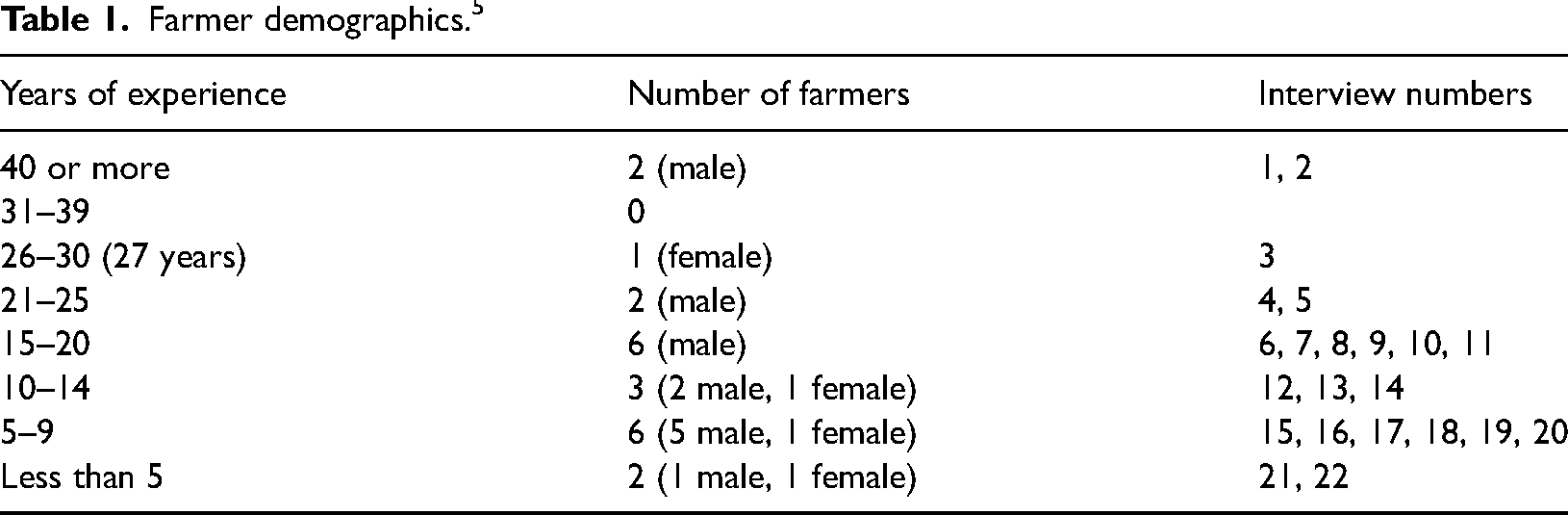
I obtained data via semi-structured, open-ended interviews, during which I asked farmers questions about their reasons for grass-fed beef farming, understandings of cow welfare, and day-to-day relationships with cows. I asked follow-up questions when I wanted farmers to expand on specific points and interpreting questions to confirm understanding. Table 1 outlines the farmers’ age, gender, and years of experience with grass-fed beef farming.
Farmer demographics. 5
I uploaded and coded my data using the qualitative data analysis software, Nvivo. First, I scanned the data to identify preliminary codes such as “farmer understandings of welfare” and “relationships.” I then analyzed these preliminary codes with greater precision, creating sub-codes when key details and nuances in the data emerged. For example, I explored “farmer-cow relations,” “herd relations,” and “cow-calf relations” as sub-codes of “relationships.” During my final stage of coding, I identified nuances within sub-codes, for example, coding “favoritism,” “care,” and “dislike” as sub-codes of “farmer-cow relations.” Accounting for these details allowed me to understand the dynamics and complexities of day-to-day relationships between cows and farmers that underpin welfare practices.
The ethical dilemmas of ethnographically studying animals in asymmetric relationships have been well documented by animal scholars. For example, some highlight the problem of anthropomorphic bias and miscalculation and advocate for engaging with people, such as ethologists, who share their lives with animals to address this hurdle (Abrell and Gruen, 2020; Johnston, 2008; Seymour and Wolch, 2010). Other scholars caution how we are complicit in the power relations we seek to contest through our ethnographic encounters with animal death, suffering and subordination (Gillespie, 2018). We also risk enacting power relations by rendering animals methodologically encounterable in the first place and must, therefore, question when to let animals be unencounterable (Collard, 2015). Complementary to this approach is investigating power relations in non-participatory ways, building indirect knowledge about animals via secondary sources that do not require our complacency in witnessing harm to animals (Gillespie, 2018). Alternatively, Kopina (2017) argues that animal ethnographers must mobilize animal rights initiatives (i.e., covert, investigative work) through their ethnographic research to enact meaningful, political change for animals. Rather than using a non-participatory approach, making cows unencounterable, or mobilizing animal rights initiatives through my research, I chose to investigate cows’ lives and the ethically fraught contexts that shape them by accessing spaces in which cows are farmed, reporting on animals who may have otherwise gone unnoticed (Garcia, 2019).
Analytics
Animal geographies
Animal geographies draw attention to the geographical dimensions of power between humans and animals (Collard and Gillespie, 2015; Philo and Wilbert, 2000), interrogating the dominant social orders that perpetuate human-animal hierarchies, which the animal industrial complex starkly reveals (Noske, 1997). Animal geographers identify animals as agents who exert power in their relations with people in ways that influence, shape, and transform their lives as well as ours (Emel and Wolch, 1998; McFarland and Hediger, 2009). Agency, scholars assert, is something that animals and people co-produce in their relationships, conflicts, negotiations, and alliances (Notzke, 2013; Van Patter and Hovorka, 2017). For example, in their relations with humans, animals exercise agency to shape national landscapes (Rutherford, 2013), environmental politics (Dempsey, 2010), companion species relations (Haraway, 2008), animal sanctuary practices (Abrell, 2021), and technologies that humans use to govern them (Bear and Holloway, 2019). Animal geographers define animal subjectivity as animals’ abilities to live and experience the world as thinking, feeling, sentient, and self-conscious beings (Bear, 2011; Fraser-Celin and Hovorka, 2019; Geiger and Hovorka, 2015) with attachments, proclivities, personalities, and social and emotional lives (Gillespie, 2018).
Drawing insight from scholarship that examines cow agency in the context of industrial dairy production, I build upon the work of Gillespie (2018) who politicizes agency as resistance by examining how dairy cows attempt to flee or fight back in agricultural power relations. Holloway and Bear (2021) rightfully caution against oversimplifying animal agency as necessarily resistance, as this, they argue, rewards an anthropomorphic lens that fails to capture forms of agency that arise in less violent, mundane, or technologically mediated exchanges between humans and animals. In the context of violence, however, Gillespie's analysis of agency as resistance helps to valorize and thus problematize the subjugation that dairy cows respond to in agricultural power relations.
In this article, I further Gillespie's analysis of cow agency by examining grass-fed beef cows’ non-complacency as acts of resistance, which farmers respond to at times by removing cows from the herd. Additionally, I show how welfare practices govern cows’ agencies, bodies, and interrelations. For example, I discuss how castration, polling, and weaning negatively impact cows’ bodies, relationships with farmers, and interrelations, while benefitting farmers and only minimally serving cows. 2 When we take the emphasis on wellbeing and care at face value and fail to acknowledge the extent to which these practices benefit farmers, we risk glossing over social, emotional, and embodied aspects of cow welfare for cows.
I expand animal geographies’ literature on animal subjectivity by showing how farmers acknowledge and respond to animal subjectivity within asymmetric power dimensions. For example, I draw on farmers’ discussions about cows’ individualities, liveliness, and communicative gestures, which farmers respond to by developing emotional attachments to cows. Conceptualizing cows’ individualities, liveliness, and communicative gestures as expressions of cow subjectivity, I shed light on the emotional nuances of farmer-cow relations, which I show complicate and strengthen cows’ value for farmers. Responding to Hovorka's (2018) call for hybridizing animal geographies, I bring animal geographies scholarship into conversation with debates in biopolitics to investigate the entanglement of welfare, commodification, and killing, which shapes the ethical, emotional, and economic complexities of farmer-cow relations.
Biopolitics
Foucault coined the term biopolitics (1976) to address how, in the nineteenth century, a new kind of political power emerged that signaled a transition from sovereign power to biopower. Biopower, for Foucault, aims to enhance, protect, and make life productive, or in other words, “to make live and let die” (1976: 241). For Agamben (2004), biopower operates according to a human-animal divide that takes place within us, shaping our conception of what it means to be human and, thus, worthy or unworthy of life. Agamben's theorization of animality alludes to the logic through which humans determine animals’ killability, given their ontological difference from humans. Animal scholars, however, argue that biopolitics reveals our shared ontology with animals, within which both humans and animals can be deemed killable. Scholars theorize this in different ways: some highlight the link between animal husbandry and human slavery (Boggs, 2013), the poor treatment of agricultural animals and slaughterhouse workers (Wentworth, 2015), and the genocide of Indigenous Peoples in connection with the eradication of wolves (Rutherford, 2013). Others examine the biopolitics of zoonotic diseases, which transgress a human-animal distinction (Blue and Rock, 2011). These works demonstrate how biopolitics impacts humans and animals by blurring a human-animal distinction, highlighting the ways humans and animals become biopolitically killable (Wolfe, 2013). In other words, these insights show how biopolitics sheds light on our relational ontology with animals.
Shukin (2009) investigates this relational ontology by examining how, via capitalism, biopower operates by strategically and ambivalently dissolving and reinscribing borders between humans and animals. Capitalism, she argues, renders animals into “animal capital,” signaling “a world in which species boundaries can be radically crossed (and reinscribed) in the genetic and aesthetic pursuit of markets” (Shukin, 2009: 11). Shukin explains that such rendering produces a semiotic and material closed loop between animal and capital, making the meaning and matter of the one feed seamlessly back into the other. While Shukin focuses on animals’ killability, some scholars highlight how biopolitics works on animal bodies in productive ways, creating “lively commodities” (Collard and Dempsey, 2013) and investing in animals’ subjectivities, bodies, and behaviors as objects of biopolitical knowledge. For example, Holloway (2007) explores the biopolitics of bovine milking machines, showing how milking machines monitor, calculate, and reshape cows’ agencies and subjectivities to make their bodies more productive. Exploring the biopolitics of agriculture and genetics, Twine examines how biopower invests in the genetic improvement of animal bodies, whereby “the interests of animal scientists in behavioral genetics speaks to the aim of building animal subjectivities into the very anatomo-politics of the animal body and mind” (2010: 89). Going beyond what he calls “the repressive hypothesis” of human-animal relations, Chrulew (2017) argues that animals’ subjectivities are integral to how biopower invests in the management of zoo, laboratory, and farm animals, whereby animals’ experiences, behaviors, intentions, responses, and psychological capacities become the objects of biopolitical knowledge. In opposition to claims about biopolitics’ impacts on animals’ killability, these scholars emphasize how biopower works by making animals productive. Some scholars extend beyond these notions of productivity by exploring, for example, a “sensory biopolitics” that can teach us to be affected and affective in multispecies relations (Hinchcliffe, 2017). For Asdal et al., biopower enables a “livelier politics, in which the surprise of human-nonhuman engagements and entanglements can force us to hesitate and think again about the obligations we have to others” (2017: 2). Biopolitics are underpinned by such possibility because it cannot be reduced to a totalizing politics of life or death; it is, instead, always in flux (Asdal et al., 2017).
Foucault theorized how biopower operates in the name of “the welfare of the population” (Foucault, 1991: 100), making analyses of biopower insightful for examining cow welfare practices. Biopower targets the population as its subject-object of biopolitical care, yet biopolitical interventions also work through individual bodies (Srinivasan, 2014), enabling what Foucault (1976) calls an “anatomo-politics” of the body. I show how biopower impacts food animals’ productivity (Chrulew, 2017; Collard and Dempsey, 2013; Holloway, 2007; Twine, 2010) just as much as their killability (Shukin, 2009; Wolfe, 2013). Thus, through my analyses of welfare, I explore forms of biopower that both “make live and let die” (Foucault, 1976: 241).
Biopower's impacts on cows are most evident in the control, manipulation, and “improvement” of cows’ bodies, reflecting an anatomo-politics of the bovine body. I theorize genetics as a modality of biopower that invests in cow bodies—at the individual and herd level—via genetic manipulation to enhance cows’ performance, productivity, welfare, and capital. Furthermore, I show how cows’ lively, encounterable qualities strengthen and complicate their economic value for famers as biopolitical subjects of care. This, I show, is exemplified in farmers’ emotional attachments to cows and cows’ commodification as “quality beef.” An analysis of the former extends ways of understanding cows as lively (Collard and Dempsey, 2013) and sentient commodities (Wilkie, 2005), offering an in-depth consideration of how cows’ liveliness complements and complicates their commodification. Farmers’ emphases on “quality beef,” I argue, articulates a welfare-endowed animal capital (Shukin, 2009) that reveals a complex fusion of care, capital, and killing that underscores the biopolitical dimensions of grass-fed beef farming. Lastly, I theorize cow culling and euthanasia as forms of biopower that take animal life as a means for fostering welfare and, at other times, disciplining “crazy” cows.
Caring and killing
Through its analyses of welfare as an avenue for exploring the complex dimensions of caring, harming, and killing that occur in farmer-cow relations, this article contributes to emerging debates in the growing body of literature on caring and killing in human-animal relations. Some scholars, for example, theorize caring for and killing animals in the context of COVID-19, particularly given its zoonotic roots (Gibbs, 2021), while others explore the complex relations between animal technologists and animal subjects in scientific research (Roe and Greenhough, 2021). Some discuss how competing forms of care in conservation efforts result in the killing of animals (Bocci, 2017; Srinivasan, 2014), while others focus on the tensions of caring for and consuming animals, urging scholars to explore what “livelier” relations for food animals might look like (Emel et al., 2015). I build upon debates about the complexities of care and harm in “livelier” human-animal relations through my analyses of welfare's impacts on cows’ subjectivities, agencies, bodies, and interrelations, showcasing the ethical, emotional, and economic dimensions of farmer-cow relations. Illustrating care and harm via these analyses, I argue, complicates and strengthens our ability to have meaningful and challenging conversations about the ethics of farm animal production.
Findings and discussion: Exploring farmers’ discussions about welfare through the analytics of animal geographies and biopolitics
Cow agency and subjectivity: Analyzing cows’ individualities, liveliness, and responsiveness
In our conversations about cow welfare, farmers spoke about cows’ individualities in different ways: “Everyone is an individual, just like your kids. They all have their own idiosyncrasies and mannerisms. Some are a little more standoffish and timid, some like to be scratched behind the ears, and some like a full shoulder rub” (18). Another farmer stated that cows “have brains, personalities, character, and so we treat them as such.” In other words, “they’re not much different from people. Some are super friendly and will come right up to you and lick you through the fence. And you have others that are the boss” (20). Despite the anthropomorphic tendency of understanding animals, farmers do outwardly acknowledge animals’ agentic capacity for response, which they associate with animals’ individualities. Farmers also highlight how they form bonds with cows with whom they share most of their time: “The bond for us is stronger with our older animals. The longer we have them, the more attached we get” (20). Over time, “you get to know them, and they get to know you” (2). Another farmer explains, “When you own a cow for 20 years, you become attached to it” (2). 3 In these accounts, farmers allude to a cocreation of agency in their relations with cows in which their bonds with the animals are a direct response to cows as subjective, agentic beings, inferring how farming relations can be more respectful and considerate of animal subjectivity and agency (Emel et al., 2015).
Commenting on their day-to-day interactions, farmers explain how understanding their cows’ individualities helps them manage cows with safety and ease. For example, “you know who is who and . . . if they’re going to be grumpy with you or dangerous” (15). Put differently, “after dealing with them so much, you know who is going to be the pain, who's the treat, and you manage it accordingly as you’re doing things” (20). Cows also, at times, refuse to cooperate with farmers: they “get a feeling that you want them to do a certain thing, and they don’t want to do that. It's almost like they know what you want, and they’re going to make sure they don’t do it” (12). At times, cows require farmers to adjust their expectations and exercise patience: “Cows control the schedule” (18).
Alluding to cows’ subjectivities, farmers explain that cows are “curious but trepidatious, so their initial response to anything that surprises or scares them is to run from it. If it doesn’t continue to seem like a threat, they will investigate” (19). As one farmer explains, “We have to listen to cows [because] they tell us what they need” (18). In these ways, farmers illustrate how cows express themselves as emotional beings with social proclivities (Gillespie, 2018). Holloway (2007) explains that bovine subjectivities are heterogenous, fluid, and contingent upon specific sets of relations among humans, environments, and technologies. Holloway's insights speak to how farmers’ accounts of cows’ subjectivities in these contexts depend on cows’ ability on grass-fed beef farms to graze with their herd mates in an environment that provides enrichment, often unencumbered by farmers while feeding throughout the day. When we pay attention to bovine subjectivities, we untie the closed loop (Shukin, 2009) that reiterates cows’ exclusive identity as capital. More importantly, when we open ourselves to cows’ communicative and responsive nature, we see how they challenge the practices that render them as beef (MacKay, 2021).
An animal geographies lens reveals the nuanced ways that farmers acknowledge cows’ individualities and social, emotional, and agentic capacities by reflecting on their experiences and relations with cows. Farmers’ reflections signify how human-animal relationality provides a site for learning about animal individuality. While I see great value in Bear's (2011) cautioning that we risk losing sight of animals’ individual subjectivities and identities when we focus too much on their relationships with humans, I disagree that identity becomes lost in relationality. Instead, I argue that human-animal relationality, and the ontological connections that bind us, can serve as foundations to learn about the individual, social, and emotional lives and experiences of animals. Drawing from farmers’ stories about their cows, and, in this way, responding to Bear's (2011) call for learning about individual animals through stories told about them, shows how relationships are also sites for learning about animals’ individualities, subjectivities, and agencies.
Governing cows through welfare practices
Bodily governance: Polled genetics and castration
Gillespie (2018) traces the governance of cow bodies back to their legal status as live property, arguing that branding, ear tagging, tail docking, nose ringing, artificial insemination, and castration are manifestations of cows’ property status. Farmers reveal how they exercise control over cows to ensure cows’ welfare. As sites of power-knowledge relations (Holloway and Morris, 2008), cow bodies become manipulated, managed, and made productive in grass-fed beef farming. Polled genetics and castration exemplify how farmers govern cows’ bodies in the name of welfare.
Farmers breed hornless (polled) cows to eliminate horns from cow herds. Farmers who have horned animals in their herd crossbreed horned and hornless cows to expand their polled genetics. In our conversations, farmers explained that cows protect themselves when feeling threatened or caught off guard by swinging their heads back and forth. While this behavior is instinctual, it endangers farmers and the herd when cows’ horns are intact. Cows with horns can also injure other animals when being shipped to the abattoir, unintentionally jabbing one another due to fear. For these reasons, farmers or veterinarians perform a painful procedure on calves called disbudding, in which they burn calves’ horn buds to stunt future growth. Farmers, therefore, argue that polled genetics enable welfare by protecting calves from undergoing this painful procedure.
Missing from this discussion, however, is an acknowledgement of how polled genetics prevent cows from developing a part of their body that carries value for them. For example, horns help cows recognize one another at a distance by their silhouette and enable cows to protect themselves from predators. Because grass-fed beef cows live their lives on pastures rather than confined in feedlots, being able to defend themselves from predators is essential to their welfare. Horns offer a point of contact for cows when pushing up against one another, and they provide cows with a sense of place in the pecking order (Neff et al., 2016). Cows also use their horns to scratch their backs and use the horn tip of fellow herd mates to scratch and clean their eyes (Neff et al., 2016). In these ways, breeding horns out of cows violates their evolutionary development and prevents them from performing species-specific behaviors (Neff et al., 2016). As a form of bodily governance, polled genetics manipulate cows’ bodies, affecting their subjectivities, behaviors, and interpersonal relations. Although farmers associate polled genetics with cow welfare, polled genetics also manipulate cow bodies by weakening their species-specific abilities, radically altering what it means to be a cow. While horns are naturally occurring and provide value for cows, in this context they become a problem which farmers must manage, control, and ultimately prevent.
Like polled genetics, castration exemplifies how farmers frame cows’ bodies as problems to be altered and controlled to ensure cow welfare. Castration allows farmers to control a herd's population size, which is central to grass-fed beef agriculture, given that farmers must maintain balance between land and herd size to ensure their land does not become over-grazed. Most farmers I spoke with described castrating males with elastic bands as the least painful method: As far as castrating goes, it seems like there is no perfect option, but the closest to an ideal is the rubber band before seven days old. Baby calves are pretty stunned for the first few days, and while I’m sure they find the rubber band uncomfortable, I’m confident it's not as traumatizing as it is if done later. (15)
Farmers explain that neutering reduces testosterone and makes the animals less aggressive with one another and farmers: “For several years, I was not pinching my bulls [and found] that they were fighting an awful lot more, so . . . I went back to pinching them, and I haven’t had that problem again” (6). Farmers emphasize that decreasing male aggression via castration is a form of long-term welfare, despite the short-term stress and pain it causes for calves: castration is “a necessary evil because if you don’t castrate, bulls are like out-of-control teenagers. They start hurting each other, breaking fences, and it's not healthy for them. Castration is humane [because] it calms them down” (2).
While farmers link castration and welfare, castration also disrupts cow welfare. When farmers manipulate bulls’ hormones by removing their testicles to curb aggression, they impact how males experience and express behaviors that carry meaning for them. Castration tampers with hormones tied to aggression, reducing a male's capacity to exercise strength in the context of threat, fear, or distress. It also impacts how males encounter farmers and engage with their herd. Thus, when farmers castrate males, they govern how the animals behave and relate with one another. Animals establish positions of power among themselves (Hovorka, 2019); castration, however, impacts how males may navigate this positioning, thus affecting cows’ interpersonal relations. Examining castration as a form of governance complicates it as an attribute of cow welfare because it reveals how castration, while linked to cow welfare, limits males’ behavioral autonomy.
Relational governance: Weaning
Weaning refers to removing calves from their mothers to prevent mothers from feeding their calves. Farmers explain that weaning is a necessary practice, and reducing the anxiety it poses for calves is central to cow welfare. However, weaning severs relationships between mothers and calves that even good welfare practices cannot restore. It is also inherently tied to their commodification. When females are in heat, farmers introduce a bull of their choosing to the herd to ensure that females become pregnant and give birth once a year. The mating cycle of cows guarantees a steady supply of beef for farmers’ customers. Weaning, farmers explain, gets mothers ready for their next calving season, as mothers who milk for too long can suffer from energy depletion when calving. Farmers also note that weaning prevents older calves from competing for their mothers’ milk, which jeopardizes the nutrition of new calves. The annual re-breeding of mothers signals their continuous experience of being separated from their calves. Many farmers wean calves when they are seven to eight months old because “by that time, the cows are probably pregnant again” (7). Other farmers wait until the calves are closer to 10 months old, giving “the mom the opportunity to do it herself” (19) because, in preparation for her next calf, “mothers get to a point where they no longer allow calves to milk them” (15).
When farmers let mothers self-wean, they give them more autonomy. While this is an important measure of welfare, this freedom is a by-product of the reproductive demands placed on cows as part of their commodification. Many farmers choose weaning methods that create the least amount of stress for the animals (low stress weaning). Two popular methods that farmers use include separating calves and mothers by a fence or using a “quiet wean” nose clip on calves. The former approach allows the animals to see, hear, and touch noses with one another, and the latter enables calves to stay with their mothers while preventing them from suckling their mother's teats. As the name “quiet wean” suggests, nose clips are promoted as mechanisms that, in allowing calves to remain in contact with their mother, reduce calves’ bellowing and anxiety. What the name elides, however, is the likelihood of physical and psychological frustration calves and mothers endure due to these feeding restrictions.
Power, connection, intimacy, and emotion are central to animal relations (Gillespie, 2017), and when we pay attention to cows as emotional and social beings, we begin to see the different ways that cows establish relations with one another that hold different meanings for them (MacKay, 2021). For example, while conducting this multispecies research with cows, I observed mothers and babies interact through licking, suckling, and vocalizing with one another. I saw calves skipping and running in groups and listened to mothers call their babies when they wandered too far. The vulnerability I experienced in my encounters with mothers and calves served as an indication of their intimate connections. In moments of proximity, mothers bellowed loudly or walked toward me, cautioning me to distance myself from their calves, revealing meaningful mother-calf relationships that develop on farms (MacKay, 2021).
Humans are entangled with animals given our shared vulnerabilities and capacity for experiencing connection, emotion, and intimacy (Bekoff, 2007). The intimate connection that we experience with our kin provides a visceral avenue for grasping cows’ emotional relationships. When farmers wean calves from their mothers, they sever this connection, governing and restricting a mother's capacity to protect and bond with her offspring. Although fencing and nose clips minimize cow and calf stress, weaning shatters valuable relationships for cows. Examining this practice as a form of relational governance exposes the traumatic experiences that cows endure in routine welfare procedures, and grasping this reality deepens our ability to understand the impacts of welfare on cows’ lives and experiences.
Bodily and relational governance reveal how inherent limitations are built into welfare practices given the harnessing of cows’ lives for food. While I am not suggesting that castration, polling, and weaning are not, in fact, welfare practices, we risk glossing over social, emotional, and embodied aspects of cow welfare when we take its emphases on care and wellbeing at face value.
Biopower and cow welfare
Genetics, encounterability, and commodification
Farmers attribute genetics to cow welfare by noting how breeding cows based on their genetic qualities helps farmers manage their behavior and temperament. I conceptualize genetic selection via breeding as a form of biopower that seeks to manage and improve cows’ bodies with the goal of producing ideal offspring. For Holloway and Morris, the geneticization of cows signals how “a cow is a body with data in a network which extends well beyond the body and the farm” (2008: 1718). Genetic selection draws on ideas of progress and embeds animals in practices that aim to increase their economic efficiency (Holloway and Morris, 2008). Genetic selection helps farmers preserve or achieve ideal behavioral and physical traits in cows to create profitable cow herds. If farmers lack what one refers to as “genetic rock stars with excellent performance and carcass traits” (2), they can rent bulls with good genetics to enhance the herd's performance. Although cows are killed for profit, their lively and genetic qualities become central to their economic value as biopolitical subjects of care.
Biopower, and the capitalist system it circulates within, assigns an economic value to animal life and death. Exploring the former, Collard and Dempsey (2013) discuss how biopower transforms animals into “lively commodities:” nonhuman, living beings whose capitalist values are derived from their liveliness. Collard and Dempsey explain that an “exotic” animal's “ability to enter into encounters with humans—to be touched, looked upon, spoken to, and heard—is essential to their construction as valuable, economic objects” (2013: 2687). On the one hand, cows do not exemplify lively commodities because their economic value obliterates their encounterable and social nature. On the other hand, however, my conversations with farmers revealed how cows’ lively, encounterable qualities strengthen and complicate their economic value for famers as biopolitical subjects of care. For example, as one farmer notes: You get attached. I don’t know if it's as I get older, but it pulls a bit more when I ship them. It is maybe something that I’ve gleaned from what I understand is Aboriginal. I try to thank the animals when they go off on the truck. I don’t know, but I do have more of a connection like that. And I almost tend to treat them, and I mean not completely, like the dog. I always talk to them. (6)
Echoing this, farmers explain that “you get attached to cows [because] they’re almost like pets” (20); “It's like having a dog” (2). Another farmer states how cows are “responsive and socially interactive. There's something about them when they are honoured in the fullness of their cow-ness that [allows] you to experience them on a different level” (18). These descriptions of farmer-cow relationships highlight how farmers build companionship with cows while profiting from their commodification. Cows’ encounterability, I argue, is central to these relational dynamics. Offering insight here, Wilkie (2005) highlights how farmers de-commodify and recommodify animals throughout the duration of their relationship, indicating how cows, for farmers, become sentient commodities.
Cows possess specific characteristics that make them likable or unlikable to farmers. For example, according to one farmer, “you tend to like the ones that you perceive to be good for your livelihood as a farmer. I have favorite cows, and that is usually because it's such a good one” (12). Factors that measure a cow's “goodness” include their physical build, docile temperament, and genealogy. These qualities, farmers explain, are “important for making sure cows produce a good end product” (17). Cows “need to be able to hold their end [because] they’re like employees. If they misbehave, you have to fire them” (17). Farmers cull cows who misbehave or can no longer fulfill their role as a productive body (e.g., are aggressive, old, genetically poor, sick, or infertile). As one farmer explains, in situations of infertility, “you retire her. If she's given you X amount of calves, why run her into the ground for the sake of having another calf” (20). When cows exude these traits, farmers deem them unproductive and no longer economically valuable as living beings. When a cows’ liveliness loses its economic value, farmers operationalize another form of biopower in which they take life, sending cows for slaughter on their transformation to “quality beef.”
A “quality life” = “quality beef”
During our conversations about beef farming, farmers often conflated their animals’ age with their weight, leading me to reflect on the closed loop between animal (cow) and capital (beef) (Shukin, 2009), and how biopower's investment in farm animal life comes full circle with its investment in animal death. Farmers associated the quality of a cow's life with the quality of their flesh, discussing how “meat quality has a big bearing on slaughterhouse stress” (6). As one farmer explained, We try to handle cattle quietly and gently. Stressing cattle can lead to a bad product. . . . If they are very stressed, they might not bleed out properly. So, you end up with an animal that somehow retains blood in the meat, [which] refers to “dark cutters.” It creates a tougher product that doesn’t taste good. (6)
The notion of “dark cutters” suggests that humans can see, touch, and consume the texture of a cow's stress and suffering. Farmers attempt to avoid the production of dark cutters by calmly working with their cows, exercising the logic that content, calm, and happy animals produce healthy, quality beef: “The animals we raise are an extension of our family, which means we believe in raising them in the happiest and healthiest way possible” (3). Happy cows are healthy cows, and “you need to treat cows well for them to produce well” (17). Attributing health and happiness to grass-fed beef farming, farmers explain feeding cows grass rather than grain “is better for them, the environment, and for the meat quality” (15). Echoing this, another farmer states that he is “more interested in producing beef that is from animals that have had wonderful lives and a positive environmental impact” (21). Farmers associate cows’ happiness with quality beef, arguing that cows’ wellbeing and commodification coexist in a way that benefits the animals, farmers, and consumers. By emphasizing the relationship between a cow's life (as happy) and flesh (as healthy), farmers suggest that cows can thrive, albeit temporarily, within a system that requires their death to secure profit.
Euthanasia complicates this logic because euthanized cows do not yield profit for farmers. Alongside this, euthanasia exposes a context in which farmers kill cows to protect their welfare, highlighting how euthanasia, as a form of biopower that “lets die,” enacts care while inflicting harm (Srinivasan, 2014).
Fostering care and enacting discipline: Euthanasia and culling as biopower
The term euthanasia comes from the Greek word euthanatos, meaning “easy death.” It is “the act or practice of ending the life of someone who is very sick or injured in order to prevent more suffering” (Merriam-Webster, n.d.), or welfare. Culling via euthanasia “should not be considered a last resort. It's often the best way to reduce animal suffering, producer anxiety, and vet bills” (15). Other farmers describe how “putting an animal down is not nice and certainly is a part of the business that I hate,” (6) but “if there's any question at all these days, you put the animal down” (6). Some farmers have a veterinarian euthanize cows, and others perform this task themselves. One farmer explained that he shot a calf who had their eye pried out by a raven; another discussed how he had shot sick and injured cows on-site: “I will shoot an animal if it gets sick, and if it's going to be a week to 10 days before it dies. I don’t like doing it, but it's the humane thing [and] better for the animal” (17). The decision of when to euthanize an animal emotionally weighs on farmers, creating an “emotional roller coaster” that many find difficult and draining. “That's the emotional part. . . . You’re so close to the animals, so when something goes wrong, it hurts” (20). Farmers cannot sell euthanized cows as beef; however, they can salvage them for personal consumption. The term “salvage” suggests saving animals from a wasted death. Illustrating this point, one farmer expresses the emotional labor of butchering her euthanized calf for personal consumption: We have these big old tractor things we use for feeding hay to the horses. And we had a calf in the yard who tipped into it. We got her out and thought she was going to be okay, and then she wasn’t. So, we put her down on the farm and butchered her ourselves, which was rewarding. Instead of wasting her meat and her life, we were using it. But I can’t fathom working in a butcher shop and doing that daily. But making the decision to put her down was challenging. (19)
Government-enforced welfare guidelines are in place to ensure that sick or injured animals who therefore require euthanasia are not shipped to abattoirs. 4 One farmer explained that if a lame animal is on the trailer, inspectors will have them immediately stunned or euthanized and dragged out of the truck. He noted how these actions represent good intentions but “are a bit of an overkill” (14). The notion of overkill reflects how a cow's de-commodified state puts economic pressure on farmers. More importantly, it indirectly reveals the necessity of curbing cruel transportation to protect animals in need of euthanasia.
Welfare practices can be generative or detrimental to a farmer's profits. Farmers provide cows with a good life and, in turn, create a quality and profitable beef product. However, when farmers euthanize injured or sick cows, they yield unprofitable animals. The emotional and financial hardship of euthanizing cows with whom farmers share bonds highlights the complexities of euthanasia as a form of biopower that fosters care and forfeits profit, showing how companionship and killing coexist. Yet, when farmers cull aggressive cows, they articulate culling as a form of biopower in which discipline, killing, and welfare become entangled.
Depending on their age, cull cows—“cows that aren’t measuring up to your standards, so you’re getting rid of her” (6)—are auctioned or sent for slaughter. This process of removal from the herd is referred to as culling. Farmers explain that cull cows exhibit aggression toward farmers or other cows and often refer to these animals as “crazy.” As one farmer explains, “It's like just shoot that thing because it's going to get us killed. If you have an animal always causing you headaches. . . . They can be bad for your business. It doesn’t make sense to keep the crazy ones” (12). As another farmer states, “Crazy cows are the cows you want to eliminate from your herd” (10). The status of “crazy” reveals how a cow's “moment of singularity is also that of their culling” (Buller, 2013: 156). Farmers explain that crazy cows threaten the herd's safety, highlighting culling as a biopolitical practice of killing cows who jeopardize the herds’ wellbeing.
Cow behaviors that warrant culling include jumping fences and gates, charging, and kicking. The notion of crazy reveals cows as disciplined bodies who refuse to comply with farmers. What this term evades are the reasons that cows may choose to act aggressively. Gillespie considers how a cow's aggressive behavior is likely the result of “a reasonable response to unfamiliar and frightening conditions” (2018: 79). As one farmer explains, when cows are “crazy, like nervous and afraid of you, they make your life so much worse” (12). However, calling cows crazy dismisses their interests—interests that they rightfully seek to protect. Farmers imply that crazy cows require punishment: “Any cow that isn’t well behaved doesn’t last on our farm” (2). If cows “don’t play by the rules, they have to go” (13). Another farmer explains that farmers’ physical force toward non-compliant cows is similar to police officers who use force on those who fail to comply. “When someone gets arrested and decides to not comply with the officer, the officer needs to get physical. However, if that person is compliant, the process is easier and doesn’t require physical force” (14). Put differently, “animals need to be able to hold their end. They’re like employees. If your employee is misbehaving, you have to fire them, even if you like them” (17). “Employee” conveys a dual conceptualization of cow as a worker and beef commodity, and the notion of being fired alludes to a cow's punishment for failing to act as a good worker.
Farmers use disciplinary language to explain cow behavior they deem bad, conflating bad temperament with poor labor. Offering insight here, Wadiwel argues that animal labor and animal resistance are intrinsically tied: in agriculture, animals “have to be ‘tamed’ or subordinated, including through coercive means, into the rhythms of production in order to generate value. As such, animal labor is tied to the process of resistance to that labor” (2018: 531). As Hribal (2003) explains, practices of animal subordination via castration and dehorning—while referenced by farmers as acts of welfare—directly respond to animals’ resistance, and this resistance, Wadiwel (2018) makes clear, is intrinsic to labor. Culling serves as a response to animal resistance, highlighting it as a form of biopower that disciplines by taking life.
Farmers’ emotional descriptions of euthanizing sick and injured cows and disciplinary descriptions of culling “crazy” cows highlight the narratives of killing for beef versus killing for welfare and, in this way, provide insight into different forms of biopower that operate within the context of producing beef and practicing welfare. As I have discussed, these include practices in which cows are “improved” through genetic selection, honored for their liveliness and, in turn, deemed of greater economic value as biopolitical subjects of care, killed to ensure their welfare, and killed for their “crazy,” untamable nature.
The culmination of these practices reveals a complex relationship between biopower and cow welfare, strengthening and complicating how we understand caring and killing in human-farm animal relations. This theorization of biopower provides an alternative to Shukin's (2009) analysis of welfare as a technology of animal death and suffering that aims to feed capitalism. I also offer an alternative to Carey's (2016) “post-factory-farm biopolitics,” in which any notion of respect and care is reduced to disguised violence that aims to encourage killing and consumption. Located within the realm of biopolitics, I explore the dimensions of care and killing and argue that we need to be open to conversations about the ethical, emotional, and violent dimensions of animal commodification and human-farm animal relations because our understanding of these becomes limited when we exclusively focus on violence. When we understand these relationships within a network of care, connection, commodification, and killing, we grasp the ethically and emotionally complex nature of farmer-cow relations.
Exploring the emotional, economic, and ethical complexities of farmer-cow relationships
Literature on biopolitics conceptualizes human-farm animal relations as problematic and does not often consider how care can shape these relationships. Animal geographies offer insight here by drawing attention to the problematic relationships we share with farm animals while also imagining new possibilities for creating more just relations (Emel et al., 2015; Porcher and Schmitt, 2012; Spinka and Wemelsfelder, 2011). Furthermore, biopolitics sheds light on our relational ontology with animals, and animal geographies explore how human-animal relationships can become grounded by a politics of mutual flourishing rather than domination (Rutherford, 2013). Whatmore (1997) argues that our particular relations with animals embody a relational ethics, and, as Holloway (2002) shows, relational ethics are tied to specific places, such as small-scale farms. “Instances of small-scale farming provide examples of relationships in which animal agriculture is bound into moral discourses concerned with re-establishing a more ethical connection between humans, animals, food, land, and nature” (Holloway, 2002: 2056). For Holloway, farmers’ relational and ethical identities depend on specific farming situations and places, suggesting that these identities are mobile and dynamic rather than fixed. Drawing from these insights, I contend that the mobile quality of relational ethics shapes how grass-fed beef farmers understand caring and killing in their relationships with cows.
In this section, I analyze farmers’ emotional reflections to unpack the complexity of welfare and farmer-cow relationality. I explore how farmers’ feelings of love, responsibility, and acceptance shape their relationships with cows and argue that capitalism's impacts on these relations cannot fully account for the different ways that farmers bond with and care for their cows. While we must be cautious of the meat industry's attempts to disguise itself as ethical, conceptualizing killing as an antithesis to caring also risks producing a misunderstanding of farmer-animal relations as purely unethical. Therefore, I analyze farmers’ feelings toward cows to reveal the complexities of welfare and the emotionally and economically muddied entanglement between caring and killing.
Love, responsibility, and the acceptance of killing
Farmers’ economic investments in cows are apparent; however, they also explain that they are emotionally invested in their cows: “I’m hugely emotionally invested in all my animals. I love them” (7). “We love our animals. The cows have been the best therapy I’ve ever had. They’re just such a calming presence to be around. There are benefits way beyond the bank account to what we’re doing” (18). Another farmer notes that “if you’re stressed and your cattle are not stressed, they calm you down” (12). Farming is emotional labor: “If this work isn’t emotional, I don’t know what is. You love cows and . . . can’t live without cows. We collect cow families. So, we’re very emotional” (2). Farmers describe the emotional labor they endure in farming and implicitly speak to an emotional labor that they extract from cows as a part of this process. However, unlike the labor that Wadiwel (2018) theorizes in connection to animal resistance, this form of labor is not demanded of cows, nor is it necessary for their production as beef. Therefore, while cows are a form of animal capital for farmers, the love and emotional labor farmers describe cannot be reduced to the logic of capitalism because they are not solely defined by capitalism. This is further revealed in the emotional impacts farmers experience when sending cows for slaughter.
Farmers’ emotional attachments to cows make killing them difficult: “I want to be able to part with them even if I love them” (17), and “that's the heartbreaking thing; you get attached to them:” (20) “If you don’t, there's something wrong with you” (1). The emotional weight of sending cows for slaughter is challenging for farmers who “try to keep the human perspective out of it [because] when you don’t you have a hard time culling your favourite cows” (17). One farmer expresses that he “gets attached but tries to prevent this by not naming the animals because they are all destined for the same thing” (1). While “it's kind of sad sending off those you got along well with . . . it's inevitable” (15). “It's not what I like to do. But it's an unfortunate part of what we do” (2). Sharing in this sentiment, one farmer states, “I feel bad sometimes like you should, but it's not so bad that I don’t get over it and am not able to accept it as part of what I think is a great thing” (12) because, as another farmer expresses, sending cows for slaughter is “the natural culmination of your involvement with the animal” (5).
Farmers explain their acceptance of cow death is grounded in their responsibility for the animals. As one farmer describes, “as long as I am eating meat, and as long as others are eating meat, I feel responsible for trying to give them the best life possible” (22). Thus, “given that there has to be this one unfortunate event in our production model, we want to do it in the best way possible” (2). Another farmer echoes this sentiment: We’ve done everything to care for these cattle beasts, and then one day, we put them on a trailer, and we know the finishing line is here. The only way we can find some relief around that is to say that we’ve done that with honour, and we’re feeding humans with honour. This is our obligation, and that gives us some relief. (10)
Farmers’ reflections about acceptance and responsibility reveal their understanding and practices of care within the context of killing. As one farmer articulates, “we all have to manage the emotional labour of loss. It becomes a fact of life. You sign on for this when you become a farmer” (13). In other words, “you’re going to get attached to them, and it's going to hurt, but that's what it is to be human and alive. That feels real to me versus something served on a Styrofoam tray in the grocery store” (18). Another farmer states: I haven’t completely reconciled with killing my animals; it always makes me sad. But when we started this business, I thought a lot about my own death and the people I love and how we are all going to die. It's not so much death that is a problem; it's suffering. And if we can reduce suffering as much as possible, that's what our goal should be. (21)
Layering the analytics of animal geographies and biopolitics allows me to highlight the emotional, economic, and ethically rich dimensions of farmer-cow relations, responding to Emel et al. (2015), who, in contending that human-nonhuman farming relations can be more respectful, lively, and considerate of animal subjectivity and intentional agency, encourage animal geographies scholarship that questions and examines these kinds of relations alongside explorations and debates about the eating, use, and killing of farm animals. Addressing this call for scholarship and, in turn, expanding debates in animal geographies, biopolitics, and literature on caring and killing, I illustrate lively, agentic, and subjective relations between farmers and cows, showing how cows exercise both resistance and compliance in their relationships with farmers as social, emotional, and individualized beings. Drawing attention to the emotional dimensions of farmer-cow relationships is critical for questions and debates about the production and consumption of food animals because these aspects complicate and strengthen our ability to have meaningful and challenging conversations about the ethics of farm animal production and consumption.
My attention to farmer-cow relations and welfare practices as sites for learning about cow subjectivity contributes to discussions about how animal subjectivity unfolds in human-animal relations of power. Cows, Holloway (2007) explains, are subjects of and subject to farming relations and practices that govern their bodies and produce their subjectivities. Because cow subjectivities are the effects and outcome of agricultural biopower, Holloway critiques the notion that cows, when seen as beings with subjectivities, are treated better and offered more autonomy in agricultural relations of power. While a biopolitical analysis of subjectivity is helpful for showing the embodied effects of biopower, it fails to capture the emotional and social ways in which cows affect farmers who do, in turn, engage with cows as emotional and social subjects. My analyses of farmers’ stories and relationships with cows serve to make space for questioning and investigating the love and affection farmers have toward their animals which, I argue, can have positive implications for animals’ and farmers’ lives. Farmers acknowledge cows’ subjectivities within capitalist human-animal relations, and these relationships and the attention that farmers provide to cows’ subjectivities cannot be exclusively defined through the logic of capitalism, despite the latter's fundamental impact on the former. Furthermore, alongside the violence of killing, love, care, and affection can enter into capitalist, biopolitical relationships between farmers and food animals. Attending to this unsettling reality means grappling with the ethical ambiguity and complexity of human-animal relationality, thinking deeply about the nuanced and complex ways in which life, death, caring and killing are entangled in our relationships with animals.
Conclusion
In this article, I called for an analysis of farm animal welfare as more than a mere façade for violence and ethical consumerism. While farm animal welfare is fundamentally human-centric, welfare's transformative impacts on the lives of animals and those who farm them are revealed in its human-centric contours. Interviews with grass-fed beef farmers in Ontario provided an empirical foundation from which I used the analytics of animal geographies and biopolitics to conceptualize welfare as a complex, contested discourse and set of practices with emotional, economic, and ethical dimensions that impact animals’ bodies, interrelations, and lives. Animal geographies, biopolitics, and literature on caring and killing provide groundwork for examining how power, care, and harm become operationalized in human-animal relations.
In my analysis of welfare, I have built upon scholarship in animal geographies on animal agency, animal subjectivity, and power to analyze farmer-cow relations and how welfare impacts cows’ bodies and interrelations through castration, polling, and weaning. Here, I show that cows exercise agency in their relationships with farmers, despite and in response to the different forms of governance that shape cows’ welfare and relationships with farmers. Drawing from scholarship that examines the biopolitical dimensions of animal commodification, I theorize welfare practices such as genetic selection and euthanasia as forms of biopower that care for, and take, animal life. I discuss how cows’ encounterable qualities strengthen and complicate their status as biopolitical subjects of care, and I theorize cow culling and euthanasia as forms of biopower that foster welfare and, at other times, enact discipline, eliminating “crazy,” noncompliant cows from the herd. In these ways, I show how biopower determines animals as both productive and killable.
Literature on biopolitics provides nuanced attention to the violence of human-farm animal relations but often fails to consider how care enters a biopolitics of killing. Scholarship in animal geographies offers key insight into human-animal power dimensions while imagining new possibilities for creating more just relations. Through an analytical fusion of animal geographies and biopolitics that responds to Hovorka's (2018) call to hybridize animal geographies scholarship, I extend my analysis of cow welfare into a discussion of the emotional, economic, and ethical complexities of farmer-cow relations. I focus on the themes of love, responsibility, and the acceptance of killing animals that farmers highlight in their discussions of farming cows to reveal how care, connection, commodification, and killing underscore welfare practices and shape farmer-cow relations. I elaborate on the intricacies of farmer-cow power dimensions, within which farmers both care for and harm cows, to expand debates on caring and killing and offer insight into the ethical, emotional, economic, and biopolitical dimensions that complicate and strengthen our ability to have meaningful and challenging conversations about the ethics of farm animal production.
Collectively, these contributions provide a foundation for understanding some of the social, embodied, and emotional aspects of farm animal welfare that are unaccounted for in welfare analyses that focus exclusively on animals’ wellbeing or how welfare provides a façade for violence. It is my hope that this article will serve scholars, readers, and, perhaps most importantly, animal consumers with tools for questioning, learning, and caring about the lives and experiences of animals we call food and the relationships and practices through which animals become food.
Highlights
Uses a case study of interviews with grass-fed beef farmers to unearth different dimensions of cows’ welfare and governance.
Uses analytics of animal geographies and biopolitics to unpack the complexities of care and commodification.
Emphasizes the ways in which cows live emotional and social lives despite of, and in response to, their governance.
Grapples with the emotional, ethical, and economic dimensions of care, commodification, and cows’ interrelations and relations with farmers.
Disrupts fixed logic about the ethics of animal production and prompts us to rethink our relationships with food animals.
Footnotes
Acknowledgments
The author would like to thank the research participants for their generous insights, transparency, and time, as well as Alice Hovorka, Peter Vandergeest, and Catriona Sandilands for their incredible insight and assistance throughout the process of conducting this research. Last, but certainly not least, the author would like to thank her dearest friend, Jillian Smith of Small Seeds Editing, and the three anonymous reviewers for their insightful feedback for strengthening this discussion.
Declaration of conflicting interests
The author(s) declared no potential conflicts of interest with respect to the research, authorship, and/or publication of this article.
Funding
The author(s) disclosed receipt of the following financial support for the research, authorship, and/or publication of this article: This work was supported by the Social Sciences and Humanities Research Council of Canada Insight Grant number 435-2016-0253.