




Abstract
This article brings mold metabolisms into dialogue with urban metabolism in urban political ecology (UPE) and animal geographies by conceiving mold and its spores as vital objects to think with for an enriched understanding of a more-than-human urban metabolism. Both research strands, UPE and animal geographies, offer several conjunctions: the city as a common contact zone, lively commodities, and animate capital. Mold fungi understood in terms of their most vital metabolistic function (growth and reproduction) in regard to rot, decomposition, and their transformative capacity of changing states between airborne spores and spatialized colonies will be related to some of the most significant objects of research in urban metabolism like water, built structures, commodities, waste, and capital. This, then, helps to flesh out the concept of Rotten Capital that is organized around two key categories of critical engagement: first, Rotten Capital as a form of urban metabolism that (de-)territorializes microbial mobilities, effecting the (de-)valuation of labor, commodities and capital (dis)investments; secondly, Rotten Capital as a form of (un)intended obsolescence and creative destruction in the wider logic of capital circulation and accumulation, in which mold is functionally similar to but accelerates “time” in the decay of value. Thus, three different moldy trajectories (mold as hydrological cyborg fungus, mold's spatial fix, and mold's biosemiotic switch) will be explained in discussing mold as a potent driver entangled in more-than-human urban metabolisms that can become profitably utilized in different directions in the form of Rotten Capital.
Introduction
Spores of mold 1 have accompanied humankind and its settlements not just since some humans started to build roofs over their heads, live within four walls, and store food in artificially cooled locations. These long-standing and omnipresent fungi are an inevitable organic element of our ecosystem and play a crucial part in the process of decomposing and recycling manifold materialities, turning them eventually into fertile soil again. Yet, they are not just one of the most frequent and “urbanized” microbial beings but also one of the most unwanted “companion species” (cf. Haraway, 2003; Tsing, 2012)—at least when they make a morphologic appearance as colonies and become visible in our otherwise ‘un-soiled’ and purified homes or on valuable perishables. Understanding the ecology of mold as an urban phenomenon here is directly connected to flows of water—necessary for both, the city's complex functionality and mold's biological growth metabolism (just like heating for instance), building (e.g. sheltered structures as breeding grounds) and living (e.g. comestibles as substrates). Hence, mold fungi and other microorganisms participate in processes of rot and decay regarding valuable commodities and built environments and emit noxious spores and metabolites that can threaten human health, especially in causing allergies and troubling the condition of immunosuppressed people. Thus, mold can cause diseases which connects mold to questions of biopolitics and biosecurity (cf. Gandy, 2006; Hinchliffe et al., 2016) just as the fungi's ecological function of rot can be connected to questions of decay and ruination (cf. Stoler, 2013; Ureta, 2021, Yarrow, 2017). However, leaving aside these crucial alternative paths here this paper explicitly focuses on urban political ecology (UPE) and its respective concept of urban metabolism instead.
Almost regardless of their factual risk intensity or further classification, mold fungi are frequently exposed to immediate human counteractions of purge and elimination when they emerge in apparently visible (and on occasion even merely smellable) colonies. Against the tendency to ignore mold, this analysis of spores in urban environments strives to do precisely what Henry Buller (2014: 311) brings together with Wolch's (1998) prominent notion of “Zoopolis” in his first progress report on animal geographies 10 years ago: Cities and the non-human world are, claim Lynn and Shepherd (sic!) (2004: 54), “inseparable in thought and in practice”. Such an acceptance underlies Wolch's notion of “Zoopolis” (1998: 120), […] allowing the animal residents of urban spaces to come out of the shadows.
Though not an animal but a small microbial resident, this article seeks to illuminate the role of mold fungi living in the cold and damp shadows of domestic corners and other places in the urban Zoopolis, in order better to understand why and when urbanities of mold emerge as troublesome contamination. Mold contaminations in buildings, on commodities, and edibles are a form of metabolism that proliferate spores and mycotoxins important for the fungi's growth and reproduction. How does this kind of metabolism biologically necessary for mold fungi relate to the forms of metabolism more familiar in UPE? Why and what kind of difference do mold fungi make in different socio-spatial urbanities and economic constellations and how do they alter relations of capital (dis)investments?
As I have shown elsewhere, encounters with mold can be much more versatile and positive in focusing on more affirmative perceptions of mold and an understanding of contamination as a form of multispecies collaboration (Schemann, 2020; Tsing, 2015: 27–34). 2 In contrast, “contamination” here will be referred to as a conflictive more-than-human relation between the spatialized occurrence of mold and its material substrates that disrupts or alters the stability and function of different urban metabolisms. Regarding occurrences of mold in an urban context one could speak of differently shaped “mold urbanities” that can occur in different (infra)structural assemblages like buildings and everything structurally or temporarily exposed to water and moisture enclosed in between “bricks and mortar” or other containers as well as their sustaining networks ranging from sewerage to food chains. The analytical concept of Rotten Capital to be developed here can be seen as a specific lens toward mold urbanities that explicitly highlights the socio-economic dimension of mold contaminations in relation to their metabolic emergence. This concept refers to the interplay of two processes: on the one hand, the (de)territorialization of urban metabolisms, the (de-)valuation of labor, commodities, and capital (dis)investments; and on the other, productive obsolescence and creative destruction in the political economy of urban capital circulation and accumulation. In theoretical terms, mold and its spores will be treated as “boundary objects” (Star and Griesemer, 1989, defined below) causing productive reactions between mold metabolisms as a more-than-human process and urban metabolism, that is, the metabolization of nature in urban political ecology.
The empirical basis for the conceptual argument is a multisited research project on mold in different urban constellations conducted between late 2016 and early 2020. Following Marcus (1998), the research was conducted with a multisited “follow the spores” design that traced spatializations of mold in the urban sector. The data explicitly used and discussed in this article comes from a case study in an inhabited contaminated building next to an armed forces base in Germany; ethnographic research in a decontamination center for vermin and microbiological threats like fungi in Bavaria which is specialized in cleaning cargo loads (in addition to other commodities and buildings); and participatory work with local food sharing activists. However, the overall data of the research (which also includes ethnographic research in two industrial ruins, a research collaboration with a microbiological laboratory for environmental analysis, and several collected “mold stories” (narrative vignettes) from private persons and professionals in the building sector) was sampled, coded and analyzed all together both in analog form and with the support of coding software informed by the iterative process of grounded theory (Glaser and Strauss, 2010; Strübing, 2021). The main objective interest has been to develop an enhanced intersectional understanding of mold damages in the urban sphere in more-than-human terms (beyond the “moldy” nature-culture divide). This coding process of the overall data has led to four interrelated main categories “visibility,” “disgust,” “time,” and “circulation” that make up mold as contamination besides (or in addition) to their negative impact to human health. From these four, “time” and “circulation” became key for thinking through urban metabolism with mold and developing the concept of Rotten Capital that relates these categories to economic questions, illustrated by the selected examples from the above-mentioned explicit data supplementing this paper. Nevertheless, questions of “visibility” as well as embodied emotional reactions of “disgust” clearly inform especially the last subsection on “mold's biosemiotic switch” regarding foodstuffs. Hence, this article analyses how mold and its spores intervene, influence, and become influenced by many urban, economic, and domestic forms of circulation and commodification in different time lapses that processes of rot and decay can take, most importantly those of and in between buildings, water, capital, trade, foodstuffs, and waste.
These entanglements of mold in more-than-human urban metabolisms will be illustrated in three ways. First, mold as a transformative hydrological cyborg fungus will enhance our understanding of what are described as “cyborg cities” in UPE, especially with regard to civic and domestic (infra)structures and the distribution of water. This accentuates Rotten Capital as urban metabolism through a more-than-human territorialization that literally “takes place” through the material components of housing spaces and water infrastructure as well as through attempts to purify and exclude unwanted organic metabolisms through the de-territorialization of moldy (and other noxious) contaminations. The second “cut” through mold's entanglements centers on the notion of mold's spatial fix. This part of the argument will direct attention toward the ambivalence of mold as both a threat to specific capital investments and a potential accelerator of creative destruction, clearing the way for new rounds of urban investment. The critically contested effort to eradicate mold highlights socio-political dimensions of inequality and capital (dis)investments. Once mold fixes itself in place and begins to spread, it can be interpreted as a form of slow violence effecting (dis)investments in the spatiotemporal fix(ation) of capital. While both these sections focus primarily on the physical presence of mold in and on infrastructures and buildings, the final section before the conclusion examines what I term mold's “biosemiotic switch.” Here the focus is upon food mold, commodities in transportation, and urban food waste, which entangle mold's biochemical metabolism with urban metabolism through abjection and disgust. Mold's biosemiotic switch highlights the production, circulation, and consumption of valuable commodities like edibles that tip over into (and go to) waste by means of rotten fungal devaluation. Taken together, these dimensions of Rotten Capital can enrich the politics of urban political ecology by including biochemical metabolisms in our analyses of uneven processes of living, housing, and commodification in the wider urbanization of nature in cities.
Locating emergences of mold through urban metabolism
At the junction of more-than-human and animal geographies (cf. Gillespie and Collard, 2015; Whatmore, 2006) some rich work has already started to appear in UPE on urban ecologies, animal or lively commodities, value and capitalist natures (cf. Barua, 2016, 2017, 2019; Collard and Dempsey, 2013, 2017). Especially Matthew Gandy and Maan Barua (cf. Gandy, 2022b: 24) have already opened up space for recognition of heterotopic alliances (Gandy, 2012), saproxylic as well as feral and forensic ecologies (Barua, 2021a; Gandy, 2012, 2019, 2022a, 2022b) or in understanding the city as zoonotic urban space (Gandy, 2022c, 2006; cf. Wolch, 1998).
Yet the circular and metabolic qualities of fungi like mold—that is, the transformation of these fungi from airborne spores to spatialized colonies as well as their capacity to metabolize and emit manifold substrates and mycotoxins—not only blur taxonomic classifications but also common animal (and vegetal) attributes of transformation and mobility. Therefore, it might be useful to understand nonhuman life as a kind of infrastructure (Barua, 2021b: 1478–1482). The dependence of mold and its emitted spores on different states and elements of weather, climate, the composite built environment and other (an)organic materialities for multiplying its mobile capacities requires an understanding of materiality as “never apprehensible in just one state” but as “always already scored across states (solid, liquid, gaseous) and elements (air, fire, water, earth) […] perpetually beyond itself” (Anderson and Wylie, 2009: 332). In particular, the materiality of water, whether liquid, gaseous (humidity), or solid (ice) is a key factor for mold, which depends on it to be able to spawn colonies as domestic enclaves.
Even though mold fungi share more features with animals than with plants, they are seen to lack positive “encounter value” (Barua, 2016, 2017; Pütz, 2021) or “nonhuman charisma” (Lorimer, 2007). In addition, their connection to rot (Lorimer, 2016) and association with feelings of abjection and disgust primarily provoke responses of negation and eradication, not a sense of care or conservation such as that driving perceptions of endangered species or biodiversity more generally. Focusing rather on “abject lives” (Fleischmann and Everts, 2024) places mold in the company of different sorts of discomforting critters that often accompany urban decay, like bed bugs, rats, flies, or cockroaches (cf. Biehler, 2013; Hollin and Giraud, 2022) or microbes understood as “pathological lives” (Hinchliffe et al., 2016). The concept of urban metabolism enables an analysis of urban (de-)composition and unfolding processes of capital (de)construction that includes microbes as well as animals and plants. If the production of urban space is thought of as a process of the metabolization of nature in which different animal and non-animal residents entangle, then what kind of (and whose) “metabolism” does this imply?
Notions of “urban metabolism” have been deployed in at least three different strands of intellectual thought on ecologies (cf. Wachsmuth, 2012), drawing on different academic legacies, stemming from Marx, Moleschott, Liebig and others to Abel Wolman (cf. Barua et al., 2020; Newell and Cousins, 2015, Swyngedouw, 1996, 2006a, 2006b). Following Newell and Cousins (2015) these strands are (1) “Marxist ecologies,” which refer to urban metabolism as constitutive for the hybrid and dialectical production of cities, analyzing urban structures, materialities and flows most prominently of water through human labor intertwined in nature-society relations; (2) “industrial ecology” where metabolism is primarily considered in terms of the role of biological organisms in industrial systems; and (3) “urban ecology,” which often frames metabolism biophysically as a socio-ecological system involving an ontological construction of nature and society. However, each of the three approaches has “effectively formed islands of urban metabolism, with little cross-fertilization” (Newell and Cousins, 2015: 703–704). UPE, which is “relatively small in terms of scholars and citations, is especially isolated from the other clusters” (Newell and Cousins, 2015: 704). UPE is part of what the authors refer to as Marxist ecologies, based on the important influence of historical materialism, especially in “first wave” UPE.
Given this, placing mold's urban agency within the context of metabolic circulations is most promising in the framework of urban political ecology as specified in the so-called “Oxford school” around Erik Swyngedouw and colleagues (cf. Swyngedouw, 2004: 23–24; Keil, 2003: 732, 2005: 642–644) as well as of more-than-human urban metabolisms (Barua, 2018, 2019, Collard and Dempsey, 2013, 2017). These works best allow mold to be brought into constructive relations that meet in urban spaces.
The fundamental baseline for an analysis of more-than-human urban metabolisms is clearly to be derived from “second wave” UPE (cf. Gandy, 2012; Grove, 2009; Holifield, 2009), as “the roots of actor-network theory (ANT), posthumanism, and broader theoretical connective language that Swyngedouw initially used in 1996 left the door open for other productive cross-fertilization within UPE” (Heynen, 2014: 601; cf. Heynen, 2014: 598–600; Heynen et al., 2006; Kaika and Swyngedouw, 2011: 97–99). In this second wave, attention is given not only to the inscriptions of nature, ecologies or animals in cities but to the urbanization of these phenomena and processes that constitute “the urban” as “the arrangements of socio-metabolic organization (what is usually called capitalism) that we inhabit” (Swyngedouw and Kaika, 2014: 477), and to more recent urban ecological imaginaries (Gandy, 2019, 2022a, 2022c).
In this UPE discourse then, urban metabolism is understood as an ongoing transformation of nature through human labor, a dialectical process in which nature is fabricated and urbanized through different metabolic vehicles and circulatory flows channeled and entrenched in all sorts of conduits and broader socio-technical structures and networks, which then form the context for, and provide some of the actants involved in, further transformations. As Swyngedouw (2006b: 33) has put it: A dialectical approach recognises both the radical non-identity of actants (human and non-human) enrolled in socio-metabolic processes within an assemblage, while recognising the social, cultural, and political power relations embodied relationally in these socio-natural imbroglios.
It is Swyngedouw's (1996, 2004: 7–26) conceptual agenda for UPE that this article takes up, foregrounding one specific aspect of its dialectics that is often left invisible: biochemical relations. Swyngedouw (2004: 23) writes that “socio-spatial processes are invariably also predicated upon the transformation or metabolism of physical, chemical or biological components.” Thus, biochemical metabolisms of organisms and materialities must be seen as relational actants or agencies which mutually and actively process and get processed by their wider social, political, cultural, technological, and material entanglements at all stages in the metabolization of nature. Hence, they are neither purely (biological, chemical, and physical) natural processes, factors, or resources nor mere outcomes or products of human interests, means, or desires at the beginning or the end of metabolic processes.
The term “Rotten Capital” is an attempt to bring biochemical processes of a particular kind more clearly into the framework of UPE while simultaneously offering possible future points of connection to ideas on different “urban ecologies” (Gandy, 2012, 2022a, 2022b, 2022c) in general. Mold inhabits an ontological zone exactly in between “a living or dead form in which value is realized or destroyed” (Barua, 2019: 664). As such, it “thrives in the largely unseen of urban technological networks” (Gandy, 2022a: 70) and the reconfiguration of lively capital and commodity (dis)investments. The term “Rotten Capital” seeks to place microbial lives like mold within a more-than-human framing of urban metabolism in its “saproxylic dimension” (Gandy, 2019: 398) driven not by charisma but the abject (counter) value of rot and decay.
Mold as Rotten Capital
Before exemplifying the different urban entanglements of mold in the metabolization of water, built structures, housing, commodities, and waste in more detail, I propose the following definition of “Rotten Capital” based upon the above considerations:
The concept of Rotten Capital derives its urban as well as its political dimensions from the theoretical considerations of Urban Political Ecology as outlined above. However, this does not mean that Rotten Capital and especially conflicts of mold are exclusive to a somewhat “delimited” urban sphere. It seeks to bring into dialogue common ecological forces with specific microbial processes and examine their social, material, and political conglomerations in conflictual urban spaces that emerge through entanglements with certain urban metabolisms as highlighted by UPE in (mostly) inadvertent ways. Therefore, understanding cities or “the urban” as dense assemblages made of various networks, flows, and infrastructures that circulate and situate capital in extensive ways is the here chosen frame of examination, yet not imperative. Given that, Rotten Capital describes a form of urban metabolism that works through shifting mechanisms of mobility and fixity to devalue—or add value to—labor, commodities, and capital that rely on other metabolic states. This means that mold complicates the relationship between enclosure and flows in urbanized areas in a distinct way. On the one hand, immobilizing mold in a controlled way can produce both use and exchange values (cheese, penicillin, etc.). On the other hand, because of the threat of mold, sufficient airflow across (property and room) boundaries is necessary to maintain the value of those fixed spaces. But unlike, for example, flows of water, the flows of air necessary for the protection of value cannot be limited to a fixed infrastructure like a plumbing system but must be permitted everywhere. In this sense, mold as Rotten Capital is an unavoidable dimension of capital in the more conventional sense of the built environment, as well as of labor as breathing human beings. To keep it compatible with the value-accumulating function of capital, its “rottenness” has to be either immobilized and made productive in controlled environments or kept in motion. Where its motion is not maintained, or where other metabolic flows enter the same spaces (via water leaks, decomposing food, or condensation from air conditioning), Rotten Capital becomes a form of intended or unintended obsolescence and “creative destruction,” devaluing both capital and, potentially, the means of reproducing labor (reconstruction, foodstuffs, and health).
In this logic, buildings become semi-durable products always potentially threatened by forms of devaluation other than those traditionally calculated as amortization. Where the rottenness of Rotten Capital comes to the fore in an uncontrolled manner, the return on investment for individual capitals may suffer, but the aggregate dynamic of creative destruction, in which existing capital is devalued “in order to make way for the creation of the new” (Harvey, 1996: 245; cf. Harvey, 2006b), is incrementally accelerated. Yet there is also always the possibility of a mere devaluation of various commodities that start to rot and lose both their use and their exchange value without creating any new capitalistic benefits.
Each of the sections to follow will take a closer look at these different qualities of Rotten Capital. Through these three sections, what links mold to other “lively commodities” (Gillespie, 2021; cf. Collard and Dempsey, 2013) entangled in urban metabolisms and the circulation of capital is its transformative more-than-human mobilities and socio-technical “cyborg” capacities of up-, de- and revaluation that can make it either an asset or a threat or both. Thus, in the next section, the interpretation of mold as a hydrological cyborg fungus will serve as a suitable opening. This step prepares the very foundation of the metabolic conflict at hand. Here mold intersects fundamentally with urban metabolism and the nonhuman life of infrastructures (Barua, 2021b). In the subsequent section, mold is interpreted as involving its own kind of “spatial fix.” It is at this point where the “rottenness” entangles with capital (dis)investments in conflicting power relations based on the prior outlined circulative mobilities of spores, air, and water that come to stagnate in buildings. The final section before the conclusion discusses food mold in the context of urban metabolism as a “biosemiotic switch.” Besides the symbolic role of publicly visible, rotting, mold-infested food (in line with other bulks of waste, debris, and disposal) as part of the devaluation of an urban neighborhood, the disposal of private and municipal waste is not only connected to civic and governmental waste management as yet another form of metabolism that circulates through the organic urban body but also to socio-political matters of food waste (cf. Schemann, 2020: 158–161) and the “household economy.” Thus, regarding organic goods the economic circle of demand/purchase and consumption/disposal switches states based on the visible and smellable biosemiotic marker of rot and decay.
Mold as hydrological cyborg fungus
Beyond such factors as ventilation and heating that connect homes and their inhabitants to flows and transmissions of energy and the usage of resources like electricity, fuel, or gas, it is especially the connectedness of domiciles and other buildings to circulations of water that are of utmost concern for the activities of mold in connection with human labor, technologies, and materialities (cf. Gandy, 2004; Swyngedouw, 2004). In the processes making up modern urbanization, the circulation of water as a valuable resource and product was domesticated and commodified through processes such as installations of distinct networks of conduits, pipes, drains, and the like (Kaika, 2005, 2006). In this transformation, in which “hydrophobic public spaces were replaced by hydrophilic private spaces” (Swyngedouw, 2004: 34) the channeling of liquid was thought of as somehow circulatory, controllable and containable “following a given path and finally returning to its source” (Swyngedouw, 2006b: 29). And yet the inadvertent occurrence of moisture and dampness in buildings does not seem to keep this well-defined promise even in commonplace, non-catastrophic scenarios. Mold can draw on almost all states of water from liquid to gaseous present inside, outside, or in-between the structural shells of buildings and their interior spaces to colonize, as long as there is a certain spatial concentration of water and a favorable temperature range. This is important to understand the fluid/solid ground on which mold can emerge as Rotten Capital in the first place. The “cyborg outfit” of buildings in connection to the wider city is what connects all three aspects of Rotten Capital as stated above to the crucial generic point of conflictual emergence. In what follows, this will be demonstrated by a rather common example of mold damage located directly under the sink where water circulates in and out on a daily basis.
Figure 1 shows a photo taken by a research participant in Berlin that depicts a quite common location for mold colonies to grow, due to installed water conduits beneath stations for activities such as washing up, cooking, etc. that cause additional moisture to accumulate on the back wall in the compact space under the sink. It demonstrates the networked—or “cyborg”—qualities of mold in its relations of infrastructural and socio-material codependence and coproduction in indoor spaces. Here the proposed solution of the tenant was moving out in some months, a step which was already planned. Hence, no more effort was put into excluding the mold infestation through cleaning as the small enclosed space under the sink could easily be ignored in an “out of sight out of mind” manner by simply leaving the lower doors closed.
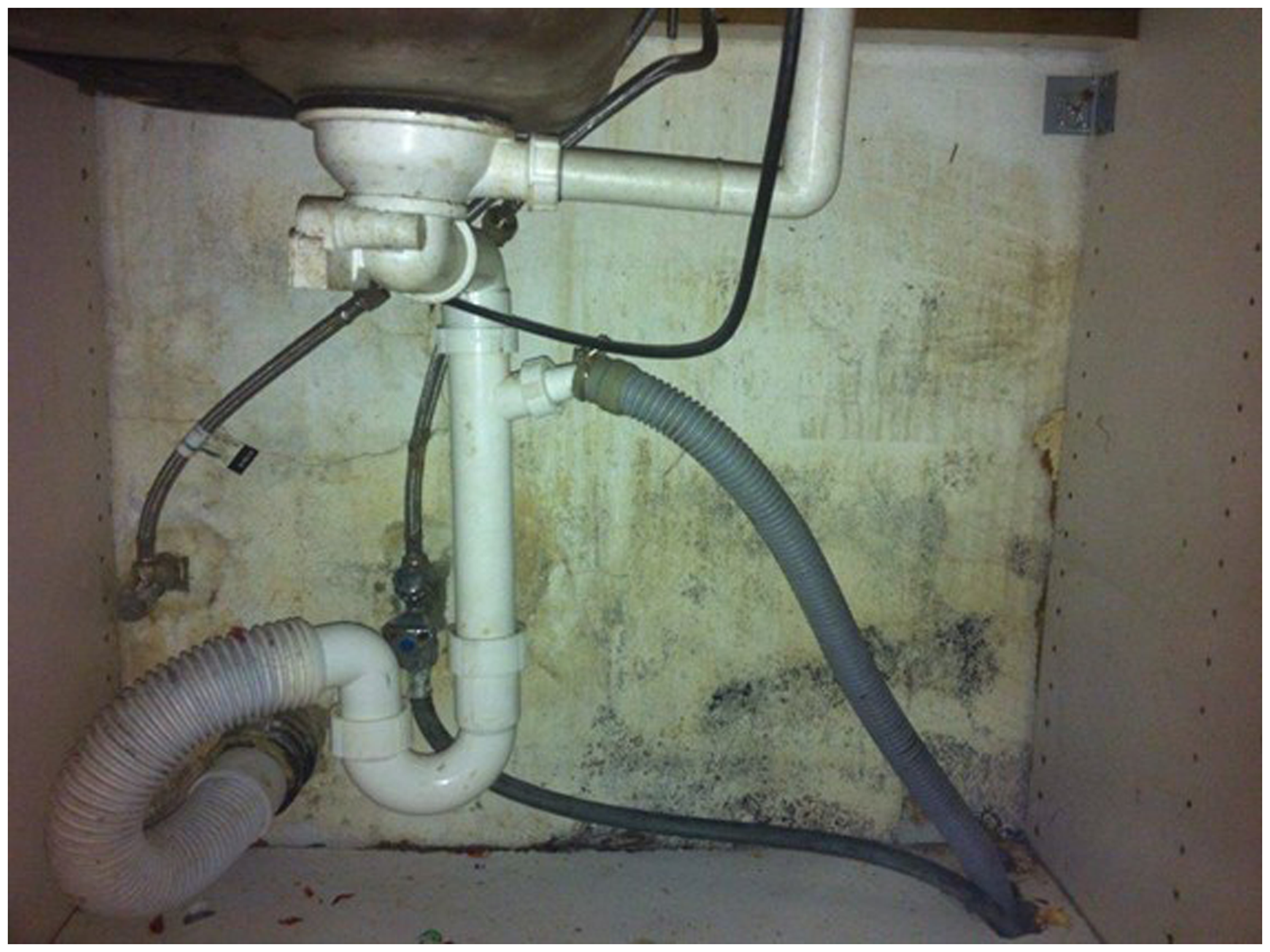
Water conduits on the kitchen sink and moldy back wall in a Berlin flat © “Lenny.”
The unintended presence of water can be caused by different sources converging upon buildings from different vertical or horizontal directions. Water can invade buildings from beneath the ground through leakages in wastewater systems, rainwater runoffs, unstable groundwater levels, and many more out- and overflows. In contrast, water can also permeate from above in continuing heavy rainfalls or depositions of water or even snow on the roof that cannot drain off. Rain and wind, however, can also bring in moisture laterally either directly through apertures like windows or slowly through absorption by outer walls. Importantly, the degree of damage (if at all) and subsequent contamination always depends on the architecture and construction of buildings, including all obstructing building materials and their (im)proper installment and balanced arrangement. The same can be said for moisture that stems from inside sources like steam or evaporation as commonly caused in bathrooms and kitchens, for instance. Besides human behaviors which impact ventilation, constructional faults like thermal bridges that cool off wall areas and angles due to their problematic thermal conductivity also effect their inside-outside transmission, that is, their capacity to conduct or block heat flow. Furthermore, inhabitants rely on further water infrastructure to shower, cook, do the dishes, clean or flush that connects them not only to the civic urban water system but also to others in adjacent flats, bordering houses, neighborhoods, and their community.
In all these well-designed and planned urban connectivities, occurrences of mold, like rats, are an abject reminder that, no matter how sanitized and clean, both in symbolic and literary terms, our cities have become, the “urban trash” in the form of networks, dirt, sewerage, pipes, homeless people etc. (Davis, 1992) keeps lurking underneath the city, in the corners, at the outskirts, bursting out on occasion in the form of rats, disease, homelessness, garbage piles, polluted waters, floods, bursting pipes etc. They remain stubborn reminders of the materiality of the networked city, while threatening the city's existence. (Kaika and Swyngedouw, 2000: 136)
Mold crops up in the combination of what lies underneath the city in the form of (un)structured watery networks, materialities, and ecological aggregations as well as what circulates above and through it in the form of rain, air, and contaminants like spores. These flows cannot be fully controlled, and are susceptible to faults and the formation of inadvertent biotic habitats through leaks, cracks, and fractures in the modern city's socio-technical skeleton and (an)organic underbelly.
Formulated in terms of Swyngedouw's and Gandy's inscription of “cyborg cities/urbanization” (cf. Gandy, 2005: 27, note 1; Haraway, 1991), “mold” is nothing less than an unruly hydrological cyborg fungus—hidden yet always ready to be visibly transformed—enhancing its organic mobility and pathological capacity wherever circumstances invite its spores either to pass by, pass through or in the worst case settle down to colonize all sorts of structures for its own biochemical metabolism. In this sense, urban infrastructures built from human labor for human needs inadvertently become more-than-human “life-support systems” (Gandy, 2005: 28) that (co)produce nonhuman mobility. At the same time, it is worth paying more “attention to the myriad indoor spaces found in cities or their connections to circulation flows of nature, capital and power” (Biehler and Simon, 2010: 175). What happens when mold’ “cyborg spatialization” gets utilized on purpose in capital investments and accumulation can be understood through the idea of mold's “spatial fix.”
Mold's spatial fix
David Harvey's (1981) prominent notion of the spatial fix of capital in the urban economic landscape (cf. Harvey, 2006a: 233) can be related to mold's “spatial fix” in both fixity and in terms of a possible solution. The two are analogous in some ways.
Like the spatial fixation of capital in a landscape in Harvey's case, the fixation of mold spores through a grown colony on commodities and structures enables the potential to generate the same amount (perishables that have rotten before consumption and get rebought in the next supermarket) ore even more capital than it's destroying. One might think here of a building after a fatal water damage, now in poor condition and of low economic value, that gets demolished, rebuilt and thus increases in value afterwards (not to mention the consumption of work force, new materials, etc. that generates a financial loss for the owner but revenues on the market). However, the two uses of the image are not strictly parallel: mold does not “pay a price” for its fixation in place in the same sense that capital's fixation eventually leads to levels of surplus-value generation below what could be achieved elsewhere. The two kinds of spatial fix may be articulated in the sense that if mold anchors itself in place too strongly, its spatial fix can accelerate the devaluation of property, thus resolving the problem posed to capital by its own spatial fixation in the built environment.
Contaminations of mold as spatially fixed colonies can both block and enable the circulation of capital in buildings. Initially, an untreated growth of mold lowers the economic value of buildings as they devalue the structural condition but, in some cases, this unhealthy event is deployed against unwanted recalcitrant tenants who do not want to move out but cannot or will not afford to remove and repair such damages. This occurs in conflicts about living spaces where estates and buildings are marketed to new investors who want to sell, transform, or rebuild dwellings that are still occupied and what poses a certain problem to the circulation of capital, something that can also be understood differently with Harvey (2006a: 233): “Immobility in space means that a commodity cannot be moved without the value embodied in it being destroyed.” Mold, in other words, can be an accelerator of gentrification when purposefully ignored by owners of built capital. In this sense then, the durability and temporality of mold's spatial fix becomes an important resource to be used against “intractable” renters. The case to follow helps to demonstrate the entanglement of the second and third aspects of Rotten Capital. It directly addresses the question of Rotten Capital as an unavoidable dimension of capital in the more conventional sense of the built environment that needs to be compatible with the value-accumulating function of capital. Thus, here the “rottenness” gets immobilized and made productive in the form of intended obsolescence.
One such case emerged in 2017 in the southern part of Germany. Figure 2 shows an initial excerpt from fieldnotes recorded when I first met the daughter of the tenant (her mother) before also talking to the tenant later on and gathering more detailed data from the family. The daughter described her case with courageous honesty but also a certain shame and resignation regarding the situation.
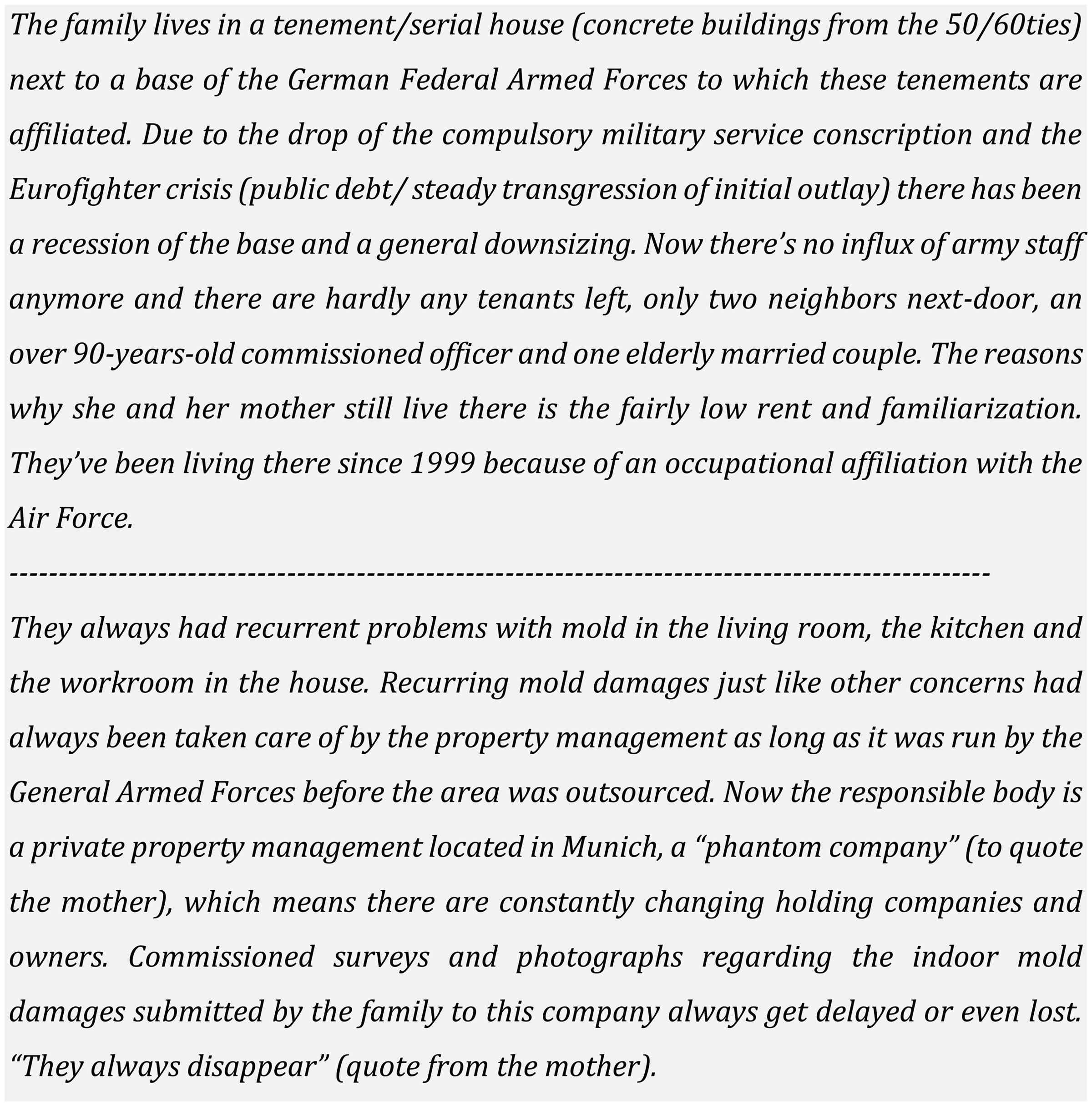
Excerpt from fieldnote “Sarah's case,” May 2017 (translated from German by the author, emphasized accentuations in original).
The key problem, in this case, was that the property and buildings still belong to the Federal Armed Forces and so far, no deal could be made with the city or other prospective buyers, leaving the tenements in a state of abandonment and surrounded by creeping decay as nobody is willing (or able) to invest any more. The property cannot be demolished or sold as long as parts of it are still occupied, leaving it locked in an unsatisfactory intermediate state of little value and almost no profit for capital, and diminishing use-value for renters. In this regard, water and mold damage are a form of indirect pressure on tenants. The interchangeable “phantom companies” diffuse responsibility and remain unwilling to invest as long as there are still rental contracts in force. However, in other cases observed in Berlin (at Kottbusser Tor for instance), tenants are knowingly left with mold damages in their flats on behalf of owners who try to get longtime tenants to clear their old flats.
3
While refusals or abatements of rent payments could be attempted as a form of resistance, such strategies often only work out when authorized by a court, at least in cases in which other sorts of more gentle communication and agreements seem impossible. Such cases where inhabitants are arbitrarily or purposefully abandoned to a state of domestic pollution by damages of mold can be seen as a more indiscriminate form of what Thom Davies (2018, 2024; cf. Nixon, 2011) refers to as “slow violence” in the exposure of communities to toxic petrochemical pollution in the context of environmental (in)justice. Here, the crucial nexus lies in the interlacing of polluted space with time and matter: Temporality and toxics have a dialectical link. In an empirical sense, within the field of toxicology, time is an important factor that determines the level of bodily damage that a toxic substance can enact. […] In other words, the longer an individual is exposed to a toxic substance, the more likely he or she is to be harmed. In everyday life, however, beyond clinical conditions and in the less controllable world of epidemiology, time creates significant ambiguity. (Davies, 2018: 1538)
Being left in a state of ambiguity and uncertainty regarding when (if at all) landlords, proprietaries, companies, etc. will finally invest resources to resolve the damaging condition of living with mold can be seen as an issue of urban health (in)justice (Dzudzek and Strüver, 2020). Not being rich in (monetary, social, political) resources, that is, immobilized and/or not being able to move out, refugees, seasonal workers, etc. who have to live in uncared-for places of permanent fungal infestations are thus exposed to a more-than-human form of slow violence. Mold brings a risk to health, and thus, also to the reproduction of labor. Even though the tenant in the case study noted above stated, “at least I have no cancer yet” (Interview IN3, 01.06.2017) the concern over health lingers like the sword of Damocles over her situation. As Rob Nixon (2011: 3) initially states in his important monograph on slow violence, we live in an age where “[f]alling bodies, burning towers, exploding heads, avalanches, volcanoes, and tsunamis have a visceral, eye-catching and page-turning power that tales of slow violence […] cannot match.” But it is also important to attend to more unspectacular disasters like persistent mold damages.
Returning to the impacts of contamination on capital circulation, mold can have additional valences. For firms doing mold remediation, and for their workers, mold can be seen as a positive factor. In other cases, where unoccupied properties get boarded up and sealed to prevent trespassing, this fosters the proliferation and growth of mold. This kind of ecological decomposition processes increase the chance that a building will finally be demolished rather than renovated by prospective investors in the future, creating completely new possibilities for building and investment. Efforts to prevent one form of accelerated devaluation (occupation by unauthorized persons) can cause a different form of devaluation. In the next section, we will now turn to examples of Rotten Capital that concern cargo and commodities in shipping.
Mold's biosemiotic switch
Regarding comestibles, the decomposing forces of rot (cf. Lorimer, 2016) of which mold fungi are a part, are opposed by social and economic demands for healthy purity and freshness in foods. To combat rot and spoilage we deploy “conserving powers” (Freidberg, 2009: 19) of spraying and injecting comestibles with pesticides, emulsifiers, and other agents, as well as socio-technical apparatuses to prolong shelf-life, like refrigerators and cooling systems. Spores of rot accompany and afflict all sorts of food-related sites from small stalls to big supermarkets. They even endanger the security of political-economic regimes of trade, such as (neo-)colonial enterprises of establishing and expanding imperial and national “foodways” (Freidberg, 2004: 47) or the food systems of the Global North. At all scales, the threat of rot lingers as a danger to the maintenance and transaction of expensive (cold) supply chains and food safety. Here Rotten Capital as it has been examined in the crucial entanglement of aspects two and three regarding buildings can be applied to the urban metabolism of food and waste, trade and disposal that reflects yet another productive form of obsolescence and “creative destruction” in terms of (re-)producing demand, durability, and expiry.
Key to the trade in fruits—perishables that are especially susceptible to fungal rot is a preferably constant availability of foreign and summer fruits throughout the year, coupled with standards of freshness, shape, and color. Yet, as Susanne Freidberg (2009: 123) reminds us, good looks obviously don’t guarantee good taste. At one time or another we’ve all fallen for the beautiful and the bland. We’ve grown used to disappointing supermarket fruit—mushy waxed apples and giant watery berries, peaches that go straight from rock-hard to rotten—just as we’ve grown used to blaming the supermarkets for our disappointment. After all, it's their long-distance distribution systems that demand varieties as tough and durable as baseballs.
Cargo containers are a key part of long-distance distribution systems. Whether loaded with foods or other resources and commodities, they are delivered by ships traveling through rough seas and weather, transported on railways and roads, and are often coated and sprayed with chemicals when opened or closed to prevent or eradicate intrusive vermin and microbes. These containers also build sealed breeding boxes for mold, which finds a hospitable habitat on loaded goods, woody stillages, cardboards, and anything else they can digest while traveling around the world (see Figure 3).
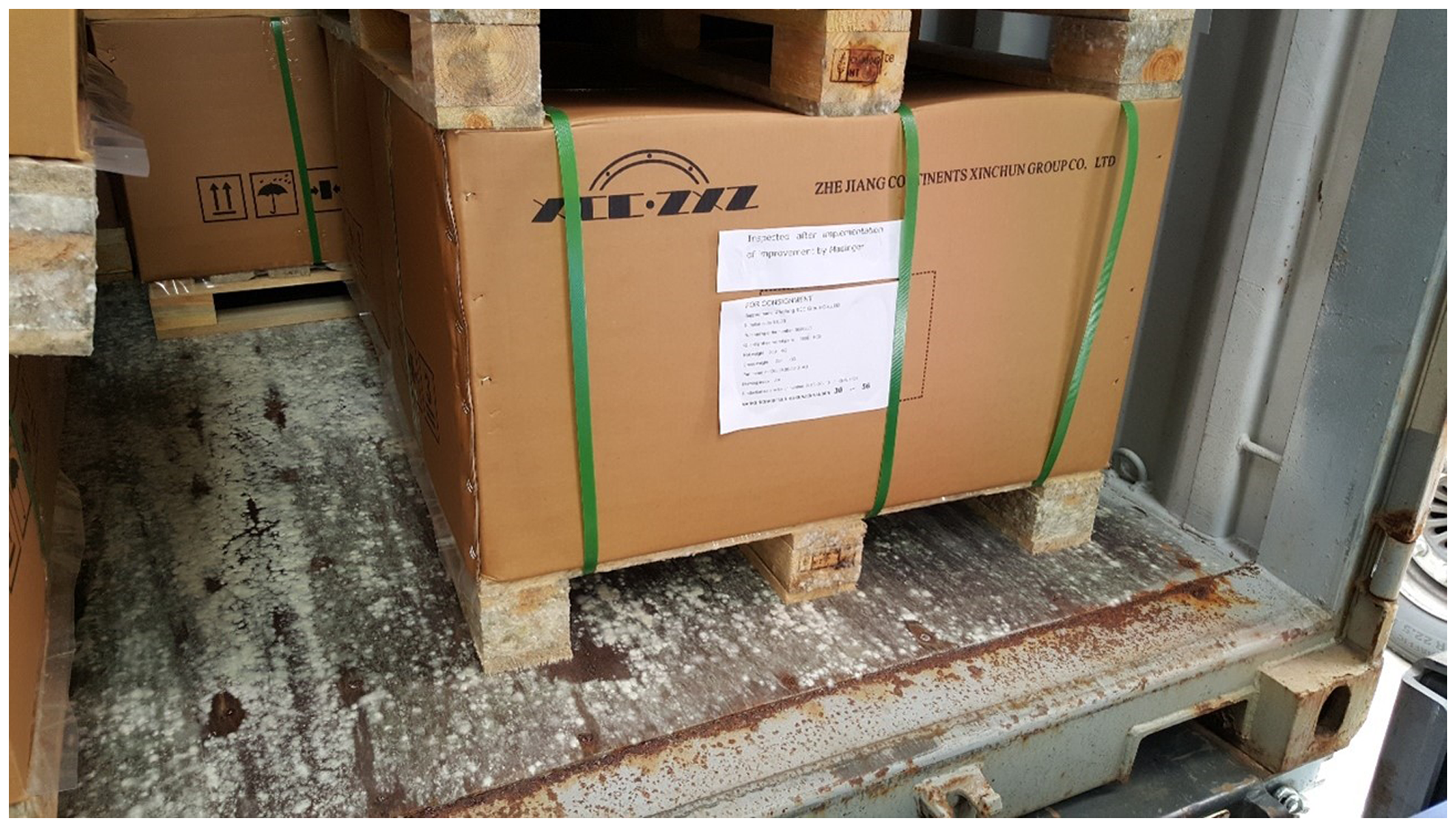
Mold on loaded maritime cargo container, cut-off from the supply chain and interim stuck in a visited decontamination center © Binker Materialschutz GmbH.
Put differently, whereas commodities need to be mobilized to circulate between destinations from producers to distributors and consumers, within the bolted spaces of cargo containers there is the insufficient circulation of air. Combined with infiltration of moisture and a favorable range of temperature (depending on specific sorts of mold and settings, ranging from ca. 20°C to 35°C, while 0° to 60° is nevertheless possible in some cases), this can cause serious market disruptions in terms of time and cost-intensive cargo delay for quarantining and cleaning loads and containers. Regarding comestibles, David Goodman (1999: 17, emphasis in original) notes that the metabolic relations of agro-food networks involve a two-step process: on the land, where agricultural nature and its harvest are co-produced and co-evolve with social labour, and at the table, where these co-productions are metabolized corporeally and symbolically as food.
Between these two termini, cargo transport and logistics constitute yet another important intermediate step in “a train of monetary and commodity transactions across space” (Harvey, 1996: 150). These transactions, spatiotemporally located between food production and consumption, between land and table, contribute to the metabolization of resources, labor, and capital in the process of supplying human populations with foodstuffs. All along this chain mold can fixate spatially when given enough time by means of delay, stoppage, or other “deficits” like initial overproduction or extended non-consumption while sitting in fridges or pantries.
In addition, mold is entangled with many crucial drivers of foodwaste (cf. Blakeney, 2019: 69–97). It connects ordinary decisions on the edibility of foodstuffs in the domestic governance of households to the circulatory flow of production, containment, and disposal of waste in cities and their environs, as the “metabolic cycle is not completed until the waste and residues of daily life have been removed and disposed of with a minimum of nuisance and hazard” (Wolman, 1965: 179). In this regard, the fungi's devaluing of food, metabolizing edibles into unhealthy rotten organic materialities, connects mold to food waste (cf. Evans, 2014).
Mold can be seen as a semiotic signifier or biologic indicator for proceeding rot. It constitutes what can be referred to as a “biosemiotic switch” in edibles that together with human agency often transforms valued commodities like foods and other goods (like books, files, mattresses, clothes, and other textiles) into devaluated waste which then gets entangled in costly municipal efforts of waste management and disposal. A biosemiotic switch is a binary function that turns goods like food into waste, when a threshold is crossed through the activation of social (disgust, fear, conduct, etc.) and biological (rot, organic decay, and toxicity) triggers semiotically coded through a mold. While moldy rotten foodstuffs are therefore part of post-consumer waste, they are not easily recyclable in the sense of “recovery of re-usable materials from the municipal waste stream” (Gandy, 1994: 21) but they are, nevertheless, highly compostable. The “on-going metabolic activities of the bin” (Abrahamsson and Bertoni, 2014: 134) often merely begin with disposal. Indeed, it is the metabolic process of fertile decomposition that connects mold to food and waste, and which therefore relates humans to humus in disposal. This can in the right circumstances, create new earthy value for all sorts of lives “in every mixing and turning of the terran compost pile” (Haraway, 2016: 97). The transformation of gustatory materials into disgusting waste via this biosemiotic switch is a gradual, temporal and relational process of visceral sensing and sense making (Evans and Miele, 2012) that focuses upon locating the affective brink of edibility through carefully re-valuating comestibles by look, smell and taste before disposal and even afterwards in attempts at food saving (Schemann, 2020: 158–161). In terms of the reproduction of labor power, the disposal of food waste also relates to questions of the “household economy.” Here the wastage and spoilage of everyday vital goods like food simply raises the costs of bodily reproduction. On the one hand, already bought and paid goods get thrown away unused while on the other hand, the threat of mold and decomposition, codified in sell-by dates, accelerates demand.
In summary, mold's biosemiotic switch of valued/devaluated food/waste is an important factor in the socio-material lifecycle of foodstuffs, themselves a crucial dimension of urban metabolism. However, responses to mold in this context differ from responses to mold in buildings. The ability to quickly contain, bin, and dispose of mold-infected food as “subsequent ordering acts that aim to correct disorder” (Hetherington, 2004: 162) is lacking with regard to mold on the static structure. The potential impacts of mold on the reproduction of labor power are different from its impacts on the creation and destruction of fixed capital.
Conclusion
In this article, I have attempted to place mold within discussions of urban metabolisms in UPE. Mold, like other organisms, is often invisibly enrolled and coproduced through socio-technical networks that have been described as having “cyborg” qualities. This seems to happen quite “naturally” (by means of their biological and biochemical capacities), but mold harbors abundant possibilities for altering the obsolescence (whether in a planned or an unplanned way) of built materialities, resources, and commodities crucial for perpetuating the circulation of capital as well as the reproduction of labor power. Investments (e.g. in buildings) and consumption (e.g. of foodstuffs) can be significantly affected by the dynamics of mold growth. Mold's spatial fix may play a role in slow violence perpetrated upon tenants facing structural decay, and more generally in accelerating processes of creative destruction that resolve the problems generated by the spatial fixation of capital in built environments. Focusing on foodstuffs in turn, mold's biosemiotic switch is a source of loss and waste production that turns “officially valued” commodities into “outcast surplus” (Collard and Dempsey, 2017), linking mold to urban networks of supply and disposal.
The goal has been to enrich UPE by adding the phenomenon of mold to conceptualizations of metabolism as a form of more-than-human agency that oscillates between flux and fixation. In turn, different processes of value and capital become involved in both the proliferation and control of such Rotten Capital. The relational concept of “Rotten Capital” has thus been developed to help follow the moldy entanglements or assemblages (cf. Braun, 2006; Kinkaid, 2019) that co-configure various urban metabolisms. The three key characterizations of mold as hydrological cyborg fungus, as spatial fix, and as biosemiotic switch suggest that the concept of “Rotten Capital” might be seen as a fruitful nexus to assemble and bring into dialogue different more-than-human agencies and configurations in different urban spaces. Impacts of building and materialities as well as socio-ecological influences of water, wind, weather, etc., also contribute to moldy mobilities, as do the circulation and distribution of infrastructures, cargo containers, or commodities. Mold crosses different socio-spatial, economic, and political boundaries whenever it territorializes.
Further work could help to develop the concept of “Rotten Capital” in different directions, for example, either by broadening the scope to encompass other nonhuman lives than mold fungi or by narrowing the scope and directing attention towards specific genera of mold fungi (Cladosporium, Aspergillus, Penicillium, Mucor, Fusarium, etc.), focusing the biological, ecological, or socio-technical specifics of different categories. I have grouped those mold fungi as contaminants in light of their shared common capacities for developing a more extensive and inclusive framework of Rotten Capital. Yet, these two suggested directions for further inquiry might reveal not only other emergent entanglements in the mold multiple but also help to flesh out other inequalities and conflicts involved in the generation, control, and eradication of abject lives whenever they cross and exceed well-established frontiers of our increasingly purified living environment.
Highlights
Brings mold metabolisms into dialogue with urban metabolism in UPE Highlights the role of more-than-human urban metabolisms in capitalist natures. Introduces the concept of “rotten capital” as a critical mode of urban metabolism in the wider logic of capital circulation and accumulation. Exemplifies the concept of “rotten capital” through mold as hydrological cyborg fungus, mold's spatial fix, and mold's biosemiotic switch.
Footnotes
Acknowledgements
I would like to thank the three anonymous referees for their insightful reviews of this paper and Matthew G. Hannah for his substantiated remarks on different drafts of the manuscript. Parts of this article have also been presented at a lecture series on “Abject Lives” at MLU Halle-Wittenberg in 2021, the AAG Annual Meeting in New York in 2022, and the DKG 23 in Frankfurt 2023 where I received a lot of fruitful feedback and recommendations informing the idea of “Rotten Capital.”
Declaration of conflicting interests
The author(s) declared no potential conflicts of interest with respect to the research, authorship, and/or publication of this article.
Funding
The author(s) received no financial support for the research, authorship, and/or publication of this article.