




Abstract
This article examines the River Wye in the southwest UK as a political ecology marked by relations of colonial inheritance. A controversial case of contemporary British river pollution, the Wye is suffering from increasingly dramatic eutrophication events, with nutrient pollution from mineral phosphate fertilisers used in industrial agriculture causing algal blooms that destroy the river's ecology. This paper complicates dominant framings of the Wye's eutrophication as a local event and future crisis, instead arguing that eutrophication is structured by over a century of colonial histories of phosphate. Motivated by recent debates in geography and other cognate disciplines on decolonial ecology and the Plantationocene that point to the colonial origins of ecological crisis, this paper develops a theoretical framework of inheritance/transmission to articulate the situated histories of violence and dispossession shaping phosphate matter. It then empirically tracks the phosphate inheritances of the Wye by analysing the archives of the British Phosphate Commissioners (1873–1983), a 20th century governmental company that procured fertiliser for the British Empire by intensively mining phosphates on the Pacific Islands of Nauru and Banaba. Through this archive emerges a history in which, on a national and local level, the Wye is connected to the people, corporations, and institutions responsible for the emergence of the mineral phosphates industry that has spread ecological devastation across the globe. Through theoretically and empirically examining the Wye's phosphate inheritances, this paper foregrounds ethical obligations to think systematically and historically about phosphates as a prerequisite for bringing about deep structural changes needed to repair phosphate's harms.
Introduction: Murky waters
The River Wye is dying; at least, this is what many of those who know it best have claimed. Known as the ‘birthplace of tourism’ and deemed Britain's favourite river (DEFRA, 2024), the Wye (Figure 1) is gaining a reputation as a shocking case of contemporary river pollution. Of particular concern is eutrophication, a form of nutrient pollution whereby an increased availability of phosphorus (P) or nitrogen (N) sparks an explosion of algae in the water. In a eutrophicated—literally meaning ‘well-nourished’ (Trombley, 2018) – river, algal blooms block sunlight, kill plants that oxygenate the water, and thus destabilise the entire riverine ecology.
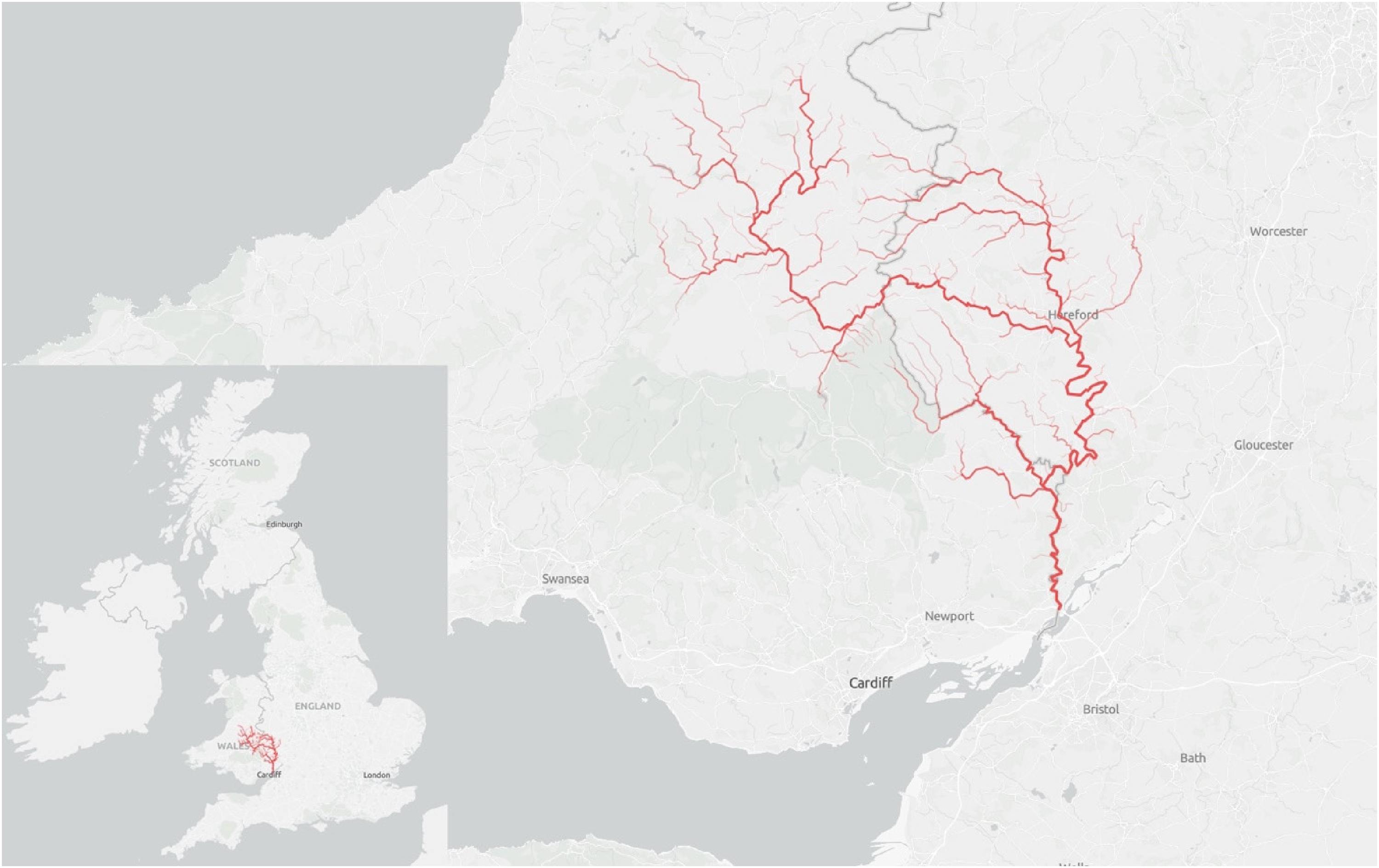
River Wye, Southwest UK. Made using ArcGIS Online.
Multiple forms of pollution can increase the availability of P or N in water (Radomska and Åsberg, 2022). However, it is nutrient pollution from agricultural mineral phosphate fertilisers that is eutrophicating the Wye (Environment Agency, 2022; Withers et al., 2022). This has been linked to a series of large Industrial Poultry Units (IPUs), constructed throughout the 2010s, that transformed the Upper Wye Valley (UWV) into the ‘poultry capital’ of the UK (Cutcher and Levitt, 2023: np; Caffyn, 2021). Like other post-1950 concentrated animal feeding operations presented by industry as ‘marvels of efficiency’ (Sayre, 2023: 1208), UWV IPUs have been critiqued as sites of animal cruelty and ecological devastation (Ungoed-Thomas, 2024). One of the major ecological concerns is chicken excrement. In the process of transforming ‘chickens to poultry’ or ‘broilers’ (Williams and Freshour, 2022: 42), 30 million birds are placed in cramped and filthy conditions; here they produce vast quantities of manure that is rich in phosphates from the heavily fertilised soy-based chicken feed they are forced to consume. Farmers then spread this surplus ‘waste’ on fields, and it enters the Wye as run-off (Cutcher and Levitt, 2023). Thus, following patterns of industrial agriculture's metabolic ‘rifts and shifts’ identified by critical political-ecological scholars (Clark and York, 2008: 13; Gunderson, 2011), nutrients intended for broiler chickens outlive their ovine hosts and instead nourish algae in nearby waterways, sparking eutrophication events that turn Britain's favourite river into a foul-smelling ‘pea soup’ (McKie, 2020: np).
The Wye's eutrophication has been heavily reported across British media. Environmental journalist George Monbiot has been at the fore of this, arguing that recent failures in the planning systems have enabled IPUs to be built and are thus responsible for turning the Wye into an ‘open sewer’ (Monbiot, 2021, 2022: np). Coverage of the scandal has been amplified within the context of a wider crisis across Britain's rivers. In 2020, it was declared that all of Britain's rivers were heavily polluted (Laville, 2020; Tsouvalis, 2023); water quality has since become a major political focus and the Wye has become a symbol of the crisis, with the dramatic contrast between its picturesque past and ecologically degraded present a particularly emotive narrative hook.
Media discourses are echoed on the ground. Between 2021 and 2023 I conducted 23 in-depth, semi-structured interviews with people who live and labour on the Wye, including scientists, policy makers, NGO workers, and anglers. Interviewees mostly framed eutrophication as a novel issue emergent within the last decade and contrasted this to the idyllic history of the Wye. As one interviewee, a salmon angler who had lived on the Wye for over 50 years, glumly put it to me: ‘I’ve known this river my whole life, I’ve loved it my whole life. And it took them less than ten years to destroy it’ (research interview, 2023). Eutrophication was subsequently narrated as an urgent crisis in need of management. Most interviewees argued that, with fast action, true catastrophe might be avoided. On the Wye, well-funded charitable initiatives have leapt into action and conservation projects have been set up to monitor and address eutrophication; as the head of one of these organisations put it to me: ‘We’ve rung the media klaxon, heads have turned, we’ve got the money, and now it's time to get on with the job of cleaning up while it's not too late’ (research interview, 2022). Most interviewees shared this emphasis on swift and decisive leadership as key to tackling the crisis and hoped that things might return to normal on the Wye.
The purpose of this paper is to unsettle the temporal and geographic imaginaries that frame this discussion of eutrophication. Rather than seeing the Wye's eutrophication as a local crisis and urgent event, this paper argues that it is a result of long-running and wide-reaching historical structures. I make this argument via an in-depth inquiry into the histories of phosphate fertilisers. While much attention has been given to IPUs, far less has been paid to the phosphate fertilisers that make factory farming possible and cause nutrient imbalances in the water. I ask, in order to challenge these taken-for-granted approaches to phosphate fertilisers: where do they come from? How do they come into being? Why do they come into being?
This paper's central argument is that colonial histories structure the presence of phosphate fertiliser in the River Wye. As I will show, the British Empire, in pursuit of wealth, resources, and scientific knowledge, was a key player in bringing about the ecologically and socially violent mineral phosphates mining industry; this troubling legacy is seldom, if ever, mentioned in discussions of the Wye and similar cases of eutrophication. I foreground this legacy by analysing the archives of the British Phosphate Commissioners (BPC), a 20th century government-controlled company that, from 1919 to 1983, procured fertiliser for the British Empire by mining phosphates on the Pacific Islands of Nauru and Banaba, pioneering an extractive model the global phosphate fertiliser industry still follows to this day. Read through the lens of these fragmented histories of the British Empire, the ostensibly local and novel crisis unfolding on the Wye is instead understood as resulting from deeply ingrained colonial systems and structures.
The stakes of this analytic shift are significant. It calls for an ethical response that goes beyond familiar technocratic grammars of conservation management and instead articulates a decolonial approach that situates the Wye as part of a wider system of imperial violence that extends beyond even the territories of the former British Empire. As I will show, this system stretches from the Wye's algae riddled waters, to, inter alia, the hollowed-out mines of Banaba and Nauru, the soy plantations of Brazil, and the phosphate rich deserts of the Western Sahara. The shift I propose demands that we develop critical concepts for examining the relational worlds brought into being by imperial histories of phosphate extraction, an intellectual and empirical challenge that I argue is one essential component of wider struggles to resist and dismantle coloniality.
I turn to recent theories of ‘decolonial ecology’ developed in geography, political ecology, and cognate disciplines to develop critical concepts for analysing the fragmented imperial histories of phosphate (Ferdinand, 2022). Decolonial ecology has been theorised in divergent ways, but I am particularly interested in its articulation via the Plantationocene concept (e.g. Haraway et al., 2016). I contend that the Plantationocene, with its emphasis on colonial models of land management and racialised labour forces as productive of contemporary ecological crisis, offers vital tools for conceptualising the Wye's imbrication in wider colonial and imperial structures via phosphate histories. However, considering recent critiques of the Plantationocene's ontological flatness and its tendency to obscure differences between historically situated geographies (e.g. Davis et al., 2019), I also seek to critically develop the concept. I do so by mobilising Heather Davis's concept of inheritance/transmission, which she advances to track histories of ‘plastic matter’ (2022: 1), as a framework for tracking how flows of phosphate matter are structured by racialised colonial and imperial histories. Although not originally tied to the Plantationocene concept, I argue that inheritance/transmission offers critical tools for countering its ethical ambivalences.
This paper thus weaves together empirical and conceptual contributions. I contribute to empirical analyses of the Wye's current crisis by identifying ongoing histories of colonialism and empire, materialised in phosphate, as the source of eutrophication; I therefore highlight the stakes of my decolonial analysis of the Wye that considers it alongside other geographies marked by phosphate extraction. My conceptual contributions to wider decolonial ecological literatures emerge through my careful engagement with the Plantationocene. My uptake of the concept confirms its utility in developing more historically nuanced analyses of environmental crisis. However, my intervention also significantly extends the concept by using it to consider how colonial and imperial plantation logics ‘boomerang’ back to Europe (Césaire, 2000 [1950]; Koram, 2022), and by developing inheritance/transmission as a lens that examines how different kinds of sites get woven together through systemic Plantationocene histories without erasing difference.
The rest of the paper proceeds as follows: ‘Theorising Decolonial Ecology’ first explores the Plantationocene literatures that inform this paper and maps the framework of inheritance/transmission. ‘Tracking Phosphate Matter Inheritances/Transmissions’ then uses the records of the BPC to examine in detail the specific histories that have brought ecologically harmful phosphate fertilisers into being and that constitute the Wye as a space of colonial inheritance. The concluding sections return to the physical space of the Wye to re-iterate my call for understanding its contemporary crisis through the analytics of decolonial ecology.
Theorising decolonial ecology
Foregrounding colonial histories: Welcome to the Plantationocene?
The Plantationocene is an increasingly important concept for theorising decolonial ecology that seeks to historicize contemporary ecological arrangements as emergent from histories of colonialism, slavery, and empire. Breaking with the Eurocentric industrial emphases of the Anthropocene and Capitalocene (Moore, 2015; Steffen et al., 2015), the Plantationocene concept was initially developed to underline the foundational role of the transatlantic slave plantation economy in founding capitalist modernity and thus the current ecological crisis (Haraway, 2015). Drawing on historical political ecologies of empire (e.g. Crosby, 1986; Grove, 1996), early Plantationocene scholarship also sought to foreground processes of Columbian Exchange that underpin contemporary ecological collapse, with ‘the historical relocations of the substances of living and dying around the Earth’ (Haraway et al., 2016: 557) resulting in ‘feral’ ecologies (Bubandt and Tsing, 2018: 5).
The Plantationocene has since become a polyvalent concept. It has been theorised from a plurality of plantation geographies beyond transatlantic slave plantations (Paredes et al., 2024), including contemporary monocrop plantations across the Global South (Chao, 2022a; Chao, 2022b; Li and Semedi, 2021; Barua, 2024; Paredes, 2023). Others have tracked the epoch-defining influence of plantations ‘beyond agriculture’ altogether (Ferdinand, 2022: 47). For example, political ecologist Stock (2023) theorises solar parks as energy plantations, while Aikens et al. (2019) argue that mineral extraction mines are akin to plantations. This wave of Plantationocene literature thus goes beyond the specific institution of the plantation to track the systemic spread of ‘plantocratic logics’ (Stock, 2023: 163; Wolford, 2021).
The Plantationocene is a promising conceptual scaffolding for my decolonial ecological analysis of the Wye. In particular, by foregrounding the deep colonial histories and logics of racialised land and labour management underpinning contemporary processes of ecological change, the Plantationocene provides an epistemic foundation for looking beyond the veneer of sensational scandal and local crisis that currently frames the Wye's eutrophication. Innovative studies of the spread of plantocratic logics beyond agriculture are particularly helpful here, enabling me to conceptualise the processes tethering temporally and geographically dispersed sites of phosphate production and consumption. In doing so, the Plantationocene also helps open the way for me to analyse how imperial histories of socio-ecological violence ‘boomerang’ back to ecologies of the former metropole (Césaire, 2000 [1950]; Koram, 2022).
Yet despite this promise the Plantationocene also contains a key tension. Specifically: in identifying in plantations a logic that travels beyond their traditionally imagined boundaries, how do we avoid erasing important distinctions between geographies that have been constituted by different sorts of colonial power? How might one articulate the plantocratic logics underpinning the Wye's crisis without flattening the profound differences between a river in rural Wales and England and, say, a sugarcane plantation produced using the labour of enslaved West Africans in the Antebellum south? Plantationocene literature has been extensively critiqued for its ontological flattening of a violently particular historical geography (Barua, 2023; Besky, 2022; Davis et al., 2019; Jegathesan, 2021). For many, this results from a failure to adequately engage long-standing Black scholarship that has theorised plantations by foregrounding the embodied realities of plantation life and Black survival, escape and refusal (McKittrick, 2013; Thomas, 2019; Woods, 2017[1998]; Wynter, 1971), as well as related abolitionist and Black Radical literatures analysing the evolution of plantation logics (Gilmore, 2007; Robinson, 2021[1983]). This citational erasure also extends to pioneering Caribbean plantation studies offering critical socio-economic and empirically grounded studies of plantations and plantation societies (e.g. Beckford, 1999[1972]; Mintz, 1986; Williams, 2022[1944]).
Plantationocene scholars have sought to address these critiques by eschewing overly euphemistic approaches to the plantation and adopting a more reflexive citational praxis (e.g. Chao et al., 2024; Carney, 2021; Ludwig, 2021). However, decolonial critiques of the Plantationocene remain. In particular, it has been drawn into wider debates around the totalising temporalities of ‘-cene’ time (Curley and Smith, 2024; Davidson and Da Silva, 2021; Jackson, 2020). Through this ‘-cenic’ imaginary, the Plantationocene elevates the plantation to planetary epoch, inscribing it in the earth's geology and denying Black and Indigenous senses of time/place. These critiques of the Plantationocene's ontological frameworks and temporal grammar raise challenging questions about whether the concept can articulate the decolonial ecological approach it seeks. And yet, the concept remains helpful to me in its identification of the systemic and widespread ecological transformations triggered by colonial and imperial histories. To chart a way out of this impasse, I suggest a more nuanced mobilisation of the Plantationocene based on a framework of inheritance/transmission. This will enable me to empirically track how the Wye's current crisis has been produced through plantocratic, racialised logics of labour, dispossession, and resource extraction and insist on the importance of a decolonial project of linking the Wye to other geographies of phosphate extraction without flattening difference.
Difference in the Plantationocene: Inheritances/transmissions
Cultural theorist Heather Davis develops inheritance/transmission to theorise flows of ‘plastic matter,’ which refers both to plastic as a material and to the colonial mentalities that ‘fostered the conditions for plastic to emerge in the world in the first place’ (2022: 9). I argue inheritance/transmission can be used to develop a decolonial ecological framework that critically reworks the Plantationocene and allows me to articulate my own critical account of the materialities and logics of the ‘phosphate matter’ eutrophicating the Wye. In this section, I explore three areas where inheritance/transmission critically reworks the Plantationocene and how this applies to my own case study: (a) its ethically situated and historically oriented approach to relationality; (b) its centring of Black and Indigenous temporalities; and (c) its opening of analytical space to study structures of violence over sites of harm.
Inheritance/transmission first reworks the Plantationocene by offering a more nuanced approach to the ways sites get entangled through colonial and imperial histories. In Davis's work, inheritance/transmission names distinct kinds of ecological power relations to plastic matter. Transmission refers to ‘the imposition of plastic, its legacies on multiple peoples, largely racialized and poor, who deal with the intergenerational effects of plastic but are not responsible for its emergence or proliferation’ (Davis, 2022: 6), while inheritance refers to the structural logics of rights, possession, and property that allow some to reap the greatest rewards of plastic matter, even as it also likely causes them some level of harm. Inheritance/transmission is thus an analytic ‘through which difference comes to matter’ (Lehman, 2024: 1; Povinelli, 2021), pointing not to flat ontologies of entanglement, but to complex and ambivalently situated relations of power. By extending inheritance/transmission to consider phosphate matter, I understand the Wye as a geography of inheritance. The Wye is situated in the metropolitan core of the former British Empire which, as subsequent sections will make clear, was responsible for the emergence and proliferation of phosphate matter as a fertiliser. Thus, even as phosphate fertilisers unravel life in the Wye, I argue that it also inherits British colonial logics of property, possession and control that brought phosphate matter into being. In short, inheritance/transmission enables me to attend to the far-flung colonial and imperial histories that underpin phosphate matter and align their connected geographies without collapsing them.
Building on this, inheritance/transmission extends the Plantationocene by allowing a closer engagement with Black and Indigenous relational temporal philosophies (Keeler, 2021). Davis draws on Potawatomi philosopher Kyle Powys Whyte's (2018: 224) framework of ‘spiralling time’ to attend to looped relations between ancestors, current generations, and descendants. Using Whyte's notion of ancestral dystopias, Davis argues that contemporary flows of plastic matter are something those responsible for plastic's proliferation could scarcely have dreamed of, while having long been a dystopian nightmare for many, a move also indebted to Sylvia Wynter's interruption of biocentric, that is essentialising and teleological, temporalities (Wynter & McKittrick, 2015). Inheritance/transmission thus contributes a critical temporal framework to my decolonial ecological analysis of the Wye. It emphasises that the ancestral relations shaping phosphate matter are ongoing and contemporary, and thus creates an ethical onus to tell stories that unsettle dominant crisis narratives framing the Wye.
Inheritance/transmission's final contribution to Plantationocene scholarship is the opportunity it presents to study structures of violence over sites of harm. This move is latent rather than explicit in Davis's work. I develop it, however, by placing inheritance/transmission into dialogue with a decolonial ethical tradition of refusing ‘damaged-centred research’ (Tuck cited in Liboiron, 2021: 34). This is what inheritance does: it is a form of ‘studying up’ that challenges some of the ingrained power dynamics shaping research (Nader, 1974[1969]: 284). Analysing the Wye through the lens of inheritance allows me to approach it as an aperture for perceiving and understanding wider histories of imperial violence that structure phosphate matter, rather than placing the sole burden of representation on other sites we might more readily appreciate as being shaped by processes of imperial harm. Inheritance/transmission thus provides a critical path for unsettling this overreliance on ‘mining’ certain kinds of case studies to furnish our analyses.
Thus, in this section I have developed inheritance/transmission as a theoretical framework for charting plantocratic histories that resists the Plantationocene's flattening and totalising tendencies. Inheritance/transmission makes significant contributions to my analysis of the Wye and to decolonial ecology more generally by developing conceptual tools for aligning geographies connected by colonial histories without collapsing their differences, taking seriously Black and Indigenous temporalities that foreground the ongoing and politically consequential nature of ancestral relations, and developing an ethic of focusing on structures of violence rather than individual cases of harm. Through inheritance/transmission, then, emerges a critical approach to the study of crisis-riddled political ecologies that centres their ethically situated histories. Let us now turn to apply this theoretical framework to analyse the logics and materialities of phosphate matter.
Tracking phosphate matter inheritances/transmissions
Histories of mineral phosphate fertilisers
I start my discussion of phosphate matter with a brief overview of the geochemical, agrarian, and political economic histories that led to the rise of mineral phosphate fertilisers and an outline of mineral phosphate's contemporary global infrastructures. The key chemical component of mineral phosphate fertilisers is phosphorus, an essential building block of life that underpins all forms of biological growth. Unlike other core elements (oxygen, hydrogen, carbon and nitrogen), phosphorus cannot circulate through the atmosphere (Elser & Haygarth, 2021). This is because pure elemental phosphorus is highly reactive and exists mainly in compound form bonded to other elements (Egan, 2023); phosphates are one such compound form, with phosphorus bonded to hydrogen and oxygen. Because phosphorus mainly exists in compound form, humans since the dawn of agriculture have laboured to reroute the slow-moving phosphorus cycle towards their crops and animals via fertilisers.
For most of human history, fertilisers were made from locally sourced organic phosphates found in bones and manure – but 19th century political economic developments sparked a shift to globalised supply chains. Seeking a source of fertiliser that could enable British soils to keep up with the reproductive demands of rapidly industrialising capital, Britain turned to guano, the mountains of accreted seabird and bat excrement that lined the coasts of Peru and Bolivia. The guano trade flourished between 1802 and 1884, a revolutionary era of ‘ecological imperialism’ that facilitated the economic and demographic development of European empires by allowing them to live in the ‘environmental overdraft’ (Clark & Bellamy Foster, 2009: 313). Much has been written about the history of the guano trade, which had major geopolitical consequences for Latin America as disputes over phosphate contributed to a series of ‘guano wars’ along the Pacific Coast in the latter half of the 19th century (Goffe, 2019). Historians have even documented the economic and cultural impact of this trade on the Wye region, where several key guano trading families were based (Kinsley, 2020). However, far less has been written about what happened after ancient mountains of guano had been exhausted by European ecological imperialism.
The transition to mineral phosphate fertilisers began on the eve of the collapse of the guano trade. Mineral phosphates are produced by the fossilisation of organic matter (bones, manure, etc.) in interaction with the earth's crust, soils, and waters. From the 1840s, geochemists developed a process for turning mineral phosphates into a potent fertiliser called ‘superphosphates’ (Packard, 2005[1952]), in which mined phosphatic rock was dissolved in sulphuric acid to make it soluble. This processing of raw mineral phosphates was labour and technology intensive; however, as guano dwindled, mineral phosphate matter became key to enabling industrial agriculture to continue. Indeed, mineral phosphate matter makes the dominant monocrop forms of contemporary global agriculture possible, providing ecologically exhausted soils with a jolt of nutrients that allows them to keep on producing. Mineral phosphate infrastructures have an intricate global architecture. Reserves are concentrated in five countries: China, Moroccan-controlled Western Sahara, the US, Russia, and Jordan (Pistilli, 2023). Smaller operations also exist in Palestine-Israel, with Israel Chemicals Ltd seeking to expand phosphate mining in the Naqab/Negev desert (Rinat, 2023). The rest of the world tends to depend on the source of phosphate closest to them; for example, the UK relies on North African and Middle Eastern phosphates to fertilise its farmlands (research interview, 2023). However, the circulation of phosphate is not limited to a straightforward journey from mine to field; as we have seen, phosphates polluting the Wye originate mainly from soy-based chicken feed that has been grown outside of the UK.
There are growing fears of a ‘phosphageddon’ situation in which this intricate global architecture collapses (Cordell et al., 2009; McKie, 2023). Phosphate reserves are being rapidly depleted, and the mining industry is an opaque and geopolitically vulnerable one. It is characterised by ecological devastation and violent territorial struggles – particularly in Western Sahara, the location of the Earth's largest mineral phosphate deposits and Africa's ‘last colony’ where some 180,000 Indigenous Saharawis have been displaced to refugee camps in Algeria (Allan et al., 2021), Palestine–Israel (Knight, 2023) and Russia (Hook, 2023). Dovetailing with wider concerns over infrastructural security (Bosworth and Chua, 2021), there is a growing narrative that geopolitical precarity threatens to halt flows of mineral phosphate matter.
Yet what rarely features in these accounts of global phosphate infrastructures is an analysis of how they were set up and, until quite recently, controlled by the French and British empires. In 1919 much of the nascent mineral phosphates industry was centralised into two monopolies: the Office Cherifién des Phosphates (OCP), which secured French control over reserves in North Africa, and the British Phosphate Commissioners (BPC), which established British (including its erstwhile dominions of Australia and New Zealand) control over reserves on the Pacific islands of Banaba (then known as ‘Ocean Island’) and Nauru. Though largely forgotten from a European perspective, these Anglo-French phosphate monopolies defined and made 20th-century agrarian regimes and ‘agricultural best practices’ possible (Williams, 2021: 423). The BPC operated until 1983, only decommissioning once phosphate reserves on Banaba and Nauru had been virtually exhausted, while the OCP was taken over by Morocco and continues operating today.
What are these ignored colonial histories of phosphate? How do they continue to reverberate within precarious global infrastructures of phosphate matter and contemporary agrarian regimes? And how does this connect to the phosphates eutrophicating the Wye? I turn to the records of the BPC to answer these questions and to develop an account of the Wye's phosphate inheritance.
The records of the British Phosphate Commissioners (1873–1983)
The BPC archives are a series of 850 files spanning over a century of history (1873–1983) and are part of the wider collection of the Dominions Office of the British Empire, housed at the National Archives in Kew, London. The contents of this vast archive include correspondence between the BPC and various governments, corporations, and individuals across the globe, in-depth accounts of mining operations and life on Banaba and Nauru, bureaucratic records, photographs, and publications. The archive is extremely well preserved: whereas the archives of the OCP were destroyed in the Second World War to prevent their falling into Nazi hands (David, 1980), the astonishing documentary practices of the BPC enables a unique view at the history of the mineral phosphates industry.
My archival methodology was shaped by the decolonial ecological questions this paper asks; I studied these records not to produce an exhaustive historical account of the BPC, but to understand why the British Empire needed phosphate matter and how it went about securing it. This enabled a more selective reading strategy, with a particular focus emerging on the earlier histories of the BPC that give a sense of why and how phosphate came to matter. This method was indebted to anthropologist Katerina Teaiwa's intricate reading of the BPC's Australian archives as a space for producing an ‘appropriately partial view’ of the history of phosphate mining in Banaba (2014: 11). Drawing on Teaiwa's use of BPC archives to track Banaba as a ‘flow of rocks with multiple trajectories and itineraries’ (ibid: 11), I read BPC archives to examine flows of phosphate matter so I can better understand the Wye's phosphate inheritance.
Given this empirical context, I was particularly interested in finding any BPC records that directly reference and discuss the Wye and its watershed region. This was not straightforward: the BPC was not focused on recording in detail how and where phosphate was used in the UK and there was thus no ‘smoking gun’ piece of evidence that neatly documents how phosphate changed the Wye region. There are, however, flashes of the Wye in the archive. Taking my cue from writings on ‘minor histories’ (Gidwani and Reddy, 2011; Stoler, 2009), I approach these ‘archival traces’ as cracks through which vital but overlooked histories leak (Goffe, 2019: 27). This method is particularly essential for a decolonial ecological approach. As Palestinian writer Adania Shibli's work explores, colonial histories are often dismissed as ‘minor details’ and structurally erased from documentary collections (2020: 1). To see the Wye's phosphate inheritance requires a critical and innovative reading of official sources to glimpse the material histories they obscure.
The next section begins this reading with an examination of the BPC's interwar, wartime and post-war archives (c1919–60). Here I bring into view the colonial structure of the early mineral phosphates industry and Britain's leading role in its global architecture. Understanding phosphate's complex entailments across and between colonial empires is, I argue, the first key step in understanding the Wye's phosphate inheritance.
The British Phosphate Commissioners: Phosphate matter's colonial entailments
The BPC came into being on 28th October 1919 with the signing of the Nauru Island Agreement (NIA) by the governments of Britain, Australia, and New Zealand, creating a monopoly on Pacific phosphate run by a board of commissioners from each partner nation. Pacific phosphates had been mapped and identified as ‘best quality’ by leading ‘phosphateer’ Albert F. Ellis at the beginning of the 20th century (Williams & Macdonald, 1985). The NIA conferred approximately ‘50,000,000 tons of the best-known material’ upon the UK (Dickinson, 1920), and mining began immediately, with the BPC inheriting the infrastructure set up by a short-lived predecessor, the Pacific Phosphate Company. This was exciting to many in Britain, especially farmers, superphosphate manufacturers, and members of the colonial government. Pacific phosphate promised the government a vast source of income and it was also anticipated that it would provide a cheap and plentiful supply of fertiliser that would improve the productivity of British soils, stimulate British agriculture, and feed Britain's rapidly growing industrial metropolises (Dickinson, 1923).
However, the UK never got close to receiving the 42% quota of BPC phosphate to which it was entitled. In 1921, a contract was written for the shipment of 215,000 tons of phosphate to the UK, but the contract was cancelled after only 33,300 tons had been shipped due to high transport costs and low demand (Dickinson, 1927). Indeed, the UK received less than 1.45% of BPC phosphate between 1920 and 1939 (Gaye, 1939). This could be understood as a failure. Yet this would miss the important connections across empire that allowed Britain to benefit from BPC phosphate extraction even as it failed to claim its quota. Hoarding phosphate matter within a colonial monopoly transformed the interwar global economy in two key advantageous ways for the British Empire. First, BPC-mined phosphate nourished Australia's wheat fields and New Zealand's cattle pastures, greatly expanding their function as ‘special food producers for the British Empire’ (Dickinson, 1929). Second, knowing that Britain had fifty million tons of phosphate within its empire, Belgian and French superphosphate manufacturers sold their North African-sourced product on the British market at greatly suppressed prices to remain competitive, ensuring a cheap and plentiful supply of fertiliser for British farmers (ibid).
Thus, although only a small amount of Pacific phosphate was ever applied directly to British farmlands, its increasing circulation in the global economy made possible the wider agrarian regimes that transformed British soils (Williams, 2021) and the BPC continued to be vigorously supported by UK-based farmer's unions and agricultural colleges (Dickinson, 1923). BPC archives reveal, then, that phosphate matter was entailed across a globalised colonial British geography that confounds anachronistic projections of contemporary national borders. Through the BPC, the far-flung phosphate histories of Britain, Australia, New Zealand, Banaba, and Nauru emerge as ‘composite’ national histories that all took place within the territorial bounds of the British Empire – including its dominions and its mandates (Bhambra, 2022: 5).
This reading of empire is essential for understanding colonial histories of phosphate matter and the Wye's phosphate inheritances. Building on the work of decolonial ecological scholars, it allows us to grasp a model of extraction that is fundamental to empire, yet that is often obscured and omitted from dominant historical accounts, whereby peripheral colonies and territories provide the ‘conditions for the production’ of resources and technology enjoyed in metropolitan cores (Ferdinand, 2022: 9). Grasping this model allows us to understand the contemporary phosphate inheritances of the Wye. Through the BPC, Britain built a colonial infrastructure of phosphate matter that changed ecologies across the world; as a geography at the heart of the former British Empire, the Wye region structurally benefitted from this infrastructure even when it was not directly connected to it. The Wye thus inherits phosphate matter (Figure 2).
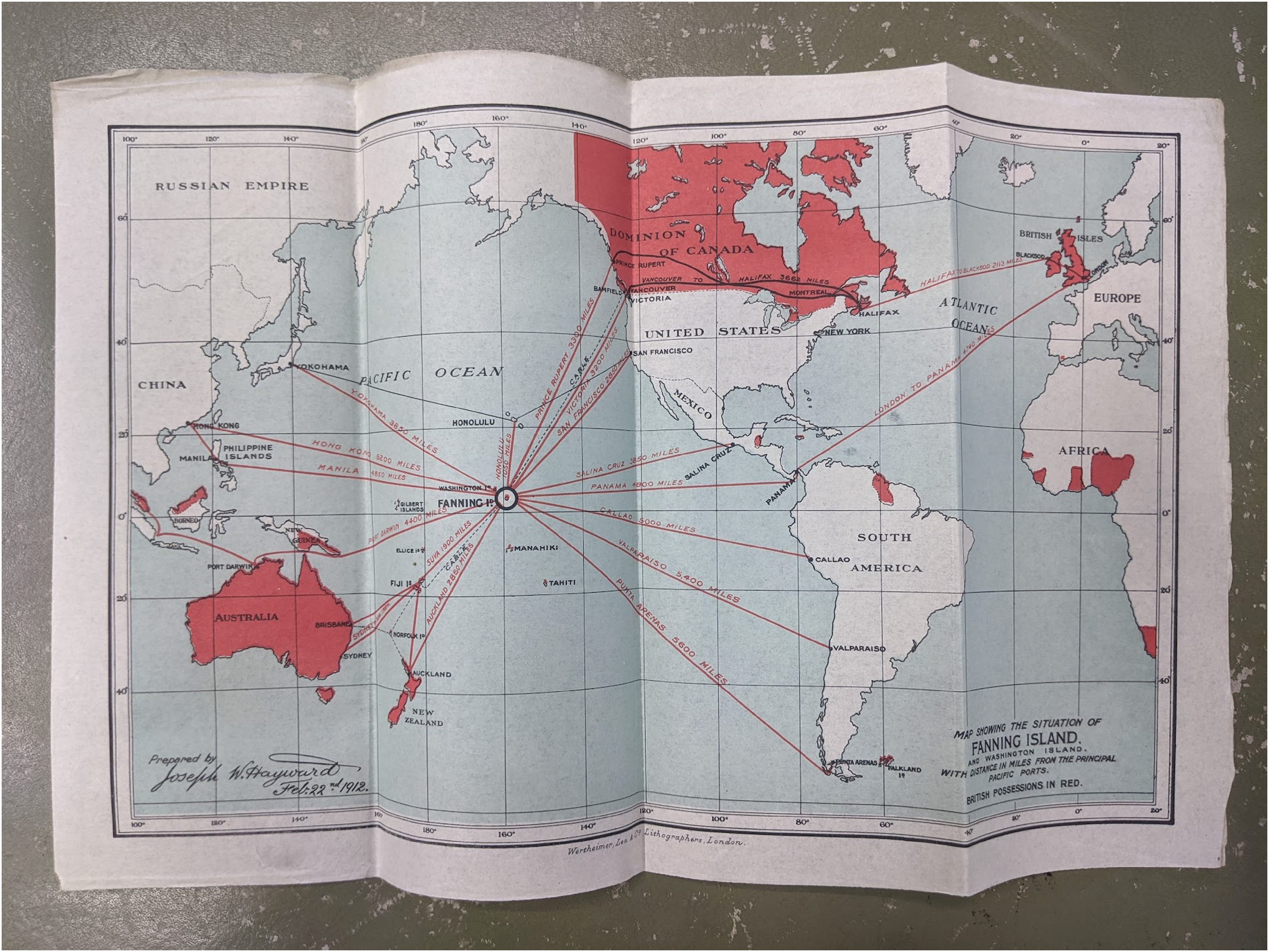
A map showing the contours of phosphate matter's colonial infrastructure and the territories of the British Empire and its Dominions (Pacific Phosphate Commissioners, 1912). The island circled is Tabuaeran (previously known as Fanning Island), another island in Kiribati that was proposed as a potential site for BPC mining.
Wartime and post-war BPC archives reveal that British colonial infrastructures of phosphate matter extended beyond the territories of the British Empire. BPC extraction operations shifted dramatically from 1941 as war expanded into the Pacific. Imperial Japan, which before the war was the only major non-NIA signatory consumer of BPC phosphates (Dickinson, 1927), occupied Nauru and Banaba from 1942 to 1945 to avoid being shut off from the phosphate market (Teaiwa, 2014). The BPC was forced to abandon operations and flee the island. Upon returning to the islands following Allied victory over Japan, the BPC was faced with a landscape of destruction and devastation (Gaye, 1945a). In this dire context, the urgent priority for the BPC was securing phosphate for Australia and New Zealand. When it came to UK supplies, the focus was closer relations with the OCP and French-controlled mines in North Africa. Although it had long been considered that the ‘successful working of the North African cartel’ was a pre-requisite rather than an impediment to British interests (Dickinson, 1930a), extensive communications between the BPC and OCP throughout the 1940s to 1950s testify to their increasingly close cooperation (Gaye, 1945b). Economic interests were never far away in this correspondence, and the mutual focus was, as one OCP official put it, ‘de ne rien faire qui puisse contrarier nos efforts de rationalisation du marché des phosphates en Europe’ [not to do anything that could thwart our efforts to rationalise the European phosphates market] (de Bailliencourt, 1945, translation mine).
Britain's far-reaching influence over phosphate has significant implications for a decolonial ecological analysis of the Wye. BPC archives make clear that it was not only colonial entailments within empires that made industrial technologies of phosphate fertilisers possible, but also imperial connections across different empires. The Wye is thus linked, via phosphates, not only to territories of the former British Empire, but also to, for example, sites of phosphate extraction in North Africa. These infrastructures of phosphate extraction, which today displace Indigenous Saharawis and force them to toil under brutal racialised labour regimes (Allan, 2016; Egan, 2023), could not have come into being without British custom, knowledge, expertise, and support. They are thus also a key part of the Wye's phosphate inheritances.
Thus, as this section has explored, BPC archives reveal that mineral phosphate matter circulated through complex colonial and imperial entailments within and beyond the British Empire. Yet what has thus far been absent from this analysis has been the materialities and presences of the two islands, Banaba and Nauru, that were occupied by the BPC. The next section turns to these islands, using BPC archives to theorise their transformation into phosphate plantations and arguing that this transmission of plantocratic logics must be foregrounded as the core of the Wye's phosphate inheritance.
Phosphate plantations: The transmission of plantation logics to Banaba and Nauru
Banaba and Nauru were radically transformed by the phosphate mining operations of the BPC and its predecessor companies. In this section I argue that these islands, which had been home to vibrant Indigenous societies for over 2000 years (Ellis, 1936; Sigrah and King, 2019), were, in less than 100 years (Teaiwa, 2014), transformed into phosphate plantations. I draw on BPC archives to evidence three major ‘plantation logics’ (McKittrick, 2013: 3) underpinning extraction of phosphate matter on Banaba and Nauru: monocultural resource ontologies that dispossessed Indigenous inhabitants and disrupted their relational ontologies, strategies of Indigenous displacement and relocation that enabled total control of the land, and technologies of racialisation that ensured a cheap and divided labour force. My theorisation of phosphate plantations serves two essential functions. It expands current scholarship on plantations ‘beyond agriculture’ that theorise various extractive industries as plantations (Aikens et al., 2019; Ferdinand, 2022:47; Stock, 2023) by developing an account of a resource that is critical to contemporary ‘agrarian racial regimes’ (Williams, 2021: 422), yet is often overlooked in critical plantation studies. Second, it makes clear the situated histories of transmission that characterise phosphate matter and builds a case for centring these transmissions in an account of the Wye's phosphate inheritances.
The first decades of BPC activities on Banaba and Nauru were characterised by a plantation logic of enclosure and dispossession. Large swathes of both islands, particularly the more sparsely populated coastal regions, were purchased for phosphate mining. This brutal restructuring of land relations was particularly stark on Banaba. Banaba was renowned for its highly unique land relations. Unlike in other Pacific societies, land on Banaba was held by individuals rather than communally (Maude and Maude, 1994; Sigrah and King, 2019). This individual holding of land was radically different from Eurocentric models of property-based ownership; land holders remained interdependent with other human and more-than-human island inhabitants through relational concepts such as ‘te aba’, a Banaban term that refers to both the island and the people that live on it (Teaiwa, 2014: 9).
BPC archives painstakingly document this dispossession of Banaban land. Bound volumes of land deeds cartographically dissect the island, enclosing dynamic and shifting patterns of land holding within static grids of private property (Pacific Phosphate Commissioners, 1901–1911; 1903–1919; 1904–1916; 1905–1917). Each book holds hundreds of deeds (see Figure 3) that map the location and dimensions of the purchased plot and name the original Banaban owner. At first glance, these deeds might appear to archive consensual transactions rather different from the violent enclosure that Marx described as being written in ‘letters of blood and fire’ (1990[1867]: 506). However, while Banabans regularly practiced Indigenous forms of land exchange, they had little experience of European land relations and were ill-prepared for the consequences of the trade they engaged in.
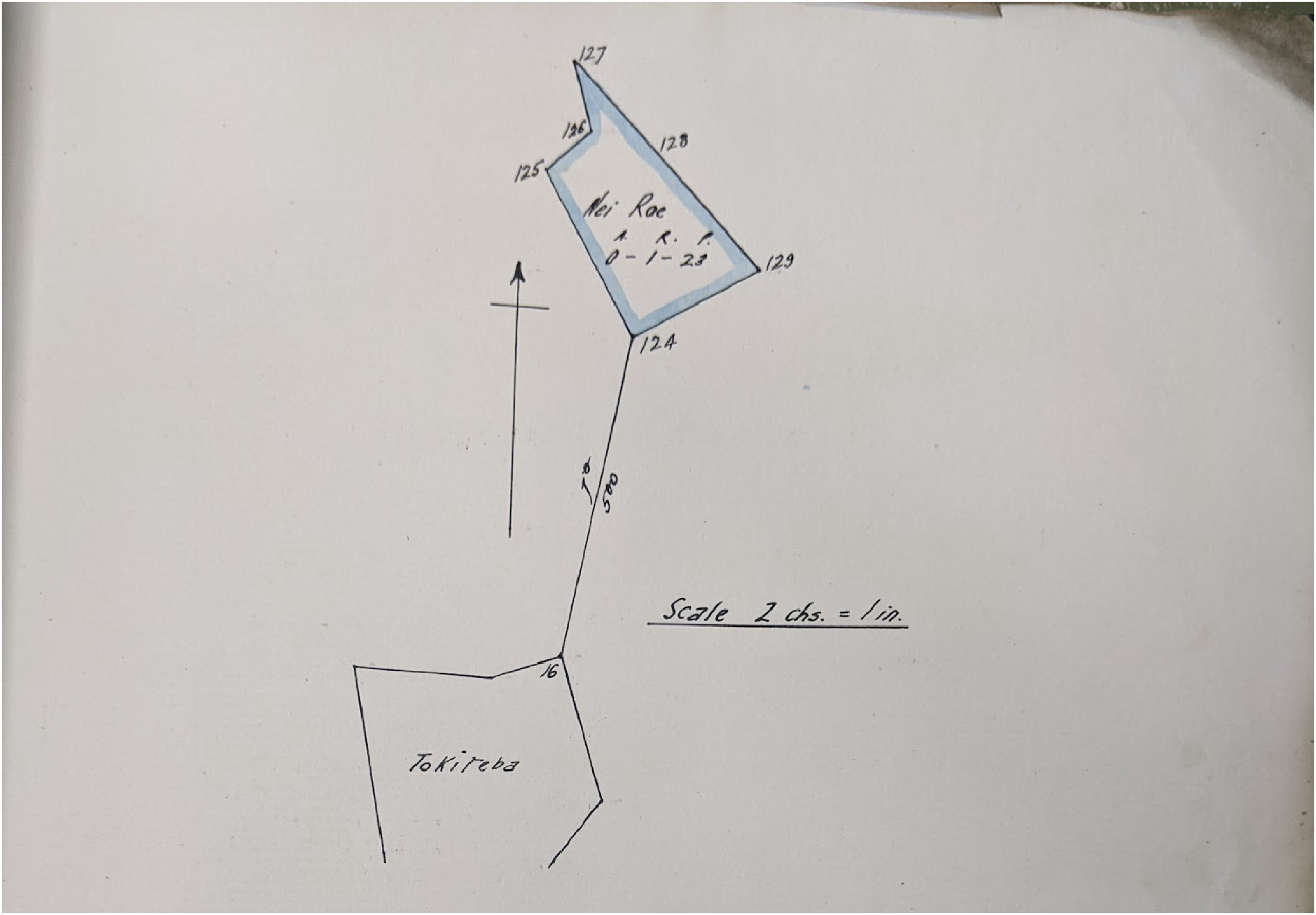
Excerpt from a book of land deeds of Northern Banaba, c1909 (Pacific Phosphate Commissioners, 1904–1916). This shows the dimensions of plots belonging to Nei Roe.
The archive reveals what Banabans at the beginning of the 20th century could never have anticipated: a European gaze that carved te aba into fungible grids of property enclosed within legal and economic contracts and transformed it into a resource to be extracted from, where the Company could claim ‘all the Rock and Alluvial Phosphate that may be found’ there (Pacific Phosphate Commissioners, 1904–1916). By enclosing Banaba within logics of property and resource, the BPC was able to begin the rapid transformation of a unique relational ecology into a monocultural field of phosphate mines that stretched across the island. Through the plantocratic gaze of European occupiers, Banabans were dispossessed of te aba and alienated from their more-than-human kin who were being ‘consumed’ by phosphate mines at an astonishing pace (Teaiwa, 2014: 1).
Subsequent phases of BPC activity on Banaba and Nauru following these early decades of encroaching dispossession reveal the second plantation logic guiding extraction of phosphate matter: displacement. Once again, this logic was particularly stark on Banaba. While Banabans were dispossessed from the beginning of the BPC's arrival, they did initially retain autonomy over parts of the island. The situation during these early decades was thus not one of classic ‘global enclosure’ associated with plantations (Jackson, 2020: 704). This changed once the BPC began to exhaust phosphate reserves on purchased land and looked to extend mining to the interior of the island, where most Banabans lived (Dickinson, 1925a). In 1931, after Banabans refused to sign away any more of their land, the BPC introduced compulsory acquisition, eliminating the remaining power Banabans held (Maude, 1947).
It was at this point that enclosure and dispossession thus accelerated into total displacement. As critical plantation scholars have argued, displacement is a core logic of the plantation and its ‘biopolitics of rule by extraction’ (Chao et al., 2024: 554; Jegathesan, 2021), with Indigenous inhabitants expelled from their lands to make room for plantation infrastructures. We see this logic at play in post-1931 Banaba: it was now not only stretches of land around the exterior of the island that were being turned over to phosphate mining, but the entire island. Schools, cemeteries, and sacred sites were all demolished to make way for infrastructures of phosphate matter (Maude, 1947). The Pacific War provided a fig leaf to complete this displacement. In 1941, most Banabans were evacuated to neighbouring Pacific islands; all but one of the two hundred Banaban men that remained were murdered by Japanese soldiers. After the war, British colonial administrators and the BPC agreed that Banabans should not return to their homeland and would instead be rehomed on Rabi, an already-inhabited Fijian island located over 2000 km away. Some in the colonial administration professed concern for Banabans and perhaps genuinely believed that a ‘fresh start’ on Rabi would allow Banabans to flourish away from an island scarred by extraction and war (Maude, 1947). The principal concern, however, was the extension of phosphate plantations. By relocating Banabans, the BPC could access the entirety of the island's phosphate reserves without any resistance.
Cutting across both early phases of dispossession and later phases of displacement in the BPC's activities on Banaba and Nauru was a third and final plantation logic: racialised labour. Phosphate mining is labour and technology intensive and requires substantial amounts of capital for extractive and transport infrastructure. The BPC needed cheap labour to recuperate expenditure; the transplanting of European ontologies of race to Banaba and Nauru created a hierarchised, segregated, and cheap labour force. BPC archives document three categories of employees: ‘European’ engineers, technical staff, and management, ‘Coolie’ Chinese mechanics and miners and Indian shipmates, and ‘Native’ Pacific Islanders employed as miners (Gaye, 1939). The three racialised categories of workers were housed in separate quarters, paid different wages, contracted to work different hours, and expected to toil under different conditions (ibid). Even as liberal employment reforms swept through the British Empire, the BPC resisted the introduction of measures such as the 48-hour working week for Coolie and Native labourers, which they feared would ‘impact costs of production’ (Dickinson, 1925a). This racial segregation fostered resentments that, at times, proved explosive, particularly between Chinese coolie labourers and Pacific Islanders (Dickinson, 1925b). However, racial segregation remained in place because, as Dickinson (1925a) put it, ‘there are not sufficient of them [Pacific Islanders] for our needs, while the supply of Chinese is unlimited’.
BPC archives reveal here ‘the colonial ecology of racial ontologies’ shaping phosphate matter (Ferdinand, 2022: 11). Extending the logic of plantations, which in ‘both their older forms and new representations… depend directly on hierarchical and racialized control over the workforce’ (Chao et al., 2024: 551), the BPC crafted a racialised mode of production. This taxonomic separation of workers via European racial ontologies enshrined the inequality needed to render the BPC a profitable enterprise (cf. Gilmore, 2022). Importantly, as critical theorists of plantations drawing on abolitionist and Black Radical thinkers such as Eric Williams, Cedric Robinson and Ruth Wilson Gilmore have noted (e.g. Ferdinand, 2022; Graddy-Lovelace, 2023; Williams, 2021), racial categories of ‘European’, ‘Coolie’ and ‘Native’ are not essential or pre-given, but were constructed ‘to justify unstable and toxic relations of unequal power and profit’ (Williams, 2021: 422)
Constructed racial ontologies thus have profoundly material impacts, and the labouring bodies of Company workers were differentially transformed along racialised contours. Drawing on Tao Leigh Goffe's analysis of Chinese indentured labour in the guano trade, we can say that race was ‘sedimented’ or ‘calcified into the geology and landscape’ of Banaba and Nauru (2019: 28). The mining work performed by ‘Coolie’ and ‘Native’ labourers was difficult and dangerous; several workers died in the process, their bodies literally claimed by the geology of Banaba and Nauru (Gaye, 1946). Absent from BPC records are the forms of ‘slow violence’ which would have also undoubtedly harmed these labourers (Nixon, 2009): the toxic dust that would have engulfed them, scarring their lungs, and increasing risk of cancers, kidney failure and bone disease (White, 2015). As the Banaban concept of te aba asserts, then, it is impossible to analytically distinguish people and place when it comes to understanding histories of phosphate matter in Banaba and Nauru.
Thus, as this section has argued, the extraction of phosphate matter in Banaba and Nauru emerged through violent and interwoven plantation logics of dispossession, displacement, and racialised labour. These islands were transformed from vibrant relational ecologies into monocultural phosphate plantations. Crucially, these phosphate plantations were transmitted to Banaba and Nauru; the indigenous societies that have lived on these islands for thousands of years and the racialised labourers who toiled to extract phosphate matter did not choose to industrialise phosphate, had no control over the industry and did not structurally benefit from phosphate's proliferation. The legacies of this transmission continue to reverberate to this day. On Banaba, the small caretaker population of three hundred Indigenous Banabans who have returned to their ancestral homeland struggle against a new round of phosphate extraction (Teaiwa, 2022). In Nauru, where mining machinery once cracked open the earth now stands one of Australia's infamous offshore migrant detention facilities – an infrastructural transition that anthropologist Julia Morris (2023) argues is not incidental, but characteristic of an historically export-dependent colony built on an industrial monoculture.
Beyond the archives of the BPC, there are many accounts of the ongoing resistance and survivance of Banabans and Nauruans (Teaiwa, 2022; Vizenor, 2008). Yet foregrounding these violent histories of transmission remains essential for enabling critical discussions of phosphate matter that allow us to grasp the systemic plantation logics that have shaped its emergence and circulation. What is more, doing so reiterates the consequential nature of a decolonial ecological analysis that employs an ethically situated and historically oriented study of empire. The transmissions discussed in this section are ongoing inheritances of the British Empire, which precipitated and oversaw the transformation of Banaba and Nauru into phosphate plantations; centring them changes how we approach contemporary cases. For example, through my analysis of the BPC archives, it becomes clear that current framings of the Wye's eutrophication as an isolated, novel, or unprecedented crisis are untenable because they overlook and erase the long histories of suffering, loss and displacement that have been caused by the extraction of phosphate matter.
Return to the Wye
Examining the Wye's phosphate inheritances has required me to travel far away from the waters and soils of its physical geography to look at the systems and histories that shape them. As I have argued throughout this paper, the Wye, as a geography at the metropolitan core of the former British Empire, inherits eutrophication via histories of British control and responsibility for the emergence of phosphate matter. Put differently, I have made clear that the Wye's connection to phosphates is not one of neutral or incidental entanglement, but a politically charged and deeply embedded inheritance. In this section I extend this argument by returning to the physical space of the Wye to consider how its immediate political ecology has been shaped by relations of inheritance. My discussion of this inheritance is twofold: I first focus on the physical transfer of phosphates mined in the phosphate plantations of Banaba and Nauru to the Wye's watershed and their potential lingering presence via biogeochemical histories of ‘legacy phosphates’ (Doydora et al., 2020: 1). I then discuss the ways that flows of phosphate wealth shaped the local political economy of the Wye region that, today, constructs the Wye as a sink for pollutants, including phosphates.
Although, as discussed, BPC phosphates were never applied to British soils in significant amounts, a close reading of BPC archives’ minor histories provides glimpses of the movement of BPC phosphate towards the Wye. Some of the mineral phosphates that the BPC sporadically shipped to the UK throughout the 20th century reached the Port of Avonmouth, located near the mouth of the Wye (Dickinson, 1930b). Here, fragments of te aba extracted through plantation logics were turned into fertiliser by superphosphate manufacturer Fisons Ltd (Dickinson, 1923). While there is no record for where phosphate matter went next, the Wye's privileged proximity to one of the only major fertiliser plants in the region and one of the few ports in the country receiving shipments of BPC phosphate means that one can reasonably speculate that at least some BPC phosphate would have ended up spread over the vast number of fields that cover the Wye's agrarian watershed. The ‘destructive, dispossessive, and racially uneven’ phosphate industry explored in the previous section was thus physically incorporated into the Wye's soils and waters (Williams, 2021: 423).
This is particularly significant when considering the biogeochemical histories of phosphate matter that soils archive. Recent advances in soil science have tracked ‘legacy phosphates’ that remain stored in soils for decades (Doydora et al., 2020). It is therefore highly possible that fragments of Nauru and Banaba remain trapped in the soils of the Wye watershed today. Furthermore, these fragments of legacy phosphate could be contributing to the Wye's current eutrophication crisis. While legacy phosphates lying dormant in the soil pose no known ecological risk, when disturbed they can contribute to eutrophication. The geophysical characteristics of the Wye watershed make this risk particularly pronounced: its steep valleys that accelerate run-off and leave soils at risk of erosion, its vulnerability to violent flooding that further strip top layers of the soil bare (Natural England, 2022). As one Wye-based NGO head – the same one who espoused the call for firm leadership and fast action against eutrophication quoted at the beginning of this paper – told me, the worry is that, even if all IPUs shut down tomorrow, there are enough phosphates locked away in the Wye's watershed soils to keep on sparking catastrophic eutrophication events for ‘another fifty years’ (research interview, 2022).
Following these flows of BPC phosphate matter towards the Wye watershed make clear that the Wye's eutrophication is not novel, unprecedented, or incidental. The soils of this wealthy agricultural region have been nourished by mineral phosphate matter for over a century and the histories of dispossession, displacement and racialised labour that constitute phosphate plantations have literally been ‘sedimented’ into its soils and agricultural practices (Goffe, 2019: 28). Furthermore, the biogeochemical endurance of legacy phosphates confounds colonial logics of ‘assimilative capacity’ or the ‘theory that environments can handle a specific amount of contaminant before harm occurs’ (Liboiron, 2021: 39); while the amount of BPC phosphates applied to the Wye's watershed soils was most likely very minimal, they remain capable of causing damage almost a century later. Thus, while it is currently IPUs that are targeted for the nutrient pollution they cause, following inherited legacy phosphates reveals that this is a wider and more deeply engrained issue that cannot be extricated from the Wye's local experience of phosphate histories.
This local experience extends beyond physical flows of phosphate to also include the Wye's regional political economy. Flows of phosphate wealth towards the Wye can be tracked at several scales. BPC archives reveal this flow on an individual level, naming several Wye-based men who gained wealth from advising, managing, and lobbying for the BPC. The most notable of these was Charles Bathurst, 1st Viscount Bledisloe, a Conservative MP and Lord of Lydney Park, a 17th-century country estate located near the Wye. BPC correspondence reveals he was also a keen phosphate lobbyist, calling for their increased application in UK agriculture (Bathurst, 1940). This was not a disinterested practice: in his introduction to ‘phosphateer’ Ellis’ (1937) account of his ‘discovery’ of Banaba's phosphate reserves, the Viscount pays ‘humble and sincere’ tribute to him for stimulating ‘the root and fruit of the world's economic plants’ and signalling that he was particularly indebted to Ellis because he was a farmer (ibid).
Triangulating the archives of the BPC with other sources allows us to see wealth transfers on a broader scale. In particular, the superphosphate manufacturer at Avonmouth was a key part of an important local economy that brought jobs, investment, and infrastructure to the Wye region (Walker, 1965). It helped to resuscitate and re-embed this growing port and industrial hub at the mouth of the Wye (Figure 4) which had begun to economically stagnate; for example, it partnered with a flailing zinc smelting factory to capitalise on the surplus sulphuric acid it produced (Packard, 2005[1952]). The Wye region, then, was stimulated by a transfer of phosphatic wealth. As Banaba and Nauru were rapidly and violently consumed by phosphate plantations, phosphate economically nourished the Wye by stimulating the creation of jobs, resources, technology, and infrastructure (Figure 4).
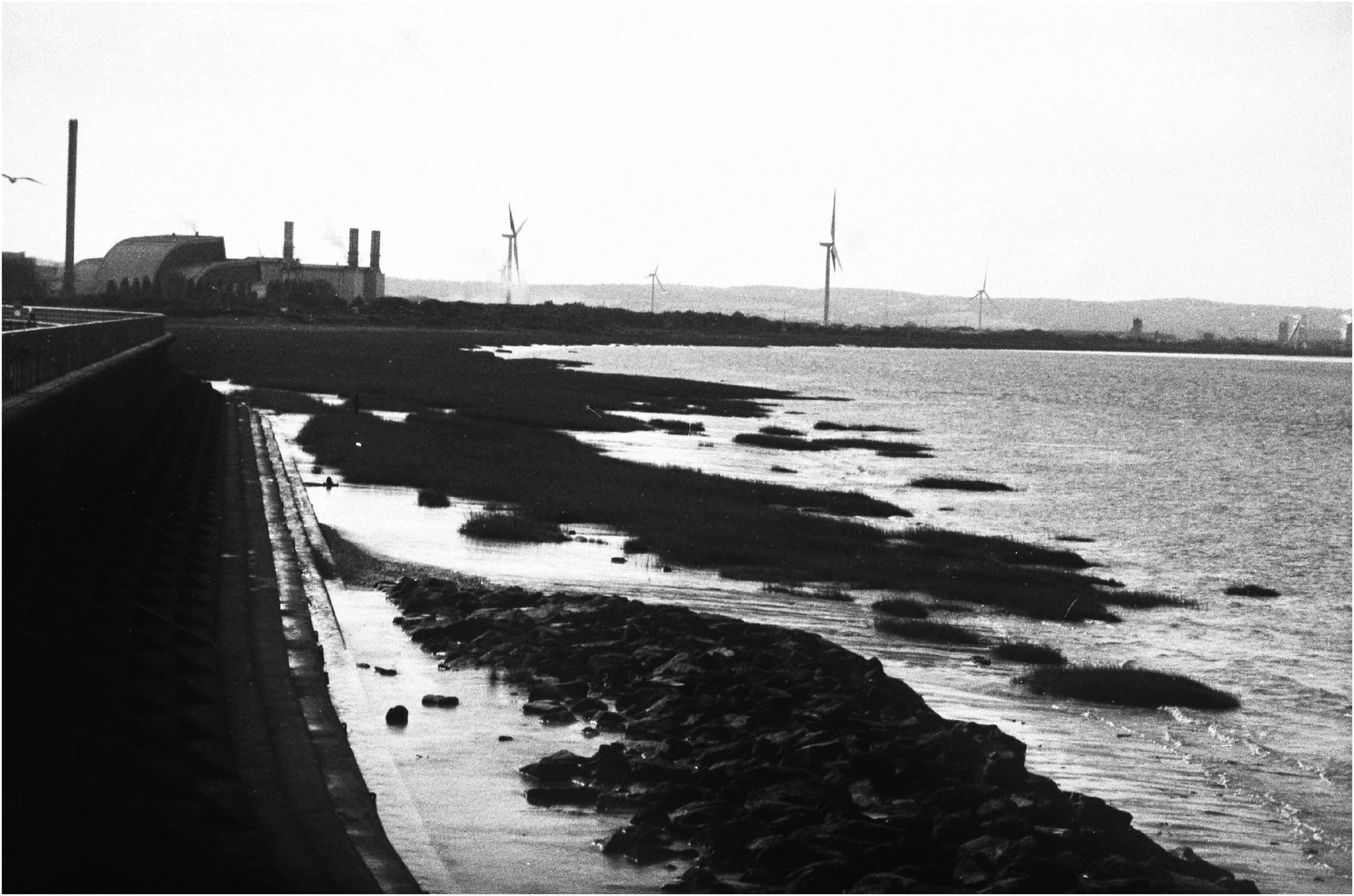
The industrial hub of Avonmouth, located on the Severn Estuary near the mouth of the Wye. Image author's own.
In a twist of irony, it is this local economy that has been nourished by transfers of phosphate wealth that now threatens to unravel life in the Wye as we know it. Infrastructure built partly through extraction of phosphate matter has transformed the Wye from a river used for fishing, navigation, and leisure to a sink – ‘those environmental zones that receive, absorb, and contain wastes’ (Gabrys, 2009: 666). While IPUs are the most recent and dramatic case of treating the Wye as a sink for pollutants, what following historic flows of phosphate wealth shows is that they have not emerged without precedent. They are the latest form of a local economy that has been treating the Wye as a sink for at least 100 years, as evidenced by the emergence of several Wye preservation societies that campaigned against the Wye's pollution in the 20th century (Wye Valley Society, n.d.). Crucially, then, if we are to understand how the Wye has become a sink, we must attend to the histories of British colonial violence – the transmissions – upon which its local economy rests, and which it thus inherits.
The Wye has long been known as a ‘Gentleman's River’ (Gilbert, 1929). It was on this very river that the 18th century picturesque movement was founded, and the aesthetic prestige of this landscape made it a site of elite leisure (Gilpin 2013[1794]). It is highly likely that someone like the Viscount Bledisloe, a man who so well represents the long-standing interests of the Wye's local political economy, would have walked along its banks. Perhaps he paused to fish its famously large salmon or paddle its crystal-clear waters, his mind empty of the Pacific Islands, 14,000 km away, he was lobbying to destroy. He would have been deeply shocked to discover that, within a century, the ‘ancestral dystopias’ he helped to create in the Pacific would have boomeranged back to his bucolic home (Whyte, 2018: 224). That phosphate matter can spill and reverberate across time and space (Gabrys, 2009) and the Picturesque Wye would be unravelled, the life choked out of it, by the very trades and practices he was labouring so hard to bring into being.
Conclusions
Right now, vibrant coalitions are emerging to address eutrophication in the Wye. Ecologists, anglers, state officials, NGOs, and environmentalists have campaigned tirelessly for the reforms in planning and river management needed to halt the ongoing degradation of the Wye's water quality. The purpose of this article has not been to dismiss this work, but instead to show the importance of going beyond the veneer of scandal and crisis to examine the longer histories and systems that underpin the proliferation of phosphate matter in the Wye.
As this paper has shown, the presence of phosphate in the Wye is the result of colonial histories of the British Empire. The BPC archives reveal how global infrastructures of mineral phosphate fertilisers were built by and for Britain and how the islands of Banaba and Nauru were transformed into phosphate plantations through logics of dispossession, displacement, and racialisation. Examining this history underlines the importance of a decolonial ecological approach that refuses standard erasures of the colonial ‘conditions of production’ of resources and technologies (Ferdinand, 2022: 9). I have developed Davis’s (2022) concepts of inheritance/transmission and plastic matter to articulate such a decolonial ecological approach. I have used these concepts to theorise the Wye's relationship to phosphate matter as one of inheritance, an argument I have empirically grounded by evidencing flows of phosphate materials and wealth towards the Wye and articulating the river's broader connections to people, corporations, institutions and governments responsible for the emergence of the mineral phosphates industry.
My decolonial ecological approach has thus contributed much to my analysis of the Wye and its current crisis. By charting phosphate matter's broad and deep histories, I have demonstrated the futility of technocratic responses focused on managing and reducing contemporary eutrophication events without addressing the underlying plantocratic structure of the phosphate industry. For example, my decolonial ecological approach has shown that it is insufficient to focus on technical solutions such as anaerobic digestors that allow farmers to extract and isolate phosphorus from manure, as the UK government's recently published River Wye action plan proposes (DEFRA, 2024). While these measures might reduce some specific cases of harm, wider systems of violence are left intact (cf. Liboiron, 2021).
My decolonial ecological analysis of the Wye's phosphate inheritances, then, broadens current obligations and responsibilities. By reading the imperial histories of phosphate, I have shown that the struggle against the Wye's eutrophication is linked to struggles against the aggressive expansion of soy plantations in Brazil, for an independent state for Saharawis and repatriation of refugees in Africa's last colony (Allan et al., 2021), against the settler-colonial dispossession and displacement of Palestinian Bedouin communities from their ancestral homelands in the Naqab, for reparations for Banabans and Nauruans, and more. Of course, linking these wide-reaching and multi-pronged struggles is complex work that raises new strategic questions and political problematics. But in this paper I have taken essential first steps in articulating the sedimented histories that characterise the logics and materialities of phosphate matter, identifying connections that will necessarily underpin the building of deeper and more thoughtful coalitional solidarities.
At the same time as addressing riverine coalitions seeking to address the Wye's eutrophication, I have also addressed geographers and others interested in decolonial ecology more widely. Through empirically expanding the Plantationocene concept beyond its usual geographies to examine an ecology at the metropolitan heart of a former empire, I have demonstrated the political importance of charting how European soils, waters, and airs have also been damaged by the spread of imperial ‘plantation logics’ (McKittrick, 2013: 3). But I have also taken seriously critiques of the Plantationocene, developing inheritance/transmission as a strategy for bringing about a more historically situated and ethically informed approach to the study of colonial entailments that steadfastly refuses to erase difference.
The River Wye is constituted by a myriad of human and more-than-human agencies, many of which have not featured in this ‘appropriately partial’ account (Teaiwa, 2014: 11), and is much more than its phosphate inheritances. Yet at a time when phosphate fertilisers unravel life in the Wye alongside a vast swathe of other global Plantationocene ecologies, I have shown in this paper that tracking inheritances is one helpful path to envisioning the decolonial ecological solutions so desperately needed to heal the scarred worlds left in phosphate matter's wake.
Highlights
A decolonial ecological approach of inheritance/transmission is needed to contextualise the River Wye's eutrophication and challenge dominant ecological crisis narratives.
Inheritance/transmission builds on recent Plantationocene literatures linking ecological crisis to colonial histories, while critically reworking their erasure of difference.
Inheritance/transmission is applied here to the British Phosphate Commissioners archives to conceptually and empirically track histories of phosphate matter.
This reveals that phosphate matter emerged through imperial entailments that nourished the Wye while transforming Banaba/Nauru into phosphate plantations.
A decolonial ecology of the Wye thus clarifies the obligations that must be centred to confront and repair phosphate's violences.
Footnotes
Acknowledgements
This paper emerges from a PhD project that was funded by a University of Bristol scholarship from 2020 to 2024. The author is grateful to Mark Jackson and Courtenay Crawford, both members of the University of Bristol’s Anticolonial Research Kitchen, for discussions that helped this paper take form and for their careful feedback on early drafts. He would also like to thank Mark Griffiths, Kali Rubaii and Mikko Joronen for organising the session Seeping, leaching, drifting: contaminated earth and colonial violence at the American Association of Geographers conference in Denver in 2023, where he presented an early version of this paper. Finally, he is indebted to the anonymous interviewees who helped him to understand eutrophication in the Wye, archivists at the National Archives for their help and guidance in accessing the records of the British Phosphate Commissioners, and to the three anonymous reviewers whose careful and rigorous reading of this manuscript greatly improved it.
Funding
The author received no financial support for the research, authorship and/or publication of this article.
