




Abstract
The Anthropocene, Capitalocene, and Plantationocene are propositions for new ways of understanding the role of people on the planet. The theories hold that humans, capitalism, or the logic of plantation agriculture have so fundamentally reworked the world that we can demarcate these as new eras in the planet's history. In this article, we argue that these narratives privilege Eurocentric narratives of human history, failing to adequately engage Black and Indigenous scholarship and theorizations on the nature and origin of environmental change. We argue for scholars grappling with questions of environmental change to include Black and Indigenous scholarship, experience, and thought when theorizing new histories of the planet.
Introduction
Climate change is an anxious pair of words. They resonate in visceral ways within a fractured political environment, speaking to planetary crisis now and in the future. Environmentalists, scholars, and social scientists have done their best to contextualize the moment, and following the lead of geologists, have debated timescales of “epochs”: the Anthropocene, Capitalocene, and Plantationocene—what we call the “cene scene.”
In 2013, Curley witnessed the painting of a mural in downtown Phoenix, Arizona that told a story about climate and colonialism. The mural, “Water Writes,” was sponsored by an Oakland-based nongovernmental organization (NGO) but designed and painted by Indigenous artists from the Diné and O'odham nations along the Colorado River. It was an imperfect match of ideas. Although the mural focuses on technologies that are popularly understood to act linearly, as in “energy transition,” we argue that the mural's narrative has deeper significance to our climate change discourse. Importantly, it puts elements of the natural world and human interventions in relation to each other. There is a spatial association between different kinds of energy technologies and Indigenous timelines that emphasize discordant kinds of environmental logics at work (Figures 1–3).
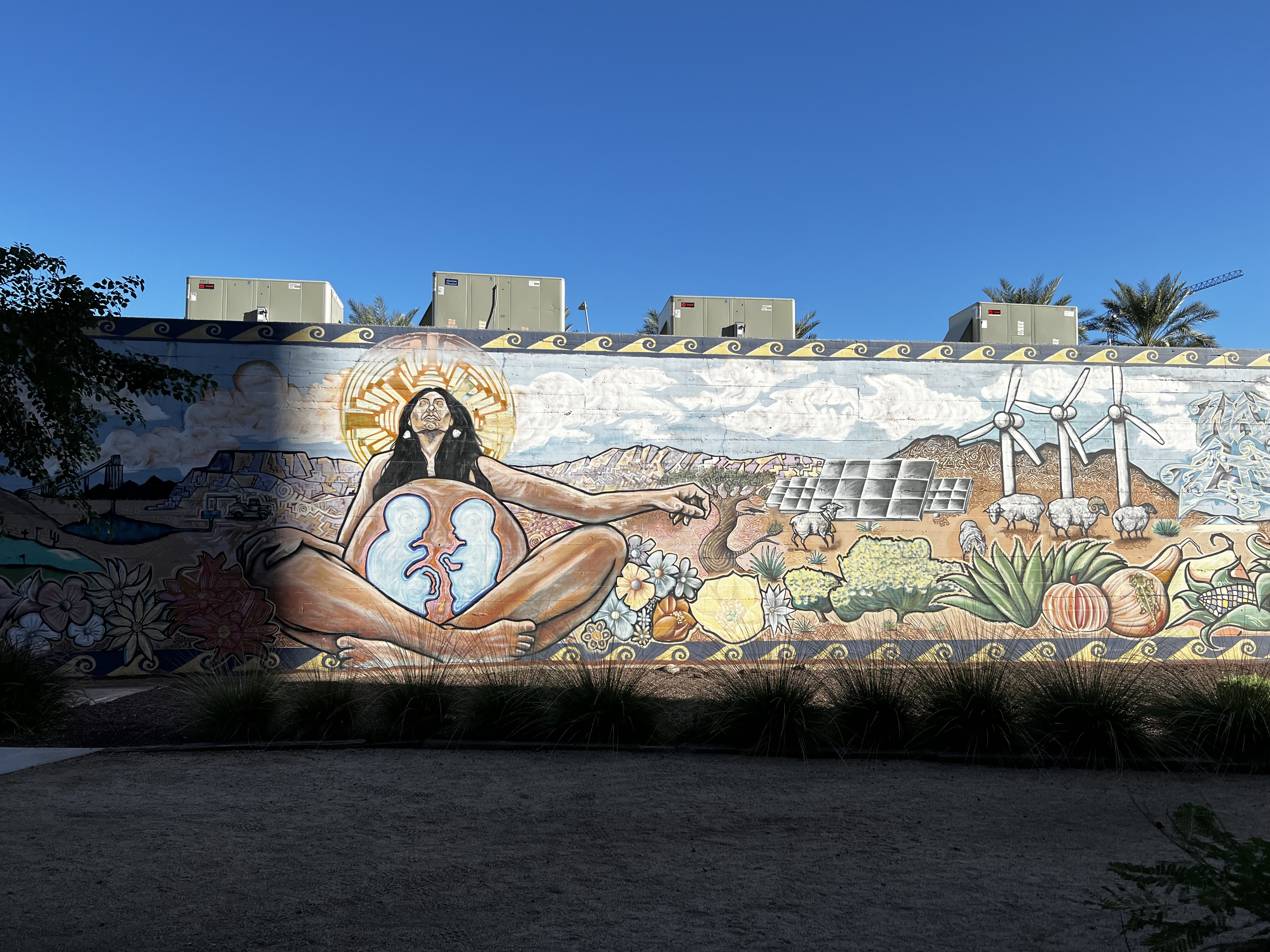
Water Writes Phoenix, Arizona 1 (Photo Andrew Curley, October 11, 2022).
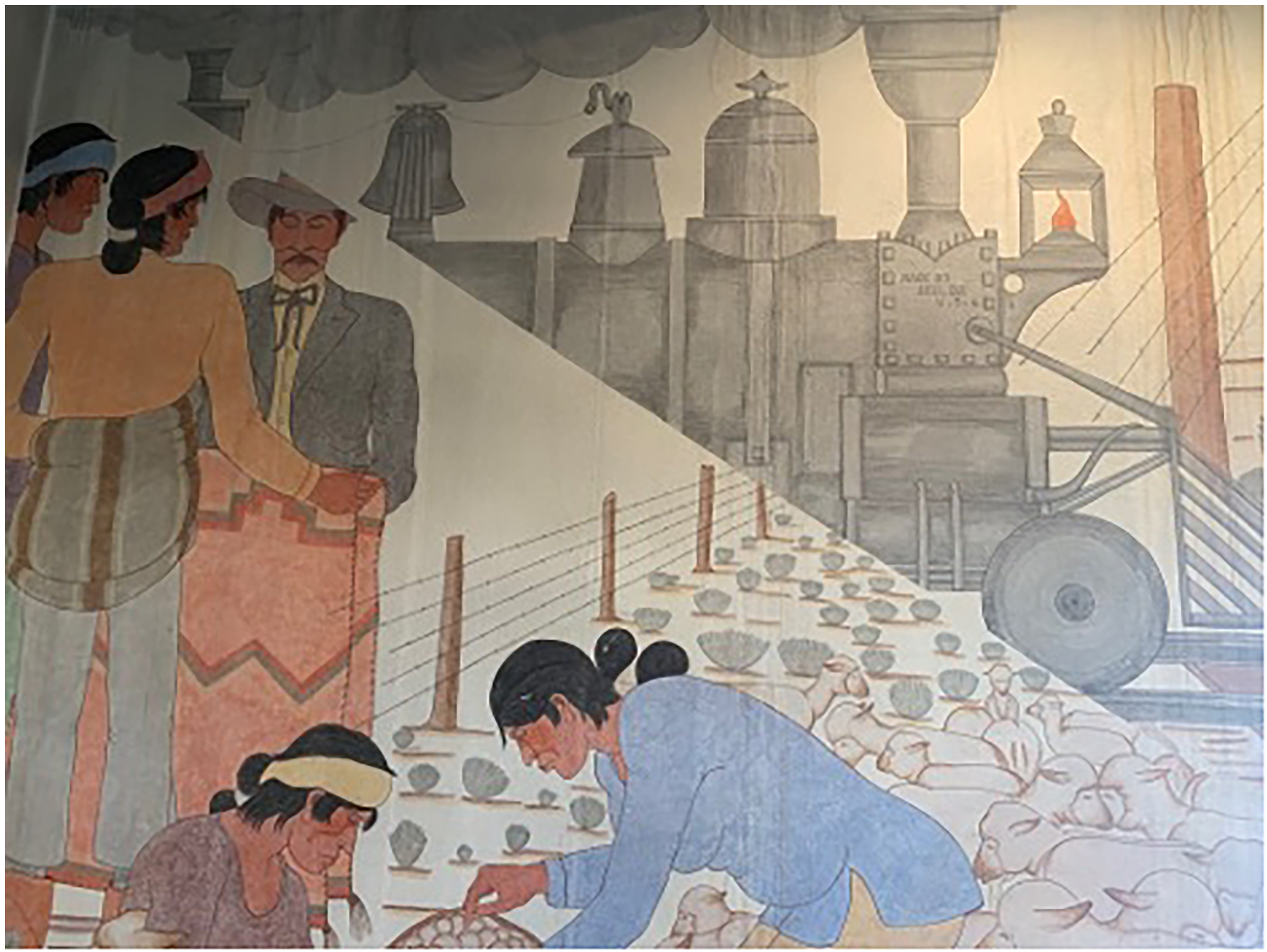
Mural in the Navajo Nation Council Chambers by Gerald Nailor (Diné) (Photo by Andrew Curley, June 10, 2022).
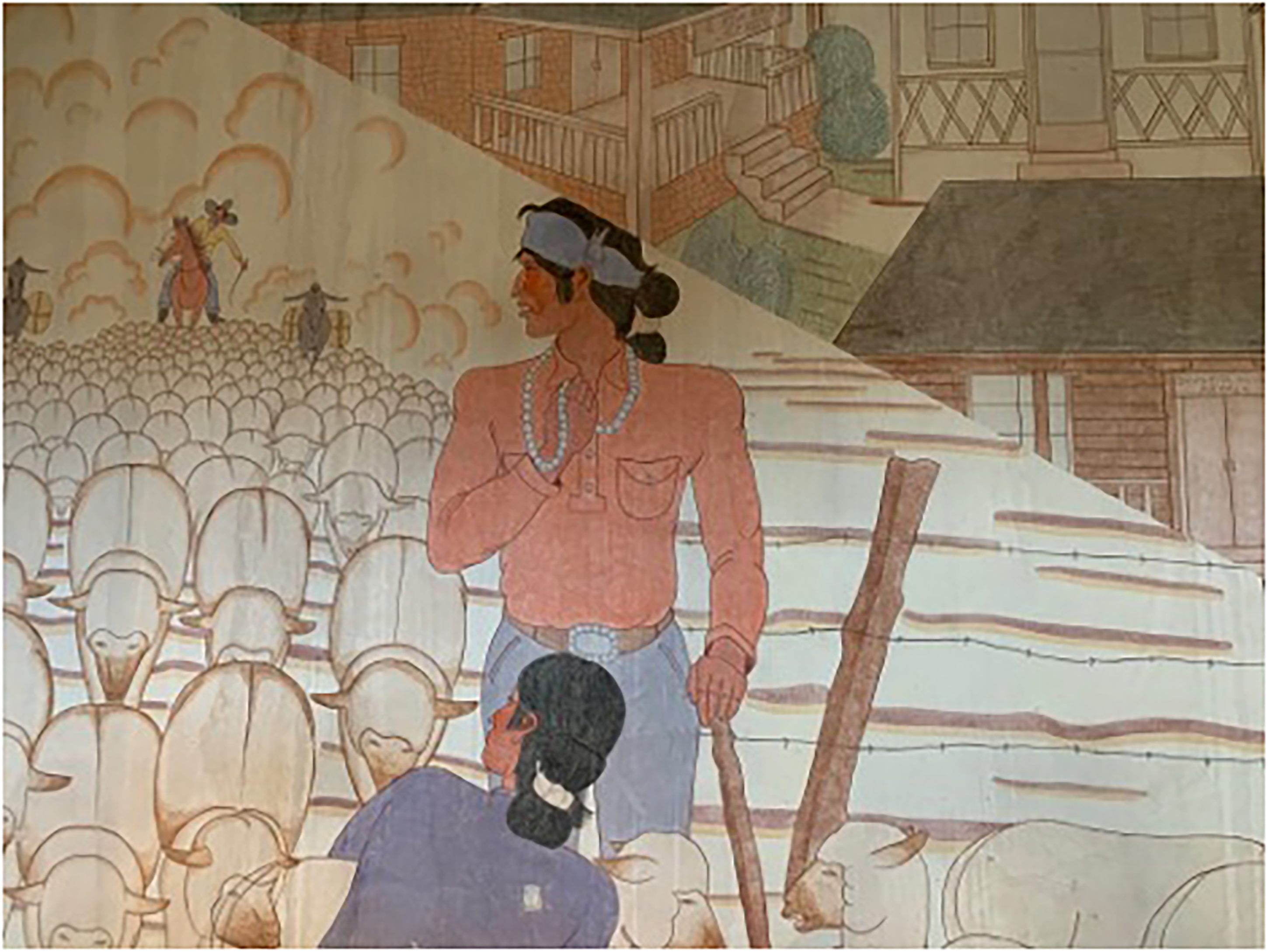
Section of surrounding Navajo Nation Council Chambers by Gerald Nailor (Diné) (Photo by Andrew Curley, June 10, 2022).
Working with Diné (Navajo) philosophy, the mural put notions of good and bad in the same plane, within the same time, and to balance extractive and renewable technologies. Centered was Mother Earth, pregnant with Diné Warrior Twins, against the backdrop of Tohono O’odham First Man basket. On the left-hand side of the mural was the exploitation of Diné water and coal for the development of Phoenix. On the right side was traditional Indigenous farming and herding alongside renewable energy technologies like solar and wind. The mural put past and future, balance, and exploitation, what Mohawk/Anishinaabe sociologist Vanessa Watts calls “place and thought” on the same plane (Watts, 2013). This was not a story of cenes, but of past and possibilities rooted in Indigenous understandings of violence, trauma, and survival.
Surrounding the Navajo Nation Council in their chambers is a very different kind of mural.
Painted as New Deal art in the 1940s by famed Diné artist Gerald Nailor, the mural tells the story of Euromerican colonization, “progress,” and the advancement of modernity. In this linear retelling of Diné history, the colonizer brings benefit and erases traditional economies, replacing them with formal education, monoculture agriculture, and wage-labor jobs. In this, the logic of colonization seeks to overwrite both space and time with global, decontextualized, and abstract patterns of modernity.
These murals present dissimilar environmental and temporal narratives. The 2013 mural reflects new interpretations of Indigenous political philosophies of the environment. It contains an ontological understanding of place and time that spatially combines elements of positive and negative with notions of the past and the future; it connects present day technology with Indigenous natural law. In the second mural, history is told linearly, bad events are in the past, and progress is in the present and in the future. This tells time in a way that is consistent with colonial progress narratives. It centers Euromerican intervention, history, and time with idealized representations of the present. These murals and their differences reflect the problems and erasures when theorizing human history and climate change.
For more than 20 years, scientists and scholars have grappled with the Anthropocene as a politically affective term demarcating a break in time from whence human activity has become a geologic force (Crutzen and Stoermer, 2000; Lewis and Maslin, 2015). A cacophonous chorus has pointed out the risk of folding all of human history into one timeline that positions apocalypse as imminent rather than already well underway (e.g. Curley and Lister, 2020; Davis and Todd, 2017; Gergan et al., 2020; Whyte, 2018), and suggested the need to narrow culpability—for instance in capital (Malm, 2016; Moore, 2017), racial capitalism (Saldanha, 2020; Vergès, 2017), or the plantation (Haraway, 2015; Haraway et al., 2016; Wolford, 2021). Witnessing this “parade of alternative rubrics” (Taylor, 2021), we ask: what do all cenes do?
Cenes bound time and space while generating linear narratives about the past and present. They impose abstract and singular timescales on diverse places, overwriting variegated experiences and temporalities. When combined with human history, cenes emphasize attributes of human activity or certain standpoints to stand for everything and everyone in that time. For example, in defining the Capitalocene, Jason Moore constructs a familiar history of transformations in Europe while making this history stand in for the history of all people on the planet at the same time—ignoring non-European voices and perspectives even while talking about these peoples in the construction of a structural-functionalist epoch. Even in their most progressive iterations, these geographic imaginaries are fundamentally universal, linear, and crisis oriented.
Potawatomi scholar Kyle Whyte (2021: 39, see also Whyte, 2020) reminds us: “when people relate to climate change through linear time, that is, as a ticking clock, they feel peril…Yet swift action obscures their responsibilities to others who risk being harmed by the solutions.” Whyte suggests instead a kinship-based approach to temporality. This itself connects to how kinship, relationality, and humanity is defined, and complements those asking why all of human history pivots on the history of Europe (Rao, 2020). Regardless of prefix, the -cenes keep us on a straight timeline. Can we live differently by shifting the temporal borders this way or that if we are stuck in simplistic and anemic understandings of land and time itself? What is made possible and impossible when we keep beginning from this storyline?
Recently scholars have observed that injustice is baked into the structures that have been used to fight for justice—and that this means struggles for environmental and climate justice must address these structures themselves, not technocratic solutions (Pulido and De Lara, 2018; Sultana, 2022; Táíwò, 2022). That is, we need to center decolonization and abolition in environmental struggles. Abolition, as “the destruction of racial regimes and racial capitalism—entails the end not only of racial slavery, racial segregation and racism, but also the abolition of a capitalist order that has always been racial, and that not only extracts life from Black bodies, but dehumanizes all workers while colonizing indigenous lands and incarcerating surplus bodies” (Johnson and Lubin, 2017: 12). We take up Pulido and De Lara's (2018: 78) reading of abolitionism as a “political project of liberation that extends the struggle for Black freedom to abolishing the same racial and capitalist relationships of power that produced the colonial project of plunder and dispossession in the Americas.” This framing of abolition, “recognizes that making appeals to the settler colonial state makes us complicit with dispossession; asking for 40 acres and a mule equates freedom and justice with a small piece of the plunder made possible by the past and present removal of indigenous people from the landscape” (Pulido and De Lara, 2018: 78; citing Tuck and Yang, 2012). If “freedom is a place,” and abolition is as much about presence as about absence, about building as about deconstructing (Gilmore, 2017; Kaba, 2021; Critical Resistance, 2008; see also Heynen and Ybarra, 2021), then we must also consider what kinds of temporalities allow for this work.
Awasis (Métis/Anishinaabe) reminds us that clock time, the work week, the Gregorian calendar do not spring from the earth: “These temporal concepts fit into larger Western assumptions about a single, linear temporality, comprised of shared present and homogenous movement along a singular axis through empty time” (Awasis, 2020: 832; citing Rifkin, 2017). Awasis suggests that “temporal justice” is fundamental for Indigenous sovereignty: Anishinaabe temporalities—from periodicity, timeframes, kindship, to nonhuman temporalities—provide a firmer basis from which to make environmental decisions around, for example, pipelines and infrastructure.
Here, we add to productive calls to unpack underlying racism and settler tendencies in cene discourse by centering times and ontologies from Indigenous place making and Black Studies. Rather than argue for a different -cene, we ask: what are the political implications of the entire -cene scene?—a tendency to summarize our environmental problems into a singular totalizing logic. In what follows, we first provide an overview of the -cenes, followed by a glimpse of Black Studies and Native Studies theories of time and space. We then discuss specific ways that we see Black and Native temporal strategies providing complexity and potential.
We suggest that care be taken in the designation of and marshaling evidence for one or another of the cenes. There is a tension between the promise of ascribing culpability to capitalist colonization and the perils overwriting the earth's variegated landscape with one timeline of scarcity and progress, erasing the multiplicity of place-based and nonlinear times that can account for complexity and abundance. Indigenous scholars have called for land-based accountings of politics and environment—these must be at the heart of our understandings of temporality even as we can account for the movement of capital across this land.
Cenes and scenes
Cene temporalities generate crisis narratives that enable a politics of looking to the future for solutions and portraying crisis as our future, rather than seeing past and present as sites and sources of ongoing dystopia making (Whyte, 2018, 2020–though crisis is multivalent – for the political potential of crisis see Gilmore, 2008). Theorizations and policies centering European history and agency that seek to protect humanity in the face of global environmental catastrophe risk derailing existing claims and practices for decolonization that already contain possibilities for emancipated environments (Erickson, 2020; Jackson, 2021; Myhal and Carroll, 2023; Todd, 2015; Vazquez, 2017).
For example, in popular news accounts and in policy and academic circles, the Colorado River is seen in crisis. The source of the crisis is climate change in the form of drought, declining snowpack, and faster melting snow. However, this understanding of crisis, consistent with the temporal narratives of cenes, portrays the problem as present and future tense or in the immediate future. The implications are that the western states need to change their water governance in response to a changing climate. But already existing colonial intrusions, such as dams, reservoirs, and canals are naturalized on the landscape. The dams, diversions, and reservoirs—colonial transformations of the landscape—are ignored. What is more, if you advocate for the removal of these systems and allow the river to run unobstructed from human dams and diversions, these solutions that would return the river to how it existed for most of its history are now portrayed as fantastical, and impossible to take up as real kinds of responses to climate change. They are cemented by the colossal architecture of the projects and the perception that the Law of the River, the Colorado Compact, is unmovable. Indigenous temporalities are not considered when thinking about the crisis or climate change. The crisis is now when white communities struggle for water and not in the past when white communities denied water access to Indigenous nations through various forms of skullduggery and colonial dispossession. Centering the history of the region on Indigenous temporalities and ontologies would suggest a completely different kind of relationship with the water, not just the Colorado River. Not too different from early European settlement patterns, Indigenous practices to this day entail movement toward water instead of bringing water to you. While 30 million people rely on colonial infrastructures to move the Colorado River waters toward cities like Phoenix, Denver, and Los Angeles, the largest Indigenous nation in the region, the Navajo Nation, still doesn’t get water from the mainstem of the Colorado River and continues to rely on wells, aquifers, and bottled water purchased from nearby bordertowns. For the Diné, as is the case for many Indigenous nations, the past contains the original points of climate crisis. How does anticipation of the future animate our relations to one another and the earth?
Our understandings of time, progress, and history shape how we think about the cenes and solutions to environmental crises.
The cene emerges from Eurocentric geological practices to define time into great eras. It is an account of the planet told through Greek and Latin. Geologists of the 19th century formalized the practice at the same moment when white science was likewise dividing up humanity into races to be colonized (Yusoff, 2018). If, as Fagan suggests, “times are worlds,” (2019: 56) then, however well intentioned, by marking time's breaking point the Anthropocene and its kin risk flattening our worlds and reproducing a global linear time, thus, generating “a mapping of the world-historical present which relies on and reproduces exclusionary accounts of the human” (Fagan, 2019: 56). Davis and Todd write, “the Anthropocene betrays itself in its name: in its reassertion of universality, it implicitly aligns itself with the colonial era” (Davis and Todd, 2017: 763; see also Gill, 2021; Taylor et al., 2016).
The human implied in the cene discourse resurrects the universal subject of the white man making things happen (Lugones, 2016; McKittrick, 2021; Perry, 2018; Wynter, 2003). This universal man comes with a lot of baggage, especially with his notions of time and progress. The implied European universalism of cene discourse parallels debates in climate change that foresee solutions in green technologies, eco-fixes to unequal and racist social systems, empowering European history and first world capitalist developmentalism. A wealth of scholarship has already taught us that universal humanity is an enlightenment scam; the idea of the human emerged only in relation to others rendered less than (see, e.g. Byrd, 2011; Coulthard, 2014; Fanon, 1963; McKittrick, 2014; Spillers, 1987; Weheliye, 2014; Wynter, 1994).
The bounding of the inside and outside of humanity was always geographic, with races mapped onto the globe as a recipe and justification for colonization and imperialism. The violence of this (unhuman) cartography is naturalized in our global histories that understand modernity and capital as the driving forces of all human history (whether cast as villains or heroes). These processes echo one another—the bounding of time, the bounding of humanity, and the bounding of time and humanity into places and spaces. This understanding of land and life is fundamentally incompatible with Indigenous theorizations of land and the environment as relational (Daigle, 2016; Fox et al., 2017; Goeman, 2015; Reo and Whyte, 2012; Simpson, 2014). Paulette F.C. Steeves (Cree/Metis) argues that much of North American archeology and anthropology deny Indigenous oral histories in racist attempts to weaken Indigenous peoples' claims to the continent and open the way for colonialism and displacement (Steeves, 2021). She shows that there was institutional interest in archeology to deny Indigenous presence in North or South American before “Clovis Culture.”
As an alternative to the Anthropocene, the Capitalocene binds human environmental impact to the emergence of capitalism (Haraway, 2015; Moore, 2017). Our concern is that these boundary-making dates establish European history as the implied history of man and the planet, retelling, now in relation to environmental change, the Hegelian mapping of time that ultimately creates an imperial “denial of coevalness” (Fabian, 2014)—relegating some people and places “out of time,” to primitive stasis (Rao, 2020). As Middleton (2015: 564) writes in reference to the development of Indigenous political ecology, “This does not mean that Marxist or post-structural thinking is irrelevant, but that it is de-centered in favor of indigenous framings derived from indigenous jurisprudence, story, art, language and ceremony.” While keeping the processes and patterns of global capital in mind we can still begin from an embodied and land-based pedagogy, in pursuit of the question provided by Vergès (2017: 73): “What methodology is needed to write a history of the environment that includes slavery, colonialism, imperialism and racial capitalism, from the standpoint of those who were made into ‘cheap’ objects of commerce, their bodies as objects renewable through wars, capture, and enslavement, fabricated as disposable people, whose lives do not matter?”
Haraway, Tsing, and others (Haraway, 2015; Haraway et al., 2016; Tsing, 2015) propose the Plantationocene: pinning a new geologic era to the development and spread of the colonial plantation model of agriculture. The Plantationocene evokes scalability, replicability, specific forms of labor, specific forms of life—and promises to explain both racism and changing land use (Carney, 2020; Wolford, 2021). These new -cenes complicate the “Anthropos” suggesting it's “not all humans” who have driven climate change; for decades Black Studies scholars have been telling us that the idea of the human has excluded great swathes of humanity (Spillers, 2003; Weheliye, 2014; Wynter, 1994). But all this reframing centers European interventions as the motor engine of history. We do not deny the planetary consequences of colonialism, imperialism, and capitalism, but we object to European and Anglophone perspectives as the only way to tell these stories, as if you could only understand settler-colonialism through the writings of John Smith. In a careful and important reading of Haraway and Tsing (Haraway, 2015; Haraway et al., 2016), Davis et al. (2019: 5) point to a troubling flattening and obscuring of the Black people through the use of multispecies ontology that glosses plantations as the “slavery of plants,” and reduces enslaved Black people only to the (quite literal) footnotes.
Notably, where the focus of much Plantationocene scholarship has been on the technologies, mechanics, and environmental harms of this form, within Black Geographies we see a proliferation of vibrant scholarship focusing on the relationality between plantation and escape—particularly geographies of marronage, which focuses on maintaining and making humanity and generating a Black sense of place in the face of the plantation's dehumanizing logics (e.g. Bledsoe, 2017; Winston, 2021; Wright, 2020). The Plantationocene can’t encounter Black humanity because it explains the world through the framework of the enslaver, corporate landowner, or technocrat working on making land and labor more efficient. This risks projecting the plantation form into all foreseeable futures devoid of Black livingness (McKittrick, 2013).
Black scholarship has deeply and productively engaged with the persistent geographies of the plantation—from Wynter's “plot and plantation,” to careful retheorizations of the plantation integrated into theories of Black place-making (Barra, forthcoming; Bledsoe et al., 2017; Bruno, forthcoming; Davis et al., 2019; Goffe, forthcoming; McInnis, 2016; McKittrick, 2011; Woods, 1998; Wynter, 1971). Woods's classic, Development Arrested demonstrates the potential of this approach: refusing to trace only the afterlives of the plantation's replication in the Mississippi Delta, Woods traces the consolidation of white power via the material and capitalist transformation of the landscape through and alongside Blues epistemology. In what could be termed a land-as-pedagogy approach (Simpson, 2014), Woods describes in meticulous detail how white settler-enslavers remade stolen Native land to serve capitalist extraction and build an infrastructure that would maintain white supremacy into the future. He reads this landscape through the language and life of blues epistemology, “a longstanding African American tradition of explaining reality and change,” that came to fruition during and after Reconstruction (Woods 1998: 25). Quoting musicians like Willie Dixon and Bessie Smith, Woods (1998: 103) makes the case that “working-class Blacks have their own epistemology, their own theory of social change, and their own theories of class and ethnic depravity.” Where white sociologists have read deviance and depravity in Black culture, Woods shows us Black livingness, desire, and social critique of racial–class relations. His approach, like many place-based storytelling epistemologies, allows him to begin from and center the Mississippi Delta while connecting it to the sweep of global history: If we are to build a society where working-class knowledge and participatory democracy are truly treasured, we must understand that the South is the center of African American culture, not its periphery. The Delta then becomes understood as a Mecca. Future political and economic movements must view African American folk culture as a central, and necessary, element in the construction of new institutions and new regional realities…an all-out effort must be undertaken to celebrate and valorize the millions upon millions, living and dead, who met the regimes of daily destruction with unshakeable dignity. In the same vein, the lands, rivers, streams, air, plants, and animals of the region must be restored to their sacred status. (Woods 1998:290)
Why isn’t Black and Indigenous scholarship central to theorizing the Anthropocene, Capitalocene, and Plantationocene? Against an unmarked universal, Black feminists have described their struggle as both rooted and expansive: “If Black women were free it would mean that everyone else would have to be free since our freedom would necessitate the destruction of all the systems of oppression” (Combahee River Collective, 1977). And yet, when women of color speak from their embodied life, “the knowledge they produce is often relegated to ethnographic locality within mainstream discourses” (Weheliye, 2014: 7).
In a parallel but distinct argument, Million (2009; Morrill, 2017) foregrounds how Native women's testimonies have shaped but been erased by mainstream white scholarship. The value of these women's telling of history is in its felt theorization, but this experiential origin is also used to discredit felt theory. In modern renditions of climate change, Indigenous peoples are both the front-line communities and the source of the solutions to the problems, ultimately serving the needs of white environmentalist narratives and not decolonial projects. This is another form of detainment, placing Indigenous experiences as a premodern and extra-modern kind of reality that borders on the ecologically noble savage (Grande, 1999). As Kwakwaka’wakw geographer Hunt (2014: 30) has argued, there is the risk that Indigenous knowledge is incorporated into academic theorization, but as a “trinket” or case study rather than the central argument. Thus, Indigenous knowledge is simplified and positions Indigenous people as naturally closer to nature/de facto protectors of the environment without engaging complex local politics on their own terms (Wright and Tofa, 2021).
Here, we take small steps toward redressing this ethnographic detainment. Native scholars have written about the temporality of climate change, crisis, liberation, and resurgence. Scholarship in Black studies and Native studies, postcolonial studies, and queer of color critique provides capacious understandings of the relationships between time, our bodies, land, and oceans. What happens if we work against crisis and scarcity narratives and center abundance? Fujikane (2021) narrates the land-based relational history of Hawai‘i through the migration of mo‘o –reptile/women water deities whose migration signals teaches how to care for water and fish. Fujikane (2021: 3) describes this as a fostering of abundance, whereas, “Capital tells a different story of changing earth.” Fujikane does not frame history as trauma or generate a European master narrative; she asks us to consider climate change as the death of capital and to map abundance because “capital depends on growth through the manufacturing of hunger” (Fujikane 2021: 4–5). This is connected to the “settler colonial mathematics of subdivision,” in which cartographies of capital commodify and diminish the vitality of land by drawing boundary lines around successively smaller, isolated pieces of land,” much like how the management of the Colorado River to manage crisis effectively creates crisis.
In what follows, we describe examples of recent scholarship in which planetary history is tied to embodied and place-based life in ways that account for but are not divided or fully contained within colonizing timelines. We then go on to outline potential lessons for theorizing temporalities of environmental change that draw on these bodies of scholarship.
Time and space out of bounds
Beyond the -cenes, there are other ways of understanding the replication and repetition of violence across time, and other ways of understanding the future. Here we highlight a few examples found in Black and Indigenous scholarship. Whyte calls for temporalities such as “spiraling time,” which could include “narratives of cyclicality, reversal, dream-like scenarios, simultaneity, counter-factuality, irregular rhythms, ironic un-cyclicality, slipstream, parodies of linear pragmatism, eternality” (Whyte, 2018: 229). Grande Chippewa Indians (e.g. Reo and Parker, 2013) have argued that environmental catastrophes already happened under colonialism, and a generative and heterogenous literature questions how life proceeds in the wake of slavery. In accounting for the destructive forces of capitalism, LaDuke and Cowen (2020) refer to the destructive force of the Wiindigo economy, an Anishinaabe story of cannibalistic monster that reflects today's capitalistic practices. The burden of environmental destruction is especially felt by Indigenous peoples and Black communities, leading to a convergence of interest in environmental injustice.
While we do not suggest that Indigenous and/or Black scholarship is unified in its political orientation or environmental theorization, we do want to note that time sometimes works differently in these scholarships and reveals radically different political possibilities. It is crucial both that we avoid conflating distinct lineages of thought and that we also acknowledge the dangers of disarticulating Blackness and Indigeneity (Cordis, 2019; K Mays, 2021; KT Mays, 2021; Mollett, 2021). What we do observe is that the position from which this scholarship begins enables a critical assessment of the present tense nature of oppression, linked to events, histories, and structures that colonial accounts move into the distant past. If colonialism is a structure, not an event, and we still live in the wake of slavery, how is it we can talk about cenes without an explicit centering of the experiences and knowledge of those who survived colonialism and slavery? The white man is a boogeyman, hidden in linear accounts of history.
In “Indigenizing the Anthropocene,” Métis scholar Zoe Todd (2015) connects an evening of personal alienation to longer patterns of Indigenous erasure in urban and academic spaces. Todd's reflections matter here for two reasons. First, she is marking though not bounding time—marking how Indigeneity is known across time in an embodied way—this is part of a wealth of scholarship on the ways that bodies and land are interwoven (e.g. Denetdale, 2011; Goeman, 2013; Mollett, 2021; Yazzie, 2018; Zaragocin, 2019). Secondly, she gives material terms to how whiteness occludes, territorializing academic thought and gentrifying spaces. Through this work, what Todd accomplishes is the connection of her own embodied life through time to that of her ancestors, and then to the now colonized space of the city: this is a story about time and the sweep of history that is grounded and in relation to land and knowledge production.
In the opening to In the Wake, Christina Sharpe writes about death and Black precarity that “looked and felt like winters without heat because there was no money for oil.” She also writes about her mother who “brought beauty into that house in every way that she could; [who] worked at joy, and…made livable moments, spaces, and places in the midst of all that was unlivable” (Sharpe, 2016: 4). Relatives’ deaths are told in relation to the long wake of slavery. Sharpe connects the present to prior times and spaces. Like cene theorists, Sharpe breaks time, with slavery as a planetary boundary; but also an oceanic expansiveness in how enslaved people remain with us: “even if those Africans who were in the holds, who left something of their prior selves in those rooms as a trace to be discovered, and who passed through the doors of no return did not survive the holding and the sea, they, like us, are alive in hydrogen, in oxygen; in carbon, in phosphorous a, and iron; in sodium and chlorine…”(Sharpe, 2016: 19). In a resonant personal reflection, Chickasaw scholar Jodi Byrd's Transit of Empire begins with Byrd's father's life and death, connecting it to the long struggles of the Chickasaw: “For my dad, I think, that loss was unmappable, ungrievable, and unapproachable within the constraints of US settler society” (2011: xi; for similarly rich accountings see Cordis, 2019; Laymon, 2018).
In the “parable of Black places,” Danielle Purifoy (2021) draws from the relentlessly prescient analysis of Octavia Butler to suggest we learn survival from Black places that have been left out of “discourse on the future,” such as the Lake Charles region in Louisiana or the Alabama Black Belt. Purifoy (2021: 830) argues that “Black places are parables of the threats of industrialization, technology, and white ideals of progress, and they are parables of adaptation, interdependence, and supportability,” and asks, “What happens when, instead of trying to adapt Black places to white progress, we instead let Black places (and people) live, and white progress die?” In concert with Purifoy, we could turn to Alana de Hinojosa's (2021: 736) discussion of how “minoritized people made dignified places for themselves where they were not supposed to turn out well,” in “el Chamizal” in the El Paso–Ciudad Juárez borderlands. De Hinojosa (2021: 737) turns from white possessive logics that do not–and cannot–transform the conceptual underpinnings of white settler colonialism, to the river itself: “The Río Grande intervened in the geographic knowability of multiple and supposedly secure white settler colonialities by disrupting and haunting settler colonial borders, multiple constructs of property and settler emplacement, racial capitalism, exclusionary citizenship, and white possessive logics more broadly.” Returning to the plantation's afterlives, Tianna Bruno (forthcoming: 1) develops a framework for understanding the “biophysical afterlife of slavery,” comprising how “the precarity and devaluation of Black life have affected the biophysical environments in which these lives exist.” This afterlife comprises the lasting ecological impacts of slavery as well as “the logics, ideologies, and structures embedded in legal and social systems that legitimated slavery and continue to maintain hierarchies of human life today” (Bruno, forthcoming: 1). Key to Bruno's approach, precarity is bound to the “persistence of Black life,” in places in which “Black people have worked, lived on, cultivated, and love.”
These scholars grapple with embodied loss and rupture while still maintaining an orientation toward life, toward survivance (Vizenor, 2008). They hold the past in the present while looking toward the future. In a similar vein, Nxumalo, calls for “presencing” or “refiguring presences” to insist upon Indigenous presence in the present and future as a political practice (Nxumalo, 2020; citing Simpson, 2011). Katherine McKittrick's “plantation futures,” also asks us to consider slavery's afterlives in concert with Black livingness, that is, to consider “black geographies as the sites through which particular forces of empire (oppression/resistance, black immortality, racial violence, urbicide) bring forth a poetics that envisions a decolonial future” (2013: 3, 5; citing Beckford, 1999).
Stories of mothers and fathers in relation to time, place, dispossession, and survival, are echoed in Whyte's conversations about intergenerational time with Sherry Copenace and Dylan Miner. Whyte writes on the term “aanikoobijigan (yankobjegen),” which means “both ancestor and descendent at the same time” and thus enables us to “consider ourselves as living alongside future and past relatives simultaneously as we walk through life” (2018: 228), Without collapsing difference or context, Whyte suggests we might consider aanikoobijigan in relation to other Indigenous temporalities that refigure relations between past, present and future—alongside Dillon's work on time travel and storytelling in Native epistemologies Dillon (2012, 2016). Where Whyte collapses time through the ancestor who is also descendent, Leanne Simpson uses the Nishabemowin term, biidaaban to fold time. “‘Bii’ is a prefix, a future tense; the future is coming towards us, at us, at that moment when the sunlight first comes above the horizon; full anticipation of the future; you can see the whole picture”. “Daa” is a word for home; the present; the exactly right now (Simpson et al., 2018: 75; resonating with the horizon of Muñoz, 2009) For Simpson, dawn, “is a collapsing of the future and the past onto the present,” and, thus, the present is “a moment of creation, of collective presence.” Relationships to time are political orientations. For Whyte and Simpson, crucially, this does not mean reifying or fixing ancestors in time but placing their practices and political systems alongside those of today. This is the political vision we see in the “Water Writes” mural.
In the summer of 2013, Indigenous artists from nations with a relationship with the Colorado River conceptualized a mural that centered traditional teachings from their nations, Diné and O’odham. The O’odham have lived in what is now Phoenix for more than 1000 years. Their knowledge of the land, water, and landscape predate white occupation. Diné people have lived in the area for equally long periods of time, but with some ancestors related to the Pueblo nations in the Rio Grande Valley or the Anasazi who are also related to the Hopi. Using traditional narratives, the mural centers Changing Woman, naadleeh adzaa, pregnant with the warrior twins. Warrior twins battle monsters from previous worlds through observation and planning, eventually exploiting a weakness in the monsters and prevailing over the problem. These stories are sometimes linked to longer, geological histories that environmental scientists produce, the origin of the cene discourse. There are paintings depicting the twins using realistic renderings descended from European artistic traditions to also show the twins shooting down Pterodactyls from the Cretaceous era when humans didn’t exist. This collapsing of traditional narratives with animals from different epochs challenges the linear implications of cene discourse, connecting the problem of dinosaurs to the climate anxieties of today—which are accurate in the way the bones of dead ancestors weigh like a nightmare on the minds of the living, to paraphrase Marx.
Returning to the 2013 mural, echoing Whyte's spiral time, the temporal reading of extraction and energy are put onto a single plane, combining the past and present. On the left, coal, the building of the Central Arizona Project, and expansion of Phoenix—all events in the recent past—are combined into the same part of the mural, reflecting a lifestyle out-of-balance with the natural limitations of the environment. On the right-hand side are subsistence crops, squash, pumpkins, corn, alongside sheep that are grazing under current technologies solar and wind.
For Driftpile Cree scholar Billy-Ray Belcourt, in “Indian time,” “queer indigeneity is prefigured by an escape from and bringing forward of the past as well as a taking residence in the future. To be queer and Indigenous might mean to live outside time,” and to “will a decolonial world into a future that hails rather than expels its ghosts.” In another example, Angie Morrill takes up the work of Cherokee, Modoc, and Klamath artist Peggy Ball to show how Ball's paintings remix time by placing together family members who could have or should have met but were prevented by death, displacement, and gentrification that is the result of antiblackness and colonization (2017; Morrison, 1988). While we lack space to fully discuss the rich landscape of Afro-futurism, African Futurism, and Indigenous Futurism, these are also spaces in which time is a political orientation to the present, and in which past and present-day struggles are not erased but are reconfigured in ways that project Afro-descendant and Indigenous people in the future (see, e.g. among many others Dillon, 2012; Frazier, 2016; Hunt, 2018; Womack, 2013; Yaszek, 2006). This is not in utopian ways that disappear oppression, but rather reshapes how we might understand time and itself. When du Bois imagines that a comet wiping out most of humanity could signal Black liberation, this is a political orientation toward time and history, and one that calls not for mitigation but something much more radical (Yaszek, 2006).
The -cenes metanarrative provides an unfolding history of global rupture that calls for crisis response. The scholars we have engaged with here also tell stories about time and power and global rupture. The politics of their stories, however, have a different orientation, which comes through in the telling, which is not about bounding, but is about generating ethical imperatives toward work in the present that is accountable to both past and present.
Against -cene time
In its pretentions to telling a global story, the cene scene segments and divides. Man is separated from nature to dominate it, and some people are made unhuman to be dominated (Hage, 2017). Time is made linear; Europe is placed at its center. Knowledge is made scientific, abstract, and disembodied. Accordingly, theories of and solutions to global environmental change then become apolitical, technocratic, alienated from place-based pedagogies and temporalities, and thus overwrite existing claims and demands for abolition and land back—becoming instead a theoretical and policy land grab of their own. In this section we draw out four lessons from the capacious provocations of Black and Indigenous Studies and affiliated fields to understand history's unfolding and our relationship to nature. These disparate but resonant refusals of European timelines and spacescapes trouble simplistic understandings of human/land/animal and reject policy proposals that rely on progress narratives and simplistic understandings of development, as well as theorizations that center European timelines. Through the case of the Canadian Boreal Forest Agreement, Erickson (2020: 112, 113) points to the dangers of such “‘green’ settler colonialism,” suggesting that the Anthropocene risks becoming “not just the geological era of human impact, but the geophysical justification for a colonial environmentalism.” Understandings of our changing planet grounded in Indigenous and Black theorizations that seek decolonization or liberation set the terms differently (though not homogenously).
To respond to global environmental change, we then attend to the already existing scholarship drawing on Black and Indigenous thought, which: (1) questions the human/nature divide; (2) centers place-based and embodied relations to the environment; (3) disrupts progress narratives and linear time; and (4) suggests abolition, decolonization, or anticolonial projects, rather than proffering technical solutions to political problems. These are spatial and temporal disruptions to the cene scene—interwoven starting points that provide openings to ask questions rather than bounded explanations of all time and space. Following Middleton (2015: 568), let's begin from Indigenous frameworks, as “there is little room for indigenous self-determination or epistemology in either Marxist or capitalist frameworks … these frameworks may include indigeneity in analysis, but usually in a way described as ‘epistemic coloniality’ (Grosfoguel, 2007)—where Western thinking is still in charge.”
Against the “firsting and lasting” (O’Brien, 2010) that temporally captures Native people as original but now disappeared, Leanne Simpson demands a Nishnaabeg present that collapses both past and future as a way to connect with ancestors and kin. How we think of time and space makes things possible: “What does it mean for me as an Nishnaabekwe to live in freedom? I want my great-grandchildren to be able to fall in love with every piece of our territory.” For Simpson, nature is generative, rather than being a commodifiable resource, and “her existence, and nationhood, calls into question the whole system of settler colonialism,” through maintenance of kindship and connections to territory (see also Curley, 2021b). This telling of time is relational and makes a different relationship to land possible. In his case for reparations as climate justice, Táíwò also calls for a reconfiguration of relations: “Injustice and oppression are global in scale. Why? Because Trans-Atlantic slavery and colonialism built the world we live in, and slavery and colonialism were unjust and oppressive. If we want reparations, we should be thinking more broadly about how to remake the world system” (Táíwò, 2022: 1). Like proponents of abolition who connect it not with absence but with presence, Táíwò envisions reparations as world-building. These might be impossible goals, but following Tuck and Muñoz, we consider the potential of a temporality of the horizon. That is, that we put forward abolition and decolonization as orienting directions, that can actually destabilize linear temporalities because they place ancestors’ political desires and current desires for sovereignty into the center of our contemporary struggle (see also Lister, forthcoming).
We connect Black and Indigenous thought in the spirit of decolonial constellations (Daigle and Ramírez, 2019; Simpson et al., 2018), which can guide us while also being both complex, nuanced, place-based, and relational; as we move through the stars our perspective on their relations also changes. We also emphasize the importance of attending to the intersections of Blackness and Indigeneity and rejecting the positioning of Blackness as never Indigenous (see, e.g. Cordis, 2019; John and Brown, 2019; K Mays, 2021).
First, initial theorizations of the Anthropocene contained an implicit human/nature boundary. While the critical cenes work to redress this, they relegate Black and Indigenous experiences to the footnotes of history and rarely if ever engage these scholarships. We do need a critique of colonialism and plantation and the Anthropocene but not one that centers western history—we need one that is grounded and accepts entangled relations between human, land, and nature. A wide range of Indigenous and Black scholars and those drawing on their work describe human/nonhuman or human/animal divisions as neocolonial projects (e.g. Ahuja, 2016; Daigle, 2016; Gergan, 2015; Jackson, 2021; Nxumalo, 2020; Taylor et al., 2016; Todd, 2015). For Zahara and Hird (2016), for example, the temporality of waste is a political relationship between those in the past future: trash animals like ravens and dogs are regulated by the settler state in ways that are incompatible with Inuit approaches. In relation to the sciences and Black Studies, Zakiyyah Iman Jackson (2020) rejects the premise of shared humanity as a useful political project, because humanity has been defined in relation to the animal to exclude Black people.
Second, as Mark Jackson (2021: 7) highlights, the potential of both Afro-descendant and Indigenous scholarship and ontologies to provide “earthbound constitutions,” or place-based orientations to politics that, “embody forms of relational worlding outside dominant epistemic apparatuses,” which do not start from a position of mastery over the environment, “but from care, attention to flourishing, and a certain disobedience to hegemony.” Jackson suggests that geographies of the plot (the small sustenance gardens of enslaved people) can be understood as material counternarratives to the Plantationocene (see also Davis et al., 2019; Wynter, 1971). Jackson connects these place-based positions to “rootedness” in Anishinaabe legal constitutions. In this reading of Anishinaabe legal scholarship, akinoomaagewin comprises an earthbound political orientation that can guide environmental policy (Jackson, 2021: 8; citing Borrows, 2019; McGregor, 2018; Mills, 2019; see also Coulthard and Simpson, 2016). Conceptions of plot and rootedness crucially make possible ways of relating to land that overturn those of ownership and territory. Noxolo observes that Black place making has been in part about making life and connection in the absence of property and territory as defined through law (Allen et al., 2019; Goffe, forthcoming; Noxolo, 2022). Returning to Fujikane (2021: 7), mapping abundance “centers not on the settler state's recognition of Indigenous peoples but on whether the earth will recognize us.”
Third, these scholars give us generative temporalities. In a scathing critique of both settler time and “cruel nostalgia” for a queer presettler time, Belcourt describes colonialism as an affective regime that “takes hold of the body, makes it perspire, and wears it out. It converts flesh into pliable automation and people into grim reapers who must choose which lives are worth keeping in the world. It can turn a person into a murderer in a matter of seconds. It is an epistemic rupturing of our attachments to life, to each other, and to ourselves” (Belcourt, 2016: 25). Against return to precolonization utopia, Belcourt forwards “ferality,” rejecting progress and nostalgia for an Indigeneity that “makes manifest residues or pockets of times, worlds, and subjectivities that warp both common sense and philosophy into falsities that fall short of completely explaining what is going on” (Belcourt, 2016: 24). This ferality resonates with Rao's (2020) suggestion that postcolonial queers might remain “out of time”: sidestep linear time that places colonization at its centerpoint. When we look to Muñoz's horizon, Belcourt's ferality, Fujikane's abundance, Tuck's focus on desire rather than past trauma, can we also decenter plantation futures (McKittrick 2013)? In his treatise “on being area studied,” Macharia (2016: 184) positions himself in the black diaspora as a s/place from which to “imagine worlds, inhabit ungeographies, and produce fugitive temporalities, not simply ‘other’ or ‘alternative’ or even ‘counter’ modernities but different configurations of time altogether, in Sharpe's ‘wake time’.”
Finally, embedded in refusals to adhere to linear global time and exclusionary models of the human is a refusal to turn to the -cene diagnosis as political orientation. Abolition, anticolonialism, and decolonization predate the designation of the Anthropocene as era and provide a blueprint for reorienting relations to one another and the earth. Instead, scholars like Davis and Todd (2017: 776) point to the need to reevaluate “not just our energy use, but our modes of governance, ongoing racial injustice, and our understandings of ourselves as human.” Following Whyte's (2021) theories of time as kinship, and Macharia's writing on diasporic relations, in which he eschews the colonial archive to look for “how different Black people from across multiple geohistories have co-imagined each other,” that is, we might try to understand the points where we might generate relationality across worlds: “to create a shareable world,” which is also, the theory we “need to survive” (Macharia, 2016: 186; citing Christian, 1987). Black and Indigenous thought have not been allowed to answer universal (planetary) questions; Weheliye's observations about who Black people can theorize for then also extend to time—why is universal history white history (for a parallel argument see Craggs and Neate, 2020)?
Centering Black and Indigenous time draws our attention to different kinds of politics and solutions, moving away technological fixes to revolutionary futures. It draws our attention to land back, abolition work, decolonization, and radical forms of climate justice.
Conclusion
It is not hard to see why historic and contemporary persons and institutions who participate in settler colonialism are not different from a zombie apocalypse. Like in dystopian science fiction, our ancestors would have seen us living in a situation in which the conditions of our individual and collective agency are almost entirely curtailed. But our ancestors and future generations are rooting for us to find those secret sources of agency that will allow us to empower protagonists that can help us survive the dystopia or postapocalypse (Whyte, 2018: 231).
Temporal questions are important because conceptions of the unfolding of history shape policy decision, the production of knowledge, and ongoing structures of violence and exclusion—or they might provide grounds for solidarity and transformation. A host of scholarship has pointed to how abstraction into theory can too quickly evacuate political and embodied intentions and experiences—that is, we kid ourselves when we pretend that in the theorization of time, history, and the planet, we begin from a level playing field—not everyone has skin in the game (Bruno and Faiver-Serna, 2022; Christian, 1987; Curley et al., 2022; Eaves, 2020; Faria and Mollett, 2020; Hawthorne and Heitz, 2018; Macharia, 2016; Oswin, 2020; Pulido, 2002). Academic institutions make us this way, yet we must fight against this tendency (Curley et al., 2022).
We take seriously Saldanha's (2020: 16) observation that the Anthropocene has potential to build fruitful alliances across social and physical sciences and also acknowledge his point that “it cannot be favorable to those in power if they can be shown to be maintaining a trajectory possibly leading, if not to the extinction of humans, at least to massive deprivation and uncertainty.” Anemic theorizations result in technocratic solutions, legacies of Malthusian scarcity and eugenics, and underwrite new security measures that replicate old patterns of violence (Ahuja, 2015; Hartmann, 2014; Meché, 2019). We see this in how the Colorado River is understood only in its recent history, from the moment of colonization onward, ignoring Indigenous temporalities or histories with the river.
We suggest that the bounding and fracturing of time and space into segments is a central technology of colonization. Colonization and imperialism require categorization: of people into those who master or are mastered, of land (into civilized or empty, productive, or wild), of time—into so many befores and afters, often with colonial “encounter” at the center (Rao, 2020; Shilliam, 2015). These boundings happen through language, anthropology, geography, but also through other technologies: infrastructure of development/underdevelopment that fixes some places and peoples in a temporal register of not yet modern/always becoming (Curley, 2021a, 2023). The nuances of Capitalocene and Plantationocene do not address this fundamental and troubling aspect of temporal politics—in fact, they elevate whiteness to a geologic force determining all human history and predestined to complete the colonization of the world, now through carbon.
Existing -cenes center our attention on breaking points in time determined by white European expansion, linear narratives about technology, or common metrics of economic processes. This helpfully places responsibility for environmental catastrophe on colonization and capitalism, but also recenters Europe's place in human history and enables a trap door through which Eurocentric theory and history becomes global history and thought. The role allotted to colonized peoples in this dark fairytale is one of aggrieved victim or heroic activist (Bruno, forthcoming). Cenes generate a global scarcity plotline in which justice can be rendered through mathematic and technocratic solutions allotting the right to commit environmental harms according to the allocation of past trauma. These settler-enslaver approaches assume land as territory, property, and resource, rather than relations (Curley et al., 2022; Goeman, 2015). They transfer settler-enslaver visions of land as property and territory onto time itself and begin from a premise of scarcity rather than abundance. Are they the guidance that we require?
These theorizations enact the settler replacement that Tuck and Gaztambide-Fernández warn us about Tuck and Gaztambide-Fernández (2013; see also Hunt, 2018). That is, the reformulations of the Anthropocene that try to account for European guilt help maintain European settler expertise and maintain settler futurity. Swan River First Nation scholar Dallas Hunt describes this in the language of totem transfer—in which white settlers claim dominion and protection of the environment against the backdrop of the vanishing Native who legitimizes their ownership (Hunt, 2018; citing Fee, 1987). Against this, Tuck and Gaztambide-Fernández commit to an Indigenous futurity, (2013: 80) “which does not foreclose the inhabitation of Indigenous land by non-Indigenous peoples, but does foreclose settler colonialism and settler epistemologies.” We can further read the white guilt narratives of the -cenes as being spectacular performances (Daigle, 2019) that are nonperformative (Ahmed, 2007): that is, the spectacle of white scholarship accounting for global apocalypse actually maintains white theory as overdetermining both thought and policy. Our current apocalypse is a settler fantasy of unlimited domination and extraction: “Many of the ancestors of today's allies designed the worlds we live in today to fulfill their fantasies of the future” (Whyte, 2018: 237).
Fagan observes that in Anthropocene rhetoric, the “others” of modernity inspire, “but their time is not the world historical time that is of relevance for progressive political projects, and nor can it be while the Anthropocene remains embedded in the periodizing temporal structures of modernity” (2019: 60). For example, Moore uses the violence against Black and Indigenous peoples as plot points in a larger narrative about capitalism—the Capitalocene. The implied solution therefore is to simply challenge capitalism alone without attending to the living legacies of slave ships (Moore, 2018). Similarly, Donna Haraway and Anna Tsing place the history of European racism and violence against the rest of the world as footnotes to the ordering of plants. But land reform that ignores the history of settler colonialism only perpetuates the violence and racism of land dispossession. We draw on Tuck's rejection of damage-centered research. Referencing researchers’ engagement with Indigenous life and her own grandmothers’ generation in the Aleutian Islands, Tuck writes that some research is both “damage-centered research and damaging research,” particularly that which assumes change comes from demonstrating harm in order to move toward repair (Tuck, 2009: 412). A geologic history of all time centering colonization as an epistemic break likewise confines us to this trauma paradigm. Tuck asks us to shift our orientation from past trauma to desire: “Desire, yes, accounts for the loss and despair, but also the hope, the visions, the wisdom of lived lives and communities”—desire is temporal because it is “about longing, about a present that is enriched by both the past and the future. It is integral to our humanness” (Tuck, 2009: 417).
We live in a postapocalyptic world. The structures of domination and the wake of the slave ship are contemporary issues, not plot points in some grand history of Europe (Sharpe, 2016; Todd, 2016; Whyte, 2018). Attending to the distortion of the cene scene is important because it is part of broader processes of overwriting in which climate change urgency tramples existing struggles for environmental sovereignty and re-centers colonial and settler scholarship in theorizing planetary history. If as we have argued, orientations to time are political, where can we go if we orient all of human time to Europe?
Both the cenes and climate policy risk being forms of land grabs/territory-making practices by (a) re-centering Eurocentric vision of history, maintaining ethnographic detainment and universal man and (b) laying the ground for policy land grabs as challenges to sovereignty when solutions to climate catastrophe are derived from European history and thinking. That is, the urgency of climate change can produce an “organizing principle of obedience, a force majeure, for epistemic and political legitimacy that linearizes time” (Jackson, 2021: 701). As we consider the work done by the sweeping narratives of Anthropocene, Capitalocene, and Plantationocene, we ask: what future is enabled for Indigenous people and knowledge when we understand all of time through these lenses? Can we follow Tuck and Muñoz by framing time not through past trauma, but through a horizon inflected with desire? What does this enable for our politics? For our policy?
The water writes mural featured at the beginning of the article centers Changing Woman, giving birth to the Warrior Twins, whose destiny was to lead Diné people out of danger of giant monsters plaguing the people. The Warrior Twins studied their enemy for its weakness before striking it dead. It was through patience, observation, and planning that the warrior twins were able to save the people. In the mural, the temporal plane on which Changing Woman and the Warrior Twins are featured is nonlinear. The twins and their mother are placed prominently in the center of the painting, putting a damaged and exploited earth on the left and a more sustainable and healing earth on the right. The universal man sailing across the Atlantic in his pantaloons, with his Cartesian dualism, theories or labor and value, or notions of property, territory, and space are not in the center of this mural. They are not featured but implied in the damaged earth on the left. We know their story well. It's the story Euroamericans tell themselves about their own history, a people whose claim to land is one premised on theft and not origin. For Indigenous peoples, the land is a place tied to the origin of the people. It's not just land, but a relationship. It's a relationship to the plants and animals who also have rights to it.
One of the legacies of colonial temporal understandings of the world are crude notions of social change, an idea that's not only temporal but also epistemic—at the root of sociology, anthropology, and other social sciences. On the other hand, using images instead of words, the water writes mural incorporates new technologies into older land regimes, from sheep to solar. Change and continuity happen at the same time. The Warrior Twins are not just stories of the past, but they also work in the present and in the future—always problems solving and taking action. The dynamics of destruction, recovery, and desire that inform Black and Indigenous place making are contemporaneous. The temporal plane is encompassing and inclusive, not segmentary, dividing, and epistemically organized around periods, epochs, and anthropological notions of social evolution. In this way, cenes can be limiting, distracting, and inevitably imply a teleology of technological innovation within a colonial-capitalist world to solve the world's environmental problems. What Black and Indigenous scholars and activists suggest is that solutions are already here, they are present tense, and they are radical political projects.
Highlights
In this article, we ask what “cenes,” do. That is, what political and policy effects do the designations of temporal boundaries such as the Anthropocene, Capitalocene, and Plantationocene have?
We argue that ultimately, even when critical, the “cenes,” center Europe not only in space but in history in ways that do not allow for more capacious thinking about environmental catastrophe.
As a different set of possibilities, we look to Black and Native scholarship on time and the environment to sketch out different ways of relating to time and the environment.
Footnotes
Acknowledgements
We are grateful for the feedback we have received from presenting earlier versions of this work at Cornell's Conversation on the Plantationocene, at the Ohio State University, in the 2021 RGS-IBG “Historical geographies of environmental futures,” session. Thank you to Wendy Wolford, Joel Wainwright, and others for these invitations, and to the audiences for their helpful comments! We would also like to thank Nik Heynan, Katie Nudd, and the very generous reviewers at Environment and Planning E: Nature and Space for understanding the intent of the article and providing helpful reading suggestions that strengthened our argument.
Funding
The author(s) received no financial support for the research, authorship, and/or publication of this article.
