




Abstract
In the social sciences literature, experimentation in civil society as in food co-ops, urban gardens, repair cafés, or sharing platforms is widely considered as promising to address mounting socio-ecological problems. But is this confidence justified at a point in time when fundamental change is more urgent than ever? After all, these forms of experimentation have a history that reaches back to the very beginnings of environmentalism. Why should they trigger a comprehensive socio-ecological transformation today, if they have not done so in the past? For academic confidence in transformative change through experimentation to be plausible, at least one of two conditions would have to be fulfilled: either academic accounts plausibly demonstrate that the meanings and functions of present experiments fundamentally differ from those in the past. Or these accounts convincingly show that societal context conditions today are much more favourable for transformative change through experimentation than in the past. To assess whether or to what extent at least one of these conditions is fulfilled, we pursue a comparative analysis of past and present discourses on eco-political experimentation in civil society and a conjunctural analysis of current context conditions for transformative change through experimentation. Our findings suggest that neither the criterion of substantial difference nor that of favourable context conditions is fulfilled. For this reason, the current academic trust in transformative change through experimentation, arguably, remains implausible. Hence, we caution against spreading hope when doubt seems in order, for unwarranted narratives of hope may come with an unintended side-effect: ‘sustaining the unsustainable.'
Keywords
Introduction
In recent years, the tightening socio-ecological crisis has triggered a new wave of civil society-driven experimentation in countries of the Global North with alternative practices in the provision of everyday needs. In contrast to other forms of eco-political action such as protest and advocacy, this experimental politics—we will refer to related initiatives as Local Experiments in Socio-Ecological Change (LESECs)—seeks to test and prefigure alternative systems of provisioning, allocation, and decision-making in processes of trial and error (Deflorian, 2021; Frantzeskaki et al., 2016). LESECs champion “direct social action” (Bosi and Zamponi, 2020), which means that people involved in them take change into their own hands by experimenting with more sustainable practices and infrastructures on a small scale to test them as levers for changing society at large. Including food co-ops, urban gardens, community supported agriculture, repair cafés, sharing platforms, sustainable housing projects, and many other initiatives, some LESECs become more permanent than others, but in the sense that they test new practices, they still remain experimental (Haderer et al., 2024; Sengers et al., 2019).
Academic observers have framed these experiments as a promising “turn to everyday life” (Meyer and Kersten, 2016) likely to “open space for a more broadly and deeply resonant form of environmental criticism” which is “more democratic and ultimately more hopeful” (Meyer, 2015: 167). Closer exploration of such local experiments, Bennett and colleagues suggest, would “provide useful insights about how to advance along a more positive pathway and lead to more positive visions of the future” (Bennett et al., 2016: 447). “Generating novel bottom-up solutions for sustainable development” (Seyfang/ Smith, 2007: 585), others have argued, LESECs point to a possible sustainability transformation. They rehearse “alternatives in worldviews and practices that challenge the structures of inequality, oppression, and unsustainability and replace them with those that promote justice, equality, and sustainability” (Brand et al., 2021: 279). Although in some respects the framings offered by different observers are quite diverse, they are united by a strong confidence in LESECs’ transformative potentials. But is this striking confidence in the transformative potentials of LESECs really justified?
In fact, such portrayals of LESECs as promising drivers of change sit uneasily with observations of their limitations regarding “durability and the challenge of scaling up” (Eckersley, 2020: 228) as well as potentially problematic side-effects such as their potential of neoliberal co-optation, effects of depoliticization, or their significance as strategies of simulation (Blühdorn, 2017; Kenis and Mathijs, 2014; Rosol, 2012). Nevertheless, as recent review articles indicate (Agyeman et al., 2016; Bendix, 2017; Brand et al., 2021; Eckersley, 2020; Kallis et al., 2018; Köhler et al., 2019; Sengers et al., 2019), many critical environmental social and political theorists, literature on sustainability transitions in socio-technical systems and many discourses on post- and de-growth, too, tend to ascribe considerable transformative potentials to LESECs. This is puzzling because the IPCC calls for “rapid, far-reaching and unprecedented changes in all aspects of society” (IPCC, 2018: 1). Experimental initiatives do evoke changes, of course. Yet, their impact is restricted in terms of context, time, and scale (Deflorian, 2021; Mocca, 2020), and thus not in line with the comprehensive transformation the IPCC is calling for and with the transformative potentials commonly ascribed to LESECs in environmental social science. 1 Also, these local experiments are certainly not “unprecedented” but have a history that reaches back to the very beginnings of environmentalism in the late nineteenth century (Guha, 2000) and have not enabled “rapid” and comprehensive socio-ecological change so far.
Why, then, should LESECs trigger a comprehensive socio-ecological transformation today? To support the prevalent academic confidence in their transformative potentials, at least one of two conditions must be fulfilled: academic accounts of LESECs either should reveal fundamental differences between contemporary LESECs and their predecessors, or demonstrate that today societal and socio-ecological context conditions are substantially more favorable for LESECs to have a strong transformative impact. The aim of this article is to address these issues. In doing so, we are not aiming to deny or assess the impacts of concrete experimental initiatives. But we pursue a comparative analysis of past and present discourses on LESECs, and we undertake a conjunctural analysis of current socio-political and socio-ecological context conditions of eco-political experimentation. 2 In our comparative analysis we find striking similarities in how LESECs, their meanings and functions were portrayed at earlier points in time and how they are understood today. Recent academic accounts of present LESECs are not fundamentally different from their predecessors by highlighting LESECs’ moral appeal of living sustainably and preparation for ecological calamity, LESECs’ contentious prefiguration of sustainable futures or LESECs’ provision of socio-technical innovations. If it is justified at all, the widespread academic trust in LESECs as promising agents of change can, therefore, only be based on the second of the above two conditions, a fundamental difference between past and present societal contexts and opportunity structures. Putting it in Eckersley's (2020) words, there must be a “critical conjuncture” today that opens an unprecedented window of opportunity for societal change, which leads to a realization of the transformative potentials often conceptualized as this—a potentiality. In fact, our conjunctural analysis does identify an exceptional window of opportunity for transformative experimentation—namely an unprecedented openness towards experimental governance responses in eco-politics triggered by the waning confidence in co-ordinated global environmental governance and in the sustainability paradigm (Foster, 2015; Haderer et al., 2024). However, there is little to suggest that this window can actually be used for a profound sustainability transformation. Current societal conditions may well be interpreted as a critical conjuncture, but in light of the urgency of the socio-ecological crisis, the proliferation of postapocalyptic narratives, the increasing focus on security, adaptation and resilience, and the widely debated autocratic-authoritarian turn (Cassegård and Thörn, 2018; Lührmann and Lindberg, 2019; Wakefield, 2018), we suspect that this conjuncture provides favorable conditions for agendas quite different from the ones LESECs are commonly associated with. Interestingly, most of the recent literature on LESECs does not give much attention to these important contextual conditions. But failing to take due account of the scope and limits in given circumstances, academic portrayals of recent LESECs as promising change agents may have the unintended side-effect of reinforcing rather than challenging the current “condition of sustained unsustainability” (Blühdorn, 2013: 21)—a side-effect especially critical environmental social science should want to avoid.
In fully developing this argument, we proceed in four steps. We begin by revisiting earlier forms of eco-political experimentation in civil society. We identify three waves of eco-political experimentation and systematize the discourses that have accompanied them (section Past waves of eco-political experimentation and related discourses). In section “Mapping the trust in radical change in the fourth wave of experimentation,” we then turn to recent academic accounts on eco-political experiments and identify three dominant types, which we label resilience communities, prefigurative utopias, and innovation laboratories. 3 By comparing present with past discourses on LESECs, we find substantial similarities. Against this backdrop, we then turn to the question of whether changes in societal and socio-ecological conditions might justify this confidence today. We highlight that the current conjuncture is favorable for agendas fundamentally different to those usually ascribed to LESECs (section “Beyond community, prefiguration, and innovation: new context conditions for experimentation”). We conclude by arguing that overly hasty attributions of transformative potentials may actually run the risk of backing rather than challenging prevailing conditions of unsustainability. Overall, in addition to the value of typology building, this conceptual article invites environmental social scientists who instill confidence in the transformative potentials of LESECs to critically reflect on potential blind spots. Offering a problematization that aims at a critical rethinking of “particular theoretical tradition[s],” we seek to contribute to the reformulation of “received wisdom” and the carving out of new, perhaps surprising and “‘logic-breaking’ questions” (Sandberg and Alvesson, 2011: 39).
Past waves of eco-political experimentation and related discourses
The question whether academic accounts of present LESECs differ fundamentally from past ones requires exploring the agendas and discourses local experiments were implicated with in the past. Following and extending Guha's (2000) distinction of different waves of environmentalism, at least three earlier waves of eco-political experimentation precede the recent fourth tide of LESECs. 4 In these waves eco-political concerns, societal conditions, typical actors, and ideological orientations varied, and so did the relation of the initiatives to mainstream society and associated transformative potentials of experimentation.
In the late nineteenth and early twentieth century, the experience of rapid industrialization and urbanization triggered not only early efforts of wilderness and nature conservation; it also gave rise to a variety of counter-cultural movements that Guha describes as “Back to the land!” (Guha, 2000: 10ff.). Seeking to address the transformation of the landscape by mines, mills, rails, and smoking chimneys as well as feelings of cultural uprootedness, their critique of urban life as miserable as well as decadent nurtured the desire for a reconciliation of civilization with nature (Doherty, 2002). Bemoaning the alienation of modern civilization from its natural, meaning-generating context, the writings of bourgeois intellectuals such as John Ruskin, Ludwig Klages, and Edward Carpenter motivated their readers to engage in a variety of practices that were perceived as marking a “sharp break with the prevailing lifestyle” (Radkau, 2014: 43). Carpenter himself, who would later inspire Gandhi’s ideas of an ideal village, established a commune near Sheffield, and Ruskin founded the Guild of St Georges, “that ran farms and craft shops which stressed self-sufficiency and simplicity, producing food and weaving cloth for their own use” (Guha, 2000: 15). In Germany romanticism-inspired life-reform movements engaged in diverse practices—nudism, vegetarianism, holistic philosophy, dance, etc.—aiming to reintegrate the organic whole, increase resilience to the temptations of modern life, and avoid the evil and doom implicated, they believed, in industrial modernity (Humphrey, 2007). Forming a first wave of eco-political experimentation, these intellectuals and movements endorsed living in rural communes and experimenting with what they perceived as nature-guided and nature-oriented lifestyles (Radkau, 2014). Although there were overlaps with associations that actively and successfully attempted to influence policies, as well as a broad ideological variety of communes—like settlement movements in Germany ranging from early socialist to evangelical and völkisch orientations—the back to nature ethos and the apocalyptic narratives of environmentalist experiments tended to distance experimentation from modern political institutions like the state (Linse, 1983). As counter-cultural movements, they were not necessarily anti-modernist, but radically critical of industrial modernity—which inspired their attempt to withdraw from its pathologies (Humphrey, 2007).
While during this first wave of eco-political experimentation the crisis of the “liberal-colonial regime” (Fraser, 2021: 112) only began to become visible, a second wave of local experimental eco-initiatives emerged in the 1960s and 1970s when the age of unprecedented prosperity and homogenization of lifestyles was much more obviously drawing to a close. Environmental protection was becoming a mainstream societal concern and the institutionalization of the environmental nation state got underway. Yet, these government- and mostly technology-centered approaches not only left modern societies’ resource-intensive social metabolism unaddressed (Hausknost, 2020), but they also failed to take account of rising citizen expectations in terms of democratic participation, equality, and autonomy. Carson's (1962) Silent Spring, the Earthrise- and blue marble-photographs and the Club of Rome's Limits to Growth report (Meadows et al., 1972) had ushered in a new sense of risk and urgency to fundamentally change existing nature-society relations. Especially the increasingly critical and self-confident younger cohorts as well as critical academics were convinced that civil society was in a much better position to initiate comprehensive systemic change than the environmental state (Beck, 1995). Bearing witness of this new self-confidence, new ecologist grassroots movements emerged in the context of a variety of new social movements and assemblages of different communist, feminist, anarchist but also deep-ecologist intellectual and activist associations (Dobson, 2007). In addition to protests against large infrastructure projects, diverse, self-organized, local initiatives were determined to take improving the quality of life into their own hands. Small is beautiful (Schumacher, 1972) became a prominent slogan of the DIY-politics of urban as well as rural initiatives triggering inter alia an unprecedented “communal tidal wave” (Miller, 1999: xiv cited in Wallmeier, 2017: 154). Becoming the practical complement of mere protest politics, these initiatives and their academic allies conceived of themselves as the emancipatory avant-garde of a democratized, emancipated, and socially as well as ecologically more pacified society to come. Benefiting from prosperity and the welfare state that enabled young people to leave their parents’ home, they sought to prefigure alternative forms of everyday life and social infrastructures (Dobson, 2007; Wallmeier, 2017). In comparison to the first wave of eco-political experimentation, many of these initiatives—embedded in a broader landscape of new social movements and critical scholarship—aimed for societal transformation at large: self-organized alternative social infrastructures would at first bypass and eventually fully replace the established institutions, culture, and structure (Princen and Finger, 1994).
Around the turn to the 1990s, both the nation-centered paradigm of environmental protection as well as radical grassroots ecologism were increasingly side-lined by the new paradigm of sustainability and sustainable development. These concepts had been first introduced by the UN Brundtland Report of 1987 (WCED, 1987), were fully mainstreamed through the 1992 UN Conference on Environment and Development in Rio, and generated—under the umbrella of the UN's Local Agenda 21—a third wave of eco-political experimentation. Given lingering pressures to address environmental issues at the international and global level but, at the same time, to democratize environmental politics and knowledge production, Local Agenda 21 was envisaged as a local and regional network of initiatives to complement the UN's structures at the transnational level. The slogan think globally, act locally, which had already been popular in the 1970s and 1980s, was now co-opted into a new governance discourse in political research and practice that put much emphasis on cooperation between civil society, political institutions, and the private sector to identify problems, set policy goals, and implement action programmes in a cooperative and consensual manner (Bäckstrand et al., 2010; Geissel, 2009). In contrast to the second wave of experimentation that articulated bottom-up demands for participation, this top-down activation of the citizenry for new forms of inclusive knowledge production and stakeholder engagement was a response to the widely perceived legitimacy and efficiency deficits of the environmental state in an increasingly complex world (Blühdorn, 2013; Lawhon and Patel, 2013). Although many existing local action groups rebranded themselves as Local Agenda 21 initiatives, the majority of experiments in this wave was populated by financially stable, globally connected, well-integrated urban middle-class and middle-aged professionals whose activism was a lifestyle choice facilitating social distinction (Haderer, 2020; Wallmeier, 2017). As opposed to young activists in the second wave embedded into a universe of transgressive, counter-cultural social movements viewed rather critically by the societal mainstream, third-wave experiments were integrated in the UN-orchestrated action program and new governance approaches to manage the increasing complexity of eco-political issues and policy-making. Integration into this framework implied, of course, that these initiatives were often much less autonomous and counter-cultural than their predecessors.
Obviously, this ideal-typical three-wave-model of precursors of recent experiments, as tentatively summarized in Table 1, cannot do justice to the full diversity of eco-political and theoretical currents and experimental initiatives. However, it signals how all of these waves are particular in their ideological orientation and relation to mainstream society. Furthermore, it highlights how experiments were shaped by and responded to particular socio-economic, cultural, and political conditions, and particular eco-political paradigms prevailing at time when they, respectively, emerged. Considering all three waves, it can be stated that LESECs in the past, did effect changes, but not of the kind triggering any comprehensive socio-ecological transformation. Accordingly, if LESECs are in environmental social science widely ascribed major transformative potentials, they must be perceived as being fundamentally different from earlier waves of eco-political experimentation. Therefore, we now turn to academic portrayals of recent eco-political experiments.
Three precursors of recent eco-political experimentation.
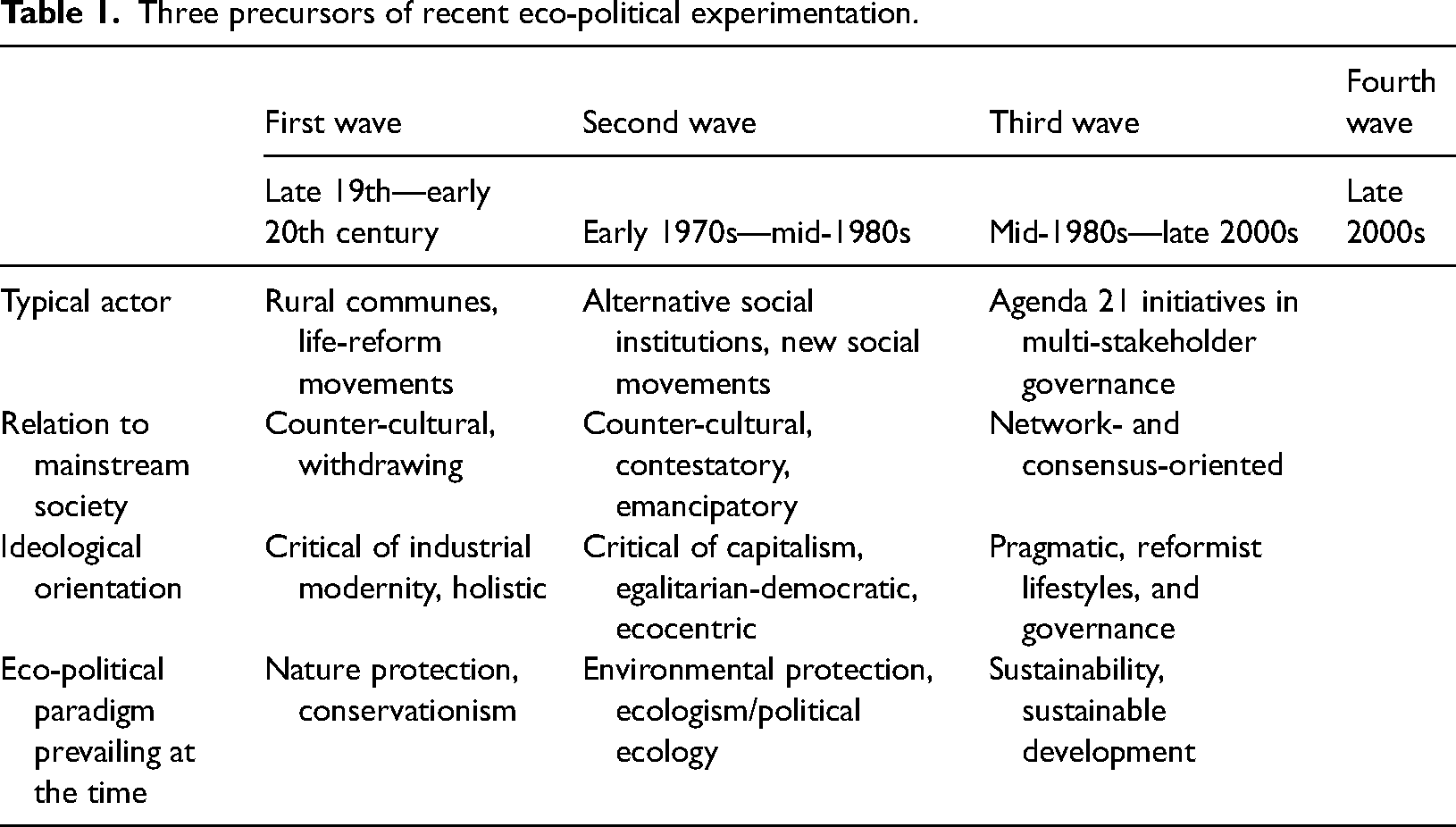
Three precursors of recent eco-political experimentation.
Mapping the trust in radical change in the fourth wave of experimentation
In the recent literature, LESECs have been described, inter alia, as a “journey towards community resilience” (Hopkins, 2011), as “resilience pioneers” (Barry, 2012), as the “imagination of a postcapitalist future” (Asara et al., 2015), as “seeds of a good Anthropocene” (Bennett et al., 2016), as “pioneers of change” (Brand, 2016), as “concrete utopias” (Muraca, 2017), as “grassroots innovation movements” (Smith et al., 2017), and as a “new politics of sustainable materialism” (Schlosberg, 2019). This variety of labels immediately signals, how diverse the portrayals and interpretations of recent LESECs are. Despite the heterogeneity of these initiatives—like urban gardens, community supported agriculture, transition towns, repair cafés, sharing platforms, sustainable housing projects, or eco-villages—and of expectations regarding their ability to realize their specific visions of transformation, it is typically highlighted in academic accounts that recent LESECs do not primarily seek to address the state, nor the market, by protest or advocacy but focus instead on taking change into their own hands in the everyday (Bosi and Zamponi, 2020; Pellizzoni, 2021). Consequently, experimental initiatives are viewed as being embedded into daily life and into specific spatial relations, communities, and their nature relations (Asara and Kallis, 2022; Seyfang and Smith, 2007). Appealing by doing what they preach, it has been argued, they challenge deterministic notions of societal totality and teleological perceptions of history, which are identified in more absolutist forms of environmental criticism (Meyer, 2023; Swain, 2019). Yet, while agreeing on these shared characteristics of LESECs, different strands of the recent literature interpret the socio-ecological transformation these initiatives aim for, the socio-ecological problem perceptions motivating their efforts as well as the normative foundations underpinning them in very diverse ways. Therefore, in order to answer the question whether recent hopeful portrayals on LESECs fundamentally differ from earlier ones, a systematization of recent academic accounts is required. 5 We argue that three particularly prominent lines of argumentation can be distinguished, which we depict in an ideal-typical way: one that interprets experimentation as withdrawal from institutionalized democratic processes turning to hands-on preparation for resilience, a second one that emphasizes the emancipatory character of experimentation contesting the status quo, and finally one that is more instrumentally and managerially oriented towards the testing and upscaling of innovations.
Resilience communities
The first of these currently dominant accounts of LESECs is strongly inspired by the expectation of socio-ecological catastrophe and apocalyptic narratives. Prominent (mainly academic) advocates of transition towns and postgrowth economies typically identify the causes of such disasters in modern societies’ transgression of natural limits and, by implication, their propensity to institutional breakdown. From this perspective, promethean hubris and addiction to economic growth, techno-scientific innovation, globalized consumerism, and rampant individualism are perceived as fatal threats to survival (Hopkins, 2008; Paech, 2012). Correspondingly, LESECs are prominently presented as pathways realizing demands for a radical turn towards re-localized, community-situated provisioning based on values and practices of self-sufficiency, subsistence, and simplicity. As regards these initiatives’ potential for inducing transformative socio-ecological change, this perspective oscillates between the fear of a societal transformation being violently imposed by disaster and the hope for change to be achieved by design (Lovelock, 2009; Paech, 2012). On the one hand, a higher probability of triggering change is ascribed to catastrophic events. Considering the deep entanglement of modern and democratic welfare states with economic growth and consumerist values, Niko Paech, for example, argues, that intentional transformation is unlikely, and he regards disruptive events putting societies under major socio-ecological stress as increasingly likely especially under democratic conditions: “Ultimately, no democratically electable politician can ever afford to question the level of affluence” (Paech, 2012: 19). On the other hand, severe warnings of deadly catastrophes are hoped to ignite some transformative momentum—and, against all odds, still preempt change by disaster. In any case, in this literature, LESECs are expected to function as preparatory sites for experimenting with and cultivating practices of adaptation and resilience (Barry, 2012; Holmgren, 2009). Even if they prove unable to avert catastrophe, they are still regarded as essential for developing the coping strategies and building the capacities, which after the postcatastrophic withdrawal from unsustainable growth dependencies and consumerism will prove indispensable, categorically imperative and, in fact, common sense (Hopkins, 2008; Paech, 2012).
This rejection of modern growth economies, rampant consumerism, and the transgression of natural limits supplemented by deep skepticism regarding the very possibility of a democratically negotiated transformation echoes elements of early twentieth century conservative Zivilisationskritik articulated, for example, by Ludwig Klages or Oswald Spengler, and later in the 1970s’ “eco-doomsday scenarios” (Humphrey, 2007: 23) presented by William Ophuls (1977) or Robert Heilbroner (1974). This critique had tried to evoke radical action to prevent the catastrophe, while, at the same time, questioning its very possibility—at least if this was to be achieved in democratic ways. Furthermore, the emphasis on nonnegotiable natural limits and moral imperatives directly deduced from nature resonates with depoliticized understandings of nature as “extra-human” and normative justifications of the social order (Freeden, 1996: 334) that have led eco-political theorists (e.g., Dobson, 2007) as well as conservatives thinkers to describe conservatism and environmentalism as “natural bedfellows” (Scruton, 2006: 8). 6 Similarly, the focus on small-scale adaptive coping and resilience capacities resonates with the fundamentally reactive character of conservatism (Mannheim, 1986). Additionally, the romanticization of re-localized provision based on artisanship, simplicity, and sufficiency played a key role in back-to-nature discourses at the dawn of the twentieth century. Thus, today's readings of LESECs as resilience communities, in quite a number of respects, reiterate traditions of conservative eco-political thought and the first wave of eco-political experimentation (see Table 1).
Prefigurative utopias
A second perspective displays more confidence in transformative agency and stresses the socio-political character of socio-ecological limits (Brand et al., 2021). Especially academic proponents of political ecology, degrowth, and environmental justice interpret LESECs as spaces for more sustainable forms of everyday provisioning that contest and politicize hegemonic nature–society relations as well as their reproduction in everyday life. Through this contestation, LESECs are said to expose the contingency and malleability of these established relations and to prefigure, right in the present, their reorganization for a radically different future. From this perspective, socio-ecological problems are traced back to oppressive, alienating, socially as well as ecologically exploitative societal structures of domination, unjust power relations as well as capitalist imaginaries and modes of living (Brand and Wissen, 2018; Schlosberg, 2019). Fundamental societal change, it is argued, necessitates a thorough rethinking and emancipatory reconfiguration of established human–nature relations embedding societies in their material preconditions and multispecies landscapes (Asara et al., 2015; Schlosberg, 2019; Tsing, 2015). While resilience and sufficiency might come into view considering unjust distributions of environmental vulnerabilities, the shift towards more sustainable nature–society relations is mainly expected to be driven by collective claims for autonomy, equality, justice, and emancipation (Bergame et al., 2023; Eversberg and Schmelzer, 2018). The emancipatory realization of these ends is imagined as a collective and explicitly political process in which these ends and strategies of transformation are constantly deliberatively reflected upon and possibly revised. Experimentation with alternative practices, imaginaries, subjectivities, and counter-hegemonic modes of living in LESECs, thus, is portrayed as an end in itself and as empowering, democratizing, micro-political intervention in everyday life that allows for experiencing self-efficacy and solidarity, to “collectively learn about desires” (Muraca, 2017: 165) and to open spaces for new imaginaries and assemblages of human and nonhuman actors (Asara, 2020; Schlosberg, 2019). Therefore, on this account, LESECs serve as a “concrete utopia” that anticipate a sustainable society to come and at least partly realize transformative ends in the present (Kallis and March, 2015; Muraca, 2017).
The prefigurative utopias perspective reconfirms the critical-emancipatory tradition within eco-political thinking that problematizes the unequal distribution of political power and socio-ecological vulnerabilities. The vision of sustainability linked to autonomy, equality, and democracy is strongly related to eco-political thinking inspired by Adorno and Horkheimer's critique of the mastery of nature and by the advocates of early social and political ecology (Bookchin, 1971; Enzensberger, 1974; Merchant, 1980/2000). Similarly, the belief that a socio-ecological transformation can be brought about by means of contentious prefiguration may be traced back to this tradition (Gibson-Graham, 1996; Gorz, 1968). Seeking to transgress the reform-revolution dichotomy, it is assumed that prefigurative politics enable resonance in broader parts of society than vanguardism (Meyer, 2023; Yates, 2015). Unsurprisingly, many theoretical reference points in today's prefigurative utopia narratives on LESECs—such as the concepts of heterotopia, concrete utopia or real utopia—are firmly rooted in the academic tradition of critical thought (Bloch, 1959/1986; Foucault, 1986; Wright, 2010). Further, this is well familiar from discourses on emancipatory experiments, which triggered a strong socio-cultural and political dynamic in new social movements of the 1970s and 1980s. Anarcho-primitivist, eco-feminist, and other experiments, too, tried to politicize the private and “anticipate the hoped-for green future” (Dobson, 2007: 127; MacGregor, 2021). Hence, recent interpretations of LESECs as prefigurative utopias may be said to continue critical eco-political thought traditions and primarily the second wave of eco-political experimentation (as illustrated in Table 1).
Innovation laboratories
A third prominent account of LESECs addresses transformation from an instrumental–managerial rather than intrinsic emancipatory point of view. In contrast to explicitly normative claims for emancipation, this perspective often sets out from the implicitly normative diagnosis that established socio-technical systems, e.g., energy, transport, housing, and agri-food systems are bio-physically unsustainable. Especially in sustainability transitions research, today's socio-ecological challenges are characterized by conditions of high complexity, path dependency, and uncertainty (Geels, 2010). In such conditions, protected experimental niches are believed to play a key role in bringing about regime-shifting sustainability transitions—understood as comprehensive, nonlinear, and co-evolutionary transitions of socio-technical systems of provision (Köhler et al., 2019; Loorbach et al., 2017). In these “protected spaces,” the argument runs, new or marginal actors remain shielded “from mainstream market selection” and are able to spawn innovations serving as solutions to socio-ecological problems (Köhler et al., 2019: 4). Located in such niches, LESECs are perceived as laboratories for “grassroots innovations” (Seyfang and Smith, 2007) providing “new ways of thinking, doing, and organizing” (Lam et al., 2020: 3). Through experimentation, that is, through a process of trial and error, it is argued, they invent, improve, nurture, and cultivate more sustainable technologies and practices (Sengers et al., 2019; Smith and Seyfang, 2013). LESECs are assumed to be particular in that the social rather than technological innovations they generate are rooted in local communities, shaped by real-world needs, and powered by collective desire (Seyfang and Haxeltine, 2012; Smith et al., 2017). Nevertheless, to effect comprehensive transitions, promising niche innovations depend on processes of upscaling or diffusion into broader parts of society (Lam et al., 2020). Hence, these modes of amplification are embedded into broader frameworks for reflexive governance aiming for strategic niche management (Kemp et al., 1998; Rotmans and Loorbach, 2008) or niche policy advocacy, that is, “lobbying that positions niche performance as something that matters” (Smith et al., 2016: 411).
This framing of LESECs as innovation laboratories strongly resonates with systems-thinking that had become prominent in the late 1960s in the natural sciences (Maturana and Varela, 1980; Meadows, 2008) and later also attracted some attention in the social sciences (Capra, 1996). The focus on specific systems of provision and niches, in particular, calls to mind a core tenet of systems-thinking, namely the decentralization of the human subject (and its autonomy) along with the shift of emphasis towards systems (and their autopoiesis) as the interplay between agents, technologies, infrastructures, policies, and cultural norms (Luhmann, 1989; Urry, 2005). This shift of emphasis leads the innovation laboratories perspective as well as eco-political systems-thinking to foreground systemic path-dependencies, complexity and the nonlinearity, unpredictability, and co-evolutionary character of socio-ecological change. Embodying a critique of technocratic, top-down governance approaches as well as utopian, collective subject-approaches, the innovation laboratories perspective emphasizes the need for cooperative reflexive governance and strategic niche management. Already becoming prominent in eco-political systems and innovation thinking in the late 1960s (Meadows et al., 1972), this critique underpinned calls for improved cooperation in multi-level and multi-stakeholder governance and for hands-on-learning and local knowledge as a basis for innovation in the locally embedded implementation of sustainability policy in the UN's Agenda 21 (Geels, 2019; Moulaert and MacCallum, 2019). Therefore, portraying LESECs as innovation laboratories strongly resonates with eco-political systems and innovation thinking and discourses during the third wave of eco-political experimentation (specified in the previous section and Table 1).
This systematization of the ways in which the recent environmental social science literature conceptualizes and accounts for fourth-wave LESECs is, again, an ideal-typical simplification. Yet, in the present context, the deliberately simplifying distinction of three major accounts of LESECs—resilience communities, prefigurative utopias and innovation laboratories, as tentatively captured in Table 2—helps, first, to reveal their diversity. Second, addressing the question, whether recent discourses on LESECs fundamentally differ to their predecessors, we find that current hopeful portrayals of LESECs bear major resemblances to earlier discourses on eco-political experimentation. Accounts of LESECs as resilience communities resemble discourses during the first wave of experimentation and eco-conservative thinking. As prefigurative utopias they reiterate earlier eco-emancipatory discourses during the second wave of experimentation. And as innovation laboratories they strongly resonate with systems and innovation thinking shaping the third wave of experimentation. Of course, present accounts of LESECs are not mere reiterations of past meaning-making of LESECs. Any meaning-making involves reconfiguration, adaptation, and expansion. In fact, some contributions we map cut across different accounts and bring them into conversation. For example, approaches that can be attributed to the perspective of resilience communities, such as Niko Paech's postgrowth economy, take up insights from research on the diffusion of social and grassroots innovations (Paech, 2012), and approaches that can be attributed to the perspective of prefigurative utopias point even more strongly than the eco-centric approaches of the 1980s to the involvement of nonhuman species, actors, and natures (e.g., Meyer, 2015; Schlosberg, 2019). Also, interpretations of LESECs as innovation laboratories, are beginning to take on board the criticism that they have paid too little attention to the politics determining upscaling and diffusion processes (Shove and Walker, 2010). Increasingly, they now integrate aspects of contentious politics and power relations into their analysis (e.g., Avelino et al., 2019; Smith et al., 2016). However, these adaptations, reconfigurations and ties do not suggest any fundamental difference to earlier practices and interpretations of eco-political experimentation that would justify the assumption that recent LESECs have transformative potential far beyond that of their predecessors.
Three prominent portrayals of LESECs in the fourth wave of experimentation.
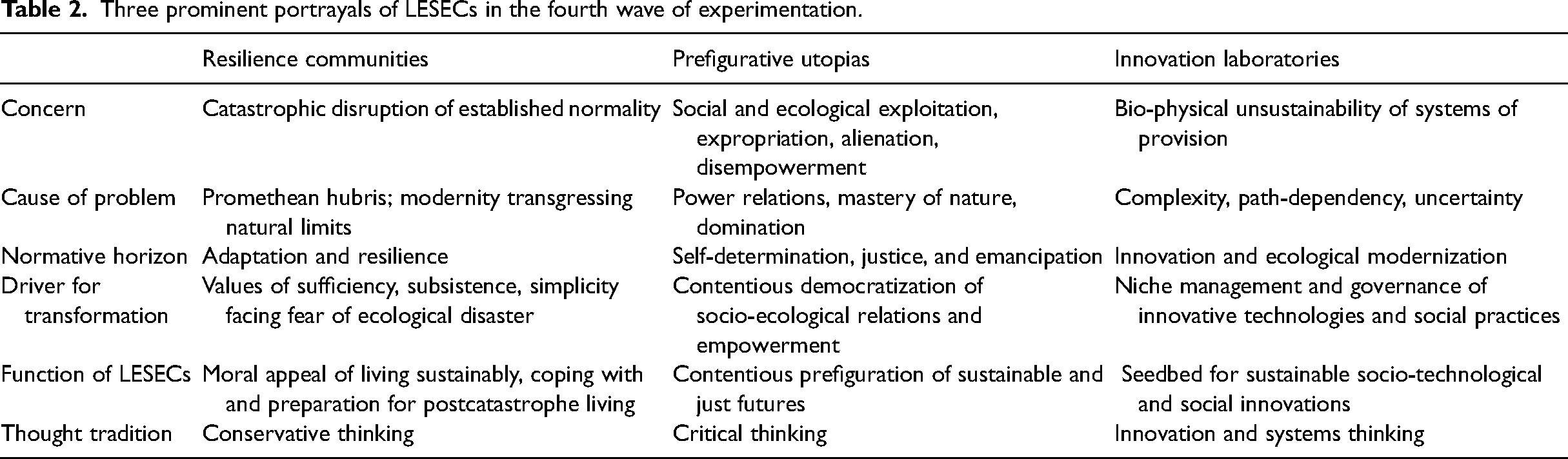
Beyond community, prefiguration, and innovation: new context conditions for experimentation
Hence, the confidence in the ability of LESECs to initiate fundamental socio-ecological change must hinge, primarily, on the larger political, cultural, and socio-ecological context that may facilitate “potentially catalytic” (Eckersley, 2020: 224) transformative impacts today. How, then, does the current societal constellation—in contrast to the context conditions of earlier waves of experimentation—endow experimental interventions and related present-day discourses with new transformative traction? What is required is a conjunctural analysis extrapolating the “specificity” of the “given historical moment” (Gilbert, 2019: 6). Conjunctural analysis is essential to “identify the political opportunities (and dangers) that are presented for ecological transition, including sites within … civil society” (Eckersley, 2021: 255). It implies a “nuanced diagnosis of contemporary societies” (Blühdorn, 2022b: 577), which includes, but is not limited to, “the analysis of convergent and divergent tendencies shaping the totality of power relations within a given social field during a particular period of time” (Gilbert, 2019: 6) at “different levels of expression—political, ideological, cultural, and economic” (Hall and Massey, 2010: 65). With regard to LESECs this calls, in particular, for an investigation of discursive shifts and political opportunities. When compared to earlier waves of experimentation, these contextual parameters and conditions undoubtedly have changed substantially.
Such conjunctural analysis, invariably, remains selective and unfinished (Eckersley, 2021). As we highlighted in section “Mapping the trust in radical change in the fourth wave of experimentation,” the different accounts of LESECs themselves identify necessary contextual conditions for bringing the transformative potential of LESECs to fruition. Conceptualizations of LESECs as resilience communities regard catastrophe as a context condition. Accounts of LESECs as prefigurative utopias emphasize politicization, democratization, and the overcoming of unjust power relations as essential to the unfolding of the LESEC's transformative potentials (Schoppek and Krams 2021). And as concerns grassroots laboratories, their unfolding hinges on adequate transition management. For present purposes, we expand this focus by zooming in on two particular socio-political and socio-ecological conditions in late modern societies of the global North: firstly, fundamentally new perceptions of the socio-ecological crisis—with the multiplicity of spiralling crises and the erosion of the ideals of sustainability and ecological modernization. Secondly, the current constellation is determined by an increasingly observable autocratic-authoritarian turn. While current debates in social theory highlight the centrality of these parameters, they remain strangely unreflected in recent accounts of LESECs in environmental social science.
Coping with an accelerating spiral of crises at the end of sustainability
To answer the question of whether societal conditions have changed in favour of realizing the transformative potentials of experiments in civil society, we first turn to the changing perception of socio-ecological crises. In the last decade, the paradigm of sustainability has lost much of its mobilizing power. Much of the confidence in co-ordinated global environmental governance under the leadership of the UN has evaporated. As global warming, resource extraction, biodiversity loss, and social inequality continue to worsen, many critical observers in academia and civil society no longer regard sustainability as a promising lead concept for the socio-ecological transformation of modern societies (Blühdorn, 2017; Foster, 2015). Dominant techno-managerial understandings of sustainability are increasingly implausible since improvements of resource efficiency tend to be swiftly offset by rebound effects (Haberl et al., 2020), and public trust in the problem-solving- and steering capacities of the environmental state and global governance mechanisms has diminished (Bulkeley, 2023). Therefore, the sense of frustration that commonly underpins the “turn to everyday life” (Meyer and Kersten, 2016) in environmental social science is clearly justified. One reaction to this frustration is to renew ideals of sustainability by highlighting that experimentation beyond civil society has become indispensable (Bulkeley, 2023; Hoffmann, 2011). In contrast to modernist top-down and expert-driven planning, decision-making, and state practices as well as avant-garde eco-politics of environmentalists, experimental governance, it is argued, is able to transgress traditional boundaries of bottom-up and top-down politics to deal collaboratively and reflexively with the contingency, complexity, and contextuality of socio-ecological problems including the ignorance and indeterminacy that comes with them (Evans et al., 2018; Meyer, 2023; Ritts and Bakker, 2022). In living, transformation, urban transition, and real-world labs multiple actors as scientists, politicians, planners, stakeholders from administration and civil society participate and collaborate to understand as well as provide and test solutions to complex socio-ecological problems. Transdisciplinary research and experimental governance settings, it is argued, enable the co-creation of locally embedded solutions and recursive learning by surprise in the real world (Bergmann et al., 2021; Sengers et al., 2021). This “experimental turn” (Overdevest et al., 2010) in transdisciplinary sustainability science and participatory sustainability governance, one might argue, does not only contribute to an “opening of spaces for practicing a politics of hope” (Castán Broto and Bulkeley, 2018: 69), but also constitutes promising context conditions and a novel opportunity structure for experimentation in civil society with the latter being embedded in a larger socio-political turn toward experimentation and invited to participate in specific local governance-driven experiments—potentially enabling to overcome the lack of “durability and the challenge of scaling up” (Eckersley, 2020: 228).
However, experimentation in civil society was already embedded in collaborative forms of sustainability governance during the third wave of experimentation and the confidence in the “promises of experimentation” (Evans et al., 2018) has declined in recent years. As was already the case during the third wave of experimentation, experimental governance is criticized due to its project-based form of organization. Experimental governance, Torrens and von Wirth (2021) argue, is hampered by “unambitious incrementalism, short-termism, lack of direction, lack of follow-up, and unmet learning promises” (14). Despite—or even because of—its participatory and transdisciplinary orientation, eco-modernist governance remains mostly unopposed, decisions depoliticized and opaque (Savini and Bertolini, 2019; Swyngedouw, 2005), and inequality and injustice reinforced (Butzlaff, 2020). Therefore, some observers criticize experimental governance as manifestation of “elite power” (Sovacool et al., 2019) and Beck's (1995) notion of “organized irresponsibility” (Haderer, 2023; Torrens and von Wirth, 2021) being “involuntarily and contrary to its declared commitments, itself … part of the problem” (Blühdorn, 2023: 57). Therefore, the experimental turn in sustainability governance and science might rather confirm the limits than the promises of LESECs.
Another reaction to the frustration with existing environmental and climate policy and the increasingly apparent consequences of an accelerating spiral of socio-ecological crises is an increased sense of urgency. Experimental approaches, Davidson et al. (2019) argue, may simply run out of time. In light of this discursive shift, scholars call for top-down decision-making by a strong state (Haderer, 2023; Weibust, 2016) and climate protesters demand the state to “follow the science.” And in the wake of the COVID-19 pandemic and the Russian invasion of Ukraine, a return of the state has indeed occurred. Increasingly superseding participatory and experimental approaches to governance, this signals a changing opportunity structure to the disadvantage of civil-society based experimentation. Given this new sense of urgency, postapocalyptic narratives proliferate among activists and theorists (Cassegård and Thörn, 2018; de Moor, 2021; Swyngedouw, 2022) that presume climate catastrophe has already occurred and cannot be avoided. Additionally, in light of the COVID-19 pandemic, Russia's war against Ukraine and the energy crisis, narratives shift further from transformation, mitigation, and emancipation towards resilience, adaptation, security, and coping “in the ruins” (Wakefield, 2018) of a disintegrating order. In this constellation, agendas of defence and resilience increasingly bypass agendas of transformation and emancipation, shifting the emphasis toward “mental or cultural adaptation to loss rather than to prevent[ing] it” (Cassegård and Thörn, 2018: 563) and “coping with the prevailing order of unsustainability” (Blühdorn, 2023: 55). One might argue that, in line with the perspective of resilience communities, this sheer urgency of the sustainability-crisis is sufficient for making sure that innovations rehearsed in LESECs will soon gain a lot more socio-political traction and transformative power. This urgency alone might, then, render further conjunctural analysis unnecessary and legitimate the portrayal of LESECs as promising drivers of change. But to what extent do recent hopeful interpretations of LESECs actually account for this increased sense of urgency?
The prefigurative utopias perspective operates with an open time frame, even though the intensification of the socio-ecological crisis seems to confine future horizons for emancipation. As Kenis highlights the socio-ecological preconditions for activism have fundamentally changed: “while for the ‘68ers the future was open, for the youth climate strikers the future is haunted by the past. … Their frustration is exactly that they will not get rid of the legacy of the past” (Kenis, 2021: 139). Additionally, the innovation laboratory perspective does not fully clarify how decisions are made upon the most promising innovations and is, therefore, not able to suggest, why an increasing sense of urgency may lead to mainstreaming innovations throughout society at large (Hausknost and Haas, 2019). Also, the resilience communities’ perspective on LESECs, which seems at first better prepared to address this discursive shift due to its reactive character and emphasis on resilience, cannot explain why the amplification of eco-experimental practices should be imperative since it essentially depoliticizes matters of urgency. There is no reason to assume that the perception of urgency will automatically be conducive to the mainstreaming of the practices and imaginaries pioneered by LESECs, rather than to efforts to restabilize the status quo. For, as Beck noted already in 1995: “the relations of definition which determine … hazards are socially negotiated. … Anyone who fails to appreciate this falls victim to a force-of-circumstance ideology” (Beck, 1995: 43). Therefore, the closing time frame just signals worsened conditions for transformative experimentation and currently changing perceptions of socio-ecological crises might not justify the academic confidence in the realization of transformative potentials of experimentation in civil society.
The autocratic-authoritarian turn
Escalating dynamics of crises might certainly give rise to critical conjunctures, which “hold the greatest potential for a systemic reconfiguration” (Eckersley, 2021: 254). The coronavirus pandemic, for example, triggered great expectations for socio-ecologically emancipatory pathways out of the crisis and the societal structures made responsible for the crisis in the first place (Dean, 2020). These hopeful aspirations, however, have not materialized so far. At least, no increasing amplification of grassroots innovations or emancipatory imaginaries has been observed. In fact, critical conjunctures offer chances not only to the actors, movements, and initiatives that are typically taken into account in discourses of environmental social science in general and regarding LESECs in particular. As Hall notes, “crises are moments of potential change, but the nature of their resolution is not given” (Hall and Massey, 2010: 57). Actors pursuing quite different almost opposite objectives may take advantage of critical conjunctures as well. During the COVID-19 pandemic, for example, protests against Corona measures that seek to emancipate themselves not from unsustainable social structures and systems of provision but from responsibilities and solidarity in favor of exclusive individual liberty gained momentum (Opratko et al., 2021). These protests for exclusive forms of individual freedom of the few are familiar not only from anti-science movements which, inter alia, engage in denial or skepticism regarding climate change. They also further the “autocratic-authoritarian turn” (Blühdorn, 2022b) signaled by the global decline of democracy and democratization ushering in a “third wave of autocratization” (Lührmann and Lindberg, 2019) that is entangled with the decline of democratic and the rise of authoritarian capitalism, renationalization, and increasing geopolitical tensions (Mouffe, 2022; Streeck, 2014). In the global North and beyond, this turn is most visible in the successes of far-right parties, governments, and movements, and by the normalization of far-right actors, ideologies, and argumentations far into the societal mainstream (Brown et al., 2021; Krzyżanowski et al., 2023). Some have argued that this “populist moment” (Mouffe, 2018) represents a rupture within the postpolitical condition of liberal democracies in the global North that does not only open a space for radical democratization but also a repoliticization of depoliticized environmental and climate politics (Meyer, 2024; Mouffe, 2022). Especially from the prefigurative utopias perspective, the integration of LESECs into such a progressive populist agenda could be a lever for progressive LESECs to open up new spaces of possibility to realize and widen their potential of resonance. As Eckersley highlights, the recent hopeful academic portrayals of LESECs share “with populism of all stripes a disillusionment with, and rejection of, democratic representation by mainstream political parties and technocratic elites” and a reorientation towards “particularistic preoccupations and grievances of local communities, environmental, and otherwise” (Eckersley, 2020: 227–228).
In fact, lines of de/politicization and eco-political conflicts are currently reconfigured (Blühdorn and Deflorian 2021), which fundamentally justifies these considerations and potentials. In the current conjuncture of politicization, polarization and “environmental culture wars” (Dryzek, 2021: 237), however, the conditions for realizing the transformative potentials of LESECs seem to become much more challenging. So far, ongoing autocratization has exceeded the radical democratization of democracy by far (Lührmann and Lindberg, 2019). Especially far-right parties in power constrain the public sphere and ecologist parts of civil society in Europe and beyond, which makes it difficult for progressive LESECs to forge political alliances (Buzogány et al., 2022). Instead, not only climate obstruction and anti-environmentalism but also agendas of “authoritarian sustainability” (Dannemann, 2023) are gaining in significance. Under these conditions, the potential of social resonance of far-right initiatives in civil society promoting local everyday politics and collective experimentation with environmental lifestyles as well seems to be—at least for the moment—expanding more strongly than the potential of progressive LESECs (Benoist, 2024; Dannemann, 2023; Forchtner and Olsen, 2024).
So, what does this mean for the promise of transformative change through LESECs that continues to loom large in present-day environmental social science? Starting with the observation that civil society-driven experimentation in socio-ecological change is hardly new and, as yet, has not triggered the unprecedented socio-ecological transformation which many scientists and activist demand, the agenda of this article has been to reassess these promises ascribed to eco-political experimentation. For the promising portrayals to be justified, we have argued, either these accounts should demonstrate that recent experiments are radically different from their predecessors or that their social and socio-ecological context conditions are much more favourable of the realization of transformative capacities of experimentation.
To investigate whether at least one of these conditions is fulfilled, we, first, reviewed discourses accompanying earlier waves of eco-political experimentation and academic accounts of recent LESECs in environmental social science. As concerns the former, we distinguished three earlier waves. The latter, we systematized by distinguishing three ideal-typical accounts of LESECs in the fourth wave of eco-political experimentation: LESECs understood as resilience communities, as prefigurative utopias, and as innovation laboratories, which we found to be strikingly similar to earlier waves of experimentation and related discourses. Accordingly, any claim for significant transformative potentials of LESECs can only be based in major changes in the societal and eco-political conditions of experimentation. Today, LESECs find themselves in a situation in which frustration—with the paradigm of sustainability, the environmental state, with techno-managerial, global, top-down governance approaches—is widespread, which triggered an experimental turn in sustainability governance and science. To some extent, this generates new momentum for experimentation. Yet, this new penchant for experiments in civil society is increasingly challenged by a new sense of eco-political urgency, a return of the state, and the autocratic-authoritarian turn reinforced by the current multiplicity of crises. Increasingly agendas of adaptation and resilience supersede earlier ideals of transformation and emancipation, which enables actors in civil society to gain momentum whose ideas of social change are very different from those most commonly envisaged in the context of socio-ecological transformation.
Thus, the recent confidence in the transformative potentials of experimentation in civil society is, we conclude, hardly justified. The question whether and to what extent LESECs can plausibly be regarded as significant carriers of hope requires, we suggest, much more explicit engagement with the question Why now? Why should LESESCs today realize transformative potentials that were hardly realized in the past? One might argue, that any conjunctural analysis is itself a social construction. But the phenomena addressed in recent social theory, such as an accelerating spiral of crises and the autocratic-authoritarian turn, are significant. Therefore, historical evidence and the aspects of the current conjuncture that signal increasingly unfavourable context conditions for the transformative capacities of eco-political experimentation to fully unfold must not be ignored. Of course, focusing on fundamental societal dynamics captured by contemporary social theory our conjunctural analysis is limited and further research is needed in comparing different accounts of conjunctural analyses and empirical accounts of social practices. However, simply repeating well-known problem diagnoses and solutions to them; holding on too easily to portrayals of LESECS as radical change agents may itself have a stabilizing effect. This stabilizing effect unfolds by repeating problem diagnoses and solutions to them without convincingly accounting for why phenomena, that have been prominent in the past, may have the power to effect radical change in the present. Clearly, such portrayals may elicit optimism, they may help to be “ultimately more hopeful” (Meyer, 2015: 167) and provide “positive visions for the future” (Bennett et al., 2016: 447). Yet, despite past waves of LESECs and their current prominence, at a societal level, “sustaining the unsustainable” (Blühdorn, 2017: 55) continues to be the norm rather than the exception. Hence, if only temporarily, environmental social science may have to postpone its effort to identify “seeds” for transformative change and prioritize, instead, the task to explain why the seeds sown at various stages in the past, have not really come to fruition. If it fails to do so, it may betray both its normative-political responsibility and its descriptive-analytical responsibility (Blühdorn 2022a). Optimism, although crucial to motivating transformative action, also comes with a risk—a risk that Immanuel Kant had once illustrated as follows: “A doctor who consoled his patients from one day to the next with hopes of a speedy convalescence, pledging to one that his pulse beat better, to another an improvement in his stool, to the third the same regarding his perspiration, etc., received a visit from one of his friends. ‘How is your illness, my friend,’ was his first question. ‘How should it be?’ I am dying of improvement, pure and simple!” (Kant, 1789/1979: 169)
Highlights
In environmental social science, the confidence in societal change through civil society-driven experimentation is high, a confidence this article questions.
We find three dominant varieties of hopeful discourses on experiments today: resilience communities, prefigurative utopias, and innovation laboratories.
Past and recent discourses on experimentation are strikingly similar, which begs the question of why hope is supposedly justified now.
The current shift towards resilience (away from transformation) and the autocratic- authoritarian turn are unfavourable context conditions for hope in experimentation.
The academic confidence in transformation through eco-political experimentation may itself sustain the unsustainable.
Footnotes
Contributions
H.D. and M.H. conceived the original idea of the paper, carried out the research, and developed the argument. I.B. contributed to structuring the argument and paper. H.D. took the lead in writing the manuscript, supported by M.H. and I.B. at various stages.
Funding
The authors disclosed receipt of the following financial support for the research, authorship, and/or publication of this article: This work was supported by the Austrian Science Fund (FWF) under Grant P 31226.
