




Abstract
The idea of ‘Sustainability as a Real Utopia’ elaborated on here adapts sociologist Erik Olin Wright’s emancipatory social science and is a heuristic informed by critical realism and social theory for interdisciplinary research on viable alternatives that move society towards achieving sustainability. Starting from the proposition that many environmental problems are rooted in how social structures and institutions interact with nature by shaping human agency, we argue for concretely situated analysis aimed at guiding human agency towards changing those root causes. Then, drawing on concrete examples from sustainability research, we elaborate on three central tasks: diagnosing and critiquing environmental problems, elaborating viable alternatives and proposing a theory of transformation. Finally, we discuss, and welcome dialogue around two central and interlinked challenges of our approach to transformative sustainability research: that of scales, and that of the distinction and relationship between reforms and transformation.
Introduction
In the face of multiple and intersecting ecological crises that impact human well-being, sustainability science has evolved over the past two decades into a theoretically, methodologically and empirically diverse academic field bound together by a shared ambition to conduct problem-driven and use-inspired research (Lang et al., 2017; Miller et al., 2014). The environmental problems and sustainability challenges that its researchers engage with involve interactions between multiple biophysical and social entities and processes that span across time and space, which necessitates interdisciplinary research (Haider et al., 2018). In this field, it is uncontroversial to call for analysis of the social drivers and impacts of environmental problems, and interventions into social processes are often supported. However, its interdisciplinary nature generates a high degree of heterogeneity when it comes to conceptualizing the social – what it is, how it is to be researched, and how it may potentially be changed.
Even though pluralism is an important and defining feature of sustainability science (Isgren et al., 2017), we maintain that it is crucial that foundational insights from various disciplines are not overlooked. Given the central role that social structures and institutions have in shaping our world, we believe that sociology can provide sustainability researchers with important disciplinary knowledge. Thus, in this article, we build on prominent sociologist Erik Olin Wright’s (2010, 2012) work on Real Utopias to create a heuristic for use-inspired interdisciplinary sustainability research firmly rooted in social theory, with the parallel aim to stimulate further engagement with it and associated work amongst researchers and students in sustainability science.
In the inaugural editorial for this journal, similar to the debates in sustainability science, Collard et al. (2018) called for a deepened scholarly conversation on how work on socio-natures might benefit from ‘social theoretical debates, concepts, and modes of analysis from across the social sciences, humanities, and interdisciplinary critical biophysical perspectives’ (16). In addition, they asked, ‘[…] which alternative movements and approaches might provide ways to reconfigure nature/space/society relations in ways that have the scope to be truly transformative, or that allows us to reimagine and reconfigure nature-society-spaces “otherwise?”’ (16),
We view our proposal for a Real Utopias approach to sustainability research as a response to both calls. Not only does it bring – to borrow the words of C Wright Mills – a much needed sociological imagination to sustainability research, it also represents a critical approach that seeks to reveal the deeper drivers of environmental change while identifying and engaging with potential agents of change and the alternative configurations of nature–society relations they (could) propose.
However, as we translate Wright’s work on Real Utopias into the context of sustainability research, we propose and argue for important adaptations. Most fundamentally, we explicitly root our heuristic in a critical realist philosophy of science (Bhaskar, 2013) and highlight the method of immanent criticism as a transparent and coherent procedure for addressing normative challenges and integrating scientific knowledge from across discipline in use-inspired sustainability research (Boda and Faran, 2018). When presenting this reasoning, we will also juxtapose this critical realist approach to normativity with those that a priori adopt a theory of justice to root their normative position, as is common in the field of political ecology. By doing so, we create a heuristic for interdisciplinary research that aims to address environmental problems which have social drivers, and also invite further dialogue with radical thinkers outside of our own field.
It should be acknowledged that other attempts have been made to steer sustainability research in the direction of deeper structural understandings and more comprehensive transformative pathways (Perez Salgado et al., 2018). These include the ‘leverage points for sustainability’ rooted in systems-thinking (Abson et al., 2017) and cultural evolutionary perspectives (Brooks et al., 2018). These also confront the analytical weakness of sustainability science that stems from neglect of social science perspectives (Kagan and Burton, 2018) but avoids engaging with more radical and emancipatory literature on social change of which Wright’s work constitute an influential example. Outside of our own research (Harnesk, 2018; Isgren, 2018), those that have engaged with Wright’s Real Utopias in our own field either focused on its theory of transformation (O’Brien, 2018) or applied it as a general framing (Crews et al., 2018).
We mainly contrast our sustainability science approach to various transdisciplinary and consensus-oriented processes of knowledge co-production, which have become common in sustainability research that seeks to create action-oriented knowledge through research collaboration with ‘stakeholders’ or ‘non-academics’ (Lang et al., 2012; Norström et al., 2020). These are underpinned by claims about the need for deeper engagement with societal actors, which are valid, but in practice become vulnerable to co-optation by powerful actors with vested interests (c.f. Folke et al., 2019). As Polk (2014) so clearly puts it in her cautionary remark: these approaches create a necessity to remain ‘compatible with institutional structures and decision-making processes’ (450).
Instead, we contend that for action to contribute towards solving problems, it must be directed towards the central drivers of those problems, regardless of compatibility with present institutions and social structures. This position may warrant or indeed require researchers to engage more strategically with novel sets of actors that typically do not get included, or choose not to take part, in so-called participatory processes or stakeholder dialogues, and whose solutions tend to get written off as too radical or unfeasible. We posit that a critical realist approach structured by Wright’s emancipatory social science has strong potential to help tackling sustainability challenges, particularly those that call for transformational change through social struggle. In this time of debate on how to achieve transformation towards sustainability (see Scoones et al., 2020) we launch this heuristic not as a grand theory on Sustainability, but as a heuristic to analyse and confront environmental problems with social drivers within their concrete context. Thus, we leave room for researchers to define, through the heuristic elaborated below, what constitutes the kinds of transformation necessary in relation to the specific problem and context at hand.
We begin this article by explaining the foundations and overarching logic of the heuristic, and then describe in greater detail its three major steps: diagnosing and critiquing, elaborating viable alternatives, and proposing a theory of transformation. As we do so, we seek to clarify and overcome some important limitations of Wright’s emancipatory social science when used in the specific context of sustainability research, and through an appendix provide further empirical grounding and concretization. We end by reflecting on the contribution of this heuristic and discussing remaining tensions that need further attention – not least from geographers.
Foundations: On social drivers of concrete environmental problems
The title ‘Sustainability as a Real Utopia’ refers to two fundamental aspects of this heuristic: the ontological position of critical realism, 1 and the utopian metaphor of the seminal book of emancipatory social science, ‘Envisioning Real Utopias’ (Wright, 2010). In the face of the real biophysical facts of many sustainability challenges that societies are confronted with, any realization of sustainability may seem to belong to the realm of utopian dreams rather than that of practical realities – at least outside of staunchly eco-modernist circles (see Grunwald, 2018). Our ambition is to embrace utopian ideals of sustainability ‘that are grounded in the real potentials of humanity, utopian destinations that have accessible waystations, utopian designs of institutions that can inform our practical tasks of navigating a world of imperfect conditions for social change’ (Wright, 2010: 6).
Our proposal starts from the position that sustainability science should generate use-inspired scientific knowledge relevant to the collective project of achieving real sustainability. One way of doing so, we will argue while adapting Wright’s framework into a critical realist position is to systematically elaborate on achievable alternatives that can address concrete environmental problems. To be clear, sustainability for us, similar to utopias for Wright, is more of a metaphor that frames our approach, rather than a specific concept we attribute some specific normative meaning to within our heuristic. In this first section, we present the propositions that underpin our heuristic and clarify why they differ from Wright’s foundational principles, 2 thus also delineating which kinds of problems the heuristic is applicable to.
In broad agreement with the sociological approach that Wright employs, our heuristic starts out from two basic propositions. First, that institutions and social structures shape human agency – including humans’ interaction with nature – and it is through this process that many environmental problems arise. Second, that institutions and social structures have been created by humans and, consequently, they can also be transformed through human agency. The points where we significantly differ concerns how disciplinary knowledge and normative positions should be incorporated into the research process.
We refer to environmental problems as biophysical outcomes that take place in a concrete context. These outcomes may vary in terms of scale (e.g. local to global, short to long-term) and drivers (e.g. technology-, market-, state- and citizen-led) but are within this heuristic rooted in nature–society interactions. Importantly, describing biophysical outcomes in purely natural scientific terms does not treat them as a problem per se (e.g. droughts and soil degradation). For it to be a problem it must involve some human perspective. Consequently, environmental problems must here eventually be conceptualized as problems for someone (e.g. poverty and food insecurity), which involves taking a normative position.
Why do we emphasize that the heuristic must be applied to concrete environmental problems? This is a logical consequence of conducting use-inspired research within a critical realist tradition, which poses that there is always a multiplicity of causal mechanisms behind phenomena such as environmental problems (Bhaskar et al., 2018). These causal mechanisms exist regardless of our knowledge of them, interact with one another, and may in due course give rise to emergent phenomena which necessarily manifest themselves differently depending on the specific context (Sayer, 2000). In order to identify such causal relations, concrete analysis of how the past actively shapes both current dynamics of the environmental problems and future opportunities/barriers for reforms and transformation that can address these become necessary.
The heuristic proposed here is not applicable to all conceivable environmental problems, but those demonstrably caused by the ways that institutions and social structures shape human interaction with nature, or in other words have social drivers. In these terms, consider land degradation. When, across a region of considerable size, only a few farmers have problems with sustaining soil fertility, it is reasonable to look to the characteristics of the individual farmers, their skills and the land they farm. But when most farmers across a region or even nation experience severe problems in maintaining soil productivity, this indicates an environmental problem with social drivers, and that the solution calls for analysis and intervention beyond the individual level.
Finally, any conceptualization of an environmental problem is deeply affected by the selection of analytical scales, as different scales and levels may generate emphasis on certain nature–society interactions at the expense of others (Cash et al., 2003; Gibson et al., 2000; Neumann, 2009). To be clear, by ‘analytical scales’ we refer to ‘the spatial, temporal, quantitative, or analytical dimensions used to measure and study any phenomenon’, where different levels constitute ‘the units of analysis that are located at the same position on a scale’ (Gibson et al., 2000: 218). In essence, questions of scale have far-reaching repercussions for what and whose problems end up as research objects – an issue we will return to throughout the article, especially in the concluding discussion.
Having established these foundations, we move on to present our adaptation of Wright’s three organizing principles, or ‘tasks’ as Wright calls them (Wright, 2010). The three tasks as adapted to our heuristic are: (1) conducting a systematic diagnosis and critique of an environmental problem; (2) elaborating on viable alternatives that convincingly respond to the diagnosis and critique, and; (3) understanding which agents can achieve alternatives which address the environmental problem given existing obstacles and possibilities, and through what processes. All three are necessary for a comprehensive theory of transformation, but one may in each case be in more urgent need of researchers’ attention than the others (Wright, 2010: 10).
Diagnosis and critique – The first task
The first task is to diagnose and critique the causal processes that generate environmental problems. It is not enough to declare in natural scientific terms that phenomena such as land degradation or climate change are escalating at alarming rates, although such points may form part of the critique. As we have argued, environmental problems must be conceptualized as problems for someone, and theory must eventually be applied to understand their root causes. In terms of theoretical substance, within our heuristic’s sociological approach, this requires research to show how specific properties of institutions and social structures shape human agency in ways which generate such problems. Hereafter we elaborate on a process for fulfilling this task, wherein difficult choices regarding whose problem to research and how are guided by the method of immanent criticism.
In order to avoid arbitrary and incommensurable judgements, the process of diagnosis and critique must follow some coherent logic for how choices are made regarding both the object of critique and the criteria to follow. It is here that we will propose an important modification to Wright’s approach, which we characterize as an external mode of critique that evaluates practices against criteria set by the researcher. In his work on Real Utopias, Wright outlines a set of moral principles rooted in a radical democratic egalitarian understanding of justice which serve as a baseline against which to judge institutions and social structures (Wright, 2010). 3 Notably, he later added sustainability as one of the moral principles (Wright, 2012). 4
While perfectly valid from a scientific standpoint, external critiques come with their own set of challenges. First, on what basis do researchers choose one particular set of values, one theory of justice, or political actors to be relied upon, and not others? Why Rawls not Fraser, why Sen not Nussbaum, why Schlosberg not Martínez-Alier? Any external critiques must still be able to justify why they start with that normative position and not others. This immediately moves the discussion to the abstract level of values, and to the question of whether certain values or theories of justice can be shown to be superior to others, or if it is simply a choice based on one’s own values or those of the people one interacts with. Second, as observed in the Rights to the City scholarship, theories of justice may bring attention to the context specificity of movement claims, and be proposed as unifying political actors, but can easily ‘forget this specificity and produce vague or abstract recommendations’ as they forget that ‘the particular dynamics depend on the case’ (O’Byrne, 2020a: 131). Instead, below we elaborate a critical realist approach, which we argue provides a transparent and coherent way for how researchers make value-based judgements (what ought to be done) and helps assure that research can have something meaningful to say about practical issues faced by those that are affected by, and attempt to address, environmental problems (what can be done).
The method of immanent criticism – Tackling normativity and interdisciplinarity
The method of immanent criticism, commonly used within critical realism (Bhaskar, 2013), has been convincingly argued to offer an appealing alternative mode of critique within the interdisciplinary and normative field of sustainability science (Boda and Faran, 2018). The purpose of an immanent critique is to depart from an object of study (e.g. goals, practices, explanations) and identify its internal contradictions (e.g. gaps, silences and inadequacies), in order to then formulate more comprehensive explanations and more adequate practices (Boda and Faran, 2018; see also Boda and Jerneck, 2019). Internal contradictions can take different forms, such as theory–theory, theory–practice and/or theory–data inconsistencies which can be elucidated through systematic and scientific analysis (Isaksen, 2018: 97). For example, analysis may demonstrate how current theoretical approaches to addressing environmental problems are either not lived up to in practise, or fundamentally incapable of addressing them.
As a method, immanent criticism establishes a process for moving iteratively between the concrete empirical problem and abstract theoretical approaches throughout the task of diagnosis and critique to eventually capture more of the problem. Since this process can appear somewhat esoteric, we have provided an idealized schematic that includes: an initial description of the environmental problem, the succeeding iterative process of conceptualization and theorization that explains root causes of that environmental problem, and a synthesis (see Figure 1, and Supplementary Appendix 1 for further concretization and guidance). 5
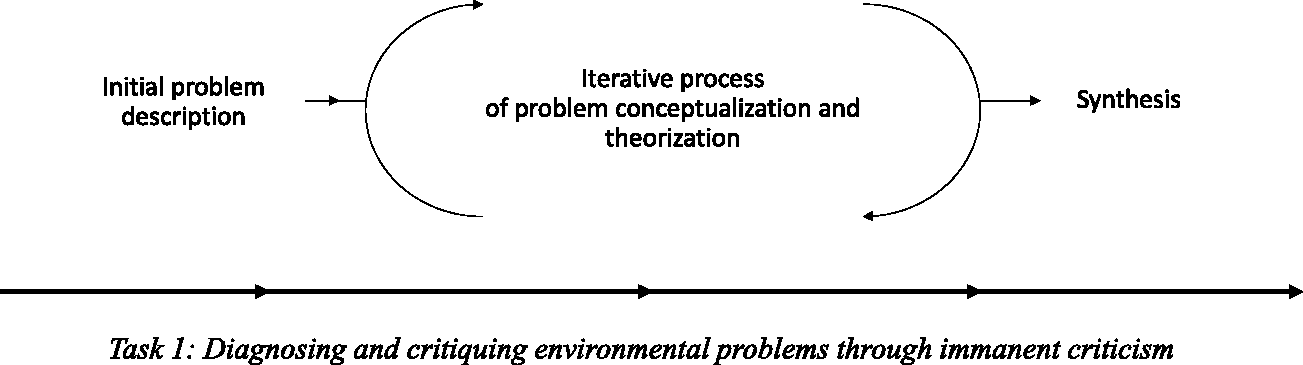
An idealized schematic for diagnosing and critiquing environmental problems through immanent criticism.
Why is immanent criticism appealing for sustainability science? Siding with Boda and Faran (2018), we argue that this approach helps researchers deal with two interlinked challenges inherent to sustainability science: (1) normativity and (2) interdisciplinarity. While immanent criticism does not offer any simple, generalizable solutions to neither challenge, it does provide a coherent logic for addressing them in research.
Normativity is a challenge for sustainability science as it is difficult to establish agreement on what constitutes a problem and what constitutes a desirable improvement (see Sayer, 2000). The use-inspired ambition of sustainability science forces researchers to at some stage take such normative positions on what states are desirable and undesirable. There is widespread awareness within sustainability science that sustainability has normative content (e.g. Kajikawa, 2008; Spangenberg, 2011; Swart et al., 2002), but multiple and partly contradictory approaches have been employed to deal with it (see Boda and Faran, 2018). Various approaches to this dilemma have since long been subject to intense debate in social sciences with emancipatory aspirations, including immanent criticism (see Antonio, 1989).
Immanent criticism does not leave normative questions to the realm of politics (e.g. politicians determining the problems science should solve), nor does it allow the researcher to formulate the basis of critique independently from its social context (e.g. uncritical acceptance of universal models like ‘modern agriculture’ as the template; Boda and Faran, 2018). Instead, it calls for critique to begin from ‘the ideas and practices that already exist in the concrete context; that is, how society has actually attempted to solve the problem historically’ (Boda, 2018: 243) – especially those that are widely accepted and prevalent today. The task is then to explain how and why these tend to fail, even by their own standards, which also creates a stronger link between the scientific critique and the concerns of social actors in a given context (see O’Byrne, 2020a).
Interdisciplinarity is a challenge for sustainability science as it is difficult to determine which theoretical approach has a better claim on truth, the outcome of which is intrinsically connected to the potential solutions that may emerge. It is well-established that conceptualizing and understanding environmental problems and their causal mechanisms require integration of knowledge from numerous disciplines across the natural and social sciences (Clark and Dickson, 2003; Kates et al., 2001). As disciplines come with their own paradigms (Lakatos, 1986) and interpretative repertoires (Alvesson and Sköldberg, 2018), researchers from various disciplinary backgrounds may approach the same environmental problem and end up with fundamentally irreconcilable claims. For example, research projects addressing the environmental problems of modern agriculture are likely to seek different explanations if they depart from neoclassical agricultural economics compared to those that depart from political ecology. 6 Thus, it is not surprising that the question of if and how interdisciplinary research can identify the most comprehensive set of explanations available to any given problem has generated several tools and approaches over the years (e.g. Bhaskar et al., 2018; Boda and Faran, 2018; Hirsch Hadorn et al., 2006; Nastar et al., 2018; Persson et al., 2018), including immanent criticism (Boda and Faran, 2018).
Immanent criticism does not prescribe which disciplines should be utilized to conceptualize environmental problems, nor does it allow for haphazard movement between disciplines. Instead, it aids the researcher by establishing a process for identifying the limits of existing explanations and understanding when and where to look beyond them. Immanent criticism suggests starting with the most common or influential explanatory models, and then move to (or incorporate) others as limitations become apparent. The point is that it is the tensions and gaps in a specific way of conceptualizing, explaining and addressing concrete environmental problems which justify the search for more adequate ways of thinking and acting – potentially in other disciplines, and in dialogue with the experiences and knowledge held by groups outside of academia.
But what about the perspectives of the people that the research approaches? They may very well already have their own diagnosis and critique. Respectful of the accomplishments of environmental justice organizations and scholarship, we nonetheless propose a different route than adopting the vocabulary and explanations of social actors (e.g. Martinez-Alier et al., 2014), clarified below.
We emphasize the value of ‘reflexive science’ characterized by ‘a dialogue between us and them, between social scientists and those we study’ (Burawoy, 2009: 25) within our heuristic. Instead of minimizing interaction with people, and instead observing ‘subjects’ from the outside, researchers should use this interference to our advantage; analysing it in close dialogue with theory, possibly reconstructing it. This is in line with use-inspired research within the critical realist tradition, for two reasons. First, ambitions to conceptualize environmental problems motivate serious engagement with the reality of those that are negatively affected, and this interference should be used to reconstruct theory. Second, as we elaborate on in the following sections, the relationship between those affected by problems and the agency to solve those problems also motivates such engagement. This is not a simple one-to-one relationship, and the process of immanent criticism might lead the researcher to interact primarily with other groups than the most affected, whose agency to address environmental problems may be severely restricted. 7 Thus, since immanent critique pushes researchers to not only identify more adequate ways of thinking about environmental problems but also acting on them, it encourages researchers to identify, engage with and even support actors whose interests and values align with the kinds of changes that the analysis suggests. 8 But in the end, this process is a negotiation where the researcher’s responsibility is to the analysis, if irreconcilable differences emerge.
In summary, we argue that the internal mode of critique provided by immanent criticism provides a transparent and coherent method for problem-driven interdisciplinary research on normative environmental problems and sustainability challenges, which clearly aligns with the explicit goal to produce use-inspired knowledge. It does so by generating research that critically reveals how existing theories and practices for achieving widely accepted societal goals are incapable of doing so, or simply fail to include what are critical issues in the concrete context, rather than measuring them against criteria which may not resonate with social actors in the concrete context at hand. But no conceptualization or explanation should ever be considered absolute or indisputable, and our own method suggests any ‘synthesis’ can still be subject to revision as the research moves through the subsequent tasks (e.g. as a result of engaging with additional perspectives and actors). Yet it remains important that some form of synthesis can serve as the basis for developing objective criteria for what ought to be, that is, what constitutes as desirable alternatives – elaborated on next.
Alternatives – The second task
The second task is to identify and elaborate on alternatives, and must consistently be carried out in close dialogue with the previous task. For if one does not know the main drivers that generate environmental problems, how can one suggest changes that would eliminate, or at least significantly mitigate, such outcomes? The basis of the second task, however, is that even the most convincing critique is insufficient for achieving change. It is equally important to elaborate alternatives that can convincingly deliver positive outcomes.
What is an alternative, more concretely? Wright (2012) speaks of alternatives both at the level of specific institutions and macro-structures of society. Although ultimately a profound transformation of society, not least the economy, is the goal of emancipatory social science, 9 Wright highlights the importance of efforts at the level of specific institutions which – if realized – can move society towards the destination of macro-level change. These new institutional arrangements may not in of themselves constitute fundamental transformation but must be opposed to structural problem drivers and in-line with long-term transformative change. In other words, they must be informed by the diagnosis and critique, not succumb to pragmatist misunderstandings of reform, and work to change the nature–society interactions that cause the concrete environmental problem. We return to this issue of reforms and transformation in the concluding discussion.
More concretely, transferred into the context of sustainability research, alternatives can be thought of as alternative institutional arrangements, such as new socio-economic organization of agroecological (Isgren, 2018) or perennial agri-food systems (Crews et al., 2018), and redistributive policies that enable modal shifts away from carbon-intense private vehicle transport to low-carbon mobilities in cities (Harnesk, 2018). Given the nature–society interaction that lies at the heart of environmental problems, technological change (in a broad sense) likely warrants a more central position in our heuristic than it has in Wright’s work. As often pointed out by researchers in various branches of sustainability studies, sustainability often calls for changes that are socio-technical in nature (Isgren and Ness, 2017; Markard et al., 2012), thus including new material practices coupled with alternative institutional arrangements.
We draw attention to the role of technology with some caution, as there has been much debate within the field regarding the relative centrality attached to physical infrastructure and technology in different research streams, not least surrounding the (controversial) notion of ecological modernization (see York et al., 2010). For example, empirical research continues to demonstrate that reducing carbon emissions caused by fossil fuel consumption requires changes other than simply expanding non-fossil fuel energy production (e.g. York, 2012). We argue that in the search for ‘real sustainability’, technology, physical infrastructure and the like must always be studied in relation to both the biophysical reality as well as the institutions and social structures; the degree of centrality of specific technologies for alternatives ought to follow from the analysis of the concrete situation at hand. This brings us to our application of Wright’s criteria for evaluating alternatives.
Evaluating alternatives
There can obviously exist a great number of potential alternatives. Acknowledging this, Wright (2010) defines three procedural criteria against which alternatives should be evaluated: (1) desirability, (2) viability and (3) achievability (see Figure 2, and Supplementary Appendix 1 for further concretization and guidance).
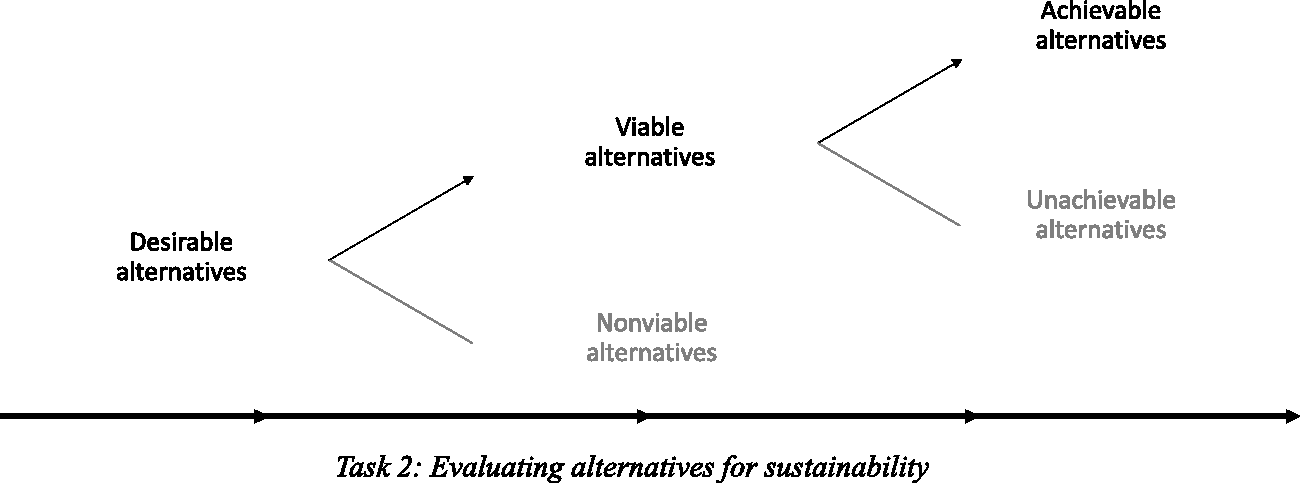
Three criteria for evaluating alternatives for solving environmental problems.
Desirability suggests that alternatives must be desirable to even be considered. Therefore, desirable alternatives are those that, if fully realized, can solve environmental problems in ways that are also socially acceptable. To be clear, this judgement must not be arbitrary, but be made in close dialogue with, and be consistent with the synthesis emerging from, the immanent criticism of the previous task. For an alternative to meet the criteria of desirability, it must address the environmental problem at hand, which at this stage should incorporate the various interests of social groups involved in the concrete context. In these terms, for example, for agroecology to be desirable as a social-environmental practice in Uganda it must alleviate poverty and malnutrition within the biophysical constraints imposed on agriculture such as climate or soils (Isgren, 2018).
Viability asks: if these alternatives would be implemented, would they able to robustly deliver real, desirable outcomes? For example, when put into actual practice, agroecology must have the capacity to maintain a certain level of productivity and robustly generate desirable socio-economic outcomes for people to be a viable alternative in the case of agricultural development in Uganda (Isgren, 2018). Assessment of viability must have a rigorous scientific basis in the biophysical dynamics of the phenomenon, 10 and include social dynamics at various levels. 11 Nevertheless, demonstrating viability can of course be challenging and may demand further research and experimentation, requiring mobilization of resources. Fortunately, there are many existing approaches within sustainability science that provide relevant methodological insights for exploring alternatives in complex realities, such as living labs (Evans and Karvonen, 2014), scenario approaches (Swart et al., 2004) and immanent criticism (Boda and Faran, 2018; Boda and Jerneck, 2019; O’Byrne, 2020b). Case-based approaches are of clear importance as these enable assessment of desirability and viability within concrete contexts.
Achievability concerns whether the processes of change necessary to realize viable alternatives are at least within the realm of possibility. Here we need to locate social structures and institutions standing in the way of viable alternatives and whether there are agents and strategies that have at least a theoretical capacity to overcome them. It should thus be clear that achievability within this sociological approach rests on collective action capable of achieving social change, and likely some form of political struggle. For example, Wright’s position here has recently been discussed in relation to the mobilization for a Green New Deal in the USA as a potential ‘non-reformist reform’ capable of catalysing a broader transformation (Stuart et al., 2020). Given the high degree of contingency associated with achievability, its assessment is best thought of as a starting point for the third task – elaborating a theory of transformation.
To conclude, the sequential triad of desirability, viability and achievability helps researchers pose relevant (and researchable) questions around alternatives. As pointed out by Wright (2010: 22), it is not always a simple matter to assess whether a particular alternative fulfils these three criteria due to the uncertainties and contingencies that may surround them. The criterion of achievability is particularly challenging in this regard, which is why Wright (2010) proposes – in relation to this second task – to prioritize questions of viability. 12 One important reason is that understandings, conceptions and social relevance of viability in and of themselves influence whether enough social pressure can be mobilized to achieve an alternative in the real world. In such situations, the second task may overlap with the more strategic third task: elaborating a theory of transformation.
Transformation – The third task
The third task is to elaborate a theory of transformation by posing and exploring questions regarding how viable alternatives could be achieved in actual practice. Considering the extent and complexity of the environmental problems that our heuristic can be applied to, the agents of change are not isolated individuals, but rather collective agents whose combined human agency can give them capacity to change institutions and social structures. As regards climate change mitigation, for example, Wright himself argued that the socials relations at hand require collective agents (e.g. social movements, political parties, unions) that mobilize people for collective action towards achieving viable alternatives (Wright, 2015: 903).
Wright outlines three major dimensions within his sociological approach that are important to consider when elaborating on a theory of transformation: processes of social reproduction (and their gaps and contradictions), unintended social change, and collective agents, strategies and struggles. Hereafter we expand these into our heuristic by sketching the outlines of their biophysical aspects (see Figure 3, and Supplementary Appendix 1 for further concretization and guidance).
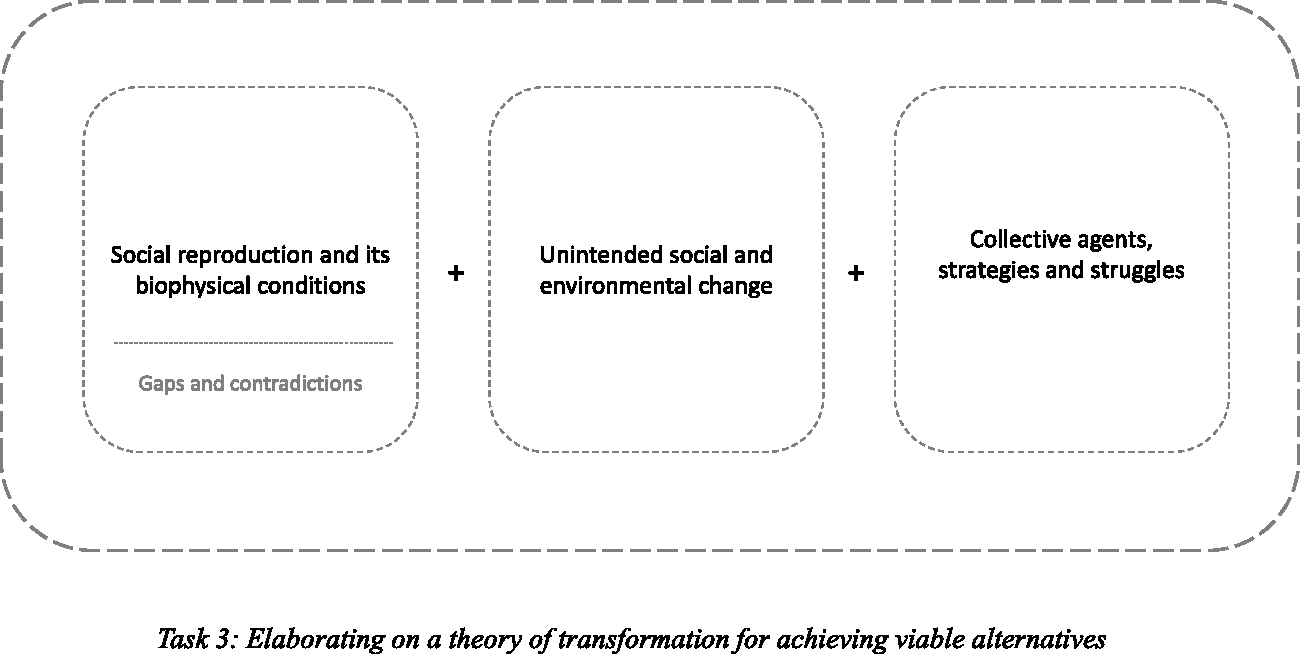
Three major dimensions of a comprehensive theory of transformation for achieving viable alternatives.
Social reproduction refers to the mechanisms through which social structures and institutions remain (relatively) stable over time – sometimes despite problematic outcomes. An important part of achieving transformation is not only understanding mechanisms of social reproduction but also their inherent limitations, or ‘gaps and contradictions’, which can open possibilities for institutional and structural change when utilized by agents of change (Wright, 2010). Gaps and contradictions always exist, but the possibilities for collective agents to utilize them at least partly depend on the progress of scientific knowledge about them (Wright, 2010: 17). As regards environmental problems, it is crucial to acknowledge that social reproduction may also have biophysical dimensions. While gaps and contradictions may arise not only from social mechanisms but also from society’s constant interaction with nature. Extreme weather-events and ecological limits may, for example, undermine mechanisms of social reproduction.
Unintended social change refers to the long-term dynamic trajectory of social change. In essence, although the opportunities for change may be closed for now, these constraints may contract over time through unintended by-products of people in power, and the cumulative effects of those who mobilize for alternatives. Wright (2010) himself is sceptical of existing theories of long-term societal transformation, including the orthodox historical materialism of classical Marxism (e.g. that a built-in tendency for crisis will open for transformational change), but also argues that compelling alternatives have yet to be presented (28). Thus, there are many questions surrounding how researchers and agents of change alike are to deal with unintended social change, but it is clearly crucial to be cognizant of the fact that obstacles and opportunities for change evolve over time, sometimes unexpectedly. Again, the fact that we are explicitly dealing with nature–society interaction brings us to add that also long-term (and unintended) environmental dynamics may play an important role. For example, the long-term effects of climate change, soil degradation or biodiversity loss may over time generate increased impetus for mobilization against, say, the forces that drive such phenomena or worsen their social impacts. In fact, the role that similar unintended change processes have in struggles has been observed in the literature on environmental justice movements (Cable and Shriver, 1995; Schlosberg, 2004).
Collective agents, strategies and struggles constitute a crucial research area as this is where we can begin to understand which agents might with good reason engage in collective strategies and struggles for realizing alternatives (or indeed already are in the process of doing so). Which types of agents, strategies and struggles are deemed worthy of attention in part depends on scholars’ assumptions about how social change can happen. Wright distinguishes between ruptural, interstitial and symbiotic trajectories and points to merits, limitations and risks of each trajectory (Wright, 2010). Put differently, should agents try to smash, tame, escape or erode institutions and social structures (see Wright, 2019) that give rise to environmental problems? Wright (2010) delves into two questions which are crucial in the context of anti-capitalist struggles, and which may also be so in the context of struggles against environmental problems: a logic regarding the state, and a logic regarding economic elites. Should collective agents seek to attack, collaborate with, or work outside the state? Should they seek to confront, ignore, or collaborate with economic elites? Wright (2010, 2019) does not provide any definite answers, but usefully points to the range of choices that are available to collective agents, again with their own strengths and weaknesses.
This task contains important methodological considerations as it encourages sustainability researchers to identify various possible collective agents, strategies and struggles in relation to concrete environmental problems at hand, and to identify their constraints and opportunities as well as likely consequences. 13 Some approaches mentioned under ‘alternatives’, such as living labs and other collaborative approaches, can play a role in actual change processes, but we would emphasize that researchers must not assume the appropriateness of specific approaches or actor constellations a priori. This heuristic emphasizes that the types of human agency, and thus which types of collective agents, are pivotal for altering problematic institutions and social structures are necessarily contextual. For example, conflicting interests and disparate identities (e.g. amongst and between smallholders and professionalized NGOs) and structural forces that hinder agency for transformation (e.g. political repression) can have profound implications for the strength and characteristics of collective action in some contexts (see Supplementary Appendix 1 and Isgren, 2018). Therefore, the specific actors that make up collective agents can and must be identified both in relation to the environmental problem at hand, and the concrete social context. They may be located within established institutions (e.g. governments, political parties, unions, NGOs), outside of them (e.g. social movements), or perhaps both.
But what is the role of the researcher in these change processes? The actual process of social change is not one that we, nor Wright, think of as being led by scholars as this is in large part a practical and strategic task. 14 That said, there are many things that scholars can do, beyond contributing to the development and evaluation of alternatives. Different positions exist on the relationship between academic research and social change, for example the consensus-based approaches to knowledge co-production or transdisciplinary processes mentioned in the introduction (Lang et al., 2012; Polk, 2014) and ‘scholar-activism’ (Chatterton et al., 2010; Routledge and Derickson, 2015). Sharing the position elaborated on by O’Byrne (2020a), we instead emphasize the importance and usefulness of scientific knowledge in social struggles, such as those led by social movements (see also Isgren et al., 2019). This implies first actively trying to identify relevant agents of change and proceed to offer our scientific analysis of environmental problems, their drivers, possible viable alternatives and/or theories of transformation as support or guidance.
Future directions for transformative sustainability research
In this article, adapting sociologist Erik Olin Wright’s emancipatory social science, we have constructed a heuristic informed by critical realism and social theory for understanding and contribute towards transforming the social drivers of environmental problems. Despite our emphasis on logical and consistent procedures, we are under no illusion that our proposal neatly resolves the many difficult questions that sustainability researchers face. Yet its three tasks, and most importantly their theoretical and methodological content, offer guidelines which strengthens the field’s weakness in dealing with environmental problems rooted in institutions and social structures. Our most important modification to Wright’s work is the shift to critical realism and immanent criticism, which we argue helps sustainability researchers manage the interconnected challenges of normativity and interdisciplinarity. It also aligns well with the field’s ambition to produce salient use-inspired knowledge. Staying true to our own method, however, it is important to recognize the tensions that exist within our own proposal. We would like to return to certain issues of scalar dynamics and the relationship between reforms and transformation within our heuristic – while also pointing towards potential resolutions.
Throughout the article, we have alluded to the challenges that scalar dynamics pose to researchers. Scales have indeed often warranted particular attention in sustainability research as environmental problems and their drivers often span multiple levels on multiple interconnected scales (e.g. Ness et al., 2010; Wilbanks, 2007). Therefore, when using the proposed heuristic, we have emphasized that research must be situated within a concrete context rather than at an abstract level. However, this does not resolve the methodological issue of scalar dynamics. When, and where, does a particular ‘environmental problem’ and its social drivers begin and end? Can institutional measures to address an environmental problem be viable at one scale, but unviable and/or unachievable at another scale? An apparent solution may in indeed simply shift the problem elsewhere or cause new ones that are equally undesirable, which is one reason why sustainability challenges are often referred to as ‘wicked’ (Jerneck et al., 2011).
We cannot offer a complete resolution to this dilemma, but immanent criticism would guide the researcher towards the most comprehensive problem conceptualization within that concrete geographical context. Moreover, when operating within Wright’s framework, we can at least delineate four scalar dynamics that are clearly relevant: the impacts of environmental problems; the social drivers of environmental problems; the viability of different alternatives for addressing environmental problems, and; the process of achieving those viable alternatives through collective strategies and struggles. These four scalar dynamics are obviously interrelated, but not necessarily aligned. For instance, the effects of a given environmental problem may be observed at very different levels and scales than the social drivers of that same problem. Further, viable alternatives for addressing this problem may have to be implemented at a different level than it is observed, or perhaps at multiple levels at the same time. Our point is that researchers must embrace the existence of these multi-scalar dynamics and make them explicit throughout their research process, and that the method of immanent criticism is an important tool for doing so in a transparent and consistent manner.
Second, a different, but related, problem is the issue of alternatives for reform versus alternatives for transformation. This issue can also be partly viewed as a question of scale, but it also links back to a long-standing debate in social theory around how and when reforms can foster agency and better position society towards transformation. The heuristic presented here aims at identifying viable institutional reforms, but what about when drivers of environmental problems are identified at a deep structural level – such as in the central mechanisms of capitalist development? As we hopefully have made clear, we argue that the proposed heuristic has broad applicability, both when reforms are sufficient and when they are not. This does make for an essential difference between our proposal and the original project of emancipatory social science, which explicitly takes its starting point in a critique of capitalism and the project of realizing a socialist alternative. This difference can be traced back to the problem-driven agenda of sustainability research, and the wide variety of environmental problems it seeks to address. As a result, and as mentioned in ‘Alternatives – The second task’ section, alternatives may be fruitfully sought both at the level of specific institutions, and at the level of society’s macro-structures.
But, some may interject, is not sustainability just a pipe dream without transformation of capitalism? Indeed, there has since long been scholarly disagreement on the possibility of real sustainability within capitalism (Hopwood et al., 2005): between, put simplistically, those who argue that sustainability challenges can be solved without a radical break with the dominant economic system of capitalism through ecological modernization and those who argue that a new economic system is necessary from a sustainability standpoint. Wright (2012) largely sided with the latter, when he brings in sustainability as a question of intergenerational justice with which capitalism is fundamentally at odds. Based on this position, there are clearly good reasons to argue that radical transformation ought to be the long-term goal for anyone engaged in achieving real sustainability, and therefore, that this should be an explicit starting point of our heuristic. However, we maintain that the extremely wide range of environmental problems that sustainability researchers inspired by this heuristic engage with calls for this question being approached analytically. The heuristic is geared towards identifying viable institutional reforms, and argues that viability is connected to agency; but if scientific analysis reveals that deeper structural forces constitute obstacles to robustly addressing the environmental problem at hand, then one must face the question of how reforms fit into a transformative agenda. This includes clarifying not only how such reforms are opposed to structural drivers and contribute to making them weaker, but also how reforms relate to agency – in the sense of strengthening actors’ capacity for further action, or perhaps enabling new sets of collective actors to emerge. In such cases, alternatives that constitute reforms may still be validly proposed, but to avoid the so called ‘reformist trap’ they must be ones that enable ‘doing things now that put us in the best position to do more later’ (Wright, 2010: 21). Sharing this rationale, our hope is that the heuristic that we have presented shows how, when coupled with transformative emancipatory strategies and struggles, science can more effectively support human agency towards achieving ‘sustainability as a real utopia’.
Highlights
Infuses Erik Olin Wright’s seminal work on Real Utopias with cutting-edge interdisciplinary methodology Invites broader engagement with social theory in environmental studies and sustainability science Advocates for new types of actor constellations in use-inspired sustainability research Provokes deeper debate on the scalar dynamics of critique, alternatives and transformation.
Supplemental Material
sj-pdf-1-ene-10.1177_25148486211018570 - Supplemental material for Sustainability as a Real Utopia – Heuristics for transformative sustainability research
Supplemental material, sj-pdf-1-ene-10.1177_25148486211018570 for Sustainability as a Real Utopia – Heuristics for transformative sustainability research by David Harnesk and Ellinor Isgren in EPE: Nature and Space
Footnotes
Declaration of conflicting interests
The author(s) declared no potential conflicts of interest with respect to the research, authorship, and/or publication of this article.
Funding
The author(s) received no financial support for the research, authorship, and/or publication of this article.

Supplemental material
Supplemental material for this article is available online.
Notes
References
Supplementary Material
Please find the following supplemental material available below.
For Open Access articles published under a Creative Commons License, all supplemental material carries the same license as the article it is associated with.
For non-Open Access articles published, all supplemental material carries a non-exclusive license, and permission requests for re-use of supplemental material or any part of supplemental material shall be sent directly to the copyright owner as specified in the copyright notice associated with the article.
