




Abstract
Waste pickers all over the world work innovatively to reduce the environmental footprint of cities as they struggle to meet their critical livelihood obligations. Informed by the case of waste picker organizations (WPOs) this article examines how grassroots initiatives and extreme-niche innovations are created and sustained by mobilizing resources, rationales and relations. The study is informed by a cross-national survey and in-depth interviews with WPOs in Argentina, Brazil, Nicaragua, Kenya and Tanzania, and builds upon theories of grassroots innovation movements. The findings show how operating in contexts of extreme scarcity, these grassroots organisations tap into local resources, e.g. tacit knowledge, economies of affection and other socially embedded institutional resources. Blending material and environmental rationales, contributes to expanding their audiences and to gaining further support. In such deprived urban contexts, radical and cumulative crises and events hindering residents’ livelihoods can paradoxically also spark ingenuity out of necessity, and the transformation of these settings into extreme niches of innovation. Finally, the mobilization of relations through the formation of networks linking WPOs with supportive intermediaries and global circuits of solidarity becomes another fundamental resilience strategy by which WPOs can navigate contested environments and insert their extreme-niche innovations in governmental structures. By simultaneously adopting a broad repertoire of strategies of insertion, contention, and mobilization WPO and their innovations thrive in highly constrained environments. We conclude with reflecting on how ‘extreme’ niches of innovation − at the cracks of the formal city, economy and waste systems − can unleash the creative power of stigmatized, illiterate and neglected grassroots to experiment with new solutions in resource-poor environments.
Keywords
Introduction
Millions of waste pickers in cities around the world make a living by collecting, sorting, transforming, and diverting waste materials (Gutberlet and Carenzo, 2020). They are increasingly recognized by environmental policy and scholarship for their significant contributions in reducing the carbon footprint of cities (da Silva da Silva Carvalho et al., 2012), recovering resources (Navarrete-Hernandez and Navarrete-Hernandez, 2018), improving environmental conditions and the health of low-income residents (Dias, 2016), and creating jobs and income among the poor (Rebehy et al., 2017). Through their everyday work, waste pickers create innovation spaces for sustainability and social justice, for example, by developing new technological approaches (Carenzo, 2017), engaging in novel ways of organization and management (Zapata and Zapata Campos, 2015), and inducing innovative policies and legal frameworks (Carenzo and Schmukler, 2018).
Despite their contributions, waste pickers represent the most widely excluded, impoverished, and disempowered segments of society. Waste pickers are exposed to toxic materials (Gutberlet and Uddin, 2018), suffer from widespread prejudice and stigmatization (Moreno-Sánchez and Maldonado, 2006), are persecuted by the police (Zapata Campos and Zapata, 2013), lack access to official microfinance and funding opportunities, are susceptible to price market oscillations, and have abusive relations with intermediaries (Tirado-Soto and Zamberlan, 2013). Their exploitative and vulnerable working conditions are deeply ingrained in neo-colonial waste regimes whereby higher-income countries outsource their waste and the associated environmental externalities to lower-income and less-regulated settings (Millington and Lawhon, 2019).
To overcome those difficulties, waste pickers around the world are increasingly forming different types of waste picker organizations (WPOs): self-help groups, women’s groups, youth groups, extended family groups, cooperatives, micro-enterprises, and other forms of community-based organizations (CBOs). Many of these have expanded their reach from the local community to city-wide, regional, and global networks involving other waste pickers as well as public, private, and civil society organizations (Zapata Campos et al., 2020).
Grassroots innovations, such as those of waste pickers, usually develop through networks of practitioners, activists, and organizations generating pioneering, bottom–up solutions responding to local problems and needs and involving the knowledge, resources, interests, and values of local communities (Seyfang and Smith, 2007; Smith et al., 2014). Examples of such innovations include those emerging from alternative energy communities (Smith et al., 2017), the repair movement (Zapata Campos and Zapata, 2017), food networks (Kirwan et al., 2013; Smith, 2006), eco-housing (Seyfang, 2009), community currencies (Seyfang and Longhurst, 2013), and the transition town movement (Seyfang and Haxeltine, 2012). These movements and communities are characterized by the multiple organizational forms in which they manifest themselves – for example, as cooperatives, voluntary associations, community organizations, and companies – supported by different resource bases, motivations, and contexts (Hargreaves et al., 2013). Research on urban social movements has acknowledged that contexts of extreme scarcity, such as Brazilian favelas (Holston, 2009) and Indian shanty towns (Appadurai, 2001), can host creative grassroots initiatives (Moulaert, 2010). New forms of urbanism and critical services are developed that provide self-solutions to specific problems, for example, via the self-construction of housing or the provision of water, waste management, and sanitation services. Holston (2009) suggested that, with their livelihood practices, self-knowledge, and creativity, the innovators of these solutions ‘propose a city with a different order of citizenship’ (p. 246) that ‘cannot be readily assimilated into established conceptual frameworks’ (p. 249). Paradoxically, while these urban settings have been cut off from public service delivery and formal economic dynamics, their isolation and exclusion have ‘enabled an off-work and out-of-sight freedom’ (Holston, 2009: 257) favourable to social innovation.
As seen above, grassroots innovations are attracting increased attention from scholars interested in environmental governance driven from below (Seyfang and Smith, 2007). Related theoretical development builds on a combination of transition management and social movement theories, with a focus on how community-led innovations are disseminated and trigger wider societal transformations. Still, while grassroots innovation movement theory has progressed in its understanding of the challenges of scaling up innovative practices, the examination of the grassroots initiatives stemming from these extremely deprived settings has been underexamined.
Informed by the case of WPOs and the recycling network movement, this article examines how grassroots organizations operating in contexts of extreme scarcity create and sustain their initiatives and innovations. This study presents a cross-national survey and in-depth interviews with WPO representatives from Argentina, Brazil, Kenya, Nicaragua, and Tanzania.
This paper illustrates how ‘extreme’ niches of innovation within the cracks of formal urban, economic, and waste management systems can unleash the creative power of stigmatized grassroots communities to experiment with new solutions in resource-poor environments. It shows how WPOs develop grassroots entrepreneurial activities and extreme-niche innovations, practically out of nothing, in several ways: first, by blending material and environmental rationales and raising subsequent broad support; second, by tapping their ability to recognize the possibilities offered by community assets (including hidden resources in waste streams) and the social relations and economies of affection among relatives, friends, and neighbours; and, third, by forming networks and articulating simultaneous strategies of insertion, mobilization, and contention. While isolation and resource scarcity spark the creation of these grassroots extreme-niche innovations, they can paradoxically also hinder their diffusion and capacity to promote more structural changes.
In the following section we present our theoretical framework of grassroots innovation movements, with a focus on their resources, rationales, and relations. We then describe our methodology and analyse and discuss the data according to the categories outlined in the theoretical framework. The analysis is supported by the voices of interviewed waste pickers. Our conclusions summarize key findings concerning the grassroots innovation movement literature and identify gaps in the literature.
Grassroots innovation movements: analytical framework
Research has explored how grassroots initiatives develop and recombine resources, rationales, and relations to create and maintain social innovations that drive change (Zapata Campos and Zapata, 2017). These initiatives display and reframe rationales for socio–environmental change, including the discursive processes through which new practices are framed and legitimated; they mobilize material and cognitive resources and forge new collaborative relations. Informed by the grassroots innovation literature, the analytical framework outlined below is structured according to these three main premises of grassroots innovativeness.
Resources
WPOs emerge and often operate in extremely deprived urban settings characterized by high unemployment, extreme poverty, and economic informality. These environments of extreme scarcity typically suffer from chronic shortages of financial, human, and infrastructural resources as well as from unconducive political and legal environments (Linna, 2013). This leaves grassroots entrepreneurs and innovators with limited resources. Despite this, some have argued that environments of extreme scarcity act as ‘extreme’ niches that can trigger entrepreneurship and innovation (Holston, 2009; Moulaert, 2010). In these settings, informal, uneducated, and stigmatized innovators develop the ability to tinker with locally available resources to solve neighbourhood problems, often involving social activities or spontaneous collective action to respond rapidly to social or environmental problems (Zahra et al., 2009).
In these resource-scarce contexts, social and economic reciprocity networks, drawing on, for example, personal networks, kinship ties, and neighbours, become fundamental parts of resourcing strategies (Grabs et al., 2016; Linna, 2013). That is, entrepreneurship and innovation in these contexts rest on social rather than economic factors. Improvisation and experimentation are other key resourcing practices characterizing grassroots innovations (Weick, 1993). The literature acknowledges the importance of tapping grassroots resourcefulness and local knowledge (Smith et al., 2014) to develop innovative products that respond to the needs of local communities but are not provided by markets or the state (Mair et al., 2007). This local knowledge implies the recognition of locally available but hidden resources existing in, for example, informal settlements, resources such as waste.
Rationales
In the grassroots innovation movement literature, Smith et al. (2017) used the concept of framing ‘empirically to uncover what specifically motivated the movement’s origin, how movements problematize mainstream models for innovation and development, what alternative visions and aims they develop and promote and how these change over time’ (pp. 23–24). In other words, here frames are the contextualized and changing rationales embraced by the members of grassroots innovation movements, functioning as drivers of initiatives; frames, rationales, and innovation are thus closely connected. Innovation is often the result of putting multiple frames together (Hess, 2005; Smith, 2005).
Since grassroots innovations typically involve diverse actors, the adoption of different frames can result in tensions, contestation, and debate. Smith et al. (2017) suggested that such frames can also be used to foster ‘flexibility and pragmatism in coalition building’ (p. 24) by framing innovation in different ways: as the development of new ideas and solutions (i.e., the grassroots ingenuity framing), as the empowerment of local communities (i.e., the grassroots empowerment framing), or as a way of addressing structural problems and questioning conventional innovation (i.e., the structural framing). These framings developed in response to different challenges, with each framing emphasizing different forms of knowledge production (Smith et al., 2017). The ‘grassroots ingenuity’ framing emphasizes grassroots ethnographic knowledge and products meeting the needs of local communities. The ‘grassroots empowerment’ framing contributes to the development of capability and instrumental knowledge in local communities that can trigger broader change. Finally, the ‘structural’ framing addresses structural transformation by generating critical knowledge that raises awareness of structural obstacles in order to prompt change in mainstream institutions (Smith et al., 2014).
Relations
Grassroots innovation movements engage in network creation to mobilize resources, shape their institutional contexts, and engage with organizational intermediaries and mainstream institutions (Smith et al., 2017). Yet, intermediaries (e.g., NGOs and research centres) play an important role by documenting innovative practices, supporting exchange of knowledge between grassroots initiatives, and bringing innovations to other localities (Hargreaves et al., 2013). Networks and intermediaries make it possible for grassroots initiatives to engage with wider institutional contexts, policy opportunities, and discourses, avoiding project isolation and too narrow a focus on local issues, by participating in collective learning processes (Gutberlet et al., 2016).
Various strategies have been adopted by grassroots innovation movements when building relations to diffuse their innovations, strategies ranging from insertion to mobilization. Insertion involves creating linkages with other groups (e.g., businesses and governmental or nongovernmental organizations), while mobilization entails the transformation of mainstream institutions. Smith et al. (2017) argued that grassroots movements navigate between these two strategies dynamically and in combination, depending on the context and on previous experience. Nevertheless, how to balance necessary context sensitivity against ambitions for broader reach and structural change is a dilemma. While certain innovations are easily aligned with dominant pathways (but risk being co-opted), others associated with marginalized pathways can potentially be more important but may be left behind (Leach et al., 2010; Smith, 2005).
Methodology
The article is empirically informed by a survey and in-depth interviews conducted by local research teams among grassroots initiatives operating in the cities of Dar es Salaam (Tanzania), Managua (Nicaragua), and Kisumu (Kenya) and the metropolitan areas of São Paulo (Brazil) and Buenos Aires (Argentina). The rationale was to expand our understanding of the processes creating and maintaining these grassroots movements by examining WPOs from different regions, contexts, historical pathways, and socio–political dynamics: two upper-middle income economies in South America (i.e., Brazil and Argentina), a lower-middle-income country in Central America (i.e., Nicaragua, also the second poorest country in the Americas), and a least-developed and a lower-middle-income country in East Africa (i.e., Tanzania and Kenya, respectively).
The survey was conducted between 2017 and 2018 with representatives of a total of 110 WPOs in these cities, identified by the local researchers. The survey consisted of 28 questions about the history and characteristics of the particular initiative, covering its governance structure, funding, equipment situation, type of work, worker characteristics, working conditions, network relations, challenges, and innovations. The survey was conducted in person by local researchers in the local language, and the resulting data were compiled in a unified spreadsheet for analysis.
The survey was complemented by 55 in-depth interviews with a selection of WPO representatives; the interviews followed a semi-structured guide and were mostly conducted face to face by the local researchers. The WPO representatives interviewed in each city were selected based on both survey information and in-field identification by the local researchers of ‘instances of innovation’ in WPOs, including both innovations that failed and those that were scaled up. The innovation concept was framed broadly to avoid, as suggested by Smith et al. (2017: 193), ‘the more visible artefacts eclips[ing] what else goes on’. Dimensions of innovations beyond material and technological aspects, which often tend to be forgotten and are undermined in the literature, were explicitly considered.
Most interviews lasted 90 minutes to 2 hours. The interviewees were asked to tell of the origins of their WPOs (describing when, how, with whom, where, and why they arose), the support received, and the difficulties experienced since WPO inception and how these have been addressed. We further wanted to capture key achievements realized so far and the kinds of innovations developed. Finally, we asked what a ‘best-case scenario’ would be like for their initiatives to thrive.
Most interviews were recorded and transcribed verbatim for analysis. They were then first coded into categories, some of which were observed to be consistent with the theoretical framework of ‘resources, rationales, and relations’, with which we were already familiar. Accordingly, we decided to continue the coding in a second round, following these three categories, to analyze and discuss our data.
WPOs and grassroots innovations
The organizational forms in which WPOs crystallize differ among regions. Figure 1 shows the numbers and types of grassroots organizations involved in this research in the studied countries. In the Latin American countries, cooperatives are prevalent, explained by their historic promotion in public policies that have continuously strengthened social and solidarity economy movements in this region. In Kenya and Tanzania, in contrast, self-help groups and CBOs are prevalent, with some being embedded in institutional arrangements for the self-organization of civil society in informal settlements (Kain, 2022), but many increasingly being transformed into small entrepreneurial operations supported by international aid organizations (Gutberlet et al., 2016). Types of waste picker organizations across the different countries.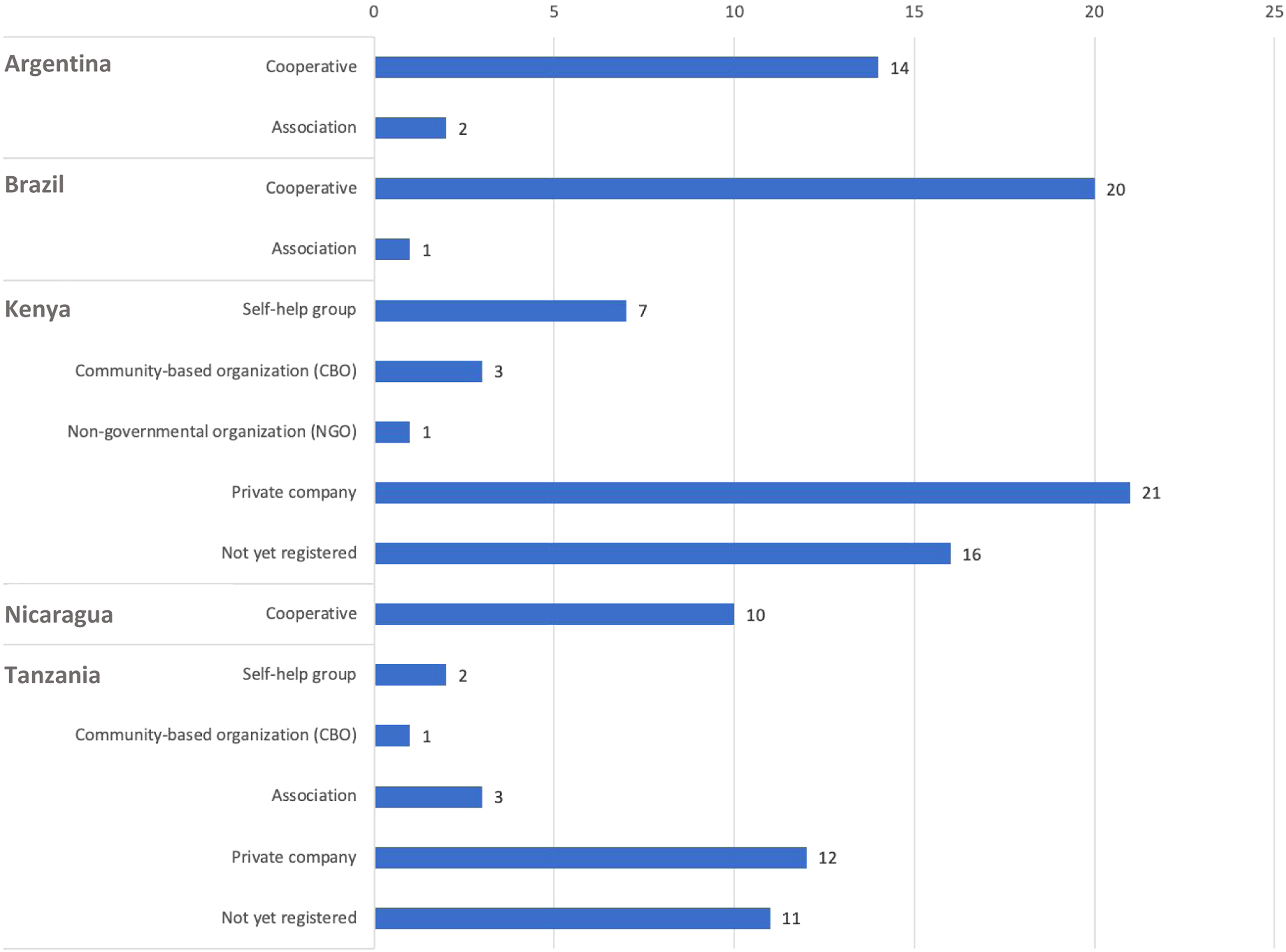
Numbers and types of support actions received by initiatives during start-up and currently.
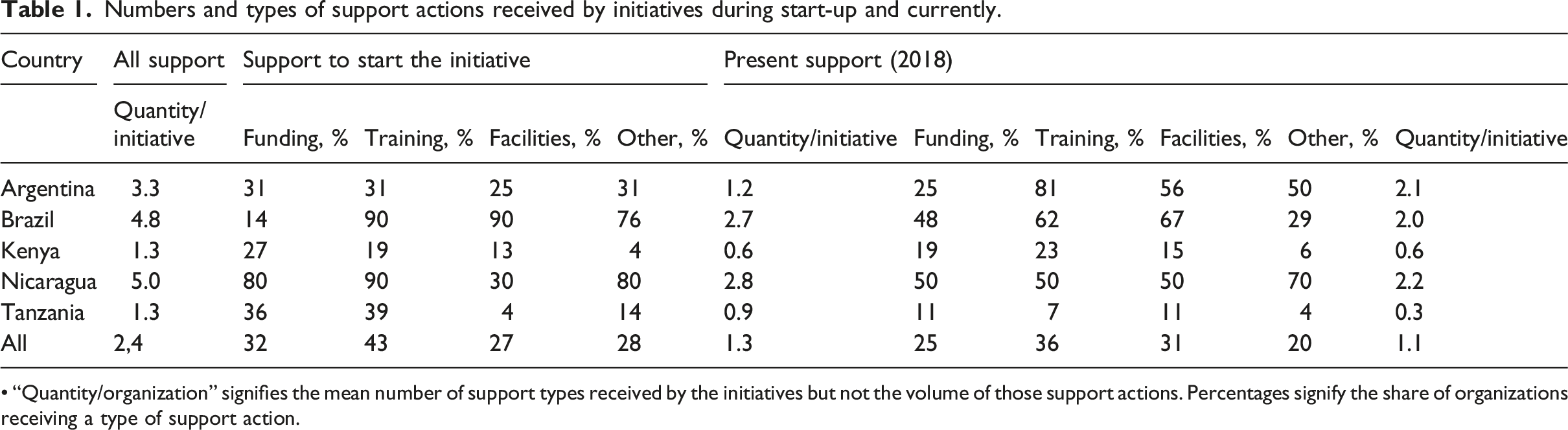
• “Quantity/organization” signifies the mean number of support types received by the initiatives but not the volume of those support actions. Percentages signify the share of organizations receiving a type of support action.
A summary of identified grassroots innovations through interviews by country and type of innovation.
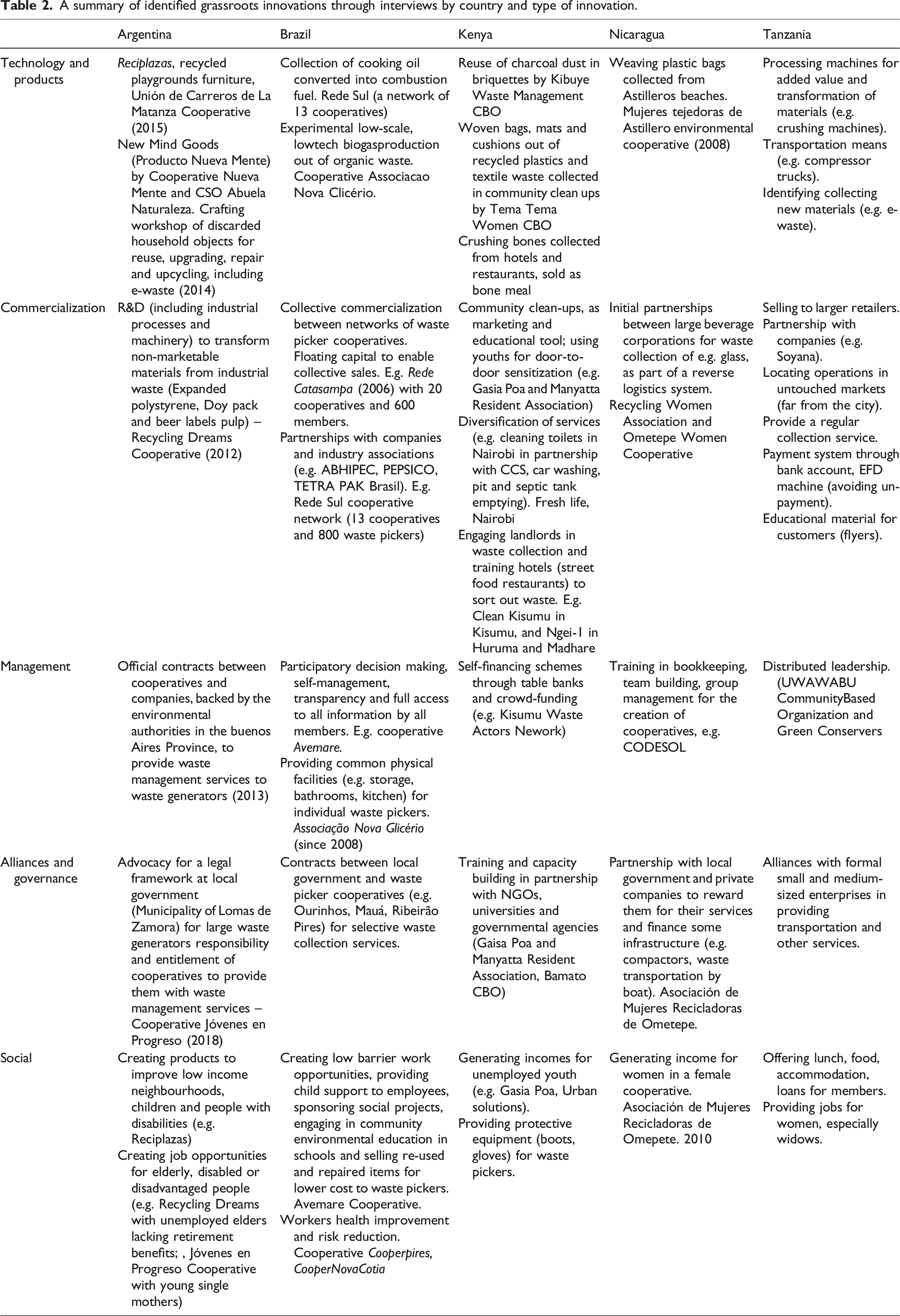
Technological grassroots innovations have developed in many groups that have set up processing machines for transforming waste materials to add value or produce new materials. For example, charcoal dust is made into briquettes and plastics into fence posts in Kenya and old tires are made into children’s playground equipment (‘ReciPlazas’) in Argentina, while a polymer industry and a processing plant for cooking oil were set up by a network of cooperatives in Brazil.
Innovative commercialization is closely linked to such technological and product innovation. In Argentina, the Recycling Dreams cooperative, working with university researchers, develops R&D projects to transform non-marketable recyclables, rejected by the local recycling industry and discarded in landfills, into marketable materials. In so doing, they provide reverse logistics services to large manufacturers ensuring their compliance with environmental legislation, including the transformation of expanded polystyrene, multilayered plastics, and beer labels. Nicaraguan and Brazilian WPOs have similar agreements with large corporations. Among Brazilian WPOs, novel modes of collective commercialization and partnerships are central to resilient operations. In both Kenya and Tanzania, much effort is put into multiple ways of sensitization to build markets, with community clean-ups in informal settlements being used as simultaneous marketing and educational tools.
When it comes to management, innovation is often closely linked to the origins of WPOs in various social and political struggles. Distributed leadership, participatory decision making, self-management, and transparency for all members regarding both information and bookkeeping are key elements of WPOs in all five countries. It was indicated that strengthening women’s participation is particularly relevant in Brazil and Nicaragua. Management is also linked to the various novel alliances, partnerships, and contracts established with local authorities, private companies, NGOs, and universities. WPOs seek to position themselves as key actors in local waste governance; for example, WPOs are remunerated by certain Brazilian municipalities for their waste collection and recycling services.
In Kenya and Tanzania, due to the lack of support from authorities, the social dimension of waste innovation is significant, including self-financing schemes through ‘table banks’, job generation, and health-improvement efforts among the most excluded waste workers. In Kisumu, dozens of women’s groups work with fish-processing leftovers, transforming them into nutritious by-products affordable by low-income citizens, thus contributing to food security, women’s economic empowerment, and zero waste.
These varied grassroots innovations address various challenges. Some innovations provide genuine solutions that meet the needs of specific grassroots groups (e.g., using charcoal dust to make briquettes in Kisumu). Other innovations address more broadly the empowerment of local communities (e.g., table banking in Tanzania). A third group of innovations addresses more structural transformations, raising awareness of systemic obstacles and prompting change in mainstream institutions (e.g., via legislation or public policies) (Smith et al., 2014). The ReciPlazas in Buenos Aires are a good example of how an innovation can address challenges at three levels. ReciPlazas are playground equipment built from discarded materials, such as tires or wire, designed and constructed by waste pickers of the Union de Carreros de la Matanza in one of the poorest city districts. ReciPlazas illustrate the intention to address a local problem using the resources at hand – here, a lack of playground facilities addressed using waste materials. They also exemplify local community empowerment and the improved social and environmental sustainability of the neighbourhood. Most importantly, they embody the development of conscious, reflective, and critical knowledge aiming at realizing structural transformation by spreading this innovation. For the members of this WPO, the largest challenge is to build ReciPlazas not only in low-income settlements but also in affluent neighbourhoods.
Creating and sustaining grassroots initiatives and innovations: Resources, rationales, and relations
Our analysis shows how the innovations and resilience manifested by the WPOs and their activities were enabled in highly constrained environments through blending various rationales for establishing a collective approach to recycling activities, mobilizing necessary resources, and articulating relations.
Rationales
A wide range of rationales underlies the formation of WPOs, together with their activities, innovations, and resilience, in environments of extreme scarcity.
The events triggering grassroots recycling practices and the formation of related initiatives and innovations are multifaceted. They can involve sudden political or economic shocks related to: a health crisis, such as a cholera outbreak in Kisumu that led to the creation of CBOs working on sanitation and waste (Gutberlet et al., 2017a); a macro-economic crisis, such as the one in Argentina in 2001, which left thousands unemployed and sparked the formation of a considerable number of waste picker cooperatives; and political crisis, such as the Kenyan post-election violence in 2008 that prompted the creation of self-help groups to address security and health in informal settlements. General police persecution triggered the creation of cooperatives in Argentina, while in Nicaragua and Brazil waste pickers organized themselves into cooperatives and networks after landfill closures, the privatization of waste management, and subsequent police persecution.
The rationales underlying recycling practices also relate to cumulative events in their local environments, such as the prolonged resource scarcity as well as general complexity, uncertainty, and unpredictability (Holt and Littlewood, 2017) typical of East African informal settlements. WPOs are created in response to the absence of formal waste collection services, but also as a result of the high rates of school drop-out and lack of employment and livelihoods. In both Kenya and Tanzania, the creation of self-help groups (e.g., youth, table-banking, and women’s groups) for other purposes led to the provision of waste collection services due to these groups’ need to diversify their economic activities. These findings show how extremely deprived urban contexts can become extreme niches of innovation, sparking ingenuity out of necessity (Gibbert et al., 2007; Holt and Littlewood, 2017), while making products and services affordable for low-income residents, particularly in contexts of crisis (Linna, 2013).
Beyond extreme scarcity and crisis, institutional efforts can also stimulate the creation of organized WPOs and recycling activities. In Brazil, federal legislation, enacted from 2003 to 2016 under the Workers’ Party (Partido dos Trabalhadores), stimulated the organization of recycling cooperatives, backed by financial support and capacity building. This resonates with recent developments in grassroots innovation movements illustrating how a particular context, for example, in Latin America, can structurally shape grassroots innovations by either restricting or favouring the availability and location of resources and through the opportunities triggered by single or cumulative events (Smith et al., 2017).
Blended rationales
Economic and security needs are prime reasons to get organized. However, social and environmental rationales have also developed successively or in parallel to the triggering economic and material rationales, for example, contributing to cleaner and healthier environments or providing critical services in highly deprived neighbourhoods. These motivations then become intertwined to such an extent that they are difficult to separate: It started in 2004 as a youth group. The youths were mostly neighbours and former schoolmates. The main objective was to address the issue of neighbourhood cleanliness and to give youths something constructive to engage in. (KWAMS, Kisumu) The reason for starting the initiative was to become self-employed and to clean up our city. (UWAWAMBU, Dar es Salaam)
The interviewees argued both for the need for employment and for a healthier local environment. This is in line with previous grassroots innovation studies showing how ‘jointly framing multiple social, material and environmental meanings and rationales served to attract a range of groups and thus mobilize massive human resources’ (Zapata Campos and Zapata, 2017: 1070). Similarly, in accordance with previous research on environmental movements, jointly reframing multiple rationales also aligns the WPOs’ values and practices with those of a broader audience, creating legitimacy and attracting sponsors from NGOs, waste picker networks, and other environmental movements (Dobernig and Stagl, 2015). Gaining legitimacy by blending multiple rationales together, results therefore fundamental for the development of grassroots innovations, in environments of extreme scarcity.
Blended rationales help WPOs both recruit members and attract external support; they also generate conflicts stemming from the different priorities, and therefore different frames, of the members (Smith, 2005; Smith et al., 2017). Unresolved tensions can lead to the collapse or dissolution of the group, as happened with the women’s cooperative in Ometepe Island in Nicaragua, where distinctions between ‘old’ and ‘new’ waste pickers ended in internal conflict. A similar situation was reported among recycling networks in Brazil: There is also a power struggle between the networks, that are not legitimized, which weakens the national movement of waste pickers in Brazil MNCR. And there is the struggle between the ‘historical waste pickers’ … and the ‘false waste pickers’. (MNCR, Brazil)
Likewise, the ability of youth groups in Kenya to recruit members with different interests (e.g., public health, the environment, and employment) resulted in internal conflicts that led to the abandonment or exclusion of members, often women, from many groups: The youths comprised different groups with different interests and not all were interested in waste management, some wanted to pursue performance art, HIV/AIDS awareness and advocacy. So, these other members with different interests eventually broke away. (KWAMS, Kisumu) Gender was also a challenge, as most of our activities were not woman, girl, child friendly. This led to the exodus of women. (Manygro, Nairobi)
Blended rationales lead to complex and, at times, overlapping identities. These organizations address ‘the needs of multiple groups, juggle numerous projects, manage relationships with a wide range of funders and wear ‘many hats’’ (Holt and Littlewood, 2017: 260). While the ability to combine different environmental, economic, and social rationales provides resources and opportunities for grassroots innovation and organizational resilience and adaptation in very resource-constrained environments, these multiple rationales can also be ‘difficult to manage and indeed to institutionalize more formally’ (Holt and Littlewood, 2017: 260).
Resources
Highly deprived environments and radical and cumulative events can therefore spark the development of extreme niches of innovation, but how can the required resources be mobilized out of almost nothing? Pooling local resources, including time and small savings, is a common strategy in all initiatives. Other strategies involve collective funding or crowdfunding (e.g., convincing relatives to help with seed investments, as do youth groups in Kenya), table banking (i.e., group-based funding in Kenya and Tanzania), donations from nongovernmental organizations (e.g., in Nicaragua and Kenya), and government subsidies (e.g., in Brazil and Argentina). Yet, gaining the trust of communities and relatives and motivating them to invest in an activity that is highly stigmatized requires awareness and sensitization: Starting the initiative was an issue since there was no support from friends and family due to the stigma associated with waste. … In 2011, I travelled to Thailand and in 2012 to South Africa to represent Kenya as a waste entrepreneur through the organization WIEGO, and this improved the faith they had in the work I was doing. (Gasia Poa, Kenya)
NGOs, residents’ associations, civil society organizations, and supportive networks are important to boost WPO activities, particularly in the start-up phase, by helping them stabilize through providing initial funding, training, or facilities (see Table 1). Many WPOs are aware of this, and strategically draw on existing local resources, as in the case of youth groups in Kenya relying on NGO support. The risk is that, since many such resources are project based, once they are used up, the grassroots initiatives can fade away if not anchored in actors remaining in the territory. This was the case for some cooperatives created in Nicaragua: The Carmeo group was organized in 2010–2011 and received training from the NGO Renisa with the support of the Mayor’s Office. They helped us form the cooperative with 25 people, mostly women. Afterwards we were left alone to work, and little by little it became disorganized. … In the following year, we were alone and there was no way to continue working. (Women’s Recycling Cooperative, Ometepe, Nicaragua)
WPOs take advantage of their tacit knowledge of local markets and customers – often their own neighbours and relatives. In the case of East African informal settlements, by being brought up and living in these neighbourhoods, waste pickers could tap into locally available resources and an understanding of the specific needs of low-income residents, their financial situation, and the challenges of obtaining payment for services. WPOs in Kisumu’s informal settlements strategically recruit members among relatives and friends living in the informal settlement where the services are provided. Speaking the local language and knowing the customers personally are vital criteria when recruiting waste pickers.
Relatives, friends, and neighbours are also sources of inspiration and knowledge regarding waste management, ranging from accessing materials for infrastructure to understanding the diversity of materials, markets, prices, and distribution channels. In Managua, the founding member of a cooperative explained: Our arrival [at La Chureca dump] was because I wanted to change jobs. Her brothers [i.e., pointing at his wife] advised her to come to Managua. They said ‘It is true, it’s La Chureca, but there you can make a good living’. … And I told my wife ‘I can’t find a way to work with rubbish’. And we asked the boys, ‘But, can you sell this? And this?’ … But look, we started to learn. (Guardabarranco La Chureca Cooperative, Nicaragua)
Yet, much of the knowledge – about technological, material, and organizational issues – is self-produced through local experimentation. In cooperatives in Buenos Aires, members quickly realized that the better they sorted the materials by type and colour, the better the market prices: We saw that the middlemen separated PET bottles that we sold to them by colour, then we began to classify by colour before selling and we got a better price. From then on, we started learning how to sort everything, the types of paper and cardboard and plastics … With plastics we developed a system based on the noise the material made, or the type of reaction when burned, the smoke, the odour, if it made a flame or a spark … so we learned to recognize and differentiate what was PVC, polyethylene, polystyrene, and all the other plastics that you find on the street. (Recycling Dreams Cooperative, Buenos Aires)
These examples illustrate the fundamental role of local and tacit knowledge of existing problems and available resources (Smith et al., 2014), as well as the role of experimentation and improvisation (e.g., Weick, 1993), in uncovering the potential value hidden in waste (Carenzo and Schmukler, 2018; Zapata and Zapata Campos, 2015). As Linna (2013) has previously observed, affordability is fundamental in extreme niches of innovation, through exploiting existing hidden resources such as waste.
In contexts of extreme scarcity, waste becomes a free or low-cost resource for the urban poor. Access to waste streams constitutes the backbone of WPOs’ livelihood activities and innovations, but in itself it is not sufficient. Simultaneous resourcing practices are articulated by WPOs, as shown above, for accessing, retrieving, and transforming waste into novel products and services. In the contexts of extreme scarcity characteristic of many low-income neighbourhoods, these resourcing activities are deeply embedded in the social, territorial, and commercial relations of reciprocity and trust (Grabs et al., 2016; Linna, 2013), making use of social capital (Holt and Littlewood, 2017) and drawing on scarce resources among poor relatives, friends, and neighbours to amass capital to initiate activities. This recalls Hyden’s (1983) ‘economy of affection’, referring to the social relations and economies of reciprocity among relatives, friends, and neighbours – relations based on kinship, community, religion, or other affinities – that provide mutual protection in times of need. It is through activating these economies of affection that resource-constrained urban poor communities thrive, developing these extreme-niche entrepreneurial activities and grassroots innovations.
Relations
Reframing rationales and mobilizing resources imply the articulation of relations between WPOs through networks and strategies of mobilization and insertion to shape their institutional contexts.
Formation of networks
All WPOs engaged in or created networks to mobilize resources in contexts of high scarcity (e.g., to facilitate material acquisition and price negotiation with intermediaries), share knowledge, convey their interests to governmental structures, and diffuse their extreme-niche innovations (Smith et al., 2017). As a result, city-wide, regional, national, and global waste picker networks have been established in recent decades in all studied regions, such as the Kisumu Waste Actors Network (Kiwan), the Movimento Nacional de Catadores de Materiais Recicláveis in Brazil (MNCR), the Nicaraguan Network of Waste Pickers (RedNica), and the Latin American Network of Waste Pickers.
Maintaining these networks is often challenging due to resource scarcity and the multiple interests and rationales involved. Regardless of previous efforts to create waste picker networks in Kenya and Tanzania, their fortunes still fluctuate, and some have disappeared or become dormant (Zapata Campos et al., 2022a). The Kisumu Waste Management Association created in 2009 lost its significance due to internal conflicts and mismanagement but was resurrected as Kiwan in 2017. In Brazil, a favourable political climate has stimulated the creation of the national movement, a federation of cooperatives, and multiple regional networks over the past 15 years. However, with the rise of the right-wing federal government in 2018, new economic and political challenges have begun afflicting these umbrella organizations. Lack of representation, poor internal governance, and lack of transparency also affect these networks, such as RedNica in Nicaragua (Zapata Campos et al., 2020).
Our study shows how, despite the autonomy of these networks, the role of supportive intermediaries (Hargreaves et al., 2013; Smith et al., 2014) either in their creation or during their lifespan is crucial. These networks can grow from the cooperative movement in Argentina, from the support of NGOs instrumentalizing existing forms of self-organization in East Africa, or through the mediation of national WPOs, such as RedNica or MNCR in Brazil. WPOs often engage in collaborative networks with, for example, universities, municipalities, or NGOs. These supporting organizations contribute to horizontal knowledge exchange by ‘giving access to their “repertoire” building on networks of trust and reciprocity’ (Holt and Littlewood, 2017: 260). This exchange of knowledge has been facilitated through connection with global circuits of solidarity developed in recent decades (Appadurai, 2001; Sassen, 2010).
Despite the relevance of these networks to supportive intermediaries, networking between WPOs (e.g., via the Latin American Waste Picker Network) appears to be as important as networking with external societal actors, confirming previous research on grassroots innovations (Seyfang and Haxeltine, 2012) such as transition towns, time banks, and community currencies (Seyfang and Longhurst, 2013).
Strategies of insertion and mobilization
When navigating their harsh and resource-poor environments, grassroots initiatives and networks alternate between strategies of insertion and mobilization (Smith et al., 2017). At the local government level in Dar es Salaam (Charles, 2021), Kisumu (Gutberlet et al., 2017b), and Managua (Zapata Campos and Zapata, 2013), a hybrid waste management model has become institutionalized (i.e., inserted into local waste governance) whereby WPOs provide collection and recycling services in informal settlements in collaboration with the municipality. In Dar es Salaam, groups have to bid to offer the waste collection service, in Kisumu they apply for recognition letters, and in Managua they receive temporary permits. This hybrid model has expanded to other parts of these cities, as a sign of the further institutionalization of the role of WPOs in household waste collection in informal settlements (Gutberlet et al., 2016). Nevertheless, in Nicaragua most agreements initially made with the cooperatives (e.g., regarding licenses to collect household waste, emptying a city district waste transfer station, and space for waste separation) have not been respected by the municipality, causing some cooperatives to disappear and others to struggle to survive financially. This shows how novel and decentralized waste management practices can remain loose and unstable, despite their insertion in mainstream institutions (Zapata Campos and Zapata, 2015).
Favourable contexts in Brazil and Argentina have prompted insertion strategies whereby cooperatives have been recognized as official service providers, in some cases remunerated for selective waste collection services as a result of their advocacy work in public policy making (Gutberlet et al., 2020a). Buenos Aires metropolitan region has a new waste regulation whereby large waste producers have to take responsibility for their waste and WPOs can provide them with such waste management services by processing new waste fractions (Carenzo and Schmukler, 2018). It took more than 10 years of struggle for the waste pickers to be reorganized as workers. Thanks to that struggle, we have been invited to reorganize the waste system to include us … It was a victory for the entire sector! For the first time the regulations specifically recognize us as providers of specialized services in waste management, enabling us to charge for that service. (Recycling Dreams, Buenos Aires)
Likewise, new Brazilian national waste management legislation, influenced by the participation of the MNCT, resulted in reverse logistics policies forcing companies to provide evidence of the destination of their residues, creating opportunities for existing and new WPOs (Gutberlet et al., 2020a; Rutowski and Rutowski, 2015).
Still, one unintended risk of ‘insertion strategies’ is their potential to reproduce and legitimize linear and unsustainable modes of production, consumption, and disposal by means of their recycling practices, which become necessary for the waste pickers’ livelihoods. The adoption of insertion strategies can therefore help cement neo-colonial waste geographies and waste regimes (Gille, 2010; Millington and Lawhon, 2019) that assume continuous growth, continuous waste production, and therefore recycling as the only way forward (Liborion, 2014).
Another risk is that, by means of insertion strategies, WPO practices may simply contribute to the façade of an inclusive and sustainable waste management system that becomes co-opted by the authorities they collaborate with, only for the WPOs later to be dropped, as has happened in Brazil and Nicaragua. As the history of the recycling movement has shown in different Latin American countries, these alternative development pathways are not necessarily linear (Smith et al., 2017). While periods of insertion have been experienced under progressive governments, the retreat of social policies and the welfare state coupled with the introduction of competing but less environmentally sustainable technologies, such as waste incineration, has sidelined many social innovations that spread in the past (Gutberlet et al., 2020b). In Brazil and Nicaragua, the collaboration between cooperatives and public policy making would not have been possible without previous protests and continuous social and political mobilization. In Argentina, Brazil, and Nicaragua, cooperatives and their alliances have articulated continuous protests to demand recognition of their work, oppose the introduction of incineration technologies (Gutberlet et al., 2020b), and contest exclusion from policy-making spaces.
While RedNica is supporting WPO mobilization and protests in Nicaragua against the Managua local government for closing access to the landfill, the network simultaneously collaborates with the Ministry of Family and Cooperative Affairs to facilitate the participation of cooperatives in social entrepreneur fairs. Similarly, in Kisumu, the previous KIWAMA waste picker association, despite its inactivity, was used as a joint voice by the WPOs to lobby against the administration when necessary, for example, filing a complaint against the county to prevent a multinational waste corporation from obtaining a monopoly over waste collection in the city (Gutberlet et al., 2017b).
Beyond contestation, WPOs have also tried other innovative and more subversive mobilization strategies, through innovations such as the ReciPlazas in Argentina. These novel practices are intended to expand WPO presence to settings beyond deprived neighbourhoods. In so doing, they question the ideals of a ‘modern’ city and of orthodox, formally educated innovators. Yet another example is RedNica’s proposal to co-manage the sanitary landfill in Managua to facilitate formal access for waste pickers while improving recycling rates at the dump. Still, these initiatives are more radical in nature and therefore less likely to attain mainstream diffusion.
All in all, as Mitlin (2018) has also observed in Kenya and South Africa and Rossi (2017) has observed in Argentina, urban and labour social movements develop a repertoire of simultaneous strategies of contention, collaboration, and subversion. In the context of WPOs, there is ‘continuity’ between alternative strategies of insertion and mobilization, rather than any fixed and separate distinction, as argued before in the grassroots innovation movement literature (Smith et al., 2017). This continuity between strategies provides these extreme-niche grassroots innovations with a broader repertoire of actions with which to thrive in highly constrained contexts.
Conclusions
This article has examined how WPOs as grassroots organizations create and sustain their initiatives and extreme-niche innovations by mobilizing rationales, resources, and relations. Operating in exceptionally resource-poor and turbulent environments, WPOs develop social and environmental innovations practically out of nothing. They do so by blending economic and environmental rationales, expanding their audiences to gain necessary support in the environments of extreme scarcity in which they operate. In such deprived urban contexts, radical and cumulative crises and events hindering residents’ livelihoods can paradoxically also spark ingenuity out of necessity, and the consequent transformation of these settings into extreme niches of innovation. In resource-constrained environments, waste is typically a relatively unrestricted resource, yet waste alone is insufficient. The articulation of resourcing practices is intimately embedded with the social, spatial, and commercial relations of trust and reciprocity and the activation of economies of affection. Finally, the mobilization of relations through the formation of networks linking WPOs with supportive intermediaries and global circuits of solidarity becomes another fundamental resilience strategy by which WPOs can navigate contested environments and insert their extreme-niche innovations in governmental structures. Their resilience is also fuelled by the capability of ‘doing meanwhile’ (Carenzo, 2017) and simultaneously adopting a broad repertoire of strategies of insertion, contention, and mobilization (Mitlin, 2018; Rossi, 2017; Zapata Campos et al., 2022b, 2022c) to thrive in highly constrained environments.
We make a twofold contribution to grassroots innovation theories. First, the article studies highly stigmatized communities operating in extremely resource-poor environments, a collective of innovators under-examined in this literature. The innovations emerge not only from the grassroots but also in the urban peripheries, the fringes of the formal economy, and the margins of municipal waste management. In other words, the innovations emerge in the cracks of the formal city, economy, society, and waste systems. These economic, social, spatial, and material interstices form extreme niches of innovation where the creative power of stigmatized, illiterate, and neglected citizens can be unleashed to imagine and experiment with new solutions (Holston, 2009; Moulaert, 2010). In the context of ongoing environmental crises, these extreme-niche grassroots organizations offer novel and necessary radical practices with which to rethink global challenges, such as the climate crisis, global environmental change, and natural resource depletion. Grassroots movements develop a crucial ability to navigate the challenges of their harsh environments, such as the ability to see hidden resources, identify the potential of community assets such as economies of affection, develop networks, exploit various strategies of insertion and mobilization, and make critical events into opportunities. They also provide solutions of simplicity, resilience, and environmental stewardship in a society drowning in overconsumption.
Second, this study has implications for our understanding of how different scale levels of environmental governance and change interact (Zapata and Zapata Campos, 2018). Grassroots innovations do not necessarily involve just typical bottom–up processes, but rather combine processes with different and varied dynamics (Smith et al., 2014). Our findings confirm that grassroots environmental innovations emerge from collective processes (Wejs, 2014; Zapata Campos and Zapata, 2017). The diffusion and scaling up of grassroots innovations are accelerated both by the creation of horizontal networks of grassroots initiatives at different scales, and by connecting local practices with global circuits of solidarity (Appadurai, 2001; Sassen, 2010). This is particularly relevant to grassroots innovation movements born out of extreme niche situations. However, while isolation and resource scarcity can initially release the creativity of these stigmatized innovators, these conditions paradoxically also hinder its diffusion if wider connections are not established.
Finally, several issues have been identified that require further investigation. WPOs make a considerable and recognized contribution to the recovery of recyclables that otherwise would end up in landfills and to their reinsertion and valorization in the recycling industry (da Silva Carvalho et al., 2012; Gutberlet et al., 2017a; Gutberlet and Carenzo, 2020), by inserting their recycling practices into the existing recycling industry and waste management policies. However, their recycling activities can paradoxically help maintain and cement the ‘consume and discard’ society as their cumulative innovations can be co-opted. As Liborion (2014) has noted, disposability and subsequent recycling are fundamental parts of modern capitalist economies, which assume that continuous growth, waste, and recycling are the only way economies can operate.
While these grassroots movements, through their insertion strategies, pragmatically engage in open alliances with actors having differing interests, such as multinational corporations, they must be vigilant in protecting their recycling practices and innovations from the attempts of both large corporations and local governments to privatize such activities as soon as their market value becomes evident (Zapata Campos et al., 2020).
Furthermore, waste pickers are subject to exploitative relations and inhumane working conditions, and some commentators argue that building on their innovations could exacerbate these conditions and resulting inequalities, not least strengthening neo-colonial waste geographies in which higher-income countries export their waste and associated environmental externalities to lower-income and less-regulated settings (e.g., Lawhon, 2013). Although we acknowledge some of these criticisms, our findings help nuance these complex relations. For example, WPOs throughout Latin America – individually, organized in national and regional networks, as well as in close collaboration with global environmental organizations – have been among the central grassroots organizations campaigning against the introduction of incineration, providing a strong connection between the global anti-incineration movement and the most stigmatized grassroots workers (Zapata Campos et al., 2020). Simultaneously, the grassroots recycling movement has, in recent decades, both shaped and been shaped by other environmental movements, such as the Zero Waste Movement, through long processes of mutual learning and negotiation, despite initial reciprocal distrust. Moreover, these grassroots initiatives are increasingly developing innovations that address higher levels of the waste hierarchy, developing practices of reuse, repair, and upcycling and supporting other environmental struggles, for example, concerning water scarcity or climate change, at both local and global levels, along with participation in several UN climate change summits.
To conclude, all these issues merit further research attention, to deepen our knowledge of grassroots innovation movements and help disseminate their innovations in support of broad social and environmental improvement.
Footnotes
Acknowledgements
The authors recognize the vital input of the waste picker organizations that have participated in this research. Without their knowledge and critical experience, we would not have written this article. We would also like to acknowledge the contribution in the coordination of field work by George Selestine of Centre for Policy Research and Advocacy, University of Dar es Salaam, Tanzania; John Chweya, Silas Otieno and the leadership of the Kisumu Waste Actors Network, Kenya; Martha Rizo, Erdalí Urbina, Teresa Acevedo and Belkys Fuentes from the UCA, University of Central America and the Nicaraguan Waste Pickers Network RedNica in Nicaragua; and Solange Dias de Araujo in Brazil. Finally, we would also like to acknowledge the funding agencies which have supported the empirical research (Swedish Research Council VR, grant reg. No. 2016-06289 and the Social Sciences and Humanities Research Council of Canada).
Declaration of conflicting interests
The author(s) declared no potential conflicts of interest with respect to the research, authorship, and/or publication of this article.
Funding
The author(s) disclosed receipt of the following financial support for the research, authorship, and/or publication of this article: This work was supported by the Vetenskapsrådet, grant reg. No. 2016-06289 and the Social Sciences and Humanities Research Council of Canada.
