




Abstract
In this article, we investigate the evolution of the birdfeeder and analyze it as a multispecies technology, a technological artefact that has co-evolved between multispecies interactions of humans, the target species of the feeding, and unwanted visitors. We use close reading as a method to examine pictures, design descriptions, photos and text sources published in Finnish magazines and newspapers from the late nineteenth century, when birdfeeders were first discussed, until the late twentieth century, with the aim of analyzing how birdfeeder designs and models have changed in relation to various (and especially unwanted) visitor species. Birdfeeders are visited not only by species that humans want to feed but also by several unwanted visitors, such as birds, mammals, bacteria and the weather. Being inspired by posthumanism and Science and Technology Studies (STS), we ask what the role of unwanted visitors has been as co-designers of technological artefacts, here the birdfeeder. Our article discusses the broader subject of how people welcome or exclude other beings from shared environments. We argue that it is vital for environmental humanities scholars to study artefacts and technology and vice versa, for design studies and STS scholars to examine non-humans. We hope to encourage other researchers to ponder how animals, and unwanted users in general, participate in designing technology and artefacts.
Introduction
Humans have, since the dawn of our existence, used technology to hunt, domesticate, farm and kill non-human species (Jørgensen, 2014). Humans have also developed technical solutions and artefacts related to housing, feeding and observing birds, for the benefit of birds and other animals. These technologies, ranging from simple artefacts to complex industrial machineries, are often studied separately from nature and the environment, and from technologies and structures built and used by non-human species. While the architecture of non-humans, especially that of birds, has been studied for centuries (e.g., Pallasmaa, 1995; Rennie, 1833), the disciplines of environmental history and history of technology are conventionally understood as distinct, following the sempiternal dichotomy of the human technological civilization and the wild natural environment.
In this article, we explore the entanglement of human and more-than-human technology through the evolution of the birdfeeder 1 in twentieth-century Finland. The history of the birdfeeder offers an example of human technology and artefacts designed not only by humans but rather shaped in a reciprocal interaction between humans and more-than-humans. We approach the technological evolution of the birdfeeder through the lens of unwelcome visitors, meaning animals, bacteria and the weather and argue that this multispecies reciprocal interaction unfolds a technological evolution that encompasses the boundaries between human and more-than-human technological cultures. Moreover, the birdfeeder as a case reveals how culturally formed and constrained human attitudes lead to welcoming or excluding other beings from their proximate environment and how this is mirrored in the co-design of artefacts.
Finland as a geographical context for the evolution of birdfeeders is grounded due to several cultural and natural circumstances. Firstly, the cold winter climate creates conditions of deficient or insufficient nutrition for small overwintering birds. Secondly, birdfeeders emerged in the late nineteenth century and have been widely promoted in newspapers and magazines and also in the literature, for example, by one of the most influential literary figures of the era: Zachris Topelius (Berlepsch, 1928, 168). Birds and their feeding habits arouse empathetic emotions, which are also present in the songs and literature of the national–romantic era in Finland. This background has produced a wide material that covers over a century-long period, ranging from published instructions for building birdfeeders, articles written for school children, literature and visual materials, among others. These form the body of our following analysis.
We first introduce the theoretical background, Science and Technology Studies (STS), and environmental history and provide a glance at earlier research in the field. After introducing our sources, we describe the background of bird feeding as a cultural and historical practice. Then, we explore the various phases in the evolution of the birdfeeder and show how multispecies co-design has shaped its history.
Multispecies technology and co-design
As the birdfeeder and its multispecies design processes are complex and cross-disciplinary topics, our article overlaps with the fields of environmental history, environmental humanities, design studies and STS. For some time now, researchers have been interested in the use of technological artefacts and how users modify them and their meanings. Oftentimes, artefact users and designers have been understood as humans or companies but non-human animals also use human-made technology, as many researchers have shown. Domestic animals often use human technology involuntarily. For instance, Kaarlenkaski (2018) has shown how cows have been forced to use milking machines, and Grier (2006) has written about purchasable objects created for the use and comfort of pets. Wild animals have more say as users of technology and technological artefacts, as shown for instance by Jørgensen (2019) when studying birdhouses. Because artefacts can be used in ways unintended by the designers or may be rejected altogether by wild animals, the agency of non-human users of human technology becomes important for the functionality of the artefact (Eaton, 2020; Jørgensen, 2019, 231). As Jørgensen (2014, 481) writes: ‘[a]nimal and plant life do not always behave as humans want – they have their own drivers for action–so including them in networks of power can reveal the limitations of human plans’.
Human and non-human users of technology drive the evolution of artefacts, as both are part of the artefacts’ creation and re-creation processes. In design research, users or stakeholders are often passively referred to as users or informants, actively as partners or co-designers, and some researchers challenge whether any boundary between designers and stakeholders as actors exists at all (Veselova and Gaziulusoy, 2022, 152). As the approach of participatory design has become popular, co-design has been defined by many as collective creativity applied across the whole span of a design process, as designers and people untrained in design work together, and co-creation is used as a broader term of collective creativity (Sanders and Stappers, 2008). We use both terms, as we wish to expand the idea of who and what can be defined as designers and creators. In terms of co-creation, it is also essential to acknowledge that birds have supposedly used nest-building technologies for at least tens of millions of years, much before the emergence of the human species or its technology (Naish, 2014, 7–8). Unwanted visitors, such as rats, are also skilled nest builders with hundreds of years of experience of living next to humans and within human architecture (e.g., Skotnes-Brown, 2023).
It is also important to note that failure is a hallmark of design processes. Petroski (1994, 24, 32) highlights how the process of technological evolution is driven by things failing to do what people expect them to do: ‘the form of made things is always subject to change in response to their real or perceived shortcomings, their failures to function properly’. The process of change is cumulative, as small improvements are made to artefacts through time according to the needs and desires of – mostly – humans. The desired traits of artefacts are selected by inventors, designers, users and manufacturers (Eaton, 2020, 187; Petroski, 1994, 47).
As bird feeding is a popular activity that has been practised since the nineteenth century in many Western countries, it has also been studied in abundance within history, social sciences and ecology. Most studies have examined peoples’ motivations to feed birds, bird feeders’ socio-economic backgrounds and the ecological impact of feeding (e.g., Clark et al., 2019; Horn and Johansen, 2013; Jones, 2018). In contrast, feeding devices themselves have been nearly invisible in the studies, with some exceptions: Baicich, Barker and Henderson's book Feeding wild birds in America: Culture, commerce and conservation (2015) examines various models and techniques, and in their survey, Horn and Johansen (2013) asked why people choose certain feeders and how important the devices are for discouraging ‘undesirable’ animals. Our research broadens the scientific discussions regarding bird feeding by introducing multispecies and material approaches, focusing on both the rarely discussed topics of unwelcomed visitors and on the material side of the feeding.
As Jørgensen (2014, 2019) and Pritchard (2013), we also want to urge environmental historians and other environmental humanities scholars to examine technological artefacts because animals and plants are affected by human technologies. Technology should be understood ‘as part of ecosystems from the animal's point of view, rather than only as human interventions in nature’, as Jørgensen (2014, 486) writes. Both non-human technologies and co-designed and human technologies constitute a material realm difficult to detach from the idea of untouched nature or ecosystems. Therefore, technology should not be neglected within environmental humanities.
The history of animal and wildlife conservation has been studied in abundance. The focus has been on species that people have wanted to protect and help. Conservation consists of political decisions and (discursive and material) practices of inclusion and exclusion, as not all species are protected and sometimes, to protect one species there is a ‘need’ to control the populations of others. These unwanted targets of conservation have not been studied enough (see e.g., Milton, 2000). It is important to examine bird feeding from the perspective of unwanted visitors and ask what it tells us about our need to include some and exclude others from our shared environments and what consequences it has on the world.
Birdfeeders in historical newspapers and magazines
By using close reading as a method, we analyzed from pictures, design descriptions, photos and text sources published in Finnish magazines and newspapers from the late nineteenth century, when birdfeeders were first discussed in our sources, until the late twentieth century, how birdfeeder designs and models have changed in relation to various (and especially unwanted) visitor species. The research data were collected from the digitized archive of the Finnish National Library and the Päivälehti archive using keyword searches. We focused on birdfeeders that were called ‘lintulauta’ in Finnish and were used to feed birds mainly with food scraps, seeds and nuts. During our study period, people also used devices for holding suet balls or animal fat, but we do not examine their evolution in this study.
A search with the keyword ‘lintulauta’ yielded 4808 hits from the Finnish National Library. Lähdesmäki perused those hits that, in addition to the article mentioning birdfeeders, also included a photograph or drawing of a feeding device or contained articles with unrelated illustrations. This resulted in 102 hits. 2 Our source material consisted of articles, building instructions, recommendations for what types of feeding devices to buy, cartoons, stories and illustrations published in a variety of newspapers and magazines ranging from national to provincial ones aimed at either adults or children, including animal welfare and politically committed publications, which highlights the cultural importance of bird feeding.
During our research period, bird feeding was a popular topic (see Figure 1) and could be discussed in nearly any media. Besides texts, we examined images, including photographs of actual bird feeding devices, drawings of imagined birdfeeders and instructional drawings of potential birdfeeders. 3 Our research material thus offered an interesting peek through the Finnish-language press of the twentieth century into the evolution of the ‘ideal’ feeder. 4
‘Help your small friends!’
A birdfeeder (in Finnish, ‘lintulauta’) was first mentioned in a newspaper article in 1882: an article discussing the lately deceased national poet J. L. Runeberg and his home in Porvoo mentioned that he had had a ‘a birdfeeder hanging on the outside wall under the window, in which could still be seen remnants of the seeds that the deceased fed to sparrows and other small birds’ (Kesäisiä muistelmia, 1882). This feeder was probably a simple wooden plank, which is an example of one of the earliest and consequently simplest birdfeeder models, pictured for example in Sarastus magazine in 1927 (see Figure 2). These plain planks could also be placed at the end of a pole (see Figure 3).
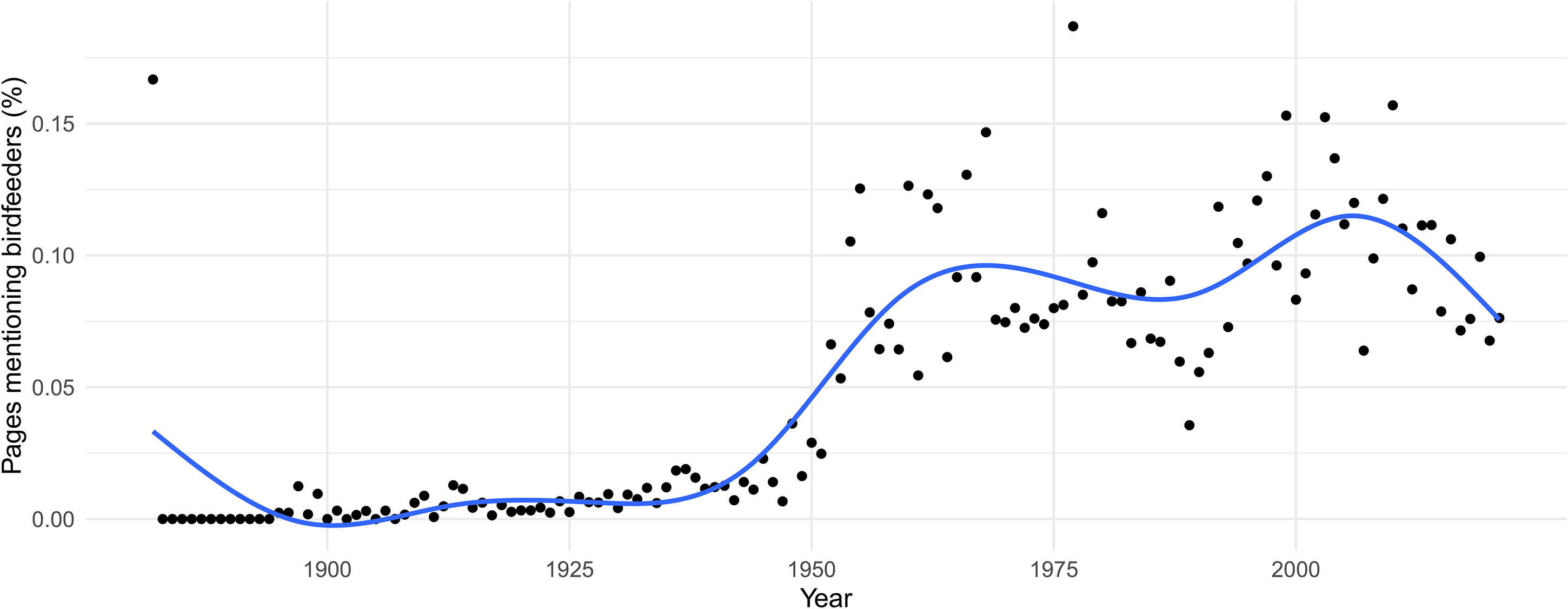
References to ‘lintulauta’ in Finnish-language newspapers and magazines have been normalized in relation to the number of digitized pages per year (%).
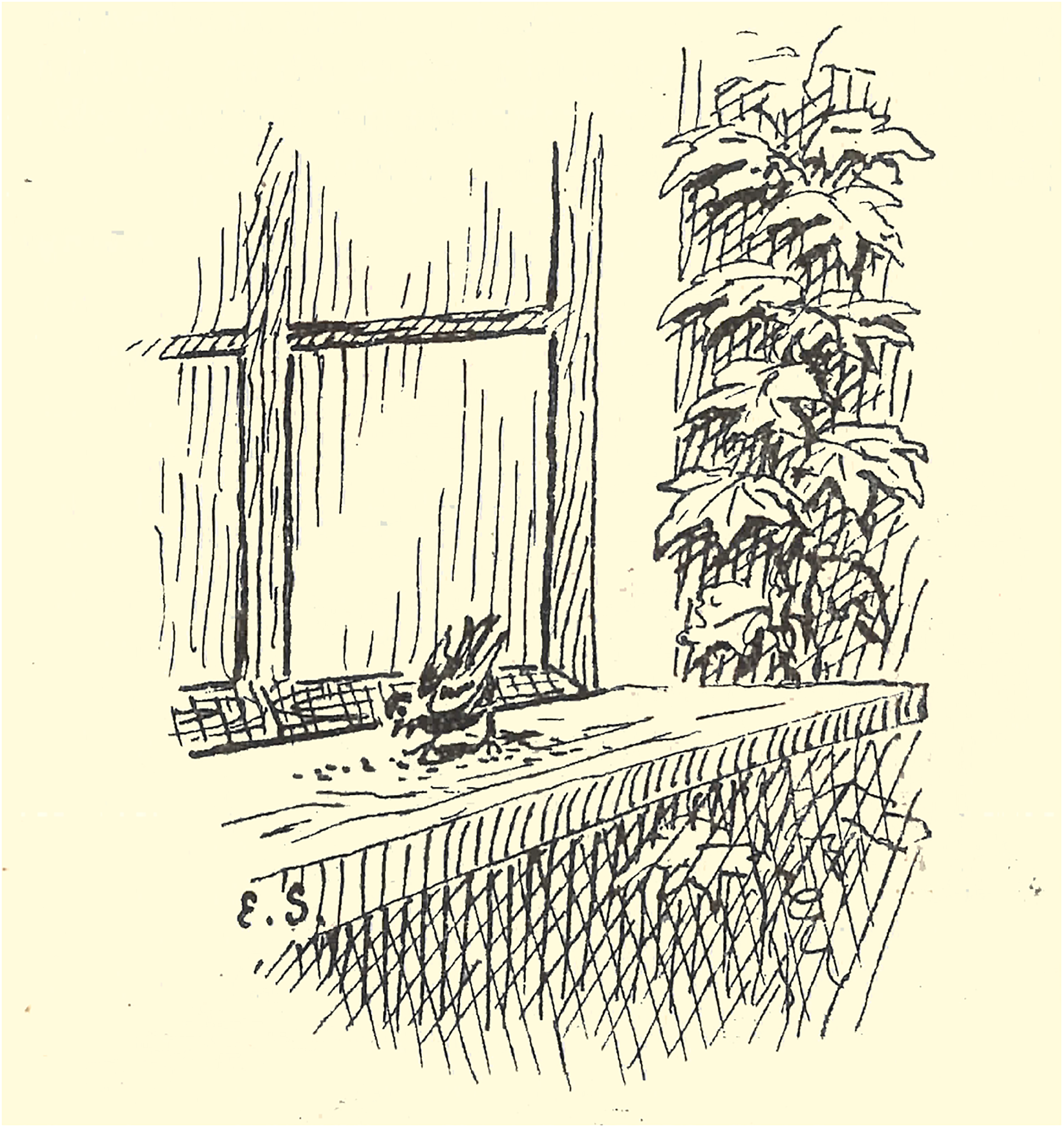
An example of a simple birdfeeder model.
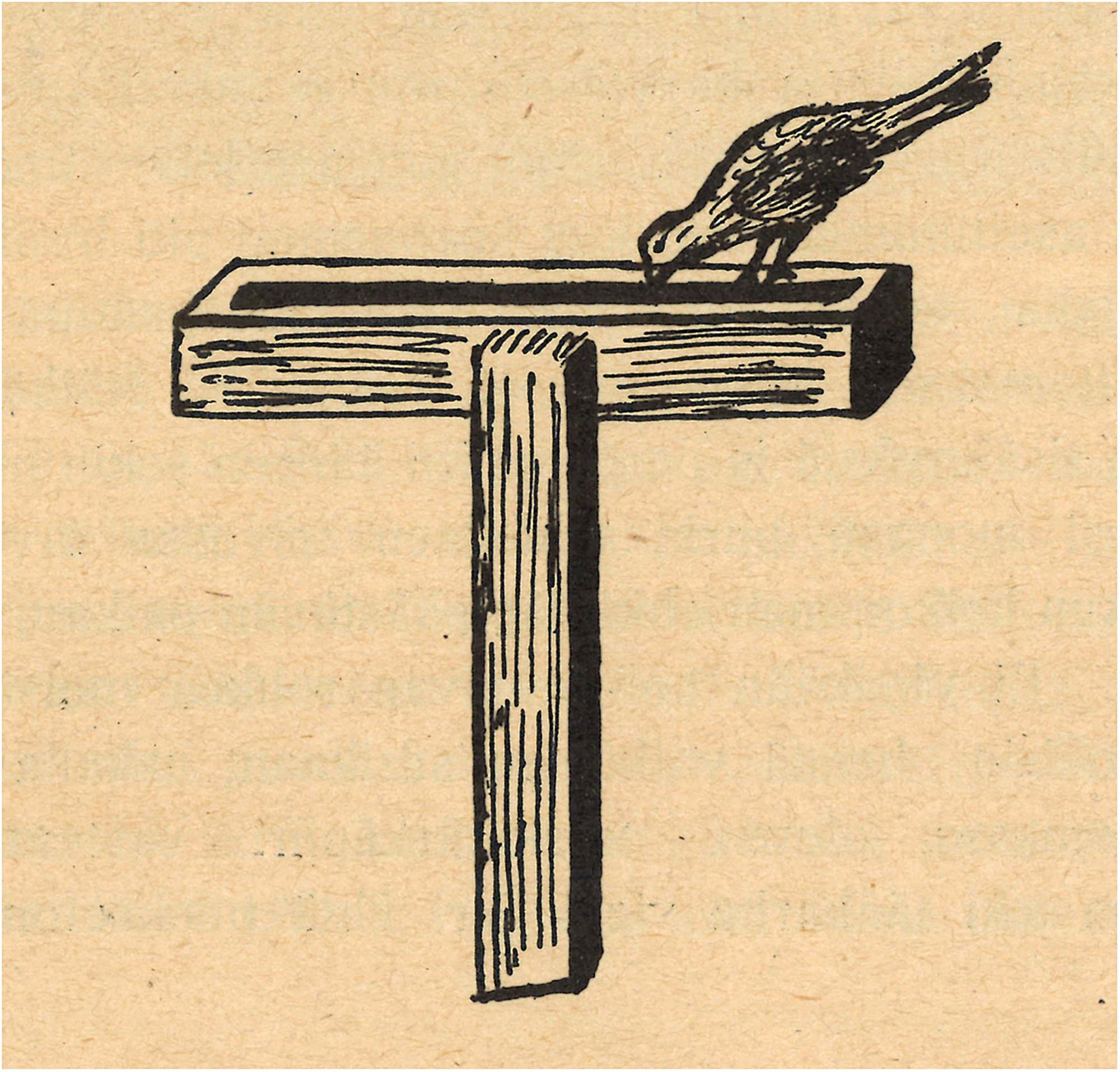
A simple birdfeeder could also be attached to a pole.
The national poet of Finland was not alone in his bird feeding habits. During the nineteenth century, people wanted to help (especially overwintering small) birds survive the harsh winters and bring birds closer to humans. Many of the first bird feeders were children and young people. For example, Zachris Topelius, who has been called the leading figure in Finnish animal protection, founded the Maj Föreningen/Kevätyhdistys organization in 1870 to encourage school children to help small birds. They were believed to be innocent God's creations. They were also seen as useful animals: insect-feeding birds helped farmers and gardeners by eating pest insects. Topelius and his contemporaries were also worried about the diminishing number of birds due to deforestation and fowling. Bird feeding was thus linked to the nature conservation and animal welfare movements, as well as to Christian values. Bird feeding was also a way to observe birds and learn about them (Haapanen, 2001; Lähdesmäki and Paju, 2021; Vuorisalo et al., 1999).
The birdfeeder as an artefact was created for bird feeding, to be explicitly used by people who wanted to feed birds in the late nineteenth century. Artefacts are solutions to a problem, as Petroski (1994, 23) points out. Thus, the question is what problem did the birdfeeder solve. This is not a trivial question, as the birdfeeder as a technology is not necessary in itself: birds were probably first fed in Finland and elsewhere by throwing food to the ground, by tying or nailing fat and other food items to trees, by pouring suet onto trees or by placing food onto windowsills (Baicich et al., 2015; Berlepsch, 1928). 5
Interestingly, birdfeeder structure underwent a fast-paced evolution from simple to elaborate during the 1900s. At first, newspapers and magazines encouraged particularly children to build and use birdfeeders (See e.g., Mitä linnut odottavat lapsilta, 1913). Recommending easy and simple-to-make models was probably important due to the age of the potential crafter. Also, until the beginning of the twentieth century, Finland was a developing country still overcoming a famine in the 1860s. People did not have an abundance of excess food to give to birds or building materials to construct elaborate models. In 1899, Eläinsuojelus magazine (Lindman, 1899) regretted that bird feeding was not a common practice even though it was a way to help small birds at a time when they were unable to forage for themselves.
Urbanization and structural change in Finnish society made bird feeding more popular during the twentieth century, as more people had excess food to give to birds. The practice became common among school children and nature-loving adults in both urban and rural environments (Haapanen, 2001; Lähdesmäki and Paju, 2021; Vuorisalo et al., 1999). During the latter part of the twentieth century, newspapers and magazines frequently encouraged adults to build birdfeeders, and they probably had more resources to make difficult models. Also, the articles we analyzed dating from the second half of the twentieth century featured more and more commercial devices: buying a birdfeeder instead of making one probably became common around this time. 6 Grier (2006, 273) writes about how ‘ordinary practices such as pet keeping spawned constellations of purchasable objects’ designed for ordinary households since the late eighteenth century in the United States. Similarly, in Finland, the birdfeeder was linked to the country developing into a consumer society.
Returning to the question of what problem did bird feeding devices solve: they were designed and built or bought and used because birdfeeders made bird feeding possible and successful, meaning they allowed birds to obtain food in a way that people wished. But, as e.g., Petroski reminds us, artefacts often fail. With the birdfeeder, weather proved to be a non-human actor causing simple birdfeeder types to fail, inspiring changes in the models, as we will show next.
A roof over the birdfeeder – Protection against snow and rain
The first modification made to the plain, plank birdfeeder model was to build a roof over the plank board. This was necessary due to weather: an obvious non-human factor influencing birdfeeder models. Snow and rain were particularly unwanted visitors on feeding devices, as they prevented birds from accessing the food or ruined it. A 1913 children's magazine (Mitä linnut odottavat lapsilta, 1913) encouraged children to build a birdfeeder with a roof: I will guide you to help birds. You boys who are handy with a knife, axe, and saw, can begin building a birdfeeder that will be placed under a window with the help of two additional wooden parts. Or you can make a really small house that has a roof but no walls, in case of snow flurries.
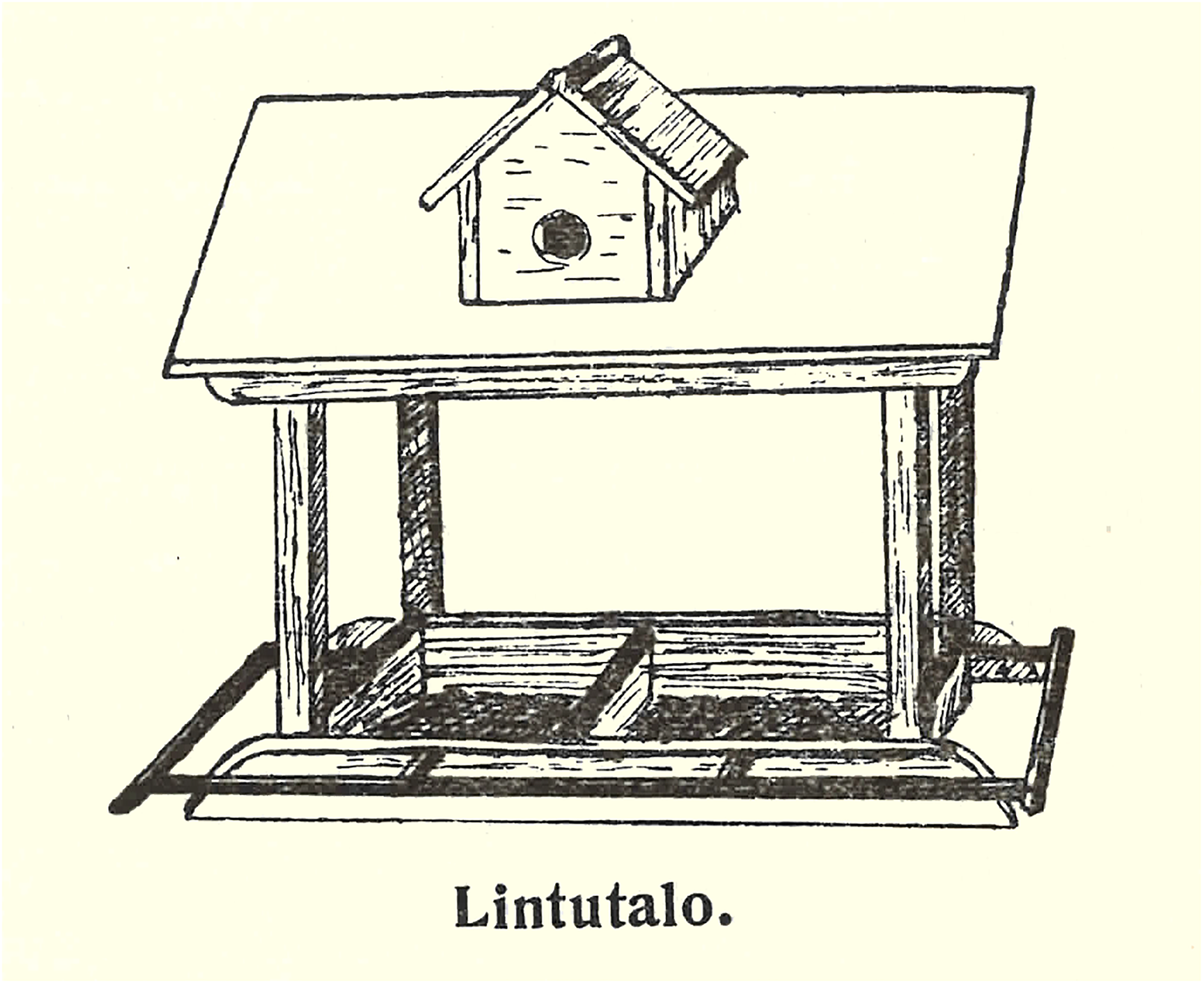
One of the oldest birdfeeder models is a house-like device.
As Jørgensen writes, North American birdhouses also sometimes mimicked human houses, with gabled roofs and columns. This probably resulted from human aesthetics or possibly the birds were believed to like them too. Also, as Grier (2006, 299) shows, pet bird (and squirrel and white mice) architectural cages usually mimicked houses during the nineteenth century, thus playing with the idea of the animals’ domestic lives. Similar reasons may be behind building birdfeeders that mimicked human houses. Jørgensen (2019, 226) describes that some people in North America criticized ‘toy human habitation’ birdhouses because a successful bird house should look like a ‘house for birds’. The same can be asked of birdfeeders: can they ever look ‘natural’ or mimic the places where birds naturally feed?
In 1924, Nuorison eläinten ystävä magazine (Sra, 1924) advised young people to add a roof to the birdfeeder: [D]ining tables can be made using various models. The picture above shows a collection of models. Below is a picture [Picture 2] of a rather simple table that is faulty in the sense that snowfall will cover the food. Therefore, birdfeeders with a roof are more practical.
Despite roofs being a basic element, people were reminded of their importance also during the second half of the twentieth century. In 1979, Ilta-Sanomat wrote that ‘a small roof protects the food from snow and meltwaters’ (Jyviä ja talia pikkufoguille, 1979), and in 1997, Länsi-Savo stated that ‘[t]he birdfeeder can also be colourful and take almost any form. As long as the birds can access the food and the food is protected against direct rain’ (Nojonen, 1997).
These recommendations demonstrate what Petroski (1994, 28, 30, 32) writes about failure or shortcomings being the driving force in the process of technological evolution. He also discusses irritants that are neutralized by changing the artefact. As perceived problems, rain and snow were actors that took part in the re-creation or further designing of the birdfeeder, i.e., the creation of a model with a roof. The idea that the environment and weather influence human cultures has been integral in environmental history (see e.g., Hughes 2009). When using new materialist approaches, snow can be interpreted as an actor influencing cultural habits and products, such as bird feeding and feeding devices, but also whole industries like the winter tourism industry. As Nadegger (2023) writes about snow: ‘this tiny actor keeps the industry both running and crumbling’. Snow and rain were actors that had to be considered also during bird feeding. In addition to natural elements, non-human animals, such as mammals, caused changes to the birdfeeder models, as we will show next.
Hanging high – The squirrel joins cats and rats as unwanted visitors
The second modification that we noticed in our sources was to hang birdfeeders high up to prevent their misuse. Indeed, humans as primary builders are often held responsible for preventing the misuse of technology. Lähdesmäki and Paju (2021, 118) have written about Finnish birdhouses, stating that, for some time now, the recommendations have been to build birdhouses in a way that prevents cats and other predators from accessing and killing the nestlings.
Similarly, advice for preventing the misuse of birdfeeders was published in newspapers and magazines. The pseudonym ‘Maalainen’
7
wrote in Pohjanlahti magazine in 1916 (Maalainen, 1916) about their birdfeeder and its unwanted visitors, a cat that tried to catch a bullfinch and a ‘disgusting’ rat: I once saw an animal as disgusting as a rat sitting on the feeder and eating in peace. That's why it is important that we place the birdfeeder so that no such blasted visitors can reach it. For example, the corners of buildings are incorrect places because they are easily accessible by the above-mentioned enemies. A good place is a food board at the end of a tall pole attached to the ground because there is no way the uninvited visitors can access it.
Suomen Sosialidemokraatti satirically wrote in 1955 (Lintulautakin, 1955) about a model specifically designed against cats (see Figure 5): As a result of many years of work, our architect has created the model shown above hanging from a steel pipe, which we recommend to those interested in building [a birdfeeder]. During extensive experiments carried out with the help of the neighbour's cat, [we saw] it had no chance of reaching [the birdfeeder] to startle the little birds that are eating on the table.
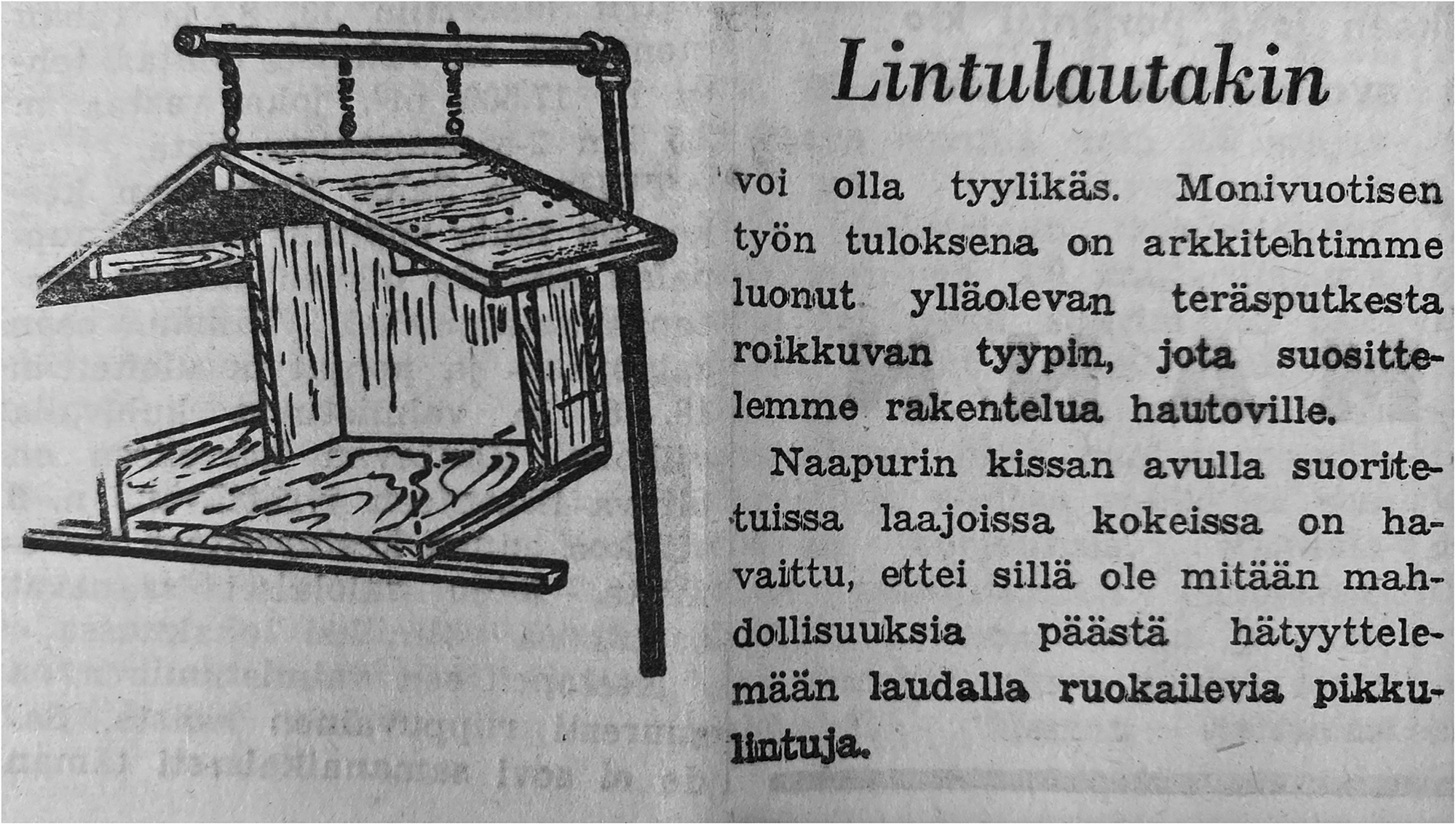
Hanging models like the one pictured here were considered to be inaccessible for cats.
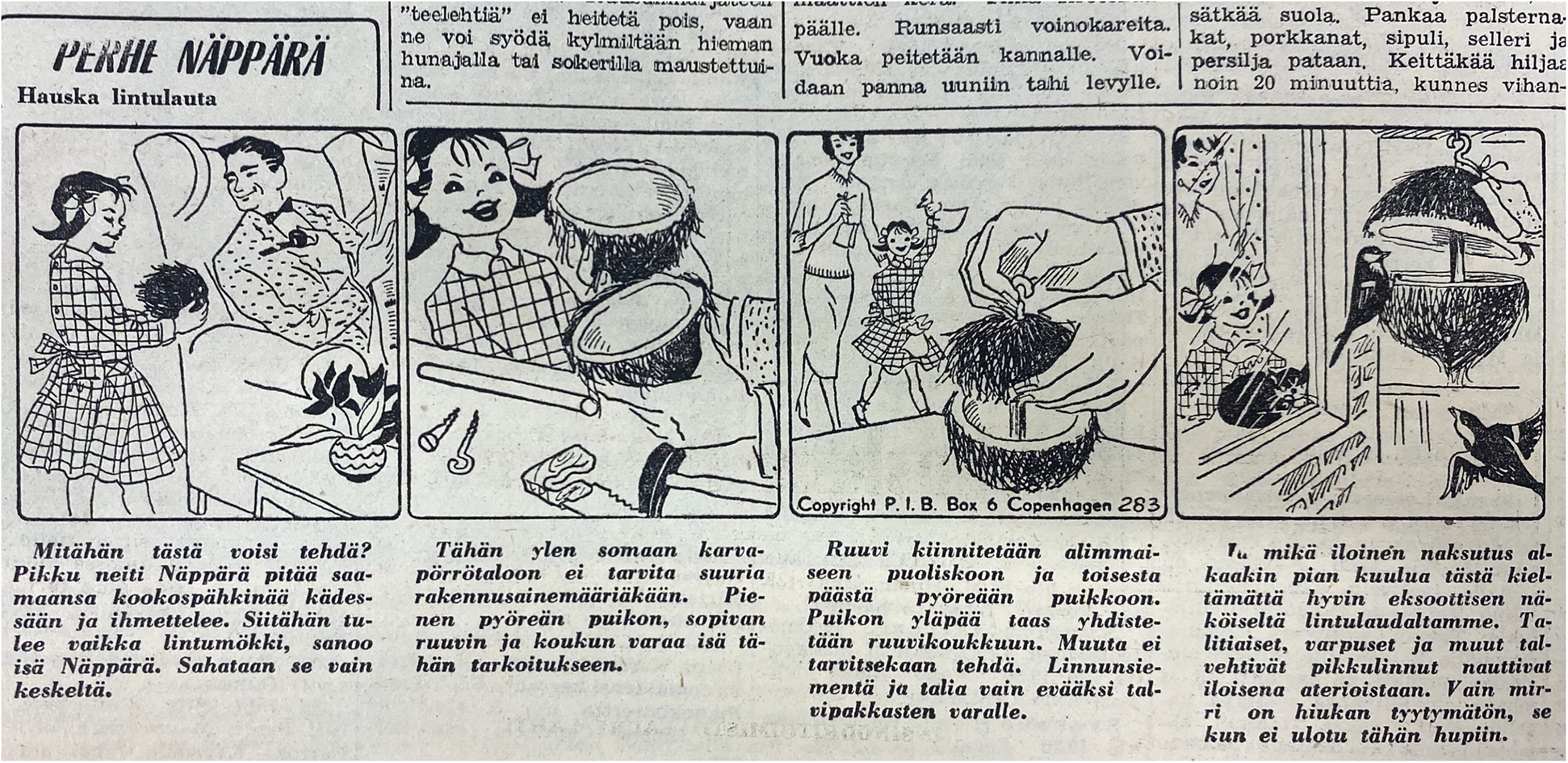
Besides hanging birdfeeder models, the cat's transition from a free-roaming outside animal to an indoor pet made it difficult for the species to access feeding sites.
In addition to hanging models, cats were also prevented from visiting birdfeeders by an attitude shift during the twentieth century, where cats transitioned from free-roaming outside animals to indoor pets (Syrjämaa, 2020). However, even after this change, people often let their cats roam free, especially in the countryside. This is visible in our sources: for instance, in 1986, Etelä-Suomen Sanomat (Ihonen, 1986) advised people to place feeding devices high enough as ‘wingless visitors like cats and dogs do not belong in the environment of the feeding place. The birds avoid these nuisances when the birdfeeder is raised high enough out of reach [of cats and dogs]’.
We found the first recommendation on how to keep squirrels away from birdfeeders at quite a late time, in 1964, when Suomen Sosialidemokraatti stated that ‘[n]aturally, when choosing a place for the birdfeeder, one must be careful not to allow e.g., cats and squirrels to visit it’. The reason for this instruction was that ‘greedy’ and ‘comfort-loving’ squirrels forage too much food from the feeding devices (KE, 1964). Interestingly, people have had contradicting views of squirrels. Squirrels used to be an important fur animal in Finland and were thus seen as useful to humans, but on the other hand, they have also been considered harmful for killing useful small birds (Kaski and Latva, 2022). During the first part of the twentieth century, children were nevertheless encouraged to welcome squirrels to their birdfeeders and squirrels were often described in positive ways, especially in writings and stories meant for children (e.g., Hjelt-Cajanus, 1912). Also, later, during the end of the century, newspapers sometimes wrote about acrobatic squirrels hanging from feeding devices as an amusing, nice phenomenon (e.g., Pörröhännän aamuvoimistelu, 1973). Peoples’ affection towards squirrels may have do to with their cuteness or charisma, traits that affect how humans treat non-human animals (e.g., Lorimer, 2007; Sherman and Haidt, 2011). When it comes to squirrels, birdfeeders were not solely excluding. Hinchliffe and Whatmore (2006, 127) write about the (posthuman) politics of conviviality in multispecies cities where humans and various bird species ‘co-habit the designs of urban space’. In a similar manner, there is a potential of seeing birdfeeders as an experimental space of convivial coexistence where negotiations happen and care is provided.
These recommendations concerning squirrels, cats and rats describe how technology can be used in ways not intended by the designer or human user. In her article concerning bird houses and how bridges are used as roosts by bats, Jørgensen (2019) writes that technology is both adjusted to practices and affects its users’ behaviours and environments. Jørgensen argues that technologies ‘are objects of negotiation’ and can be used in surprising ways.
Birdfeeders can also be interpreted as infrastructures and forms of multispecies governance in the sense that Barua (2021) writes about species, e.g., Rhesus macaques that repurpose electric wires to cross busy roads in India. Like Rhesus macaques who use infrastructure against the grain of design, squirrels, cats and rats took advantage of feeding devices meant for birds.
Many species use birdfeeders for the exact purpose they are built for, i.e., for acquiring food, yet they are unwanted visitors because the humans who have set up the birdfeeder do not want to specifically feed those species. As Petroski (1994, 25, 32) points out, engineers and designers have been concerned with how technologies, from simple gadgets to the most advanced technological systems, behave at the hands of their intended and unintended users. Following recommendations published in newspapers and magazines, people feeding birds tried to keep these unwanted visitors out.
Too small or difficult to access – Larger birds as unwelcomed guests
The third modification was to make the birdfeeder more difficult to access for larger birds. In the ‘girls’ corner’ of an extreme right newspaper Ajan Suunta (Eeva, 1935), in January 1935, ‘Eeva’ recommended that children should build birdfeeding devices that prevent crows from accessing food: ‘Thin crossbars can be nailed to corner posts to prevent crows from getting onto the birdfeeder, and the bars can concurrently serve as perching trees for small birds’. Peoples’ unwillingness to feed crows had to do with the species’ negative image: crows had been considered problem animals at least since the eighteenth century and faced open persecution in Finland until the 1960s (Pohja-Mykrä and Mykrä, 2007). Another reason for the unwelcomeness of crows may have been the idea that they were able to find their own food from dunghills and compost heaps (Mitä linnut odottavat lapsilta, 1913).
In 1938, in the Karjala (Perttu, 1938) newspaper, pseudonym ‘Perttu’ described how ‘dirty city pigeons’ sometimes visited his birdfeeder but were unable to get any food from the covered design. To keep larger birds away, people were also told to use small feeding devices. In 1972, Helsingin Sanomat advised (Ollila, 1972) that ‘[b]irdfeeders should be so small, that pigeon-sized birds cannot partake of their offerings’. In 1979, Ilta-Sanomat advised that ‘when it [the birdfeeder] is low enough, pigeons will be unable to take over the entire birdfeeder’ and went on to provide instructions on how to make a feeding device out of plywood boxes ‘during one evening. [They] are a joy to yourself and a help for great tits, sparrows, great spotted woodpeckers, and other wintering small birds’ (Jyviä ja talia pikkufoguille, 1979). The model shown in the picture was probably designed to keep larger birds from feeding from it, even though it looks somewhat open (see Figure 7). Also, in December 1982, Helsingin Sanomat (Kokko and Laine, 1982) recommended not using overly larger feeders that provide pigeons with access. Here, the reason given was Helsinki City ordinance, which prohibited pigeon feeding outside indicated feeding places. This shows that besides being co-designers of birdfeeder models, pigeons were also co-designers of law.
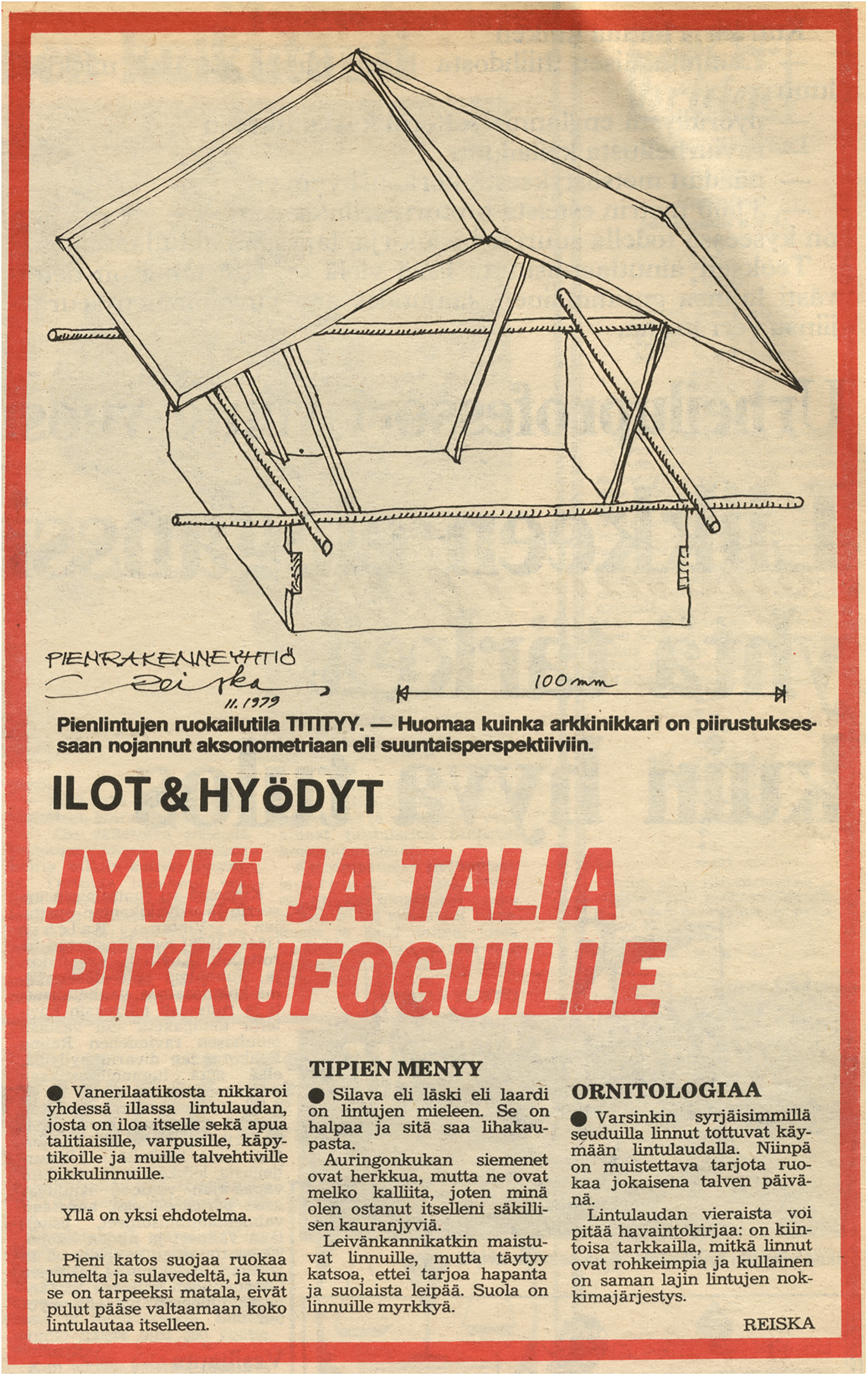
This model was designed to keep pigeons away.
These recommendations and stories show how a once-loved city bird had become an unwanted intruder at feeding places (Jerolmack, 2008). Until the 1950s, the city officials of e.g., Helsinki encouraged pigeon feeding within the city. As time progressed, more and more people began connecting pigeons with dirtiness, seeing them as nuisance animals, and less and less people wanted to feed them (Lähdesmäki, 2024, forthcoming).
In addition to pigeons, cats were also considered to take advantage of overly large feeders. In 1981, Etelä-Suomen Sanomat published a story with a picture of an excessively open feeder (see Figure 8). ‘A nice cottage for a cat, right. - - the pussy cat sits on a birdfeeder, waiting to make a treat of the feathered ones looking for food. The cat should be ashamed, but what can you do when a birdfeeder has been built to be suitable for both a great tit and a crow’ (Kameleontti, 1981). Here, a birdfeeder that was too large was described almost as if it were malfunctioning. People feeding birds were blamed for building or using such improper artefacts. It allowed non-human actors to use it in improper ways, allowing performance that was improper for the artefact. Von Essen et al. (2023) write how human-made structures, such as fences, can be seen as interspecies communication imposing social contracts. Small birdfeeders were a way to communicate unwelcomeness to birds and cats while too open and large models allowed miscommunication to happen, as they gave off unclear signals.
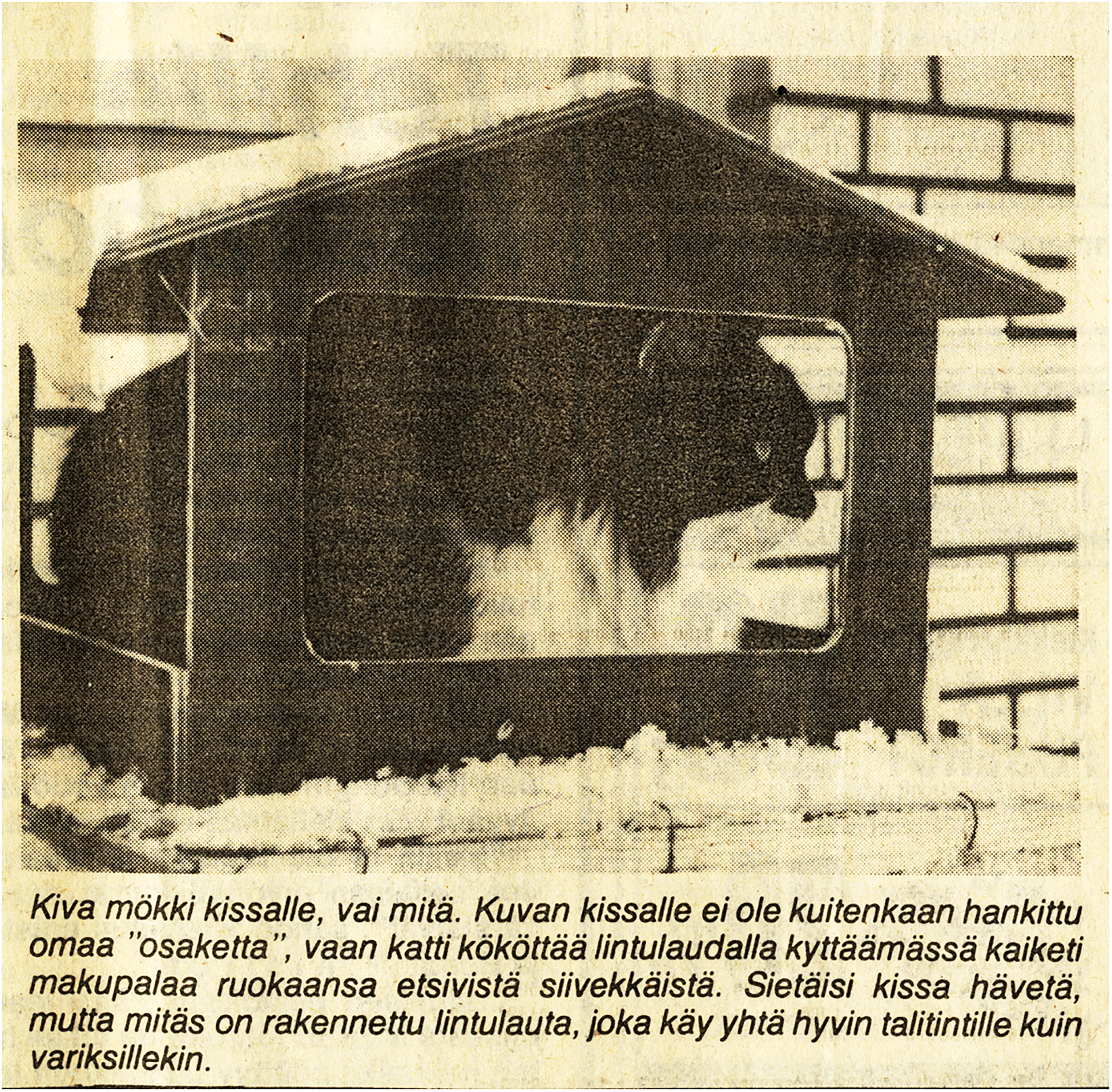
This model was too open, allowing cats to misuse the birdfeeder.
To prevent access to corvids, people were encouraged to build automatic feeders in Etelä-Suomen Sanomat in January 1985 (Lintujen ruokinta vaatii venytettyä joulumieltä, 1985): Consumption is also reduced by using vending machines, as constructing a cramped gadget can help prevent members of the corvid family from entering. - - The automatic feeder prevents big eaters, such as jays and squirrels, from obtaining food. With these [species], you can easily lose ten marks [former Finnish currency] worth of nuts in one day.
As Jørgensen (2019, 223) notes, ‘while designers and builders may have certain uses in mind when an object is created (from a small mobile phone to a large-scale urban area), it is the individuals who determine how (or even if) a technology becomes part of their everyday lives and practices’. With birdfeeders, problems arose or they were not resolved (sensu Petroski) if they became a part of an unwanted bird or mammal visitor's life and food supply.
In addition to larger birds, the smallest of organisms, bacteria were also unwanted visitors on birdfeeders. They affected the style of birdfeeders, as we will shows next.
Easy to clean and difficult to soil – Salmonella becomes a concern
The fourth modification that we observed was to build a feeding device that prevented birds from defecating onto the food. A good birdfeeder was easy to keep clean because birds could spread Salmonella. Cleanliness and practicality were mentioned early on in the birdfeeder instructions, but from the 1980s onwards, they were vital qualities of a birdfeeder. In the 1970s, only two articles were published discussing Salmonella in birdfeeders, whereas Helsingin Sanomat and evening paper Ilta-Sanomat discussed Salmonella and birdfeeders in 11 articles in the 1980s and in four pieces in the 1990s. Since the 1970s, Salmonella has probably been the most unwanted visitor on feeders.
Salmonella refers to a genus of gram-negative bacteria. As Salmonella species cause several illnesses to humans, they were first visualized and discovered already in 1880. The bacteria are motile thanks to flagella, hairlike tails that cover their cell bodies. As the smallest birdfeeder visitor examined in this article, Salmonella bacteria are not directly perceivable by human sight but indirectly via animal excrements.
In February 1971, Helsingin Sanomat (Salmonellaa puisissa lintulaudoissa, 1971) wrote about birds dying in Sweden due to Salmonella and quoted a Swedish magazine stating that dirty birdfeeding devices were to blame for the transmissions: If you have an old and dirty wooden birdfeeder in the yard or on the balcony, burn it. The birdfeeder can be quite a source of salmonella infection. This is what the Swedish magazine Råd och Rön 10/71 warns. - - [The] magazine is of the opinion that there is no need to stop feeding small birds because of salmonella. You just need to care for the cleanliness of the birdfeeders.
Ten years later, in January 1982, Helsingin Sanomat (Pikkulintuja ruokitaan kaikkialla enemmän kuin koskaan aiemmin, 1982) published pictures of a preferable model (Figure 9), an automatic feeding device that was easy to build and prevented birds from defecating on top of the food. In 1986, Helsingin Sanomat (Lintulaudalta voi saada salmonellan, 1986) reported that the Ministry of Forestry and Agriculture recommended ‘automatic feeders, where the birds must sit on a small frame surrounding the device’.
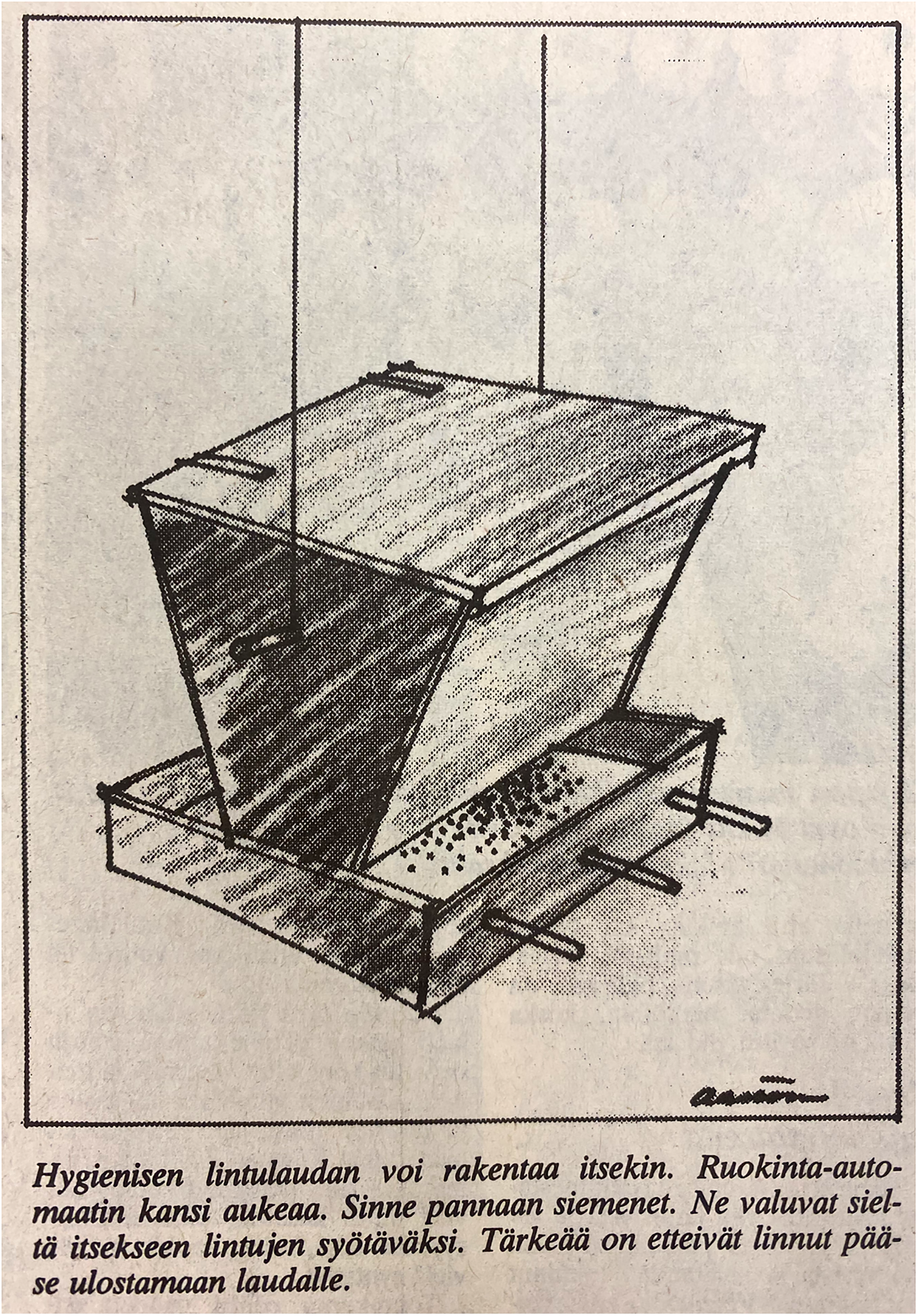
A model like this was supposed to prevent Salmonella outbreaks.
Interestingly, such automatic feeders were no novelty. As Petroski (1994) writes, by quoting George Basalla's Evolution of Technology, ‘any new thing that appears in the made world is based on some object already there’. People had been advised to use similar birdfeeders decades before (see Figures 10 and 11). These models, published, for instance, in a leftist youth magazine Pioneeri in 1927 (Lintulautoja järjestämään!, 1927) and in Maaseudun Tulevaisuus magazine in 1955 (A&O, 1955) were designed so that more food was released as the birds ate. According to one of the articles, work ergonomics was one reason for such automatic models. The novel aspect in the articles published in the 1980s was the open declaration that such models prevented diseases and promoted cleanliness.
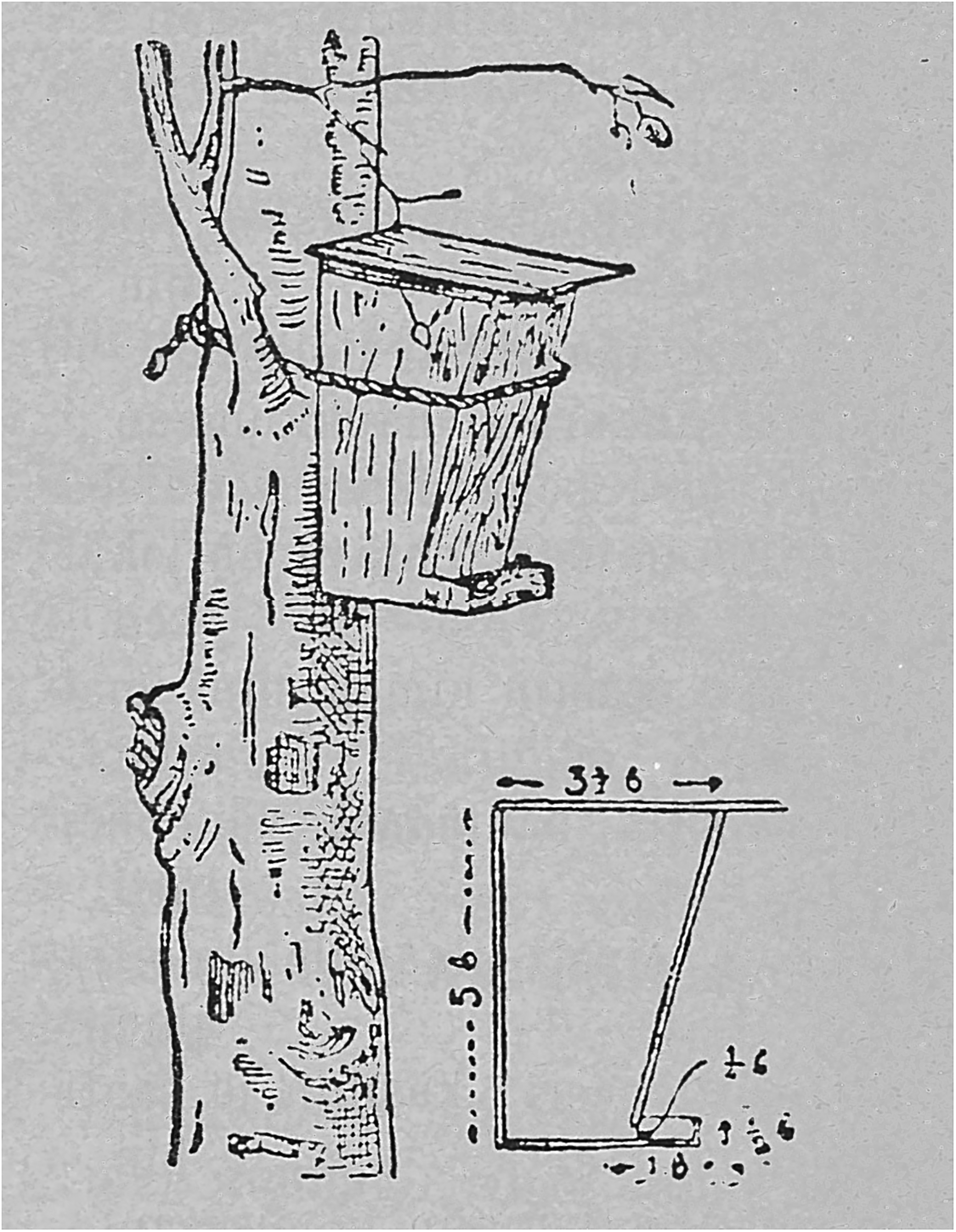
Automatic birdfeeder models improved the work ergonomics of bird feeders.
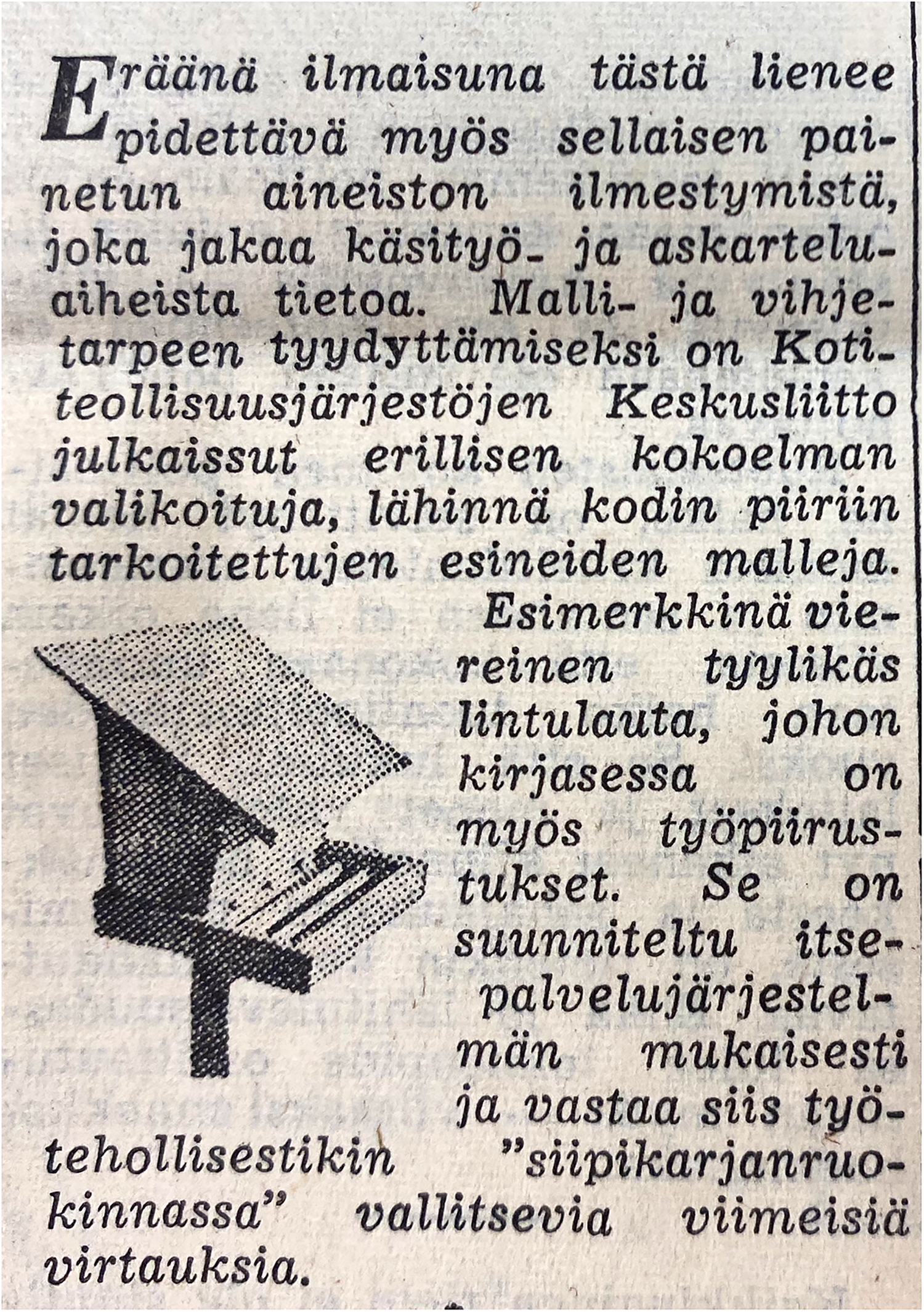
According to the article, this birdfeeder model was inspired by poultry farming.
The turn from traditional house-like birdfeeders to semi-automatic feeders also reflects the changing architectural paradigms and the availability of new synthetic materials such as metal and plastic. This additionally shows that the architecture and technology of birdfeeders was grounded not only on the bacterial risks but also in the realms of human architecture and the availability of new industrial and hygienic materials. Eventually, birdfeeders that looked like human houses or cottages were described as ‘old-fashioned’ (Salmonellasta harmia lintulautavieraille, 1984). Besides being dated, old models were even described as reckless: in 1989, an opinion piece writer in Helsingin Sanomat (Lindholm, 1989) condemned models that were too open and allowed birds to defecate on top of the food and therefore spread Salmonella (see Figure 12). According to the writer, people who used these models were ‘unknowingly the biggest threat’ to birds.
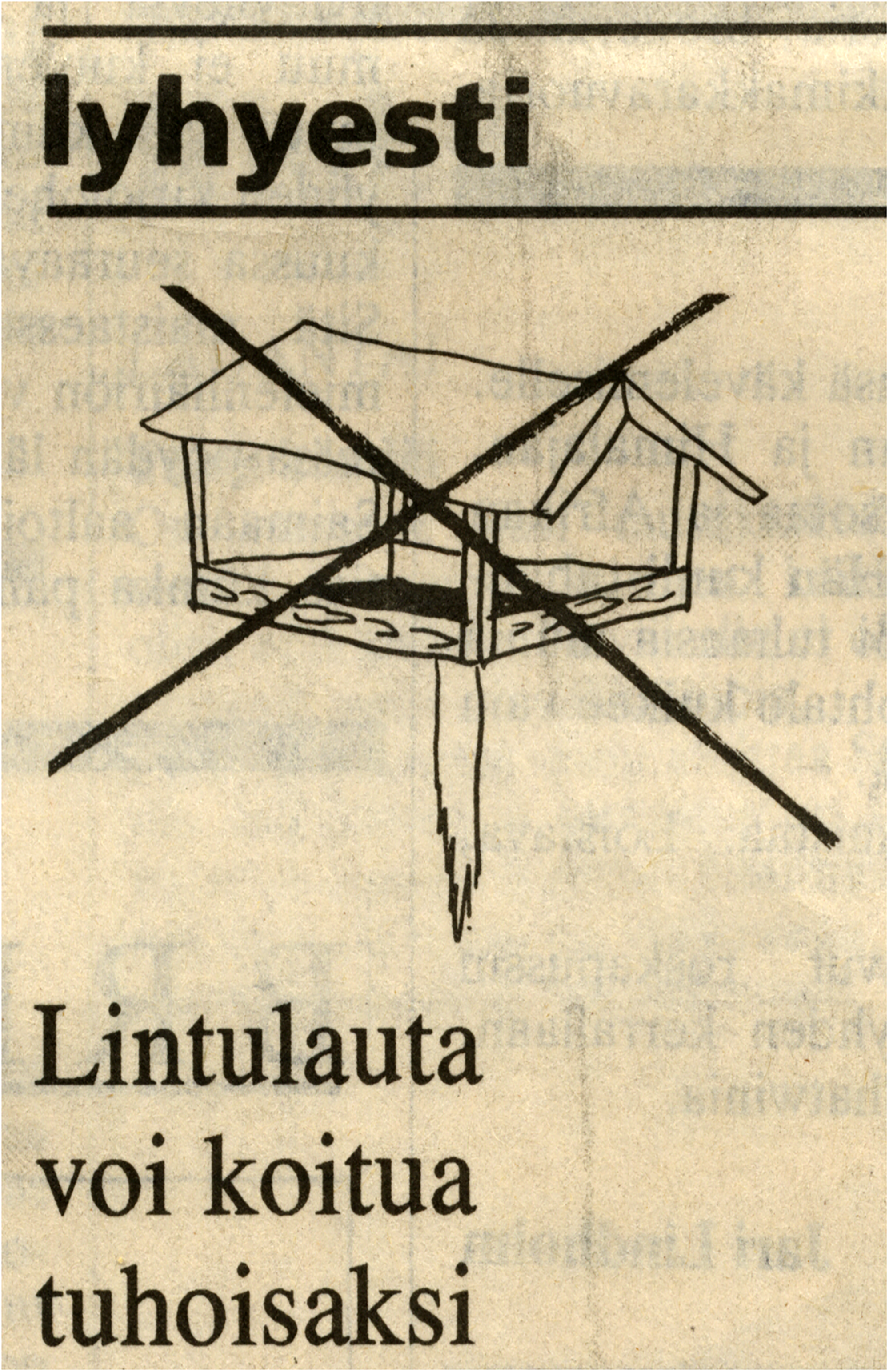
Old models like this were condemned as dangerous to small birds.
Throughout the 1980s and 1990s, newspapers recommended that feeders use automatic or semiautomatic birdfeeders because of the reduced Salmonella risk and because they did not have to be cleaned as often as ‘older’ or ‘traditional’ models (Nojonen, 1996). Petroski (1994) writes about paper clips when stating that ‘alternate forms of the artefact evolved in response to the failure of existing forms to reach perfection, and therein lies the value of this most common object as a case study of how failure can drive form to fanciful extremes in the quest of parallel objectives’. Birdfeeders mirror this: as people became aware of Salmonella, and it became an unwanted visitor at feeding sites, the old models failed. A previously less popular design was opted as the hygienic alternative and became the norm. Salmonella bacteria, along with unwanted birds and mammals and rain and snow, was a driving force, co-creating or re-creating the ‘perfect’ birdfeeder alongside human designers and users.
Conclusions
We argue that it is vital for environmental humanities scholars to study artefacts and technology and, vice versa, in a similar manner as we have done here, for design studies and STS scholars to examine non-humans. Historians and other researchers should also further examine the agency of birds, other animals, bacteria and the weather when studying technological artefacts, as the human-centric approach hides important processes. As we have demonstrated in this article, all these non-human actors or beings influenced what the ‘perfect’ birdfeeder of the time looked like according to newspapers and magazines. Therefore, they can be interpreted as co-creators of the birdfeeder alongside human creators and designers. Our article highlights how fruitful the cross-disciplinary approach is: by combining history with design studies and STS, we are able to draw attention to the material side of bird feeding and to highlight non-human agency.
We have highlighted four turns of events in the birdfeeder's technological evolution: (a) from a simple plank to a roofed ‘house’, (b) hanging the feeder from a wire or attaching it to the end of a long pole, (c) creating narrower slits for obtaining the food and (d) modelling the feeder so that birds could not sit directly above it. These turns seem to correspond with contemporary worries related to unwanted visitors: a roof covers the feed from rain and snow, hanging the feeder provides less access to cats, squirrels or rats to enter a birdfeeder, narrower slits prevent larger birds, including corvids and pigeons, from entering the birdfeeder, and lastly, Salmonella and other pathogens were seen as unwelcome guests and easy-to-clean became one of the important attributes of the birdfeeder.
Jørgensen (2019, 226) writes how ‘[i]n the early twentieth century, urban spaces were regarded as deficient in habitats for birds, so that artificial birdhouses became necessary’. In contrast, birdfeeders and other feeding devices are not necessary elements for bird feeding, as feeding can be accomplished by throwing food onto the ground. Also, a simple plank would serve the purpose of feeding birds. As we have shown in this article, more complex birdfeeder models had to do with keeping unwanted elements (snow and rain), animals and bacteria away from the feeding site. We therefore argue that the outward appearance of a birdfeeder, and the entire evolution of the device, had more to do with unwanted visitors than the targeted species, or with the practice itself. For instance, in our research material the wish to watch birds while they eat did not influence birdfeeder designs but did affect the location of feeding devices, as they were often recommended to be placed near windows to enable bird watching. During our research period, people were recommended to feed birds with various foods, but, according to our data, food trends did not affect the evolution of feeding devices. Jørgensen (2019) also writes about free-tailed bats that took up residence under bridges and subsequently humans adapted their building practices to encourage the bats’ nesting. Human adaptation targeted a different outcome in birdfeeders: humans adapted the birdfeeder to exclude unwanted species.
Eaton (2020, 52 note 25) argues that in artefact evolution ‘it is humans, rather than nature, doing the selecting’ and causing change. The four turns of events in birdfeeder design evolution can be seen from the human point of view, but we suggest that this viewpoint masks non-human agency: for example, birdfeeder design created an inviting space for both cats and bird pathogens, which in turn used birdfeeders in ways not accepted by humans. One can ponder, as Eaton (2020, 38–39) does while writing about the hermeneutics of artefact function, whether artefacts have correct or incorrect functions, proper or improper uses or activities and who decides this. We suggest that it was the unwelcomed non-humans that urged humans to alter birdfeeders and worked as co-designers. Therefore, the birdfeeder and its evolution are not merely cultural or human but rather a multispecies phenomenon.
Highlights
The article examines the evolution of birdfeeders as multispecies technology, shaped by interactions among humans, target species and unwanted visitors.
Birdfeeders also reveal how cultural circumstances and changes influence how humans welcome or exclude other beings from shared environments.
Four key turns in the technological evolution of birdfeeders are identified: from simple planks to roofed structures, hanging feeders, narrower access slits and feeders where birds can not sit directly above the food.
We bridge environmental history, environmental humanities and design studies to show how the agency of non-human actors is shaping the evolution of technology.
Footnotes
Acknowledgement
We thank the three anonymous reviewers and the editor of the journal Krithika Srinivasan for their insightful comments. First draft of the article was commented by the members of the Turku University's seminar group Space and materiality; we thank them for their feedback. We also want to thank the Finnish National Library and the Päivälehti archive and Reijo Rouvinen from PIB Features.
Authors' note
Heta Lähdesmäki is is also affiliated with Global Change and Conservation Lab, Organismal and Evolutionary Biology Research Program, Faculty of Biological and Environmental Sciences, University of Helsinki, Helsinki, Finland.
Declaration of conflicting interests
The author(s) declared no potential conflicts of interest with respect to the research, authorship, and/or publication of this article.
Funding
The author(s) disclosed receipt of the following financial support for the research, authorship, and/or publication of this article: Lähdesmäki is funded by Helsinki Institute of Sustainability, University of Helsinki, and Aivelo is funded by Emil Aaltonen foundation and Academy of Finland project numbers 344438 and 355183.
