




Abstract
This paper reconceptualises fishing as a dynamic, multispecies negotiation involving fish, fishers, and fishing technologies, using Lake Kariba in Zimbabwe as a case study to develop broader analytical insights. While prior research at Kariba has largely focused on human-centred perspectives, we show how both fish and technologies act as active participants in the fishing process. Drawing on ethnographic fieldwork and interviews, we argue that fishing entails two overlapping forms of negotiation: between fish and fishers, and directly between fish and technologies, as fish encounter, evade, or engage with fishing gear in ways that reflect their own agency. These interactions, shaped by water conditions, technological design, and human intention, produce a distributed choreography of relational encounters. Using examples from rod-and-line and gillnet practices – including passive, active, and illegal techniques – we highlight how fishing technologies mediate these encounters and how fish assert influence over capture outcomes. By foregrounding multispecies and technological agency, the study positions Lake Kariba as a lens through which to theorise relational, contested, and co-constituted waterscapes beyond a single locale.
Keywords
Introduction
Fishing at Lake Kariba, Zimbabwe, is more than a human activity of extraction; it is a dynamic, multispecies negotiation mediated through interactions between fish, fishers, and technologies. Each fishing encounter –whether with rods, lines, or gillnets – involves reciprocal exchanges in which humans, fish, and technologies co-produce outcomes, resistances, and adaptations. Technologies are not neutral tools but active mediators, while fish are responsive actors whose behaviour shapes, interrupts, and reconfigures human intentions. This paper situates Lake Kariba fisheries within debates in multispecies studies and science and technology studies, arguing for a relational understanding of agency in which fish, fishers, and technologies co-constitute the fishing process. We foreground negotiation as the key analytic lens, capturing both active and passive engagements: from fish driving and gillnetting to ghost fishing, where nets continue to act long after human presence.
The paper unfolds in four parts. First, we outline the conceptual framework for multispecies and technological negotiation. Second, we examine the role of fishing technologies and techniques in shaping human–fish encounters. Third, we present ethnographic evidence from Lake Kariba, detailing rod-and-line and gillnet fishing practices, including illegal and improvisational techniques. Finally, we conclude by theorising fishing as a relational and co-constituted practice, with implications for understanding agency, technology, and interspecies interactions in water environments.
Setting out the argument
Extensive literature exists on Lake Kariba and the Zambezi River landscapes in Zimbabwe, with one of the authors (Matanzima) making a very significant contribution to this literature (for example, Matanzima, 2022, 2024; Matanzima et al., 2022). This literature covers: the lake's creation through the Kariba Dam in the 1950s; the ensuing human displacements and suffering (Colson, 1971; Scudder, 1962, 2019) and effects on other species (Lagus, 1959); changing human livelihoods and fishing over six decades (Hughes, 2006, 2010; Mashingaidze, 2019); conflicts between people and elephants, crocodiles, baboons, and hippos (Marowa et al., 2021; McGregor, 2005; Muguti, 2024); and the hydro-mobilities generated by the lake across the Zimbabwe–Zambia border (Matanzima, 2024).
Our focus is on literature concerning fishing and human–wildlife relations at Kariba. Existing studies privilege terrestrial and legged animals – especially interactions between fishers, crocodiles, and hippos – while rarely attributing agency to aquatic species or to the lake itself. The Kariba waterscape is thus often portrayed as passive. A few studies attend to the lake's material affectivities and agency (Matanzima, 2024; Tombindo, 2024), yet these only begin to explore the multiple agential entities animating the waterscape, particularly fish. Consequently, scholarship on Kariba's fisheries remains largely anthropocentric and terrestrial, overlooking that fishing is relationally constituted between fishers and fish.
Our ethnographic material from Lake Kariba is not an exhaustive empirical account but an entry point for rethinking small-scale fishing as a multispecies and technological negotiation, informed by global multispecies and science and technology perspectives (Bear and Eden, 2011; Mordue and Wilson, 2023; Todd, 2014). Unlike Kariba studies, this literature often acknowledges how fishing technologies mediate relations between fish and fishers (Sautchuk, 2019; Swanson, 2019). We thus conceptualise fishing as structured through human–fish–technology assemblages in which agency is relational and negotiated, following feminist notions of relational autonomy (MacKenzie and Stoljar, 2000) extended to multispecies studies (Molfese, 2023; Wilbert, 2000).
Our paper involves a two-fold focus and argument. On the one hand, we examine what we label as “negotiation” between fisher and fish. In doing so, we speak about the variegated affordances offered by fishing technologies to fishers and how these technologies intervene in, mediate, affect and act as actants in the negotiated relationship between fish and fishers (Howard, 2017; Jørgensen and Jørgensen, 2024). Whether or not fish see the fish-fisher relationship as entailing negotiation, and what forms this negotiation takes, is of course by no means easily understood, let alone resolved. In this regard, as Buttacavoli (2024: 277) argues, if we are to “address those experiences which escape us as humans”, we need somehow to suspend our own “sense of the world”, because our “perceptual biases influence our interpretations of non-human experiences.” Nevertheless, the global fishing literature is highly suggestive of fish agency and fish-fisher negotiation.
On the other hand, we use this fish-fisher line of enquiry as a platform for pursuing what we consider to be a novel argument not visible in the fishing literature, namely, that negotiation also takes place between fish and fishing technology – whether in the presence or absence of a fisher. Consistent with this, Jørgensen (2014: 485–486) makes the wider point that “from the point of view of living creatures, technological artefacts are no less part of their ecosystem than trees or grass or rocks”, so that they are not invariably encountered as “human interventions in nature” by fish and other creatures. The possibility of such interaction (and specifically, negotiation) between fish and fishing technologies, from the perspective of fish, has not been explored in the literature. The likelihood of this negotiation occurring depends in part on the type of fishing taking place, with water's opaqueness as a medium and the refraction present along the surface of a lake or other water body being significant in this respect. Though fishing technologies (such as gillnets) are embodied, becoming a delegated extension of the human body of and for the fisher, and thus offering affordances to fishers in the process, they may not be encountered or experienced as such from the watery medium inhabited by fish.
At the same time, this does not imply that the fisher has no effects on the process and outcome of fish-technology negotiations, as the fisher acts as a kind of ghost-writer and even mediator of the encounter. In the fisher's immediate absence, his or her presence is materially and discursively embedded in the negotiation between fish and fishing gear. For example, through the selection and placement of a particular fishing gear, the fisher scripts the possible range of interactions between gear and fish. While fish engage with technology directly – testing, avoiding, or becoming entangled or hooked – the fisher remains a behind-the-scenes facilitator, configuring the conditions of encounter through temporal, spatial, and affective entanglements. The negotiation is thus not purely “non-human”, but a fish-technology-fisher choreography sustained by distributed agency.
In both forms of negotiation – fish-fisher and fish-technology – what emerges is a relational dynamic marked by processes of mediation. We use the term ‘negotiation’ as a heuristic for understanding the relational, interactive and co-constitutive dynamics between fish, fishers and technologies. Negotiation thus refers to the dynamic and situated interactions through which outcomes of fishing are not pre-determined by human intent or technological design, but are instead emergent from multispecies encounters. Further, we use the term ‘mediation’, or “technological mediation” (Kramer and Meijboom, 2022), in the sense put forward by Bruno Latour, such that mediators “transform, translate, distort, and modify the meaning or the elements that they are supposed to carry” (quoted in Jørgensen and Jørgensen, 2024: 8). Thus, fishing technologies are not passive intermediaries which simply carry human intentions into bodies of water. Though not always explicitly stated, processes of negotiation involve mediation, as human and technological interactions shape outcomes within the broader relational field. Mediation is thus positioned as a mechanism within negotiation rather than a separate, competing concept.
Fish-fisher negotiations are explicitly shaped by the embodied presence of the human and the direct affordances that technologies provide to the fisher, while fish-technology negotiations underscore the indirect yet consequential imprint of human intention through technological configuration. This implies that fish–fisher and fish–technology negotiations are not ontologically distinct. Rather, without collapsing into each other, they are deeply intertwined within the same relational assemblage. They may even represent different epistemological framings of a shared field, that is, two ways of apprehending the distributed agencies at play. In other words, the negotiated relations among fish, fishers, and technology are co-constituted, but depending on our analytic lens, we might emphasise different aspects – direct embodiment and affordances (fish–fisher) or mediated technological inscriptions (fish–technology). This speaks to the main title of this paper, “Lines of Negotiation”, which is inspired by Ingold's (2007) argument about the ontological centrality of lines and processional interactions entailing ongoing negotiation.
Re-Turns, not turns: Rethinking Species and technologies
In this study, we draw upon and hope to contribute to both multispecies and technologies studies, with specific reference to fish and fishing. Though these areas of study are depicted as fresh and innovative ‘turns’ in European social theory, indigenous scholarship commonly highlights instead their status as ‘re-turns’ to indigenous ways of knowing, because “Indigenous thinkers…have been writing about…human-animal relations and multiple epistemologies/ontologies for decades” (Todd, 2016: 14), including the vitalities and agency of inanimate entities (Todd, 2018). Indigenous scholars like Watts (2013: 32) state that “our ability to speak to the land [and dialogue with it] is not just an echo of a mythic tale or part of a moral code [or merely metaphorical], but a reality”. In a study of hunting among First Nations people in North America, Nadasdy (2007) argues that such accounts of subjecthood (for all animate and inanimate entities) need to be taken more seriously, a point which resonates with our overall thesis.
In this light, any claim that fish might negotiate during fishing raises the broader issue of how agency is commonly defined – and how such definitions remain tethered to human exceptionalism. Debates within social theory reveal that even human agency is contested. Whereas Margaret Archer (2003) argues for a necessary link between conscious deliberation and agency, Pierre Bourdieu (1992) maintains that agency need not depend on reflective intention, but rather on acting reasonably within the constraints of one's situation. Hence, insisting that fish consciously articulate aims for their actions, in order to enact agency, would be problematic.
There is in fact considerable debate around animal agency with specific reference to intention and reflexivity – and the implications of this for claims about animal resistance (Gillespie, 2015; Pearson, 2015; Wadiwel, 2016; Wilbert, 2000). Fish, like other nonhuman species, are often “rendered flat of effect” (Druschke et al., 2017: 731), with their capacities to influence relations or environments muted by human-centred frameworks. As Knott et al. (2022: 1774) argue, there is a need to “disrupt the dominant narrative of human centrism in human-fish relations.” This involves recognising that agency may vary across species, possibly in hierarchical or heterogeneous forms (Carter and Charles, 2013). Lindstrom (2015: 222, emphasis in original) thus contends that all vertebrates, including fish, exhibit “active agency with behavioural flexibility, the ability to act, and to act consciously and intentionally”, while other species without such intention nonetheless generate relational effects. Agency, then, need not be uniform or fully conscious; it is distributed, emergent, and expressed differently across species.
Recent research further underscores the need to take fish seriously as sentient, affective, and agentic beings. Although fish have “largely taken a backseat in human–animal studies” (Druschke et al., 2017: 726), a growing body of work recognises their intelligence, subjecthood, and capacity for relational agency (Law and Lien, 2012; Mallon Andrews, 2023; Todd, 2014). Studies in the natural sciences reveal that fish have “excellent long-term memories”, can associate certain stimuli with harm, and actively avoid such contexts (Brown, 2015). Behaviour such as “gear avoidance” (Diaz Pauli et al., 2015) exemplifies a learned responsiveness that shapes human–fish interactions. As fishers often remark, one must “think like a fish” (Duggan et al., 2014) – a phrase that, rather than being purely metaphorical, points to fish cognition and adaptiveness. In this sense, as Bear and Eden (2011: 341, emphasis in original) note, “fish are both affected and affective”: they do not merely receive human actions but actively participate in configuring fishing practices and relations.
In the case of technologies, Ingold (1990: 7,12) argues that these extend “the capacity of an agent to operate within a given environment”, activating a “purposive engagement” as mediators as a result. Though more controversial than in the case of animate beings, Latour (Latour, 2007) famously argues that technologies, as actants, are agents because of the direct and indirect effects they have in and on the world. Others like Lindstrom (2015: 216) are sceptical, declaring that Latour conflates “the [human] experience of things” – including what humans attribute anthropomorphically to objects and artefacts – and “the nature of things”: “[t]he lifeless are not actants, but can be effectants” and it is human agency that is “effected/performed through” technologies (Lindstrom, 2015: 222, emphasis in original). Lindstrom's view seems reasonable; however, it is articulated strictly from a human perspective. Fish, we suggest, engage with technologies in ways that are not necessarily aligned with human-centred understandings of what those technologies are or do.
This leads us to the central question about the interaction, indeed negotiation, between fish and fishing technologies. The possibility of negotiation taking place from the viewpoint of fish would seem to make sense given the recognised existence of resistance by animals broadly to humans and their technologies (Brown and Emery, 2008; Kowalczyk, 2014; Wilbert, 2000). Some scholars prefer to call it transgression (Philo and Wilbert, 2004), while Bear and Holloway (2019) articulate the notion of ‘divergent conduct’. Whatever term is preferred, it seems clear that the evolving design, development, and character of certain technologies as they relate to animals is connected to strident efforts to keep the latter in their rightful place (as defined by humans), by controlling, subduing, and confining them, not unlike what happens amongst humans. In the case of labouring animals, “in order to obtain [their] production and obedience”, numerous “offers” are put forward to them over time, leading to specific technologies as “a product of an unspoken negotiation” between humans and these animals (Hribal, 2007: 103). Insofar as fish resist fishers, and fishers use enhanced fishing technologies as a result, human technologies are not necessarily proactive, but a reaction to fish resistance (Wadiwel, 2016).
Intriguingly, there are tantalising claims in literature about farm animals and robotic technologies, including autonomous robotic milking machines on intensive dairy farms, which are highly suggestive of the existence of communication between these technologies and cows independently of, and unmediated directly by, any human presence and agency (Bear et al., 2017; Porcher and Schmitt, 2012). Cows, it appears, even negotiate with the robotic machine, and vice versa, with the farmer intervening at times to mediate their relationship, perhaps to calm things down, particularly when the toing-and-froing actions of the cows and robots go against farmer expectations. In this sense, the milking machines are “not installed on any farm as a finalised technological assemblage but are co-produced by their users, humans or otherwise” (Bear and Holloway, 2019: 213). Wadiwel (2018) in fact argues that, in the light of ongoing resistance by animals, a process of technological intensification takes place over time, which robotic machines likely represent. This leads to “the character of resistance encounters” shifting “from engagements between humans and animals towards encounters purely between animals and the instruments of mechanised production” (Wadiwel, 2018: 538) – as epitomised in Wadiwel's case by the chicken-harvesting machine. In relation to resistance by fish, an equivalent response to resistance might involve domesticating fish via the technologies of aquaculture (Wadiwel, 2016).
We would suggest that our concepts of negotiation and mediation, as used to describe the dynamic and co-constitutive interactions between fish, fishers, and technologies, are best supported by a relational, distributed, and emergent notion of agency. Rather than locating agency solely in human intention or technological design, this perspective understands agency as arising through the situated interplay of heterogeneous actors. Importantly, this notion of agency does not require intention or purposeful action in a human sense; instead, it refers to the capacity of beings or things to affect and be affected within specific relational contexts. Within this framework, resistance is a more consistent term than transgression for characterising animal behaviour, as it implies an active, if not always intentional, capacity to shape outcomes and disrupt human control. In contrast, transgression risks suggesting passive or accidental boundary-crossing, obscuring the relational dynamics at play.
These reflections on agency, relationality and negotiation across species and material forms lay the groundwork for rethinking fishing as a multispecies and technological assemblage. Rather than treating technologies as neutral tools or fish as passive, we propose a distributed understanding of agency involving fish, fishers, and gear. In the sections that follow, we explore how this plays out by examining, first, the affordances of fishing technologies, and second, the techniques through which they are deployed. Together, these points portray fishing as a dynamic choreography shaped by water, technologies, and the agential capacities of fish.
Wet assemblages: Technologies in the fish-fisher encounter
Michael (2000: 107) argues that to examine “the role of the body in the mediation of relations between humans and the natural environment is, inevitably, to consider the part played by technology”. As bodily extensions, technologies afford humans different ways of accessing – and intervening in – the world (such as water bodies and the underwater world of fish), and hence – as mediators – they configure our relationships within and to the world (Jørgensen and Jørgensen, 2024). In providing affordances, technologies expand the range of possible actions available to the human body. In this way, technologies are “not mere simple conduits” but “interject” in relationships (Michael, 2000: 121), including those between fishers and fish. Indeed, fishing technologies (and fishing gears specifically) have been imagined, designed, and constructed throughout history to ‘interject’ on behalf of humans because of the capacity of fish to resist and evade capture. As Wadiwel (2016: 214) argues, for example, “it is precisely because fish elude human capture that the [fishing] hook was devised”. In specific ways, then, all fishing technologies crystallise and embody fish-fisher relationships.
Todd (2018: 61) refers to fisher-fish relations as entailing a “‘micro-site’ of engagement”. Importantly, the ‘sites’ of fishing (as hunting) are normally vastly different from hunting sites for four-legged animals – these take place on land, where the hunted and hunter are commonly visible to each other. However, fish “inhabit very different, and clearly bounded, lifeworlds” (Bear and Eden, 2011: 341), separate from the land-based lives of fishers. Until caught, fishers may never see the fish being fished (and vice versa), only signs of their possible presence or absence. The ‘wet ontologies’ (Choi, 2022; Steinberg and Peters, 2015) of fluid and flowing water bodies differ from more stable terrestrial ontologies, even though there is an ontological intimacy between land and water (Cortesi, 2021; Lahiri-Dutt, 2014). As well, the refracted interface between water and air (whether fishing on or off the water) further complicates any fishing activities pursued from above the water's surface, and this requires technologies configured in particular ways. As Lien (2024: 406, emphasis in original) posits with specific reference to fishing, “the water surface represents a rather firm boundary between the lives of salmon [and other fish] and the lives of humans”, and thus “water enacts a kind of separation through the water surface”. The water surface “mediates”, but, like fishing technologies, it is more than just a boundary, as the “shifting and shimmering texture of the water surface … can also be enacted as a lively interface between salmon [and other fish] below and human above” (Lien, 2024: 406, emphasis in original). Of course, some fishing techniques require the fishers’ complete submergence below the water surface, which raises different challenges for fishers.
Other scholars make similar points about the water-air interface (Mordue and Wilson, 2023). Steinberg and Peters (2015: 253, emphasis in original), for instance, speak about the pronounced mobility of “either the water or the fish” and “our [human] inability to fully comprehend either in its essential mobility”; further, because water is a space “not moved on, but through … and also under”, it creates “distinct opportunities and complications for the projection of [human] power”. Underwater fishers are certainly fully cognisant of these complications (Pauwelussen, 2022). The key point is that the ontological features of water often constrain the powers of fishers and their fishing activities. This forms the basis for another reason for ‘thinking like a fish’. In highlighting how the water surface bends, scatters and disperses light, and “distorts the visibility of fish worlds below”, Todd (2018: 64) contends that it becomes “necessary to understand how fish move and behave … in order to catch one”. Similarly, for Duggan et al. (2014: 17), ‘thinking like a fish’ entails “embodied, relational engagements” on the part of fishers. It would appear that water densities and refracting surfaces simultaneously require and inhibit this embodied engagement, therefore necessitating technological extensions and affordances for fishers.
In discussing the hunting of four-legged animal species, Nadasdy (2007: 32) suggests that these species are “not only aware of humans but are also able to learn from their experiences with them” – and they act, and we would argue negotiate, accordingly. In relation to fishing as a form of hunting, Bear and Eden (2011: 349) suggest that what takes place during fishing encounters is the “negotiation of angler [fisher] rhythms and practices” by fish. While we recognise that animals, including fish, learn and negotiate, we suggest that, from the viewpoint of fish, they might at times learn from their experiences of (and with) disembodied and seemingly fully autonomous fishing technologies which break through and intrude into their watery world. In the case of some, but certainly not all, fishing practices, we imagine that fish negotiate with the technology, not the fisher, and that this is required and structured by the presence of different lifeworlds, the opaqueness of water, and the refraction appearing along the water's surface. Therefore, fish might, in certain instances, negotiate with the ‘rhythms and practices’ of fishing technologies.
Techniques of entanglement: Performing the catch
To understand negotiation more fully, it is necessary to distinguish between fishing technologies and fishing techniques. Fishing technologies (gears), as material artefacts, are used in different ways by fishers, which we label as fishing techniques. These techniques, as a form of “relation or mediation” (Mura and Sautchuk, 2019: 5), add another layer of complexity and affordances to human-fish-technology assemblages. Thus, though fishing technologies serve as material mediators that puncture the watery life-worlds of fish, they do not act alone. Technologies become entangled in specific practices – the techniques through which fishers deploy, adapt, and animate them. In this section, we shift from thinking about how technologies afford action, to examining how techniques reconfigure the space of negotiation, at times extending, amplifying, or subverting what the gear alone might afford. It is through these performative techniques that the choreography of fishing becomes most apparent, as fishers not only engage with the capacities of gear and fish, but also rework their rhythms in search of the catch.
In this respect, the distinction between active and passive fishing is of some importance, and it can be drawn in two senses. First of all, it refers typically to the technology (or gear) itself. If the gear has to be moved to catch fish, such as in seine fishing, it is labelled as active. Stationary gear (for example, gillnets) involves passive fishing, as catching fish depends upon the movement of the fish and not the technology (Mehdi et al., 2021), such that the technology “fishes by itself” (Sautchuk, 2019: 179) autonomously from, and possibly in the absence of, the fisher. All of these technologies, whether passive or active, are designed of course to maximise catches. Additionally, passive technologies are sometimes actively deployed through specific techniques or are recalibrated by fishers to enhance catches, while active gear may be further activated by fishers in various ways. In this second sense, identifying particular gears as inherently passive or active is problematic, as they “come into being” through “formative processes” (Ingold, 2012: 341). In the end, affordances are not fully constituted by and embodied in the object or technology itself. Combined, fishing technologies (and their techniques), as affordances, become “a relational property between object and agent” (Swanson, 2019: 403).
From the perspective of fishers, different techniques offer or afford diverse opportunities and possibilities for catching fish. In particular, active fishing techniques using passive gear are pursued to heighten the chances of enticing or entrapping fish through the fisher's movement of the fishing gear (for instance, a rod and line), which would otherwise lie stationary and unmanipulated by the fisher. Therefore, fishing technologies which, in terms of their structured form, are typically labelled as passive gears (or traps), including gillnets, may be manipulated or recalibrated by fishers to maximise their catch. Active fishing techniques, like the material form of fishing technologies, reflect an awareness by fishers that fish enact agency, and that they (the hunter) must somehow shift the balance of power in their favour during the fishing encounter. Active fishing techniques seek to reconfigure the negotiation occurring during fishing by closing down the space, sometimes literally, for negotiation on the part of fish. To illustrate this, we outline two studies from the fishing literature.
Markuksela and Valtonen (2019) examine the hobby of sport fishing from boats in Norway. They highlight the encounter between fish and fisher at the interface of under-water and above-water lifeworlds, calling it “partner dancing”. Because humans have “difficulty seeing and hearing under the water, …. fishermen attempt to alter their own embodiment and senses to match those of the fish” (Markuksela and Valtonen, 2019: 354). Like humans, though, fish also have their “own bodily routines and rhythmicity … that form underwater patterns” (Markuksela and Valtonen, 2019: 355). The encounter takes place “through technology” and, at times, fish “have little possibility to refuse being part” of the dance, particularly when the fishers use (active) trolling as a technique “in which some form of bait is drawn on a line through the water” to rouse fish curiosity: what they also call “waltzing various lures near the fish, wooing and politely ‘requesting’ the fish to take a bite” (Markuksela and Valtonen, 2019: 355, 356, 357). Meanwhile, fish and fisher “usually do not see one another, due to the colour of the water or due [to] the distance between them or the depth” (Markuksela and Valtonen, 2019: 359). Like fishers trying to become fish metaphorically, fish themselves “may also be pulled into becoming a [hu]man [or thinking like one]…. [T]he fish has the prospect of becoming aware of the angler's intentions and practices, of learning how a [hu]man acts” (Markuksela and Valtonen, 2019: 363). For us, though, there is a strong likelihood that that the fish are negotiating with the technologies (and techniques), not the angler, despite what the angler believes.
Mosquito net fishing is another example which highlights the presence of active fishing techniques. Short et al. (2020: 74) examine mosquito net fishing in Cabo Delgado in Mozambique. Mosquito nets have a small mesh size and their use is illegal because they are indiscriminate in the size of fish caught, including fingerlings and smaller fish that would be able to pass through the mesh of a regulatory sized net. In this light, even when stationary (or used passively), this type of net entraps and ultimately limits the prospects for negotiation by fish. However, they are used actively and in different ways by men and women: respectively, the techniques are labelled as chicocota and kutanda. In crafting their fishing nets, women sew a number of mosquito nets together while men, in addition, place stronger nets along the bottom of the mosquito nets for reinforcement. In fishing in intertidal spaces in groups, some women will seine by walking toward the shore holding the net while other female members of the group, the chasers, will “herd fish” towards the net “using splashes”; in contrast, men in groups move further from the shore and deploy and drag the nets “over reefs, in deep water and even from boats” (Short et al., 2020: 73). In this case, fishers immerse themselves if only partially in the water and this might, from the perspective of fish, involve some form of negotiation with the fishers themselves.
The discussion thus far has explored how fishing is shaped through dynamic assemblages of fish, fishers, and technologies, and how embodied techniques also act as mediators. The relations constituting the assemblages are not simply linear or anthropocentric, and they are often negotiated – sometimes directly between fish and fishers, at other times between fish and gear, with technologies acting seemingly autonomously at times within aquatic life-worlds. Crucially, the watery medium itself refracts, mediates, and sometimes conceals these encounters, prompting both fishers and fish to respond adaptively. In what follows, we turn to the case of Lake Kariba to examine how these ideas unfold empirically. By focusing on specific fishing practices in the lake, we illustrate how fish, fishers, and gear become entangled in processes of negotiation that are shaped by the unique materialities, histories, and multispecies relations of this complex waterscape: both negotiation between fisher and fish, and between fish and fishing technologies. To ground these conceptual insights in empirical observation, the following section outlines the study sites and methods through which the dynamics of fish–fisher–technology negotiation were documented at Lake Kariba.
Study site and methods
This paper is based on qualitative studies carried out at Lake Kariba, in north-western Zimbabwe. The Lake was constructed in the 1950s for the sole purpose of electricity generation, but over the years it attracted other activities such as conservation, recreation and fishing. The Lake borders Zimbabwe and Zambia, and is over 223 kilometres (139 miles) long and up to 40 kilometres (25 miles) in width. It covers an area of 5580 square kilometres (2154 square miles). The Lake has five basins (see Figure 1). Our research is mainly based on basin number 5, which is located relatively near to Kariba town, where both the first and second authors (Helliker and Matanzima respectively) conducted fieldwork relating to different forms of fishing, such as rod and line and gillnetting.
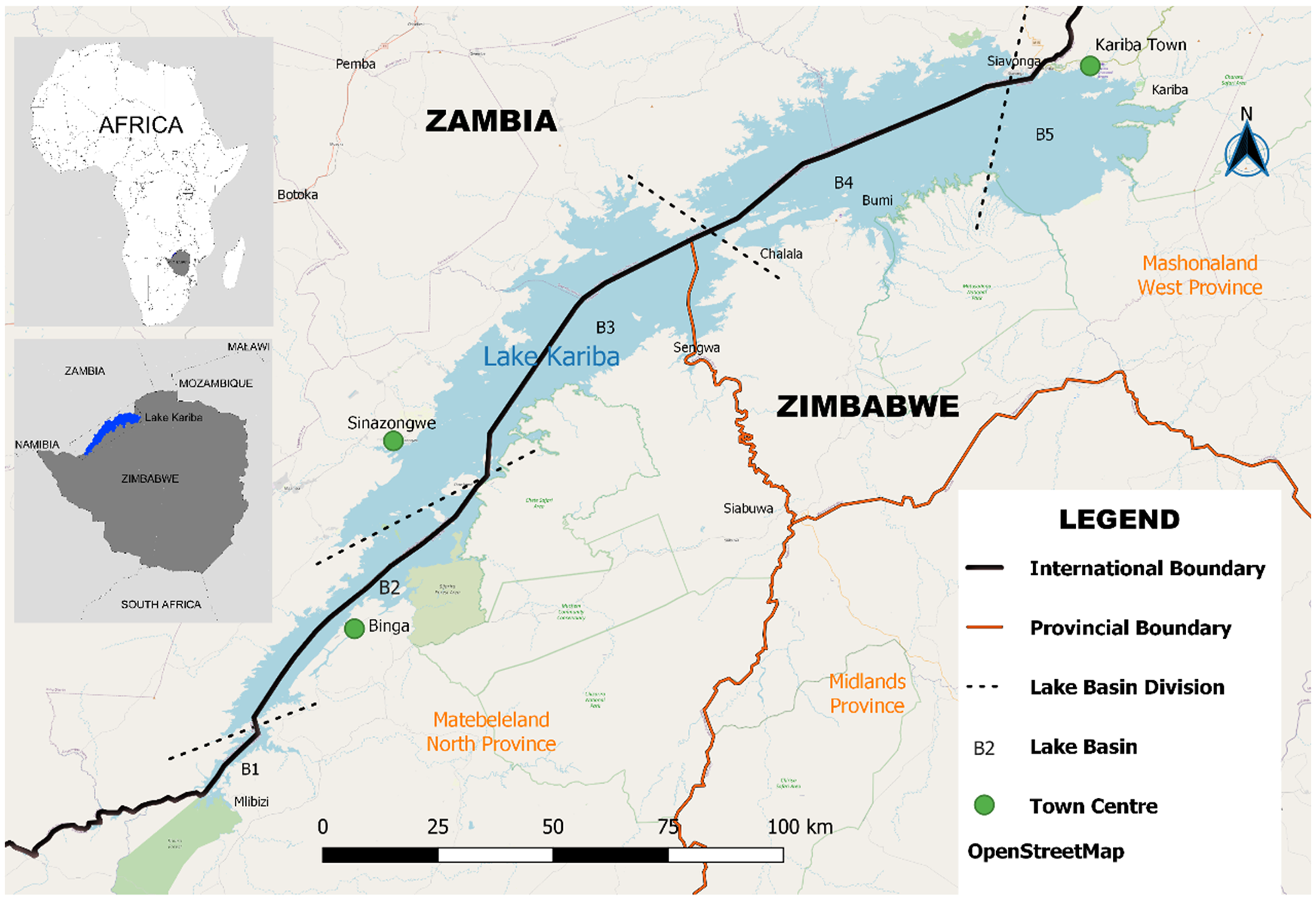
Lake Kariba Map showing its five basins (Source: Second Author).
Matanzima was born and raised in Kariba town. Before pursuing his academic career, he also taught for two years in one fishing camp and one fishing village located along the shores of Lake Kariba, where he engaged in numerous fishing conversations with fishers. These conversations laid bare the different material relations in the Lake, manifested in two important ways: the symbiotic interactions between people and aquatic beings (including fish), and the interactions of aquatic beings with technologies (Marowa et al., 2021). At night, detailed notes were taken about these conversations, and he revisited these notes to identify material pertinent to this paper. In part, the paper thus draws on his personal knowledge and experiences of fishing at Lake Kariba, thereby augmenting his academic research.
Overall, Matanzima has been researching the social dimensions of Lake Kariba's waterscape since 2017, focusing on human-fish relations, human-wildlife interactions, tourism and recreation, illegal hunting and poaching, and cross border trading and smuggling across Lake Kariba. His research has been ethnographic in character over extended periods, involving personal observations and qualitative interviewing at Lake Kariba including Kariba town, nearby fishing camps and villages, and rural communities more widely. This paper incorporates data gathered over the many years of his intensive research. While he has interviewed hundreds of local fishers at Lake Kariba over the years, for this paper we rely on fieldnotes emerging from interviews with 50 fishers (30 women and 20 men), including during a recent visit in December 2024. Helliker also spent time at Lake Kariba in 2023 observing fishing activities, undertaking transect walks and conducting informal interviews. These two authors have collaborated on research about the livelihoods of Tonga people in Zimbabwe (Helliker and Matanzima, 2022), who constitute the dominant ethnic group residing along the Lake in Zimbabwe. The third author (Alexander) also grew up in Zimbabwe and has visited many different parts of the Lake over the years, having family who lived beside the Kariba waterscape for many years.
Our approach focused mainly on collecting qualitative data about how fishers interact with fish. This includes understanding fishers’ perspectives on how fishing technologies and fish interact, in ways that suggest and indeed show the fishes’ ability to negotiate with different forms of fishing technology and gear. The qualitative methodology allowed us to gather stories about fish and fishing in depth.
From 2017 to 2024, Matanzima undertook numerous research trips to Lake Kariba. He has interviewed both male and female fishers either near the Lake shore or in their homesteads. Likewise, focus group discussions were carried out in different settings in Kariba town, and at fishing camps and villages with both men and women. Each gathering had from four to ten participants, either men or women only, or a mixture of both. Engaging with male and female fishers was crucial as it allowed for a deep understanding of the complexities of different forms of fishing (i.e., rod and line and gillnetting), and the material relations that these entail. Key informant interviews also took place, involving local fishers’ chairpersons: one from Kariba town, two from the fishing camps (Nyaodza and Ndomo) and one from the Gache-Gache fishing villages. In addition, all five Village Heads from the Gache fishing villages were interviewed. Interviews with the local national parks authorities were enacted as well. Discussions were conducted with two successive Directors of the National Parks offices based at the Charara station in Kariba (in December 2018 and January 2020), and in-depth interviews were carried out with 17 park rangers at the Lake Kariba Fisheries Research Station in June 2021: the latter also allowed more in depth details about fishing regulations and the intricacies of policing the Kariba waterscape. For Matanzima, participant observation has been crucial to his research over the years. Examples that relate to this study involve encountering injured male fishers, whose hands had been wounded by aggressive fish when emptying their nets, as these fish tried to escape capture. During research trips, he saw many nets destroyed by big fish. He also went on many fishing expeditions with local fishers.
While his initial research focus for Kariba was to understand the interactions between fishers and fish, his findings increasingly pointed towards another possible line of interaction, that is, a more direct relationship between fish and fishing gear. It was these observations that motivated us to revisit the research and to conduct further research in 2024, including participant observation, which sought to explore fish-technological interactions. The ways in which these observations occurred and the evidence they produced resonate with multispecies and “other-than-human” ethnographies (Lien and Pálsson, 2019; Ogden et al., 2013). We corroborated our findings with interviews and participant observations found in existing literature about Kariba, including the biological sciences (Magqina et al., 2020; Marufu et al., 2021; McGregor, 2008). Several research projects at the University of Zimbabwe's Lake Kariba Research Station (ULKRS), focusing on the biology and behaviour of fish in the Lake, indirectly confirm our claims about fish-technology relations. Finally, thematic analysis was used to categorise information from observations and interviews under key themes of rod and line and gillnet fishing, as these are the most practised fishing activities in which we see the interactions between fish, fishers and fishing technologies.
Fish, lines, and lives: Entanglements in the kariba waterscape
We begin with a short historical overview of fishing in the area, first along the Zambezi River and later in Lake Kariba. While some of the earlier fishing practices resonate with the analytical points raised in this paper, we reserve our analytical commentary to contemporary practices observed and researched, as detailed later.
The written record of fishing starts in the nineteenth century when European explorers, mercenaries, slave traders, hunters and missionaries entered the Zambezi Valley. Their narratives depicted indigenous fishing and flood-recession agriculture as primitive, premised on the use of “unsophisticated” gear including dugout canoes (Scudder, 1960). The most common fishing technologies were spears and baskets, used by men and women respectively (McGregor, 2009). In seeking to optimise their catch, women deployed their baskets in shallow waters to capture small fish, while men utilised spears to catch larger fish residing in deep waters and pools – where baskets proved ineffective (Colson, 1960; Scudder, 1960).
Throughout the first half of the twentieth century, before the construction of the dam, both European and indigenous communities accessed fishing sites along the Zambezi River, for recreation and livelihoods respectively (Matanzima, 2024; McGregor, 2003a, 2003b). The construction of the Kariba dam in the 1950s by the Central African Federation brought about major changes in the waterscape, leading to massive displacement of human and animal populations. It led to the inundation and closure of local fishing places along the Zambezi (i.e., riverine fishing) (Lagus, 1959), and opened up new fishing sites (including fishing camps reserved for indigenous people by the colonial state). The waterscape along the Lake became, first and foremost, a site of leisure and recreation for whites (including recreational fishing), with indigenous fishing tightly regulated and often labelled as poaching by the colonial state.
Further, the dam resulted in the intentional introduction of new fish species, including kapenta and its commercialisation. Initially owned exclusively by Europeans, commercial kapenta fishing operations required specialised gear – capital-intensive and mechanised methods involving boats and specialised lift nets – and soon became prominent on the lake. Kapenta fishing is carried out at night with beaming lights to which kapenta are drawn, where they become ensnared in the lift nets. The now well-established fishing technologies used by indigenous fishers, mainly gillnets and rod-and-line fishing, were ineffective in catching kapenta.
These broad changes on the waterscape and their implications for fishing (and other) communities displaced by the dam are the subject of several studies of post-Kariba Dam construction (Hughes, 2006; Reynolds, 2019; Scudder, 2005). As a general tendency, the Europeans’ agenda was to minimise Africans’ access to the lake (for example, through establishing isolated fishing camps) as they tried to turn the entire littoral into a space for “white men” (Hughes, 2010; Mashingaidze, 2022). Layers of colonising space emerged – the dam emerged in a period of building infrastructure as part of nation building and, on top of that, the water space itself became a space made and configured for the colonial economy's hydropower demands, and for white commerce and recreation.
The survival of displaced indigenous people (Tonga, Shangwe and Korekore) in new emplacements became extremely difficult and problematic as they were resettled in very dry areas with low agricultural potential. In the resettled lands, nearby local rivers were not perennial enough to sustain fishing by displaced people throughout the year, as was the case with the Zambezi (Matanzima, 2022). Further, only men were allowed to stay in the new fishing camps opened along different parts of the Lake. Women and children lived elsewhere in their rural homes, with men regularly visiting them (Matanzima, 2024; Scudder, 1982). Prior to the dam's construction, women had been involved in both fishing and farming along the Zambezi river.
At Zimbabwean independence in 1980, colonial barriers were removed and male fishers commenced living with their families in the fishing camps. This provided displaced women with another chance to fish, with rod and lines. They are still not permitted to engage in gillnetting, which remains the prerogative of men for cultural and other reasons, including claims that women do not have the strength or courage to paddle to deeper waters to place nets given the risks of encountering crocodiles and hippos (Matanzima, 2024). Currently, fishing in Zimbabwe is guided by rules enforced by the National Parks authorities. These rules are enshrined in the Parks and Wildlife Act (Chapter 20) (2024), and failure to abide by them, if caught doing so, will – at least officially – lead to fines or even imprisonment. In what follows, we discuss rod and line, and gillnet fishing.
Waterscapes of negotiation
There is a growing literature on small-scale fishing in contemporary Kariba, which generally treats fish and technology as inert (Magqina et al., 2020; Matanzima, 2024; Muringai et al., 2020; Ndhlovu et al., 2017; Nhiwatiwa and Matanzima, 2023). We focus on fishing at Kariba as it relates to fish, fishers, technology and negotiation. We seek to show that fish, whether through nets or rods, are not simply caught or enticed, but are active through processes of negotiation. For instance, fishers claim that the noisy practice of fish driving, discussed below, causes fish to migrate to deeper waters (Tombindo, 2024: 114). As a general tendency, fish are drawn into a form of interaction with the gillnet or the rod-and-line itself, and not merely with the fisher wielding these technologies. These fishing technologies are not simply there (in the water), as they participate in shaping the perceptual waterscape, thereby creating conditions under which negotiations – of escape, entrapment, or avoidance – may unfold.
Although gender is not the primary analytic in our theoretical framing, the empirical material from Kariba reveals its centrality for further research. Gendered patterns of fishing – including differential access to gear, exposure to danger, and mobility across the waterscape – do not merely reflect social divisions; they shape the very processes of negotiation between fish, humans, and technologies. Rather than treating this as a theoretical disjuncture, we take it as an invitation to attend to how gender is entangled with ecological, technological, and multispecies dynamics, co-producing the conditions under which fishing encounters unfold.
Negotiating the shoreline: Rods and improvised techniques
Rod and line fishing, by both men and women, takes place in areas in the immediate vicinity of Kariba town, such as Lomagundi, Lake Harvest Harbour and Greenwater. Providing estimates of the overall number of these fishers at Lake Kariba is difficult, but female fishers are very common. One old woman, who has nearly 20 years’ fishing experience, insisted: Women are the majority rod and line fishers. Even when we go fishing with cars in faraway areas, women are the majority of fishers. (Interviewed on 23 September 2021)
For Lake Kariba, in relation to rod and line, there are differences in the use of fishing gear between male and female fishers. Women use simple stick rod and lines from the shore or they wade into shallow water with their rods, while men use spinning reel rods walking deeper into the water or fishing from unmotorised boats. As Nhiwatiwa and Matanzima (2023: 631) note: [Women's] key fishing gear includes the rod (locally known as mutepe), the line …, weights, fish hooks, worms and feed. Women use unsophisticated fishing gear and ‘methods’ as compared to men. For example, in place of traditional fishing logs (mutepe) used as rod by women, most men use sophisticated machine rods. Due to fear of crocodiles, most women fish sitting on their buckets on the shores, but most men get into the water to the ‘waist’ or mazamu ‘breasts’ level. [N]o person shall, in any waters, use any fishing gear other than: (a) a rod and line or hand line to which (i) not more than three single hooks are attached; or (ii) not more than one conventional lure, having not more than three single, double or treble hooks, is attached.
Small fish can be easily caught by a single hook on a simple stick rod and line, but these are rarely targeted by fishers because they are commercially unviable and mostly desirable for own consumption. Medium-sized fish when ensnared in a single hook are often able to escape back into the water, leaving the simple rod and line damaged or entirely broken. To avoid this unintended “catch and release” in which fish go off the hook, female fishers tend to use illegal gear. This includes attaching more than the stipulated number of hooks to ensure that medium-sized fish do not evade capture. Male fishers often do likewise when it comes to big fish.
The sturdier but more flexible reel-rods also afford men a greater opportunity of active fishing through jerking the rod (jigging), for purposes of enticing fish. At times, this also involves reconfiguring the gear itself, specifically by way of the illegal use of un-baited three-star hooks. A number of hooks are attached together and used to increase the rate of capturing big fish, given their capacity to break free from the fisher's grasp. Though not permitted, men use these methods (including illegal lures and jigging) for catching tigerfish, as these fish are attracted to lures. Thus, the ways in which particular fish species negotiate with the rod-and-line induce fishers’ engagement in illegal fishing methods.
The motive behind the use of “machine” rods through jigging is the desire to realise higher catches for both subsistence and selling on local markets. Most men in the Kariba area are unemployed and they consider fishing as a form of employment so they seek to maximise their returns, sometimes at all costs. Even though this form of fishing, whether standing in the lake at waist level or fishing from a boat, is dangerous in terms of exposure to crocodiles, snakes and hippos in the Lake, men continue to take this risk. Though female fishers are constantly scanning the water's edge for the presence of hippos and crocodiles, their methods are less risky and they fish almost exclusively for subsistence purposes (Matanzima et al., 2022).
What emerges from these rod and line fishing practices at Kariba is a clear illustration of the two forms of negotiation outlined earlier. First, the fish–fisher negotiation is apparent in how fish behaviour – whether evading hooks, resisting capture, or responding to lures – shapes human practices, legal or otherwise. Fishers, in turn, recalibrate techniques and strategies, often pushing against legal boundaries, in response to the elusiveness or desirability of specific fish species. Second, a subtler but equally critical dynamic involves fish–technology negotiation. Fish engage with the rod and line – simple or sophisticated, legal or improvised – in ways that either allow for or disrupt capture. The gear is not an inert implement but a material agent that co-structures encounters. In both cases, the outcome of fishing is not pre-determined by human intent, but emerges from entangled, often unpredictable, negotiations between human, fish, and gear within a watery environment thick with risk, law, and improvisation.
Gillnetting deep waters: Illegal technologies and multispecies tactics
There are numerous fishing camps and fishing villages along the Lake Kariba shoreline of Zimbabwe from which gillnet fishing occurs. Because the camps are located in a national park, only temporary structures are allowed, yet they have a well-established permanent fishing population. Indeed, people living in these areas no longer consider themselves as temporary residents. This “imagined” permanency is reflected in the developments that have occurred over time within the camps, including basic infrastructure. Though women in the fishing camps and villages engage in rod and line fishing (as they are barred from gillnet fishing), they only do so on a limited basis.
Men mostly use gillnets in the fishing camps and villages. According to the laws and regulations in Zimbabwe, particularly the Zimbabwe Parks and Wildlife Act, the gillnets used in the lake must be made of cotton. While they may vary in mesh size, they must not be “less than a four-inch (102-mm stretched) mesh size” (Kolding et al., 2003: 6). Illegal nets with smaller mesh sizes, however, are often deployed to catch “different sizes of fish” (Matanzima, 2024: 249), that is, to ensure that at least some harvesting of fish takes place. This is conditioned by the need to realise higher fish yields for subsistence, sales or both. Nylon twine nets – locally referred to simply as twine nets – are also used, though again illegally. The eagerness to engage in illegal activities (such as twine nets) to enhance fish catches by entrapment is also induced by the fact that fish populations are dwindling in the lake as a result of climate change and other factors. Commenting on this, one male fisher, quoted by Matanzima (2024), stated that: Fish catches in the lake are declining, and people are competing for reduced fish resources using unregulated gear. Our lake no longer has sufficient fish stocks due to falling lake water levels. With low water levels, there are fewer breeding spaces for fish. Sometimes my nets catch only one fish (Matanzima, 2024: 250).
Fishers prefer using the twine nets because of the claim that the nylon mesh is less visible to the fish than the cotton ones are, and hence these nets more easily ensnare fish. As Bjordal, (2002: n.p.) argues more broadly (beyond just Kariba), “fish may avoid the gillnet if they notice the gear” so that monofilament netting is “increasingly being used because of its low visibility”. The use of unregulated-size twine nets results in the catching of small fish, disallowing their growth for future breeding. Besides invisibility, the twine nets are more effective than cotton nets in catching the in-demand bream fish at Kariba because they “cannot bite through” it “to escape” (Tombindo, 2024: 119). The nets are not legally sold in Zimbabwe but are imported from Zambia. The proximity of the fishing camps and villages, at the border of the two countries, makes it convenient and easy for Lake Kariba fishers on the Zimbabwean side to have access to twine nets. Though becoming increasingly popular today (see Figure 2), the nets clearly undercut the sustainable management and use of fishery resources. Whatever type of net is used, once fish are trapped in nets, their negotiating power becomes minimal, as they simply await human harvesting or, in some cases, predation from crocodiles. At Lake Kariba, crocodiles are known to often steal fish from nets (McGregor, 2008).
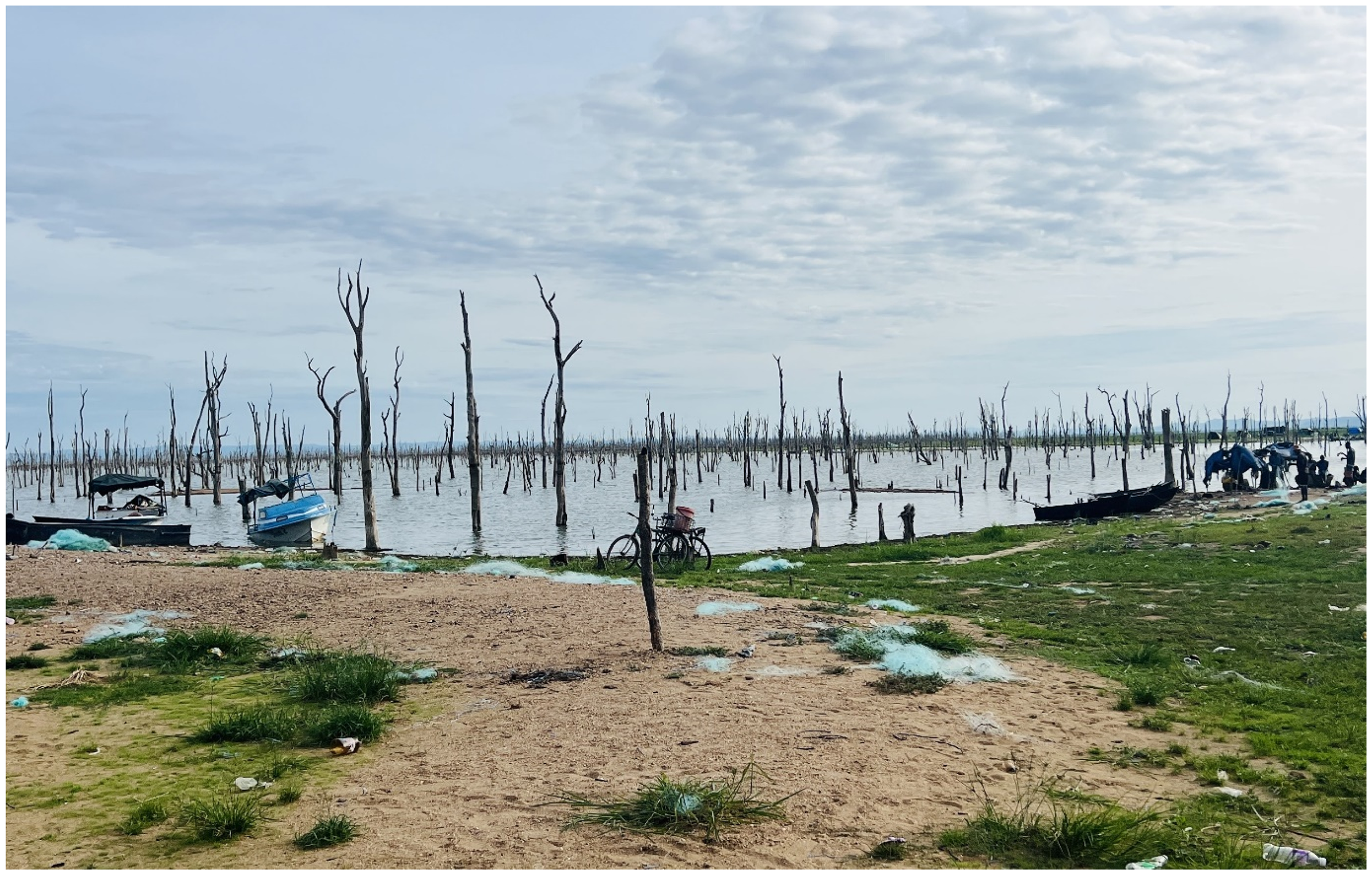
Twine nets laid on the ground in the Gache-Gache Fishing Villages, Lake Kariba (Source: Second Author).
For some time, unmotorised boats made of steel sheets and wood were used (see Figure 3) to facilitate off-shore gillnetting. The reason behind these boats was to allow the fishers to navigate and reach the deeper waters of the lake. Deep waters attract fishers because they are believed to provide “big” fish catches, compared to shallower waters. According to local fishers, big fish generally prefer deeper waters due to such factors as minimal anthropogenic activities, stable temperatures and reduced risk of predation from crocodiles and birds. For instance, crocodiles are locally believed to favour shallow waters where prey is easier to catch (wild game and humans), and this is confirmed by other studies on the lake (Matanzima et al., 2022; McGregor, 2008). While big fish are occasionally caught in shallow waters as they feed, they typically return to deeper areas. Big fish are the most sought after on the market, so much effort is made to navigate the deep waters. Though unmotorised boats are still used, today fishers have added – as a technological reconfiguration – small Changfa engines to their boats for easy and swift navigation.
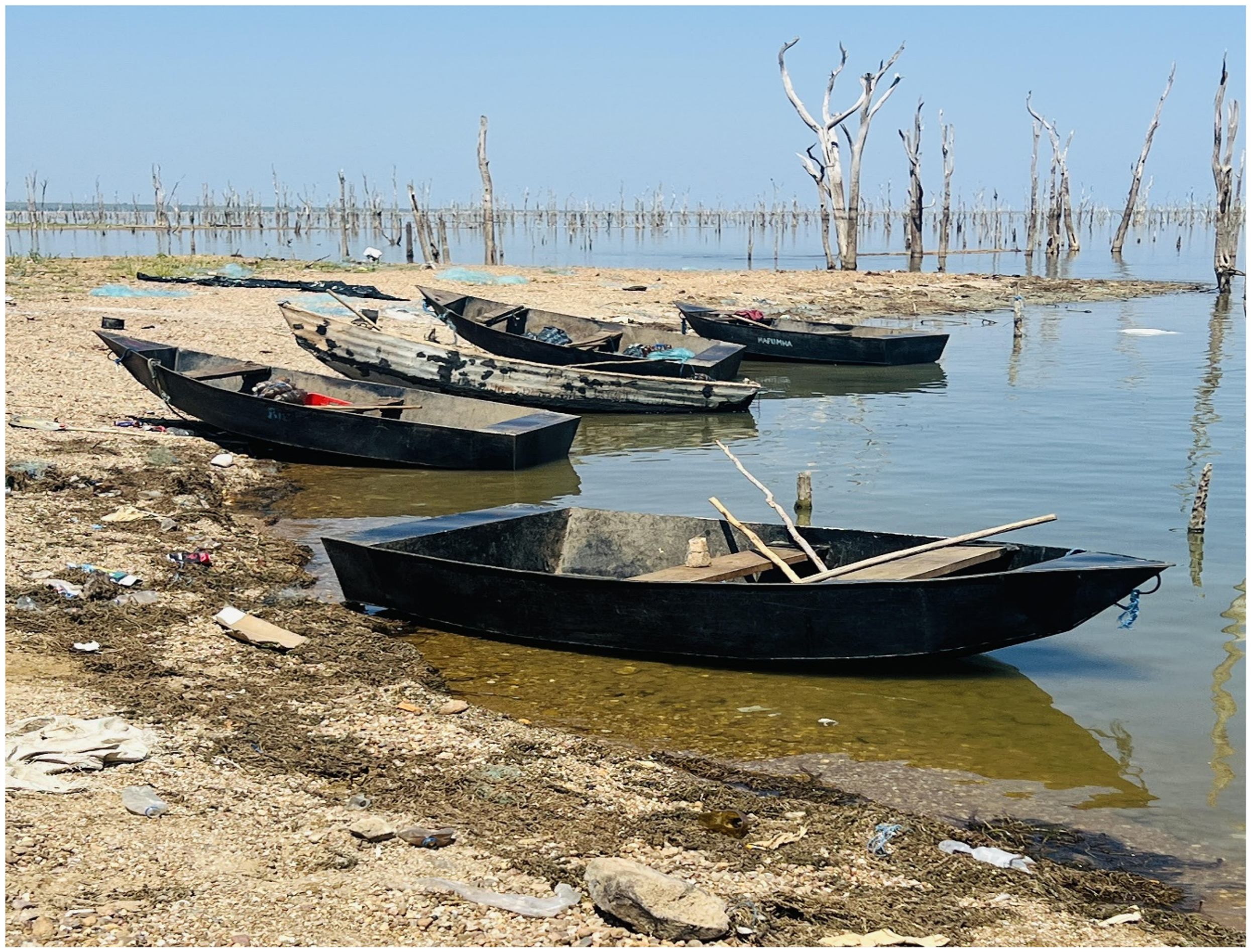
Unmotorised boats in the Gache-Gache fishing villages, Lake Kariba (Source: Second Author).
The fishers interviewed by Matanzima in December 2024 indicated four key reasons for making use of the Changfa engine. First of all, it is easier to travel the lake when there are strong winds, as articulated in the statement: “Zvinorerutsa basa redu [It makes our work easier]”. Secondly, the engines ensure that fishers safely reach the deepest waters and, thirdly, they facilitate the fishers’ evasion of the law. They are able to swiftly move from the ‘illegal waterscapes’ upon alert of the patrolling of National Parks’ authorities. Finally, these Changfa engines (technologies) often reduce human-wildlife conflict encounters, such as attacks from hippos and crocodiles – as the sound of the Changfa engine might scare away these animals in certain instances.
Boats and engines thus form one part of the technological assemblage that enables and shapes fishing practices on the lake. Yet, navigation technologies are only half the story – equally central are the gillnets through which fishers engage fish.
Fishers use gillnets both passively and actively. In the case of passive fishing, fishers leave gillnets out at night unattended. The case of overnight gillnets, where fish interact with gillnets as a passive technology in the absence of fishers, presents a particularly compelling moment to consider fish–technology negotiation. Here, the fish encounters a static mesh in the darkened lake. It may brush against the net, swim away, become entangled, or redirect its movement. The character of the encounter will depend on the type and size of fish, and with the size and type of netting (for example, cotton nets) as well. In these moments, the fish engages with the net as a material and sensory reality, suggesting a negotiation that does not necessarily require the active mediation of the fisher.
Like rod and line fishing, only passive fishing is legally allowed for gillnets, which means that the moving of nets or thrashing of water with sticks near nets – called fish driving – is not allowed. But this active fishing happens, and often. As Matanzima (2024: 241) highlights, men take their nets by unmotorised boats at night to lay their nets: Some men … spend the entire night out on the lake engaging in illegal fish trawling or driving in order to catch more fish. They would place their nets and then, while one person paddled the canoe [boat], the other person would splash the water in various spots to make (or drive) the fish swim towards the nets where they would become entangled.
Fishing driving is very effective in situations where big fish can see the “cotton” net and try to evade capture. As narrated by local fishers, fish driving forces fish into the nets as they move away from the “driving stick” and noise. Fish – knowing and unknowingly – head towards the direction of the cotton net. Splashing techniques entail attempts to manipulate fish perception, thus assuming that fish are sensing and responding. Like jigging in rod and line fishing, fish driving using gillnets acts as a provocation or invitation to the fish to enter into a relational dynamic with the technology. Fish driving recalibrates the net as a responsive interface, as a structure made more “attractive” or unavoidable through sensory provocation. This suggests that fish are not simply lured or trapped but are being drawn into a field of forced choice, an asymmetrical but nonetheless interactive negotiation with the technology.
Near Kariba town, unemployed youth use mosquito nets for fish driving in shallow waters. Women are involved in this at the fishing camps near the shore, whereby “an entire cove is netted off, and the shallows are beaten to scare the fish into nets” (McGregor, 2009: 181). Small fish in particular are captured in this way, as juvenile fish favour shallow waters for refuge from large predator fish and food abundance in different forms. Further, in a study of three fishing camps in the Sanyati basin, it was found that nearly all fishers, during the summer season, “block the [river] passages that the fish [tigerfish and other fish] use in migrating to their breeding grounds” by casting “gillnets across the passages” (Magqina et al., 2020: 7).
Perhaps the most vivid and purest example of direct fish-technology engagement is that of ghost fishing. Dead fish stuck in small pieces of gillnet are found regularly along the shores of Kariba. Pieces of twine net are torn off by tigerfish when they swim into and escape the nets, or by crocodiles when “stealing” from nets, with these twine pieces remaining in the lake for years because they are not easily biodegradable (Tombindo, 2024: 120–121). Ghost fishing brings to light the material agency of fishing technology itself
In summary, gillnetting practices at Kariba reveal both fish-fisher and fish-technology negotiations at work. Fish-technology negotiation appears most clearly in overnight netting and ghost fishing, where fish encounter and respond to nets without a human presence. It also emerges in how fish react to different net materials, like the low-visibility twine. Fish–fisher negotiation is evident in active techniques like fish driving, where fishers use sound and movement to influence fish behaviour, drawing them into entanglement. Yet, as fish driving illustrates, these two forms of negotiation are not always easily separable: the fisher's embodied actions mediate the fish's encounter with the net, blurring the line between direct and indirect interaction. This overlapping relationality exemplifies the ontological entanglement and epistemological point highlighted earlier. Across these practices, fishers shape the terms of encounter, but fish respond in ways that suggest agency and interpretation. Rather than seeing fishing as a one-sided act, this section (like the one on rod and line fishing) shows it as a dynamic and relational process shaped by all three: fish, fishers, and technologies.
Conclusion
This paper has reconfigured small-scale fishing at Lake Kariba as a multispecies and technological field of negotiation, rather than a straightforward practice of extraction or subsistence. Drawing from ethnographic material, we have foregrounded how fish, fishers, and technologies co-produce a dynamic and contested waterscape. By moving beyond instrumentalist accounts of fishing, we argue that both fish and fishing technologies possess forms of agency that shape, disrupt, or recalibrate human intentions.
In attending to these entanglements, our analysis contributes to growing efforts within multispecies and technology studies to decentre the human in accounts of environmental interaction. Technologies such as gillnets and rods are not neutral intermediaries but “actants” in the Latourian sense – objects that transform the nature of relations through their affordances, visibilities, and sensory provocations. Likewise, fish are not passive biotic resources but sentient actors who sense, respond to, and sometimes resist human and technological interventions. The concept of negotiation thus opens up new analytic terrain: one where capture is never guaranteed, and success depends on a series of relational adjustments in a volatile ecological field.
This reorientation also calls into question managerial paradigms that presume predictability, compliance, or static resource-user models. Instead, Lake Kariba exemplifies a fluid and emergent ontology of fishing – where technologies continue to act even in human absence (as in ghost fishing), and where each encounter is shaped by overlapping temporalities of ecological change, regulatory evasion, and material improvisation. By theorising fishing as relational, negotiated, and co-constituted, we make a case for analyses – and policies – that are sensitive to multispecies dynamics, and attuned to the messy, creative work of survival in waterscapes. Although our analysis has drawn from a focused set of observations and interviews, its primary contribution lies in developing a conceptual vocabulary for multispecies and technological negotiation that can travel beyond Kariba.
Beyond the shores of Lake Kariba, the analysis gestures toward a broader theorisation of temporality and intention in human–technology relations. The notion of the fisher as ‘ghost-writer’ of technology captures how human intent becomes sedimented within material forms that continue to act, often unpredictably, across time. Technologies such as nets bear traces of human purpose yet exceed it, generating afterlives of agency, as demonstrated in the spectral operations of ghost fishing. Thinking with these temporal disjunctions invites a more expansive understanding of mediation: not as a moment of translation alone, but as an ongoing inscription through which humans, fish, and technologies co-construct unfolding relationships.
Highlights
Provides a detailed theoretical analysis of the existence of technology-human-fish assemblages in which the agency of all needs to be privileged.
Suggests that technology does not merely mediate the relationship between fish and humans as fish also negotiate directly with technologies.
Demonstrates this through a case study of the Lake Kariba waterscape in Zimbabwe.
Footnotes
Acknowledgements
We thank the people of Lake Kariba and surrounding areas for their contribution to the fieldwork for this study.
Author contributions
The first author conceptualised the study and wrote most of the first draft of the paper. The second author did most of the fieldwork for the paper and contributed to finalising the first draft of the paper. The third author provided key insights into reworking the first draft. All three authors were involved in revising and finalising the paper for submission purposes.
Consent to participate
Verbal consent, in line with basic ethical research principles, was provided by all those who participated in the study.
Consent to publication
All those who participated in the study consented to publication on the basis of anonymity.
Declaration of conflicting interests
The authors declared no potential conflicts of interest with respect to the research, authorship, and/or publication of this article.
Funding
The authors disclosed receipt of the following financial support for the research, authorship, and/or publication of this article: The second author acknowledges funding received from the National Geographic Society, Grant Number: EC-115063C-24 on a Project about Incorporating cultural knowledge in conservation at Lake Kariba Zimbabwe.
