




Abstract
This paper seeks to understand how caring for new-born livestock is made possible, which practices of care are privileged and to what effect? These aims are situated in attempts to promote the prudent use of antibiotics amongst livestock farmers to prevent antimicrobial resistance. In focusing on the rearing of new-born calves on dairy and beef farms in England and Wales, the paper reveals how care is configured by different temporal orders, the tensions between different temporalities of care, the reasons for them and the strategies employed by calf rearers to manage these tensions. Drawing on the concept of the ‘timescape’, the paper shows how calf care temporalities are relationally enacted and configured by materials, infrastructures and technologies. Common (productivist) agricultural temporalities of care emphasise speed, urgency and efficiency. However, by analysing the practice of feeding colostrum and ‘tubing’ – the forced feeding of calves via a tube inserted into the oesophagus – we highlight how these rapid caring temporalities conflict with the slower, patient skills of calf rearing. At the same time, however, we show how care is rendered fluid as calf rearers find ways of accommodating seemingly discordant temporalities – what we call ‘patient urgence’ – allowing different temporalities to co-exist within agricultural timescapes. Nevertheless, we show how these practices of accommodation are themselves the result of a productivist temporal order that marginalises calves and calf rearers. We argue that these timescapes point to the need for broader structural and cultural changes within agriculture to reduce the use of antibiotics.
Introduction
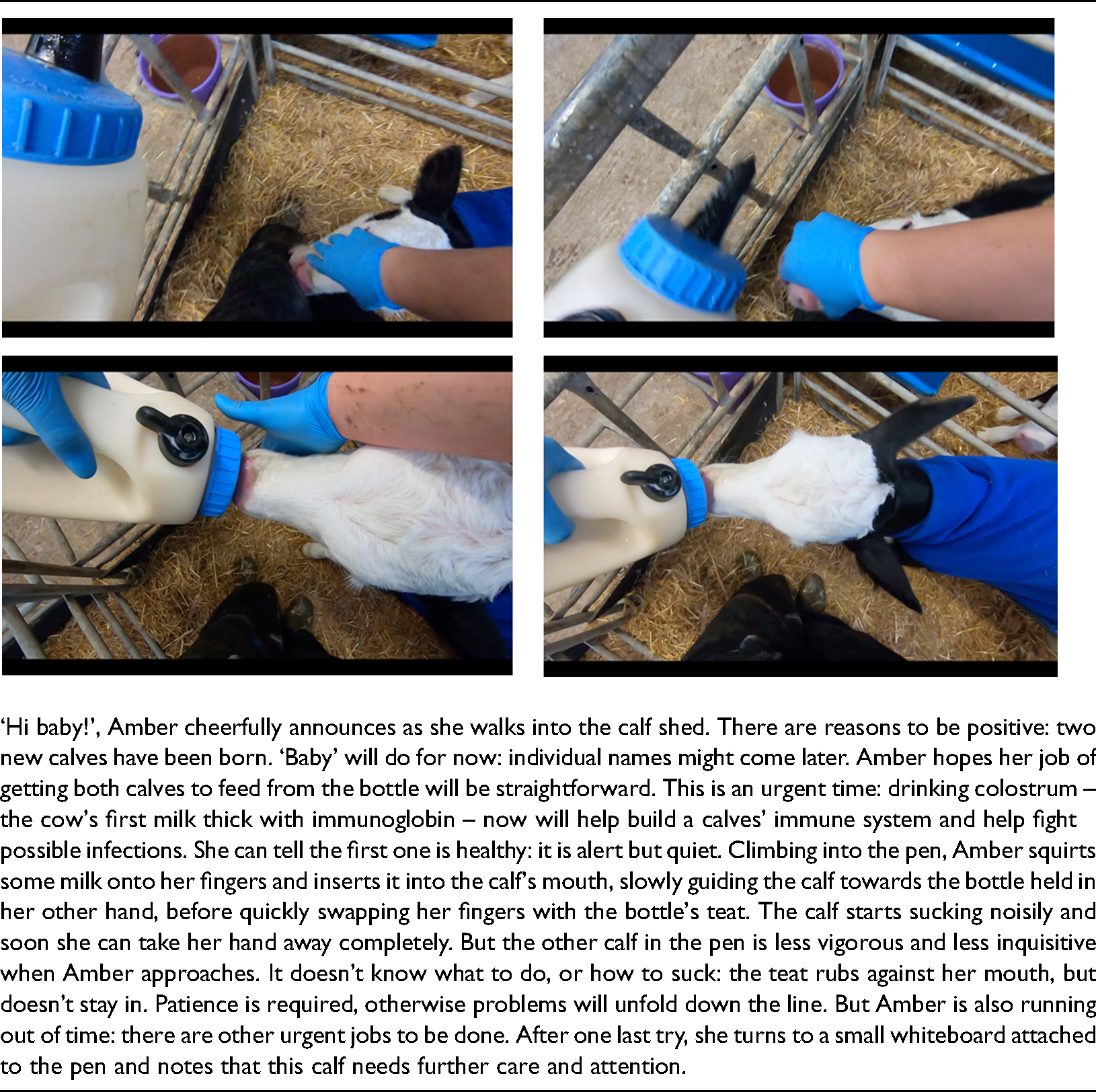
Feeding new-born calves like this is a routine practice of care found across dairy and beef farms. During this neonatal stage of life, careful practices are vital to aiding long-term health and a productive life. But routine care is not straightforward on farms, nor is it a neutral practice. Care, as Reisman (2021: 403) suggests, is situated within a ‘politics of relational maintenance’ that ‘sustains particular forms of agrarian political economy that benefit some at the expense of others’. Careful practices are established within ‘biosocial collectivities’ (Holloway et al., 2023) in which materialities, people and the lively more-than-human relationally choreograph the possibilities for care, and the possibilities for a range of ‘somatic sensibilities’ (Greenhough and Roe, 2011). The aim of this paper is to understand the underlying politics of care in productivist agriculture: how calf care is made possible, which practices of calf care are privileged and to what effect?
The need to answer these questions is situated within ongoing attempts to promote the responsible use of antimicrobial medicines in agriculture as a result of concerns about a future in which antimicrobial resistance (AMR) renders these treatments ineffective and dangerous to public health (O’Neill, 2016). Approximately half of the global use of antimicrobials is accounted for by livestock farming (Van Boeckel et al., 2015), their use having rapidly diffused into productivist agriculture (Kirchhelle, 2018) and sustained through practices that precipitate greater use in an unvirtuous circle (Allen and Lavau, 2014). Warnings surrounding AMR invoke dark consequences for agriculture and an atmosphere of future uncertainty. As the repercussions of antimicrobial overusage rebound within the fields and sheds of productivist farms, farmers must find ways of countering this threat, as much as responding to evidence of antibiotic resistance itself (Helliwell et al., 2019). Calls for the prudent use of antimicrobials and antimicrobial stewardship have therefore been accompanied by attempts to regulate or educate farmers about the dangers of AMR (Hinchliffe et al., 2018).
As AMR warnings have intensified, so the everyday has become as important as the exceptional. Daily farming routines and foundational husbandry principles have become reframed by the AMR agenda as key activities to preventing resistance. In the case of calf rearing, feeding practices have been given renewed importance which, if done properly, promote a healthy metabolism and help prevent common ailments such as diarrhoea (often known as scour) and pneumonia, and thereby reduce the need for antimicrobials (Bartram et al., 2017; RUMA, 2018). However, calves have historically been marginalised on farms. As one vet told us, calves are just not ‘sexy’ enough to be a priority: they are not of immediate economic value, nor do they necessarily capture the attention of tech-orientated agri-businesses. This ontology enacts what calves are thought to be, how they should be cared for, and who they are cared by (cf. Mee, 2013; Vaarst and Sørensen, 2009), one mirrored within the AMR agenda. In the United Kingdom, for example, numerical forms of medicinal governance, such as the use of targets, are focused on productive adult cattle (RUMA, 2020). Calves, in contrast, appear to escape these forms of medicinal surveillance, not least because their relative marginality means data is hard to come by and patterns of antibiotic use difficult to discern. Meanwhile, academic study focusing on adult cattle, pathologising the bodily sites of production, and focusing on farm owners rather than all farm workers (such as calf rearers) further enacts this marginalisation. In this context, calf AMR has hitherto been framed around more nebulous concepts of welfare, and practices such as cleanliness, feeding and ventilation (Helliwell et al., 2020). In this calf ontology, what can be done about the use of antibiotics in calf care, or what counts as careful rearing, is not straightforward, presenting dilemmas of care that calf rearers must somehow resolve.
We explore these dilemmas and tensions of care through the lens of time. Compared to spatialities, the temporalities of animal health and biosecurity, or agriculture in general (Mincytė et al., 2020), have received less attention (for exceptions, see: Allen and Lavau, 2014; Hinchliffe et al., 2016; Phillips, 2020b). As Henry et al. (2022) argue, despite farming's inherent exposure to different temporalities – the role of the seasons, and the life cycle of birth, growth and decay – spatialities overshadow temporal analyses, reducing them to ‘matters of fact’, naturalising speed and eliding multiple temporalities. Instead, to explore the range and significance of temporalities in calf care, we draw on Adam's (1998) concept of the ‘timescape’, in which temporalities are choreographed in relation to configurations of materials, biologies and technologies that are spatially distributed (cf. Law and Lien, 2014). In this context, we follow literature conceptualising ‘care’ to explore how calf care temporalities are relationally enacted and configured by materials, infrastructures and technologies (Puig de la Bellacasa, 2015). These agricultural timescapes commonly specify temporalities of care that emphasise speed, urgency and efficiency (Allen and Lavau, 2014). By focusing on the practices of feeding colostrum and ‘tubing’ – the forced feeding of calves via a tube inserted into the oesophagus – we highlight how rapid and urgent temporalities of care conflict with slower, patient skills of calf rearers. At the same time, however, we show how time is rendered fluid as careful practices find ways of accommodating seemingly opposite temporalities – what we call ‘patient urgence’ – enabling different temporalities to co-exist within agricultural timescapes, and allowing calf rearers to live between these worlds. Nevertheless, we also consider how these practices of accommodation are emergent from a productivist temporal order that marginalises calves and calf rearers. We argue that these timescapes point to the need for broader structural and cultural changes within agriculture to reduce the use of antibiotics. Drawing attention to these human and nonhuman marginalities is an important part of highlighting unjust intersections within agriculture, AMR agendas and their politics of care.
The paper is structured as follows: firstly, we describe the relationship between care and time, introducing the concept of the timescape and its relevance to animal health and biosecurity. Secondly, we describe the temporalities of calf care, the tensions between different temporalities of care, the reasons for them and the strategies employed by calf rearers to manage these tensions. Finally, we conclude by highlighting the way different caring temporalities can accommodate each other, whilst also highlighting the need for AMR initiatives to pay attention to the systemic and structural dimensions of timescapes, rather than rely on individual behaviour change.
The timescapes of animal health
Despite the interweaving of time and space in everyday life (May and Thrift, 2003), recent geographies of biosecurity and animal health have largely focused on spatial imaginaries – such as the border and borderlands (Hinchliffe et al., 2013) – rather than its temporalities. Just like space, time is made through ‘socio-technical arrangements and everyday practices’ (Puig de la Bellacasa, 2015) which form what Adam (1998) refers to as a ‘timescape’. Timescapes provide a temporal order to a landscape, establishing temporal expectations, routines, and appropriate conduct. Understood thus, the timescape of productivist agriculture seeks to create a smooth, rapid flowing network of relations that maximise productivity, transporting animals between different sites of production and converting them into food in the quickest and most efficient ways possible. The excesses of this temporality, however, come at the cost of environmental protections (Franklin et al., 2021) and animal welfare (Haggerty et al., 2009). A biosecurity timescape is allied to this logic of productivism, imagining a future temporality in which veterinary technoscience promises disease freedom, so long as farmers follow appropriate medicinal practices in the present time. Biosecurity timescapes are therefore characterised by an urgent temporality to facilitate the rapid growth of crops and livestock by pre-empting and overcoming frictions – like disease outbreaks - that slow down livestock production and food processing, and disturb their synchronisation. On the farm, this timescape summons an ‘affective atmosphere’ (Anderson, 2010) that commonly prescribes prophylactic and pre-emptive medical interventions, and orients farmers’ anticipatory senses to signs of ill health and the unexpected (Phillips, 2020a; Wang, 2022). Elsewhere in the food system, practices are developed to overcome systemic temporal frictions, but which may ironically increase the consequences of productive excess. For example, Allen and Lavau (2014) describe how the rapid temporalities of ‘just-in-time’ food systems heighten the risk of animal disease. In this tightly coupled timescape, chickens transported to slaughter must arrive at dedicated timeslots. If delivery lorries stand idle by arriving early, they risk a build-up of bacteria due to a lack of airflow. Instead, early arriving lorries continue to drive to ensure sufficient ventilation.
However, suggesting that these temporalities are merely marked by speed and urgency belies the complexity and precarity of temporal relations. Whilst dominant temporal paradigms may emerge, timescapes are ‘restless temporal regimes’ (Puig de la Bellacasa, 2015) whose flows, rhythms, cycles, and tempos are not fixed (Law and Lien, 2014), nor entirely predictable (Broz et al., 2021; O’Mahony, 2022). These instabilities are reflected in the rebounding temporality of AMR, frequently enacted by an imagined future of biological breakdown and crisis as a result of the present-day excesses and malpractices of productivist agriculture. This rebounding timescape is common across narratives of productivist agriculture (Adam, 1998) but leads to ‘the everyday experience of time [as] one of permanent precariousness: an on-going sense of urgency and crisis [which] calls to act ‘now’’ (Puig de la Bellacasa, 2015: 694). Dominant technoscientific timescapes are called into question by such breakdowns: action in the present time by farmers and vets is demanded to prevent a future in which animal and human health is compromised. However, whilst the urgency to do something about AMR highlights the creation and contest over how a timescape should be organised (cf. Helliwell et al., 2022), it also hints at the tensions and accommodations between a diversity of temporalities within the productivist biosecurity timescape. Thus, if productivist biosecurity timescapes direct attention to the sites and practices at which time is sped up (Henry et al., 2022), they can also lead to a focus on marginal sites and practices in which these temporalities are contested through slower practices of care (Puig de la Bellacasa, 2010). Here, the emphasis has been on exploring a feminist ethics of care in which more-than-human temporalities are identified, nurtured, and accommodated (Mol, 2008). These actions highlight the existence of alternative more-than-human temporalities that operate at a different pace to those programmed by productivist timescapes. Avoiding the kinds of ecological and biological breakdowns in productivist timescapes requires different forms of conduct: more-than-human temporalities are enacted through practices of attentiveness (Krzywoszynska, 2019) and play (Ellis, 2022) by learning to be affected by more-than-human temporality (Brice, 2014).
These embodied practices and ‘somatic sensibilities’ (Greenhough and Roe, 2011) are not necessarily alien to sites of productivism: they are routinely found in the laboratory (Anderson and Hobson-West, 2023; Giraud and Hollin, 2016) as well as the modern farm (Holloway et al., 2023), or in times of crisis (Gibbs, 2020; Law, 2010). However, paying attention to caring temporalities problematises the notion of care, revealing its tension and co-existence in the timescapes of technoscience and modern agriculture (Cusworth, 2023). For Haraway (2016) the solution to these tensions lies in ‘staying with the trouble’: adopting an ethics of care that seeks to make animals less ‘killable’ (Greenhough and Roe, 2011), developed through practices of attention and care-giving that demonstrate ‘response-ability’ to others’ needs (Haraway, 2008). In doing so, the temporalities of care become fluid: transitioning between fast and slow to become neither one nor the other. Thus, as Puig de la Bellacasa (2015: 692) concludes in relation to the temporalities of soil care, ‘care time, in practice and experience, is neither a slowed mode of, nor outside, the timescales of technoscientific futurity. Focusing on making care time does, however, offer glimpses into a diversity of timelines that, despite being made invisible or marginalised in the dominant timescape, can challenge traditional notions of technoscientific innovation’.
This kind of temporal fluidity, situated through the tensions of care is evident, at least implicitly, in recent relational and ecological conceptualisations of the management of animal health (Broom and Doron, 2022). Firstly, Holloway et al. (2023) identify biosocial collectivities as ‘intentional groupings that come together because members have a shared concern for a fundamentally biological issue’ (Morris and Holloway, 2014: 152). In analysing endemic livestock disease, they show how they are connected to farm-specific environments and priorities that have become embedded by productivist modes of agriculture. In seeking to maintain welfare, practices of care, such as breeding resilience, ensure that the systemic causes of ill-health go ‘largely unquestioned’ (Holloway et al., 2023). As Holloway et al. (2023: 1293) suggest, this makes ‘relations of care troubling because they can be associated with an acceptance of harm being caused to animals'. Moreover, in managing animal disease, practices of care involve making animals ‘killable’ to reduce individual or collective suffering, such as the continued transmission of disease within the herd. Secondly, other relational approaches to animal disease understand the farm as a set of heterogeneous relations that prescribes a spatio-temporal order for livestock from birth to productive life and death (Law, 2006). Maintaining the rapid temporalities of these productivist systems casts farmers as ‘fluid engineers’ (Higgins et al., 2018) who seek to prevent relations from ‘overflowing’ or breaking down in ways that reconfigure temporal orders. One way of preventing overflows such as disease outbreaks is by using standardised practices such as protocols and hygienic routines. However, the complexity of these relations is such that systems are never likely to be perfect and overflows are inevitable (Enticott and Little, 2023). Practices of accommodation – care and ‘tinkering’ (Law, 2010) – allow these systems to continue to function (Singleton and Law, 2013) as a form of ‘local universality’ (Enticott, 2012): making standardised systems workable in challenging environments using lived experience (Krzywoszynska, 2016) to guide on-going experimental practices in order to find ways of living with uncertainty (cf. Atchison, 2015). This is reliant on different practices of care in which vets and farmers care for themselves, care for their colleagues through informal learning practices, and for the herd and farmers by deploying situated judgement rather than standardised procedure. These practices of accommodation, choreographed through space and time (Law, 2010), show how care extends beyond its traditional understanding, and is implicated in promoting ‘ongoingness’ (Puig de la Bellacasa, 2017) – the work of sustaining and maintaining interdependencies in all their forms. In this way, as Reisman (2021: 421 emphasis in original) argues in relation to disease management, care ‘is not a solution but a perpetually open and deeply political question of how relational maintenance takes place … it is a call to see the web of relations … as the site of politics where the ongoingness of specific configurations of existence is negotiated’.
Efforts to reduce the use of antibiotics should therefore direct us to a consideration of the complex timescapes of livestock agriculture. Paying attention to these intersecting temporalities is essential to understand how practices of care enable the maintenance of animal health, but also the material politics of care and its inclusions and exclusions more widely. In this sense, care, like time, is not normative: it is differentiated, troubling and evolves in relation to the situation at hand. Yet, it is at these sites of contest that it is possible to witness the fluid temporalities of care, and find ways for different times to live with each other. In what follows, we explore how the future threat of AMR is folded into everyday practices of calf rearing. Rather than specific instances of AMR, we examine how its different temporalities are revealed through the on-going, quotidian practices of care which respond to its more nebulous threat by minimising antimicrobial intervention. In doing so we discuss the tensions between caring practices, who cares and how it is valued; and the fluidity that allows different temporalities to co-exist and form a paradoxical temporality, one we call ‘patient urgence’. Our analysis is based on qualitative methods that were themselves temporal in nature. Disrupted by the 2019 coronavirus disease pandemic, we conducted online interviews with 25 calf rearers in England and Wales, and a further 13 interviews with industry specialists (vets, advisers, nutritionists and equipment suppliers). Reflecting the structure of the industry, all but one of the calf rearers interviewed was female. Interviews employed a biographical narrative method to elicit descriptions through time of significant challenges and changes to calf care in the careers of calf rearers, and their evolution in relation to the threat of AMR. In developing research relations with these calf rearers, and the ebbs and flows of lockdowns, we were able to conduct participant observation on three farms where we observed the feeding of calves, and other routine calf rearing practices. This was supplemented with video ethnography in which calf rearers were asked to wear Go-Pro cameras to film practices they felt were important to maintaining calf health and preventing AMR. This technique facilitated particular insights into the temporal practices of care in absentia of researchers. Further information on the characteristics of research participants can be found in the supplementary material and in Enticott et al. (2022).
Feeding rapid temporalities
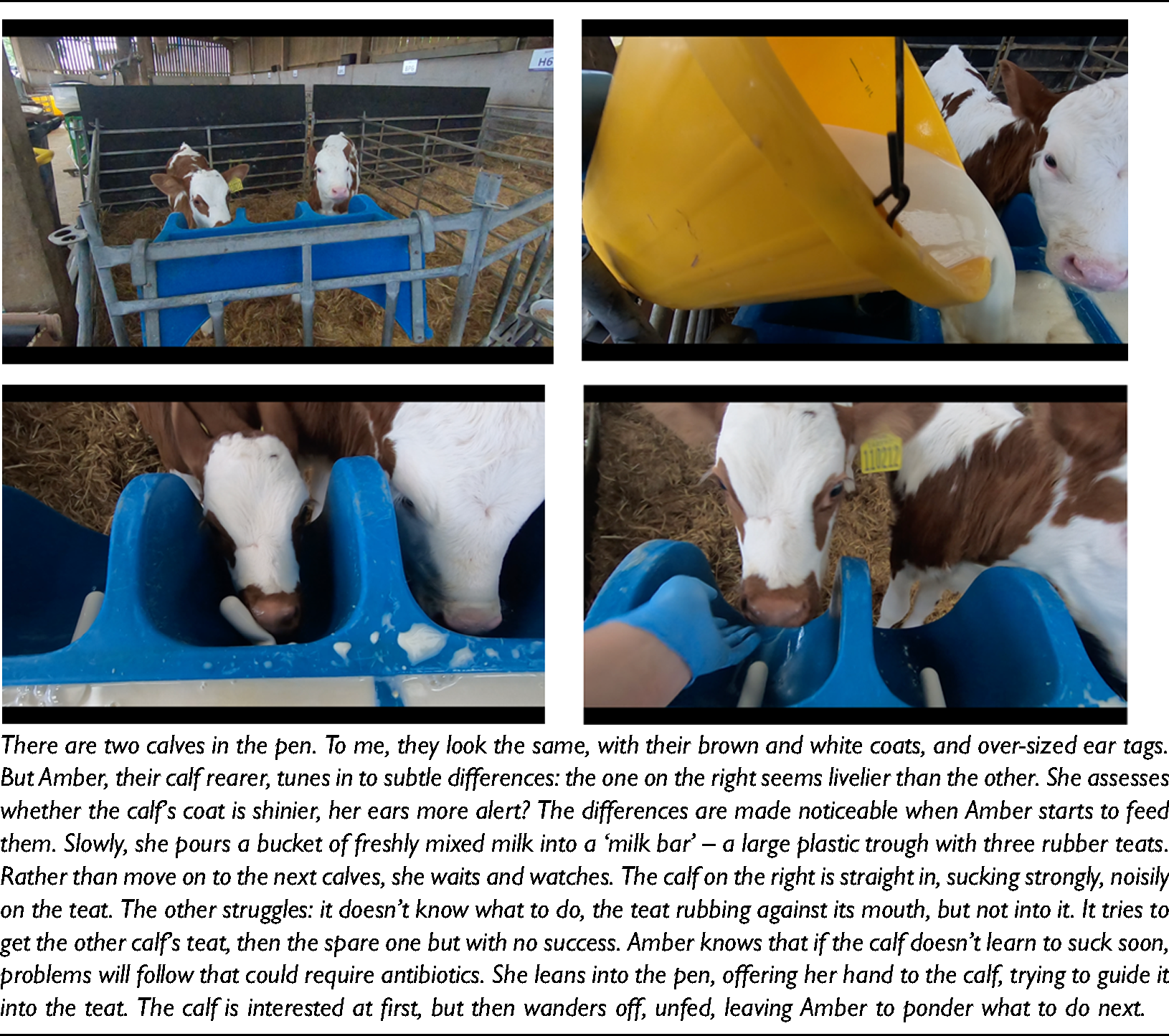
When new life emerges on farms, so it becomes enrolled into everyday practices that are partially guided by the future threat of AMR. Feeding fluids to calves – as Amber does here – is one such example, revealing the fluid temporalities of calf care and the politics of AMR. Specifically, here we refer to the practices of feeding milk to new-born calves, and pathologising of the conduct of feeding at different bodily sites and through different kinds of milk. The neonatal phase of a calf's life sees them born into the rapid timescape of bovine productivism. Calves must be carefully (but also quickly) enrolled into this timescape because their future is defined by their response to attempts to accelerate the development of their rumen. Rumen development is initially achieved by using concentrated feed (a coarse pellet known as calf starter) which stimulate microbes to allow grass and forage to be fermented within the rumen (for more details see: AHDB, Undated). The process befits the logic of productivist agriculture, replacing a calf's mother's milk as a feed source. However, as Glen a calf vet told us, the acceleration of rumen development is not easy and needs careful management: [calves] are designed to be weaned at six months of age when they’re ruminants. We’re trying to turn a baby pre-ruminant … a simple-stomached animal into a ruminant in a space of eight weeks. That takes a lot of skill, and you need to get a lot of nutritional aspects right there. You need to feed a lot of milk, but you also need to be improving … increasing their starch intake from day one in order to develop the rumen so that when you wean them at eight weeks, they don’t suffer a setback, and that that weaning period coincides with a high risk for pneumonia.
The urgency of feeding colostrum, coupled with the acceleration of weaning outlined above by Glen the calf vet, reflects an urgent productivist timescape. However, this timescape can be disrupted by undesirable more-than-human temporalities that might be bred into productivist systems. Specifically, dairy productivist systems value the genetic ability to do some things quickly – become pregnant, give birth and grow – and maximise milk production, often at the expense of health and welfare (see: Holloway et al., 2023). In block calving systems – when breeding is organised so calving ordinarily occurs en masse in spring and/or autumn – this rapid temporality is referred to as being ‘in sync’: if a cow's’ reproductive system fails to match the desired productivist flow, they are likely to be culled to maintain the herd's synchronicity. The consequence of these temporal orders is a transformation of bovine sensibilities in which qualities of rapid growth and adaption are bred into cows, whilst slower practices of mothering and natural feeding are bred out: I think traditionally you would have left the calf on the cow to suckle, or maybe left the calf with a cow for a few days. But I think you’re really putting a lot of faith in the mothering ability of the cow, particularly with the genetics in the Holstein's now. A lot of that mothering has been bred out of them. So, I wouldn’t feel comfortable now just leaving calves just to work out how to suckle (Katherine). there's something wrong with the Holstein breed in my view, they seem to have lost the will [to suck]. You know, they’re not very … They’re not very vigorous (Pauline).
While rearers understand the importance of feeding colostrum, they also face decisions over which colostrum to feed. The best is often thought to be straight from the mother, partly because it is readily available, perceived as natural, and provides longer term immunity that is matched to the local environment. In doing so it reduces the future need for antibiotics. However, getting this colostrum into the calf is problematic because cows’ teats are pathologised as hazardous bodily sites. Their cleanliness is called into question by their living conditions, but also the use of antibiotic tubes of dry cow therapy, inserted into the teat to prevent infection in the weeks before giving birth. The danger is that if a calf does suckle, its first mouthful will be contaminated with dirt, bacteria, and antibiotic residue. As Katherine told us, the best way for a calf to get its ‘fill’ of colostrum is to feed the calf yourself.
Doing so, however, also requires caring for colostrum. Importantly, uncareful colostrum practices – often compromised by the urgencies and time constraints of competing on-farm temporalities – can compound or contribute to ill health. Unclean bottles, dirty buckets, or inadequately heated colostrum become vectors mobilising risky pathogens to susceptible calves. Some cows may fail to produce colostrum of sufficient quality – something common with first time mothers – whilst others can produce enough for more than one calf. Commonly, careful rearing practices mean the excess colostrum of healthy cows is frozen, stored, and defrosted for subsequent births. As such, the care of future immunity produced by healthy cows is diffused throughout the herd, and choreographed through practices enacted with multiple temporalities in mind. Alternatively, some rearers purchase colostrum powder which can be mixed with water which should, time permitting, be mixed warm. Either way, colostrum quality is important, something commonly measured and calculated by using a Brix refractometer. Reflecting Holloway et al. (2023), these temporalities of calf care can be seen to enact a biosocial collective whose geography stretches around and beyond the farm gate, incorporating humans, animals and materials.
Feeding protocols and patient urgence
As a way of reigning in the productivist excesses of these bovine temporalities, calf rearers often deploy two colostrum-related feeding practices. Both practices sustain productivist timescapes but in ways that reduce the likelihood of AMR rebound. The first of these is the use of feeding protocols, such as the monitoring of colostrum quality before feeds, or at least at regular periods throughout the year. This allows calf rearers to eliminate poor quality colostrum being the cause of ill-health in growing calves. Most protocols relate to the amount of colostrum to be fed to calves, the temperature to which it should be heated, and when it should be fed. Other protocols encompass routine hygiene procedures including cleaning feeding equipment such as buckets, or sterilising rubber teats. Similarly, many calf-rearers establish protocols, often with their vets, to guide and monitor the use of medicines, whether anti-inflammatories and painkillers, or antibiotics.
The use of protocols provides a further way of standardising the timescape, choreographing behaviour and eliminating the causes of ill-health to maximise efficient productivist flows, whilst avoiding its excesses that contribute to AMR. Implementing and following protocols therefore enacts specific practices of care that are consistent with desirable timescapes of calf rearing, and their outcomes. Here, care is not just for calves, but applies to the labour force and the reputation of the farm as a producer of strong healthy calves. For example, Michelle describes how she had won awards for her calf rearing, which had led to her selling calves to another farmer because they valued their health status. Central to this reputation within the industry was a set of protocols that were used to monitor how effectively staff cared for calves, as much as the health of calves themselves: if someone doesn’t follow the protocol, with new-born calves, for example, or with the animals and feeding, and then and then there's some kind of problem down the line, I might be able to know if someone's sort of making the record up or hasn’t done it properly … we have such high standards, for example, with cleanliness and cleaning, and our other protocols, and he [calf rearer] couldn’t really go any further. He found it hard to fulfil all the expectations of the job and, it sounds really ruthless, but we had to let him go. I don’t think she cared about the calves as much as what we did, she kind of came in and did it as a job whereas I do it for the love of calves … I know we had a couple of Heifers shot down at the other unit [I used to work at] because they weren’t growing properly because they hadn’t had the right start. So, we want to get at least four litres of colostrum into them in the first feed so she’d say she’d put four litres in and they’d still be [some left] in the bottom and she’d go oh, yeah, it's had 4 litres, take the rest away … Whereas to me that is crucial to get that four litres in so every last bit has to go in. (Amber) Say if it was if it was born just after milking in the morning, it wouldn’t get fed till milking time in the afternoon, till four or five o’clock or six o’clock, it could be about that time until my uncle could get to it. Well, I’m like it has always got to have colostrum. You know, I’d go in if I needed to, if it was born in the middle of day I’d have to get in the parlour to go and get some milk off it. (Abbie) If everything's organised, and they’ve got protocols in place, it's not to complicate things, it's actually to make things simpler so that there is no panic about, ’Oh, gosh, what do I do? Oh, how much colostrum do I give it? Oh, gosh, what am I supposed to do? Where's the milk?’ You know? Everything's done in a sort of less hasslely manner … the aim is to do things in the best way possible. And the best welfare-friendly ways. And that's got to be calmly and gently (Andrea). It's making wee tweaks to your protocols along the way. So, yeah, I mean it was four times a day and it's now just at either end as long as they take something in. You know, even if it is just a litre, it's enough to keep them hydrated to the next feed, and then hopefully they’ve made an improvement, that they want to drink themselves, and I think that's always quite a good sign (Fiona). We started changing the protocol around looking after the calves and the routines of calf-rearing. For example, previously we didn’t use to give new-born calves any water. I think it's because old farmers worry if they give calves water, the calves wouldn’t drink the colostrum and milk so they don’t want to give them water. But water is so important. And even if they drink water, they will still drink milk. Now all the calves are given water and corn in the first twelve to twenty-four hours to help them through. So, this is one of the protocols we brought in (Michelle). As soon as you go in a pen of calves, they think they're going to be feed, so it's a race to the front. You will always get one, if it's poorly sat at the back and a bit slow to come, that's one sign. And maybe an ear that's slightly drooped that's another, maybe mycoplasma … Just breathing, tifting we call it: just breathing slightly fast. And sometimes it can take you ten minutes to sit there and watch your calf because it will breathe fast and then breathe normally, and then breathe fast. Catching things like pneumonia at that stage is far better than six hours later, you know, because the damage can already be done. And yeah, smell is another along with scour. Like you can just smell that straightaway … [it has] a real pungent like rotten smell.
Tubing colostrum and the tensions of patient urgence
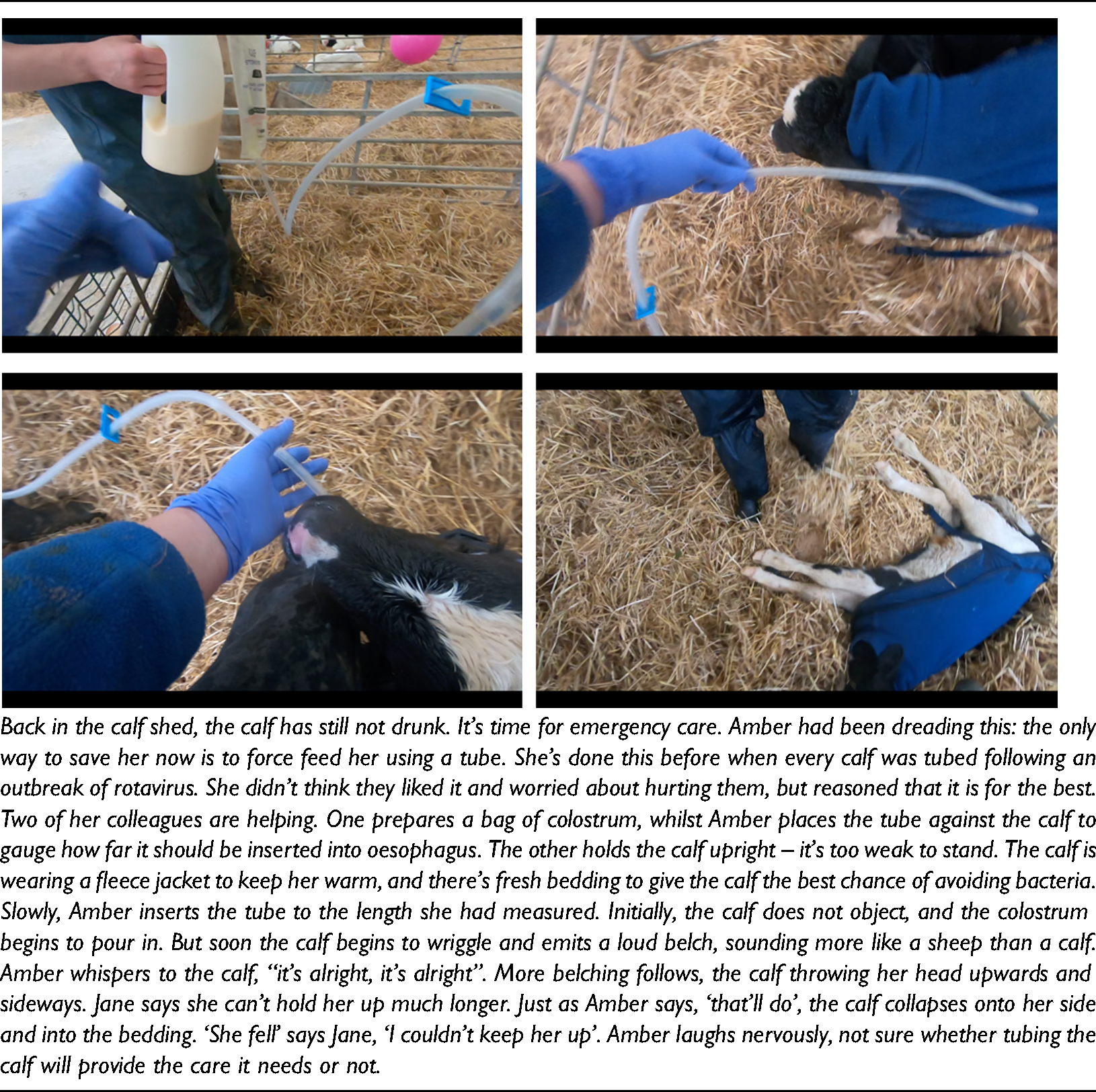
If productivist timescapes simultaneously accommodate urgency and patience, this is not without tension. This is exposed in the second feeding practice that helps avert future threats of AMR. Tubing involves force-feeding colostrum to a calf to ensure it has the necessary volume in the first hours of its life. Tubing may also be used to provide other fluids, such as electrolytes, to help a calf recover from illness. In practice, tubing involves preparing a bag of colostrum (hence tubing may also be referred to as ‘bagging’), gripping a calf securely between the calf rearer's legs, and then inserting a tube into the oesophagus and pouring the colostrum directly into the stomach. This is a skilled task that should be conducted by trained staff (AHDB, 2020). Dangers include inserting the tube into the windpipe and lungs, and killing a calf by drowning. In this way, tubing reflects a productivist timescape in which care is enacted as rapid and urgent, if not violent and dangerous: I just tubed this calf like normal, and next thing it started coming out of its nose and it dropped dead … This calf was just like choking on the floor, and I just didn’t know what to do. I just stood there and I thought shit, I can’t believe it. And all I could say was, it was in the right hole, I could feel it. It was in the right hole because I felt it go down, I would not have tipped the milk in if I didn’t feel the thing go through my fingers…. You feel so bloody bad because you are responsible for their life, and you've just snuffed it out in five minutes. And it was a good calf as well (Hayley). I have plenty of calves, especially this year, when they've had this Selenium and iodine thing and they're all very slow. And, and if they are, if we're not sure now, if we're not sure that they have drunk properly, we will just tube them automatically, that's what we'll do. And then they'll get the full bag (Hayley). So where possible, mother's milk goes to baby, and every calf gets tubed with the milk for the colostrum. Because when you’ve got 15 to 20 [being born] in a day, you just need to bang that colostrum in. It needs to go in as soon as possible. So, we tube just to save faffing about, and then we know that that calf has had its first couple of litres of colostrum and it's good to go. So that’ll be done as soon as possible after calving … If, you know, it's sucked from its mum, great, and it might not have that much. But generally, everything gets tubed twice before we start feeding it. The one thing I still hate doing to this day, is to tube them. I find that pretty difficult just because the calves don’t really like it, and I think they’re a little bit sensitive and things like that. And, but sometimes it's got to be done because they won’t drink and if they don’t have a feed, then they’ll get dehydrated … It just makes me feel a bit sad because I think that I’m hurting them, and I don’t want to hurt them … but I guess it's for the greater good. So as long as they’re making a little effort, they’ve obviously got a little bit of something about them wanting to get better, and forcing stuff into them just maybe isn’t the right thing to do. So, if they’re willing to take a litre, but maybe not going to drink three, at least they’ve got something on board, and nine times out of ten you go back to feed them at the next feed stage and that's done some good (Lucy). We take a lot longer to get them going on the bottle and the last resort is to bag them. We realise it takes a lot longer to get going, the lads are like shove the bottle in their mouth and try and get them going, if they’re not they bag them … [And] because we’re with them all the time we spot when something's not right, they associate us as being their mum, we’d sit there and play with them whereas the lads are like oh, come on, do some work (Amber).
In contrast, the dismissal of patient skills reflects how care is embedded in and sustains specific forms of agrarian political economy and labour at the expense of others (Reisman, 2021). In calf care, productivist timescapes are not only difficult to change, but also choreograph the very problems that calf rearers are trying to resolve. The low priority given to calf rearing means that there is commonly neither enough time nor space to look after calves appropriately: You find that this calf is being left in a dry cow yard, and it's wandering around trying to find its mum, and they lick the walls, and they follow other cows which are not their mum. And by the time the farmer picks them up in the morning, they could be a bit hungry, but they … they go off the boil a bit, they … they're very keen to suck as soon as they're born, but twelve hours later, or even six hours later, they're not. So, the suck reflex just diminishes …You could even go mad and actually clean the cow's udder, you know … just put a wet wipe over their udder so that the first feed the calf gets isn’t a mouthful of muck. But people are reluctant to adopt these regimes because it takes up more space in the dry cow yard (Pauline). It's a massive responsibility, especially when you really don’t know what you're doing. Like, I don’t think any of us know what we're doing, really. You just kind of like make a series of mistakes and it's like each time you don’t make that mistake again, and then you make another one and you don’t make that mistake again, it's, I don’t know, it's quite hard work (Hayley) Some mornings you’d go in and the beds would be quite damp, even though obviously we were keeping up with the bedding, and the passageway would be quite wet, and that's just purely the rain, like the prevailing wind coming in. I mean it would hammer it with the wind and rain, and it was pretty intense. So, it was blowing in, so it was moist. It wasn’t the best, really, environment for fresh air, if that makes sense. So yeah, there was moisture. I mean it was … yeah, it was an old, old building (Sam). We’ve had to put on either sheeted gates, or straw bales inside the pens. Just think of it as a big box and you basically just put a straw bale here, and they can walk around to go in behind their shelter or they can come out the front to feed. So just gives them just somewhere to keep warm, because otherwise, I know you fed them warm milk, but then if you’re getting… it's like standing on a hill. If you’re not moving, you’re just going to get cold. So, we’re just trying to give her a little bit of protection (Katie).
The future timescapes of antimicrobial resistance
If the rapid timescapes of productivist agriculture configure how calves are cared for, tracing their politics of care to understand who benefits at the expense of others (Reisman, 2021) has important implications for attempts to foster the prudent use of antimicrobial medicines across the industry. Firstly, understanding the timescape of livestock farming exposes the systemic challenges facing attempts to reduce the use of antibiotics. The temporalities of calf rearing and the materialities and subjectivities they enact are key to understanding these systemic challenges. Thus, calf rearing can frequently find itself in tension with an ‘old’ or ‘aging’ temporality: it has been beset by traditional cultural attitudes that it is not productive work, and therefore of limited value. These politics of care are reflected in the way calf rearing is perceived to be women's work, and which can be organised around other maternal and labour roles. Similarly, this old temporality is reflected in the make-shift buildings and facilities calf rearers must often work with. This does not mean that it is the same across all farms, or that new technologies, practices and labour conditions are not being developed and used by calf rearers. Rather, shifts in the cultural timescape of calving are taking shape at different pace on different farms resulting in a differentiated geography of calf care.
Whilst the temporalities of calf rearing come to sustain productivist farming, they have consequences for calf care and AMR: insufficient time is available to care appropriately for calves, the skills of patience and attention to detail are constantly under pressure, and the availability of training opportunities is inadequate. These systemic challenges pose a key problem for the AMR agenda (cf. Bellet, 2018). On the one hand, farming timescapes create conditions in which the use of antibiotics is inevitable: they enact fragile relationships of care that are easily broken by the absence of time and presence of past times. In these systems, the use of antibiotics is therefore a ‘normal accident’ (Perrow, 1999); an overflow waiting to happen (Law, 2006). On the other hand, attempts to encourage behavioural change in relation to AMR on farms conceptualise change as a matter of communication with ‘farmers’ (Bard et al., 2022) and/or the adoption of new technologies. As we have shown, technological solutions like tubing do not address systemic challenges, rather they seek to strengthen existing systems enacting a technoscience future temporality of hope (Puig de la Bellacasa, 2015). Yet, adding new materialities to old systems makes them more complex, more vulnerable and more likely to overflow (Perrow, 1999). At the same time, these methods fail to reflect the complex relations that comprise farming timescapes. Indeed, as other research on calf rearing and animal health demonstrates, systemic change is emotionally driven (Bassi et al., 2019) or by other social factors in the family (such as succession) (Enticott et al., 2022; Sutherland et al., 2012), rather than a simple response to communicative stimuli. Thus, in understanding farming timescapes, we suggest for AMR initiatives to be successful, attention is turned to these systemic challenges, rather than the future timescapes of technology.
Secondly, the timescapes of calf rearing provide insight into the constitution and nature of care in agriculture. Care in calf rearing is similar to other agricultural practices. As in soil management (Krzywoszynska, 2019; Puig de la Bellacasa, 2015), care in calf rearing is marked by distinct but intersecting temporal practices: of slow, patient care versus fast, technoscience care. Similarly, as in the management of animal health (Singleton and Law, 2013), so in calf rearing is care reflected in the patchwork, bricolage tinkering practices of retrofitting and adaption of calf sheds to ensure that systems work. And, just as (Reisman, 2021: 404) notes, care is multi-faceted, going beyond simply eliminating bacterial pathogens, and focuses on ‘a politics of relational maintenance: what relations are being sustained, and to what ends?’. As the calf rearers in this study revealed, their care was constituted by the relations of political economy and their related timescapes. Thus, whilst their care was focused on calves, where was the care for calf rearers: who cared for them? Their references to lack of time, being fearful of making mistakes whilst juggling over responsibilities, and their use of tubing to make themselves as well as the calf feel better, point to an absence of care for them. Moreover, calf rearers expressed care not just for the calves, but also through their multiple roles as care givers for the farming family and farm.
At the same time, in following the relations of care in farming timescapes, it is also possible to see tensions between different temporalities of care, but which can nevertheless be accommodated within an overall timescape. The dominant timescape of productivist agriculture and its excesses that lead to AMR emphasise speed, efficiency and urgency. Protocols and feeding technologies like tubing seek to enact this timescape whilst also seeking to avoid the rebounding risks of AMR. It is easy to put this caring temporality in opposition to the slower skills of patience and attention to detail. Yet, this is not an easy opposition, rather these different temporalities find themselves as part of the same system. Caring temporalities are neither fast or slow, but both, the balance of which changes in context and the situation at hand. Thus, the prudent usage of anti-microbials was commonly associated by our rearers as relating to patience, time and waiting; as well as being attentive enough to respond when necessary. Conversely, responding to infection, particularly something with its own rapid temporalities (such as pneumonia) requires urgency, but an urgency that comes from patience: spending time and noticing symptoms, or listening to the calves and picking up on wheezing or a cough. Crucial to the attempts to encourage the prudent use of antibiotics is, therefore, the development of these different temporal sensibilities – what we have referred to as ‘patient urgence’ –, the recognition and accommodation of the tensions between competing temporalities, and finding ways for calf rearers to experiment and find the balance between them.
Finally, Haraway (2008) suggests that recognising the presence of care in unlikely settings (such as laboratories) is important in developing an ethics of care and ‘response-ability’ through slower practices such as attention and patience. Whilst there may be similarities between the ethics of care in laboratories and productivist farms (Greenhough and Roe, 2011: 55), a final question our research raises is why are these ethics of care found on some farms and not others? What stimulates their presence? The experimentation with protocols to avoid tubing was not present on all farms. Similarly, where tubing protocols were present, tubing could be conducted reluctantly with calf rearers concerned about the reasons for its use. This signifies the presence of a different range of farming timescapes and affective atmospheres that are important to understand in attempts to manage AMR. Previous studies of AMR in farming and calf care either focus solely on intensive agriculture (Helliwell et al., 2020) or fail to differentiate between different farming systems (Palczynski et al., 2022). Paying greater attention to the differentiated evolution of the timescapes of care – or care-full timescapes – may therefore help understand the breeding of patient urgence – and other temporal tensions and accommodations – that are better placed to ensure responsible calf care.
Conclusion
To ask how to feed a calf is to ask, what is it to care in livestock agriculture? Feeding calves enacts the timescapes of modern livestock farming, reminding us of its excesses and rebounding risks. Promoting the use of colostrum to reduce the use of antibiotics asserts a timescape in which feeding is configured by standardisation, consistency, and urgency. Feeding practices such as tubing entrench productivist temporalities, enacting urgent care as a means to ensure the productivist flow of calf to cow in the smoothest way possible. At the same time, feeding colostrum symbolises temporal fluidity: urgent feeding practices can give way to slower, patient and situated practices of care that have been developed in situ (Hinchliffe et al., 2021). In this way, different caring temporalities come to co-exist as ‘patient urgence’, making protocols workable, and performing care for calf rearers themselves by allowing them to live with the emotional and practical demands of agricultural work. In doing so, understanding the timescapes of calf rearing highlights how the reduction of AMR may be less about individual actions, and more about the material, social and biological relations that configure them. If calf rearers are defined by attention to detail and patience, then so should efforts to contain AMR pay attention to systemic practices that have become embedded and require longer term change (Bellet, 2018). The cultural status of calves and calf rearers, the genetic evolution of bovids, and their material living conditions all demand attention. Thus, if feeding calves is to understand care within livestock farming, then it is to also direct attention to what sustains systems of agriculture, and how best to repair them.
Highlights
Livestock care on farms is configured by different temporal orders known as a timescape. Urgent temporalities specify productivist technologies to reduce the use of anti-microbial medicines Patient temporalities specify slower embodied and situated practices to prevent disease outbreaks In livestock farming, these different temporalities co-exist within agricultural timescapes rendering time as fluid. The concept of “Patient Urgence” is developed to show how discordant temporal orders are accommodated in farm animal care.
Supplemental Material
sj-docx-1-ene-10.1177_25148486241231205 - Supplemental material for Feeding time(s): Patient urgence and the careful temporalities of antimicrobial resistance
Supplemental material, sj-docx-1-ene-10.1177_25148486241231205 for Feeding time(s): Patient urgence and the careful temporalities of antimicrobial resistance by Gareth Enticott and Kieran O’Mahony in Environment and Planning E: Nature and Space
Footnotes
Acknowledgements

Declaration of conflicting interests
The authors declared no potential conflicts of interest with respect to the research, authorship, and/or publication of this article.
Funding
The authors disclosed receipt of the following financial support for the research, authorship, and/or publication of this article: This work was supported by the European Union's Horizon 2020 research and innovation programme under grant agreement No. 817626.
Supplemental material
Supplemental material for this article is available online.
References
Supplementary Material
Please find the following supplemental material available below.
For Open Access articles published under a Creative Commons License, all supplemental material carries the same license as the article it is associated with.
For non-Open Access articles published, all supplemental material carries a non-exclusive license, and permission requests for re-use of supplemental material or any part of supplemental material shall be sent directly to the copyright owner as specified in the copyright notice associated with the article.
