




Abstract
Systemic inequalities, which affect how water is distributed and used, underlie water insecurities in higher-income (global North) countries. We explore the interlinkages between municipal decision-making and infrastructure to understand how urban climate justice can be advanced through engaging with state-like forms of governance. Drawing on archival information, spatial analysis, participant observation, and semi-structured interviews in the underbounded Latinx community of East Porterville, California, we analyze how local actors actively work against municipal-scale processes of infrastructure exclusion and production, within and beyond the state, to facilitate water access and particular notions of citizenship. We argue urban climate justice demands both an understanding of infrastructural marginalization, and attention to the diversity of perspectives, approaches, and solutions preferred by communities.
Introduction
Water insecurities are outcomes of governance processes (Anand, 2017; Jepson et al., 2017; Zwarteveen et al., 2017), wherein state and non-state actors engage to shape how, for what, and for whom water is made available (Bakker, 2003). They exist when food production and consumption, livelihoods, and human health and wellbeing are undermined by water insufficiency and inaccessibility (Brewis et al., 2020; Cook and Bakker, 2012; Rosinger and Young, 2020; Shah, 2021). Insecurities occur in spaces assumed to have the technological capacity for water security, such as high-income or global North countries, but that nonetheless are imbued with unequal and unjust socio-environmental systems that affect water availability, quality, distribution, and use (Marshall and Mozee, 2022; Meehan et al., 2020; Ranganathan, 2016; Sultana, 2018; Wilson et al., 2021).
A major question for water justice advocates is how different forms of actor engagement contribute to, or detracts from, meeting the needs of all people now and in the future. Relevant here is the “state,” which often denotes the governing agencies and their representatives who extend policies and regulations into local decision-making venues. We, however, consider the state not only as a set of government organizations and rules, but as the uneven “relations,” “experiences,” and “effects” produced through its interactions with non-state actors (Harris, 2012; Loftus, 2019; Meehan and Molden, 2015; Painter, 2006 on the state as a “social relation”; Mitchell, 1991 on the state “as a structural effect”). These effects—experienced by non-state actors, like the citizens and resource users that participate in local policy processes—include asymmetries in citizenship, belonging, and deservingness (Anand, 2017; Kemerink et al., 2013). Given power asymmetries between state and non-state actors, their interactions may (re)produce asymmetries in water security (Perreault, 2014; Sultana, 2018; see Morrison et al., 2019 for a discussion of power in environmental governance).
While some scholars assert that policy processes are generative and can transform the state to better address climate change and its uneven impacts (Angel and Loftus, 2019), we analyze the extent to which climate justice can be advanced through engaging with formal state water governance processes, using a case from the U.S. State of California. We focus on the water insecurities of peri-urban, lower-income, and racialized communities, who have been historically “underbounded,” that is, excluded from centralized water and sewerage connections (Aiken, 1987). These unincorporated communities often face pronounced health and economic risks because of their disproportionate reliance on unregulated private wells, deteriorating small water system infrastructure, and expensive bottled water (London et al., 2021; elsewhere see: Lockhart et al., 2020). Further, as we demonstrate, these water insecurities are worsened by the impacts of climate change. Drawing on archival information, spatial analysis, and semi-structured interviews, we center the struggle for water justice in California within historical and contemporary municipal-scale processes of infrastructure development and exclusion in the United States. Our analysis further draws from scholarship on water security in the global South (Anand, 2017; Allen et al., 2006; Wamuchiru, 2017) to contribute to the growing scholarship on water insecurity in the global North (Deitz and Meehan, 2019; Jepson and Vandewalle, 2016; Marshall and Mozee, 2022; Meehan et al., 2020; Pulido, 2016; Ranganathan, 2016; Wilson et al., 2021). We document how peripheral communities of color are deemed “non-viable” not only for water provisioning, but as citizen-actors for long-term planning (cf. London et al., 2021). We conclude by connecting these state interactions to the struggle for safe drinking water, equitable infrastructure, and more broadly, to advocacy for climate justice.
Situating citizenship and belonging through water infrastructure in “the global South within the global North” 1
Building upon Fraser (1995), we define water and climate justice as the bundle of four scales of interaction for environmental justice: (i) recognition of diverse participants and their experiences, (ii) participation in shaping environmental policy, (iii) distribution of policy outcomes for and across groups in society, and (iv) restoration of rights and services to previously segregated or excluded communities. Restorative justice (Robinson and Carlson, 2021; Táíwò, 2022) connects uneven resource insecurities to unjust and inequitable social systems and relations, and argues both for the recognition of wrongs, and for collective movements that reconstruct a more just world (Táíwò, 2022)—a subject we return to later in this paper.
In particular, recognition is a foundational requirement for citizenship and belonging, which itself is a precursor for environmental justice. Groups that are subjected to misrepresentation or are rendered invisible are typically not recognized as users and therefore, not included in processes of decision-making that determine planning, implementation, and the eventual distribution of environmental burdens and benefits (Chu and Michael, 2018; Schlosberg, 2004). This is important because processes of exclusion, such as from central water and sewerage systems as evidenced by municipal underbounding, might be less of a function of whether people are included in decision-making processes (i.e. procedural justice) and, more actively, a result of deliberate exclusion (i.e. recognitional justice) that stems from, and maintains, structural disadvantage and racism (Aiken, 1987). Here Chu and Michael (2018) argue procedural and distributive justice must account for recognitional justice. For them, this enables the identification of how diverse identities,values, and behaviors are embedded into policy processes (c.f. Berardo, 2013), defining who and what is granted deservingness to a suite of rights, including water infrastructure and other urban services (Chu and Michael, 2018).
Central to recognitional justice is citizenship. Citizenship often evokes the shared understanding of equality in rights; however, in practice, citizens do not experience equal civil, political, and economic rights, responsibilities, and protections (Anand, 2017; Wamuchiru, 2017). For Anand (2017), (hydraulic) citizenship is a dynamic and iterative process by which residents are recognized by political actors and agencies in ways that enable them to acquire water. Anand (2017: 10) suggests citizenship emerges both from how laws, regulations, and plans shape relationships between residents and political actors (“technologies of politics”), and from the social, economic, and political relations that shape planning and development (“politics of technologies”). Their proposition conveys water infrastructure and provisioning as more than a series of technical decisions, and instead as a set of socio-political relations (Anand, 2017; Jepson et al., 2017; Lawhon et al., 2018). Further, Wamuchiru (2017) highlights how, through socio-political relations, citizenship is negotiated and re-defined in local policy processes, effectively and differentially re-scaling it from the nation-state to communities. Important for us, Wamuchiru (2017) proposes citizenship as a form of agency that includes individual and collective action to demand and construct new formulations of citizenship for improved quality of life. In our case, the linkage between citizenship and belonging, and infrastructure as more-than-material (Anand, 2017; Lemanski, 2019), is essential because of how water supply problems in California, and elsewhere in the global North, have been de-politicized as technical shortcomings (Meehan et al., 2020).
As prefaced above, we explore local configurations of water and climate justice below via formal processes of annexation and service extension aimed at addressing the impacts of “municipal underbounding” (Aiken, 1987), whereby municipal governments exclude geographically proximate yet primarily lower-income communities of color from public services, such as centralized water and sewage infrastructure (Aiken, 1987; Anderson, 2010; Durst, 2014; MacDonald Gibson et al., 2014; Mukhija and Mason, 2013). As such, we consider water infrastructure and resource provisioning as “hydrosocial territories” where socially, naturally, and politically constituted spaces are regularly (re)created through human interactions and material flows of water (Boelens et al., 2016). Given water, infrastructure is as material as it is social (Bakker, 2012; Lawhon et al., 2018), attention to governance remains an important pathway for redressing the on-going exclusion and discrimination of public works and service provision. Such efforts can support processes of climate preparedness and resilience—and more broadly, climate justice—under contexts of increasing hydrological variability and extreme events, such as drought.
Methodology
Case study context
In the United States, marginalized and excluded peri-urban communities are often subjected to racialized access to urban services, including safe drinking water. In California, water governance is highly fragmented and decentralized due to the many local water agencies entrusted with meeting water provision (see Dobbin and Fencl, 2021; Méndez-Barrientos et al., 2020; Pannu, 2012). As mentioned earlier, excluded communities are often unincorporated communities of color (Flegal et al., 2013). Disadvantaged unincorporated community (DUC), is a term legally defined in Senate Bill (SB) 244 (Flegal et al., 2013; London et al., 2021; SB 244, 2011), which describes communities who are both low-income and are unincorporated to water systems. DUCs commonly use unreliable and unsafe water sources (Bliss, 2015; Lockhart et al., 2020; London et al., 2018, 2021; Ranganathan and Balazs, 2015). Households in these communities generally have two main options for domestic water: self-supplied drinking water from private groundwater wells; or centralized water service provision from relatively small water systems, such as mutual water companies or mobile home parks (London et al., 2021), which experience higher than average Safe Drinking Water Act violations (Dobbin and Fencl, 2021).
State actors are working to address structural inequalities in water access. One preferred policy at the state level is consolidation: the physical and/or managerial combination of water systems, including the integration of smaller systems into larger ones. This is often perceived by state agencies as “the best solution” (SWRCB, 2015: 170). In 2015, this preference was codified in statute, giving the state the power to mandate consolidation 2 , 3 (SB 552, 2016; SB 88, 2015) when efforts to incentivize voluntary consolidation fail. Importantly, consolidation is a strategy that succeeds in water system establishment. In other words, unincorporated communities without water systems necessitate other policy strategies, such as service extension and annexation, to solve their water insecurity issues.
A second strategy is an annexation. Annexation refers to the legal process of expanding municipal boundaries, part of which involves the extension of municipal infrastructures, such as water and sewer connections (when the municipality is the water provider). That is, annexation and service extension occurs when a nearby municipal-run water system physically connects a household or community of self-supplying households to its distribution system. A co-benefit of service extension is the possibility to redress long-standing groundwater contamination concerns affecting domestic wells (Balazs et al., 2012; Honeycutt et al., 2012; London et al., 2018), as well as increasing domestic water reliability under a changing climate. However, the state of California does not have the same legal authority to compel systems to extend services to self-supplying households (London et al., 2018).
Generally, however, state agencies only intervene in local water management when other levels of governance, namely local city, and county governments, hesitate or oppose service extension to marginalized communities. Annexation decisions are often claimed to be based on technological capacities and associated costs. However, historical county general development plans in California's Central Valley include explicit policy language refusing to invest, or extend municipal services, to lower-income unincorporated communities of color (London et al., 2021; Pannu, 2012). As mentioned earlier, these plans describe these unincorporated communities as “non-viable” for water and sewerage extension, instead directing investments to communities with “authentic futures” (Pannu, 2012). Similar language exists in many of the Central Valley's general development plans, which have withheld funding and discouraged annexation, creating a legacy of unincorporated self-supplying communities (London et al., 2021). Given the historical tendency to disproportionately exclude lower-income communities of color, framing certain communities in one's jurisdiction as non-viable is inseparable from how systemic racism and neoliberal decisions around water extension combine to affect infrastructural decisions (Aiken, 1987; Mukhija and Mason, 2013). This racially coded language unveils how decisions to avoid the annexation of certain communities and neighborhoods emerges from and perpetuates systemic racism—including what it means to belong and to be a citizen.
Importantly, and as connected to the case below, recurring and more severe catastrophic droughts are exacerbating existing disparities and endangering the already precarious water access of self-supplying communities. Rising temperatures have reduced surface moisture (Seager et al., 2015), and changes in precipitation regimes increased the probability of warm-dry conditions associated with the California 2011–2016 drought (Diffenbaugh et al., 2015). These physical conditions, in combination with the prior appropriation system of water rights, 4 which triggers a hierarchical system for surface water allocation, have radically increased groundwater extraction during droughts (Scanlon et al., 2012). Reliance on increasingly vulnerable shallow wells exposed unincorporated households to costly well failure and drought-related water shortages (Fencl, 2019; Pauloo et al., 2020).
Even amidst structural disadvantages and during the water emergency posed by the drought, communities are not passive actors (Dobbin, 2021). On the contrary, water justice advocates and marginalized communities have successfully championed state interventions (Karner et al., 2020; London et al., 2021). For example, water justice organizations successfully advocated to codify a Human Right to Water (AB 685, 2012), to get new legal authority for the State Boards to force system consolidation (SB 552, 2016; SB 88, 2015), and to create the Safe and Affordable Drinking Water Fund (SB 200, 2019). In some instances, advocates have gone beyond the use of state-centric approaches and become part of the state themselves. Most visibly, one of the co-founders of the Community Water Center was appointed to the State Water Board in 2019. While the trade-offs of the shift from activism into environmental agencies are discussed in detail by London and Harrison (2021), we believe that the combination of activism and inside agency leadership has facilitated transformative practices that raised awareness about the core issues, helped re-prioritize funding, and passed new legislation to support drought-vulnerable self-supplying households during water emergencies. 5 We now explore the intricacies and challenges associated with the integration of a self-supplying, underbounded, community into a nearby water system via service extension during a drought emergency.
Case study selection and analysis
This paper examines whether climate and environmental justice can be advanced through engaging with the water governance process. To address this question, we used a critical case study research design (George and Bennett, 2005). We selected a prominent case of climate justice organizing and advocacy in one of the United States’ most socially progressive states, California, which also faces a suite of climate change impacts. Specifically, we examine processes of service extension and annexation in the pursuit of water justice in East Porterville, a peri-urban community in the south Central Valley of California.
While our case study focuses on East Porterville, we draw from semi-structured interview data conducted for two complementary studies in the Tulare Lake hydrologic region of California. This hydrologic region is geographically located in the south Central Valley and spans multiple counties, including Tulare County (DWR, 2016). Each study used a purposive sampling design to select interviewees based on their local and regional expertise and/or involvement in drinking water advocacy in Tulare County (Bernard et al., 2016; Gerring, 2017). The authors undertook six semi-structured interviews conducted under Institutional Review Board (IRB) Protocol #1000058-1 and 15 interviews under IRB Protocol #1079430-1 between January 2017 and 2019 with local water system managers, community advocates, community leaders, and city, county, and state officials. Interviewees had expertise in multiple disciplines and areas, including government regulation and administration, water system management and operation, and nonprofit technical assistance.
Interviews addressed perceptions about the annexation development process, and constraints faced by water systems and domestic well households. All interviews occurred in-person, prior to the COVID-19 pandemic, and ranged from 45 min to 2.5 h. Interviews were recorded and transcribed. Analysis followed an inductive approach that mapped participant perspectives on their engagement with state actors and water governance processes taking place (Bernard et al., 2016). Interview data was complemented by the authors’ participant observations as attendees of public meetings on the proposed project between May and November of 2016. Public meetings were organized by state agencies and attended by community members, city and county officials, as well as state officials, including but not limited to the Department of Water Resources.
In order to further contextualize the inequities involved in the development of DUCs, we also conducted archival research on city and county general plans and Local Agency Formation Commission (LAFCO) documents from the 1960s to the present. Archival evidence included reviewing historical county general plans (1972) and more recent municipal service reviews undertaken by Tulare County LAFCO (2007, 2014). In addition, we reviewed secondary data sources (e.g. legislative bills, municipal documents, newspaper articles, and place-based scholarship). Archival material was used to demonstrate patterns of disinvestment in DUCs.
Last, spatial analysis was also conducted, revealing systemic patterns or clusters (i.e. hotspots and coldspots) of racialized resource distribution (Deitz and Meehan, 2019; Pulido, 2000). The approach uses a distance-based proximity analysis, 6 which measures the distance between the location of domestic well-reliant households and nearby Community Water Systems (CWSs). The actual location of distribution infrastructure within a water system's service area is unknown. Hence, we measure the proximity to both the systems’ center (centroid), a representative central location of a water system, and to the CWS’ boundary, which assumes infrastructure is present at the edge of a system's service area.
East Porterville service extension and annexation
Effectively, East Porterville is an unincorporated “island” on the east side edge of the City of Porterville (Figure 1), which over time became partially enclosed by parts of the City of Porterville, with some parcels even within the city's water system boundaries, yet not fully annexed 7 and predominantly reliant on private domestic wells (Figure 2). Despite the community's proximity to the City of Porterville, there are also a handful of very small community water systems (CWS) (< 500 people served) and state-small systems near East Porterville (< 25 people or 15 connections) (London et al., 2018, 2021).
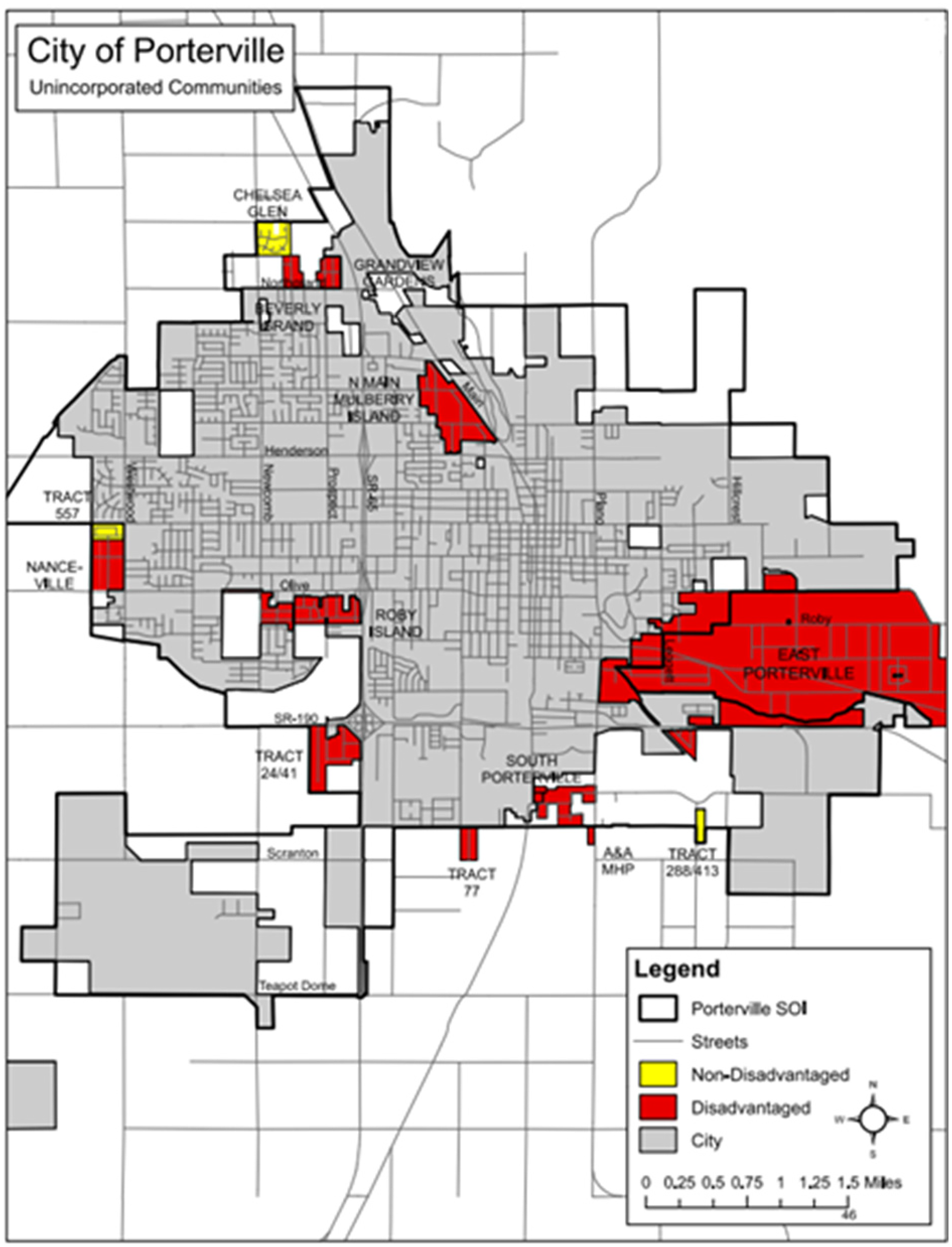
Map of the City of Porterville, showing disadvantaged communities in red. East Porterville is shown on the east side of the City limits. Source: LAFCO (2014).
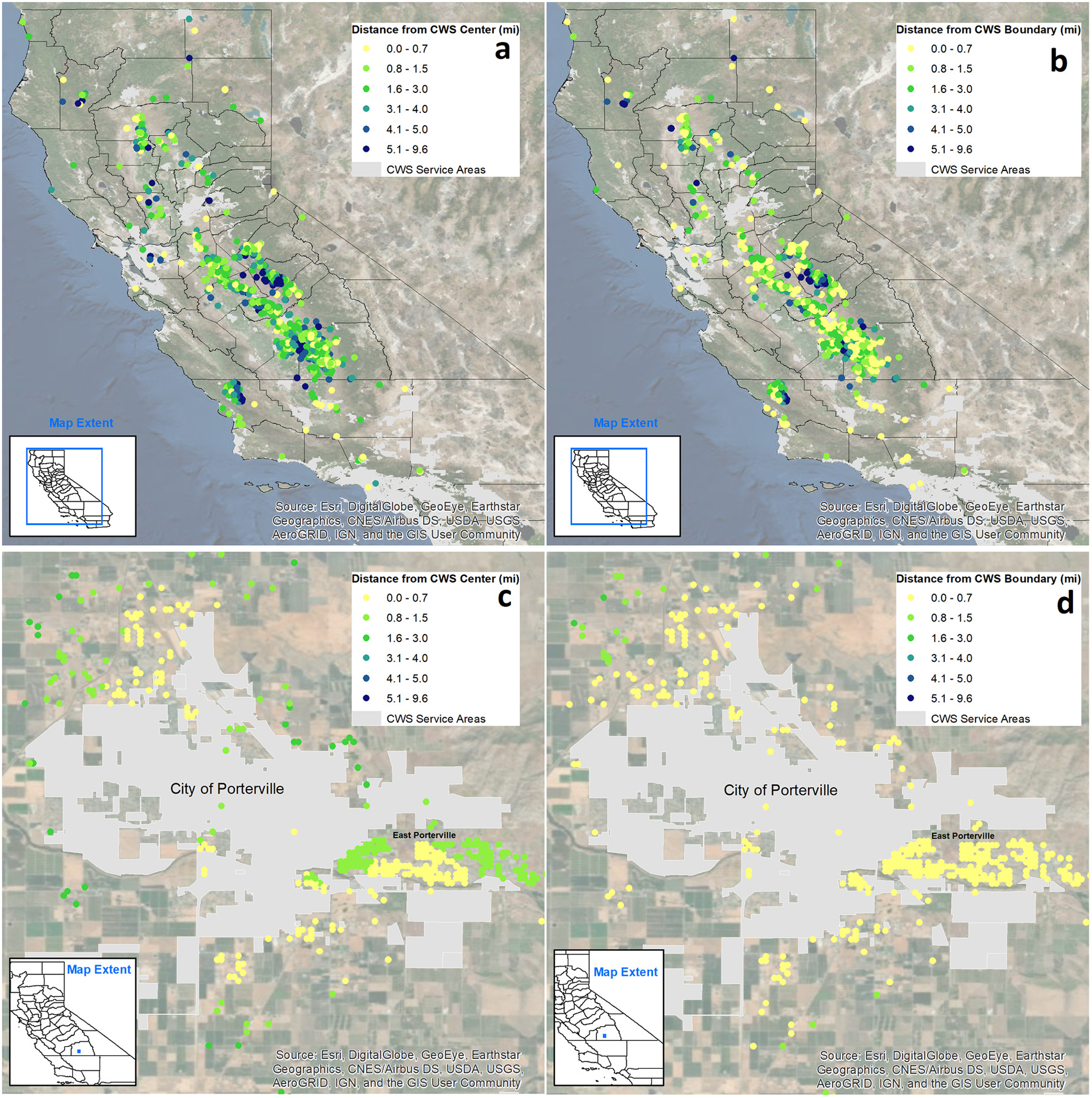
Point data conveys the distance from a reported dry domestic well to the nearest community water system (CWS) center (left) and service area boundary (right). Reported dry wells cover the period between 2014 and 2017 (DWR, 2018b), and CWSs service area boundaries, shown in gray, were downloaded on 7 May 2019 (Tracking California-Public Health Institute 2019). Top quadrants (a, b) show statewide calculated distances between dry wells and CWS. The bottom quadrants (c, d) zoom into our case study site: the City of Porterville and East Porterville. These show the unincorporated East Porterville surrounded by the City of Porterville's water service area, which has expanded over time, but not included East Porterville. During the course of the drought, East Porterville residents reported hundreds of dry or drought-impact domestic wells: yellow and green points, denoting < 1.5 miles from the nearest CWS.
During the 2012–2016 drought, East Porterville had approximately 7300 residents in 1800 households reliant on domestic wells (DWR, 2016). According to the United States Census (2010), East Porterville is predominantly Latinx (73%), with a median household income of $25,022. In 2010, before the drought, approximately 39% of the population was below the poverty line (United States Census, 2010). The intersection of low-income and unincorporated status makes East Porterville a DUC. Through SB 244, the state required counties to assess and develop plans to mitigate inequities in DUCs like East Porterville; however, only eight of the 27 DUCs in Tulare County had been annexed as of 2017 (London et al., 2018).
On the other hand, the City of Porterville hereby referred to as “the City,” has owned and operated its municipal water supply system since 1903. A portion of East Porterville is within the City's urban development boundaries and could be annexed without protests or elections; however, the remainder of East Porterville would need to be annexed under the regular process that requires landowner and voter approval (Tulare County LAFCO, 2014). Notably, after the three-year drought in 1972 and subsequent domestic well failures, the City then proposed annexing and extending service to East Porterville, but was opposed by City of Porterville voters (see Tulare County LAFCO, 2014: 69–70). Rather than attempting another annexation, in 1977 the Porter Vista Public Utilities District (PUD) was created to at least provide sewer services to address domestic well contamination from septic tanks (City of Porterville, 2017; Tulare County LAFCO, 2014). As recent as 2014, the county's review of the City's municipal services deemed it in fact capable of extending services and even posited that service extension of domestic water to East Porterville “could be prioritized based on the areas with the worst water contamination” (Tulare County LAFCO, 2014: 50) yet contingent “on registered vote and landowner support” (Tulare County LAFCO, 2014: 70).
In further support of annexation and service extension was the state's concern that East Porterville was unlikely to meet the State Water Boards capacity requirements to own and operate its own system (DWR, 2016), including the creation of any new, self-supported small water systems (SWRCB, 2015). Despite these recommendations by the county and the state towards City annexation and water system service extension, East Porterville, to date, remains one of the largest unincorporated communities in Tulare County. As such, East Porterville has no formal opportunities to elect city officials nor participate in city government decisions that could represent community interests, including, importantly, negotiating improvements in water access and reliability. DUCs, as Flegal et al. (2013) explain, while technically governed by counties, are “systematically underserved in the overall allocation of public resources and are frequently left out of local decision-making processes. Concentrated poverty, institutional and individual racism, and California's systems of public finance and land use regulation exacerbate” conditions (Flegal et al., 2013: 7). Consequently, unincorporated status is not only about material (infrastructural) connection to water systems, but also about connection to political (governance) systems (cf. Aiken, 1987).
The confluence of uneven water access and extreme events came to the fore during the 2012–2016 drought in California with many self-supplying households reporting dry wells (no water) and failing wells (low water or pump failures). Our spatial analysis shows that statewide, a large proportion of reported dry wells during the 2012–2016 drought (55–75%) were within 1.5 miles of a water system's service area. 8 Notably, half of all reported dry wells in the state were within 0.5 miles of a boundary of a CWS service area (Figure 2(a) and (b)). Thus, households with reported dry wells are geographically close but remain unconnected to centralized water provision.
The infrastructural and racial contradictions of this proximity became particularly salient in the Central Valley of California, where Tulare County was considered to be “ground zero” for the drought's impacts. Specifically, within Tulare County, East Porterville concentrated a disproportionate share of the state's reported dry domestic groundwater wells during the 2012–2016 drought (Figure 2(c) and (d)).
Drought emergency and interim solutions
As the 2012–2016 drought affected the Central Valley, concern grew for the households in East Porterville who self-supplied from very shallow domestic wells (London et al., 2018; Medina, 2014; Tulare County LAFCO, 2014). In the Spring of 2014, state agencies began to hear reports of failing domestic wells driven by the prolonged drought emergency, and community members had started to reach out to community-based organizations in search of support (Valley Voice Contributor, 2014). As documented by Egge and Ajibade (2021) through their interviews with East Porterville residents after the drought, water insecurity was experienced emotionally and culturally, as much as physically. Residents experienced lasting trauma from prolonged water insecurity during the drought, reported feelings of embarrassment and shame for not having access to water, and importantly for this study, fear of engagement with the government due to immigration status (Egge and Ajibade, 2021). Lack of citizenship in immigration status prevented community members from formally participating in governance processes and requesting the aid (Egge and Ajibade, 2021).
Local community advocacy organizations like Community Water Center, Self Help Enterprises, and the Porterville Area Coordinating Committee lobbied local and state agencies to respond to the crisis (London et al., 2021). As this pressure and media attention mounted, the state created an Emergency Household Tank program in 2014 as an interim emergency response. At the peak of the program, state agencies were providing around 1500 households with dry wells with 2000–5000 gallon water tanks for non-potable household water use, monthly hauled water deliveries from contracted suppliers to refill the tanks, and with deliveries of bottled water. In Tulare County alone, the household tank and hauling water program cost state agencies $570,000 per month (DWR, 2016). In addition, community showers and laundry facilities were installed in church parking lots. By November 2015, Tulare County had documented reports of more than 1300 well failures affecting more than 6000 residents county-wide (Tulare County, 2015). By early 2016, more than 500 households in East Porterville alone had reported failed wells (DWR, 2016).
As the drought wore on, it became clear that the on-going disaster assistance was cost-prohibitive and not sustainable (pers. comm. Local Water Advocate and State Water Advocate; DWR, 2016). However, a debate over whose responsibility was to resolve East Porterville's water crisis complicated implementing a permanent solution. As the Tulare County Emergency Services administrator told the press in early 2015: “‘It is not the City of Porterville's responsibility’ he said, adding that the city should look after its own first. And while it may be willing to consider tapping into the water system for those out in the county, outside city limits, ‘where does the $30 million come from?’” (cited in Vigran, 2015: n.p.).
In the absence of formal representation in the form of a local agency that could facilitate participation for East Porterville residents, the Community Water Center, a Central Valley-based water justice non-governmental organization (NGO), helped organize residents to create East Porterville Water for Justice (EPWJ) in early 2016. 9 Through EPWJ, residents built a platform to express their preferences and concerns with state agencies poised to find a long-term permanent solution. EPWJ met monthly, with attendance by local and state agency staff, “to ensure that residents have a voice in the development of a long-term water solution” (CWC, 2016; see Figure 3). EPWJ is now known as Porterville United, where residents continue to advocate for community development needs (CWC, 2018). Importantly, until the formation of EPWJ, East Porterville’s lack of infrastructural access to the City or to their own water system had also closed access to a set of other urban commons, such as participation in City or local water governance processes (cf. Méndez-Barrientos et al., 2020), mediating citizenship and shaping belonging perceptions.
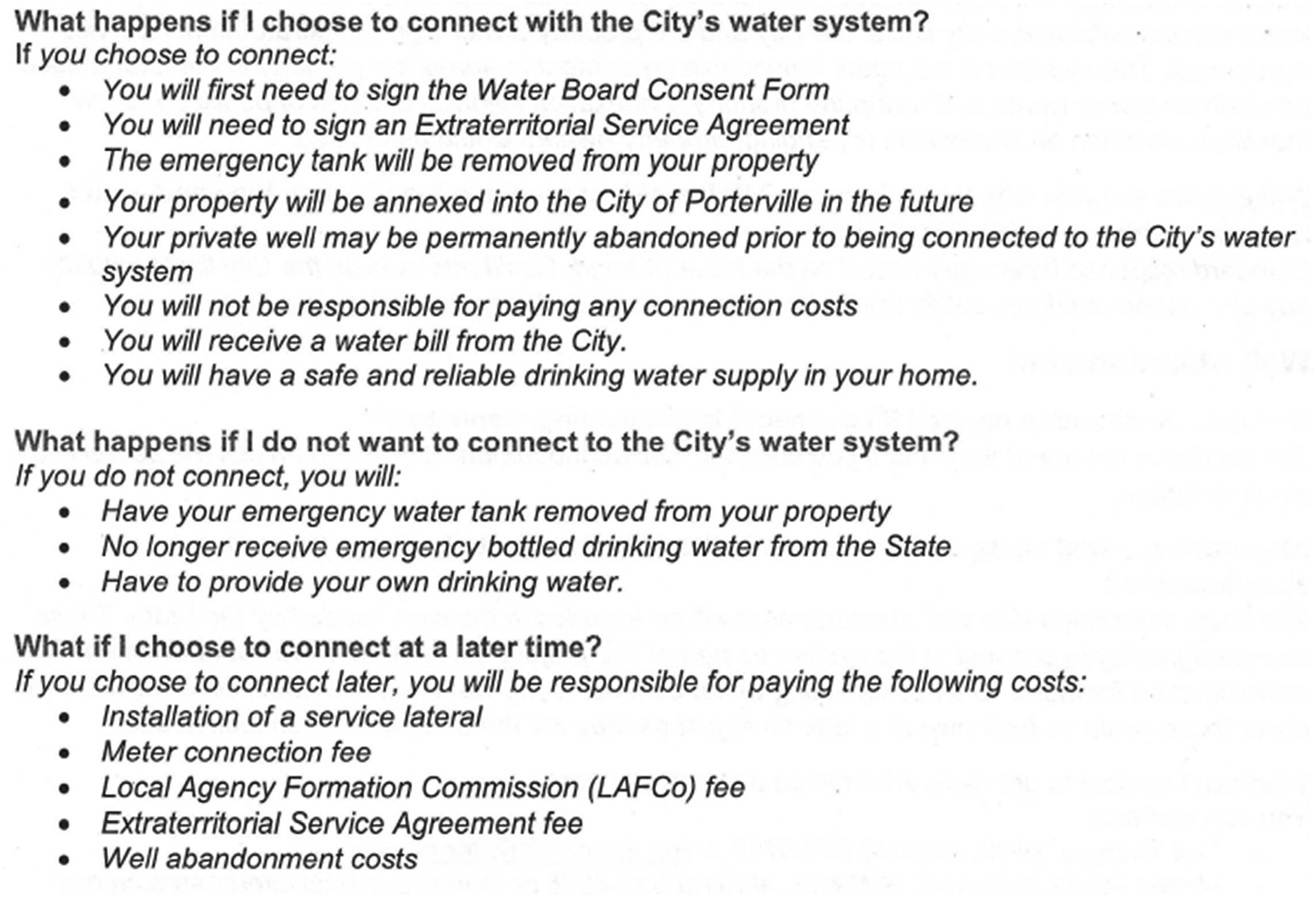
A snapshot of the FAQ provided to residents outlining the results of choosing to participate or not in the project. Signing an Extraterritorial Service Agreement meant City water service could be extended and the homeowner was consenting to future annexation, yet on to be determined timeline. Source: Documentation provided by the Department of Water Resources at a June 2016 community meeting in East Porterville.
In parallel, the California Department of Water Resources (DWR) led a feasibility study in collaboration with its partner agencies to identify a permanent solution. The study evaluated four different alternatives: (1) service extension and annexation with the City of Porterville, (2) service extension from a private for-profit water company (which does not require annexation), (3) extending the Porter Vista PUD's capabilities 10 from the sewer to include drinking water, or (4) creating a new water system either as a private water company or special district to serve the East Porterville community (DWR, 2016; SWRCB, 2017). The feasibility study concluded that extending water services from the City of Porterville to East Porterville was the most cost-effective, feasible solution (pers. comm. Local Water Advocate) and “preferred alternative” for a sustainable and resilient long-term supply for the community (DWR, 2016: 56). Our spatial analysis similarly shows that the City of Porterville was physically the closest large system with the capacity to extend water service to East Porterville (Figure 2(c) and (d)).
In June 2016, DWR presented these findings and recommendations to the community in search of their buy-in to the proposed East Porterville Water Supply Project. 11 Project documentation notes that “the decision on the preferred water purveys is to be made by all stakeholders, including the homeowners of the East Porterville Community” (DWR, 2016: 58). However, officials struggled to get the word out about the proposed project to the community, and officials acknowledged that getting all the affected residents to sign annexation agreements would prove difficult. As mentioned above, unincorporated status prevents communities from accessing governance networks and even state funding. Without a formal agency with a defined jurisdiction and governance apparatus for representation, unincorporated communities are often left out of policy networks. As such, state government agencies often struggle to identify a point of contact (since they do not have a chairperson or other elected officials) and rely on local advocates to identify leaders and other community members.
Project documentation suggests that service extension and annexation “was widely accepted by East Porterville as well as state and local government agencies, and non-profit organizations” (SWRCB, 2017: 2). However, our qualitative and archival review shows that while service extension might have been welcome, the annexation of historically marginalized communities into exclusionary communities is crowded with challenges. At EPWJ meetings, members voiced support for one of the alternative solutions considered by DWR but that had been dismissed: a new water distribution system, supported by deeper wells and managed by a new private non-profit water company (pers. comm. Local Water Advocate). Significant challenges remained, described below, related to persuading East Porterville homeowners to opt-in to the state-funded projects.
Building support for a long-term solution: Municipal service extension
In order to participate in the East Porterville Water Supply Project, East Porterville households had to sign an extra-territorial water service agreement (ESA), which signaled their consent to being annexed at some point in the future while the county amended the new city boundaries (London et al., 2021). Signing the ESA meant that residents were held to an “irrevocable agreement to annex” (East Porterville Water Supply Project, 2016). To accommodate the emergency nature of the project for the drought-impacted parcels in the East Porterville Feasibility Study Project Area, the new procedures allowed for a connection before annexation while the City amended its annexation and extension of municipal services procedures (Tulare County, 2016: 22).
From the East Porterville community perspective, members had multiple concerns, with the community divided over how to proceed. Notably, more privileged landowners who had themselves afforded new deeper wells to address their water security problems and/or who owned livestock and other animals voiced concerns over the state solution. On the contrary, landowners and other stakeholders, such as renters who had no access to water aside from the Emergency Household Tank program, generally voiced public support for the state solution (pers. observ. June 2016 meeting).
We identified four overarching community member concerns with the proposed City of Porterville annexation. The most salient concern was over the loss of autonomy and a rural lifestyle that would come with annexation to the City. Since City ordinances prohibit having livestock, some community members worried about what would happen to their animals. A second concern was about sunk investments in private groundwater wells. Some residents had already pursued and invested in drilling deeper wells in advance of and during the drought. Understandably, they wanted to continue to use their wells and not have to pay a water bill, or be subject to well abandonment. 12 A third reported concern related to the uncertainty around the affordability of City water. Despite energy costs associated with water pumping, the prevailing perception of groundwater as “free” water prompted concerns over paying a utility bill and a 6% Utility Users Tax 13 once connected (pers. observ. Community Meeting, 2016). Finally, general mistrust of the government and the City of Porterville made annexation difficult (cf. Egge and Ajibade, 2021). After decades of unequal and racialized disparities in water access, plus a historic unwillingness to annex East Porterville, residents remained skeptical about any help offered.
In contrast, other residents were enthusiastic about the state's proposal to fund household connections with city water services. During public meetings in 2016, residents offered public comments to convince hesitant neighbors, suggesting that “is the best option,” the project “is trustworthy,” and it “would be better if water is connected to the city.” One resident encouraged his neighbors, exclaiming that “we need to take advantage of this opportunity being offered to us … Many people need water, many of us don't have water” (pers. observ. Community Meeting, 2016). There were concerns that this was a one-time opportunity to have access to reliable water provision that may not arise again.
From the state's perspective, the agencies designing and funding the project were concerned with both securing cooperation from the City of Porterville and getting ample “voluntary” East Porterville community participation to be successful. To secure cooperation from the City and facilitate an agreement between the county and the City for East Porterville service extension, 14 the state funded a new municipal supply well (Tulare County, 2016). The City's new well alleviated its concerns about its ability to meet demand from additional service connections. In contrast, East Porterville residents were limited to a single option: The state's plan was to build a long-term solution by connecting East Porterville residents to the City and removing the household tanks and non-potable water deliveries once that were in place (see Figure 3). While no one was being forcibly annexed, if homeowners did not sign the ESA (consenting to future annexation), the state would not be able to justify pursuing and maintaining both service extension (to some) and continuing the Emergency Household Tank program with bottled water deliveries (to others). Securing community support relied on a proposed structured community engagement component to the project design, as outlined in Figure 4, to build local support and ensure residents understood the presumed benefits of project participation.
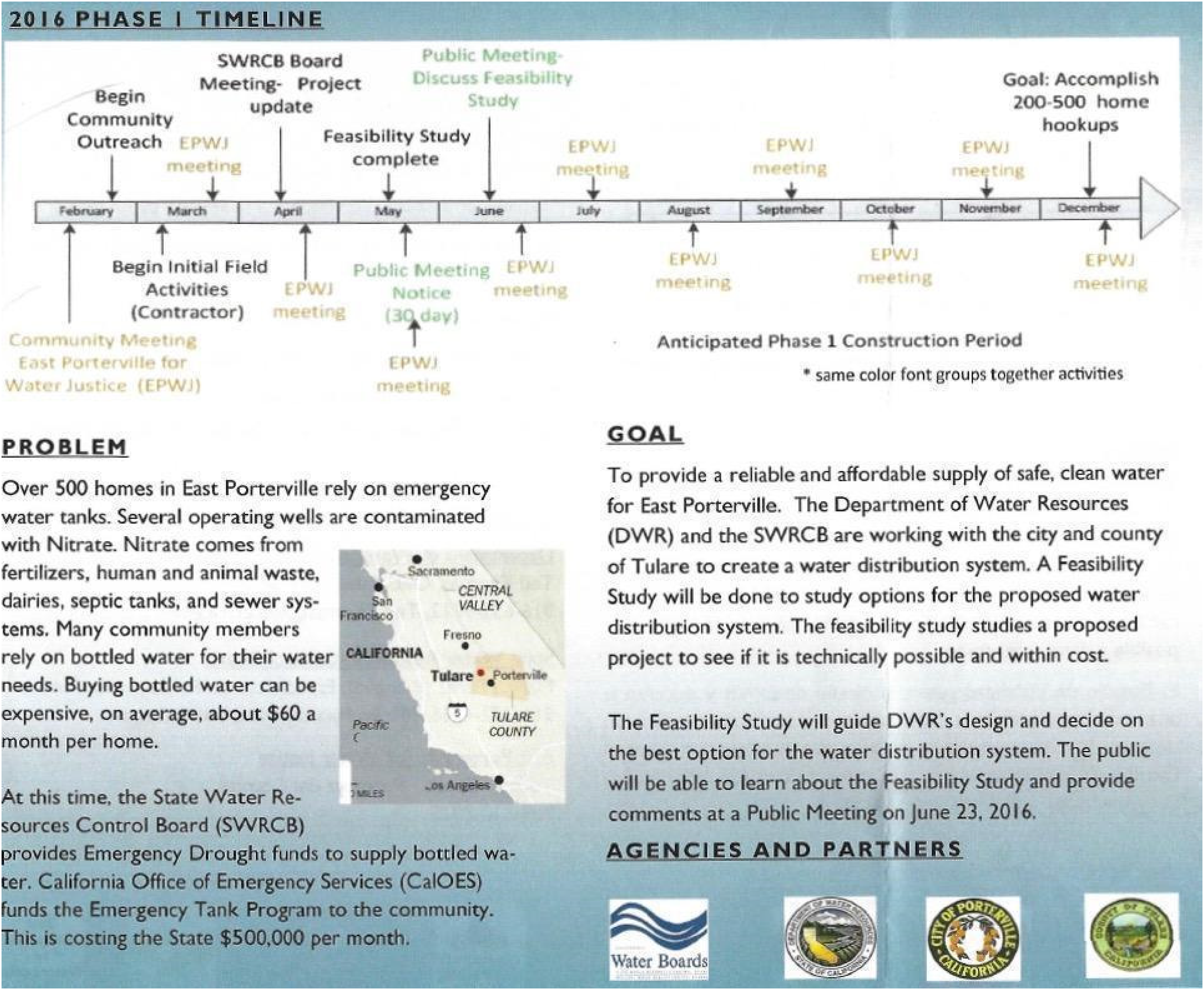
Scan of a bilingual handout from the June 2016 meeting where DWR presented their proposed approach to the residents of East Porterville. This snapshot cuts off additional partners: Self Help Enterprises, Porterville Area Coordinating Council, and East Porterville Water for Justice (EPWJ). Source: Documentation provided by DWR at a June 2016 community meeting in East Porterville.
As the agencies communicated during the June 2016 public meeting to discuss the feasibility study, “State emergency assistance is going away, if you don't sign up to connect to the city, you’ll be responsible for securing your water supply” (pers. observ., Community Meeting, June 2016). Government officials explained that they cannot continue to pay the monthly cost to deliver emergency water. Notably, this project was also available to households that did not yet have a dry well. As a result, nearly anyone in East Porterville was eligible, officials at the meeting explained: “Even if you have a working well right now, there is a risk if you choose not to connect—it's free now, and may not be later” (pers. observ. Community Meeting, June 2016; Figure 3). The state estimated that households who signed up later, they may be subjected to out-of-pocket costs of up to $10,000 per connection. As one journalist estimated in mid-2015, it could actually cost a household more than $17,000 to get connected to the City's water supply (Ballard, 2015).
Ultimately, between Phase I (completed March 2017) and Phase II (2018) of the $48 million East Porterville Water Supply Project, more than two-thirds of the eligible households (755 of 1100 homes), around 2500 people, were connected to the City of Porterville's drinking water distribution system (DWR, 2018a). Because of the drought emergency, local, state, and federal agencies worked together and more expeditiously than they would have otherwise (London et al., 2021). Moreover, they leveraged various funding mechanisms to connect people without running water to a long-term solution within a few years. The speed at which this project was designed and implemented during the drought emergency was noted by one local advocate: “You have to go through a longer process without the emergency […] That's not a good solution if you’ve been waiting for years already” (Grossi, 2017).
Outside of a drought emergency, East Porterville residents should have had more time to seriously consider the alternative scenario of creating a new small, non-profit water system with deeper municipal wells they could have locally managed. As one community organizer summarized, “there is a fundamental ethos to pursue projects they have chosen themselves” (pers. comm. Local Water Advocate). Scholars corroborate our interviews and demonstrate that, despite the plethora of challenges associated with managing a small water system, small communities often still like to manage their own systems (Dobbin, 2021). According to a project manager from Self-Help Enterprises who works to connect communities in Tulare County to more reliable sources of water, there is distrust from small communities who typically self-supply or rely on small water systems towards bigger, city-run systems. While integrating previously excluded communities into centralized water systems may be the most technically feasible and reliable long-term solution to water insecurity, questions of trust that build on the legacy of unincorporation and exclusion still pervade implementation efforts (cf. Wilson et al., 2022).
Discussion
In this paper, we sought to understand how climate and water justice can be advanced through engagement with governance processes. Drawing on archival information, spatial analysis, participant observation, and semi-structured interviews, we analyzed water injustice in East Porterville, California through historical and contemporary municipal-scale processes of infrastructure development and exclusion.
We began by highlighting the historic refusals of local agencies to extend public water and sewerage infrastructure to racialized and low-income communities—a process referred to as “municipal underbounding” (Aiken, 1987). Municipal underbounding is commonly rationalized through the colorblind language of government solvency and fiscal responsibility. In other words, local and state agencies prioritize dollars and cents at the expense of providing a basic and non-substitutable human need (London et al., 2021). The apathy, or outright refusal, to extend water to “non-viable” unrecognized communities (London et al., 2021) is inseparable from their perceived deservingness of clean water and ability to cover the costs for water—both of which emerge from and prolong the effects of systemic racism. The underbounding of low-income communities of color reflects the larger acceptance of segregation and racialized notions of identity in the United States, protected through the “neutral” shield of infrastructure. Yet, when confronted with exacerbated water insecurities due to climate change, the extension of municipal water infrastructure was rationalized as a fiscal responsibility in East Porterville. A lack of long-term and inclusive planning resulted in untenable emergency water provisioning at a steep cost. The de-politicization of annexation as once economically impossible, and now economically preferable when confronted with climate change, unmasks the racialized politics of water service extension.
We argue that the service extension and annexation of East Porterville should not be uncritically viewed as necessarily contributing to water and climate justice, which we understand as complementary objectives (Mills-Novoa et al., 2022). To explain this position, we refer back to the four dimensions of environmental injustice from “Situating citizenship and belonging through water infrastructure in ‘the global South within the global North’”: recognitional, procedural, distributive, and restorative (Fraser, 1995; Táíwò, 2022). These dimensions are reinforcing of one another. Without recognition, participation cannot be meaningful; without meaningful participation, the identified “solutions” are not fair and representative; without fair and representative processes and solutions, reparative and restorative justice cannot be realized (Táíwò, 2022). Water and climate justice, then, demand integrated attention across these dimensions.
However, what we observed in East Porterville was a fait accompli-a solution that had essentially been predetermined by state agencies before community members could seriously entertain other alternatives (cf. Zhou and Dai, 2021). Procedurally, when state officials were confronted with a diversity of perspectives and approaches preferred by different actors, they resorted to constraining the range of solution options for East Porterville residents. Since residents had to agree to annexation to the City of Porterville to access water service extension while the Emergency Household Tanks Program was discontinued, this meant that residents could either join the state-led solution or wait until their domestic well recovered after the drought without the safety net of emergency assistance. Predictably, municipal infrastructure extension was not perceived as the only, or perhaps even the most desired mechanism to address the disproportionately larger risks lived by marginalized communities. In practice, residents' preferred water management choices were profoundly shaped by the relationships they have with the state. In this case, systemic exclusion from decision-making processes and distrust in the implementation strategy reproduced many aspects of recognitional, procedural, distributive, and restorative injustice experienced by marginalized groups (Méndez-Barrientos, 2021).
That water is unjustly governed and distributed has been the impetus for theorizations about what water justice entails, and how it could and should be achieved (Boelens et al., 2018; Knudson et al., 2022; Neal et al., 2014; Nikolakis and Quentin Grafton, 2014; Sultana, 2018; Zwarteveen and Boelens, 2014). From our case, the challenge for justice advocates, however, is not whether or which approach—be communing (society-centric) or state-extended services (state-centric)—is technically better, but rather, how community concerns, values, and interests intersect to render these strategies more or less desirable (e.g. Karner et al., 2020). Neglecting meaningful recognition and inclusion in shaping the solution space of urban climate justice cannot and do not amount to governance, but rather, constitute another way in which status-quo state-society relations are re-produced. In the context of climate change and increased hydrosocial pressures, this finding echoes the importance of relational justice (Jepson et al., 2017; Mills-Novoa et al., 2022; Sultana, 2018), which stresses “understanding how diverse people experience and define justice within a specific context, history, and time” over “universalising transcendent approaches, disembedded from human experiences” (Joy et al., 2014: 965). Herein, we argue that advancing urban climate justice in California, and beyond, demands greater focus on the recognition of historical and on-going processes of infrastructural marginalization, which mediate the uneven experiences of climate-related impacts in urban spaces (cf. Chu and Michael, 2018).
Circling back to our initial discussion, citizenship is not just about receiving a service or a resource, in this case, connection to the City of Porterville's municipal water system. It is also about recognizing communities as “users” and including them as “problem-solvers” in defining what justice means and how it is to be advanced (Chu and Michael, 2018; Fraser, 1995; Joy et al., 2014; Schlosberg, 2004). Yet, East Porterville was considered “non-viable” for service provision, and even when services were extended, residents remained “non-viable” as citizen-actors in long-term planning, as clarified by the performative and compulsory “consultations” with community members and the dismissal of an alternative choice: a community-managed water system. The case shows how pursuing what may otherwise superficially be seen as distributive justice via service extension remains disconnected from residents’ preferences, values, and interests as mediated through their relations with the state. Hence, to even beginning a process toward climate and water justice requires addressing the relations that fostered marginalization in the first place (Jepson et al., 2017).
Conclusions
This paper showed how a perceived lack of citizenship and belonging of East Porterville residents, both as deserving water users and as part of solution-creation spaces, shaped the kinds of water projects ultimately chosen to redress water insecurities. This recognitional injustice prevented the meaningful participation and shaping of water security interventions for residents in East Porterville (i.e. procedural justice). That is, even with “solutions” for the community, the underlying factors that create injustice, to begin with, were, and continue to be ill-addressed. To achieve water and climate justice, engagement with governance interventions must thus move beyond attention to the symbolic and towards restoration and reparations (Táíwò, 2022).
We have underscored that community collective action or “commoning” approaches are not homogeneous. Attention to the diversity of perspectives and approaches preferred by different actors is crucial for supporting more just and inclusive infrastructural development processes. These findings clarify the importance of foregrounding value and knowledge pluralism to advance equitable reconstitutions of hydrosocial territories in the pursuit of water security and climate justice (Fernandez-Bou et al., 2021; Mills-Novoa et al., 2022; Ziervogel et al., 2017).
Highlights
In climate emergency contexts, extending municipal service infrastructure may be advanced under the guise of fiscal responsibility.
The depoliticization of annexation obfuscates the distributive politics behind decisions that define who benefits and who loses in water service extension.
Municipal infrastructure extension is not perceived by local communities as the only, or perhaps even most desired, mechanism to address water insecurity.
We argue for value and knowledge pluralism to advance water security and climate justice.
Footnotes
Declaration of conflicting interests
The author(s) declared no potential conflicts of interest with respect to the research, authorship, and/or publication of this article.
Funding
The author(s) disclosed receipt of the following financial support for the research, authorship, and/or publication of this article: This work was supported by the National Science Foundation (Grant No. 2036201).
