




Abstract
The role of urban regions in action on reducing greenhouse gas emissions has become increasingly central to global urban governance over the past 20 years and particularly after new promises and agreements made at COP21. Despite some attention across urban studies, the need to interrogate how new forms of urban carbon governance are transforming infrastructure space remains pressing. This paper examines the low-carbon restructuring of the waste system in Mbale, Uganda, a town struggling to address its socio-ecological futures. The paper asserts that a UPE approach to how urban carbon governance is materialised advances three particular concerns; the governing of urban circulation, carbon capital and socio-material relations. Through examining these, the paper shows how global actors are increasingly involved in low-carbon transformation, use places such as Mbale as spaces of experimentation and dominate the governing of this restructuring. Yet out of such unjust processes new forms of contestation and low-carbon politics may emerge.
Introduction
Acknowledging the role of carbon-intensive urbanisation in the production of climate change has come to the fore of contemporary debates on managing global circulations of carbon, such as at the COP21 in Paris (Tollin, 2015). Resulting studies have been particularly concerned with the ways in which multi-scalar governance is reshaped to address the urban dimensions of climate change in the 21st-century. This has examined the critical role of local intermediaries in addressing greenhouse gas (GHG) emissions through mitigation efforts (Bulkeley and Betsill, 2003, 2013; Jonas et al., 2011; Revi, 2008; Wheeler, 2008). Emerging from this work on urban carbon governance has been a growing focus on the role of infrastructure space and the materialities of low-carbon transformation across socio-technical networks. Such work has been especially prominent across the energy sector (Aylett, 2013; Bulkeley et al., 2010; Monstadt and Wolff, 2015; Rutherford and Coutard, 2014). However, within these studies, the dynamic role of capital (understood here as carbon capital) in shaping the techno-politics of infrastructure and its restructuring have not been especially prominent. This is in contrast to political economic studies of carbon markets, prompting new vocabularies in considering the expansive role of capitalism in the governing of the climate crisis (Newell, 2012). Yet this work tends to focus beyond cities, either on the operations of the markets themselves (Bond, 2011, 2012; Boyd et al., 2011), or on natural resources, such as forests (Corbera, 2012). The result is such studies have neglected the material transformations that carbon capital is enabling across urban regions.
The paper contributes to debates on the climate crisis and urbanisation through arguing that urban political ecology (UPE) (Keil, 2003, 2005; Swyngedouw and Heynen, 2003) provides a critical set of tools to examine urban carbon governance. The paper seeks to expand understanding and critical analysis of the techno-politics of governing cities in a climate change(ing) world. The paper mobilises Marxist concerns within UPE through attention to the socio-materialities of restructuring these networked systems, drawing analysis to the governing of urban circulation, new flows of carbon capital across urban regions and the ways that power relations are being reshaped. This task is pressing as carbon financing, mitigation imperatives and low-carbon urbanisation become central to global, urban planning designed to avert the worst of the climate crisis (Tollin, 2015; UN-Habitat, 2011a). Such significant potential transformation requires explanatory frameworks that can interrogate and scrutinise the resulting spatialities, particularly across the earlier examples of low-carbon urbanisation. Here critical studies of these transformations are vital in contributing toward struggles for urban climate justice (Bulkeley and Betsill, 2013; Steele et al., 2012), particularly in the aftermath of the Paris Agreement (Tollin, 2015). Additionally, there are growing connections between climate action and demands for urban service provision (Parnell and Pieterse, 2014) emerging from the Sustainable Development Goals and Habitat III agendas (Parnell, 2016). These policy imperatives show the need to develop critical analysis, through empirical cases, to better understand the processes and outcomes of low-carbon transformation across towns and cities. If the future is urban (UN-Habitat, 2016) then how authorities implement and operate the infrastructure systems underpinning low-carbon futurities presents one of the major challenges in the governing of global environmental change and the current wave of global urbanisation (Simon, 2010).
The argument is advanced through a case study of Mbale and the experiences of this eastern Ugandan town. The case study examines the waste system as it is restructured to capture methane emissions through a new World Bank initiative of the Clean Development Mechanism (CDM), 1 the Program of Activities (POA). Planned to test new forms of carbon financing, technological innovation and ways of governing both urban and atmospheric resource flows the, ‘Uganda Municipal Waste to Compost Program’ provides an important and early example of the growing role of carbon capital in shaping infrastructure space (World Bank, 2012).
In examining the socio-material processes and outcomes of this restructuring in Mbale through UPE, the paper argues responses to climate change across towns and cities are being imposed by more powerful, transnational actors. These intermediaries are realigning the governance of networked systems into new multi-scalar arrangements that shift management of material circulations of waste and GHG emissions beyond the urban scale. It goes on to assert this restructuring of infrastructure is predicated on the difficulties faced by municipalities in securing investment, allowing them to become spaces for experimentation in new (and commodified) forms of urban carbon governance. Here, the World Bank is able to exert power and financialise local resources, in order to pilot, test and develop neoliberalised operation and management of low-carbon, urban infrastructure. Furthermore, risk of failure, whether operational or financial, is assigned and concentrated at the local scale. This is in conjunction with marginalised groups facing new socio-environmental inequalities. The paper cautions that emerging evidence from Mbale suggests that what Parenti (2012) has termed, ‘the violence of climate change’ is likely to be experienced not just from the unfolding socio-ecological crisis but from the restructuring of infrastructure space, instigated through urban carbon governance. But these transformations are not uncontested. The paper goes on to argue that new forms of localised low-carbon politics and political possibilities at the urban scale may become visible, offering alternative imaginaries for post-carbon and post-capitalist transitions beyond the fossil fuelled ‘capitalist present’ (Chatterton, 2016).
Understanding what happens in places like Mbale is important. Whilst the town may be on the periphery of debates concerning global urban futures it is simultaneously being used as a space for ‘climate change experimentation’ (Bulkeley and Castán Broto, 2013). The paper argues the intention of this experimenting is to find ways of upscaling low-carbon models of restructuring across urban regions. As the World Bank (2010b) asserts, ‘it serves as an example for many other African countries to design and implement large scale mitigation activities.’ Mbale then offers a case study of how the operation of infrastructure becomes entwined with global flows of carbon capital and new arrangements of multi-scalar, urban (carbon) governance that may prefigure futures elsewhere. The World Bank (2010b) goes on to claim, ‘the program represents many “firsts” in the carbon finance community.’ The urban experience of Mbale is common for many sub-Saharan African cities as they face multiple developmental and environmental challenges (Parnell and Pieterse, 2014; Simon, 2010). And these new models of governance and financing may also be deployed to cities beyond the global South. This would echo the historical development of neoliberal (urban) economics as an imposition on global South countries, ‘tested and rolled out’ before returning to the North (Harvey, 2003: also see Prashad, 2013). Furthermore, studies from the so-called periphery can contribute to what Comaroff and Comaroff (2012: 113) term an, ‘ex-centric vantage point’ as ‘a source of theory and explanation for world historical events.’ In this case the transition to low-carbon forms of urbanisation. Such efforts are vital to contributing towards global knowledge and politics concerned with the climate crisis.
A UPE of urban carbon governance
Scholarship on the carbon governance of cities is increasingly visible across urban studies (Bulkeley and Betsill, 2003, 2005a, 2005b, 2013; Jonas et al., 2011; Revi, 2008; Wheeler, 2008; While et al., 2010). Work on the ‘carbonization of urban governance’ (Rice, 2014) has helped to critically interrogate the ways in which intermediaries attempt to address low-carbon concerns. These include the reconfiguration of governance relations within and between cities (Acuto, 2013; Bulkeley et al., 2010) and attention to new or adjusted forms of resource circulation across urban infrastructure systems (Bulkeley and Castán Broto, 2013). While et al. (2010: 82) argue that processes of eco-state restructuring are now focused on ‘carbon control’, creating a, ‘distinctive political economy associated with climate mitigation in which discourses of climate change both open up, and necessitate an extension of, state intervention in the spheres of production and consumption.’ These material interventions are increasingly focused on transformations of infrastructure space, understood as central to the unfolding low-carbon transition (Edwards and Bulkeley, 2017; Hodson and Marvin, 2014). Yet within this literature that has usefully helped examine the new and shifting intermediaries involved in this governance (Guy et al., 2011) and the ways in which the circulation of resource flows are being shifted (Edwards and Bulkeley, 2017) there has been a lack of explicit focus on the crucial role of carbon capital. Understanding the dynamic nature of new (or promised) circulations of carbon capital in transforming infrastructure space and broader urban spatialities is important in extending debates about ‘carbon control’ (While et al., 2010). Interrogating the socio-materialities that these financial flows are precipitating provides a means to consider how responses to climate change are beginning to reshape cities and with what implications.
In related work on the carbon markets studies have shown responses to the climate crisis are generating new forms of natural resource capitalisation (Böhm, 2009). This process has been understood as the ‘privitisation of the air’ (Bond, 2011, 2012), or the ‘enclosure of the atmosphere’ (Sharife, 2011), or even as a new form of coloniality (Bachram, 2004). These provocations demand attention at the urban scale and to be integrated with research on the carbon governance of cities yet have so far been limited (see for example Sharife and Bond, 2009 and Bond, 2012 on the controversy surrounding the CDM transformation of the Bisasar Road waste site in Durban). This work needs to examine whether the operation of carbon markets within urban regions may also be facilitating new and expanding processes of capitalisation and capital accumulation (Layfield, 2013; Liverman and Boyd, 2008) or the protection of the existing carbon industrial complex (Splash, 2010), in ways that might mirror carbon financialisation taking place beyond city boundaries.
It is this intersection or analytical gap, between concerns within studies of urban carbon governance, that have examined intermediaries and new resource circulations, alongside the political economic work on the carbon markets, that can be addressed through a UPE. This is a sub-field concerned with the socio-material processes implicated in the urbanisation of nature and the resulting unequal power relations these conditions produce (Keil, 2003, 2005; Rademacher, 2015). As Swyngedouw and Kaika (2014: 462) argue the urban is, a socio-spatial process whose functions are predicated upon ever longer, often globally structured, socio-ecological metabolic flows that not only fuse objects, nature, and people together, but do so in socially, ecologically and geographically articulated, but depressingly uneven, manners.
Considering the inherent socio-materialities of planetary scale(s) of carbon across and through urban regions it is surprising how little work has been undertaken within UPE on the climate crisis and urbanisation given the politicised natures of concentrations of GHG emissions and flows of carbon capital. A UPE study of these processes would begin from the perspective that new circulations of finance and shifting resource flows at multiple scales are likely to produce new, unequal socio-spatial relations across the networked systems of urban regions (Heynen et al., 2006; Swyngedouw, 2004). As such this paper advances three contributions to how studies on urban carbon governance can be expanded through UPE. Firstly, building on a focus on circulation as crucial to the urbanisation process (Heynen et al., 2006) the paper illustrates the ways that flows of waste and GHG emissions are governed through the restructuring of infrastructure and the type of techno-politics that are constituted. Secondly, drawing on the crucial, dynamic role of capital-nature relations in underpinning (urban) political economy (Kaika, 2005) the paper examines how new or promised circulations of carbon capital operate and reshape infrastructure space. Finally, in responding to urban transformation as deeply politicised (Swyngedouw, 2004) the paper asserts that low-carbon restructuring engenders new forms of socio-material relation, shifting inequalities and emerging contestations.
Methodology
As the first urban-based experiment in the new POA for the CDM, was undertaken across Uganda the research focused on case study selection that allowed for detailed fieldwork of this new low-carbon initiative by the World Bank. Whilst a number of towns and cities participating in this restructuring could have been selected for the fieldwork Mbale provided a good example of the urban experience in Uganda (outside of the capital, Kampala) in terms of population, service delivery, municipal management and broader development concerns (UN-Habitat, 2011b). Furthermore, studies focused on the waste sector are important as energy is not the only infrastructure sector being restructured around low-carbon logics and objectives. A UNEP report (2010) argues, ‘the waste sector is in a unique position to move from being a minor source of global emissions to becoming a major saver of emissions.’ Waste can only make a relatively minor if important part of emission reductions over the next 50 years. However, it arguably takes on extra significance at the urban scale through the ability of authorities to control, operate and manage its circulations (Dhakal, 2010). Alongside the potentials bound up in capturing its material value (Bond, 2012) and in addressing under-funded waste system operations through new circulations of finance it is likely that waste infrastructure will become a crucial site of urban carbon governance.
This selection of Mbale was further strengthened through close personal connections in the region. Fieldwork was undertaken in Mbale and Kampala between 2013 and 2015, developed with the support of a research assistant, essential to undertaking this research (Apentiik and Parpart, 2006). The research was informed by 26 different actors being interviewed, with some of these being returned to throughout the process. Using existing networks and ‘snowball sampling’ (Noy, 2008) meant engaging the municipality, elected officials, a range of civil society groups, social movements, and local communities. Further interviewing was undertaken in Kampala with a number of Government Ministries and agencies, international institutions and NGOs. Three workshops of up to ten people were undertaken that encompassed the workers on site, health professionals employed at the hospital and members of the local Slum Dweller Federation (SDF).
The research also included site visits, especially to the waste facility. Access was negotiated with the municipality and after the initial visit, we were allowed to return. Further sites included a number of informal settlements, especially in the adjacent Doko Cell, to understand everyday waste issues through ethnographic practise. Finally, the collection of policy/planning documents relating specifically to the project were essential to understanding the specific process of project formulation and implementation, together with the broader local/national issues being faced around infrastructure investment, climate change mitigation and service delivery (UNDP, 2013; UN-Habitat, 2011b). Other key documentation was secured with the support of government officials including the project design (UNFCC, 2009), environmental impact assessment (World Bank, 2007), the application to the CDM and the validation (Aenor, 2010) and monitoring reports (UNFCC, 2013), alongside an extensive web-search for media accounts of the project.
Context and case study
Mbale and its socio-ecological challenges
A town in eastern Uganda, located in the foothills of Mount Elgon and close to the border with Kenya, Mbale has a population expected to double in size from 70,000 to over 150,000 between 2002 and 2022 (Mbale Development Plan, 2010). Mbale once had the reputation as the cleanest town in East Africa yet presently over 50,000 of its population are without adequate services needed for everyday social reproduction (UN-Habitat, 2011b). Reflecting broader urbanisation trajectories across sub-Saharan urban Africa (Parnell and Pieterse, 2014) Mbale’s future remains in flux and shaped by a series of complex socio-natural dynamics. These include intensifying floods and drought, through to the HIV/AIDs epidemic, an ongoing history of internally displaced persons and refugees (Stites and Akabwai, 2012) and even its status as a city (Mukwaya et al., 2010). Furthermore, the municipality has limited financial capacity, illustrated through the total of £5 million available for the 2015/16 budget (Ministry of Finance, 2016). This means the local government in Mbale has difficulties in operating essential urban services (UN-Habitat, 2011b), a common if variegated experience across cities both in the global South (Pieterse, 2008) and increasingly, in an era of austerity, the North (Hall and Jonas, 2014). The struggle to operate infrastructure such as water had one particularly striking outcome in a cholera outbreak in 2012/13 that showed the health problems generated from the inability to adequately run urban systems. As an SDF member (#3) commented, ‘Our people are so vulnerable as people are forced to use drainage water that connects to disease.’ UN-Habitat (2011b) suggests these problems were down to years of municipal under-performance including its relations with the national authority charged with waste services, the National Environment Management Agency (NEMA). These existing conditions suggest that Mbale’s reputation as the cleanest in East Africa has faded over time with it described by media commentators in Uganda media as, ‘a shadow of its past’, 2 ‘gone to the dogs’ 3 and even a, ‘tragedy.’ 4
Perhaps most important to considering the techno-politics of infrastructure in Mbale is the town’s fiscal position in relation to these service provision demands. Like urban regions across sub-Saharan Africa investment in infrastructure remains a fraught and difficult process in the context of ongoing struggles to finance, manage and operate essential resources flows underpinning what Parnell and Pieterse (2014) term Africa’s ‘urban revolution.’ Securing necessary finance in the context of what Demissie (2013) describes as the, ‘imperial legacies and postcolonial predicament’ of urban Africa is rarely straightforward. Such investment geographies require authorities to connect to financial flows at the national scale, themselves reliant on transnational institutions such as the World Bank (Obeng-Odoom, 2013). Despite ongoing decentralisation for urban authorities, including across Ugandan towns (Saito, 2012) and incorporating the waste sector, municipalities have effectively been given responsibility for these urban services without the local tax base or revenue to sustain operations (Muhumuza, 2008; Okot-Okumu and Nyenje, 2011). This fiscal context has meant that the municipality is forced, through its financing predicament and growing socio-ecological challenges, to seek new multi-scalar financing relations that may offer investment across the town’s infrastructure space.
The multiple demands facing authorities and urban dwellers alike will be aggravated through the unfolding climate change crisis in eastern Uganda. The increased frequency of mudslides around the town, killing dozens over the least few years, alongside growing insecurity over future viability of economically important coffee growing (UNDP, 2013), are but two present indicators of the climate crisis in the region. These bio-physical shifts and associated socio-ecological dynamics are evidenced by new meteorological patterns that already include an overall increase in temperature between 1961 and 1990, projected to rise a further two degrees celsius by 2060 (UNDP, 2013). This temperature increase will occur alongside lowering but more intense rainfall and increased incidences of extreme weather (UNDP, 2013). As a UNEP policymaker (#4) commented climate change will have important effects that will instigate, ‘multiple vulnerabilities being faced by communities around livelihoods and particularly agriculture.’ Like other Ugandan urban regions Mbale’s existing infrastructure systems face both the perils of underinvestment and municipal decline in a long era of structural adjustment, together with ever-growing intersections and imperatives emerging from the climate crisis (Lwasa, 2010).
The ‘Uganda Municipal Waste to Compost Program’
The aim of the ‘Uganda Municipal Waste to Compost Program’ initiated from 2005 was to, ‘reduce emissions of CO2 by recovering the organic matter from municipal solid waste as compost and avoiding methane emission’ (Aenor, 2010: 5). In addition to the central objective of reducing GHG emissions under-resourced municipalities such as Mbale were provided with investment for much needed upgrading of infrastructure to address serious issues of waste management across the country (UN-Habitat, 2011b).
The program was being actively planned from 2007 onwards through the World Bank, the key actor involved in its inception, the NEMA, which is tasked with co-ordinating and implementing the project and eight municipalities, as the partners responsible for operating the new waste systems. The Government of Uganda financed the project through a loan from the World Bank under the ‘Environment Management and Capacity Building Project-II’ providing NEMA with the $421,000 needed to establish each of the eight such facilities (Aenor, 2010; UNFCC, 2013). The loan for this large capital investment from NEMA was intended to be paid back by municipalities through anticipated revenues generated through selling carbon credits on the carbon markets. Further costs included an upfront investment of over $85,000 from the municipality and fiscal responsibility for ongoing operation and management of the restructured waste system.
This initial investment contributed to the preparation of a suitable site (in Mbale this was on the existing waste facility), alongside the equipment required for collection and processing (primarily skips and a collection vehicle). The restructuring of the waste system was designed for collection to be expanded to 28 points across the town for processing on a regular basis. Garbage was to be taken to a nearby facility in the industrial zone and transformed through an aerobic composting process, thereby curtailing emissions of methane (see Figure 1). The compost was then intended to be sold to local farmers, with revenue envisaged as another income stream to sustain ongoing operations. The system was designed with a collection capacity of 70 tonnes of garbage per week and to operate for up to fifteen years (Aenor, 2010). It was hoped that the restructuring would provide a comprehensive infrastructure solution to address the problems of waste in a low-carbon, sustainable manner. As a municipal official (#12) noted, ‘We thought we had made a breakthrough with our waste management.’
The transformation of waste to compost in Mbale (photos by author).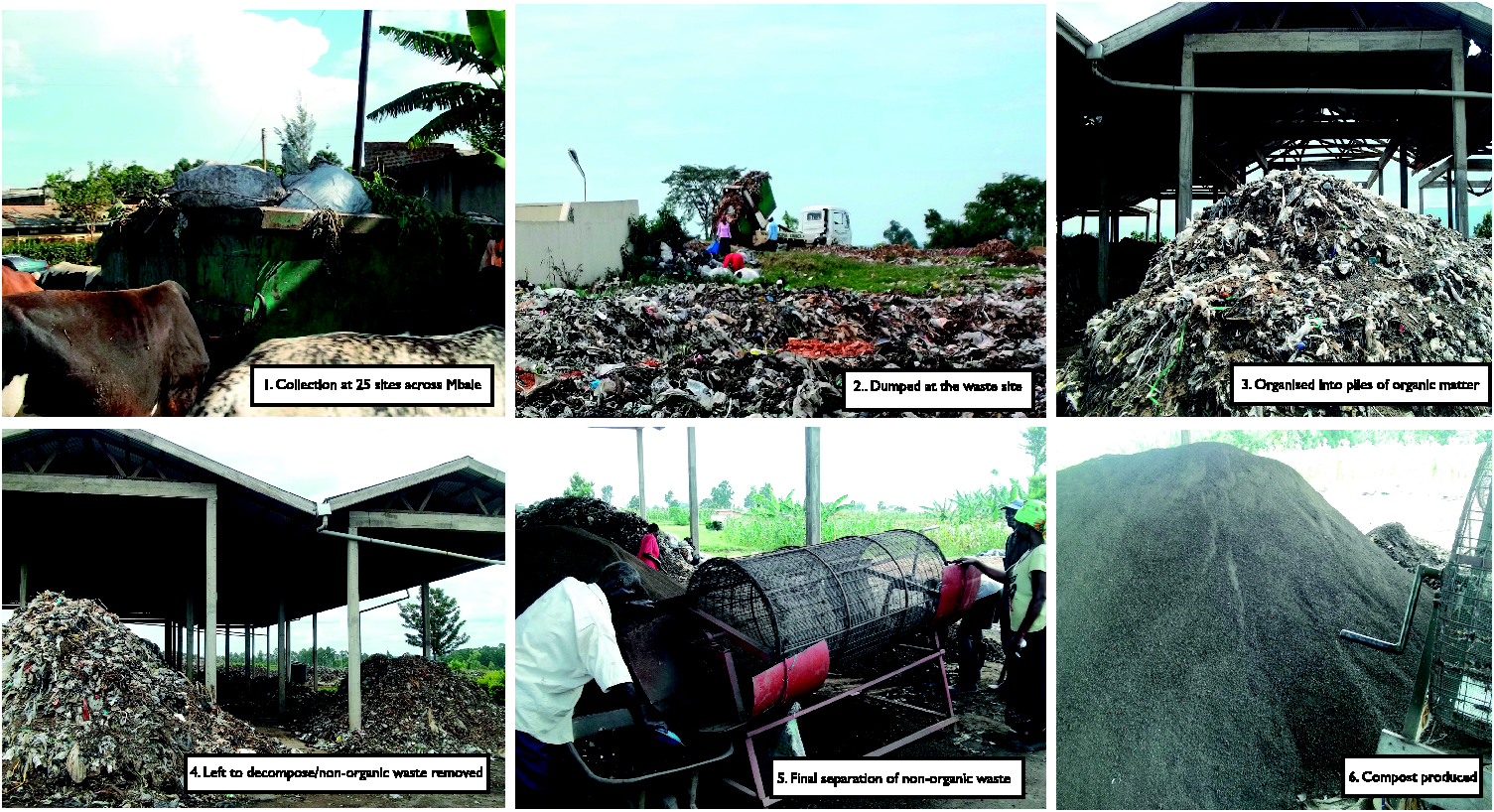
The financial architectures
The restructuring of Mbale’s infrastructure space was conceived by the World Bank as part of their ongoing agenda to develop new low-carbon financed transformation across urban regions (World Bank, 2010b). It was established through a PoA which is a, ‘recent facility under the Clean Development Mechanism of the Kyoto Protocol, the world’s main carbon credit scheme’ (Climate Focus, 2011: 8) (see Olsen, 2007 for an overview of the CDM). The premise of the PoA, and key difference with CDM projects beforehand, is the possibility to register the coordinated implementation of a policy, measure or goal that leads to GHG emission reduction across a series of sites. Once a PoA is registered, an unlimited number of component project activities (CPAs) can be added without undergoing the notoriously long, costly and difficult verification process (Bryant et al., 2015). This has provided the opportunity to ‘bunch’ a series of GHG emission reductions across infrastructure space either within one or across regions, providing the opportunity for cities to be better integrated in the CDM. The motivation for the development of PoAs was to address the difficulty for towns and cities in accessing investment through the global carbon markets by including replicable projects with low and distributed GHG reductions into the CDM. This provides the opportunity to bunch a series of GHG emission reductions across a series of sites and support investment into low-carbon projects unsuitable to previous verification processes (Climate Focus, 2011). In Mbale, the PoA was being piloted and tested, producing an important moment of what Bulkeley and Castán-Broto (2013) have termed, climate change experimentation. In this case for the World Bank to make a success its claims, that the increasingly maligned carbon markets (Bond, 2013), can support low-carbon and development objectives for cities (Climate Focus, 2011). Despite the modest GHG emission savings, estimated in total across the lifetime of all the municipalities, at less than 60,000 metric tonnes of equivalent CO2 (Aenor, 2010), it was the first PoA in Africa. It has therefore served its purpose as an urban located, carbon finance intervention (World Bank, 2010a).
The project was registered by the CDM Executive Board in 2010 as part of the methodology, ‘Avoidance of methane emissions through composting’ (UNFCC, 2013). The PoA was verified in 2013 resulting in the issuing of 16,549 Certified Emission Reductions (or carbon credits) from the CDM (equivalent to $215,000 per annum across all eight municipalities as estimated in 2010 but likely to be less in early 2016). It is the intention of the World Bank (2010a) to sell these carbon credits to its own Community Development Carbon Fund (CDCF). The municipality in Mbale were informed at the inception of the project of anticipated revenues of up to $26,000 annually but these have yet to be received. As a national government official (#2) noted, ‘though we have finished the verification process we can't be sure how much and when the money will start to flow.’
Planning and preparation
Planning of the project was led by the World Bank and NEMA within a implementation framework that municipalities subsequently adhered to (UNFCC, 2009). In 2007 agreements between municipality and NEMA were made and later in the year preparatory works began in anticipation of the official commencement of the programme in October. As part of the planning process the relocation of waste-pickers, particularly from around neighbouring Doko Cell was deemed necessary for the preparation of the waste processing facilities. In reality up to 25 waste-pickers with another 50 or so working on related recycling nearby had to be moved from the land before construction could proceed, as reported by multiple sources including the ‘resettlement plan' (NEMA, 2012).
A planning process with community consultation was also expected. The validation report (Aenor, 2010: 28) suggested, ‘local communities have been consulted and have demonstrated their support for the development of the programme.’ Furthermore, a range of community benefits were promised after plans for the restructuring were announced (NEMA, 2016). They are reported by the World Bank (2015) to include, ‘the construction of a schools, latrine pits, health centers and roads; the provision of scholastic materials, energy saving stoves for households….’
Operation and disruption
The operation of the restructured, waste system began in 2009 with the technology, procedures and personnel in place in Mbale. Up to 23 workers began operations on site, being paid 40,000 shillings a month (around £10 per month) for the compost processing. This was supplied by the ongoing flows of waste collected by a new vehicle and crew across the various collection points planned to extend across the town. There have been a series of operational challenges in sustaining this new form of waste circulation between households, businesses and the compost processing facility. These included the lack of adequate equipment to manage the higher than anticipated levels of waste, the breakdown of key technology, in particular the only collection vehicle and most damaging, the ongoing issues with the contracting to a private operator. This incorporated issues with the tendering process, disagreements on when operation would begin and payment disputes. The municipality have been forced to change contractors on two occasions due to a failure to fulfil the terms of agreement and yet still found it difficult to hold the private operators to account.
In late 2013, the collection of waste and the compost processing had again ceased, this time due to a strike by the workers with labour conditions described by a community leader (#2) as, ‘terrible.’ The pay for the workers collectively adds up to a limited 25% of the monthly payment to the operator from the municipality. Such poor wages attracted only the poorest of Mbale, rather than locals in Doko Cell promised employment, with workers travelling from various parts of the town, many of them older and in bad health. The failure to pay the workers during parts of 2012, 2013 and into 2014/15 has meant that they have regularly withdrawn their labour. Hence, the operation of the infrastructure has been disrupted not just through technological malfunction and breakdown, or lack of anticipated revenues but through the self-organisation and withdrawal of labour by the workers. By early 2016, the collective strike action of the workers, alongside growing frustration at the municipality had been successful in securing an improvement in conditions as the contract ended and the private operator was replaced. This has led to a significant rise in the wages to 70,000 shillings (around £18 a month), the issuing of personal protection equipment for use during hazardous processing, and even promised tea and sugar which had been denied by the previous contractor. The waste system is now partly functioning but struggling to keep up with the amount of garbage generated in Mbale and the limitations of the existing technology. Furthermore, without any revenue from the CDM and with little success in selling significant amounts of compost to local farmers, in an already fertile agricultural region, the municipality is struggling to generate sufficient finances required for everyday operation and maintenance.
Waste(d) infrastructures
The governance of low-carbon restructuring
The first series of concerns that need elucidating in a developing UPE analysis concern how circulations of GHG emissions and waste have been governed through the restructuring of infrastructure in Mbale. This involves considering the intermediaries and power relations in relation to the capacity to impose particular visions of urban resource circulation (Swyngedouw, 2004). Or as Rice (2014: 390) eloquently argues, ‘The socio-material focus of UPE demonstrates how carbon is central to the urban metabolism of nature, both as a material object that makes urban climate interventions possible and a political project that reproduces the city’s political economy.’
The governance involved in the restructuring of infrastructure in Mbale did not come about through a democratic or open process of urban planning. Rather this way of managing the waste system vis-a-vis the CDM can be considered as imposed through a powerful transnational actor that has shaped the possibilities and scope of transformation through a low-carbon, market orientated restructuring. This was undertaken whilst assigning much of the risk of failure, such as operational or financial, at the local scale. Here, we can see how the World Bank played a pivotal role in the flows and transformation of (formerly localised and at times unstable) circulations of waste in Mbale. This gave NEMA, and more so the municipality, little capacity to actively shape the program design, leading to accusations of, ‘throwing their weight around’ by a municipal official (#12). Under the fiscal conditions faced by local government in Uganda, the power relations of urban carbon governance are in this case constituted through weak municipal capacity, allowing the World Bank to impose its vision of low-carbon restructuring whilst also proclaiming that, ‘The entire program is voluntary in nature.’ 5 The process and outcome are therefore predicated on the institutional concerns of the World Bank and those of its corporate and financial backers coming to take precedence over the people and civic institutions of Mbale. This emergent governance of urban circulation connects to much longer histories of structural adjustment and take-over of urban management by institutions such as the World Bank and IMF (Harris and Fabricius, 2005).
Local policymakers were clear in their assessment of who was in control of the restructuring and the ways in which it has reinforced historic and existing power relations between under-resourced municipalities in Uganda and the World Bank. In terms of the ability to address local socio-ecological challenges and shape its own future, the municipality was sidelined. As a municipal official (#5) commented about the design of the project, ‘they came up with plan and we provided land, we didn't participate.’ This contention was supported by an elected official (#3) who questioned whether the project was the best solution for waste management in the town and asserting that, ‘If we were given opportunity would have prioritised investment in landfill.’ Instead the municipality was left with the responsibility to ensure ongoing operation and maintenance for what might be understood as an infrastructural imposition. Here, it is important to connect the unfolding governance of low-carbon restructuring into the shadow of wider macro-economic transformation as structural adjustment continues to shape capacities and potentials of towns and cities in Uganda (Branch and Mampilly, 2015; Lie, 2015). This is a fiscal context in which the Government of Uganda (2010: 3) has, ‘adopted a policy of public-private partnership as a tool for the provision of public services and public infrastructure.’ This turn toward the private sector across municipalities has been intensified through ongoing World Bank led reforms, especially concerning procurement from the late 1990s onwards that have effectively privatised many municipal services (Guma, 2016). In this case study, the public–private partnership, a standard outcome of neoliberal governance (Brenner and Theodore, 2005) is extended into circulations of urban resources. This is undertaken through mobilising low-carbon concerns, alongside the promise of (much needed) investment and future revenues to local partners. The logics of this low-carbon restructuring meant that the municipality was unable to operate the waste system as a public service. It was forced to use a private operator and unable to participate in decision making about the conditions of infrastructure investment. As a senior official (#17) contended, ‘The contractors and the management of this contract is one of many challenges, he takes the money but when you look at what the outputs are [they are] just not there.’
There was sustained criticism beyond the municipality concerning the governance of this low-carbon restructuring and the power relations it both exposed and served to reinforce. The anger was articulated by SDF as they claimed to have been ignored during planning and implementation, coupled with the failure of a whole raft of promised community benefits from the World Bank (2015). As far as SDF was concerned, these benefits were nothing more than broken promises with little being delivered across Mbale’s marginalised spaces. Furthermore, the failure to operate the waste system as intended has meant under-serviced neighbourhoods continued to experience waste management issues, and resulting in vulnerabilities to socio-environmental hazards such as cholera. The waste to compost project was supposedly designed to address particular local imperatives but it became evident for social movements and civic organisations that these were simply not being addressed. The implications of which being serious, in that waste would continue to create precarious socio-ecological conditions for some of Mbale’s poorest residents. Other potentially democratic, or at least ‘participatory’ governance possibilities for Mbale to improve waste management, were foreclosed through the imposition of this restructuring. A municipal official (#5) explained, ‘the community should dispose of their own waste.’ And yet the centralised nature of the infrastructure meant that, ‘people see it as a government problem, not theirs’ and explained that, ‘this is a World Bank project with its own set of guidelines, they have their own ways.’
The fiscal conditions and multitude of socio-ecological challenges faced by the municipality in Mbale, became productive for the World Bank by allowing the institution to impose its own vision of urban carbon governance. Here, the case study provides an example of what Rice (2014: 385) terms the ‘territorial politics of carbon’ as it becomes entwined in longer histories of structural adjustment and (post)colonial control across East African cities (Guma, 2016). The process and outcome of this restructuring has been both predicated upon and helped to expand neoliberal logics of infrastructure operation (Graham and Marvin, 2001) through mobilising low-carbon intervention. It has meant a transnational actor became central to the governance of urban scale systems and to the management of circulations of urban resources including waste and GHG emissions. Simultaneously, it left the municipality with the difficulties of maintaining a new investment whilst dealing with procurement guidance and legislation that restricted its ability to operate this new system. Such imposition, of a particular set of (green) neoliberal logics, as part of what Obeng-Odoom (2014: 129) terms a, ‘broader process of global change towards marketising the environment’, raises important questions about the capacity of local authorities to govern the operation of service provision to local populations. Here, a democratic process, to prioritise which investments would be best suited to restructuring circulations of waste and curtailing GHG emissions was non-existent. This led to particular operational logics, in this case marketised and low-carbon, orientating the nature of this restructuring, whilst taking place with little local scrutiny or decision-making.
The circulation of carbon capital
The second set of concerns that a UPE opens up is make visible and address the circulation and operation of capital across and through infrastructure (Heynen et al., 2006; Kaika, 2005). In considering urban carbon governance this should be particularly focused on how new or promised circulations of carbon capital might operate to generate processes of restructuring and transformations of infrastructure space.
To understand the role of carbon capital in restructuring the waste system in Mbale means to make visible capitalism-nature relations that are realigned through infrastructure space (Swyngedouw, 2004). Here, we can argue both from the case study, and drawing on broader studies that urban carbon governance remains predominantly established upon, ‘market based solutions’ (While et al., 2010: 83). From such a vantage point, the restructuring in Mbale can be understood as predicated upon broader processes in the capitalisation of life (Krippner, 2005) that takes multiple socio-ecological forms across infrastructure. Work informing UPE has understood the commodification of nature as crucial to the operations of the capitalist system as it is extended into new uncommodified spaces (Castree, 2003; Heynen et al., 2006), in this case Mbale’s waste and GHG emissions. This extension of the circuit of capital to incorporate these new forms of marketised nature is vital to what Moore (2015: 63) terms, ‘the lifeblood of capitalism.’ And carbon markets, used as a global response to address the climate crisis, including across infrastructure space, can as Böhm et al. (2012: 1630) argue, ‘be seen as the latest incarnation of an ongoing process of commodification and capitalist expansion, and hence the most recent development in the continuous attempt to find new opportunities for accumulation through, and from, nature.’ We can see that an outcome of this marketisation of GHG emissions in Mbale is to privatise the ‘atmospheric commons’ (Sharife, 2011). This process was understood by a municipal official (#7) who stated, ‘The World Bank understanding of CDM is that its a commodity and they are doing business buying them and then selling them.’ Through this low-carbon restructuring attempts at limiting circulations of GHG into the atmosphere in Mbale, are designed, but not necessarily enacted due to ongoing failures within the CDM, to enable new circulations of capital and redistributed flows of carbon.
The transformation of the waste system in Mbale served to both reproduce and reinforce existing processes of commodification of various socio-natural circulations (of GHG emissions and of waste) undertaken through the CDM. But the importance of Mbale was not simply in following existing forms of capitalisation. Instead it has also been at the forefront of climate change experimentation (Bulkeley and Castán Broto, 2013) by the World Bank to create new forms of financialisation, through its role in testing a particular ‘innovation’, the PoA for the increasingly discredited CDM. As part of the initial experimentation and piloting of the PoA, Mbale forms a crucial moment for the World Bank to make successful its claims that new circulations of carbon capital can address the climate crisis alongside multiple development imperatives. Here, the importance of experimentation, both financially and to an extent materially, is highlighted as crucial in the production of new logics and knowledges of low-carbon urbanisation.
World Bank promises of over $26,000 per annum generated through the sale of ‘carbon credits’ had failed to arrive in municipal coffers by late 2016, despite some officials being under the impression that revenues would be forthcoming after CDM registration in 2011. After years of waiting, the POA had been issued 16,549 carbon credits (equivalent to $215,000 across all eight municipalities) in 2015 (NEMA, 2016) with the intention of the World Bank to sell these credits to its own CDFC, established in 2003 to navigate around the worrying performance of the carbon markets. The CDCF is underpinned through private sector involvement, including BASF, the German chemical giant, regularly forced to pay multi-million dollar fines for toxic pollution (see for instance Greenpeace, 2009 on the company in China). Involvement from the Japanese petroleum company JX Nippon Oil and Energy, linked to human rights abuses and pollutions claims including in Burma (Human Rights Watch, 2007) provides another example of companies with dubious social and environmental records contributing and participating in the CDCF. Whilst the carbon credits have yet to be sold they may allow companies, such as those above, to continue to pollute the atmosphere and uphold claims of corporate social responsibility (see accusations of BASF complicity in greenwashing at RIO+ 20). In effect the production and sale of carbon credits through Mbale’s low-carbon waste system would allow a business as usual approach (Bond, 2012) to continue for these high polluting private sector actors, allowing them to sustain carbon intensive production.
Alongside the failure to generate revenue via the CDM stand serious accusations that the process is discredited through accounting for methane savings that may not have actually been accrued. The verification report (Aenor, 2010) makes assumptions of 70 tonnes of waste per week being processed despite operations being disrupted for months at a time by striking workers, lack of equipment and malfunctioning technology. With long periods without operation and the failure of waste to be collected or transformed into compost in sufficient quantities the estimates of methane saved from the project are potentially incorrect. Furthermore, with the volatility in the carbon price during and especially after the verification process prompts further scepticism about the calculative practises involved in such schemes. These issues, with verification, pricing and claimed emission savings resonate with ongoing criticism of the CDM as corrupt.
Transformed socio-material relations
The third component in articulating a UPE of carbon governance in Mbale is to examine the socio-material relations that transformation, operation, usage and maintenance of infrastructure precipitate (Loftus, 2012; Swyngedouw, 2004). Such a focus would consider the implications generated through this restructuring on marginalised and precarious urban populations, examining how inequalities have been reshaped in Mbale through the materialisation of a low-carbon logic.
Perhaps the most evident inequality generated through Mbale’s low-carbon restructuring was the displacement of the waste-pickers. This displacement was instigated through a technocratic process leading to a report (see World Bank, 2007; and also Aenor, 2010) that communities and municipal staff had little awareness of. The reports show that concern over global and local environment change is mobilised as a way to justify the displacement of the waste-pickers. The evaluation clearly highlighted a lack of concern for the waste-pickers who had historically used the site for income generation. It goes on to crudely suggest that, ‘Since the composting operations will be fenced and guarded; scavengers will have no access to the site….A fence will be constructed to enclose the site to control vermin, dogs, people and unplanned dumping’ (World Bank, 2007: x). Numbering up to 25 on the site these waste-pickers were able to generate vital income for everyday survival through collection of a number of waste products, such as plastic bottles. With the construction of the fence access to what has more broadly been termed the ‘waste commons’ (Lane, 2011) was restricted and the waste-pickers dispersed after what a local community leader (#2) described as being ‘chased off’ the land.
These waste-pickers are now excluded from income generation activities. In effect low-carbon restructuring has led to an intensification of precarious conditions for people already struggling to navigate the challenges of securing food, income and everyday life. As Samson (2009: 4) has commented about their experiences globally, ‘Waste pickers are often ignored and treated as invisible.’ This seems the case in Mbale as no alternative arrangements were made for the waste-pickers. They were understood only as ‘squatters’ and had no rights to appeal the decision-making processes or work to find solutions that might incorporate their ideas, experiences or labour power. Municipal officials (#4/#8) agreed with the local community there had not been, ‘comprehensive’ engagement due to the pressure from the World Bank and NEMA to move forward quickly, forestalling any possible dialogue or alternative opportunities with the waste pickers.
The displacement of the waste pickers in Mbale was in spite of the potentials bound up in localised recycling systems instigated through collaborative activities that the waste-pickers had negotiated amongst themselves. As Myers (2014: 456) explains ‘Many urban Africans in informal settlements work from an urban consciousness that sees waste differently, or doesn’t see waste at all’. Some are beginning to sing the song that ‘garbage is wealth.’ This experience of foreclosing local knowledges of waste management in Mbale is not unique amongst CDM waste projects. The NGO GAIA makes clear, on its website, that the process of displacement is central to the convergence of carbon and waste management; One of the most striking flaws of the CDM regulations for waste projects is that they do not take into account their impact to already existing recycling rates, particularly those resulting from the informal recycling sector. All over the Global South, communities of waste pickers are threatened by the CDM.
6
Beyond a carbon capital logic?
To use UPE to examine the low-carbon restructuring in Mbale’s case does not simply end with new forms of climate injustice (Steele et al., 2012). Rather such transformed ways of governing resource flows, new circulations of carbon capital and compounding socio-environmental inequality have instigated emerging forms of contestation, political mobilisation and alternative ways of imagining the operation of low-carbon infrastructure and management of resource flows. Out of such constellations, Mbale offers a partial view in how technocratic, green neoliberal management of infrastructure space might be challenged at an urban scale through new forms of collective, low-carbon politics.
Contesting low-carbon impositions
The restructuring of the waste system in Mbale as a low-carbon infrastructure was not unopposed. Whilst the waste-pickers themselves struggled to organise in the face of threats of violence other forms of contestation soon emerged and with the breakdown of operations new alternatives began to be proposed. Perhaps the most successful political mobilisation to this imposed restructuring was the withdrawal of labour by the workers on site after months of failed promises concerning pay. By early 2016, the action of the workers had been successful in securing some immediate concessions. These include a change in the contractor, a significant rise in the wages to 70,000 shillings (around £18) a month and the issuing of personal protection equipment. This victory by the workers showed that labour power can remain an important defence for workers in urban regions as they are restructured around low-carbon imperatives.
It was not just the workers who challenged the logics, operations and imposition of this project. Community groups and social movements responded to this ‘solution’ through mobilisation and coalescing around visions for new, more localised forms of waste system operation during the research process and in public forums. One example being a SDF inspired, community-run distributed waste recycling network across informal settlements. Such a restructuring would shift circulations of much of the rubbish in Mbale to a community scale, allowing for the possibility of keeping the value generated by waste (recyclables, the compost) amongst local inhabitants. This proposal recognises the ongoing importance of addressing GHG emissions for Mbale but seeks to do so with community at its centre, emphasising operation that is decentralised, democratic and focused on value-creation within marginalised spaces. A women's co-operative offered another alternative vision. Through producing briquettes fuel cells from collected waste and providing a sustainable source of energy for the urban poor this group suggested another localised way of dealing with waste. This proposal draws on developing connections and capacities across a co-operative form of low-carbon enterprise, one that provides a series of benefits beyond immediate economic value, in particular the protection of existing forestry resources currently being destroyed by the widespread usage of charcoal. Both these examples offer relatively low-cost, democratic and community orientated responses to the climate crisis that challenge the neoliberal, top-down organisation of infrastructure space that has taken place in the town. Whilst they remain to be fully developed and relatively unknown such alternatives show that the World Bank and Ugandan state must take seriously these civic voices. Recent initiatives such as the ‘Transforming the Settlements of the Urban Poor in Uganda' may offer future potential to reconsider how do undertaken low-carbon restructuring.
Whilst workers, communities and co-operatives have all responded with alternatives propositions, the municipality has been more muted. This is to be expected with the World Bank and Government of Uganda crucial funders to the municipality, with 65 percent of the 2015/16 budget provided alone from central government grant (Ministry of Finance, 2016). This does not mean that either elected or appointed officials have not expressed disappointment and anger. Frustration at the procurement rules explicitly favouring a privater operator of the infrastructure has also led to calls at some of the highest political levels within Mbale for this to be taken over by the municipality. This re-municipalisation of operations would allow for financial savings that could be reinvested in some of the alternatives outlined above, or investment in workers and equipment, or in better public scrutiny of how waste is collected and processes within the town.
Towards a collective, low-carbon politics?
These low-carbon alternatives to the current operation are by no means likely to be tested or experimented with. Indeed the potentials of such new forms of infrastructure are fragile in a context of marginalised and impoverished communities and an under-resourced municipality dependent on external fiscal support. Much would depend on creating a program of low-carbon transformation that builds on the traditions of co-operation, slum dweller empowerment, the skills of municipal workers and the resources of communities through a emancipatory and local vision of restructuring infrastructure space. This would include a series of demands being articulated in Mbale including the re-municipalisation of the waste infrastructure operation, that would place it back in the control of the local authority, taking away a profit orientated contractor and allowing for more democratic oversight by local people. Such a move would draw on the increasing waves of global public mobilisation concerning, not just the privatisation of infrastructure, but how it might be brought into new forms of infrastructure commons. A collective, low-carbon politics would suggest this would be fundamental in developing broader democratic control of local environments, resource flows and infrastructure space. Drawing on revitalised traditions on post-capitalism (Chatterton, 2016; Gibson-Graham, 1996, 2006; Mason, 2016), including co-operative arrangements, community control, the opening up of municipal decision making and the broadening of democratic politics of the urban offer hope and potential in imaginaries of a post-carbon and post-capitalist world. Undertaking such low-carbon experiments outside the carbon capital logic adhered to in Mbale would allow for the necessary restructuring of infrastructure in this Uganda town whilst opening new experiments in popular, low-carbon democracy.
Conclusion
As Klein (2014: 189) remarked on the international response to climate change, ‘it didn't take long for the flaws in the plan to show’ and this is certainly the case from evidence that has emerged from examining Mbale’s experience. Post-COP21 and the supposed progress that has been secured in a new global agreement concerning GHG emission reduction necessitates scrutiny about how low-carbon restructuring will transform towns and cities over the coming decades. The paper has used UPE to open up questions about the climate crisis, carbon capital and urbanisation through one case study of the restructuring of infrastructure space. This is an example that offers important lessons as urban transformations are upscaled to achieve a global urban, low-carbon transition. The paper has asserted that debates in urban carbon governance need to better problematise these emerging forms of transformation as they become materialised across infrastructure systems of waste (and energy). Furthermore, the paper has shown how a UPE can provide the basis upon which to interrogate the visions, logic and operations of managing GHG emissions, waste and infrastructure vis-a-vis the climate crisis. Through a focus on the governance of urban resource circulation, the dynamic role of capital in shaping urban environments and paying attention to reshaping socio-material relations, this paper demonstrates the importance of taking seriously the materialisation of low-carbon imperatives across and through our towns and cities.
There are some necessary lessons to draw out of this low-carbon restructuring in eastern Uganda. Unable to rely on the fiscal capacity of better resourced cities places such as Mbale remain at once hesitant and overawed to impositions by governance actors already deeply implicated in decades of uneven economic restructuring (Briggs and Yeboah, 2001). This way of governing changes to urban circulation has in turn led to the commodification of the waste and GHG ‘commons’ of the town and new forms of financialisation (in the shape of the POA). The case study has demonstrated how low-carbon restructuring serves to reinforce the political economy of neoliberal urban resource management (Heynen et al., 2006). Furthermore, the paper illustrates the need to take seriously the political-economic/ecological underpinnings of such transformation, especially the ways that discourses on low-carbon are being mobilised to shape future urbanisation.
This experience of restructuring has created new and unequal power relations shaped through an emerging urban carbon governance, that have important implications for a series of actors in Mbale. For waste-pickers and workers, this includes everyday struggles to survive, for surrounding communities ongoing issues in the management of waste and for a municipality an inability to address multiple and unstable socio-ecological futures. Here the case illustrates how new forms of ‘accumulation by dispossession’ (Harvey, 2003) and enclosure might become materialised as a response to planetary destruction. Simultaneously, the livelihood strategies of the poor (in this case waste-pickers) are deemed as blocking progress in addressing the climate crisis. The case would suggest that turning GHG emissions and circulations of waste in Mbale into exchange value that travels far beyond the town may lead to the displacement of already marginalised groups and populations. This draws attention to how poor people are becoming exposed to new socio-ecological precarity through low-carbon management in urban regions. And we can draw the material politics of urban carbon governance into the longer histories of capitalism as being based on appropriating people and uncapitalised natures (Moore, 2015). As Whitington (2012) has cautioned the creation of these new (carbon) markets is predicated on the wholesale transfer (or theft) of emission rights from developing countries such as Uganda to the global North. Such global relations raise profound questions about the neo-colonial nature of such mechanisms. This (carbon) dispossession (Böhm et al., 2012) in Mbale offers important parallels to the colonial project that plundered the resources of countries such as Uganda (Klein, 2014), calling our attention to the continued (and new) inequalities of centre-periphery relations, coloniality and the ensuing socio-environmental violence contained that may emerge through low-carbon transformation. As such the restructuring in Mbale shows that the violence of climate change will not just unfold through the multiple and unequal socio-environmental disasters – droughts, floods, famines, mudslides – brought forth through GHG emission generated changes to the atmosphere (Parenti, 2012). The global response to the climate crisis, increasingly centred on urban carbon governance (Bulkeley and Newell, 2015) seems likely to reinforce existing unjust socio-ecological dynamics. This is likely to occur due to both the ineffectively of actions to significantly reduce GHG emissions and as this paper has asserted, the new inequalities and power relations generated through low-carbon restructuring, particularly in creating or reinforcing precarious conditions for the poor.
Yet, following the dialectic of a UPE approach also leads us to new possibilities and political potentials that emerge from this restructuring, particularly as the continued operation of the CDM remains fraught (Böhm et al., 2012) and the operation at a local level open to challenge. Out of such contested conditions, the future management of circulations of waste and GHG emissions in Mbale may indeed open up to new locally generated ideas, actions and mobilisations that offer alternative imaginaries of a low-carbon transition. The workers involved in strike action, the alternatives proposed by social movements and the desire to bring operations back inside the municipality offer a window into the likely struggles and ‘everyday environmentalisms’ (Loftus, 2012) that will be required across towns and cities as low-carbon restructuring becomes ever present across urban infrastructure space.
Paying attention to out of the way places like Mbale is important in seeking to understand the transformations instigated through urban carbon governance and increasingly materialised across infrastructure space. What happens on the supposed ‘periphery’ may prefigure broader urban, low-carbon futures (both within and exceeding geographical containers such as the global South). The elsewheres of global urbanisation such as Mbale, far from the older metropoles of the modern era and the iconic mega-cities of the South, become important spaces for charting new trajectories in urban futurity. The case study in Mbale shows that this experimentation is not just concerned with the technologies required for low-carbon transition. Rather it has shown new forms of neoliberal ‘green’ logic and circulations of carbon capital becoming materialised across the urban scale. This low-carbon restructuring allows global institutions, like the World Bank, to exert power, commodify and financialise local resources to pilot, test and develop neoliberal operation and management of urban infrastructure as a response to global climate crisis. Global restructuring of infrastructure space to better manage GHG emissions means towns and cities becoming deeply entwined with the low-carbon logics and objectives of market-based climate action, engendering new forms of inequality and power relations. This is a milieu in which a speculative, commodified approach to urban carbon governance is generating new socio-ecological arrangements in our towns and cities, which this paper has argued are both unjust and require political mobilisation to challenge.
Footnotes
Acknowledgements
I would also like to express my sincere gratitude to old friend and research facilitator Sydney Nsubuga of REHEMA for providing such a productive time in Mbale. Thanks to the support and encouragement from Austin Zeiderman, Sobia Ahmad Kaker and Patrick Bigger for spending time to read and comment on a draft of this paper. Finally, I’d like to acknowledge the thoughtful comments by reviewers that have improved the paper considerably.
Declaration of conflicting interests
The author(s)(s) declared no potential conflicts of interest with respect to the research, authorship, and/or publication of this article.
Funding
The author(s) disclosed receipt of the following financial support for the research, authorship, and/or publication of this article: This research was funded through the LSE Cities ‘Governing Uncertainty’ project at the London School of Economics and Political Science.