




Abstract
Recreation in protected areas can greatly contribute to health and wellbeing, but there exist significant demographic disparities in protected area use across Europe and North America. Minority ethnic groups, in particular, are often underrepresented in protected areas due to a variety of cultural, economic, and discriminatory barriers. Muslims are one of the fastest growing minority ethnic communities in Western countries but have received little study in the context of protected areas. More research is therefore needed to understand protected area exclusion as experienced by Muslim communities. Through 14 in-depth interviews with Muslim community leaders in the United Kingdom, we explored the socio-cultural barriers and opportunities that contribute to the accessibility of protected areas for Muslims. As the majority of our participants were women, this study addresses the underrepresentation of diverse female voices in research on Muslims and leisure and foregrounds Muslim women as agents in their recreational lives. We found that a wide variety of factors can inhibit access, cumulatively resulting in several layers of exclusion. Primary barriers included a lack of inclusive imagery, insufficient facilities for social gathering, prior instances of discrimination, the perceived whiteness of protected areas, and unfamiliarity with these spaces. Several barriers related to the wilderness ideology that is embedded across many aspects of protected area marketing, design, and management as it does not embrace collectivist aspects of Muslim cultures. The level of “naturalness” associated with protected areas, however, did not emerge as a barrier. We also identified many opportunities, including the stewardship role of humans depicted within Islam. Lastly, we discuss the management implications for protected areas that emerge from our results. This research demonstrates that to foster a sense of belonging for Muslim communities, protected area managers must consider many socio-cultural dimensions of accessibility, holistically engage with Muslim communities, and embrace diverse worldviews relating to the human–nature relationship.
Introduction
Alongside the mounting evidence linking green space use to wellbeing, governing institutions are increasingly recognizing that significant demographic disparities exist in the use of protected areas (PAs) within Europe and North America (Alberta Parks, 2014; Boyd et al., 2018; Jay et al., 2012). Minority ethnic communities, in particular, are often underrepresented within these natural spaces (Suckall et al., 2009). When individuals from minority ethnic backgrounds do access nature, they disproportionately choose parks with built leisure infrastructure over more biodiverse spaces such as PAs (Chavez and Olson, 2009; Whiting et al., 2017). The literature has also revealed a plethora of PA access barriers experienced by minority ethnic communities including inadequate amenities, economic constraints, safety concerns, and insufficient information (Gobster, 2002; Kloek et al., 2013; Stodolska, 2015). A growing body of work has sought to combine these findings on access and leisure patterns to provide explanations for the underrepresentation of minority communities in PAs, and green spaces more broadly. Such research, however, often overlooks the diversity of lived experiences that exist within and among minority ethnic groups. We address this literature gap through exploring the underrepresentation of Muslim communities within PAs in the United Kingdom. Using an in-depth, qualitative approach, we aim to advance empirical research and existing theory on minority ethnic underrepresentation within PAs though exploring socio-cultural dimensions of access experienced by Muslim communities.
Three dominant hypotheses have emerged to explain minority ethnic underrepresentation within green space: the ethnicity hypothesis, the marginality hypothesis, and the discrimination hypothesis (Krymkowski et al., 2014). The ethnicity hypothesis suggests that socio-cultural factors give rise to a preference for more functional parks over PAs among minority ethnic groups (Stodolska, 2015; Washburne, 1978). For example, minority ethnic communities are often motivated to visit green spaces by social interaction which is better facilitated in spaces with built leisure infrastructure such as large picnic areas and opportunities for organized sport (Ordóñez-Barona, 2017). The marginality hypothesis, on the other hand, postulates that socio-economic inequalities create barriers for minority communities such as high entrance costs, the need for car ownership, and a lack of information (Metcalf et al., 2013; Washburne, 1978). Finally, the discrimination hypothesis suggests that institutionalized and experienced discrimination act as barriers to the use of PAs for minority communities (Davis, 2019; Livengood and Stodolska, 2004). Research has emerged in support of all three hypotheses (although the discrimination hypothesis has received comparatively less attention) (Krymkowski et al., 2014), but most of this work has focused on minority ethnic communities as a collective cultural group (Kloek et al., 2013; Public Health England, 2020). This homogenization in outdoor recreation research has been criticized as it obscures the substantial differences in lived experiences within and among minority ethnic communities (Kloek et al., 2017a).
Islam is one of the fastest-growing religions in Europe and North America, with most adherents belonging to minority ethnic communities (Mohamed, 2018; Pew Research Center, 2017). Accordingly, Muslims represent important stakeholder groups to consider in the planning of green space. In the UK, most Muslim communities are concentrated in (post)industrial towns and cities (Muslim Council of Britain, 2015). Muslims often experience some of the highest levels of deprivation and are frequently among the lowest ranked in terms of their participation in leisure and physical activity, subsequently linked to a variety of health concerns (Amara and Henry, 2010; Snape and Binks, 2008; Stevenson et al., 2017). To our knowledge, no prior research has explicitly investigated the underrepresentation of Muslims within PAs and little work has explored Muslim preferences relating to green spaces (but see Buijs et al., 2009; Yazdani, 2019). Although Muslim communities have much in common with other minority ethnic and/or migrant groups in terms of the inequalities they experience, their unique cultures and religion are likely to bring about notable differences. Improving our understanding of barriers experienced by Muslims in relation to PA use is thus critical to addressing the inequalities and social exclusion experienced by these communities. With this study, we address this literature gap through exploring socio-cultural drivers of green space leisure choices for those of the Islamic faith.
Although little research has examined green space use patterns of Muslim communities, literature on related subjects can be drawn upon to formulate initial predictions. Firstly, the literature has thoroughly explored Muslim access to sport and leisure more generally. Factors identified as impacting Muslim participation include physical and cultural safety, a sense of place, and the need for women's spaces (Laar et al., 2019; Nayak, 2017; Snape and Binks, 2008). It is possible that some of these barriers to leisure participation are exacerbated in the context of PAs such as an extreme lack of visible representation and high levels of seclusion reducing perceived safety. A second useful area of research focuses on the depiction of nature in the Islamic faith. This literature suggests that the Qur’an presents a primarily functional, anthropocentric image of nature compared to the more Arcadian image depicted in Christian culture (Buijs et al., 2009). This difference in how nature is conceptualized could contribute to a preference for a more highly managed space.
Finally, the Anglocentric wilderness ideologies which have dominated PA governance in Europe and North America could inhibit access for Muslim communities (Ho and Chang, 2021). This aesthetic of “untamed wilderness” was idealized by the Romanic movement of the 1800s (Kloek et al., 2013) and has since been institutionalized within PA management practices (Demars, 1990; Edwards and Larson 2022; Suckall et al., 2009; Youdelis et al., 2020). Romanticism conceptualizes humans as separate from nature and the natural environment as a place to visit for escape and solitude (Drennig, 2013). In practice, this ideology has meant managing PAs to appear untouched by civilization and prioritizing activities thought to foster mindful and inspiring experiences such as hiking, camping, fishing, and canoeing (Ho and Chang, 2021). Urry (1990: 45) contrasted romanticism with the “collective gazer” who looks for interaction with others to “give atmosphere or a sense of carnival to a place’’ and the literature suggests that minority ethnic communities more often adhere to this collectivist worldview in how they relate to nature (Suckall et al., 2009). As such, scholars have criticized the dominance of the wilderness ideal for contributing to the exclusion of minority ethnic communities through delegitimizing the diversity of alternative worldviews concerning the human–nature relationship (Curry et al., 2001; Davis, 2019).
Within the UK, promoting equity of access to nature has become a national priority (Jay et al., 2012; Morris et al., 2011). Data from Natural England's annually conducted survey, People and Nature, indicates that several groups are significantly underrepresented as users of the natural environment, including those of lower socioeconomic status and from minority ethnic backgrounds (Boyd et al., 2018). In response, steps have been taken to inform and mandate the equitable planning and management of green space. For example, the Department for Environment, Food and Rural Affairs launched Outdoors for All, a diversity action plan that aims to improve opportunities for accessing nature (Natural England, 2015). Statutory organizations are also legally required to promote equal access to nature through legislation such as the Equality Act 2010.
In addition to the national priority the UK assigns to promoting equitable access to nature, the size of the UK Muslim population—over three million, denoting Islam the second largest religious affiliation behind Christianity (Office for National Statistics, 2018a)—led to our selection of British Muslims for the focus of this research. Through in-depth interviews with Muslim community leaders in the UK, the objective of this study was to advance empirical evidence and theory on minority ethnic underrepresentation in PAs through identifying the socio-cultural barriers and opportunities that contribute to the accessibility of PAs for Muslim communities. In the context of this objective, we also examined how the human-nature relationship is depicted in Islam to identify potential opportunities for fostering Muslim use of PAs. We recognize the significant diversity that exists within and between Muslim communities and, therefore, sought to gain a broad understanding of how this variation relates to experienced barriers and opportunities. We discuss our findings in relation to existing theory on green space access and leisure patterns and expand on current conceptualizations of accessibility, thereby aiding in the management of PAs to promote higher levels of user diversity.
Methods
This study involved in-depth, semi-structured interviews with Muslim community leaders in the UK. Qualitative inquiry was desired as detailed insight into Muslim lived experiences was necessary to understand the complexity surrounding their underrepresentation in PAs. We chose to interview leaders as they could provide a broad perspective of their community, and variation within their community, rather than speaking exclusively from their own life experiences. In this way, they offered a form of expert knowledge (Bennett, 2016). We ensured that our sample contained a high proportion of women given the underrepresentation of diverse female voices in research on Muslims and leisure (Samie, 2013), and the tendency for women to be marginalized from broader community leadership roles. As Samie (2013: 257) describes, prior research on Muslims and leisure often presents “a monolithic Orientalist narrative that sensationalizes the veil, and asserts the oppression of Islamic thinking on gender equality and female sexuality.” Conversely, we sought to foreground Muslim women as agents in their recreational lives.
The authors of this research, being white and non-Muslim, were outsiders to Muslim communities. Given this positionality, we sought to be reflexive at each stage of the research, adopting a flexible interview process with open-ended questions (which allowed participants to input into the interview schedule) and an inductive analysis. These methods were thought to reduce the extent to which participants’ perspectives were constrained by our worldviews, knowledge systems, and potential biases. At the same time, we recognize that it is impossible to completely de-center ourselves from the research and acknowledge our power as well as our privilege in how we are able to confidently access the types of natural spaces about which our participants discussed Muslim exclusion (Burdsey, 2013).
As part of the interview process, we gathered participants’ critiques of a specific urban PA: Walthamstow Wetlands, London. Providing an example through which to ground responses was thought to aid participants in identifying barriers and opportunities specifically relevant to PAs as well as trigger ideas and inspire discussion. Furthermore, exploring the inclusiveness of a green space that is representative of many PAs in Western countries in terms of design, programming, and marketing would increase the generalization of our findings.
Research on green space accessibility has predominantly focused on objective, spatial-physical dimensions such as park proximity rather than subjective and socio-cultural dimensions (Wang et al., 2013). Such spatial-physical variables “do not address the complexity of the concept, excluding a more authentic and comprehensive representation that includes perceived access to parks” (Wang et al., 2015: 54). Indeed, perceived access is often found to be a better predictor of park use than geographic access (Jones et al., 2009). In this study, we focus on subjectively measured perceived access to PAs as experienced by Muslim communities.
Study site
The case study for this research was Walthamstow Wetlands, a free-to-access PA in North-East London situated a short walk from a station on the London Underground Network (for more information visit https://www.wildlondon.org.uk/nature-reserves/walthamstow-wetlands). It opened to the public in 2017 and, at 211 hectares, is Europe's largest urban wetland nature reserve. Walthamstow Wetlands is managed in partnership by the London Wildlife Trust, Thames Water, and the London Borough of Waltham Forest. The site is listed on Ramsar's List of Wetlands of International Importance and includes the Walthamstow Reservoirs Site of Special Scientific Interest.
Walthamstow Wetlands is comprised of ten reservoirs surrounded by a series of interconnecting paths bordered by dense patches of shrubs and trees (Figure 1). The site also contains wildflower meadows. The main path through Walthamstow Wetlands is paved and accessible to wheelchairs and buggies, while the remainder of the paths is dirt tracks where accessibility is dependent on the weather. The site includes a small picnic area and a Victorian-era Engine House which contains a visitor center, café, toilets, and a small gift shop. The wetlands particularly cater to bird watchers and anglers, containing several bird hides, docks bordering the reservoirs, and are the largest recreational fishery in London. It also runs a range of nature-based events and activities, primarily focused on environmental education.
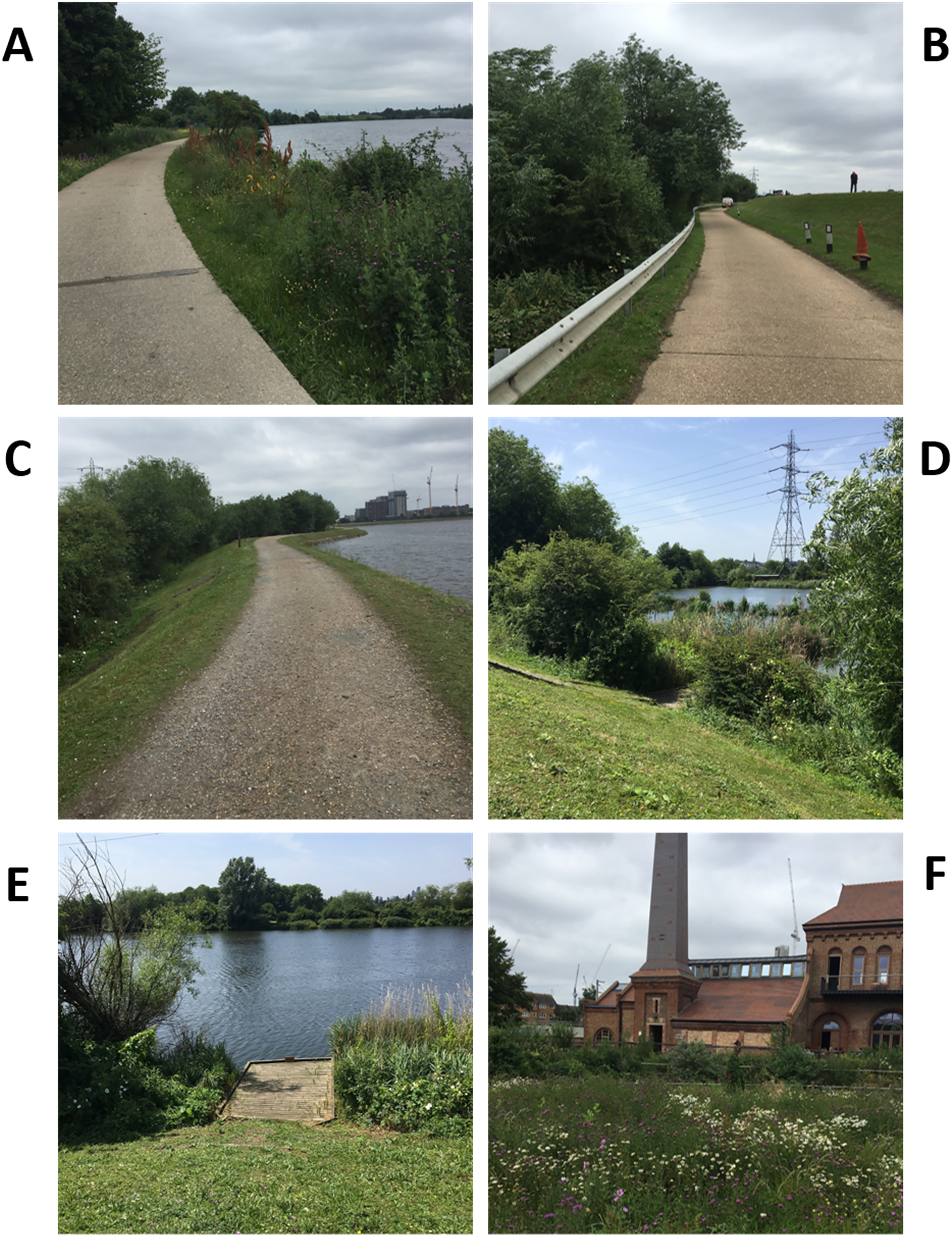
Representative images of Walthamstow Wetlands. (A and B) The main paved path through the site. (C) The dirt track running through most of the wetlands. (D) A view of the reservoir from the path. (E) One of the docks looking out over the reservoir. (F) A wildflower meadow and the Victorian-Era Engine House containing an interpretive center, café, toilets, and a small gift shop.
The London boroughs surrounding Walthamstow Wetlands contain some of the highest levels of ethnic diversity in the UK. In Waltham Forest, the borough in which Walthamstow Wetlands is situated, nearly 25% of residents identify as Muslim (Office for National Statistics, 2018b). Through prior research in the area conducted by the authors, as well as discussions with Walthamstow Wetlands staff, we identified that the usage of this nature reserve by minority ethnic groups is low in comparison to their proportional representation in the surrounding communities. The researchers also informally observed this ethnic diversity in Walthamstow Wetlands to be much lower than in nearby managed parks. Given (1) that the types of outdoor recreation infrastructure (e.g. bird hides, interpretive center) and programming (e.g. pond dipping, bird identification) within Walthamstow Wetlands are characteristic of PAs in the UK and other Western countries, (2) the underrepresentation of minority ethnic groups in Walthamstow Wetlands, and (3) the large Muslim communities in surrounding areas, Walthamstow Wetlands was deemed a suitable case study for this research.
Recruitment and interview protocol
We identified an initial list of potential participants through an internet search of (1) mosques and community centers surrounding Walthamstow Wetlands and (2) UK faith-based organizations and organizations focused on ethnicity and sport, leisure, nature, and/or inclusion. These organizations and institutions were then contacted via email. If specific individuals were listed on organizational websites, we directly contacted the person(s) most relevant to the study. If this information was unavailable, we contacted the general organization by email. In both cases, we indicated that we were looking for community leaders who could offer a broad perspective of Muslim cultures and leisure choices. We also applied snowball sampling, asking each participant to identify others who would be useful to speak with for this study (Robinson, 2014). We stopped sampling when we reached data saturation (i.e. when additional interviews provide no new substantive information) (Guest et al., 2006).
Participant recruitment and interviews themselves were carried out by the primary author who is a white woman. This gender and ethnic positioning presented some challenges, but also opportunities. First, the primary author found that participants often assumed that, as a non-Muslim, she had little in-depth knowledge of Muslim cultures or religion (Turnbull, 2000). Therefore, they provided significant detail on these aspects of Muslim communities and their connection to green spaces. This detail benefitted the research, not least because it reduced ambiguity in responses. The literature also suggests that a female interviewer can promote participation by Muslim women (Aroian et al., 2006; Zempi, 2016) and, indeed, respondents to our interview requests were predominantly female (see section “Demographics”). While the interviewer's gender could have contributed to this gender imbalance in our sample, we avoid making assumptions about the rationale behind an individual's response (or non-response) to our interview request
Interviews took place from July 2020 to January 2021. All interviews were in English and were undertaken online through Zoom. Online interviews allowed us to speak with participants across the UK but were also necessary due to the COVID-19 pandemic that was ongoing during the time of this research. Prior to beginning interviews, we informed participants of the anonymity of their responses and requested their consent to the use of an audio recorder.
Wang et al. (2015) have constructed a conceptual model for explaining the physical and non-physical factors influencing park accessibility. We used the socio-cultural dimensions of this model as a starting point in the design of our semi-structured interview schedule. These dimensions consisted of knowledge (e.g. information about the PA), social (e.g. safety, appeal of activities, discrimination, shared identity with other users), and personal (e.g. financial affordability, health).
The first portion of our interviews consisted of a discussion of Muslim communities and green space use in a general sense (see Supplemental Materials A for a full template of interview questions). Participants were asked to discuss the activities that they observed to be popular within Muslim communities and to identify features/characteristics within green spaces that would accommodate these activities. We also asked participants to identify any green space features or characteristics that would be welcomed by Muslim communities from a religious perspective. We then asked participants whether being one of only a few visible minorities within a green space would be a deterrent for many Muslims. Finally, we asked participants to describe the relationship between Islam and nature and the human–nature relationship.
For the second portion of the interview, we asked participants to view Walthamstow Wetlands’ website and to identify any potential factors that would encourage or deter someone who is Muslim from visiting the space. We followed up with several more specific questions relating to the access dimensions listed above if these topics were not brought up by participants; for example, “Would the activities offered hold wide appeal within Muslim communities?,” “Were the language and images inclusive?.” Most participants, however, brought up such discussions themselves without us asking these more detailed questions. Since the time of interviews, Walthamstow Wetlands’ website has been absorbed into the webpage of its management organization, the London Wildlife Trust. It is, therefore, no longer available in the form used as part of this research. However, the objective of the study was not to provide a critique of Walthamstow Wetlands, but rather to use this PA as an example to ground participant responses. Therefore, we do not consider this website change to be a limitation of the study.
If there was time, participants were shown a virtual tour of Walthamstow Wetlands using images of the space on Microsoft PowerPoint. They were asked similar questions to those following their review of the website. Throughout all our questions, participants were encouraged to discuss variations within Muslim communities.
The final section of our interviews consisted of several demographic questions: ethnicity, country in which participants were raised, parents’ birth countries, gender, age, and religious identity.
In total, we conducted fourteen interviews with Muslim community leaders in the UK. This sample size is consistent with similar in-depth, qualitative research with Muslim communities (Nayak, 2017; Sijtsma, 2011; Tirone and Pedlar, 2000). Nine participants were given the virtual tour of Walthamstow Wetlands. All but one of the interviews were audio recorded, lasting an average of 53 min (range: 42–64 min), and manually transcribed. Handwritten notes were taken for the participant who did not want their interview to be recorded.
Analysis
We applied an inductive thematic analysis approach to explore our data in which barriers and opportunities were not pre-defined, but rather identified and grouped through repeated explorations of the transcripts. We followed the flexible thematic analysis guidelines identified by Braun and Clarke (2006). Prior to coding, we reviewed all transcripts in their entirety and created a preliminary list of potential codes. We then coded all data, beginning with this initial list and adding and grouping codes as we examined the transcripts. Dedoose analysis software was used for the coding process (Version 8.3.43, 2021, Los Angeles, CA, www.dedoose.com). As we coded the data, we arranged codes into themes in relation to overarching access barriers and opportunities. For example, a lack of halal food options and deficiency of large seating areas both contributed to an overall perception that Walthamstow Wetlands gave little consideration to Muslim cultures, leading to feelings of exclusion. We then extracted and separated the data by theme into Microsoft Word and performed a final review. At this stage, we checked each excerpt for accuracy as it pertained to its identified code, performed corrections, and grouped similar codes into sub-themes. Codes that were not grouped became sub-themes in and of themselves.
Results
Demographics
The fourteen participants in this study were community leaders in a wide range of formal and informal capacities including volunteers and leaders with faith-based organizations, educators and coaches, organizers of community groups, leaders from sport and leisure organizations, and a student researching Islam and nature. All but two participants identified as practicing Muslims. Of the two participants who were not practicing Muslim themselves, one came from a Muslim family and the other worked very closely with Muslim communities as the founder of a charitable organization. These two participants were not asked the question about the relationship between Islam and nature. Most participants identified as female (N = 10), two as male, one as non-binary, and one chose not to answer. Half of the participants were aged between 30 and 50 (N = 7), with two being under 30, and three over 50 (two chose not to answer). Most participants were raised in the UK (N = 12) (one chose not to answer). Most participants identified as being from an Asian ethnic background (N = 10) (Indian, Pakistani, Bangladeshi, or Palestinian), with seven of these participants also identifying as British. Two participants identified as Black British African and one as Mixed. One participant did not answer the ethnicity question.
Overview of results
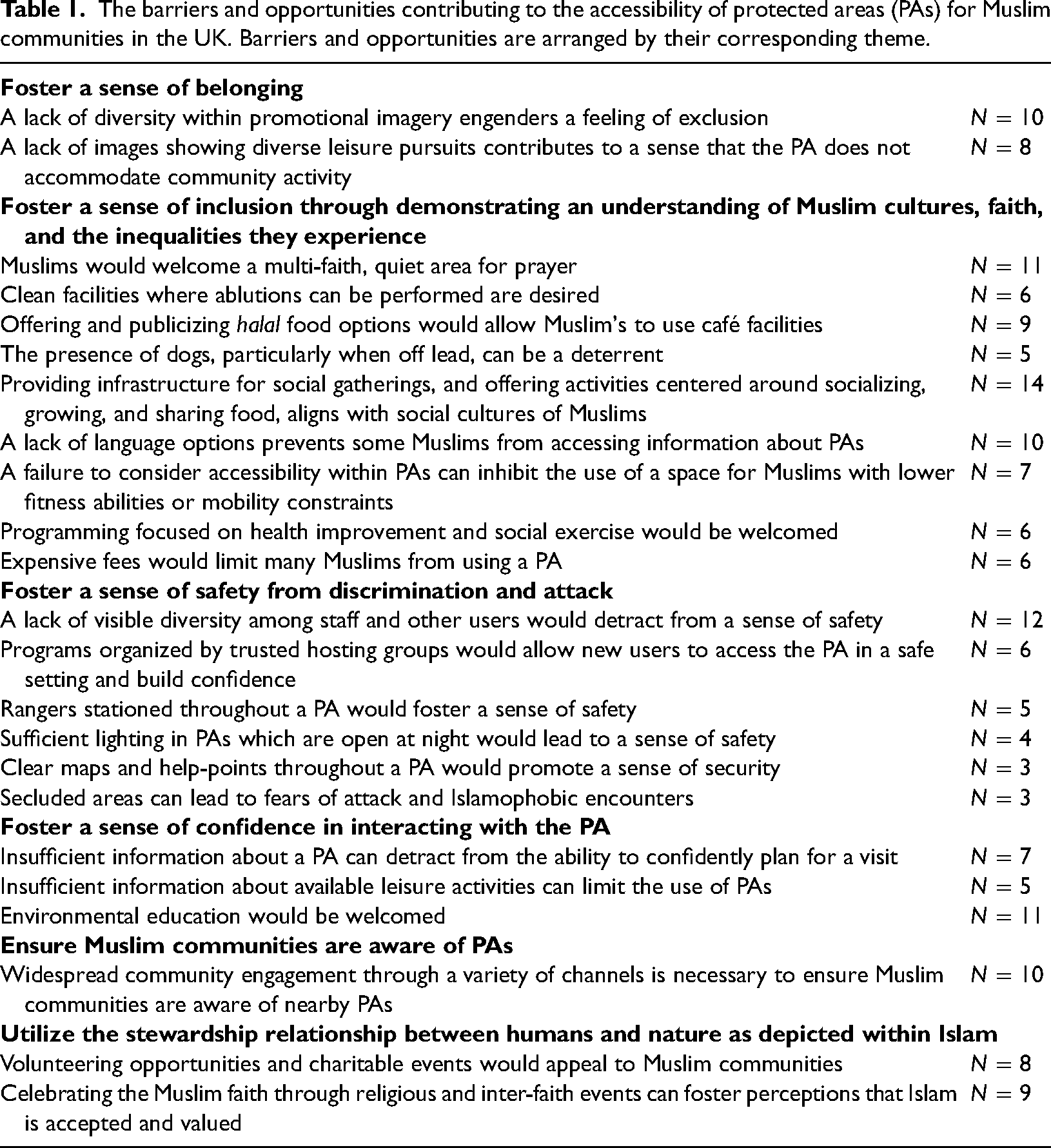
Participants identified a wide variety of socio-cultural barriers and opportunities that could contribute to the accessibility of PAs for Muslim communities (Table 1). These results suggest that many interlinked and cumulative factors can inhibit or foster accessibility. Participants indicated that a lack of inclusive imagery within marketing content (the main critique of Walthamstow Wetlands’ website) was a primary barrier inhibiting Muslims’ use of PAs. Other barriers and opportunities related to (1) inclusive design and management, (2) safety, and (3) confidence in using the PA. The role of humans as stewards of nature that is emphasized within Islam was identified as a valuable opportunity. Although rigorous exploration of the relative importance of each barrier and opportunity was outside the scope of this research, the emphasis that participants placed on each factor provided an indication of their significance. Most barriers were generally not portrayed as deciding obstacles to the use of a PA. Rather, they were discussed as deterrents and their cumulative presence resulted in several layers of deeper exclusion.
The barriers and opportunities contributing to the accessibility of protected areas (PAs) for Muslim communities in the UK. Barriers and opportunities are arranged by their corresponding theme.
During our interviews, participants highlighted the variation that existed within Muslim communities in relation to the relevance of barriers and opportunities. They identified several demographic and other factors that are likely to impact this relevance at the individual level including age, gender, immigration generation, interpretation of the faith, and simply individual interests.
Barriers and opportunities
Perceptions of Walthamstow Wetlands: “Do I see myself represented?”
Over half the participants (N = 9) indicated that, from viewing Walthamstow Wetlands’ website, Muslim communities would not feel a sense of belonging, nor feel welcomed. One woman described this in saying: “I don't think I would feel, as a Muslim, any sense of ownership or link with this particular area.” Similarly, another woman indicated that “it feels like it's just a bird watching for older white people. […] It's not really giving me that community spirit.” The feelings of exclusion did not appear to be linked to the type of nature within Walthamstow Wetlands, which most participants perceived to be beautiful. Rather, concerns were linked to how human interaction with the space was portrayed.
Many participants (N = 10) pointed out that the people shown in photos were predominantly white, and that they had to search to find themselves represented. One participant described how this lack of representation “inadvertently, unconsciously, dictates that this is not somewhere for them.” Participants emphasized how diverse imagery is necessary to foster a sense of belonging among potential visitors. A participant described this in saying how when you look at a website, it says a lot. It tells a story. And it tells a story about the type of people you want to attract. So, if you’re not able to represent that story, to tell that story to get the people in, then that's your problem there.
Several participants (N = 6) spoke about how a welcome sign in multiple languages would improve this sense of belonging, described by a participant as “a universal representation of ‘yes, it's safe here’.”
Many participants (N = 8) described the need for the website to include more photos of people interacting with the space in diverse ways rather than primarily depicting images of nature (e.g. scenery, birds). Some of these participants indicated that the activities highlighted on the website are not widely undertaken within Muslim communities. “You get the initial impression that there's a certain type of person or people who would come to this [space]. For example, angling and bird watching. I don't know many people from my community who can relate to that” indicated one participant. Including photos of people engaged in a wide range of activities was thought to promote the different ways in which the space could be used and reflect a sense of community spirit. “I want to see mixture. I want to see kids having fun. I want to see smiling faces. I want to see families at picnics, kids running around. I want to see people. There's no people!” described one participant. A few participants suggested integrating the current images on the website with more diverse photos in a moving slide show and including video testimonials to highlight the many ways one could interact with the space.
Despite these critiques, various positive aspects of the website were highlighted, although there was little consistency across participants in this regard. Furthermore, although the barriers described above were commonly expressed, they were not shared by all participants, highlighting variation in how a PA could be perceived within Muslim communities. For example, two participants viewed an emphasis on bird watching as a positive. This variation emphasizes that those seeking to make a space inclusive must acknowledge and explore community heterogeneity. Finally, several participants (N = 6) highlighted how first impressions are important with regard to an organization's website and, therefore, inclusive imagery and important information must be displayed in a prominent place.
Inclusive design and management: “Are my faith, culture, and the inequalities I experience considered within this space?”
Many of the barriers and opportunities described by participants related to the extent to which the PA demonstrated an understanding of, and accounted for, Muslim religion, cultures, and the inequalities they experience. A failure to consider these factors was described as both affecting a Muslim person's ability to interact with the PA and influencing perceptions of inclusion. A lack of consideration for these factors was emphasized by several participants as being particularly problematic in areas with large surrounding Muslim populations, such as Walthamstow Wetlands.
Several barriers and opportunities were described relating to the Islamic faith. Most participants (N = 11) indicated that many Muslims would welcome a quiet, secluded area for prayer. For Muslims who are not comfortable praying in the open, the lack of a place for prayer could inhibit them from using the space for extended periods of time. Participants stressed that this area should be multi-use and multi-faith. Secondly, many participants (N = 9) stressed the need for halal food options. A participant highlighted how a lack of halal options can reduce Muslim families’ sense of inclusivity: “unless they prepare a picnic, [a meal is] part of the experience that they miss out on and that, again, reinforces that inherent belief that that's a space that's not for them.” Third, several participants (N = 6) indicated that clean facilities where Muslims can perform their ablutions (e.g. shower jets, running fountains with potable water), a ritual washing performed before prayer, would also be welcomed. Another factor that was described as affecting many Muslims’ experiences within a PA was the presence of dogs (N = 5). Participants described how many Muslims are anxious around dogs and that, for some, dog saliva is thought to break their state of purity, requiring them to repeat their ablutions before prayer. Some participants suggested dog-free areas while others spoke about the importance of education and enforcement in areas where dogs are supposed to be kept on a lead.
Several factors were discussed that relate to Muslim cultures. All participants (N = 14) described how Muslim use of green spaces tends to revolve around family, children, and social activity. “I think families always come first for the Muslim community” said one participant. Participants indicated that such social activity was often centered on food. In describing how her Muslim students interact with green spaces, one participant said: if it's a park that allows you to have a little barbecue, there'll be kebabs coming off and hot fried breads and things like that. They're sitting in big groups, and they really know how to picnic properly, and they're not inhibited in any way.
As such, many participants discussed the need for infrastructure to support large gatherings (e.g. large eating areas, benches, picnic tables). One participant who often brings large groups of Muslim people into the countryside described how infrastructure in PAs is often inadequate: “picnic benches are small, separated out, so only four people, five people can sit on the bench, but there's 15 people coming and where are they going to sit?.” The lack of sufficient infrastructure led to feelings of exclusion due to Muslim social culture not being considered within the design of a space. Other social infrastructure that would be welcomed in a green space included sports pitches and playgrounds. Participants also described activities that could be offered that would appeal to the social culture of Muslim communities including children's activities and activities centered on cooking and growing.
Finally, participants also identified several factors that relate to the socio-economic inequalities often experienced by Muslim communities (e.g. health concerns, poverty). The most identified factor in this regard was language barriers and the need to ensure that signage and information was inclusive (N = 10). Particularly for older Muslims and new migrants, participants described the benefits associated with having the website and signage available in multiple languages. Many participants (N = 7) described the need for green spaces that are accessible to those with mobility constraints and/or of lower fitness abilities. Suggestions that were offered included ensuring paths were smooth, having lots of benches, and offering walking routes of varying lengths. Several participants (N = 6) recommended exercise classes or walking groups, particularly for women, focused on health, wellbeing, and social interaction. Finally, participants (N = 6) identified the need for facilities and activities to be free.
Safety: “Do I feel secure in this space and safe to express my culture and religion?”
Many participants (N = 11) spoke about the necessity for PAs to foster a sense of safety and acceptance. They discussed how this will generate trust that the PA is a place where Muslim communities can express their religion and culture, and simply be present, without fear of discrimination. Several of these participants spoke about the apprehension Muslim people often feel about how they will be perceived in unfamiliar spaces. A woman spoke about her own experience in this regard when she leaves London: I've noticed that you have to make the effort to say hello first and to smile and make it seem like you're not dangerous immediately. Because if they get a sense that you're dangerous then they report you or they question why you're there and they watch you.
Another participant who often took groups of Muslim people into the countryside spoke about several racist and Islamophobic instances that people in his group have experienced. Participants spoke about various actions that can be taken within PAs to contribute to the creation of a safe space.
Related to the identified importance of diverse imagery, most participants (N = 12) spoke about how a lack of visible user diversity can be a barrier to Muslims’ use of a space as this reduces the sense of safety and belonging. A participant spoke about this in the context of the countryside when she said: “the countryside is really, really white, and you really do notice that, and people tend to feel safer if they're in their own group.” The importance of seeing ethnic diversity within a space was not limited to users, but also to the staff and volunteers. “Look at all your staff, look at all your volunteers. When people come in […], do they see themselves reflected back?” said one participant. Another suggestion that was offered was to allow trusted hosting organizations (e.g. faith groups) to run organized activities within the space. Participants discussed how entering unfamiliar spaces as part of a group can build confidence and foster a sense of security.
Several management features were also mentioned in the context of safety. Five participants mentioned having rangers/volunteers present throughout a green space, four identified the importance of good lighting to foster a sense of safety, and three participants spoke about the need for clear maps and help points throughout an area. A few participants (N = 3) discussed how Muslim people often do not feel safe in wooded or highly secluded areas for fear of attack from other people. Fear of wild animals was not widely emphasized as a barrier.
One way to foster perceptions that the Muslim faith is not only accepted within a space, but celebrated and valued, is through religious and inter-faith events. Nine participants pointed out the inter-faith week on Walthamstow Wetlands’ website, discussing how it was positive for attracting Muslim communities. Many participants recommended holding Eid and other religious celebrations. One participant was critical of the fact that Christian holidays are often celebrated, “but there don't appear to be things for the Hindu community, for Diwali, and the Jewish community and Hanukkah, and then for the Muslim community.” Others mentioned subtle design features that would celebrate Muslim cultures and foster a sense of belonging such as pointing out the direction of Mecca and incorporating Eastern architectural features.
Confidence: “Do I feel confident in my ability to plan and interact with this space?”
Participants also described several factors related to information that contribute to a sense of confidence in planning and interacting with the space. They stressed that pre-existing knowledge should not be assumed. A number of participants (N = 7) discussed the importance of clearly publicizing information about the PA (e.g. permitted activities, amenities, cost) to allow potential users to adequately plan for their visit. Participants proposed a variety of ideas for how to make this information accessible including clearly marked signage, maps, and information on the website, as well as volunteer welcomers who could introduce new users to a space and what it offers.
Participants also emphasized the need to provide clear information on different ways in which visitors could interact with the PA (N = 5). This guidance is particularly necessary for those less familiar with PA environments. For example, a participant described how “if you were to put an inner-city kid into a nature reserve, he's going to be like, ‘okay what am I going to do here?’. There needs to be some form of transition into it.” Given the underrepresentation of minority ethnic groups within PAs and the concentration of Muslim communities within urban environments, it is likely that many Muslims will be new to PAs. Another participant described how, for people who are unfamiliar with PAs, “they just need a little bit of help in terms of getting creative and knowing that they could just go out there and just immerse themselves in that environment.”
Finally, most participants (N = 11) described the value of environmental education so those who are less familiar with the space could learn about the flora and fauna. Many examples were provided including activity sheets, interactive signage, and guided activities. Participants described the benefits of making the PA an interactive learning space, with many purposeful activities. In the context of parents, one participant described the importance of these activities when she said: “These parents are not going to have the knowledge to be able to enjoy the experience and make a learning experience necessarily for their children.” Such activity would promote confidence in using the space for those who are less familiar with nature. A participant described this well when he said: “it's about progression. If they can go to Walthamstow Wetlands and they enjoy that, then they might want to explore further and feel more confident.”
Community engagement
In addition to ensuring a PA offers an inclusive environment, many participants (N = 10) described the importance of ensuring Muslim communities are made aware of the PA's existence. These participants described the importance of community engagement through a wide variety of channels including community leaders, mosques, faith groups and community centers, WhatsApp groups, schools, and social media. The value of using many channels was emphasized given the diversity that exists within and between Muslim communities. Word of mouth was described by several participants as being particularly important within Muslim communities.
Nature and Islam
The twelve participants who identified as Muslim indicated that nature held a prominent place within Islam, with many verses in the Qur’an speaking about different aspects of the natural world. Two prominent themes were described in the relationship between Islam and nature. First, many participants (N = 9) discussed how nature was created by God and, therefore, viewed as proof of God's existence and power. A participant described this relationship in saying God is the creator of everything, and nature is one of the signs of God's power, and just a sign of the proof of God, basically. That is repeated over and over again: look at the mountains, look at the sky, look at the rain.
Participants spoke about how Muslims are encouraged to observe and experience the natural world as a way of connecting to God through the wonder of his creation.
In line with the theme of connecting to God through nature, various participants spoke about praying and practicing other aspects of their spirituality in the outdoors (N = 12). Many of these participants described how Muslims are encouraged to undertake their Eid congregational prayers outdoors. Opportunities for such spiritual activities within PAs could, therefore, present an opportunity to encourage the use of the space by Muslim communities. “I think any space is more beloved if you have had profound experiences in it, so if you can create opportunities for those experiences, it's wonderful” described one participant. She went on to say: “we want the natural space to be our cathedrals, our churches, our mosques, our synagogues, we want that because that is already made for us by God.” Such spiritual events within PAs could introduce new users to the space as part of a trusted group as well as signal that the space is welcoming to those of the Islamic faith.
A second theme identified by participants was the relationship between humans and nature as depicted in Islam. Most participants (N = 11) spoke about how Islam portrays humans as caretakers of the planet. A participant described this relationship in saying “We are told in the Qur’an that we are stewards, or guardians, on this earth and every one of us have been put in a position where we are responsible for something.” Participants discussed how humans have a duty to respect nature. Cutting down trees and being wasteful with resources, for example, were described as frowned upon within Islam.
Harnessing this stewardship role within marketing and programming could present an avenue to attract Muslim communities to green spaces. For example, a participant described this opportunity in saying: “It's all linked back to the faith and putting it back to the faith. It's our duty to look after our environment, not only for ourselves, but for the future. So, it's about using that to engage.” Indeed, just over half of the participants (N = 8) discussed how charitable events and volunteering activities in green spaces would hold wide appeal with Muslim communities. Activities mentioned included litter picks, sponsored charity hikes, and tree planting. Two participants, however, spoke about how the relationship between humans and nature as described within Islam is not always well recognized among Muslim communities. For example, a participant said: “we've got a direct instruction from the Prophet that says that we need to preserve the earth because it is our mother. I'm not sure that is at the forefront of most Muslims’ minds.” These participants, therefore, described how engaging Muslim people in stewardship would present an opportunity to highlight this link between their faith and nature.
Diversity within Muslim communities
Although a detailed exploration of variation that exists within and between Muslim communities was outside the scope of this paper, we acknowledge this diversity and recognize that it will affect the barriers and opportunities experienced at the individual level. When discussing barriers and opportunities underlying the use of PAs, participants often identified this diversity. Ethnic background, for example, was emphasized as differentiating Muslim communities. One participant described this in saying “Somalis are very different to Bangladeshis who are very different to Iraqis, to Lebanese. They have some similarities in between, but they're still different.” Other factors identified as affecting the relevance of barriers and opportunities included gender, immigration generation, interpretation of the faith, age, and simply individual preferences. Barriers that were described as varying in the extent to which they would impede someone from visiting a green space included a lack of visible representation within a PA, the presence of dogs, and the lack of a prayer space. Despite this variation, however, participants indicated that the aforementioned barriers and opportunities are likely to be widely significant across Muslim communities.
One factor that was strongly emphasized as differentiating Muslims in terms of the barriers they experience was immigration generation, or, indeed, those that were born in the UK. Language barriers, for example, were described as more relevant to individuals who were new to the country. For those who were raised in the UK, the combination of family heritage and a UK upbringing were both discussed as contributing to their identity. As a result, a few participants suggested that some younger Muslims are less traditional in their interpretation of the faith. For example, one woman described how praying later than the recommended time would not bother her and, therefore, the absence of a space to pray would not present a barrier. She contrasted this to her mother who is more traditional in her interpretation of the religion. Immigration generation was also discussed in relation to comfort levels in nature. A few participants indicated how first-generation migrants could be more comfortable around nature than those brought up in UK cities given that many grew up on farms and/or surrounded by wildlife.
Discussion
Our results indicate that a wide variety of interlinked and cumulative factors act as barriers or opportunities to the use of PAs by Muslim communities. Many of the barriers exist at a functional level. For example, the lack of a prayer space could prevent Muslims from using a PA for long periods of time and insufficient seating facilities could inhibit a Muslim family from undertaking their preferred activities. Individually, however, each functional barrier was not typically identified as a deciding obstacle inhibiting the use of a PA. Rather, these functional barriers cumulatively led to deeper levels of perceived exclusion. We found that through a combination of these barriers, a PA could fail to foster a sense of safety, confidence, and/or inclusivity. Overall, this can lead to the perception that a PA is not a place where Muslim communities are welcome. We also identified many opportunities that could address these barriers and improve the sense of belonging experienced by Muslims. These included using the central role of nature in Islam within programming and marketing to draw Muslim communities to a PA. This relationship between nature and Islam has been explored in prior research (Makhzoumi, 2002). Participants indicated that even subtle changes and acknowledgement of the Muslim faith and cultures would make a considerable difference to perceived inclusion.
Most barriers and opportunities identified in this study align with the literature on Muslim participation in sports and leisure. For example, in their qualitative study exploring the influence of religion on the leisure practices of Muslims in the US, Stodolska and Livengood (2006) found that the family oriented and collectivist Muslim cultures were primary drivers of leisure behavior. Similarly, all participants in our research identified that preferred leisure pursuits revolved around families and social gatherings. Our findings relating to the need to foster a sense of safety and demonstrate cultural understanding also align with research on Muslims and leisure. In an in-depth case study of a UK leisure center, Snape and Binks (2008) found that perceived safety and cultural recognition were primary factors underlying the appeal of the space for Muslims. Their findings also aligned with our research in that the presence of staff from Muslim communities was identified as critical to the center's success. As with our study, prior research has identified fear of discrimination as a factor affecting Muslim use of green space (Pitt, 2019). Finally, aligning with our recommendation to hold religious events within PAs, Yazdani (2019: 6) found that for Iranian migrants “The interweaving of social and cultural dimensions of [cultural celebrations] is highly significant as a source of collective affirmation and identity in conditions of migration, and can also foster a sense of familiarity and belonging to the physical environment.”
The overlap of barriers and opportunities identified in this research with those described within leisure studies suggests that many of these factors would apply in all types of green space (e.g. language and economic barriers, lack of halal food options, religious celebrations). However, several barriers would likely be exacerbated within PAs such as the lack of infrastructure to undertake preferred social leisure activities, safety concerns deriving from the secluded nature of many PAs, insufficient seating and paths for those with mobility constraints, and a lack of visible cultural diversity. Furthermore, a focus on traditional Anglo-Western activities (e.g. bird watching), and assumptions surrounding levels of prior experience and confidence in nature, are also likely to be more prominent in PAs than in highly managed parks.
One factor that prior research has hypothesized as contributing to the underrepresentation of Muslim communities in PAs is that such communities have a different perception of natural beauty than the “Romantic gaze” often held by those from a white background (Suckall et al., 2009). In their comparison of landscape preferences between “native Dutch people” and Islamic migrants, Buijs et al. (2009: 113) suggested that the migrants had “low preferences for wild and unmanaged landscapes” due to their more functional conceptualization of nature. In contrast, we did not detect a strong influence of the type of natural environment on the leisure choices of Muslims, with most participants perceiving the natural elements of Walthamstow Wetlands as highly attractive and the “wildness” of the space did not emerge as a prominent barrier. This finding suggests that the type of nature within a space does not strongly influence green space preferences for Muslim communities. Rather, their choices are influenced by how humans can interact with the space, along with other factors such as prior instances of discrimination, the perceived “whiteness” of a space, and unfamiliarity. When exploring the use of a large urban park in Australia by Iranian migrants, Yazdani (2019) similarly found that the natural features, many of which were similar to Walthamstow Wetlands, were perceived as peaceful, but that a lack of prior experience and “unfamiliarity with design references” led to a feeling of otherness. In fact, UK green spaces such as those with mountains and hills have been found to evoke recollections of ancestral homelands (Tolia-Kelly, 2006).
Ethnicity and green space access: Broadening the discussion
This research provides support for the ethnicity, marginality, and discrimination hypotheses in explaining minority ethnic underrepresentation in PAs. Our finding that desired leisure activities revolve around Muslim family cultures aligns with the large body of research suggesting that minority ethnic groups tend to prefer social activities over Anglo-traditional nature-based pursuits (Gobster, 2002; Jay and Schraml, 2014; Ordóñez-Barona, 2017). This result provides support for the ethnicity hypothesis. In line with the marginality hypothesis were barriers such as the lack of infrastructure within PAs to support those with health and mobility constraints, which tend to be more prominent within minority communities, as well as a lack of widespread information about PAs. Finally, barriers including fear of potential Islamophobic discrimination support the discrimination hypothesis.
Although our findings support the marginality and ethnicity hypotheses, we contend that many of the barriers associated with these theories reflect a failure to account for Muslims' lived experiences and collectivist worldviews relating to the natural environment. Such exclusion presents a form of discrimination at the governance level. For example, the wilderness ideology that has dominated PA management is reflected by insufficient information for those less confident in/with nature, few promotional photos depicting human-nature interaction, and limited opportunities for social gatherings. Nature is thus managed to appear as an “untamed” or “pristine” environment for escaping civilization. Conversely, participants in our research indicated that Muslims often celebrate in seeing and experiencing lively recreational activity within nature and value green spaces for offering relaxing opportunities to socialize. Therefore, although barriers such as a lack of information or social infrastructure relate to theories of marginality and ethnicity, they are perpetuated by an exclusionary Anglo-normative governance lens and therefore also support theories of discrimination.
In comparison to the ethnicity and marginality hypotheses, the discrimination hypothesis has received little research attention, particularly within Europe (Kloek et al., 2013; Krymkowski et al., 2014). Furthermore, research supporting this hypothesis has predominantly explored experienced discrimination rather than internalized bias within governance. Our results suggest that discrimination can underlie many dimensions of access and, therefore, we suggest that future research moves beyond the three-hypotheses conceptualization to explore the interaction of variables and their relationship to governance practices and associated ideologies. A large body of work has explored and critiqued the wilderness ethic for contributing to the exclusion of minority ethnic communities (e.g. Curry et al., 2001; Davis, 2019; Ho and Chang, 2021) and we suggest that this theory should be embraced more widely by leisure researchers exploring multiple dimensions of access.
Conclusions: Future research and management implications
This research presents the first study to explicitly investigate PA access for Muslims in the UK. Through focusing specifically on Muslim communities, it advances theory on minority ethnic underrepresentation while avoiding the homogenization of minority ethnic groups (Kloek et al., 2017a). We identified a variety of factors that have the potential to hinder or facilitate Muslim access to PAs. Several of the opportunities we discussed require only subtle changes but could have a significant impact on perceived and actual inclusion. Ensuring images are inclusive would be particularly effective in this regard. Many of the barriers and opportunities we described are likely to be relevant in the context of other minority ethnic groups. For example, insufficient information (Metcalf et al., 2013), a lack of diverse imagery (Kloek, et al., 2017b), and insufficient social infrastructure (Suckall et al., 2009) have all been identified as barriers to accessing more biodiverse spaces experienced by minority ethnic groups in a general sense. Other barriers, however, such as Islamophobic encounters, are primarily experienced by Muslims, especially Muslim women, and are particularly associated with the countryside (Sijtsma, 2011).
We expect that some of the management actions needed to improve PA access for Muslim communities would be met with barriers and resistance at the institutional level. For example, offering opportunities for large social gatherings and fitness-related activities might be perceived as conflicting, both by managers and other users, with wilderness ideologies and/or conservation goals (Edwards and Larson 2022; Fraser and Kenney, 2000; Suckall et al., 2009). Careful stakeholder management and dialogue are needed to overcome such potential conflict. Many PAs already contain areas with significant social infrastructure. Therefore, PAs could simply ensure such opportunities are publicized more widely rather than adding additional infrastructure. Perceptions that PAs are catering to religious needs could also bring about criticism. Such conflict could arise, for example, if dog-free areas were established on religious grounds. The literature has already identified some of these constraints in relation to sport, for example, when certain Muslim requirements (e.g. no gender mixing) are perceived as contrasting to Western belief systems (Amara and Henry, 2010; Lenneis and Agergaard, 2018). Although some of these issues present complex ideological conflicts, many of the religiously associated barriers and opportunities we identified could be met without any form of exclusion or religious bias. For example, many PAs already have rules in relation to dogs at certain locations (e.g. bird sanctuaries). Therefore, publicizing these areas as such would promote Muslim use of the space. Furthermore, many Christian holidays are already marked by events within PAs. Therefore, providing opportunities to celebrate Islamic and other religious holidays would serve to create an equitable events calendar.
Although we captured some data on variation within and between Muslim communities, we did not explore such variation in detail, presenting a limitation of the study. Immigration generation was identified as being particularly influential to the relevance of identified barriers and opportunities. Muslim cultures are not static, and surrounding cultural contexts are likely to influence identities and, subsequently, perceptions and preferences related to leisure. Indeed, a large body of research has applied concepts such as acculturation and integration to explore leisure choices and green space access (Gentin et al., 2019; Stodolska and Livengood, 2006). We suggest that further in-depth exploration is needed on Muslim communities and intersectionality as it relates to PA access. Furthermore, although our participants were thought to provide a broad perspective of their communities, the gender imbalance of our sample suggests that the results were more strongly reflective of the lived experiences of Muslim women. This limits the generalization of our findings across genders. However, our research also helps to remedy the under-representation of diverse female voices in research on Muslims and leisure (Samie, 2013) and we suggest that further such female-dominated samples are needed to highlight Muslim female agency and challenge the dichotomous “othering” of Muslim women in the context of leisure (Ratna and Samie, 2018).
The qualitative approach adopted in this research allowed us to go beyond identifying functional access barriers and identify deeper levels of perceived exclusion experienced by Muslim communities. It also facilitated an exploration of the relationship between these barriers and allowed us to distinguish their cumulative effect on access. Prior research suggests that perceived access is influenced more by physical and geographic factors than by socio-cultural variables (Wang et al., 2015). Although we did not include geographic variables within this study, the degree to which participants described socio-cultural barriers as limiting access leads us to suggest that such dimensions can be equally influential. Future research could build off our results in the context of other socio-cultural groups. Such research would provide a more detailed understanding of how the factors underlying PA access vary within and between different underrepresented communities. Qualitative research with PA managers would also be useful to explore the feasibility of the identified management actions and to identify any potential factors that could aid or inhibit their implementation. Our results demonstrate that to foster a sense of belonging for Muslim communities in PAs, managers must consider many socio-cultural dimensions of accessibility, holistically engage with Muslim communities, and embrace more diverse worldviews relating to the human–nature relationship.
Highlights
We qualitatively analyzed the socio-cultural barriers constraining Muslims’ access to protected areas in the United Kingdom.
A wide variety of barriers cumulatively result in several layers of exclusion for Muslim communities.
The wilderness ideology embedded in protected area management constrains access as it does not embrace collectivist aspects of Muslim cultures.
In Islam, humans are seen as stewards of the earth, presenting an opportunity to promote Muslim use of protected areas.
We discuss several management implications that emerged from our findings as well as potential constraints to their implementation.
Supplemental Material
sj-docx-1-ene-10.1177_25148486221116737 - Supplemental material for What limits Muslim communities’ access to nature? Barriers and opportunities in the United Kingdom
Supplemental material, sj-docx-1-ene-10.1177_25148486221116737 for What limits Muslim communities’ access to nature? Barriers and opportunities in the United Kingdom by Rachael C Edwards, Brendon MH Larson and Daniel Burdsey in Environment and Planning E: Nature and Space
Footnotes
Acknowledgements
The authors would like to thank all the participants and those who pilot-tested our interview questions for donating their time and energy to this project. The authors would also like to thank Sandeep Agrawal, Mark Seasons, Andrew Church, Jeremy Pittman, and the journal referees for their feedback and insight.
Declaration of conflicting interests
The author(s) declared no potential conflicts of interest with respect to the research, authorship, and/or publication of this article.
Funding
The author(s) disclosed receipt of the following financial support for the research, authorship, and/or publication of this article: This work was supported by the Faculty of Environment, University of Waterloo (Dean’s Doctoral Initiative).

Supplemental material
Supplemental material for this article is available online.
References
Supplementary Material
Please find the following supplemental material available below.
For Open Access articles published under a Creative Commons License, all supplemental material carries the same license as the article it is associated with.
For non-Open Access articles published, all supplemental material carries a non-exclusive license, and permission requests for re-use of supplemental material or any part of supplemental material shall be sent directly to the copyright owner as specified in the copyright notice associated with the article.
