




Abstract
Physical and social barriers have long hindered people with disabilities from full participation in outdoor recreation and nature experiences. As spending time in nature, where protected areas constitute an important arena for nature engagement, is increasingly connected to improved health and well-being, there is a need for nature activities and experiences in protected areas to become more accessible and inclusive. However, the provision of accessible protected areas for outdoor recreation and nature activities poses challenges for planners and managers of such areas, as there are elements of contradiction between interests of accessibility and nature conservation. This qualitative study examines how providers of nature experiences and outdoor activities, such as governmental authorities, outdoor recreation associations and nature-based tourism entrepreneurs in Sweden view and practice the balancing of these interests, through perspectives of the social construction of nature, inclusion, and collaboration. Findings indicate that interests in nature conservation generally take precedence over measures of accessibility and that such initiatives are directed to a few, designated areas. There is also an apparent lack of knowledge about how people with disabilities wish to engage with nature, which hinders full access to nature. It is therefore important to include people with disabilities in the process of developing accessibility in protected areas and promote collaboration between stakeholders, to avoid excluding decisions. The study concludes by stating the necessity to challenge the viewpoint of accessible infrastructure for outdoor activities in protected areas as ‘ruining’ the nature experience, in order for access to nature to become a truly democratic right.
Keywords
Introduction
Policies and declarations of accessibility and inclusion in all aspects of society for people with disabilities have never been more ambitious than today. By December 2023, 188 countries had ratified the UN Convention on the Rights of Persons with Disabilities (CRPD) from 2006 (United Nations, 2023), where accessibility is outlined as a general principle (United Nations, 2006: 5). Moreover, the Office of the United Nations High Commissioner for Human Rights (OHCHR) declares that participation in recreational, sporting and leisure activities is a human right, and states that ‘article 30 (5) (c) requires States parties to take measures to ensure the accessibility of sporting, recreational and tourism venues. Most people engage in physical activity during leisure time, such as long walks in cities or in nature, visiting tourist sites, or participating in sports events. All spaces open to the public should be accessible to persons with disabilities’ (United Nations, 2021: 7). Despite these ambitious objectives, nature areas and recreational activities that take place outdoors are seldom truly inclusive and accessible to people with disabilities, often due to factors such as inaccessible environments, lack of support, lack of accessible information, attitudinal and social barriers and prejudice, to name a few (Garrod and Fennell, 2023; Groulx et al., 2021; Menzies et al., 2021; United Nations, 2021). Even though nature contact has become well recognised as beneficial for people's health and well-being, there is substantial evidence that people with disabilities spend less time in nature compared to those without disabilities, and hence risk losing health gains. Studies from the UK (Boyd et al., 2018; Morris and O’Brien, 2011), the US (Burns and Graefe, 2007; Williams et al., 2004), Sweden (Fredman et al., 2019), Denmark (Stigsdotter et al., 2018), Canada and Spain (Aguilar-Carrasco et al., 2023) and New Zealand (Lovelock, 2010), all conclude that people with disabilities are marginalised when it comes to nature experiences. Consequently, calls for improved development of accessible nature areas have been raised (Bianchi et al., 2020; Corazon et al., 2019; Wall-Reinius et al., 2023) to promote inclusivity and equal access to nature, but such claims are despite their innocuous appeal surrounded by controversy. The idea of accessible nature for all is characterised by contradicting views on how to balance interests of nature conservation, accessible infrastructure, social inclusion, democratic rights and the integrity of nature itself (Kafer, 2017; Mullick, 1993), and how to, as expressed by Donlon (2000: 109) ‘resolve the moral contest between purity and access, between inclusion and exclusion, between accommodation and destruction?’
This contradiction is particularly apparent in protected areas such as national parks and nature reserves, where interests in ecological and cultural conservation and wilderness features compete with political and legal considerations of visitor access that require actions from planners and managers of these areas (Groulx et al., 2022; Mebus et al., 2013). In Sweden, where this study is situated, governmental authorities have started to recognise the need for improved accessibility in protected areas, so that diverse groups of visitors will have the opportunity to participate in outdoor activities (SOU, 2017; Swedish Environmental Protection Agency (SEPA), 2023a), but this recognition inevitably raises challenges for managers and planners of protected areas, as they are to ensure an ecologically sustainable use of the area, while simultaneously providing access for all and offer high-quality nature experiences (SæÞórsdóttir, 2013; Wolf et al., 2019). The expansion of infrastructure and the improvement of facilities to increase accessibility in protected areas can influence visitors’ perceptions of ‘untouched’ or ‘wild’ nature and raise questions as to whether such actions are compatible with the objectives of nature conservation (Tverijonaite et al., 2018; Øian et al., 2018). However, a perhaps even more critical issue that is raised through improving accessibility in protected areas is how ableist discourses are allowed to determine the narrative of the most ‘authentic’ ways to experience nature, and to set the agenda of the meaning of ‘natural’ and ‘unnatural’ nature (Ray and Sibara, 2017). Kafer (2017: 216) states ‘the development of trails and buildings that suit very particular bodies goes unmarked as access; it is only when atypical bodies are taken into account that the question of access becomes a problem. […] Trails, which are mapped, cut and maintained by human beings with tools and machinery, are seen as natural, but wheelchair-accessible trails are seen as unnatural’. This statement recounts how the construction of nature from within social practices (see e.g. Castree, 2005; Macnaghten and Urry, 1998) is organised to keep people with disabilities ‘in their place’, that is, away from ‘untouched’ nature; as well as how people with disabilities are told they are ‘out of place’ (Kitchin 1998: 345) in certain outdoor settings.
Given the ambitious global declarations and objectives related to accessibility, recreation and participation in nature-based activities and the recognition that nature contact promotes public and individual health, there is a need to explore how the negotiation of these contradictory interests is handled in practice to challenge assumptions of ‘ideal’ adjustments of nature for people with disabilities, as well as the view that accessibility efforts in protected areas risk ‘ruining’ nature. This topic has hitherto been sparsely researched and previous studies (Godtman Kling and Ioannides, 2019; Groulx et al., 2022) conclude that better knowledge will contribute to more inclusive practices in the planning and management of accessibility measures in protected areas. The aim of this paper is, therefore, to address this knowledge gap and examine how state, regional and local public authorities deal with the planning and management of protected areas, outdoor recreation organisations, nature-based tourism entrepreneurs and disability rights organisations in Sweden view and practice the balancing of accessible nature experiences and nature conservation in protected areas. The study draws on the findings of qualitative research material analysing the possibilities to further encourage protected area managers to consider inclusive actions.
In this article, I use the concepts of outdoor recreation, nature experiences, nature-based tourism and outdoor activities interchangeably to describe visits to and stays in protected areas. Although these are not identical concepts, as there for example is a commercial component to nature-based tourism, which is not necessarily present in outdoor recreation (e.g. Fredman and Tyrväinen, 2010), I choose to use the concepts as such to include a variety of nature-based, recreational activities. Moreover, I use the term ‘people with disabilities’ to refer to the large group of people in society who may face unequal access to nature due to inaccessible environments and attitudes. The primary concern of this study is to examine how the ‘supply-side’ of outdoor recreation and nature experiences views and practices the balancing of accessibility and nature conservation, so the focus is not the specific users. It is nonetheless important to clarify that this study is underpinned by social and human rights models of disability. The social model of disability highlights discriminatory social and environmental barriers that hinder people with disabilities from fully participating in society and identifies disability as a social construct caused by exclusionary structures and oppression (Oliver and Barnes, 2012). The human rights model of disability puts the individual in the centre stage and embraces human dignity and diversity, and moreover, it advocates for cooperation between people with and without disabilities to address social injustices and achieve positive change (Degener, 2016). In accordance with Lawson and Beckett (2021), I regard the two models as complementary and as two valuable tools to examine how providers of nature experiences and outdoor activities view and practice the balancing of accessibility and nature conservation.
Constructing nature in a Swedish context
Before I dive into the issue of accessible nature in protected areas, it is worth mentioning the word nature and how it is used, perceived and valued. A seemingly endless topic, and with the famous words of Williams (1983: 221) in mind; ‘nature is perhaps the most complex word in the language’, the points of discussion related to ideas of nature put forward in this article are far from exhaustive. For example, Cronon (1996) suggests nature is not natural, but rather a product of civilisation and the values placed on the idea of nature. Kafer (2017) argues that nature encounters are completely bound up in our personal experiences and assumptions of what nature ‘is’ and can therefore never be defined, and Robbins et al. (2022) claim that nature is a product of assumptions, social processes and ideologies. This notion of nature as socially constructed, which has been extensively discussed in academia (e.g. Bird, 1987; Ducarme and Couvet, 2020; Eder, 1996; Proctor, 1998; Ryan, 2015) is pertinent to this topic because it exposes the tensions between protected nature and accessibility in a highly tangible way: vast, untouched nature areas, often labelled ‘wilderness’, versus built infrastructure.
The construction of ‘wilderness’ can be argued as being particularly problematic in relation to disability and protected areas (Bell, 2023; Cram et al., 2022). Many of the advocates of the preservationist movement that arose in the early 1900s, especially in the US, were also influential in the eugenics ideology (Allen, 2013; National Park Service, 2022), thus making protected areas arenas of implicit judgements about which individuals deserved to be there. The perception that ‘wilderness’ areas and other types of protected nature is constructed and thus reserved primarily for people that meet the norms of a typical outdoor recreationist (male, white, able-bodied, middle-aged, middle-class) is still salient and largely affect management approaches to protected areas (Edwards and Larson, 2022). This, in turn, inevitably results in judgements on who belongs in these areas.
The social construction of nature becomes evident also in the context of Swedish protected areas, which are generally perceived by visitors, and marketed as, ‘wilderness’ (Wall-Reinius, 2012; Österlin et al., 2020). The concept of wilderness as a Western idea that represents original environments, like those that existed before human interference and therefore in need of preservation, has thus far been well established with nature conservation interests and practitioners (Cronon, 1996; Gómez-Pompa and Kaus, 1992; Vidon et al., 2018), and is true also for the case of Sweden. However, the interest for visiting protected areas such as national parks and nature reserves has rapidly increased in Sweden, especially in the wake of the COVID-19 pandemic. This increase in the number of visitors has required managers of protected areas to quickly address issues of environmental degradation, crowding, littering, conflicts between user groups etc., that is to say issues related to the accessibility of those areas (Hansen et al., 2023).
The conflicts of interests related to accessibility and increasing visitor numbers in protected areas, as a consequence of the COVID-19 pandemic, brought to the fore a discrepancy in Swedish policies and strategies associated with access to nature and nature conservation. For instance, the Swedish Environmental Code, chapter 7, § 2 (SFS 1998:808) states that ‘an area of land or water belonging to the state may, with the consent of the parliament and the government, be declared a national park with the aim of preserving a larger contiguous area of a certain landscape type in its natural state or in an essentially unchanged condition’ (author's translation). The phrase ‘in its natural state or in an essentially unchanged condition’ here constitutes an example of how governmental authorities decide what a ‘natural state’ or ‘essentially unchanged condition’ means, based on assumptions, beliefs and ideologies (Robbins et al., 2022) of what nature worthy of preservation looks like. This is interesting as the Swedish government, in order to promote nature experiences among the population, has instituted ten political outdoor recreation objectives, with the first objective being ‘accessible nature for all’. This objective means that all people should have the possibility to visit, enjoy and feel welcome in natural- and cultural landscapes (SEPA, 2020). Even so, many people with disabilities do not feel welcome in natural landscapes, precisely because these landscapes are inaccessible due to efforts to preserve nature in a ‘natural state’ (Gomes and Eusébio 2023; Tregaskis, 2004), which can be argued to defeat the purpose of installing such objectives. Moreover, the ninth outdoor recreation objective is ‘outdoor recreation for good public health’, for which the Public Health Agency of Sweden is responsible. This objective relates to creating conditions for people to be active in natural- and cultural landscapes on a regular basis (Public Health Agency of Sweden, 2023), so there is a clear connection between accessible nature and public health in governmental policies.
Accessible nature for people with disabilities
There is wide recognition in the scientific literature that spending time in nature and participating in outdoor activities are connected to better health and an increased sense of well-being, both for people with disabilities as well as for those without disabilities (e.g. Beringer, 2004; Farkić et al., 2020; Freudenberg and Arlinghaus, 2010; Hanna et al., 2019). Protected areas, such as national parks and nature reserves, function as important places for people to recreate and care for their physical and mental well-being, which implies they possess remedial abilities (Aguilar-Carrasco et al., 2023; Buckley, 2020; Duedahl et al., 2022).
It can therefore be argued that making efforts to provide accessible nature experiences for people with disabilities would be a priority for planners and managers of protected areas, both to improve public health and to offer equal opportunities to outdoor activities. However, insufficient accessibility measures in protected areas are barriers many people with disabilities are unable to overcome, which reduces their participation (Crosbie, 2016; Menzies et al., 2021). Although the physical obstacles to full access to nature activities are apparent, social constraints can be equally inhibiting for people with disabilities. Viewing able-bodied people hike a rough trail can lead to feelings of exclusion, and the fear of being stared at and not fitting in with social norms can prevent people from even visiting natural areas (Burns et al., 2013; Corazon et al., 2019). It is thus important to note that constraints to nature-based participation can be both structural and intrapersonal, and people with disabilities risk losing the health- and wellbeing benefits nature experiences provide due to exclusive environments.
Adjusting protected areas to increase accessibility and inclusion is nevertheless a complex process that needs to be continuously ongoing and an integrated part in the daily work of authorities and organisations (Mebus et al., 2013). Burns et al. (2009) argue that little is known about the outdoor experiences of people with disabilities, and that it is important to not only research the barriers to nature activities, but also how and why people with disabilities wish to access the outdoors. People with disabilities are not a homogenous group and therefore their expectations, needs, wants and perceptions of what it means to engage in nature-based activities and outdoor recreation will be just as varied as for the non-disabled (Chikuta et al., 2017; Figueiredo et al., 2012). Barriers to nature experiences are often a result of poor understanding of people with disabilities and a belief that ‘one size fits all’, and managers and planners of protected areas, therefore, need to invite this group in the decision-making process to collaborate about what is necessary to ensure full accessibility (Bell, 2019; Groulx et al., 2021). However, people with disabilities are often excluded from the decision-making process, even though they are accessibility experts. It is therefore vital to create opportunities for sharing knowledge between stakeholders, in order to reach full accessibility through inclusive design (Bell, 2023; Nyanjom et al., 2018).
There is nevertheless an inherent contradiction related to the design of accessible natural areas, which challenges managers of natural areas to ensure an access-for-all-policy whilst also preserving the quality of protected areas for future use (Lovelock, 2010; McAvoy et al., 2006).
Balancing interests of accessibility and nature conservation
Donlon (2000) illustrates this inherent contradiction by discussing the discrepancy between the Americans with Disabilities Act (ADA), which guarantees equality of access to all groups in society, and conservation acts such as the American Wilderness Act. Completely acting on the ADA would, according to Donlon (2000), highly affect the notion of wilderness, or perhaps even destroy it since facilitating access would require substantial changes to the surrounding environment. Neglecting to undertake such efforts, however, would exclude many citizens who could benefit from visiting natural areas. Bricker (1995) departs from a legislative framework when discussing accessibility for wheelchair users in protected areas and focuses on the difference between ‘theoretical access’ and ‘practical access’. ‘Theoretical access’ is merely the absence of prohibition whereby wheelchair users are free to enter such areas but are in practice unable to do so. Bricker (1995) argues that paving certain trails to make them wheelchair accessible is, from a legal standpoint, not incompatible with nature conservation objectives and does not compromise the ‘wilderness character’ of an area, but rather provides the ‘practical access’ that is the purpose of political anti-discrimination acts. McAvoy et al., (2006: 31) have a different opinion regarding accessibility and protected areas. They state that although managers can provide information about the levels of accessibility in specific areas and collaborate with wilderness programs, ‘wilderness is not intended to be a developed recreation facility … Managers are not expected to solve accessibility problems for persons with disabilities’.
The above viewpoints highlight the conflicting beliefs of who should have access to certain protected areas (see e.g. Ray and Sibara, 2017). The rise in popularity of nature-based tourism in protected areas, together with the demand for accessible nature experiences, has created a pressing need to handle issues of contradicting interests in these areas (Wolf et al., 2019; Øian et al., 2018). To move beyond the conflicting interests of making protected areas accessible for people with disabilities while simultaneously considering interests of nature conservation and visitor experiences, it can be necessary to focus on compromises between interests and to accept a level of conflict associated with ideologies of inclusion and conservation (Corazon et al., 2019; Pearn, 2011). Strategic planning and collaboration between stakeholders are therefore essential for balancing these interests (Dahlberg et al. 2022).
The negotiation of contradicting interests related to access to nature is, however, not limited to hands-on solutions of collaboration and infrastructure, but exists within a sphere of stereotypes, prejudices and prevailing ableist narratives (Bell, 2019; Clare, 2017). Such stereotypes tend to overlook diverse ways of engaging with nature and assume able-bodied perspectives as norm. Kafer (2017) argues it is imperative to question these assumptions, as ideas of what constitutes nature are grounded in our history and culture, and spring from personal experiences, and should thus not be limited to the experiences of a particular group. Taking able-bodied perspectives as a norm in the design of parks and other public lands determines both directly and indirectly, who has access to such resources, and this norm needs to be challenged to promote other ways of engaging with nature (Tregaskis, 2004). There is, nevertheless, a strong opinion of many able-bodied people that accessibility efforts equal damage to the surrounding natural environment, and that such efforts affect the ‘wild’ nature negatively, even though access for the able-bodied is facilitated by the construction of bridges, trails, footbridges, etc. (Kafer, 2017).
In light of the above, I return to the social construction of nature and put forward a quote by Demeritt (2002: 786), who states that: ‘understanding the ‘social construction of nature’ is important because it can help us acknowledge the power of humans to shape nature both through our concepts and through the material practices that lead to and follow from those ways of constru(ct)ing nature’. In this study, I depart from this quote to address how the views and practices of planners and managers of protected areas, as well as other stakeholders providing opportunities for outdoor recreation and nature experiences, to a high extent shape access to nature for people with disabilities. The discrepancy of policies, strategies and discourses surrounding the contradictory element of nature conservation and accessibility is thus explored through a hitherto unexamined perspective.
Materials and method
This study is part of a bigger research project with the overall aim to examine outdoor recreation, opportunities for outdoor activities and nature-based tourism for people with disabilities. The findings of this study are drawn from qualitative data that was collected in three different geographical locations in Sweden. This collective case study examines the same chosen concern but in different contexts, and thus illustrates the research problem through multiple cases (Crowe et al., 2011; Yin, 2018). Each case in this study was treated with the same in-depth approach and the same methods of data collection and analysis was used, with the purpose to obtain a thorough understanding of the topic by collecting a rich set of data from locations with different characteristics and conditions. The essence of the study is nevertheless the views and perspectives conveyed by the participating stakeholders, so although the geographical differences of the locations are of some significance, the weight is on the results from the qualitative data collection. Thereby, the findings generate analytical generalisation in the sense that it is the concept of accessibility in protected areas that can be generalised, not the specific context (Yin, 2018). Short descriptions of the case study areas are presented below.
Case 1: Jämtland County
Jämtland County is a popular tourism destination in both summer and winter. The county is the third largest county in Sweden by size, and constitutes 12% of the country's total area, but houses only 1.5% of Sweden's total population. The region is located about 500 km northwest of Stockholm (Figure 1), and most visitors come for the mountains in the western part of the region where there are large ski resorts and a well-developed infrastructure for hiking and other summer activities. Tourism in Jämtland county is primarily nature-based and there are 230 nature reserves, of which many are located in the mountains, and one national park in the region (Jämtland County Administration Board, n.d.). In this study, Jämtland county represents a peripheral mountain destination offering challenging tourism activities, and nature that can be perceived as ‘untouched’.
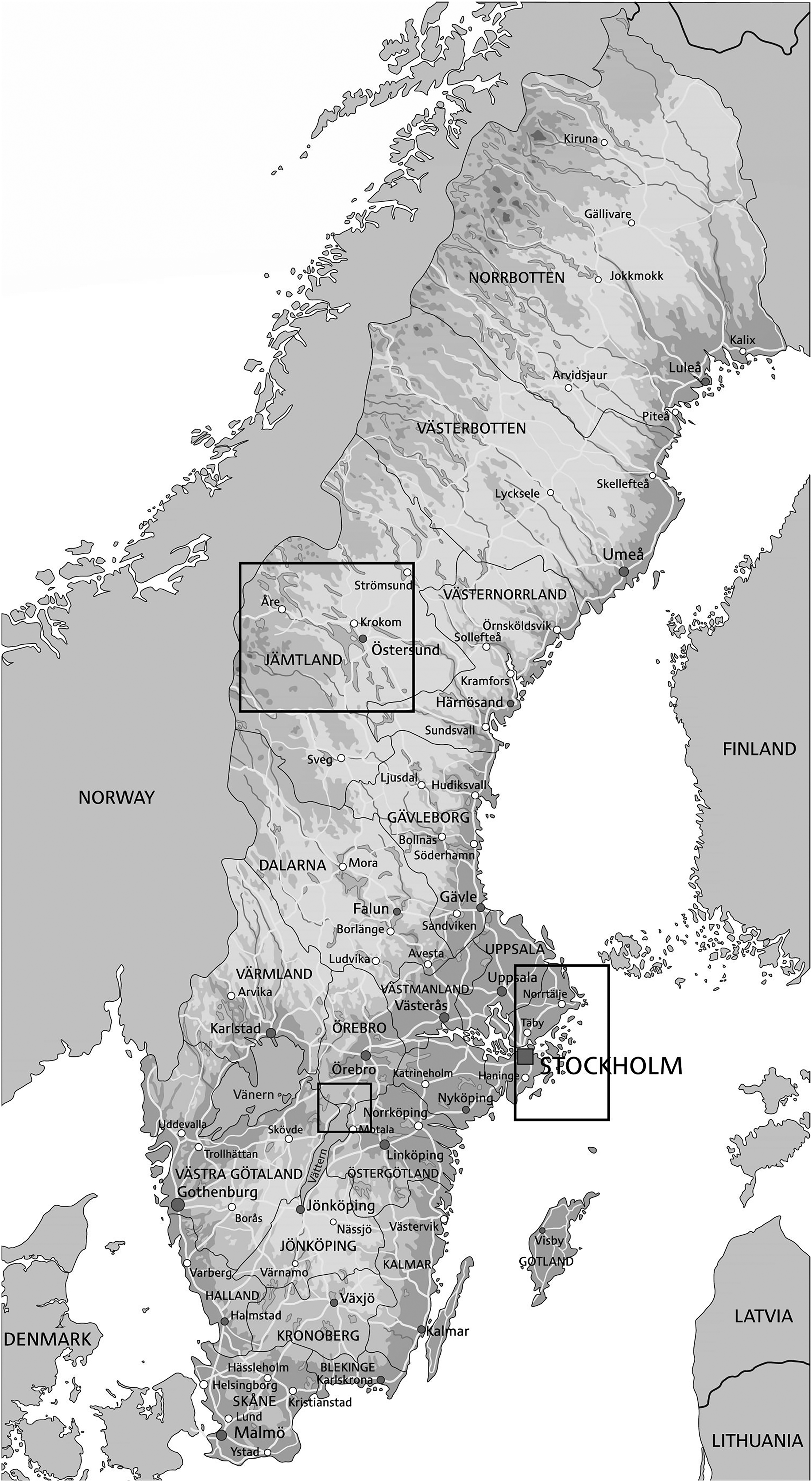
Map of Sweden where the case study areas are highlighted with rectangles. Map from iStockphotos.
Case 2: Stockholm Archipelago
The Stockholm archipelago reaches about 150 km from north to south along the coast of Stockholm county and consists of both mainland and circa 30 000 islands and islets, of which 200 are inhabited (Figure 1). The archipelago area administratively belongs to eight municipalities in the Stockholm region, which all have their administrative centres on the mainland. The Archipelago Foundation, with the purpose of preserving the natural and cultural values of the archipelago and keeping it open and accessible to all, owns and manages about 12% of the archipelago, including 40 nature reserves (The Archipelago Foundation, 2020). There is also one national park and an ongoing proposal to establish a second national park in the area (SEPA, 2023b). The remaining land is primarily privately owned with a large share of second homes, and the archipelago receives high numbers of visitors during summer. Stockholm archipelago represents a peri-urban area with a focus on water-based activities in this study.
Case 3: the municipality of Askersund and Tiveden National Park
The third case study area is located at the north end of Vättern, Sweden's second largest lake, about 250 km southwest of Stockholm (Figure 1). Outdoor activities and tourism in Askersund are mostly centred around natural and cultural experiences and boating in Lake Vättern. The reason why Askersund municipality was chosen as a case in this study is the long ongoing work to make the municipality as accessible as possible, which also includes accessible outdoor experiences and activities (Visit Askersund, n.d.). An attraction close to the municipality is also Tiveden national park, which the local destination organisation markets as ‘Sweden's southernmost wilderness’ (Tiveden, 2020).
Data collection and analysis
The main empirical technique for this study was semi-structured interviews with stakeholders representing different interests in the selected areas. The respondents were found through their professional roles of working with outdoor recreation, nature-based tourism, nature conservation, or accessibility. The sample was mainly a result of snowball-sampling (Tashakkori et al., 2021), where I first searched the websites of different national, regional and local organisations to identify appropriate respondents. I then contacted the potential respondents by email and asked them for an interview and when a positive answer had been obtained, I suggested they decide a time and a place for the event. At the end of the interviews, I asked respondents to suggest additional persons that they thought could contribute to this study, and I continued to ask respondents this question throughout the data collection process until saturation was reached (Tashakkori et al., 2021). This approach resulted in 36 interviews in total. Thirty of the interviews were conducted face-to-face, five were digital (Zoom or Microsoft Teams), and one was conducted by phone. The interviews lasted between 25 and 90 min with open-ended questions, which allowed the respondents to elaborate on their thoughts in their own words, as well as allowing me as an interviewer the freedom to pursue comments that were particularly pertinent to the research question (e.g. Brinkmann, 2014). The interviews focused on both the broader issues of accessibility in outdoor recreation, nature-based tourism, and nature experiences, such as the characteristics of these types of activities and their needs and challenges, as well as focused questions about the respondents’ perceptions of how nature can be made accessible while still considering other interests. I conducted the interviews in Swedish from October 2019 to August 2020, and they were recorded and later transcribed. As a researcher without a disability conducting research on accessibility, I acknowledge the importance of positionality and reflexivity in my work. My perspective is shaped by my own experiences and privileges, which do not include living with a disability. This lack of personal experience necessitates a heightened awareness of potential biases and assumptions that may inadvertently influence my research, and I seek to continually educate myself on disability issues and be open to feedback and correction from the disability community.
The respondents represented municipalities, County Administrative Boards, destination management organisations, nature-based tourism entrepreneurs, disability rights organisations, publicly funded or non-profit organisations working with outdoor recreation and/or nature conservation (e.g. the Archipelago Foundation, Swedish Outdoor Association, local fishing organisations), and SEPA. This study focused on the supply-side of nature experiences and outdoor recreation, and the aim was therefore not to specifically interview people with direct experience of working with disability, or people who had a disability themselves. Therefore, the respondents generally did not have extensive experience with disability. In many cases, especially for the governmental representatives, the responsibility of accessibility measures in protected areas was administered to them as part of the overall work with planning and management of protected areas, but few had prior awareness of accessibility issues and specific training on this matter. None of the respondents to my knowledge identified as having a disability. Prior to the commencement of the bigger research project, the researchers consulted with the ethical committee of the university regarding ethical approval. As the purpose of the project was to examine the supply-side of outdoor recreation, nature experiences and nature-based tourism and not the demand-side of such areas and activities, ethical approval was not assessed as necessary.
The data analysis was an inductive, iterative process that began already during the data collection phase, with the purpose of revealing important patterns (e.g. Silverman, 2017). The data was analysed by highlighting the sections of the transcribed interviews where participants reflected on the balance between accessibility in protected areas and other interests, to detect themes from the data material (Yin, 2018). In this article, a theme is viewed as ‘a pattern of shared meaning organised around a central concept’ (Braun and Clarke, 2022:77), thus uniting data and creating meaning from different outlooks. Identified themes were a result of extracting and scrutinising data in an open process to develop an understanding of the material and to provide a coherent interpretation of the data (Braun and Clarke, 2022).
Results and discussion
The interviews covered several topics related to accessible nature, ranging from technical solutions to enhance accessibility in protected areas to philosophical discussions of what a barrier-free society can mean. It nevertheless became apparent in the analysis that respondents representing governmental nature conservation interests, i.e., County Administration Boards and SEPA, were more concerned with balancing accessibility, ecological preservation, and accommodating expectations from visitors in protected areas than, for example, nature-based tourism entrepreneurs were. However, some tourism entrepreneurs raised concern that their guests, who seek experiences in ‘untouched’ or ‘wild’ nature, would consider activities in areas with extensive accessibility constructions less appealing. In this section, I further examine the ways stakeholders engage with the balancing of interests by centring the discussion around three emergent themes: a focus on designated areas, the quality of the nature experience, and collaboration. Although these themes are examined (in turn) for analytical purposes, they together form an interconnected display of how stakeholders view and negotiate the balancing of nature conservation and accessibility for people with disabilities.
A focus on designated areas – nature conservation over accessibility
The representatives of the governmental authorities were consistent in the opinion that there is a need to select certain areas when making protected areas accessible, as it is not possible to keep a high level of accessibility in all of them. This is due to mainly two reasons, according to the respondents: first, the financial resources provided by the government are limited, thus forcing the responsible agencies to initiate accessibility measures in only a few areas; and second, not all areas are suitable for such measures, as the topography and/or ecological preconditions do not allow for constructions or extensive infrastructure that risk harming sensitive vegetation or species. This is illustrated by three quotes below.
We want them [County Administration Boards] to select a few reserves and focus extra on accessibility. We have 5000 nature reserves in Sweden, and we cannot make all of them accessible, we don’t have enough resources for that.
-SEPA representative
Some people will not have the opportunity to see certain species of plants. There are areas that cannot, without intervention, be made accessible, then you would have to blast rocks and build ramps, it would be a huge intervention in nature.
-County Administration Board representative
Well, we work with nature, and it's not so adjusted to begin with. So, we have to think about how we can make areas accessible without ruining or exploiting too much. It's important to let nature be nature without ruining it with constructions.
-County Administration Board representative
This finding can be argued to show how the balancing of interests of nature conservation and accessibility in protected areas in Sweden is largely based on the view of nature in protected areas as somewhat of an inviolable entity. It appears as representatives of primarily nature conservation interests consider nature of high quality to be equal to nature that is unaltered and original, or at least with as little human intrusion as possible. This view is perhaps to be expected, as these officials by training are biologists, ecologists, nature conservationists, etc. It nevertheless raises questions of what the nature of ‘high quality’, or ‘natural nature’ means. Pezzullo (2023, cited in Cram et al., 2022: 852) identifies this view as eco-ableism, and states that ‘eco-ableism may be defined as the marginalization of disabled people through environmental design; the exclusion of disabled people in environmental decision-making; and the discrimination against disabled people through environmental discourses, beliefs and attitudes’. As discussed in a previous section in this article, the idea of nature and ‘wilderness’ as socially constructed (e.g. Cronon, 1996; Demeritt, 2002; Ducarme and Couvet, 2020; Ryan, 2015) is well-established in academia and has been debated for many years. However, the view of how nature is constructed in relation to disability, i.e., how discourses and ideologies interact with political objectives is researched to a much lesser extent. I would like to argue that planners and managers of protected areas contribute to, although unconsciously, constructing nature in an eco-ableist manner. An example of this eco-ableist construction is how several of the respondents use the phrase ‘ruin nature’ when talking about accessibility measures in protected areas, and how there always must be a balance between ‘making nature accessible and ruining it’. By stating that certain measures can ruin nature and the nature experience, nature conservation interests can be argued to claim the true interpretation of such experiences, thus closing the door to alternative understandings of what an ideal nature means. This view privileges able-bodied people and helps consolidate the notion that other types of bodies and minds are ‘out of place’ (Kitchin, 1998) and that value judgements are made about who belongs in these areas. Such judgements are precisely what the social and human rights models aspire to address and counteract by shifting focus from the individual's disability to society's disabling environments and attitudes, as well as to focus on advancing disability policy and law reforms (Bell, 2023; Lawson and Beckett, 2021).
Two other examples of eco-ableist views and practices are that respondents representing nature conservation interests admit there is an injustice in the fact that not everyone will have the possibility to experience all types of nature, and that existing accessible areas are not necessarily the types of areas people with disabilities request. These examples illustrate the rather inflexible view of conservation in protected areas: one that allows for injustices in order to safeguard assumptions of an ideal nature.
Respondents nevertheless recognised that all human presence in nature is a form of intrusion, regardless of if that intrusion is a narrow path or a built wheelchair ramp, which is illustrated by the quote below:
I think we need to work with accessibility even though it is a contradiction to intrusion. … There are many things that are intrusions in nature, all social structure is intrusion.
-SEPA representative
Stakeholders balancing the contradiction between accessibility and nature conservation nevertheless need to practically manage and plan for accessible infrastructure in protected areas. Respondents expressed a clear accessibility strategy that is to direct efforts to designated areas, preferably those with natural characteristics representing the protected area in question and where viewpoints and guided tours are available. This strategy is an attempt to overcome conflicting interests through compromises (Mebus et al., 2013; Pearn, 2011), but also a way to enhance the quality of the nature experience for people with disabilities and provide the ‘practical access’ that Bricker (1995) argues is necessary to meet political anti-discriminatory acts. However, it can be argued that nature conservation interests rely heavily on directing accessibility efforts to designated areas, and therefore fail to consider alternative ways of engaging with nature. Proposing that viewpoints and guided tours are sufficient for a high-quality nature experience represents a rather unimaginative apprehension of nature engagement, and efforts to support ‘theoretical access’ (Bricker, 1995), as well as attempts to expand and challenge the understanding of nature and the natural, should therefore be encouraged.
Respondents representing governmental authorities nevertheless bring up the idea that all types of adjustments to increase accessibility for visitors entail a degree of intrusion in nature, whether it is a wooden ramp or an information sign. According to respondents, people who visit protected areas will therefore have to accept some degree of adjustments, and those who seek ‘untouched’ nature and solitude can always choose to travel to the least visited and the least accessible areas to experience as unaltered nature as possible.
I’m sure that some people consider accessibility efforts an intrusion to the nature experience … but there are so few areas where we do work with high degrees of accessibility, so you will have to accept that intrusion. … I think that experiencing nature is a democratic right as all other rights in society, so you will have to accept that. Things are adjusted everywhere, but since it's the norm, we don’t think about it.
-SEPA representative
I mean, a very sensitive building or a very sensitive nature area is sensitive regardless of if you use a wheelchair. That is where you have to make the assessment, should this be open to the public, or only to a few, and who are these few? Only those who can walk?
-Representative of a disability rights organisation
When we develop accessibility in certain places, the pressure on parking lots, trails etc. increases.
- Regional developer of outdoor recreation
The quality of the nature experience
A second theme that emerged from the interviews relates to the quality of the nature experience. A majority of the respondents pointed out the importance of selecting sites that have certain characteristics, so that people with disabilities will have the same quality of nature experiences as their able-bodied counterparts. This can be manifested through the selection of a site where the environment is very typical for that specific area, so that the person who cannot easily hike the trails, for example, will get a good grasp of what the area looks like and its important features. It is therefore important that entrance points and trailheads with parking and accessible infrastructure and facilities are located in parts of the protected area that represent the characteristic nature of the area. Moreover, viewpoints are considered a convenient way to present a large part of a protected area and they are recommended to enhance the quality of the nature experience, as illustrated by the quote below:
When we do something, we try to find what is typical for the nature reserve so you can experience it. You will not be able to come all the way, but if you can get an outlook over the Ängsö [a national park] meadows, you can still experience what is typical for Ängsö.
-County Administration Board representative
They should have the same quality of the experience, on their terms. We can make the tour simpler, but they should still be able to experience that richness – to see, hear and touch the forest, rocks, water.
-Nature guide
This finding clearly corresponds to what previous studies (Bell and Foley, 2021; Burns et al., 2013; Moura et al., 2023) have pointed out: that little is known about people with disabilities’ preferences for natural areas, and their motivations to engage in outdoor activities. This lack of knowledge was apparent in the interviews, as several respondents stated that they find it difficult to reach people with disabilities and provide information about accessibility improvements made in protected areas. A majority expressed concern over the fact that few people with disabilities actually use the accessible constructions, so planners and managers of protected areas are uncertain whether or not the efforts made are successful in promoting outdoor experiences. It can therefore be questioned if the accessibility measures are of high quality to the target group, as high-quality nature to a conservation biologist is not necessarily high-quality nature to a visitor. This is also highlighted by Brown et al. (1999:219), who emphasise the need to thoroughly examine the preferences of nature areas for people with disabilities in order to design accessible areas that are of high quality to the user, and strongly recommend inviting input from the target group to ‘increase the likelihood that there is a strong match between accessibility and satisfying destinations’. Respondents nevertheless expressed that they experience difficulties in knowing what the user group finds to be high-quality nature experiences, even though their ambition is to provide accessible areas. One respondent stated that:
You try to learn all the time … We took a course in how to build for people with disabilities but it's still difficult when you don’t have a disability yourself, how to think.
-Municipality representative
Similar findings have previously been discussed in other studies (Aguilar-Carrasco et al., 2023; Bianchi et al., 2020; Wall-Reinius et al., 2023), which found information and communication regarding accessible nature areas and outdoor activities to be insufficient. Representatives of public authorities stated that they often bring in accessibility consultants when such measures are to be implemented, but few respondents had specific training themselves on how to ensure high quality nature experiences for people with disabilities. Respondents speculated about the reasons why people with disabilities do not extensively visit accessible protected areas and suggested that it is perhaps due to the lack of knowledge among staff on how to raise awareness about these areas to the user group. One respondent reflected on this and somewhat self-critically stated that:
perhaps many people are afraid to visit even though it says [on the website] that it is accessible, because you don’t know how it is accessible. Maybe we don’t know what type of accessibility is required, and there could be many things we haven’t thought of.
-County Administration Board representative
Collaboration
The low levels of collaboration between stakeholders were reflected in the self-experienced lack of knowledge about accessible nature experiences and outdoor recreation among staff, both in public and private organisations. In the CRPD (United Nations, 2006) it is stated that State Parties must actively consult with and involve people with disabilities in decision-making processes. However, few of the representatives of public authorities responsible for protected areas could mention on-going collaboration they have with other governmental or municipal authorities, private actors, or interest organisations, although several respondents emphasised that accessibility is a prioritised issue that permeates all actions taken by the organisation. It was common to have had projects related to accessibility, but these had been terminated when the project time and funding ran out, so most efforts were selective measures together with accessibility consultants. Previous studies (Nyanjom et al., 2018, Sisto et al., 2022) suggest that successful stakeholder collaboration to improve accessibility requires time and efforts that include economic, social and political initiatives; something that was also stressed by one representative of a disability rights organisation. The disability rights organisation representative nevertheless emphasised that people with disabilities are not sufficiently involved in the planning processes of accessibility initiatives, even though they are the experts (see also Dahlberg et al., 2022). The respondent argued that people with disabilities are not always invited to participate in the planning process or invited too late when decisions have already been made, thus making their involvement only little more than window dressing.
I think there's a lot to gain by having more time in construction projects, because then you would have time for the reference groups, and include them properly, give them fair conditions, and not use our members as an alibi.
- Representative of disability rights organisation
There are several [challenges], at different levels. What I think of immediately is resources, that we have limited funds and that we have such short budget processes. We receive money from year to year, you can't really say in the long term that we will be at this or that level, it is politically controlled and quite uncertain.
-County Administration Board representative
Respondents also found it problematic that there are many different actors involved on different levels, thus making it difficult to know what various actors plan in terms of accessibility initiatives in protected areas in the county. Hence, there were requests for overall plans at the county level that guide accessibility efforts. Uncertainties about the roles and responsibilities on the matter of accessibility was expressed by one of the respondents:
It's so unclear, who owns the issue of the archipelago, which municipalities, what does the Archipelago foundation do, what does the County Administration Board do? … It's unclear who does what.
-Municipality representative
The findings of this study support previous research that low degrees of collaboration hinder the implementation and operationalisation of accessibility initiatives (Bianchi et al., 2020; Groulx et al., 2021). Moreover, I argue that the lack of collaboration and knowledge sharing between stakeholders hinders an effective way to address the conflicting views of accessibility and nature conservation. Already in 1993, Mullick asked: ‘can the natural environment be made fully accessible, without damaging it permanently?’(1993: 33). It appears as if there is not yet a clear answer to this question, although the matter of access to protected areas is becoming increasingly pressing due to growing numbers of visitors (Döringer et al., 2023; Schultz and Svajda, 2017; Tverijonaite et al., 2018). However, even though people with disabilities could be argued to benefit the most from outdoor activities and nature experiences (Menzies et al., 2021; Taylor and McGruder, 1996; Zhang et al., 2017), people with disabilities are underrepresented when it comes to spending time in nature, so this group does not contribute to crowding, environmental degradation, littering or other actions that also could be considered to ‘ruin’ nature. With this in mind, I suggest that there is a need for a new perspective on the balancing of accessibility and nature conservation; a perspective that does not pit the two against each other, but rather seek compromise. This is illustrated by one respondent who stated that:
Well, perhaps as a conservationist and biologist, I am not particularly happy of having trails in all these places, but maybe you need to let that [outdoor recreation] come first, because it benefits other purposes.
-Archipelago Foundation representative
Concluding remarks
This article contributes to a limited literature on balancing interests of nature conservation and accessibility, by focusing on how public and private stakeholders view and practice this contradiction in protected areas. Although there is a constant negotiation between these interests, nature conservation interests generally take precedence over interests of accessibility, which is manifested through the perspective of accessible infrastructure in protected areas as damaging to nature. In the introductory pages of this paper, I used the quote from Demeritt (2002) as a point of departure to discuss contrasting views of what nature in protected areas ‘should’ look like, and how these preconceived notions shape our understanding of an original nature, untouched by humans, as ideal. This ideal is nonetheless nothing short of an image, formed by officials that, albeit well-meaning, to a great extent have the prerogative to ‘shape nature both through our concepts and through the material practices that lead to and follow from those ways of constructing nature’ (Demeritt 2002: 786).
The findings of this study suggest there is a need to renegotiate the meaning of nature and accessibility in protected areas to challenge the prevailing able-bodied narrative that accessibility measures equal ruin. The ‘material practice’ of managing protected areas with as little human intrusion as possible is excluding and maintains able-bodied norms of nature conservation and accessibility as incompatible interests and does little to counteract stereotypes and assumptions of the ‘right’ way to engage with nature. In this study, I suggest that the renegotiation of protected nature and accessibility as incompatible interests can be handled through compromises, with the help of actions such as improving long-term collaboration between planners and managers of protected areas and the user group. For nature experiences to become inclusive, it is however crucial to acknowledge that simply constructing accessible infrastructure does not automatically result in equal access to nature for all, as suggested also by Duedahl et al. (2022). Access to nature relies on far more complex factors than infrastructure, and the results of this study highlight the importance of sharing knowledge, ideas and experiences of how accessible nature can become reality. Perhaps most important is to acknowledge how the ideal of an ‘untouched’ nature is a production of human ideas and perceptions, and that this ideal is subject to constant change depending on prevailing norms and conditions. As stated by Ryan (2015:146): ‘by remaining more open to paradoxes and contradictions, outdoor recreation can begin to examine whether all human impacts are indeed negative’.
Obviously, changing norms, practices and prejudices with stakeholders working with nature conservation and accessibility, as well as with the public, takes time and efforts. This calls for further research that would continue to examine how arenas for collaboration can promote innovative ways of engaging with nature, and there is a need to focus on the preferences of accessible nature experiences and activities from the perspective of the users.
Highlights
Physical and social barriers impede the full participation of people with disabilities in outdoor recreation and nature experiences.
Balancing accessibility and nature conservation in protected areas poses challenges for planners and managers in the nature/culture dichotomy.
Nature conservation interests often override accessibility measures, arguing that such measures ‘ruin’ nature and the nature experience.
Limited understanding of how people with disabilities wish to engage with nature hinders comprehensive access.
Inclusive collaboration among stakeholders, including people with disabilities, is crucial to avoid exclusionary decisions and challenge ableist norms.
Footnotes
Acknowledgements
I would like to thank Sandra Wall-Reinius for insightful comments, which helped to improve the manuscript. Project assistants Torun Östling and Annika Jonsson deserve thanks for their valuable contributions to the data collection process. I also thank the respondents for sharing their time and thoughts with me.
Funding
The author disclosed receipt of the following financial support for the research, authorship, and/or publication of this article: This study was part of the research project ‘Accessible and Inclusive Nature-Based Tourism: Promising Practices of Universal Design in Sweden’, which was funded by the R&D Fund of the Swedish Tourism & Hospitality Industry, Östersund Municipality, Sweden and Mid Sweden University, Sweden.
