




Abstract
Echolalia – the repetition of words and phrases gleaned from one's environment – is often treated as a key behavioural marker of autism. Along with other perceived ‘stereotypies’, it is dismissed by Western biomedical and political discourses as disruptive, ‘meaningless repetition’ and targeted for individual and collective elimination in the context of a global ‘war on autism’. However, as this article shows, echoing is also a crucial element of Autistic ways of worlding. That is, it can be integral to forming and maintaining co-constitutive relations and ethical intimacy with other beings through distinctively resonant political-ec(h)ological relations. At the same time, echoing is a political act that can disrupt interwoven neurotypical (NT), colonial, racial and capitalist rhythms of sociality, communication and space. This insight challenges negative stereotypes about the perceived ‘lack’ or ‘impairment’ of Autistic people in the areas of relationality, intentionality and meaning-making. At the same time, it opens up a wider discussion of how Autistic ways of worlding can contribute to the creation of alternative eco-political futures. To flesh out these arguments, I draw on auto-ethnographic research based on my experience as an Autistic and Dyspraxic global political ecologist. In particular, I share elements of my experimental practice of ‘eco-lalia' – a reclamation of echoing as a form of echo-political praxis, expressed here in the form of poetry. In so doing, I argue that ec(h)olalia and other Autistic ways of worlding can contribute to nurturing robust more-than-human relations, confronting violence and creating solidarities across communities marginalized by dominant global norms of ‘humanity’.
Content notice: this article discusses ableism; racism; physical, sexual and emotional abuse; ABA; mental health and suicide; institutionalization; involuntary sterilization; eugenics and other potentially re-traumatizing subjects. If you are a survivor of any (or many) of these forms of violence, please read with care – and know that you are cared for.
I am almost completely submerged, just the tip of my nose breaking the surface. I can't see to the bottom of the mineral-thick water, but I sense its layered depths as my feet slice through pockets of heat and cold. I am alone in one of my favourite bodily states, suspension: pressed into place by the weight of the water, feeling its feedback in each of my cells. I am enclosed, self-contained, yet in open exchange with the sulfuric mist, the air and the falling snow, all of my surfaces interfacing with theirs. As I float, a fragment of language repeats inside my head, shifting and tilting before curling up into a short, assonant phrase: earth-burned. It is a found sound, gleaned from a nearby tour guide whom I overheard describing the origins of a scorched patch of Icelandic soil. In my synaesthetic bodymind (see
Clare, 2017
), it feels pitted, dark-brown and richly-acidic, like clumps of scalded chocolate. As I move through my days, my magpie brain reflexively collects and polishes artifacts like this one. I move them over my tongue, tap them out with my fingertips or front teeth, or make their shapes with my lips, feeling for the rhythms and patterns hidden within the words. Re-assembling syllables, I coax out the unintended rhymes and sonic tumbles lurking in everyday language. I dwell in, and on, subtle mis-hearings that yield startling combinations of ideas. This process is sensual, intellectual, automatic, creative, soothing, irritating and invigorating. Although it is nearly constant, I have learned to hide it most of the time. But often, as in this case, the tension built up by internal repetition demands release. Since I’m in public and social norms prevent me from repeating the words out loud, I need to write them down. I leave the water, find my mobile phone, and type out the following:
These lines, arriving on my screen fully formed, are a co-composition of my sensorium and its environment, the echo of my intensely embodied mind in conversation with its worlds.
What I have just described is a practice that I call eco-lalia: a way of communicating, relating, co-creating, and literally resonating with ecosystems. It is integral to how I navigate and engage with the world, and a foundational source of my work as global political ecologist. Yet, despite its generative role in my thinking and practice, it is not accepted or credited as a legitimate research method or theoretical source. On the contrary, within dominant academic and social contexts, it is usually necessary to hide, deny and suppress it for a range of reasons, from protecting the perceived quality and legitimacy of my work 2 to avoiding various forms of violence. This is because the practice I have described is pathologized in dominant, neurotypical 3 (NT) scientific and social discourses as echolalia 4 : an apparently ‘meaningless’ and disruptive type of verbal emission associated with developmental disorders.
I am Autistic and Dyspraxic 5 , and echolalia is one of the key ‘behaviours’ through which Autistic ways of being are diagnosed and targeted for ‘extinction’ 6 – not only as individual bodies but also in the global normative-material body of ‘humanity’. Indeed, in the face of increasing ecological turmoil and political change, the dominant norm of ‘humanity’ (see Wynter, 2003) is increasingly framed as threatened or embattled – (Mitchell, 2016, 2023). In this context, collective formations that disrupt its norms – including Autistic ways of worlding and many others – are intensively targeted for destruction. In the case of Autistic ways of worlding, crucial forms of expression, communication and co-creation, including echolalia, are dismissed by the dominant medical-scientific complex (see Clare, 2017; Kafer, 2013) as undesirable, useless or even dangerous. Pushing back against this eliminative imaginary, I offer an alternative account of echolalia as a form of political–ec(h)ological relationality and way of creating more-than-human worlds, including visions of future flourishing. I also highlight possibilities for nurturing solidarities across Autistic and other (multiply- and intersectionally-) marginalized communities oppressed in different ways by dominant norms of ‘humanity’. To this end, I offer an auto-ethnographic reflection on my practice of ‘eco-lalia’ as an example of the contributions Autistic ways of worlding can make to imagining, designing and embodying futures in which plural worlds can flourish.
(echo-)locating myself
Autistic worlds are not homogeneous: they are as diverse as allistic worlds, and, likewise, are shaped by unique patterns of privilege, oppression, security and vulnerability. For these reasons, it is important to offer context about my specific positionality and how it affects my experiences and perspective. I am a white neuroqueer 7 person in my late thirties who eventually 8 received a formal diagnosis as Autistic and Dyspraxic at age 35. 9 As a white person living in a settler-colonial state rooted in white supremacist political structures, I am a beneficiary of multiple forms of social, economic and political privilege 10 . I enjoy a high degree of economic security, having been employed since my early teens, obtaining a permanent academic post at age 24 and tenure at age 28. This experience contrasts with the long-term unemployment experienced by between 42% and 78% of Autistic people in the countries where I have lived as an adult (see ONS, 2020; Solomon, 2020; Statistics Canada, 2017). I have lived independently of my parents since my mid-teens, have access to affordable credit that has enabled me to rent and own/mortgage homes, and I have cohabited with my long-term partner for over a decade. For these reasons, when my energy and level of executive function 11 are waxing, I am often able to pass as (almost-)neurotypical.
Nonetheless, being Autistic saturates my daily experience, especially in the realm of cognition, sensory experience, communication and interactions. Although I will discuss the former two elements below, common examples of the latter two include difficulty conveying meanings to and being understood by allistic people, despite immense effort; difficulty in interpreting sayings, cliches or implied meanings; trouble ‘timing’ my interventions in conversations; confusion about unwritten or inconsistent conventions, expectations or social mores; trouble adjusting to impromptu or unscripted interactions; perceived ‘mismatches’ between my tone and emotions or intentions; or others’ beliefs that I am being ‘fake’, ‘superficial’ or ‘shifty’ due to masking (see below). My sense of embodiment is also deeply affected by my interactions with spaces designed along with NT principles; I am almost always in intense discomfort, including muscular pain, migraines, exhaustion and strain from having to hold myself still or maintain NT postures for long periods. Through decades of socially-enforced ‘masking’ 12 (see Price, 2022), I have internalized and suppressed most of what many NTs categorize as overtly ‘autistic behaviours’ when in public – albeit at immense cost to my physical and mental health (see Rose, 2021), which causes many people to label me as ‘high-functioning’. ‘Functioning labels’ are rejected by many Autistic people, since they impose hierarchies – based on NT criteria – that degrade, marginalize and dehumanize those deemed ‘low(er) functioning’, including those who cannot and/or do not speak. Simultaneously, the high demands placed on Autistic people labelled as ‘high-functioning’ to act ‘NT’ often lead to long-term burnout – including sudden, non-linear drops in ‘functionality’ and /or suicidality (Pearson and Rose, 2021; Raymaker, Teo, Steckler et al., 2020). Functioning labels also freeze and ossify Autistic experience; for many Autistic people, the capacities that Western medical-scientific and social norms code as ‘functionality’ can vary substantially across time and context (see Aucademy 2021; Gadsby, 2018; Kim, 2014) 13 . In my own case, although I usually can speak and am frequently hyper-verbal 14 , I experience frequent periods of burnout, meltdown and shutdown caused by overstimulation and the stress of navigating complex NT social and material structures. In such states, I am often unable to speak at all, or fluidly; I struggle physically to form words with my mouth or to ‘find’ them cognitively; I am restricted in my movement and coordination, or in controlling them precisely; and I am exhausted and need of full-body stimming (e.g. rocking, deep pressure, swinging in a hammock or, indeed, echoing). Although I seek and often enjoy interaction with people, I also experience all social interactions, to various degrees, as risky, exhausting, stressful, confusing and/or anxiety- or fear-inducing. In addition, physical, sensory and cognitive differences make it very difficult for me to engage with others via phone, text message, apps or social media.
Adult diagnosis allowed me to escape some of the disciplinary and often traumatizing (Sandoval-Norton and Schkedy, 2019) therapies designed to excise ‘autism 15 ‘ from young children, including Applied Behaviour Therapy (ABA 16 ) and other social, chemical, dietary, physical and pharmaceutical ‘treatments’ (see Silberman, 2015). Nonetheless, in modern Western (-influenced) societies, people who exhibit ‘autistic behaviours’ – whether diagnosed or not – are subjected to myriad informal ‘interventions’ by teachers, parents, peers, medical professionals and others. These may include but are not limited to: ostracization; punishment; teasing and bullying; detention and physical restraint; public shaming and scapegoating; gaslighting; verbal, physical, emotional and sexual abuse; time spent in the foster care system; and much more. In addition to all of these experiences, like a high percentage of Autistic women and girls (Hendrickx, 2015), I was (incompletely) diagnosed with anorexia nervosa as a pre-teen, and misdiagnosed with various anxiety disorders in subsequent years. These mis- and partial diagnoses led to institutionalization, including lengthy hospitalization and placement in a group home. Not least as a result of these ‘interventions’ I, like a large proportion of Autistic adults (Aucademy, 2021; Gates, 2019), have long held a co-diagnosis of complex post-traumatic stress disorder (cPTSD).
This brief auto-ethnographic sketch illustrates the complexity of social, political, cultural, biomedical, psychological and other factors that condition an Autistic person's world, refracted through unique combinations of privilege and marginalization. As this sketch suggests, my experiences should not be generalized or taken to represent ‘Autistic experience’ as a whole; I do not, and cannot, access the internal worlds of other Autistic people. Contrary to the influential (to NTs) and widely reviled (by Autistic self-advocates) name of an influential US anti-Autistic organization, each Autistic person speaks – or writes, flaps, stims, blinks, paints, yells, sings, echoes or does whatever – for themself. What's more, the forms of anti-Autistic violence I will now discuss are inextricably linked to other structures of oppression stemming from global norms of ‘humanity’, including racism, colonialism, gender-based and sexualized violence and anthropocentrism. Of course, many Autistic people exist at the intersections of several of these vectors of violence, and I do not wish to flatten or homogenize inequalities of privilege and harm. Instead, my aim is to highlight the interfaces between the various forms of structural violence that seek to create and enforce dominant norms of ‘humanity’, and to help kindle solidarities that can dissolve them.
Making the right noises: Campaigns to silence echolalia
The vast bulk of the multi-billion dollar global industry devoted to ‘autism research’, ‘autism advocacy’ and related fields is, in fact, anti-Autistic in its assumptions and goals: that is, it seeks to eliminate, prevent, ‘cure’ or extinguish Autistic worlds and culture. As allistic researcher McGuire (2016) shows, this industry reifies (and vilifies) ‘autism’ as a pathological ‘disorder’ marring the lives of otherwise ‘normal’ people and their families, and a threat to be vanquished through an encompassing, global, medical-scientific and cultural–political ‘war’. As McGuire demonstrates, ‘autism research’ and advocacy are often carried out by and for the benefit of allistics (predominantly the parents/family of Autistic children) – often in direct contradiction or opposition to the increasingly rich body of research and self-advocacy carried out by and for Autistic people (see, e.g. Brown, 2012; National Women’s Law Center (NWLC)/Autistic Women’s and Nonbinary Network, 2021; Ne’eman, 2010).
A key aim of anti-Autistic research and treatments focuses on extinguishing ‘autistic behaviours’, including ‘stereotypies’ (repetitive actions) such as echolalia, before adulthood. Indeed, many anti-Autistic treatment regimens, including ABA, operate on the assumption that children can ‘overcome’ or ‘be cured of’ Autism through the suppression of undesired ‘behaviours’ – an approach that was directly co-developed with the so-called ‘gay conversion’ therapies in the United States in the 1970s and 1980s (see Silberman, 2015; Yergeau, 2018). Just a few concrete examples of interventions intended to extinguish Autism through ‘behavioural engineering’ (see Silberman, 2015) include a therapist pushing colour-coded cards into a child's face while commanding him to speak or ‘be quiet’; compelling a child to press his index finger to his lips one hundred times after speaking ‘out of turn’; depriving children of toys on which they rely for self-regulation; and playing children recordings of themselves echoing as a ‘replacement’, while punishing the act itself (Stiegler 2015). In some cases, pharmaceuticals such as Zoloft or hormones used as chemical castration agents are prescribed to pubescent Autistic children as behavioural controls (Yergeau, 2018). Lovaas’ early experiments, the basis of the ABA regimen, infamously involved punishment in the form of emotional and physical ‘aversives’, including beatings and electric-shock ‘therapy’. This practice continues in the present day, most notoriously at the Judge Rotenberg Center (JRC), a residential medical facility in Massachusetts. In 2021, a US federal appeals court ruled to allow JRC staff to continue administering electric shock ‘treatments’ (proven to cause third-degree burns and neurological damage) to control ‘aggressive’ or ‘self-harming behaviours 17 ’ amongst ‘patients’ (see Kaplan, 2021) – despite a deep-seated and well-documented culture of abuse (Neumeir, 2012),
Notably, the researcher who implemented the coloured card ‘therapy’ described above found it worthy of remark that the child did not ‘forcefully resist’ (see Stiegler, 2015). This comment reflects the degree of normality and frequency with which coercive force is against Autistic people despite explicit resistance – and the highly compromised conditions of consent for such interventions, especially when given by proxy (e.g. a parent or carer). What's more, resistance or negative reactions to such interventions are often labelled as uncooperative or disruptive behaviour, which may lead to further punishment and/or reputational stigmatization (for instance, negative notes on official records). For BIPOC children, in particular, such reputational harms can lead to cascades of harmful consequences, from peer-shaming to segregation and incarceration (see Erevelles and Nimear 2010).
Some practitioners (see, for instance, Healy and Leader, 2011; Stiegler, 2015) oppose interventions designed to extinguish echolalia based on the instrumental logic that it may help Autistic children learn to communicate in NT ways. Two seminal studies of (small groups of presumably white, American) Autistic boys (Prizant and Rydell, 1984; Prizant and Duchan, 1981) argue that immediate and delayed echolalia helped Autistic subjects to achieve ‘communicative goals’ such as labelling, calling, issuing directives, offering affirmation or protesting demands made upon them. However, the study did not afford echolalia the designation of ‘true communication’ (defined in terms of intentionality, conventionality, symbolism and flexibility). Allistic speech-language therapist Blanc (2013) suggests that echolalia is part of the gestalt form of language-learning used by approximately half of human children (including NTs) and therefore may act as ‘building blocks’ for ‘normal’ language acquisition and use (Blanc, 2013). However, she does not find any value in echolalia in itself, or in terms of Autistic peoples’ experiences and needs. A more recent study shows how one American autistic child ‘used’ echolalic utterances to perform complex relational manoeuvres such as negotiation, contestation and humourously diffusing conflict amongst family members (Sterponi and Shankey, 2014). This account points to the value of echolalia in helping Autistic people to communicate with NTs – but not its (other) value(s) for autistic people.
As these studies suggest, the creative use of echolalia can help autistic people to forge social bonds, get needs met and navigate dominant NT-dominated social systems more safely and effectively. However, echolalia also has a wide range of values for autistic people that have little or nothing to do with NT social structures and norms. For instance, Métis Autistic/multiply-disabled writer and speaker Schaber (2014) describes echolalia as ‘a way to process your environment… and what you’re thinking and feeling’, a source of self-regulation, creativity, fun or pleasure. In other words, echolalia can enable Autistic people to engage, navigate and co-create Autistic worlds, in our own terms and in line with our needs and interests. Before exploring this idea in more detail, however, it is important to examine the broader and deeper roots of the widespread campaign to silence echolalia.
Protecting ‘humanity’ from (its) uncanny echoes
Efforts to extinguish echolalia within individual autistic bodies and minds are microcosms of a broader structural-systemic effort to eliminate ‘autism’ from the broader body of ‘humanity’. As McGuire (2016) shows, numerous national and international campaigns have, for several decades, mobilized governments, medical and educational institutions and the private sector in a concerted ‘war against autism’. In the face of mounting eco-political crises such as climate change, this ‘war’ – or, more accurately, one-sided campaign of elimination – expresses increasing insecurities amongst currently dominant about the long-term survival and fitness of a global norm of ‘humanity’ (see Mitchell, 2014a, 2014b).
This norm is steeped racist and colonial inscriptions of ‘the human’ rooted in essentialist assumptions about embodiment, geography and relationships with the land and other beings (Belcourt, 2016; Ferreira da Silva, 2007; Mbembe, 2017; Singh, 2018; Wynter, 2003) 18 . It is also grounded in heteronormative (Braidotti, 2022; Colebrook, 2014); anthropocentric (Mitchell, 2014a; TallBear, Taylor, 2018) and ableist (Chen, 2012; Clare, 2017; Kafer, 2013; Taylor, 2018) presumptions about the kinds of bodies, relationships and political arrangements deserve to exist in ‘the’ future. As such, ongoing and emerging efforts to protect ‘humanity’ often involve the violent targeting of groups that diverge from are oppressed by and increasingly resist dominant norms of ‘humanity’ (Mitchell and Chaudhury, 2020). Autistic people are amongst the groups explicitly targeted by such discourses. Indeed, in articulating its ‘Sustainable Development Goals’ in 2015 (United Nations, 2015, italics mine), the United Nations specifically identifies ‘behavioural, developmental and neurological disorders [as]…a major challenge for sustainable development’ – that is, an obstacle preventing humanity as a whole (not just those directly affected by ‘autism’) from achieving what the UN considers a good human life. The SDGs class ‘autism spectrum disorders’ as ‘noncommunicable diseases’, and ‘commi[t]’ to their ‘prevention and treatment’ (United Nations, 2015, italics mine) – that is, to the elimination of Autistic futures, and of futures with Autistic people in them (see Kafer, 2013; Yergeau, 2018).
Echolalia enters this fray as a sonic marker of the monstrous and, literally, spectral entity of ‘autism’ that is feared to be invading, disfiguring and weakening the body of ‘humanity’ just as it faces unprecedented threats. An audible haunting by unwanted forms of life (see Belcourt, 2016), echolalia prompts mainstream NT fears of the apparently rapidly increasing incidence of ‘autism’
19
, which is, in turn, perceived as a damper on the development and improvement of ‘humanity’, and an interruption to modern rhythms of capitalist productivity (McGuire, 2016). Reduced by this logic to ‘behaviours’ such as ‘echolalia’, Autistic people and our ways of being are framed as the distorted echoes of ‘humanity’: simulacra that sound ‘like’, but do not count as ‘real’, language – or ‘real humans’. Our echoes telegraph collectively feared futures that involve the interruption, ‘retardation’ or even devolution of ‘humanity’ (see Mitchell, 2023). We can get a clearer sense of this logic by looking at three of the key charges made against echolalia by NT culture. ‘meaningless repetition’
Echolalia and other ‘repetitive stereotypies’ are clinically labelled as ‘pathological’, which suggests that they harm those who engage in them. Yet I have not been able to find a single study arguing that echolalia in itself causes direct harm to Autistic people – only reports of negative responses by allistics, including punishment, shaming and violence. To treat these phenomena as necessary ‘effects’ of echolalia is to naturalize them, erasing their status as expressions of anti-Autistic ableism and violence. Much greater emphasis is placed on the discomfort that echoing seems to cause allistics, who appear to find it disruptive, inappropriate and, above all, annoying (Healy and Leader, 2011; Stiegler, 2015). Consider Blanc's comment that echoes created by Autistic children leave ‘us’ (her presumed allistic readership, and the objects of her empathy) feeling ‘dismay’, ‘scratch[ing] our heads in confusion, clos[ing] our ears in consternation and… try[ing] to ignore it’ (Blanc, 2013: 4). Of course, repetition is not, in itself, inherently offensive or unpleasant within NT culture; it is regularly embraced and enjoyed in the context of music, sports cheers, political slogans, prayers, stories, cliches, games and more. What allistics appear to consider ‘pathological’ about echolalic repetition is that it violates (NT) expectations of ‘human’ behaviour. Specifically, echoing introduces repetition where variation is expected – and demanded – as proof of a flexible, responsive, truly ‘human’ mind. It is often characterized by allistics as ‘mechanical’, ‘robotic’ or ‘machine-like’ ‘noise’. Indeed, when encountering echolalia, many allistics (are conditioned to) experience a phenomenon called bukimi no tani genshō (‘the uncanny valley’) (Mori, 2012): an involuntary and self-protective feeling of confusion, fear, unease and/or revulsion that many people report when engaging with extremely ‘human-like’ nonhumans (usually robots or artificial intelligences). Several Autistic writers believe that this experience occurs when allistics are suddenly confronted with an Autistic embodiment such as echolalia (see Goldstein, 2021; Hansen, 2018). In these encounters, what is at stake is the boundaries of ‘humanity’ - and allistics’ ability to discern and enforce it.
Echolalia is also frequently dismissed as ‘meaningless’ by allistic researchers because it is repetitive. In fact, many echoes – such as song lyrics, melodies or lines from films 20 – consist of standardly pronounced (if in an unconventional tone or tempo), culturally salient, grammatically consistent words, phrases or melodies in widely-spoken languages or structures, delivered in a logical order – this is why they are called ‘echoes’! As discussed above, they may also be used creatively to convey information or share ideas. Nonetheless, since echoes rarely meet linguists’ criteria for making meaning through ‘true language use’ (see above) they are assumed to have no meaning (see Prizant and Rydell, 1984; Yergeau, 2018).
In fact, what renders echolalic utterances ‘meaningless’ by NT standards is their flexibility, their semiotic multiplicity and indeterminacy: in short, they express the ability of Autistics to simultaneously and partially occupy distinct worlds, and thus be ‘out of place/time’ (in relation to NT norms). When we echo, Autistics embody and render present words, thoughts, states and contexts that, in the context of the linear timespace imposed by NT modernity, may be perceived as eery, ghostly or monstrous (see Belcourt, 2016). Our manifestation of this state of being-in-multiple-worlds confounds a key assumption of Eurocentric accounts of ‘humanity’: that ‘we’ all share a single world or universe (Viveiros de Castro, 2012). This assumption is shattered by the coexistence with Eurocentric modernity of diverse more-than-human and Indigenous worlds (see Blaser, 2014; Escobar, 2018) – and of worlds within worlds, such as the queer Indigeneities embodied and expressed by Cree thinker Belcourt (2016). These worlds are not neatly nested; they overlap but also sometimes collide in a ‘partially-connected time-place’ (De La Cadena, 2019). Similarly, when we echo, Autistic worlds partially overlap and possibly disrupt the NT worlds that we imperfectly traverse. This state of being-in-multiple-worlds is highlighted by the late Autistic activist Baggs (2007). In the first section of a short viral video, Baggs records themself engaging in complex, world-forming interactions with running water, wooden objects, light and other non-humans, explicitly framing these interactions as part of their ‘own language’. Then, collaborating with speech-assistive technology, Baggs delivers (and directly embodies) an incisive critique of NT dismissals of their language as ‘meaningless’ – and of allistics’ disbelief that they can engage in both their own language and NT language use. Importantly, similar assumptions are often applied by racist–colonial systems to disavow or undermine worlds and knowledge systems that exceed, precede, collide with and challenge Eurocentric modernity.
Combining the mutually supporting logics of ableism and racist thought (see Taylor, 2018), anti-Autistic research often associates echolalia as ‘primitive’, ‘pre-human’, an indication of ‘regression’ or a threat to human ‘development’ and ‘civilization’. This narrative is captured by a scene from Anishinaabe writer Erdrich's (2017) novel Future Home of the Living God. In the novel, evolution suddenly reverses itself, and an increasingly authoritarian government hunts down, arrests and removes infants from pregnant (in particular, BIPOC) people to prevent human devolution. It is rumoured that all infants are being tested for differences in size, physical coordination and speech abilities – all ‘symptoms’ frequently framed as ‘early warning signs’ of autism (see McGuire, 2016). As this unfolds, Sarah, the middle class, cis-het, anti-vaxxer
21
adoptive mother of the pregnant, Indigenous protagonist watches a news report. She is terrified by its images of ‘humanoids hunch[ing] as they walk backwards into the mists of time, while in the background, Beethoven's 5th symphony dissolves into a series of hoots and squawks’ (Erdrich, 2017: np).
In response, Sarah cries: ‘dear God. There goes poetry. There goes literary fiction. There goes science. There goes art’ (Erdrich, 2017: np). Sarah's reaction encapsulates NT fears that Autistic expressions – including echolalia, but also singing, humming, grunts, hoots, squeaks, croaks and yells (see Blanc, 2013) – are not only ‘primitive’ but also evidence of the ‘regression’ of ‘humanity’. In a similar fashion, echoes and other Autistic ways of worlding are interpreted to be not simply ‘meaningless’ but also threats to meaning: inversions of Eurocentric linear time and its promises of perfection; and literal echoes of a feared ‘pre-human’ past/future.
Refusing to communicate
Echolalia is often dismissed as failed or distorted NT communication, or as an obstacle to ‘real’ speech. This premise assumes that its exclusive or primary ‘function’ or value is communicative (in NT terms) rather than, for instance, cognitive (Reboul, 2015), relational (Baggs, 2007; Manning and Massumi, 2014), sensual or sensory (Schaber, 2014; Manning, 2016). Some of the scholars cited above attempt to redeem echolalia as a (lesser) prototype of, or precursor to, NT and/or allistic modes of speech. Instead, I want to examine this idea of echoing as non-speech by showing how it can function as a-, non- or even anti-communication – that is, as resistance to the total penetration and assimilation of Autistic worlds into NT ones. Indeed, the search for cure and the NT effort to control Autistics has long been used to justify the intense surveillance and invasion of our bodies and worlds. In addition to the many ‘therapies’ and studies discussed above, these invasive processes also include genetic registries such as the new UK-based ‘Spectrum 10K project’ 22 and ‘brain banks 23 ’ that encourage donations of brain tissue from deceased Autistic people (often made by family members or carers), used to support cure-oriented research. They also include efforts to control our sexualities and reproductivities, including widespread legal, forced sterilizations of disabled – as well as Black and Indigenous – people with uteruses across the United States and Canada (see National Women’s Law Center (NWLC)/Autistic Women’s and Nonbinary Network, 2021; Clare, 2017).
In this context of pervasive penetration, echolalia and other non-NT actions can function as a form of refusal, in a sense that resonates with the thinking of Mohawk philosopher Simpson (2014). For Simpson, unwillingness to reveal certain information to non-Indigenous researchers, or to communicate in their terms (see also Coulthard, 2014), can assert Indigenous sovereignty, autonomy and self-determination 24 , and refuse untrammeled access to Indigenous bodies, minds, worlds and lands. Although I do not wish to conflate echolalia or other Autistic ways of worlding with Indigenous political praxis, I contend that echoing is sometimes used in resonant ways by Autistic people to resist incursions into our bodyminds, and to insist on relating and interacting on our own terms.
Certainly, not all echoes are ‘refusals’ in this sense. Rather, the point is that – whether or not the echoer is employing anything like Cartesian intentionality (see below and Yergeau, 2018) – the opacity (to NT culture) of echoing can do important political work, from resisting interventions to neuroqueering our social worlds. Sometimes, the practice of echoing-as-politics is explicit, as in the case of ‘Aaron’ (Sterponi and Shankey, 2014), a male American child, whose race, economic class and other identifiers are not provided. According to the researchers studying him, Aaron used echolalic utterances to distance himself from or affiliate himself to his interlocutors; to negotiate terms (such as time spent in the bath 25 ); to reinterpret or modify others’ statements better to express his experiences; to develop and assert a unique personality and lifeworld; and to defuse or redirect conflict. He also used echolalic acts to navigate and resist the rules imposed on him by comedically ventriloquizing the ‘voice of power’ (Sterponi and Shankey, 2014). Micropolitical acts like these reveal, critique and alter NT power structures, norms and invasions of (the Autistic) self, helping Autistics to co-create our worlds.
Unintentionality
In mainstream anti-Autistic research, echolalia is linked to another key criterion of mainstream norms of personhood: intentionality. Echoing is framed as the ‘aimless and involuntary repetition of verbal stimuli that is automatically triggered and that is due to a deficit in monitoring systems devoted to the control of this specific verbal behaviour’ (Grossi et al., 2013, italics mine). Building on this belief, echolalia is not only classed as ‘unintentional’ in itself but is also used as evidence to suggest that Autistic people lack intentionality in general (Saad and Goldfeld, 2009: 904). This presumption rests on NT neurocognitive definitions of ‘intentionality’ that focus on the ability to ‘read’ or predict the internal states, beliefs or desires of other (NT) humans ‘naturally’ in order to act strategically (see Dennett, 1996). Salient amongst this approaches is the ‘theory of mind’ (ToM) concept developed and elaborated by allistic researchers Simon Baron-Cohen, Alan M. Leslie and Uta Frith (1985) since 1985. The ‘Sally Anne’ test, used to test for ToM, assesses whether children in laboratory settings can predict whether one fictional character will move another's toy when the first child leaves the room. Apparently, Autistic children struggle to imagine the thoughts and intentions of the second character sufficiently to predict her actions. On this basis, they are presumed to lack the kind of intentionality necessary to pursue their own self-interests – a claim which can have serious implications when questions such as ‘capacity’ and ‘consent’ are at stake.
Many factors, including culture, language, body type and species skew the results of standardized tests like this one (Clare, 2017; Taylor, 2018). Indeed, I would argue that this test primarily measures familiarity with NT (rather than ‘human’) behaviour and norms such as competitiveness, individualism or deception than it does the capacity to ‘read minds’. What's more, this test measures the ability to (reciprocally) read only specific kinds of minds. Recently, a sulfur-crested cockatoo verified that I possess at least some theory of mind by studying me for about half an hour – largely through reciprocal echoing of words and croaks – then passing me a twig with the expectation that I would scratch his ear, in exchange for abstaining from biting me. For this interaction to succeed, the cockatoo needed to know that I could discern his ‘internal’ desire for a scratch (versus some other use of the stick) and his intention to bite me if I did not comply; and, absent a shared language, I needed to ‘read’ his internal thoughts correctly to avoid injury.
This interspecies interaction challenges ToM's assertion that Autistics are ‘mind-blind 26 ’, and that our internal worlds are empty or ‘essentially devoid of mental things’ (Baron-Cohen, 1995). Crucially, the claim of ‘mindblindness’ is also used to bolster popular beliefs that Autistic people lack ‘empathy’ – a claim contested by Damian Milton's ‘double empathy problem’ (Milton, 2013). Milton's work shows that Autistics and allistics alike struggle reciprocally to predict each others’ internal mental states – yet only the former is deemed to ‘lack’ intentionality and empathy. And, as my interaction with the cockatoo shows, we may be able to effectively imagine the mental states of some others – just not the ones deemed relevant by NT culture. ToM is also frequently used to deny Autistics’ capacity for abstract, theoretical, fictional or rhetorical thought (Yergeau, 2018), and to reduce our contributions to knowledge to ‘concrete specifics’. This resonates with the tendency of colonial actors to reduce Indigenous knowledge systems to ‘local’, ‘empirical’ data, while treating their own knowledge as ‘abstract’ and ‘universal’ (Kuokannen, 2007). Autistic people who flagrantly demonstrate these capacities – for instance, by writing books and articles that refer to others’ mental states – may have our diagnoses and identities questioned (see Yergeau, 2018).
Within these discourses, Autistic minds and bodies are cast as purely reactive, lacking purposeful agency, and, crucially, control over our disorderly bodies and worlds. Indeed, echolalia is often described by anti-Autistic researchers as proof of a lack of boundaries between Autistic people and our ‘environments’. According to this stereotype, rather than imposing our minds on nature as NTs are expected to do, Autistic people are trapped in the ‘slave repetition’ (Grossi et al., 2013: 903) of environmental stimuli, restricted to inert forms of echoing, mirroring and, yes, parroting. In what follows, I want to re-appropriate this gross reduction of Autistic relationships to our ‘environments’ by highlighting the deep, reciprocal, resonant relations that can be engendered through echoes.
eco-lalia and autistic worlding
Echoing is a distinctly Autistic practice of worlding: the ways in which beings (human and otherwise) collaboratively imagine, negotiate, materialize, contest and transform the conditions of our coexistence (Mitchell, 2023). Through this lens, I now want to briefly analyze a series of poems emerging from an experimental eco-political-artistic practice that I call ‘eco-lalia’. This practice involves four main elements, which do not always follow the same order, and often overlap. The first is intense sensory-somatic immersion in a particular ecosystem or material context (see Davidson and Smith, 2009). I experience this state as similar to deep relaxation, meditation or hypnosis, but distinguished by extreme lucidity and often hyper-real intensity (for instance, I may sense colours as painfully bright or pulsating). Entering this state does not require intentional action, and I cannot usually control it (although I can better predict that I will ‘drop into’ it in conditions such as submersion in water or exposure to a detailed pattern). Practicing eco-lalia requires noticing when I have entered this state, and attuning my sensory and cognitive attention to it.
The second element involves forms of whole-body ‘minding’ that register multiple inputs – haptic, olfactory, visual, gustatory and aural – as resonances or felt patterns (such as rhythms, beats or undulations) that repeat in different parts of my body. The third element involves witnessing and interacting with the ways that these sounds attach to, interact with and modify words, phrases or fragments from my internal archive of learned and found language. The fourth entails actively attending to the ways these patterns resonate through me. The sonic patterns that emerge are not always words – often they present as what most NTs would label ‘noises’ (for instance, the croaking mentioned above). Indeed, Autistic blogger Bascom (2012: np) describes echolalia as ‘meta-language’: ‘what you use when language is too much… [and] when it's not enough’. Onomatapeia, assonance and other queerings of words in terms of their sound, form and pattern are also common for me. These sounds are often simultaneously translated by my body as movements, or visual representations such as intricately detailed drawings (Figure 1). As my body repeats them, I make modifications, such as the stress placed on a word or syllable, or the recombination of words (see introduction). Some of this work occurs while I am still immersed in a particular environment, and some of it is ‘delayed’, arriving hours or even years later, and some of the meanings arising from echoes do not become apparent until they have repeated hundreds of times, including through writing. This experience is captured beautifully by Bascom: ‘…When I’m echoing, referencing, scripting, riffing and rifting, storing and combing and recombining, patterning, quoting, punning, swinging from hyperlexic memory to synesthetic connection, words are my tangible playground. Make me talk like you, and you’ll get a bunch of syntactically sophisticated nonsense. Let me keep my memories and connections, my resonations and associations and word-pictures and… you might hear something ringing true’ (Bascom, 2012)
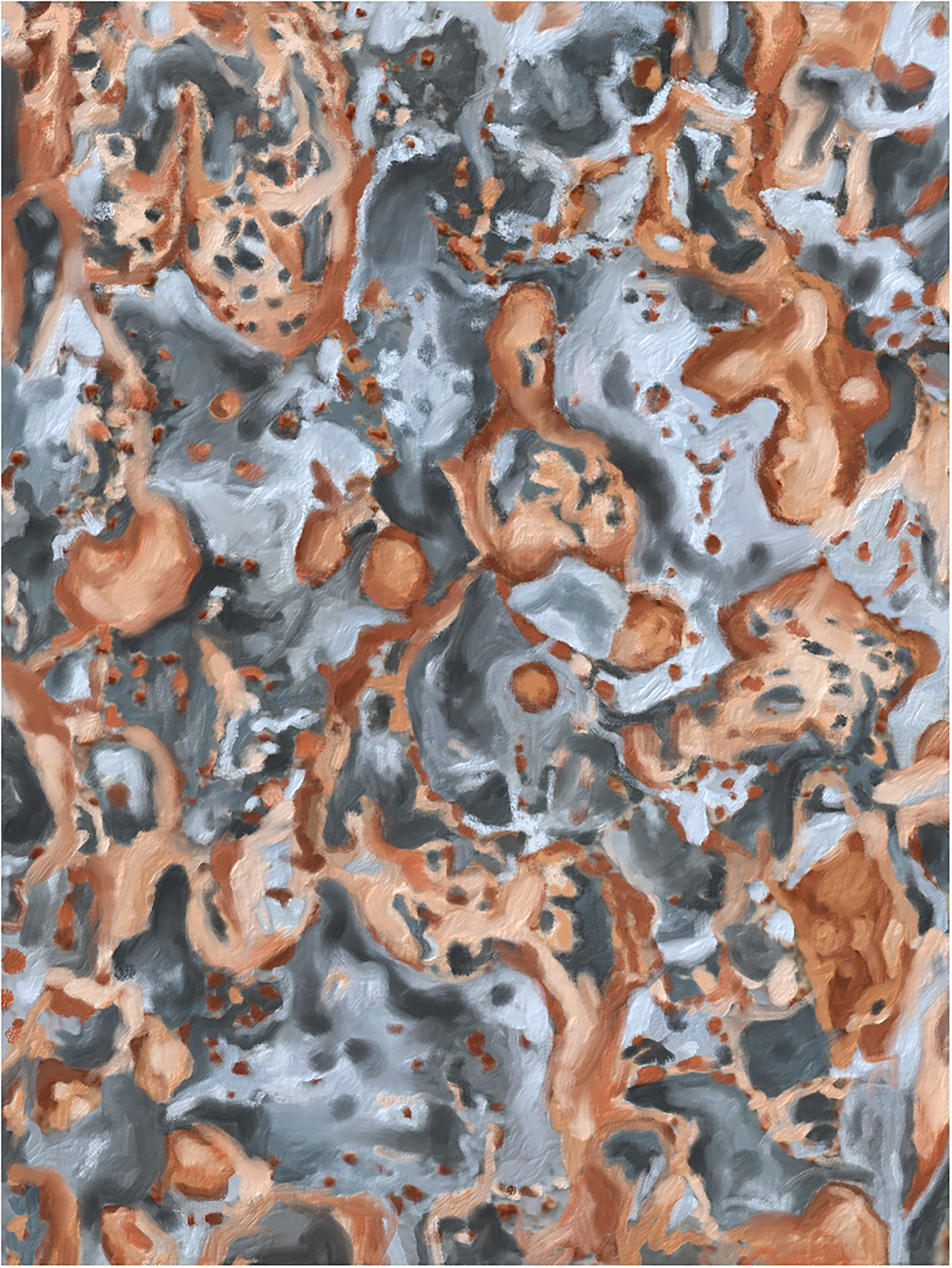
eco-lalic painting, Audra Mitchell, 2022.
Building from this outline of echolalic practice, I now want to highlight some of the ways it contributes to Autistic worlding.
eco-lalia as relation-making
I experience eco-lalia as a reciprocal interpretative process carried out between my bodymind and its co-constitutive ecologies. It is a dynamic, improvisational, multidirectional flow of diverse forms of information and sensation between me and other (kinds of) beings. This deeply felt awareness of co-constitution is often accessed through encounters with animals, plants, waters, soils and other beings, as expressed in the poem ‘river’ (2019):
This excerpt describes an intimate immersion in/as one's landscape, a blurring of skin and clay, water and flesh, and, ultimately an attunement to the threat that is distributed across different kinds of bodies in the ecosystem. Similarly, in ‘turkey vultures’ (2019) the complexities of co-constitution, violence and unequal vulnerabilities emerge in a moment of reciprocal recognition between very different animals:
The kinds of relationality enacted and reflected in these poems are a distinctly Autistic example of ‘(bio)plurality’ (Mitchell, 2023): the formation of unique worlds by different kinds of beings who are rendered singular and multiple by their co-constitution. The common stereotype that Autistic people have ‘special’ relationships with other animals (see Davidson and Smith, 2009) is often presented as ‘automatic’, involuntary or effortless. Instead, I want to reframe it as laborious, embodied, relation-making (see Judge, 2017). It actively re-negotiates ‘geontological’ (Povinelli, 2016) boundaries, including with beings deemed by Western science to be non-relational (and non-agential) on the basis of being ‘non-living’ or ‘inanimate’. Since ‘autism’ is so often negatively stereotyped in terms of limited or non-relationality, it is especially important to recognize the relational labour involved in Autistic worlding, and the contributions it can make to nourishing more-than-human worlds.
Immersion and porosity
As discussed above, anti-Autistic research on echolalia points to a weakly- or unmediated relation between the Autistic mind/body and its ‘environment’, including a perceived inability ‘filter out background environmental noise’, sometimes to the point of total ‘environmental dependency’ (Grossi et al., 2013: 910). On the contrary, my Autistic sensorium makes me constantly and viscerally aware of co- and inter-dependencies (see Piepzna-Samarasinha, 2018) with those beings with whom I world. Grossi et al. use the term ‘environmental’ to denote ‘context’ rather than, say, ‘ecosystems’. Nonetheless, I want to reappropriate their terminology literally (a key technique of Autistic thought) and refocus on possibilities for ecological intimacy, humility and ethical responsiveness opened by intense exposure to ‘environments’ that one cannot simply ‘filter out’ as ‘background’. Indeed, ‘backgrounding’ other beings is not a universal ‘human’ practice, but rather a distinctive feature of a post-Enlightenment European subjectivity that seeks to dominate ‘nature’ through separation and mastery (see Merchant, 1983; Plumwood, 2001; see also Singh, 2018). Certainly, differences in how my sensorium organizes stimuli often frustrate my attempts to perform NT tasks such as (linear) timekeeping, productive (versus creative or sensory) ‘focus’ or conversation (with allistic humans). At the same time, it enables generative reorderings of ‘foreground’ and ‘background’ that help me to critique existing power structures – for instance, which beings are considered salient, agential or ‘harmable’ (see Mitchell, 2014a). This, in turn, sensitizes me to harms, pains and disruptions that exceed my body – which is not, contra Grossi et al., an inert mirror mechanically reflecting ‘external’ outputs without mediation. Instead, I experience it like a complex, intricate instrument being ‘played’ by the patterns, signals, materials, vibrations and information flowing through me, as the poem ‘instrument’ suggests:
As the poems quoted below reflect, these signals do not move through me without being changed and co(e)laborated by me. I am soothed, beaten, disturbed, burned, rocked, sounded, shocked, held and felt by the beings around me – and I reciprocate in echoes. These forms of input and feedback are inherent to my sense of being embodied (see introduction and below), but also to the harms held by the multiply-violenced worlds in which I am immersed, as reflected in ‘filter’ (2019):
Indeed, it is in moments of radical opening to other beings that I seem most ‘opaque’ or ‘impenetrable’ to allistics. However, I do not experience this state as evidence of surrendered, impaired or absent agency. Instead, I understand my agency, consciousness and sense of self to be distributed across multiple bodies, registers of experience and systems of intelligence (see Kohn, 2013; Sheridan and Longboat 2006). This experience confounds common stereotypes that frame Autistic people as being ‘trapped’ inside the sealed fortress of ‘autism’ (Bettelheim, 1967). At the same time, this distributed sense of self creates an ethical challenge for me, especially as a white settler on Indigenous lands, to ensure that my extension into other spaces and bodies respects land-based law and protocol (Mitchell, 2020) and does not simply reproduce expansionist logics of whiteness (see Sullivan, 2007).
So, instead of fighting to occupy and command the foreground, when practicing eco-lalia I work deliberately to render myself more porous
27
to the violently ‘backgrounded’ ecologies with which I world. In this way, eco-lalia helps me to locate myself in and as a body that is implicated in complex, fraught and often violent ways with other bodies, as ‘deep pressure’ (2019) suggests:
Harm, violence and vulnerability
Autistic advocate Rose (2021; Pearson and Rose, 2021) describes how, from birth, Autistic mindbodies are shaped by micro- and macro-traumas as a result of living in structures not designed for – and often deliberately destructive of – our ways of being. These cumulative traumas can range from unwanted hugs, washing and feeding to physical violence or lethal restraint (see also McGuire, 2016); from anxiety related to social tasks such as eye contact; to almost constant sensory overwhelm (Nerenberg, 2020). Not only are Autistic people disproportionately targeted for violence (and even more so racialized and 2SLGBTQ + Autistics), but our sensory and neurological differences may alter experiences of pain and harm, whether by intensifying or dulling them. Many Autistic people also struggle to differentiate others’ emotions from our own (see Kim, 2014) and may experience them somatically. ‘rage’ (2019) reflects how I feel others' anti-Autistic ableist, gendered and heteronormative violence in a literally visceral way:
Practicing eco-lalia also gives words to the overwhelming sensations of pain, discomfort, illness and dysfiguring of body and identity that results from the pressure to ‘pass’ as NT (Pearson and Rose, 2021). In this vein, ‘dysmorphic’ (2019) refracts the experience of body dysmorphia, shot through with internalized NT norms of facial expressions, through structures of settler-colonial eco-political violence in which I am implicated:
Meanwhile, ‘embodied’ expresses how the internalized pressure to maintain NT facial expressions – eye contact, smiling, mirroring others – over years caused a permanent injury to my temporomandibular joint:
When forced to inhabit worlds materially constructed to engender pain, discomfort, exclusion and, ultimately, elimination, Autistic mindbodies – along with many other systemically oppressed mindbodies – are turned against themselves, then pathologized as, weak, invalid or unviable. In this context, echolalia and other Autistic forms of worlding can be crucial in releasing pain, and in co-creating good relations with our bodies and broader ecosystems.
Beyond moments of acute violence or trauma, continual immersion in sense-scapes saturated with loud, complex, competing stimuli constantly disrupts not only my ‘executive function’, but also my sense of self. Quandamooka scholar Moreton-Robinson (2015) describes how the pervasive material-aesthetic culture of settler-colonial whiteness continually disrupts BIPOC experiences of connection to land, community and body (see also Mbembe, 2017). Naturalized through political, social and economic power structures, these architectures of harm are rendered all but insensible to those who benefit from and enjoy them. In a distinct but resonant way, NT sense-scapes disrupt Autistic experiences and possibilities of being-in-the-world. Whether through incessant construction noise in downtown Toronto, constantly droning lawnmowers in suburban Guelph or ubiquitous post-pandemic loudspeaker video-calls in Montreal cafes, the sonic dominance of NT (and white, settler-colonial capitalist) culture fragments my sensorium – even as I benefit from some of its features. Such sonic assaults can make it hard to locate my limbs ‘in space’, put words in the ‘right’ order, or move safely amongst objects; and they can saturate my body with neural sensation that feels like mild electrocution. Compared with the incessant, system, structural – and therefore extremely difficult to escape – nature of these disruptions to Autistic and other worlds, the demonization of echolalia by anti-Autistic researchers and publics as ‘disruptive’ seems particularly ironic. Indeed, many Autistics must stim (more) simply to survive, self-regulate and maintain relations in these world-fracturing conditions. Existing in and as an Autistic bodymind can, rather than precluding empathy, render one hyper-sensitive to – and critical of – (infra)structural forms of violence that NTs may perceive subtly, positively, or not at all. In this sense, the porosity and lived vulnerability of Autistic embodiment may open up possibilities for solidarity with other marginalized more-than-human communities against distinct but overlapping, co-constitutive (Taylor, 2018) and logically similar structures of violence and oppression.
Conclusions
Echolalia is not, as anti-Autistic researchers claim, disruptive, dangerous, ‘meaningless repetition’ demanding urgent and coercive ‘extinction’. It is a vital form of Autistic worlding, and an element of a political ec(h)ology sustained by quite literally resonating with other beings. If echolalia threatens ‘humanity’, then it is the universalizing (Wynter, 2003), ‘figural’ (Colebrook, 2014) expression of this norm and its oppressive structures that is at stake. Yet the direction of threat is normally the opposite. To echo in modern, Western-dominated societies is to be vulnerable to a lifetime of intersecting interventions that severely restrict one's ability to make choices for oneself, the recognition of one's personhood, one's quality of life and chances of survival. It is an act of resistance, one that tactically echoes back (to) the violence of NT culture, but also a co-creative practice and a form of relational labour that helps to nurture connections across life forms and multi-life-form worlds. It may also hold potential for elaborating solidarities across violently imposed and maintained lines of species, race, gender and (dis)ability to support the thriving of (bio)plural worlds.
In this piece, I have offered my experimental practice of ‘eco-lalia’ as one example of how echolalia can offer rich forms of connection, experience and co-creativity that help to generate and sustain (bio)plural worlds. However, Autistic people world in myriad ways, including through ways of echoing that differ from mine. I have the privilege of being able to partially translate this particular way of worlding into written forms legible to NT knowledge systems. However, this capacity should never be used to discredit other Autistic ways of worlding, whether or not they involve words. Allistics who care about Autistics, and, crucially, our worlds and ways of worlding, need not only to tolerate but rather to value and respect echoing and other forms of Autistic worlding, to challenge (their own) neurotypical norms, and to embrace the ongoing existence of Autistic worlds. With this hope in mind, I want to close with a poem, ‘echolalia’ (2021) that emerged in the moments after I learned a word for a practice that is as integral to me as my heartbeat:
Argues that, and demonstrates how, Autistic people may use echolalia to form relations and co-create more-than-human worlds. Shows how echolalia and Autistic ways of being and relating are targeted for destruction by dominant biomedical and political structures, including global norms of ‘humanity’. Features auto-ethnographic reflections on the author's experimental research practice of 'eco-lalia', including experimental research creation methods. Argues that ec(h)o-lalia and other Autistic ways of worlding are modes of politics that can: contest oppression; engender solidarities with other marginalized groups; and help to imagine more pluralistic eco-political futures.
Footnotes
Declaration of conflicting interests
The author(s) declared no potential conflicts of interest with respect to the research, authorship and/or publication of this article.
Funding
The author(s) disclosed receipt of the following financial support for the research, authorship, and/or publication of this article: This work was supported by the Canada Research Chairs Secretariat (Canada Research Chair (Tier II) in Global Political Ecology).