




Abstract
This paper argues that the conservation sector in South Africa is fossilized – unsustainable, outmoded and resistant to change – in two integrated ways. First, it is completely dependent on and steeped in fossil fuels and mineral extraction. The historical development of the South African economy's reliance on fossil and mineral resources provides the basis for this dependency but has since tentacularized into the very fabric of conservation and associated wildlife economies in the country. This unsustainable basis of the sector places a major stain on the ways in which South Africa's biodiversity is ‘saved’ for posterity. Second and relatedly, the social and labour relations that make up conservation in South Africa are fossilized in particularly racialized and gendered ways. This is socially unsustainable, as most of these relations are unjust and exploitative. Building on theories of fossil energy and labour relations that emphasise their everyday character, we argue that confronting the fossilized state of conservation in South Africa is necessary in and of itself, and a prerequisite for a broader societal transformation to sustainability. We conclude that the effective chances for this to happen are low, especially given the massive conservation attention on combatting rhino poaching in the last decade. This seems to have reinforced rather than alleviated the status quo.
Introduction
Travelling by road from Johannesburg to Kruger National Park, which many tourists visiting South Africa do, leads one down the N4 highway along some of the most degraded and polluted landscapes in the country. Approaching the town aptly named eMalahleni, ‘place of coal’, the landscape becomes dotted with coal-fired power stations and large coal mountains. The air is thick with coal dust and a brownish glow hovers over the landscape. This continues until one of the most popular stopovers – some 60 km after eMalahleni – for refuelling, refreshments and sanitary breaks: the Alzu Petroport; home to a petrol station, five restaurants and an outdoor supply shop. Alzu is a special petrol station: it has a small patch of land at the back of the building where you can view (your first) wildlife in South Africa, including rhino, gemsbok, buffalo and sable antelope. There is a special viewing platform and the possibility to take photographs of the wildlife through a frame that boasts the name and place of the location (Figure 1). Once you have taken the photo, filled up with petrol and purchased some snacks, you continue the journey of another three hours’ drive to Kruger National Park.
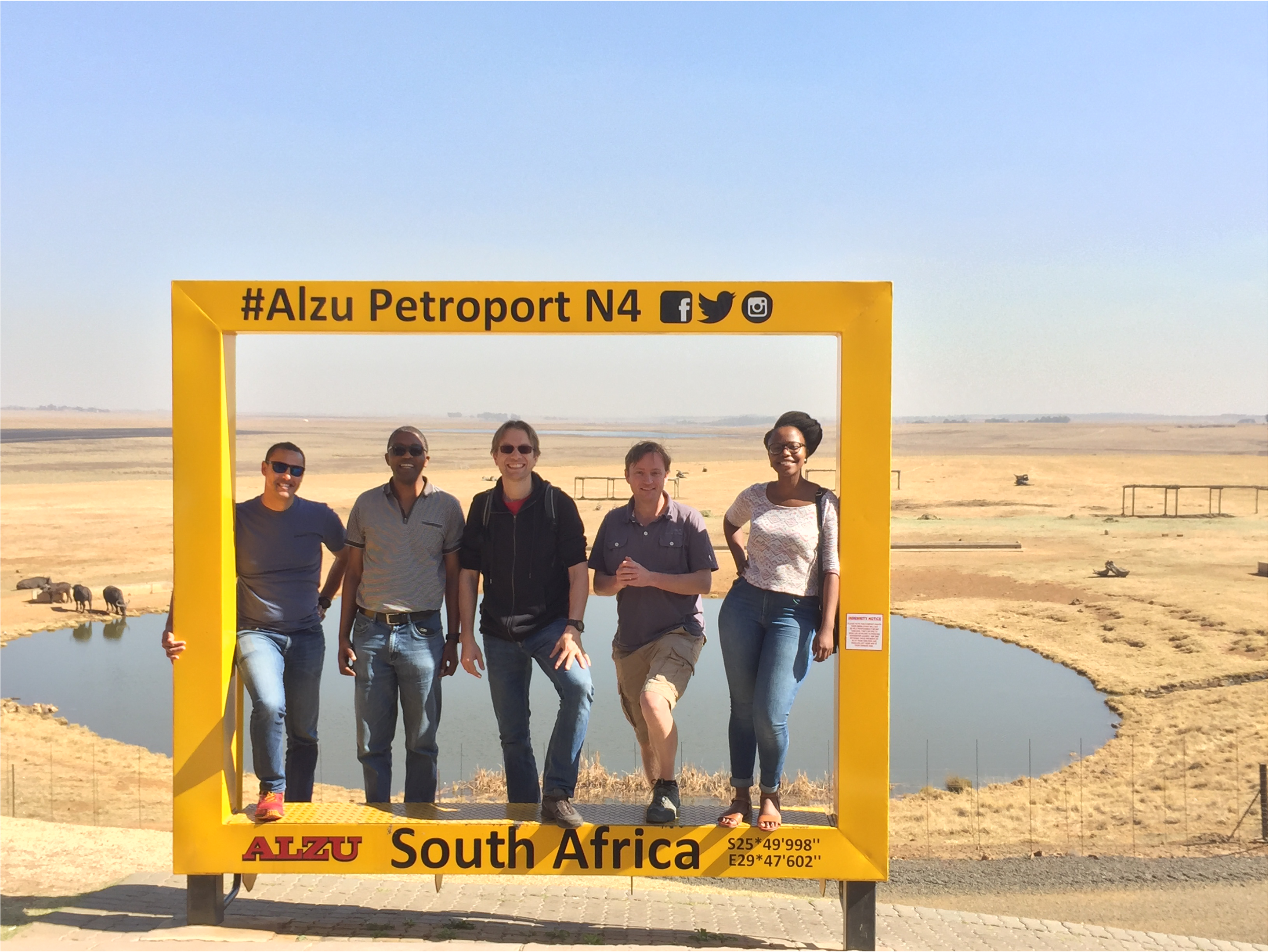
The three authors (on the right) and two colleagues at the Alzu Petroport wildlife viewing point, Wednesday 10 July 2019. Photo by anonymous visitor. See also: http://alzu.co.za/alzuPetroportGallery.html.
The Alzu petrol station and the wildlife in its backyard is an interesting metaphor for understanding one aspect of the fossilized state of conservation in South Africa: from your fossil fuel-saturated platform and with coal-fired power plants and coal dust in the background, you can view and enjoy wildlife. Alzu is – literally – an enclosed pocket of wildlife, made possible and surrounded by fossil energy and mineral extraction. In this paper, we argue that conservation in South Africa – generally hailed as an international environmental leader (Death, 2011) – is deeply dependent on, even ‘drenched’ in fossil energy and mineral extraction. 1 Given climate change and other urgent environmental imperatives, breaking through this fossilized state is critical. However, considering the power of Mineral-Energy capital in South Africa, this is exceedingly difficult and rendered even more so when taking into account a second connotation to ‘fossilized conservation’, namely how the social and labour relations that make up the conservation sector are also ‘fossilized’, in the sense that they have been preserved along very specific racialized and gendered ways.
Getting closer to Kruger, after the Nelspruit exit to the R40 road, we get a first glimpse of these relations. Here, the journey to South Africa's wildlife mecca leads to something that often surprises the first-time tourist: extensive former homeland areas on both sides of the road. These hilly areas are crowded with thousands of houses that belong to a fraction of the 2.3 million mostly Black people that live along the western boundary of the park (Figure 2). With around 60% youth unemployment, low education, scarce water resources and many other social, ecological and political-economic problems, these areas form a stark contrast to the wildlife haven you were expecting. Going through one of the park's gates, the communal areas stop abruptly, and you enter wildlife territory. The gate is marked by a large sign through which the national park agency and the park's fossil and banking sponsors bid you welcome (Figure 3). Along with the over 1.8 million other visitors that normally flock to Kruger annually, 2 you relax and start your first of many ‘game drives’ to spot wildlife.
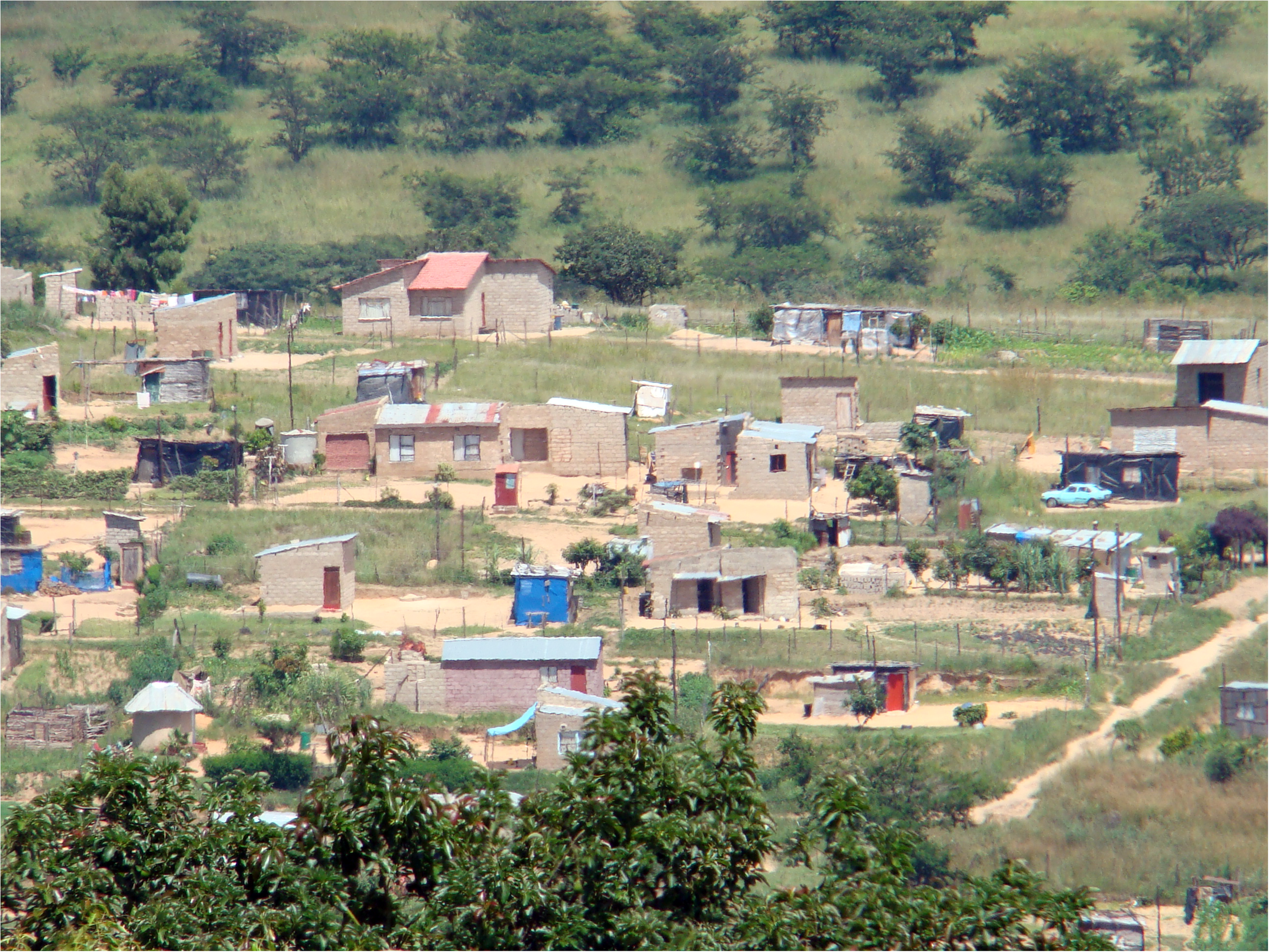
Former homeland landscapes on the road to Kruger's Numbi gate. Photo: Stacey Büscher-Brown, 5 February 2010.
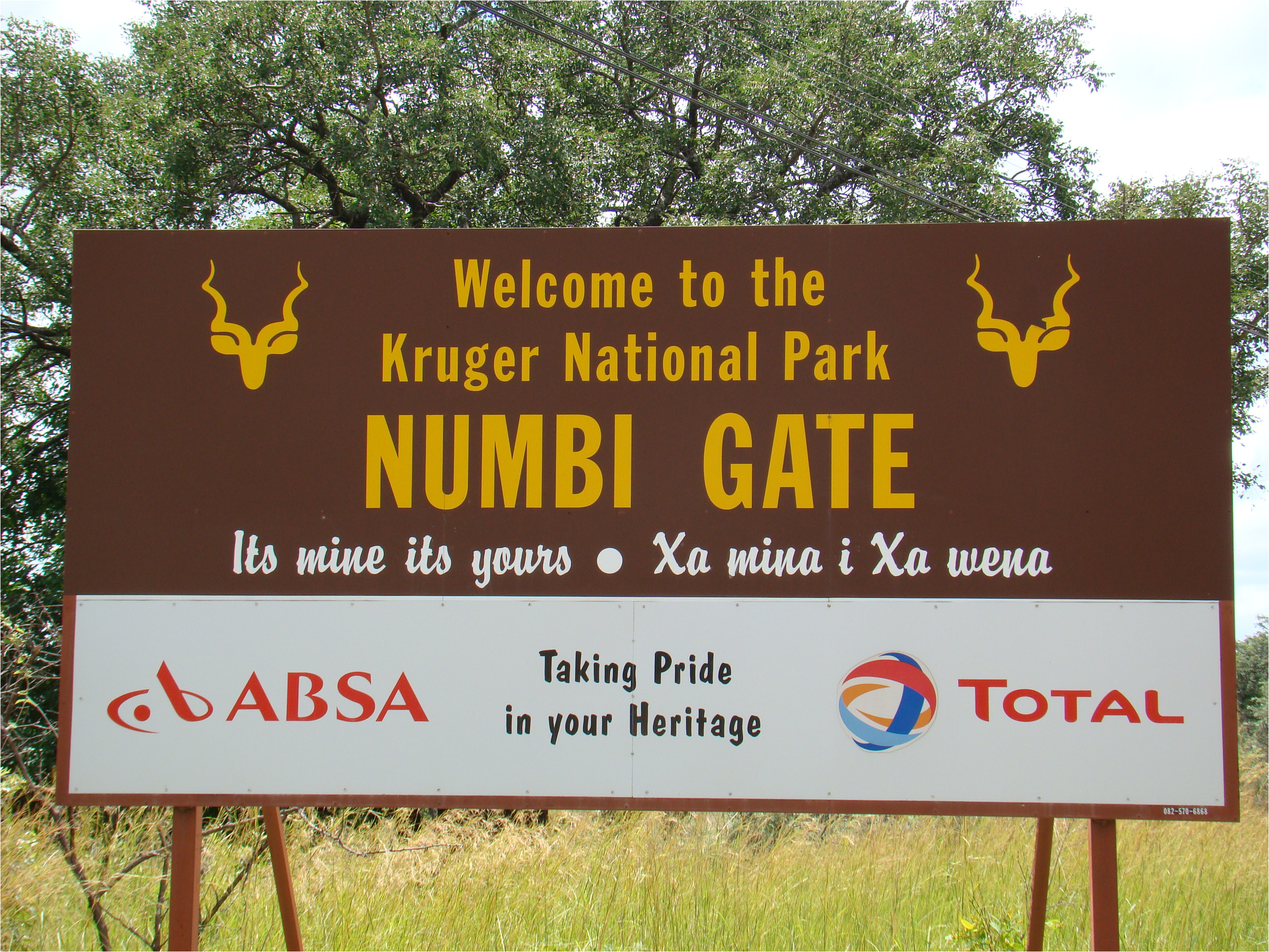
Entry sign to Kruger national park Numbi gate. Photo: Bram Büscher, 5 February 2010.
Unknown to most tourists, the communal, poverty-stricken areas they just left behind are a crucial part of the historically built-up social and labour relations of the park they just entered. Here live the low-wage labourers of the Kruger and other public and private reserves, most of whom remain conspicuously invisible for tourists (Thakholi and Büscher, 2002). From cleaners, cooks and guards to rangers, builders and managers, much of the labour in the park and private reserves functions outside of the tourist gaze (cf. Urry, 2002), which in any event is mostly fixated on wildlife. Sometimes a glimpse of this comes out in the ranger diaries one can buy in the park, but these are of the romantic and heroic kind. The dominant side of the equation, where labour is poorly paid, highly insecure and subject to intimidation, racism and other forms of abuse, is rarely highlighted or noted, save for in some research reports, academic works and internal memos (Meskell, 2012; Reid-Hresko, 2018; Thakholi, 2021). What makes this situation worse, we argue, is that the highly unequal and often abusive social relations that characterize conservation in South Africa are deeply fossilized: stuck in rigid structures highly resistant to change. 3 The second half of the paper confronts and analyses this second connotation of ‘fossilized’ and how this further renders conservation in South Africa unsustainable.
This paper is based on our extensive collective research in South Africa since 2003. 4 It is meant to provide a ‘big-picture view’ of the political economic position of conservation in the country as well as the social relations that make up (part of) the sector. 5 The broader message that we believe is critical is that the idea of South Africa being an international environmental leader and the states’ choice to make a ‘wildlife economy’ the basis for further developing the conservation sector (Sanparks, 2020) is intensely problematic. We conclude that a structural rethinking and redesign of the sector is urgently needed, both in and of itself and as part of a broader societal transformation to sustainability. At the same time, the conclusion tempers expectations. Given that recent militarised and violent responses to the rhino poaching crisis have arguably reinforced rather than alleviated the fossilized state of conservation in South Africa, we believe the chances to confront the status quo are low.
Importantly and despite the ‘broad brush’ we employ in this paper, we emphasise that by no means do we argue that the conservation sector as a whole is responsible for the current, unsustainable status quo, or that there are no positive incentives and results or good people in the sector. To the contrary: we know and appreciate many people in the sector and have often found that problematic stereotypical behaviours (can) go hand-in-hand with gestures of kindness and generosity. The aim of the paper is not to denounce (people in) the sector, but to unequivocally state that the sector's structural social-environmental foundations and relations are not sustainable in the literal meaning of the word: that these cannot and should not be maintained despite their averseness to change. We believe this is a critical message in the current global juncture. Given the manifold, urgent and integrated socio-environmental crises the world is facing, we must look beyond the obvious appeals of the rich biodiversity that the South African conservation sector holds in trust to confront the possibility that the sector is not an antidote to, but deeply implicated in these crises. We elaborate on this in the conclusion.
Fossil South Africa
Central to our argument that conservation in South Africa is steeped in unsustainable fossil fuels is an understanding of fossil fuel use as banal, common and ‘everyday’, combined with the dependency of the South African economy on the ‘Mineral-Extraction Complex’ (MEC). Starting with the former, we follow Huber (2013) and Hughes (2017) in arguing that what is so extraordinary about fossil fuels is that they are so remarkably ordinary. Huber (2013: xi–xii) states that the story of oil is ‘almost always told from the perspective of “big” forces – geopolitical strategy, oil kingdoms, titans of oil finance and global oil capital’. He argues, however, that ‘the problem with these big stories of oil is they ignore the fact that oil is also incredibly ordinary because it is embedded in everyday patterns of life’. In his book Lifeblood, he traces the history of fossil fuel use in the United States and how it ‘became constitutive of a specific cultural politics of life’ itself. Hughes (2017: 2), similarly, focuses his analysis on the ‘everyday, intended functions of our energy system’: When platforms, pipelines, and pumps work properly, oil arrives safely at the gas tank of a motor vehicle. Then, combusted in the engine, the hydrocarbon spews carbon dioxide into the air unnoticed and without protest One might refer to this form of pollution as ‘the spill everywhere’. It far outweighs local contamination, both in volume and in planetary effects. Oil, in other words, is most dangerous when it behaves ordinarily and when people treat it as ordinary – that is, as neither moral or immoral, but amoral.
This everyday, ordinary use of fossil fuels has also infused South Africa's society and economy across all levels. In fact, not only is South African society – like most others – completely dependent on the everyday use of oil for much of its transport, trade and many consumptive activities, it is consistently the world's top-ranked country in terms of reliance on the most polluting of all fossil fuels, coal. According to Ember's Global Electricity Review 2021, South Africa relies on coal for 86% of its energy use, compared to a global average of 34% (Graham, 2021). As Figure 4 shows, progress in phasing out coal towards clean energy is incredibly slow. It is no wonder, then, that the ‘coal fields’ in Mpumalanga province, which one traverses on the way to Kruger National Park, are in the top three worst sulphur dioxide emission hotspots in the world. 6
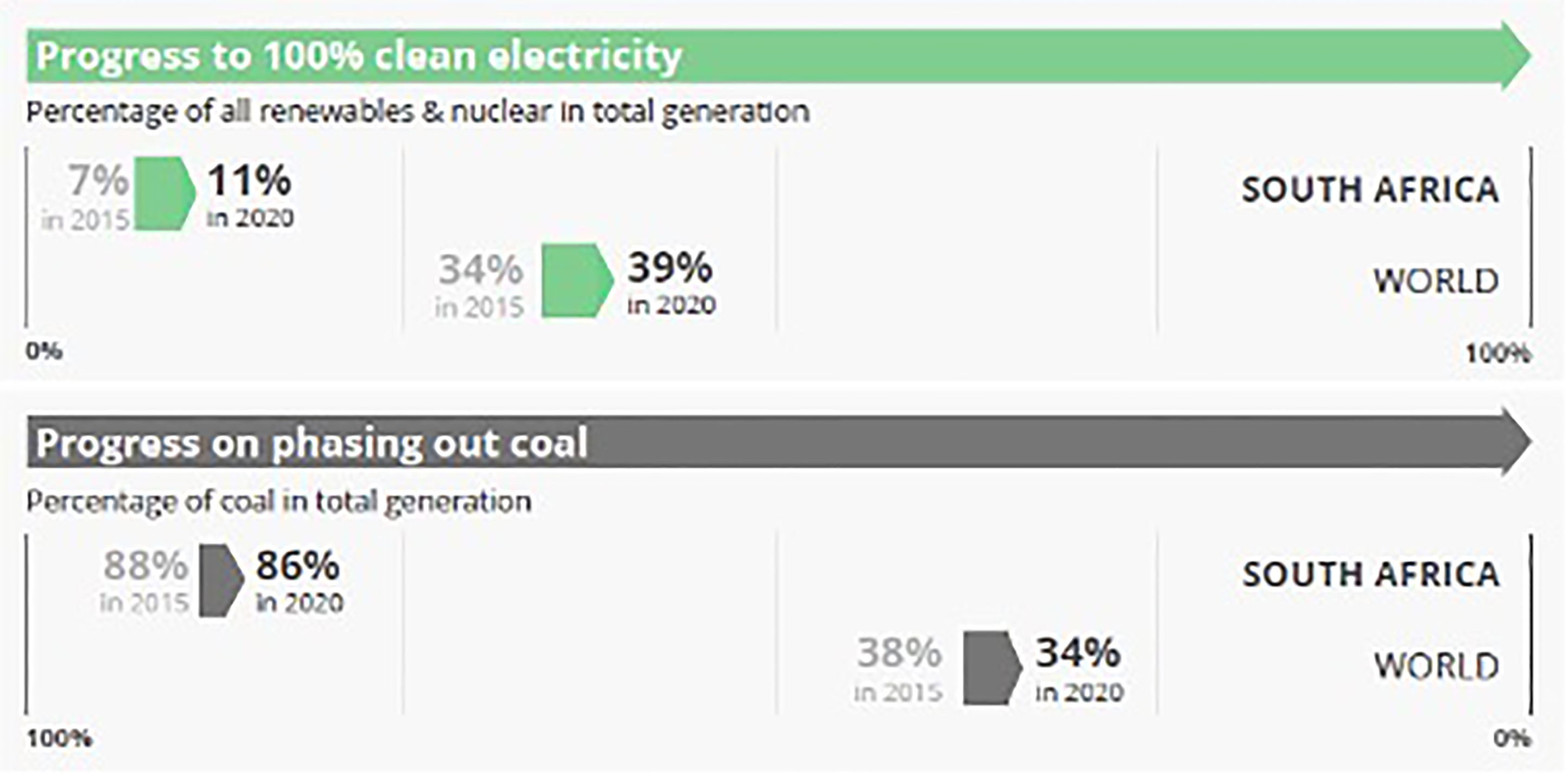
South Africa energy trends. Source: Graham (2021: 1).
The South African government is aware of the scale of the challenge this creates (DME, 1998: 92-93). In its 2020 ‘Low-emission development strategy 2050’, it aspires to become a carbon-neutral economy and society in 2050 by peaking fossil fuel use in 2025 and declining it from 2030 onwards (South African government, 2020). 7 Critics, however, argue that the government's actions completely undermine these targets. In 2011, Weston argued that ‘despite both peak oil and global warming, South Africa is expanding its coal-intensive electricity infrastructure, locking the country into a fossil fuel future that contradicts any political claims of attempting to mitigate climate change’ (Weston, 2011: 142). Mwenda and Bond (2020) more recently argue that South African and global capital do little to prevent a ‘climate holocaust’.
One of the reasons for the government's inactivity in this regard, is that South Africa's industrial-economic structure and development is historically based on a ‘mineral-energy complex’ that is heavily reliant on fossil fuels, highly centralized and resistant to change (Baker and Phillips, 2019; Fine and Rustomjee, 1996). Therefore, instead of scaling down fossil investments, we have seen a continuing expansion of coal-fired energy production capacity, most notably through the controversial Medupi power station, South Africa's largest and most expensive plant ever built (Marcatelli, 2020). Moreover, the MEC is at the basis of South African capital's expansion plans towards large parts of the rest of Africa: aggressive expansion plans for new power generation in southern and Central Africa provide enormous potential for the continued growth of an electricity-intensive MEC-plus [minerals-energy complex] economy out of South Africa. Once in place, this new electricity infrastructure will provide a long-term platform for stable (if unpredictable) accumulation patterns for South African capital. (McDonald, 2009: 37)
But again, it is not just the big energy plans and actors that we should focus on. Even more consequential is the everyday, common use of fossil fuels and the way this continues to be facilitated by the fossil fuel industry. This is less visible than large power stations like Medupi, but equally important in determining action regarding climate change. One example of this facilitation concerns the regular, large conferences organized by the fossil sector, like the IHS McCloskey South African Coal Exports conferences, in 2012 attended by the first author (Büscher, 2015). Every year, these bring together ‘heads of state, market leaders, executives, experts and market participants for learning, idea exchange and networking’ in support of coal. 8 From participatory observations, one thing stands out: these actors work hard to ensure the continuing smooth flow of coal into global economic infrastructures, regardless of socio-environmental costs and organized resistance against coal-derived energy. 9
The global infrastructures of extraction, production, consumption and finance that fossil capitalism subsumes, clearly took a long time to become ‘indistinguishable from life itself’, as Malm (2016: 13) has convincingly shown. Yet the banal commonality of fossil fuels under contemporary capitalism not only makes it difficult to shift to a low-carbon economy, it also renders invisible how it is the ‘everyday basis’ for most dimensions of life under late capitalism, including ‘green’ sectors such as conservation.
Fuelling conservation
Like South African society more generally, the conservation sector has become so foundationally dependent on fossil fuels that pointing this out almost sounds trivial. Yet this is exactly the argument we want to emphasize and build on. Moreover, as the history of fossil capitalism itself was not self-evident (Malm, 2016), the historical development of fossilized conservation was never preordained either. As Carruthers (1995) and Bunn (2003) show, especially given its green image, barriers had to be overcome to enable, for example, the building of tarred roads and other ‘modern’ tourist infrastructures in Kruger National Park.
In this paper, however, we are not interested in recounting this history and the obstacles, but emphasize the outcome, namely that fossil-fuel consumption and conservation are deeply integrated in everyday, common ways: first, almost all national and provincial parks and nature reserves in South Africa have an excellent road and car infrastructure, including petrol stations. Second, the financing of parks and nature reserves heavily depends on tourism, 10 which is completely facilitated and made possible by automobile and other forms of (fossil-fuelled) transport. This is further emphasized by the fact that dangerous animals roam the parks and that motorized vehicles are the only safe option to have millions of tourists see them (which in practice often leads to traffic jams around sightings, see Figure 5).
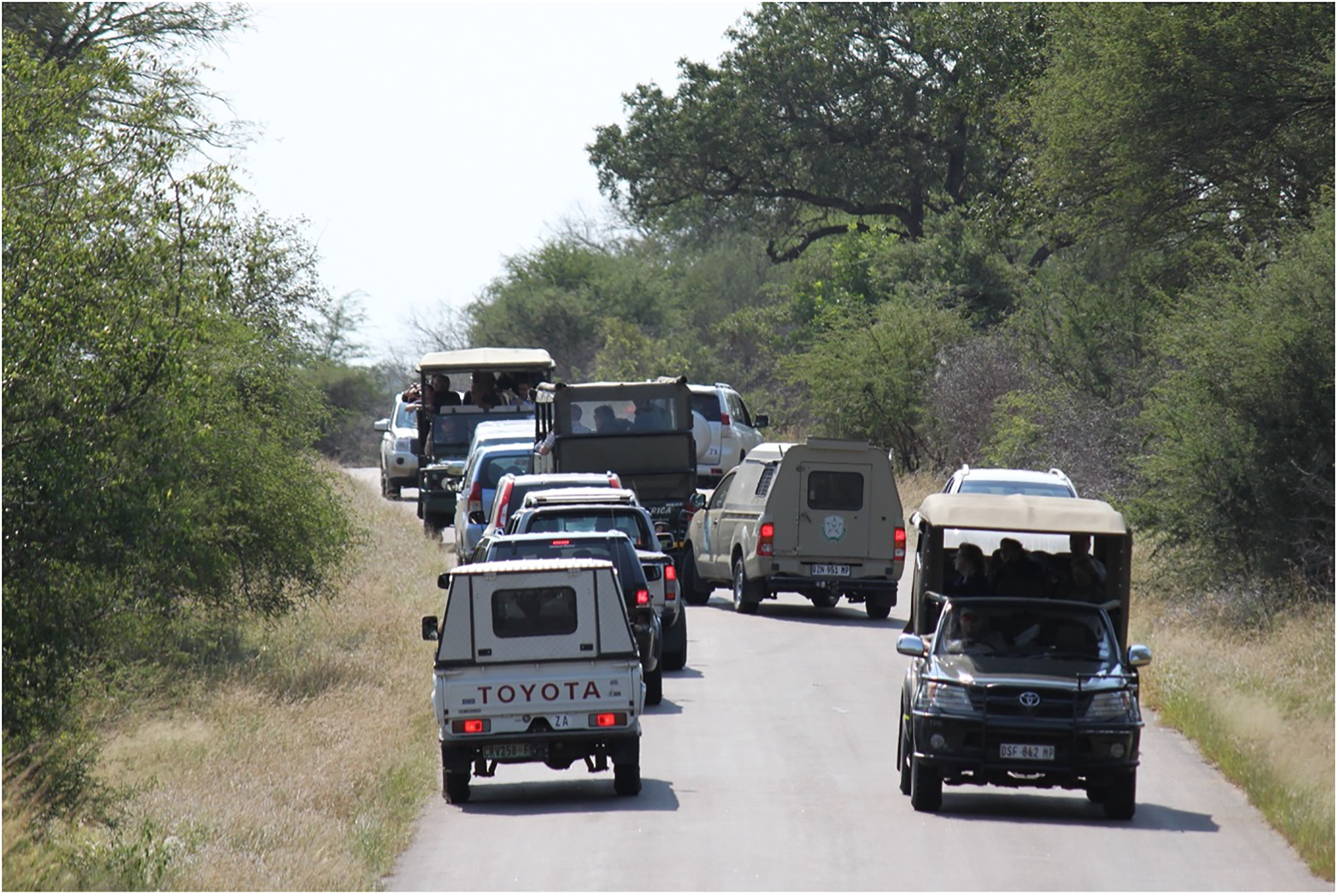
Typical traffic jam in the Kruger National Park. Photo: Bram Büscher.
Third, South Africa is the main tourist destination on the African continent and wildlife one of its main tourist attractions. This means that the conservation sector depends for a good part on Europeans and Americans flying far to get to South Africa, and then having to fly or drive yet further to get to the main parks (as our introduction showed). Ironically, southern Africa seems to be the region that will be most affected by and vulnerable to climate change impacts; temperature increases for this region are predicted as much higher than in other world regions: 3.4°C annually (and up to 3.7°C in spring) when comparing the periods 1980–1999 to 2080–2099 (Lotz-Sisitka and Urquhart, 2014; see also IPCC, 2021).
Fourth, much electricity used in protected areas is, like the rest of the country, dependent on coal and hence unsustainable. 11 Fifth, many parts of the conservation sector depend on or are linked to ‘high-end’ forms of luxury tourism, which is even more fossil-fuel intensive due to private flights, use of luxury SUV vehicles, high water consumption (e.g. bottled water, but also swimming pools etc.), transport and a continuous promotion of excessive consumption of luxury items (like cold champagne), and more (Koot, 2021). 12 Finally, all this links to the ‘braai’ meat culture that is deeply engrained in the country and especially related to conservation (Brandt and Josefsson, 2017). Practically every house and campsite in all national parks have braais. This stimulates the consumption of large quantities of meat, which has been shown to have a tremendous impact on the global environment (Godfrey et al., 2018). 13
Above and beyond these everyday yet consequential and foundational ways in which the South African conservation sector (and its counterpart, the tourism sector) is drenched in fossil fuels, we argue that the country's political economy steeped in the MEC and the conservation sector's continuing capitalist intensification provides further evidence of the sector's environmentally unsustainable basis. Three main elements are critical.
First, we argue that the conservation sector is tied into the MEC in a broader way than the above elements suggest, which focus mainly on fossil fuel consumption. Central here is that many conservation areas are surrounded by or even implicated in MEC activities: famous parks like Kruger and Hluhluwe-iMfolozi are next to and impacted by mining (Cock, 2019; Leonard, 2021), 14 while other parks like Ai-Ais-Richtersveld and the Greater Mapungubwe Transfrontier Conservation Area (GMTFCA) include extraction of diamonds and coal, respectively. Relatedly, there are strong and intimate ties between big conservation and big MEC players: influential NGOs like the Peace Parks Foundation consist of and are supported by many corporate and individual players in the fossil, MEC and related tourism, luxury goods and other industries (Ramutsindela, 2007). Even more directly, some of these major players, like Richard Branson of the Virgin empire, own conservation land in the Sabi Sand private nature reserve next to Kruger while the mining giant De Beers leased their nature reserve and four other properties to SANParks to consolidate the GMTFCA (Sinthumule, 2017).
Regarding public parks, Total is not the only sponsor of the Kruger National Park (Figure 3); the large mining giant AngloAmerican is another (Figure 6). Coal mining is even seen as complementary to conservation: in 2014 the then Department of Environment, SANParks and Coal of Africa (now MCMining) signed a 55 million ZAR biodiversity offset agreement. The latter operates a coal mine 7 km from the Mapungubwe World Heritage Site and has committed to disburse the funds over a period of 25 years. The money will be managed by SANParks and used for conservation and the protection of archaeological sites. 15 While high profile, this example is not the only one: there are many more offsetting initiatives in South Africa, such indeed that in 2017 a draft national biodiversity offset policy was published by the Department of Environmental Affairs. 16
Signboard for Kruger sponsor AngloAmerica at the entrance of the Orpen gate. Photo: Bram Büscher.
While all this may seem contradictory, the history of conservation shows that the sector has always been integrated with big business, including fossil and mineral interests (Brockington et al., 2008; Ramutsindela et al., 2011). Taylor (2016: 27), in her history of the US conservation movement, argues that ‘business environmentalism’, ‘an amalgam of utilitarianism, preservationism, conservationism, and capitalist interests’, was central to late nineteenth, early twentieth century conservation, while MacDonald (2010) and others show that this has intensified in recent times. Interestingly, and arguably because of its historical integration and ability to combine a ‘green’ outlook with business-as-usual, Ramutsindela et al. (2011: 27) show that affluent businesspeople particularly ‘emphasized the conservation aspect of the biophysical environment’, more than, for example, climate change or pollution. It is for this reason, perhaps, that they are able to point to animal populations and intact ecosystems as proof of their sustainability, while disregarding their highly unsustainable use of fossil fuels and celebratory participation into global consumer culture.
Worryingly, the public sector seems fully on board with this. In relation to the above offset agreement, then Acting Director General of Environmental Affairs, Ms Judy Beaumont, stated: ‘We have indeed reached a momentous stage in our country's development, where sectors originally perceived to have competing mandates, have realised the common vision of growth and prosperity for our country, and are beginning to walk this path towards sustainability together.’ 17 To be clear: this common vision as worked out in the agreement fully supports coal capitalism, and even believes this to be ‘sustainable’. The problem here is not that the actual benefits of offsets to regional or global environment are often minimal but that this joint public-private uptake of offsetting supports a slightly modified form of business-as-usual that continues to be deeply unsustainable (Apostolopoulou and Adams, 2017).
Second, the conservation sector in South Africa is developing rapidly, most notably through the growth of the wildlife economy, which leads to a further integration between conservation, fossil fuel use and consumer culture. This includes, for example, the translocation of wildlife by the game capture industry, which depends heavily on roads, automobiles and aviation (e.g. when transporting animals); the fact that some game auctions have become extravagant affairs where well-to-do game breeders and investors fly into the location; but also conservation labourers who in many areas have to commute to work daily to service the wildlife economy. These examples are, again, forms of regular, ‘everyday’ dependence on fossil fuels, but newer dynamics in the wildlife economy seem to intensify rather than alleviate – let alone question – this everyday dependence. Notable here is the emergence of wildlife estates as new forms of nature-based living. Wildlife estates are gated estates that leave part of their property as ‘wilderness’ and are predominantly occupied (permanently or as ‘second homes’) by bourgeois, well-to-do classes, including the (very) rich (see Koot et al., 2002).
Some of those we interviewed in the wildlife economy believed that because these estates focus on habitation, they have little to do with conservation.
18
Yet estates often present themselves as such. Hoedspruit Wildlife Estate, for example, believes it is ‘a beautiful, conserved part of the Lowveld bushveld’ while the Zandspruit Bush and Aero estate states that: In conjunction with various specialists, our game farm manager is involved in a variety of conservation projects on the Estate, which aid the study of endangered animals. His work also extends to the natural vegetation on the property, ensuring that the vegetation is protected from destruction and ensuring the natural balance is maintained.
19
Astoundingly, estates like Zandspruit do not see any contradiction between these statements and the fact that they have ‘aero stands’ along a 1 km runway with the option of building a private hangar for private planes: Zandspruit's website shows a big 4 × 4 SUV vehicle driving into the estate while urging viewers to ‘move to sustainability’ (Figure 7). Several respondents working in the estate sector in Hoedspruit told us that you can work in Johannesburg and leave your family ‘safely’ in the estate, and fly back home for the weekends, all of which is apparently part of ‘sustainability’ for the wealthy. 20 More generally, as Koot et al. (2002) show, Hoedspruit's wildlife estates have become directly linked to extensive patterns of global consumption that promote rather than ameliorate fossil fuel use.

Zandspruit website and introduction film. https://www.zandspruit.com/.
Apart from the estates, nature reserves across South Africa are often equipped with landing strips whose presence has moved from raising eyebrows to being celebrated as easing mobility. Another example of the deepening relations between the wildlife economy and fossil fuels is the questionable alliances between private and state-owned defence and security companies and SANParks in response to (rhino) poaching (Lunstrum, 2018). Beyond green washing, the concern here is the ease with which these partnerships have been accommodated. Even the most vocal environmental groups against mining have let slip this marriage with defence companies, which are notorious for pollution (idem).
Third and perhaps most consequentially, the wider conjoining of capitalism and conservation in South Africa leads conservation to not just normalize fossil fuel use, but indeed regard the global trajectory of (fossil) capitalism as natural and inevitable (Büscher, 2013). Oberem and Oberem (2016: 20–3), two prominent South African game ranchers, for example, state that commercial game ranching has been a ‘huge success and contribution to the economy’ and is indeed part of ‘the green economy of South Africa’. They, and many of the (nearly exclusively White), contributors to their book posit commercial wildlife industries as sustainable and critical to the South African economy despite mentioning many ‘challenges’ to be overcome. They are not an exception: most conservation actors in South Africa, in our joint experiences, do not resist but celebrate capitalism, while simultaneously ignoring or wishing away deep contradictions, even those that may ultimately undermine the very wildlife and ecosystems they own and wish to preserve. 21
But if indeed capitalism is fundamentally incompatible with a sustainable world and solving current ecological crises (Büscher and Fletcher, 2020), then conservation's long historical embrace and continuous deepening of capitalism is intensely problematic and outmoded. For one, as we have shown, as conservation is not outside of capitalism, so it has never been outside of fossil capital. And if, as Malm (2016: 279) argues, fossil capital is ‘the energy basis of bourgeois property relations’, and conservation (in South Africa and beyond) has largely been built on these property relations (Thakholi, 2021), then it means that the relations that undergird fossil capital and capitalist conservation are the same or, at least, very similar.
This is something Huber (2013: xv) also stresses, namely that capital and hence fossil capital, is not a thing but a social relation. The integration of fossil capital and capitalist conservation means that they fundamentally share relations focused not on sustainability but, first and foremost, on private property, growth markets, unequal labour relations and profit. These relations were laid bare when international travel was suspended as a result of the SARS-CoV-2 pandemic, which exposed the deep dependency of conservation – even animal lives – on travel and fossil fuel. 22 It also showed that these relations go far beyond fossil fuels, into the broader social domain that undergirds conservation. These relations, too, have a long and unsustainable history in South Africa that has become fossilized in problematic ways.
Fossilized social relations
Social relations in the conservation sector in South Africa are deeply fossilized and resistant to change, particularly in racial but also in gendered ways (Brandt and Josefsson, 2017; Kepe, 2009; Koot, 2016; Musavengane and Leonard, 2019; Ramutsindela et al., 2011; Thakholi, 2021). We will discuss both, but start by noting that these largely preserved social relations (can) serve a similar purpose as do fossil fuels: they energize and indeed enable capital accumulation and profit. Capitalist conservation needs cheap labour to function and to be profitable – all of which is amply provided by the continuing dismal inequality of South African society. Hence, cheap (mostly Black) labour ‘fuels’ the conservation sector in South Africa like fossil fuels do. This comparison is not without precedent. David Hughes, for instance, writes about ‘plantation slaves’ as ‘the first fuel’ for early Caribbean capitalist energy systems. The ideal for slavers and plantation owners was a ‘scientific slavery’ that would work seamlessly and without issues: ‘if every slave worked at the same rate every day, then the master could reliably stock his fields with three per fanega. 23 Laborers would function like barrels of sugar or, better yet, as wood used to heat cane juice to a boil: they would serve as the faceless fuel of the plantation machine’ (Hughes, 2017: 39).
Hughes is acutely aware that the relation between early capitalism and slavery-as-energy is not straightforward and that the latter preceded the former. What he emphasizes is that capitalism could not have flourished without ‘cheap’ labour and lives (and, as Patel and Moore (2017) argue, without cheap resources more generally), while also stating that enslaved people resisted their harrowing treatment in numerous ways. One critical way was to insist they were not faceless at all: they were people, just like the slave-owners, and hence deserving of the same (human) rights and possibilities. 24 Conservation labour, however, has a distinctive challenge in this regard: as conservation is supposedly all about animals and nonhuman nature, it is often ‘faceless’. Most conservation images are without people in general, and if there are people, they are often working in the service of conservation, like locals in ‘traditional’ garb or service-oriented labourers (mostly Black), or anonymous tourists (mostly White). It is therefore hard to see exploitation in the conservation sector as the whole idea is to invisibilize much of the basic labour that goes into the conservation experience (Thakholi, 2021).
This is not to say that Black people who sit on the exploited or neglected end of conservation do not try to be heard. For example, when ‘service delivery’ or other protests happen in the former homelands around Kruger, they often target the Orpen and Numbi park gates to the irritation of conservationists and tourism operators. So, although the relations are resistant to change, locals and labourers still find spaces to push back and make their claims heard. Yet, we argue that these spaces are limited and that trying to change the status quo is challenging. 25 Next we provide evidence for this, mainly in relation to race though we also briefly touch on gender.
The more things change: Racial and gendered relations
Conservation in South Africa is still dominated by Whites. Although Black people have in many, especially state conservation organisations, risen to influential and management positions, this has not always changed the structure of the sector in a fundamental way (yet). For instance, Maguranyanga (2009: 183) concluded that the “‘de-racialization’ or ‘Africanization’ of park management does not necessarily ensure the ‘transformation’ of park management practices.” Importantly, this does not mean that nothing has changed or improved in public parks; fossilized for us means that certain structural, historical relations and ways of working are preserved and resistant to change, even as we have seen Black officers rise to power in public conservation agencies. One generic way to explain this is how the neoliberalization of state protected areas (and of conservation more generally) can reproduce the original conditions of production, including the differential value of humans along racial and gender lines, even when minorities or individuals from previously disadvantaged groups occupy positions of power (see Pulido, 2017). More specifically, neoliberal conservation in South Africa comes with a commercial incentive to please the key clientele responsible for income. And since these are still overwhelmingly White and often expect certain experiences and images that chime with historical, exclusionary forms of park management, it makes it harder in practice to change certain relations or management practices (Büscher, 2021).
In the private or nongovermental conservation sector, the picture changes drastically: here the majority of those in influential positions are White, often exclusively so. This is a conclusion that many Whites in the conservation sector themselves also draw and which was on full display at the 2016 CITES conference of parties, where many, especially private conservation panels often consisted exclusively of White conservationists. If we look at conservation NGOs, a similar picture emerges. Take, for example, the wealthy, influential South African NGO Peace Parks Foundation. Their top leadership has always been almost exclusively White 26 while their elite origins in White business networks (Ramutsindela, 2007) continues to live on in their board and current ‘club’ of donors. In May 2020, these included Anglo American, Virgin, De Beers, Eskom and other major MEC players, as well as over 220 business and individual members, the far majority of which are (led by) Whites.
While the Peace Parks Foundation is but one example, the fact that private conservation in South Africa is overwhelmingly dominated by Whites is not a surprise or contested. What matters to us here is that the social relations underpinning this racialized inequality are often very problematic and highly resistant to change. There are several aspects to this. Most importantly are the labour relations. While most private reserves in the country are owned and run by Whites, low-wage labour in these spaces is almost exclusively done by Black people. As Thakholi (2021) has shown in her research on private conservation next to the Kruger, not only is there a starkly racialized division of labour, but this situation is compounded by the fact that low-wage labourers tend to be ‘stuck’ in manual jobs with little prospects of moving up the ladder. Koot (2016) has analysed similar patterns in the Northern Cape, while Büscher (2013) has observed comparable issues in KwaZulu Natal. These labour relations are a continuation of the colonial and apartheid racialized migrant labour system (Trimikliniotis et al., 2008; Wolpe, 1972) which resulted in the aforementioned labour regimes.
Next to problematic labour relations, White-owned private conservation and wildlife economies across South Africa are notorious for hoarding land and so inhibiting and even actively resisting spatial justice (Thakholi, 2021). This is due in part to the fact that the land restitution process has thus far been treated as a threat to conservation (Ramutsindela and Shabangu, 2013), so much so that the state has made it legally impossible to restitute land in nature reserves (Mollett and Kepe, 2018). But apart from land claims, in the Waterberg area in Limpopo, Marcatelli and Büscher (2019) found that transformations of farms to high-end wildlife reserves fortifies White land ownership while simultaneously exposing ex-farm workers and their families to many vulnerabilities, including a lack of consistent safe drinkable water. In the Northern Cape, Koot (2016) finds that colonial farm relations, based on paternalism, continue in today's tourism and conservation spaces, withholding local San workers from the promises that tourism often holds for them to improve their living conditions. Similarly, in KZN, Josefsson (2014) shows that wildlife farms are nearly exclusively White-owned spaces that – almost literally – ‘laager’ (encamp or barricade) themselves in the land to protect their property and safety. These cases, spread across South Africa, demonstrate that conservation remains a bastion where many Whites continue to control land and so – actively or passively – resist (fundamental) transformation.
These unequal labour and property relations, in turn, fuel the private wildlife economy which flourishes precisely because there are 60% unemployed and mostly Black youth in the country, many of whom have no option but to work for low wages. And while there has been much political mobilization against unequal distribution of land, labour in conservation has received much less attention, adding to the normalization and ordinariness of this unsustainable status quo. In addition to being fossilized in racial terms, the conservation sector is also gendered in often racialized ways, again especially in private conservation and the wildlife economy. Brandt and Josefsson (2017: 28) state that ‘common characteristics of the South African game farm’ are ‘explicitly tied to racial hierarchies as well as patriarchal and paternalistic relationships; and to histories of contestations over belonging’. Doing research as western, White women at game farms in the eastern Cape and KwaZulu Natal, they ‘experienced how masculinities were cultivated, how African landscapes and wildlife are eroticized, and how White men in particular maintain a position of power, and reassert their sense of belonging in landscapes constructed around hunting, wilderness, manhood and domination’.
Burnett and Milani (2017) found that such conceptions reaffirm White masculinity as belonging to nature while othering the deviant Black poacher. Conversely, Black women, many of whom work in hospitality and conservation NGOs, are often invisibilized and rarely celebrated as conservationists (Thakholi, 2021). And even in the rare cases where they are celebrated, like in the case of the Black Mambas, an all-Black, all-female anti-poaching unit in a private reserve in Limpopo, the hidden reality behind their spectacularization is that White managers are still in charge of anti-poaching and running the reserve they work in. Moreover, as they are unarmed, they often do not feel safe in the presence of dangerous animals. In case of danger, they are supposed to call in the all-male armed rangers to protect them. In her study on the Black Mambas, Huijssoon (2017) referred to this situation as ‘instrumentalizing gender’.
Having said all this, a note of caution is critical. While many social relations in the conservation sector remain problematic and resistant to change, it is important not to oversimplify or overgeneralize. Draper, already in 1998 (page 801), showed that social relations have changed over time, and that ‘both the racial and gendered aspects of nature conservation need to be seen in a multi-dimensional frame that accommodates the insouciant agency of people, as well as nature’ (see also Dlamini, 2020). Moreover, we do see some Black leaders emerging in the sector, while there are many (visionary) female conservation leaders, including in the private sector and, ironically, in organised wildlife crime (Hübschle, 2014).
Is all this then a matter of ‘the more things change, the more they stay the same’, as the saying goes? Yes and no. No, because we should not lose sight of the changes that have happened since the end of apartheid, including the positive examples of Black women leaders in conservation, including in the private sector, some of whom are simply not named. 27 At the same time, and this is the main reason for writing the article, the social relations underpinning conservation in South Africa remain highly problematic and have, in some situations, become even worse (Koot et al., 2002). In this way, conservation in South Africa is not different from – and perhaps even worse than – the broader society it is part of, where the hoped-for gains in equality and a post-racial society have been very disappointing (though not unforeseen; Alexander, 2002).
Hence, the paper connects with a broader literature that shows how unequal, racialized social relations in South Africa have endured after apartheid, especially Patrick Bond's Elite transition (2014), where he convincingly showed how the transition from apartheid to post-apartheid kept elite economic structures in place and hence a lot of Whites in power. Another reason for these enduring social relations could be borrowed from Daggett’s (2018) analysis of the fossil fuel industry in the US which she suggests reproduces subjectivities of conservative White American men. Consequently, she argues ‘challenges to fossil-fuelled systems, and more broadly to fossil-soaked lifestyles, become interpreted as challenges to White patriarchal rule’ (Daggett, 2018: 29). Similarly, calls for just land redistribution and fair labour relations in South Africa are often erroneously perceived as a threat to White belonging. In this process of consolidating White power, land ownership, agriculture and conservation have played a crucial role. Indeed, through conservation – including farm conversions from agriculture to the wildlife economy – Whites have been able to consolidate and often even expand their belonging to ‘Africa’ through a focus on animals and nature rather than relating to their fellow nonWhite citizens, all in the context of private property, markets, unequal labour relations and continuing inequality (Brooks et al., 2011; Büscher, 2021).
Conclusion
Let us briefly go back to the journey we started the paper with. There is nothing too extraordinary about the road to the Kruger perhaps except for the quite extraordinary Alzu petrol station. And when one travels along the 30 km Orpen road towards Kruger's Orpen gate, nothing seems extraordinary either. And yet the Orpen road separates two completely different worlds. On the left (or to the north), there are private nature reserves and electrified fences that skirt the road. On the right (or to the south), there are low-income houses, interrupted by rolling hills, bushes and cows, but these are mostly hidden from sight. The road is emblematic of the fossilized relations we discussed. To get here, one ought to have travelled some 400 km from Johannesburg or flown into local airports to finally make this last stretch. The Orpen road also separates rich from poor and (generally) White from Black. The main connection between these two spaces is the Black labourers that traverse the Orpen road to work in private nature reserves. If one pays attention, they can often be seen sitting on the side of the road. Yet most visitors focus on getting to the Orpen gate of the Kruger after a spectacularly ordinary voyage, enabled by South Africa's MEC.
We argue that this situation is emblematic of conservation in South Africa, which is essentially unsustainable; it cannot – and should not – be maintained. This is, therefore, quite a different idea of sustainability than the one often used by the sector, which is either focused on spectacular biodiversity or seems predominantly focused on the local or small scale: saving (or hoarding) wildlife in geographical ‘pockets of nature’, complemented by using environmentally degradable materials to build tourism lodges; saving energy, prompting guests to save water, and the like. Socially, the sector often focuses on initiatives like environmental education, creating jobs for local community members and building schools for children. Although such initiatives can be praiseworthy, they are at best complementary to the structural, systemic changes that are needed to transform the sector – and the context in which it operates – in a truly sustainable direction. At worst, they enhance air travel, car use and the unsustainable fossil fuel and MEC industries, while deepening problematic race and gender relations under the guises of ‘sustainability’ or ‘development’.
One major reason why this is hardly recognised is that both the intense use of fossil fuels and the unequal social relations are completely normalized in how ‘everyday’ life simply seems to work in South Africa (and many other places). But on reflection, it is precisely this ordinariness that makes South African conservation so fossilized: deeply outmoded, unsustainable and resistant to change. Challenging the fossilized state of South African conservation therefore means challenging the everyday relations it is built on. This is, clearly, a tall order. Even worse, since 2008, the rhino poaching crisis that swept the country seems to have further entrenched rather than alleviated the fossilized state of conservation. Ironically, the rhino is often referred to as a ‘fossil animal’, a living dinosaur that deserves all of ‘our’ collective energy to safeguard it from extinction. This focus on ‘saving the rhino from extinction’, seems to not only have set back the clock on challenging the social and fossil relations underpinning conservation but almost made this unthinkable (Büscher, 2021; Massé, 2018). We therefore believe the chances to confront the status quo are currently low.
However, the even more recent SARS-CoV-2 pandemic showed the cracks in these relations, therefore perhaps opening up some space for thinking differently about conservation. In our view, if conservationists really want to do something for the environment, they should start confronting and challenging the country's MEC instead of partnering with them. Furthermore, the sector ought to move away from a reductionist, capitalist and ecocentric conceptualization of sustainability to one where public values, public responsibility and human welfare, especially of marginalised people, is central to the agenda. This means challenging the highly regressive racialised and gendered labour relations underpinning the conservation sector. Only by structurally and systemically addressing these issues could the conservation sector in South Africa hope to move from a fossilized, unsustainable state to a more convivial, sustainable state.
Highlights
The South African conservation sector presents itself as sustainable due to its focus on saving important biodiversity.
We argue that the South African conservation sector is fossilised: unsustainable, outmoded and resistant to change.
Fossilised conservation comes in both environmental and social dimensions, with a particular focus on race and gender.
The chances to effectively confront the fossilized state of the conservation sector in South Africa are currently low.
Footnotes
Declaration of conflicting interests
The authors declared no potential conflicts of interest with respect to the research, authorship, and/or publication of this article.
Funding
The authors disclosed receipt of the following financial support for the research, authorship, and/or publication of this article: This work was supported by the Nederlandse Organisatie voor Wetenschappelijk Onderzoek (grant no. 425-14-001).
