




Abstract
In this paper, we explore relations between race, capital and wildlife conservation in the town of Hoedspruit and its surroundings, which has developed into one of the main centres of the lucrative and rapidly growing ‘wildlife economy’ in South Africa. Behind its image as a shining ‘green’ example of wildlife-based development is a highly unequal and racialised state of affairs that is deeply unsustainable. At the core of these dynamics are private wildlife reserves, high-end nature-based tourism and gated ‘wildlife estates’, which have further consolidated land into private, mostly white, ownership. In addition to contestations about the building of a shopping mall and land claims, Hoedspruit’s wildlife economy is dependent upon black labourers who commute daily from former homeland areas. Municipal efforts to mediate this situation by building affordable housing, have been thwarted by several wealthy inhabitants and property developers. We build on Mbembe’s ‘logic of enclosure’ to argue that the wildlife economy and its ‘green’ image perpetuate and reinvent older forms of colonial and apartheid geographies of segregation, in effect creating a form of ‘new green apartheid’. While physical-geographical enclosures are at the centre of the wildlife economy, we show that they are reinforced by class and racial enclosures and ideological enclosures, the latter consisting of both the belief in the market as a natural solution for social and environmental causes and apartheid as an historical era that has now ended. We conclude that Hoedspruit serves as an important example of the regressive and unsustainable forms of development that the wildlife economy in South Africa can create.
Introduction
Since the early 2000s, the town of Hoedspruit has become central to the lucrative and rapidly growing ‘wildlife economy’ in South Africa. The wildlife economy is ‘centred on the sustainable utilisation of indigenous biological resources’. Its focus is ‘on the socio-economic benefits of eco-tourism, co-managed conservation areas and ancillary services to protected areas’ (DEFF, 2021) and is given much support by the South African government. Located 70 km west of the iconic Kruger National Park, Hoedspruit is surrounded by private nature reserves and the centre of many wildlife-based industries. It is a self-proclaimed ‘Wildlife Haven’ and is generally marketed as a shining ‘green’ example of wildlife-based development. Central to this are several intersecting enterprises, including wildlife-based tourism, trophy hunting, wildlife ranching, game meat production, game breeding and so-called ‘wildlife estates’. Wildlife estates are gated spaces where people can purchase housing properties surrounded by wildlife. As such, they are a relatively new variation of eco-estates and gated communities in South Africa and can be regarded as part of a larger global trend in which ‘green’ market economics enable ecosystems to ‘become compartmentalized and commodified in an ever greater variety of ways’ (Fairhead et al., 2012: 254). Hoedspruit likes to present itself as a thriving little ‘haven’ where wildlife and commerce blend together in prosperous harmony as depicted in Figure 1.
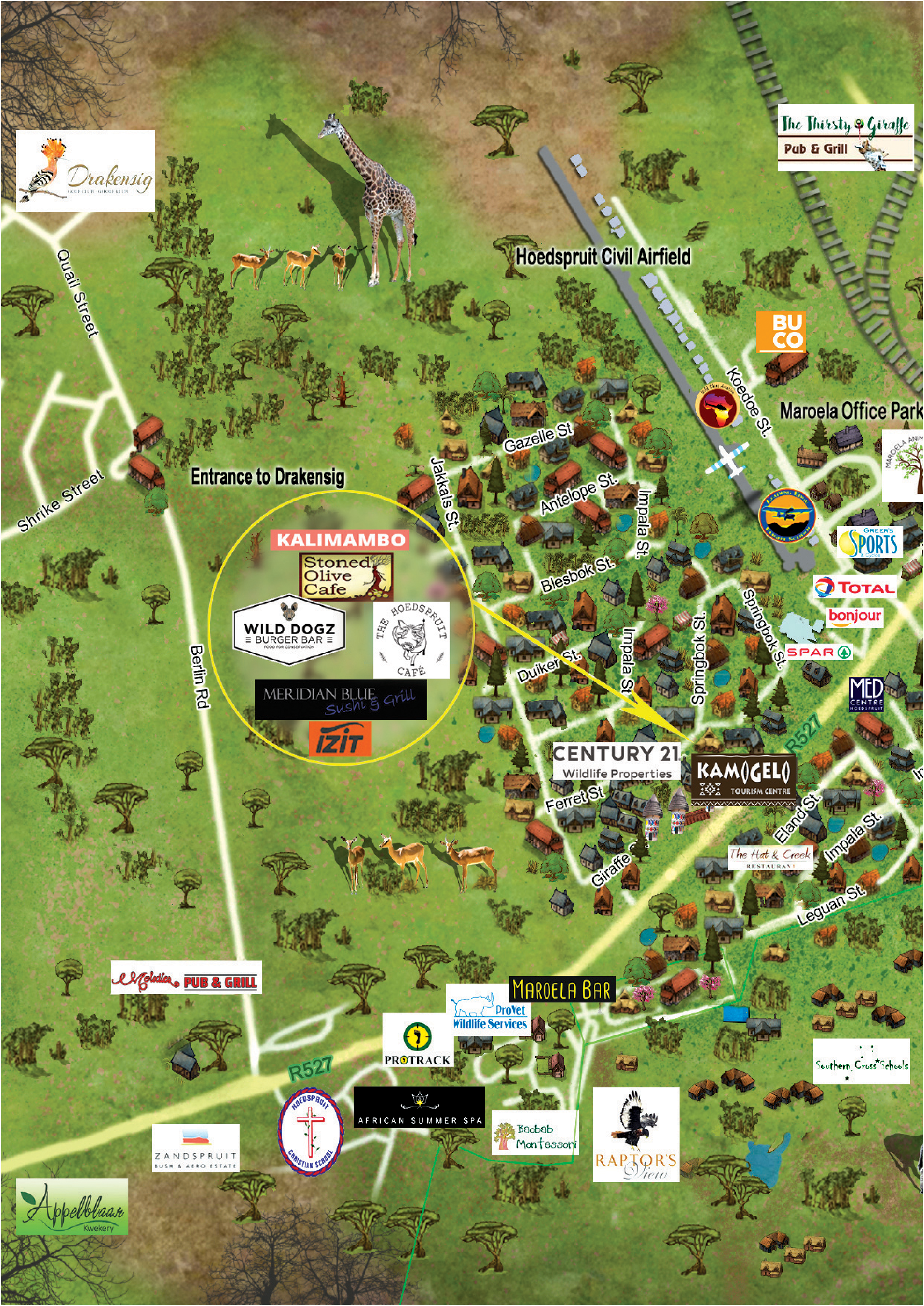
Commercial Hoedspruit map (Century21, 2021: 12–13).
In this paper, we show that behind the image of a prospering wildlife economy is a highly unequal and racialised state of affairs that is deeply unsustainable. This analysis is important because, in southern Africa, there has long been ‘silence on the racial character of land and natural resource tenure, [which] is rather surprising given that colonial tenure systems were based on race and racist grounds’ (Ramutsindela, 2012: 753). One important consequence of promoting the wildlife economy, we show, has been the further consolidation of land and resources into private, mostly white, ownership in the area. Efforts by the local municipality to change this situation by allocating land for affordable housing in Hoedspruit have thus far failed and even actively been thwarted by several wealthy, mostly white, inhabitants and developers. And while we will show that there are major differences of opinion amongst the white population in the area, the net effect of their combined presence and activities, in combination with developments in the wildlife economy over the past decades, has led to a form of ‘green apartheid’.
The term ‘green apartheid’ was first posited by Venter et al. (2020). Their focus was on the provision of urban green infrastructures across race and income geographies in South Africa in both private (e.g. gardens) and public spaces (e.g. green belts, parks, street verges). It refers to how ‘the legacy of Apartheid and socio-economic segregation’ regarding the highly unequal access to these spaces has not just been maintained but in fact ‘worsened since the end of Apartheid’ (Venter et al., 2020: 11, emphasis added). This conclusion is also highly relevant to our case. Our joint research shows that Hoedspruit’s wildlife economy also reinforces and often even worsens former apartheid-driven structures of inequality and racial discrimination. A key difference in our case, however, is that much of this wildlife economy was developed after the official end of apartheid in 1994. To truly understand green apartheid in Hoedspruit, it is critical to centralise the role of capital (investments) since the early 2000s, something that Venter and colleagues do not.
In the literature on the transition from apartheid to post-apartheid, the role of capital in maintaining many racialised material and ideological boundaries and barriers have been emphasised (Alexander, 2002; Bond, 2014; Goldberg, 2009; Goodman, 2017). Neville Alexander already concluded in 2002 (p. 64) that ‘the apartheid-capitalist system has simply given way to the post-apartheid-capitalist system’. More recently, Mpofu-Walsh (2021: 13) makes the case in his book The New Apartheid that ‘[a]partheid did not die; it was privatised’. He shows in detail how both the spirit and the major effects of apartheid have not only survived, but indeed strengthened due to several trends that include marketisation (the policing of privilege ‘by price rather than prose’); digitisation (‘how digital technology and persona computing often reinforce the culture of surveillance and toxic racial categorisation upon which apartheid was built’), and deracialisation ‘in a narrow sense’ (where ‘some Black South Africans can now participate in its spoils, though most still experience the vast disproportion of its evils’) (Mpofu-Walsh, 2021: 17–19, emphasis in original). These and other trends challenge ‘the idea that democracy combats injustice and inequality’ (Mpofu-Walsh, 2021: 166). Indeed, it may even hide the fact that some forms of inequality and injustice may have gotten worse. Our research confirms this argument but adds a crucial dimension not touched on by Mpofu-Walsh, namely how the environmental realm is a critical component of the new apartheid in South Africa. In cases like Hoedspruit’s wildlife economy, we witness a ‘new green apartheid’ where racial and social inequalities are reinforced under an erroneous banner of ‘sustainability’. The green dimension, we will show, further intensifies processes of racial inclusion and exclusion in specific ways, especially in relation to how inequality becomes invisibilised and normalised.
We analyse the case of Hoedspruit using Achille Mbembe’s concept ‘logic of enclosure’ to identify how such mechanisms of racial inclusion and exclusion work. According to him, ‘the contemporary world is deeply shaped and conditioned by the ancestral forms of religious, legal, and political life built around fences, enclosures, walls, camps, circles, and, above all, borders’ (Mbembe, 2017: 24). We build on this by extending the meaning of how enclosures ‘work’, since ‘recent debates on enclosure usually lack an effective consideration of how space is mobilized in the process of dispossession’ (Sevilla-Buitrago, 2015: 999, emphasis added). And since the enclosures at stake here are focussed on the inclusion and exclusion of those with(out) capital and show highly racial segregation, it is crucial to investigate ‘how racism takes place’ (cf. Lipsitz, 2011): which ‘green’ practices assign people of different class and race to which spaces, and how and why is that happening?
The wildlife economy in and around Hoedspruit is fully steeped in several logics of enclosure. The enclosure is here understood as the renewed spatial disintegration of the commons, with manifold expressions in time and based on a consistent capitalist logic to subsume non-commodified, social spaces (Sevilla-Buitrago, 2015). The most visible enclosures in the wildlife economy are material or physical-geographical: the fences, checkpoints, and walls that enclose the reserves and estates. Political ecologists have theorised conservation enclosures as important instruments in processes of state territorialisation and the privatisation of natural resources (Carroll, 2014). Throughout history, ‘enclosures meant dispossession of certain users or the exclusion of some bodies and inclusion of others from rights of use and control’ (Peluso and Lund, 2011: 672). Important for us is that physical-geographical enclosures are informed and underpinned by again other logics of enclosure that are the focus of the paper. In this way, enclosures are much more than ‘conventional’ material spaces for conservation that allow for inclusion or exclusion for particular groups of people (cf. Neumann, 2004). As Mpofu-Walsh (2021) also highlights, complex legal, governance, digital and other mechanisms inform and cut across material enclosures such that they continue to overlap with two other prominent forms of enclosure.
First, private reserves and wildlife estates function as class and racial enclosures for the (very) well-off, which in South Africa translates into the mainly white middle to upper class (including apposite different possibilities for the simply well-off and the extremely wealthy). This logic of class and racial enclosures is based on older patterns of social and racial segregation. Second, becoming part of the wildlife economy in practice means becoming part of ‘a particular reality’ that works as an ideological enclosure that, quite literally, narrows what can or ought to be thought or experienced (Marcus, 2018: 64). In practice, this ideological enclosure translates into dual forms: the application of the market as something that is considered ‘naturally’ suitable to solve social and environmental problems, and in referring to apartheid ideology as a formal political system from the past (i.e. before 1994). Both ideological enclosures legitimise the disregard of current and continuing racial inequalities and apartheid structures. 2 This logic of ideological enclosures directs discourses and can obstruct political alternatives. We argue that these co-constitutive ‘logics of enclosure’ not merely manifest in but are fundamental to the functioning of the material, physical-geographical enclosures so central to the wildlife economy and its profitability in and around Hoedspruit. Moreover, we argue that these logics become (further) legitimated and normalised through the outward green image of Hoedspruit as a haven for biodiversity conservation.
This case serves as an important example of the regressive and unsustainable forms of development that the ‘green’ wildlife economy in South Africa can create. Central in the article is how the prioritisation of capital investments over socio-economic and racial equality perpetuates and intensifies older forms of colonial and apartheid geographies of segregation. This situation is so ingrained that it has de facto resulted in a ‘new green apartheid’, which may sound harsh but analysing the Hoedspruit situation in this way is important for addressing the situation. While we by no means argue that powerful whites in and around Hoedspruit aim to implement an apartheid system, we have had to conclude, based on our extensive research, that the actual outcome of many of their actions and the wildlife economy is that many are part of this new green apartheid. Apartheid, in essence, was a system of governance and state ideology that sought to structurally separate people along racial lines and to institute this across all spheres of life, as well as geographically (Alexander, 2002; Goldberg, 2009). The principal exception, of course, was the apartheid-capitalist dependence on cheap black labour, including intimate forms of care labour (Arrighi et al., 2010; Goldberg, 2009; Wolpe, 1972). Important in our conceptualisation is that apartheid should not just be seen as an historical system, but something that continues into the present. As Mboti (2019: 26–27, emphasis in original) explains, apartheid is not just a static societal structure from the past, but a complex worldly phenomenon that is of significant interest to our attempts to understand the present and the future […] There is scope to see how apartheid disappears and renders itself invisible, normal, and commonplace, and how it mutates, persists, and adapts to opportunities. Central to the design of apartheid is metamorphosis: it incorporates lessons learned, necessarily evolves with time, and adapts to changing environments and circumstances. Apartheid innovates and moves with the times.
One of these innovations, we show, is through environmental conservation, which in turn in southern Africa depends on deep cultural and social attachments that whites have built with land and nature in order to belong in and to Africa (Büscher, 2016; Hughes, 2010; Koot, 2015). We will show that these two elements – ‘green’ and ‘apartheid’ – have indeed reshaped each other in novel yet also disturbingly familiar ways in Hoedspruit.
We start the paper with an historical description of the development of Hoedspruit town and its surroundings, followed by an elaboration of our research methodology. Next, we empirically illustrate how the above two logics of enclosure inform the more visible, material, physical-geographical enclosures, by focussing on the critical issues of labour mobility and affordable housing in Hoedspruit’s wildlife economy. The conclusion reiterates our central argument.
Historical development of Hoedspruit and surroundings
Conservation initiatives and ideology in Africa are infused with a colonial legacy. The creation of protected areas, especially, habitually occurred through brutal dispossession and was meant to benefit and be enjoyed by whites, while black people were relegated to cheap labour or surplus populations (Hays, 2019; Neumann, 1995; Ramutsindela et al., 2011). The founding of the Kruger National Park in 1926 was no different (Carruthers, 1995) and together with capitalist agriculture (Bunn, 1996) fundamentally changed the entire north-east region. Since the early twentieth century, many farms to the west of Kruger National Park have changed from livestock farms into nature reserves. Over the years, these changes were prompted by concerns about extinction (Ramutsindela et al., 2011), a decline in the profitability of livestock farming (Carruthers, 2008), the privatisation of wildlife (Snijders, 2012) and the dropping of secondary fences between Kruger National Park and the private nature reserves (Jordan, 2016). These conditions, coupled with tourism developments since the 1920s and a major tourism boom since the 1990s, facilitated the mushrooming of nature reserves in the region (Jordan, 2016; Dlamini, 2020; Oosthuizen, 2018; Van Reenen, 2007; WAH, 2020). Over several decades these developments were accompanied by structural evictions of people from Hoedspruit and surroundings into the Bantustans (‘homelands’ for black people during apartheid) (Davis, 2014), resulting in the highly uneven regional geography we witness today.
Hoedspruit was originally established as a settler farm in 1848 (WAH, 2020), 3 and until the 1990s it was primarily a farmer’s hub and the site of an air force base. The increasing number of tourism lodges at the private nature reserves changed the economy substantially, while tourism numbers were further boosted by these reserves opening up to the Kruger National Park, leading to what is called the ‘Greater Kruger Area’. Altogether this has led to a thriving wildlife economy in and around Hoedspruit, which ‘is often referred to as the safari capital of the world’ (GKEP, 2020). This image is mainly based on the private reserves that thrive on high-end wildlife-based tourism, which predominantly relies on the attraction of the wildlife of the Greater Kruger Area, the vicinity of Kruger National Park and the Little Drakensberg range. In addition to conventional tourism activities, some private reserves offer consumptive tourism (i.e. trophy hunting) and today there is an increase in philanthropic initiatives in tourism (Koot, 2021). Importantly, the wildlife economy’s focus is centred on a private property regime, which has led to an increase in structural inequality and unjust labour circumstances for many (Thakholi and Büscher, 2021).
Next to tourism, another important reason why Hoedspruit has rapidly developed into a small but cosmopolitan wildlife hub is the development of wildlife estates since around 2000. This accelerated the establishment of the wildlife economy. Indeed, the town itself believes it is ‘the original home of the concept of the “Wildlife Estate”’ (WAH, 2017). These gated estates are developed within a Wildlife area and allow for residents to live and work within the reserve combining the best worlds of an estate development with nature reserve living. This factor together with Hoedspruit being the home of the largest privately owned conservation area in the world, makes Hoedspruit a prime destination for a variety of wildlife-based developments. (WAH, 2017)
Wildlife estates are gated communities where one buys into a particular lifestyle of living with wildlife, in an environment that is relatively ‘crime free’. This development is part of a broader trend of different types of (self-declared ‘eco-friendly’) estates in South Africa that are often described as ‘escapist’ spaces, especially from crime (Ballard and Jones, 2011; Ramsawmy et al., 2020; Spocter, 2017). Inhabitants buy their own plots and build their own houses based on strict architectural guidelines, or they buy both completely developed. Many houses have their own swimming pools since luxury is rarely sacrificed for the ‘bush experience’ (Figure 2).
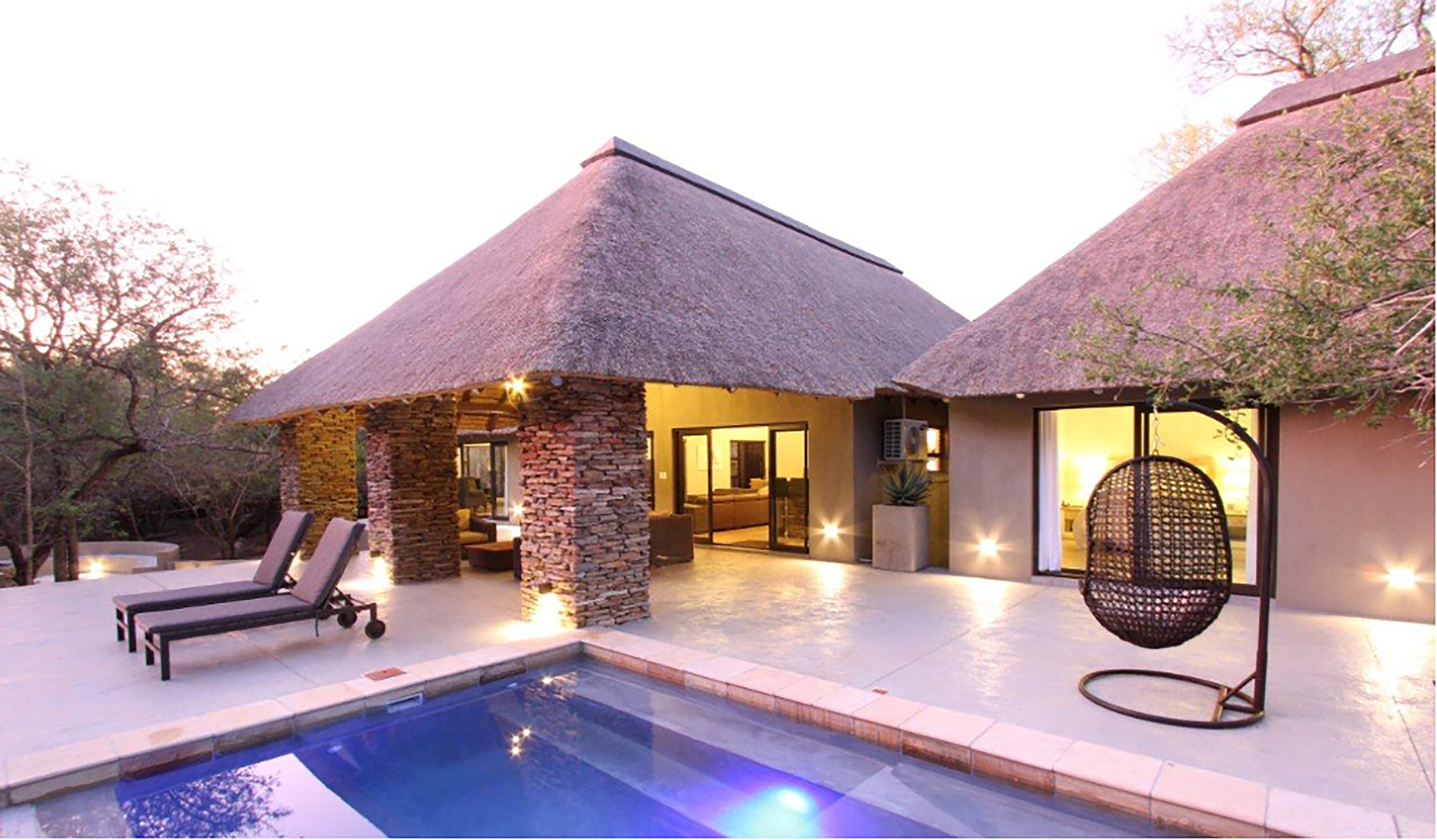
Typical property photo of Hoedspruit wildlife estates (source: PH, 2021).
There are currently seven wildlife estates in or just outside of Hoedspruit: Raptors View, Hoedspruit Wildlife Estate, Moditlo Game Reserve, Canyon Game Reserve, Blyde Wildlife Estate, Zandspruit Bush and Aero Estate and Leadwood Big Game Estate. Yet others are situated further away from Hoedspruit (e.g. Leopard Rock Nature Reserve). They all have a different character and differ in degree of luxury, big five or ‘plains game’, and more suburban, family-friendly or ‘wilder’, amongst others. Their inhabitants are predominantly urban white South Africans, and European and (some) American expatriates, including many pensioners. For some, the wildlife estate property functions as a second home while others live there permanently.
Given that nearly every South African town has one or more townships, it is noteworthy that Hoedspruit has no formal township. There is, in fact, hardly any formal living space available for low-wage labourers. Hence, many hundreds of workers commute every day by bus from former homeland areas and towns nearby, including the Oaks (39 km), the Willows (52 km), Acornhoek (38 km) and Bushbuckridge (71 km). A heated, ongoing discussion in Hoedspruit is about social or affordable housing for low-wage labourers. Until now, the discussion remains in a stalemate, which de facto means that ‘apartheid’ type spatial ordering continues to develop hand-in-hand with the growing wildlife economy. Yet to truly understand how ‘green’ and ‘apartheid’ come together in Hoedspruit’s ‘wildlife haven’, we need to pay attention to class, race and ideological enclosures, and how they – as ideal types – overlap, interact and develop.
Methodology
The findings of this article are based on ethnographic research of the three authors together. The first author conducted fieldwork between September 2015 and September 2019, including almost 5 months of ethnographic fieldwork on private tourism reserves to the west of Kruger National Park and on wildlife estates in and around Hoedspruit, while being based in Hoedspruit. He conducted 87 semi-structured interviews with a variety of participants in the wildlife economy (e.g. government officials, wildlife estate developers, conservationists, wildlife estate inhabitants, and lodge owners). The second author has done research in the ‘Greater Kruger Area’ since 2003, including six fieldwork visits to Hoedspruit between 2015 and 2020, during which he conducted 24 semi-structured interviews. The third author conducted ethnographic research in Hoedspruit for over 15 months between 2017 and 2019, and did 150 semi-structured interviews with conservation stakeholders and conducted four life histories with elders in the same area. Interviews were conducted predominantly in English and Sepedi and a few in Dutch.
The enclosures informing green apartheid
Class and racial enclosures
About three-quarters of the 55 million South Africans are black and for many of them, apartheid has continued economically: their political liberation has not yet translated into noteworthy material gains (Goodman, 2017). Class inequality has a strong ongoing racial bias: white people earn over three times more than black people (StatsSA, 2019) and experience 8.8% unemployment in contrast to 36.5% for black people (StatsSA, 2020); the creation of state-funded housing for black South Africans in townships left apartheid geographical divisions mostly intact while currently about 10% of the (predominantly white) South Africans own over 90% of the country’s wealth (Goodman, 2017; Koot et al., 2019; Ramutsindela, 2012). The South African state’s post-1994 embrace of neoliberal policies is often posited as the main reason for this situation because it continues to guide much government policy (Goodman, 2017), including the 2017 National Biodiversity Economy Strategy that aims to boost private sector involvement in the wildlife economy.
Altogether, since 1994, South Africa thus experienced ongoing ‘class apartheid’. Although ‘racial apartheid’ has officially been outlawed for almost three decades, daily and institutionalised racism has tenaciously persisted, while a strong dependency on a black working-class continues as under apartheid (Naidoo, 2020). A black working class is also strongly present in Hoedspruit and occupies critical roles such as builders, domestic workers, cashiers, gardeners and petrol attendants. Nonetheless, some of the upper-class inhabitants strongly oppose the creation of affordable housing, predominantly based on a fear that this would increase crime. Currently, Hoedspruit is experienced as a safe town by South African standards, which is one important reason why many people buy property and live there. This perception of safety further increases Hoedspruit’s market value, which is directly related to the unwillingness to sell land for affordable or social housing. One wildlife estate manager, for instance, declared how fortunate it was that prior plans to develop affordable housing on the estate lands had been thwarted, because this ‘would have killed the town’, lead to an influx of poor people, too many houses and ‘chaos’ (see Thakholi and Büscher, 2021). This reference to a lower class has a strong racial connotation, since Hoedspruit is an overwhelmingly white and well-off town, while nearly all ‘poor people’ are black. Importantly, the racialised hierarchical division of labour or references to ‘poor people’ was never directly articulated in our interviews; yet it was clear that this was nearly always connoted.
There is a general perception that was articulated in several of our interviews that low-cost housing will introduce criminality to the quaint town and ruin its peaceful ambience. A European estate and tourism developer who opposes affordable housing stated that ‘you can pile them [labourers] all up in huts but in the end that is not the way forward’. According to him: this is a very simple conclusion, poverty creates crime, very simple. […] Those people living in Acornhoek get a salary, like the cleaners and the bricklayers, which in our perception might be low but in their eyes is quite a good salary. And they have a certain standard of living there that they can never achieve if they would live in a township [in Hoedspruit]. And if you would get a township, you would see that this lower group would come over from these places to live in a township because it doesn’t cost anything, and there is also no incentive to get out of this situation. That is not how their culture works: if they have made enough money for today, they don’t go to work tomorrow. And that’s a culture that you need to get rid of, and you will not achieve that by letting people live in a township.
When he was subsequently asked if he believed there was any racism in Hoedspruit, his answer was firm: ‘Absolutely not’.
4
Another interviewee, a real-estate salesperson, responded to the question ‘why has Hoedspruit become such a wildlife haven’, as follows: I think it is because of the way Hoedspruit is laid out. Because of all the farms, there cannot be encroachments, there are no settlements close to Hoedspruit; so it is very safe. In other places you cannot control that but here it is controlled.
5
This view that affordable housing is a threat, while dominant, is not exclusive: other whites capitalising on the wildlife economy support affordable housing. They reason that if you want to employ labourers, it is also your duty to provide decent housing. An estate agent explained: ‘we need affordable housing here [Hoedspruit], because the property prices here are simply too high especially for the middle class, not low-cost housing, affordable housing’.
6
And one of the very few black inhabitants of a wildlife estate explained that Hoedspruit needs social housing because to become ‘a successful community […] you don’t create the gap that is now being created in Hoedspruit whereby like, if you have a certain race, or you can’t afford it, you have to stay far away from town or something.’
7
Several whites strongly agree with this and also relate this inversely to crime, like the following lodge owner and estate inhabitant: It cannot be the case that you build very beautiful estates […] and big lodges attracting much revenue, and that you then do not care for the people who do the labour and provide decent housing for them. Now you get squatter camps. […] Social housing is very important but will make the place neater and it will be better maintained and look better, and crime will drop. […] If you ever want to have an integrated society, my feeling is you have to let people live where they want, so you have to give them the option. It cannot be the case that people are forced to commute every day for 30 km and back in fully packed public transportation that takes at least a third of their salary.
8
Can you imagine if they would put that money into their houses? I do not expect crime to rise if they would be enabled to do that. Most crime here is committed by drunken white people.
9
Other white inhabitants articulated a similar opinion. However, according to a municipality employee, the concept of affordable housing is often mixed up with the national Reconstruction and Development Programme (RDP), a government programme that provides free houses for the most marginalised (Bond, 2014; Spocter, 2017). She emphasised that the idea is to create (comparatively) more affordable housing in Hoedspruit, which makes for a crucial difference in the people it would attract. The employee wants to create affordable houses also for people like herself who can currently not afford to live in Hoedspruit despite having a decent job.
In both private reserves and wildlife estates, conservation is dominated by elite whites, with blacks providing low-wage labour. The creation of labour through conservation, construction and tourism, is often articulated by elites as ‘development’ through the wildlife economy, and thus an incentive for black people to conserve ‘their’ natural heritage for ‘their future’. For instance, a lodge owner explained: ‘My most important drive is to make sure that in the future […] poaching has stopped and people benefit from all the jobs, and selling game, and selling curios, and train their own kids, you know […] I only create black role models for them’. 10 When asked about this, a young, black, female conservationist (an exception in the area that can be considered a role model) laughed loudly and said that ‘this future that we are trying to conserve we are conserving it for the […] tourists, because the tourists must somehow bring us money’. 11
Although (labouring) blacks and (resident, elite) whites are co-dependent upon each other through labour relations, they generally continue to ‘live apart’. It is equally clear that socio-economic opportunities are not the same for the different groups and the wildlife economy is not likely to change this. On the contrary, some capitalists (wildlife estate developers, lodge owners) articulate a vision about how the town should further develop, based on the idea that not only it is better to keep living separately, but that blacks themselves prefer this. As a white South African developer emphasised, ‘most of them [labourers], in my opinion, don’t want to live in Hoedspruit. They have got their homes there, they want to go home to them in the evenings’. 12 Residents of an informal settlement in Hoedspruit vehemently refuted this idea. Despite unsanitary and fire-prone living conditions, they regard Hoedspruit as their home.
Importantly, the layer of class and race enclosures is tightly connected to the physical-geographical enclosures ‘afforded’ by ‘the bush’ and wildlife critical to the image of Hoedspruit. Racial inclusion and exclusion are for a large part emphasised through nature (Hays, 2019; Neumann, 2004). The fact that Hoedspruit is surrounded (and thus itself ‘enclosed’) by nature was often stressed as another central part of its ‘uniqueness’ that needs to be maintained: Town [Hoedspruit] is sort of landlocked now by these various estates, so what this means is town will grow through these estates meaning it will never expand beyond its borders. So you will always have this beautiful conservation area around this beautiful little town of Hoedspruit.
13
Since another important element of Hoedspruit’s uniqueness is the absence of a township, to keep the town’s character it was also emphasised to not ‘bring in a more affordable type of element to the town by that model [affordable housing], because I think it could spoil it, the uniqueness […] as long as the transport remains subsidised’. 14 This statement is rather blunt, as were others we noted.
Besides opposition to low-cost housing, another revealing case pertains to how land claims have been dealt with by wildlife estates. 15 The Moletele community lodged a claim on most farms in and around Hoedspruit (Davis, 2019). Instead of wildlife estate land being restored, the community was offered financial compensation (Lahiff et al., 2012) in a deal marred by controversy (Eprop, 2021): it came to light that the developer of the estate proposed to the property owners to contribute to paying out the claimants. The land claims commissioner disapproved these transactions, nonetheless, the claim was finally settled with financial compensation. Today the estate website claims that ‘an important aspect of the estate maintaining its investment value is that the Land Claim on the estate was resolved in 2006’ (RV, 2021).
Thus, in the wildlife economy, a ‘logic of enclosure’ is not merely visible in physical-geographical enclosures, but there is an intensification through race and class relations, leading to a situation of inclusion and exclusion in which the processes of racialization aim to mark population groups, to fix as precisely as possible the limits within which they can circulate, and to determine as exactly as possible which sites they can occupy—in sum, to limit circulation in a way that diminishes threats and secures general safety. (Mbembe, 2017: 35)
This limitation of circulation is thus not only geographical but also includes class and racial ‘movements’. In practice, this means people are ‘fixed’ in place and in class, based predominantly on race. As such, these are enclosures in themselves, albeit not in the visible physical-geographical sense of the concept, but enclosures nonetheless that inform physical-geographical enclosures. Thus, ‘[t]he apartheid of race has been replaced by – better yet, subsumed into – a spiraling [sic] apartheid of class’ (Goldberg 2009, 311). Seen as such, circulation and movement become much more than only movements between geographical spaces, between crossing a fence or a wall. In this way of thinking, ‘[b]orders are no longer sites to be crossed but lines that separate. Within these […] spaces, everything is supposed to remain still’ (Mbembe, 2016: 3). Following, we suggest that the borders of private reserves and wildlife estates symbolise much more than physical and geographical segregation; they are also social and psychological barriers, preventing people from thinking they can move ‘upwards’.
Ideological enclosures
Colonial legacies in Africa that solely focus on material aspects are intellectually limited and tend to neglect ‘the less visible yet fundamental and pervasive ideologies which underlie and are reflected in material processes [including] a complex of concepts such as racial superiority and national destiny’ (Neumann, 1995: 149). In our research, we identified ideologies that also function as enclosures, related to two phenomena: first, how (more) capital and capitalist markets are seen as the ‘natural’ solution to most problems and that these are supposedly neutral in relation to race or class differentiation (as described in the previous section). Second, it denotes a specific conviction that apartheid is a historical system of a racial government that ended in 1994 and that since then racism mainly comes down to racial bias instead of a structural form of power and differentiation.
Regarding the first, one estate inhabitant explained that a focus on economic interests would be much more helpful than a focus on skin colour to ‘develop the poor’ in the region.
16
As a wildlife estate manager explained, he did not understand why you would want to make it a race thing. It’s an open market, whoever wants to come buy can buy here, and I think Hoedspruit is the business hub of this municipal area and most of the business owners are white […] So it’s where most of the white population of the area comes together, this is where they wanted to live, so I don’t think it’s a racial thing.
17
Notwithstanding obvious contradictions in the above quote, the ideology of the open market and the ability to capitalise on the wildlife economy are often presented in similar ways: as honest because they create ‘equal opportunities’ for all. In our interviews, critical questions about the situation would often bypass racial inequality and consider capital crucial merit for development opportunities. Yet, the fact is that access to the highly capitalised markets in Hoedspruit has a strong racial component (as in South Africa more generally), including in wildlife estates. This purported faith in the ‘open’ market was tested when a new shopping mall was planned in Hoedspruit. The mall never materialised because many small business owners in Hoedspruit opposed it on grounds that it would bring cheaper products. One estate inhabitant explained that a mall ‘will draw people again and people that need to live near it and it’s gonna change the town, and it will change it to something that we don’t want’, whereas in other places such as Acornhoek ‘they’ve got all the malls in the world’. 18 For one public official, however, this was clear ‘anti-competitive behaviour [which] was unfortunate because the mall would have provided jobs for many people’. 19 Furthermore, the mall would have transformed the ‘small town’ atmosphere, attracting more black consumers from surrounding villages, more cars and taxis, and more street vendors and car guards. The opposition to the mall thus illustrates a selective faith in open market ideology.
Nobody seemed to fundamentally critique the conjoining of green and capital in the wildlife economy in Hoedspruit, and so do little to challenge the de facto green apartheid situation. Indeed, most seem to buy into the ideology of markets as ‘the’ solution for environmental and social problems, like the idea that investing in wildlife and nature reserves leads to job creation and hence to welfare. Clearly, jobs are created in the wildlife economy. But the key issue is whether these are good, secure jobs within a conducive, safe, and pleasant context, which is often not the case (Thakholi, 2021). Moreover, as the opposition to the shopping mall also shows, for some, job creation should also not come at the expense of particular private economic interests. Lastly, all capitalists in Hoedspruit seem to benefit from the cheap labour market. Altogether, this means that most capitalists have little incentive to fundamentally oppose the green apartheid situation.
Despite a variety of well-intended philanthropic initiatives – such as community-based tourism, community development (with a strong focus on environmental education) and a large variety of conservation initiatives – Hoedspruit capitalists do not seem to be in a position (or not willing) to address the structural socio-economic and racial inequalities in the area. Moreover, such philanthropic initiatives themselves are fully based on a belief in market ideology. As one philanthropist explained about a community-based tourism project: ‘the only way to make this a success is to run it as a proper business’. 20 In this way, humanitarian acts help stabilise the capitalist order that leaves structural inequality unaddressed and can even worsen it (Koot, 2021; Ramutsindela, 2015). Altogether, the ideology of the market as naturally good is at the heart of Hoedspruit’s identity, closing off the need to address more structural issues caused in part by the same market ideology.
The second important ideological enclosure is historical, in which the formal abolishment of apartheid in 1994 marks the end of a repressive regime such that contemporary formations like the wildlife economy are, by definition, independent of apartheid. However, this is too simplistic: building on recent scholarly work (Bond, 2014; Mboti, 2019; Mpofu-Walsh, 2021), we consider apartheid not as an ideology from the past, but as a formation that changes and endures (Stoler, 2016). In many ways, this resembles the situation in the Unites States, where after the Civil Rights Movement of the 1960s racial discrimination has persisted – despite the abolishment of legal ‘colourblindness’ – through institutionalised power structures and subsequent legalised policies and practices (Alexander, 2010). Furthermore, Stoler (2016: 27) shows how colonial practices and visions perpetuate globally through processes such as recursion, which involves ‘processes of partial reinscriptions, modified displacements and amplified recuperations’. Seen as such, enclosures historically ‘provide some continuities; however, these are not alien to ruptures and difference’ (Peluso and Lund, 2011: 672). These ideas resonate with the wildlife economy of Hoedspruit. Here, history is often portrayed as ‘enclosed’ into an apartheid and a post-apartheid era, whereby post-apartheid is often conflated with non-apartheid. Furthermore, it is believed that the post-apartheid era, as mentioned, is marked by ‘equal opportunities’ in the open market. But because equal opportunities do not exist, this discourse legitimises contemporary practices, obstructs political alternatives and in fact perpetuates apartheid processes of inclusion and exclusion in new ways.
It is important to acknowledge that present-day enclosures and separations often have their ‘foundation in socio-historical processes that racialized space’ (Carrillo, 2020: 6). As such, the wildlife economy functions in the context of a ‘consensus-building process that enables white people to create and sustain a market in order to secure social and economic benefits from the historical consequences of racial disparity and racism’ (Mumm, 2017: 104). Conservation-based markets, especially tourism, have a long history in Hoedspruit and the region, and this keeps affecting today’s wildlife economy, as explained by a real estate agent: Hoedspruit is founded on entrepreneurship, on tourism, which is an alive thing, and on big conservation. If you look at who owns property; there is a lot of old money, especially in the reserves, and especially Klaserie, but also Timbavati. In Klaserie, you have the Hewlett, sugar dynasty, and Oppenheimers, they all own property in Klaserie, so perhaps a deeper-longer old relation to Hoedspruit, which gives it legitimacy; so perhaps there is a mixing of old money and new money, and that gives it legitimacy; these old guys are also very protective of their areas.
21
As indicated in this quote, ‘old money’ built up under colonial and formal apartheid regimes keeps having strong effects on the present-day wildlife economy. Clearly, many people with ‘old and new money’ who invest their capital in the wildlife economy today would consider themselves ‘non-racist’. This, however, does not repudiate the benefits they have experienced – and continue to experience – from the past and present apartheid structures. In our findings, racial issues were often relegated to something from the apartheid days, as a ‘closed’ period in time, despite the ‘mixing of old money and new money’. This allows the contemporary South African wildlife economy to be presented as ‘thriving, inclusive and sustainable […] for the well-being of all South Africans’ (Thomson, 2018: 9, emphases added; see also DEA, 2018).
In reality, however, tourism, private reserves and wildlife estates benefit mostly whites, and are only ‘inclusive’ in the sense that blacks work in these industries for low wages. This view of apartheid as an enclosed period in the past is considered a big problem by some tourism operators. One emphasised that apartheid is still very visible today, based on who benefitted and who suffered from it. He explained that in response to the current socio-economic conditions, and for fear of ‘black’ crime, most whites prefer to buy another gun or build another fence, instead of going ‘to Acornhoek, and ask there, what are your problems?’ 22 However, despite the fact that some capitalists acknowledge aspects of apartheid today, they simultaneously often keep investing in the wildlife economy, based on a belief in capitalist markets as ultimately good, as explained above.
Further evidence that many in Hoedspruit view racism as something ‘from the past’ comes from a wildlife estate inhabitant: ‘at one point racism was a factor in limiting opportunity for the black cultures, but with that having lifted, after apartheid […] I see more and more opportunities in the black communities [who need] access to capital markets’.
23
At the same time, this view and why it is problematic is regularly acknowledged. As a South African estate owner, game breeder and lodge owner summarised the development of racism in Hoedspruit over the last 20 years: Hoedspruit looks positively cosmopolitan, which in a way it is. It is still with racism and that, but it is much more subtle because the discourses changed in town. [Because] I think a large proportion of it is the urban ‘refugees’, sophisticated people, you know people made money in Jo’burg, Pretoria and so on, they have sort of middle class, upper-middle-class […] That was sort of the first wave of change, and then with the expats coming in, I think that changed town in subtle ways. For instance, it would not be unusual 15 or 20 years ago for somebody to be openly racist Whereas in the last 10 years it’s much more subtle. People are much more aware of who is watching them, of who is commenting on them.
24
Hence, racism is not merely relegated to the past. But this does not mean that apartheid is seen as something structural and enduring. An estate and tourism developer stated, for example, that ‘originally Hoedspruit is a farmers’ community, so there are still a few farmers who believe the apartheid days were better’. 25 Hence, this developer acknowledges that racism persists, but simultaneously relegates it to isolated individuals, ‘a few farmers’, who are regarded as relics from the apartheid era. In this way, the continuation of the apartheid ideology is both acknowledged and enclosed. This historical ideological enclosure is informed by a conflation of racism as racial bias as opposed to racism as an institutionalised and structural exclusion and marginalisation of people based on a constructed racial hierarchy.
Like class and racial enclosures, both ideological enclosures described here maintain and intensify structural issues behind green apartheid, including the creation of physical-geographical enclosures: they legitimise current practices and capital investments that lead to a continuation of contemporary class and race division.
Conclusion
In Hoedspruit, ‘green’ and ‘sustainable’ marketing masks the perpetuation and deepening of physical and geographical enclosures and social and racial injustice (cf. Baigrie and Ernstson, 2017). Central to this has been the development of private nature reserves that provide spectacular African wilderness experiences for international tourists (especially since the early 1990s) and wildlife estates that provide housing for a mobile white elite (since around the 2000s). Hoedspruit grew from a ‘farmer’s hub’ into a ‘wildlife haven’ in just over three decades, facilitated by large capital investments in infrastructure, consumption possibilities, and many other modern amenities. Much of this has happened after the abolishment of the formal apartheid regime, which for many seems to indicate that the issues plaguing the town’s growth are simply modern-day challenges that need to be managed and found ‘solutions’ for (ideally through further capital investment and broadening of ‘markets’).
As we have shown, however, core issues in the town, like the provision of affordable housing for the many labourers in the wildlife economy, contestations about a shopping mall, ongoing land claims and others, are part of a structurally problematic situation that reveals a ‘new green apartheid’. While the wildlife economy thrives and allows many whites to make money and ‘live in a wild place you thought no longer existed’ (Zandspruit, 2021), it has simultaneously reinforced (and often worsened) historical structures of social and racial inequality. Precisely because most of the wildlife economy has emerged after the end of formal apartheid, the role of capital is crucial to understanding the new green apartheid. Since many well-to-do and often wealthy people can now work and live away from offices or urban centres – something that has taken further flight due to the recent SARS-CoV-2 pandemic – they can afford to live in and collectively build a ‘haven’ that combines their ideals of wildlife, business, safety and comfort. Wildlife estates are a clear example in which a global capitalist class can ‘enclose’ themselves, their consumption and indeed much of their lives within a bounded geographical space that brings ‘like-minded people’ together. The layer of spatial, physical-geographical enclosures, however, is continually informed by both the layer of racial and class enclosures and the layer of ideological enclosures. The three are not separated but seem to reinforce existing structures and each other.
Building on Mboti’s (2019: 26, emphasis in original) proposition that ‘[c]entral to the design of apartheid is metamorphosis’, we have shown that an increasing number of ‘green’ capital investments in the wildlife economy of Hoedspruit instigated such a metamorphosis after 1994, though not ones that reduced racial inequalities. Quite the contrary, capital investments in the wildlife economy built around physical-geographical enclosures have mostly reinforced pre-1994 apartheid structures and intensified separation. The fact that these investments are considered ‘green’ under the wildlife economy further legitimises them, leaving structural, racial and socio-economic issues unaddressed. Furthermore, while the apartheid regime was overtly repressive and the violence easy to identify, the racial and class enclosures and ideological enclosures that maintain and intensify the new green apartheid are less visible and normalised which makes it much more insidious and difficult to tackle.
Our research shows that the visible, material layer of physical-geographical enclosures created by these capital investments does not function on its own in sustaining a green apartheid situation. It needs ‘supporting’ enclosures that legitimise and reaffirm the inclusionary and exclusionary systems. We identified two such main supporting layers of enclosures in and around Hoedspruit: class and racial enclosures, and ideological enclosures. Together, these allow middle- and upper-class whites to create a space that combines the ideology of the market and capital with wilderness ideals of wildlife conservation to create an enclave fantasy that is placed outside context or history. As we showed, ideological enclosures not only work to privilege capitalist markets over social and racial justice, but also cordon off those elements of the past – like the formal apartheid system – that are inconvenient in relation to the present situation. In this way, the end of ‘formal’ apartheid in 1994, together with a strong belief in markets, now functions to disregard current and continuing racial inequalities and apartheid structures. In specific-yet-integrated ways, the three enclosures are systems of inclusion and exclusion.
Altogether, the Hoedspruit case serves as an important example of the regressive and unsustainable forms of development that the wildlife economy in South Africa can create. Especially because the wildlife economy is an invitation to further capitalise (on) the town and its surroundings, it reproduces and even intensifies already strong racial divisions by fortifying enclosures that in turn reinforce each other, so in effect allowing apartheid to morph anew, now in green.
Highlights
Hoedspruit, a self-declared ‘wildlife haven’ in South Africa, is often portrayed as a shining ‘green’ example of the wildlife economy.
Private nature reserves, high-end tourism and ‘wildlife estates’ have consolidated much land in mostly white ownership.
We argue that the wildlife economy and its ‘green’ and philanthropic discourse keeps reproducing apartheid-style, racial segregation: new green apartheid.
New green apartheid is built on ‘logics of enclosure’ that include physical-geographical, class and racial, and ideological enclosures.
This continuation of racial segregation illustrates the unsustainable and regressive character of the wildlife economy in South Africa.
Footnotes
Declaration of conflicting interests
The authors declared no potential conflicts of interest with respect to the research, authorship, and/or publication of this article.
Funding
The authors disclosed receipt of the following financial support for the research, authorship, and/or publication of this article. This work was supported by the NWO (Netherlands Organisation for Scientific Research), (grant number 016.155.325).
