




Abstract
This article examines the potential for online activism to contest hegemonic neoliberal conservation models in South Africa, using the Covid-19 crisis as a window onto discursive struggle. National lockdown measures during the pandemic sent the vital tourism sector of an already fragile economy into deep crisis. Neoliberal and militarized conservation models, with their reliance on international travel, are examined as affected by a conjunctural crisis, the meaning of which was contested by a broad range of social actors in traditional and on social media. In 30 online news videos, racial hierarchies of land ownership and conservation labour geographies are reproduced and legitimated, as is a visual vocabulary of conservation as equivalent with guns, boots, and anti-poaching patrols. Here, hope is represented as residing in the increased privatization of public goods, and the extraction of value from these goods in the form of elite, luxury consumption. In a corpus of posts on Twitter corpus, on the other hand, significant counter-hegemonic resistance to established neoliberal conservation models is in evidence. In their replies to white celebrity conservationist Kevin Pietersen, critical South African Twitter users offer a contrasting vision of hope grounded in anti-racist equality, a rejection of any special human-animal relations enjoyed by Europeans, and an articulation of a future with land justice at its centre. The analysis supports the idea that in the “interregnum” between hegemonic social orders, pathways towards transformed futures may be glimpsed as “kernels of truth” in discursive struggles on social media.
Highlights
The future of South African conservation is contested in traditional and social media texts during the COVID-19 crisis
Online News Videos about the “crisis” in conservation normalize racial hierarchies, landholding patterns, and militarized conservation
The violent symbolic tropes and material practices of militarized anti-poaching campaigns are applied to poor people hunting for meat
Hegemonic conservation models are contested on Twitter, where the whiteness of conservation and its capitalist form are ridiculed
In an influential pamphlet, Nancy Fraser recently diagnosed the reactionary populism of the Trump era in the United States as being only one among many “morbid symptoms” (2019: 29) of an interregnum where the “old is dying and the new cannot be born” (cf. Gramsci, 1971: 271). The current conjuncture was brought about by an especially unstable form of financial capitalism that liberated capital accumulation from its political social, ecological, and moral constraints “like a tiger that eats its own tail” (Fraser, 2019: 38). In many Western contexts the hegemonic social form that enabled this was “progressive neoliberalism” – replete with vapid commitments to “diversity”, lean-in feminism, multiculturalism, and (most saliently for this paper) capital-friendly forms of environmentalism. Its eclipse occasioned a crisis that is global, systemic, “ecological, economic, and social” (Fraser, 2019: 36). But in the uncertainty and instability of the present, an opportunity for articulating new social visions arises. If the exact dynamics of crisis are apprehended, and the struggle for a new hegemonic order is caught in action, we might just be able to “glimpse a path that leads beyond the current impasse – through political realignment to societal transformation” (Fraser, 2019: 1).
The odds of public discussion of ecological crisis offering any “glimpses” of a transformative future in the age of “platform capitalism” (Srnicek, 2016) have been hotly debated within political ecology (Büscher, 2020; contributions to the special issue on ‘Nature 2.0’ edited by Büscher et al., 2017). While some scholars see opportunity in the “politics of visibility” (Massé, 2019) of online attention economies, others argue that empowerment in digital spaces is an illusion that “falls flat” in terms of its real world influence (Büscher et al., 2017, p. 112). This article aims to contribute to this debate through analysis of the online mediatisation of a South African conservation “crisis” that intersects with a long-standing economic crisis and is exacerbated by a novel health crisis: the Covid-19 pandemic. While South Africa's virulent racial capitalism and centrality in neo-colonial flows of the international eco-tourism industry make the country a good case study for how global forces play out in a national context, the confluence of these forces is not unique (see Lunstrum et al., 2021; Mollett and Kepe, 2018, for other country cases). The South African context is however exemplary of the power of social media counter-publics to reframe, resist, and in certain cases even organise themselves to revolt against hegemonic media discourses (Mpofu, 2019; Mudavanhu, 2017). South African “Black Twitter” is an especially active site for the “political realignments” that presage the kinds of societal transformations Fraser envisages (see Mpofu, 2019).
In the sections below, I will argue that online reaction to “philanthrocapitalist conservation” (Koot and Fletcher, 2020) and “celebrity environmentalism” (Abidin et al., 2020) during the Covid-19 crisis offers opportunities for the re-politicization and societal contextualisation advocated for by critical political ecologists. This resistance comes not from the environmental advocates usually implicated in Nature 2.0 but from ordinary citizens whose participation online is motivated by social, political, or economic, as well as ecological, concerns. This resistance will be read against the dominant narratives of still-powerful video news channels which portray “spectacular environmentalisms” (Goodman et al., 2016) secured by neoliberal “solutions” that work to sediment capitalist modes of production. From soon after lockdown measures were announced in May 2020, international media started reporting that Covid-19 was a crisis for South African conservation. Protected areas earned less income from paying tourists, which was “dangerous to wildlife in regions usually patrolled by rangers” (Kurosawa, 2020). In this typical formulation, the implied retrenchment of conservation personnel is presented as a threat to animal, and not human, welfare, which in turn depends on the international tourism market. Exploitative conservation labour geographies (Thakholi, 2021) are thus discursively defended and repaired, reaffirming the hegemony of neoliberal conservation. In the analysis I present below, I tease out how these orders are articulated in the context of conjoined crises. I first present a corpus of mainstream media texts that are fairly consistent in their representation of South Africa's Covid-19 conservation crisis, and that offer insights into the naturalization of racialised conservation labour geographies in South Africa. I then move on to examine a Twitter “firestorm” (Johnen et al., 2018) that resists, reframes, and undermines many of these mainstream chains of signification. Before turning to these dynamics, however, I lay out the nature of these conjoined crises, and present my approach to unpicking them.
COVID-19, capitalism, and conservation: A conjunctural crisis
South Africa experienced three devastating coronavirus waves in 2020–2021, which presented policymakers with a fundamental dilemma (Staunton et al., 2020). On the one horn of the dilemma was the spread of an infectious disease in a country already ravaged by HIV and tuberculosis; on the other, the suffering (and death) inevitably caused by an economic shutdown in one of the world's most unequal countries. The extent to which coronavirus infection and death are associated with race and social class in South Africa is not currently clear. While in November 2021 the official Department of Health Covid-19 death toll stood at just under 90,000, estimates based on excess death data suggest this number could be to three times higher, making the national death rate one of the highest in the world (Bradshaw et al., 2021). South Africa's persistent racial divisions mean that life in rural or urban poverty, where access to healthcare is often patchy, is largely experienced by Black people already disproportionately affected by food poverty and disease, who thus might well be over-represented in the gap between reported and actual deaths.
The pandemic caused a dramatic decline in South African GDP, and a disastrous increase in the budget deficit; however, privileged households have been “able to continue to earn an income by working from home, and many will actually save money due to reduced expenditure on things like eating out, holidays, and entertainment” (Francis et al., 2020: 346). The comfort of this class, to which nearly all white South Africans belong, is based on histories of colonial dispossession and centuries-long enforcement of racist laws. These interdependencies exist not only at the national level, but are intimately involved in a global system of extraction and appropriation (Hickel, 2021) that continues to shift value from global peripheries to Euro-American metropoles. It is in this context that the phenomenon of “neoliberal conservation” (Apostolopoulou et al., 2021; Fletcher, 2013) as a mode of production must be understood. Under neoliberal capitalism, conservation space is formulated as a site of value, but not material, extraction, guided by and confirming capitalist commodification, accumulation, and governance insofar as its subjection to market forces, and attraction of private investment, is legitimized (Apostolopoulou et al., 2021). Professing love for the environment is a crucial element of “progressive” neoliberalism (Fraser, 2019) where environmental activism itself becomes a depoliticized commodity, substituting political struggle for faith in a “philanthrocapitalist” class and a highly disconnected mode of environmental engagement (see Koot and Fletcher, 2020) that focuses on the consumption of “spectacular environmentalisms” (Goodman et al., 2016) at the expense of organising for structural change. The value of nature in this model is its market value, which means that it can be brought into capitalist modes of accumulation and thus “pay for itself” (Büscher and Fletcher, 2015). This discursive move works to obscure that ecological crisis is not a side effect, but a logical consequence, of capitalism (Massarella et al., 2021) and that “capitalist conservation” is inherently contradictory.
The dialectic between the production of conservation space and the labour that extracts it is enacted territorially in “conservation labour geographies” (Thakholi, 2021) entangled in social and historical contingencies. In the borderlands of the Kruger National Park (KNP) women's unpaid reproductive and household labour is kept in place “beyond the fence” (Thakholi, 2021) in a network of racialised and gendered territorial power relations. As Hickel (2021) observes, there is “nothing ‘naturally’ cheap about labour and nature at the frontier” and these must therefore be “actively cheapened”. Along these frontiers, “green violence” (Büscher and Ramutsindela, 2016) is meted out to protect luxury conservation consumption zones from the impoverished communities historically evicted to create them. The high market value of wildlife products fuels a deadly militarized conflict between poachers and rangers (Lunstrum, 2014), the discursive legitimization of which is in turn intimately connected with raced and gendered hierarchies that valorise white men as exemplary conservationists (Burnett and Milani, 2017). That a white supremacist material and symbolic order has historically been entangled in South African conservation is not the whole story about protected areas; as Dlamini (2020) has shown, Black-led conservation has effectively worked to construct national parks as more than just colonial hangovers. These contrasts confirm that conservation is a discursive domain over which struggle for ground and for meaning-potential are played out dramatically.
It is against this backdrop that the role of digital media in environmental activism is contested. While few would disagree that social networks allow people to organize across distance and difference, an increasingly pessimistic view has formed around Srnicek’s (2016) theorisation of “platform capitalism” and Zuboff's (2019) alarming work on “surveillance capitalism”. Büscher (2020) powerfully argues for the self-defeating nature of using tools that reproduce the structural dynamics of capitalism, which are responsible for environmental crisis in the first place, to tell the “truth” about nature. While these analyses serve as necessary correctives to wishful academic enthusiasm for the utopian potential of technological solutions to a variety of problems, including that social media would ensure the spread of “democracy” (in its market-friendly form; see Fuchs, 2017) around the world, the emerging picture of how social media interact with real-world activism and politics is complex. The loosening grip of the African National Congress (ANC) on political hegemony in South Africa, and the extent of progressive (but also reactionary) political entrepreneurialism on display at present is due in no small part to the multiple and ideologically diverse political realignments associated with “Black Twitter” (Mpofu, 2019) and the lasting impact of the #FeesMustFall and #RhodesMustFall movements (Mudavanhu, 2017). In many instances, online activism has won important discursive shifts with real world implications that have exceeded their status as the essential commodities of platform and surveillance capitalism. The sense of agency provided by online participation is only “false” (Büscher et al., 2017) to the extent that it fails to form a coherent discursive formation that wins the affinity of a social group, and consolidates them into action (see Laclau, 2014). The stakes for the contestation of social vision, and the future of South African conservation in traditional and online media, are high. The contradictions of neoliberal conservation were already stark before the events of 2020–2021. Might there be a prospect for a thoroughgoing transformation of the existing model of South African conservation in the wake of this crisis? Or will neoliberal conservation respond to the aftermath of Covid-19 with invention and inspiration, renewing itself as a source of life and of hope?
Mapping the conservation crisis in media discourses
The analysis presented below approaches discursive struggle in the conservation crisis though critical discourse analysis of traditional and social media texts. The traditional media corpus consists of 30 online news videos (ONVs), which represent a growing global trend in mainstream news production and consumption (see Kalogeropoulos et al., 2016). News networks produce segments either specifically for online consumption, or use online platforms as a diversification strategy in addition to more traditional broadcast formats. Specific stories thus exist in multiple formats across different channels. This ONV corpus was built from the top 30 results of a Google video search for the terms covid AND “South Africa” AND tourism OR conservation. Tourism was included as a search term because conservation is often thematized as tourism (and vice versa) and also to establish how these domains interweave. The full corpus is just over four hours in length, with the earliest clip published online on 9 March 2020 and the most recent on 21 April 2021. The ONVs were produced by 15 news media companies, with Deutsche Welle responsible for 11 out of 30, which is unsurprising given the size of the German market for South African tourism. The full table with references (Appendix 1) provides hyperlinks to each video, relevant meta-text, and allocates codes to the videos from V1 to V30, in chronological order. These codes are used to refer to the ONVs in the analysis below.
The second corpus consists of responses to a tweet by celebrity conservationist Kevin Pietersen in July 2021. The tweet provoked a “firestorm” motivated (as per the definition in Johnen et al., 2018) by the moral outrage of thousands of Twitter users over an intense period of about 48 h. While Apostolopoulou et al. (2021) have called for more scholarly attention to how neoliberal conservation is resisted by local communities, the relation of this firestorm to the “grassroots” cannot be ascertained. It is read as a potential site of counter-hegemonic discursive condensation, rather than active and organised resistance. In the poststructuralist approach to discourse adopted here, when a specific social order (and its discursive formation) goes into crisis, previously sedimented articulations of social identities are dislocated, drawing attention to the contingency of all identification (see Laclau and Mouffe, 2014). This sense of dislocation, of a gap between signifier and signified, becomes a terrain of struggle where social agents attempt to fix the meaning of discursive elements into the moments of a new discourse. These contestations of meaning are understood as a discursive struggle to articulate a new social vision, which can become installed as a new imaginary if it secures the affinity of a social bloc. Careful attention to chains of signification – to the ways in which words and images are strung together and made to seem equivalent, commensurate, or antagonistic – is thus the core work of analysis to which I now turn.
Articulating conservation crisis in mainstream ONVs
Reportage on the conservation “crisis” employed consistent chains of signification which reflect the common-sense, hegemonic (neoliberal) approach to conservation. Five of these chains will be discussed here. The first chain articulated a racialised picture of labour and vulnerability to poverty. Whereas the vast majority of tourism operators and entrepreneurs portrayed by the media as suffering the effects of Covid-19 lockdowns in urban areas are Black, every owner or apex manager of a rural protected area (with one exception, discussed below) is a white man. The latter group expresses heartfelt concern for the staff they have “lost” (V7). Precarious workers such as ranger Bongani Jujula express gratefulness for still having a job, while “most of my colleagues have been laid off” (V24). One retrenched worker, James Zishiri, values his relationship with his former employer, who donates meat to him, but worries about what his family will eat tomorrow (V14). The conservation workers who are represented as retained in protected areas are skeleton staff, anti-poaching rangers, and management. In certain cases, as game farm owner Nico Erasmus explains, jobs have been retained through task shifting. As an unnamed Black man sweeps piles of leaves for the benefit of the camera in the background (Figure 1), Erasmus explains that the man is the lodge's chef, now “doing the cleaning just in order to keep busy” (V29).
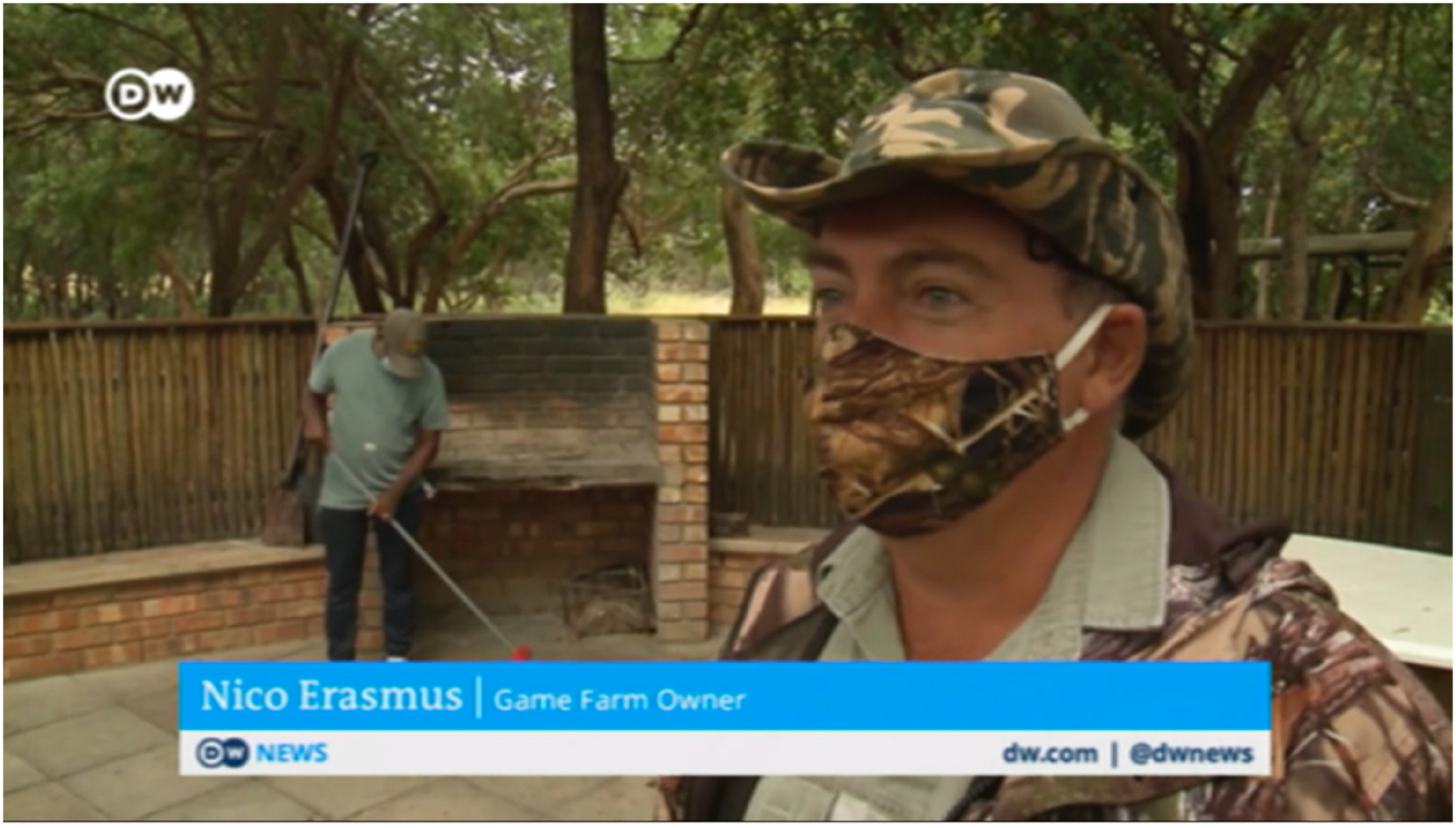
“My chef is doing the cleaning just in order to keep busy” (V29, see Appendix I).
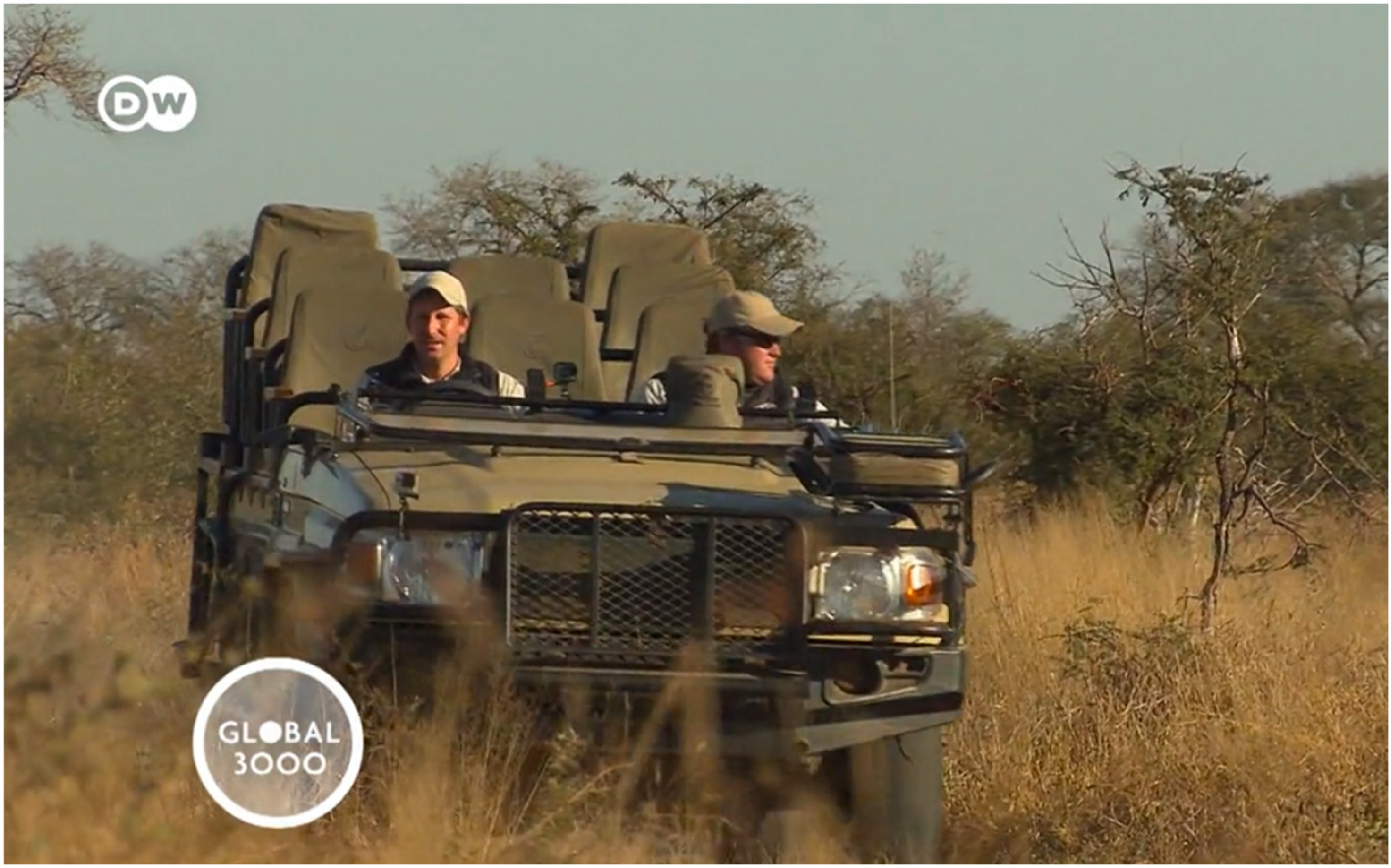
“As far as the eye can see…” (V14, see Appendix I).
The owners and managers of the land are typically shown as still in place, and still working, though clearly worried both about their staff and the future of their businesses. Some employees have found ways to make the best of a bad situation, such as Alistair Leuner and Neil Jennings, who are pictured in the game drive vehicle of Tintswalo Safari Lodge having the “expansive bush […] all to themselves as far as the eye can see” (V14, Figure 2).
The visual vocabulary of green militarization (V30, see Appendix I).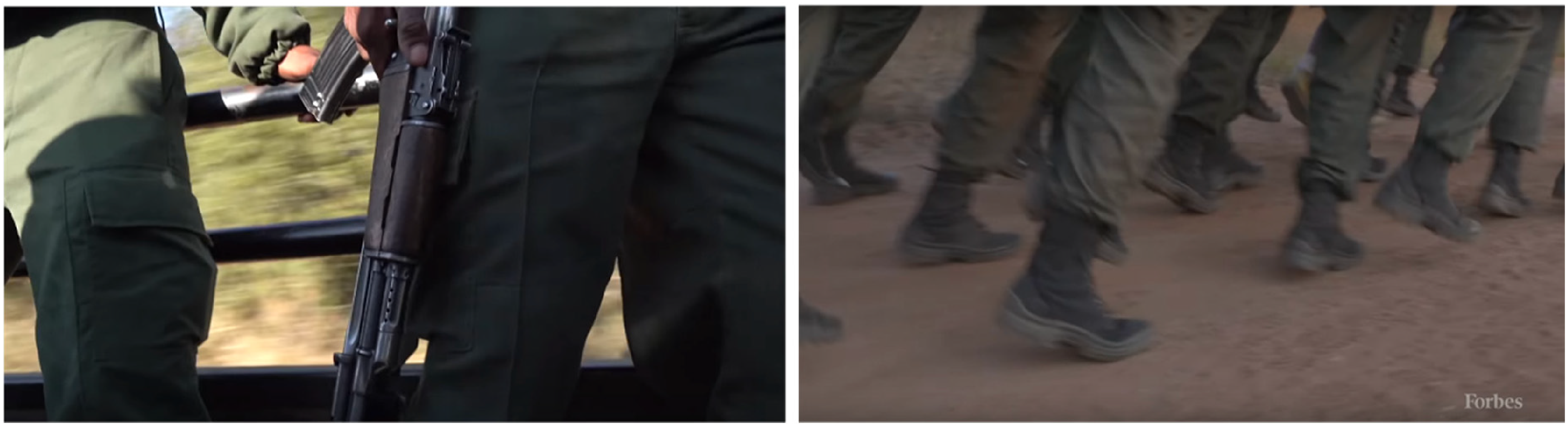
Thus while a form of the wilderness experience (albeit with altered sensory and hedonic affordances) may still be consumed by the lodge's traditional (white, rich) customers (see Büscher, 2020 on ‘Kruger 2.0’ for a critique), those who are lower down the pecking order – cleaners, guides, and rangers not involved in anti-poaching – are left uncertain about their next meal. This is apparent even in the ONV in which Black ownership is foregrounded (V9). While the journalist narrates that the government's acquisition and transfer of Mala Mala to local communities has resulted in locals building themselves modern houses to replace their traditional huts, starving residents are also said to be poaching for meat, necessitating armed patrols. Staff express their hope that tourists will return, so that they can once again earn an income. The business model of Mala Mala arguably bears many similarities to the apartheid social order in its capitalist labour relations, and racial divisions in who provides service and who gets to enjoy the consumption of nature as a luxury good (Ramutsindela, 2015; see also Alasow, 2020). Mala Mala is however described by the journalist in positive and progressive terms, even as starving locals appear as a threatening background force. The reserve itself is managed as a separate entity, which pays rent to landowners. The employees of this business, managed on-site by general manager Vusi Mpandza, who is shown on a zoom call with his white supervisor, seem as vulnerable as at other reserves. And so even in the rare cases of Black land ownership, however indirectly exercised, the commodification of conservation as a product – named as “some of the most luxurious safaris in southern Africa” (V9) – reproduces the contours of historical racial capitalism.
The second chain of signification equated human suffering with constraints to economic activity. In apportioning blame for hardship, the ONVs construct a prime suspect: not COVID-19, but lockdown has “hit them hard” (V7). Travel restrictions are the “final nail in the coffin” of tourism; if they do not end soon “we will have nothing left” (V6). Travel restrictions are undeniably the proximate causes of lost income, but it is remarkable that the tens of thousands of people who have died of COVID-19 and the millions who have fallen sick are referred to only once, in the reference by Kathleen Fitzgerald of Conservation Capital to the “incredible impact Covid has had on the health of citizens” (V30).
Behind the lockdown itself sits the South African government. Government's system of grants to tourism operators is mentioned by the SABC (e.g. V1, V2) but the South African population is more typically represented as suffering without government “offering them anything” (V7). Tourism industry representatives blame government for throttling businesses with a “dog's breakfast” (V19) of regulations lacking a “data-driven” (V6) approach. David Frost, CEO of the Southern African Tourism Services Association, advocates that the government's “dogmatic” approach to saving lives must be balanced against the question of “livelihoods” (V19). To this end, his organisation has “engaged some of the top scientists and epidemiologists” who confirmed that the government's country-specific approach to restricting international arrivals was “disingenuous” (V19).
Government is constructed as irrationally denying working people the benefits they would gain from the tourism sector. The life blood of this sector, according to many of the people interviewed, is long-haul international flights. Referring to these, Tshifiwa Tshivhengwa, CEO of the Tourism Business Council of South Africa, says “travel is innate to us, we cannot live without travel” (V6). Opening borders to international tourists is described as vital to the “export market” (V6) which exchanges experiences for foreign currency. Covid-19 is said to offer South Africa significant opportunities, such as being a “first mover” in opening this “low volume, wide open spaces, sunshine-driven destination” (V19). The financial register helps make sense of the economics of the stories being told in the clips: even as staff are retrenched or go hungry, new heat sensitive cameras are bought (V7) and heavily armed men race around protected areas in jeeps (V9). Protected areas are shown as in a constant struggle to keep the wild attractions on which “tourism lives” (V14) from being poached now that “the financial pipelines have been cut off” (V30).
The outlines of the picture are thus brought into relief: experiences of the South African wild are a commodity dependent on a carbon-hungry system of exchange requiring international flights between historical colonial metropoles and their peripheries. This system secures the “livelihoods” of the people so ill-served by an unscientific government. Capitalism is indeed “the source of life” (Lunstrum et al., 2021) – and structured by racial and colonial power relations.
The third chain enacts the sedimentation of militarised conservation. In the nine clips that explicitly thematize conservation, eight focus on poaching as its threatening opposite. Because conservation is so consistently antagonized by poaching, anti-poaching and conservation become articulated as equivalent terms. To conserve, in this sense, is simply and fundamentally to stop poachers. The other meaning potentials of conservation are effectively supressed, as other items in the visual vocabulary of ecosystem preservation are supplanted by the semiotics of green militarization: fences, rifles, and heavy black boots marching (Figure 3).
These eight clips articulate a broadly consistent causal account: governments prevent international travel; forex no longer funds armed guards; economic pressure on surrounding communities makes poaching an attractive option. And yet there are problems with this narrative, and they surface at revealing moments. For one, rhino poaching is said to have decreased by a third (V30) as trade routes were entirely cut off, or opened to increased scrutiny. Green violence gets much of its energy from the spectre of Eastern rhino horn consumers who pay and arm desperate locals (Burnett and Milani, 2017; Büscher and Ramutsindela, 2016). Covid-19 has however caused “a different kind of poaching” (V30): What Covid has done, is it's put huge strain on communities, it's increased unemployment, it's increased food insecurity […] They’re making decisions for food on the table. That's the bottom line (V30).
Colonial poacher/hunter dichotomies produced through historical alienation of people from their ancestral lands (Neumann, 2004) are also made visible. In one clip, the culling of an antelope “to make meat available to staff that has been retrenched” (V14) is in stark contrast to another, where an impala is freed from wire snares by the anti-poaching unit of the Dinokeng reserve (V7). In the former instance the killing of the animal, which is shown being butchered, is framed as a commendable act by a landowner meeting the needs of his broader community. In the second, the stretches of wire, and the suffering of the struggling impala, are traces of menace “beyond the fence”: Hammanskraal, “an impoverished township of 100,000 people” (V7). The sheer scale of poverty in South Africa, with all of those hungry mouths to feed, is in certain instances powerfully visually evoked (Figure 4).
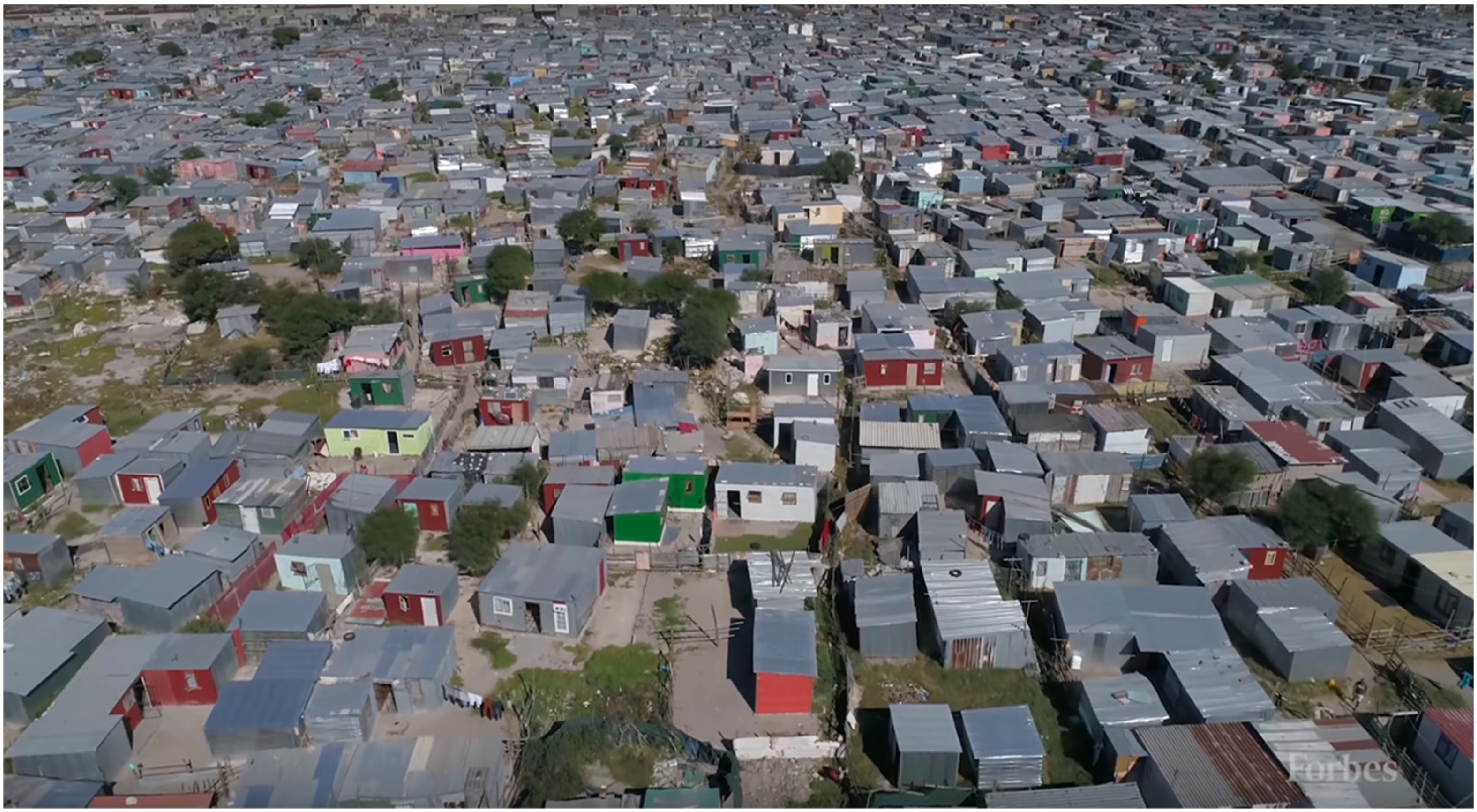
Hungry mouths to feed (V30, see Appendix I).
The fourth chain in the corpus related to intimate social relationships between animals and tourists. The absence of tourists whose “eyes and ears” previously helped identify intruders has necessitated that anti-poaching units alone must “keep the animals safe for when the tourists return” (V3). The sense in which animals exist for tourists is more expansive than the economic argument that their forex is needed to fund security. The tourists care; under lockdown they come to “know the animals better than us” (V14) through digital safaris; the animals are a “hit on social media” (V9) and “instant celebrities” (V14). A preoccupation with how animals experience the lack of tourists is also evident. While one camp owner observes that “funnily enough the wildlife carries on oblivious” (V6) ranger Bongani Jujula from Shalati Lodge speculates that animals are “begging for the tourists to come back” (V24). Bonds between tourists and animals are constructed as threatened by interlopers, such as when the Deutsche Welle journalist states that “the longer the tourists don’t return, the longer this community will bleed, and the less chance there will be animals to greet visitors on their return” (V11).
A fifth and crucial chain represents neoliberal conservation as constituting hope for the future. While the SABC is consistent in foregrounding domestic tourism, profiling affordable middle-class activities (e.g. V17) most other clips place foreign and/or luxury tourism at the centre of the picture of what a properly functioning sector looks like. The urgent priority for industry representatives is to “get international tourists onto our mountains and into our parks again” (V6). The attraction of the world's most “luxurious” (V9) outdoor experiences is constructed as a significant advantage for South Africa in the context of social distancing. Domestic tourists may be allowed to do day trips into parks, but “the reserves can only make enough money with overnight guests, especially international ones” (V14). The “reserve” referred to in this clip is Tintswalo Safari Lodge, a privately owned five-star lodge. The actual reserve in which Tintswalo has its concession, however, is owned and operated as a non-profit by the Mpumalanga Provincial Government. This collapsing of distinctions between for-profit and public sector conservation appears elsewhere in the corpus. The representation of private reserves such as Balule as being in the KNP (V3, V5) and of private lodge employees as being employed as KNP rangers (V24) works to produce the private lodge experience as representative of the public park. For viewers unfamiliar with the area and its economy, the KNP – which belongs to the people of South Africa and has a mandate to be accessible to the country's citizens – is discursively produced as a site of elite consumption, and indeed as depending entirely on luxury for its continued existence. This is a remarkable reversal. A more faithful account of the business models of private operators on the fringes of the KNP is that it is they who depend on this vast public good for their continued existence.
The profitable privatisation of public goods is given eloquent material form at Shalati Lodge, covered in two Deutsche Welle inserts (V24, V25), where a series of train coaches on a disused railway bridge have been converted into “one of the most exclusive lodges in the country” (V25). The decay of South Africa's public railway system, overseen by the parastatal company Transnet, has unfolded over decades-long looting by profiteers in cahoots with corrupt politicians. This rail infrastructure, which once provided public transport, is pictured here as “a part of history” (V24) transformed into “something unique… a tourism gem” (V25). The bridge is shown fitted with expensive furniture on a wooden deck, with a rimless swimming pool (Figure 5). The journalist interviews lodge manager Alan Ferreira, who tells him that 5000 applications were received for just 40 jobs at the lodge. They share a nervous chuckle. Importantly, both Jujula (V24) and the journalist (V25) refer to the train as a “sign of hope”. In a context where thousands of desperate people compete for a handful of jobs, astronomically luxurious conversions of public goods for the enjoyment of a narrow global elite are thus inscribed onto the horizon of possibility as the glowing portents of better days to come.
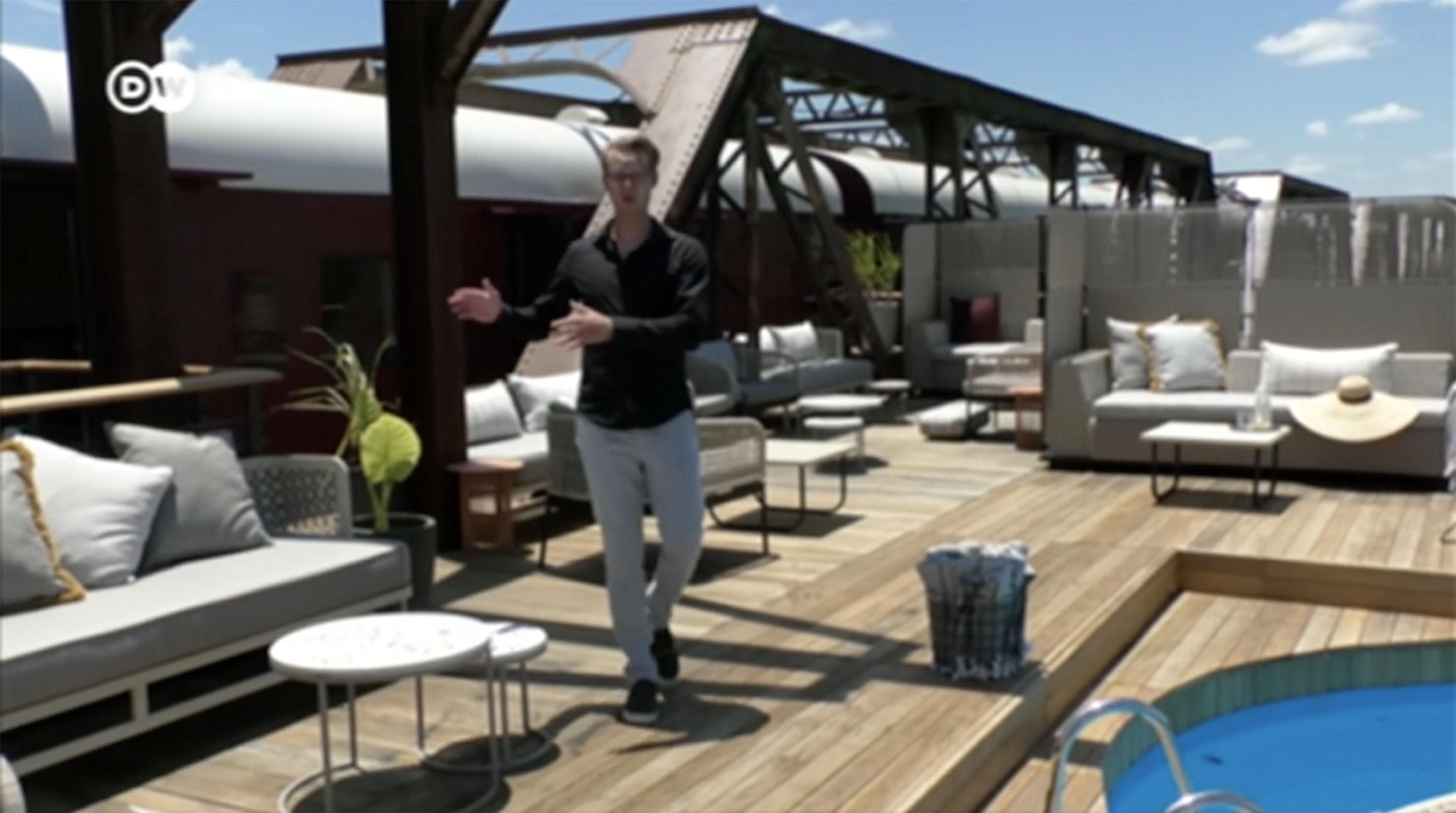
The train conversion at shalati: “…one of the most exclusive lodges in the country” (V25, see Appendix I).
Online resistance to a conservation capitalist
We now turn to the ways in which some of these mainstream conservation scripts are resisted in online spaces. On 21 July 2020 prominent sportsman Kevin Pietersen posted a tweet lambasting South African president Cyril Ramaphosa (Figure 6).
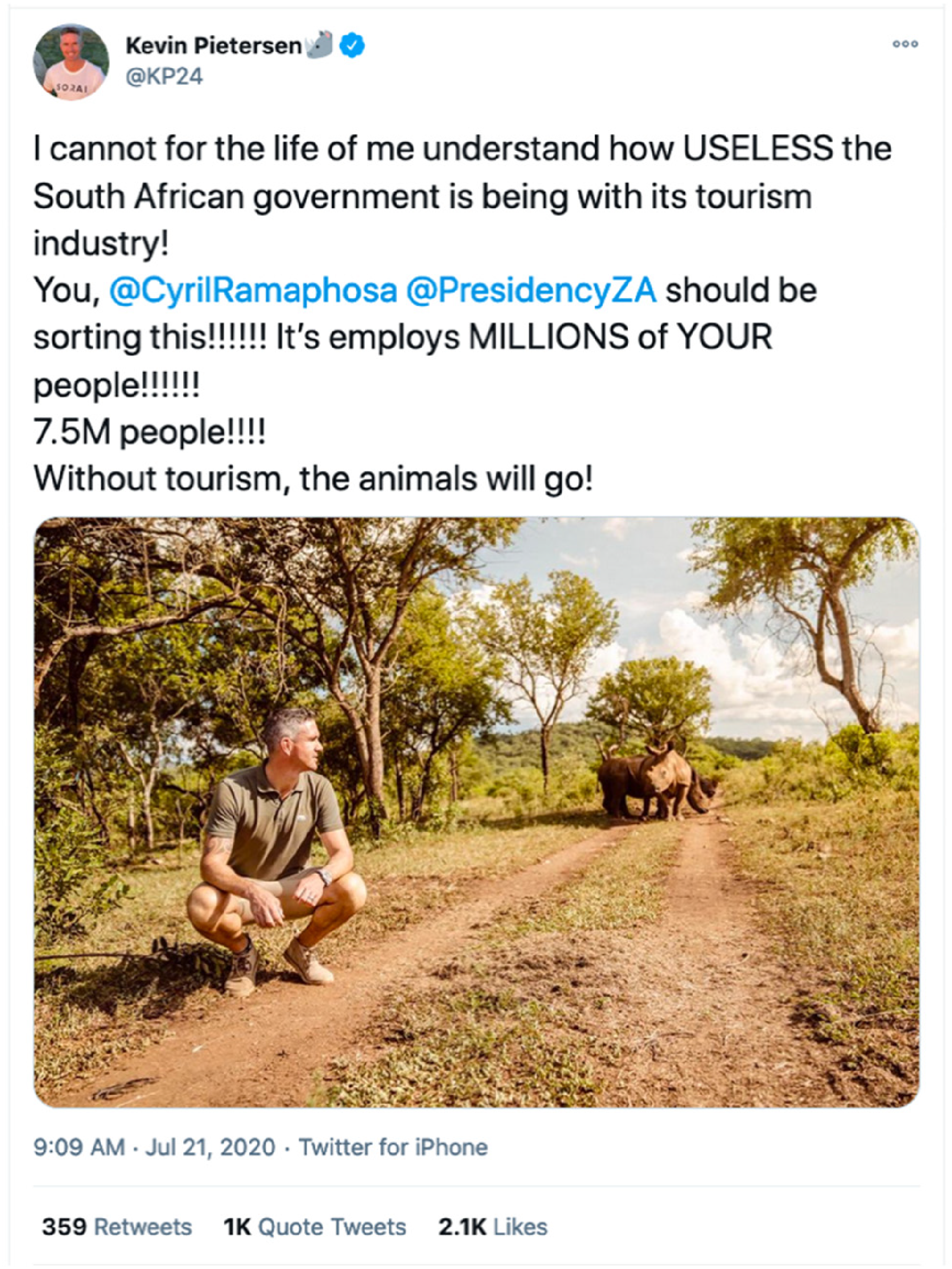
Kevin pietersen's tweet on 21 July 2020 (twitter.com).
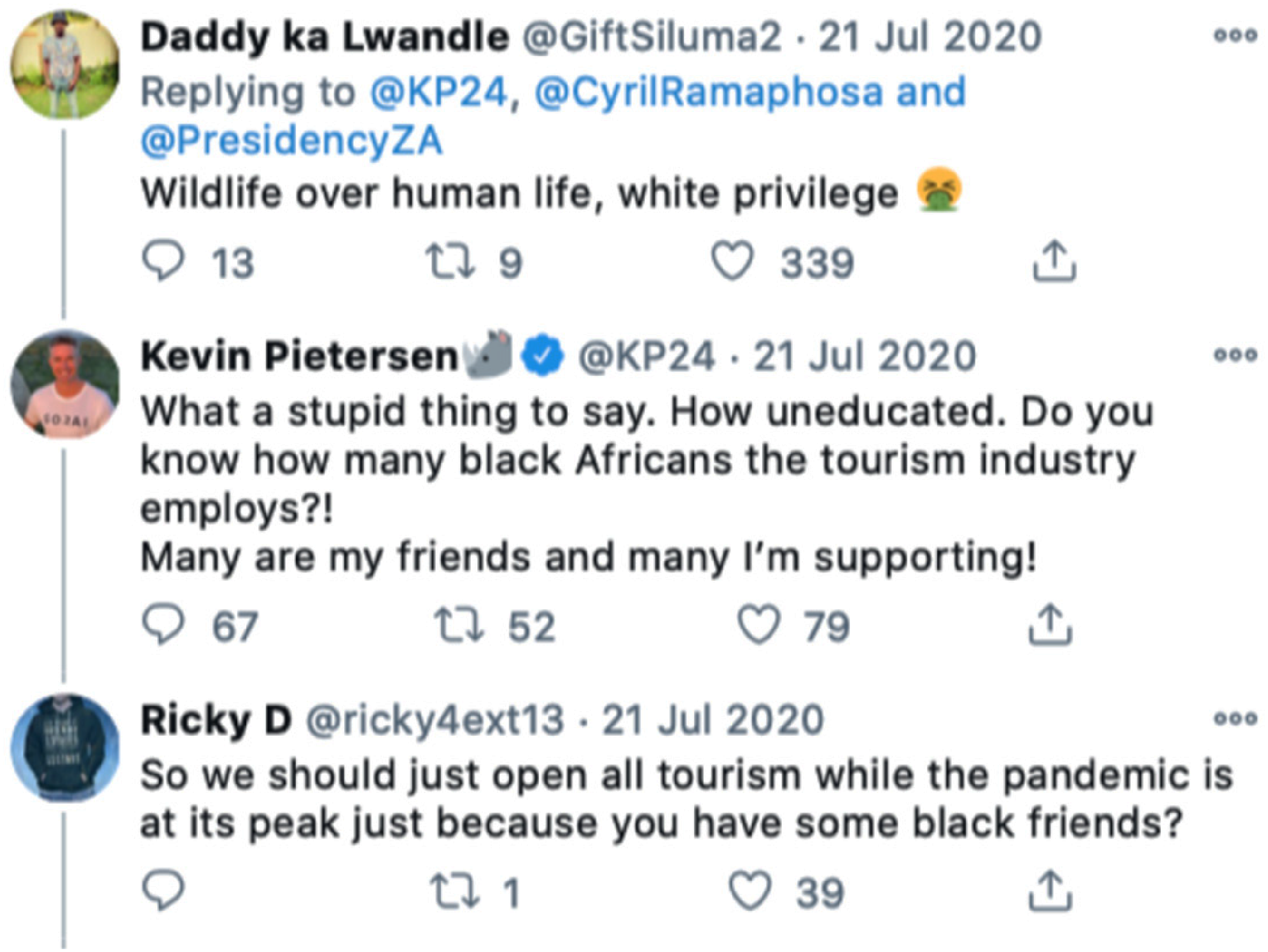
“many are my friends” (twitter.com)
Pietersen's prowess as a batsman and stints as Test captain of the English international side have been overshadowed in the South African media by his pretext for emigration to the United Kingdom in 2000: that his future as a white professional sportsman would be threatened by plans to “transform” cricket into a multiracial sport (Mohamed, 2017). Later, when his career was on the wane, Pietersen restyled himself as a conservationist He owns Umganu Lodge, an “idyllic retreat built on the banks of the magnificent Sabie River” overlooking the KNP complete with “a heated outdoor pool, sunken boma and braai area” 1 . He also heads up a charity that rehabilitates rhino injured by poachers, called SORAI (Save our Rhino's in Africa and India). The portrayal of Pietersen as a celebrity conservationist in coverage of SORAI draws on the usual colonial and racist tropes of the heroic white environmentalist in Africa (Abidin et al., 2020: 9–10). The centrality of Pietersen as an environmental hero is also established in the photograph Pietersen chose for his tweet. He is pictured in a ranger's khaki uniform crouching in the pose of a tracker, close to the earth. While one focus of the shot is at the point where the leading lines of the dirt road meet the two rhino, his body is oriented towards the camera, lending it equivalent salience. The direction of his gaze establishes him as the point of mediation between the viewer and the rhino: we are not merely watching the rhino, but observing the watchful guard of their khaki-clad protector.
The tweet itself relies on similar articulations to those observed in the ONV corpus, though employing a more explicitly confrontational tone. It is to this tone, but also to the elisions in Pietersen's statement, that the moral outrage of the people who replied is directed. Importantly, many of the people who tweet at Pietersen use ridicule, irony, or other forms of humour. Humour plays an important disciplinary function in discourse, and is fundamental to establishing and challenging social norms (see Billig, 2005) and thus also to the contestation of articulations seen as commonsensical, potentially constituting counter-hegemonic challenges to sedimented truths.
The replies to Pietersen
2
combined derision with earnest argument, in a style typical of online registers. The pandemic however was no laughing matter. Pietersen's interlocutors remind him that COVID-19 is “a national and global tragedy” (@CedricDeBeer1) and that travel has been curtailed for very good reasons: Disgusting tweet. Have you looked at our numbers, fifth most cases in the world and rising. Who can even think of tourism right now. Your government won’t let you come here because it's too dangerous but our government is useless for trying to halt the spread. Shame on you. (@Emsa33)
A number of tweets shine a critical light on the spatial dynamics of the conservation mode of production. Pietersen is constructed as typical of capitalist employers who when faced with a crisis “cut jobs first” (@103sTaR103). His business model is to price “safaris so expensive that normal South Africans can’t even afford it” (@BlackWizSA). The price per person per night to stay at Umganu – R19,000 – engenders frequent outrage in the replies. This amount is roughly double the annual median expenditure of Black households (StatsSA, 2019). The industry is repeatedly described as dependent on foreigners as South Africans can’t afford to “pay in dollars and pounds” (@mzizim).
Other replies delegitimise Pietersen's authority to speak as a South African. Because he “ran away to go play in England” (@CuanPrince) he should instead “enjoy the wilderness and wildlife of Europe” (@SibacaVuiyisile). His use of all caps “YOUR” is reproduced as proof of a dividing line between who gets to speak for South Africa: “I take it you have abdicated all claims to being South African so then please go to YOUR own country Great Britain” tweets @wheresalecia.
His tone in addressing the president is constructed as typical of a “ngwana’lekgowa’ [white boy – Sepedi] (@Afrikanist) who disrespects Black elders, a common cultural practice of white people raised to assume that Black people are their servants. Pietersen's whiteness is culturally mocked by @vho_mli, who attaches a clip of an awkward and artless rendition of a Lion King song performed by white U.S. naval officers. In a similarly derisive vein, @_SonOfMars affects gratitude to the “great white saviour, Kevin” to which @NolwaziMbele replies “Let's never forget to thank the white man”. This tweet is accompanied by a meme from the humour series Boondocks showing the character of Uncle Ruckus, a Black man who supports white supremacy. “Don’t ever leave us Oh Kevin!” replies @_SonOfMars, attaching a picture of Samuel L. Jackson's character in Quentiin Tarantino’s 2009 film Django Unchained protecting his master, a murderous and sadistic slave-owner played by Leonardo DiCaprio. The white saviour who has nothing to contribute to racial or economic liberation is thus roundly rejected as an object of admiration or respect. He is the source of slavish mentality, and colonial power relations.
The most common theme is mockery of Pietersen's assertion that “the animals will go”. The animals’ feelings about lockdown, and motivation for staying or going, becomes the subject of wry speculation. “Shame man,” writes @MukodiT “Poor Rhinos, Elephants and other wildlife just want tourists to come and see them”. A number of respondents ask where animals will go if not “to the wild where they can roam freely” (@Sikisantis). One of the most popular tweets (liked 385 times) states that “I work for a national park n I can confirm that the animals are still here and are not intending on going anywhere” (@mandrax88). Users post humorous memes of poodles walking on their hind legs (@LeratoNkwenkwe1) or elephants clumsily scaling walls, voiced as saying “We will Go” (@zacritic). The anthropomorphization of the animals is both humorous in itself, with animals that can talk and walk on their hind legs as typical examples of “incongruous” humour (Billig, 2005), but in the process Pietersen's performance of the ranger, close to the earth and in community with the rhino, is being mocked. Animals, furthermore, are classed and racialised. If his animals are threatening to leave, Pietersen should perhaps “cancel their uber account” suggests @AmandaRinquest In a reference to post-apartheid “white flight” to majority white countries by people such as Pietersen, @MayibuyeAfrica3 asks “You think they will go to Australia or New Zealand too???”. “I guess the animals are following him to England” quips @EllieWhip. A number of users voice the animals, using recognizably white South African registers: “Cyril, how dare you lock up the humans, thats it, thats the final straw, we are moving to Australia” writes @zacritic. Pietersen's posture as an animal ally, his whiteness, and his historical emigration are thus discursively enchained and mocked.
These riffs on Pietersen's racial hauteur and national allegiance importantly attach to his ownership of land. “If it's “YOUR PEOPLE”’ observes @ReneMalika2 then “it's also “YOUR LAND””. The fact that game farms such as Pietersen's are facing difficulties is a “blessing in disguise” according to @MakhaveniA, as “blacks don’t own land, 82% is in white hands”. Another respondent, @GlassPearl, puts the point succinctly: Typical of former Europeans whose ancestors stole African land and minerals. Still think they own Africa & everyone must do as they say. Imagine leaving and not just staying TF [the fuck] away. @CyrilRamaphosa enough of these with blood on their hands acting like they have a say in AFRICA.
While this theme of the firestorm articulates elements of a nativist essentialism, it is important to note that its organising values are equality, restitution for historical injustice, and a problematization of a specific instance of racist arrogance by Pietersen as illustrative of more general social norms. This is a politics expansive enough to include the descendants of colonisers on condition that the land is shared for the benefit of all. Though the odds of realising this social vision through building solidarity across historical lines of race and class might not be high, the lines drawn between haves and have-nots are not purely antagonistic, but hold agonistic doors open for rapprochement and redistribution.
Conclusion
The algorithmic logics of platform capitalism have been critiqued as inevitably prioritising profit at the expense of “truth”, and as contributing to individual dispersion even as they seem to create community, meaning that our “understandings and experiences of reality are less and less shared” (Büscher, 2020: 171). And yet, when compared to the very uniform, hegemonic picture of conservation offered by the ONVs, the role of South African Twitter users to build a nuanced and agonistic counter-hegemonic narrative seems absolutely vital to the “political realignments” (Fraser, 2019; Mpofu, 2019) necessary to chart some kind of path out of the present impasse. And indeed, Büscher (2020: 180) concedes that the capitalist nature of the platform itself does not preclude the formation of “kernels that aim to condense to a bigger truth”. The aim of this paper has been to show the ways in which overlapping crises in the present conjuncture in South Africa are productive of elements of alternative social visions that are articulated in social media spaces. In conclusion, I will sketch out the ways in which these kernels may be articulated as a discourse regime that forms novel, post-neoliberal conservation subjects and institutions.
The counter-hegemonic discourse analysed here is only a partial critique of neoliberal securitized conservation, as it focuses on the content of one tweet, locating Pietersen and his rhinos in the particular social and historical context of colonialism, racism, and capitalist accumulation. Two discursive “kernels” organise the critique. The first is the piercing of the philanthrocapitalist miasma surrounding rhino conservation achieved as embodied in the figure of Pietersen, by spotlighting the inherent contradiction in the gap between the luxury consumption of nature, and the conservation labour geographies that enable it. Pietersen's guests spend in one night what South African households live on for months, while serving them exposes already precarious workers to illness and premature death from Covid-19. The second picks on Pietersen's emigration as representative of white South Africans generally, who are always threatening to leave the country if not pandered to by the government. The normalisation of land and wildlife as white possessions is dislocated through a rhetoric of ridicule which includes poodles on their hind legs, and elephants scaling walls, anthropomorphised as speaking like white South Africans. This use of humour works in disciplinary fashion to reveal the ridiculousness of people whose solidarity with a national community is entirely contingent on self-interest, and who yet claim to speak for South Africa and its animals, whom they protect from local people who in their unfathomable hunger and need would (supposedly) otherwise decimate them.
While barriers to participation in Twitter debates mean that these tactics are not necessarily representative of “grassroots” resistance to neoliberal conservation (see Apostolopoulou et al., 2021) I suggest that there is a significant potential for a counter-hegemonic discourse to articulate conservation around these kernels as commensurate with projects of national solidarity and economic models that rely on domestic accessibility to the enjoyment of South Africa's natural heritage, redistributing leisure (and even luxury) from haves to have-nots. The firestorm did not celebrate poaching or reject conservation tout suite; what it did do was to put the fairness of human social and economic relations at the centre of imagining nature and our future in it – something that might indeed offer some glimpses of a path to “societal transformation”.
Footnotes
Declaration of conflicting interests
The author(s) declared no potential conflicts of interest with respect to the research, authorship, and/or publication of this article.
Funding
The author(s) received no financial support for the research, authorship and/or publication of this article.

Notes
Appendix 1