




Abstract
In 2016 the Chinese infant formula company Feihe International signed a deal with the Canadian Dairy Commission (CDC) to process Canadian cows’ and goats’ milk for infant formula export to China. Our purpose in this paper is to understand how this deal – and the new Feihe formula factory located in Kingston, Canada – is underpinned by a series of multispecies entanglements across cow, human and goat mothers in China and Canada. To do so, we analyse official correspondence between the CDC, Feihe and City of Kingston; market reports for the dairy, goat and infant formula industries; and news articles about the Feihe infant formula plant. Conceptually, we develop an anti-colonial, multispecies entanglement framework to chart the violent inclusions, exclusions and typologizations that make milk and formula economies possible. We are specifically interested in how the Feihe–CDC deal (re)configures entanglements across species, nation, race, science and motherhood. To understand these relations, we heuristically imbricate two different sets of entanglements that underpin this deal: milk drinking, empire and genetic purity across race, breed and species; and motherhood, science and technology across humans, goats and cows. We use our threefold entanglement framework to better understand the violence of these imbrications and to work towards a multispecies feminist ethic in the infant formula industry.
In 2016 the Chinese infant formula company Feihe signed a deal with the Canadian Dairy Commission (CDC) to create the first ever infant formula production facility in Canada. Feihe subsequently established a subsidiary company, called Canada Royal Milk, which opened its processing plant in Kingston, Ontario, in 2020. The facility will generate 50–60,000 tonnes of infant formula made from Canadian cows’ and goats’ milk, 85% of which will be exported back to China to meet its growing demand (‘CDC-Presentation’, 2016-See Table 1). This large foreign direct investment is valued at $332 million dollars and expected to generate at least 200 direct and 1600 indirect jobs in Canada (‘Media-Lines’, 2016).
Yet this deal is not only a product of transnational economic relations but is also borne of a series of multispecies relations. Cows, goats and humans across the globe are implicated within this transnational network of infant feeding: cows’ milk generally serves as the base of human infant formulas; increasingly, goats’ milk is used for premium formula products (‘Feihe-Presentation’, 2016; Paramio and Izquierdo, 2014); and Chinese mothers are targeted by breastmilk substitute (BMS) companies to feed their infants this animal-based formula. How multispecies entanglements are created, maintained and resisted, and how social relations of power shape these entanglements, are often invisible in economic discourses about the formula industry. This deal provides an opportunity to consider changing transnational milk geopolitics as multispecies entanglements. We are particularly interested in how these entanglements are constituted in and through normative ideas about species, gender, race and nation, with a view towards more ethical ways of being in relation. Before moving towards our entanglement framework, however, we briefly contextualize the deal and the financial justifications for it.
Established in 1962, Feihe’s financial growth is due partly to the company’s distance from the 2008 melamine-tainted infant formula scandal in China that damaged the kidneys of 300,000 infants, killing six. The scandal caused domestic confidence in Chinese brands to plummet (Gong and Jackson 2012; Qian et al., 2011; Qiu et al., 2010). The government responded by modernizing its dairy and formula production and actively promoting the development of reliable and competitive domestic brands (‘Feihe-Presentation’, 2016). Feihe, specifically, was chosen by the Chinese government as ‘a key company to receive support for its focus on the development and revitalization of the Chinese national milk industry [helping to build a] Chinese milk brand’ (‘Feihe-Presentation’, 2016: 448). The company’s market has since grown significantly and they have built themselves into the first vertically integrated formula manufacturer in China, accounting for 8.1% of the country’s domestic market share of infant formula sales (‘Revised-Business-Plan’, 2016). The company still sees room for considerable domestic growth, however, with China being the world’s largest and fastest-growing infant formula market (Fortune Business Insights, 2018; Fuller et al., 2006). To benefit from this growth, Feihe has been actively seeking out international partnerships to supplement its domestic cows’ milk production – specifically looking for skim milk that forms the basis of most infant formulas.
Canada and the CDC have, at the same time, sought foreign investment in their dairy market. Dairy is Canada’s second largest agricultural sector and is supply-managed by the CDC, which controls domestic production, prices and imports (‘OMAFRA-Presentation’, 2016). The CDC buys milk from 10,095 farms and sells it to processors of milk and manufacturers (CDIC, 2021). Due to decreased domestic consumption of milk and increased consumption of butter (made from milk cream), the CDC currently has what it calls a ‘structural surplus of skim milk’ (‘CDC-Presentation’, 2016: 158). Thus, just as Feihe was searching for a market like Canada’s from which to buy skim milk, the CDC was looking for investors and manufacturers to buy their surplus. The CDC–Feihe deal therefore appeared economically beneficial to both, with the CDC claiming that it would ‘create new profitable markets for dairy producers’ (‘CDC-Presentation’, 2016).
Our paper complicates this standard economic narrative of the deal by imbricating onto it two sets of multispecies entanglements that also work to define (and make possible) the contours of the deal. First, we outline how the supply and demand of cows’ and goats’ milk in Canada and China are entangled with normative ideas of nation, race, species and gender. Second, we consider how the manufacturing and promotion of Feihe’s infant formula is entangled with the scientific and technological governance of cow, goat and human motherhood. To do this, we methodologically draw together empirical data about Feihe, the CDC and infant feeding in North America and China, with secondary evidence from public health and infant formula studies. Our reflections are informed by theoretical ideas from critical animal, anticolonial and gender studies. Inspired by Eva Haifa Giraud (2019), we think of ours as a diffractive methodology: we (the authors) are each differently situated – Claudia an animal studies historical geographer and Carolyn a feminist anticolonial economic geographer. These differences create varying waves of analysis; we hope in their coming together they produce a novel analysis helping to glean a more intricate understanding (and therefore ethics) of more-than-human entanglements in the BMS industry.
We retrieved our empirical material about the deal through a Freedom of Information (FOI) request, which reveals the timeline, key negotiation points and major decisions made by the respective stakeholders. Through our request we obtained two files: a heavily redacted 516-page document (AI02-2019-00001) from the CDC that includes meeting minutes, itineraries, business plans, presentations and letters of correspondence between April and December 2016; and a 31-page file (AI-2019-00057) from Agriculture and Agri-Food Canada with reports, summaries and material for the minister or deputy minister’s office pertaining to the Feihe/Canada Royal Milk plant and international trade considerations (see Table 1). We supplemented these sources with grey literature from public news and corporate websites.
Selected list of FOI documents.
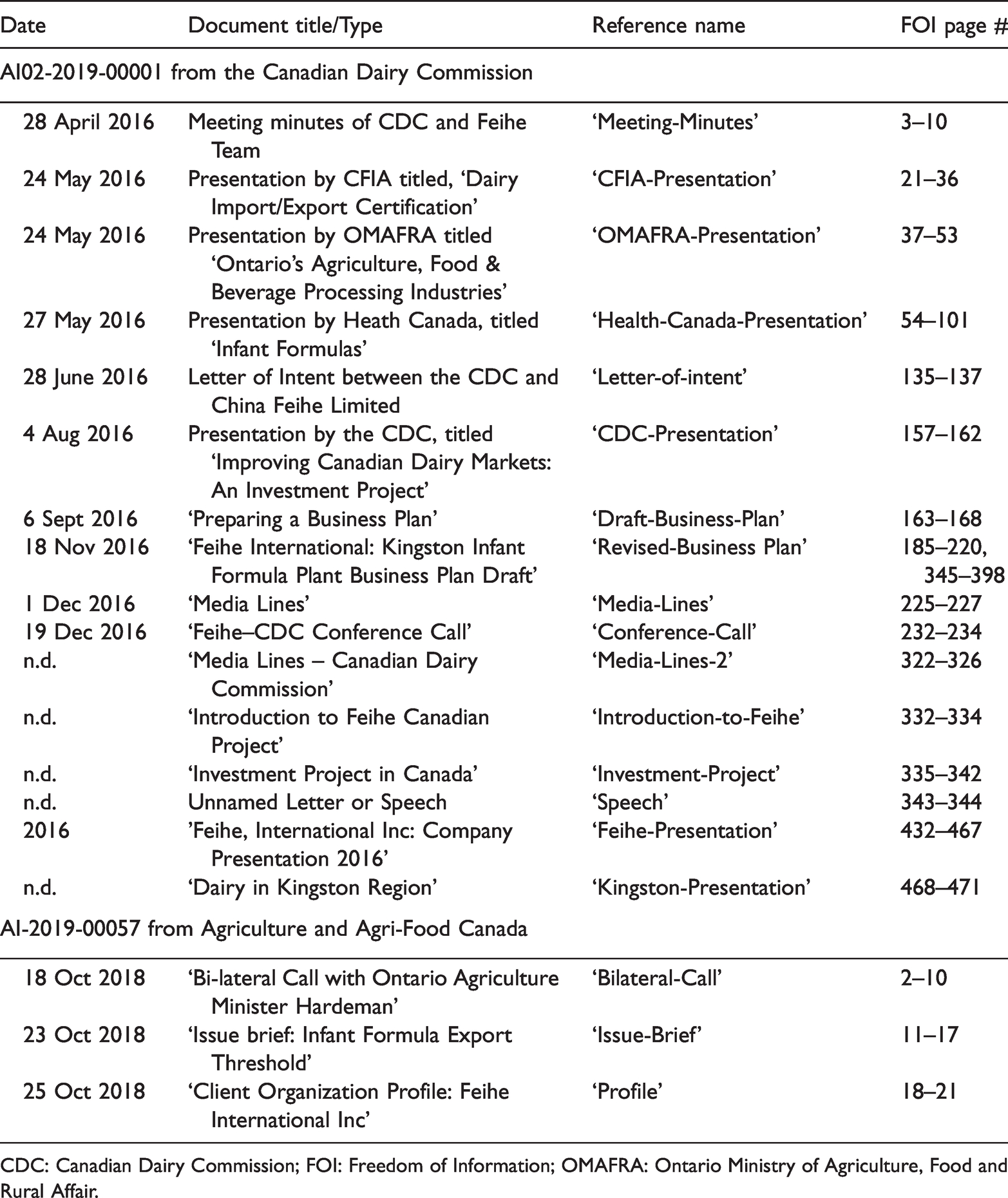
CDC: Canadian Dairy Commission; FOI: Freedom of Information; OMAFRA: Ontario Ministry of Agriculture, Food and Rural Affair.
Our paper is laid out as follows: we first discuss our theoretical framework of entanglement and explain our imbrication methodology. We then turn to two different entanglements and subdivide each into three parts: empirical details of Feihe/CDC/the deal, critical analysis using secondary literature and reflections on the entanglements involved. We conclude by returning to our analytic framework and charting a preliminary ethics of entanglement for the formula industry.
Multispecies entanglements and imbricated reflections
Our analytical framework is built on two axes: first, a more-than-human anticolonial ontology that foregrounds multispecies relations and entanglements; and second, a methodology of imbrication that overlays our partial reflections in ways that allow us to unmask and de-fetishize the infant formula commodity. Our starting point is work that uses the concept of entanglement to de-centre the human by highlighting how humans, animals and technologies, among other entities and beings, are constituted through relations with one another (Barad, 2007; Chiew, 2014; Gruen, 2015). Entanglements, ‘encapsulate the myriad of world-making relationships that constitute environments’ and are ‘the site[s] through which subject (and object) positions, identities and even materialities emerge’ (Giraud, 2019: 5). Whereas entanglement is a concept often used to celebrate multispecies relationalities and an ethos of ‘becoming with’ (Haraway, 2008), we follow scholars who instead highlight how entanglements are often constituted through violence and exclusion (Arcari et al., 2020; Collard, 2014; Giraud, 2019), as various beings are enrolled in and shaped by broader systems of power such as capitalism, colonialism, patriarchy and speciesism (Ahuja, 2016; Deckha, 2008; Nibert, 2003). By politicizing violent inclusions in and exclusions from industrialized formula entanglements, our purpose is to advance a feminist, anticolonial, multispecies politics that calls for ways of living less harmfully and to articulate relations of accountability and ethical significance. Our entanglement framework is therefore threefold, attending to: the harms of exclusion/disentanglement, the violences wrought through inclusion, and how entanglements constitute new typologizations and taxonomic categories across and within species.
The first pillar of our framework is concerned with how entanglements are constituted through violent exclusions. Exclusions sustain hegemonic entanglements by violently disentangling some humans and animals from other ways of being, relating and living more fulsome lives. Materially and socially, a person or group might be removed from a particular place only to be entangled in another, such as a spider monkey taken from their habitat to be a commodity, severing them from their ecological and community connections (Collard, 2014). Epistemically, some groups might be excluded from consideration, forming part of what Arcari et al. (2020) might call ‘invisibilized relations’, such as a failure to appreciate the role of agricultural workers and animals in urban developments.
Second, our analytic considers how inclusion within certain entanglements can also be violent. For instance, within colonial–capitalist industrial agricultural systems, the slaughterhouse is a site that violently entangles and includes some animals – through their mass and technologically efficient killing – to feed people. But various species are also entangled at this site: human migrant workers are charged with killing animals, which Nibert (2003) argues reinforces the mutual devaluation of those entangled – the animals being killed and the humans forced to kill. Entanglement is also used to conceptualize how various systems of power are relational, co-constitutive and depend on one another as they violently include numerous beings. Some historians argue that imperial projects have always been entangled, creating differential harm for both people and animals through inclusions of exploited labour and resources (Cañizares-Esguerra, 2018; Gould, 2007). Colonial–capitalist structures of power therefore create their own kinds of violent entanglements across beings who are ‘included’, but these inclusions are also the result of relational meanings, practices and discourses operating across multiple entangled imperial projects.
Finally, like most approaches to entanglement, ours de-centres the human but does so by focusing on how different species are violently constituted through their relations with one another. Entanglements are both constitutive of what we come to know as ‘humans’ and ‘animals’, and also create different subject positions within and across these categories. For instance, the typologization of humans across an evolutionary timeline has been central to racializing and gendering particular peoples – placing some in closer proximity to the ‘animal’ category, often due to their perceived ‘uncivilized’/unproductive relations with land (Anderson, 2004; Gidwani, 2008) (which also problematically positions animals as uncivilized and unproductive). Animal species, too, are violently taxonomized as they become entangled with human-led imperial and capitalist projects. For example, in the pursuit of industrial efficiency in the US dairy industry, specific cows and bulls are differentially valued based on their sexed reproductive capacities (Gillespie, 2013) and, as we show, are actively produced as different breeds. Crucially, these taxonomic classifications are the result of entanglements of beings with each other but also with different imperial discourses and technologies, as bodies become symbolically and materially categorized in service of colonizing empires.
We use this threefold anticolonial, multispecies entanglement analytic attentive to inclusions, exclusions and constitutions in order to explore how the Feihe/Canada Royal Milk transnational economy is borne of more-than-human relations shaped by power-laden, hierarchical entanglements across species, empire, race, technology, nation and gender. We thus think of entanglements as relations between beings but also as relations between different processes of nation-building, racialization and gendering. Our focus is on the violence of entanglement, but our goal is to forward an ethic of responsibility: we chart out where particular relations and ‘cuts’ are being made, and, in the conclusion, discuss how these may be sites of both oppression and potential liberation.
To complement this framework we use a methodology of imbrication. The term imbrication originally referred to the overlaying of tiles (tegula and imbrex) to produce waterproof roofs, but is now a common geological concept and has received some attention in the social sciences. Most of the concept’s methodological and theoretical development has been in organizational studies; notably Taylor (2001, 2011) and Leonardi (2011) use imbrication to analyze overlapping human and material agencies in the production of organizational identity, routines and technologies. For Leonardi (2011) the metaphor of imbrication is useful because it suggests that the different elements in focus are not reducible to each other, that they produce durable patterns that have staying power, and that past imbrications can be used to understand present and future ones – that is, one imbricates onto a history of imbricated relations. We similarly define imbrication as the layering of different elements/relations which produce stable patterns/structures that are the result of historically successive accumulations shaping both present and future relations (Leonardi, 2011; Taylor, 2001).
We use imbrication as a methodology that structures our paper. We think through two sets of entanglements as complex roof tiles neither collapsible into one another, nor effectively standalone, but which together enable a fuller picture of how the Feihe–CDC deal is shaped by knowledges, practices and desires that extend beyond profit motives. The entanglements (tiles) we overlap are historically and materially connected but not reducible to each other, even as they work together to produce stable patterns of inclusion, exclusion and typologization in the infant formula industry. This fuller picture is not, however, complete or totalizing, but offers partial knowledges central to understanding the power-laden entanglements that inform this economic deal. Moreover, the order in which these entanglements are presented is more a product of social convention (Taylor, 2001) than a suggestion that one argument necessarily needs to proceed another – one tile has to come first, but it does not mean it is more important to the structure of the roof or the argument than the second. Our first entanglement focuses on the ongoing relationships between milk drinking, empire and genetic purity, interrogating how particular ideas of race, species and breed are produced through nation-building. Our second entanglement investigates how particular mothers – specifically Chinese women, Holstein cows and does – are shaped by scientific and technological notions of motherhood through the manufacturing and promotion practices of the industrialized formula industry. We believe that imbricating these two entanglements produces insights we would not otherwise glean and enables a more intricate understanding (and ethics) of more-than-human entanglements.
Milk, nation, genes and purity
In this section we explore how the Feihe–CDC deal relies on the entanglement of inter-related histories of empire building, processes of racialization and differential genetic valuations that have shaped and been shaped by milk drinking norms. We first discuss how Feihe–CDC negotiations were centred on the supply and management of milk and then consider how supply and demand are informed by entanglements of species according to notions of biology, genetics and purity. We look specifically at how racialized and ethnic understandings of different humans – especially their ability to digest milk – are produced through nation-building discourses; and how goats and cows are actively constituted and typologized through species and breed valuations as they become entangled in the formula industry. We conclude the section by reflecting on how transnational milk markets such as the CDC–Feihe infant formula deal are a continuation and reconfiguration of entanglements across race, nation, species and breed that have long imbued milk meanings and desirabilities.
The supply and management of milk in the deal
The CDC–Feihe negotiations often centred on the quantity of cows’ and goats’ milk the CDC could supply. When Feihe delegates visited Canada in 2016 they tried to ascertain how much milk the CDC could provide their proposed manufacturing plant and how much product they could legally take back to China under Canada’s export trade regulations (‘Draft-Business-Plan’, 2016). At the time, the CDC said there was no upper limit to the quantity of cows’ milk they could provide, nor how much infant formula could be exported. However, through the negotiation of the new 2020 US–Mexico–Canada (USMCA) Free Trade Agreement, the export limit for cows’ milk was set at 110 million litres a year, slightly above Feihe’s stated needs (‘Issue-Brief’, 2018; ‘Media-Lines 2’, n.d.). While not expressly mentioned in the negotiations, we have calculated that at least 10,083 cows will be needed, per year, to supply Feihe with the milk it requires. Canada has an established cow dairy herd (currently 1,405,000 cows) meaning it is poised to meet these desires (CDIC, 2019, 2021).
Discussions of goats’ milk in the deal were markedly different. Even though goats’ milk is one of the fastest growing agricultural industries in Ontario (TVO, 2019) it is still a nascent industry in Canada: only 16% of goats’ milk is sold in fluid form (the majority of the rest retained for cheese production) and in 2018 the whole of Canada produced less fluid goats’ milk (62.2 million litres) than the 75 million litres of raw milk a year Feihe will need (CDIC, 2018; ‘Investment-Project’, n.d.). Nonetheless, Canada’s goat herd is growing – in 2019 it reached 120,000 individuals – and fluid milk from 68,493 of these goats will be needed yearly to meet Feihe’s supply needs.
The novelty of goats’ milk production in Canada was particularly evident in the early stages of the negotiations when the CDC explained that no Canadian supervision agency exists for goats’ milk and that it was not clear how Feihe could obtain a goat milk infant formula permit, noting that the company could potentially ‘directly import [goats’] milk from New York state’ (‘Meeting-Minutes’, 2016: 3). Yet by December 2016, the Ontario and Quebec Agricultural ministries were working together to meet Feihe’s goats’ milk demand (‘Conference-Call’, 2016). Current reports hold that the plant will be supplied with goats’ milk from several sources: the Mayor of Kingston confirmed, controversially, that Kingston’s Prison Farms (contentious carceral rehabilitation projects) will supply cows’ and goats’ milk (Fitzgerald, 2021); the CDC and the Ontario Ministry of Agriculture, Food and Rural Affairs (OMAFRA) are encouraging cow-dairy farmers to switch to goat operations; and there are (not yet substantiated) rumours that Feihe will establish its own goat farm (Farmer’s Forum, 2018).
Why, given the limitations in supply of goats’ milk in Canada, is Feihe so intent on this resource? In short, the company is attempting to reach new markets in China and better cater to people who are lactose intolerant by harvesting a milk that is easier to digest. Feihe argues that: The component of goat milk is more close to breast milk, so it is easy to be absorbed by infant, it also has benefit for the development of intelligence and body immunity, and it is even better to be absorbed, especially for the people who have lactose intolerance. (‘Introduction-to-Feihe’, n.d.)
But Feihe does not intend to create just any human-digestible milk; the company is focused on using animal milk to make a distinctly ‘Chinese’ infant formula, one closer in composition to Chinese mothers’ breastmilk. That is, Feihe hopes to use Canadian cows’ and goats’ milk to ‘achieve an optimal balance of key ingredients for Chinese babies based on their biological physique’, a goal epitomized in their by-line ‘China Feihe: More Suitable for Chinese Babies’ (Feihe, 2020). To accomplish this, Feihe has created a comprehensive human milk database with over 1500 milk samples of Chinese mothers’ milk, the composition of which they are attempting to emulate in their manufactured milk formulas. To this end, and in collaboration with Harvard Medical School’s Beth Israel Deaconess Medical Center, the company has established the Feihe Nutrition Laboratory in Boston (Feihe, 2020). Thus far the lab has collected breastmilk from mothers living in major Chinese cities between 15 and 180 days after they had given birth, with Feihe’s scientists paying particular attention to the protein, triglyceride, phospholipid, oligosaccharide and probiotic content of these mothers’ milks (Jiang, 2019). The results from lab testing have fed the company’s super-premium formula, Astrobaby, which Feihe markets as ‘closely resembling the composition of breast milk of Chinese mothers’.
The milks of cows, goats and Chinese mothers’ are therefore variously entangled through the CDC–Feihe deal. We next explore how these inclusions are shaped by colonial–capitalist histories of racialization and Empire-building that have also worked to constitute and exclude certain populations. We argue that nation-building projects are themselves entangled and relational, often trucking in meanings of race, purity, genetics and nature that manifest through historical and emerging typologizations of people and animals, which have come to underpin the economic logics of the infant formula industry.
Milk entanglements of nation, genetics and purity
Ideas of milk drinking, lactose intolerance and digestibility have been central to notions of racial purity and superiority in North America. During Britain’s formal colonial encounters with the continent, dairying and drinking cows’ milk were seen as divinely ordained activities that produced superior, more civilized (i.e. whiter) people (Anderson, 2004; Fischer, 2017). These sentiments were further entrenched in the settler colonies of Canada and the US at the end of World War I, with cows’ milk defined as a ‘food of an imperial nation and superior race’ and American President Hoover stating that ‘the white race cannot survive without dairy products’ (DuPuis, 2002). This white race was relationally constituted against Asian/Chinese people in North America – often brought to the continent as low-waged and indentured labour – who drank plant- instead of animal-based milk, such as soy. White working-class discourse feminized the ‘yellow race’ through celebrating the strength and superiority of animal milk products in building strong masculine white bodies (Gambert and Linné, 2018), thus establishing milk-drinking traditions as key signifiers of racial difference.
Discourses of racialized milk-drinking were increasingly biologized when, in the 1960s, scientific studies began showing that non-Euro descended adults often have trouble digesting milk because they lack the lactase enzyme (Deckha, 2008; Eisen, 2019; Hustak, 2017). Here, the ‘perfect whiteness of dairy milk became linked with the white body genetically capable of digesting it’ (Gambert and Linné, 2018: 142). This scientific racism continues today, re-mobilized by economists to argue that Europeans’ biological ability to digest milk allowed them to accrue substantial wealth during colonialism (Cook, 2015); and by white supremacists chugging milk and posting emojis on Twitter to signify racial purity (Gambert and Linné, 2018; Stănescu, 2018). Race and cows’ milk have thus been continuously entangled in what Hustak (2017: 198) calls ‘global circuits of transnational whiteness’. They also continue to haunt the historical and ongoing state support and promotion of the dairy industry in Canada, which has one of the strongest lobby groups in the country (Ling, 2014).
Despite an extensive history of plant-based milk consumption in China, cows’ milk has long been used as a tool and symbol for socialist progress, ethnic unity and nation building in that country. Ancient Chinese texts cite cows’ milk as an elixir for weakness, but it was only in the 19th century, when Western and Russian immigrants introduced higher-yielding, European cows to the country, that dairy consumption increased (DuBois, 2019). Chinese Health reformers believed milk drinking was a key variable in explaining differences between Western and Asian, as well as strong and weak nations (Wei, 2020). By the 20th century, especially during ‘The Great Leap Forward’ (1952–1962), the Chinese government came to frame cows’ milk as essential to building not only a stronger and superior people but a communist nation, too. This was iterated by juxtaposing China’s careful rationing of milk to Chinese people (especially babies) against images of Americans pouring out milk that had not been sold, implying that a capitalist government did not care for its people (DuBois, 2019). Here the Communist Nation was relationally constituted in opposition to capitalism and the West, specifically through ideas of milk drinking and milk waste.
The desirability of milk drinking in China deepened with globalization and the increasing Americanization of Chinese cultural habits (Gong and Jackson, 2012). Despite widespread scientific discourses of lactose intolerance among Chinese people, the government continues to promote milk as ‘one of the oldest natural drinks for human beings’ and as ‘white blood’, saying that it is necessary ‘to improve the country’s ‘population quality’ (renkou sushi/suzhi)’ (Gong and Jackson, 2012: 559). The state has likewise supported the domestic dairy industry by creating school milk programmes (Gong and Jackson, 2012) and promoting domestic dairy operations and consumption. By 2007, China was the third largest dairy producer in the world, with the average Chinese person consuming 15.64 kg more dairy than they did a decade earlier (Qian et al., 2011). Today, China is home to three of the largest dairy-cow operations globally, one of which houses 100,000 cows (DuBois, 2017). The Chinese government uses programmes and investments such as these as symbols of Chinese progress, superiority and modernization. Milk drinking in both China and Canada, then, has been crucial to defining racial and ethnic difference, manifesting entanglements of East and West, capitalism and communism, Asian-ness and whiteness differentially but relationally within the countries’ respective nation-building projects.
Cows, too, have been included within nation building processes in both North America and China. European cows were brought by ship to North America and used as tools to exclude Indigenous people and their claims to land (Anderson, 2004). In China, European cows displaced domestic cow breeds (namely Fēng cows) and further marginalized the role of dairying populations (primarily Tibetans and Mongolians) in Chinese society (DuBois, 2019). Due to these historical entanglements, European breeds have been included within and come to dominate agricultural projects in both North America and China, but not all breeds equally. When it comes to dairy, one breed in particular has come to overrepresent nationalized ideas of purity and market ideals of efficiency: Holstein-Friesians.
Holsteins (as they are more commonly known) are valued both as symbols of purity and for their supposedly ‘natural’ capacity to produce large quantities of milk. Due to their valued inclusion in European colonial projects, Holsteins are now found in over 150 countries (FAO, 2020) and, with their characteristic black and white coats, are often used to represent ideas of purity and safety in milk advertising, including in Chinese infant formula advertisements (Gong and Jackson, 2012). China’s own cow dairy herd is now composed primarily of Holsteins imported from Australia (‘Feihe-Presentation’, 2016). In China, milk from Holsteins in New Zealand, Australia and Canada has been signified as better, safer and purer than domestic milk, a common perception only heightened after the 2008 melamine scandal. Holsteins are also viewed as biologically efficient, having an apparently ‘unequalled genetically anchored achievement ability which has no biological ceiling’ (The Cattle Site, 2020). For example, in the Canadian cow dairy herd, Holsteins (who make up 93% of the herd) produce on average 3000 kilograms more milk than the next most prominent breed (Jersey cows) in the country (Holstein Canada, 2020).
Holsteins have been made into prolific milk producers through targeted breeding, meticulous record keeping and genetic interventions. Put differently, Holsteins are not ‘natural’ but are actively constituted as an efficient, pure breed through animal breeding practices that have always ‘pushed the natural limits or approached unattainable ideals’ (Ritvo, 1989: 56). One of the technologies that produce Holsteins in Canada are herd-books, which scrupulously record breeds’ ‘outputs’ (in terms of calving and milk production) and thus act as ‘authoritative carriers of truths about their particular breed’ (Holloway et al., 2009: 402). The agricultural industry aims to improve these outputs through genetic manipulation. The CDC for instance uses ‘innovative…genetic technologies in dairy cattle breeding’ to actively constitute the Holstein breed: The Canadian dairy industry is famous for the superior genetic quality of its herd as well as its strong dairy cattle genetic evaluation and improvement programs. Canada is at the forefront of innovative use of genetic technologies in dairy cattle breeding. Animal DNA profiles are assessed by genomic evaluation for over 60 different traits. Genomic evaluations using imputed genotypes (3K and 50K panels) has contributed to a doubling of the rate of genetic progress for key traits. (CDIC, 2021)
Feihe draws on Holsteins to symbolize the purity and naturalness of their products. But they do so in ways that entangle the geneticized (and nationalized) human: allusions to Astro-baby’s composition as mimicking ‘Chinese milk’ is juxtaposed with the unmistakable image of the ‘Western’ Holstein in green fields, under blue skies – connoting the purity of milk that this cow has come to represent. In deploying these images and slogans, Feihe draws on a long history of colonial, capitalist and communist ideologies that entangle and differentially value species, breed and race/ethnicity. These entanglements, crucially, occur at the genetic and biological level through the scientific knowledges being produced (and managed) about humans and animals. These knowledges are made material through technologies such as (cow) herd-books and (human) breastmilk composition databases that actively constitute different types of cows (Holsteins) and humans (Chinese mothers) through their entanglement in the infant formula industry.
Goats are increasingly being included in capitalist agricultural practices but, unlike cows, they have not historically been central to national or economic projects, and their role within dairy operations has received less social scientific attention. Goats have been entangled within cheese making traditions and geographies (Miller and Lu, 2019), but they have rarely been included or invested in large-scale fluid milk and BMS markets. This historical exclusion of goats is partly tied to the species’ ambivalent position within European colonial projects. While small and adaptable, goats do not produce as much milk as cows, and colonial authorities framed them as unruly and counterproductive to civilizing projects (Anderson, 2004). However, in China, goats’ milk – like cows’ – is mentioned in ancient texts referring to its health benefits and usefulness as a human breastmilk replacement (DuBois, 2019). It is only recently though that goats have been subject to heightened dairy market attention, due largely to the perceived digestibility of goats’ milk (Miller and Lu, 2019) and because it requires less supplementation than Holsteins’ milk as it ‘better mimic[s] human milk for infant formula’ (‘Health-Canada-Presentation’, 2016).
Several breeds of goats, such as Alpine, Lamancha, Nubian, Oberhasli, Saanen and Toggenburg, are used in Canadian and Chinese dairying operations (CNGF, 2020), but none of these were explicitly mentioned within the Feihe–CDC deal. This is likely a function of Canada’s underdeveloped dairy goat industry, but also indicates how the breed and species of different animals are constituted and valued differently within the industry. That is, where as Holsteins are valued as a breed of cow because they produce large quantities of milk and are effective symbols of purity, goats are increasingly valued as a species in infant formula manufacturing, partly because their milk is believed to be more digestible to humans – especially for those who are considered lactose intolerant (such as Chinese people). That said, some goat breeds (such as the Saanen) are being given increasing attention for their higher productivity potential (Miller and Lu, 2019) but they have not yet achieved the iconic status and investment of the Holstein cow breed. In the final sub-section of this first entanglement we further reflect on these relations, thinking through how humans, cows and goats – as species, race and breed – are differentially entangled within the infant formula industry based on ideas of digestibility, productivity, purity and nation, which, we argue, underpin and make possible the Feihe–CDC deal.
Reflection on the deal: An entanglement of race, nation and multispecies genetic superiority
While the deal between Feihe and the CDC is often publicly expressed through the language of economics, investment and growth, notions of whiteness and nation-building are implicated in the histories of milk in each nation. In Canada and the United States, large dairy industries have long been established and supported through governmental financial investment but also cultural desires for racial superiority via milk drinking. Alternately, in China, milk production and consumption came to be tied to communist and Americanized Chinese ideals about a strong national body. The economic importance of dairy as a large industrialized agricultural sector in Canada, alongside decreased consumption of milk in that country, has ‘fortuitously’ mapped onto the increased desirability for milk in China, making the deal feasible, and even profitable, for the CDC and Feihe.
The entanglements of humans, cows and goats in the infant formula industry involve exclusions, inclusions and typologizations across empires, nations and species. For instance, milk drinking and notions of white genetic superiority are premised on the historical racialized ‘exclusion’ of non-Europeans (such as Chinese people) from discourses of North American nation-building, of lactose tolerance, and of the ‘human’ more generally. Through this contemporary deal, however, Chinese people (gendered mothers in particular) are being included via new scientific knowledges and technological developments that seek to understand the ethnic and nationalized particularity of human milk composition, an understanding of Chinese bodies haunted by histories of racialized discourses of biological difference. Goats, too, are increasingly entangled as a species in the infant formula industry due in part to their milks’ perceived digestibility to a particular species (human) and race/ethnicity (Asian). In other words, the entanglement of goats and Chinese people into the BMS industry is co-constitutive of typologizations between and within species: goats are constituted as a species with potentially more human-like milk than cows (whose milk is the industry staple); and Asian-ness (connoted through milk in/digestibility and the composition of Chinese women’s milk) is constituted as different from Western whiteness. At the same time, cows’ inclusion in the infant formula industry has generated striations across this species, with Holsteins typologized as genetically superior and pure while excluding breeds perceived and constituted as less productive. This cow breed’s dominance is not ‘natural’ but a function of human industrialized agricultural interventions into Holstein milk production capacities, which have constituted the breed as the most profitable milk producers.
In sum, then, the milks of goats, Holsteins and Chinese mothers are produced and controlled through a series of inclusions and exclusions that are shaped by capitalist agricultural practices of valuation but also by historical, multispecies and geneticized ideas of purity and nation. Undergirding this discussion is the transforming role of science in infant feeding practices. In the next section we explicitly attend to this process by imbricating onto this first reflection the entanglement of infant formula, motherhood and technology. We explore some of the specific scientific management practices and discourses that are central to creating entanglements within and between species, especially through interrelated forms of scientific motherhood and inter-species reproduction.
Formula, motherhood, science and technology
The dairy industry in general, and Feihe’s production of infant formula in particular, relies on and constitutes entanglements of science and motherhood across species. In this section we first recount how Feihe uses ‘technology’, ‘science’ and ‘safety’ to produce and promote its products. We then turn to how meanings of being a ‘good [human] mother’ are increasingly entangled with science and biomedical knowledge; and how scientific technologies are used in the dairy industry to violently (re)produce animal mothers. We ultimately suggest that transnational infant formula markets rely on and actively produce multispecies entanglements of scientific motherhood that manifest differently for those beings included in the industry, which are premised on exclusions of diverse practices of feeding and mothering.
Science, branding and infant formula
While the aforementioned supply of milk was essential to the deal, so too was the location of the plant and its perceived safety and integrity. The new Canada Royal Milk infant formula factory is located in Kingston, Ontario, on the traditional territory of the Anishinaabe and Haudenosaunee peoples. The location of this settler colonial city in Canada is important for Feihe so as to ‘Enhance the reputation of Feihe’s product line within China ([because] in the wake of the melamine-tainted infant milk scandal in China, products manufactured overseas are still viewed within China as inherently safer and more trustworthy)’ (‘Revised-Business-Plan’, 2016: 205). To further capitalize on this geographical imaginary of safety, Feihe recently introduced a Management and Engineering Technology that allows consumers to trace product supply chains (‘Revised-Business-Plan’, 2016). Feihe thus views its automated, mechanized and increasingly internationalized supply chain as crucial to it becoming ‘the most trusted and reputable infant milk formula and nutrition brand in the world’ (Feihe, 2020).
Milking animals and creating formula are highly technical and increasingly mechanized processes. The milk destined for Feihe’s factories is taken from cows and does who are generally intensively bred and often milked by machines. Milk at the Kingston plant is processed on two production lines: Line A manufactures cows’ milk products and Line B goats’ milk products (‘Revised-Business-Plan’, 2016). The raw milk undergoes separation, batching, evaporation and drying before being blended with pre-mixed additives including probiotics, fibre and fatty acids (‘Revised-Business-Plan’, 2016). Cows’ milk is further homogenized and pasteurized, with butterfat separated for sale to the CDC (‘Revised-Business-Plan’, 2016). Most of the infant formula is then shipped to China and made the subject of highly targeted marketing campaigns.
Feihe weaves together discourses of advanced science and safety to sell its products and position the company as a nutritional leader. Coupled with its use of scientific imagery in promotional material (including DNA double helices, mechanized tractors and men in white protective equipment), Feihe has manufactured an image of itself as a nutritional leader by establishing the aforementioned nutritional laboratory in Boston and using their four-time Monde Gold Award as a globally recognized scientific certification to promote itself as the No.1 Asian infant formula brand (Feihe, 2018, 2020). Feihe uses this discourse of science and safety to market its products to urban dwelling middle- and upper-class ‘moms from 25 to 35 years old’ (‘Draft-Business-Plan’, 2016) who, according to a 2016 Frost and Sullivan financial markets report, have higher levels of disposable income and are increasingly attracted to premium products. Feihe has held over 300,000 face-to-face nutritional seminars with Chinese customers (primarily mothers); releases weekly customized online nutrition articles; and grants parents access to nutritionists and doctors through exclusive infant formula deals (Feihe, 2020). Through advertising campaigns like ‘Chinese mums love Astrobaby’ and ‘A Mother’s Love’, these women (they are almost always women) are constituted as increasingly scientifically savvy and compelled to make decisions about infant nutrition through a lens of biomedical science.
Chinese mothers are therefore quite visibly entangled within Feihe’s scientific and technologically oriented marketing and advertising. Less visible are the cow and doe mothers who are also embroiled within the BMS industry. Next, we reflect on how the Feihe–CDC deal is underpinned by entanglements of scientific motherhood across goats, cows and humans, imbricating onto our previous entanglement of species/breed/racial purity a consideration of how this deal is shaped through gendered inclusions, exclusions and typologizations of multispecies motherhood.
Infant formula entanglements of motherhood, science and technology
Concerns over the cleanliness of milk have long resulted in the gendered regulation of female bodies. This is particularly apparent in histories of infant feeding. With increasing industrial urbanization in the 19th and 20th centuries in the West, milk was embroiled in concerns about the health and mortality of white infants (DuPuis, 2002; Hustak, 2017, Robichaud, 2019). Public health officials and medical doctors in cities across Canada, the United States, Europe and South Africa were preoccupied with how disease was transmitted through cows’ milk to infants (Hustak, 2017). At the time, human mothers’ milk was increasingly viewed as inadequate, the farming of urban cows was viewed as unhygienic, and racialized workers were labelled as potential contaminants of milk’s purity (Brown, 2016; DuPuis, 2002; Hustak, 2017). Boards of health and urban municipalities subsequently subjected cows to increased levels of surveillance (Cohen, 2017; Hustak, 2017). For instance, City Inspectors raided urban dairies, established milk regulations (such as the Milk Act in Canada) and routinely ordered milk instruments like pails and buckets to be cleaned (Hustak, 2017; Robichaud, 2019). While goats were not historically subject to the same kinds of public health regulations as cows in North America, with their increased entanglement in the industrialized formula industry they too have become enrolled in some of the same surveillance and hygiene infrastructure (Miller and Lu, 2019).
Concerns over hygiene and infant mortality caused by contaminated milk inspired technological advances in pasteurization and refrigeration in the American, Canadian and European dairy industries. These ‘advances’ led to more ‘controlled’ and ‘safe’ dairy-based infant formula manufactured by BMS companies such as Nestlé. The growth in the infant formula market led to widespread weaning in favour of formula, or commerciogenic weaning, during the latter part of the 20th century (Almeida and Novak, 2004; Prouse, 2021; Swanson, 2014). BMS firms alongside biomedical doctors marketed infant formula to a more biomedically-savvy consumer base as safer and increasingly approaching the biochemical composition of human milk (Swanson, 2014). Concerns over milk hygiene – and the more generalized scientization of infant feeding – have therefore facilitated a human consumer market for ‘safe’ BMS and formula products. But, as we have shown here, this ‘safe’ market is a multispecies phenomenon in which ‘milk continues to be a site entrenching the reproductive bodies of women and cows [and increasingly goats] in concerns over environmental conditions, global capitalist production, and sexual politics’ (Hustak, 2017: 209). And, as Cohen (2017: 519) illustrates, underlying this governance and regulation is a scientific discourse which frames female (human and animal) bodies as ‘risky environments, sources of problems and impurities’ with science subsequently ‘called to rescue’ milk by transfiguring it into something clean.
These advances in the scientization and safety of infant formula have helped constitute infant feeding as something that is scientific and technical. The focus on science within infant feeding practices and promotion is part of a broader shift towards what scholars call ‘scientific motherhood’. Within this care regime, mothers increasingly rely on the biomedical expertise of doctors and scientists to care for their children (Apple, 2006, 2014). Scientific motherhood is not static but shifts and changes with new medical and scientific developments and knowledge – helping to sustain its position as a ‘hallmark of the modern mother’ (Apple, 2014: 123). While Rima Apple (2014: 121) notes that the ideals of scientific motherhood are not globally uniform she argues that scientific motherhood has, nevertheless, become ‘an important symbol of acculturation’ to modernity.
Chinese mothers are increasingly enveloped within practices of scientific motherhood as they try to navigate the complex, scientized terrain of expectations related to infant feeding in their country. These mothers shoulder ‘the gendered burden’ of producing ‘quality’ infants (Hanser and Li, 2015), particularly as neoliberal discourses responsibilize them for the individualized care of their children (Gong and Jackson, 2012). These mothers’ practices of producing ‘quality children’ are shaped by discourses of scientific motherhood that promote not one, single form of feeding: mothers are forced to navigate between formulas pushed by the BMS industry and breastfeeding, the latter increasingly advocated for by biomedical professionals, the global health establishment, the Chinese government and breastfeeding supporters. Yet, despite national public health programmes to boost breastfeeding, advocates in China are continually concerned with how the BMS industry promotes formula manufactured in ‘modern’ facilities as safer and even better than human milk (Thomas, 2015). All forms of feeding, though, are increasingly scientized: a ‘good mother’ is one that either feeds her child breastmilk (often with the assistance of technologies like breast pumps and topical nipple creams); or ‘the savvy consumer who can afford foreign infant formula, perceived as the best alternative’ (Hanser and Li, 2017: 10). Indeed, it is often urban middle class mothers who, despite valuing breastfeeding, turn to formula when going back to work, having trouble breastfeeding, or believing their milk to be weak (Zhang et al., 2015). The new purchasing power afforded by China’s turn to a socialist market economy has enabled this middle class to access foreign formula, which many mothers believe to be safer than domestic brands, especially since the melamine scandal (Gong and Jackson, 2012; Hanser and Li, 2017).
Yet caregivers in China are not completely engulfed by Western scientific rhetoric, products and biomedicalization. Chinese practices of infant feeding also navigate what are often considered ‘traditional’ family structures, as they negotiate caregiving with grandparents and in-laws (Liu et al., 2013). Infant feeding decisions in urban, especially middle-class, households are also influenced by the transformation of a traditional confinement practice (called zuoyuezi), in which a ‘confinement lady’ (yuesao) is hired to take care of a mother and new-born directly after birth, and whose nutritional advice is sought in infant feeding decisions (Zhang et al., 2015). The articulation of Western scientific motherhood to and through Chinese practices of kinship and childrearing has been labelled by Lan (2014, in Hanser and Li, 2017) as ‘glocal entanglements’, pointing to the ways in which ‘East’ and ‘West’ are negotiated through everyday practices of mothering. These entangled practices of mothering, though, increasingly exclude particular ways of feeding – such as breastfeeding outside the biomedical gaze – and particular types of food – such as plant-based milk (Gambert and Linné, 2018). In other words, industrialized infant formula manufacture and promotion often excludes, or discursively invisibilizes, alternate forms of infant care.
The scientific motherhood of people in China and North America is entangled with the reproduction of nonhuman mammalian bodies, a reproduction that is increasingly scientized. For instance, to achieve standardized products and sustain high levels of milk production, cows’ and goats’ bodies are intensely monitored and managed through numerous reproductive technologies, including: genomic selection and editing, embryonic transfers, artificial insemination, sexed semen, cryopreservation of both embryos and semen, and the use of ‘rape racks’ (Gillespie, 2018; Moore and Hasler, 2017; Moore and Thatcher, 2006; Paramio and Izquierdo, 2014). To reduce the need for supplementing infant formula to make it more like breastmilk, dairy industries are also creating transgenic animals whose bodies produce human milk proteins such as lysosome (Cooper et al., 2015; Maga et al., 2006; Moore and Hasler, 2017). Scientific technologies are used here to manage these animals’ reproduction so that they themselves are turned into a sort of standardized, technological machine – their bodies and milk becoming ‘techno-scientific objects’ in service to human consumers (Cohen, 2017: 519).
But these animals are not machines, and it is not ‘just’ their bodies that are manipulated through scientific interventions. Standard industry scientific and technical practices are also contingent on the denial – or exclusion – of any sort of meaningful motherhood for these animals (Deckha, 2008; Eisen, 2019; Gillespie, 2018; Narayanan, 2019). Cows and goats are social animals who, when able, live in matriarchal herds where the mother–child bond is a vital component of community relations. In the BMS industry this mother–child relation is violently constituted and then denied. Because milk is produced only after a mammal has given birth, industrialized agricultural practices impregnate cows and does repeatedly to maintain a continued milk supply, with each successive infant taken from them (Cohen; 2017; Gillespie, 2018; Ontario Goat, 2016). Cows and does, exhibit signs of intense distress and grief when their children are removed (Gillespie, 2018; Kent, 2020; Narayanan, 2019). These practices create, we argue, a violent form of scientific motherhood for these animals, not only because their bodies and reproductive systems are deeply scientifically managed but also because the industry itself is reliant on the denial of mother–child relations as a scientific ‘solution’ to this social ‘problem’ of the mother–calf and mother–kid bond. The result is science and industry standards that violently circumscribe the ways in which these mothers and infants are able to experience mothering.
Furthermore, while female reproduction and the denial of motherhood form the backbone of the dairy industry, it is also contingent on particular gendered exclusions – the starkest being the killing of male calves and kids. Removed shortly after birth, male calves are either killed at rendering plants or sent to veal farms where they are kept in hutches and denied nourishing food and social stimulation to keep their flesh young and pale (Cusack, 2013; Gillespie, 2021). Male kids are either sold to the meat industry (Ontario Goat, 2016) or killed because they are viewed as industry waste and economic liabilities. Female calves and kids, on the other hand, will be kept alive so that they can also be impregnated and entangled into the dairy industry as scientific milk producing machines (Cusack, 2013: 27). Like their mothers they will be thrust into rotations of impregnation and lactation before they are labelled ‘spent’ and sent to slaughter, often at a very young age (Gillespie, 2018). The industrialized infant formula industry, then, relies on particular ‘scientific’ practices that entangle young female cows and goats into efficient forms of reproduction, excluding their chance to be mothered, while altogether dismissing the futures of male calves and kids.
Reflection on the deal: An entanglement of multispecies motherhood
In the CDC–Feihe deal the location of the plant in Kingston, Canada, as well as its technical and mechanized functioning, were important to Feihe so the company could position itself as a national leader in producing pure, safe and scientific infant formula. Feihe deployed images of science and safety to market its products to its Chinese consumer base, specifically targeting the increasing middle class of mothers with disposable income. Feihe’s promotional narratives, however, obfuscate some of the other mothers that are entangled within the industrialized agricultural practices necessary for creating its lucrative formula – specifically cow and goat mothers; and the company’s creation and promotion of formulas undermine alternative forms of feeding among cow, human and goat mothers.
This second section has focused on how mothers across different species are increasingly included in the infant formula industry through their entanglement with scientific technologies that discipline very specific forms of motherhood or, sometimes, exclude motherhood altogether. Chinese mothers are increasingly compelled, through neoliberal governance reforms and global cultural practices, to use ‘scientific’ and ‘safe’ dairy-based formula, often times marketed as ‘pure’ through signifiers of the cows’ breed and location (i.e. Holsteins from Western countries). Here, scientific motherhood and notions of scientific safety are imbricated onto (or manifest through) the aforementioned entanglements of breed, species, nation and purity. Cows and does, on the other hand, are technologically (and often violently) included and reproduced for heightened milk production value. We argue, alongside Hustak (2017), that human and animal motherhood are here constituted through their entanglement in the infant formula industry, an oft-times violent materialization sculpted by corporate regimes of formula profitability. These entanglements are, crucially, shaped by typologizations of infant feeding across borders, as national imaginaries of East and West are articulated and navigated through discourses of scientific motherhood within which Chinese mothers are disciplined.
But the entanglements of cow, goat and human mothers are also premised on violent exclusions. For cows and does to be efficient sources of milk they must be aggressively reproduced and have their infants torn from them, severing social connections between families and thus denying cows and does their own autonomy and motherhood. Oftentimes young male animals are excluded altogether through their killing. For human mothers, the increasing biomedicalization and scientization of infant formula exclude other ways of feeding infants such as breastfeeding, mixed feeding and cross-feeding (i.e. feeding other humans’ babies). Here, human mothers are disciplined into very specific gendered and ethnic burdens of care that are vastly different from, but intimately entangled with, cow and doe (non)motherhood.
Towards an ethics of entanglement in the infant formula industry
Our paper has focused on how the Feihe–CDC infant formula relationship is an economic deal borne of entangled histories, geographies, discourses and subjectivities that bring together the lives and beings of multiple species. We have looked at the relations constituted between multiple species (in our case humans, cows and goats), between multiple locations (China and Canada), and between national, racial, gendered, classed and speciezed forms of power. We have chosen to imbricate two sets of entanglements onto one another to illustrate some of these power relations upon which the infant formula industry is based. The first focused on entanglements of race, nation, species, breed and purity across humans, cows and goats; and the second focused on entanglements of science, technology and motherhood across species. We have methodologically used imbrication – building one on top of the other – to demonstrate both the entanglements’ complex nuances and their overlapping nature. There are many other entanglements that could be imbricated onto the ones we have discussed here, each working to give us a fuller picture of how these transnational markets operate. Our account is thus necessarily partial, but this partiality gives us a better situated understanding of how the racial nationalisms of milk and the scientific genderings of motherhood and infant formula are integral to the BMS industry.
We developed an analytical framework of entanglement to understand how humans, animals, technologies and other entities or beings are relationally produced in and through one another, recognizing that the concept of entanglement can itself verge on the romantic. Our framework responds to this critique by focusing on the violences associated with inclusions into infant formula market entanglements, the exclusions that these entanglements require, and the ways that particular beings are constituted and typologized through their discursive and material enrolment in the milk and formula industries. Table 2 summarizes some of the inclusions, exclusions and typologizations we have focused on in this paper. For example, specific racializations (whiteness), nationalities (Chinese people), breeds (Holsteins), species (goats) and genders (mothers) are included in the making of these markets and this deal, with classifications of breed, race and gender actively constituted through their entanglement. Moreover, to make these markets possible and profitable, specific populations and ways of being are excluded: epistemically (goats in social science literature and industry standards), materially (male calves and kids) and socially (non-scientized ways of mothering). Our approach helps us to understand both the violent visibilities and invisibilities wrought through the industry, as well as the multiple beings, technologies, economic forces and symbolic imaginaries that come to shape cows’, goats’ and humans’ entanglements with one another.
The entanglements of the Feihe–CDC deal.
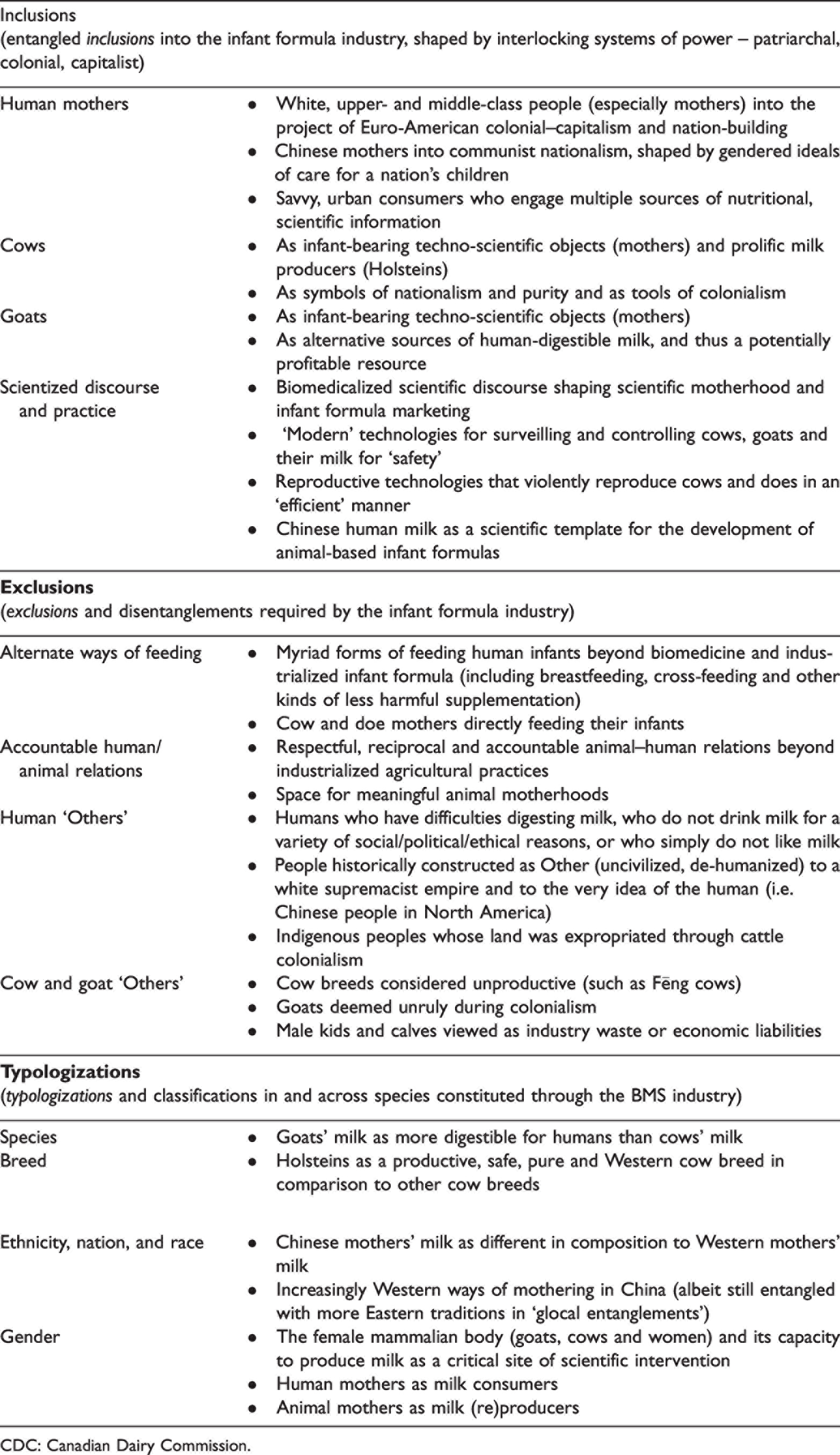
CDC: Canadian Dairy Commission.
This framework of inclusion, exclusion and typologization also helps determine where ethical action can and should be taken within and against the industrialized infant formula industry. Working across anticolonial economic geography and animal studies has been vital to charting out a fuller picture of what these ethical commitments might look like. An anti-colonial feminist economic geographer might begin to explore how an ethics of care can be used to better respond to the dietary and often excluded needs of racialized populations, advocating for less moralizing around infant feeding practices and more material support for diverse ways of mothering. They might also draw on Indigenous scholars (Belcourt, 2015; Burrows, 2016) to think of how entanglements can be sites of accountability for humans living in good relation with animals, whereby entangled beings have much to gain if these relations are respectful, reciprocal and accountable – how could Indigenous ways of knowing and legal traditions, for instance, help to build more reciprocal feeding practices across species? A critical animal studies geographer might want to explore how an ethics of accountability could disentangle animals like cows and goats from multispecies practices of infant feeding, working to disrupt and dismantle the colonial–speciesist structures which necessitate their inclusion. They might also learn from activists and animal studies scholars who advocate not only for animals’ exclusion from violent industries but also for their political and social inclusion in multispecies communities (Adams, 2010; Blattner et al., 2020; jones, 2010) – an inclusion that would entail a deeper appreciation for the spaces and ways in which these animals (as individuals and as groups) might want to mother.
We believe that the power of our particular analysis is in working across anticolonial (human) economic geographies and critical animal studies. The ethics that arise from our different orientations do not always neatly map on to one another, and there are points of friction which we have necessarily had to negotiate. Nonetheless, through using a theory of entanglement and a methodology of imbrication we have together garnered what we believe to be a more fulsome account of how diverse beings are violently entangled in the infant formula industry, which makes visible a multitude of accountabilities. Our respective ethical commitments would necessarily recognize the different situatedness of each human, goat and cow experience without reducing particular forms of human exploitation to diverse animal oppressions. An anticolonial, feminist ethics of infant feeding practices should, ultimately, consider how various inclusions, exclusions and typologizations work to sustain these oppressions, thus opening up debate and inciting action to change, disrupt, and/or dismantle the infant formula industry. This work continues.
Highlights
A multispecies analysis of the 2016 Feihe–Canadian Dairy Commission deal unmasks the extra-economic transnational geopolitics and entanglements of the infant formula industry. Understanding the violences of industrialized infant formula requires an analytical framework attentive to the multispecies inclusions, exclusions and constitutions wrought through the industry. Milk and infant formula markets in China and Canada are historically and contemporarily shaped by ideas of race, ethnicity and nationhood. The deal reproduces species and breed striations across cows, goats and humans through a variety of corporeal and technological interventions. Cows, goats and humans are entangled (albeit differently) in the infant formula industry through the scientific governance of their motherhood.
Footnotes
Acknowledgements
We would like to thank Sue Donaldson and Will Kymlicka for their insightful comments on an earlier version of this paper. We would also like to thank the insightful and detailed comments of the three anonymous reviewers who helped to strengthen this paper and greatly deepen our analysis. And, finally, a thank you to the editor, Rosemary-Claire Collard, for her and guidance throughout this process.
Declaration of conflicting interests
The author(s) declared no potential conflicts of interest with respect to the research, authorship, and/or publication of this article.
Funding
The author(s) received no financial support for the research, authorship, and/or publication of this article.