




Abstract
A growing body of literature is concerned with ‘healing’ our cities, fostering an ethic of care for urban nature and creating more socially and environmentally just cities. At the same time, urban biodiversity is the focus of an increasing number of projects at multiple scales. However, in contrast to the ethos of multispecies ‘entanglement’ and ‘becoming with’ that typically animates this research, large numbers of animals ‘entangled’ in the machinations of our cities constitute a ‘nature’ that remains mostly unseen. And yet, it is the local and global practices these animals are part of – associated with food, entertainment, education, companionship and research – and the persistent relations of use and exploitation that underpin them, that are most directly implicated in the ongoing environmental degradation, destruction of habitats and extinction of species that create the ‘problem’ of urban biodiversity. We therefore argue that a persistent anthropocentrism is hampering efforts to respond effectively to the findings and recommendations of the IPCC, IPBES, FAO and others. Based on a thorough literature search and review of 65 articles concerned with urban ‘nature’ and multispecies relations, we demonstrate a prevailing hierarchy in how, and more importantly which, nonhuman species are being represented. Parallels are noted from recent social movements and the work of scholars from complementary fields. We highlight the dangers posed by this selective remit of care and concern and suggest critical animal studies as a way to adjust the frame and extend the boundaries of dominant thinking about what constitutes ‘nature’. In conclusion, we call for researchers concerned with urban nature and biodiversity to adopt more critical and repoliticized understandings of ‘nature’ and multispecies relations – ones that are better poised to challenge practices involving commodified animals and slow the pace of environmental destructions and losses they are associated with.
An encounter
I’m driving south down a major freeway towards Melbourne with the radio on. The engine thrums and I enter a semi-trance as the second shift of daily commuter traffic dissipates. Lights twinkle to life. Dusk gives way to darkness. About 100 m ahead, in the lane to my left, I see one of those high, imposing trucks – the ones that look too tall and thin for the crosswinds. As I draw closer, I see the perforated metal sides that signal a ‘livestock’ truck. I pull alongside. Soft wet muzzles poke out between the grills, twitching and sniffing the air. Their eyes are wide. They strain to peer down at the strange shiny object passing below them. A faint musky, earthy smell finds ways through the car’s metal barrier. A moment of bodily connection. I pull ahead and watch the truck and its 50-odd passengers 1 – typically young male bovines or ‘spent’ females from the dairy industry 2 – in my rear-view mirror as they gradually fade and disappear in the encroaching night. It’s likely their first and last time on a truck (Figure 1).
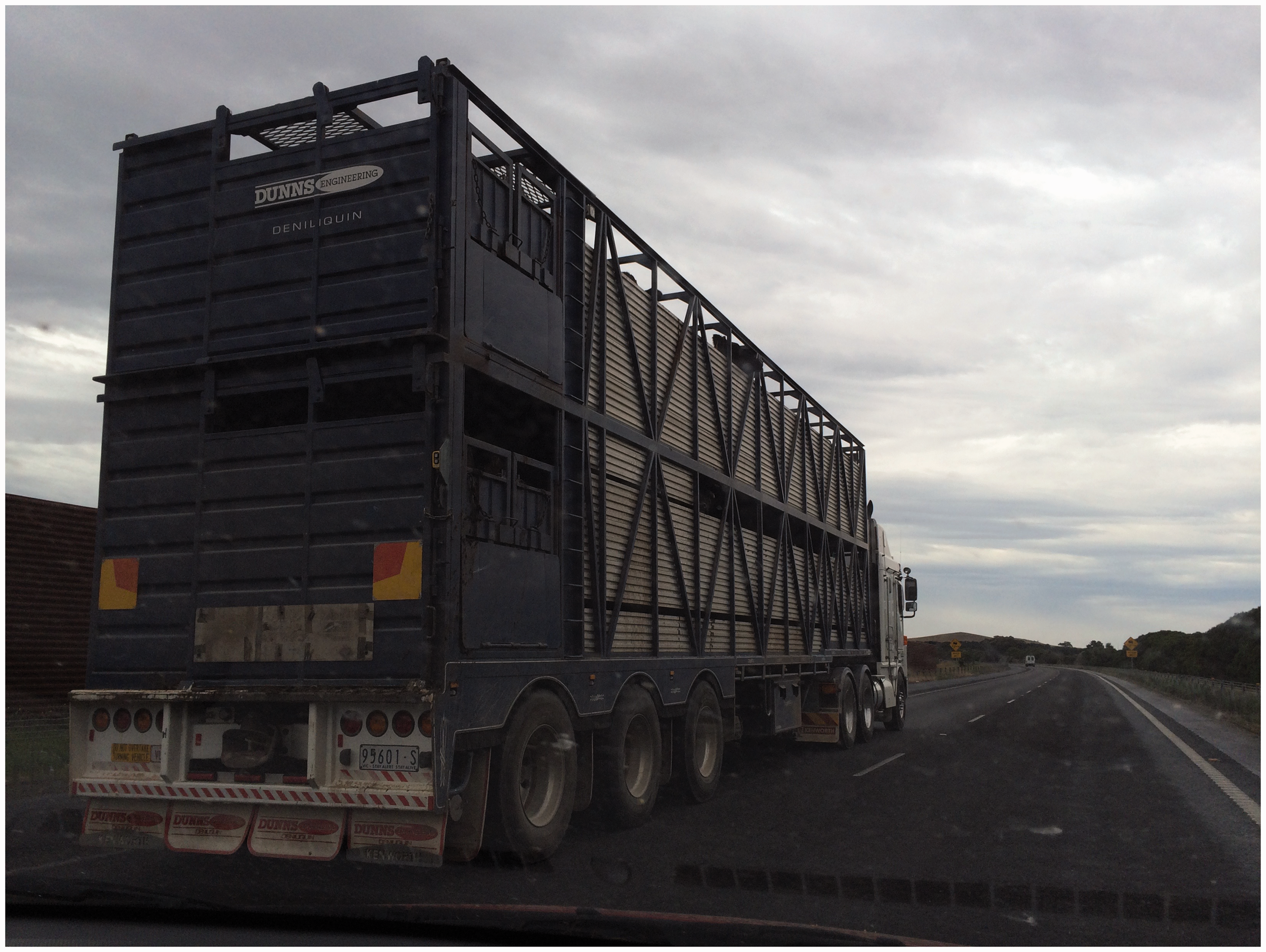
A two-storey `livestock' truck delivering bovines to a Melbourne slaughterhouse (Author image).
Their destination is probably the western suburbs of Melbourne, specifically Laverton, Brooklyn and Albion, between 13 and 16 km from Melbourne’s CBD and the site of five slaughterhouses that between them ‘process’ upwards of 32,000 pigs, cows, sheep, chickens and other ‘small stock’ or ‘units’ per day. Unbeknownst to most people, even many who live nearby, this area of Melbourne, so close to the CBD, is a hotspot of daily killing. But it is not the only one within the Greater Melbourne region. Another encompasses the south-eastern suburbs of Dandenong, Cranbourne, Pakenham and Keysborough, which are home to at least seven more such operations. 3 Here, based on similar facilities, at least another 40,000 cows, sheep, chickens and other ‘meat’ birds or poultry are killed daily, all within 35–50 km of the CBD. Adding a few more facilities located in other areas of Greater Melbourne, this amounts to around 100,000 animals per day, at a conservative estimate, who routinely become part of the daily fabric of the city – briefly as living beings, and then as body parts. Our cities are teaming with animal life of this nature.
Introduction
A growing body of literature, encompassing human geography, ecology, conservation science, urban planning, environmental science and others is concerned with ‘healing’ our cities, fostering an ethic of care for urban nature and creating more socially and environmentally just cities, all set within a broader context of climate change adaptation and mitigation (Barrett et al., 2016; Beatley, 2011; Dannenberg et al., 2012; Loder, 2014; Newman and Jennings, 2012). At the same time, urban biodiversity is the focus of an increasing number of on-the-ground projects at multiple scales, from citizen-science to international partnerships (Buijs et al., 2016; CBD, 2012; Krasny and Tidball, 2012; Nilon et al., 2017). Reflecting a broader ideological shift towards less human-centric modes of thinking, concurrent with the emergence of the ‘Anthropocene’, this heightened focus on urban nature is often accompanied by references to concepts popularized by Haraway (2007, 2016), such as multispecies ‘entanglements’ and notions of ‘becoming with’ or co-habiting (for example, Ginn, 2014; Hinchliffe et al., 2005; Houston et al., 2018; van Dooren and Rose, 2012). And yet, large numbers of animals ‘entangled’ in the machinations of our cities, including those one of us shared a moment with that evening on the freeway, constitute a ‘nature’ that is mostly unseen by this broad field of scholarship. 4
In this paper, we extend the boundaries of dominant thinking about urban nature and animals to include those whose lives and bodies are expended in the service of human ‘needs’ – needs associated with, and constituted by, our species’ demand for animal protein and products, entertainment, education, ‘pets’ and research involving animals. Our intention is to challenge widespread notions (and claims) regarding care for ‘nature’ in urban contexts, while at the same time foregrounding and unsettling normalized sensibilities associated with these notions. Research originating in human geography, urban planning and design, architecture, environmental studies and ecology, specifically from Seymour and Wolch (2009), Owens and Wolch (2017), Beatley and Bekoff (2013) and Byrne (2010), has noted the peripheral status of certain animals, primarily ‘farm’ and zoo animals, within concerns for urban and peri-urban nature. However, as yet, none have foregrounded how increasingly at odds this status is becoming with claims of a growing recognition and respect for ‘nature’ in urban-related studies.
As we outline here, calls to respect and cultivate greater biodiversity in our cities in response to global losses and climate change are hampered by anthropocentric views of the city and of ‘nature’. A now widespread public manifestation of this can be seen in the rise of global Extinction Rebellion groups and their civil disobedience actions taking place across cities around the world, and which draw focus on ecological crises impacting ‘this planet and its wildlife’ (Farrell et al., 2019: 1). Such calls exclude the slaughterhouse (for one), placing it and all those who are ‘processed’ in it, at modernity’s tolerance limits (Vialles, 1994). In addition, they ignore the deadly entanglements intensive factory farming and other normalized practices involving animals produce for all animals, whether ‘wild’, ‘farm’, captive bred or many other designations. Such a position risks emptying out the cultural and political significance of animals’ urban existence as stretching from the ‘biodiverse’ creatures we ‘care’ for, the more visible animals designated as pets and entertainment, and the ‘biohomogenized’, biomedicalized and industrialized animals sequestered from sight both industrially and epistemologically (O’Sullivan, 2011; Pachirat, 2011; Vialles, 1994).
This emptying out can be seen via interactions between animal liberation groups and broader environmental communities. In October 2019, the London-based animal justice group, Animals Rebellion, called on Extinction Rebellion to support planned actions to engage Smithfield Market as a site of animal and climate injustice. Their planned nonviolent action sparked significant debate within the broader Rebel Alliance, and beyond. In a public response, Animals Rebellion noted, ‘you cannot fix the climate emergency without ending the animal emergency’ (Animal Rebellion, 2019). Animal Rebellion formed in response to the exclusion of commodified animals from the purview of the Extinction Rebellion agenda, which had ‘significant shortcomings with regard to the consideration it affords to nonhuman sentient beings’ (Murphy, 2020). 5 Similar tensions are playing out in Melbourne as The Animal Justice Party is being accused of seeking to ‘hijack’ the climate movement for ‘their own cause’ (Andrewartha and Bolton, 2020) by voting to include the demand to transition away from animal agriculture at an upcoming Day of Action for the Climate Justice Alliance Melbourne. For the Alliance, consideration of farm animals threatens to alienate unions and working people.
And so a persistent problem undermines the project of city ‘healing’: it is the normalized culture of eating food of animal origin that is contributing most to the accelerating loss of nature and biodiversity in the first place, and also significantly to climate change. Efforts to safeguard, restore and foster urban nature and biodiversity, as the latter are popularly understood, are therefore only tackling one end of the problem. The scale and rate of these efforts are, furthermore, dwarfed by losses associated (directly and indirectly) with everyday practices, primarily (but not only) of meat and dairy production and consumption, whose normalization makes the continuing domination of animals and nature both acceptable and necessary. Without a wholesale shift in thinking and practices about human relations with all animals, these losses will continue unabated and unchallenged. This situation is recognized by Swyngedouw and Kaika (2016) who note in their critique of urban theory and practice: Despite [the] extraordinary leap forward in critical understanding of the urban environmental condition … precious little is achieved to prevent greenhouse gasses from accumulating in the atmosphere, the expanding use of natural resources, biodiversity loss, or the rapidly increasing privatization and commodification of the commons of the environment. (54)
We are not the first to draw attention to this wild contradiction in urban and environmental geographies. 6 Almost 20 years ago, environmental humanities scholar Owain Jones (2000) warned of the emergence of what he described as ‘unethical geographies’ of encounter across a (then) growing body of social science and humanities literature concerned with human–nonhuman relations. His responding call for an ‘ethics of encounter’ encompasses animals used for food, companionship, research and entertainment; practices such as hunting, fishing, farming and captive breeding; and the corresponding spaces ‘which are customarily closed off from the conventional ethical gaze’ (268). Three years later, environmental ethicist Clare Palmer noted that within the (then) nascent field of urban environmental ethics, ‘[animals] become swallowed up into “environment” or the “nonhuman world”’ (2003b: 65). In another paper from the same year, she observes: ‘much writing on urban sustainability emphasizes the importance of wildlife in the city; though this tends to focus on biodiversity rather than relations with individual animals, and usually rests on the basis that urban wildlife provides social, educational and quality of life benefits to humans, and that urban humans need some kind of “contact with nature”’ (2003a: 55). Palmer ends the latter paper with a plea for more critical attention to these relations, noting that ‘during a time in which past colonization of humans is widely ethically condemned … are there ways in which such ethical consideration, or some aspects of it, might apply to human colonization of non-human habitat?’ (55).
Even before these studies, in 1998, geographer Jody Emel and urban scholar Jennifer Wolch raised similar concerns. In an expansive and hard-hitting account of ‘nature–culture borderlands’, they document the growth in all animal-based industries, including the wildlife trade and biomedical research, and their consequences in terms of pervasive environmental problems, ‘profound’ moral choices, habitat loss and species extinction (509). Noting the moral exemptions surrounding commodified lives, they describe how these animals are ‘obscured by disembodied and endless processing, and normalized by institutional routines and procedures’ which render them spatially and morally invisible (527). It is to this ‘modern instrumental rationality’ (1998: 527) that Emel and Wolch attribute this invisibility, and Jones similarly argues that it is simply ‘useful’ (2000: 277) and leads inevitably to a ‘silent collusion’ in ‘anthropocentric constructions of ethics’ (271). Palmer explains the moral invisibility in terms of a failure of responsibility (Palmer, 2003b) operating within normalized relations of power (Palmer, 2003a), and Kopnina (2017) identifies a ‘symbol-induced passivity’ (341) founded on the persistence of the nature–culture dualism whereby human interests and wellbeing are always ranked first. In other words, for all these scholars, anthropocentrism pervades human–animal relations at the deepest levels and informs hierarchies of the differently seen and cared-for. Moreover, when ‘anthropocentrism shakes hands with capitalism’ (Wadiwel, 2018), the associated commodifications of nonhuman lives, body parts and representations take this anthropocentrism to new, supercharged heights.
In the context of this previous work, where the aim of Emel and Wolch’s chapter is to explain the rise of ‘the animal moment’ in social theory, and where Jones and Palmer are calling for more critical perspectives on human relations with commodified and colonized animals, here we foreground the urban as the locus of our wild and deeply problematic contradiction. First, cities are catalysts that sustain both the increasing demand for animal-based commodities (through ‘institutional routines and procedures’) and the associated environmental damage; 7 second, they are where most of these animals, at some point on their co-opted life journeys, will be found, anywhere on the spectrum between living and dead; and finally, both these facts are overwhelmingly sidelined by urban and environmental geographies that claim to hold ‘nature’, biodiversity and the mitigation of climate and environmental change as their top priorities. Given the fluidity of disciplinary boundaries between geography, human geography, environmental studies, urban studies, urban planning, conservation and urban ecology, it might be expected that some kind of seachange might have started to permeate urban-centred research since these studies appeared, especially where environments, nature and animals are an explicit focus.
With than in mind, how have Jones’ and Palmer’s respective pleas been received over the last 20-odd years? Based on a review of recent literature concerned with urban ‘nature’, biodiversity and multispecies relations, we demonstrate an enduring species hierarchy in how, and more importantly which, nonhuman animals are being represented. Drawing on similar observations made by scholars from diverse fields, including geography, environmental anthropology and creative writing, we highlight the dangers posed by this persistent anthropocentrism and suggest that perspectives offered by critical animal studies (CAS) offer a way to productively adjust the frame.
Reviewed literature
The literature review began with a number of articles collated between 2016 and 2018 that were representative of a ‘caring’ approach to urban ‘nature’ and multispecies communities that was emerging in Australia. Subsequently, in response to a call for papers from the Institute of Australian Geographers as part of a two-day urban theory symposium titled Cities of Care to be held in Melbourne in June 2018, one of the authors presented the founding ideas of this current paper in a presentation titled, When Species Shouldn’t Meet: Human/Nonhuman Dis-Entanglements for Care-Full More-Than-Human Cities. This symposium further cemented the working notion that despite calls for urban theory to ‘“listen with care” to silences and neglected things’ (Williams, 2018), these silences and ‘things’ still did not include the commodified ‘kin’ contained in our cities.
Following this event, the collection of literature was formalized and extended under two categories. Searches were undertaken using Google Scholar and university library databases for specific journals and were restricted to literature published between 2009 and 2019. Book reviews were not included. The first category singled out studies where urban ‘nature’ was the primary focus, and which specifically included animals located within city boundaries 8 – either animals in general or individual species. Studies also had to include an explicit intent around humans (re)connecting with urban nature, indicated by terms relating to compassion, care and coexistence and/or highlight their critical approach. Studies concerned primarily with urban greening, urban gardening, urban rewilding, urban renaturing and even re-earthing (Escobar, 2019) were excluded as was the substantial body of literature on the health and wellbeing benefits of urban nature and biodiversity, encompassing green roofs, green infrastructure, ecological restoration, ecosystem services and urban wilderness. The reason being that both of these bodies of literature make explicit their conception of ‘nature’ as meaning ‘wild’ and ‘native’, though occasionally including ‘pest’ and ‘feral’ species. They do not recognize the commodified ‘nature’ we are concerned with.
Search terms included ‘urban AND nature’ and ‘urban AND animal(s)’. Search results were assessed based on urban ‘nature’ and/or animals being the primary focus, and particularly noting additional references to the terms ‘compassion’, ‘care’, ‘connection’ or ‘coexistence’. Eleven journals were consulted based on their ranking in urban studies and also coverage of these topics: Progress in Human Geography, Environmental and Planning A, D and E, Urban Studies, Urban Geography, Planning Theory, Transactions of the Institute of British Geographers, Geoforum, Social and Cultural Geography and Antipode. In addition, a collective search of urban nature related journals – among them Landscape and Urban Planning, Sustainable Cities and Society, Health & Place, Journal of Environmental Management, Environmental Research, Land Use Policy and Urban Forestry and Urban Greening – yielded 129,271 articles under the ‘urban AND nature’ search. A scan of the first few hundred articles indicated a predominant focus on green infrastructure, parks, biodiversity, gardening and nature-based solutions, and so the review was discontinued. We do not consider this a systematic review and acknowledge the potential that some relevant literature may have been overlooked. Nevertheless, it offers a heuristic appreciation of the dominant themes and trends in terms of how animals are thought of in relation to urban natures in research papers within key journals in the field. Overall, more than 1500 articles were reviewed, resulting in 31 papers that fit the criteria for this category.
The small number of studies that resulted from this search underscores how normalized a limited conception of ‘nature’ has become across the broader urban-focused literature. Widening our criteria to include literature featuring unproblematized animal parts or human–animal relations (e.g. urban animal husbandry) would have further demonstrated just how small a space is allocated to invisibilized animals in urban and environmental geographies. We are not implying that every study of urban ‘nature’ and animals needs to adopt the more critical perspective we advocate. Nor are we critiquing the reviewed literature for how it approaches its subjects and materials, nor questioning the value of its contribution to specific fields of scholarship. However, we argue that the relative dearth of studies is significantly out of balance with the scale of environmental problems being highlighted by recognized international organizations of scientists and the activities that they directly implicate in these problems.
For the second category, the search was narrowed to a small but growing field of research interested in exploring urban environments through a multispecies lens, encompassing concepts such as naturecultures, entanglement, cohabitation and coexistence. A search of these terms, coupled with ‘urban’, was conducted at the same time as the first but excluded the terms ‘nature’ and ‘animals’. The intent was to target literature that explicitly advanced ideas of human–animal (re)connection in cities and to determine what kinds of animals were included in these connections, and how they were conceived. This search yielded a similar number of articles – a total of 34.
Within the two groups of articles, there are studies that could be associated with the broadly inclusive fields of animal studies, animal geographies or human/animal studies and a much smaller proportion oriented towards the more normative goals of CAS (Twine, 2014). Others do not exhibit an obvious affiliation either way, concerned rather with aggregated notions of nature and wildlife, or with describing the relational ontologies that shape humans’ being-in-relation-with a multispecies world. Taylor and Twine (2014) highlight the tensions that can exist particularly between animal studies and CAS. However, we do not wish here to stress or foment those tensions, and therefore do not feel it is helpful to try to label each study accordingly. Besides there being no hard boundaries between these generalized fields of scholarship – indeed, all contain distinct threads of criticality, for example Philo’s (2017) ‘less-than-human’ geographies – the aim of this paper is to demonstrate the overall paucity of critical perspectives on animals and point to the opportunities afforded by CAS as an interdisciplinary field rooted in radical ecology and ecofeminism, and committed to intersectional, politically engaged theory and practice (Twine, 2014).
Findings are organized according to the two search categories and what they reveal about common understandings of the terms ‘nature’ and ‘multispecies’. Appropriate books, including edited collections, were also drawn on where relevant to emphasize and/or illustrate certain points.
The urban nature that is not ‘nature’
Across the reviewed literature, many studies, in the same way as those we excluded, present a view of ‘nature’ or biodiversity as only comprising what is commonly understood as wildlife (Beatley, 2011; Beery et al., 2017; Fuller et al., 2010; Hunold, 2017; Shillington and Murnaghan, 2016; Taylor and Hochuli, 2014). This of course holds true for all literature concerned with urban rewilding, renaturing and even re-earthing (Escobar, 2019) too numerous to be listed here. Even when a broad range of potential habitats is cited, ‘from wilderness areas to farms and gardens’ (Beery et al., 2017), the authors’ interpretation of this notably excludes a host of other habitats, presumably because they are not considered to align with their definition of nature as an ‘organic environment where the majority of ecosystem processes are present (eg. birth, death, reproduction, relationships between species’ (717).
A number of studies do feature animals. However, a large proportion of these take an uncritical view of the human–animal relations that constitute them and the practices they are part of. Among these is a study by Tornaghi (2014) which takes a socially critical approach to the geographies of urban agriculture but does not extend this perspective to animal husbandry. Others include an exploration of zoo governance in the wake of the Tbilisi flood (Swann-Quinn, 2019), the farming of edible birds (Connolly, 2016), human–animal/wildlife conflict relating to urbanization (Barua and Sinha, 2017; Boonman-Berson et al., 2016; Yeo and Neo, 2010) and ‘livestock’ (Margulies and Karanth, 2018), and geographies of ‘meat’ consumption (Waitt, 2014). Remaining studies of urban animals that do critically problematize the underlying human–animal relations notably include the work of Narayanan (2016a, 2016b, 2019) who has examined stray dogs, bovines and snakes in Indian cities. Also, Neo and Ngiam’s (2014) study of captive dolphins in urban Singapore, Garlick (2015) on animal experimentation and vivisection (including a suggestion to extend Haraway’s thesis through the notion of ‘discomforting encounters’) and papers examining racehorses (McManus and Montoya, 2012), rescue dogs (Schuurman, 2019), farm animals in assemblages of therapeutic care (Gorman, 2016) and animals in carceral spaces (Moran, 2015; Morin, 2016), although an urban context is not central to these latter studies. Furthermore, direct links are not made between these constitutions and uses of animals, and the degradation of global environments they help shape – despite these links becoming increasingly unequivocal.
The most recent report from the IPCC (2014) finds that emissions of greenhouse gases from agriculture, forestry and other land use constitute 24% of total global emissions, a close second to electricity and heat production at 25%. Deforestation and agricultural emissions from livestock, soil and nutrient management are identified as the main contributors. To put this in context, almost 80% of global agricultural land is allocated to the production of meat and dairy products (Ritchie and Roser, 2019), and over 80% of deforestation currently taking place in Amazon countries is attributed to the creation of pastures and soy plantations for ‘beef’ production (Anon, 2019). Based on a review of life-cycle analyses, the IPCC authors conclude that most plant-based foods are associated with substantially lower GHG emissions than animal products, leading them to state that ‘GHG emissions may be reduced through … changing diets towards less GHG-intensive food, e.g. substitution of animal products with plant-based food’ (838) – a recommendation that is repeated in their 2018 special report, Global Warming of 1.5°C (IPCC, 2018).
Released in 2019, the latest report from the Intergovernmental Science-Policy Platform on Biodiversity and Ecosystem Services (IPBES) complements and supports the IPCC report (Diaz et al., 2019). With reference to changes in nature including ecosystem decline, loss of biodiversity, increases in threatened species and extinctions, the IPBES identifies five direct drivers. In order of their global impact, starting with the highest, these are changes in land and sea use, direct exploitation of organisms, climate change, pollution and invasion of alien species. Noting that the global forest area is now 68% of pre-industrial levels, the report’s authors identify ‘agricultural expansion’ as the most widespread form of land-use change, due to ‘cropping or animal husbandry’. They also note the need to combat wildlife trafficking to help protect natural areas (29). Despite the IPBES report lacking any meaningful or substantive statements regarding where the ‘bold’ and ‘transformative changes’ they call for are needed, and recognizing that the discourses surrounding meat and animals contained in these reports (among others) are still decidedly human-centric (Arcari, 2017), they do provide an unequivocal set of guidelines on the kinds of human activities that are causing the greatest harms to the environment. The IPCC and the IPBES are by no means the first to make these observations. In 2006, the FAO declared that the livestock sector may be the leading driver in the reduction of biodiversity due primarily to habitat loss and furthermore contributes ‘significantly’ to climate change (Steinfeld et al., 2006: xxiii).
Unfortunately, this growing weight of evidence has so far not been matched with sufficient work in the social sphere. Acknowledgement of the impacts of either the livestock sector or the wildlife trade is notably absent in urban ecology, conservation and planning literature, which is currently more concerned with gardening, greening, rewilding, nature-based solutions and the health benefits of nature interactions. While well meaning, and no doubt delivering benefits to small groups of people and other species, these research efforts rarely make a connection with humans’ more extensive and impactful relations with nonhuman nature, and the power dynamics that shape them (Pitt, 2018). This leaves such work open to critique.
For example, while greening initiatives have been shown to improve the urban environment in terms of reducing the heat-island effect, providing shade, improving air quality, aiding stormwater management and increasing local biodiversity, they are also being framed primarily in terms of their benefits to humans (Beery et al., 2017; Flies et al., 2018; Pinho et al., 2017; Taylor and Hochuli, 2014), and some of the assumptions and approaches informing these initiatives are being questioned (Schwartz et al., 2012; Williams et al., 2014; Wood et al., 2018). Furthermore, their localized benefits accrue at the same time as the world’s population is increasing by 82 million people annually, 9 an increasing proportion of which is becoming urbanized. 10 Under current systems and structures of production, distribution and demand, it is the growing pressure that this urban growth exerts on the other 99% of the earth’s habitable land area 11 that is the catalyst for the biggest environmental problems. 12
The promotion of green roofs and neighbourhoods, local community gardens and initiatives to save particular ecosystems or native species is intimately ‘entangled’ with the nearby horse and dog racing events, the promotion of interactions with zoo and other animals, learning about and celebrating the ‘functionality’ of cows, pigs, sheep and chickens and buying a ‘pet’ from a shop or a breeder. The common thread is our species’ relationships with nonhuman others, and there is a fundamental dysfunction at the heart of these relationships that needs to be addressed before poeticized notions of mutually beneficial entanglements with a particular ‘nature’ can hold water. As Schulz argues in her call for the decolonization of political ecology, ‘ … enchantments may also function as and through technologies of power’ (Schulz, 2017: 125). Our dysfunctional relationship with nature can only be addressed by directly confronting the array of everyday social practices built on relations of domination, exploitation and eradication of nonhuman animals – practices that tend to be excluded or ‘off-staged’ in the literature concerned with promoting urban ‘nature’ and biodiversity. Hence, we agree with Giraud’s assertion, in her volume What Comes After Entanglement, that ‘more concerted efforts need to be made to render visible - and assume ethical responsibility for – the exclusions that play an equally constitutive role in materializing particular realities at the expense of others’ (Giraud, 2019: 20).
Let us take Melbourne as an example. In addition to the 36.5 million (at least) bovines, sheep, pigs, poultry and other ‘livestock’, that enter Melbourne’s city limits over the course of a year, around 20,000 more ‘spectacularized’ animals may be regular or one-off visitors (Table 1). These animals are typically the result of intensive, and often expensive, breeding programmes designed to optimize key physical attributes, such as speed, strength, stamina and the capacity to grow muscle quickly and in the ‘right’ places, as well as mental attributes such as compliance, fearlessness and ‘spirit’ (Flint and Woolliams, 2008; Twine, 2010). These attributes are turned into visual commodities for entertainment (supported by a powerful betting industry) and for ‘expert’ assessment, and it is by winning at these events that owners realize the monetized value of ‘their’ animals – through prize money and/or improving the value of their lineage and future as breeding stock. Then there are the permanent and semi-permanent residents – conservatively another 80,000 animals within Melbourne who ‘reside’ in zoos, are held in shelters, are used (and created) in commercial breeding operations and research facilities, horses used to pull carriages and hundreds of animals used in mobile children’s farms and exotic animal parties and as travelling ‘educational’ exhibits. Other urban regions include animals farmed for their skin 13 or captured for other purposes. 14
Permanent, semi-permanent and temporary nonhuman residents in Greater Melbourne, Australia.
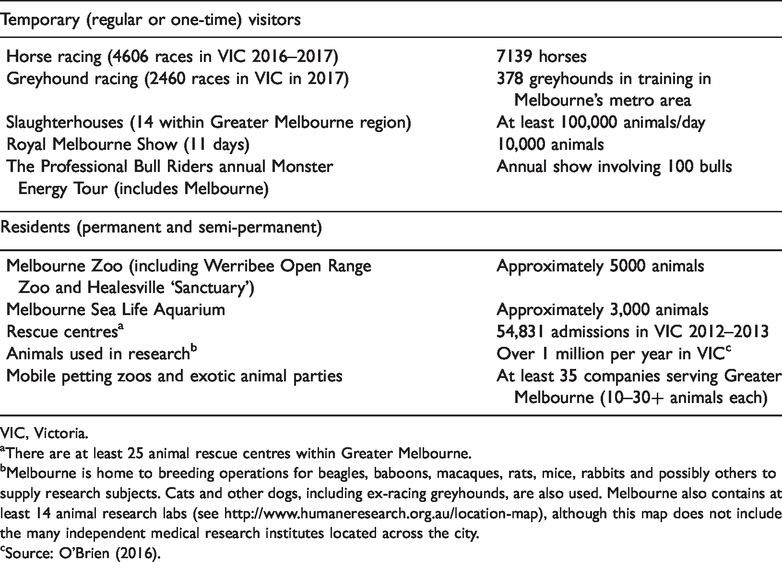
VIC, Victoria.
aThere are at least 25 animal rescue centres within Greater Melbourne.
bMelbourne is home to breeding operations for beagles, baboons, macaques, rats, mice, rabbits and possibly others to supply research subjects. Cats and other dogs, including ex-racing greyhounds, are also used. Melbourne also contains at least 14 animal research labs (see http://www.humaneresearch.org.au/location-map), although this map does not include the many independent medical research institutes located across the city.
cSource: O’Brien (2016).
The numbers of these captive and lively commodities (Collard, 2014) are significant, and urban centres all over the world play host to these, and other, sites and practices that maintain these animals’ presence in variably visible ways, from the zoo and the racecourse, to the slaughterhouse and the morning glass of milk – Adams’ (1990) ever relevant absent referents. However, unlike the ‘wild’ mammals, birds, insects, organisms and other nonhumans that are commonly the subjects of research that explores, and laments, the increasingly de-natured state of urban environments, these more utilitarian animals are not subjected to the same ethical considerations of care.
And yet, as indicated, the local and global practices these animals are part of (especially ‘food’ and ‘wild’ animals), and more importantly, the persistent relations of use and exploitation that underpin them, are the ones that are most directly connected to the ongoing environmental degradation, climate changes, destruction of habitats, loss of biodiversity and extinction of species that have created the ‘problem’ of urban biodiversity. These practices include meat production and consumption, land-clearing and deforestation, capture, coercion and confinement, forced and captive breeding, genetic modification, growth enhancement, mistreatment and abuse and of course killing. Thinking of practices that are associated with more popular kinds of ‘nature’ 15 – the birds, native mammals, insects and other nonhumans who are more incidental presences in the urban fabric (but are becoming increasingly valued for their ecosystem and social/health services), it becomes clear how differently our relations with these animals are constituted. Differential valuations of ‘nature’ are implicit, which inevitably leads to double standards of care and concern. Moreover, to the extent that some of the literature reinforces the normalization of environmentally damaging practices involving commodified animals, it could also be accused of hypocrisy, a term deployed by Alex Lockwood (2019) in relation to ‘New Nature Writing’. More on this later.
The potential for nature-based initiatives with a ‘feel-good’ factor (Dallimer et al., 2012) to generate support for others, including at larger scales and involving other kinds of ‘nature’, should not be undervalued, although this potential is unsubstantiated and contested (Bekessy et al., 2018; Pitt, 2018). However, without explicit links being made with the most problematic practices involving ‘nature’ they are more likely to remain localized and largely impotent (in as far as the bigger problems remain unacknowledged) and also fundamentally speciesist. As Swyngedouw and Ernstson argue, off-staging these practices with respect to the popularized ‘mis-en-scene’ of the Anthropocene creates an ‘impoverished notion of what constitutes “the political”’ (Swyngedouw and Ernstson, 2018: 6). In this way, these initiatives largely elide key questions regarding the need, and possibility, for more radical and potentially contentious actions – ones that would respond to the repeated and increasingly unequivocal findings of organizations like the IPCC and IPBES.
A limited remit of ‘multispecies’ care
The same inattention is arguably more dissonant within the growing body of literature that explicitly promotes a multispecies approach to research, characterized by a ‘coming together of questions of kinds and their multiplicities’ (van Dooren et al., 2016: 1) and aligned with a cosmopolitical conception of (urban) space as where ‘all agents, animate and “vibrant matter”’ come together ‘in the ongoing making of a shared world’ (Duhn, 2017: 47, after Stengers, 2010). These writings often mobilize various affectively appealing notions around all kinds ‘living well together’ (Duhn, 2017: 46), such as cohabitation, naturecultures, conviviality, ‘becoming with’, enchantment and others (Desai and Smith, 2018; Duhn, 2017; Fjalland and Samson, 2019; Ginn, 2014; Hinchliffe et al., 2005; Holmberg, 2015; Houston et al., 2018; van Dooren et al., 2016; van Dooren and Rose, 2012). However, here again, conceptions of the ‘multiple’ and the vibrant cosmos or common world tend to exclude highly commodified and instrumentalized animals, focusing rather on insects, birds, bats, bees, cockatoos, flying foxes, wolves, foxes, Ibis, dingoes, koalas, cats, dogs, slugs, hyaenas, penguins, rabbits, possums and other wild, stray, feral or hybrid nonhumans (Baynes-Rock, 2013; Danby et al., 2019; Filipovic, 2019; Franklin, 2017; Ginn, 2014; Hohti and Tammio, 2019; Houston et al., 2018; Kirksey et al., 2018; Lorimer, 2015; McKiernan and Instone, 2016; Panelli, 2010; Phillips, 2019; Power, 2009; Rigby, 2018; Rutherford, 2018; Steele et al., 2019; Van Patter and Hovorka, 2017).
In a small number of studies, the variably commodified lives and human relations experienced by some animals, including elephants, salmon, chickens, ‘cattle’, horses and dolphins, are explored within the context of a broader cosmopolitical agenda or from the perspective of non- and posthuman care (for example, Barua, 2014; Blecha and Davis, 2014; Franklin and Schuurman, 2017; Hovorka, 2012; Swanson, 2015; Taylor and Carter, 2018). However, in common with the previous body of literature, the relations and commodifications that constitute their lives are treated as further modes of entanglement and are not approached in ways that critically reflect on how these animals come to be in these situations. Companion animals, especially dogs, also feature in a number of studies (Fletcher and Platt, 2016; Fox and Gee, 2017), although the darker side of the breeding industry that supports ‘pet’ ownership, linked to wastage, abandonment, neglect, abuse, experimentation and killing, is rarely acknowledged.
Only three articles were found that problematize the notion of multispecies enquiry – Collard (2014) and Jaclin (2016) in relation to international wildlife trafficking, who also note the urban sites and practices connected with this activity, and Kopnina (2017) who uses animal experimentation and their exploitation for food as the basis of a broader critique of multispecies ethnography.
Hence, despite common intentions around instigating a ‘more equitable multispecies city’ (van Dooren and Rose, 2012: 2), a more ethical resituation of ‘otherkind’ (Rigby, 2018: 73), and ‘reparative practices’ that inspire more ‘caring and collaborative multispecies inhabitation’ (Fjalland and Samson, 2019: 2), there is, across the urban and environmental geographies literature, a prevalent and implicit limit to these ethical considerations, and it stands firmly at the threshold of the slaughterhouse, the zoo, the research laboratory, the racecourse and all those sites where an animal’s intrinsic value has been erased in the process of being monetized. As Probyn-Rapsey observes, ‘environmental or multispecies approaches are … at risk of drawing a line at the “animal gulag” … avoiding the extent of the violence that exists in “relationality” and “mutuality”’ (2018: 59). Giraud argues that the repoliticization of these exclusions is vital for articulating the space for intervention – a space that is currently underdeveloped in dominant narratives where entanglement tends to be celebrated or ‘treated as a good in itself’ (2019: 7).
Some studies from both of the above groups do recognize ‘nature’ as a construction (for example, Beery et al., 2017; Shillington and Murnaghan, 2016) and even acknowledge other literature that addresses more instrumental constructions (for example, Houston et al., 2018; Rigby, 2018). However, like Haraway, these studies fall short of critiquing the ontological basis of some of the ‘complex relationships’ between humans and animals that they briefly mention. 16
These two bodies of literature, their underlying approaches and their dovetailing within associated ‘turns’
17
are summarized by Owens and Wolch in their 2017 chapter, ‘Lively Cities’. They observe: … a contemporary re-emergence of vitalism, embodied and situated cognition, neo-animism, and the ‘hyperobjects’ of speculative realism find context in discussions of a decidedly urban ‘age of the anthropocene’ and an acknowledgment that if the nonhuman world does not possess what some might consider agency, it nonetheless cannot be considered a static object in the Cartesian sense. (547)
Consistent challenges are, however, being levelled from within at the broader field of urban and environmental geographies and have been since at least 1995 when Chris Philo first used the term ‘new animal geography’ to signal the possibilities for thinking ‘of animals as animals; as beings with their own lives’ (657–658). Since then, the work of pioneers in these more critical geographies, including Chris Philo, Chris Wilbert, Jennifer Wolch, Jody Emel and Owain Jones, has been carried steadily forward by a number of scholars. For example, Johnston (2008), Bear (2011), Urbanik (2012), Hillier (2013), Collard (2014) and Collard and Dempsey (2013), Srinivasan (2013, 2016), Holmberg (2015) and more recently Narayanan (2016b, 2016a, 2019) and Narayanan and Bindumadhav (2019) and Gillespie and Collard (2015) and Gillespie (2019). In addition, animal geographies are the focus of three (to date) serialized literature reviews in the journal Progress in Human Geography, first by Buller (2013, 2014, 2016), then Hovorka (2016, 2018, 2019) and most recently Gibbs (2020).
However, Buller (2016: 424) notes that while a number of animal geographers promote a more critical and emancipatory approach to human–animal relations, these perspectives do not define the field. There is, he says, a persistent bifurcation in animal geographies between ‘mainstream’ animal studies and their more critical counterpart (2015: 424–425), many of whose scholars are well versed in the broader fields of animal studies and CAS, including some of those listed above. He describes this increasing polarization as strange, given the advances in awareness of animal agency, human responsibilities and the fallacies of biologism that have accompanied the response to geographical approaches now deemed anthropocentric. However, in light of this paper’s critique of how multispecies cities and urban ‘nature’ are conceived, this effective ‘line in the sand’ noted by Buller perhaps underscores the way anthropocentrism continues to find refuge and succour in spaces considered outside ethical or political contention. These stalwartly defended spaces are inhabited by non-natures whose relations with humans, and associated practices, are enduringly beyond effective reproach.
Further afield, other scholars from diverse disciplines, including history, law, political science and the creative arts, are also tackling human relations with urbanized animals from critical perspectives. Associated studies focus on particular animals, for example dogs (Instone and Sweeney, 2014), horseshoe crabs (Moore, 2015), ‘food’ animals and their products (Mowson, 2019; Singer, 2019) and raccoons (Chaudhuri and Zurkow, 2016) or particular sites and practices including zoos, circuses, bullfighting, horseracing and rodeos (Acampora, 2005; Bergmann, 2019; Boyd, 2015; Gillespie, 2018; Yates, 2009). There are also volumes that mount more wholesale disciplinary challenges, for example Gillespie and Collard’s (2015) Critical Animal Geographies, Cudworth and Hobden’s (2017) The Emancipatory Project of Posthumanism and Hamilton and Taylor’s (2017) Ethnography after Humanism.
This body of work could be taken as supporting Owens and Wolch’s claim that the situation of off-staged urban animals, and the binaries that shape them, are being interrogated in urban animal research. However, in the 15 years since Palmer’s call for the inclusion of animals in urban environmental ethics, change has been slow. The ways of thinking about human–animal relations that these works reflect are not yet found in the dominant literature relating to multispecies ‘living with’ urban ‘nature’ and biodiversity. In fact, reflecting on the current field of global environmental change research, Hovorka recently echoed the earlier observations of Jones, Palmer, and Emel and Wolch, remarking: ‘[t]hat human exploitation of animals shapes global environment change and creates such animal, human and ecological vulnerability in the first place goes largely unaddressed’ (2018: 457). Like these previous scholars, she attributes this to their anthropocentric conceptualization as ‘biophysical components associated with ecosystem services, structure and function’, and as part of systems of capitalist agriculture (457–458).
The situation for animal geography described by Philo and MacLachlan has wider application across urban studies: ‘the field [of animal geographies] tends to prefer pets in domestic spaces, feral animals in the city, livestock living “in the fields,” wild animals in the countryside and even animals in zoos and laboratories’ (2019: 87–88, emphasis in original). The hundreds of thousands of temporary, semi- and permanent nonhuman residents of cities around the world who are not considered ‘nature’ remain unseen. That they do not feature within conceptualizations of ‘nature’ is part of the problem; it is a concept that is mobilized in a way that forgets its own history and entanglement with domestication. Think of all the ‘nature’ that has, for instance, gone into the production of standardized, industrialized animal bodies (Probyn-Rapsey, 2013), a process that involves, as Swyngedouw and Kaika put it ‘universalization of the commodification and accumulation of natures’ (2016: 55). Where these ‘natures’ are accumulated and sequestered through histories of domestication, they can also be brought back into the frame to trouble the borders of who gets to count as ‘natural’. In this endeavour, CAS may be the way forward.
Adjusting the frame
CAS literature is characterized by a persistent drawing attention to the presence of commodified animals, especially industrialized ‘livestock’, as equally deserving of moral consideration alongside species deemed wild, native, feral, etc. CAS does not seek to conserve species such as meat chickens, or dairy cows; instead it seeks an end to their forced, mass reproduction. CAS does not celebrate our entanglements with these commodified animals, it seeks to both recognize these entanglements and disentangle from their worst excesses. CAS does not necessarily distinguish so neatly between the moral worth of one bird over another on the grounds of domestication, a point made salient in Lockwood’s (2019) critical interrogation of ‘New Nature Writing’ which shares similar blind spots to the urban studies and multispecies literature we have reviewed.
As exemplified by George Monbiot’s Feral: Searching for Enchantment on the Frontiers of Rewilding, Charles Foster’s Being a Beast, Kathleen Dean Moore’s Great Tide Rising and Helen Macdonald’s H is for Hawk, Lockwood contends that ‘H’ would more aptly stand for hypocrisy. His reasoning is that these authors ‘fetishiz[e] some animals’ (including humans and variously a hawk, starfish, badger, otter, fox, deer, swift, dolphin and wolves, among others), while ‘at the same time reinforcing and naturalizing the subordination of other beleaguered nonhumans’ (2019: 213). At the heart of these authors,’ ‘new nature’ is the sense that domesticated ‘livestock’ animals are fundamentally not a part of the urban ecology. But as Lockwood asks of the live chick destined to be food for Macdonald’s hawk – is the chick not part of nature too? Chickens are certainly part of the urban ecology in which the hawk exists and their presence certainly has significant implications for broader ecologies. The ‘nature’ these authors reinscribe is therefore decidedly ‘domestic’ and anthropocentric. The animal subordinations that they naturalize include hunting, fishing, falconry and the industrial production and consumption of meat and dairy products; new ‘nature’ starts to look like ‘old’ style domestication and subordination of wild and industrialized animals.
For Lockwood, the fields of CAS and animal liberation provide a way to address and navigate these imaginative limitations, which have been inherited from nature writing – a form traditionally focused on ecology and conservation practice. Indeed, a growing body of imaginative and literary-critical perspectives is focusing on some of these animals (primarily ‘farm’ animals) and the practices that implicate them, such as the edited collection Meat Culture (Potts, 2016) and The Vegan Studies Project: Food, Animals, and Gender in the Age of Terror (Wright, 2015). In addition, publishing series such as Palgrave Studies in Animals and Literature, edited by Susan McHugh, and the Sydney University Press Animal Publics Series, edited by Fiona Probyn-Rapsey and Melissa Boyde, are paving the way for more focused literary and critical consideration of livestock–human–nature–culture entanglements. However, where does this leave the vast majority of literature concerning ‘nature’, animals and multispecies relations that is yet to seriously engage with critical perspectives?
Hypocrisy or no?
Based on this review, there are two ways in which research concerning urban ‘nature’ might be considered to exhibit double standards, and possibly even hypocrisy, with respect to the nature deemed deserving of attention. The first is that the majority of this literature, which typically references climate change and other global environmental problems, is primarily concerned with restoration, preservation and conservation, and with fostering more ethical and caring relations between humans and wild, native, commensal and some feral species. The existence of the captive commodities illustrated by Table 1 is barely recognized, and the associated relations and practices that contribute most to climate and environmental change are largely ignored. In other words, urban-based research focuses on ameliorating the symptoms of biodiversity loss at a local level while off-staging and thereby depoliticizing larger-scale causes.
What does it say about a city that aims to become ‘re-enchanted’, ‘re-natured’ or ‘re-wilded’, in reflection of an idealized conception of entanglement and conviviality with ‘nature’, if within that same city other ‘natures’ are still slaughtered, bred, traded, confined, raced, tested on, put to work, abused and killed? The normalization of these relations and associated practices is not a static entity flowing through time. Rather, it is their reproduction and reinforcement over time, in discourses and practices, which contributes to their normalization. Fresh understandings of human-nature relations in both fiction and non-fiction (including New Nature writing) have certainly advanced appreciation and application of Haraway’s more situated knowledges. However, the homogenizing language surrounding naturecultural entanglements and wariness of condemning ‘any’ practice in the interests of remaining open and anti-essentialist can put these relations beyond criticism. Giraud makes a similar observation with regards to relational ontologies more broadly (2019: 180). If urban researchers are not putting human relations with all ‘nature’ under critical scrutiny, then those who draw on this work to inform practice and policy are likely to follow suit. However, now more urgently than ever, researchers have a responsibility to change the discourse and challenge these normative structures. And while the various ‘turns’ have provided new narratives and ways of describing the kinds of multispecies interactions that shape cities, thus far ‘little has been said about how to produce alternative, more equitable and enabling urban socio-ecological assemblages’ (Swyngedouw and Kaika, 2016: 47). Alleging a respect and care for nature that extends only so far, to some animals but not others, reproduces persistent species differences and hierarchies that are at odds with the practical and theoretical intentions of these endeavours.
However, with reference to our conception of hypocrisy as a socially generated phenomenon rather than an individual failing, an interrogation of the fluidity of these varied animal categories, hierarchies, meanings and associated uses can provide a more nuanced understanding of how hypocrisy might be constituted, while also defusing the implication of intent that it carries. This understanding could be informed by researchers asking critical questions of their narratives such as, (1) how do types of entanglement vary across species and between individuals within species? (2) to whose benefit, primarily, is the entanglement? (3) is there an option for another species to end or refuse the entanglement? and (4) who is being excluded from a particular conception of entanglement? In this way, the detection of hypocrisy, if that is how it is conceived, can offer an opportunity to challenge its normative scaffold and amplify the capacity of these narratives to extend their fresh perspectives to all animals. As Giraud explains, ‘centralizing exclusions … holds potential for opening them to future contestation and the possibility of alternatives’ (2019: 4). By contrast, an acceptance and reproduction of existing norms, like the current ‘obsession with a singular Nature that requires “sustaining”’, ‘forecloses asking political questions about immediately and truly possible alternative urban socio-natural arrangements’ (Swyngedouw and Kaika, 2016: 59).
In light of this, we contend that much of the work mobilizing an ethic of care in relation to urban ‘nature’ is primarily an exercise in philosophical positioning enacted through a ‘lens of academic reflexivity and symbolism’ (Kopnina, 2017: 340) that is deeply grounded in the status quo. It is characterized by largely theoretical imaginings designed to positively affect how humans regard, approach and feel about implicitly accepted modes of interaction with animals rather than challenge the ontological bases of those, and other more exploitative, interactions. The promotion of greater regard and care for those currently caught in the realities of their commodified lives is critically important. However, there must at the same time be a concerted and ongoing critique that seeks to chip away, and ultimately dismantle, the relations and practices that are responsible for these realities, and for the realities of many more animals to follow.
To be clear, we believe that supporting biodiversity in cities is important, and that efforts to foster greater understanding, respect and care for the (free-living) ‘wild’ and ‘native’ nature with which we share these spaces are a necessary part of that. But, let us put this into perspective. Urban areas comprise only 1% of the earth’s habitable land area (Ritchie and Roser, 2019) but are responsible for 80% of the world’s use of resources (Swyngedouw and Kaika, 2016: 43). Fifty percent of the earth’s total habitable area is allocated to agriculture, and 77% of that to ‘livestock’ (Ritchie and Roser, 2019). As of 2016, forests occupied 37%, and while some studies show an increase in certain areas of temperate forests, the greatest annual losses, more than 5 million hectares per year, continue to be in tropical and natural forests which, Keenan notes, ‘while covering only 15% of the global land area, contain over 50% of land animals and plants’ (Keenan, 2015). Commodity production is the primary reason these forests are disappearing (Curtis et al., 2018), and the ‘big four’ commodities implicated here are, in order of scale and climate impacts, beef, palm oil, soy (of which at least 70% is allocated to feed ‘livestock’ and ‘poultry’ (Potts et al., 2014)) and wood products. In contrast, urbanization accounts for just 0.6% of total forest disturbance. But the social practices that characterize our human settlements, and the demand for resources they create, extend far beyond their geographical limits.
As Swyngedouz and Kaika explain, ‘cities [are] the pivotal sites for confronting the environmental conundrum that affects us all’ and yet ‘these urban origins are routinely ignored in urban theory and practice’ (2016: 43). Instead, they continue, there are: feeble techno-managerial attempts to produce more ‘sustainable’ forms of urban living (understood in terms of a more benign socio-ecological urban relationship) [which] are actually heightening the combined and uneven socio-ecological apocalypse that marks the contemporary dynamics of planetary urbanization. (43)
Conclusion: Centralizing unseen animals
There seems a renewed sense of urgency for social and political change to match the challenges of climate crises, with ‘new’ approaches shot through with a call for change. Swyngedouw and Kaika (2016) and earlier Jameson (2003) highlight the danger posed by prevalent ‘change’ discourses in maintaining the very status quo they claim to challenge. Lockwood (2019) similarly warns that the pro-environmental messages of New Nature texts are undermined by their failure to create space for the majority of nonhuman others. Ever-increasing numbers of animals are being trapped, incarcerated, traded, bred and killed, while global environmental problems are worsening due in large part to the ‘livestock’ industry and the wildlife trade, as documented by the IPCC, IPBES and others. Yet, environmentally concerned urban research efforts continue to be directed predominantly at those least instrumentalized of animals – the insects, native fauna, even pests and ferals – reinscribing our continuing progress down a trajectory defined by the ‘eco-capitalist order and its inequities’ (Jameson, 2003: 76). As long as lines continue to be drawn at certain kinds of nature deemed useful for eating, watching, testing on and otherwise using, the advancement of a broad ethic of care for nature and multispecies urban co-habitants will be perpetually flawed. Such lines delineate, and reproduce, ‘a compound differential of spatialized ethical relations’ (Jones, 2000: 268) – relations that are to the ultimate detriment of still existing environments, habitats and species.
This failure to attend to the widespread, and often mundane, realities of species inequality – to the ‘massive scale of nonhuman abuse’ (Kopnina, 2017: 333), to the ‘animals victimized and imprisoned by anthropocentric domination’ (Probyn-Rapsey, 2018: 60), and the relations of power and colonization that are involved (Palmer, 2003a) – is being tackled by many scholars across multiple disciplines. But it is, ironically, within literature concerned with ecology, conservation, the environment and with nonhuman, multispecies nature, especially in urban contexts, that this species inequality seems most entrenched and, at the same time, invisible.
Returning to Lockwood, he contends that in failing to attend to the off-staged animals we focus on in this paper – the abused, exploited, eaten and tested upon – New Nature Writing ‘falls short of its potential: to reveal the full range of “enmeshed subjections” and bodily entanglements we have with a nonhuman world’ (2019: 215). This holds true for the literature examined here, both in terms of who is considered part of the ‘nonhuman world’ and the range of entanglements that surround them. However, the way the concept of entanglement is currently being deployed, from within the structures of species difference and hierarchy that define it, reflects a highly constrained understanding that is neither critical of, nor reflective about, the normative relations that are being implicitly reinforced. Such an understanding permits the relationship between, for example, farmer and ‘farm animals’ to be conceived as one of ‘connectivity and mutuality through affective entanglement’ (Bruckner et al., 2019). 18
In What Comes After Entanglement, Giraud begins by arguing for a conceptual reorientation of entanglement (2019: 2) and arrives at an articulation of the term’s primary value as a timely catalyst for a more productive and politically engaged ethics of exclusion (171). Echoing Giraud, we are yet to be convinced that the term can be saved from the clutches of a politically neutralized romance with ‘nature’. When literature begins with a socially constrained view of ‘nature’ itself, then theorizations of entanglement, and similarly of complexity, diversity, hybridity, mutuality and non-binary thinking, become equally compromised. Responsibility is downplayed or ignored and persistent mechanisms of power and privilege are masked, foreclosing opportunities for structural change that are perhaps controversial but urgently needed. In common with other hopeful terms like multicultural and multispecies, notions of entanglement thus tend to flatten the political terrain and become emblematic of only particular, normalized and ‘tolerated’ relations (Probyn-Rapsey, 2014: 13). Multitudes are left ever more deeply ‘othered’ in the process.
A growing field of scholarship is demonstrating, in different ways, the richness of animals’ lives, and just how much damage decades of thinking has done in insisting that only humans possess the capacities to suffer, experience joy and grief, communicate, empathize, plan, be altruistic and many more (for example, De Waal, 2016; Godfrey-Smith, 2016; Meijer, 2019; Passarello, 2017; Roberts, 2014). It also shows how often, and in so many ways, animals communicate their feelings, needs and desires to the humans around them, including their desire to interact or not. The time is now long overdue for these animals to start being seen within urban research efforts that claim to be for ‘nature’ and all nonhumans. It is care-less to imply that one ‘nature’ is more or less than another, or not even, like the thousands of bovines that hurtle into the city of Melbourne every day in two-storey trucks.
Designated highlights
Commodified animals and their associated practices remain largely unseen by scholarship concerned with urban ‘nature’ and multispecies entanglements The normalization of relations and practices of animal use reinforces the continuing domination of nature Anthropocentric views of the city and ‘nature’ are thus limiting efforts to address the primary causes of global biodiversity loss Critical animal studies offer a way to centralize unseen animals and repoliticize this field of research A critical reframing is urgently needed to address the rate and scale of environmental degradation, habitat loss and species extinction.
Footnotes
Acknowledgements
Thank you to Jane Daly for her valuable comments on an earlier version of this paper. The authors are also very grateful to the editor and three anonymous reviewers for their generous and constructive comments.
Declaration of conflicting interests
The author(s) declared no potential conflicts of interest with respect to the research, authorship, and/or publication of this article.
Funding
The author(s) disclosed receipt of the following financial support for the research, authorship, and/or publication of this article: The first author acknowledges that this work was supported by a research fellowship funded by the Leverhulme Trust Early Career Fellowship and Edge Hill University.
