




Abstract
In the rural rice fields of upland northern Vietnam, Hmong and Yao ethnic minority farmers have been relationally “entangled” with a number of domesticated animal species to secure semi-subsistence livelihoods. Among these different inter-species entanglements, the relationships between farmers and water buffalo are the most profound. However, in recent years, the broader, contextual factors that shape the entanglements between farmers and water buffalo have been changing rapidly, provoked primarily by increasing extreme weather events, government-supported market integration, and rising land constraints. As these environmental, political, and socioeconomic factors have intensified, the complexity and persistence of long-standing entanglements between farmers and water buffalo appear to be diminishing. We offer a new conceptual perspective to the entanglement literature in this regard, suggesting that “unraveling” might best represent these processes. Nonetheless, we present the idea of “resistant” entanglements to indicate how many farmers have halted unraveling processes, while we posit a future of “reconfigured” entanglements, increasingly based on market forces. Drawing from in-depth ethnographic fieldwork with ethnic minority farmers, we analyze the changing characteristics of these farmer–buffalo entanglements, as well as a range of related socioeconomic and cultural consequences.
Introduction
Water buffalo (Bubalus bubalis) are the most prized domesticated animal for ethnic minority Hmong and Yao farmers in northern Vietnam's upland locales, especially where wet rice remains the staple crop (Bonnin, 2011; Turner et al., 2015). Water buffalo possess numerous traits that afford them this prized status, particularly their remarkable ability to plow steep and uneven rice terraces, while their usual docile nature allows them to be tended to by children. Moreover, buffalo play important roles in a number of Hmong and, to a lesser extent, Yao cultural rites of passage, including the sacrifice of a buffalo when an adult member of a household dies, and—if a household has enough buffalo—being consumed during New Year festivities and at weddings. Water buffalo can also be sold in times of financial crisis, although this usually represents a “last resort,” given their other cherished roles. These multiple values underscore why this human–animal entanglement has endured for generations (Berthouly, 2008; Bonnin, 2011).
Our aim in this paper is to analyze a range of entanglements that tie ethnic minority farmers and water buffalo together in upland northern Vietnam, focusing on how and why these relationships have both endured and been modified over time. We focus on ethnic minority Hmong and Yao farmers living in Sa Pa District, Lào Cai Province (Figure 1), a province in the midst of an important agrarian transition. This transition includes new farming technologies that are not only creating different opportunities, but also creating tensions and frictions for upland households (Turner et al., 2015). Emotions and memories, as well as dynamic agroecological conditions, farming activities, and state policies, comprise the threads of this study that we seek to weave together into a cohesive tapestry.
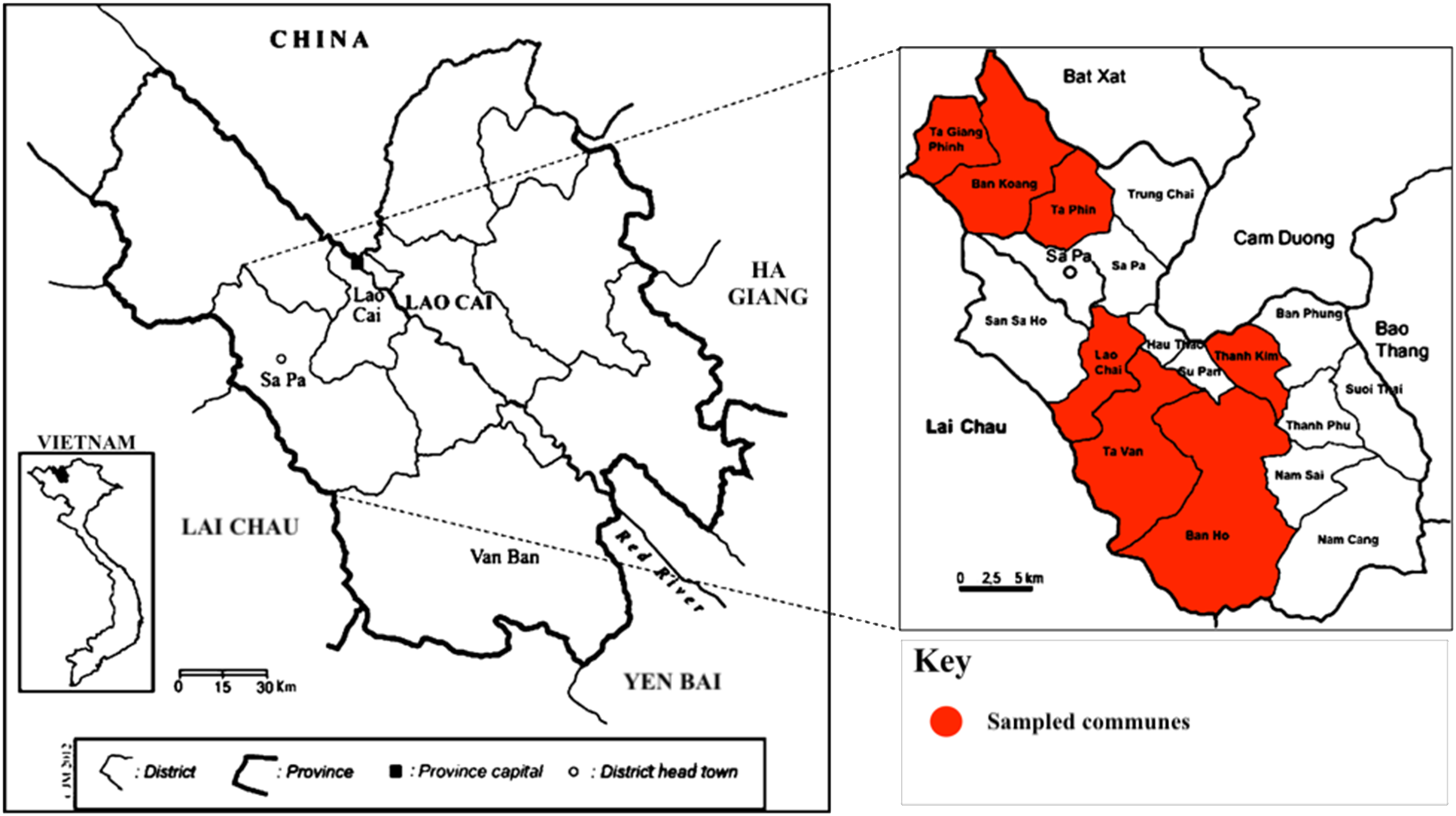
Sampled communes in Sa Pa district, Lào Cai province, Vietnam (Adapted from Bonnin and Turner, 2012: 97; Delisle, 2014: 10; Roche and Michaud, 2000: 106–107).
We frame our analysis through the conceptual lens of human–animal entanglements, a concept that we explore in more depth throughout this paper. This lens allows us to reveal how complex and dynamic environmental, political, and socioeconomic processes are resulting in profound transformations for specific human–animal entanglements, while other entanglements have endured through time. In recent years, the “entanglement” concept has expanded beyond its origins in quantum physics. Barad (2007) introduced the concept from physics to the social sciences, and since then social scientists from across disciplines have engaged with “entanglements” in their research (Hollin et al., 2017). 1 A particularly recent and popular application of the entanglement concept has arisen among scholars undertaking multispecies ethnographies. Entanglement in these more-than-human studies suggests that material and discursive interspecies relations co-create phenomena, a process based on Barad's (2007) conceptualization of “agential realism.” An agential realist approach proposes that reality is neither fixed nor presupposed, but rather that intra-actions among agents produce a world of ever-changing entanglements. Researchers have employed entanglement in this way to examine volunteer shepherding programs in the United Kingdom (Adams et al., 2021), the “virosphere” related to the COVID-19 pandemic (Aronsson and Holm, 2020; Lunstrum et al., 2021), farming practices and perceptions in Canada (Linton, 2019), and the myriad consequences of extinction among particular bird species around the world (van Dooren, 2014), to name just a few. Although most of this research has been based in Global North locales (see also Ginn, 2014; Swanson, 2017), work in the Global South is growing, with studies focusing on the (de)commodification of wild animals at a wildlife rehabilitation center in Guatemala (Collard, 2014), human–elephant coexistence in India and Sri Lanka (Locke and Buckingham, 2016), and more-than-human homemaking practices in Bangladesh (Alam et al., 2018). Nonetheless, to date, we have found no work drawing on human–animal entanglement conceptualizations to better understand human–animal relations in Vietnam, and only a few elsewhere in Southeast Asia, such as Chao's (2022) excellent case study in West Papua. We thus want to start a discussion on entanglement's applicability to understanding the realities, challenges, and opportunities facing ethnic minority farmers in upland northern Vietnam with regard to changing human–water buffalo relationships.
In the northern Vietnam context, the entanglement framework helps us identify what we have termed “unraveling processes.” These important socioeconomic, political, and environmental processes have been challenging human–buffalo ties over the past 30 years, especially in light of the agrarian transition unfolding across these uplands. We find that these processes have been unevenly affecting farmer–buffalo entanglements, largely due to a household's degree of market integration and ethnicity. Through analyzing these processes and their impacts on farmer–buffalo relationships, we tease apart the conceptualization of entanglements to also distinguish “resistant” human–buffalo entanglements that withstand envelopment by such processes. Notwithstanding, such resistant entanglements are not necessarily one-dimensional nor guaranteed, as we also uncover the possibility of “reconfigured” entanglements as farmers and buffalo are further integrated into the market economy.
Next, we outline our methods before briefly reviewing the conceptual literature that informs our analysis. We then illustrate the key contextual elements that continue to shape upland ethnic minority livelihoods and buffalo habitats in northern Vietnam, including farmer–buffalo entanglements. We identify four “unraveling processes,” focusing on the potential for each to impact human–buffalo entanglements. Lastly, we propose two new categorizations which we hope can add nuance to future entanglement research, namely resistant and reconfigured entanglements.
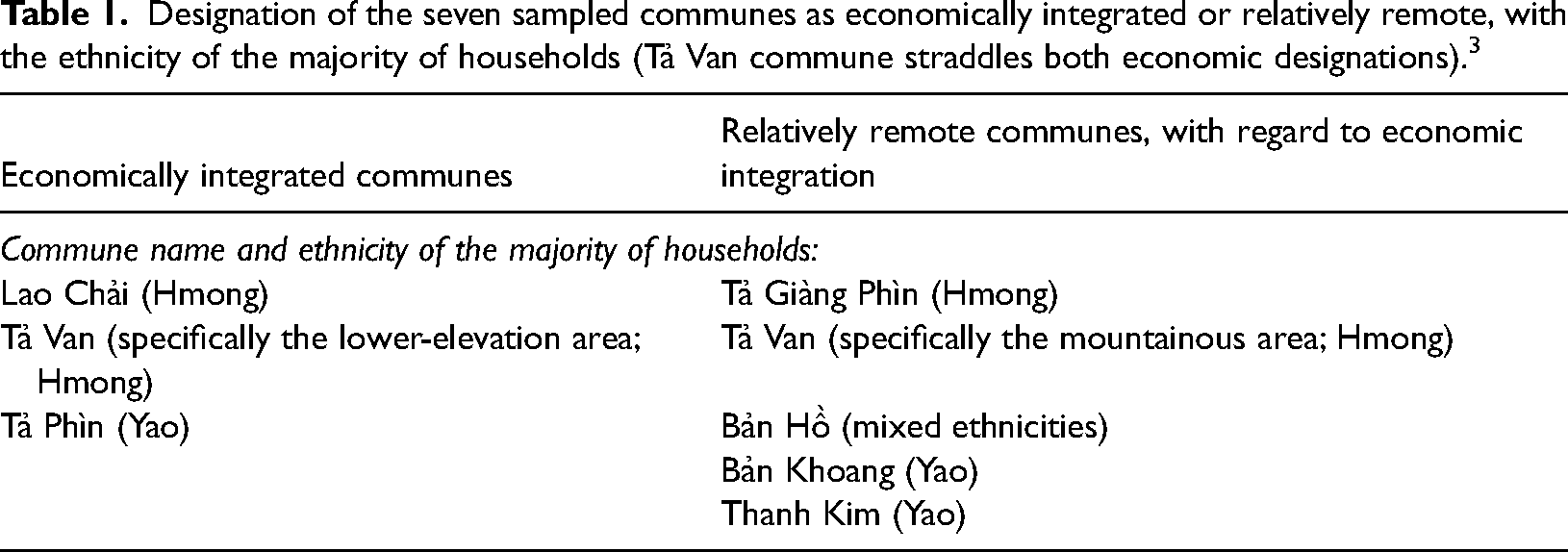
Fieldwork focusing specifically on farmer-buffalo entanglements was completed by the first author in Sa Pa District, Lào Cai Province, Vietnam, during summer 2019. This included 70 in-depth interviews with Hmong and Yao farmers, as well as overt participant observation. Interviewees ranged in age from 23 to 97, with an almost even ratio of women (36) to men (34). Interviews were completed in seven communes (Figure 1). 2 Our sampling strategy for choosing these communes included two main criteria: the commune's degree of market integration (determined by ease of access from each commune to Sa Pa Town, the district head town and home to daily and larger weekly markets); and the commune's dominant ethnic population. The commune's degree of market integration was a crucial factor because tourism, public works infrastructure, and the cash economy have been growing rapidly in Sa Pa District, albeit highly unevenly, with divergent impacts on local communes (Michaud and Turner, 2016). The ethnic composition of the communes was a sampling criterion that allowed us to analyze the degree to which ethnicity and culture may (or may not) have important impacts on human–animal entanglements. Hmong and Yao farmers comprise the two largest ethnic minority groups in Sa Pa District (GSO, 2019). They share fairly similar livelihoods, yet have cultural differences that we outline later. The seven communes where fieldwork was completed are detailed in Table 1.
Designation of the seven sampled communes as economically integrated or relatively remote, with the ethnicity of the majority of households (Tả Van commune straddles both economic designations). 3
Fieldwork was completed with Hmong men and women interpreters who could also understand Yao or with a lowland Kinh (ethnic majority) male research assistant who had worked with upland ethnic minority communities before. Our findings are also underpinned by ethnographic fieldwork undertaken in the same district by the second author since 1999.
Beyond these engagements with local residents, a focus on entanglements in a more-than-human context requires us to pay attention to the agency of water buffalo as well. 4 Attempts to do this in previous multispecies studies have included: a) through ethology, focusing on animal behavior in natural or experimental contexts (e.g., Despret, 2004); b) via semiotics, exploring how humans and animals are communicating/understanding each other through semiotic practices (e.g., Kohn, 2007); and c) focusing on affective relationships (i.e., positive and negative affects) (e.g., Govindrajan et al., 2022; Lobo et al., 2022). To bring elements of these approaches together, we have found it useful to draw on a form of “diffractive methodology.” Giraud (2019: 13) explains this as “two stones being dropped into water. Each stone creates ripples, but as they come together, a more complex diffraction pattern emerges as the two sets of ripples converge and complicate one another. By attending to the pattern that emerges as the ripples meet…it is possible to learn something of the apparatus that produced it.” Thus, if farmers represent one stone and buffalo the other, we can attempt to trace back—at least some of—the patterns of each agent's ripples, doing so by focusing on elements from the three approaches outlined above.
Situating human–animal entanglements
Despite the recent rise in popularity of the entanglement concept among social scientists, physicists have used the term “entanglement” since the 1930s to describe “the most perplexing phenomenon in the bizarre world of the quantum” (Aczel, 2002: xi). In physics, entanglement refers to how two seemingly separate particles can be inherently connected, to the extent that “the measurement of one of them…instantly affects the other particle over any distance” (Brody, 2020: 1). Karen Barad, a theoretical physicist and feminist theorist, pivoted the study of entanglement from physics toward the social sciences in her 1996 essay and then book Meeting the Universe Halfway (2007). In the latter, she presented the theory of “agential realism” (ibid.: 393–394), suggesting: “Events and things do not occupy particular positions in space and time; rather, space, time, and matter are iteratively produced and performed…With each intra-action, the manifold of entangled relations is reconfigured.” Bolstered by Barad's work, anthropologists, in particular, have begun to engage with the concept of entanglement through the theoretical and methodological practice of “multispecies ethnography” (Kirksey and Helmreich, 2010: 545).
Kohn's (2007: 6) notion of an “anthropology of life” reinforced entanglement's adoption and use among anthropologists and other social scientists. Kohn (2007: 3, 6) called for “ethnography beyond the boundaries of the human” toward a “kind of anthropology that situates all-too-human worlds within a larger series of processes and relationships that exceed the human.” Donna Haraway's book When Species Meet (2008) and Anna Tsing's article “Unruly Edges” (2012) further solidified multispecies ethnography as an accepted method in anthropology (see also de Gennaro, 2015). In her book, Haraway (2008: 220) detailed case studies of her ethnographic research on various nonhuman species’ relationships with humans, leading her to assert that: “Co-constitutive companion species and coevolution are the rule, not the exception.” This claim is built on Haraway's previous use of Despret's (2004) term “becoming with,” which signifies the idea that species shape one another (Haraway, 2006: 102). Tsing (2012: 141) extended Haraway's findings through an exploration of the “unruly edges”—points where “interspecies interdependencies” become clear—connecting humans and fungi.
These works have developed the primary conceptual foundations of current multispecies ethnography. Briefly focusing on three studies that have since put these conceptual ideas into practice helps us show how such a framing can, in turn, be useful to explore human–buffalo entanglements. Maurstad et al.'s (2013) investigation of human–horse relationships represents a practical example of how scholars have pursued multispecies ethnography. The authors directly employed Barad's notion of “intra-acting” to show “how naturalcultural practices matter to human and horse being, co-being and well-being” (Maurstad et al., 2013: 323). The authors revealed the entanglements between horses and their riders, which, through a mutual agency, shaped one another in various ways. The emerging product of this entanglement took diverse forms, from physical changes, such as muscle growth for riders and horses, to new emotional understandings, such as developing a shared language between horses and humans (Maurstad et al., 2013). Birke et al. (2004) offered another example of multispecies ethnography in their study of rats used in scientific experiments. Similarly recalling Barad's theory of agential realism, Birke et al. (2004: 167) explained that rats held and used in laboratories could be considered as “a materialization of specific scientific practices and as active participants in the creation of their own meaning.” Humans have bred “lab rats” over generations to express certain traits (e.g., size, color, behavior) in order to reflect and satisfy the standardizing desires of scientists; simultaneously, lab rats have influenced the scientific process themselves by possessing “favorable”/“unfavorable” traits that scientists wished to breed for/out, as well as requiring particular laboratory equipment for their life and death (e.g., cages, food, restraining, and killing devices) (Birke et al., 2004). These animals have even come to represent what a person might think of when they imagine a “laboratory” (Birke et al., 2004). Finally, Collard (2014: 162) implemented a multisited ethnographic approach in a commodity chain analysis of the exotic pet trade, which revealed how “humans and animals are fundamentally materially and discursively entangled.” Wild animals and humans are thus brought together when humans take wild animals from their natural habitats, physically modify their bodies (e.g., clipping wings and declawing), trade them internationally, and facilitate their dependence on human care (e.g., food and shelter) (Collard, 2014).
As such, authors and multispecies ethnographers including Barad (2007), Kohn (2007), Haraway (2016), and Tsing (2012; also see Tsing et al., 2017), as well as those who have continued to develop these ideas, have referred to entanglement in a range of different, albeit relevant ways, to how we understand entanglement in this paper. Broadly, these focus on the inherent ties and intra-actions that bind and reproduce biotic and abiotic phenomena (e.g., the roles of biodiversity and landscapes in maintaining life on earth). Yet, while these authors have considered entanglement as indicating a degree of co-dependence between entities, other academics, including Scott (2011) and Hodder (2016), have defined entanglement differently. The latter have considered entanglement as human dependence on entities (e.g., human reliance on animals, plows, soils, and weather patterns to grow food), focusing more explicitly on the seemingly one-sided aspect of humans’ entanglements with their surroundings. In fact, these authors have argued that increasing entanglements work to “entrap” humans in states of dependency, by pulling them into deeper and more complex relationships of “care for things that is entrapping” (Hodder, 2016: 1). Moreover, while discussing his conception of “entanglement,” Hodder (2016: 102) also defined “disentanglement” as “a solution to intractable and messy problems” for humans, which stem from entanglements and the ultimate possibility of entrapment. With the view that entanglements lead to dependency and entrapment, Hodder (2016) presented disentanglement as a way “out”—a means to free humans from their ever-increasing need to “care for things.” As we will show later in this paper, the complex relationships we found emerging between humans and animals in upland Vietnam did not appear to be entrapping or freeing along the lines of Hodder's (2016) arguments. Instead, we found a more complex set of processes at play that we frame within Barad's (2007) notion of intra-actions.
More recently, in her book What comes after entanglement?, Giraud (2019) revisits the theoretical foundations of the multispecies ethnographers highlighted above, including an exploration of whether more-than-human studies have been able to overcome the anthropocentric tendencies of much social science work to date. Giraud (2019) carefully questions how scholars identify entanglements as well as the practical consequences of considering the world as a culmination of irreducibly complex relations. Although largely agreeing with the co-constitutive premise of entanglements adopted by earlier multispecies ethnographers, Giraud (2019) asserts that a relational portrayal of reality—namely, relations of entanglement—necessarily excludes some entities and agencies in their description, complicating the ethical positions that entanglement research has sought to uphold and confusing the ideological propulsion of political interventions through activism. Giraud (2019) explains that these exclusions should not only be recognized but also emphasized, to prevent further exclusions and to refine entanglements from being an overwhelmingly complex concept (with these exclusions) to a pragmatic tool with the potential for meaningful political intervention through activism.
Hmong and Yao farmers and water buffalo in upland northern Vietnam
The Socialist Republic of Vietnam (SRV, 2010) acknowledges 54 ethnic groups (dân tộc or “nationalities”) living within its borders, one being Kinh, the ethnic majority lowland Vietnamese. Kinh comprised roughly 85% of the country's total population of nearly 96 million people at the time of the 2019 census (GSO, 2019). Vietnam's northern provinces, including our study location of Lào Cai Province, are home to an important proportion of the country's ethnic minority groups (dân tộc thiểu số or “minority nationalities”; Michaud, 2009; GSO, 2019; Figure 1). Around 66% of Lào Cai's total population (730,420) consists of ethnic minorities, belonging to over 20 different groups (GSO, 2019). In Sa Pa District (pop. 65,700), Hmong and Yao ethnic minorities—the focus populations of this study—comprise just over 35,000 and 14,000 individuals, respectively (GSO, 2019).
Hmong and Yao ethnic groups share many commonalities, including historical ties to southern China, linguistic connections to the Miao-Yao language family, as well as livelihood adaptations to high-altitude terrains (Michaud et al., 2016; Tapp, 2001). Hmong and Yao households living in northern Vietnam historically rooted their livelihoods in subsistence-oriented shifting cultivation practices, periodically moving their villages while typically growing dry rice, maize, beans, and cassava (McElwee, 2004; Sowerwine, 2011). Although shifting cultivation has essentially ceased among these groups, rotational swiddening across a specific land area is still sometimes practiced, and Hmong and Yao commonly engage in other subsistence activities such as animal husbandry, horticultural gardening, and collecting forest and non-timber forest products (Turner et al., 2015). Small-scale trade is often part of these livelihoods as well.
Wet rice cultivation comprises a common core livelihood strategy among Hmong and Yao households across these uplands where the agroecological conditions allow, with water buffalo providing the draft power needed to plow the terraces for this crop (Nguyen Van Thang, 1995). Since 1998, many ethnic minority households in Lào Cai Province have begun planting hybrid rice and maize seeds that have been strongly promoted by the state (Bonnin and Turner, 2012). As these hybrid seeds need to be purchased annually (they are generally infertile past one generation) and require large quantities of chemical pesticides and fertilizers, households have needed to find regular sources of cash-income to pay for these new agricultural inputs (Bonnin and Turner, 2012). This requirement has been a key factor in driving an important agrarian transition in the region, which has also seen growth in cash cropping, labor migration, and other forms of livelihood diversification (Slack, 2020).
Although small-scale trade has long been a part of these households’ semi-subsistence livelihoods, several income-generating activities have become increasingly relied upon in order to cover these new agricultural expenses and other recent costs (e.g., motorbikes, cell phones, school and health costs, among others). Small-scale trade often includes selling animals, both domesticated (e.g., water buffalo, pigs, chickens, ducks, and goats) and wild (e.g., songbirds), forest and non-timber forest products (e.g., honey, mushrooms, bamboo shoots, orchids, and fuel wood), as well as home-distilled alcohols (Po et al., 2020). Cultivating and trading black cardamom also constitutes an important form of cash-generation among upland households with access to forest cover (Rousseau et al., 2019). As an alternative to farm- and forest-based trade opportunities, some Hmong and Yao individuals sell textile handicrafts to tourists, guide tourists on treks to local hamlets, and engage in waged work (e.g., tourism-linked construction work and farm laboring) (Turner, 2012).
Animal husbandry represents a particularly dynamic aspect of Hmong and Yao livelihoods. Larger domesticated animals, including water buffalo and pigs (and formally horses, but far less so today) have traditionally been wealth and status symbols and continue to be offered in a range of shamanistic ceremonies. Water buffalo also provide productive labor for plowing land, notably enabling farmers to cultivate incredibly steep and narrow rice terraces. Water buffalo possess a range of other important uses, including the provision of manure for cooking fuel and soil enrichment, meat and other organs for food, as well as hides, horns, and other body parts used for tools and rituals (Bonnin, 2011; Sowerwine, 2004a; Figure 2). Buffalo are a key component of Hmong and Yao social lives as well. For example, buffalo can be forfeited to resolve “a transgression of cultural values and norms” and given to another household to right a serious wrong; they are also sacrificed (more commonly by Hmong) at significant “life-cycle ceremonies…and curing rituals” (Bonnin, 2011: 244–245, 247). Hmong and Yao households have also typically gifted or exchanged water buffalo via marriage payments, inheritance, and/or barter and trade among local households who might need buffalo for work or sacrifice. Kinship, personal networks, and trust fundamentally facilitate such exchanges (Bonnin, 2011).
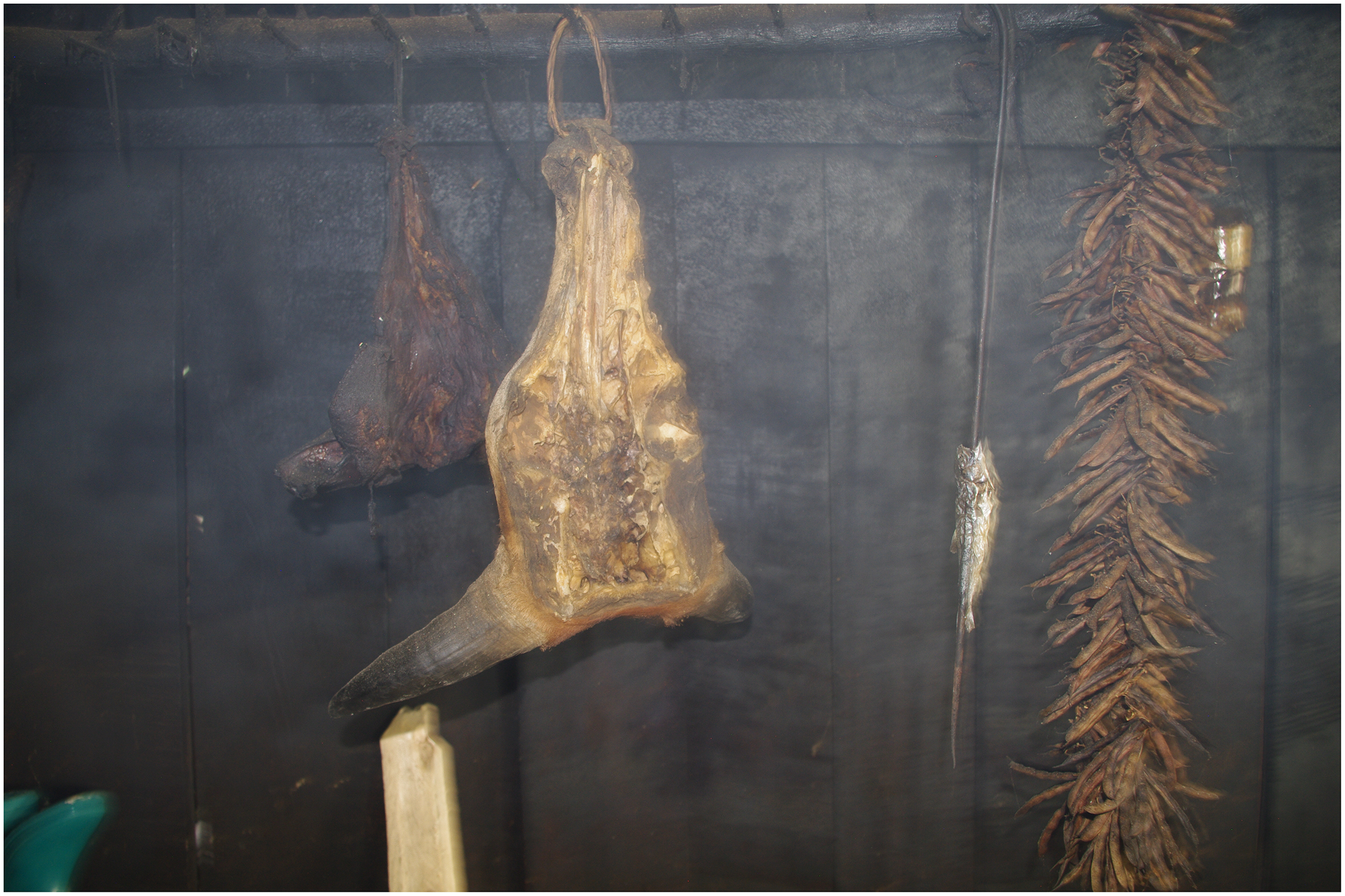
Buffalo head and meat, along with chilies and fish, drying over an open fire.
With market integration intensifying in recent years, water buffalo have been recognized as significant embodiments of living financial capital, for an increasing range of circumstances. This begins to highlight their changing relationships with people who have incorporated them into their lifeworlds for generations, as explored next.
Four processes unraveling long-standing entanglements
Our interviews and observations clearly indicated that a number of customary human–buffalo entanglements are long-standing. The vast majority (over four-fifths) of Hmong and Yao individuals who participated in this study confirmed that buffalo still hold important, often essential, roles in their lives and livelihoods. These roles range from plowing rice terraces, being fundamental to shaman rituals, and/or being able to be counted or “liquidated” as a financial asset. Nonetheless, interviewees also described four processes that have had “unraveling” effects on their traditional entanglements with buffalo.
By “unraveling” we refer to what could be considered the opposite processes of entanglement; namely the reverse of “the constitutive mutualities of…dynamic interrelations” (Locke, 2018: 1). Viewing the connections between farmers and buffalo through this lens, we find that increasing extreme weather events, market integration, land constraints, and rising rates of school attendance for children are contributing to the reduction or loss of the “constitutive mutualities” that have tied farmers and buffalo together for generations. These unraveling processes incentivize farmers to raise fewer buffalo, in turn reducing the number and complexity of connections and intra-actions—or entanglements—that can arise between farmers and buffalo, as well as the number of phenomena that are produced from their intra-actions. In some cases, these processes have caused important damage to the livelihoods of Hmong and Yao farmers, as well as to buffalo health and longevity. In other cases, Hmong and Yao interviewees have adapted to and/or taken advantage of the changing nature of farming and “making a living” in Sa Pa District, again with concurrent ramifications for buffalo. It is important to emphasize that these “unraveling processes” have not eliminated interspecies entanglements between buffalo and farmers. We instead suggest that a microscale analysis of these four unraveling processes for farmer–buffalo entanglements allows for a more nuanced understanding and appreciation of how these entanglements are being reworked and modified in some circumstances. This is creating new forms of intra-actions, which we examine after exploring these four processes.
Dire impacts of extreme weather events
Interviewees from each of our sampled communes identified an increasing frequency of extreme weather events in Sa Pa District since the mid-2000s, especially cold spells and snowstorms. Although interviewees noted that such events were not new to the region, they asserted that extreme weather events had become far more frequent, intense, and destructive. Mr Di, 5 a Hmong man in his 30s from the mountainous section of Tả Van commune, captured this point: “I’d heard about tigers and wolves killing buffalo, but before 20 years ago, I’d never heard about winter killing buffalo.” Interviewees consistently mentioned the winter of 2008 as particularly intense and destructive. Mr Tien, a 32-year-old Yao man from Tả Phìn commune, explained: “We had cold weather when I was a kid, but it wasn’t so bad that it’d kill a lot of buffalo. It started from 2008.” With the growing threat of extreme winter weather, farmers’ concerns, as well as recent government interventions in response to such weather events, are spawning two contrasting responses among upland farmers: first, try to safeguard buffalo from the cold, or second, buy a mechanical plow to complement or replace buffalo.
Although techniques for safeguarding buffalo from extreme winter weather can be successful, they require much effort and highlight the need for farmers to carefully interpret animal behavior and responses to environmental conditions (cf. Despret, 2004). For buffalo to survive such weather events, farmers must cut, gather, and store months of buffalo fodder to have adequate supplies. Many have also built new shelters for buffalo and use blankets or recycle large discarded fertilizer bags to cover buffalo in the cold. Some farming households have even patiently sheltered large, non-house-trained buffalo in their homes to avoid the cold, often for extended periods of time. Even though the likelihood of losing buffalo may be reduced by employing these efforts, risks remain high. Mr Tee, a 75-year-old Hmong man from Bản Hồ commune, offered an example: “We’ll let our buffalo into the house to stay warm, but if the buffalo has a broken leg, the temperature change [from outside to indoors] could be too fast and kill it.”
The high levels of resources and risks involved in safeguarding buffalo from extreme weather conditions have led some households to turn to a second response—machines—to meet their plowing needs, with mechanical plows either used to complement their buffalo or replace them altogether. Noting his concerns about extreme weather events, Mr Fou, a Yao man in his 40s from Tả Phìn, remarked: In 2008, I lost five buffalo and three cows. Since then, I’ve used a mechanical plow because I didn’t want my animals to die anymore…Buffalo could die even if people prepare three months of grass for them. Tả Phìn has 117 households, but now just ten households raise buffalo…Each year, some households sell five to seven buffalo because they’re afraid that next year will be cold again.
Market integration of a governmental persuasion—The rise of mechanical plows
The number of Hmong and Yao farmers in Sa Pa District using mechanical plows has grown dramatically since the mid-2000s, following a series of state interventions. These interventions were, in part, a response to this rise in extreme weather events affecting buffalo well-being and survival across the province. Mr Tien, introduced earlier, explained: Around 2008, when the first severe snow came to Tả Phìn, the government gave some groups of four to five really poor households new mechanical plows to share…It was a government plan to help people who lost their buffalo because of the cold weather. Before that, there was no plan.
This government initiative is part of the “Program for Socio-Economic Development in Communes Facing Extreme Hardship in Ethnic Minority and Mountainous Areas (2006–2010)” (de Groot, 2011). 6 This Program sought to “promote household-level production skills, economic livelihoods, and market integration” (Mearns et al., 2007: 33). A wide variety of Program initiatives, including the provision of physical tools, workshops, and services, were aspects of the state's aim to encourage higher levels of productivity and monetization among upland farmers. The Program's provision of agricultural technology—particularly mechanical plows—has been an important factor in unraveling the entanglements between Hmong and Yao farmers and their buffalo.
For Hmong and Yao households whose buffalo died or became too frail to work, the mechanical plows supplied through this Program eliminated a process inherent to traditional farmer–buffalo entanglements. Instead of replacing their lost/frail buffalo using their own resources and social networks, many low-income households “qualified” to be provided with this—incomplete—mechanical substitute by the government. When households would lose buffalo or need extra buffalo labor in the past, they would typically borrow buffalo from family members or neighbors, sometimes in exchange for personal labor or rice. Mr Tien confirmed: “Before I had a machine, I’d borrow my brother's buffalo.” These types of reciprocal relationships around buffalo have now been interrupted by the introduction of mechanical plows in notable ways.
Although mechanical plows have disrupted the cycle of borrowing, bartering, or trading buffalo in these uplands, they have also initiated new relationships of cooperation between households. For example, Mr Kao, a Yao man in his 40s from Thanh Kim commune, described how village households now access mechanical plows and settle repairs: I’m the manager of a mechanical plow in a group of five households. If someone needs to use the machine they call me…There are no problems between us. If the machine goes wrong…the five households gather and contribute money to fix it.
Government interventions have been a notable motivating force behind the adoption of mechanical plows and the gradual decline of long-held working relationships forged between buffalo and farmers in and beyond the rice fields. As noted above, since the government's introduction of mechanical plows, authorities have sometimes supplied these machines for free following severe snowstorms, specifically during the winters of 2013 and 2016, as a sort of ad hoc extension of the initial state Program (Interviews, 2019). Over the years, such interventions have steadily normalized the use of mechanical plows, with many households deciding to purchase their own machine. Ms Sai, a Yao woman in her 50s from Thanh Kim commune, outlined why households in her hamlet started to buy their own machines: “The government provided one mechanical plow for three or four households to share. We felt that the machines were convenient, and we started to buy them.” Mr Di, a Hmong man introduced earlier, identified a similar process of adoption: “Five or six years ago, no one in this village used mechanical plows. But when the government gave one machine to the village leader to try, people wanted to start using them.” Compounding these impacts of extreme weather events and government interventions, we also found decreasing access to land to be posing a spatial threat to Hmong and Yao households’ long-standing entanglements with buffalo, analyzed next.
Less land, less buffalo
According to interviewees, three main processes have contributed to diminishing land resources across Sa Pa District: population growth; the implementation of increasingly restrictive conservation policies; and infrastructure development. Mr San, a 50-year-old Yao man from Thanh Kim commune, summarized the consequences of local population growth: “Before, families had around ten buffalo, but now there's less grassland and places to graze them…The [human] population has grown, and people are building houses and rice fields.” Informants from all of the sampled communes noted this trend of population growth, with similar impacts on the ability of households to raise buffalo in each location. Mr Saw, a Hmong man in his 70s from the mountainous section of Tả Van commune, illustrated these ties: Now, there are more people in my village, so there are more farms, less grasslands, and less buffalo…The population growth has just been natural. When I was a kid, there were five families here, and now there are more than 100 families.
The Vietnamese government has also pursued specific conservation policies restricting the activities and movements of Hmong and Yao households, again affecting long-standing human–buffalo entanglements. 7 All of the sampled communes are either within or border Hoàng Liên National Park, meaning that inhabitants are subject to Park regulations restricting the clearing and collecting of forest resources (Nguyen Ha Anh and Tran Tri Thu Ha, 2017; Turner, 2012). These restrictions have interrupted a traditional function of buffalo for farmers, namely hauling timber, in turn possibly reducing buffalo strength and stamina. Mr San, introduced earlier, explained: “Before, we used buffalo for transporting wood, but now there's no available wood…The government doesn’t allow people to destroy the forest.” Beyond collecting wood, households are not permitted to graze buffalo inside Hoàng Liên National Park, eliminating historical grazing lands. In response to such restrictions, farmers are either decreasing the number of buffalo they own or, more significantly, being deterred from raising buffalo altogether.
Infrastructure development has also decreased farmers’ access to the land needed to graze and raise buffalo. Many new infrastructural projects underway or recently completed throughout Sa Pa District are products of the area's rapid rise “into one of the most desirable [tourist] destinations for the country's growing urban middle class” (Michaud and Turner, 2017: 38). Tourism projects, including large resorts, hotels, scenic lookouts, and a cable car to the top of nearby Fansipan mountain and its terminals, have increasingly occupied land surrounding Sa Pa Town. Other infrastructure projects such as new and widened roads as well as the construction of a number of small-scale dams and reservoirs have also taken valuable farming and grazing land. These projects have had notable impacts on households living in two of the locations sampled in this study, Thanh Kim commune and the mountainous reaches of Tả Van commune. In Thanh Kim, Ms Choi, a Yao woman in her 40s, listed several factors contributing to the enclosure of land around her hamlet: The population's increasing, more people make corn fields and rice fields, and this company [Topas Ecolodge] doesn’t allow us to use this area [pointing to a hill opposite her home]. Before, we’d graze our buffalo here, but now this company's here.
Topas Ecolodge claims to be “committed to producing real sustainable benefits” for both the people and places surrounding the up-scale tourist lodge, and the company can claim a number of successes (Topas Ecolodge, n.d.; Interviews, 2019). However, the Ecolodge also spans eight hectares, removing important buffalo grazing land from local farmers. Ms Thi, another Yao woman in her 40s from Thanh Kim, explained how some households have responded: “Now, there are less buffalo. If someone doesn’t have a buffalo, they’ll use machines…Maybe two-thirds of households in Thanh Kim use mechanical plows.” Other interviewees from Thanh Kim noted that many of the households owning mechanical plows still keep buffalo, but that a combination of factors including the reduction in grazing land due to the Ecolodge and population pressures, coupled with rising concerns over extreme weather events, was reducing the number of buffalo kept by each household.
Across the Mường Hoa Valley to the west, on a high mountain ridge, the reduction of farm and grazing land in the mountainous section of Tả Van commune started in 2007, due to the construction of the Seo Chong Ho Hydropower Project. The dam and reservoir, operated by Vietnam–China Power Investment Company Limited, appropriated about 63 hectares of land (Clean Development Mechanism, 2012: 2; Dao Trong Tu et al., 2013; Department of Culture, Sports and Tourism of Lào Cai, n.d.). On a walk around the reservoir's circumference, Mr Thao, a Hmong man in his 30s from the upland part of this commune, detailed: “Before, all this land belonged to us. We could farm, we could do anything. But now, they took all this land.” Mr Thao elaborated that this loss of land has meant a shortfall of buffalo grazing terrain as well as less land for growing rice and/or maize (the stalks of which are fed to buffalo). Similar to households in Thanh Kim, mechanical plow ownership and utilization are growing. However, in these mountainous reaches of Tả Van, many households also continue to raise buffalo, albeit herd sizes are decreasing. Mr Thao added: “The majority of people in my village use buffalo, and although some people use mechanical plows, they still have their buffalo because they love their buffalo…The buffalo kept by these people aren’t for working.” Such reflections point to the profound values buffalo still maintain as spiritual and economic assets for local ethnic minority farmers.
Changing childhoods
We found that as farmers reduce their buffalo herds across all our commune study sites, certain activities, relationships, and emotions are either beginning to fade away or, we suggest, could do so in the near future. Although having impacts across generations, it is worth noting how changes in ethnic minority childhoods, combined with decreasing numbers of buffalo, are impacting the experiences of children and buffalo. In the past, it was commonly the task of children to tend to buffalo and take them to graze and bath, with children from different households often playing together at the same time (Figure 3). Although school attendance for ethnic minority children in Lào Cai Province remains relatively low compared to Kinh children there and elsewhere, school attendance has nonetheless increased for ethnic minority children in recent decades (SRV, 2010). This has resulted in children having less time available to tend to buffalo, and adults having to step in. The affective relationships between buffalo and caretakers have thus changed as buffalo caretakers’ tendencies, priorities, and leniencies, shift from those of children to adults (cf. Govindrajan et al., 2022). This unraveling also reflects a generational loss of farming knowledge among some of today's children, who no longer learn to care for, use, or value buffalo in the same ways that their parents did in their childhoods. Yao and Hmong parents expressed mixed feelings about their children's possible growing alienation from buffalo. Although some were concerned that their sons, especially, would not know how to tend to these animals and care for them, particularly if the buffalo became sick in the future, others were more accepting of these changes.
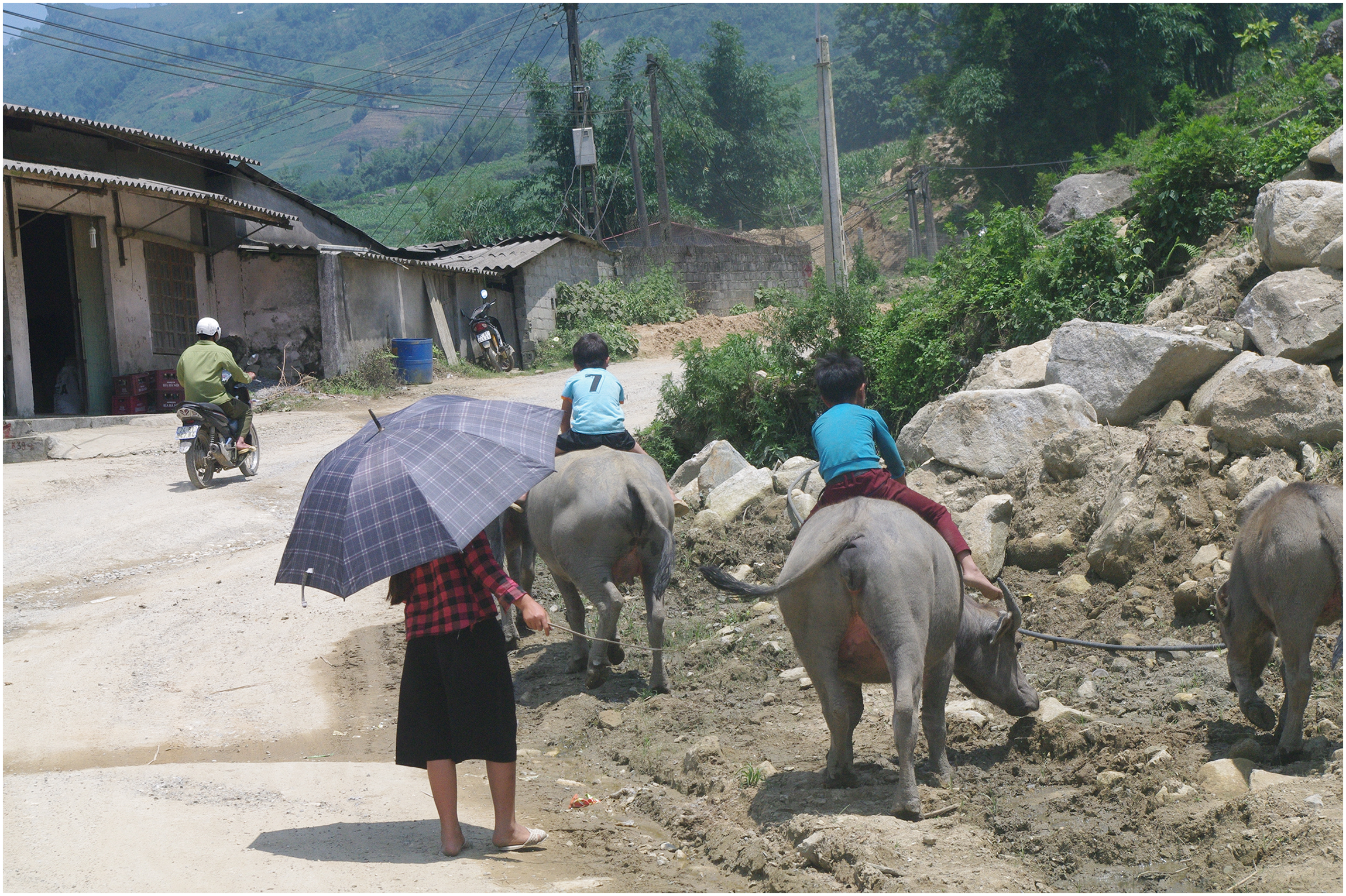
Children riding buffalo.
Uneven consequences of unraveling processes
It is crucial to highlight how the aforementioned processes have been unfolding unevenly across ethnic minority farming households in Sa Pa District. One causal factor has been differences in the extent to which communes are integrated into market relations. This is closely related to how near households are to roads for easier access to marketplaces and trade opportunities, which is influenced by local topography. Another factor is ethnicity. Both factors are important indicators of whether long-standing human–buffalo entanglements have endured or weakened over time. Specifically, we found that Hmong households living in steeper, more remote areas, from which it takes far longer and more effort to reach marketplaces, have maintained stronger entanglements with buffalo. In comparison, these entanglements have become relatively weaker among Yao households living in flatter, more market-integrated areas.
Although Hmong and Yao communities have typically lived at high elevations in Vietnam (Culas and Michaud, 2004; Sowerwine, 2004a), particular communes or even household clusters (hamlets) within the same commune can be located in quite different topographies. Between and even within the sampled communes in Sa Pa District, agroecological and climatic conditions varied from warm, humid, flat, and naturally well-irrigated lands, to cool, dry, and steep lands. These conditions have resulted in diverse livelihood activities ranging from plum and grape cultivation in relatively low-lying and flat areas of Tả Phìn commune, to cold-water aquaculture in the hamlets in the highest reaches of Tả Van commune.
Similar to the ways these environmental conditions have permitted, hindered, or negated certain livelihood activities, they have also influenced the practicality of using mechanical plows and tills as a supplement or replacement for buffalo when preparing land for terraced rice farming. Farmers tend to continue to enlist buffalo where their land is uneven and steep. Mr Hin, a Yao man from Thanh Kim commune introduced earlier, confirmed what many other farmers also conveyed: “Terraces in Thanh Kim are often uneven, with one side of the terrace being far higher than the other side, which makes buffalo better to use here.” Alternatively, mechanical plows/tills are considered faster and more efficient (no need to feed them) where the land is flatter. Although farmers did complain about the frequency with which mechanical plows break down, many farmers had also been quick to find innovative and inexpensive ways to repair them.
Partly related to the characteristics of local terrain, and partly due to road infrastructure and physical distance, households in the sampled communes also differed in their connectivity and degree of economic integration with Sa Pa Town. This impacted their ability to trade easily with others from outside their immediate surrounds. The economically integrated communes of Lao Chải, Tả Phìn, and Tả Van (in its lower-lying areas) occupied flatter and lower-elevation terrain and also received larger flows of tourists, compared to their remote and more mountainous counterparts of Thanh Kim, Bản Hồ, Bản Khoang, Tả Giàng Phìn, and Tả Van (in its higher-elevation portions).
We found that Hmong and Yao households in more economically integrated communes raised and owned fewer buffalo than households in more remote areas. Households in integrated communes had easier road access, and many had established tourism-related handicraft shops, restaurants, and/or homestays. Although these activities increased their sources of cash income and hence their degree of market integration, they also reduced buffalo grazing land, as well as the time that household members had available to tend to buffalo and other domesticated animals. When asked about the proportion of buffalo ownership among households in Tả Van commune, compared to the relatively integrated commune of Lao Chải, Mr Keej, a Hmong man in his 50s from Lao Chải, estimated that around 70% of households in Tả Van's remote hamlets continue to own buffalo, in contrast to only 10–20% of Lao Chải households. Hmong households comprise the primary populations of both these locales, thus these differences in buffalo ownership emphasize the role that terrain, and in turn, economic integration, play in strengthening or weakening human–buffalo entanglements.
Nonetheless, ethnic identity—with its potential to inform cultural, spiritual, and social aspects of everyday life—certainly factors into whether farmer–buffalo entanglements remain long-standing or are unraveling. Yao interviewees generally indicated a greater willingness to sever ties with buffalo than Hmong interviewees. This is not too surprising given the greater importance and frequency of buffalo use in Hmong cultural customs and especially shamanistic practices compared to the Yao in Sa Pa District. Such an observation reinforces the argument that the degree of human–animal entanglements often extends far beyond economic rationality exclusively, to include other diverse dimensions of human life such as one's ethnicity, culture, “embodied history” (habitus), and location (Bourdieu 1977: 52; Lutz and Lux, 1988). This finding directly reflects Giraud's (2019) call to focus on the exclusions inherent in entanglements. In this case, examining the increasing exclusion of Yao farmers from these entanglements reveals the cultural, environmental, and geographical reasons as to why. A number of Hmong interviewees emphatically noted that they continue to raise buffalo—despite the availability of inexpensive and effective plowing alternatives—due to the continued centrality of buffalo to both spiritual customs and rice cultivation. In comparison, several Yao interviewees attested to their waning need for the animal altogether. Mr Di, a Hmong man in his 30s from a high-elevation hamlet in Tả Van commune, illustrated this point when asked whether he would keep buffalo in the future: “Even though I have a mechanical plow, I’ve still kept my buffalo. When the machine goes wrong, I could use my buffalo, and either way, I still need buffalo to sacrifice on special days.” Conversely, Mr Tien, a Yao man in his 30s from Tả Phìn commune, responded to this question by asserting: “I’m sure there’ll be no buffalo here in twenty years’ time.”
Newly emerging human–buffalo entanglements
Resistant entanglements
When upland Hmong and Yao farmers and their domesticated buffalo meet, they transform each other and create a range of new realities. This reflects Barad's (2007) description of “intra-action,” in which entangled agencies, whether humans, animals, or otherwise, iteratively change one another and their surroundings. In contrast, interaction denotes the idea that entities are inherently separate, meaning that they do not necessarily alter each other or their surroundings upon meeting, but rather leave themselves and their environments unaltered (Maurstad et al., 2013). Although a surface investigation of human–animal relationships often results in findings of interactions, we contend that intra-actions are occurring through important, even if somewhat abstract, processes that impact people, animals, and places in the mountainous uplands of northern Vietnam.
We found multiple connections between the farmers whom we interviewed and water buffalo, spanning working, economic, and spiritual relationships. Moreover, buffalo continue to contribute to important nutritional, social, and medicinal aspects of human everyday life. Everything from successful rice cultivation to a household's wealth and status, not to mention mystical communication with supernatural entities, revolves around the presence of buffalo. Interviewees were quick to note the intimate relationships that they form with their buffalo, as the farmers raise them and teach them commands for ploughing and tilling. Buffalo are trained to work in rice terrace fields from about three to four years old and respond to commands including up, down (for navigating terraces), stop, go, right, and left. Much as Maurstad et al. (2013) talked about developing a shared language between horses and humans, Hmong and Yao farmers do the same with their buffalo, with buffalo consciously responding to learned commands (see also Kohn, 2007).
Ms Cua, a Hmong woman in her 80s from a lower-lying hamlet in Tả Van commune, remarked: “Every [Hmong] family should have a buffalo. You can earn a bit more money if you have more buffalo, and then you have farming, rice paddies, and you can make a house to have a better life.” Mr Saw, a Hmong man in his 70s from a mountainous hamlet in the same commune, added categorically: “You always need a buffalo to kill for a wedding or funeral.” In both of these cases, the intra-actions of humans and buffalo create new phenomena: the possibility of cultivating wet rice (tilling and plowing terraced rice paddies), and the generation of spiritual phenomena deeply tied to Hmong lifeworlds (through ritual ceremonies for social institutions such as weddings and funerals). Yao and Hmong farmer interviewees added that while the financial value of their buffalo reflects the amount of cash the animal can fetch if sold, such value is also central to Hmong and Yao endogenous conceptualizations of wealth, prestige, and social status.
Hmong households’ sacrifice and use of buffalo in shamanistic rituals represent additional examples of how the intra-action of humans and buffalo creates new phenomena (Tapp, 1989). 8 The need to either heal or honor a loved one brings together buffalo sacrifice, the use of buffalo horns (yaj kuam yeeb kuam in Hmong), and the meeting of shamans, buffalo, and household members, spawning phenomena in both physical and supernatural worlds. The resulting phenomena from these spiritual interspecies intra-actions are myriad. People gather, customs and beliefs are reinforced while using parts of buffalo during these rituals, and buffalo meat is shared, helping to build social and kinship connections among community members. Buffalo spirits also help ill individuals or guide human spirits on their way to yeeb ceeb (the “unseen world”). Ms. Lu, a Hmong woman in her 20s from Lao Chải, explained: “We need to keep the buffalo for the funeral day when a person passes and goes away. We need to kill the buffalo…If the person is from the older generation, like a grandmother, the family needs to kill two or three buffalo.” The specific ways in which humans and buffalo intra-act, namely when a person's status dictates the number of buffalo to be sacrificed, generates different realities in this world (e.g., the sacrifice of more buffalo and the attendance of more people), and in the “unseen world” (e.g., more buffalo guiding the spirits of higher-status individuals).
Following Barad (2007), the entanglements outlined above reveal intra-actions of humans and buffalo that have endured over time, with elderly farmers recounting stories of these connections from over 50 years ago or more. The experiences and involvements that flow from the meeting of these human and animal agents are dialectically intertwined with the agents themselves. Without humans or buffalo, these experiences could not be produced or reproduced. In this way, many Hmong and Yao households in upland Vietnam, the buffalo they raise, and the variety of physical and metaphysical experiences that both humans and animals create and engage with every day, are entangled with one another. Despite the four unraveling processes described above, such entanglements have endured due to their resistance.
Hodder (2016) argued that entanglements need to be reexamined through time to understand whether recent entanglements represent steps toward a more complete entrapment with “things” and the market. In defining entrapment, Hodder (2016: 142) elaborated: “It becomes very difficult, costly in economic, social and cultural terms, to disentangle things and go back to the beginning.” Thus, increasing human entanglements with the market render a return to previous livelihoods impractical. Yet, in the case of Hmong and Yao farmers and buffalo, farmers appear to have kept this supposedly inevitable, complete entrapment at bay, forging interspecies entanglements that not only support their need to engage with the market but also help to buoy their long-standing livelihoods and cultural needs.
Rather than reflecting a conceptualization of complete entrapment, all of the Hmong and Yao farmers whom we interviewed continue to practice semi-subsistence livelihood strategies, of which only one element includes engagements with the market economy. Thus, despite increasing human–animal entanglements with the market, Hmong and Yao farmers’ deep connections with semi-subsistence-oriented agriculture work to subvert the forces of entrapment, and also to reaffirm culturally appropriate livelihoods in a rapidly transforming place. This reflects Stern's (1987) idea of “resistant adaptation,” summarized by Korovkin (1997: 91) as a process by which people “adapt themselves to cultural values and institutions imposed on them by powerful external actors while also preserving many elements of their own culture” (see also Singh, 2018). Although this study highlights the challenges—environmental, state policy-driven, and economic—that upland Hmong and Yao farmers face now and undoubtedly in the near future, this research also confirms how these communities continue to maintain and adapt human–animal entanglements that best fit their ongoing livelihood needs and lifeworlds. Building on this idea of “resistant adaptation,” we consider these continued, albeit adaptable, farmer–buffalo entanglements as examples of “resistant entanglements.”
Reconfigured entanglements
Human–buffalo entanglements in Sa Pa District were relatively unchallenged until about 30 years ago. Confronted by the four key unraveling processes detailed earlier, we found that location, including market access and agroecological and climatic conditions, as well as ethnicity, have become important factors indicating the degree to which human–buffalo entanglements have been unraveled or remained resistant. However, we suggest that a second form of entanglement could arise in the near future: “reconfigured entanglements.” We refer to these entanglements as reconfigured because the entangled actors remain the same—humans and buffalo—though changing market forces could result in altered nodes and modes of connectivity. This idea furthers a process identified by Collard (2014) and Giraud (2019), in which new commodity-based relationships arise from the demise of others.
Hmong and Yao farmers in Vietnam have long bartered and/or sold their buffalo. However, the recent and intense pull of market forces could transform these long-standing human–buffalo entanglements in important ways, creating a greater number and diversity of connections between people, animals, and the market. Interestingly, it has been the changing values of buffalo by “outsiders,” namely lowland, higher-income Kinh populations, that have accelerated the possibility of this potential reconfiguring. This group, especially due to their growing tourism numbers in the uplands and increased demand for “safe” and “high-quality” meat (Hansen, 2018), now value highland meat far more than in the past and has notably contributed to changing market forces.
Since the early 2000s, the rapidly increasing influx of domestic Kinh tourists to Sa Pa District has been creating demand not only for Sa Pa's vistas of mountainous landscapes and cooler climate but also for its local specialties, such as orchids, distilled alcohols, and highland meat (Michaud and Turner, 2017). For lowland Vietnamese tourists, the opportunity to eat highland buffalo (either freshly cooked or as dried “buffalo jerky”), “Sa Pa black pig” (also often called “Hmong black pig”), and/or local chicken meat at restaurants and homestays in Sa Pa District is often a culinary highlight of their visit to the area. These animal products are considered to be uniquely produced by Sa Pa's ethnic minority communities, to be “safe” with regard to their raising practices comprising only organic foodstuffs, and to be free-range. Lowland Kinh tourists whom the second author has interviewed since 2000 also noted that they can be confident that the meat bought in Sa Pa is from the region, whereas in the lowlands, reports of “fake” dried buffalo meat have surfaced among Vietnamese media outlets in recent years, with some disturbing accusations that this meat is diseased pork at times. 9
The rapid rise of the tourism industry in Sa Pa District has expanded the livelihood diversification options for a number of ethnic minority households as they seek new ways to fulfill their growing need for cash to secure hybrid rice and maize seeds as well as other household needs. Among other cash-based livelihood strategies linked to tourism, such as operating homestays and selling textiles and distilled alcohols, some Hmong and Yao households have taken advantage of the opportunity to sell meat to local tourists, or to restaurants and cafes catering to the new tourist influx (Figure 4).
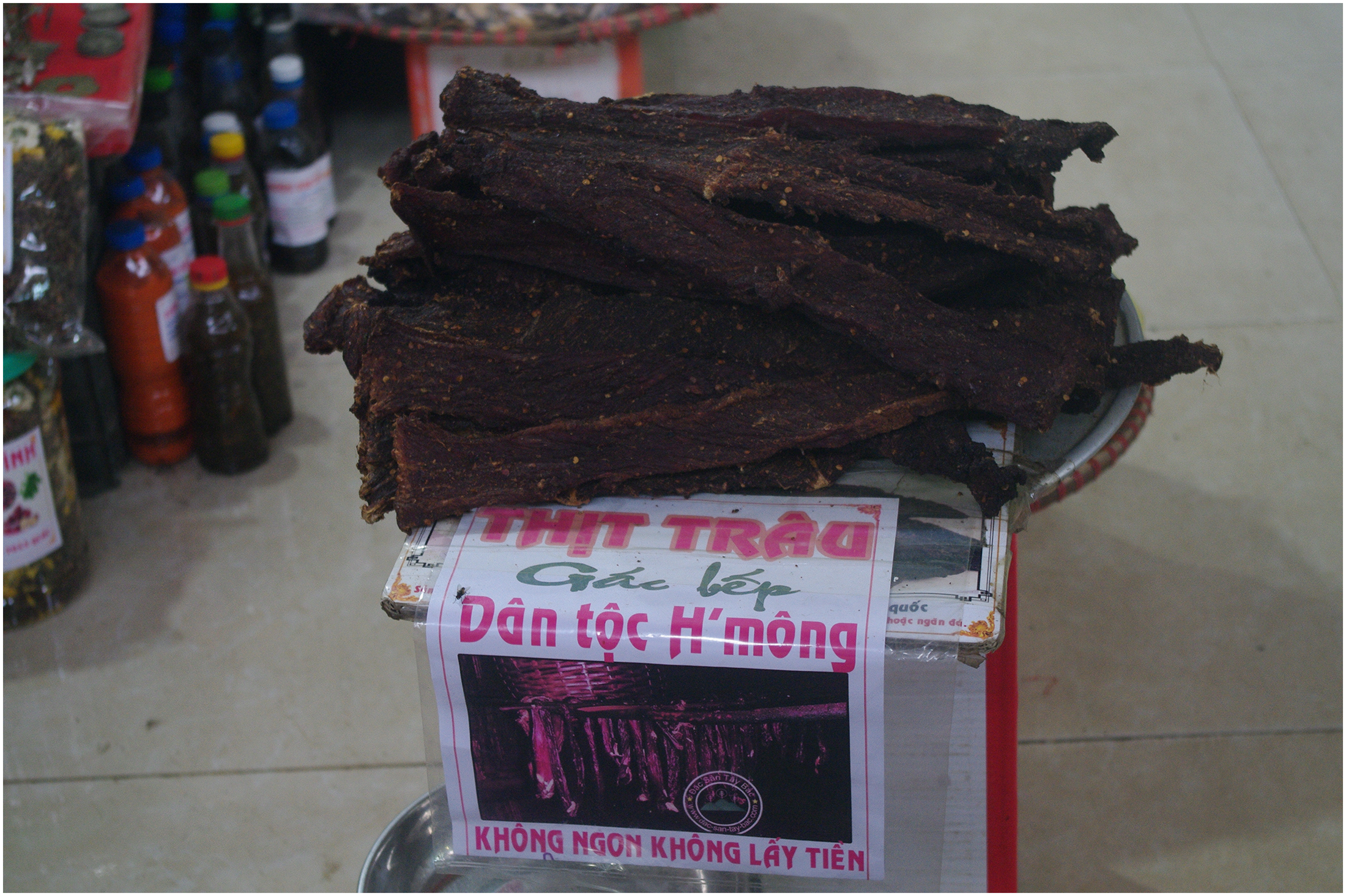
Dried buffalo meat being marketed to Vietnamese tourists in Sa Pa Town [EN: “kitchen buffalo meat ethnic H’mông”].
In this tradescape, a reconfigured entanglement—one based more prominently on market forces than in the past—could intertwine ethnic minority farmers and buffalo in new ways, along with a number of new actors and enabling factors. It is not yet known how this will impact buffalo. However, if being raised for meat, buffalo might undertake less farm work (hence gaining less physical strength and training of human voice commands), and perhaps receive less care and nurturing from their human owners (possibly resulting in poorer nutrition, health, and well-being).
Moreover, to satisfy rising levels of lowland tourist demand for buffalo meat, a new array of actors has become part of the entanglements between farmers and buffalo. These include new intermediaries and buffalo traders (including growing numbers of Hmong and Yao individuals), bankers offering loans for ethnic minority farmers expanding into this commercial venture, government officials providing authenticity certificates, as well as new and expanded slaughterhouses and restaurants. These actors and their involvement in this trade are facilitated by a range of technologies such as cellphones, motorbikes, the internet and social media, as well as new commodities such as plastic packaging and labeling that promotes local places and peoples. Together, these reconfigured entanglements signal the entrance of new actors, uses of technologies, and commodities, all linked to new economic demands.
Concluding thoughts
Throughout Sa Pa District, in Vietnam's northern uplands, we found evidence of long-standing entanglements between ethnic minority farmers and buffalo, through spiritual, cultural, economic, and livelihood relations. Yet we also noted powerful vectors of change occurring in these uplands, in the form of extreme weather events, government interventions, and a reduction in grazing land due to population growth, state conservation policies, and infrastructure projects. As these processes, individually or often in combination, reduce buffalo herds, and as fewer children experience tending to buffalo, they have important implications for human–animal entanglements. Moreover, these processes are occurring unevenly across the district, raising critical questions regarding the influences of market integration and ethnicity. This analysis led us to document two specific, new categorizations of entanglements. First, we identified “resistant entanglements” between farmers and buffalo as those entanglements that have withstood the pressures of the unraveling processes we outlined, with farmers conveying a number of significant spiritual, emotional, and cultural-based reasons as to why. These findings matter because the Vietnamese government and a number of external aid agencies are strongly promoting new agrarian policies and practices in these uplands with little thought to such entanglements. With greater awareness of “resistant entanglements” and their roots, more productive and sustainable upland policy options could be developed. Second, we noted the possibility of “reconfigured entanglements” as farmers and buffalo are further integrated into the market economy in novel ways, such as through increased demand for upland meat by lowland residents. If these “reconfigured entanglements” are recognized, government and external aid agencies could support such trade initiatives to benefit both humans and buffalo (such as introducing humane treatment protocols before and during slaughter). Despite our inevitable exclusion of some factors, these potential political interventions derive from the identification of particular mechanisms—whether environmental, political, cultural, or socioeconomic—that have been shaping unraveling processes as well as resistant and reconfigured entanglements (Giraud, 2019).
Yet, we propose that the “unraveling processes” and the categorizations of “resistant” and “reconfigured” entanglements that we have developed here are not unique to Sa Pa District. Indeed, this case has highlighted the importance of two key elements for understanding the nuances of entanglement anywhere: situatedness and scalarity. Entanglements are the (intra-active) production of specific relations of particular places, times, persons, species, processes, ideas, and technologies. These entanglements create a specific situatedness, attached to a geographic context but also molded by broader regional and/or global and historical contexts, which represent scalarity. In this article, we focus on entanglements as they arise, unravel, resist, and become reconfigured in a particular Southeast Asian locale. Here, our findings are situated in the social, political, historical, environmental, and economic contexts of Sa Pa District (cf. Haraway, 1988). Yet, the nuances of situatedness and scalarity are central to understanding the conceptual and empirical relationships of entanglement processes wherever they might occur. 10 We thus suggest that examining human–animal entanglements in other rural settings, with the additional support of these conceptual tools and insights, could help highlight critical sources of change and examples of human and animal agency with regard to human–animal entanglements, which, in turn, could potentially lead to more culturally appropriate and sustainable policy choices. Conceptually, we hope that these new entanglement categorizations that we have proposed will help uncover more nuanced examples of how such agency enables people and animals to adapt to or even resist ever-changing external pressures when it comes to their relationships with each other.
Highlights
This article draws on human–animal entanglement conceptualizations to better understand human–animal relations in Vietnam.
Among ethnic minority farmers and water buffalo in upland northern Vietnam, we identify four important processes that have been working to unravel human–animal entanglements.
Despite unraveling processes, we note how many households have resisted a complete unraveling of human–buffalo entanglements, and we develop the concept of ‘resistant entanglements’.
We also introduce and explore the concept of ‘reconfigured entanglements’.
Footnotes
Acknowledgments
The authors would like to thank the Hmong and Yao farmers in Sa Pa District for their time, insightful reflections, and patience, three anonymous reviewers for their constructive comments, and Associate Professor Karine Gagne (University of Guelph) for her thoughtful feedback. This research has been funded by the Social Sciences and Humanities Research Council, Canada, and the Fonds de Recherche du Québec—Société et culture.
Declaration of conflicting interests
The author(s) declared no potential conflicts of interest with respect to the research, authorship, and/or publication of this article.
Funding
The author(s) received no financial support for the research, authorship, and/or publication of this article.
