




Abstract
Increasing recognition of the irrefutable urgency to address the global climate challenge is driving mitigation efforts to decarbonise. Countries are setting targets, technological innovation is making renewable energy sources competitive and fossil fuel actors are leveraging their incumbent privilege and political reach to modulate energy transitions. As techno-economic competitiveness is rapidly reconfigured in favour of sources such as solar energy, governance puzzles dominate the research frontier. Who makes key decisions about decarbonisation based on what metrics, and how are consequent benefits and burdens allocated? This article takes its point of departure in ambitious sustainability metrics for solar rollout that Portugal embraced in the late 2010s. This southwestern European country leads on hydro and wind power, and recently emerged from austerity politics after the 2008–2015 recession. Despite Europe’s best solar irradiation, its big solar push only kicked off in late 2018. In explaining how this arose and unfolded until mid-2020 and why, the article investigates what key issues ambitious rapid decarbonisation plans must address to enhance social equity. It combines attention to accountability and legitimacy to offer an analytical framework geared at generating actionable knowledge to advance an accountable energy transition. Drawing on empirical study of the contingencies that determine the implementation of sustainability metrics, the article traces how discrete acts legitimate specific trajectories of territorialisation by solar photovoltaics through discursive, bureaucratic, technocratic and financial practices. Combining empirics and perspectives from political ecology and energy geographies, it probes the politics of just energy transitions to more low-carbon and equitable societal futures.
Sustainability metrics and transition politics
Metrics are not the outcome of a struggle once it is over. They are simultaneously tools and products, the ends we seek to fashion and the means through which we try to fashion them. As noted by Loconto and Hatanaka (2018: 427), ‘metrics and assessments are difficult to disentangle from each other and from the definition of sustainability’. Hence, to unpack metrics is to shed light on successful but contingent arguments. They are successful because metrics are ‘systems of measurement privileged as standards’ (Sareen, 2020a: 31) that represent an accretion of recognition that a particular object and type of measurement is legitimate, e.g. as a measure of sustainability defined in a very specific way. They are contingent because this recognition is itself premised on social legitimacy, and legitimation refers to dynamic practices always in the making. Indeed, Pallesen (2016: 528) highlights ‘the plurality of conceptions and metrics of value across different spheres’ as a core concern of valuation studies.
Approaching sustainability transitions through metrics elides ‘success’ with durability. Durability is not always the goal in relation to sustainability; for instance, local sustainability transition initiatives can be successful without being durable (Aiken, 2017; Madanipour, 2017). Yet when the referent is metrics, i.e. standardised systems of measurement, durability becomes an essential component of how success is defined. What purpose can a standard serve if it keeps changing? The flip side of such an argument is that standards must change; if a metric is not adaptive, it may fail to retain relevance, e.g. as a sector evolves rapidly and makes recalibration necessary (Lippert, 2015). Here, ‘contingency’ relates closely to adaptiveness. A system of measurement that is socially legitimated as a suitable standard has by definition adapted, in a recursive dance with an evolving sector. In the phrasing of Jensen et al. (2017: 460), ‘the way in which sociotechnical systems are acted upon (or governed) is inextricably linked to the epistemic practices through which a system is made visible’. Moreover, as Bowker and Star (1999) famously pointed out, who is able to define and measure is a political matter. It is well established, then, that both the means of measuring socio-technical change, and socio-technical change itself, advance through entanglement.
Such a dynamic, reflexive understanding of metrics and socio-technical transitions does not square easily with structural accounts. This is not to gainsay structural approaches; institutional fixity matters and so does path dependence (see Cherp et al., 2018; Geels, 2004). Rather, I suggest that metrics present a distinctive analytical point of entry into understanding the workings of socio-technical change in temporal sync with its societal effects. Star (1999: 377) refers to this as ‘pinpointing the epistemological status of indicators’. A key shortcoming of structural approaches is that they largely treat formal aspects (such as institutions) as a given. As institutions and the sectors they govern change, there is great analytical purchase in adopting a relational approach over a structural one (Bouzarovski and Haarstad, 2019; Clemens and Cook, 1999). A concern with the politics of implementation of metrics constitutes a relational approach to change (Mahoney and Thelen, 2009), focused on the act of institutionalisation at moments of flux. Heinrichs and Schuster (2017: 541) find that metrics and indicators are the most developed elements of institutionalising sustainability within governance apparatus, making these an apt locus of investigation.
Contemporary transitions to low-carbon energy systems mark an extended historical moment of flux, where accelerated change is called for, and low-carbon technologies such as solar photovoltaics (PV) have become rapidly affordable and widely available at scale. Scholarship on energy metrics has focused on target-setting for ambitious climate action (e.g. Krabbe et al., 2015), and on measuring progress in relation to targets for, e.g. increasing renewable energy capacity and reducing the use of fossil fuel sources (Szarka, 2016; Walenta, 2020). Yet there are increasingly cases where ambitious targets have already been set, and where it is not yet possible to quantify progress in meeting them – e.g. National Energy and Climate Plans 2030 by European Union member states. These demand a more relational approach, so as to gain insights on how sustainability metrics are being implemented (Nerini et al., 2018). Ex post evaluations of whether metrics were successful are of little use – we cannot afford to fail to achieve ambitious climate targets due to the great cost to planetary wellbeing (Biermann et al., 2012; Hale et al., 2020). Rather, there is need for ongoing assessment of socio-technical change in relation to sustainability metrics that have been socially legitimated as necessary to avoid climate breakdown. This implies addressing the politics of how sustainability metrics are implemented, i.e. the accountability of sustainability metrics when transitions are underway. What possibilities does this open up, what possibilities does it close down (Stirling, 2008), and for which actors?
In this article, I examine what happens when sustainability metrics have been put in place by a formal authority, and the hard work of implementing a socio-technical transition gets underway, in the national context of Portugal. This is a question of institutionalising sustainability metrics in order to materialise low-carbon transitions. Political commitment is tested, technical challenges need to be handled and finance must be secured by new entrants. I use the case of solar energy rollout in Portugal from October 2018 until August 2020. This captures the dynamics around the emergence and early functioning of a new ministry in the energy sector, an instance of massive institutional change, and the promulgation of ambitious sustainability metrics for rapid solar rollout during the 2020s, backed by new mechanisms for implementation, including two sets of large-scale solar auctions. Such metrics legitimate the territorialisation of space for specific purposes – solar plants – but there is still discretion in how territorialisation is configured. For instance, land use changes are notoriously fraught with contestation, low-carbon transitions notwithstanding (e.g. Kiesecker and Naugle, 2017). Who makes key decisions about decarbonisation based on what metrics, and how are consequent benefits and burdens allocated? As I argue below, studying the politics of implementation of metrics can yield a timely understanding of these issues. At stake is a matter of interest to scholars of critical renewabilities: how the legitimating power of metrics of low-carbon transitions impacts social equity in issues such as energy access and land use change.
I proceed as follows. The next section integrates a conceptual anchoring in scholarship on legitimacy and accountability and then presents the methodology, which combines two analytical frameworks with the aim of producing actionable knowledge. Then, a background section elaborates the case of solar rollout in Portugal leading up to the study period. The next section presents results on the implementation of metrics and transition politics in the case study during October 2018 to August 2020. These are thereafter discussed in terms of the accountability relations and practices of legitimation that undergird the implementation of these sustainability metrics. The final section offers policy insights and concluding reflections on the potential and scope of such an approach.
From accountability analysis to evidence-based energy policy insights
Starting more than a decade ago (Biermann and Gupta, 2011; Black, 2008), research on accountability and legitimacy has undergone a relational turn. Established scholarship on these concepts from further back stems mainly from political scientists and to a lesser extent from development studies, and tends to focus on structural mechanisms. Accountability is treated as vertical or horizontal, with relationships between actors understood in relation to specific institutional structures. Neoinstitutional theory has problematised static accounts of institutions, pointing out that institutions themselves change (Mahoney and Thelen, 2009), and working towards examination of accountability relations in a more dynamic sense (Bäckstrand et al., 2010). For instance, Kramarz and Park (2017: 4) argue for conceptualising accountability as ‘a reflection of choices within relationships of obligation between decision makers and takers’. This marks a shift in focus away from institutional structures – even shifting ones – as the frame of reference, and towards understanding changing relations of accountability between actors as constitutive of sociotechnical change.
Human geographers inspired by work on actor networks (Rutherford and Coutard, 2014) and sociologists working with Bourdieusian ‘configuring fields’ approaches (Stirling, 2019) have developed approaches that take point of departure in the relationships between changing fields of actors. Bridge (2018) identifies a ‘relational turn’ in human geography with regard to an increasing interest in studying large, rapid sectoral changes linked with low-carbon transitions. While accountability scholarship has been slow to adopt such a relational approach, legitimacy has been increasingly foregrounded, perhaps as it lends itself explicitly to empirical investigation of relational aspects. Indeed, Bäckstrand et al. (2018: 340) argue for greater attention to ‘the legitimacy challenges posed by the twin issues of representation and inclusion (who should be part of decision-making bodies in various networks?) and accountability (to whom should such bodies be accountable and how?)’.
Continuity from neoinstitutional theory to legitimacy can be traced through the prominent emergent focus on polycentric governance, notably by climate change scholars, as an accurate descriptor of institutions with overlapping domains of authority during sectoral change, which raises questions of institutional legitimacy (see, e.g. Jordan et al., 2015; Sovacool and Van de Graaf, 2018). Another long-running strand comes from development studies’ in-depth investigation of power relations, and which ones are legitimated in order to constitute authority (e.g. Cleaver, 2002; Sikor and Lund, 2009). For instance, Lund (2016) analyses competing efforts to legitimate power towards distinct configurations of institutional authority, with significant implications for resource allocation, and thus for who benefits from change.
Yet the twin concepts, accountability and legitimacy, have rarely been analytically operationalised in conjunction in a relational approach. While scholars of accountability and legitimacy have noted this lacuna and called for such analyses (e.g. Biermann and Gupta, 2011; Kramarz and Park, 2016), it is only recently that relational frameworks in this direction have been proposed at scales other than the global. An accountability analysis framework foregrounds the following concern: are decisions based on deliberative assessment, and are they backed by sanctions or not? The framework uses the resultant 2 × 2 matrix to posit four types of accountability relations: strong and hollow relations of accountability, or authoritarian and libertarian relations (Sareen and Wolf, 2020).
Another framework mainframes legitimacy in a relational sense, as ‘practices of legitimation’. Sareen (2020a: 15) proposes four such practices: discursive, bureaucratic, technocratic and financial. The emergence of this framework is responsive to calls for increased attention to sectoral changes at sub-national levels (Cowell et al., 2017; Padt et al., 2014), where many of the activities of low-carbon transitions take place, while the focus has long been on the national and global debates that have been critiqued for having had limited impact on real-world change. The focus on practices aims to empirically examine legitimation as discrete relational phenomena constituted by actors engaged in sectoral change at the sub-national level, in regions and cities. Unlike structural approaches that are limited by a fixity of institutions (Mahoney and Thelen, 2009), a focus on legitimation is sensitive to informal power dynamics, as it captures endeavours to legitimate power, while their success is still contingent. Thus, this approach is equipped to study institutional authority in the making. This is a strength for the engaged study of rapid sectoral change.
This paper combines these two frameworks for the first time, in order to benefit from both their strengths and generate actionable knowledge. The accountability framework can be critiqued for mainly categorising changing accountability relations, without suggesting a clear path forward to enable low-carbon transitions. The practices of legitimation can be critiqued for identifying a large set of practices without conveying a sense of what the assemblage of these reconfigured relationships implies for the nature of overall change in a given sector. As Stirling (2019) argues, researchers are themselves embedded actors in low-carbon transitions, and risk embodying incumbency in their own outlook. Others have called for ‘sustainability collectives’ of researchers to produce actionable knowledge for a just transition (Care et al., 2021). Combining these frameworks, I propose, can address precisely this need, by identifying specific practices of legitimation and characterising them in terms of the sort of accountability relations that they constitute, in a manner that provides a place-specific and policy-relevant output to influence sectoral change. Table 1 provides a generic overview of the contribution the framework can make to actionable knowledge.
From accountability analysis to actionable knowledge for just transitions.
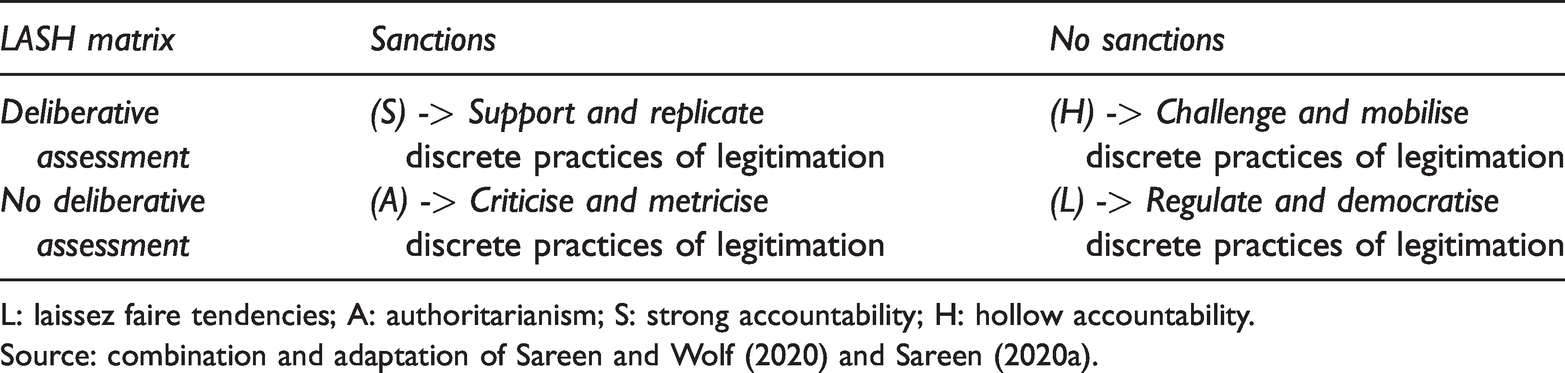
L: laissez faire tendencies; A: authoritarianism; S: strong accountability; H: hollow accountability.
Source: combination and adaptation of Sareen and Wolf (2020) and Sareen (2020a).
While the approach proposed in Table 1 combines the accountability framework of Sareen and Wolf (2020) and the practices of legitimation of Sareen (2020a), its output is distinct from both these frameworks, and aimed at informing and influencing real-world change more directly and to a greater extent. Such a move beyond analytical characterisation of broader sectoral change on the one hand, and of specific practices on the other hand, towards a place-based and policy-relevant account of legitimating power in practice, is both timely and of interest to scholars of accountability and legitimacy as well as sustainability transitions (see, e.g. Kern and Rogge, 2018).
Mapping accountability relations during a sectoral transition like solar rollout constitutes a basis to identify and critique practices of legitimation as contributing to a low-carbon transition or not, and enhancing social equity or not, within a bounded territory such as Portugal in this article. Unpacking the politics of implementing sustainability metrics helps to characterise the particular social values that undergird the solar rollout, by studying the manner in which these metrics are enacted and how such change is legitimated. This means that accountability may empirically vary from Portugal’s formal commitment to a rapid low-carbon transition through solar energy rollout, because informal practices betray a lack of support for such a transition, for instance delaying solar plants for financial speculation. Alternatively, solar rollout may cater to the interests of particular well-positioned actors at the cost of others, thus enabling a rapid low-carbon transition while exacerbating social equity. The embodiment of transition politics in the actual implementation of sustainability metrics serves as a window onto the reconfiguration of ‘legitimating power’ – the power to influence accountability relations – in a changing field of actors in the energy sector.
Methods and empirical material
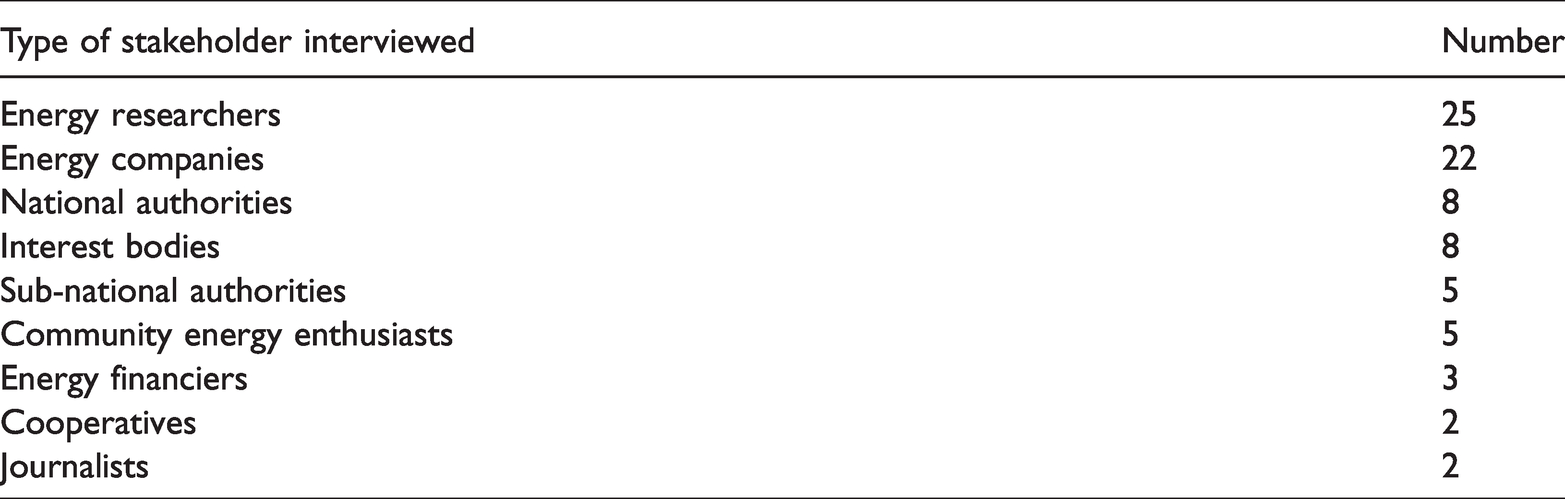
I collected data by interviewing 80 experts with insights on Portugal’s solar energy rollout, during 2017–2019. Interviewees included solar energy researchers, representatives of energy companies, national authorities including the regulator and energy ministry, representatives of interest bodies such as energy associations, sub-national authorities at the regional and municipal scale, community energy enthusiasts, solar energy financiers, staff of a solar energy cooperative and energy journalists (see Table 2). Interviews were conducted on a generic institutional attribution basis to facilitate greater openness of the interviewees and safeguard against any adverse effects to them in a tightly-networked and rapidly-evolving sector, hence specific energy companies are not specified in quotes, while for unique national authorities such as the sectoral ministry and regulator, staff identities are not disclosed.
Overview of stakeholders interviewed by type.
I also conducted multi-sited field observation (e.g. at solar plants and energy sector events) during five months of fieldwork in Portugal over 2017–2019. This was complemented by desk study focused on developments until August 2020. 1 A field visit scheduled for April 2020 was cancelled due to global pandemic-related travel restrictions, but it was possible to attend some events and meetings that were moved online due to this disruption during summer 2020. This ensured as much empirical purchase as possible. A second solar auction, completed in August 2020, marks a natural concluding point for the empirical analysis.
Establishing sustainability metrics for solar rollout in Portugal
In October 2018, Portugal instituted a new Ministry of Environment and Energy Transition, marking a historic shift of the energy portfolio away from the Ministry of Economy. By January 2019, Portugal had launched a Roadmap for Carbon Neutrality 2050 and published its draft National Energy and Climate Plan 2030. With the incumbent political coalition winning the national election that year, the new ministry changed name to the Ministry for the Environment and Climate Action, maintaining a Secretary of State for Energy. With this succession of rapid changes, a country that has steadily moved away from fossil fuel dependence (Krajačić et al., 2011) – first with hydropower starting in the 1980s and then with wind power from the late 1990s onwards (Bento and Fontes, 2015) – looked set to enter the 2020s with an ambitious intent for climate action. Portugal’s wind power rollout marks a recent and remarkable energy transition, growing from 58 megawatts (MW) in 1999 to 4364 MW in 2011, and achieving an annual penetration of 24% of electricity production by 2017, when installed wind capacity stood at 5313 MW (Bento and Fontes, 2015; Costa et al., 2019). Along with the continued expansion of wind power and the introduction of green hydrogen for low-carbon mobility transitions, the country with Europe’s highest rate of solar irradiation envisaged significant near-future solar energy growth. While increasing its installed solar capacity from 585 MW in 2017 to 1035 MW in 2020 (DGEG, 2020), Portugal expected to rapidly expand this to 9 gigawatts (GW) during the 2020s. 2
Yet this turn of events was anything but apparent until a scandal in Portugal’s defence ministry set a cabinet reshuffle in motion in October 2018, a year ahead of the national elections, as the first step in a cascade of changes with significance for the national energy policy, notably for its solar energy rollout.
Some years prior to this period, Portugal underwent austerity politics during the financial recession of 2008–2015, with renewable energy subsidies becoming politically unpopular during the early 2010s. A pro-renewables Socialist Party-led coalition, ousted by the Social Democrats during their 2011–2015 term in government, returned to power in 2015, and won the national elections in October 2019. During 2015–2018, political and administrative enthusiasm for solar energy remained lukewarm, with solar developers stuck queuing for solar licenses. Despite techno-economic promise with solar PV costs falling globally, the regulatory and political line was not yet altogether promising for solar industry actors in Portugal. Yet, with the formation of the new ministry, the declaration of ambitious solar targets, and the consolidation of another term in government, 2020 presented a radically altered outlook. Most significant for this shift was the success of the 1.35 GW solar auctions conducted by Portugal in July 2019. These set a new world record low solar bid at the time, and resulted in a very competitive average price across all 24 auctioned lots. At just over €20 per megawatt hour (MWh), the average solar tariff compared favourably with the €55–57 per MWh annual average price on the Iberian wholesale market for electricity in Portugal and Spain. This was further improved upon by another world record set during the August 2020 solar auctions, which fetched even lower average prices and created considerable debate among solar industry analysts. 3
The solar rollout background in Portugal until October 2018 has been analysed in terms of accountability, metrics and practices of legitimation (Sareen, 2020b). In this article, the point of departure is how metrics of sustainability, once in place, are implemented during solar energy rollout. Conceptually, I am interested in a combined understanding of accountability and legitimacy in the governance of this component of Portugal’s sustainability transition. Empirically, I focus on the politics around metrics during the rollout. Who is able to bring particular metrics to bear, in which manner (through practices of legitimation), and with what implications for the underlying regime of accountability that determines the implementation of a low-carbon transition? Once the state has articulated a clear vision for the direction of progress in the solar energy sector, how are the associated metrics mobilised in various forms to institutionalise the practices this vision legitimates?
The next section presents findings on the practices of legitimation of solar rollout in particular ways from October 2018, when the new ministry was formed, until August 2020, when a second set of solar auctions for 700 MW was concluded. The subsequent section categorises and discusses these practices in terms of accountability relations. This paves the way for some policy insights in the conclusion, along with reflections on applying the approach.
Solar rollout metrics and practices of legitimation (October 2018 to August 2020)
Here, I draw on specific practices that legitimated the way that solar rollout took place from October 2018 onwards. These are related to solar licenses, electric transmission grid investments, the first solar auction (July 2019), large power purchase agreements (PPAs), foreign investment, community energy, prominent solar energy sector events hosted in Portugal and a second solar auction (August 2020). The practices are organised using the four-fold typology of the practices of legitimation framework from mentioned above (Sareen 2020a).
Discursive legitimation
The important role for solar energy envisaged in the National Energy and Climate Plan 2030 – targeting up to 9 GW of solar PV (and modest amounts of other solar generation technologies including concentrating solar power) for electricity by 2030 – was a key metric. The plan drew on a range of inputs based on existing technologies and energy sector expertise, including from researchers involved in energy modelling, renewable energy associations and global players. As one of the researchers involved stated during an interview on 1 March 2019: Whereas the Drawdown project used existing available data and did a meta-analysis based on chosen most promising technologies to deliver a portfolio, here we created ‘new data’ to get results for Portugal. This is what the International Energy Agency and World Energy Outlook use, but we do it at the country level. We have validated a lot of things, so public stakeholders are confident, because we engage with stakeholders such as EDP [Energias de Portugal] and cement manufacturers. We have done a set of sector-specific workshops to understand their problems and integrate them in our modelling.
The anticipation generated by the plan and roadmap was backed up by the announcement of Portugal’s first solar energy auction, which took place in July 2019. Thus, the auction was one of the first concrete efforts to implement the plan. Pitched at 1.35 GW, it was big for the country (twice its installed solar capacity at the time) but small on a global scale. It attracted global attention, however, when it set a new world record for the lowest tariff, with a lot auctioned at below €15 per MWh. Within months, announcements of additional solar projects based on PPAs followed. During 2019, Lisbon became a hotspot within Europe to host solar energy conferences and events. These ranged from big industry fairs like Large Scale Solar Europe to global network events such as Solar Cities, as well as national events such as Solar Market Parity Portugal, an Energy Forum, and a Sun Day. 4 To quote the Secretary of State for Energy at the Energy Forum on 16 July 2019: ‘Solar will help not only decarbonise but also bring down sectoral costs and benefit the consumer’ (author’s translation). The discursive emphasis at these events was on large-scale solar PV plants, not surprising given the billions of Euro pouring into this sectoral segment. Small-scale solar PV was in focus at smaller workshops, such as those involving the solar energy cooperative Coopérnico, the Lisboa Enova municipal agency of energy and environment in Lisbon, and the Lisbon-based PROsumers for the Energy Union project funded by the European Commission. 5
By 2020, solar energy was clearly legitimated as a rapidly growing sector in Portugal, a distinct change from October 2018, up to which its fortunes were regarded with greater uncertainty (for summary statistics on growth, see DGEG, 2020). Despite the postponement of the planned second round of solar auctions from spring to August 2020 due to measures related to the global COVID-19 pandemic, the ministry stuck to its intent to auction 700 MW, fetched world record low tariffs again and consolidated Portugal’s solar trajectory in line with recently institutionalised energy policy ambitions in the 2030 plan.
Bureaucratic legitimation
The mode of bureaucratic legitimation for solar plants changed drastically shortly after October 2018. Solar developers had been queueing for solar licenses, with a build-up of over 2 GW in license applications, and indications of much more limited available capacity on the electric grid from the Directorate General for Energy and Geology. The newly formed ministry worked to resolve all pending applications as quickly as possible, most notably stopping any further extensions of licenses where developers had overshot the originally allocated deadline to install solar capacity. This move was welcomed by most solar developers, who had been complaining about the rise of speculative investment, which was driving up sectoral costs as actors acquired solar licenses and held on to them while their value rose, without installing solar plants. As a renewable energy association representative stated when interviewed on 7 August 2018: ‘There are frequent changes of ownership for the same solar park, for example [name redacted]. This is not a traditional energy sector practice and it is speculative and bad for business’.
With the solar licensing backlog resolved, the ministry chose solar auctions as a process to gain a clearer sense of actually interested solar developers and to determine a competitive price for new solar plants. As a ministry representative interviewed on 7 March 2019 emphasised: ‘Pushing on solar auctions is very hard. That has needed several legislative adjustments. Earlier projects had done due diligence on EIA [environmental impact assessment] and technology, but failed at the bottleneck of grid capacity constraints’. The representative described consideration of multiple auction designs, and emphasised that besides reflecting global developments in reverse e-auction designs, their choices were informed by consultations with stakeholders interested in the sector in Portugal. Thus, this preparatory phase marks a rejigging of institutional structures in a manner responsive to changing realities and emerging targets.
Industrial actors again welcomed this development: a market-based competitive mechanism such as solar auctions to set solar tariffs for 15 years (as per the auction design) enabled developers to avail finance at competitive rates from financial institutions that were familiar with this modality for risk management. Registrations for the first solar auctions attracted 300 solar developers, and the available grid capacity was pre-specified and divided into 24 lots, bringing new transparency into the process. Developers could thus register interest to bid on specific lots, and get talks underway for greenfield development in those areas, e.g. for land acquisition, environmental impact assessment, project finance and solar PV module procurement based on the envisaged plant size. They were also assured grid access in case of a successful bid. This front-loaded supply side approach eased the planning horizon for industrial actors and attributed more legitimacy to the solar sector in the eyes of key players such as foreign investors. A foreign investor interviewed on 17 July 2019 reflected that: It is very hard to get the right amount at the right price at a given time. Such a step as Portugal has taken with the solar auction seems to make sense and it is not always that corporate PPAs are better, so it is a question of how it is implemented – all the hype around the technology makes sense given conditions in Iberia. That does raise private sector enthusiasm for solar investment. But there is the risk of a spillover effect if you overbuild and have misallocated capital, which is something the private sector can also tend to do itself.
Technocratic legitimation
The chief development from late-2018 to mid-2020 was the emergence and refinement of the solar auction in line with Portugal’s energy sector needs and solar rollout targets. Ahead of the first solar auction, ministry representatives explained the auction design to me as two-fold: bidders could compete for the lowest fixed tariff per unit solar electricity sold for 15 years, or offer the highest payment to the grid per unit solar electricity sold at the prevalent rate on the wholesale electricity market. This approach was founded in the logic that grid capacity was limited, and the state was keen to secure competitive bids, given the large prospective interest from industrial and financial actors in investing in this segment. This logic was backed up by a ceiling of €45/MWh on fixed solar tariffs, significantly (approximately 20%) below the annual average rate in the Iberian wholesale electricity market.
As the 24 lots proceeded to be auctioned, initial expectations tumbled. Solar developers interviewed ahead of the auctions stated that they hoped for the tariff to stay above €30/MWh as a reasonable outcome. One preferred to support others with financing rather than bidding themselves, stating on 17 July 2019 that: ‘We got solar projects under the old [subsidised] regime as well as licenses under the initial [unsubsidised during 2017–2018] regime which have continued to be implemented after the new ministry stepped in. [But] we will not participate ourselves in the solar auctions as we do not feel equipped to compete with others’.
Rather, this developer saw its core strength in facilitating greenfield development. The representative elaborated: ‘Single window clearance is namesake, a lot of the steps have simply been moved to the pre-DGEG [Directorate General for Energy and Geology] stage but still require going to many stakeholders to get clearances’. As the auctions proceeded with significant participation from foreign investors, the mental threshold of €30/MWh was rapidly breached, and then bids went below €20/MWh. In the aftermath of the result, one developer reflected on the past week by stating that they had repeatedly gone back to the drawing board, reconfigured financial agreements, and established new baselines of what they as industrial actors saw as financially feasible on the cost side. Interviewed on 30 July 2019, he reflected that: For our classic business this is not good, it cuts our margins both in our management fees as well as EPC [engineering, procurement and construction] fees, as well as our premium on the greenfield development, which is our core business model. The business models have completely changed in these couple of weeks.
Ahead of the second auction for 700 MW that took place in August 2020, the ministry unveiled new auction modalities. When registration for the auction opened, developers had the option to signal interest in building solar PV plants with storage, to contribute to electric grid flexibility as the share of intermittent renewable energy sources such as solar energy grew in the Portuguese electricity mix. This will to identify a new metric (a component of the auctions for solar-energy-plus-storage) reflected global cost declines in energy storage, and the increasingly explicit valuation of energy flexibility. Additionally, Portuguese energy policy began to push for green hydrogen as a transport fuel with a target of 1000 MW by 2030, and developers were interested in establishing solar plants that could power the hydrolysis to produce hydrogen fuel. A renewable energy association representative stated during the Large Scale Solar Digital conference on 22 May 2020 that: ‘We see that solar PV has two markets now, electricity and green hydrogen generation which is attracting investment. We are getting members who want to be grid off-takers who invest in establishing green hydrogen powered by solar PV’. This sectoral development provides a basis for new metrics to capture a new temporal dimension to the energy demand side of solar PV during the second auction, a topic for future research highlighted in emerging work on energy flexibility (e.g. Walker, 2021).
Financial legitimation
There were contrastingly scaled developments in terms of financial legitimation. On the one hand, large-scale solar PV saw costs tumble, and solar developers went down as low as €15/MWh on fixed tariffs. Some industry experts regarded this as a risky development that did not reflect the actual cost of solar PV plants. Installing 1 MW of solar capacity requires somewhat less than €1 million, a cost that varies across projects but continues to decrease (Chase, 2019). But even at the low tariffs emerging in Portugal, there was clearly continued interest in the large-scale solar PV sector, which the Ministry for the Environment and Climate Action highlighted as a success. Ahead of the second solar auctions, an energy company representative stated during the Large Scale Solar Digital conference on 19 May 2020 that ‘we will see firms doing more EPC as an integrated part of value chains’. During 2019 and 2020, energy companies continued to announce PPAs for solar power in the hundreds of MW, beyond the solar auctions. This proved that solar power was indeed competitive on costs for many industrial applications, as suggested by average auction tariffs of just over €20/MWh – or about 40% the average rates on the wholesale market. 6
On the other hand, small-scale solar PV had not yet seen dramatic increases until August 2020. The solar cooperative Coopérnico’s crowdfunding offerings continued to be fully funded rapidly, indicating an appetite for investing in small-scale plants. The impact investing platform GoParity raised funds for several solar PV projects in Portugal.
7
Yet due to a legislative constraint until 2020, these projects were limited to self-consumption; the study period cannot capture the effect of the removal of this constraint in January 2020. Ostensibly, however, community-scale solar energy projects will emerge shortly, in line with the trend in Europe (Essletzbichler, 2012; Hewitt et al., 2019). Yet metrics for the potential benefits of such solar plants – optimal use of existing grid capacity, less transmission losses, more efficient land use, revenue sharing with users, energy flexibility through demand response (also see Campos et al., 2020) – remained absent in terms of any financial valuation. Commenting on the presentations at a national energy conference, an energy cooperative representative reflected on 25 July 2019 that: Of the large and small scale drivers of solar uptake, the conference had mainly representatives from big players. We are still not putting the citizen in the centre of the energy transition. … With the new auctions it is clear there is a lot of money in the renewable energy sector and these players can invest anywhere else, the companies that are here are here to make money. For us it is about a fair price for energy, and democratisation, which was not present.
New community energy legislation did, however, remove the constraint of having to register as an energy supplier to gain a larger share of benefits from producing solar energy, an option blocked by high barriers to entry to gain supplier status (Sareen and Haarstad, 2018). It meant that small-scale solar plant users such as households, who were previously limited to self-consumption, could participate in a wider array of financial arrangements for solar prosuming. This presented scope for new metrics to emerge as well, such as revenue sharing arrangements for community solar energy plants shared by residential and commercial users with complementary energy use temporalities. Unlike the headline metrics of the national plans, which suited large-scale solar PV plants for which modalities like solar auctions were put in place, metrics for small-scale solar plants thus lagged behind, and had to be developed by local communities of practice. These communities included actors such as energy cooperatives, municipal agencies and researchers.
These results show how the solar segment of Portugal’s energy sector became a strongly legitimated concern and began to rigidify. During this period of institutionalisation and metricisation, top-down actions largely prevailed over bottom-up efforts through legitimating power, though with some indications of emerging local agency. Some space was ‘opened up’ while other space was ‘closed down’ (Stirling, 2008) for territorialisation in socio-spatial patterns and with contrasting temporalities, represented through a limited but growing set of metrics for the solar energy transition.
New metrics, changing regimes of accountability?
Here, I discuss the practices elaborated in the empirical analysis above in terms of which practices embody laissez faire tendencies (no deliberative assessment nor sanctions), authoritarianism (sanctions without deliberative assessment), strong accountability (deliberative assessment backed by sanctions) and hollow accountability (no sanctions despite deliberative assessment). Accordingly, these are plotted into Table 3, which is an empirically populated version of Table 1 above. For each of the types of accountability relations that undergird various practices of legitimation, I reflect on what is ‘opened up’ and ‘closed down’ (Stirling, 2008), and on what basis.
Policy insights based on acountability analysis of solar energy transition in Portugal.
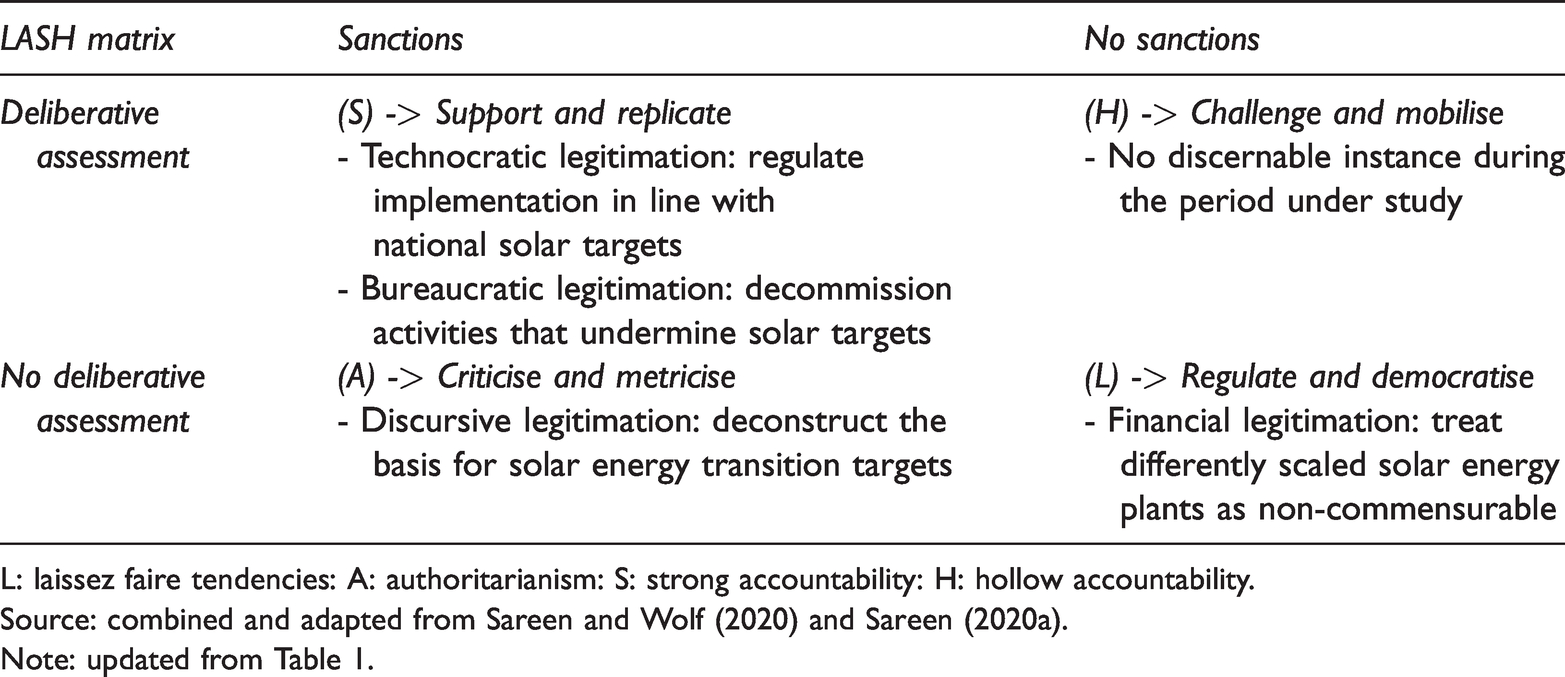
L: laissez faire tendencies: A: authoritarianism: S: strong accountability: H: hollow accountability.
Source: combined and adapted from Sareen and Wolf (2020) and Sareen (2020a).
Note: updated from Table 1.
Laissez faire tendencies
Commensuration of differently scaled solar plants (financial legitimation)
The metrics deployed in Portugal’s solar energy transition during October 2018 to August 2020 treat solar PV plants at all scales as similar objects, measured in terms of MW contributed to the national solar rollout targets. This does not reflect deliberative assessment of the many other potential benefits of small-scale solar plants, nor provides positive sanctions to support their growth beyond removing an existing legislative obstacle. Community solar energy plants can, for instance, enable revenue sharing, contribute to energy flexibility by matching prosumers and users with complementary energy demand profiles, forego investments in expensive and carbon-intensive new grid infrastructure and reduce electricity transmission losses. Yet space for such discussions has not been ‘opened up’ as a core part of energy transition metrics. Such a reductive focus is fairly typical of climate mitigation metrics (Krabbe et al., 2015), and lacks adequate contextualisation in terms of socio-spatial effects. This finding supports scholarly claims that metrics and assessment are closely intertwined Loconto and Hatanaka, 2018), while highlighting the folly of accepting such equivalence at face value. False equivalence means that in practice, forms of new solar capacity that have corporate ownership (large-scale plants of many MW worth many millions of Euro) are treated the same as forms that have individual or community ownership (in tens or hundreds of KW) and can be built closer to electricity demand. There is scope to incentivise the latter through positive sanctions – such as financial incentives and revenue sharing models – in recognition of the above characteristics (Allan et al., 2011; Funkhouser et al., 2015). Wide public discussion that goes beyond ‘the commensurability of carbon’ (Dalsgaard, 2013) could serve as a basis to legitimate and institute new metrics that address this issue by attributing value to the social benefits that accompany more distributed solar energy rollout.
Authoritarianism
Imposition of ambitious energy transition targets (discursive legitimation)
The metrics mobilised in support of the rapid decarbonisation plan in Portugal were rather front loaded. The Ministry of Environment and Energy Transition (and later the Ministry for the Environment and Climate Action) took point of departure in the Paris Agreement and in scientific models in order to draft the National Energy and Climate Plan 2030 and the Roadmap for Carbon Neutrality 2050. These were thereafter taken on a road show, and ‘opened up’ for public comment, but prior to this, the broad lines had been drawn, and the overarching direction and scale of ambition was no longer subject to discussion – it had already been ‘closed down’ (Stirling, 2008). While this can be said to have been the outcome of expert assessment, this is distinct from deliberative assessment with wider publics, à la the point by Star (1999) to consider indicators in terms of their epistemological status. While the timing for this institutionalisation of targets at the end of 2018 proved opportune for the Portuguese government, with the incumbent coalition reelected in late 2019 and thus consolidating power, Portugal began to find fiscal space squeezed once again due to the effects of the COVID-19 pandemic in 2020. The commitment to ambitious decarbonisation targets thus constitutes a ‘green authoritarian’ measure (cf. Carter, 1996) that has enabled the discursive legitimation of measures such as solar auctions for aggressive solar rollout. I am reminded here that Bowker and Star (1999) caution that who defines and measures is political, and in this instance, governmental bodies firmly took the lead in retaining control in these regards. While positive from a climate perspective, such an approach nonetheless runs the risk of setting a precedent for future actions that may have less salutary effects, from an environmental or socioeconomic perspective. Thus it is notable that metrics that enable a low-carbon energy transition are not necessarily based on strong accountability relations, but can instead be the product of top-down energy policy. China is often cited as such an example globally (e.g. Beeson, 2010), but similar traits are in evidence in this Western European country.
Strong accountability
Regulated solar auction mechanism (technocratic legitimation)
The emergence and institutionalisation of metrics for allocation of limited grid capacity for solar energy rollout was the most laudable achievement of Portugal’s solar energy transition during the study period. This finding resonates with the observation by Heinrichs and Schuster (2017) that the institutionalisation of sustainability is visible early on in metrics and indicators. The market-based mechanism of solar auctions has in recent years become a tried and tested way to establish competitive prices for this renewable energy source globally. In the Portuguese case, this was used in a context-specific manner, with apt adjustments made ahead of the second auction. This makes the market mechanism regulated, purpose-driven and adaptive, with a basis in the national solar energy targets and in governing the energy sector in the public interest. In this sense, it ‘opens up’ for change, while ‘closing down’ some possibilities of an unfettered market-based approach. Specific characteristics include the ceiling for solar tariffs in the first auction (which ensured competitive bids), the allocation of lots ahead of the auction (which matched grid availability and gave solar developers a realistic planning horizon) and the introduction of a hybrid solar-and-storage option for the second auction. The success of the auctions can thus be credited to the bureaucratic legitimation of the process led by the ministry. This legitimation was backed up through the interest shown by the hundreds of solar developers who registered for the solar auctions. This closely intertwined nature of the epistemic practices and sociotechnical changes that constructed the solar sector anew chimes well with reflections by Jensen et al. (2017), who emphasise the performative power of metrics that features so prominently here.
Wrapping up scope for speculative investment (bureaucratic legitimation)
An equally important metric to match the successful auction mechanism was the decommissioning of a less transparent mechanism for solar plant licensing that was in place until 2018 (see Sareen, 2020b). The new ministry inherited a long list of queued investors and pre-allocated solar licenses from its institutional predecessor; many of these licenses had been extended beyond the original two years of validity. Ahead of the first solar auctions held in July 2019, the ministry resolved those solar licenses that had not been honoured, and freed up the grid capacity associated with them. Solar developers generally saw this ‘closing down’ as a positive development, as it prevented speculative investment that would otherwise have driven up their costs in the solar segment. The state saw this consolidation as being in the public interest, as any speculative tendencies would eventually have resulted in higher costs for solar energy which would in turn have been passed on to citizens. While this sort of bureaucratic process rarely makes headlines the same way as energy transition targets, it rests on a key metric: respecting the two-year deadline to build solar capacity upon receiving a license. For Portugal to grow the solar energy segment in line with its ambitious targets by 2030, preventing delays is an essential concern. The ability of the present analytical approach to capture this shift underscores the strength of a relational approach over a structural one (cf.Bouzarovski and Haarstad, 2019; Clemens and Cook, 1999). Rather than taking formal aspects (like the granted licenses) as a given, examining the shifting roles and incentives of actors in entanglement provides a more granular account of sectoral changes and their underlying rationale, or what Mahoney and Thelen (2009) theorise as processes of institutional change in terms of agency and power.
Hollow accountability
It is a testament to the impressive achievement of the Portuguese solar energy transition between October 2018 and August 2020 that this study found no apparent instances of hollow accountability. In other words, wherever there was deliberative assessment of the solar rollout, it was followed up with sanctions. The most pertinent instance of this concerns community energy legislation, which the reelected government proceeded to enact and bring into force in January 2020. It was not yet possible, within the study period, to ascertain the extent to which this change would be effective in enabling community solar energy plants to proliferate. Moreover, it remains indeterminate whether these will in fact more directly benefit citizens who engage in solar prosuming. In hindsight, this may come to constitute an instance of hollow accountability, but it may equally become a model for how to bring about multi-scalar, citizen-centric solar energy transitions. Thus, to ensure even-handed treatment, this matter is left open-ended in this study.
The above characterisations of the accountability relations in play as four types of discrete practices of legitimation show that accountability is not inherent to energy systems, nor to the political-administrative paraphernalia through which these energy systems are reproduced, reconfigured and maintained. Even as their technical basis changes, the systemic logics of energy systems retain aspects that have a political economic basis justified not of technical necessity, but rather in the socio-cultural domains where they are legitimated. Accountability is always in the making, and energy transitions present a conjuncture where relations are reconfigured. The accountability relations above undergird each discrete practice of legitimation. They enact outcomes that may well diverge from the intended outcomes of sustainability metrics as expressed through visions such as national plans (Jasanoff, 2007), but in turn also shape the implementation and evolution of these metrics. Accountability relations vary based on the extent to which these metrics are specified and backed up, and on how they are modulated by actors who are able to strategically establish, manoeuvre or co-opt the discretionary room they afford. Legitimating power thus influences accountability relations and is constitutive of sectoral change.
The legitimating power of sustainability metrics
The analysis reveals the institutionalisation of sustainability metrics in a direction that supports socially equitable effects of low-carbon transition in the form of solar energy in line with rollout targets in Portugal, but suggests scope for further intervention. Such intervention is required due to the scalar biases inherent during rollout (Essletzbichler, 2012), as the energy system shifts from top-down logics to modularity. Incumbents enjoy positions of privilege that they are able to leverage to act strategically and rapidly (Avelino et al., 2016; Meadowcroft, 2009). Meanwhile, new entrants and smaller actors are held back not so much by economies of scale but by lack of legal and regulatory support for bottom-up, small-scale rollout, a situation that is itself evolving in tandem with metricisation (Aiken, 2017; Hughes et al., 2020; Madanipour, 2017). The privileging of large actors bears notable similarities to Portugal’s wind energy rollout in the decades immediately prior, where grid connection licenses were auctioned, resulting in the dominance of large actors in the sector. As scholars have noted previously, Portuguese decision-making in environmental policy displays distinct traits of being centralised, technocratic and disengaged from public participation while going through the motions of consultative and accountability-related processes (Gonçalves, 2002; Gonçalves and Delicado, 2009). In these ways, Portugal’s solar rollout reflects some historical continuity.
Table 3 provides an overview of key evidence-based energy policy insights for solar rollout in Portugal, as a summary form of the preceding findings and discussion. It shows that strong accountability relations are evident in the Portuguese solar energy transition in the technocratic and bureaucratic practices of legitimation. However, there is a need for greater deliberative assessment when it comes to target-setting, where an authoritarian tendency can be criticised and backed by a call to deconstruct the basis for metricisation. Moreover, there is a need to differentiate between scales of solar rollout and regulate them through distinct sanctions in order to democratise the effects of solar energy transitions for citizens.
In closing, I reflect on ways in which the outcome of this study is instructive for scholars working on the socio-spatial effects of energy transitions. The emerging field of critical renewabilities, broadly speaking the social and spatial turn in energy research, tends to focus on how low-carbon energy transitions are reproducing or exacerbating existing injustices (e.g. Bridge, 2018; Healy and Barry, 2017). This is certainly an important concern. But for scholars who study low-carbon transitions, this would in itself be a limited and limiting focus, in terms of enabling critical insight and producing actionable knowledge to inform the governance of these transitions (Care et al., 2021; Kirchhoff et al., 2013). The ‘legitimating power’ approach – focusing on the power to influence accountability relations – presents a way of engaging relationally with transitions (Mahoney and Thelen, 2009) such as solar rollout. It enables one to identify specific actions and actors that contribute to territorialisation through practices of legitimation (Sareen, 2020a), and critique the bases of legitimacy (Sareen and Wolf, 2020) that lead such territorialisation to have unjust socio-spatial effects, thus generating actionable knowledge in a context-specific way based on ongoing assessment.
The relationship between low-carbon transitions and their justice effects on energy systems is modulated politically and economically through ‘legitimating power’. I have shown above that unpicking how this power legitimates the ‘opening up’ and ‘closing down’ of specific socio-spatial effects (Stirling, 2008) during low-carbon transitions, by focusing on metrics (Bowker and Star, 1999; Star, 1999), can be an even-handed approach to analysing energy transitions in terms of their implications for accountability. This analytical approach can enable rigorous analysis of the way political economic contestation is legitimated through practices in socio-cultural domains in order to implement a particular version of technological rollout to achieve low-carbon transitions. In the Portuguese case, the legitimating power of sustainability metrics ‘opened up’ space to propel large-scale solar rollout, while keeping some possibilities for small-scale solar plants ‘closed down’ during the study period. The more evenly we can distribute legitimating power through an informed politics of transition, the more likely just transitions become.
Highlights
Analyses implementation of solar energy transition metrics in Portugal 2018–2020. Examines impact of national plans for rapid energy decarbonisation on social equity. Combines two analytical frameworks to analyse the legitimating power of metrics. Offers empirically grounded account of sustainability metrics for just transitions. Assesses multi-scalar legitimating practices that implement sustainability metrics.
Footnotes
Acknowledgements
The author is grateful to seminar participants at The Greenhouse at the University of Stavanger in June 2020, and to Abigail Martin and Sarah Knuth, for useful comments.
Declaration of conflicting interests
The author(s) declared no potential conflicts of interest with respect to the research, authorship, and/or publication of this article.
Funding
The author(s) disclosed receipt of the following financial support for the research, authorship, and/or publication of this article: The author gratefully acknowledges generous support from the Trond Mohn Foundation (‘European Cities as Actors in Climate and Energy Transformation’ project, grant BFS2016REK04) and the Research Council of Norway (‘Accountable Solar Energy TransitionS’ – 314022).
