




Abstract
Concerted action on climate change will require a continuing stream of social and technical innovations whose development and transmission will be influenced by public policies. New ways of doing things frequently emerge in innovative small-scale initiatives – ‘experiments’ – across sectors of economic and social life. These experiments are actionable expressions of novel governance and socio-technical arrangements. Mobilising and generalising the outputs of these experiments could lead to deep reductions in greenhouse gas emissions over the long-term. It is often assumed that the groundswell of socio-technical and governance experiments will ‘scale-up’ to systemic change. But the mechanisms for these wider, transformative impacts of experiments have not been fully conceptualised and explained. This paper proposes a conceptual framework for the mobilisation, generalisation and embedding of the outputs and outcomes of climate governance experiments. We describe and illustrate four ‘embedding mechanisms’ – (1) replication-proliferation; (2) expansion-consolidation; (3) challenging-reframing; and (4) circulation-anchoring – for entwined governance and socio-technical experiments. Through these mechanisms knowledge, capabilities, norms and networks developed by experiments become mobile and generic, and come to be embedded in reconfigured socio-technical and governance systems.
Introduction
The window of opportunity to address climate change whilst remaining within 1.5 °C above pre-industrial temperatures is closing fast and current national commitments are not sufficient to fill the greenhouse gas emissions gap (IPCC, 2018; UNEP, 2019). Over the last 25 years considerable political effort has been invested in an international governance regime centred on the United Nations Framework Convention on Climate Change (Van Asselt et al., 2018). Initially industrialized countries accepted legally-binding greenhouse gas targets (Kyoto Protocol in 1997), but it proved difficult for governments to agree on new, more comprehensive binding commitments (Copenhagen Summit in 2009). A more voluntarist, bottom-up international governance approach then emerged (Paris Agreement in 2015) emphasising action by nation states, and innovation by business as well as non-state action. The expectation is that new actors will take ‘climate action’ and develop practical ways of reducing emissions, filling the ‘governance gap’ (Bernstein and Hoffmann, 2018; Jordan et al., 2013, 2015; Jordan and Huitema, 2014a, 2014b).
Much of this action is experimental in character. Several scholars have argued that experimentation is a mode of response better attuned to the complex, situated and uncertain character of climate change challenges, as compared to traditional modes of governing through national and international policy (Bulkeley and Castan Broto, 2013; De Burca et al., 2014; McFadgen and Huitema, 2017; Overdevest and Zeitlin, 2014). In recent years, a number of fields of social science have embraced this ‘experimentalist turn’ in addressing climate change and other environmental problems (Ansell and Bartenberger, 2016; Huitema et al., 2018). More specifically, in studies of policy and governance, the notion of experimentation is increasingly advocated as a promising approach for climate governance (Hilden et al., 2017). Since global agreement on climate action has proven elusive, the groundswell of innovative local and transnational initiatives has become a focus for academic enquiry (Bulkeley et al., 2012; Castan Broto and Bulkeley, 2013; Keohane and Victor, 2011). These ‘climate governance experiments’ (Hoffmann, 2011) or ‘climate change experiments’ (Bulkeley et al., 2015) can be seen as expressions of polycentric governance in action (Ostrom, 2010) and their rise to prominence represents a parallel response compared the traditional multilateral climate governance regime (Jordan et al., 2018). 1
In studies of innovation and societal transitions, the notion of experimentation also occupies a central position. These ‘niche experiments’ (Kemp et al., 1998) or ‘socio-technical experiments’ (Sengers et al., 2019) are framed as spatially and temporally circumscribed initiatives that promote new social and technical innovations. As such, they represent important microcosms of change that are nurtured in protected spaces, eventually to bring about transformations in the configuration of socio-technical systems providing societal functions such as energy, transport and food (Geels, 2002; Kemp et al., 1998; Markard et al., 2012; Smith and Raven, 2012).
The rise to prominence of experimentation reflects a theoretical debate about the messy, contested and uncertain process of innovation, particularly in relation to complex global collective actions problems like responses to climate change. Multiple adjustments to expectations, incentives, practices and rules are needed as new socio-technical configurations emerge, stabilise and become dominant. Governance arrangements to foster experimentation need to create conditions for learning-by-doing, as well as learning about the unintended impacts of new ways of doing things; being flexible, promoting what is promising and constraining what encounters resistance. But while it is largely assumed that the proliferation of empowering local initiatives will expand, diffuse or ‘add up’ to broader systemic change, the processes for these transformations are under-theorised and explained. If experiments are to have wider impacts, their products or outputs first need to be specified and the processes by which these outputs come to adopted ‘beyond’ individual experiments need to be explained.
The conceptual territory that lies beyond experiments remains largely unexplored, with many outstanding questions: what are the outputs of an experiment? how are these outputs carried or transmitted beyond experimental boundaries? what effects do these outputs have on the economic, social and cultural environment into which they are transmitted? how should governance arrangements both stimulate and regulate the transmission of experimental outputs?
These questions can be summarised in a broader research question: how do climate governance experiments generate outcomes beyond their boundaries? In addressing this question, a key challenge is to find alternatives to unitary and unilinear concepts of diffusion or ‘scaling up’ of experimental outputs. If the reconfiguration of intertwined socio-technical and governance systems is a complex, messy and multidimensional process, this needs to be captured by an appropriate general idea. In this paper we propose to use the notion of embedding and see our primary objective as to delineate processes of embedding outputs of climate governance experiments in economic, social and cultural systems. By unpacking how experiments for climate governance can generate wider outcomes we aim to make a conceptual contribution that is relevant for both climate governance scholars and sustainability transitions scholars, and to foster a productive dialogue between these two research communities. The exploratory groundwork for this dialogue was laid in an edited volume (Turnheim et al., 2018), which contributed to framing a research programme and presenting a range of original research contributions reflecting on climate governance experiments around the world. Our intention here is to provide a synthesis of theoretical insights by formulating a distinct set of embedding mechanisms for the outputs of experiments and underlying rationales.
The paper is structured as follows. Section 2 reviews insights from transitions and governance studies to reveal how these literatures have conceived of the role of experiments and their wider impacts. Section 3 explores what lies ‘beyond’ experiments and conceptualizes the process through which individual experiments may come to wield wider influence as ‘embedding’. Section 4 articulates four embedding mechanisms, each of which reflects a distinct conceptual perspective and operational logic. These mechanisms differ from one another in terms of how they relate to the initial experiment, in terms of the possibilities for deliberate steering and in terms of the stabilisation of the emerging new configurations involved. Section 5 provides reflection and further discussion. Section 6 concludes.
Making sense of climate governance experiments
The literatures on climate governance and on socio-technical innovation have had complementary but largely disconnected debates about the generation of new ideas, the role of entrepreneurial activity by key actors, and the wider adoption and diffusion of new ways of doing things. There are differences in perspective and focus, as well as a good deal of common ground in thinking about the role of experiments and their enrolment for addressing societal challenges. We believe that a fruitful dialogue is possible and that both of these fields of study can be enriched through a cross-fertilization of ideas.
Governance studies and climate experiments
In studies of governance, climate change is often portrayed as a ‘wicked problem’: it resists being solved due to shifting problem interpretations, technical uncertainty and political contestation about appropriate ‘solutions’ (Levin et al., 2012; Rittel and Webber, 1973). Responses to wicked problems need to be firm and flexible at the same time: on the one hand firmly tied to consistent, stable and predictable institutional trajectories; and on the other flexibly adaptable to new insights and unfolding consequences in light of multiple sources of uncertainty (Jordan and Huitema, 2014a; Stirling, 2010). From the 1980s, global cooperation of national governments through formal agreements and obligations – such as the Kyoto Protocol and other extensions of the United Nations Framework Convention on Climate Change (UNFCCC) – was seen by many as an appropriate way to ensure a collective response based on formal rules and political coordination (Van Asselt et al., 2018). After the failure of the Copenhagen Summit in 2009 to achieve decisive agreement, the international climate governance regime reached a state of gridlock (Victor, 2010) and the need for a more multilevel and flexible approach to climate governance emerged with a greater role for transnational and local forms of action. This promised to plug the governance gap (Abbott, 2012; Hoffmann, 2011; Jordan and Huitema, 2014a) whilst creating new kinds of risks of delayed, inappropriate, co-opted or fragmented action (Turnheim et al., 2018).
This more entrepreneurial and action-oriented governance approach is not a new phenomenon: bottom-up experimental climate action has existed in the internationally coordinated policy approach. What is new is the prominence afforded such bottom-up climate action as a way of generating novelty and achieving changes in attitudes, practices and technologies enabling low-carbon systems.
The growth of local and transnational initiatives represents something significant. According to Keohane and Victor, we are currently witnessing a ‘Cambrian explosion’ in transnational institutions, standards, financing arrangements, and programs governing climate change (Keohane and Victor, 2011). Bulkeley et al. reveal the flowering of local initiative by presenting and analysing extensive databases of sub-national and non-state organizations involved in transnational climate initiatives and their manifestation across the globe (Bulkeley et al., 2012; Castan Broto and Bulkeley, 2013). The overall picture that emerges portrays a new institutional environment for climate governance, which is rich, highly complex and marked by forms of ‘polycentric’ governance with multiple governing actors at different scales operating independently to craft new norms and rules without central coordination (Abbott, 2012; Chan et al., 2018; Jordan et al., 2015; Ostrom, 2010). But the jury is still out on what these initiatives produce, what their proliferation represents, how their wider influence works and what this activity means for climate governance (Bulkeley et al., 2018; Turnheim et al., 2018; Widerberg and Pattberg, 2015).
Climate governance through these kinds of local or transnational initiatives has been described as ‘experimentation’. Many experiments described in the governance literature involve applying different policy measures in comparable settings with the aim of assessing the factors that determine their effectiveness (Campbell, 1997; Fischer, 1995; Greenberg et al., 2003). Since we are less interested in experimentation as a specific research method, we focus attention on the part of the governance literature that conceives of experimentation as a practical approach to governance (Huitema et al., 2009, 2018), regardless of the related degree of coordination or formalisation (Turnheim et al., 2018).
Hoffmann conceives of ‘climate governance experiments’ as “rule-making endeavors in non-traditional political spaces” (Hoffmann, 2011: 185). He stresses that it is a type of activity that involves testing in the spirit of trial-and-error and that this testing operates outside the bounds of the international climate regime (Hoffmann, 2011). These initiatives shape how communities deal with climate change, they often cross jurisdictional boundaries, and differ on the extent to which they are formal or informal, depending on the level of deliberate effort and the level of control over the process (Abbott, 2017). Likewise, Bulkeley et al. describe ‘climate change experiments’ as “purposive interventions” to try out new ideas and methods in the context of future uncertainties which aim to respond to the imperatives of mitigating and adapting to climate change (Bulkeley and Castan Broto, 2013). The idea of a purposive intervention signals that experiments are a more or less explicit attempt to innovate, learn or gain experience, rather than an experiment to establish a knowledge claim alone. They identify over 600 empirical examples of urban climate change experiments (Castan Broto and Bulkeley, 2013), including innovative zero-carbon housing project on the outskirts of Bangalore and a neighbourhood project to promote the uptake of energy efficiency improvements in Philadelphia (Bulkeley et al., 2015) or, less tangible, a ‘hub’ for public responses to climate change in Hong Kong (Bulkeley et al., 2014). 2
On the whole, then, in the context of climate governance an experiment can be seen as something new being tried out with a high degree of autonomy through a deliberate intervention that differs from the status quo (Bernstein and Hoffmann, 2018). The idea of governance experimentation as a purposive and practical way to generate social and institutional novelty resonates with the concept of ‘socio-technical experiments’ that has emerged in innovation studies.
Transition studies and socio-technical experiments
In studies on socio-technical transitions, climate change is presented as a ‘persistent problem’ (Grin et al., 2010). The field of transition studies starts from the idea that contemporary environmental problems – such as climate change, but also resource depletion and loss of biodiversity – present formidable societal challenges. In contrast to some of the environmental issues of the 1980s – such as acidification or ozone depletion – contemporary environmental problems cannot be solved through technical fixes. Addressing these problems requires more fundamental changes in transport, energy, water, agri-food and other systems (Elzen et al., 2004). These structural change processes are called socio-technical transitions, because they involve major shifts in the basic architecture of systems of provision, which entails changes in not only technology but also in policy, markets, consumer practices and cultural meanings over longer time periods (Geels, 2002, 2004; Markard et al., 2012).
Transitions scholars have long been interested in how experiments contribute to socio-technical transformation and we can trace some of the thinking about ‘socio-technical experimentation’ to ideas in the field of Science and Technology Studies (STS). This field problematizes the boundaries between technical and social phenomena and between the inside and the outside of a laboratory or experiment. Society itself is seen as a laboratory of sorts in and around which situated real-world actors commit to the messy experimental processes tied up with the introduction of alternative ways of doing things with the aim or re-shaping social and material realities (Karvonen and Van Heur, 2014; Latour and Woolgar, 1979; Sengers et al., 2019). STS scholars have argued that new technologies and related systems cannot be seen as separate from the social setting in which they have been developed (Bijker et al., 1987) – they are socially-constructed in mutual shaping processes. In Rip and Kemp’s tart expression, ‘configurations that work’ are constituted by social and technical elements that have come to a strong degree of alignment over time (Rip and Kemp, 1998). When socio-technical configurations are stable the potential for socio-technical change is limited, but when the alignment of elements comes under pressure configurations may become unstable leading to a search for different opportunities for stability, with new options being sought in alternative experimental configurations (Callon, 1998; Kemp et al., 1998).
In the context of transitions, socio-technical experiments have been viewed as important seeds of change. If these seeds flourish, they can contribute over the longer-term to profound shifts in socio-technical systems. Many empirical examples have been discussed in the literature. An early study analysed an urban experiment to promote electric vehicles or shared bikes geared to establish an alternative mobility system to that dominated by private automobility (Hoogma et al., 2002). Conceptually, socio-technical experiments have been defined as “inclusive, practice-based and challenge-led initiatives designed to promote system innovation through social learning under conditions of uncertainty and ambiguity” (Sengers et al., 2019: 161). 3 The overarching promise is that the learning and demonstration effects of experiments add to the momentum of alternative configurations (i.e. emerging niches) so they can emerge and establish themselves and eventually change the technologies, rules and routines associated with incumbent configurations (i.e. established regimes).
A feature of socio-technical experiments is their fragility and instability. For learning-by-doing, adjustment and alignment to be allowed to happen, experiments typically require some form of ‘protection’ from prevailing economic and social selection pressure. Socio-technical niches are seen as spaces that afford protection to novel socio-technical configurations and allow for experimentation with the co-evolution of technology, user practices and regulatory structures (Schot and Geels, 2008). A niche is defined at two analytical levels: the ‘local level’ of individual experiments and the ‘global level’ of an emerging proto-regime that provides coordination and support to the individual experiments (Geels and Raven, 2006). This implies that there is attention not only for the agency of local actors directly involved in experiments, but also for other actors at some distance from the experiment who are nonetheless crucial to providing necessary resources (such as finance, political support and technical specifications) and who therefore effectively construct and maintain the protective space in which local actors can work (Sengers and Raven, 2015). These insights from ‘Strategic Niche Management’ (see Kemp et al., 1998; Schot and Geels, 2008) are complementary to and in line with the broader Multi-level Perspective on socio-technical transitions (see Geels, 2002, Geels and Schot, 2007, Schot and Geels, 2008).
Transmission of outcomes of governance experiments as embedding
Acknowledging that there is more to an experiment than the project itself and its immediate outputs raises the question of what lies ‘beyond’ experiments. There may be three dimensions to what lies beyond an experiment, each linked to the various boundaries within which individual experiments may be seen as being confined (see Figure 1 below).
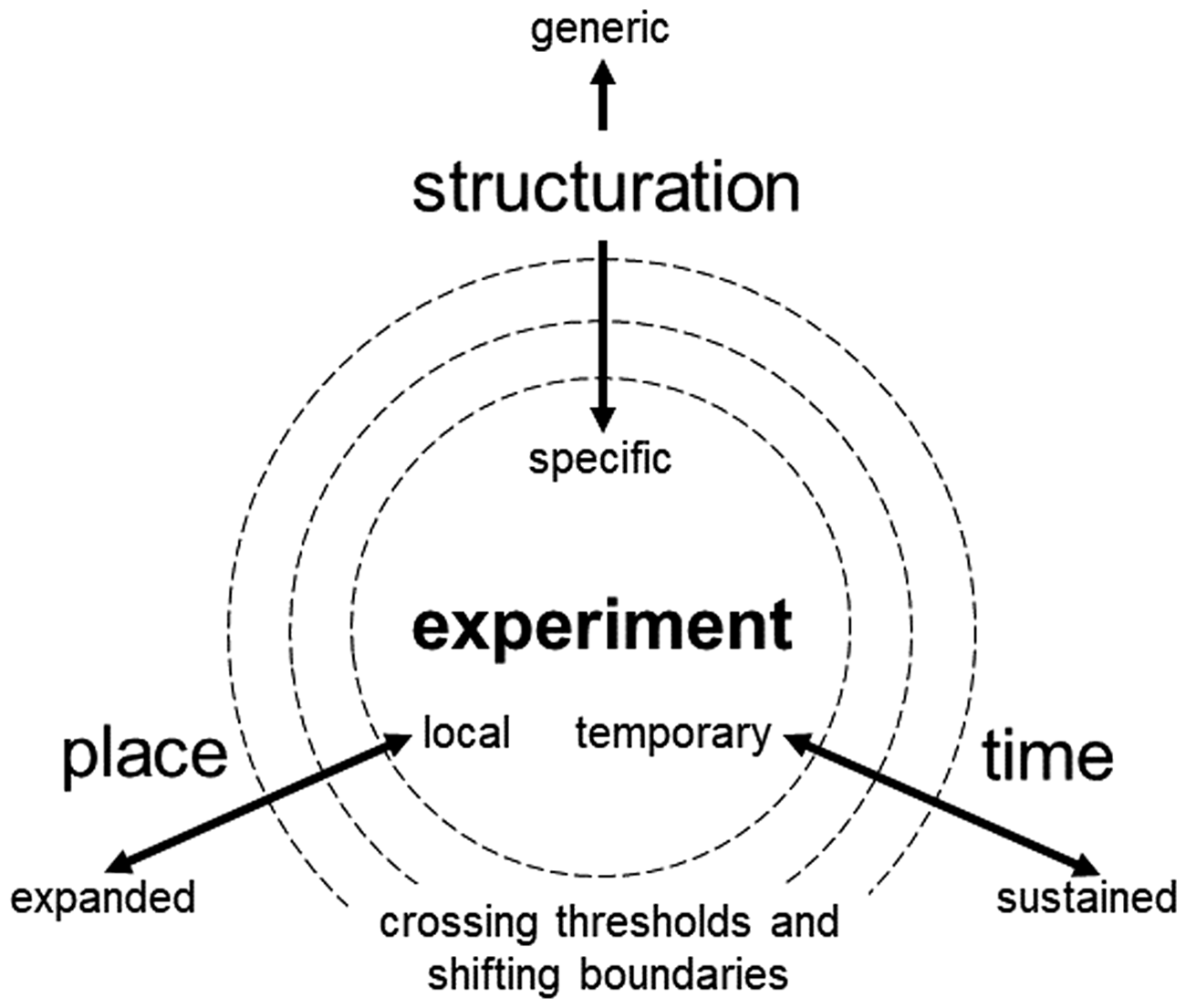
The conceptual territory ‘beyond’ the experiment.
First, the term ‘beyond’ has a temporal meaning so that we are interested in what happens after an experiment. Most socio-technical and governance experiments take the form of time-bound projects, which are abandoned once initial funding ends, political priorities change, or actor networks disperse (Hoogma et al., 2002). Even for successful or long-lived experiments, impacts are hard to trace and attribute. Individual projects tend to make indirect contributions to cumulative processes of socio-technical change. For instance, broader outcomes of climate experiments include the articulation and sharpening of shared visions (about problem-framing and how to address problems), learning and knowledge accumulation (about ways of doing things and demonstrating that they can work), and building networks or alliances of actors around the particular specifications that were developed and tested which can go on to grow stronger and more influential (Schot and Geels, 2008). These processes, where they occur, can contribute to a lasting legacy of individual experiments through practices, knowledge, and networks stabilised in emergent governance or socio-technical regimes.
Second, the term ‘beyond’ has a spatial meaning and we can ask what happens outside the confined socio-spatial context of an experiment – that is, a local initiative can expand its geographical scope (e.g. as it becomes applied at increasingly large scales) or proliferate to new sites of application (e.g. as it becomes replicated or emulated in different socio-spatial localities). For this to happen, the direct policy outputs or indirect governance outcomes have to be replicated, translated and transferred (Dolowitz and Marsh, 2000; Stone, 2012). As experiments proliferate in different places, there emerges a tension between getting a highly situated experiment to work well in its own specific context and in dis-embedding it and rendering it ‘mobile’ to travel to other settings (McCann, 2011). Features are likely to be gained or lost in translation, with positive or negative overall outcomes (Smith, 2007) and the process of reconfiguration may vary a great deal from place to place, given particularities of historical, institutional and cultural settings (Sengers and Raven, 2015).
Third, the term ‘beyond’ has an evaluative or structural connotation, and we can ask how multiple experiments add up to contribute to addressing a particular social challenge, such as mitigation and adaptation of climate change. What is meant here is not only the simple arithmetic of adding up the tons of CO2 reduction to address the global emissions gap (UNEP, 2019), but also the ‘cumulative effect’ of experimentation in another sense, namely how innovations trialled through multiple consecutive experiments – in a socio-spatial patchwork or temporal chain – can acquire momentum, become widely embedded and thereby engender regime changes (Sengers and Raven, 2015; Voß and Simons, 2018) Many climate governance experiments may not contribute directly to decarbonisation but more indirectly to potentially enabling arrangements (e.g. awareness, knowledge, novel governance practices).
The idea of moving beyond an experiment shifts our focus from the immediate local context of an individual project to the broader context through which it can become ‘something more’ in the temporal, spatial and structural sense. The entire array of dynamics associated with moving beyond experiments has sometimes been characterized as a single process of ‘scaling-up’. We believe that conceptualizations of saling-up touch upon important elements but use of this the term also risks conflating a set of distinct mechanisms leading to wider outcomes. 4
In an effort to avoid this conceptual ambiguity and to bring greater analytical precision we choose to use the concept of embedding to characterize the overall process by which outputs of experiments may come to generate wider influence beyond their initial conception and setting. Therefore, implicit to the design of an experiment is the expectation that, either as a whole or in parts, directly or indirectly, the outputs of an experiment will be loosened or extracted (i.e. dis-embedded) from its original experimental context before a process of transfer and re-embedding can take shape. This includes ideas about and preparation for processes of re-embedding.
The notion of embeddedness is a multi-faceted term that has been used in many different ways by historians, sociologists and geographers to conceive of the influence of wider social environments on social action and the reciprocal influence of such action on social environments (see Hess, 2004 for an overview). Karl Polanyi was the first to articulate how economic activity is ‘embedded and enmeshed’ in wider non-economic institutions and society at large (Polanyi, 1944, 1957). Later, Mark Granovetter, in his seminal paper on embeddedness, argued that actors should be seen as intertwined and networked within their social context, stressing that their agency is ‘…embedded in systems of social relations’ (Granovetter, 1985: 481).
These ideas are compatible with innovation studies’ insights about socio-technical experimentation, which emphasize the mutual shaping and adjustment between innovation and its wider social context (Leonard-Barton, 1988; Rip and Kemp, 1998). Geographers have stressed the spatial dynamics of embeddedness, arguing that organizations are not only agents of production, but that they are, in turn, also produced by a “…historical process of embedding, which involves an interaction between the specific cognitive, cultural, social, political and economic characteristics of a firm's 'home territory'” (Dicken and Thrift, 1992: 287). Much of the later work by economic geographers stresses this type of ‘territorial embeddedness’ to explain the evolution and economic success of regions built by locally clustered networks of firms. In a similar vein, recent work on ‘habitats for experimentation’ (Van den Heiligenberg et al., 2017), ‘favourable environments for experimentation’ (Torrens et al., 2019) and ‘place-specific institutional arrangements co-evolving with experiments’ (Raven et al., 2019) also highlight the role of contextual factors that shape experiments and their legacies. Germane notions concerning style variations are found in the literature on Large Technical Systems, pointing to significant ‘creative latitude’ of system builders seeking to fit emerging solutions to particular contexts (Hughes, 1986; Joerges, 1988).
For us the term embedding also connotes a journey – a process of ‘becoming’ and of accumulating changes in relation to cumulatively more ordered and stable socio-technical or governance configurations which experimental outputs come to influence. To the extent that an experiment can be seen as a template (a microcosm or prefiguration of a possible alternative socio-technical or governance configuration), these lessons, examples and capabilities are nurtured and transformed as they become embedded as materialised and durable features of new configurations in settings outside the original experimental milieu. Embedding implies a reciprocal process of new knowledge and capabilities coming to affect the world even as they are themselves transformed.
A central question in the journey of experimental outcomes as they become embedded in socio-technical or governance systems over time is the degree to which they are moved as a whole or as parts. An ideal type of experiment generates a mature, internally consistent and stabilised configuration (that is, the experiment creates a microcosm of an alternative future reality) which is then widely adopted wholesale. This conception resembles the model assumed in classical diffusion theory (Rogers, 1962) in which new products or services are adopted by individual customers and users through processes of demonstration and imitation. The problem with this conception in the case of systemic change is that novel configurations are likely to be radically-different and incompatible with governance and market arrangements, so that they will encounter profound resistance from incumbent actors, as well as market and institutional obstacles (think of renewable energy technologies deployed by neighbourhood collectives in a decentralised fashion vs conventional fossil energy technologies deployed by large utilities operating in regulated national markets). Experiments may, during their existence, exemplify an entirely new possible future, but their specific legacies may come to be embedded in the world in a more partial and evolutionary way as well. This is partly due to the inertia of existing systems, or their ability to absorb change, as well as the fragility of experimental configurations and the challenge of creating entirely new institutional and economic relations and contexts for novel configurations.
In analysing processes of embedding, maintaining a distinction between a governance system and a socio-technical system becomes conceptually difficult, the one being entwined and mutually constructing the other. While at the experimental stage it may be possible to hold the distinction, the multiple and unconfined processes of embedding by which the outcomes and legacies of experiments become imprinted in the world exterior to the experiment will tend to dissolve such a distinction.
Mechanisms of embedding
To capture the complex and differentiated ways in which processes of embedding experimental outputs and outcomes may unfold, we distinguish four embedding mechanisms. We propose that there is not one route by which outputs and outcomes make their journey, but several. The identity of these proposed mechanisms emerged from a collaborative, qualitative assessment of cases found in innovation and governance studies literatures. The general problem was initially formulated as part of an intensive workshop concerned with climate experimentation from a variety of disciplinary backgrounds (governance studies, innovation studies, transitions studies, economic geography, science & technology studies and policy studies), mobilising evidence from over 50 cases in multiple domains (energy, mobility, buildings, water management, agriculture, science) over four continents (Turnheim et al., 2018).This highlighted the variety of embedding mechanisms across different empirical cases.
Here we seek to synthesise these findings by formulating four mechanisms, each briefly illustrated by one empirical example, relying on secondary sources. Given the exploratory nature of our contribution we have selected well-known ‘paradigmatic cases’ that clearly highlight the relevant mechanisms at play (Flyvbjerg, 2006). We have privileged historical cases so as to capture a full sequence of dis-embedding and re-embedding from initial experimentation to wider impact over a longer period.
It should be noted that the proposed mechanisms are not exclusive to each other but may be observable in any given case of embedding of experimental outcomes in cumulatively more ordered governance and socio-technical systems. The mechanisms described here may work simultaneously on different dimensions (the reshaping of rules, incentives, practices, framings or resources) of embedding. Methodologically we found it useful to analytically bracket different mechanisms in observing and analysing change. Even if one of the mechanisms may be dominant in any given case, or at a particular phase of embedding, traces of other mechanisms may also be recognisable. In this way, we suggest a multidimensional, multilateral, recursive and hybrid process of evolutionary change, rather than a unitary and unidimensional process which may be a feature of some readings of scaling-up.
Moreover, the proposed mechanisms are ideal types. They convey the considerable ‘work’ required for individual experiments to become mobile and transposed into more generic features so that they can be replicated or absorbed into new and emergent governance and socio-technical configurations. As we set them out here, each of the four embedding mechanisms is formulated as a ‘couple’ made up of two terms, which can be seen as two sides of the same broader process. Together, these couples enable us to analyse the various ways by which the significant tensions between individual experiments and their becoming instantiated in wider systems are straddled in processes of embedding. We return to these core tensions in section 5.
Mechanism 1: Replication and proliferation – The transmission of exemplars
Some experiments inspire broader adoption by serving as exemplars for actors elsewhere or in different application domains to set up similar experiments.
Whilst the general thinking about the ‘epidemic’ diffusion of innovations is influenced by Rogers’ (1962) landmark contribution, more recently an emphasis on ‘innovation journeys’ has refocussed analytical efforts on the tracing of sequences of events leading up to particular innovations and their uptake in society. This diffusion of initiatives can be traced through genealogies or chains of experiments (see Carvalho and Lazzerini, 2018; Sengers and Raven, 2015; Voß and Simons, 2018). 5 In this perspective an experiment harbours an innovative idea that provides a solution to be emulated. To some extent this is a distinctly local solution that reflects the particularities of its specific context, but it has the potential to spread in space and in application domains by inspiring other actors to set up similar experiments. Most new designs are short-lived (most experiments are not replicated) and they do not always replicate accurately (transfer typically involves some alteration, while a displaced experimental set-up is tailored to institutions and problem orientations in the new context). But if an experiment is successful in becoming widely replicated this tends to be a largely emergent phenomenon with limited possibilities to directly control the ensuing process of proliferation and cascading as more and more experiments spring up in new places and application domains. 6
As an example, consider the early development of emissions trading schemes in the United States in the 1990s. In the late 1970s, Ellison Burton and William Sanjour of the National Air Pollution Control Administration (predecessor of the US Environmental Protection Agency), developing ideas developed by Coase (1960) and other economists, conducted a series of mathematical simulations which were mobilized as a proof of the principle that emission reduction obligations could be traded. At the time it was seen not as “…a generalized and transferable design, but a laboratory creation that was built in a piecemeal fashion … scenarios about its functioning in other governance contexts were diffuse or non-existent” (Voß, 2007: 334). Yet, in the wake of this pioneering simulation experiment, the idea sparked wider interest and more experiments proliferated in the United States through the 1990s: the RECLAIM program in Los Angeles, the Volatile Organic Compounds (VOC) trading scheme in Illinois, and the Nitrogen Oxides (NOx) Budget program in nine North-Eastern US states. Further proliferation occurred when global oil companies started to implement experiments with Greenhouse Gas (GHG) emissions trading schemes by the late 1990s, when European countries started to develop national schemes. This “…accumulation [of] developments at various governance levels created a global hype around emissions trading as the instrument of future environmental policy” (Voß, 2007: 337).
This case illustrates that in replication and proliferation of experiments core ideas are mobilised, transmitted beyond the boundary of an experiment and re-embedded through a politically situated adoption of core ideas in diverse institutional contexts. Governance experiments are set up as crystalized representations of the development of an innovative idea - a ‘cold’ configuration - which evolves and becomes constituted depending on the local setting in consecutive experiments. The ensuing experimental trajectory through which innovation in governance and technology develops has a tendency to cascade out of control, that is, a ‘hot’ configuration. 7 The increasing momentum and knock-on effect might eventually challenge system boundaries and contribute to wider changes in governance systems and socio-technical systems. Public policy instruments frequently draw on exemplars which have emerged from research and practice and come to be reconfigured in new policy settings. While the logic of the adoption of exemplars is typically historically and institutionally circumscribed (as in the idea of ‘policy styles’, see: Howlett, 1991), new policy design would be improved by committed exploration of a wider range of existing and emerging exemplars.
Mechanism 2: Expansion and consolidation – The expansion of actor networks
Whereas the replication & proliferation mechanism involves the multiplication of experiments in different places, the expansion & consolidation mechanism has an internal focus on growing and nurturing experimental outcomes beyond the original initiative to foster broader, larger-scale changes in a system. Expansion is often characterized by conscious strategic effort by actors to extend an experiment in duration or scope (e.g. geography, markets, resources). This involves renegotiating the boundaries around an experiment that affords it protection from antagonistic selection pressures. Once an experiment has stretched its protective space by including new actors or a larger application domain, this newly gained territory needs to be consolidated. There may be limits to this expansion beyond an experiment’s original boundaries. Typically, this would happen by broadening the network of actors participating in an initiative and associated processes of social learning and mutual adjustment. Through this process of ‘deepening’, a growing coalition of actors learns together about negotiating new practices, culture and structure (Van den Bosch and Rotmans, 2008).
The innovation journey of carsharing in Switzerland in the 1990s provides an illustrative case (Truffer, 2003). Carsharing as an organized practice emerged as experiments in Switzerland in the late 1980s. Two neighbourhood-based co-operatives were founded independently in Zurich and Lucerne by about a dozen households in each case. Householder-activists became convinced of the economic and environmental benefits of a mobility system based on the organized shared use of vehicles. Participation in organized car sharing fostered a learning process that led to deep changes in car ownership and mobility practices by individual users and those around them; it fostered new perceptions of costs, convenience and quality of different means of transport and a shift in mobility patterns including the reduced use of cars for shorter journeys. The impact of the cooperatives was not limited to initial users since both co-operatives experienced rapid growth in numbers of members through the 1990s. An original aim of both cooperatives was to encourage adoption by other communities of organised car sharing, with their small initiatives being exemplars. Overcoming fundamental differences in management style, these gains were consolidated when the cooperatives merged in 1997 into a new nation-wide organisation run as a social enterprise which, by 2002, had grown to 52,000 members, 1750 cars operating in 980 locations and 110 staff. This organisation is now recognized as one of the modern pioneers of carsharing (Shaheen et al., 1998), with car-share operators in present in over 3,000 cities worldwide by 2019 (Movmi, 2019).
This illustrates that the character of a social and governance experiment tends to shift as it expands over time, space, mode and application domain. A set of institutional arrangements and practices are mobilised and generalised but may be significantly altered as they expand and are transferred to new sites of application. Even if the core idea is retained, the mode of organisation and the values that underpin it may change as the process of expansion and consolidation unfolds. The main lesson for public and private governance is the importance of flexibility of political, regulatory and institutional support for experiments following an expansion and consolidation trajectory.
Mechanism 3: Challenging and reframing – The generation of social mobilisation
Whereas the two mechanisms above are concerned with the replication or growth of experiments, the primary goal of the challenging & reframing mechanism is to engender transformative changes in existing rules, institutions and governance arrangements by challenging their legitimacy. Experiments oriented towards such goals do not start with a new blueprint for alternative ways of doing things but seek to dispute existing ways of seeing things. They aim to ‘stretch’ the nature and boundaries of experiments in a way that ‘transforms’ existing selection environments (Smith and Raven, 2012). From this perspective an experiment serves as an arena to develop new framings and scripts as articulations of countervailing social or political claims that challenge the status quo represented by existing governance or socio-technical arrangements. Their primary outputs are changed perspective and motivations to act, rather than codified practices that are mobilised and transmitted.
Initially marginalised claims come into the mainstream, becoming widely accessible and legitimised, empowering actors to develop changed rule-sets and scripts, undermining institutional orders and creating spaces for new ways of doing things. Their transformative potential is realised when new rules and routines become embedded in formal-regulative institutions (e.g. new climate regulations and policy processes with formalized authority to monitor and sanction), normative institutions (e.g. shifting norms, values and widely-shared discourses) and cultural-cognitive institutions (e.g. a new mindset through which meaning is given to societal problems like climate change). 8 Through challenging and reframing, experiments are geared towards pushing back the boundaries of what is considered the norm, shifting rules and scripts in the direction of the institutional setup envisioned in the experiments (Raven et al., 2019).
One example is the Climateers Programme by the World Wide Fund for Nature (WWF) in 2007 supported by the international bank, HSBC. The programme was designed to inform secondary school students in Hong Kong about climate change (Bulkeley et al., 2014, 2015). Participants were introduced to local areas of high conservation value and taught how to use a carbon footprint calculator to inform a reconsideration of their own behaviour and lifestyle. This connected climate change to “… everyday life, so that addressing climate change became an ordinary part of mundane activities” (Bulkeley et al., 2015: 188). Through the programme participants were mobilized to consider behavioural changes, normalising individual climate action. The Climateers programme, through its focus on behaviour and through the support of business and civil society organisations generated “… a discourse in which new responsibilities for the governing of climate change are seen to lie outside the state” (Bulkeley et al., 2014: 36).
The Climateer programme was launched during a period of multiple initiatives worldwide, sponsored by Governments, business and civil society, aimed at raising awareness among younger people about climate change. Eventually, these disparate experiments appear to have laid the ground for the #FridaysForFuture climate protests which peaked in March 2019, when more than 1.6 million people participated in climate protests in some 150 countries, led by a new global icon, Greta Thunberg. This marked an historical turn in climate activism, unique in its tactics and organisation, global scope and appeal to teenage school students. The aims of the protests, as articulated by protesters themselves, were ‘to bring pressure on politicians to make things change’ and to ‘raise awareness’ (Wahlström et al., 2019). The experiments grew in scale and impact, but the basic aim – to challenge political leaders through mass social mobilisation – had remained constant. The public policy implications of this mechanism are less self-evident because the transmission of a challenge to established political and policy orders depends more on the motives and organisation of social movements.
Mechanism 4: Circulation and anchoring – Fostering distributed knowledge production
Whereas the challenging & reframing mechanism highlights an organised social and political struggle that confronts a status quo, the circulation & anchoring mechanism is concerned with the transmission of specific policy-relevant knowledge. In common with the challenging & reframing mechanism, circulation & anchoring does not foreground the experiment as such. Instead, it is concerned with the production of knowledge and the shaping of policies and practices. This knowledge is seen as highly ‘mobile’ (McCann, 2011) – both formal knowledge in the form of codified sources (e.g. policy documents or technical manuals that can be widely distributed) and tacit knowledge embodied in people (e.g. skills or know-how that requires regular interaction and trust to become transferrable). The transfer of knowledge may be facilitated by informal activist networks and collective or more formal expert networks (e.g. so-called ‘transfer agents‘or ‘traveling technocrats’ – see Larner and Laurie, 2010; Stone, 2004). As they move, these actors become entangled with place-specific power relationships, institutions and infrastructures (Binz et al., 2014; Carvalho et al., 2012; Sengers and Raven, 2015). Through their analytical, communicative and entrepreneurial work, these actors can have a transformative impact by reconfiguring flows and circulations associated with existing governance arrangements (Castan Broto and Bulkeley, 2018). It should be noted that, apart from fostering the circulation of knowledge, dedicated ‘work’ is needed to extract the relevant knowledge from the particularities of the local context of one experiment and to mobilise it. Once generalised, knowledge needs to be fitted and fixed – or anchored – to a new experimental setting.
An illustrative example is provided by the development of Community Choice Aggregation (CCA) in the United States in recent years (Carvalho and Lazzerini, 2018). CCA is an energy supply model that allows local governments in the US to procure energy on behalf of their community from alternative suppliers whilst still receiving transmission and distribution service from their existing utility provider. This provides leverage for communities giving them more local control over electricity supply, often linked to demands for more green power than the standard offer by the utility (EPA, 2019). The first CCA initiatives were implemented in few small municipalities in Massachusetts and Ohio the late 1990s and emerged from cooperation between local energy activists and public administrators. In the early 2000 these ideas travelled to California, where they initially circulated amongst regulators as a way to foster flexibility and competition in the selection of electricity providers. The circulation of CCA was amplified and altered by politicians and activists, who changed its character by imbuing it with environmental objectives and by linking it to other climate experiments by the state government. These ideas became anchored successfully in Marin County, which started California’s first CAA program in 2010. A range of locally-specific socio-spatial features explain why this experimental program succeeded in Marin County: it is a collection of small municipalities with stable energy markets and a rather homogeneous population characterized as ‘wealthy, liberal and green’, as well as a strong tradition in environmental grassroots movements for renewable energy generation and landscape preservation. Advocates and intermediaries in national environmental and green energy civil society organisations mobilized these experiences to move the ideas and practices from California across the US (Carvalho and Lazzerini, 2018). One lesson for public policy is that some governance experiments are less specific in the focus of the core idea, lack the capacity for expansion and do not seed widespread social mobilisation. Their complexity may require greater investment in further research and demonstration, and in the building of knowledge infrastructures, trainings and communications strategies for them to grow beyond their original experimental boundaries.
To summarize: to have an influence beyond the boundary of an experiment, experimental outcomes typically undergo a process of dis-embedding, modification and re-embedding in new contexts. If we see the destination of the outcomes of experiments (knowledge, practices, networks, norms, social relations, social movements, agents of change) as their embeddedness in the world exterior to the original experiment, then we argue that this is achieved through a specific set of processes of embedding into that world.
We propose that for experimental outcomes to be transmitted and embedded, they need to overcome and transgress their own boundaries (‘beyond’). Embedding beyond the experiment requires 1) for specific outputs to become mobile (these may be core ideas, actor networks, social mobilisation or knowledge production), and 2) something to become generic (so that it can be applicable beyond the original particular context). Mobilisation and generalisation are intertwined and can be seen as a dual movement, since generalisation requires mobile forms and mobility requires transferable generic forms. Table 1 below summarizes the four mechanisms in relation to these processes of generalisation and mobility.
The four embedding mechanisms in relation to mobility and generalisation.
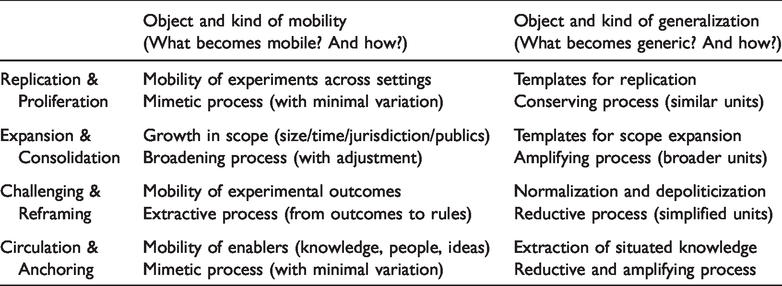
Mobility, generalisation and embedding of experimental outcomes
We have argued that experimental outcomes move beyond the boundaries of an experiment by becoming generalisable and mobile and by coming to be embedded in other contexts, always involving some process of reconfiguration of the new context, as well as the experimental outcome. We have also shown how the transmission of experimental outcomes can follow a variety of paths which we have expressed as embedding mechanisms. In addition, we would argue that the four mechanisms are not mutually exclusive. This illustrates a wider point related to embedding mechanisms, namely that they do not simply embody different inner workings but rather embody a particular perspective or organising principle that brings into focus an (radically) alternative view of reality and a set of focal points for achieving a new way of doing things. In practice, the four mechanisms are likely to be activated in parallel or in sequence. Indeed, the empirical examples discussed here illustrate potential overlaps between mechanisms. For instance, the first example of the innovation journey of emissions trading also reveals aspects of actor network growth and the circulation of new policy-relevant knowledge.
Most experiments will fail to have a distinct impact on the world, although there are many ways in which experimental outcomes may have indirect and intangible influences on knowledge, perspectives, actor networks and social attitudes. In explaining how experiments do have an impact, it is also worth remembering why experiments fail. Looking at four embedding mechanisms together, we identify several points of tension that the sequence of steps from mobilisation, generalisation and embedding has to overcome. These are (1) the scale of (re)structuration implied by the experiment, (2) the degrees of actor coordination required, and (3) the resilience of the prevailing governance or socio-technical order which is challenged by experimental outcomes. Broadly, the likelihood that an experiment comes to have wider impact will increase the less extensive the restructuring of norms, rules, practices and networks implied, the less coordination of actors needed, and the more weakened or vulnerable an incumbent governance or socio-technical system is.
First, there is an inherent tension between the level at which experiments are carried out and what lies beyond (which may variably involve a stabilised socio-technical form, governance arrangement, or community of practice). These can be seen as two distinct structuration levels, each constrained and enabled by particular rule-sets and populated by dedicated actors with specific motives and interests. Experiments and initiatives are carried out by local actors, oriented by locally formulated objectives (e.g. developing local decarbonisation solutions or trialling out tailored governance solutions), governed by place-specific rules and rule-exemptions, and the object of self-referential constraints (including the more permissive environment that an experimental setting may afford, e.g. regulatory loopholes, political backing, dedicated budget, or community involvement). By contrast, the embedding of experimental outcomes in wider structures and orders involves different kinds of actor coalitions (i.e. operating at network or system level), broader objectives (e.g. developing transferrable solutions and templates for transformative change, enabling linkages with existing structures), and rules and constraints oriented towards the development of generic enough kinds of prescriptions and solutions so that they can become mobile, generalised, and eventually applied elsewhere or at different scales. Accordingly, while these levels correspond to distinct units of analysis, we have proposed that in problematising the embedding of experiments as process, interlinkages and interdependencies between these two levels need to be addressed and foregrounded. This has three main implications: a) experiments need to be designed and implemented in ways that anticipate their embedding in wider structures, b) specific attention is needed for the development of dedicated pathways of embedding and supporting intermediation infrastructures (knowledge, networks, visions), and c) since there are likely to be limits to the transferability of governance innovations, fruitful interactions between experiment- and system-level involve two-way processes (from the particular to the generic and vis-versa) and multiple iterations.
The four proposed mechanisms handle this tension in different ways, by foregrounding a specific unit of analysis and embedding logic. The replication-proliferation and expansion-consolidation mechanisms foreground the experiment as unit of analysis and are geared primarily towards extending experiments and their logic (e.g. to different sites or at different scales). The challenging-reframing and circulation-anchoring mechanisms, on the other hand, are more focussed on residuals, enablers or generic outcomes of experiments (independent to their site-specificity), and hence concern processes and flows external to experimental settings.
Second, there is a tension corresponding to the degree of coordination that embedding mechanisms may be amenable to, which has implications concerning the extent and type of steering they might involve or require, and the possibility of control over embedding processes that may be possible. While experimentalist governance is by definition more emergent and polycentric than more traditional forms of governance, it is possible to distinguish different scope for coordination among embedding mechanisms, varying between deliberate or more emergent forms. On the one hand, challenging-reframing and expansion-consolidation mechanisms, because they point to rather clear end-goals and directional and integrative processes, provide significant scope for deliberate coordination. On the other hand, replication-proliferation and circulation-anchoring may be more unruly processes, due to their more diffuse directionality and their reliance on self-organising processes, are likely to be less coordinated and/or amenable only to emergent forms of coordination. There are implications concerning the possibilities for instrumentalising experimentalist governance, notably by those actors that initiate experiments or are centrally involved in them.
Third, there is a tension related to the political ordering inherent in experiments, which by introducing changes to socio-material worlds and casting boundaries around the objects of transformation can produce entirely novel forms of action, collectives, and decision-making, or on the contrary reproduce established forms, actors and procedures. Furthermore, since processes of embedding imply a transgressing of boundaries and ordering produced in individual experiments, political re-ordering is likely to occur over time. Kern (2011) provides a useful way to problematise political tensions arising in change processes, by distinguishing the influence of ideas, interests and institutions. Experiments that have emerged within a particular set of ideas and motivations, like the early generations of organic farming oriented towards addressing multiple issues (e.g. holistic ecological objectives, social fairness, small-scale farming, rural revitalisation), may significantly change in meaning as they become embedded through expansion-consolidation and challenging-reframing processes. The development of organic farming beyond early experimentation went hand in hand with the watering-down of certification criteria, the involvement of powerful distributors, intensification and export-orientation of production, largely driven by the prevalence of market-oriented logics and institutions, and have produced disillusionment about the actual social-ecological benefits of current systems, triggering in a new generation of experimental search processes (von Oelreich and Milestad, 2017). The co-optation of experiments and reframing of their initial formulation as they become embedded may not be inevitable, and requires vigilance concerning the motives of actors involved in processes of embedding.
This paper has aimed to clarify what lies ‘beyond’ experimentation, but this co-optation of experiments raises another important question: what lies ‘behind’ experimentation. Whereas the beyond question is one of processes and mechanisms and the ‘how’ of evolution through time, the behind question is one of motivations and rationales and the ‘why’ of engaging in experimentation in the first place. If the beyond question is about looking under the hood, so the speak, the behind question is about piercing the facade. Whilst it is difficult to interrogate motivations directly, it is possible to inquire what experiments allow certain actors to do when they formulate their actions as being experimental. Besides the rationale of engaging in an open trial of what works and seeking wider impacts, it is to be expected that there are other motivations at play as well. This includes motivations related to delaying or undermining the wider uptake of an experimental configuration.
Conclusion
Since the 2015 Paris Agreement, international climate policy has been transformed from a legal regime with binding commitments on states and towards a catalytic framework to encourage and enable transformative pathways to decarbonization. As a result, attention has turned towards the multitude of innovative ventures across global societies – often experimental in nature - which offer ways of achieving the radical changes envisaged. We have argued that the current understanding of how climate governance experiments come to project wider impacts, leading to transformative change, is underdeveloped.
We suggest the overarching notion of ‘embedding’ as a way of capturing the complex, multifaceted, hybrid and dynamic processes by which the outputs and outcomes of experiments come to have impacts, and describe and illustrate four mechanisms of embedding appropriate to different contexts. We view these processes as themselves unfolding in complementary ways across the different facets of transformation processes of intertwined socio-technical and governance systems. In this sense we avoid the assumption of a unitary and singular process of change as experimental outputs and outcomes move beyond their original boundaries, in both intended and unintended ways.
The growing research and policy interest in experimentation in the search for solutions and responses to climate problems deserves critical assessment. We have sought to make a contribution by distinguishing a conceptual framework, proposing and illustrating mechanisms and pointing to generic contextual factors that may inhibit the transmission of experimental outputs and outcomes. If the overarching international policy framework is now founded on an entrepreneurial, polycentric and mainly bottom-up generation of new approaches and their broader adoption, then the stimulation of governance and socio-technical experiments is critical, as is the creation of conditions whereby their outputs and outcomes can complete their journeys in enabling change. Whilst we have not looked in detail at the implications for policy, our analysis is suggestive. The importance of the mobilisation of outcomes suggests the value for experimental ‘extension services’ that would provide advice, support and communication as a wrap-around for climate governance experiments. Likewise, the need for generalisation suggests that knowledge infrastructures will be important, including assessment and demonstrator capabilities which seek to support the ‘fitting’ of experimental outcomes to different contexts. Finally, given the centrality of social activists and business and policy entrepreneurs to the process of embedding, public and private support for inclusive intermediation between actors within experiments and those beyond seems vital. Given the transnational nature of governance experiments and their intended impacts, these instruments and facilities also need to be international in scale and scope. Much international climate assistance and finance is aimed at fostering innovative projects which are time-bound and specific. Serious consideration now needs to be given to the design of international policy support that enables the long-term and broader-scale impacts of these many well-considered, but ultimately limited initiatives.
Footnotes
Acknowledgements
We gratefully acknowledge the financial support from INOGOV (COST funded Action No. IS1309) and the Programme d’Investissements d’Avenir of the French National Research Agency (ANR-19-MPGA-0010). We are also grateful to the anonymous reviewers for their insightful comments that helped us improve this paper.
Declaration of conflicting interests
The author(s) declared no potential conflicts of interest with respect to the research, authorship, and/or publication of this article.
Funding
The author(s) disclosed receipt of the following financial support for the research, authorship, and/or publication of this article: This study was supported by INOGOV (COST funded Action No. IS1309) and the Programme d’Investissements d’Avenir of the French National Research Agency (ANR-19-MPGA-0010).
